

What if the most effective way to save your business £5,000 this year wasn’t a new sales strategy, but a simple shift in your it maintenance routine? According to the UK Government’s 2024 Cyber Security Breaches Survey, 50% of businesses experienced a breach in the last year, often due to preventable gaps. We know the frustration when a sudden system crash halts your team’s productivity or when unpatched software makes you feel like an easy target. It’s time to stop waiting for things to break before you fix them.
As your award-winning North East partners, we’ll show you how to transition from stressful repairs to a proactive strategy that secures your data and eliminates costly downtime. This guide provides a clear, actionable checklist for 2026 to ensure you enjoy an always-on IT environment and the peace of mind that your backups are handled. We’ll explore how regular health checks and strategic updates can transform your technology into a reliable foundation for your business growth.
Key Takeaways
- Move away from the expensive “break-fix” model by adopting a proactive strategy that eliminates downtime before it starts.
- Master a comprehensive it maintenance checklist for 2026, featuring the daily and weekly checks essential for UK business continuity.
- Calculate the true cost of technical failure to your bottom line and discover how to protect your productivity from unexpected disruptions.
- Build a resilient framework that seamlessly integrates on-premise hardware with modern cloud solutions for total flexibility.
- Find out how an award-winning partnership provides the expert “can-do” attitude and peace of mind your business needs to grow.
What is IT Maintenance and Why is it the Heartbeat of Your Business?
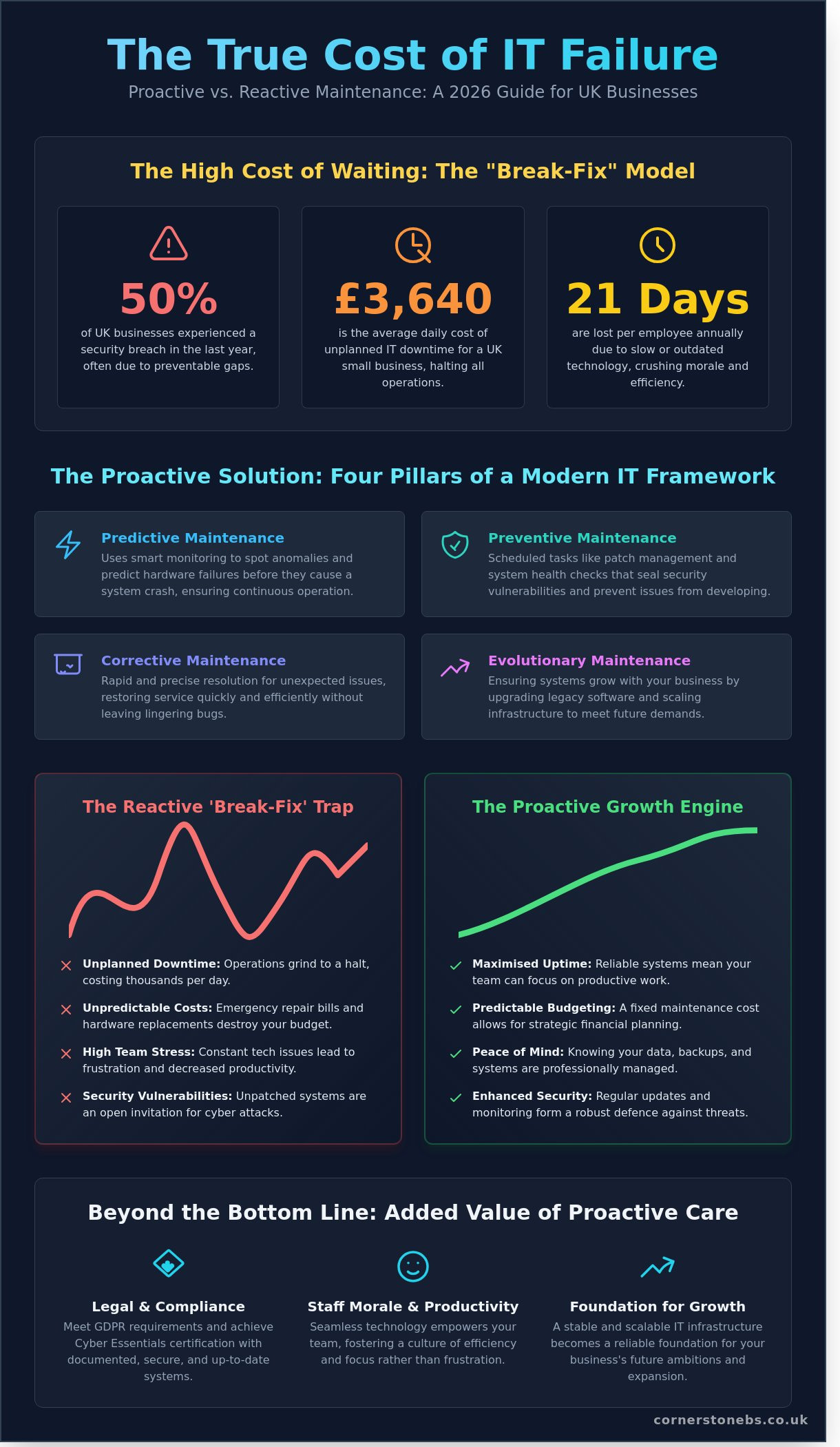
Effective it maintenance is the proactive management of your hardware, software, and network infrastructure. It ensures your systems remain reliable, secure, and ready for growth. Many businesses still rely on a reactive “break-fix” model. This approach is the most expensive way to operate. Waiting for a server to fail or a laptop to crash leads to unplanned downtime that halts your operations. Data from 2024 shows that unplanned downtime costs UK small businesses an average of £3,640 per day. Proactive care prevents these sudden spikes in expenditure and protects your bottom line.
Staff morale and productivity are directly linked to the health of your tech. A 2023 study revealed that UK workers lose approximately 21 days a year due to slow or outdated technology. When your systems work seamlessly, your team stays focused. This creates a culture of efficiency rather than frustration. Maintenance also serves as your first line of defence. In 2025, 52% of UK businesses reported a cyber attack. Regular it maintenance ensures your software is patched and your hardware is robust enough to withstand modern threats.
The Core Components of a Maintenance Strategy
Our award-winning approach focuses on three vital areas to keep your business online. Hardware health involves checking that servers, workstations, and peripherals are physically sound. Software integrity is about managing your licenses and version control. To understand the depth of this, we look at the four types of software maintenance which include preventive and adaptive measures. Finally, network stability involves monitoring the “pipes” that connect your North East business to the global market, ensuring zero bottlenecks. For retail firms, this connectivity is best paired with specialized e-commerce optimization from experts like Frooition to ensure your storefront is as robust as your network.
The Compliance and Legal Angle
Regular maintenance is a legal necessity for UK firms. It helps you meet GDPR requirements by ensuring data is stored on secure, updated systems. It is also a prerequisite for achieving Cyber Essentials certification; this is now mandatory for many government contracts. Insurance providers often demand proof of proactive care before paying out on a claim. Our team provides the documentation you need to satisfy these auditors and secure your peace of mind. We act as your long-term partner to ensure your business remains compliant and fully protected.
The Four Pillars of a Modern IT Maintenance Framework
Building a resilient business in the North East requires more than just reactive fixes. It demands a structured framework that leaves no stone unturned. By 2026, a “set and forget” mentality is a recipe for disaster. Effective it maintenance now relies on a hybrid model, balancing on-site hardware with cloud-based assets. This dual focus ensures your data stays secure and your team remains productive, regardless of where they log in. According to the Cloud Industry Forum, 85% of UK organisations have already adopted a hybrid strategy to gain this flexibility.
A comprehensive approach covers every possible failure point, from the physical server in your office to the virtual machines in the cloud. Every maintenance action must be documented to create a clear audit trail. These records aren’t just for compliance; they’re a vital roadmap for future efficiency. This transparency is a core part of the “peace of mind” our award-winning team provides to every partner. When these pillars align, technology feels invisible, allowing you to focus on growth rather than gremlins.
Predictive and Preventive: The Proactive Duo
Predictive maintenance uses smart monitoring tools to spot a failing hard drive or a struggling power supply before a crash occurs. We track performance metrics in real-time to identify anomalies that signal trouble. Preventive maintenance is the digital equivalent of a regular car service to prevent breakdown. This involves scheduled tasks like enterprise patch management, which seals security vulnerabilities before they can be exploited. Research from the 2023 Beaming Report shows that downtime costs UK SMEs an average of £3.6 million annually, making these proactive steps a vital investment in your bottom line.
Corrective and Evolutionary: Responding and Growing
Even the most robust plans face the occasional surprise. Corrective maintenance is about speed and precision when fixing issues that slip through the cracks. We aim for a rapid resolution that restores service without leaving lingering bugs. However, fixing today’s problems isn’t enough. Evolutionary maintenance ensures your systems grow alongside your business ambitions. This means upgrading legacy software and scaling infrastructure to support your 2026 goals. We balance these two needs by keeping your current systems stable while planning for the next technological leap. If you’re wondering if your current setup can handle your future plans, we’re always available to have a friendly chat about your infrastructure.
The Ultimate Business IT Maintenance Checklist for 2026
Effective it maintenance transforms your technology from a potential liability into a reliable engine for growth. Our award-winning team at Cornerstone knows that a proactive approach provides the peace of mind you need to focus on your North East business. We recommend a tiered strategy that catches small glitches before they escalate into costly downtime.
Daily and Weekly: The Essential Pulse
Your morning should start with a clear view of your system’s health. We suggest a 15-minute “morning pulse” check to ensure the day begins smoothly for every staff member. Recent data from the 2024 Cyber Security Breaches Survey indicates that 32% of UK businesses suffer a breach annually; daily vigilance is your first line of defence.
- Verify backup success: Check that your overnight backups completed 100%. Investigate any partial failures or “successful with warnings” alerts before 9:00 AM.
- Monitor server resources: Review CPU and RAM usage logs. If your servers consistently hit 85% capacity during peak hours, you have a performance bottleneck that needs addressing.
- Scan endpoint security: Review alerts for malware or unauthorised access attempts. Catching a single suspicious login on a Tuesday prevents a full-scale ransomware event by Friday.
Monthly and Quarterly: Strategic Oversight
Monthly maintenance moves away from daily monitoring and focuses on system integrity. This is where we look at the bigger picture to ensure your infrastructure remains robust. Patching is a non-negotiable part of this process. By following the NIST Guide to Enterprise Patch Management, your organisation can systematically address vulnerabilities in operating systems and third-party applications. This reduces the risk of exploitation by 60% compared to reactive patching cycles.
Quarterly checks involve deeper audits of your digital and physical assets. We recommend a “least privilege” review of user permissions. You should remove access for any leavers and ensure “admin” rights are restricted to only those who absolutely require them. This simple step significantly narrows your internal attack surface.
This principle of auditing physical assets extends beyond just servers and workstations. Just as you’d check your IT for vulnerabilities, ensuring your building’s structural integrity is key to preventing business disruption. Services that provide digital assessments, such as 1ESX Roof & Wall Reports, apply this same proactive mindset to your property, helping you identify potential issues before they cause costly damage.
This proactive mindset extends to the physical appearance of your business premises. Just as you maintain your digital infrastructure, regular professional renovation and painting prevents long-term decay and maintains a standard of excellence. For an example of high-quality commercial projects that can serve as inspiration, firms like NovoTech demonstrate the powerful impact of premier finishing on a business’s image.
Your it maintenance schedule must also include regular testing of your Disaster Recovery plan. A backup is only a theoretical safety net until you prove the data can be restored within your required timeframe. Finally, conduct a physical hardware audit every three months. Identify workstations or servers nearing their four-year end-of-life date. Replacing these proactively prevents the £1,200 average emergency cost associated with sudden hardware failure and lost productivity. We believe in being your long-term partner, helping you plan these upgrades so they never come as a surprise to your budget.
Proactive vs Reactive: Calculating the True Cost of IT Failure
Waiting for technology to break before fixing it is a strategy that rarely pays off for North East businesses. The visible repair bill is often the smallest part of the problem. When your systems fail, the clock starts ticking on a series of hidden expenses that drain your bottom line. If 20 staff members are unable to work for 4 hours, and you factor in an average UK hourly wage of £18, you’ve lost £1,440 in pure labour costs alone. That doesn’t include the lost revenue those employees would have generated or the overheads spent on an idle office.
Reputational damage is even harder to recover from. In a 2024 industry survey, 60% of customers stated they would switch to a competitor after just one instance of a business being unable to process an order due to “system issues.” Consistent it maintenance prevents these awkward conversations and keeps your brand’s promise intact. Beyond daily operations, a proactive approach significantly lowers your capital expenditure. By keeping fans clean, updating firmware, and managing thermal loads, we typically extend the functional life of a server from three years to five. This delay in hardware replacement keeps thousands of pounds in your bank account rather than tied up in new kit. A solid foundation of it infrastructure support is what makes this level of proactive care possible, ensuring your hardware and network remain stable enough to support long-term planning.
The ROI of Managed IT Maintenance
Emergency call-outs are expensive and unpredictable. You’ll often face premium hourly rates and long wait times while your business sits in limbo. Comparing this to a fixed-fee plan reveals a clear winner for your budget. Our award-winning team provides cost certainty, allowing directors to make bold decisions without worrying about a surprise four-figure repair bill. For most SMEs, a single major outage costs more than an entire year of proactive maintenance. This “Peace of Mind” is the foundation of a successful partnership.
Transitioning to a Managed Service Model
Modern business demands 24/7 vigilance that a small internal team simply cannot provide without burning out. By using Remote Monitoring and Management (RMM) tools, we spot a failing hard drive or a security breach long before your staff notice a glitch. Our Managed IT Services offer a depth of expertise that covers everything from cloud architecture to cybersecurity. When evaluating a partner, look for proven response times and a local presence. We pride ourselves on being a North East expert that understands the regional market. We don’t just fix PCs; we protect your future growth.
Ready to swap tech headaches for total reliability? Get in touch for a friendly chat about how our award-winning team can support your business.
Partnering for Peace of Mind: The Cornerstone Approach
Effective it maintenance shouldn’t be a reactive scramble when things go wrong. At Cornerstone Business Solutions, we’ve built our reputation on a “can-do” attitude that focuses on prevention rather than cure. We don’t just fix servers; we ensure your business remains operational 24/7. Our award-winning team operates as a direct extension of your own staff, bringing North East warmth and professional authority to every interaction. We’ve spent over 15 years refining a proactive model where we identify and resolve technical glitches before they ever reach your screen. It’s about staying one step ahead.
Every business infrastructure is unique. A law firm in Leeds has different requirements than a manufacturing plant in Teesside. That’s why we ditch the one-size-fits-all approach. We create bespoke maintenance plans aligned with your specific 2026 growth targets. Whether you’re managing a hybrid workforce or scaling your cloud operations, our strategy ensures your technology accelerates your progress instead of acting as a bottleneck. We take the time to understand your goals, ensuring our support evolves as you do. Underpinning every bespoke plan is a robust layer of it infrastructure support that keeps your servers, networks, and endpoints performing at their best as your ambitions grow.
Why Award-Winning Support Matters
Our status as an award-winning IT partner isn’t just for show. It represents a verified standard of excellence that benefits your bottom line. We maintain high-level partnerships with global technology leaders, including Microsoft, IBM, and Cisco. These relationships give us direct access to the latest security patches and hardware innovations before they hit the general market. You benefit from enterprise-grade expertise delivered with clear, jargon-free communication. While our roots are firmly in the North East, our national reach means your satellite offices receive the same elite support, ensuring consistency across your entire organisation.
Taking the First Step Towards Reliable IT
Reliability starts with a simple conversation. We invite you to have a chat with us about your current technology frustrations and where you want your business to be in the next twelve months. Our process is transparent and thorough. We begin with a comprehensive IT audit that examines your existing hardware, software, and security protocols. From there, we provide a detailed it maintenance proposal tailored to your budget and operational needs. We’ll show you exactly how to eliminate downtime and protect your data.
Ready to transform your technology from a headache into a high-performance asset? Book your free IT health check with our award-winning team today.
Future-Proof Your Infrastructure Today
Effective IT maintenance isn’t just a technical chore; it’s the heartbeat of your business continuity. By adopting a proactive 2026 framework, you’re shielding your operations from the escalating costs of system failure. IBM’s 2023 Cost of a Data Breach Report found that UK organisations face average breach costs of £3.4 million, a figure that underscores the value of constant vigilance. Our multi-award-winning team brings professional authority and North East warmth to every partnership, ensuring your technology works as hard as you do. We leverage elite partnerships with Microsoft, Cisco, and IBM to deliver proactive 24/7 system monitoring that catches issues before they disrupt your day. This proactive stance provides the peace of mind you need to focus on scaling your business. You deserve a partner who simplifies complex tech and treats your success as their own. We’re ready to help you build a robust, seamless foundation for the years ahead.
Take the first step toward a more reliable future and get a bespoke IT maintenance plan from Cornerstone Business Solutions. Let’s have a chat about keeping your business moving forward.
Frequently Asked Questions
What is included in a basic IT maintenance plan?
A standard IT maintenance plan covers essential proactive tasks like security patch management, data backup verification, and hardware health checks. Our award-winning approach focuses on monitoring your systems 24/7 to catch glitches before they cause downtime. Your plan should also include antivirus updates and clearing out temporary files to keep your workstation performance at peak levels.
How often should a business perform IT maintenance?
You should perform critical tasks like data backups daily, while security patches and software updates usually require a weekly schedule. We recommend a comprehensive system audit every 90 days to ensure your infrastructure remains robust and secure. Regular checks prevent the small technical hitches that often lead to major business disruptions and lost revenue.
Can I do my own IT maintenance or should I outsource it?
You can handle basic updates in-house, but outsourcing your IT maintenance to a local expert provides 24/7 monitoring and specialist knowledge. Most UK SMEs find that managing their own technology takes away 15 hours of productive time every month. Partnering with an award-winning team ensures your staff stay focused on growth while we handle the technical heavy lifting.
The same logic applies to core business management software, where specialized platforms can handle complex industry-specific requirements far more efficiently than generic tools. For example, disability service providers often use dedicated software like dock’d to streamline NDIS compliance and administration, freeing them up to focus on client care.
This principle of strategic outsourcing extends to physical assets, too. Rather than purchasing expensive equipment for one-off projects, many businesses now use rental marketplaces to save on costs. For a wide range of daily items, platforms like Life4Rent offer a flexible way to access what you need without the long-term investment.
This commitment to top-tier infrastructure extends to the physical spaces where global businesses meet. For those seeking a sustainable and technologically advanced venue for international conferences, the BDMS Connect Center provides a world-class environment that complements a robust digital strategy.
Just as a digital strategy relies on robust code, a physical workspace relies on high-quality materials and craftsmanship. For businesses looking to incorporate unique, durable timber elements into their design, you can discover Bourbon Bigfoot Woodworking and their expert approach to custom sawmilling and kiln drying.
How much does professional IT maintenance cost for a UK SME?
Professional it maintenance typically costs between £30 and £100 per user per month for UK businesses, depending on your setup’s complexity. Investing in a proactive plan is a smart financial move for any North East firm. The UK Government’s 2023 Cyber Security Breaches Survey found that the average cost of a cyber attack for a medium-sized firm is £4,960, making maintenance a cost-effective insurance policy.
What is the difference between IT support and IT maintenance?
IT maintenance is the proactive work we do to prevent problems, while IT support is the reactive assistance you need when something actually breaks. Think of maintenance as the regular MOT and servicing for your business technology. Support is the reliable roadside assistance that gets you moving again if you hit an unexpected bump in the road.
Why is patch management so important for cyber security?
Patch management is vital because it closes security loopholes that hackers use to access your sensitive data. A 2023 report by the Ponemon Institute suggests that 60% of data breaches involve vulnerabilities for which a patch was available but not applied. We automate this process to ensure your business stays protected against the latest digital threats without you lifting a finger.
What happens if we neglect our IT maintenance?
Neglecting your systems leads to increased downtime, higher repair costs, and significant security vulnerabilities. Research indicates that unplanned downtime can cost UK small businesses up to £800 per hour in lost productivity. Without regular care, your hardware life expectancy drops by 30%, forcing your business into expensive and premature replacement cycles that could have been avoided.
How does cloud computing change the way we do IT maintenance?
Cloud computing shifts the focus of maintenance from physical server hardware to identity management, data synchronisation, and cloud security configurations. While you no longer need to dust off local servers, you must regularly audit user permissions and storage limits. Our team ensures your cloud environment stays optimised, so you only pay for the resources your business actually uses.
Tags: it maintenance