Posted on: September 8th, 2026 by Cornerstone
With UK small businesses losing up to £427 per minute during IT downtime, a single afternoon of technical failure could be enough to close your doors for good. It’s a sobering reality, especially when 70% of UK consumers now say they won’t wait more than 24 hours for a business to recover. You likely already feel that a disaster recovery plan for small business uk operations is vital. However, the complex jargon like RTO and RPO often makes the process feel like it’s reserved for enterprise giants with bottomless budgets.
We believe that every local business deserves the same level of security as a multinational corporation. This guide will show you how to build a robust, cost-effective disaster recovery plan tailored for the 2026 landscape. We’ll help you define your survival minimum to stay compliant with the Data (Use and Access) Act 2025 while ensuring your systems stay resilient against modern threats. You’ll get a clear checklist of essential components designed to turn technical confusion into total peace of mind and long-term stability.
Key Takeaways
- Define your “survival minimum” to protect your organisation against 2026’s sophisticated ransomware and supply chain threats.
- Master the modern 3-2-1 backup rule using cloud solutions like Microsoft 365 to keep your critical data accessible and secure.
- Learn how to conduct a Business Impact Analysis to prioritise your assets and ensure your most vital operations recover first.
- Discover why regular testing, from tabletop exercises to full simulations, is the only way to turn a “document of hope” into a reliable safety net.
- Understand how proactive monitoring and managed support help you build a disaster recovery plan for small business uk firms that stops crises before they start.
Understanding Disaster Recovery: Why UK Small Businesses Need a Plan in 2026
At its core, a Disaster Recovery Plan is your organisation’s roadmap for regaining access to vital IT infrastructure after a crisis. It isn’t just about simple backups; it’s about the speed and precision of your response. In 2026, the landscape has shifted significantly. Ransomware has become more sophisticated, and supply chain vulnerabilities mean a failure at one of your vendors can take your own systems offline in an instant. While business continuity covers your entire operation, a disaster recovery plan for small business uk success focuses specifically on the digital heartbeat of your company.
We often see business owners confuse these two concepts. Business continuity is the broad strategy that keeps the lights on, while disaster recovery is the technical mechanism that restores your data and applications. Without a clear DR strategy, your business continuity efforts are likely to stall when they hit a technical wall. The 2025/2026 Cyber Security Breaches Survey shows that 43% of businesses experienced a breach last year, making this technical resilience a foundational element of your emotional and financial security.
The Real Cost of Downtime for UK SMEs
Every second your systems are down, your bottom line takes a hit. Research from Red Eagle Tech suggests the average cost of IT downtime for a UK small business ranges between £137 and £427 per minute. We define downtime as any period where your team cannot perform their primary digital duties due to system failure. Small businesses are frequently targeted because attackers assume their defences are weaker than those of enterprise giants. You aren’t just losing revenue during these outages; you’re losing the hard-earned trust of your local clients. To calculate your specific risk, you must combine staff wages, lost sales opportunities, and the potential cost of regulatory fines.
Regulatory and Insurance Requirements
The legal stakes have never been higher for UK firms. Following the Data (Use and Access) Act 2025, individuals now have a statutory right to lodge data protection complaints directly with your organisation. A robust disaster recovery plan for small business uk operations demonstrates the “technical and organisational measures” required by UK GDPR to protect this data. Most cyber insurance providers in 2026 now refuse to offer coverage unless you can prove you have a tested recovery strategy in place. This is where professional cyber security services become essential. They act as your first line of defence, ensuring your plan meets the strict standards of schemes like Cyber Essentials. Partnering with experts for managed IT services ensures these compliance boxes are ticked before a crisis occurs, providing you with a proactive shield against modern threats.
Key Components of a Robust Small Business Disaster Recovery Strategy
Many business guides treat backup and recovery as the same thing. They aren’t. A backup is merely a copy of your files; a disaster recovery plan for small business uk success is the engine that puts those files back to work. To build a resilient strategy, you must first identify your critical assets. This includes your data, the applications your team uses daily, and the hardware required to run them. Without knowing what is essential, you risk wasting time protecting the wrong things while your core operations remain vulnerable.
We advocate for the modern 3-2-1 backup rule. This means keeping three copies of your data on two different types of media, with at least one copy stored off-site. In 2026, this off-site copy should always live in a secure cloud environment. Off-site storage is your only real protection against physical site disasters like fires or floods. Even for tiny teams, you need a designated Disaster Recovery Team. This doesn’t require a dozen people; it just means assigning specific roles so everyone knows exactly who does what when a crisis hits. This clarity is a vital part of your broader business continuity plan.
Defining RTO and RPO: Your Recovery Yardsticks
You can’t manage what you don’t measure. Recovery Time Objective (RTO) is your “downtime clock.” It defines the maximum amount of time your business can afford to be offline before the damage becomes critical. Recovery Point Objective (RPO) is your “data diary.” It measures how much data you can afford to lose, effectively dictating how often you need to run backups. For example, your team might tolerate a two-hour RTO for email services, but a transactional database processing customer orders might require an RPO of just fifteen minutes to avoid massive financial loss.
Cloud-First Recovery and Virtualisation
Modern cloud solutions have revolutionised how SMEs handle recovery. In the past, you might have waited days for new hardware to arrive and for tapes to be restored. Today, we use virtualisation to provide “Instant Recovery.” By using platforms like Microsoft Azure, we can spin up a virtual version of your failed server in the cloud within minutes. Your team can then continue working remotely while the physical hardware is repaired. This proactive approach provides the emotional security of knowing your business is never more than a few clicks away from being back online. If you’re looking to strengthen your digital foundations, exploring a tailored cloud strategy is an excellent first step.
Step-by-Step: How to Create Your Disaster Recovery Plan
Building a disaster recovery plan for small business uk success shouldn’t feel like an impossible task. It’s about creating a clear, calm path through the fog of a crisis. We follow a structured five-step process that ensures nothing is left to chance, moving your organisation from vulnerability to total resilience. This isn’t just about technical settings; it’s about giving your leadership team the confidence to act when every second counts.
Conducting a Business Impact Analysis (BIA)
The first step is identifying what truly matters to your daily operations. We define the BIA as the roadmap for recovery priorities. You must rank your business functions to distinguish what is “mission critical” from what is merely “nice to have.” For instance, your customer payment gateway is likely more vital than your internal staff newsletter. During this phase, you should map dependencies to understand how your software relies on specific databases. If a database goes down, which applications stop working? Knowing these links prevents you from trying to fix the symptoms before the cause.
Step 2: Perform a Risk Assessment
Once you know what to protect, you need to know what you’re protecting it from. We look at four main categories: cyber attacks, fire, flood, and the most common factor: human error. By assessing the likelihood and potential impact of each, you can allocate your budget where it will have the most significant effect. This proactive approach ensures your defences are tailored to the actual threats your local business faces.
Documenting the Recovery Procedures
Your documentation should include up-to-date contact details for all critical it company solutions providers. It’s vital to detail “who does what” to avoid the chaos of everyone trying to help at once. Assigning specific tasks, such as who calls the insurance provider and who initiates the server restore, ensures an efficient recovery.
Step 4 establishes your communication protocol. If your systems are down, how will you talk to your staff and clients? Having pre-written social media posts or email templates ready can save hours of stress during a live incident. Finally, Step 5 is the review and sign-off by your leadership team. A plan is only effective if the people at the top understand it and commit to its success. This final handshake ensures the whole organisation is aligned and ready to face any challenge.
Testing and Maintenance: Ensuring Your Plan Works When You Need It
A disaster recovery plan for small business uk organisations is only as good as its last test. Without regular verification, your strategy is merely a “document of hope” that might fail you when a real crisis strikes. We’ve seen many firms invest time in documentation only to find that their backup links are broken or their staff have forgotten their roles. Testing transforms a theoretical document into a reliable, proactive safety net for your company.
Types of Disaster Recovery Testing
We recommend a tiered approach to testing to ensure complete coverage without disrupting your daily operations. Tabletop exercises involve walking through a disaster scenario in a meeting room with your key staff. This low-stress environment is perfect for identifying gaps in communication or missing contact details. It’s about building the muscle memory your team needs to stay calm during an actual event.
- Technical failover tests: These involve actually switching your operations to backup systems to verify your Recovery Time Objective (RTO). It’s the only way to prove you can truly be back online in minutes.
- Sandbox testing: This allows us to test your backups in an isolated digital environment. It ensures your data is clean and recoverable without any risk of corrupting your live systems.
Updating the Plan for Business Growth
While some competitors suggest annual audits, we know that a modern IT environment changes much faster than that. Your disaster recovery plan for small business uk needs to be a living document. You should trigger an immediate update whenever you introduce new software, hire new team members, or move to a new office location. These changes can create blind spots in your recovery strategy if they aren’t documented immediately.
Assigning a “Plan Custodian” within your team ensures that someone is always responsible for keeping the documentation current. This role doesn’t require deep technical expertise; it just requires organisation and a proactive attitude. After every test, conduct a post-test review to fix any identified gaps. This continuous improvement cycle is what separates a resilient business from one that struggles to recover. If you’re looking for expert guidance to secure your future, you can speak with our local team about your recovery strategy.
Employee training is the final piece of the puzzle. Your technology might be ready, but your people must be too. Regular training sessions ensure that every staff member knows how to report an incident and where to find the information they need. This human-centric approach provides the foundational stability that keeps your organisation moving forward, no matter what challenges arise.
Implementing Professional Disaster Recovery with Managed IT Support
Software alone isn’t a strategy. While many competitors try to sell you a specific backup tool, a truly resilient disaster recovery plan for small business uk operations requires more than just a license. It needs the steady hand of an expert who understands your specific infrastructure. By choosing managed IT services, you’re not just buying a product; you’re gaining a proactive partner dedicated to your long-term stability.
Proactive management means we don’t wait for things to break. Our 24/7 monitoring systems spot anomalies, such as unusual file encryption or failed login attempts, before they escalate into a full-scale disaster. This allows us to neutralise threats in their infancy. Unlike generic “off-the-shelf” plans, we specialise in bespoke technology solutions that account for your unique software dependencies and business goals. When a crisis does occur, your IT partner acts as the calm expert, managing the technical restoration while you focus on leading your team.
Leveraging Microsoft 365 and Azure for SME Resilience
A successful Microsoft 365 migration for business UK inherently improves your disaster recovery posture. Because your data lives in the cloud, it’s immediately accessible from any location, making your organisation more resilient to physical site failures. A robust disaster recovery plan for small business uk firms often relies on the power of the cloud to bridge the gap during an outage. We use Azure Site Recovery to automate failover processes, ensuring your virtual servers spin up automatically if your primary systems go offline. We also ensure that your cloud configurations and user permissions are backed up, not just the raw data. This means your digital environment looks and feels exactly as it should when you log back in.
Why a Partnered Approach Beats DIY Recovery
Attempting to manage disaster recovery in-house often leads to “document rot,” where plans become outdated and useless. Partnering with us gives you access to multi-award-winning expertise without the overhead of a full-time IT Director. You benefit from a tried and tested professional framework that has been refined through years of industry recognition. This collaborative approach moves you away from transactional support and toward a foundational sense of emotional security.
You don’t have to face these modern threats alone. Our local team is here to help you build a future-proof strategy that protects your livelihood and your reputation. We’d love to hear about your specific challenges and show you how we can help. Let’s have a conversation about your business resilience and how we can work together to keep your organisation secure.
Secure Your Future with a Resilient Recovery Strategy
Building resilience in 2026 isn’t about hoping for the best; it’s about being prepared for the worst. By defining your survival minimum and implementing a cloud-first strategy, you ensure your organisation can withstand any technical storm. A robust disaster recovery plan for small business uk operations is no longer a luxury. It’s the foundation of your emotional and financial security, ensuring that a single breach or hardware failure doesn’t erase years of hard work.
As a multi-award-winning IT services provider and strategic partner with Microsoft, IBM, and Cisco, we specialise in crafting bespoke solutions for UK SMEs. We provide the proactive monitoring and expert guidance you need to stay compliant and secure. Don’t leave your recovery to chance when you can have a dedicated local partner by your side. We focus on simplifying complex tech so you can focus on growth.
Book a resilience audit with our award-winning team today to start a conversation about your business stability. You’ve worked hard to build your company; let’s work together to make sure it’s here to stay, no matter what challenges the future holds.
Frequently Asked Questions
Is a disaster recovery plan a legal requirement for UK small businesses?
While there isn’t a single law titled “The Disaster Recovery Act,” having a plan is a de facto legal requirement under UK GDPR. The Data (Use and Access) Act 2025 requires you to have robust processes for handling data protection and complaints. If you lose customer data and cannot recover it, you’re failing to meet the “technical and organisational measures” mandated by law. This can lead to significant fines and legal action from the ICO.
What is the difference between backup and disaster recovery?
Backup is the process of making a copy of your data, whereas a disaster recovery plan for small business uk operations is the strategy for restoring your entire IT environment. Think of a backup as a spare tyre in the boot and disaster recovery as the toolkit and knowledge needed to change it and get back on the road. Without a plan, your backups might be useless if you don’t have the hardware to run them on.
How much does a disaster recovery plan cost for a small business?
The cost of a disaster recovery plan varies based on the complexity of your IT infrastructure and your specific recovery objectives. Factors include the volume of data you store, the number of users, and whether you require near-instant failover capabilities. Most businesses find that a managed service model is more cost-effective than building an in-house solution. It’s best to view this as an investment in business stability rather than just a technical expense.
How often should a UK SME test their disaster recovery plan?
You should test your plan at least twice a year, though we recommend quarterly reviews for businesses with rapidly changing data. A plan that isn’t tested is just a document of hope. You must also trigger a fresh test whenever you implement new software, hire significant numbers of staff, or change your network infrastructure. Regular testing ensures your team stays sharp and your Recovery Time Objectives remain achievable in a real crisis.
Can I use Microsoft 365 as my only disaster recovery solution?
Microsoft 365 provides excellent built-in resilience, but it shouldn’t be your only disaster recovery solution. While Microsoft ensures the platform stays online, they operate a “shared responsibility” model. This means you are still responsible for protecting your own data against accidental deletion or ransomware. Supplementing Microsoft 365 with a dedicated third-party backup and recovery service ensures you have a separate, immutable copy of your data that is always under your control.
What are the first three steps to take if my business suffers a data breach?
First, you must isolate the affected systems to prevent the breach from spreading further across your network. Second, notify your IT support partner immediately to begin the formal incident response process and secure your perimeters. Third, assess the nature of the data involved to determine if you need to report the breach to the ICO within the 72-hour window required by UK GDPR. Quick, calm action is essential to minimise long-term reputational damage.
Does cyber insurance cover the cost of implementing a DR plan?
Most cyber insurance policies don’t cover the initial cost of building your disaster recovery plan. In fact, insurers now typically require you to have a tested plan in place as a prerequisite for coverage. They view a disaster recovery plan for small business uk firms as a basic security standard. While the policy might cover the costs of recovery after an event, it won’t pay for the proactive measures needed to secure your organisation beforehand.
What happens if my disaster recovery plan fails during a real event?
If a plan fails, it usually leads to extended downtime and potential permanent data loss. This is why we emphasise the importance of post-test reviews and regular maintenance. A failure often occurs because the plan was based on outdated hardware or software configurations. Working with a professional managed IT partner helps prevent this by ensuring your recovery framework evolves alongside your business, providing a “tried and tested” shield that works when you need it most.
Posted on: September 4th, 2026 by Cornerstone
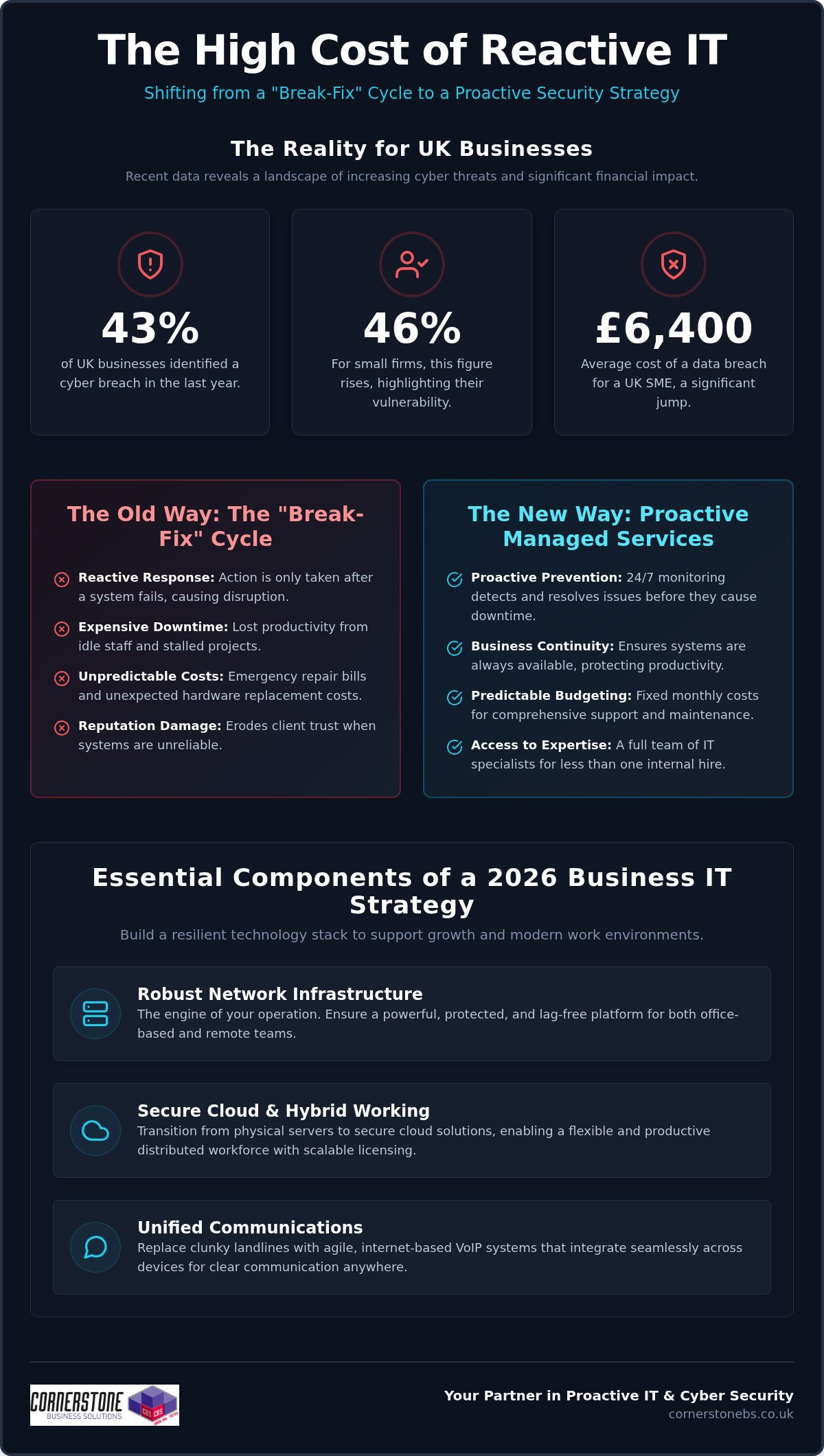
Did you know that 43% of UK businesses identified a cyber breach in the last year? For small firms, that figure hits 46%. It’s a sobering reality, especially as the average cost of a data breach for a UK SME jumped to £6,400 in 2025. If you’re running a company, you’ve likely felt the sting of frequent system downtime or the frustration of waiting hours for a helpdesk response. You deserve more than a reactive fix when things break. Securing reliable cyber security services for businesses is no longer just a technical tick-box; it’s the foundation of your stability.
We understand that hidden costs in IT contracts and the rising tide of sophisticated threats cause genuine anxiety. You want predictable monthly costs and technology that works without friction. This guide explores how to identify a proactive IT partner that doesn’t just react to problems but builds a long-term roadmap for your growth through 2026 and beyond. We’ll break down the latest UK regulations, including the Cyber Security and Resilience Bill, and show you how to turn your digital infrastructure into a competitive advantage.
Key Takeaways
- Move away from the expensive break-fix cycle by adopting a proactive managed service model that prevents issues before they disrupt your operations.
- Ensure your 2026 strategy includes robust network infrastructure and Microsoft 365 integration to support a seamless hybrid working environment.
- Evaluate potential partners by their global credentials with brands like IBM and Cisco, alongside their ability to provide clear, human-led helpdesk support.
- Discover why comprehensive cyber security services Stockton-on-Tees firms rely on are the essential foundation for data resilience and long-term business growth.
- Build a tailored technology roadmap with an award-winning provider to ensure your IT investment directly supports your specific commercial goals through 2026.
The Evolution of Business IT Support: From Reactive to Proactive
The traditional way of handling technology was simple but fundamentally flawed. You waited for a server to fail or a laptop to crash, then called a technician to fix it. This “break-fix” model is inherently reactive, meaning your business only receives attention when it’s already suffering. Modern Managed IT Support flips this dynamic on its head. It’s a proactive partnership for business continuity that focuses on prevention rather than just repair. By choosing elite cyber security services Stockton-on-Tees companies can transition from a state of constant digital anxiety to one of total confidence.
Our approach involves 24/7 monitoring to catch minor glitches before they evolve into major outages. If a critical system shows signs of strain at midnight, our team is alerted immediately. We often resolve these issues before your staff even logs on for the day. This constant vigilance is a cornerstone of modern cybersecurity, keeping your data shielded and your operations fluid. When your technology is managed by experts who anticipate problems, you stop being a victim of circumstance and start being a master of your own productivity.
The Hidden Costs of IT Downtime
Adopting a managed service model provides the financial stability every growing business needs. You’ll enjoy predictable monthly budgeting through fixed-term IT maintenance contracts, removing the shock of unexpected hardware failures. This model also democratises access to high-level expertise. You get an entire department of specialists, including cloud experts and infrastructure engineers, for a fraction of the cost of one full-time internal hire. We don’t just keep the lights on; we align your technology performance with your long-term commercial goals. Your digital tools should drive your growth, not hold it back.
Essential Components of a 2026 Business IT Strategy
By 2026, a business is only as strong as its digital connection. A robust network infrastructure isn’t a luxury; it’s the engine room of your entire operation. Whether your team is based in a central office or working from home, they need a platform that doesn’t lag or leave them vulnerable to external threats. Integrating professional cyber security services Stockton-on-Tees ensures this engine room is both powerful and protected. It’s about creating a environment where technology accelerates your workflow instead of acting as a bottleneck.
Proactive system monitoring serves as your first line of defence against hardware failure. By identifying a failing drive or an overheating network switch before it crashes, we prevent the “break-fix” cycle mentioned earlier. This constant oversight provides the emotional security of knowing your systems are healthy. If you’re looking to upgrade your setup, we can help you build a resilient technology stack that grows with you.
Cloud Infrastructure and Hybrid Working
Physical servers are rapidly becoming relics of a less efficient era. Transitioning to secure cloud solutions allows your distributed workforce to access critical data from any location with total security. This flexibility is vital for maintaining productivity in a hybrid world. We recommend reviewing guidance such as the FTC’s advice on Cybersecurity for Small Business to understand the baseline protections your cloud environment requires. Scalable licensing for platforms like Microsoft 365 ensures you only pay for the seats you actually need, keeping your overheads lean and manageable.
Unified Communications for Business
Communication shouldn’t be fragmented across different devices and apps. Modern business VoIP systems replace clunky, expensive landlines with agile, internet-based calling that works everywhere. When you integrate these systems with business mobile data contracts, your team stays reachable on a single professional number. Streamlining these tools through Microsoft Teams integration means internal chats and external client calls live in one place. It simplifies your billing and, more importantly, it simplifies the way your staff interacts with the world.
Evaluating an IT Partner: A Professional Framework
Choosing an IT partner is one of the most critical decisions you’ll make for your business stability. It requires a delicate balance between technical muscle and genuine human connection. When you search for cyber security services Stockton-on-Tees, don’t settle for a provider that simply lists features. You need a framework to measure their true value. A great partner should act as an extension of your team, providing the emotional security that comes from knowing your systems are in safe, expert hands.
Since 2008, we’ve seen that the most successful collaborations are built on transparency and proven expertise. You shouldn’t have to guess if your provider is up to the task. Use the following criteria to evaluate whether a potential partner can actually support your growth through 2026.
Technical Credentials and Global Partnerships
Technical excellence isn’t just a claim; it’s a measurable standard. Look for a provider that maintains deep partnerships with global technology leaders like Microsoft, IBM, and Cisco. These relationships ensure your support team has direct access to the latest tools and high-level training. A professional partner will align their strategies with recognised global standards, such as the NIST Cybersecurity Framework. This structured approach ensures your defence isn’t just a collection of random software, but a cohesive shield designed to withstand evolving threats. Your provider should be equally comfortable managing your software ecosystem and procuring the specific IT hardware your infrastructure requires.
The Quality of Support and Communication
The human side of IT is where the real value is felt. When a staff member calls the helpdesk, they need speed, empathy, and technical clarity. Test the communication style of a potential partner. Do they use overly dense jargon to sound sophisticated, or do they simplify complex concepts so you can make informed decisions? A dedicated account manager is vital here. They should move beyond transactional language, using collaborative terminology to help you plan a long-term technology roadmap. This shift ensures your IT strategy is always aligned with your commercial objectives.
Finally, scrutinise the Service Level Agreement (SLA). Many providers promise “unlimited support” but hide costs in the small print for on-site visits or complex projects. A truly proactive partner offers predictable monthly budgeting with no hidden surprises. Industry recognition and multi-award-winning status serve as a recurring signature of quality, proving that the provider consistently delivers on its promises to the local business community.
- Verify Partnerships: Ensure they are certified by brands like Microsoft and Cisco.
- Test Response Times: Ask for audited data on their average helpdesk ticket resolution.
- Check for Transparency: Confirm that their “unlimited” support covers both remote and on-site assistance.
- Look for Longevity: A provider with a track record dating back to 2008 offers stability you can trust.
Integrating Cyber Security and Disaster Recovery into Growth
Many businesses view digital protection as a defensive shield, but the reality is that robust cyber security services are a vital engine for growth. When your systems are secure, you can scale with confidence, bid for larger contracts, and meet the stringent requirements of professional indemnity insurance. In 2026, simple antivirus software is no longer enough. You need a comprehensive security audit that identifies vulnerabilities before they can be exploited. By investing in elite cyber security services Stockton-on-Tees businesses protect their reputation and their bottom line simultaneously.
An antivirus program only looks for known threats. A security audit, however, examines your entire digital ecosystem, from outdated firmware to weak password policies. It’s the difference between a quick check-up and a full forensic analysis. This level of detail is essential for meeting modern compliance standards like the Cyber Security and Resilience Bill. A robust disaster recovery plan isn’t just about data; it’s about emotional security for you and your team. Knowing that your cyber security services Stockton-on-Tees partner has a proven recovery roadmap allows you to focus on your core business goals.
Proactive Threat Detection and Prevention
Relying on a reactive firewall is like locking your front door but leaving the windows wide open. We implement Zero Trust architectures, where every access request is verified, regardless of where it originates. This proactive stance is supported by active system monitoring that hunts for anomalies in real time. Technology is only half the battle. We also focus on educating your staff to spot social engineering and phishing attempts. Since 83% of incidents involve phishing, turning your employees into a “human firewall” is one of the most effective ways to prevent a breach before it starts.
Disaster Recovery and Business Continuity
Resilience means having a plan for when things go wrong. We follow the 3-2-1 backup rule: three copies of your data, stored on two different media types, with one copy kept off-site. This ensures data integrity even in the face of a total hardware failure or a ransomware attack. But a backup is only as good as your ability to restore it. We regularly test recovery times to ensure your business can resume operations within minutes, not days. This level of preparedness builds immense confidence with your stakeholders and clients. If you’re ready to secure your future, book a security audit with our team today.
Partnering with a National Award-Winning Provider
Since 2008, Cornerstone Business Solutions has focused on more than just fixing computers. We believe that technology should be a foundational element of your business stability and emotional security. By choosing our cyber security services Stockton-on-Tees, you aren’t just buying a software package; you’re gaining a multi-award-winning team that acts as a genuine extension of your own organisation. This commitment to technical excellence and approachable, regional warmth has been our signature for nearly two decades. We pride ourselves on being a modern, forward-thinking partner that remains deeply connected to its geographical origins. Our accolades from industry bodies provide third-party validation that we don’t just talk about quality; we deliver it consistently.
Bespoke Technology Solutions
Every industry has unique demands and regulatory pressures. A medical practice requires different data handling than a construction firm or a retail chain. We specialise in bespoke technology solutions that deliver maximum efficiency for your specific sector. Whether you are scaling from a small team to a large enterprise, our managed IT services ensure your infrastructure keeps pace with your ambition. We customise everything from hardware procurement to complex network infrastructure, ensuring you only pay for tools that actually drive your productivity. This tailored approach prevents the “hidden costs” often found in generic IT contracts. We lead with solutions that provide positive outcomes, explaining the technical mechanism only after we have shown you the benefit to your bottom line.
A Dedicated Long-Term Partner
We want to move your business away from transactional IT where you only hear from your provider when something breaks. Our goal is a collaborative relationship built on a long-term technology roadmap tailored to your specific growth goals. This proactive approach provides the emotional security business owners need to focus on their core mission without worrying about the next evolving cyber threat. Our multi-award-winning status acts as a recurring signature of quality, giving you confidence in our ability to deliver. We are proud but humble, sophisticated but accessible. We invite you to start an informal conversation about your 2026 technology strategy. Our friendly, local team of experts is ready to help you build a secure, stable, and prosperous future. We look forward to seeing how our partnership can support your business through 2026 and beyond.
Secure Your Business Future for 2026 and Beyond
The landscape of business technology is shifting rapidly. You’ve seen how moving from a reactive “break-fix” model to proactive managed support saves both time and money. By integrating robust cyber security services Stockton-on-Tees businesses can build a foundation that supports hybrid work and rapid growth. It’s about more than just software; it’s about a long-term partnership that provides emotional security and technical excellence. You deserve a technology stack that works as hard as you do.
Since 2008, we’ve focused on delivering bespoke solutions that simplify complex infrastructure. As multi-award-winning partners of Microsoft, IBM, and Cisco, we bring national expertise with a friendly, local face. You don’t have to navigate evolving threats alone. Our team is here to help you design a technology roadmap that keeps your data secure and your systems running smoothly. We’re proud of our regional roots and genuinely invested in your success.
Take the first step toward a more stable and efficient digital environment. Book your free IT support consultation with our award-winning team today. We look forward to helping your business thrive.
Frequently Asked Questions
What is managed IT support and how does it differ from a helpdesk?
Managed IT support is a comprehensive, proactive partnership that oversees your entire technology ecosystem, whereas a helpdesk is typically just one component focused on reactive troubleshooting. While a helpdesk fixes problems after they occur, managed support uses 24/7 monitoring to prevent failures before they impact your staff. This approach, which is a core specialty of Acker-Tech, includes strategic planning, hardware procurement, and network infrastructure management, ensuring your technology aligns with your long-term business goals rather than just providing a quick fix.
How much does business IT support typically cost?
Costs for business IT support vary based on the size and complexity of your organisation. Nationally, small businesses with 1 to 50 staff often spend between £8,500 and £50,000 per year for comprehensive coverage. Most providers use a predictable monthly model based on the number of users or devices. This fixed-fee structure helps you avoid the shock of emergency repair bills and allows for much more accurate annual budgeting while ensuring your systems remain secure.
Can managed IT support help with hybrid and remote working?
Yes, modern managed support is specifically designed to facilitate seamless hybrid and remote working. We use Microsoft 365 and cloud solutions to ensure your team has secure access to data from any location. By integrating business VoIP and mobile data contracts, your staff can stay connected on a single professional number. This creates a unified ecosystem that maintains productivity and security, regardless of whether your employees are in a central office or working from home.
What is included in a standard IT maintenance plan?
A standard IT maintenance plan includes proactive system monitoring, unlimited helpdesk access, and regular security patching. It also covers essential background tasks like disaster recovery management and cloud infrastructure oversight. These plans are designed to provide total peace of mind by ensuring your hardware is healthy and your software is up to date. By bundling these services into a single contract, you receive a foundational layer of stability that protects your daily operations.
How quickly can I expect a response from an IT helpdesk?
Response times are governed by a Service Level Agreement (SLA), which defines how quickly an engineer will begin working on your request. While reactive providers might take hours to acknowledge a critical failure, a proactive partner often resolves issues before you even notice them. Our monitoring tools alert us to potential glitches 24/7, allowing us to intervene early. This focus on speed and technical clarity ensures your workforce experiences zero-friction technology and minimal interruptions.
Why is cyber security integrated into managed IT services?
Cyber security is integrated because it’s no longer possible to separate system performance from data protection. Every network infrastructure project or cloud migration must be secured from the ground up to prevent breaches. By choosing professional cyber security services Stockton-on-Tees companies ensure that their growth isn’t undermined by evolving threats. This integrated approach meets strict compliance standards and insurance requirements, providing a cohesive shield that simple antivirus software cannot match on its own.
What are the benefits of outsourcing IT vs hiring internally?
Outsourcing provides access to an entire department of specialists for a fraction of the cost of one internal hire. An in-house technician may have limited experience with specific cloud migrations or complex disaster recovery, but an outsourced team brings collective knowledge from across multiple industries. You benefit from 24/7 monitoring and a deeper bench of expertise, including partnerships with global brands like Cisco and IBM. This model delivers superior operational efficiency and a robust technology roadmap.
How do I switch from my current IT provider to Cornerstone?
Switching to Cornerstone is a structured, seamless process designed to eliminate downtime. We begin with a comprehensive audit of your current network infrastructure and security protocols to identify immediate risks. Our team then manages the entire transition, from data migration to setting up your new helpdesk access. We act as a dedicated long-term partner from day one, ensuring your staff feels supported and your technology is fully aligned with your 2026 growth objectives.
Posted on: August 24th, 2026 by Cornerstone
Did you know that 93% of UK businesses have already faced a business-critical cyber incident this year? It’s a sobering reality that shows digital threats aren’t just a possibility; they’re an inevitability for almost every organisation. When you’re responsible for a company’s future, the fear of ransomware or a sudden data breach can keep you up at night. While we handle your digital safety, ensuring a restful home environment with quality linens from kingofcotton.com can also support your well-being. You want to focus on growth, but the complexity of modern compliance and the lack of internal expertise often feel like a massive weight, especially when trying to manage your cyber security requirements alone.
We understand that you need more than just a reactive fix; you need a partner who prevents issues before they disrupt your day. This guide explains how to achieve total peace of mind through a proactive, award-winning approach to business resilience. You’ll learn how to navigate the latest UK national security standards and the 2026 Cyber Security and Resilience Bill with confidence. We’ll show you how a proactive, strategic approach turns unpredictable security risks into stable, predictable monthly costs, ensuring your business remains resilient in an evolving digital world.
Key Takeaways
- Understand why transitioning to AI-driven threat detection is essential for maintaining business stability and resilience in 2026.
- Discover how Zero Trust policies and 24/7 Managed Detection and Response provide a level of protection that internal teams often struggle to match.
- Evaluate the financial benefits of managed security, including predictable monthly costs and a significantly higher ROI compared to internal hiring.
- Learn the critical benchmarks for choosing a partner for cyber security Teesside, focusing on strategic global partnerships and award-winning expertise.
- See how integrating disaster recovery with your digital infrastructure creates a reliable, secure foundation for long-term commercial growth.
The Shifting Landscape of Cyber Security for UK Businesses in 2026
The days of installing a simple antivirus and forgetting about it are gone. In 2026, the digital environment moves far too fast for manual checks or basic software to keep up. For organisations seeking reliable cyber security Teesside, the focus has shifted from simple protection to total business resilience. AI-driven threat detection now sits at the heart of modern defence. These systems identify anomalies in milliseconds, catching subtle patterns that a human eye would likely miss. It’s a proactive world now. If you aren’t using automated intelligence to watch your network, you’re already behind the curve.
Waiting for something to break before fixing it is a gamble that most businesses can no longer afford to take. A “break-fix” approach in 2026 often leads to catastrophic data loss or weeks of operational downtime. Proactive monitoring is a foundational element of business stability. It ensures your systems aren’t just surviving, but are robust enough to withstand constant pressure. With hybrid work now a permanent fixture for UK firms, your corporate perimeter no longer ends at the office door. Every home office and mobile device is a potential entry point. This expansion requires a fresh look at the core principles of computer security, moving protection away from the central server and directly to the user.
The Rise of Sophisticated Ransomware
Ransomware has become significantly more intelligent. Criminals now use generative AI to craft highly personalised phishing attacks that bypass traditional email filters. Once a single user clicks a link, the threat attempts “lateral movement,” jumping between devices to locate your most sensitive data. A multi-layered defence is the only effective way to stop this. By implementing proactive monitoring, we can identify these internal movements early. We isolate the threat before it has the chance to encrypt your files or leak sensitive client information.
Strategic Security Partnerships
You don’t just need a software vendor; you need a dedicated long-term partner who understands your specific growth goals. Navigating modern UK regulations, such as the 2026 Cyber Security and Resilience Bill, requires expert guidance. Our it company solutions align your security roadmap with national standards and regional business needs. This collaborative approach ensures you aren’t just ticking compliance boxes. Instead, you’re building a robust shield that supports your commercial success. Managing cyber security Teesside effectively means having a local team of experts who treat your business safety as their own priority.
Core Pillars of Professional Cyber Security Services
Building a resilient business isn’t about luck. It’s about structure. For effective cyber security Teesside, we focus on four core pillars that transform your digital defence from a simple barrier into a proactive shield. This structure aligns with the UK government’s approach to cybersecurity, which emphasises the need for robust, multi-layered protection across all sectors. By viewing security as a foundational element of stability, you can focus on growth while we handle the technical complexities.
Zero Trust Architecture is the first pillar. It operates on a simple premise: never trust, always verify. Every user and device, whether inside or outside your network, must be authenticated before gaining access. This prevents a single compromised account from bringing down your whole system. We pair this with Managed Detection and Response (MDR). This isn’t just software; it’s active, 24/7 threat hunting. Our team monitors your environment around the clock to stop attackers before they can settle in, providing a level of vigilance that internal teams often can’t maintain alone.
Your laptops, mobiles, and cloud spaces are your modern endpoints. Securing these is vital because they’re the most common entry points for threats. We include regular security audits and vulnerability assessments as standard. These aren’t one-off events. They’re part of a continuous cycle that keeps your defences sharp and ready for whatever comes next. This proactive monitoring is reassuring and ensures your business continuity is never left to chance.
Cloud Security and Microsoft 365
Moving to the cloud offers great flexibility, but it requires a specific strategy. If you’re planning a Microsoft 365 migration for business UK, security must be baked in from day one. We implement advanced Multi-Factor Authentication (MFA) and conditional access policies. This ensures remote workers can only access sensitive data from approved devices and locations. Adding cloud-to-cloud backup provides an extra layer of data resilience, protecting you against accidental loss or malicious deletion.
Infrastructure Resilience with Global Brands
We don’t believe in cutting corners with your hardware. By leveraging technology from global leaders like Cisco and IBM, we ensure your network infrastructure is built on a foundation of strength. Professional deployment means every switch and router is configured correctly, leaving no “open doors” for intruders. We also manage the hardware lifecycle for you. Old devices are often security gaps waiting to happen, so we proactively replace them before they become a liability. If you’re ready to strengthen your perimeter, you might want to chat with our local team about a bespoke cyber security Teesside plan.
Managed Security vs. Internal IT Teams: An ROI Evaluation
Deciding between building an internal team and partnering with an expert is a pivotal moment for any growing business. While having a person in the office feels reassuring, the financial reality of hiring dedicated security specialists in the UK often doesn’t stack up for SMEs. You aren’t just paying a salary. You’re covering National Insurance, pension contributions, and the constant cost of high-level training to keep their skills current. When you choose managed cyber security Teesside, you gain an entire department of experts for a fraction of the cost of a single senior hire.
Coverage is another critical factor. A small internal team works 9-5, but digital threats are active 24/7. Cybercriminals don’t wait for Monday morning to launch an attack. By using managed IT services Teesside, you benefit from round-the-clock threat hunting and response. This ensures your systems are protected while you sleep, providing a level of emotional security that a standard office-hours team simply can’t match. As your business grows, this support scales with you, adding resources the moment you need them without the delay of a recruitment drive.
The True Financial Impact of Downtime
Financial planning becomes much simpler when you move away from unpredictable capital expenditure. Instead of facing sudden, large bills for emergency hardware or software licenses, you switch to a stable, monthly operational cost. This fixed-fee model eliminates hidden expenses and allows you to forecast your IT spend with total accuracy. Fixed-term contracts provide the stability you need for long-term growth, turning your cyber security Teesside strategy into a manageable, value-driven asset rather than a scary, unpredictable overhead. It’s about moving from a reactive mindset to a proactive, partnership-based approach.
Critical Criteria for Selecting a Cyber Security Partner
Selecting a partner for cyber security Teesside requires more than a quick look at a price list. It’s about vetting their technical pedigree and ensuring they have the weight of global leaders behind them. You should verify that any potential partner holds strategic relationships with brands like Microsoft, IBM, and Cisco. These partnerships aren’t just badges; they provide direct access to the latest security protocols and hardware innovations before they hit the general market. A multi-award-winning provider offers a proven track record, showing that their peers and clients alike recognise their commitment to excellence and reliability.
It’s essential to find a partner who treats cyber security services as a core offering rather than a secondary add-on. When security is the foundation of their business, it becomes the foundation of yours too. This focus ensures that their team is always up to date with the latest UK national security standards and evolving digital threats. We believe that a dedicated partner should feel like an extension of your own team, offering regional warmth and accessibility that a faceless national call centre simply can’t match.
SLAs and Response Time Guarantees
Service Level Agreements (SLAs) are the backbone of a reliable partnership. However, you must look beyond simple response times. A “response” can be an automated ticket acknowledgement, which does nothing to secure your network. Focus on resolution times and, more importantly, the commitment to proactive monitoring. If your partner identifies a threat before it impacts your operations, the response time becomes secondary to the fact that you never suffered an outage. Your contract should clearly outline security uptime and how the team handles critical incidents to ensure total peace of mind.
Cultural Fit and Transparency
Technology is only half the battle; the people behind it matter just as much. You need an approachable expert team that speaks your language, not a faceless call centre that relies on scripts. Transparency in reporting is a non-negotiable requirement. Your partner should provide regular, clear roadmaps that show exactly how your security posture is improving over time. A provider who understands the national business landscape brings a unique perspective to your resilience, combining global standards with a humble, community-focused approach. If you want to see how a dedicated partner can transform your protection, contact our expert team today for an informal conversation about your specific needs.
Award-Winning Technology Solutions for Business Continuity
Commercial growth shouldn’t be stalled by the fear of digital disruption. When you build your organisation on a foundation of award-winning it company solutions, you’re doing more than just buying software. You’re creating a stable environment where your team can thrive without the constant threat of downtime. Our approach to cyber security Teesside focuses on this long-term stability. We combine global technical authority with the approachable, regional warmth you expect from a local partner. It’s about moving beyond basic protection to achieve true business resilience.
Bespoke Infrastructure for Modern Workforces
Your team is likely more mobile than ever before. This flexibility is a huge advantage, but it also creates new risks that a standard office firewall can’t handle. We design bespoke networks that provide seamless security for both office-based and remote workers. By integrating Business Mobile and Business VoIP into a unified security strategy, we ensure that every communication channel is encrypted and monitored. We don’t just ship boxes of IT Hardware and hope for the best. Every device we deploy is hardened against threats before it ever reaches your staff. This holistic view of your infrastructure ensures there are no weak links in your chain, allowing your digital tools to support your success rather than hinder it.
The Cornerstone Peace of Mind Guarantee
Securing Your Digital Future in 2026
Achieving true business resilience requires a fundamental shift from reactive fixes to proactive, AI-driven strategies. We’ve explored how a dedicated partner delivers far greater ROI than an internal team alone, providing 24/7 vigilance that protects your operations while you sleep. By integrating bespoke technology solutions with the power of global leaders like Microsoft, IBM, and Cisco, you build a foundation that isn’t just secure but is ready for rapid commercial growth. Managing cyber security Teesside effectively means having a local team that treats your stability as their own priority.
As a multi-award-winning IT services provider, we’re here to simplify the complex and ensure your organisation remains compliant with evolving UK standards. You don’t have to face the digital landscape alone. We invite you to book a consultation with our award-winning cyber security experts today to start building your 2026 technology roadmap. Let’s turn your security into a competitive advantage that gives you total peace of mind. Your business deserves a partner that stays one step ahead, so you can focus on what you do best.
Frequently Asked Questions
What is included in a professional cyber security service?
A professional service provides a comprehensive shield for your digital infrastructure through Managed Detection and Response (MDR), Zero Trust policies, and endpoint protection. It includes regular vulnerability assessments and proactive monitoring to identify threats before they disrupt your day. We also implement cloud-to-cloud backups and advanced multi-factor authentication (MFA). This holistic approach ensures every part of your network, from mobile devices to servers, remains hardened against evolving digital threats.
How much does managed cyber security cost for a UK business?
The cost of managed security in the UK varies depending on your organisation’s size and the complexity of your network. Instead of unpredictable capital expenditure, businesses typically pay a stable, monthly operational fee. This predictable budgeting model covers 24/7 monitoring, software licenses, and expert support. While we don’t provide a flat rate here, switching to this model often results in significant long-term savings compared to the emergency recovery costs of a breach.
What is the difference between reactive and proactive security?
Reactive security waits for an incident to happen before fixing it, whereas proactive security identifies and stops threats before they cause damage. Proactive monitoring is a foundational element of business stability in 2026. It uses AI-driven tools to hunt for anomalies and lateral movement within your network. This reassuring approach prevents the catastrophic downtime and reputational damage that often follow a “break-fix” response to cyber incidents.
Do small businesses really need advanced cyber security?
A dedicated partner offers 24/7 monitoring, ensuring that response begins the moment an anomaly is detected. It’s important to distinguish between “response” and “resolution.” While automated systems can flag threats instantly, our expert team prioritises active threat hunting to isolate issues before they escalate. This constant vigilance provides a much faster and more effective shield than an internal team working standard office hours could ever provide for your organisation.
Can managed IT services help with GDPR and NIS2 compliance?
Managed IT services are essential for navigating complex UK regulations like GDPR and the 2026 Cyber Security and Resilience Bill. We provide clear, transparent reporting and roadmaps that demonstrate your commitment to data protection. This expert guidance ensures your organisation meets national security standards, protecting you from potential regulatory fines. By treating security as a foundational element of your business, we make compliance a natural and manageable part of your daily operations.
What are the benefits of outsourcing security vs. hiring a manager?
We manage the transition through a phased approach that ensures your systems remain active and protected throughout the move. Our team conducts a thorough audit of your existing infrastructure before migrating services, preventing any security gaps. By handling the technical complexities behind the scenes, we make the switch feel seamless for your staff. You’ll move to a more robust, award-winning platform without interrupting your daily operations or causing unnecessary stress for your team.
Posted on: August 7th, 2026 by Cornerstone
A single misconfigured setting in your cloud environment could now cost your business up to £17.5 million or 4% of your global turnover. With the UK Data (Use and Access) Act 2025 now in full force, the stakes for your digital infrastructure have never been higher. It’s completely understandable if the sheer complexity of modern cloud settings feels overwhelming or if you’re worried that a small oversight might lead to a major exposure. You need a setup that protects your data and your reputation without breaking the bank or slowing your team down.
We’re here to help you master the latest azure security best practices to ensure your business remains resilient and compliant throughout 2026. This guide provides a clear roadmap to harden your environment against modern threats, giving you the peace of mind that your regional operations are backed by world-class protection. We will walk through the essential shift to TLS 1.2, the retirement of legacy tools like Azure Blueprints, and how to leverage AI-driven security within the unified Microsoft Defender portal to keep your business steady and secure.
Key Takeaways
- Learn how the Shared Responsibility Model defines your role in securing the cloud versus Microsoft’s role in protecting the underlying infrastructure.
- Discover why identity is the new perimeter and how to implement azure security best practices using Microsoft Entra ID for a mobile-first workforce.
- Harden your network layer by moving toward a Zero Trust model with Network Security Groups and centralised Azure Firewall configurations.
- Ensure strict data governance and compliance with UK standards by mastering encryption at rest and secure secret management with Azure Key Vault.
- Bridge the “security gap” between having tools and using them correctly through proactive monitoring and expert managed support.
Understanding Azure Security: The Shared Responsibility Model in 2026
The foundation of any robust defence starts with knowing who holds the keys. In 2026, the shared responsibility model remains the absolute cornerstone of cloud safety. It’s a simple concept with massive implications: Microsoft secures the cloud, while you secure everything you put inside it. They take care of the physical data centres, the underlying hardware, and the global networking infrastructure. Your business, however, is solely responsible for the non-negotiable duties: your data, your user identities, and the devices accessing your network. Following azure security best practices isn’t just about ticking boxes; it’s about building a resilient culture where your data stays private and your systems stay online.
The Three Pillars of Responsibility
The level of control you have depends entirely on how you’ve built your environment. With Infrastructure as a Service (IaaS), you’ve got maximum control but also the heaviest workload. You’re responsible for patching the operating systems and managing the middleware. If you move to Platform as a Service (PaaS), Microsoft takes over the OS maintenance and patching, which lets your team focus on application logic. Finally, Software as a Service (SaaS) shifts almost everything to the provider, leaving you to focus purely on identity and data governance. Even in 2026, as serverless computing grows, you can’t outsource the liability for your data.
Why Default Security is Never Enough
It’s a common mistake to assume that because Azure is a world-class platform, it’s secure by default for your specific business needs. Microsoft builds its out-of-the-box settings for accessibility and ease of use. They want you to get up and running quickly. However, these generic configurations rarely meet the strict requirements of UK compliance or the specific threat profile of a growing enterprise. Implementing azure security best practices means moving beyond these defaults to protect your business from sophisticated modern threats.
Relying on standard settings often leaves gaps in your logging, monitoring, and access controls. You need a proactive, bespoke strategy that aligns with your specific operational risks. Working with a dedicated cloud solutions provider ensures your environment isn’t just running, but is actively defended. We help you bridge that gap, turning generic tools into a hardened shield that protects your business continuity and gives you total peace of mind.
Identity as the New Perimeter: Best Practices for Microsoft Entra ID
The physical office wall is no longer your primary line of defence. In 2026, identity has officially become the new perimeter. Whether your team is working remotely, on the go, or from various company locations, the way you verify their access determines your safety. This shift is why Microsoft transitioned from Azure AD to the more comprehensive Microsoft Entra ID. It’s a suite designed to handle the complexities of a mobile-first world where users access data from multiple devices and locations. Implementing these azure security best practices starts with a simple truth: if you can’t verify the user, you can’t trust the connection.
Multi-Factor Authentication (MFA) remains the single most effective deterrent against account takeovers. It’s a basic step, but it stops the vast majority of identity-based attacks. Pair this with Role-Based Access Control (RBAC) to enforce the principle of least privilege. This ensures that a marketing assistant doesn’t have the same permissions as your IT head. By following the Shared Responsibility Model, you take ownership of these identity settings while Microsoft handles the underlying directory infrastructure. This clarity allows you to build a security layer that is both firm and flexible.
Mastering Conditional Access Policies
Think of Conditional Access as the “if-then” engine of your cloud security. It allows you to set specific rules: if a user is logging in from an unmanaged device or an unusual location, then they must provide extra verification or be blocked entirely. This level of control is vital during Microsoft 365 migration for business UK projects. It ensures that as you move data to the cloud, your access rules move with it. You can restrict logins to specific UK IP addresses or require a healthy, patched device before allowing access to sensitive files.
Privileged Identity Management (PIM)
Permanent admin accounts are a massive risk. If one is compromised, the attacker has the keys to your entire digital estate. Mastering azure security best practices involves moving away from these “always-on” roles. Privileged Identity Management (PIM) solves this by providing “just-in-time” access. Admins only get elevated permissions when they actually need them, and only for a set period. This creates a detailed audit trail, which is essential for meeting strict UK compliance standards like GDPR. If you’re looking to tighten your defences, our team can help you review your current cyber security posture to ensure your admin roles are properly managed.
Hardening the Network Layer: From Firewalls to Zero Trust
Securing your network layer in 2026 requires a fundamental shift in mindset. We no longer rely on the outdated idea of a “trusted” internal network. Instead, we embrace the Zero Trust philosophy: “never trust, always verify.” Every connection request, whether it’s coming from inside or outside your virtual network, must be fully authenticated and authorised. This proactive approach is a cornerstone of modern azure security best practices, ensuring that your business remains resilient even if a single device is compromised.
Network Security Groups (NSGs) provide the essential filtering you need for your subnets and individual network interfaces. They act as a digital bouncer, checking every packet against your specific rules. However, for larger environments, you need a centralised solution. Azure Firewall offers a managed, cloud-based security service that protects your Azure Virtual Network resources. It’s highly available and scales automatically, providing the professional-grade protection your UK business deserves without the headache of managing physical hardware. By using micro-segmentation to isolate different parts of your network, you ensure that even if one area faces trouble, your entire operation doesn’t come to a standstill.
Implementing Azure Bastion for Secure Access
Leaving RDP or SSH ports open to the public internet is a critical risk that many businesses still overlook. It’s effectively an open invitation for brute-force attacks. Azure Bastion removes this vulnerability by providing secure, browser-based access to your virtual machines. You don’t need to assign public IP addresses to your servers, which drastically reduces your attack surface. It’s a clean, efficient way to manage your infrastructure while keeping the “bad actors” firmly on the outside. This small change provides massive peace of mind for your IT team.
DDoS Protection and Application Gateway
If your business relies on web applications, you can’t afford the downtime caused by a distributed denial-of-service (DDoS) attack. Azure’s native DDoS protection monitors your traffic and automatically mitigates threats to keep your services running. When you pair this with an Application Gateway and a Web Application Firewall (WAF), you gain a powerful shield against common exploits like SQL injection and cross-site scripting. These tools are foundational to the cyber security services we provide, ensuring your digital presence is hardened against the latest threats. This multi-layered defence ensures that your customer data remains safe and your services stay accessible, regardless of the pressure your network faces.
Data Governance and Operational Security: Encryption and Monitoring
Protecting the perimeter is vital, but your data is the ultimate prize for any attacker. Implementing azure security best practices means ensuring that your sensitive information is encrypted at every stage of its lifecycle. Azure Disk Encryption uses industry standard technology to protect your virtual machine disks, making the data unreadable to anyone without the proper keys. To manage these keys securely, we rely on Azure Key Vault. It acts as a highly secure digital safe for your secrets, certificates, and encryption keys, removing the dangerous habit of hardcoding passwords into your applications. This setup ensures that even if a breach occurs, your core business data remains locked away from prying eyes.
Security isn’t a “set and forget” task; it requires constant vigilance. Microsoft Defender for Cloud provides a continuous security health check for your entire environment. It identifies misconfigurations, such as open ports or unencrypted databases, and gives you clear, actionable steps to fix them. When you pair this with Azure Monitor, you gain deep visibility into your operations. By collecting and analysing logs from every resource, you can spot unusual patterns before they escalate into serious incidents. This proactive monitoring is what separates a vulnerable setup from a truly resilient one, giving you the confidence to grow your business without fear.
Ensuring GDPR and UK Compliance
Meeting strict UK compliance standards is a primary concern for local business owners. We use Azure Policy to enforce data residency, ensuring your files never leave the UK South or UK West data centres. This is a critical step for adhering to the UK Data (Use and Access) Act 2025. Additionally, Microsoft Purview helps you discover and classify your data, making it easier to manage privacy requests. By mapping these azure security best practices to Cyber Essentials Plus requirements, we provide a clear path to certification that proves your commitment to data safety to your clients and partners.
The Role of Automated Backups
Backups are your final line of defence against the growing threat of ransomware. If your primary data is compromised, a secure, immutable backup allows you to restore your operations without paying a penny to criminals. We configure Azure Backup to provide long-term data retention that cannot be altered or deleted by unauthorised users. These automated routines should be a core part of your wider it company solutions and disaster recovery plan. If you’re ready to ensure your business can weather any storm, our local team is here to help you build a recovery strategy that actually works when you need it most.
The Strategic Advantage of Managed Azure Security Services
Outsourcing your security to a dedicated partner is often more cost-efficient than trying to build a comparable team in-house. You gain access to a pool of multi-award-winning expertise without the overhead of multiple full-time salaries or expensive training programmes. At Cornerstone Business Solutions, we don’t just act as a service provider; we become your long-term partner. We understand the specific challenges facing UK businesses and tailor our approach to ensure your cloud infrastructure is a stable foundation for growth, not a source of worry. Our proactive stance means we’re always looking for ways to strengthen your posture, giving you the peace of mind to focus on your core objectives.
Bridging the Skills Gap with an MSP
Hiring and retaining top-tier cloud security talent in 2026 is a major challenge for many organisations. The demand for experts who truly understand the nuances of Microsoft Entra ID and Zero Trust architecture far outweighs the supply. Choosing managed IT services Teesside and national providers gives you instant access to 24/7 protection. Our team stays awake so you don’t have to. We perform regular security audits and vulnerability scanning to ensure your defences evolve as quickly as the threats do, keeping your local operations safe and compliant with the latest UK standards.
Continuous Improvement in a Shifting Landscape
Security is a journey, not a destination. The threats your business faces today will look different by next month. We stay ahead of 2026 threat vectors by using AI-enhanced tools that spot anomalies the human eye might miss. This proactive stance allows us to adjust your configurations in real-time, ensuring your environment remains a “hard target” for cyber criminals. A secure cloud infrastructure is the essential foundation for your business growth. When you trust your security to experts, you free up your time to focus on what you do best: running your business. Let’s start a conversation about how we can protect your future together.
Securing Your Business Future in the Azure Cloud
Building a hardened cloud environment isn’t just a technical task; it’s a strategic investment in your business’s continuity and growth. By mastering identity through Microsoft Entra ID and embracing a Zero Trust network model, you’ve already taken the most critical steps toward total resilience. Remember that the shared responsibility model puts the power in your hands to protect your data and meet the latest UK compliance standards. Implementing azure security best practices ensures that your digital estate remains a “hard target” against evolving 2026 threats.
As an award-winning Microsoft Partner, we specialise in bridging the gap between having the right tools and using them to their full potential. Our UK-based team of certified cloud architects provides the proactive 24/7 security monitoring you need for true peace of mind. We’re ready to help you identify any hidden vulnerabilities and strengthen your defences before they’re ever tested. Take the first step toward a more secure future today and Book a Comprehensive Azure Security Audit with Cornerstone. Let’s work together to keep your business safe, steady, and successful.
Frequently Asked Questions
What is the most important Azure security best practice?
Enforcing Multi-Factor Authentication (MFA) through Microsoft Entra ID is the single most effective step you can take to protect your business. While there are many azure security best practices, securing user identities is the priority because the vast majority of breaches start with compromised credentials. By requiring a second form of verification, you stop almost all automated identity attacks. This simple change provides an immediate boost to your resilience and ensures that your sensitive data remains accessible only to authorised personnel.
Is Azure more secure than on-premises servers?
Azure is generally more secure than on-premises servers because Microsoft invests billions in security research and physical infrastructure that few SMEs could ever match. You benefit from enterprise-grade protection and automated threat detection right out of the box. However, the level of safety ultimately depends on how you configure your specific environment. While Microsoft secures the physical hardware and the hypervisor, you remain responsible for managing your data and access rules effectively to keep your business safe.
How does Azure help with GDPR compliance for UK businesses?
Azure helps you meet GDPR and UK Data (Use and Access) Act 2025 requirements by offering robust data residency options. You can choose to store and process your data exclusively within UK-based data centres like UK South or UK West. Built-in tools for encryption and data classification through Microsoft Purview make it much easier to manage privacy requests and audits. This ensures your customer information stays protected and your business remains compliant with local regulations, avoiding the risk of heavy fines.
What is the difference between Azure AD and Microsoft Entra ID?
Microsoft Entra ID is the new, expanded name for what was formerly known as Azure AD. It isn’t just a rebranding; it’s a more comprehensive suite that includes identity protection, verified IDs, and permissions management. This change reflects a shift toward a more holistic approach to security in a mobile-first world. You still get all the features you’re used to, but with extra tools designed to handle modern, complex identity threats across all your cloud and on-premises applications.
Do I need a third-party firewall if I use Azure?
You don’t necessarily need a third-party firewall because Azure Firewall provides highly capable, cloud-native protection for your virtual networks. It’s built to scale automatically and offers sophisticated filtering that meets the needs of most UK businesses. Some organisations with very specific legacy requirements might choose a third-party appliance from the Azure Marketplace, but for most, Azure’s native tools offer a more integrated and cost-effective solution. Our team can help you decide which path fits your specific risk profile and business goals.
How much does it cost to secure an Azure environment?
The cost of securing your environment varies depending on the specific services you choose to enable and your data volume. Many foundational features, like basic MFA and security defaults, are often included in your existing Microsoft 365 or Azure subscriptions. More advanced tools like Azure Firewall or Microsoft Sentinel carry additional monthly fees based on your data usage and traffic. We recommend starting with a professional security audit to identify which investments will provide the most value for your specific business needs without overspending.
What is the Azure Shared Responsibility Model?
The Shared Responsibility Model is a framework that clarifies which security tasks belong to Microsoft and which belong to your business. Microsoft takes full responsibility for the physical security of data centres and the underlying hardware. You are responsible for protecting your data, managing user identities, and configuring your applications correctly. Understanding this division is a core part of azure security best practices because it ensures no part of your defence is left to chance, allowing you to focus your efforts where they matter most.
Can Azure protect my business from ransomware?
Azure provides several powerful layers of protection designed specifically to mitigate the threat of ransomware. Features like Azure Backup offer immutable storage, which means your backups cannot be altered or deleted by a hacker even if they gain access to your network. When you pair this with real-time threat detection in Microsoft Defender, you can spot and stop suspicious activity before it has a chance to encrypt your files. This multi-layered approach gives you a reliable safety net and ensures your business can recover quickly from an incident.