
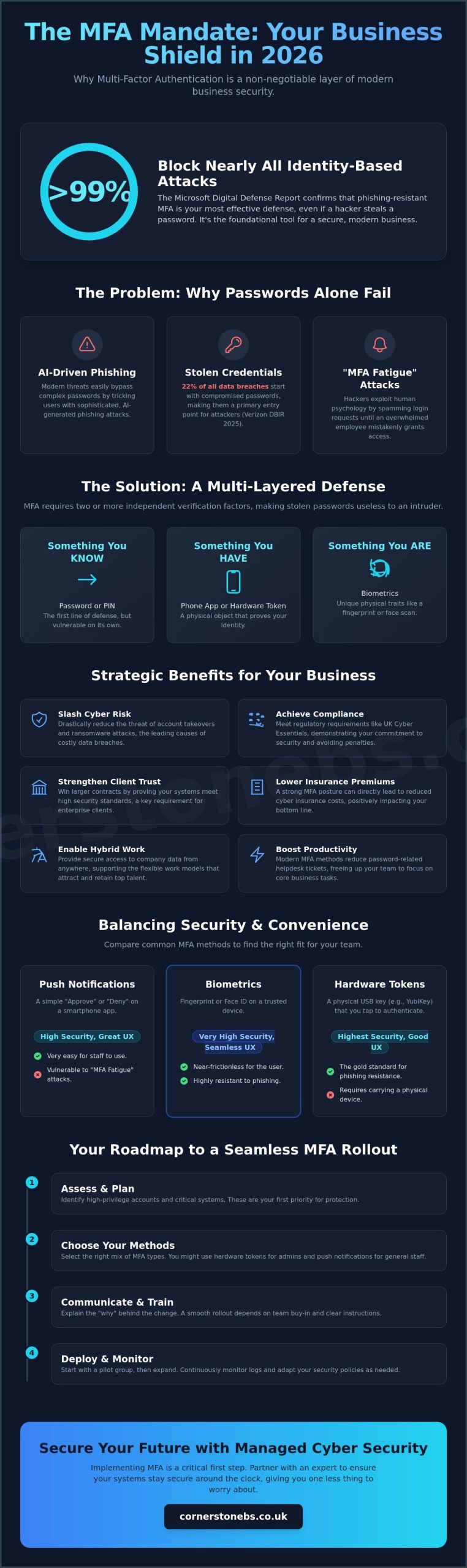
Did you know that phishing-resistant security can block over 99% of identity-based attacks even if a hacker has your password? It sounds like a bold claim, but the 2025 Microsoft Digital Defense Report confirms it. As we move through 2026, understanding multi-factor authentication for business benefits is no longer just a technical luxury; it’s a foundational tool for your company’s stability. While many local business owners worry that extra login steps will frustrate their teams, the reality is that modern MFA actually simplifies your digital life while locking the door against intruders.
We understand the pressure of rising cyber insurance premiums and the constant fear of account takeovers. It’s frustrating to feel like you’re constantly chasing new regulations just to stay afloat. This guide will show you how implementing the right MFA strategy protects your bottom line and helps you achieve compliance with UK Cyber Essentials mandates without the headache. We’ll explore how to create a seamless login experience for your staff and lower your overall risk profile. Let’s dive into how these security measures act as a partner in your long-term growth.
Key Takeaways
- Learn why traditional passwords fail against AI-driven phishing and how multi-layered verification provides the security your business needs in 2026.
- Discover the strategic multi-factor authentication for business benefits, including reduced insurance premiums and strengthened client trust through verified security standards.
- Compare different authentication methods to find the perfect balance between high-level protection and a smooth, frustration-free login experience for your team.
- Get a practical roadmap for a successful rollout that focuses on change management and protecting your most sensitive high-privilege accounts first.
- See how partnering with a local expert for Managed Cyber Security ensures your systems stay secure around the clock, giving you one less thing to worry about.
Beyond the Password: Why MFA is Non-Negotiable in 2026
Passwords are no longer the sturdy locks they once were. Relying on a single string of characters to protect your company’s sensitive data is like leaving your front door wide open with a “Welcome” mat. Multi-factor authentication (MFA) is the modern solution. It requires users to provide two or more independent verification factors to gain access to a resource. This multi-layered approach ensures that even if a password is stolen, your business remains secure because the intruder can’t provide the second or third factor.
The “Password Paradox” explains why simply making passwords longer or more complex doesn’t stop modern threats. AI-driven phishing tools can now crack complex patterns or trick users into revealing their credentials with frightening accuracy. This is why multi-factor authentication for business benefits your bottom line so effectively. It moves the goalposts. The Microsoft Digital Defense Report 2025 confirms that phishing-resistant MFA can block over 99% of common identity-based attacks. For UK SMEs, this is the essential entry point for a Zero Trust architecture. In a Zero Trust model, we never assume a user is legitimate just because they have the right credentials; we verify every single request.
For our local partners, this isn’t just about high-tech jargon. It’s about ensuring that your team can work from the office, at home, or on the go without creating a gap in your defenses. By adopting this “never trust, always verify” mindset, you’re building a foundation that supports long-term growth and stability. MFA serves as the digital gatekeeper, ensuring that only the right people access the right data at the right time.
The Evolution of Cyber Threats to UK Businesses
Modern hackers have moved past simple brute-force attacks. They now use “MFA fatigue” tactics, where they bombard an employee with login notifications until the person clicks “approve” just to stop the noise. It’s a psychological game. The Verizon 2025 Data Breach Investigations Report shows that 22% of all data breaches begin with stolen credentials. It’s no longer a question of “if” your business is targeted, but “when”. Legacy two-factor authentication often falls short against these sophisticated methods, making a robust MFA strategy a necessity for business continuity.
MFA vs. 2FA: Understanding the Critical Difference
While people often use these terms interchangeably, there’s a vital distinction. All 2FA is MFA, but it’s limited to exactly two steps. True MFA can involve multiple layers like biometrics, hardware tokens, and location-based checks. This flexibility allows for adaptive, risk-based security that changes based on where or how a user logs in. Recognising the multi-factor authentication for business benefits allows you to build a more resilient infrastructure. MFA is a dynamic security layer that adapts to user context to keep your data safe.
The Strategic Benefits of Multi-Factor Authentication for Business
Implementing multi-factor authentication for business benefits your company far beyond simple data protection. It’s a strategic move that secures your bottom line and strengthens your reputation. By adding these layers, you immediately slash the risk of identity-based attacks. These attacks are the leading cause of ransomware, which cost businesses millions globally last year. When you can prove your systems are locked down, you build instant trust with larger clients who now demand proof of security standards before signing a contract.
MFA also unlocks the potential of your workforce. It provides a secure way for your team to access files from anywhere, supporting the flexible hybrid models that attract top talent. You don’t have to worry about a lost laptop becoming a total data disaster. Operationally, it’s a breath of fresh air. Modern MFA methods like biometrics or push notifications actually reduce the volume of helpdesk tickets. Employees don’t have to remember complex, rotating passwords that lead to constant lockouts and resets. This efficiency lets your team focus on their actual jobs.
Beyond the technical shield, it’s about emotional security for you as a business owner. Knowing that a single stolen password can’t bring down your entire operation provides peace of mind that’s hard to quantify. We’ve seen how this confidence allows our local partners to scale more aggressively, knowing their foundation is solid. If you’re ready to see how these tools fit your specific setup, reaching out to a local IT partner can help you get started.
Meeting UK Compliance and Cyber Essentials Standards
The UK’s Cyber Essentials scheme now mandates MFA for all cloud services as of April 2026. This isn’t just a suggestion; it’s a requirement for any service accessed with a business account. Meeting these standards shows you’ve taken the ‘Technical and Organisational Measures’ required by GDPR. For firms in financial services, following Cybersecurity & Infrastructure Security Agency (CISA) guidelines and FCA regulations is vital for maintaining your license to operate. It proves to regulators that you take data integrity seriously.
Lowering Cyber Insurance Premiums and Improving Eligibility
The cyber insurance market has shifted dramatically. Most UK insurers now refuse to cover businesses that rely solely on passwords. We’re seeing an ‘insurability crisis’ where firms are denied protection because their risk profile is too high. By proving you have company-wide MFA, you don’t just become eligible for coverage; you often qualify for lower annual premiums. It’s a clear financial win. Understanding these multi-factor authentication for business benefits helps you turn a security necessity into a cost-saving measure for your insurance renewals.
Balancing Security and Productivity: Comparing MFA Methods
One of the biggest hurdles for local business owners is the fear that security will slow down their team. It’s a valid concern. If your staff spends twenty minutes every morning wrestling with login codes, productivity drops and frustration rises. However, the right multi-factor authentication for business benefits your workflow by matching the level of security to the risk involved. We don’t want to build a wall that your own team can’t climb; we want a smart gate that recognises them instantly.
Not all authentication methods are created equal. Security experts now consider SMS-based codes a “weak” factor because hackers can intercept them through SIM swapping or social engineering. While it’s better than no protection at all, we’ve moved towards more robust options in 2026. The goal for many forward-thinking firms is passwordless authentication. By using passkeys or biometrics, your employees don’t have to remember complex strings of characters. The Forbes Technology Council highlights that mastering these basics is the most effective way to secure a modern enterprise. When you combine this with Single Sign-On (SSO), your staff logs in once and gains secure access to all their apps, actually speeding up their workday.
Authentication Factors: Knowledge, Possession, and Inherence
Authentication relies on three pillars. “Something you know” includes PINs or passwords, while “something you have” refers to hardware keys or trusted mobile devices. The most seamless method involves “something you are,” such as fingerprints or facial recognition. We’ve seen a massive rise in biometric security for business laptops because it’s both fast and incredibly secure. Inherence factors are the hardest for hackers to spoof, making them the gold standard for protecting your most sensitive data.
Adaptive and Conditional Access: The ‘Smart’ Way to Secure
This is where multi-factor authentication for business benefits the daily user experience most. With “Conditional Access,” your security system becomes context-aware. If an employee is working from your trusted office network, the MFA can remain “silent,” allowing them to work without interruptions. The system only triggers extra verification if it detects a high-risk login, such as a connection from a new country or an unrecognised device. This “smart” approach solves the problem of MFA being annoying for staff while keeping your perimeter tight.
A Roadmap to Seamless MFA Implementation
Getting your security right is about more than just installing software. It’s a human process. We often tell our local partners that multi-factor authentication for business benefits is 20% technology and 80% change management. If you flip a switch without preparing your team, you’ll likely face frustration and support tickets. A successful rollout requires a clear roadmap that respects your employees’ time and your company’s operational rhythm. By following a structured path, you ensure that security becomes a foundational part of your culture rather than a hurdle.
We recommend a phased rollout rather than a “big bang” approach. Start with your high-privilege accounts first. This includes your Finance, HR, and IT teams. These departments handle your most sensitive data and are the most attractive targets for hackers. Once these core groups are comfortable with the new process, you can expand to the rest of the organisation. This strategy allows you to identify any specific workflow issues in a smaller, more controlled group before they affect everyone.
Clear internal communication is your most powerful tool. Tell your staff what’s changing and why it matters before you implement the new requirements. You should also establish a clear “lost device” policy. If an employee loses their phone or a hardware key, they need to know exactly who to call to get back into their accounts quickly. This prevents costly downtime and keeps your business moving. If you need a partner to help manage these transitions, you can book a conversation with our local team.
Step 1: Auditing Your Current Identity Landscape
You can’t protect what you haven’t identified. Start by auditing every application that stores sensitive business data. If you’ve recently undergone a Microsoft 365 migration for business UK, check your current licensing to see which advanced MFA and Conditional Access features are already at your disposal. This is also the time to look for “shadow IT”—those unofficial apps your team might be using that sit outside your corporate security perimeter.
Step 2: Training and Onboarding Your Team
Training is where you secure buy-in. Explain the “why” to your employees. When they understand that MFA protects their personal digital identity as much as the company’s assets, they’re much more likely to support the change. Provide simple, visual guides that show exactly how to set up authenticator apps. We’ve found that running a small pilot program for a week helps catch unique device issues or “edge cases” that might have been missed during the planning phase.
Securing Your Future with Cornerstone’s Managed Cyber Security
Protecting your business in 2026 requires more than just a set-and-forget software installation. It demands a partner who understands that multi-factor authentication for business benefits your whole organisation only when it’s managed correctly. At Cornerstone, we take the heavy lifting off your shoulders. Our cyber security services provide 24/7 monitoring to ensure your defenses are always active. If an employee struggles with a login at 8:00 AM, our UK-based helpdesk is ready to provide immediate support. We don’t just fix technical glitches; we provide the emotional security that comes from knowing your team is never locked out of their work. We’ve built our reputation on being a proactive force, stopping threats before they ever reach your inbox.
We believe that technology should serve your business, not complicate it. By choosing a managed approach, you gain access to a team that stays ahead of the latest AI-driven threats. We monitor your systems in real-time, identifying unusual login patterns that might suggest a credential theft attempt. This level of vigilance is what separates a resilient business from a vulnerable one. Our goal is to make your digital infrastructure so robust that you can focus entirely on your own clients and growth.
Why Managed IT Support Makes MFA Effortless
Managing the user lifecycle is a constant task for growing firms. When you hire new talent or say goodbye to departing staff, your MFA settings must update instantly to prevent security gaps. This is where our Managed IT Support shines. We handle the complexity of adding and removing factors, ensuring your it company solutions are always a step ahead of hackers. As a multi-award-winning team with deep regional roots, we take pride in being more than just a service provider. We’re a local partner invested in your success. Our accolades aren’t just for show. They’re a recurring signature of the quality and reliability you can expect every day. We simplify the technical so you can focus on the commercial.
Get Started: Secure Your Business Today
Moving from a vulnerable state to a resilient one doesn’t have to be overwhelming. You’ve seen how multi-factor authentication for business benefits your insurance, your compliance, and your daily productivity. Now it’s time to put those protections in place. We invite you to join us for a no-obligation security audit to identify your specific vulnerabilities. This isn’t a generic scan. It’s a deep dive into your current infrastructure by experts who care about your local community. From there, we’ll design a bespoke technology consultation tailored to your unique goals. Let’s start a conversation about how we can secure your future together. Security isn’t a cost; it’s the foundation of your growth.
Secure Your Competitive Advantage in 2026
Realising the full multi-factor authentication for business benefits means moving beyond the basics. It’s about integrating smart, context-aware security that works for your team rather than against them. You’ve learned how the right MFA strategy protects your bottom line, satisfies UK compliance mandates, and lowers your insurance premiums. This shift from vulnerable passwords to resilient, multi-layered defense is the most effective step you can take for your company’s long-term stability.
As a multi-award-winning IT provider partnered with industry leaders like Microsoft, IBM, and Cisco, we’re here to guide you through every step. We provide 24/7 proactive system monitoring to ensure your operations remain secure and uninterrupted. Our local team is ready to help you simplify the complex and lock down your digital perimeter. Book Your Free Cyber Security Audit with Cornerstone Today to identify hidden vulnerabilities and strengthen your business foundation. Let’s work together to build a stable, secure future for your company.
Frequently Asked Questions
What is the primary benefit of multi-factor authentication for my business?
The primary benefit is preventing account takeovers. By requiring a second form of verification, you ensure that a stolen password isn’t enough for a hacker to access your data. Understanding multi-factor authentication for business benefits your company by creating a resilient perimeter that protects your financial records, client information, and reputation from unauthorized access. It effectively turns a single point of failure into a robust, multi-layered defense.
Does MFA really stop 99% of cyber attacks?
Yes, phishing-resistant MFA is incredibly effective. The 2025 Microsoft Digital Defense Report confirms that these measures block over 99% of identity-based attacks. While no tool offers a total guarantee, adding these layers significantly reduces your risk profile. It turns your business into a much harder target for opportunistic cybercriminals who usually look for easy, password-only entries to exploit.
Will implementing MFA frustrate my employees and slow them down?
Modern MFA actually improves the user experience when it’s implemented correctly. By using biometrics like fingerprints or facial recognition, your team can log in faster than they would by typing a complex password. Combining MFA with Single Sign-On (SSO) means staff only verify their identity once to access all their apps. This simplifies their daily workflow and removes the frustration of remembering multiple rotating passwords.
Is MFA a legal requirement for UK businesses under GDPR?
GDPR mandates that you use appropriate “technical and organisational measures” to protect personal data. While it doesn’t name MFA specifically, the UK’s Cyber Essentials scheme now requires MFA for all cloud services as of April 2026. Failing to implement it could leave you non-compliant with these essential standards and potentially liable if a breach occurs due to weak access controls.
What happens if an employee loses their MFA device or phone?
We have clear protocols in place to ensure business continuity if a device goes missing. Your IT partner can issue temporary bypass codes or reset the authentication factors once the employee’s identity is verified. This process is secure and prevents costly downtime. We always recommend having a documented “lost device” policy so your team knows exactly who to contact for an immediate and safe fix.
Can I use MFA for all my business software, not just email?
You absolutely can and should. Most modern business applications, from CRM systems to accounting software, support MFA. By using a central identity provider, we can wrap your entire software suite in a single, secure layer of protection. This ensures that every entry point to your business data is guarded by more than just a simple password, providing a consistent security posture across your firm.
How much does it cost to implement MFA across a small business?
The cost is often lower than you might expect because many businesses already own the necessary tools. For instance, if you use Microsoft 365, robust MFA features are frequently included in your existing license. Implementation costs vary based on your specific infrastructure and the number of users. It’s a scalable investment that provides a high return by preventing the devastating costs associated with a data breach.
Is SMS-based 2FA still safe enough for business use in 2026?
Security experts now consider SMS-based codes a weak factor. Hackers can intercept these messages through SIM swapping or sophisticated social engineering. In 2026, the industry trend is moving toward phishing-resistant methods like authenticator apps or biometrics. While SMS is better than no protection at all, we recommend upgrading to more secure options to provide the level of reliability your business requires.