Posted on: September 3rd, 2026 by Cornerstone
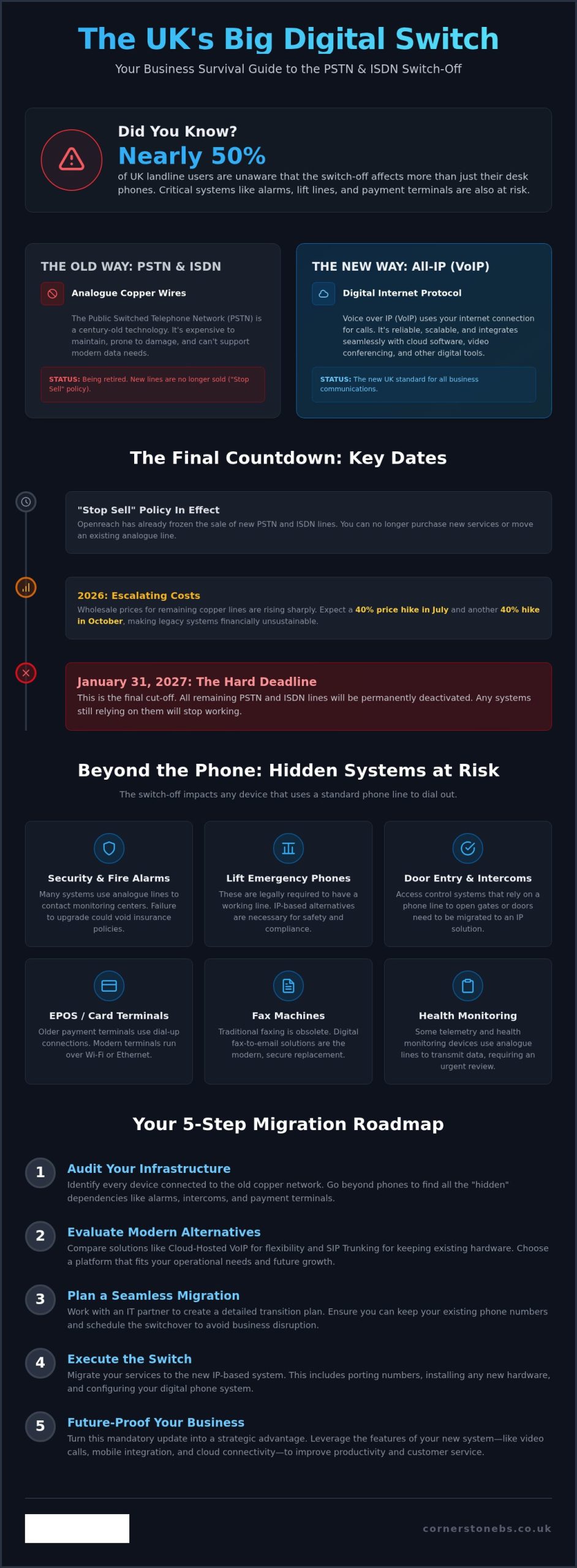
Nearly half of UK landline users still don’t realize that the PSTN switch-off affects much more than just their desk phones, making upgrading to voip from pstn a critical priority for 2026. With the final January 31, 2027 deadline looming, the pressure is on to secure your business communications before the old copper network is retired for good.
It’s natural to feel concerned about the complexity of this transition. You might worry about losing service for critical systems like lift phones and alarms, or feel frustrated by the 40% price hikes hitting legacy lines this October. We know that technical jargon like SoGEA and SIP can feel overwhelming when you’re just trying to keep your business running smoothly. As your local technology partner, we’re here to simplify the process and ensure your operations remain uninterrupted.
This guide gives you a clear, jargon-free roadmap for the 2026 landscape. You’ll discover how to migrate legacy hardware without the stress and gain the confidence to choose a scalable platform that fits your needs. We’ll show you how to turn this technical requirement into a strategic advantage that protects your business and prepares it for the future.
Key Takeaways
- Understand why the January 2027 deadline is a hard cutoff and how it impacts your existing infrastructure.
- Identify the hidden risks to your business, including alarms and lift lines, that rely on the aging copper network.
- Learn the practical steps for upgrading to voip from pstn while maintaining your existing phone numbers and hardware.
- Compare modern alternatives like SIP Trunking and cloud-hosted VoIP to find the best fit for your operational needs.
- Discover how a proactive IT partner can manage your migration to ensure total business stability without technical headaches.
Understanding PSTN and the 2026 Reality for UK Businesses
PSTN, or Public Switched Telephone Network, is the traditional copper-wire system that has powered UK communications for decades. It relies on physical lines and analogue signals to connect calls. Today, we are in the final stages of the national Big Switch Off. Openreach is decommissioning this legacy network to make room for a faster, more reliable digital alternative. Every business across the country must move from analogue signals to IP (Internet Protocol) based communication.
PSTN was the 20th-century foundation of UK voice calls that is no longer fit for a digital-first economy.
Why the Analogue Era is Officially Ending
The aging copper infrastructure is becoming a burden. It is increasingly difficult and expensive for Openreach to maintain these physical lines, especially when they are prone to weather damage and wear. Modern businesses don’t just need voice; they need data-heavy applications that analogue lines simply cannot handle. High-definition video calls, cloud software, and instant file sharing require the bandwidth of a digital network. By moving to an all-IP system, the UK aligns with global standards already adopted by other developed nations. This transition is a foundational step for businesses looking to implement modern it company solutions that drive growth and security.
The 2026 Timeline: Where Does Your Business Stand?
We have reached the final call for legacy lines. While the ultimate deadline is January 31, 2027, 2026 is the year businesses must act to avoid escalating costs and service risks. Wholesale prices for copper lines rose by 40% in July 2026, with another 40% hike expected in October. You might have already encountered the “Stop Sell” policy. This means you can no longer buy new traditional PSTN services or move an existing line. Openreach has frozen these services to ensure everyone prioritises the digital transition.
It is important to understand that both PSTN and ISDN (Integrated Services Digital Network) are being retired simultaneously. While ISDN was once the “high-speed” choice for business, it still relies on the same underlying copper infrastructure. For many, upgrading to voip from pstn is the only logical path forward. The UK PSTN switch-off isn’t just a technical update; it’s a complete change in how your business connects to the world. If you are still on copper, your connectivity is on borrowed time. Making the move now ensures you aren’t caught in the final rush as the 2027 cutoff approaches.
Beyond Voice Calls: The Strategic Impact of the Analogue Retirement
Many business owners assume the PSTN retirement only impacts their desk phones. This is a dangerous misconception. The switch-off is a complete shift in how your building functions. Any device that plugs into a standard wall socket and dials out is at risk. Failing to act creates a significant operational gap. If your business hasn’t planned for this, critical systems could simply stop working without warning once your local exchange is deactivated. Official guidance on analogue to digital landlines makes it clear that the responsibility for this transition lies with the business owner.
Viewing this as a technical chore misses the bigger picture. This transition acts as a strategic gateway. It allows for tighter integration with your managed IT support, creating a unified environment where voice and data work together seamlessly. It is also a necessary prerequisite for adopting high-performance cloud solutions that help your business scale securely. By modernising now, you turn a forced change into a competitive advantage.
Legacy Systems at Risk: The Hidden PSTN Dependencies
Connectivity as the New Business Backbone
Transitioning these complex systems requires a proactive approach to prevent downtime. If you are unsure which devices in your office still rely on copper, our team can help you audit your setup to ensure a smooth path when upgrading to voip from pstn. We focus on building a resilient network that supports your long-term growth.
Evaluating Your Options: Business VoIP, SIP Trunking, and Mobile Integration
Deciding how to move forward when upgrading to voip from pstn requires understanding the two main paths available to UK businesses. While the UK Parliament briefing on the digital switchover highlights the necessity of the change, it doesn’t dictate the specific technology you must use. Most organisations find that Hosted VoIP offers the cleanest break from the past, while others prefer the phased approach of SIP Trunking. The best choice depends on your current hardware investment and future growth plans.
Hosted VoIP: The Modern Standard
Hosted VoIP is now the modern standard for business communication. Because the system lives in the cloud, you don’t need to maintain a physical phone system in your office. This significantly reduces overheads and makes scaling your team as simple as adding a new user in a digital dashboard. You get access to advanced features like auto-attendants and call recording without the need for complex hardware. For many, this transition is a natural part of a wider Microsoft 365 migration for business UK. It allows your phone system to integrate directly with Microsoft Teams, creating a single hub for all your internal and external conversations.
SIP Trunking: For the Legacy-Invested Business
SIP Trunking is the ideal solution if you have recently invested in an expensive on-site PBX system. Instead of replacing your entire hardware setup, SIP allows you to keep your physical handsets and server while ditching the copper PSTN lines. You gain the cost savings and reliability of a digital connection without a massive upfront capital expenditure. Migrating to SIP requires expert oversight to ensure your existing hardware is compatible and secure. It acts as a bridge, allowing you to move to a digital backbone while sweating your current assets for a few more years.
Modern digital systems also solve the problem of the “tethered” worker. With Business Mobile integration, your office number follows you everywhere. By using smartphone apps, your team can make and receive calls on their business line from any location. This ensures a professional image and better work-life balance, as staff don’t have to give out personal mobile numbers. When upgrading to voip from pstn, this mobility becomes a standard feature rather than a paid extra. It turns your communication system into a flexible tool that supports your business wherever it operates.
A 5-Step Roadmap for Upgrading to VoIP from PSTN
- Audit: Identify every device in your building that uses a copper line.
- Connectivity Check: Verify your internet bandwidth can handle high-quality voice traffic alongside daily data.
- Provider Selection: Partner with a firm that understands both IT and Telecoms to avoid compatibility issues.
- Hardware Migration: Replace old handsets or use ATA adapters for legacy analogue devices.
- Staff Training: Ensure your team is comfortable with new digital features and collaboration tools.
Conducting a Full Infrastructure Audit
Success starts with a thorough audit. Many businesses have “invisible” lines they’ve forgotten about. Franking machines, panic buttons, and building monitoring sensors often rely on the same copper network as your phones. If these aren’t identified now, they will stop working the moment the PSTN is switched off. This is also the perfect time to review your existing contracts. You might find you’re still paying for lines and services that are no longer in use. Consulting with an expert IT partner allows you to map these dependencies accurately before the deadline hits.
Testing and Quality of Service (QoS)
Once you’ve identified your hardware, you must look at your network’s performance. Voice traffic is sensitive to delays. To avoid jitter or dropped calls, your network must prioritise voice data over standard web browsing. This is known as Quality of Service (QoS). You’ll need routers and switches that support modern IP telephony standards to manage this traffic effectively. Reliability is the foundation of business stability. We always recommend planning for redundancy by implementing 4G or 5G failover. This ensures that if your primary fibre line goes down, your communication stays up.
Our proactive approach prevents switch-off downtime by handling the technical heavy lifting for you. If you want to ensure your business is fully prepared, speak to our local team of experts about managing your migration today.
Future-Proofing Business Communications with Cornerstone
Choosing the right partner for your digital transition is as important as the technology itself. At Cornerstone Business Solutions, we provide a unified approach to IT and Comms. This eliminates the common frustration of finger-pointing between different service providers. When you are upgrading to voip from pstn, you need a team that understands how your phone system interacts with your wider network infrastructure. Our multi-award-winning team ensures your transition is proactive. We identify potential hurdles and solve them before they cause downtime for your business.
Security is a primary concern when moving voice calls to the internet. We integrate our bespoke cyber security services directly into your communication platform. This protects your IP-based voice traffic from modern threats and ensures your data remains private. We don’t believe in one-size-fits-all packages. Instead, we build technology solutions tailored to the specific operational requirements of your UK business.
The Benefit of Unified IT and Telecoms
Working with us gives you a single point of contact for all your business technology. Whether you have a query about your helpdesk or your phone line, you call one number. We specialise in Microsoft 365 migrations and cloud-hosted voice, creating a streamlined digital office where everything works together. Our proactive monitoring catches connectivity issues before they affect your business continuity. This level of oversight provides the emotional security of knowing your systems are in expert hands.
Beyond the Switch-Off: What is Next?
The 2027 deadline is just the beginning of your digital journey. Once your communication is digital, you can leverage AI and data analytics to gain better customer insights. You’ll see patterns in call volumes and customer interactions that were invisible on analogue lines. To see how these innovations are being put into practice, check out NeverMissACall.ie and their AI virtual receptionist solution. Scalability becomes your new reality. You can add new users or locations in minutes. You no longer have to wait weeks for physical line installations from Openreach.
As you navigate upgrading to voip from pstn, Cornerstone Business Solutions acts as your long-term technology partner. We focus on sustainable growth and ensuring your business remains at the forefront of modern communication. Our team stays connected to our geographical roots while delivering world-class technology. This blend of local trust and technical expertise makes us the ideal choice for UK businesses ready to embrace the digital future. We invite you to start a conversation with our experts to secure your communications today.
Securing Your Business Connectivity for the Digital Decade
The transition from copper to cloud is no longer a distant prospect. It’s a fundamental shift that protects your critical systems, from emergency lift phones to modern payment terminals. By acting now, you avoid the rush of the January 2027 deadline and the sharply rising costs of legacy lines. upgrading to voip from pstn isn’t just about avoiding a service cutoff; it’s about building a scalable foundation for future growth.
As a multi-award-winning UK IT provider with over 15 years of business technology excellence, we understand the nuances of this migration. Our status as Cisco and Microsoft Gold Partners ensures your transition is handled with the highest level of technical expertise and care. We’re ready to help you navigate this change with confidence. Book a free Comms Audit with our national experts today to ensure your business stays connected. The digital future is bright, and with the right partner, your move to modern communications will be seamless and rewarding.
Frequently Asked Questions
Is the PSTN switch-off definitely happening in 2026?
Yes, the retirement of the copper network is in its final stages with a hard deadline of January 31, 2027. While 2026 is the final full year for transition, Openreach has already implemented stop-sell orders across the country. Businesses remaining on legacy lines will face significant wholesale price increases in October 2026. We recommend completing your migration as soon as possible to avoid potential service loss and engineer shortages.
Will my existing business phone numbers change when I move to VoIP?
You can keep your existing business phone numbers when upgrading to voip from pstn through a process called number porting. It is vital that you don’t cancel your old analogue contracts until the porting process is complete, or you risk losing your number forever. Our team manages this transition for you, ensuring your customers can still reach you on the familiar digits they’ve used for years without any interruption.
What happens to my business alarm system after the PSTN switch-off?
Traditional alarm systems that use analogue diallers or red-care signalling will stop working once the copper network is deactivated. These systems rely on the specific voltage of an analogue line to send alerts to monitoring centres. To stay compliant with your insurance policy, you’ll need to upgrade to an IP-based signalling unit. We can help you identify these hidden dependencies during a full audit to keep your premises secure.
Do I need to buy all new handsets for a digital phone system?
Not necessarily, though modern IP handsets offer the best features and audio quality. If you want to keep your existing analogue phones, you can use Analog Telephone Adapters (ATAs) to connect them to your new digital network. However, many of our clients find that switching to softphones on laptops or mobile apps is a more flexible solution. We’ll help you decide if new IT hardware is a better long-term investment for your business.
Can I still use my traditional fax machine on a digital line?
You can use an ATA adapter to connect a physical fax machine, but results can be inconsistent due to how digital lines compress data. We usually recommend moving to a cloud-based e-fax service instead. This integrates perfectly with your Microsoft 365 environment and allows you to send or receive faxes via email. It’s a more reliable, secure, and cost-effective way to handle documents without needing paper, toner, or a dedicated line.
What is the difference between PSTN, ISDN, and VoIP?
PSTN is the old analogue network using copper wires for basic voice calls. ISDN was a digital upgrade that still used those same copper lines to carry more data. VoIP, or Voice over IP, bypasses the copper network entirely by sending your voice as data over your broadband. Since PSTN and ISDN are being retired due to their age, VoIP is the only future-proof choice that offers the scalability your business needs to grow.
How much bandwidth does a standard VoIP call actually use?
A standard high-quality VoIP call uses roughly 100kbps of bandwidth, which is a very small fraction of a modern fibre connection. The key isn’t just the amount of data, but how your network handles it. You need routers that support Quality of Service (QoS) to ensure voice traffic is prioritised over standard web browsing. We audit your network infrastructure to guarantee that your calls remain crystal clear, even during your busiest office hours.
What should I do if my business is still on analogue lines in 2026?
You should start the process of upgrading to voip from pstn immediately to avoid the risk of losing service. Begin by auditing every device in your building that plugs into a phone socket, including lift phones and credit card terminals. With the 2027 deadline approaching, hardware and engineer availability will become limited. Contacting a proactive managed IT partner now will help you secure your communications before the final October price hikes take effect.
Posted on: August 20th, 2026 by Cornerstone
Imagine you’re mid-pitch with a major UK client when your screen suddenly goes black because you’ve hit the 60-minute limit on a free Microsoft Teams call. It’s a frustrating moment that can make even an established firm look like an amateur outfit. We understand that deciphering Microsoft 365 licensing often feels like a full-time job. You want to keep overheads low, but you also need a reliable platform that doesn’t hold your professional reputation hostage or leave your data in a grey area.
As a multi-award-winning Microsoft Partner, we’ve designed this 2026 guide to strip away the technical jargon and show you exactly where the free version falls short. You’ll discover how a dedicated microsoft teams phone system for business can secure your communications and scale your operations. We’ll explore the critical feature gaps, explain the latest pricing tiers from Essentials at £3.10 to Enterprise options, and provide a clear roadmap for a seamless migration. Our goal is to ensure your business continuity remains rock solid while providing the professional edge your clients expect from a modern organisation.
Key Takeaways
- While a free version of Microsoft Teams is available, it’s built for personal use and lacks the essential security and management tools required by modern UK organisations.
- Transitioning to a paid plan allows you to leverage a microsoft teams phone system for business, ensuring your communication is professional, reliable, and fully integrated.
- Free accounts pose a threat to data governance; paid Microsoft 365 tiers ensure your business retains ownership of all files and conversations when staff members move on.
- You’ll benefit from significantly higher storage limits and professional meeting features, such as recordings and transcriptions, that are unavailable in the basic free version.
- Partnering with a multi-award-winning expert helps you navigate 2026 licensing changes, ensuring your IT infrastructure supports business continuity rather than hindering it.
Is Microsoft Teams Free? The 2026 Breakdown of Versions
Yes, you can download a version of Microsoft Teams for free, but it isn’t the professional powerhouse most UK companies actually need. As of August 2026, the free tier remains strictly partitioned for personal use and small social circles. While it’s a great way to catch up with family or run a local hobby group, it creates a productivity ceiling that can stifle a growing business. We’ve seen many firms start here only to hit a wall when they need to present a polished image to a major client.
Teams Free for Personal and Home Use
The free version offers basic video calling and chat, but the constraints are significant. You’re limited to 60-minute group calls and a maximum of 100 participants. Each user receives 5GB of cloud storage, which fills up remarkably fast once you start sharing documents or high-resolution images. Crucially, this tier lacks the ability to record meetings or generate automated transcripts, features that are now standard for professional accountability. Microsoft Teams Free is a consumer-grade communication tool, not a robust business platform. Without an administrative dashboard, you can’t manage user permissions or secure sensitive company data effectively. This lack of control is a major red flag for any organisation concerned with cyber security.
The Teams Essentials Middle Ground
For those who have outgrown the free version but aren’t ready for a full Microsoft 365 suite, Teams Essentials serves as a vital bridge. Priced at £3.10 per user, per month (excluding VAT) following the July 2026 price adjustments, it significantly expands your capabilities. You get group meeting limits of up to 30 hours and can host up to 300 participants, which is plenty for most UK SMEs. It also introduces 10GB of storage and the ability to record your sessions, ensuring you never miss a vital detail from a client briefing.
This tier is often the first step toward implementing a full microsoft teams phone system for business. Unlike the free tier, Essentials includes basic technical support, providing a safety net when things don’t go as planned. It’s the minimum standard we recommend for professional freelancers and solopreneurs in 2026 who need to look credible to their clients. Relying on the free version means you’re operating without a safety harness, as you miss out on the advanced security protocols and seamless integration that makes a microsoft teams phone system for business so valuable for long-term continuity. Your business deserves a setup that scales with your ambition, not one that cuts you off mid-pitch.
Teams Free vs. Paid: Comparing Features for Business Use
Choosing between free and paid versions isn’t just about the monthly bill. It’s about the tools your team needs to thrive. In 2026, the gap between consumer-grade chat and a full microsoft teams phone system for business has never been wider. While the free version looks familiar, the underlying architecture lacks the horsepower required for modern UK enterprises.
Meeting and Collaboration Limits
The 60-minute hard stop on free group calls is a risk to your professional perception. Imagine a high-stakes pitch ending abruptly because a timer ran out. Paid tiers remove this anxiety by offering 30-hour meeting durations. You also gain Together Mode, which uses AI to place participants in a shared background. This makes remote presentations feel cohesive and polished. Advanced tools like breakout rooms and webinar hosting remain exclusive to paid licenses, allowing you to run complex workshops that the free version cannot support.
Storage and File Management
With only 5GB per user, the free version fails quickly once you start sharing documents. Paid plans like Business Basic provide 1TB of storage per user. This is backed by SharePoint, which ensures your files are organised and secure. Using personal free accounts creates dangerous data silos where files are tied to individuals rather than the company. In document-heavy sectors like legal or finance, a centralised environment is essential for stability. If you’re unsure which tier fits your scale, our team can help you optimise your Microsoft 365 environment to ensure you aren’t overpaying for features you don’t need.
By 2026, AI has become the standard for efficiency. Microsoft Copilot automates meeting summaries and drafts emails, but this tool is strictly locked behind paid licenses. If your competitors use AI to save hours every week while you’re still taking manual notes, the free version becomes an expensive handicap. A professional microsoft teams phone system for business integrates these AI tools directly into your workflow. It turns your communication hub into a genuine productivity engine that keeps your team ahead of the curve.
The Hidden Risks of Using Teams Free for Your Business
While the lack of cost is tempting, the “free” label often hides significant liabilities that can quietly undermine your operations. One of the most dangerous traps is the rise of Shadow IT. When employees use personal Teams accounts for company tasks, you lose all visibility into what sensitive information is being shared. This creates a security nightmare because you cannot monitor, audit, or control the flow of data. Implementing a microsoft teams phone system for business provides the oversight you need to keep your communications within a secure, managed perimeter.
Data governance becomes a major hurdle the moment a staff member moves on. If they’ve been using a free personal account, they own that chat history and every file shared within it. You can’t simply revoke access or transfer that intellectual property to a new hire. For UK organisations, this also raises serious questions about UK GDPR compliance. Free versions rarely offer the granular data residency controls or detailed audit logs required to meet strict regulatory standards. Beyond legalities, there’s the issue of professional image. Communicating via a personal email or an “onmicrosoft.com” address signals a lack of permanence that can erode client trust before a project even begins.
Security and Administrative Control
The absence of a centralised management dashboard is a fundamental weakness of the free tier. In a professional environment, you need the ability to remote-wipe data from lost devices or instantly manage user permissions. Paid versions offer robust Multi-Factor Authentication (MFA) and advanced threat protection that the consumer tier simply cannot match. Because communication and data safety are inseparable, we strongly recommend integrating professional cyber security services alongside your Teams setup. This proactive approach ensures that your platform remains a tool for growth rather than a gateway for breaches.
The Cost of Productivity Friction
Productivity often takes a hit when staff have to juggle multiple accounts. We’ve seen teams lose hours every month simply switching between personal and professional profiles to access specific files or sync with company-wide calendars. The free tier doesn’t support shared mailboxes or the deep integration with Outlook that keeps a busy office running smoothly. Free software often costs more in billable hours lost to technical workarounds than the price of a monthly license. A microsoft teams phone system for business removes these barriers, creating a unified environment where your team can focus on their work instead of fighting with their tools.
Understanding Microsoft 365 Licensing and Teams Integration
Licensing shouldn’t feel like a puzzle. In 2026, the Microsoft 365 value stack offers a clear progression designed to match your business’s growth. We often see organisations overpaying for features they don’t use or, conversely, struggling with the limitations of the free tier when a small investment would unlock massive efficiency. As an official Microsoft Partner, we help you cut through the noise to find the exact license that fits your operational needs and budget.
Choosing the Right 2026 License Tier
Following the July 2026 price updates, UK businesses have three primary paths within the Business range. Each provides a different level of access to the microsoft teams phone system for business and the wider Office suite. Here is how they break down:
- Business Basic (£5.40 per user/month): This is the entry point for remote-first teams. It includes professional Teams features and web/mobile versions of Office apps. It’s perfect if you don’t require desktop installations.
- Business Standard (£10.80 per user/month): This is the sweet spot for most UK SMEs. You get everything in Basic plus the full desktop versions of Word, Excel, and Outlook, allowing for seamless offline work.
- Business Premium (£16.90 per user/month): We recommend this for firms handling sensitive data. It adds advanced cyber security and remote device management, which are essential for hybrid teams using various laptops and mobiles.
The Power of the Microsoft Ecosystem
Teams is far more than a video conferencing tool; it’s the central hub for your entire digital workspace. When you move beyond the free version, Teams integrates deeply with Power BI for data analysis, Planner for project management, and SharePoint for secure file storage. This unified approach eliminates the need to jump between different software providers, which saves time and reduces subscription fatigue. A well-executed Microsoft 365 migration often results in a tangible boost to team morale as technical frustrations disappear.
Future-proofing your organisation requires a cloud-first strategy that connects every department. By adopting a professional microsoft teams phone system for business, you ensure that your voice calls, chats, and documents live in one protected environment. Our managed migration process ensures zero downtime, allowing you to transition from free accounts to a professional setup without missing a single client call. If you’re ready to stop guessing which tier you need, you can speak with our experts today for a comprehensive licensing audit tailored to your business goals.
Optimising Your Business Communication Strategy
Success in 2026 requires more than just picking the right software; it requires a strategic implementation that aligns with your long-term goals. While Microsoft makes it easy to sign up for a free trial, a DIY approach often leads to fragmented systems and security gaps. Transitioning to a professional microsoft teams phone system for business is about building a digital headquarters that supports your team’s best work. We believe that technology should be a silent partner in your success, providing a stable foundation that allows you to focus on growth without worrying about technical failure.
Expert Setup and Configuration
Your journey toward a more professional setup should begin with a comprehensive IT audit. This process identifies critical gaps in your current communication tools and highlights where your security might be vulnerable. Once we understand your specific challenges, we can design a bespoke IT company solution that fits your unique operational needs. This isn’t just about software; it’s about creating a roadmap for your digital transformation in 2026 and beyond.
We invite you to have a friendly, informal conversation with our team about your technology goals. Whether you’re currently struggling with the limits of the free version or you’re ready to overhaul your entire infrastructure, we’re here to help. Our approachable experts are dedicated to simplifying complex tech so you can lead your business with confidence. Let’s discuss how we can build a more reliable, secure, and professional future for your organisation together.
Future-Proofing Your Business Communication
Choosing the right version of Teams is about more than avoiding a 60-minute call limit; it’s about the long-term security and professional image of your organisation. While the free tier works for social catch-ups, it simply cannot match the administrative control and seamless integration of a paid subscription. Moving to a professional microsoft teams phone system for business ensures your data stays within your control and your team has the tools to collaborate without friction.
As a multi-award-winning Managed IT Support provider and Certified Microsoft Partner, we take pride in delivering bespoke technology solutions that help UK businesses thrive. We’re not just a service provider; we’re a dedicated partner invested in your stability and growth. We can help you navigate the complexities of 2026 licensing to ensure you get the maximum value from your investment.
Don’t let technical workarounds hold your team back. Book a Free Microsoft 365 Consultation with Cornerstone Business Solutions today and let’s discuss how to build a communication strategy that works as hard as you do. We’re ready to help you take the next step toward a more secure, scalable future.
Frequently Asked Questions
Is there a free version of Microsoft Teams for business use in 2026?
Yes, a free version exists in 2026, though it’s primarily designed for personal use and small social groups rather than professional organisations. While you can sign up with a personal email, you’ll lack the administrative controls and security features essential for a growing company. For a true microsoft teams phone system for business, you’ll need to look at the paid tiers that offer the stability and professional features your clients expect.
How long can a meeting last on the free version of Teams?
Group meetings on the free version of Microsoft Teams are capped at exactly 60 minutes. Once you hit this limit, the call will end automatically, which can be disruptive during important client presentations. If you need longer sessions, moving to Teams Essentials or a Business subscription extends this limit to 30 hours. This ensures your meetings can run as long as necessary without the anxiety of a sudden cut-off.
Can I record meetings in the free version of Microsoft Teams?
No, the ability to record and transcribe meetings is not available in the free version of Teams. This feature is a significant divider between consumer and professional tiers. To capture your sessions for future reference or compliance, you’ll need at least a Teams Essentials license. Professional recording tools are foundational for business continuity, allowing your team to review vital project details and maintain accurate records of every client interaction.
Do I need a Microsoft 365 subscription to use Teams professionally?
You don’t strictly need a full Microsoft 365 suite, as Microsoft offers Teams Essentials as a standalone professional option. However, most UK businesses find that a full subscription provides much better value. Tiers like Business Basic or Standard integrate your microsoft teams phone system for business with Outlook, SharePoint, and 1TB of cloud storage. This creates a unified digital environment that’s far more efficient than using disconnected standalone applications.
What is the difference between Teams Free and Teams Essentials?
The main differences lie in meeting limits, participant capacity, and support. Teams Free limits you to 60 minutes and 100 participants, while Essentials allows meetings up to 30 hours with 300 people. Essentials also includes 10GB of storage and professional technical support, which is entirely missing from the free tier. For a small monthly fee of £3.10, Essentials provides a much more reliable foundation for your daily business communications.
Can I use my own company domain name with the free version of Teams?
No, the free version of Teams doesn’t support custom company domains for your email addresses. You’ll typically be stuck using a personal address or a generic “onmicrosoft.com” identity, which can look unprofessional to potential partners. To use your own business domain, such as @yourcompany.co.uk, you must upgrade to a paid Microsoft 365 plan. This ensures your brand identity is consistent across every email and meeting invitation you send.
How many people can join a free Microsoft Teams meeting in 2026?
In 2026, the free version of Microsoft Teams allows a maximum of 100 participants to join a single meeting. While this might suffice for internal huddles, it lacks the scalability required for larger webinars or company-wide announcements. Upgrading to a professional tier increases this capacity to 300 participants. For even larger events, Enterprise licenses support thousands of attendees, ensuring your infrastructure can grow alongside your audience without technical bottlenecks.
Is Microsoft Teams Free secure enough for sharing confidential business files?
While Teams Free uses basic encryption, it lacks the advanced administrative controls required for true business security. You cannot remote-wipe data from lost devices or enforce strict Multi-Factor Authentication policies across your team. This creates a vulnerability for confidential files. Professional tiers offer robust protection and audit logs, ensuring your intellectual property remains secure. We always recommend a managed security approach to protect your organisation from increasingly sophisticated cyber threats.
Posted on: August 3rd, 2026 by Cornerstone
With over 2.4 million lines still to be migrated as of May 2026, the countdown to the UK’s digital transformation is no longer a distant concern; it’s a pressing operational reality. We know that technical jargon like PSTN, ISDN, and VoIP can feel like a maze, especially when you’re worried about the potential for pstn switch off business disruption or hidden costs for replacing legacy hardware. It’s natural to feel a bit of pressure as Openreach increases wholesale prices throughout 2026 to encourage the move away from our ageing copper network.
This guide cuts through the noise to help you understand why the Public Switched Telephone Network is retiring and how you can safeguard your company. As a dedicated local partner, we’ll provide a clear roadmap for migrating to modern digital solutions like VoIP, positioning this change as a tool for growth rather than just a technical chore. You’ll gain the peace of mind that comes from knowing your essential systems, including alarms and payment terminals, are ready for the January 31, 2027 deadline. Let’s look at how we can turn this transition into a foundational win for your business stability.
Key Takeaways
- Understand why the UK is retiring the traditional copper-wire network and how the January 2027 deadline affects your current setup.
- Identify the “hidden” systems like alarms and lift phones that could fail during the pstn switch off business transition if you don’t audit them properly.
- Explore how digital alternatives like Business VoIP do more than just replace old lines; they provide a foundation for better productivity and scalability.
- Follow our 5-step migration roadmap to secure your infrastructure and avoid the rising costs of legacy lines throughout 2026.
What is the Public Switched Telephone Network (PSTN)?
The Public Switched Telephone Network (PSTN) is the traditional analog telephone system that has powered the UK for over a century. It’s the familiar network of copper wires, telegraph poles, and local exchanges that most of us grew up with. Originally built to carry nothing but voice, it eventually became the unexpected backbone for early internet dial-up and basic data services. Today, the PSTN is the analog legacy network being replaced by digital IP technology. Understanding this transition is essential for any pstn switch off business strategy, as the infrastructure we’ve relied on for decades reaches its final chapter.
How the PSTN Works
When you make a call on a traditional line, your voice travels as an analog signal through copper wires to a local exchange. This system uses circuit switching. This means the network creates a dedicated physical path between you and the person you’re calling for the entire duration of the conversation. While this was revolutionary in the early 20th century, it’s incredibly inefficient by modern standards because it ties up resources regardless of how much data is being sent. You might also have heard of ISDN (Integrated Services Digital Network). While ISDN was a digital upgrade that allowed for faster data and clearer voice, it still relies on the same aging copper lines. This means it’s also part of the retirement plan.
Why PSTN is Reaching End-of-Life
The primary reason for the switch-off is simple: the copper infrastructure is wearing out. Openreach finds it increasingly difficult and expensive to maintain a network that was never meant to last this long. Modern businesses demand high-speed data and seamless connectivity that analog lines physically cannot handle. The physical limits of copper simply cannot keep pace with the needs of a modern office.
Reliability is also a major factor. According to Ofcom’s Connected Nations 2023 report, PSTN incidents increased by 20% in a single year, while the hours lost to outages jumped by 60%. As spare parts for these legacy systems become obsolete, the risk to your business continuity grows. Moving to a digital setup isn’t just a requirement; it’s a proactive step to ensure your communications remain stable and secure. We see this change as an opportunity to build a more resilient foundation for your pstn switch off business planning, moving away from fragile wires toward robust, cloud-based stability.
The UK PSTN Switch-Off: What Happens in 2027?
Openreach has set the final date. January 31, 2027, marks the end of the line for the UK’s legacy copper network. This isn’t just a suggestion; it’s a mandatory shift for every business and household in the country. To successfully navigate the pstn switch off business leaders must realise that every traditional phone line must transition to a digital IP network. This is a massive national infrastructure project, comparable to the digital TV switch-over, and it requires proactive planning to avoid disruption.
Since September 2023, “stop-sell” orders have been active across many exchanges. You can no longer order new analog lines or ISDN services. This measure ensures that the number of legacy lines doesn’t grow while engineers work to migrate existing users. If your business is currently using an older system, you’re effectively on borrowed time. The network is being dismantled piece by piece, and the hardware that supports it is becoming increasingly difficult to repair.
The Timeline for UK Businesses
The process involves two clear phases. The Stop-Sell phase prevents new analog connections, while the migration phase moves existing users to digital. The 2027 deadline is the hard stop for total network withdrawal. The official government advice on Moving landlines to digital technologies highlights that this is an industry-led change aimed at creating a more reliable, modern network. It’s a collective effort to replace 19th-century technology with 21st-century capability.
Why You Should Not Wait Until the Deadline
Don’t leave it to the last minute. As we get closer to 2027, engineer availability will become scarce. Hardware lead times for routers and handsets will likely increase as demand spikes across the UK. Moving early allows for a calm, controlled transition. You’ll avoid the stress of emergency downtime and the risk of lost client calls during the busiest periods. Planning ahead is the best way to handle the pstn switch off business owners are facing, ensuring every piece of hardware is compatible and ready.
A smooth migration requires a bird’s-eye view of your entire network. This is why many local firms rely on our managed IT support to provide expert oversight. We handle the technical heavy lifting, from auditing your current lines to setting up your new digital environment. It’s about more than just phones; it’s about securing your long-term stability and ensuring your team stays connected. If you’re ready to start the conversation, our team of local experts is here to help you transition to a modern Business VoIP solution with confidence.
The Hidden PSTN Dependencies: It is Not Just About Phones
One of the biggest misconceptions we encounter is the belief that the 2027 deadline only affects the handsets sitting on your desks. In reality, the PSTN retirement is a whole-office infrastructure audit requirement that reaches far beyond simple voice calls. Many business-critical systems rely on the Public Switched Telephone Network without owners even realising it, often hidden away in plant rooms or tucked under retail counters. If these dependencies aren’t identified early, the pstn switch off business owners face could lead to unexpected security breaches or significant safety risks.
The Ofcom guide to the digital landline switch makes it clear that any device using an analog signal to dial out will be impacted. Without a physical copper path, these devices simply won’t be able to communicate with their monitoring centres or servers. It’s not just a matter of poor call quality; it’s a total loss of functionality for hardware that might be vital to your daily operations.
Common Systems Affected by the Switch-Off
Your security and safety protocols are likely at the top of the list. Intruder alarms and fire monitoring systems, particularly those using older Redcare services, are often hardwired into analog lines. When the network goes dark, these systems lose their ability to alert the authorities in an emergency. This can have serious implications for your insurance coverage and general peace of mind.
Similarly, emergency “yellow” phones in lifts and entry intercoms for buildings are frequently overlooked. These are vital for health and safety compliance, yet they often run on the same aging copper wires as your old desk phones. We also see many legacy EPOS systems and older credit card terminals that still require a dial-up connection to process transactions. A failure to update these could literally stop your ability to trade or take payments overnight.
Industrial and Remote Monitoring
Beyond the front office, the impact stretches into industrial and specialized settings. Telemetry units used in manufacturing and utilities for remote reporting often rely on PSTN to send data back to a central hub. Even fax machines, which remain a staple for secure document transfer in the legal and medical sectors, will need a digital alternative to function in a post-2027 world.
Don’t forget the smaller pieces of office hardware either. Franking machines and remote diagnostic equipment for photocopiers often use hidden phone lines for updates and billing. Because these devices dial out infrequently, it’s easy to forget they exist until they stop working. We recommend a thorough walk-through of your premises to identify every jack point and cable. Spotting these hidden links now ensures that the pstn switch off business transition remains a smooth, proactive upgrade rather than a reactive crisis.
Modern Alternatives: Transitioning to VoIP and Cloud Voice
While the retirement of the copper network might seem like a hurdle, it’s actually an invitation to upgrade your productivity. Voice over Internet Protocol (VoIP) is the primary successor to the PSTN. Instead of relying on physical wires, VoIP converts your voice into data packets and sends them over your internet connection. This shift to digital means you can finally ditch the bulky, expensive on-premise hardware that often clutters back offices. Modern cloud-hosted systems are streamlined, efficient, and built for the way we work today. Navigating the pstn switch off business requirements is simpler when you view it as a strategic tech upgrade rather than a forced change.
These digital platforms offer much more than just a dial tone. You can integrate your phone system directly with Microsoft 365 and Microsoft Teams, creating a unified workspace. Features like mobile twinning allow your office number to ring on your mobile device simultaneously. This ensures you never miss a client call, whether you’re at your desk or out on a site visit. It’s about turning the pstn switch off business challenge into a competitive advantage for your team and ensuring your communication remains a foundational element of stability.
The Benefits of Switching to Business VoIP
The transition brings immediate financial and operational rewards. You’ll see significant cost savings by eliminating traditional line rentals and reducing international call charges. Flexibility is another major win. Your team can work from home, a local coffee shop, or a client’s site while keeping their professional office number. Scalability is just as simple. You can add or remove users instantly through a web portal, avoiding the need for engineer visits or new physical line installations. This agility is vital for any growing UK enterprise.
Preparing Your Network for Digital Voice
Success in a digital-first environment depends on the strength of your foundation. A robust network infrastructure is essential for maintaining crystal-clear call quality. Without proper setup, your voice traffic might compete with large file downloads, leading to jitter or dropped calls. We often recommend SIP trunking for businesses that want to keep their existing PBX systems while still connecting to the digital world. This acts as a bridge, allowing your legacy hardware to communicate via the internet.
Ensuring your internet bandwidth can handle concurrent voice and data traffic is a vital first step. We help local businesses audit their current speeds to ensure they’re ready for the increase in digital demand. If you want to ensure your migration is handled by award-winning local experts, explore our Business VoIP solutions today to secure your company’s future and keep your operations running smoothly.
Your 5-Step PSTN Migration Strategy
Success in the digital era requires more than just swapping a handset; it’s about a total rethink of your connectivity. We’ve developed a tactical checklist to help you navigate the pstn switch off business owners are currently facing. This ensures your transition is efficient, secure, and completed well before the 2027 deadline. Each step is designed to protect your continuity and set a foundation for future growth.
- Step 1: Audit every device. Walk through your premises and identify every single item connected to a phone line. This includes the obvious desk phones, but also the “hidden” systems like intruder alarms, fire panels, and entry intercoms discussed earlier.
- Step 2: Evaluate your connectivity. Digital voice relies entirely on your internet connection. We’ll help you check your current bandwidth to ensure it can handle concurrent calls alongside your daily data needs without any loss in quality.
- Step 3: Consult the experts. Don’t try to guess your way through technical specifications. Speak with a managed provider to choose a VoIP or Cloud solution that fits your specific workflow and budget.
- Step 4: Test non-voice systems. Your lifts and alarms might need digital-compatible converters to work on the new network. Testing these early prevents safety risks and insurance headaches later.
- Step 5: Maximise your ROI through training. Once the hardware is in place, show your team how to use the new features. From mobile twinning to CRM integration, the real value lies in using the technology to its full potential.
Choosing the Right Partner
Your choice of partner is just as important as the technology itself. You need a provider that understands the intersection of telecoms and cyber security to protect your new digital lines from modern threats. Digital voice is a data service, which means it must be secured just like your email or servers to prevent unauthorised access.
Prioritise local experts who offer proactive monitoring. This ensures that any potential issues are spotted and resolved before they impact your operations. Finally, make sure your new system integrates seamlessly with your existing Microsoft 365 environment. This level of cohesion turns your phone system into a powerful productivity tool rather than a standalone silo.
How Cornerstone Simplifies the Switch
We pride ourselves on being more than just a service provider; we’re your dedicated long-term partner. Our team provides a seamless transition from legacy PSTN to robust Business VoIP, handling the technical heavy lifting so you can stay focused on running your company. We take charge of the full infrastructure audit, ensuring that no critical device is left behind in the move to digital. As an award-winning UK provider, we bring the clarity and reliability you need to move forward with confidence. Speak to our experts today for a PSTN readiness audit and let’s get your pstn switch off business strategy on the right track.
Secure Your Business Future Before the 2027 Deadline
The January 2027 deadline is approaching fast, but it doesn’t have to be a source of stress for your team. By auditing your current setup and identifying those hidden analog dependencies like lift phones and alarms, you’ve already taken the most important first step toward digital resilience. Transitioning to modern alternatives like Business VoIP isn’t just about avoiding the pstn switch off business disruption; it’s about giving your company the tools to thrive in a more flexible, connected world.
As an award-winning UK provider and certified partner with Microsoft, IBM, and Cisco, we’re here to ensure your migration is handled with expert precision. We provide proactive 24/7 system monitoring to keep your operations stable and secure during every phase of the switch. Don’t wait for the rush in 2026 to start your journey. We’d love to help you build a communication foundation that lasts for decades. Book a PSTN Readiness Audit with Cornerstone to get started today. We’re ready to help you turn this technical necessity into a lasting business win.
Frequently Asked Questions
Will my current phone hardware work after the PSTN switch-off?
Most traditional analog handsets won’t work directly with a digital line once the transition happens. While it’s sometimes possible to use an Analog Telephone Adapter (ATA) to bridge the gap, we usually recommend upgrading to modern IP handsets. These devices are designed specifically for digital voice, providing much better sound quality and access to advanced features that old hardware simply cannot support.
Do I need to change my business phone number when I switch to VoIP?
You don’t need to change your number; you can port your existing business digits over to your new digital service. This process is standard practice and ensures your customers can still reach you without any confusion or need for new marketing materials. Keeping your established number is a vital part of maintaining continuity during the pstn switch off business transition, so we handle the porting for you to keep things simple.
What happens to my internet connection if it currently runs over a PSTN line?
Your current broadband will stop working if it relies on a traditional copper phone line, such as ADSL or standard FTTC. You’ll need to migrate to a data-only connection like SOGEA or Full Fibre (FTTP). These modern connections are faster and more reliable, providing the stable foundation needed for your cloud services and digital voice calls to function without interruption or lag.
Is VoIP as reliable as the old PSTN system for business use?
VoIP is incredibly reliable for professional use, often exceeding the stability of aging copper networks when backed by a high-quality internet connection. Because digital systems aren’t vulnerable to the physical decay and weather-related issues of underground copper wires, you’ll experience fewer crackly lines. We provide proactive monitoring to ensure your network stays healthy and your communications remain a rock-solid part of your daily operations.
Can I still use my fax machine after the 2027 deadline?
You won’t be able to use a traditional fax machine directly over a digital line because analog signals don’t translate well into digital data packets. Most businesses now move to Fax-to-Email services, which are more secure and far more efficient. If your sector still requires physical faxing, you’ll need a specialized adapter, though we suggest digital alternatives to ensure your documents are transmitted reliably every time.
What is the difference between PSTN and ISDN?
PSTN is the basic analog network used for standard landlines, while ISDN was a digital upgrade that allowed for multiple channels over the same copper wires. While ISDN offered better quality and features like Direct Dialling In (DDI), it still relies on the same physical infrastructure as the PSTN. Both systems are being retired simultaneously by January 2027 to make way for a fully IP-based national network.
How much does it cost to switch from PSTN to a digital system?
The cost of switching depends on your current infrastructure and how many users you need to migrate. While there might be an initial investment in new IP handsets or network upgrades, most businesses find that monthly operational costs actually decrease. You’ll save by removing expensive line rentals and benefiting from lower call rates. We’ll provide a clear, benefit-driven breakdown of the long-term savings during our initial readiness audit.
What should I do if my lift or alarm system uses a phone line?
Contact your equipment provider immediately to check if your hardware is digital-ready. Many older lift phones and intruder alarms rely on the constant voltage of an analog line to function. You might need to install a GSM unit or a digital-compatible interface to maintain safety standards. Addressing this now is essential for your safety compliance and ensures your pstn switch off business planning covers every critical system on your premises.
Posted on: July 21st, 2026 by Cornerstone
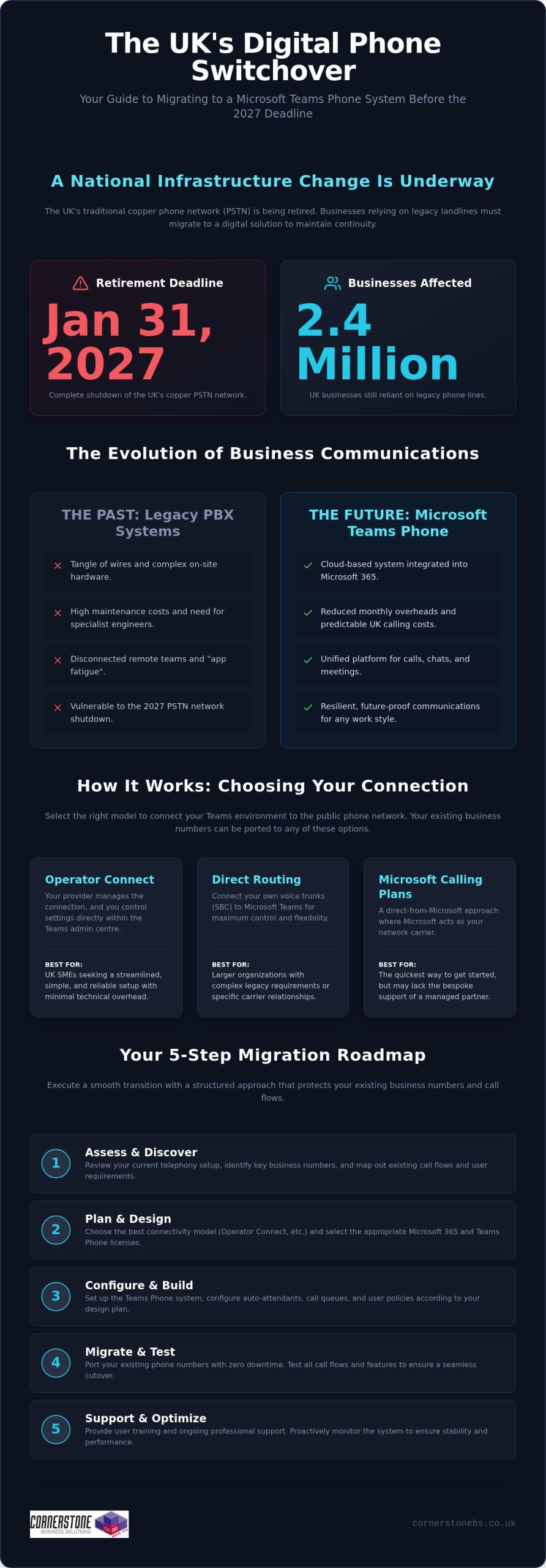
With the UK’s copper phone network scheduled for complete retirement on January 31, 2027, 2.4 million businesses are still searching for a reliable path forward. It’s a daunting deadline, especially when you’re already dealing with the high costs of traditional landlines and the frustration of disconnected remote teams. If you’ve found yourself managing a messy mix of communication vendors, you know it’s a drain on both your time and your budget. Implementing a microsoft teams phone system uk strategy isn’t just about avoiding the switch-off; it’s about finally bringing your calls, chats, and meetings into one seamless workspace.
We understand that changing your core infrastructure feels like a major hurdle. You want a solution that offers predictable UK calling costs and the security of a platform your team already knows. In this 2026 guide, we’ll show you how to transform your business communications into a cloud-based powerhouse that reduces monthly overheads. We’ll walk through the essential steps to migrate your existing numbers and explain how a unified system creates the stability your business needs to grow. It’s time to move beyond legacy hardware and embrace a communication style that works as hard as you do.
Key Takeaways
- Prepare for the 2027 PSTN switch-off by transitioning your legacy hardware to a resilient, cloud-based platform.
- Choose the best connectivity model for your microsoft teams phone system uk to balance technical flexibility with ease of management.
- Reduce monthly overheads and simplify your vendor list by integrating calls, chat, and meetings into one familiar interface.
- Execute a smooth migration using a structured five-step approach that protects your existing business numbers and call flows.
- Shift your telephony from a basic utility to a strategic asset with professional support and proactive system monitoring.
The Evolution of UK Business Telephony: Why Teams Phone is Non-Negotiable
The era of the dusty phone closet is officially coming to a close. For most UK businesses, the traditional Private Branch Exchange (PBX) was once a tangle of wires and high maintenance costs. Today, we’ve moved toward a software-defined model that prioritizes agility. A microsoft teams phone system uk implementation replaces that physical hardware with a cloud-based solution built directly into your Microsoft 365 ecosystem. It’s not just a new way to dial a number. It’s a fundamental shift in how your business stays reachable. By hosting your telephony in the cloud, you eliminate the need for expensive on-site engineers and hardware that dates the moment it’s installed.
The Impact of the UK PSTN Switch-Off
We’re currently in the final stretch of a massive national infrastructure change. The UK’s copper Public Switched Telephone Network (PSTN) will shut down completely on January 31, 2027. Recent data suggests that 2.4 million businesses are still reliant on these legacy lines. If you wait until the final months of 2026 to migrate, you’re taking a significant gamble with your business continuity. Lead times for digital installations will likely grow as the deadline nears, and support availability from providers will tighten. Moving to a cloud-based system now ensures your handsets don’t simply stop working when the network goes dark. It’s about future-proofing your operations today so you don’t have to scramble tomorrow.
Unified Communications: More Than Just a Dial Tone
Modern business requires more than just a voice connection; it requires total integration. We see many local firms struggling with “app fatigue,” where teams jump between multiple different platforms for chat, video, and file sharing. By adopting Microsoft Teams as your primary phone system, you consolidate these tools into one national infrastructure. This isn’t just about technical efficiency. It’s about the emotional security of your workforce. Knowing your team remains connected whether they’re in a city-centre office or working from home provides essential peace of mind. This transition is a core part of a modern it company solution that prioritizes stability. When your voice calls live in the same place as your project files, your business moves faster and more reliably.
The transition to a microsoft teams phone system uk strategy allows you to stop worrying about connectivity and start focusing on growth. It turns your telephony from a confusing utility bill into a strategic asset. As your long-term partner, we’ve seen how this clarity transforms day-to-day operations for small and medium-sized enterprises across the country.
How Microsoft Teams Phone System Works: Connectivity Options
Understanding how a microsoft teams phone system uk actually connects to the outside world is the first step toward a successful setup. You don’t need to be a technical genius to make the right choice, but you do need to understand the “pipes” that carry your voice data. One of the most common questions we hear from local business owners is about their existing phone numbers. Rest assured, number porting allows you to keep your established UK business presence while moving to a more modern infrastructure. This transition is a key part of navigating the future of landline calls as traditional networks fade away.
Operator Connect vs. Direct Routing
Choosing your connection method defines your daily management experience. Operator Connect has become the preferred choice for many UK SMEs because it’s streamlined. Your preferred provider manages the connection, and you control the settings directly within the Teams admin centre. It’s simple, fast, and reliable. For larger organizations with complex legacy requirements, Direct Routing offers maximum flexibility. It allows you to connect your own voice trunks, though it requires more technical oversight. Finally, Microsoft Calling Plans offer a “direct from the source” approach. This is often the quickest way to get started, but it might lack the bespoke support and regional expertise that a local partner provides.
Licensing Requirements Simplified
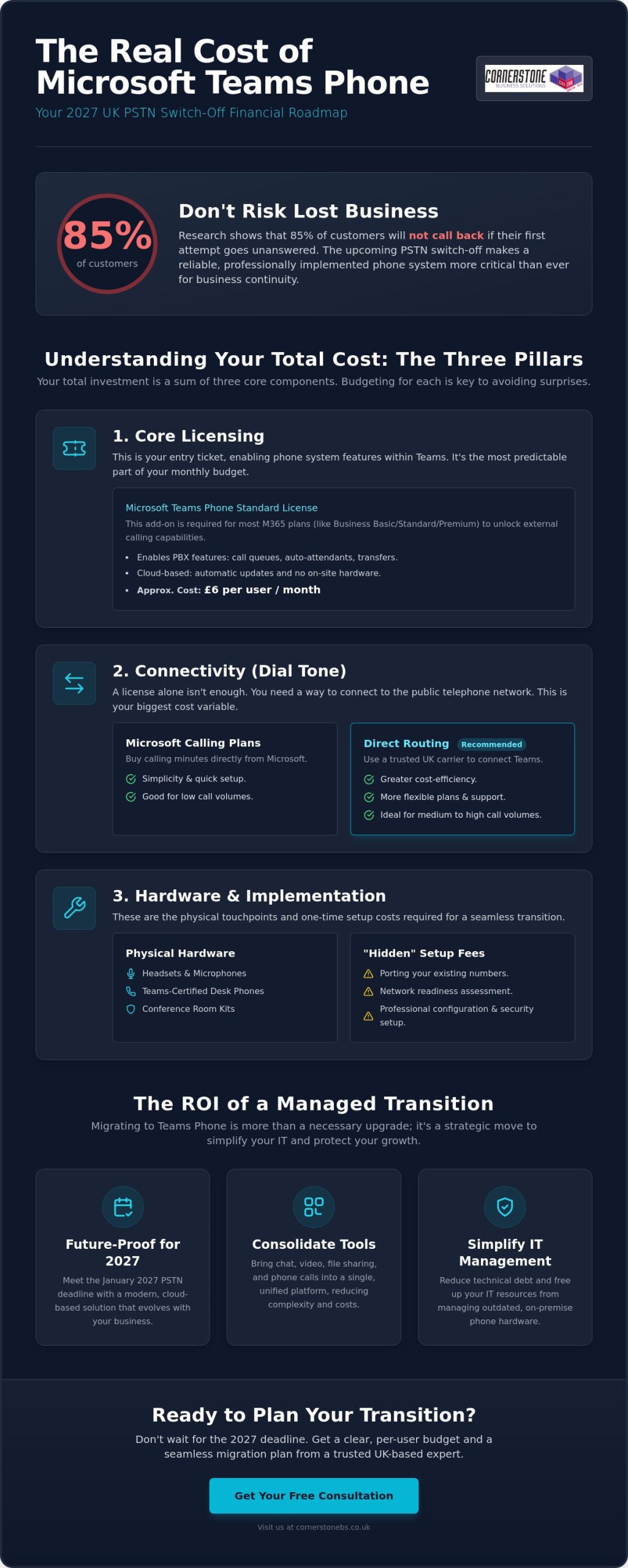
Getting your licensing right ensures you aren’t overpaying for features you don’t use. If your team is on Microsoft 365 Business Basic or Standard, you’ll typically need the Teams Phone Standard add-on. However, users on the E5 plan often find these features are already included. It’s worth having an expert audit your current Microsoft license usage to identify potential savings. We often find businesses paying for redundant services simply because their licensing hasn’t been reviewed in years. A quick conversation with our team can help you optimise your subscription costs before you begin the rollout.
Call quality isn’t just about the software; it’s about the foundation. To ensure crystal-clear audio, your business needs a robust cloud environment. Without a stable internet connection and proper network configuration, even the most advanced microsoft teams phone system uk will struggle. We focus on building that strength from the ground up, ensuring your voice calls are prioritised over standard web traffic. This proactive approach prevents the jitter and dropped calls that frustrate clients and staff alike.
Key Benefits of a Microsoft Teams Phone System in the UK
Transitioning to a microsoft teams phone system uk provides far more than just a replacement for your outgoing copper wires. It unlocks a level of operational agility that traditional hardware simply cannot match. You stop paying for physical infrastructure that sits idle in a closet and start using a communication tool that grows alongside your business. This shift turns your telephony into a proactive asset, ensuring your team stays reachable while keeping your overheads under control.
Financial Efficiency and Scalability
Moving from a CapEx to an OpEx model is a significant win for local business owners. Instead of sinking thousands into hardware that depreciates the moment it’s installed, you move to a predictable subscription. This flexibility allows you to scale user seats up or down instantly. If you expand your team or open a new branch, you don’t need to wait for a technician to install new lines. We also see a sharp reduction in IT helpdesk tickets after the switch. Because the interface is the same one your team uses for daily chat and meetings, the learning curve is nearly flat. This familiarity reduces the hidden costs of training and internal support, letting your staff focus on their actual work.
Empowering the Hybrid Workforce
Your team needs to maintain a professional image regardless of their location. With a microsoft teams phone system uk, a single business number follows an employee across their laptop, mobile app, and desk phone. Your clients see a consistent national presence rather than a fragmented collection of personal mobile numbers. This setup also provides vital business continuity. If a local network outage hits your main office, your staff can switch to mobile data and continue taking calls without missing a beat. It’s about providing the emotional security of a stable connection, ensuring that your customers can always reach a friendly, expert voice when they need it most.
Planning Your Migration: 5 Steps to a Successful Transition
Moving your business to a microsoft teams phone system uk requires a structured approach to ensure no client is left in the dark. It isn’t a simple case of flipping a switch. A successful migration is a journey that balances technical precision with the human element of your workforce. By following a proven roadmap, you can avoid the common pitfalls that lead to downtime or frustrated staff. We believe in getting it right the first time, turning a complex technical shift into a smooth operational upgrade.
The Audit and Discovery Phase
Every successful rollout begins with a deep dive into your existing setup. You need to identify more than just the handsets on your desks. Many UK businesses possess “hidden” phone lines for lifts, intruder alarms, or legacy fax machines that often go overlooked. These critical services must be addressed before the PSTN switch-off renders them useless. We also recommend mapping your current customer journey. How do people currently move through your phone menu? Evaluating your existing IT hardware for Teams compatibility at this stage prevents unexpected costs later. This audit ensures your new system mirrors your best business practices while stripping away redundant expenses.
Managing the UK number porting process is perhaps the most delicate step. You’ve spent years building your brand, and your phone number is a key part of that identity. We coordinate closely with existing providers to ensure your numbers move across without a second of downtime. Once the numbers are secured, we configure your call queues and auto-attendants. This ensures that even during peak times, your callers are greeted professionally and routed to the right expert immediately. Emergency routing is also prioritised, ensuring your team can always reach help when it matters most.
Ensuring User Adoption
Technical setup is only half the battle. Your team needs to feel confident using their new tools to truly see the benefits. A robust adoption program introduces staff to helpful features like “Consult then Transfer,” which allows for smoother handovers between departments. “Voicemail to Email” ensures no message is missed, even when your team is on the road. We also place a heavy emphasis on wellbeing. In a mobile-first world, staff can set “Quiet Hours” to protect their personal time. This balance ensures that while your business is more reachable than ever, your employees remain focused and energized. If you’re ready to start your journey, contact our local experts today for a tailored migration plan.
A microsoft teams phone system uk strategy is most effective when it feels like a natural extension of your team’s workflow. By focusing on these five steps, you move beyond basic connectivity and toward a truly unified communication culture. We’re here to guide you through every stage, providing the regional expertise and proactive support your business deserves.
Why Partner with a Managed IT Expert for Teams Phone
Telephony is no longer a standalone utility that lives on a separate bill. It’s a vital component of your digital infrastructure. Managing a microsoft teams phone system uk rollout requires more than just a software license; it demands a holistic approach that ensures your voice calls are as secure and reliable as your data backups. By shifting your perspective from a simple “dial tone” to a comprehensive it company solution, you gain the stability needed for long-term growth. We position ourselves as more than a service provider. We’re your dedicated long-term partner in a rapidly changing landscape.
Security isn’t an afterthought in a modern office. We integrate your phone system into your wider cyber security services strategy. This protects your business from modern threats like toll fraud, where unauthorized users hijack your lines to make expensive international calls at your expense. Our multi-award-winning expertise ensures your system maintains 99.99% uptime, giving you the confidence that your customers can always reach you. This level of resilience is only possible through proactive management and a deep understanding of cloud infrastructure.
Beyond the Initial Setup
A successful launch is just the beginning of our journey together. We provide ongoing optimization of your call data and cost reporting, helping you understand exactly how your team communicates. Regular security audits keep your system hardened against evolving threats. Perhaps most importantly, partnering with an expert gives you a single point of contact for all your communication needs. You don’t have to chase different vendors for internet, hardware, or phone issues. We handle it all under one roof, providing a seamless experience that respects your time and reduces operational friction.
The Cornerstone Approach
We take immense pride in our regional identity. That approachable, community-focused face is backed by national-scale reliability and industry-leading accolades. We’ve spent years simplifying complex technical concepts for UK business leaders because we believe technology should empower you, not overwhelm you. Our team provides 24/7 proactive monitoring and a national helpdesk ready to support your staff whenever they need it. This isn’t just about technical support; it’s about providing the emotional security that comes from knowing your business is in safe hands.
We invite you to a “no-jargon” conversation about your 2026 communication goals. Let’s discuss how a microsoft teams phone system uk can be tailored to your specific needs while maintaining the regional warmth you value. Our proactive attitude ensures your business stays ahead of the curve, turning technical challenges into competitive advantages.
Secure Your Business Communications for 2026 and Beyond
The transition to a digital infrastructure is no longer a choice for UK enterprises. By implementing a microsoft teams phone system uk, you’re doing more than just beating the PSTN switch-off deadline. You’re giving your team a single, secure space for every call and meeting while stripping away the unnecessary costs of legacy hardware. This shift provides the flexibility your hybrid workforce needs and the predictable overheads your budget requires. It’s about turning a technical necessity into a strategic advantage for your entire organization.
Success in this transition depends on having a partner who understands both the technical complexity and your specific business goals. As a specialist Microsoft 365 partner and multi-award-winning IT support provider, we bring national UK coverage with a proactive, regional approach. We’re here to ensure your migration is seamless and your uptime is guaranteed. It’s time to stop managing multiple vendors and start focusing on your growth. Book a free Microsoft Teams Phone consultation with our national experts today to start your no-jargon conversation. Let’s build a more connected future for your business together.
Frequently Asked Questions
Can I keep my existing UK business phone numbers with Microsoft Teams?
Yes, you can keep all your current numbers through a process called number porting. We manage the coordination with your existing provider to ensure your established business identity moves to the cloud without any downtime. This ensures your customers can always reach you on the numbers they already know and trust.
Do I need special desk phones to use Microsoft Teams Phone?
No, you don’t need physical desk phones to make or receive calls. The system works perfectly on laptops, tablets, and smartphones via the Teams app. However, if your team prefers a traditional setup, we can provide Teams-certified handsets that plug directly into your network. This flexibility allows you to tailor the workspace to your staff’s preferences.
What happens to my phone system if the internet goes down?
Your business stays connected even if your office internet fails. Because the system is cloud-based, calls automatically failover to the Teams mobile app on your staff’s smartphones using 4G or 5G data. This built-in disaster recovery ensures you never miss a vital client call due to local connectivity issues or power cuts.
Is Microsoft Teams Phone cheaper than a traditional VoIP system?
It often provides significant cost savings by consolidating your communication tools into a single subscription. You eliminate the need for separate line rentals and maintenance contracts for a standalone PBX. By adopting a microsoft teams phone system uk strategy, you leverage your existing Microsoft 365 investment to reduce monthly overheads and simplify your vendor management.
How long does it take to migrate a UK business to Teams Phone?
A typical migration takes between two to four weeks, depending on the complexity of your call flows. The timeline is usually dictated by the number porting process with your current carrier. We handle the technical configuration and staff training in the background so your business is ready to switch over the moment your numbers are released.
Does Microsoft Teams Phone support emergency 999 calls?
Yes, it fully supports emergency 999 and 112 calls within the UK. The system includes dynamic location routing, which provides your physical address to emergency services automatically. We prioritise this configuration during your setup to ensure your business remains compliant with safety regulations and your team stays protected at all times.
What is the difference between a Teams Meeting and a Teams Phone call?
Teams Meetings are for internal collaboration or scheduled video calls, while Teams Phone allows you to dial any external landline or mobile number. It adds a traditional dial pad to your app and assigns you a dedicated business number. This turns your existing microsoft teams phone system uk into a complete replacement for your old office hardware.
Can I record calls for training and compliance on Teams Phone?
Yes, the system includes robust recording features for quality assurance and regulatory compliance. You can record calls with a single click or set up automated recording for specific departments. These files are stored securely within your Microsoft 365 environment, making it easy to review conversations for training or to meet industry auditing requirements.
Posted on: June 26th, 2026 by Cornerstone
With the UK’s Public Switched Telephone Network (PSTN) set to permanently switch off in January 2027, over 26 million users worldwide have already migrated to Microsoft Teams Phone to keep their businesses connected. It’s completely natural to feel a bit overwhelmed by the technical jargon surrounding this transition. Between various licenses, calling plans, and connectivity methods, trying to pin down the actual Microsoft Teams phone system cost UK can often feel like chasing a moving target. You need a reliable system that works without fail, especially since research shows 85% of customers won’t call back if their first attempt goes unanswered.
We’ve created this guide to strip away the complexity and provide a transparent look at the total cost of ownership for 2026. Our goal is to help you build a clear, per-user budget that makes sense for your specific business size and goals. We’ll break down the differences between Direct Routing and Calling Plans, highlight the hidden implementation costs you need to watch out for, and provide a practical roadmap for a seamless transition that protects your business continuity and growth.
Key Takeaways
- Learn how to navigate the three-tier pricing structure to understand the true Microsoft Teams phone system cost UK beyond the basic license fee.
- Compare the simplicity of Microsoft Calling Plans against the cost-efficiency and flexibility of Direct Routing through a trusted UK carrier.
- Spot hidden implementation fees early by budgeting for critical steps like number porting and ensuring your office network is voice-ready.
- Discover how consolidating your communication tools into one platform reduces technical debt and simplifies your long-term IT management.
- Gain a clear roadmap for the 2027 PSTN switch-off to protect your business continuity without overspending on unnecessary features.
Understanding the Components of Microsoft Teams Phone System Costs
The January 2027 deadline for the UK PSTN switch-off is approaching fast. It’s a hard stop for traditional analogue lines. This shift forces every business to reconsider how they handle voice calls. Copper lines and rigid maintenance contracts are becoming relics of the past. By moving your telephony to the Microsoft Teams platform, you’re not just upgrading software; you’re future-proofing your business infrastructure. However, the Microsoft Teams phone system cost UK isn’t always a single figure on an invoice. It’s a modular structure designed to scale. You pay for what you use, but you must account for every layer of the stack to avoid surprises. We’ve seen many businesses focus only on the license, only to realize later that connectivity and setup require their own budget.
The Three Pillars: Licenses, Connectivity, and Hardware
Think of your phone system in three distinct layers. The license is your entry ticket. It enables the software features within Teams, like call transfers, auto-attendants, and voicemail. However, a license alone doesn’t give you a dial tone. That’s where connectivity comes in. You can choose to buy minutes directly from Microsoft or connect through a specialist UK carrier using Direct Routing. This choice is often where the biggest cost variations happen. If your team makes a high volume of calls, a third-party carrier often provides better value than standard plans.
Finally, don’t forget the physical touchpoints. While many staff are happy using a laptop with a headset, others might require dedicated desk phones or conference room kits. Teams-certified hardware ensures call quality and reliability. We also recommend a professional services layer for configuration. This covers the initial porting of your existing UK numbers and the security setup. It ensures your team hits the ground running without technical hiccups or dropped calls during the transition.
Microsoft 365 vs. Office 365: Where Does Teams Phone Fit?
The licensing landscape can be a bit confusing at first glance. Most UK small and medium enterprises use Microsoft 365 Business Basic, Standard, or Premium. These plans are fantastic for collaboration, but they don’t include telephony features by default. You’ll need to add the “Teams Phone Standard” license to these tiers to unlock the dial pad. It’s a simple add-on, but it’s a critical component of the total Microsoft Teams phone system cost UK.
For larger organizations, the Enterprise E5 license is a popular choice because it often includes the phone system natively. If you’re on E1 or E3, you’ll still need that add-on. We always look at your existing stack first. Sometimes, a simple license upgrade is more cost-effective than adding individual features. It’s about finding the balance that supports your growth while keeping your monthly budget predictable and lean. This proactive approach ensures you aren’t paying for features you don’t use while maintaining the professional authority your customers expect.
Core Licensing: Breaking Down the Monthly Subscription Fees
Licensing fees represent the most predictable part of your monthly IT budget. While connectivity costs can vary based on your call volume, your subscription fees remain fixed. This clarity is vital for UK SMEs looking to maintain tight control over their overheads. Understanding how these licenses stack up is the first step in calculating the true Microsoft Teams phone system cost UK for your specific team size.
The Microsoft Teams Phone Standard License
The Teams Phone Standard license is the absolute prerequisite for all external calling. It unlocks the professional PBX features that modern businesses expect. You get access to call queues, auto-attendants, and intelligent call transfers without needing a physical server in your office. In 2026, this add-on license is approximately £6 per user per month. This price has shown great stability, allowing you to scale your team up or down without worrying about fluctuating subscription rates.
This license acts as the digital brain of your phone system. It manages how calls are routed and how your team interacts with clients. Because it’s a cloud-based service, updates and new features are rolled out automatically. You don’t have to worry about manual software patches or hardware maintenance. It’s a “set and forget” solution that lets you focus on your business while the technology works quietly in the background.
Bundled Options: Microsoft 365 E5 and Business Voice
If your organisation is already using Microsoft 365 Business Basic, Standard, or Premium, the Phone Standard add-on is your primary path to voice connectivity. For those in the Enterprise tier, the choice becomes more strategic. The Microsoft 365 E5 license includes the phone system natively. We often find that for businesses requiring advanced security and compliance tools, moving to E5 is more cost-effective than buying individual add-ons. The older “Business Voice” bundles are a thing of the past. Microsoft has replaced them with this modular system to give you more flexibility. You can read more about aligning your licenses in our guide to Microsoft 365 migration for business UK.
Don’t overlook the common areas of your building. Lobbies, kitchens, and warehouses often need a handset but don’t require a full user account. The “Shared Device License” is a specialized, lower-cost option for these specific scenarios. It ensures every corner of your business stays connected without the price tag of a full executive seat. For larger UK organisations with over 300 users, volume licensing agreements are also on the table. These can significantly lower the per-seat Microsoft Teams phone system cost UK through negotiated enterprise agreements.
Getting your licensing right from day one prevents overspending. If you’re unsure which tier fits your current team structure, feel free to reach out for a quick chat with our local experts. We’ll help you map out a subscription plan that grows alongside your business.
Connectivity Options: Microsoft Calling Plans vs. Direct Routing
Once you’ve secured your licenses, you need to provide your team with a dial tone. This is the connectivity layer. It’s the most flexible part of the Microsoft Teams phone system cost UK, but it’s also where many businesses overspend if they don’t choose wisely. You have three main paths: Microsoft’s own plans, Direct Routing, or Operator Connect. Each has a specific profile for cost and complexity. Our role is to help you identify which path provides the strongest ROI for your current setup and future growth.
Microsoft Calling Plans: The “All-in-Cloud” Convenience
Microsoft Calling Plans are the simplest way to get started. You buy your minutes directly from Microsoft, and they act as your carrier. For a UK domestic plan, you’ll typically pay between £5 and £9 per user each month. If your team needs to reach international clients, those plans usually range from £12 to £20. There’s also a pay-as-you-go model available for low-volume users who rarely pick up the phone. It’s a quick, convenient setup that works well for very small teams.
However, convenience comes at a premium. While it’s easy to manage through the Microsoft 365 admin centre, this is often the most expensive way to run your phone system. If your staff spend significant time on the phone, the fixed minute bundles can become restrictive. You might find yourself paying for minutes you don’t use, or facing higher costs than necessary compared to the competitive rates offered by independent UK carriers.
Direct Routing and Operator Connect: Cost Savings for Larger Teams
For organisations with more than 20 users, Direct Routing is usually the most cost-effective choice. It allows you to connect Teams to a third-party UK carrier of your choice. This method offers much better rates, with calling capabilities typically costing between £2 and £8 per user per month plus competitive per-minute rates. It also lets you keep your existing telecom relationships and negotiate bespoke minute bundles that fit your actual usage patterns. It’s about having the flexibility to build a system that respects your budget.
Direct Routing does require a bit more technical setup. You’ll need a Session Border Controller (SBC) to manage the connection. Setting this up involves an initial investment, often ranging from £500 to £3,000 depending on your requirements. If you want a middle ground, Operator Connect is an excellent alternative. Approved carriers like BT or Gamma connect directly to your Teams environment. It costs between £4 and £12 per user, providing a simpler interface than Direct Routing while still offering better value than Microsoft’s standard plans. We’ll help you weigh these options to ensure your Microsoft Teams phone system cost UK stays lean and effective.
The “Hidden” Implementation Costs You Need to Budget For
Monthly subscriptions and calling minutes are only half the story. To get a true picture of the Microsoft Teams phone system cost UK, you have to look at the work happening behind the scenes. Moving your business to the cloud isn’t just a software switch; it’s a migration of your identity and your infrastructure. If you don’t budget for the initial setup, you might find yourself facing unexpected hurdles that delay your rollout or impact your call quality. We’ve seen many organisations overlook these steps, only to realize that a “cheap” DIY setup often leads to costly downtime.
Number Porting and Initial Configuration
Your business phone numbers are your lifeline. Moving your existing UK 01, 02, or 03 numbers into Teams involves a process called porting. This requires a “Letter of Authority” to be sent to your current provider. It sounds simple, but legacy carriers often charge administrative fees for this, and they can reject requests for the smallest data mismatch. These rejections often carry their own penalties, adding to the total Microsoft Teams phone system cost UK if not managed correctly.
Once your numbers are in the system, you need to build the logic that handles your calls. This includes setting up auto-attendants, hunt groups, and complex call flows. It’s about ensuring that when a customer calls, they reach the right person every time. Professional it company solutions typically include these configuration hours in a fixed project fee. This approach gives you the peace of mind that your system is built to a high standard from day one, without hourly rates spiralling out of control.
Hardware Requirements: Teams-Certified Headsets and Handsets
It’s a common misconception that old VoIP phones will work with Teams. Most legacy handsets lack the necessary firmware to communicate with the Microsoft cloud. Teams-certified hardware is different. These devices feature a dedicated “Teams Button” for instant call control and meeting access. You have a choice here based on your team’s work style. Entry-level certified headsets are a cost-effective way to get staff started, while executive desk phones represent a higher investment for those who prefer a traditional setup.
Many local businesses now opt for a “Mobile-First” strategy. By using the Teams app on business mobiles, you can eliminate the need for desk phones entirely. This significantly lowers your upfront hardware spend while giving your team the freedom to work from anywhere. However, don’t forget your office network. Voice calls are incredibly sensitive to network stability. If your broadband is struggling, your call quality will suffer. If you’re concerned about your current setup, we can help you with a full network infrastructure assessment to ensure your office is voice-ready.
Finally, budget for staff training. The internal cost of a failed rollout is high. If your team doesn’t know how to transfer a call or set their status, they’ll revert to old habits. A few hours of expert-led training ensures high adoption rates and protects your professional reputation. It’s a small investment that pays dividends in long-term efficiency and employee satisfaction.
Calculating Your ROI: Why Managed Teams Phone Systems Win
Calculating the true Microsoft Teams phone system cost UK requires looking beyond the monthly bill. It’s about the total value of a unified environment. When you consolidate your IT and communications under one managed partner, you eliminate the friction of dealing with multiple vendors. This streamlined approach reduces administrative overhead and ensures your technology stack works as a single, cohesive unit. It’s not just a phone system; it’s a foundation for business stability and growth.
Consolidating Your Comms: Eliminating Legacy PBX Costs
Several legacy expenses vanish the moment you switch to a cloud-based model. You no longer need to budget for expensive on-site maintenance contracts for physical PBX hardware or separate analogue line rental fees. Call-out charges for hardware repairs become a thing of the past. By centralising your voice, video, and chat into one secure platform, you also eliminate the hidden expense of “Shadow IT.” This happens when staff use unmanaged personal apps for business calls because their office tools are too clunky.
The productivity gains for remote UK workers are equally significant. The Teams mobile app allows your team to take their office extension anywhere, ensuring they never miss a vital client call. This level of flexibility is a core component of modern managed IT services, providing the broader support context needed to keep your team connected. It moves telephony from a static utility to a dynamic tool that supports your business continuity.
The Cornerstone Advantage: Proactive Management and Support
Navigating the modular world of Microsoft pricing shouldn’t be your full-time job. We act as your dedicated partner, simplifying the licensing and connectivity layers so you can focus on your clients. Our proactive monitoring detects potential network issues before they impact your call quality. This prevents the significant cost of downtime that often plagues DIY cloud migrations. We understand the local landscape and the specific needs of UK SMEs, ensuring your Microsoft Teams phone system cost UK remains predictable and lean.
We manage the entire porting and configuration process to ensure a right-first-time migration. You get the peace of mind that comes with a UK-based helpdesk ready to provide immediate telephony support whenever you need it. We treat your business stability as our top priority, framing technical support as a foundational element of your success. If you’re ready to see how much your business could save by modernising your comms, we invite you to Book a Comms Audit with our expert team. Let’s build a roadmap that secures your business connectivity for 2026 and beyond.
Future-Proof Your Business Communications Today
The modular nature of modern telephony means you finally have the power to pay only for what you actually use. By selecting the right connectivity path and auditing your network readiness early, you can keep your Microsoft Teams phone system cost UK lean while significantly improving your team’s flexibility. This transition is about more than just software; it’s about building a stable foundation for your business growth as the 2027 PSTN switch-off approaches. We’re here to help you get it right.
As a multi-award-winning IT provider and proud Microsoft Gold Partner, we pride ourselves on being more than just a service provider. We act as your dedicated long-term technology partner. Our expert UK-based support desk is always on hand to ensure your migration is seamless and your daily operations remain uninterrupted. We invite you to have a conversation with our local team to see how we can tailor a solution to your specific needs.
Get a Personalised Microsoft Teams Phone Quote
We look forward to helping you stay connected with your customers and your community.
Frequently Asked Questions
Do I need a special license to make external calls on Microsoft Teams?
Yes, you require the Teams Phone Standard license to make and receive external calls. This add-on enables the PBX features within your existing Microsoft 365 environment. While Enterprise E5 users have this included, most Business Standard or Premium users need to add this specific license to unlock the dial pad. It’s a straightforward subscription that ensures your team can reach any UK mobile or landline directly from their laptop or mobile device.
Can I keep my existing UK business phone numbers when moving to Teams?
You can certainly keep your existing numbers through a process called porting. We manage the transition of your current UK landline or VoIP numbers into the Microsoft cloud to ensure zero disruption for your customers. This involves a Letter of Authority and coordination with your legacy carrier. Once ported, your team can use their familiar business numbers from any location, maintaining your professional identity and local presence without needing to update marketing materials.
Is Microsoft Teams Phone cheaper than a traditional VoIP system?
In many cases, it’s more cost-effective because it eliminates the need for separate telephony hardware and maintenance contracts. By consolidating your communications, you reduce the total Microsoft Teams phone system cost UK by removing redundant line rentals and “Shadow IT” subscriptions. You benefit from a single monthly bill and a unified platform for chat, video, and voice, which significantly lowers administrative overhead and simplifies your long-term budgeting.
What is the difference between a Calling Plan and Direct Routing?
Calling Plans allow you to buy minutes directly from Microsoft, offering a simple but often more expensive all-in-one solution. Direct Routing connects Teams to an independent UK voice carrier instead. This second option typically provides more competitive rates and greater flexibility for businesses with higher call volumes. Choosing Direct Routing allows you to negotiate bespoke minute bundles and maintain existing telecom relationships while using the familiar Teams interface for all your calls.
Do I need to buy new desk phones for my staff to use Teams Phone?
You don’t necessarily need physical desk phones to use the system effectively. Many businesses adopt a mobile-first strategy using the Teams app on laptops and smartphones. However, if your staff prefer a traditional setup, you will need Teams-certified handsets. Legacy VoIP phones generally lack the firmware required to connect to the Microsoft cloud. High-quality certified headsets are often the most popular and cost-effective choice for modern, flexible working environments.
How much does it cost to add a new user to my Teams Phone system?
Adding a new user is a simple matter of assigning the appropriate licenses and a phone number. You’ll pay the monthly subscription fee for the Teams Phone Standard license plus your chosen connectivity plan. Because the system is entirely cloud-based, there are no hardware installation costs or physical wiring requirements for new starters. This scalability makes it incredibly easy to grow your team while keeping your Microsoft Teams phone system cost UK predictable and manageable.
What happens to my Teams Phone system if the internet goes down?
Your phone system remains active in the cloud even if your office internet fails. Because Teams is a cloud-native platform, calls can be automatically routed to the Teams app on your staff’s mobile devices using 4G or 5G data. This built-in disaster recovery ensures your customers can always reach you. We also recommend a network infrastructure assessment to ensure your office broadband has the necessary resilience and backup options for mission-critical voice traffic.
Is there a minimum number of users required for Microsoft Teams Phone?
There is no minimum user requirement for the system. Whether you’re a sole trader needing a professional presence or a large organisation with hundreds of staff, the platform scales to fit your needs perfectly. You can start with a single user and add more as your business expands. This flexibility allows small enterprises to access enterprise-grade telephony features, like auto-attendants and call queues, without a massive upfront investment or long-term hardware commitments.