43% of UK businesses experienced a cyber security breach or attack in the past year, according to the UK Government Cyber Security Breaches Survey 2025/26. If you’re researching business IT support, security is only part of the picture. Recurring tech issues can interrupt staff, slow customer service and leave you unsure whether your backups will work when needed.
IT support should do more than fix problems after they appear. Effective support combines responsive help with proactive care, shaped around how your organisation works. That means a clearer view of the risks, protections and ongoing support involved, as well as fewer avoidable disruptions.
This guide explains what business IT support can cover, how monitoring and maintenance help keep systems running, and how cyber security, cloud solutions and disaster recovery contribute to resilience. It also outlines what a tailored managed support relationship with Cornerstone Business Solutions can look like, so you can assess how it could support day-to-day productivity and business continuity.
Key Takeaways
See how business IT support North East searches connect to broader questions about keeping systems secure, dependable and productive.
Understand how helpdesk support and proactive monitoring can reduce disruption and help prevent recurring IT issues.
Compare in-house, ad hoc and managed support to clarify differences in ownership, continuity and cost structure.
Prepare for a move to managed support by recording your users, devices, key systems and current IT challenges.
Discover how a tailored, long-term support relationship can bring technology care in line with your organisation’s needs.
What does business IT support cover, and why does it matter?
A recurring fault, a staff member locked out of an account or uncertainty about whether important files are protected can quickly disrupt a working day. Business IT support covers both the technical help needed to resolve issues and the ongoing care that helps keep an organisation’s technology dependable. This can include user assistance, device and system maintenance, cyber security, cloud services and recovery planning.
For organisations searching for business IT support North East, an important question is what happens after the immediate problem is fixed. One-off troubleshooting addresses issues as they arise. Managed IT support adds continuing oversight and helpdesk access, giving staff a clear route to report problems while systems receive regular attention. The Managed Services model describes this ongoing approach, in contrast with relying solely on break-fix support.
Reliable technology helps staff focus on their work, serve customers and keep essential processes moving. Support cannot remove every risk or prevent every outage, but a considered approach can help an organisation respond to issues with less disruption and plan for continuity.
What is managed IT support?
Managed support combines user assistance with ongoing technical oversight. Depending on the agreed scope, it can include system monitoring, maintenance and helpdesk access. The right arrangement reflects how the organisation operates, including its users, devices, business systems and working practices.
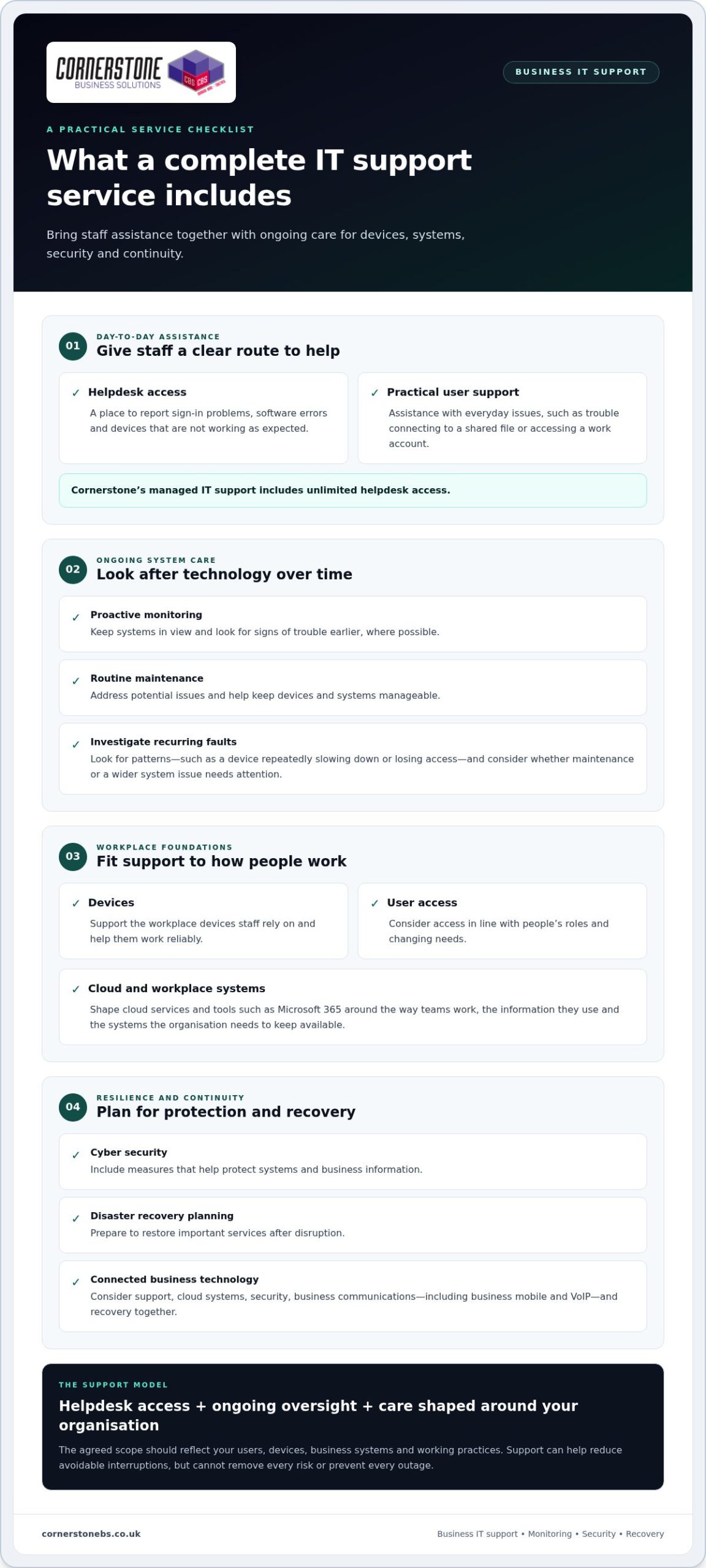
A helpdesk gives staff a route to report sign-in problems, software errors or a device that is not working as expected. With managed support, this day-to-day assistance sits alongside continuing care rather than being limited to isolated fixes. Cornerstone’s bespoke managed IT support combines proactive monitoring with unlimited helpdesk access, tailored to organisational needs.
Reactive support versus proactive support
Reactive support starts after something goes wrong. Proactive support looks for signs of trouble earlier and addresses issues where possible, helping reduce avoidable interruptions without promising that every incident can be prevented.
For example, if a team member’s device repeatedly slows down or loses access to a shared system, a reactive approach may treat each occurrence separately. A proactive approach can investigate the pattern and consider whether maintenance or a wider system issue needs attention. Addressing the cause can help the team spend less time working around faults and more time serving customers.
What should a complete business IT support service include?
A dependable service brings day-to-day help together with the care that keeps technology manageable over time. For organisations looking for business IT support North East, core elements include a staff helpdesk, proactive system monitoring, routine maintenance and support for workplace devices and user access. The scope should fit the organisation’s systems and working practices rather than assume every business has the same needs.
Helpdesk, monitoring, and IT maintenance
Staff need a straightforward way to report issues, from a laptop that will not connect to a shared file to trouble signing in to a work account. Cornerstone’s managed IT support includes unlimited helpdesk access, giving employees a route to practical technical assistance. Monitoring and maintenance complement that help by keeping systems in view and addressing potential issues earlier, where possible.
Good support also considers everyday details. Devices need to work reliably, and user access should reflect people’s roles and changing needs. Together, these measures help create a consistent environment across the tools staff rely on.
Cloud, security, and business continuity
Security and recovery planning are also important to a resilient setup. Cyber security measures help protect systems and business information, while disaster recovery planning prepares the organisation to restore important services after disruption. The NCSC’s Small Business Guide offers practical guidance for small businesses looking to strengthen their cyber security. For a deeper look at how these measures support resilience, explore cyber security services for business resilience.
Business communications, including business mobile and VoIP, can form part of the wider technology picture. Considering support, cloud systems, security, communications and recovery together helps align day-to-day tools with continuity needs. Cornerstone provides managed IT support alongside Microsoft 365, cloud solutions, cyber security, business mobile, VoIP and disaster recovery. For an overview of how support can be tailored to your organisation, visit Cornerstone’s business IT support.
How can businesses assess the value of managed IT support?
The right support arrangement depends on what your organisation needs to keep working, not simply how many computers it owns. In-house IT offers direct oversight, while ad hoc help can suit occasional issues. Managed support provides an ongoing relationship with agreed responsibilities and access to a broader range of expertise. For businesses considering business IT support North East, comparing how each model handles continuity and planning can clarify what fits.
What does a business actually need from IT support?
Start with your organisation’s day-to-day requirements: team size, critical systems, working patterns and the technical expertise already available internally. Consider which services would cause the most disruption if unavailable and how quickly staff need help to keep work moving. A small number of essential systems may need more attention than a high device count alone suggests.
A fixed, generic package can miss those priorities. A tailored scope should reflect how people work, the systems they rely on and where internal teams need additional support.
Support model
Scope and ownership
Planning and cost structure
In-house
Your organisation employs and directs its IT staff.
Planning sits internally; costs commonly include employment and associated overheads.
Ad hoc
Support is brought in to address specific issues, with your organisation retaining overall responsibility.
Usually reactive; costs may be charged by time or individual task.
Managed
An external support partner delivers an agreed, continuing scope of services.
Can include proactive planning; fees are commonly structured around an ongoing service agreement.
How do support costs and business value relate?
Managed support fees vary with the number of users and devices, the organisation’s requirements and the agreed scope. Compare like with like: identify what support covers, what remains your team’s responsibility and how the service will be reviewed as the business changes. Clear documentation helps prevent misunderstandings about included services and ownership.
Value also depends on the operational impact of unresolved, recurring issues. A low-cost response to each fault may not address the underlying cause, leaving staff to lose time to repeated disruption. Compare that with a planned service that includes continuing oversight and a clear route to support.
Planned IT support can help reduce avoidable interruptions by addressing issues earlier, giving teams more room to focus on their work. It cannot guarantee savings or prevent every problem, but it gives the organisation a clearer basis for managing technology and continuity. To explore a tailored approach, read about Cornerstone’s managed IT support.
What happens when a business moves to managed IT support?
A move to managed IT support should start with understanding how technology supports your organisation, not simply installing monitoring tools. For businesses exploring business IT support North East, a structured transition helps establish what needs attention, who is responsible and how staff will get help. The process can be broken into clear stages tailored to your systems and priorities.
Preparing systems and staff for the transition
Begin by building an accurate picture of the current environment. Useful information includes:
Users and access: staff accounts, roles and the systems each person needs.
Devices and infrastructure: computers, mobile devices, network equipment and key connections.
Business-critical systems: the platforms and services teams rely on to serve customers and complete essential work.
Existing concerns: recurring faults, known security or backup questions, and issues that regularly interrupt work.
Staff need practical guidance too. Tell them how to raise a support request, which details to include and where to go if an issue affects their work. Explaining the process can reduce confusion and help the support team understand the problem sooner.
Setting expectations for ongoing support
Once the current environment is understood, the organisation and support team can agree the service scope. Set out which systems and users are covered, how requests are submitted, what responsibilities remain with your team and how updates will be shared. Clear expectations help everyone work from the same understanding.
Support can then be established around the agreed environment and priorities. Reviewing key systems, recurring issues and upcoming changes helps keep the arrangement relevant as the organisation evolves. New starters, additional devices or a change to a core platform may affect what staff need from support.
A successful transition is more than a handover of technical information. It creates a working relationship focused on your organisation’s needs, with clear communication and a shared view of dependable support. To discuss a tailored approach, discuss your managed IT support requirements with Cornerstone.
How Cornerstone delivers business IT support as a long-term partner
Technology should support the way your organisation works, not force your team into a standard setup. Cornerstone provides bespoke managed IT support shaped around your users, systems and operational priorities. For organisations researching business IT support North East, this means looking beyond individual fixes to build a support relationship focused on day-to-day continuity and changing business needs.
A tailored support relationship for different organisations
The relationship combines unlimited helpdesk access with proactive system monitoring. Staff have a route to raise technical issues, while ongoing oversight helps the support team keep the organisation’s systems in view. This can make it easier to understand recurring needs, plan for changes and keep support aligned with how people work. It does not guarantee every fault or interruption can be avoided, but it provides a continuing framework for managing technology.
Cornerstone is a multi-award-winning IT services provider, founded in 2008. Its technology partnerships include Microsoft, IBM and Cisco. The focus is practical: understand the organisation’s needs and provide support that fits them.
Bringing connected technology services together
Managed IT support can sit alongside cloud solutions, cyber security, business communications and disaster recovery. These areas connect in everyday operations. Staff may depend on cloud platforms to access work, business communications to stay connected with customers, and recovery planning to restore important systems after disruption. Considering these needs together can help create a more coherent technology environment.
Cornerstone’s wider services let organisations consider related technology as part of their planning while keeping the support approach tailored to their priorities. As systems, teams and working practices change, an ongoing partnership can help keep those priorities in view.
Build a more dependable foundation for your business
Effective IT support is more than fixing faults. It combines a clear route for staff to get help with proactive care, security and recovery planning shaped around the way your organisation works. Choosing the right scope means looking at the systems your team relies on, the disruption recurring problems can cause and the expertise available to support them.
For businesses exploring business IT support North East, a managed relationship can bring these priorities together and adapt as needs change. Cornerstone Business Solutions provides bespoke managed IT support as a long-term partner, supporting organisations across the UK. Cornerstone is a multi-award-winning IT services provider, with technology partnerships including Microsoft, IBM and Cisco.
You do not need every technical detail worked out before taking the next step. A conversation about your systems, current challenges and business priorities can help clarify what tailored support could cover. Talk to Cornerstone about business IT support and take a practical step towards more confident, productive day-to-day technology.
Frequently Asked Questions
What does business IT support include?
Business IT support can include helpdesk assistance, system monitoring, maintenance, user and device support, and guidance on keeping technology reliable. Managed support may also connect with cloud services, cyber security, communications and recovery planning. The scope should reflect the organisation’s systems and requirements. Before support begins, agree which services are covered, who is responsible for each task, and how staff can report issues and receive help.
What is the difference between managed IT support and break-fix support?
Break-fix support generally starts when a fault occurs, while managed IT support is an ongoing arrangement that can combine issue resolution with helpdesk access, monitoring and planned maintenance. The difference is whether support mainly responds after disruption or also includes continuing oversight. Managed arrangements can vary, so agree what is included, how responsibilities are divided and how staff raise requests.
How does managed IT support help reduce downtime?
Managed IT support can help reduce avoidable disruption by combining user assistance with monitoring and maintenance. If a staff member reports a recurring sign-in or device issue, the support team can investigate it and look for causes that may affect other users. No support approach can guarantee outages will never happen. Recovery planning and clear escalation routes can help a business prepare for incidents and restore important work.
Is outsourced IT support suitable for a small business?
Outsourced IT support can suit a small business that needs technical assistance, ongoing system care or access to expertise without building a large internal IT team. The right scope depends on users, devices, systems and working practices, not just headcount. A tailored arrangement should set out how staff get help and which responsibilities are covered. It can also work alongside an existing employee or team handling internal IT tasks.
How much does business IT support cost?
Business IT support costs vary according to factors such as the number of users or devices, the services required and the complexity of the technology environment. Some arrangements use recurring fees, while project work may be scoped separately. Rather than relying on a generic figure, compare the proposed services, responsibilities and support model with your organisation’s needs. Cornerstone tailors technology solutions to each business’s requirements.
What should a business expect when moving to managed IT support?
A move to managed IT support typically begins with understanding the organisation’s users, devices, key systems and existing issues. The business and support team then agree the service scope, responsibilities and routes for requesting help. Staff should know how to report problems and what information to provide. The transition should also identify important systems and continuity needs, with expectations agreed directly rather than based on assumptions about timing or outcomes.
Switching your IT support provider shouldn’t feel like a high-stakes gamble with your business continuity. Many business owners delay a necessary change because they aren’t sure how to switch IT support providers UK without triggering a technical meltdown or exposing sensitive data. It is a valid concern. You have likely stayed with a mediocre partner longer than you should have just to avoid the headache of migration or those dreaded hidden exit fees.
We understand that anxiety, especially with the 2026 updates to the Data (Use and Access) Act and the new Cyber Essentials v3.3 standards making compliance more complex. This guide will show you how to navigate a stress-free transition to a superior, proactive IT partner without risking data loss or operational downtime. We have built our reputation as a trusted local expert by simplifying these transitions for growing businesses. You are about to discover a clear roadmap for a seamless migration that keeps your team productive and your infrastructure secure from day one.
Key Takeaways
Identify the critical warning signs that your current partnership is failing, from sluggish response times to a reactive ‘break-fix’ mindset.
Learn exactly how to switch IT support providers UK using a proven five-step roadmap that guarantees zero operational downtime.
Navigate complex contractual obligations with confidence by identifying hidden exit fees and managing notice periods effectively.
Discover why industry accolades and global vendor partnerships are essential benchmarks for selecting a reliable technology partner in 2026.
Protect your business continuity with a structured onboarding process that prioritizes data security and emotional peace of mind.
Signs It’s Time to Switch Your IT Support Provider
Your technology should work as hard as you do. If you feel like you are constantly shouting into a void when a system fails, you aren’t alone. Many UK businesses tolerate subpar service because they fear the transition process. However, staying with a provider that only reacts when things break is a recipe for stagnation. Learning how to switch IT support providers UK starts with identifying the friction points that are quietly draining your productivity and profit.
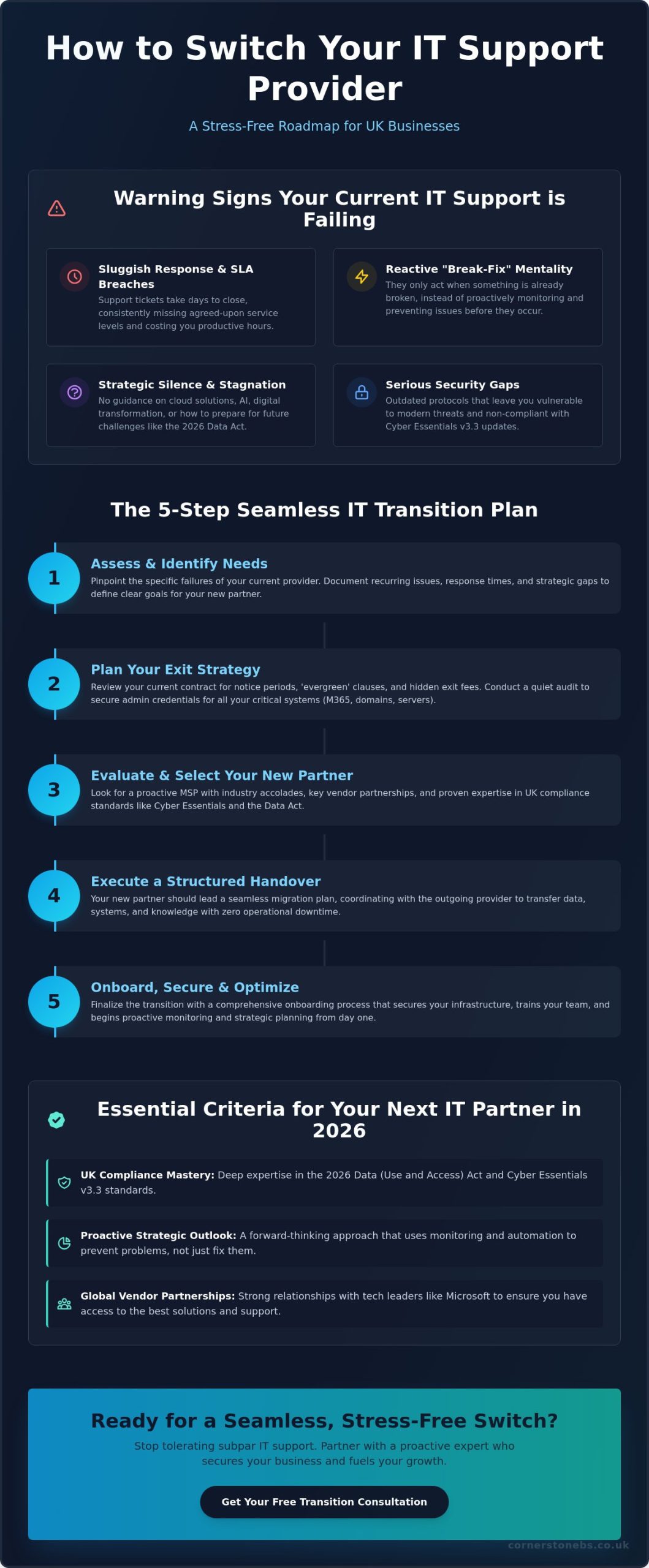
Signs of trouble often start small. Maybe it’s a support ticket that takes three days to close, or a recurring ‘glitch’ that never quite gets fixed. Eventually, these small annoyances become systemic failures. In 2026, the stakes are higher than ever. If your provider hasn’t mentioned the April 2026 Cyber Essentials v3.3 updates or helped you navigate the Data (Use and Access) Act 2025, they are leaving you legally and financially exposed. Common red flags include:
A persistent ‘break-fix’ mentality: They only show up when something is already broken, rather than preventing the issue in the first place.
SLA breaches: Slow response times that consistently miss the targets agreed upon in your contract.
Strategic silence: A total lack of guidance on cloud solutions, digital transformation, or how to use AI to drive efficiency.
Security gaps: Outdated protocols that don’t account for modern threats like deepfake vishing or sophisticated ransomware.
The Cost of Outgrowing Your Current Provider
The Proactivity Test: Is Your IT Support Reactive?
A true Managed Service Provider (MSP) doesn’t wait for your phone call to start working. They use proactive monitoring to kill problems in the cradle. In 2026, waiting for a system to fail is a high-risk strategy that leads to emergency repair costs and reputational damage. There is a massive difference between a basic helpdesk and a strategic technology partner. While a helpdesk fixes what is broken, a partner looks at your three-year growth plan and builds the infrastructure to support it. Proactive maintenance doesn’t just save time; it provides the emotional security of knowing your systems are resilient and ready for whatever comes next.
Navigating Contractual Obligations and Offboarding Requirements
Contracts shouldn’t feel like handcuffs. Yet, many business owners find themselves trapped in agreements with hidden exit fees or restrictive notice periods. Understanding how to switch IT support providers UK requires a clinical look at your current paperwork before you make a move. Start by identifying your notice period. While 30 to 90 days is standard, some contracts include ‘evergreen’ clauses that automatically renew your commitment for another year if you miss a narrow cancellation window. Spotting these traps early is the best way to ensure your exit remains on your terms.
Beyond the timeline, look for financial hurdles. Some providers charge ‘offboarding fees’ to release your data or return hardware. Knowing these costs upfront prevents budget surprises during your transition. As highlighted in the Forbes guide on Breaking Up With Your Managed Services Provider, the goal is a clean break that protects your operational integrity. If you are unsure about the fine print, our team at Cornerstone Business Solutions can help you review your current agreement to identify potential risks.
The Asset and Credentials Audit
Who actually owns your digital assets? You’d be surprised how often businesses discover they don’t have the global admin rights to their own Microsoft 365 tenant or domain names. Before giving notice, conduct a quiet audit of your credentials. You must secure administrative access to your firewall, local servers, and cloud accounts. If your current provider holds these ‘keys to the kingdom’ exclusively, you may face delays during the handover. Ensure you have a documented list of all third-party vendor relationships, such as your internet service provider or business VoIP host, to maintain continuity.
Managing the Notice Period Professionally
Once you decide to move, keep the communication professional and transparent. You still rely on your outgoing provider for support during the notice period, so maintaining a collaborative tone is vital. Clearly outline your expectations for the handover, including the transfer of technical documentation and the decommissioning of remote monitoring tools. Legal considerations for data portability are also paramount. Under the 2026 UK data protection standards, your outgoing provider has a responsibility to facilitate a ‘reasonable and proportionate’ transfer of information. A structured handover protocol ensures that no data is lost in the gap between the old contract and the new partnership.
Evaluating Your Next Partner: Criteria for UK Businesses in 2026
Selecting a new technology partner is one of the most significant decisions you will make for your business stability this year. It’s not a mere swap of service tickets. It’s a strategic upgrade. When researching how to switch IT support providers UK, you must look beyond basic helpdesk functions. You need a partner who combines regional warmth with the technical muscle of a national leader. In 2026, the benchmark for excellence is defined by those who hold multi-award-winning status and maintain deep partnerships with global innovators like Microsoft, IBM, and Cisco.
Avoid ‘one-size-fits-all’ packages that treat your unique infrastructure like a commodity. Your business deserves a bespoke solution tailored to your specific growth goals. A superior provider doesn’t just maintain your hardware; they integrate robust cyber security into every layer of your network. This unified approach ensures that your Managed IT Support, Business VoIP, and Cloud Solutions work in harmony, creating a resilient foundation for your daily operations. You aren’t just buying support; you’re investing in a team that values your uptime as much as you do.
Accreditations and Security Standards
Compliance is no longer optional. In 2026, ISO certifications and Cyber Essentials Plus are the baseline for trust. Your new partner must demonstrate a deep understanding of the evolving UK regulatory environment. This includes navigating the complexities of the NIS2 directive and the Digital Operational Resilience Act (DORA) if you operate within critical supply chains. These standards protect your reputation. We recommend choosing a provider that undergoes regular third-party quality audits. This validation proves they don’t just claim to be the best; they have the accolades to back it up.
The Partnership Approach vs. Transactional Support
The 5-Step Seamless IT Transition Plan
A successful transition is built on precision, not luck. When you are figuring out how to switch IT support providers UK, you need a methodology that eliminates the ‘fear of the unknown’. We treat every onboarding as a structured project rather than a reactive event. This ensures that your team stays productive while we migrate your systems to a more robust, proactive environment. Our multi-award-winning team follows a clear roadmap to guarantee that your business continuity remains the top priority from the first conversation to the final optimization.
Step 1: The Discovery Phase – We perform a deep dive into your current infrastructure to identify every asset, software licence, and potential bottleneck.
Step 2: Coordination – We establish a clear timeline and communicate with your outgoing provider to ensure a professional, documented handover.
Step 3: Security & Data Migration – We move your digital assets with zero data loss, prioritizing your critical business information and sensitive client records.
Step 4: The Onboarding – We set up your new helpdesk and deploy our proactive monitoring tools across your entire network.
Step 5: Post-Switch Review – We optimize every system for peak performance, ensuring your technology aligns perfectly with your 2026 growth goals.
Step 1: The Comprehensive IT Audit
You can’t protect what you haven’t mapped. Our discovery phase identifies legacy hardware or outdated software that might be holding you back or creating security vulnerabilities. Performing a comprehensive pre-switch audit prevents unexpected downtime by uncovering hidden technical debt before it can disrupt the migration process. We map out your entire network infrastructure to create a stable foundation for future it company solutions. This level of detail ensures that when the switch happens, there are no surprises.
Ensuring Zero Downtime During Migration
Operational silence is the goal of any switch. Modern cloud solutions allow us to facilitate seamless data transfers without pulling the plug on your daily work. We often use redundant systems during the critical ‘cut-over’ period. This dual-running strategy means your team can continue accessing Microsoft 365 and your business VoIP systems while we finalize the back-end transition. It’s about maintaining momentum and removing the emotional stress of a ‘big bang’ switch. If you want to see how this roadmap fits your specific business, invite our team for an informal conversation about your current setup.
Experience a Stress-Free Switch with Cornerstone Business Solutions
Choosing a new technology partner is more than a technical migration. It’s a commitment to your future growth. We understand that the process of how to switch IT support providers UK can feel daunting, which is why we’ve refined our onboarding to be as quiet and efficient as the systems we manage. You won’t find any hidden ‘onboarding fees’ or long-term contractual traps here. Instead, you get a dedicated team focused on maintaining your business continuity while we build a more resilient infrastructure for your team.
Our multi-award-winning approach is built on the belief that technology should empower people, not frustrate them. We provide bespoke technology solutions that integrate your cloud environment, business communications, and cyber security services into one seamless platform. This unified strategy removes the friction of managing multiple vendors. By lead-loading our expertise during the transition, we ensure that your systems are optimized for performance from the very first day of our partnership.
Award-Winning Support for Every UK Sector
We take immense pride in our regional roots and our ability to support a diverse range of organizations. From fast-growing SMEs to large educational institutions, our team delivers the same level of professional authority and approachable warmth. Our global partnerships with industry leaders like Microsoft and Cisco ensure you receive world-class technology, while our local presence means we are always reachable when you need us most. It’s about bringing global standards to your doorstep with a community-focused heart.
Your Invitation to a Better IT Experience
Our clients don’t just see us as a supplier. They view us as a foundational element of their business stability. This shift from transactional support to a collaborative partnership provides the emotional security you need to focus on your core goals. You shouldn’t have to worry about your data security or system uptime; that’s our job. We offer a proactive, forward-thinking service that anticipates challenges before they impact your bottom line. It’s time to move away from the anxiety of reactive IT and experience the peace of mind that comes with a truly dedicated partner.
Secure Your Business Future with a Seamless Transition
Transitioning to a new IT partner is a strategic move that protects your bottom line and your team’s sanity. By following a structured audit and managing your notice period with professional clarity, you eliminate the risks of data loss or downtime. You’ve seen that understanding how to switch IT support providers UK is less about technical complexity and more about choosing a partner that prioritizes your growth. Since 2008, we’ve delivered bespoke solutions that replace reactive helpdesks with proactive, multi-award-winning support.
As official partners with Microsoft, IBM, and Cisco, we bring global technical excellence to our local community. We don’t just fix computers; we build resilient foundations that allow you to scale with confidence. You deserve a partner that cares about your business continuity as much as you do. Our team is ready to guide you through every step of the migration with the regional warmth and expert authority you expect.
Switch to an award-winning IT partner today and experience the difference of a truly collaborative relationship. We’re here to make your next chapter the most stable and successful one yet.
Frequently Asked Questions
How long does it typically take to switch IT providers in the UK?
A full transition usually takes between 30 and 90 days, depending primarily on the notice period in your current contract. While our technical team can complete the onboarding and data migration in as little as two to four weeks, we align our roadmap with your existing agreement to ensure you don’t pay for two services at once. This timeframe allows for a deep-dive audit and a relaxed training period for your staff.
Will there be any downtime for my staff during the transition?
You should experience zero downtime during a professionally managed switch. We use a parallel onboarding process where our proactive monitoring tools and security protocols are deployed while your old service is still active. This redundant approach ensures that the final “cut-over” of your network and cloud solutions is seamless, often taking place outside of your core business hours to protect your productivity.
What happens if my current IT company refuses to hand over passwords?
Your outgoing provider is legally obligated to return your digital assets, but we recommend securing your global administrative credentials before you formally give notice. If a provider becomes uncooperative, our experts can often work directly with vendors like Microsoft to verify your ownership and regain control of your tenants. Knowing how to switch IT support providers UK safely involves having a partner who understands these technical recovery protocols.
How do I know if a new MSP is actually proactive or just selling a dream?
A truly proactive partner will provide transparent reporting on issues they have resolved before you even knew they existed. Look for multi-award-winning providers who hold current Cyber Essentials Plus and ISO certifications. These accolades are third-party proof that the company invests in the sophisticated monitoring tools and automated workflows required to maintain your system stability 24/7, rather than just waiting for your call.
Is it possible to switch IT providers mid-contract?
Yes, you can switch mid-contract, though it typically involves a financial settlement for the remaining term. We often help business owners review their current agreements to identify any persistent SLA breaches that might allow for an earlier, penalty-free exit. Even if fees apply, many businesses find that the productivity gains from a superior service far outweigh the one-off cost of leaving a failing partnership.
What is the most important document I need from my outgoing provider?
The Technical Site Documentation is the most vital asset you need for a smooth handover. This document should include your full network map, administrative logins for all hardware, and an up-to-date software licence register. Having this information ready is a cornerstone of how to switch IT support providers UK without friction, as it allows your new partner to support your infrastructure from day one without guesswork.
How does a new provider handle my existing Microsoft 365 or cloud licences?
We manage your existing Microsoft 365 or cloud environment through a simple administrative transfer. There is no need to move data, change email addresses, or deal with user downtime. We simply take over the billing and management of your current tenant through our partner portal. This back-end swap is invisible to your employees and ensures that all your files and collaborative tools remain fully intact.
Can I switch my business phone system at the same time as my IT support?
Absolutely, and consolidating these services is often the most efficient way to upgrade your technology stack. Integrating your Business VoIP and Business Mobile with your Managed IT Support creates a unified communication strategy. This reduces the number of vendors you have to manage and ensures that your connectivity is just as secure and resilient as your core computer network, all supported by a single local team.
What if your last “fixed-price” IT invoice actually cost you 22% more than the quote because of “out-of-scope” surcharges? It’s a common headache for UK business owners who find themselves trapped by hidden fees and slow helpdesk response times during critical failures. We agree that you deserve better than a guessing game when it comes to your technology budget. You need a predictable monthly cost that covers everything from proactive cyber security to daily support without any nasty surprises.
This strategy of leveraging external specialists extends beyond just IT. Many businesses also outsource their physical marketing and branding to ensure a professional image. For example, specialist firms like KR Graphics provide expert vehicle branding and signage, another key area where dedicated expertise delivers superior results.
This principle even applies to areas like corporate gifting and office branding, where sourcing unique items from a specialist retailer like Koolthings can make a memorable impression that off-the-shelf solutions can’t match.
The same logic applies to maintaining the building itself. When critical issues like a leaking roof arise, outsourcing to a dedicated contractor is far more effective than relying on a general handyman. For those considering their options for property upkeep, it’s helpful to see how specialists operate; you can visit Archers Roofing Services Ltd to understand the professional approach to commercial roofing solutions.
The principle of using specialized tools to manage costs and compliance also applies to operational expenses. For instance, accurately tracking business mileage for tax deductions is crucial for many companies, and platforms like MileageWise are designed to create audit-proof logs, maximizing savings and minimizing administrative work.
This same principle of seeking out specialists for clarity and peace of mind extends into our personal lives. For example, during a pregnancy, many expectant parents will explore Early Reassurance Scan services at a dedicated clinic to get detailed information and confidence that goes beyond routine checks.
Even when it comes to corporate hospitality or rewarding your team, the same logic of choosing specialists applies; booking a dedicated venue like The Comedy Attic provides a curated entertainment experience that a generic office gathering simply cannot replicate.
Our award-winning team has designed this 2026 guide to give you total clarity. We’ll show you exactly how to use an IT support cost calculator UK to build a transparent pricing framework that fits your specific needs. You’ll discover which security features are essential for your protection and how our North East based experts organise technology to fuel your business growth. We’re moving away from transactional fixes to provide the genuine partnership and peace of mind you’ve been looking for.
Key Takeaways
Get a clear benchmark of current UK market averages for managed services to ensure your business is receiving fair value in 2026.
Use our IT support cost calculator UK framework to accurately map out your expenses based on user count, device complexity, and industry-specific requirements.
Identify the common “out-of-scope” charges and hidden fees that often make budget-priced ad-hoc support far more expensive than a fixed-fee model.
Compare the pros and cons of per-user and per-device pricing structures to determine which model offers the best scalability for your organisation.
Learn why moving away from generic calculators toward a bespoke, award-winning partnership provides the long-term peace of mind your business deserves.
Understanding IT Support Costs in the UK for 2026
Budgeting for technology shouldn’t feel like a shot in the dark. As we move through 2026, the average UK business spends between £45 and £150 per user, per month on managed IT services. These figures reflect a shift toward comprehensive coverage that protects every corner of your digital workspace. While “cheap” ad-hoc support might look tempting on a spreadsheet, it often leads to 40% higher long-term costs due to unmanaged downtime and emergency call-out fees. We see it all the time; a small savings today results in a massive bill when a server fails on a Friday afternoon.
Our IT support cost calculator UK helps you move beyond these hidden traps by focusing on IT peace of mind. This isn’t just a buzzword; it’s a measurable business benefit that reduces staff frustration and keeps your operations seamless. The 2026 technology landscape has changed the game, with 78% of UK firms now operating hybrid models that require advanced AI-driven security. Pricing now reflects the need for 24/7 protection against sophisticated threats that didn’t exist even two years ago. Investing in a robust partnership ensures your business stays resilient and ready for growth.
The Shift from Reactive to Proactive IT Maintenance
Moving from a reactive to a proactive model is like servicing your car. You wouldn’t wait for the engine to seize on the A19 before checking the oil, yet many businesses treat their IT the same way. The old “Break-Fix” model is inherently flawed because the provider only makes money when your systems fail. In contrast, managed IT support aligns our goals with yours. We succeed when your systems are running perfectly.
This proactive approach typically reduces critical system failures by 65%, ensuring your team stays productive without the hidden cost of waiting for a technician to arrive. We use advanced monitoring tools to spot a failing hard drive or a security vulnerability before it halts your business. It’s about being on the front foot, keeping your North East business moving while others are stuck in the pits.
Why National UK Businesses are Outsourcing Their Helpdesk
Hiring a single in-house IT manager in the UK now costs upwards of £55,000 annually when you include National Insurance, pension contributions, and ongoing training. For a fraction of that investment, your business gains access to our award-winning team of specialists. You aren’t just getting one person; you’re getting a whole department of experts, from cybersecurity pros to cloud architects, all dedicated to your success.
Choosing an outsourced partner provides 24/7 monitoring that internal teams rarely manage alone. Most in-house staff want to go home at 5 PM, but cyber threats don’t keep office hours. Our local, North East based team acts as a dedicated long-term partner, offering a level of redundancy and expertise that scales with you. Let’s have a chat about how we can provide the award-winning support your business deserves.
Key Variables: How to Calculate Your IT Support Requirements
Calculating your budget requires more than a finger in the wind. Most North East businesses find that user count, device complexity, and data volume dictate 85% of their monthly spend. Every business has a unique footprint. High-compliance sectors like finance face 20% higher costs due to strict regulatory requirements compared to a standard retail setup. Old technology also drains resources. Maintaining a legacy server often costs 40% more in reactive labour than modern alternatives. Establishing comprehensive managed IT services provides the stable baseline your business needs to grow without surprise invoices.
Our award-winning team sees these variables as the foundation of any reliable partnership. We don’t just look at the numbers; we look at how your staff uses technology. If your team works remotely 3 days a week, your support needs differ wildly from a fixed-site manufacturing plant. Using an IT support cost calculator UK helps you visualise these differences before you sign a contract.
Counting Your Users vs. Your Devices
Per-user pricing has become the industry standard for 2026. It’s simple and scales as you hire. Per-device models often penalise modern teams where one person uses a laptop, tablet, and smartphone. “Bring Your Own Device” (BYOD) policies also add security layers that an IT support cost calculator UK must account for. To get an accurate figure, you need a clear inventory. If you’re unsure about your hardware lifecycle, it’s worth having a quick chat with our local team to see where you can save.
Total staff count, including part-time and contractors.
Number of active workstations and laptops in daily use.
Mobile devices accessing company email or secure apps.
Specialist hardware like CAD machines or EPOS terminals.
Assessing Your Infrastructure and Cloud Needs
Shifting to secure cloud solutions removes the heavy burden of physical hardware maintenance. Supporting an on-site server typically costs £150 more per month than managing a Microsoft 365 or Azure environment. You must also factor in data backup. A robust disaster recovery plan ensures your business stays online even during a local outage. We prioritise proactive monitoring to catch issues before they cause downtime. This approach provides the peace of mind that your data is safe and your costs are predictable.
Infrastructure isn’t just about cables and boxes. It’s about the flow of your business. A 2026 audit should look at your bandwidth requirements and your cybersecurity posture. These elements are no longer optional extras. They’re core components of a modern IT budget that protects your reputation and your bottom line.
Comparing UK IT Support Pricing Models: Per User vs Per Device
Choosing the right pricing structure is the most critical step when using an IT support cost calculator UK to plan your 2026 budget. Most award-winning MSPs now favour the per-user model, but you will still encounter per-device and ad-hoc options across the North East and the wider UK market. Understanding the mechanics behind these costs ensures you aren’t paying for “ghost” devices or suffering from hidden reactive fees.
The Per-User Monthly Retainer: The Gold Standard
The per-user monthly retainer remains the preferred choice for 92% of modern UK businesses. In 2026, professional rates typically sit between £40 and £100 per user. This bracket covers the individual rather than the hardware, which is vital as the average UK office worker now uses 2.3 devices for work. This model provides total peace of mind because it covers a person’s laptop, mobile, and tablet under one flat fee. It simplifies budgeting for CFOs and aligns our goals with yours. We want your systems to work perfectly so we can focus on proactive improvements rather than just fixing broken tech.
Ad-Hoc and Block-Hour Models: When Do They Work?
Ad-hoc or block-hour models often feel like a saving, but they are frequently a false economy for growing teams. These reactive services usually place you in a “priority queue” where contract-holding partners always come first. Research from 2024 indicated that businesses on reactive plans suffer 30% more downtime than those on managed contracts. Block hours can also lead to lazy IT management. Without a proactive partnership, small issues linger until they become expensive disasters. This model only makes sense for micro-businesses with fewer than 5 employees and zero reliance on real-time cloud data.
To build your own internal IT support cost calculator UK logic, you can use these three primary variables to estimate your monthly spend:
Base Headcount: Multiply your total staff by a mid-tier rate of £65 to find your foundation cost.
Infrastructure Complexity: Add £150 to £500 per month for physical server management or advanced cloud environment oversight.
Security Baseline: Ensure your per-user cost includes Cyber Essentials certification readiness, as this is now a requirement for 70% of UK supply chain contracts.
Our local team always suggests focusing on the “Fully Managed” flat-fee approach. It eliminates the friction of unexpected invoices and allows our experts to act as your internal IT department. This proactive stance is exactly what has earned us our award-winning reputation. We don’t just fix problems; we prevent them from occurring in the first place, ensuring your North East business stays resilient and competitive.
The True Cost of “Cheap” IT: Spotting Hidden Fees and Exclusions
We often hear the same objection during a consultation: “I’ve found a provider for half that price.” It’s a tempting proposition for any budget conscious business owner. However, standard IT support cost calculator UK models often fail to account for the “budget” trap. Low-cost providers typically strip away the proactive elements that keep your business running. This leaves you with a reactive service that costs more in downtime than you save in monthly fees.
Cheap quotes frequently hide “out-of-scope” charges that inflate your final bill. You might find yourself charged extra for:
On-site visits that aren’t included in “remote-only” base rates.
New user setups, often billed at £75 to £150 per person.
Major software updates or essential server migrations.
Account management and long-term strategic planning.
Service Level Agreements (SLAs) also dictate the price. A provider offering a “best effort” response is cheaper than an award-winning partner like Cornerstone that guarantees a fix within specific timeframes. Reliability has a price, but it pays for itself. According to 2024 industry data, UK businesses lose an average of £3,600 for every hour of IT downtime. Paying a premium for guaranteed uptime is simply a smart insurance policy for your productivity.
Onboarding Fees and Initial System Audits
A professional onboarding process isn’t just a “setup fee.” It’s a deep dive into your infrastructure. We’ve seen businesses skip the £2,000 audit only to face £10,000 in emergency repairs six months later. This “technical debt” accumulates when systems aren’t documented or stabilised from day one. A thorough audit ensures your IT support cost calculator UK estimate is accurate and prevents nasty surprises during your first year of partnership.
Cyber Security: The Non-Negotiable Cost
Basic IT support without advanced security is a liability. The 2024 UK Government Cyber Security Breaches Survey found that the average cost of a single breach for medium sized firms is £10,830. Cutting corners on Cyber Essentials certification or 24/7 monitoring is a false economy. Our award-winning approach integrates robust security into every contract. We focus on proactive protection because one successful phishing attack can dwarf ten years of support fees in a single afternoon.
Don’t settle for a service that leaves you vulnerable. Chat with our North East experts to get a transparent, all-inclusive quote for your business.
Securing Fixed-Price Managed IT Support with Cornerstone
Most online tools designed as an IT support cost calculator UK offer a generic estimate that often shifts once a real engineer looks at your systems. At Cornerstone, we’ve built our reputation on being the transparent, award-winning alternative to these opaque pricing models. We don’t rely on automated algorithms to value your business. Instead, we focus on building genuine partnerships that prioritise your long-term growth over short-term contracts. Our team ensures a seamless transition during onboarding, so your staff experience zero downtime while we implement robust security protocols across your entire network.
We’ve spent over 20 years refining a service model that eliminates the hidden “bolt-on” fees common in the industry. Whether you are a small firm in Teesside or a multi-site corporation across the North East, our fixed-price approach provides the financial predictability you need to scale. We move away from transactional fixes and toward proactive management, ensuring your technology stays ahead of potential threats before they impact your bottom line.
Why Our Bespoke Technology Solutions Win Awards
Our status as an award-winning provider isn’t just for show; it’s a reflection of our deep-rooted partnerships with global technology leaders. We hold silver and gold competencies with Microsoft, Cisco, and IBM, giving your business direct access to enterprise-grade infrastructure. We tailor our support to your specific 2026 business goals rather than just counting your laptops or head count. Every client benefits from a dedicated account manager who understands your specific operational rhythm. This personal connection means we provide solutions that actually fit, such as:
Strategic Roadmapping: We plan your hardware refreshes three years in advance to prevent budget spikes.
Priority Response: Our local North East service desk resolves 92% of issues on the first call.
Cyber Security: We implement multi-layered defences that meet Cyber Essentials Plus standards as a baseline.
Ready to Organise Your IT Budget for 2026?
Planning your 2026 expenditure requires more than a rough guess from a generic IT support cost calculator UK. To get the most accurate picture of your future spend, we recommend auditing your current software licences and identifying any “end-of-life” hardware due for replacement in the next 12 months. This preparation allows us to offer a fixed-fee contract that guarantees peace of mind. You’ll know exactly what’s leaving your bank account every month, with no surprise invoices for “out-of-scope” work.
We invite you to skip the high-pressure sales pitches and have a proactive chat with our expert team. We’ll discuss your current pain points and show you how a tailored proposal can streamline your operations. Let’s work together to make your technology a silent partner in your success.
Future-Proof Your 2026 IT Budget
Navigating the complexities of modern pricing doesn’t have to be a headache for North East business owners. By 2026, the shift towards per-user pricing models will be standard, helping companies avoid the 15% average cost creep often seen in outdated per-device contracts. While using an IT support cost calculator UK provides a vital baseline, the real value lies in eliminating those hidden fees that frequently catch SMEs off guard. We’ve seen regional businesses save up to £2,000 annually just by switching to a transparent, fixed-fee model that includes proactive maintenance.
Cornerstone is a multi-award-winning IT service provider and a strategic partner with Microsoft, IBM, and Cisco. We don’t just fix computers; we build long-term partnerships that deliver total peace of mind. Our team brings world-class expertise with a friendly, North East touch that ensures your technology drives growth. It’s time to swap unpredictable invoices for robust, fixed-price support that puts you in control of your bottom line.
What is the average cost of IT support per user in the UK?
You can expect to pay between £35 and £75 per user per month for managed IT support in the UK in 2026. This price range depends on your required response times and the complexity of your infrastructure. Our award-winning team provides tailored packages that ensure your North East business stays competitive without hidden fees. Using an IT support cost calculator UK helps you see how these monthly figures scale as your workforce grows.
Does IT support pricing include Microsoft 365 licensing?
Most IT support contracts don’t include Microsoft 365 licensing as standard because these are third-party subscription costs paid directly to Microsoft. You’ll usually see these as a separate line item on your invoice, ranging from £4.90 to £19.40 per user depending on the specific plan you choose. We manage these licences for you to ensure you only pay for what your team actually uses, keeping your overheads lean and efficient.
Are there extra charges for emergency out-of-hours support?
Standard IT contracts typically cover 09:00 to 17:00, while emergency out-of-hours support usually incurs an additional fee. You might pay a fixed monthly premium of 30% for 24/7 coverage, or a per-call rate starting around £150 per hour for late-night assistance. We recommend proactive monitoring to catch issues before they become midnight emergencies, giving you total peace of mind and predictable costs.
How much should a small business budget for IT support annually?
A small business with 10 employees should budget between £6,000 and £12,000 annually for comprehensive IT support and security. This total includes your monthly support fees, essential data backups, and basic cyber security measures. Investing this amount ensures your technology acts as a foundation for growth rather than a source of constant downtime. It’s a small price for the security of an award-winning partnership.
Is cyber security protection included in a standard IT support contract?
Essential security like antivirus and firewall management is standard, but advanced protection often requires a separate tier. In 2026, 85% of our clients opt for enhanced packages that include multi-factor authentication and dark web monitoring. We treat security as a proactive partnership, helping you meet Cyber Essentials standards to protect your local reputation and client data from modern threats.
What are the typical onboarding costs for a new IT provider?
Typical onboarding costs for a new provider range from £500 to £2,500, or roughly the equivalent of one month’s service fee. This covers the initial audit, documentation of your systems, and the installation of our proactive monitoring tools. Our award-winning onboarding process is designed to be seamless, ensuring zero disruption to your daily operations while we get your systems up to our high standards.
Can I reduce my IT support costs by moving to the cloud?
Moving to the cloud can reduce your long-term IT costs by eliminating expensive server hardware refreshes every five years. You’ll save roughly 22% on energy and maintenance costs, though your monthly subscription fees will increase slightly. It’s a strategic shift from large capital outlays to predictable operational spending that scales perfectly with your business. We’ve helped hundreds of North East firms make this transition to improve their bottom line.
Why do some UK IT companies charge per device instead of per user?
Some companies charge per device because it’s easier to track hardware maintenance for specific machines like servers or specialised workstations. However, 70% of modern UK businesses prefer per-user pricing as it covers an employee across their laptop, tablet, and mobile. This approach offers better value for money and reflects the flexible, mobile way our local partners work today. An IT support cost calculator UK can help you compare these two different models side by side.