Posted on: September 22nd, 2026 by Cornerstone
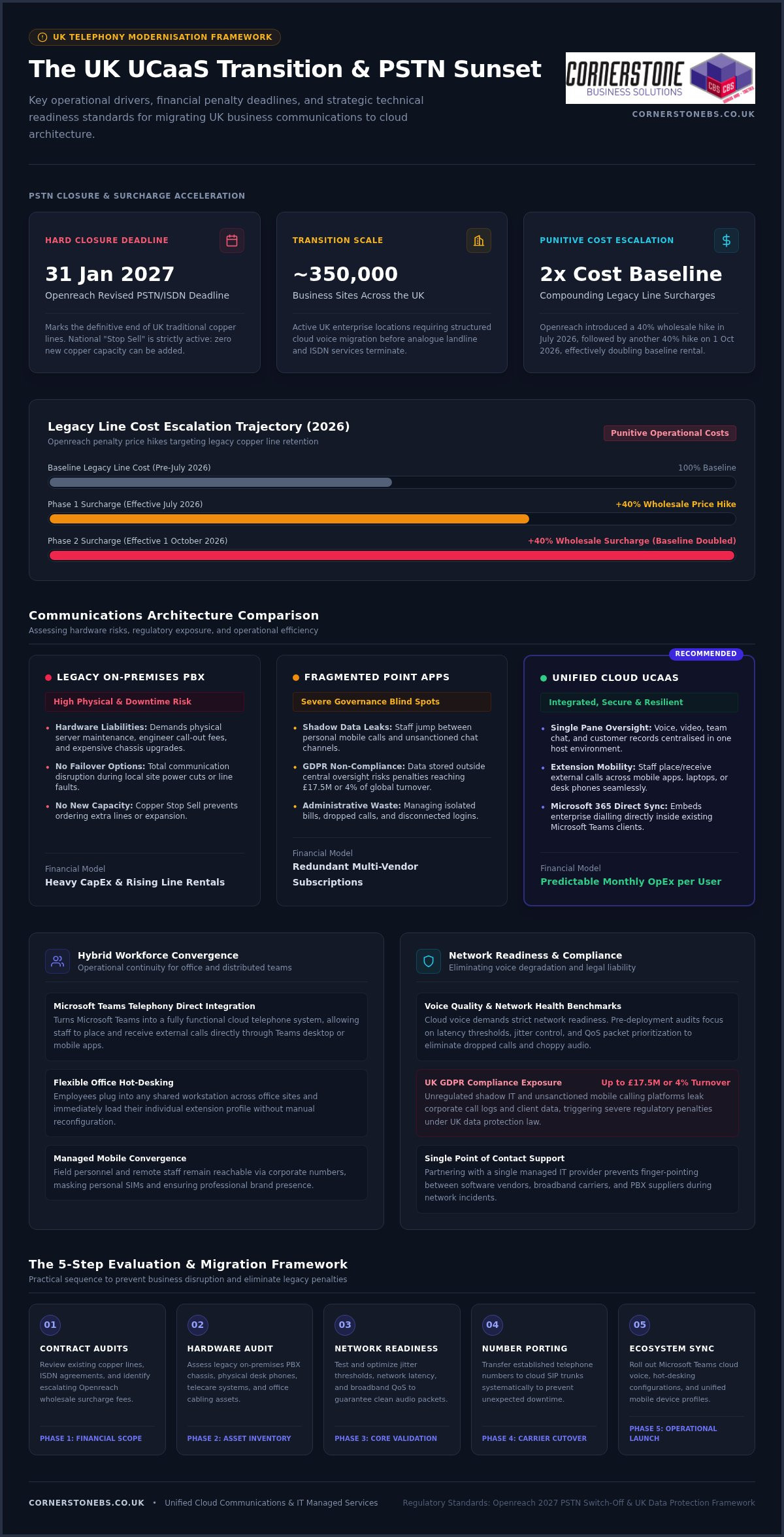
Treating your business phone system as an isolated app is the fastest way to frustrate hybrid staff and trigger administrative chaos. With roughly 350,000 business sites facing Openreach’s revised 31 January 2027 PSTN switch-off deadline, deploying unified communications as a service (UCaaS) UK organisations can depend on has shifted from a routine IT review into an urgent operational priority.
You’re likely exhausted by managing disconnected subscriptions for voice, video, and team messaging, all while absorbing punitive legacy line price hikes and troubleshooting dropped calls for remote teams. UCaaS only truly succeeds when integrated into a unified, secure IT ecosystem rather than treated as a piecemeal add-on. Telecom migrations shouldn’t come with the fear of lost numbers or unexpected downtime.
In this guide, you’ll discover how to evaluate, select, and deploy the right UCaaS platform to streamline operations, cut telecom overhead, and secure hybrid working across your workforce. We will walk you through top platform capabilities, essential network readiness benchmarks, and a dependable migration roadmap to future-proof your business telephony with total confidence.
Key Takeaways
- Understand the urgent operational drivers behind modern cloud telephony, including Openreach penalty surcharges and legacy network switch-offs.
- Discover how deploying unified communications as a service (UCaaS) UK solutions consolidates voice, video, chat, and Microsoft 365 into one predictable monthly expense.
- Identify the core network readiness metrics, from jitter control to latency thresholds, required to eliminate dropped calls and choppy audio.
- Follow a practical 5-step transition roadmap covering contract audits, number porting, and hardware assessments to prevent unexpected business downtime.
- Learn why partnering with an established managed IT provider eliminates vendor blame-shifting and creates a resilient, single-point-of-contact communications environment.
The UCaaS Business Case: Why UK Organisations Are Modernising Communications in 2026
Unified Communications as a Service merges cloud telephony, video conferencing, chat, and file sharing into a single host environment. Instead of maintaining discrete vendors for calling and collaboration, UK businesses use unified communications platforms to handle external and internal conversations through one intuitive interface. Combining this telephony framework with wider cloud solutions allows organisations to consolidate scattered infrastructure, replace bulky on-premises equipment, and shift telecom spending into a stable, predictable monthly operational model.
Drivers of Modernisation: The PSTN Switch-Off and Distributed Teams
The operational push toward cloud voice isn’t merely about convenience; it’s a regulatory necessity. Openreach’s revised PSTN and ISDN closure date of 31 January 2027 marks the definitive end of the UK’s traditional copper telephone lines. While this revision gave telecare providers essential breathing room, the national “Stop Sell” remains strictly active. You can no longer purchase or add new copper-based capacity.
Delaying action brings direct financial consequences. Openreach introduced a 40% wholesale line rental price hike in July 2026, matched by another 40% increase on 1 October 2026, effectively doubling the baseline cost of legacy line rental. Beyond avoiding these penalty fees, adopting a modern unified communications as a service (UCaaS) UK platform solves the friction of hybrid working. Staff receive full extension mobility, answering customer calls seamlessly on mobile apps, laptops, or desk phones without revealing personal numbers or wrestling with disconnected logins.
Legacy On-Premises PBX vs Fragmented Apps vs Unified UCaaS
Sticking with legacy Private Branch Exchange (PBX) units or relying on unlinked software subscriptions creates significant liabilities for growing companies:
- Hardware liabilities: Traditional PBX systems demand physical server maintenance, engineer call-out fees, and expensive chassis upgrades that lack failover options during power cuts.
- Security and governance blind spots: When staff jump between unsanctioned chat apps and personal mobile calls, company data leaks outside central oversight. This triggers major compliance risks under UK GDPR, where fines can reach £17.5 million or 4% of global turnover.
- Unified operational efficiency: Adopting consolidated unified communications as a service (UCaaS) UK architecture gives IT teams total visibility. Voice, team channels, and customer records sit in one pane, lowering administration workloads while slashing software licensing waste.
Selecting the right communication stack means looking beyond basic dial tones to ensure your tools actively support how modern teams work. As organisations adapt to the official UK transition from analogue to digital landlines, the most effective platforms weave telephony directly into day-to-day productivity software, removing the friction of standalone apps.
Cloud Telephony, Microsoft Teams Integration, and Mobile Convergence
For organisations already invested in Microsoft’s ecosystem, bridging business voice directly into that workspace offers unmatched efficiency. Integrating cloud voice with your Microsoft 365 migration for business UK strategy turns Microsoft Teams into a fully functional cloud telephone system.
Employees place and receive external calls directly within their Teams desktop client or mobile app, using their standard company telephone number. Flexible hot-desking features allow staff to plug into any office workstation and instantly load their unique extension profile. Pairing this setup with managed business mobile devices ensures field staff and office personnel remain seamlessly reachable under one corporate umbrella.
Intelligent Call Routing, Analytics, and Customer Contact Features
First impressions matter. A modern unified communications as a service (UCaaS) UK setup provides enterprise-level call management without the complexity of traditional switchboards:
- Dynamic auto-attendants and IVR: Guide callers to the right department effortlessly, routing after-hours calls to on-call mobiles or automated voicemail-to-email channels.
- Hunt groups and queue management: Distribute inbound calls evenly across departments to slash hold times and avoid abandoned customer inquiries.
- Live supervisory dashboards: Track queue volumes, answer speeds, and missed calls in real time so supervisors can adjust staffing on the fly.
- Native CRM integration: Trigger screen pops when a customer rings, showing recent tickets, account history, and order notes before your team even says hello.
Centralised Administration and Scalable User Management
Managing extensions should never require an external engineer visit. Modern UCaaS portals let your internal IT team add, reassign, or remove user licences with a few clicks. Role-based access controls keep sensitive call recordings and customer details secure, preventing unauthorised downloads or leaks.
Because cloud licensing operates on predictable per-seat monthly billing, scaling up for seasonal demand or down during restructures happens without penalising hardware overheads. If you want to see how these capabilities can fit your existing workflows, you can explore tailored options through our team at Cornerstone to build a dependable setup tailored to your operational goals.
Overcoming Technical and Security Hurdles: Network Readiness and Compliance
The biggest dread when migrating to cloud voice isn’t the software interface; it’s the fear of jittery calls, robotic audio, and dropped client conversations. While software vendors often claim their tools work over any internet connection, enterprise-grade unified communications as a service (UCaaS) UK deployments demand a resilient local network foundation. Without proper infrastructure planning, even the most advanced voice platform will struggle under daily office traffic.
Broadband Bandwidth, VLAN Configuration, and Quality of Service (QoS)
Voice traffic is uniquely sensitive to network congestion. To deliver crystal-clear conversations that hit the industry-standard 4.0+ Mean Opinion Score (MOS), your local area network (LAN) and wide area network (WAN) must satisfy strict performance benchmarks:
- Bandwidth allocation: Budget approximately 100 kbps symmetric bandwidth per concurrent standard voice call, alongside 1.5 to 3.0 Mbps per HD video stream.
- Latency and jitter thresholds: Keep one-way latency below 150 ms (ideally under 100 ms) and network jitter strictly under 30 ms. Packet loss must remain below 1% to prevent clipping.
- Voice VLANs and QoS prioritisation: Configure managed network switches to isolate voice traffic onto dedicated Virtual Local Area Networks (VLANs). Router-level Quality of Service (QoS) tagging then prioritises voice packets over heavy background file downloads or software updates.
- Local infrastructure health: High-performance Wi-Fi 6 access points and modern structured Cat6 cabling prevent local bottlenecks that broadband speed tests alone won’t reveal.
UK GDPR Compliance, Data Encryption, and Secure Call Recording
Every recorded conversation, voicemail file, and automated meeting transcript represents sensitive corporate data. Deploying cloud communication requires strict alignment with UK GDPR and the Data Protection Act 2018. Businesses face severe exposure here: an estimated 67% of UK SMEs lack a formal, compliant recording and consent policy for digital voice channels.
To keep communications safe and compliant, platforms must meet recognized frameworks such as the NCSC Cloud Security Principles. Media streams require transport layer security (TLS) alongside Secure Real-Time Transport Protocol (SRTP) for voice encryption in transit, paired with AES-256 encryption for stored recordings.
For organisations processing card payments, automated pause-and-resume mechanisms must stop recording while financial details are read aloud, satisfying PCI-DSS standards. Tying these controls into comprehensive cyber security services ensures granular role-based access permissions, preventing unauthorised staff from downloading, listening to, or tampering with sensitive client records.
The 5-Step Evaluation and Migration Framework for UK Businesses
Migrating to cloud communications shouldn’t feel like a high-wire act without a net. When leadership worries about cut lines and lost customer calls, structured execution is everything. Following a methodical, five-step migration framework ensures your unified communications as a service (UCaaS) UK transition protects business continuity while moving your operations smoothly into modern cloud telephony.
Stage 1 to 3: Audit, Connectivity Readiness, and UK Number Porting
A flawless deployment begins with rigorous discovery well before any software goes live across your estate:
- Step 1: The holistic telecoms audit: Catalog every active number, direct dial-in (DDI) range, and existing supplier contract term. Don’t overlook ancillary lines plugged into lift panic buttons, security alarms, or legacy payment terminals. These analogue connections will drop dead if migrated incorrectly. Check your emergency location records (999/112) to verify all site addresses match current records.
- Step 2: Local connectivity and LAN readiness: Audit real-time ISP throughput and stress-test local switches. Segregate voice data onto dedicated VLANs, apply QoS priorities, and assess whether high-density Wi-Fi 6 points or structured cabling are required to handle simultaneous media streams.
- Step 3: Coordinated UK number porting: Porting rejections cause the majority of cloud telephony delays. A single mismatched billing postcode or misspelled business name on a Letter of Authority (LOA) can reset an Openreach porting cycle by weeks. Verify your exact billing data with your incumbent carrier before submitting formal port orders.
Stage 4 to 5: Phased Deployment, Staff Training, and Go-Live Cutover
Once porting dates and networks are locked down, the final stages focus on execution and adoption:
- Step 4: Controlled user pilots and role-based training: Spin up a pilot group containing power users, receptionists, and remote workers. Test hunt group rings, call forwarding, and desktop softphone stability. Run tailored training sessions so staff feel confident transferring calls, setting out-of-hours messages, and using mobile apps before company-wide launch day.
- Step 5: Planned cutover and live engineer support: Execute the final switchover during an out-of-hours maintenance window. Technicians monitor number port completions, test inbound carrier routing, and verify emergency call paths. When your team logs on the next morning, active helpdesk support catches user queries immediately, ensuring a calm, painless launch.
If you’re ready to modernize your telecom infrastructure without risking operational downtime, speak with our team at Cornerstone to plan your tailored migration roadmap.
Choosing Your UK UCaaS Partner: Managed IT vs Direct Software Vendors
Buying directly from a global software vendor looks straightforward on paper, but it frequently leads to frustration when technical issues crop up. If a remote worker experiences garbled audio or dropped calls, the software vendor invariably blames your local internet provider or office firewall. Meanwhile, your broadband supplier insists the line is healthy and points the finger back at the software application. This leaves your internal team stranded in the middle with no clear fix.
The Danger of Fragmented Support: Resolving the Voice vs Network Dilemma
When you align cloud telephony with strategic it company solutions, the voice versus network dilemma disappears completely. A single managed IT partner diagnoses faults across your entire operational chain, from the user’s laptop and headset drivers to managed switches, firewall routing rules, and cloud infrastructure.
Bundling IT support with your business telephony and Microsoft 365 licensing also removes wasteful administrative duplication. Your business gains a single monthly operational invoice and one dependable helpdesk team for every technical request, eliminating multi-vendor finger-pointing for good.
Evaluating Provider SLA Guarantees and Proactive Maintenance
Strong Service Level Agreements (SLAs) are vital when evaluating telecom providers. A meaningful SLA goes well beyond theoretical platform uptime; it specifies rapid incident response times, guaranteed engineer escalation paths, and automated disaster recovery routing during broadband outages. Key metrics to verify include:
- Target response and resolution times: Check contractually backed commitments for critical voice issues, not just generic email ticket acknowledgements.
- Proactive network monitoring: Ensure your partner actively tracks latency spikes and switch port health to fix connection drops before staff notice.
- Disaster recovery automation: Confirm automated failover routing to business mobile numbers if an office suffers an unexpected power cut.
As an award-winning national IT services provider with tier-one technology partnerships across Microsoft, Cisco, and IBM, Cornerstone Business Solutions bridges the gap between cloud voice and day-to-day IT resilience. Deploying unified communications as a service (UCaaS) UK systems through an accountable technology partner gives your teams reliable tools, proven migration support, and complete operational peace of mind.
Future-Proof Your Business Communications Today
Modernising your business telephony isn’t simply about replacing old desk handsets. It’s about securing an agile operational foundation. Bringing your voice, video, and collaboration under a dependable unified communications as a service (UCaaS) UK platform eliminates fragmented software subscriptions, protects your organisation against legacy copper line price hikes, and empowers hybrid staff everywhere.
A smooth transition hinges on working with an experienced partner that manages the entire technical chain, from local VLAN priorities to Microsoft 365 licensing. Founded in 2008, Cornerstone Business Solutions is a multi-award-winning national IT and communications provider holding tier-one technology partnerships with Microsoft, Cisco, and IBM. Backed by proactive helpdesk and network specialists, we deliver fully managed UK deployments with zero guesswork.
Take control of your telephony before legacy deadlines bite. Speak with our UK technology team to plan your seamless UCaaS migration and secure the reliable, connected future your business deserves.
Frequently Asked Questions
What is the difference between VoIP and UCaaS for a UK business?
VoIP focuses specifically on transmitting voice phone calls over an internet connection rather than legacy copper wires. In contrast, unified communications as a service (UCaaS) UK solutions combine business VoIP with video meetings, team chat, presence status, and file sharing in a single software environment. VoIP acts as the calling engine, while UCaaS provides the complete collaboration workspace for your organisation.
Will our existing UK business phone numbers be retained during a UCaaS migration?
Yes, your business can keep all existing geographic and non-geographic telephone numbers through the UK number porting process. Regulated by Ofcom, number porting transfers your active main switchboard numbers and direct dial ranges from your current telecoms supplier to your new cloud platform. Submitting exact billing records and account details avoids porting delays and ensures uninterrupted inbound calling.
How does the UK PSTN switch-off affect our current office telephone system?
Openreach will permanently retire the traditional Public Switched Telephone Network and ISDN lines by 31 January 2027. If your office still connects to wall-mounted copper lines or an on-premises PBX box, your incoming and outgoing lines will stop functioning after that date. Migrating early helps you avoid escalating wholesale line surcharges and engineer backlogs heading into late 2026.
Can a UCaaS solution integrate directly with our Microsoft 365 licensing?
Yes, modern cloud telephony connects directly into Microsoft Teams using Operator Connect or Direct Routing architectures. This allows your staff to make and receive external calls straight from their Teams interface on laptops, tablets, or mobiles. It eliminates the need for separate calling software while making full use of your existing Microsoft 365 user licences.
What minimum internet speed does a UK company need to run UCaaS reliably?
A reliable deployment requires roughly 100 kbps symmetric bandwidth per concurrent standard voice call, plus 1.5 to 3.0 Mbps for each HD video session. Beyond pure broadband download speeds, stable performance depends on low latency (under 100 ms), minimal jitter (under 30 ms), and packet loss below 1%. Configuring router-level Quality of Service prioritises this traffic above general internet browsing.
Is UCaaS secure enough to meet UK GDPR and financial compliance standards?
Enterprise cloud telephony platforms satisfy UK GDPR through end-to-end data encryption, using Transport Layer Security for transmissions and AES-256 for call recordings and transcripts. To comply with privacy rules and PCI-DSS standards, systems feature role-based access permissions, audit logs, and automated pause-and-resume controls that stop recordings while customers read payment card details over the phone.
What hardware do our employees need to use a cloud communications platform?
Employees only need a standard computer, laptop, or mobile smartphone equipped with a certified USB or Bluetooth headset. Staff can manage calls, video, and messages using softphone applications without physical handsets on their desks. However, companies preferring traditional setups can still deploy plug-and-play IP desk phones that connect directly into office network ports.
Posted on: September 20th, 2026 by Cornerstone
With over 350,000 UK business premises still tethered to legacy copper lines as of mid-2026, the countdown to the 31 January 2027 hard stop has officially entered the red zone. If you feel a sense of urgency about migrating from ISDN to VoIP, you aren’t alone. It’s natural to worry about downtime or hardware compatibility when your entire communication infrastructure is on the line. We understand that your business stability depends on a dial tone that never fails, and the thought of a messy transition is enough to keep any owner awake at night.
This guide provides the definitive roadmap you need to navigate the final months of the PSTN era with absolute confidence. We’ll show you how to secure a seamless transition that protects your existing numbers and slashes your monthly overheads while boosting your team’s remote working capabilities. From conducting a deep infrastructure audit to managing the final porting process, we’re laying out the exact steps to ensure your business stays connected, resilient, and ready for the digital future.
Key Takeaways
- Understand why the 31 January 2027 deadline makes late 2026 the practical hard stop for avoiding engineering bottlenecks and carrier porting freezes.
- Learn how to audit your local network infrastructure to ensure your bandwidth and router settings can handle high-definition voice traffic without jitter or drops.
- Discover the strategic differences between Hosted VoIP and SIP Trunking to determine which configuration best suits your existing hardware and remote working needs when migrating from ISDN to VoIP.
- Identify “invisible” analogue devices like lift alarms, security panels, and payment terminals that require specific digital upgrades to prevent critical service failures.
- See how a multi-award-winning partnership provides the proactive monitoring and emotional security needed to maintain business stability throughout the entire migration process.
The 2027 ISDN Switch-Off: Why Migration is Critical in 2026
The ISDN switch-off is the mandatory retirement of the UK traditional phone network by 2027. Openreach and BT have confirmed that the Public Switched Telephone Network (PSTN) and Integrated Services Digital Network (ISDN) will be fully decommissioned by 31 January 2027. This isn’t just a minor technical update; it’s a fundamental shift in how our nation communicates. Legacy copper lines, which have served British businesses for decades, are being phased out in favour of modern, fibre-based infrastructure. For many owners, migrating from ISDN to VoIP is no longer a project for the distant future. It’s a critical 2026 priority to ensure your dial tone remains active.
Unlike the old copper network that relies on physical exchanges and analogue signals, VoIP uses your internet connection to transmit voice data. This transition often utilizes Session Initiation Protocol (SIP) trunking to route calls over your data network instead of traditional phone lines. By making the move now, you’re choosing a system built for the demands of a modern, digital-first economy. It’s about moving from a fragile physical link to a robust, software-driven solution.
The Risks of Delaying Your Transition
Waiting until the final months of 2026 to make your move is a gamble with your business continuity. With over 350,000 UK business premises still needing to switch, industry capacity is expected to tighten significantly. You might face hardware shortages as demand for IP-compatible handsets and routers spikes. There’s also the financial impact; Openreach has already implemented steep price hikes throughout 2026 to discourage the use of legacy lines. Perhaps the biggest risk is the “porting bottleneck.” Moving your existing numbers requires coordination between carriers. If you wait until the Q4 2026 rush, you risk losing your established business numbers during a period of carrier freezes and high demand.
Immediate Benefits of Moving to VoIP
The shift to digital isn’t just about avoiding a deadline; it’s a massive upgrade for your daily operations and your bottom line. Transitioning to VoIP provides several immediate advantages:
- Reduced Monthly Overheads: You’ll see a significant drop in monthly costs. VoIP eliminates expensive line rental fees and offers much lower call rates.
- Hybrid Work Support: Modern systems offer native support for remote working. Your team can take office calls on their mobiles or laptops from any location in the UK, ensuring they stay connected without being tied to a desk.
- Instant Scalability: You can scale users up or down instantly. There’s no need to wait weeks for an engineer to install physical lines when your team grows.
We see these systems as a foundational element of your business stability. Moving early gives you the breathing room to test your setup and ensure your staff are comfortable with the new features long before the copper network goes dark. It provides the emotional security of knowing your communications are future-proofed.
Essential Infrastructure Audits: Preparing Your Network for VoIP
Before you begin migrating from ISDN to VoIP, you need a clear picture of what’s currently running on your copper lines. It’s not just about the handsets sitting on your desks. Many UK businesses forget about “invisible” devices like lift alarms, fax machines, and security panels. These often rely on the same legacy infrastructure and need specific attention to avoid total failure when the switch happens. A thorough audit ensures no critical service is left behind during the transition.
Bandwidth and Connectivity Requirements
Your internet connection is the new backbone of your phone system. For a high-quality, uncompressed VoIP call, you’ll typically need around 100 kbps of symmetrical bandwidth. If you have 20 people on the phone at once, that’s 2 Mbps dedicated solely to voice traffic. We often recommend a partitioned voice circuit or a dedicated line to ensure your office file downloads don’t interfere with client calls. This level of reliability is a core part of broader cloud solutions for UK businesses, where scaling securely depends on a robust network foundation.
Your router plays a vital role in this setup. By configuring Quality of Service (QoS) settings, you tell your network to prioritise voice data over everything else. It’s like creating a VIP lane for your phone calls. This ensures they stay crystal clear even during peak data usage. Without these settings, you might experience jitter or dropped words during important client conversations.
Hardware: To Replace or Adapt?
You don’t always need to scrap every piece of hardware you own. For legacy analogue equipment that you aren’t ready to retire, Analog Telephone Adapters (ATAs) can bridge the gap. However, for most modern teams, the transition to softphones or mobile applications offers the most flexibility. If you prefer physical hardware, selecting high-grade Cisco VoIP handsets ensures long-term reliability and professional-grade audio quality. These devices are built to handle the demands of a busy office while providing the clarity your clients expect.
It’s vital to check the UK Government guidance on moving landlines to digital technologies to understand how specialized equipment like telecare and alarms are affected. These devices often require a complete hardware upgrade to function on a digital line. If you’re feeling overwhelmed by the technical requirements, we can help you design a bespoke VoIP solution that fits your specific business needs perfectly.
The 5-Step Migration Roadmap: Transitioning Without Business Downtime
Transitioning your communications shouldn’t feel like a leap into the dark. We believe that a successful move relies on a proactive, logical sequence that protects your operations at every turn. When migrating from ISDN to VoIP, following a structured roadmap ensures that your team stays connected and your clients never experience a busy signal. It’s about moving with the confidence of an expert who has already mapped out the pitfalls.
- Step 1: Communications Audit. Beyond the technical checks we’ve discussed, you must validate every Direct Dial Inward (DDI) number to ensure nothing is missed.
- Step 2: Configuration Choice. Decide between a fully cloud-based Hosted VoIP system or SIP Trunking for your existing hardware.
- Step 3: Number Porting. This is the most critical phase. We manage the coordination between your old and new carriers to move your numbers across safely.
- Step 4: Training and Deployment. Don’t just drop new phones on desks. We ensure your team knows how to use every feature before the switch.
- Step 5: Go-Live and Decommissioning. Only once the new system is verified do we safely shut down the legacy ISDN lines.
Mastering the Number Porting Process
Porting your numbers is often the part of the journey where businesses feel the most anxiety. In the UK, this process requires a signed Letter of Authority (LOA), which gives your new provider permission to request the numbers from your current carrier. Rejections are common if the data on the LOA doesn’t match your current billing records exactly. While the FCC guide on Voice over Internet Protocol outlines the broad technical standards for porting, UK businesses must navigate specific Ofcom-regulated timeframes. It’s vital to start this 2 to 6 weeks before your desired go-live date to avoid the Q4 2026 carrier embargoes.
Zero-Downtime Deployment Strategies
You don’t have to switch everything off at once. We recommend a “parallel running” strategy. This means your new VoIP system is installed and tested while your ISDN lines are still active. You can make outgoing test calls to verify audio quality and feature sets without affecting incoming traffic. To bridge the final gap, we use temporary call forwarding. Incoming calls to your legacy numbers are instantly diverted to your new digital handsets. This ensures a seamless experience for your clients, providing the emotional security of a transition that feels completely invisible to the outside world.
Strategic Configuration: Hosted VoIP vs. SIP Trunking for Modern Teams
Choosing the right architecture is the pivot point for your entire communications strategy. When migrating from ISDN to VoIP, you’ll generally face two main paths: a fully managed Hosted VoIP system or SIP Trunking. One moves your entire phone system to the cloud, while the other acts as a digital bridge for your existing on-site hardware. Both options offer the reliability you need, but the best fit depends on your current infrastructure and your plans for future growth. It’s about finding the balance between control and convenience.
Integrating your voice system with your wider digital environment is often the next logical step for a forward-thinking organisation. Many UK businesses find that aligning their phone setup with a Microsoft 365 migration for business creates a unified communications powerhouse. This allows your team to switch between calls, chats, and video meetings within a single interface, significantly improving efficiency. It turns your phone system from a standalone tool into a foundational element of your digital workspace.
When to Choose a Hosted Solution
If you’ve recently invested in high-quality on-premises PBX hardware, you don’t necessarily have to abandon it. SIP Trunking allows you to keep your existing physical phone system while switching the underlying connection from legacy copper to a digital IP pipeline. This is often the preferred route for larger organisations with complex internal routing, specialized call centre configurations, or specific security requirements. It gives your internal IT team greater control over the hardware while still delivering the cost savings and flexibility of a digital network. You’re effectively “sweating your assets” while future-proofing your connectivity.
Every business has unique requirements, and picking the wrong path can lead to unnecessary costs or technical friction. We take pride in helping you weigh these options to find the most stable and cost-effective fit for your specific team. If you’re ready to discuss which setup is right for your premises, talk to our team about a bespoke VoIP setup today.
Partnering for Success: How Cornerstone Delivers Bespoke Telecoms Solutions
Choosing a provider for migrating from ISDN to VoIP shouldn’t be a purely transactional decision. You’re selecting the team that will safeguard your dial tone and your digital reputation for years to come. As a multi-award-winning national UK IT provider, we don’t just supply a service; we act as your dedicated long-term partner. We believe that technical support is a foundational element of your emotional security. It’s about knowing that if a problem arises, a friendly expert is already working to fix it before you even notice.
Our proactive approach to system monitoring ensures that your communications remain stable as your business evolves. We customise every VoIP feature to match your specific growth goals, whether that’s expanding your customer service team or enabling seamless remote work. This resilience is backed by our comprehensive Cyber Security Services. By securing your voice data with the same rigour as your financial records, we provide the peace of mind that comes with true business resilience.
The Cornerstone Approach to Communication
We reject the “one-size-fits-all” mentality that often plagues the telecoms industry. Every organisation we support receives a bespoke design tailored to their unique call volumes and operational workflows. This commitment to quality is why we offer unlimited helpdesk access for your team. You shouldn’t have to worry about ticking clocks or hidden fees when you need assistance. Our communication solutions also integrate seamlessly with our Managed IT Services, creating a unified support structure where your hardware, software, and phones all work in perfect harmony.
Next Steps for Your Business
The 31 January 2027 deadline is approaching fast, but you still have time to make a strategic, stress-free move. Your first step should be booking a no-obligation communications audit. We’ll help you identify every legacy line and hidden analogue device, ensuring nothing gets cut off unexpectedly. This is also the ideal time to prepare your 2026/27 technology budget, shifting away from expensive line rentals toward a more efficient digital model. We invite you to start a conversation with our national team of experts. Let’s simplify your technical landscape together and ensure your business remains connected, resilient, and ready for the future.
Securing Your Business Connectivity for the Digital Era
The 31 January 2027 deadline is no longer a distant date on a calendar; it’s a hard stop for the traditional UK phone network. By taking action now, you avoid the inevitable engineering bottlenecks and price hikes that will define late 2026. We’ve explored how a thorough audit, a clear roadmap, and the right strategic configuration can turn a technical necessity into a competitive advantage. Migrating from ISDN to VoIP is about more than just keeping your dial tone; it’s about building a resilient, flexible foundation for your team’s future.
As a multi-award-winning IT provider with strategic partnerships with Cisco and Microsoft, we provide the expertise needed for a seamless transition. Our proactive 24/7 monitoring ensures your systems remain stable long after the final copper line is decommissioned. We’re here to simplify the complex and provide the emotional security you need to focus on growing your business. Ready to future-proof your communications? Book a free communications audit with Cornerstone today. We look forward to helping your business stay connected and thrive.
Frequently Asked Questions
What happens to my existing phone numbers when I migrate to VoIP?
You can keep your existing phone numbers by using a process called number porting. When migrating from ISDN to VoIP, we manage the coordination between your current carrier and the new digital network to ensure your established business numbers move across safely. This requires a signed Letter of Authority (LOA) to verify ownership. Starting this process early is vital to avoid carrier bottlenecks as the nationwide 2027 deadline approaches.
Do I need to buy new hardware to switch from ISDN to VoIP?
You don’t always need to invest in entirely new hardware. While migrating from ISDN to VoIP, many businesses choose modern IP handsets or softphones for better features, but you can often adapt legacy analogue equipment using Analog Telephone Adapters (ATAs). For those with existing IP-capable PBX systems, SIP Trunking allows you to maintain your current hardware while switching the underlying connection. We help you audit your current kit to decide whether to replace or adapt.
Will my alarm system or lift phone still work after the ISDN switch-off?
These “invisible” devices often rely on the low-voltage power from legacy copper lines, which won’t be available after the switch-off. Most lift alarms and security panels require a digital upgrade or a specialized mobile failover solution to remain compliant with safety regulations. We recommend a full physical infrastructure audit to identify these lines early. It ensures your critical safety systems continue to operate without interruption when the PSTN goes dark.
How much internet bandwidth does a VoIP system require?
A standard high-definition VoIP call requires approximately 100 kbps of symmetrical bandwidth. To ensure crystal-clear audio, you should calculate your maximum number of concurrent calls and add a buffer for standard data traffic. For many UK businesses, we recommend a dedicated or partitioned voice circuit. This prevents large file downloads or video streaming from degrading your call quality, providing the stability your clients expect during every conversation.
Can I use VoIP on my mobile phone while out of the office?
Yes, modern VoIP systems are designed for hybrid and remote working. By using mobile applications or “softphones” on your smartphone, you can make and receive calls using your professional office number from any location with an internet connection. This ensures your team stays connected without being tied to a physical desk. It’s an excellent way to maintain a professional image while your staff are on-site or working from home across the UK.
What is the actual deadline for the UK PSTN and ISDN switch-off?
The official hard stop for the UK Public Switched Telephone Network (PSTN) and ISDN is 31 January 2027. While Openreach previously targeted late 2025, this final date is now confirmed and won’t be extended further. However, the nationwide “Stop Sell” is already in effect, meaning you can’t buy new legacy lines. We treat late 2026 as the practical deadline to avoid the inevitable rush and potential engineering shortages in the final weeks.
Is VoIP as reliable as traditional ISDN lines?
VoIP is exceptionally reliable when supported by a robust internet connection and proactive monitoring. Unlike traditional copper lines, which are prone to physical degradation and weather damage, digital systems offer built-in disaster recovery features. If your office loses power, calls can automatically reroute to mobile devices or other locations. We provide the emotional security of a system that stays active, backed by our strategic partnerships with industry leaders like Cisco and Microsoft.
How long does the migration process typically take?
A typical transition takes between 2 to 6 weeks, primarily driven by the number porting process. While the technical setup of a hosted system can happen very quickly, coordinating with legacy carriers to move your DDIs requires specific lead times. Larger organisations with complex on-site hardware may require more time for infrastructure audits and user training. We work with you to create a bespoke timeline that ensures a seamless switch with zero downtime.
Posted on: August 26th, 2026 by Cornerstone
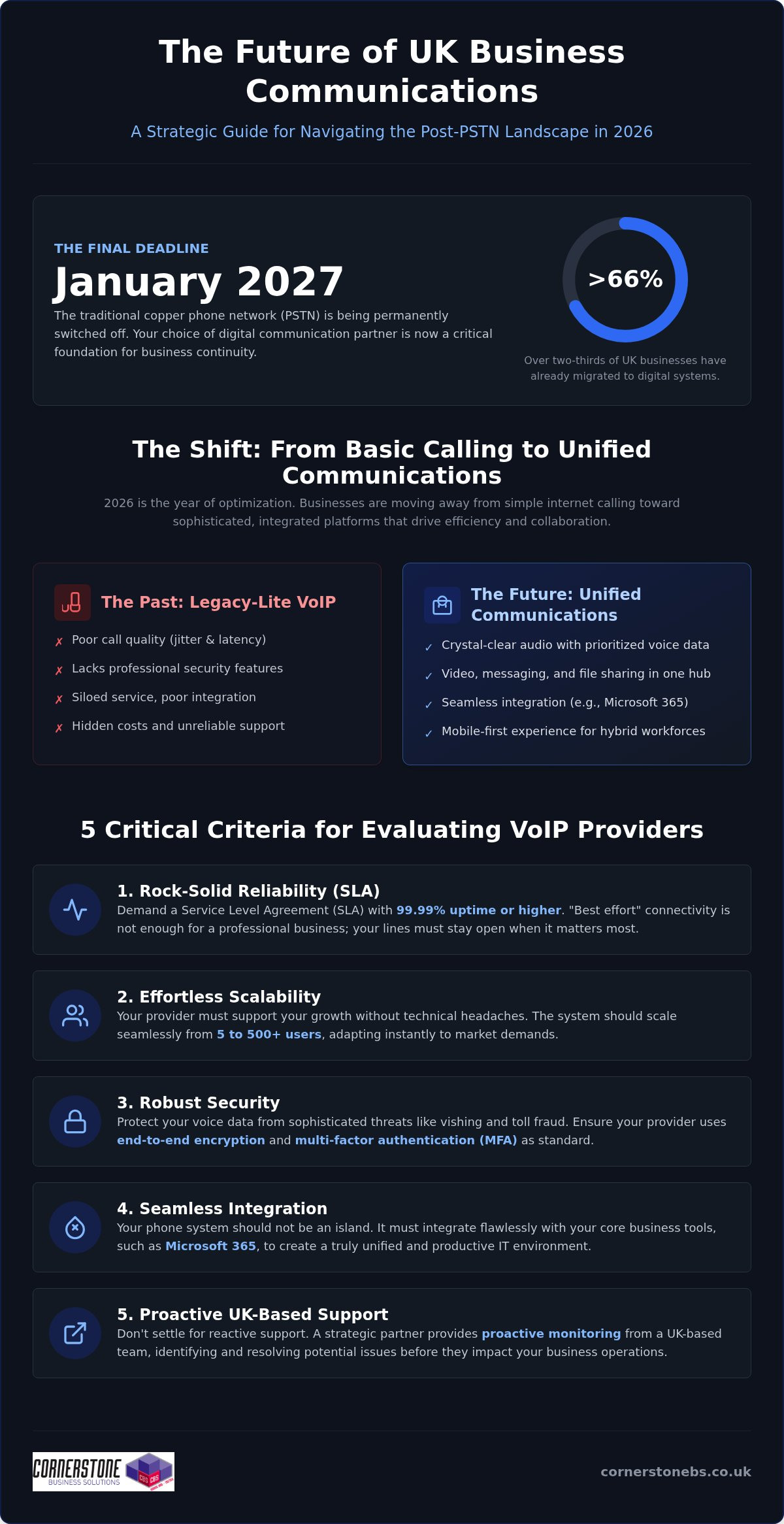
With the PSTN switch-off set for January 2027, more than two-thirds of UK businesses have already migrated to digital systems to avoid being left in the dark. It’s no longer a question of if you should switch, but which partner will actually protect your professional reputation. You’ve likely seen “cheap” deals that look great on paper, only to find they’re riddled with hidden fees or poor call quality that frustrates your clients. Choosing from the many business voip providers uk shouldn’t feel like a gamble with your company’s stability.
We know you want a system that simply works, whether your team is in the office or working from home. You need predictable monthly billing and a platform that integrates with Microsoft 365 without a week of technical downtime. This strategic 2026 guide cuts through the noise to reveal the leading providers that offer genuine security and scalability. We’ll explore how the right communication partner can transform your phones from a basic utility into a proactive tool for growth and collaboration.
Key Takeaways
- Understand why the January 2027 PSTN deadline makes your choice of digital infrastructure a critical foundation for business continuity.
- Identify the top-tier business voip providers uk by looking for robust service level agreements and seamless integration with Microsoft 365.
- Learn to calculate the true cost of ownership by comparing the support of a managed service provider against “big box” software vendors.
- Master the migration process with a step-by-step audit that protects your existing numbers and ensures a smooth transition without downtime.
- Discover how a strategic partnership with an award-winning IT provider transforms your communication tools into a secure engine for growth.
The 2026 UK VoIP Landscape: Why Your Choice Matters More Than Ever
The traditional copper phone network is now a relic of the past. In 2026, every dial tone across the country relies on digital infrastructure, making your choice of communication partner a foundational business decision. It’s no longer enough to simply find a way to make calls over the internet. You need a system that acts as a stable bridge between your team and your clients. Using Voice over Internet Protocol (VoIP) is the standard, but the quality of that connection determines your professional reputation. When you evaluate business voip providers uk, you’re looking for more than a vendor; you’re looking for a strategic partner who understands that a dropped call is a dropped opportunity.
While 2024 and 2025 were defined by the rush to migrate, 2026 is the year of optimization. Many organizations that rushed into “cheap” contracts are now discovering the hidden costs of poor integration and unreliable support. We see a clear shift where smart leaders are moving away from basic internet calling toward sophisticated Unified Communications (UC). This evolution ensures that your voice services don’t sit in a silo but work in harmony with your wider IT environment. Uptime is now synonymous with business continuity. If your phones are down, your digital storefront is effectively closed, which is why proactive monitoring and robust service levels are non-negotiable in the current market.
The Reality of Communication in a Post-PSTN UK
The major waves of the PSTN switch-off throughout 2025 have permanently changed how British firms operate. Legacy-lite VoIP solutions, which often lack the security and depth required for professional use, are failing to meet the needs of modern offices. These basic apps often struggle with jitter and latency, especially when your team is busy. To maintain crystal-clear audio, your high-speed connectivity must be optimized to prioritize voice data. It’s about creating a resilient environment where your network infrastructure is strong enough to handle heavy loads without compromising the clarity of a single conversation.
Unified Communications: More Than Just a Phone Call
In 2026, your phone system is the hub of your workplace. It seamlessly integrates video conferencing, instant messaging, and secure file sharing into one interface. This is vital for hybrid workforces where employees might move from a desk phone to a mobile app five times a day. Your business voip providers uk should offer a mobile-first experience that doesn’t feel like an afterthought. Unified Communications is the backbone of modern business efficiency, ensuring your team stays productive regardless of their physical location. By consolidating these tools, you reduce the complexity of your IT stack and provide a consistent experience for every staff member.
5 Critical Criteria for Evaluating Business VoIP Providers in 2026
When you compare business voip providers uk, it’s easy to get distracted by the lowest monthly seat price. However, a cheap plan quickly becomes expensive if it doesn’t offer a cast-iron Service Level Agreement (SLA). In 2026, “best effort” connectivity isn’t enough for a professional firm. You need a guarantee of 99.99% uptime or higher to ensure your lines stay open when it matters most. Following Ofcom’s guidance on the digital migration, businesses must prioritize reliability over cost to avoid the pitfalls of a poorly managed transition.
Scalability is another non-negotiable factor. Your communication partner should allow you to grow from five users to 500 without a technical headache or a complete hardware overhaul. This flexibility allows you to respond to market demands instantly. Beyond the software, the quality of UK-based technical support defines your experience. You deserve a team that monitors your systems proactively, catching potential issues before they affect a single call. If you’re feeling overwhelmed by the technical choices, you might find it helpful to chat with our local experts about your specific goals.
Security: Protecting Your Voice Data
Your phone system is a gateway to your business data, which makes it a prime target for cyber criminals. In 2026, threats like “vishing” and toll fraud are more sophisticated than ever. Basic VoIP setups often lack the necessary defenses to stop these intruders from racking up massive bills or intercepting private conversations. To stay safe, ensure your provider uses end-to-end encryption and multi-factor authentication (MFA). These layers of protection are foundational to modern business stability. For a deeper look at keeping your entire digital environment safe, explore our guide on Cyber Security Services.
Integration: The Microsoft 365 Advantage
Efficiency thrives when your tools talk to each other. Your VoIP system should integrate directly with your email, calendar, and CRM to save your team from switching between tabs constantly. Microsoft Teams Phone has become a leader in this space, providing a unified user experience that feels natural to anyone already using the Office suite. This integration allows you to launch calls directly from an email or see a client’s history the moment they ring. If you’re planning to upgrade your entire office setup, our comprehensive look at Microsoft 365 Migration for Business UK provides a clear roadmap for a seamless transition.
Comparing the Top UK VoIP Solutions: Features, Integration, and ROI
Selecting between various business voip providers uk often comes down to a choice between buying a box of software or investing in a managed service. Many “Big Box” vendors offer attractive entry-level prices, but the true ROI is found in how well the system serves your specific workflow. In 2026, the Total Cost of Ownership (TCO) includes much more than just the monthly seat price. You must account for the time your staff spends troubleshooting connections or the lost revenue when a “best effort” service fails. A high-quality system pays for itself by removing these technical barriers, allowing your team to focus entirely on client relationships and growth.
DIY setups like RingCentral or 8×8 provide powerful features, but they often leave the heavy lifting of configuration and security to your internal team. If you don’t have a dedicated IT department, this leads to configuration gaps and potential security risks. Managed service providers (MSPs) take a completely different approach. We don’t just hand you the keys; we manage the entire environment for you. This “single pane of glass” approach means your phones, your Microsoft 365, and your cyber security are all handled by one expert team. It reduces the burden on your staff and ensures every part of your comms stack is optimized for peak performance.
Advanced Features That Drive 2026 Productivity
The best business voip providers uk now offer tools that were once reserved for massive call centers. These features are designed to make your day-to-day operations smoother and more data-driven. Key features to look for include:
- AI-Powered Summaries: Automatic transcription and sentiment analysis help you understand customer needs without listening to hours of recordings.
- Smart Call Routing: Ensure calls are directed to the right expert across your national team, regardless of their physical location.
- Live Presence: Real-time visibility into who is available, in a meeting, or on a call to improve internal collaboration.
- Auto-Attendants: Professional greeting systems that guide callers efficiently, even outside of standard business hours.
These tools transform your phone system from a simple dialer into a proactive productivity engine. By using call analytics, you can identify peak times and staff your team accordingly, ensuring you never miss a vital client inquiry.
Avoiding Downtime: A Step-by-Step Guide to VoIP Migration
The fear of losing connection during a move is what keeps many business owners awake at night. In 2026, a botched migration doesn’t just mean a few missed calls; it can disconnect your entire digital workflow. We believe that moving your communications should be an energizing step forward, not a stressful hurdle. Leading business voip providers uk now utilize a “zero-downtime” approach, ensuring your old lines stay active until the new system is fully tested and ready to take over. By following a structured roadmap, you can protect your professional reputation and keep your team productive throughout the transition.
Success lies in the preparation before the first handset is even plugged in. A typical professional migration follows these five essential stages:
- Step 1: Network Audit. We analyze your existing internet infrastructure to ensure it can handle the increased voice load without stuttering.
- Step 2: Number Porting. We manage the logistics of moving your existing UK landlines over to the digital network.
- Step 3: Hardware Selection. Choose between traditional physical handsets, softphone apps for laptops, or a hybrid of both.
- Step 4: Configuration and Training. We set up your call flows and ensure every staff member feels confident using the new features.
- Step 5: Testing and Go-Live. A final check of every line precedes the official switch, ensuring a seamless experience for your callers.
The Crucial Network Audit
Voice over IP is a sensitive technology that requires your router to have specific Quality of Service (QoS) settings. These settings prioritize voice data over other types of traffic, like large file downloads or software updates. Without this, you might experience “jitter” or dropped words during important client meetings. We look closely at your upload speeds and latency, as these are far more important for call quality than simple download speed. If your current connection is struggling, exploring integrated Cloud Solutions for UK Businesses can provide the robust foundation you need for crystal-clear audio.
Number Porting Without the Pain
You have a legal right to keep your existing phone numbers when you switch providers. In 2026, the process is more streamlined than ever, but it still requires precise paperwork to avoid delays from major UK carriers. Most porting requests take between seven and 21 days depending on the complexity of your current setup. A managed provider acts as your advocate here, catching common errors in address matching or account numbers before they cause a rejection. We handle the “heavy lifting” of the administrative side so you can focus on running your business. If you want to ensure your transition is handled by an award-winning team, we invite you to explore our managed Business VoIP options today.
Beyond the Dial Tone: Why Cornerstone is Your Strategic National Partner
In a market crowded with business voip providers uk, it’s easy to feel like just another ticket number in a massive, faceless system. We take a different approach. At Cornerstone, we don’t view your phone system as a standalone app. Instead, we treat it as a critical component of your entire digital infrastructure. This means your voice services are integrated, secured, and monitored alongside your wider IT company solutions. By looking at the bigger picture, we ensure that your communications never become a bottleneck for your growth.
Our philosophy is simple: we’re proactive, not reactive. While other vendors wait for you to report a fault, our systems are constantly monitoring your connection. We catch and resolve potential issues before they ever reach your ears. This level of care provides more than just technical stability. It offers emotional security for business owners who have enough on their plates already. You deserve a partner who is as invested in your success as you are. We’re here to move you away from transactional vendors and toward a collaborative, long-term bond.
Multi-Award-Winning Support You Can Trust
Accolades are more than just trophies on a shelf. They’re a benchmark for the quality and reliability we deliver to every client across the UK. We pride ourselves on being professional authorities who speak in plain English. We strip away the confusing jargon to give you clear, actionable advice. Whether you’re a small firm or a national organization, you’ll feel the difference that comes from working with experts who have a national reach but a local, approachable feel. It’s about combining sophisticated, global tools with the friendly, accessible face of a team that actually cares about your business continuity.
Your Next Steps for a Better Connected Business
Every industry has unique demands. Your phone system should reflect that. We don’t believe in one-size-fits-all packages. Whether you’re managing a finance firm, a school, or a dynamic SME, we tailor our VoIP solutions to fit your specific workflow. This bespoke approach ensures you’re only paying for the features that actually drive your productivity. We’d love to have an informal chat about your communication roadmap and how we can simplify your technology. Reach out to us today for a bespoke consultation. Let’s build a more resilient, better-connected future for your business together.
Securing Your Communication Future in 2026
The January 2027 deadline for the PSTN switch-off is fast approaching, making this the perfect time to optimize your communication strategy. You’ve seen that the leading business voip providers uk offer far more than a simple dial tone; they provide a secure, integrated foundation for your entire team. By prioritizing reliability and seamless Microsoft 365 integration, you can eliminate technical friction and focus on what you do best. It’s about turning a necessary upgrade into a strategic advantage for your firm.
As a multi-award-winning IT provider and trusted partner to Microsoft, IBM, and Cisco, we’re here to ensure your transition is effortless. We don’t just set up your phones; we provide proactive monitoring to keep your business running smoothly around the clock. Moving to a managed VoIP system is about more than technology; it’s about the peace of mind that comes from a dedicated long-term partnership. Book a Strategic VoIP Consultation with our Award-Winning Team today. We’re excited to help you build a system that grows alongside your ambitions.
Frequently Asked Questions
What is the best business VoIP provider for a small UK company in 2026?
The best provider isn’t just a software vendor; it’s a partner that offers managed support and seamless integration. For small UK firms, look for providers that combine award-winning customer service with robust security. While many business voip providers uk offer basic calling, the best choice ensures your phone system is managed as part of your wider IT stack. This proactive approach prevents technical headaches and ensures your communications grow with you.
Can I keep my existing business phone number when switching to VoIP?
You have a legal right to port your existing UK landline numbers to your new digital system. This process is managed by your new provider to ensure there’s no gap in your availability. We handle the administrative logistics with your current carrier, ensuring your professional identity remains intact. Most ports are completed within seven to 21 days, allowing you to transition without losing touch with your established client base.
How much does a business VoIP system cost per user in the UK?
Costs vary depending on the features you need, such as AI transcription or international calling bundles. Instead of looking at the lowest entry price, focus on the total cost of ownership, which includes setup, security, and ongoing support. Investing in a managed service often provides better long-term value than a budget “software-only” plan. It eliminates the hidden costs of downtime and the burden of internal IT troubleshooting.
Do I need new hardware to use a VoIP phone system?
You don’t necessarily need new physical handsets to make the switch. Most modern systems work perfectly via softphone apps on your existing laptops, tablets, or smartphones. If you prefer the feel of a traditional desk phone, you can choose from a range of IP-enabled hardware. We help you audit your current equipment to see what’s compatible, ensuring your team has the right tools for their specific roles without unnecessary spending.
Is VoIP secure enough for handling sensitive customer data?
VoIP is highly secure when implemented with end-to-end encryption and multi-factor authentication. In 2026, professional systems are designed to exceed UK data protection standards, protecting you from threats like toll fraud and eavesdropping. By treating your voice data as part of your managed cyber security strategy, you ensure that every conversation remains private. Your client information stays protected against sophisticated digital threats through constant, proactive monitoring of your network.
What happens to my VoIP phone if the internet goes down?
Your system remains functional by automatically rerouting calls to mobile apps or alternative sites if your primary office internet fails. This built-in redundancy is a key benefit of cloud-based communications. We set up proactive disaster recovery rules so your callers never hear a dead tone. It’s a level of resilience that traditional copper lines simply couldn’t match, keeping your business reachable regardless of local connectivity issues or power cuts.
Can VoIP integrate directly with Microsoft Teams?
Direct integration with Microsoft Teams is a standard feature for leading business voip providers uk in 2026. This allows you to use the Teams interface as your primary phone system, making and receiving external calls without switching apps. It unifies your chats, video meetings, and voice calls into one efficient hub. We specialize in managing this environment to ensure your team enjoys a consistent, high-quality experience across all their business devices.
Is there a difference between business VoIP and residential VoIP?
Business systems offer advanced features like auto-attendants, call recording, and CRM integrations that residential plans lack. They also come with professional-grade Service Level Agreements (SLAs) that guarantee high uptime and priority technical support. While residential VoIP is fine for home use, it doesn’t provide the security or scalability required to represent a professional brand. A business-grade system ensures your communication infrastructure supports your long-term growth and stability.
Posted on: July 27th, 2026 by Cornerstone
The final PSTN switch-off in January 2027 is no longer a distant date on a calendar. With legacy phone costs scheduled to jump by another 40% this October, sticking with traditional copper lines is becoming an expensive gamble. You have likely felt the sting of budget services that result in dropped hybrid meetings or non-existent customer support from faceless companies. Choosing between business voip providers uk isn’t just a utility swap anymore. It’s a strategic move to protect your team’s productivity and your long-term stability.
We believe you deserve a communications system that just works, whether your staff are in the office or working remotely. As a multi-award-winning IT service provider with deep regional roots, we know that reliability is the foundation of your success. This guide explains how to find a partner that integrates your phones with Microsoft 365 and your CRM while maintaining predictable monthly costs. We will show you how to move beyond transactional service to a partnership that offers proactive monitoring and genuine peace of mind.
Key Takeaways
- Learn why cloud-hosted systems are the only way to maintain business continuity as traditional copper networks reach their final retirement.
- Discover how to compare business voip providers uk by prioritising 99.9% uptime and accessible, UK-based technical support.
- Identify the core features, from auto-attendants to seamless mobile apps, that empower hybrid teams to work effectively from anywhere.
- Understand the critical role of integrating your communications into your wider managed IT and cyber security stack to protect your data.
- Explore the strategic advantages of bespoke managed VoIP over DIY setups to ensure crystal-clear audio and professional system reliability.
The UK Business Telecommunications Landscape in 2026
The UK’s digital transformation has reached a critical tipping point. By 2026, the old methods of making a phone call have become effectively obsolete. At its core, Voice over Internet Protocol (VoIP) is a cloud-hosted communication system that transmits voice data over the internet instead of through traditional copper wires. It’s the engine behind modern connectivity. As the final retirement of legacy networks approaches, leading business voip providers uk have evolved. They no longer just sell phone lines; they provide Unified Communications as a Service (UCaaS). This shift integrates your voice calls, video meetings, and instant messaging into one secure, manageable ecosystem.
Reliability was once a concern for early adopters, but those days are long gone. The widespread rollout of 5G and full-fibre infrastructure across the UK has transformed the landscape. High-speed internet is now the stable backbone of every successful company. You don’t have to worry about the “jitter” or lag that plagued older systems. Today’s VoIP solutions offer crystal-clear audio quality that frequently surpasses what was possible with analogue technology. This stability allows you to focus on your clients while your communication system runs quietly and efficiently in the background.
Why the PSTN Switch-Off Changed Everything
The Public Switched Telephone Network (PSTN) is entering its final months of service. By January 2027, the copper wire infrastructure that served the UK for over a century will be switched off for good. This isn’t an optional upgrade. It’s a mandatory industry transition. “Waiting and seeing” is no longer a viable strategy for any professional organisation. Throughout 2026, legacy service costs are rising sharply to encourage migration. We’ve seen scheduled price increases of 40% in July and another 40% in October. Moving to a cloud environment now isn’t just about avoiding these costs; it’s about modernising your legacy hardware before it becomes a liability.
VoIP vs. Traditional Landlines: The 2026 Verdict
The verdict is clear. Traditional landlines were built for a world where everyone worked at the same desk from nine to five. They are rigid and expensive to maintain. In contrast, VoIP offers a level of flexibility that traditional lines simply cannot match. You trade clunky on-site hardware and per-minute charges for scalable, predictable monthly subscriptions. When you choose between business voip providers uk, you’re looking for a system that supports the modern hybrid working model. Your team can take their office extension with them on their mobile or laptop, ensuring they never miss a vital call. It’s about giving your staff the tools to stay connected, no matter where they’re working from.
Key Criteria for Selecting a UK Business VoIP Provider
While the PSTN switch-off makes the move to digital necessary, the partner you choose determines whether the transition is a headache or a genuine boost to your productivity. Many business voip providers uk compete on price alone, but a low monthly fee means very little if your calls drop during a vital pitch. Your absolute minimum requirement should be a 99.9% uptime guarantee. This ensures your front door stays open digitally and your team remains reachable at all times.
Local support is another non-negotiable factor. You want to speak to an expert who understands the UK exchange system and can offer proactive advice, not a script-reader in a distant time zone. As your organisation grows, your system must grow with you. Adding a new extension or a remote user should be a simple, two-minute task. When your communications are part of a unified Managed IT and Security Stack, your voice data remains encrypted and compliant with UK regulations. This integration also allows your phone system to talk to Microsoft 365, ensuring your staff have the tools they need to collaborate effectively.
Evaluating Call Quality and Network Stability
Crystal-clear audio depends heavily on your local network. We always recommend conducting a “VoIP readiness” audit before you commit to a new system. This audit checks if your current internet bandwidth can handle voice traffic without latency. You also need a router equipped with Quality of Service (QoS) settings. These settings prioritise voice data over other internet traffic, such as large file downloads. This prevents the robotic, “choppy” audio that can ruin a professional first impression.
Understanding the Total Cost of Ownership (TCO)
It’s easy to get caught by a low headline price, but you must look at the total cost of ownership. Some providers hide additional fees for essential hardware, installation, or basic features like call recording. We’ve found that a fixed-fee model for managed VoIP support often saves money over the long term. You gain the benefit of proactive monitoring and unlimited helpdesk access without the worry of surprise invoices. This predictable approach allows you to scale your communications with complete confidence. If you’re unsure about your current network’s capacity, our team is always happy to have a quick chat about your requirements.
Essential VoIP Features for Modern Hybrid Teams
Hybrid work isn’t a trend anymore; it’s the standard. To keep your team productive, you need more than just a dial tone. Leading business voip providers uk now offer a suite of integrated tools that bridge the gap between the office and the home study. Mobile and desktop apps are the foundation of this flexibility. They allow your staff to answer their office extension from a smartphone or laptop, maintaining a professional presence without being tethered to a physical desk. This ensures that a client calling your main line reaches the right person, whether they’re in a Leeds office or a home in Cornwall.
Beyond simple calling, smart routing and auto-attendant features act as your digital receptionist. They ensure your customers always reach the right department first time, reducing frustration and missed opportunities. We’re also seeing a massive rise in AI-driven insights. Modern systems can provide real-time transcription, call recording, and sentiment analysis. This isn’t just high-tech window dressing. It’s a practical tool for training and quality control, helping you understand client needs with pinpoint accuracy and ensuring your team provides a consistently high level of service.
Softphones vs. Physical Handsets: Making the Choice
Unified Communications: More Than Just a Phone Call
The goal of any modern system is to eliminate “app fatigue” by bringing everything into one place. Unified Communications is the integration of all digital touchpoints into one interface. By combining instant messaging, video conferencing, and file sharing with your voice service, you create a seamless workflow. This reduces the time wasted switching between different platforms. When you partner with experienced business voip providers uk, you gain a system that integrates directly with your existing software. This results in a more cohesive team and a significantly better experience for your customers.
Many business voip providers uk treat your phone system like a standalone utility. This is a mistake. Your VoIP system is a critical part of your digital infrastructure. If it’s left unmanaged, it can become a vulnerable entry point for cyber threats. We believe that robust cyber security services must extend to your voice network. By integrating your communications into your wider IT stack, you ensure every call is encrypted and every user is authenticated.
This holistic approach also strengthens your disaster recovery plan. If your physical office faces an unexpected outage, a cloud-based system allows your team to stay connected from any location with an internet connection. It keeps your business moving when others might be forced to stop.
Integrating your phones with a Microsoft 365 migration for business UK simplifies user management. You can sync your employee directory with your phone system, making onboarding and offboarding a seamless process. This level of synchronisation reduces administrative overhead. It ensures your security protocols remain consistent across all platforms.
Voice Security and Data Protection
Security shouldn’t be an afterthought for your phone lines. We implement Multi-Factor Authentication (MFA) for all VoIP applications to prevent unauthorised access to your network. Encryption is equally vital; it stops potential “eavesdropping” on sensitive business conversations. We also ensure that your call recordings are stored securely and in full compliance with UK GDPR rules. Protecting your data isn’t just a legal requirement. It’s about maintaining the trust your clients place in your business every single day.
The Role of Managed IT in VoIP Performance
Your call quality is only as good as the network behind it. Choosing between business voip providers uk often comes down to who can offer the most stable environment. Our managed support includes proactive monitoring to catch latency or bandwidth issues before they impact your staff. This means you don’t have to spend your time troubleshooting static on a line. Having “one neck to wring” for both your IT and telecoms issues simplifies your life. You get a single point of contact who understands your entire system from top to bottom. If you want to see how a truly integrated system can protect your business, speak with our local team today.
Why Managed VoIP is the Strategic Choice for UK SMEs
The temptation to choose a “plug-and-play” phone system from a generic website is understandable. Many budget business voip providers uk promise setup in minutes, but these off-the-shelf products often fall short for growing organisations. A DIY approach frequently leads to technical frustrations like echo, jitter, or frustrating latency during important client calls. These issues usually stem from a network that hasn’t been properly optimised for voice traffic. By choosing a managed solution, you ensure that professional engineers handle the installation, configuring your hardware and network to deliver crystal-clear audio from day one.
Moving beyond a simple transactional relationship with a vendor changes how your business operates. A managed partner doesn’t just give you a handset and a bill; they act as a long-term extension of your team. Our multi-award-winning support acts as an insurance policy for your communications. If a problem arises, you aren’t stuck in a long queue for a faceless call centre. Instead, you have immediate access to local experts who understand your specific setup and business goals. This proactive care provides the emotional security of knowing your connectivity is in safe, capable hands.
Bespoke Solutions vs. One-Size-Fits-All
Every business has a unique way of interacting with its customers. A one-size-fits-all system forces you to adapt your workflow to the software, rather than the other way around. We focus on designing bespoke call flows that match your specific customer journey, ensuring every caller experiences a professional and efficient service. This tailored approach also extends to your budget. By auditing your actual user needs, we can right-size your software licenses and hardware, eliminating the waste often found in generic “unlimited” plans. We can even customise integrations with your industry-specific software to keep your data flowing smoothly.
The Future of Your Business Communications
A robust VoIP foundation is the first step toward a more flexible, scalable future. Once your voice services are integrated into a modern digital stack, you are perfectly positioned to adopt more advanced cloud solutions. This tech-forward approach does more than just improve your internal efficiency. It positions your company as a modern, forward-thinking organisation, which is a significant advantage when you’re looking to attract and retain top talent in a competitive market.
We invite you to move away from transactional vendors and toward a genuine technology partnership. Your communications are too important to be left to chance or a “good enough” DIY setup. We’re proud of our regional roots and our reputation for delivering sophisticated, reliable systems for SMEs. If you’re ready to ensure your business stays connected and secure in the post-PSTN era, let’s start a conversation about how a managed VoIP system can support your long-term growth.
Future-Proof Your Business Communications Today
The mandatory shift away from traditional phone lines is a major opportunity to build a more resilient, collaborative organisation. By choosing between business voip providers uk based on deep integration and robust security rather than just the lowest price, you protect your team’s productivity for years to come. You’ve seen how a managed system bridges the gap between remote and office staff while keeping your sensitive voice data safe within a unified IT stack.
As Cisco and Microsoft certified partners, we don’t just provide phone lines; we build stable foundations for your long-term growth. Our multi-award-winning support team and UK-based helpdesk provide proactive monitoring to ensure your system stays online and crystal clear. You don’t have to navigate these technical changes alone. We’re here to simplify the complex and act as your dedicated technology partner. Book a consultation with our award-winning communications team to discover how a bespoke VoIP solution can transform your daily operations. Let’s make sure your business stays connected and ready for the future.
Frequently Asked Questions
Is VoIP better than a traditional landline for a small UK business?
VoIP is significantly better for small businesses because it removes the limitations of a physical desk. You gain professional features like auto-attendants and mobile integration that traditional lines can’t match. It’s about more than just making calls; it’s about building a flexible communication hub. This flexibility is essential for any modern team looking to stay competitive in a hybrid world.
What happens to my VoIP phone system if the office internet goes down?
Your communication doesn’t stop if your office internet fails. Because your system lives in the cloud, calls can be instantly diverted to your team’s mobile apps or an alternative location. This built-in disaster recovery ensures you never miss a client enquiry. It’s a level of resilience that traditional copper-based systems simply cannot provide, giving you total peace of mind.
Can I keep my existing UK business phone numbers when switching to VoIP?
You can absolutely keep your current numbers when moving between business voip providers uk. The porting process is a standard industry procedure that we manage on your behalf. This ensures your clients and suppliers can reach you without any disruption to your established brand identity. It’s a smooth transition that protects your most important business connections.
What exactly was the UK PSTN switch-off and how does it affect me now?
The PSTN switch-off is the retirement of the UK’s century-old copper telephone network. Openreach is replacing these legacy lines with digital, fibre-based technology. If your business still relies on traditional analogue or ISDN lines, you must migrate to a digital service before the final January 2027 deadline. Failing to act now could lead to a total loss of service and higher emergency migration costs.
Do I need to buy new hardware to use a business VoIP system?
You don’t always need to invest in new physical hardware. Many of our clients prefer using softphones, which are applications installed on your existing laptops and smartphones. This approach reduces initial costs and supports remote working. However, if you prefer the feel of a traditional desk phone, you will need to upgrade to IP-enabled handsets that connect directly to your internet router.
How much does a professional business VoIP system cost per user in the UK?
While pricing varies depending on your specific requirements, most business voip providers uk offer tiers between £12 and £25 per user, per month. We focus on providing bespoke managed solutions that offer a fixed monthly fee. This approach avoids the hidden costs often found in budget plans, such as extra charges for call recording or technical support. It’s about finding the best long-term value for your investment.
Is VoIP secure enough for handling sensitive customer financial data?
Can VoIP integrate directly with Microsoft Teams and Outlook?
Yes, seamless integration with Microsoft 365 is a core feature of modern business communications. You can make and receive calls directly within Microsoft Teams and sync your contacts with Outlook. This integration streamlines your workflow and reduces app fatigue for your staff. It allows your team to manage all their collaboration tools from a single, familiar interface, significantly boosting daily productivity.
Posted on: June 27th, 2026 by Cornerstone
Did you know that enterprises implementing Microsoft Teams Phone achieve an average return on investment of 143% over three years? For many business owners we talk to, the biggest hurdle isn’t the technology itself, but the sheer exhaustion of managing legacy hardware and separate telecom bills. You want to focus on growth, not on why a desk phone in an empty office is still costing you money. The benefits of using Microsoft Teams for calling go far beyond just making a phone call; it’s about reclaiming your time and your budget.
We understand that maintaining multiple communication platforms feels like a constant uphill battle, especially when supporting a hybrid team. You need a system that just works, whether your staff is at their desk or working from a local coffee shop. This article will show you how Microsoft Teams Phone transforms your business communication by unifying calls, chats, and meetings into a single, secure platform. We’ll preview the cost savings, explore the productivity gains reported by over 26 million users, and explain how this shift provides the stability your organization deserves in 2026.
- Replace clunky legacy phone systems with a unified cloud solution that brings your calls, chats, and meetings into one efficient workspace.
- Explore the benefits of using Microsoft Teams for calling to give your hybrid team the freedom to switch between devices without dropping a single word.
- Slash your monthly overheads by consolidating vendor contracts and eliminating the high capital costs of maintaining on-site PBX hardware.
- Protect your business with enterprise-grade security and identity management backed by Microsoft’s massive global infrastructure investment.
- Follow a proven implementation roadmap, from network readiness assessments to selecting the right licensing model for your specific business needs.
Microsoft Teams Phone is the modern answer to the clunky, hardware-heavy office setups of the past. We’ve seen many local businesses struggle with siloed legacy PBX systems that simply don’t talk to each other. Teams Phone is a cloud-based integrated calling solution that solves this by replacing your old hardware with a unified platform. This transition to Unified Communications as a Service (UCaaS) represents the most significant shift in business infrastructure we’ve seen in years. It’s why the platform now supports approximately 26 million users as of early 2026.
What is a Cloud-Based Phone System?
VoIP technology has officially retired traditional copper-wire telephone lines. By 2026, the old Public Switched Telephone Network (PSTN) is largely obsolete, replaced by flexible, software-based systems. A cloud-based phone system uses your internet connection to transmit data, which means you aren’t tethered to a physical desk. This software-first approach allows for rapid scaling and easy updates. It provides a 99.999% uptime SLA, offering a level of business continuity and reliability that traditional hardware-dependent systems simply can’t match.
The End of the “App-Switching Tax”
Every time your employees jump between a separate phone app, a chat window, and an email client, they pay an “app-switching tax.” These micro-interruptions lead to productivity loss and mental fatigue across your entire workforce. By integrating your business calling directly into Teams, you eliminate this friction entirely. Calling becomes a natural extension of your existing Microsoft 365 workflows. You can start a chat, turn it into a video call, or dial an external number all from the same interface. This level of integration is one of the primary benefits of using Microsoft Teams for calling, as it keeps your team focused and reduces the daily stress of managing multiple tools.
Management becomes significantly easier for your IT lead or office manager. Instead of juggling separate portals for your phone system and your email, everything lives within the Microsoft 365 Admin Centre. You can assign numbers, manage call queues, and review usage reports all from one familiar place. It’s about giving you back control without the technical headache. If you’re looking to streamline your setup, our team can help you explore business VoIP solutions that fit your specific local needs.
Empowering the Modern Hybrid Workforce
The Teams mobile app is a vital tool for privacy and professionalism. Your employees can make and receive business calls on their personal smartphones without ever revealing their private numbers. The caller ID shows your business line, keeping personal lives separate and secure. Presence indicators also play a crucial role in daily operations. You’ll know at a glance if a colleague is “In a meeting,” “Busy,” or “Available.” This visibility prevents unnecessary interruptions and helps manage expectations across a distributed team, making collaboration feel as natural as if you were all in the same room.
Smart Features That Drive Productivity
AI features in 2026 have moved beyond simple voice-to-text. Teams now provides real-time captioning and intelligent call summaries that automatically identify action points. You don’t have to worry about missing a detail while taking notes; the system does the heavy lifting for you. Integrating these calling insights with your CRM system provides a complete view of customer interactions. Whether it’s using shared lines for executive support or setting up delegate access for a personal assistant, these tools ensure that no important call ever goes unanswered. These benefits of using Microsoft Teams for calling allow your staff to focus on the conversation rather than the technology behind it.
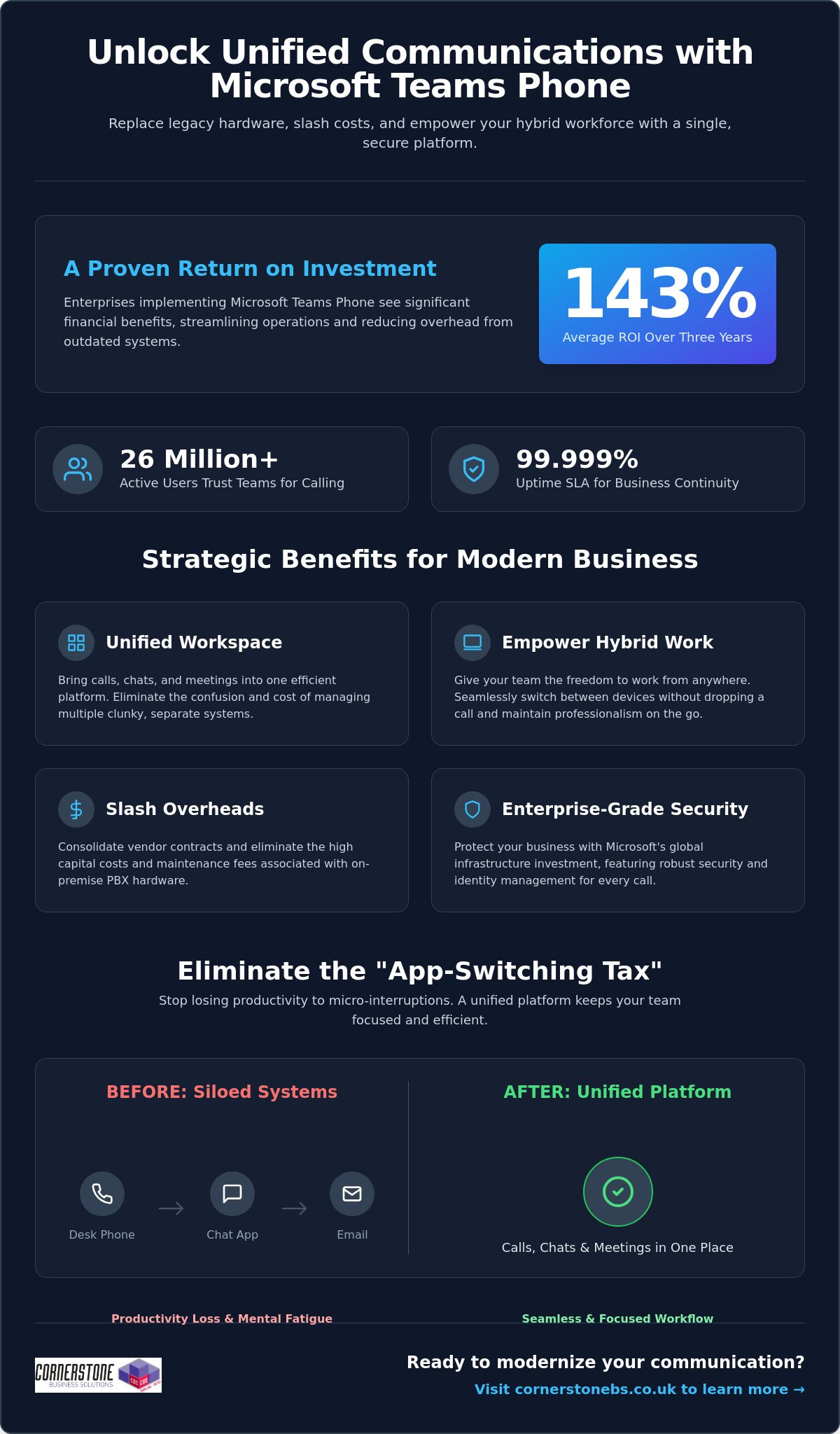
Managing a stack of different telecom invoices is a drain on your resources. It’s common for local businesses to juggle separate contracts for their phone lines, mobile plans, and internet. One of the core benefits of using Microsoft Teams for calling is the ability to consolidate these vendors into a single, manageable Microsoft subscription. This move doesn’t just simplify your paperwork; it gives you a predictable monthly cost that scales exactly as your team grows. You’ll no longer pay for capacity you don’t use or get hit with surprise fees from multiple providers.
You’ll also say goodbye to the high capital expenditure of on-site PBX hardware. Maintaining those physical boxes in your office is expensive and unnecessary in 2026. By shifting to a cloud-based model, you eliminate maintenance fees and the need for periodic hardware refreshes. Research by Forrester found that enterprises can achieve a 143% ROI over three years by making this switch. For smaller organizations, that ROI is even higher at 146%, with most businesses seeing the system pay for itself in less than six months. It’s a clear financial win that stabilizes your IT budget.
Hidden Savings: Beyond the Monthly Bill
The real value often lies in the time you reclaim. Your IT team will no longer spend hours configuring individual phone extensions or troubleshooting hardware failures. Because your staff already use Teams for chat and meetings, the learning curve is flat. This reduces the training costs that usually plague new software rollouts. To get the most out of this transition, it helps to view it as part of a wider digital strategy. We’ve detailed how to handle this shift in our guide to Microsoft 365 migration for business UK.
Preparing for the UK PSTN Switch-Off
The national deadline for the PSTN switch-off is a major driver for change. Traditional copper-wire lines are being retired; businesses that wait until the last minute risk service disruptions or inflated migration costs. Moving to Teams Calling now ensures you’re already on a modern, IP-based system long before the old network goes dark. It’s a proactive step that protects your business continuity for the next decade. By securing your communication infrastructure today, you avoid the rush and ensure your team stays connected to your customers without a hitch. These strategic benefits of using Microsoft Teams for calling provide the stability every local business owner needs.
Security shouldn’t be an afterthought for your business communications. When you move your telephony to the cloud, you’re leveraging Microsoft’s multi-billion dollar annual investment in global cyber security. This isn’t just about protecting files; it’s about securing every voice conversation your team has. One of the standout benefits of using Microsoft Teams for calling is the integration with Entra ID. This unified identity management ensures that only authorized staff can access your phone system, significantly reducing the risk of unauthorized usage or toll fraud.
Multi-factor authentication (MFA) adds another vital layer of protection. By requiring a second form of verification, you stop the vast majority of identity-based attacks before they even start. Your voice traffic is also protected by industry-standard encryption protocols. This means your conversations remain private and secure, whether your team is in the office or working from a home network. We help local firms implement these robust cyber security measures to ensure their communication stays resilient against modern threats.
Built on a Foundation of Trust
Teams Calling doesn’t exist in a vacuum. It benefits directly from the cyber security services already protecting your Microsoft 365 environment. Reliability is equally impressive, with Microsoft offering a 99.999% uptime Service Level Agreement (SLA). This level of stability is essential for maintaining customer trust. High Availability in cloud telephony means your phone system remains operational through redundant data centres, ensuring you never miss a call due to a single point of hardware failure.
Compliance and Data Governance
Meeting regulatory requirements like GDPR is much simpler when your communications are unified. Teams allows you to manage data residency, ensuring your call logs and recordings stay within the UK. This is a major advantage for businesses in regulated sectors like finance or legal. You also benefit from a single audit log for all interactions. Having your calls, chats, and meetings tracked in one place makes reporting and governance straightforward. These benefits of using Microsoft Teams for calling provide the emotional security you need to focus on your clients, knowing your data is handled with care.
Transitioning your business to a cloud-based phone system is a significant step toward future-proofing your operations. It isn’t just about software; it’s about a strategic roadmap that ensures your team stays connected without a hitch. The process begins with a thorough network readiness assessment. We look at your current internet bandwidth and network configuration to ensure your infrastructure can handle high-quality voice traffic. This prevents the common pitfalls of “jitter” or dropped calls that often plague poorly planned DIY setups. One of the greatest benefits of using Microsoft Teams for calling is that, when configured correctly, it offers a level of clarity that traditional lines simply can’t match.
Choosing the right licensing model is your next vital decision. Microsoft offers different paths, typically categorized into Business Voice for smaller firms or Enterprise models for larger organisations. We help you navigate these choices to ensure you aren’t paying for features you don’t need. Once the licensing is set, we manage the porting of your existing phone numbers. We coordinate the switch to ensure zero downtime. Your clients won’t even notice a change in service, but your staff will certainly notice the improved flexibility. This seamless transition is one of the many benefits of using Microsoft Teams for calling that we prioritise for our local partners.
The Importance of a Managed IT Partner
While the interface looks simple, the underlying architecture of a global telephony system is complex. Opting for bespoke it company solutions is far superior to a “DIY” approach. We provide the proactive monitoring and ongoing support needed to maintain peak performance. If a connectivity issue arises, our team is often working on a fix before you’ve even picked up the phone. This level of care provides the emotional security and business stability that allows you to focus on your growth rather than your dial tone.
Your Migration Checklist
Success depends on preparation. Follow these three steps to ensure a smooth rollout for your team:
- Step 1: Audit your environment. Review your existing hardware and identify which users need physical handsets versus those who prefer a mobile-only approach.
- Step 2: Verify your connection. Ensure your office Wi-Fi and wired networks are optimised for voice-over-IP traffic to maintain professional standards.
- Step 3: Empower your “Teams Champions.” Identify tech-savvy staff members to lead the change. Their peer-to-peer training will drive faster adoption and reduce frustration.
Ready to unify your communications and reclaim your productivity? Book a conversation with our experts today and let’s discuss how we can support your business journey.
Choosing a modern phone system is about more than just making calls; it’s about building a resilient foundation for your company’s growth. By eliminating legacy hardware and embracing a cloud-first approach, you’re not just saving on overheads. You’re giving your team the tools they need to collaborate without friction, no matter where they’re working. The benefits of using Microsoft Teams for calling are clear: higher ROI, simplified management, and enterprise-grade security that protects every conversation.
As a multi-award-winning managed IT provider and Microsoft Gold Partner, we specialize in delivering bespoke technology solutions that align with your specific goals. We don’t just set up the software; we act as your long-term partner to ensure your infrastructure remains stable and secure. Upgrade your business communication with Microsoft Teams Phone; contact Cornerstone today to start your transition. We’re here to help you navigate the 2026 landscape with confidence and approachable, local expertise.
Can I keep my existing business phone numbers when moving to Microsoft Teams?
Yes, you can keep your existing business phone numbers through a process called porting. We manage the entire transition with your current provider to ensure there’s zero downtime for your team. You won’t need to change your business cards or update your website. Once the numbers move to Microsoft, you’ll manage them directly from your admin dashboard, giving you total control over your communication identity.
Do I need special hardware or desk phones to use Microsoft Teams for calling?
No special hardware is required to start making calls. One of the main benefits of using Microsoft Teams for calling is that it works on devices you already own, like laptops, tablets, and smartphones. While you can invest in Teams-certified desk phones for a traditional office feel, most local businesses find that a high-quality headset provides more flexibility and better audio clarity for their hybrid teams.
Is Microsoft Teams calling reliable enough for a professional business environment?
Microsoft Teams Phone is exceptionally reliable, backed by a 99.999% uptime Service Level Agreement (SLA). This level of stability is possible because the system runs on Microsoft’s global cloud infrastructure. If one data center experiences an issue, your calls automatically route through another. This built-in redundancy ensures your business stays reachable, providing a professional experience that matches or exceeds traditional landline systems used by regional firms.
How does Microsoft Teams calling handle emergency services (999) calls?
The system fully supports emergency calling to 999 and 112 services. Microsoft uses dynamic location features to share your precise position with emergency dispatchers when you place a call. This is particularly important for hybrid workers who might be at home or in a satellite office. We help you configure these emergency addresses correctly during setup to ensure your staff stays safe and your business remains compliant with UK regulations.
What is the difference between Microsoft Teams calling and a standard VoIP system?
The biggest difference is deep integration. While a standard VoIP system offers voice over the internet, Teams brings your calls, chats, and files into one place. You don’t have to switch apps to check a calendar or share a document during a call. This unification reduces the “app-switching tax,” making your daily workflows much more efficient than using a standalone phone system that sits outside your workspace.
Can I use Microsoft Teams for calling on my mobile phone when out of the office?
Absolutely, you can use the Teams app on your mobile phone to stay connected anywhere. When you make a call, the recipient sees your professional business number rather than your private mobile ID. This keeps your personal details secure while ensuring you never miss an important client inquiry. It’s a perfect solution for staff who split their time between the office and visiting clients across the region.
What happens to my phone system if the internet goes down?
If your office internet goes down, your phone system stays active in the cloud. Calls can be answered immediately on mobile devices using 4G or 5G data. You can also set up automatic failover rules to redirect calls to a different office or an external mobile number. This flexibility means your business never truly goes “offline,” even if your physical premises lose their primary connection during a local outage.
How much does it cost to add calling capabilities to my existing Microsoft 365 plan?
The cost depends on your current subscription. If you’re on a Microsoft 365 E5 plan, calling capabilities are often already included. For Business Standard or E3 users, you’ll simply add a specific phone license. While we don’t quote prices here, the benefits of using Microsoft Teams for calling include consolidating your bills into one predictable monthly payment, which often reduces your total telecom spend compared to multiple vendors.