
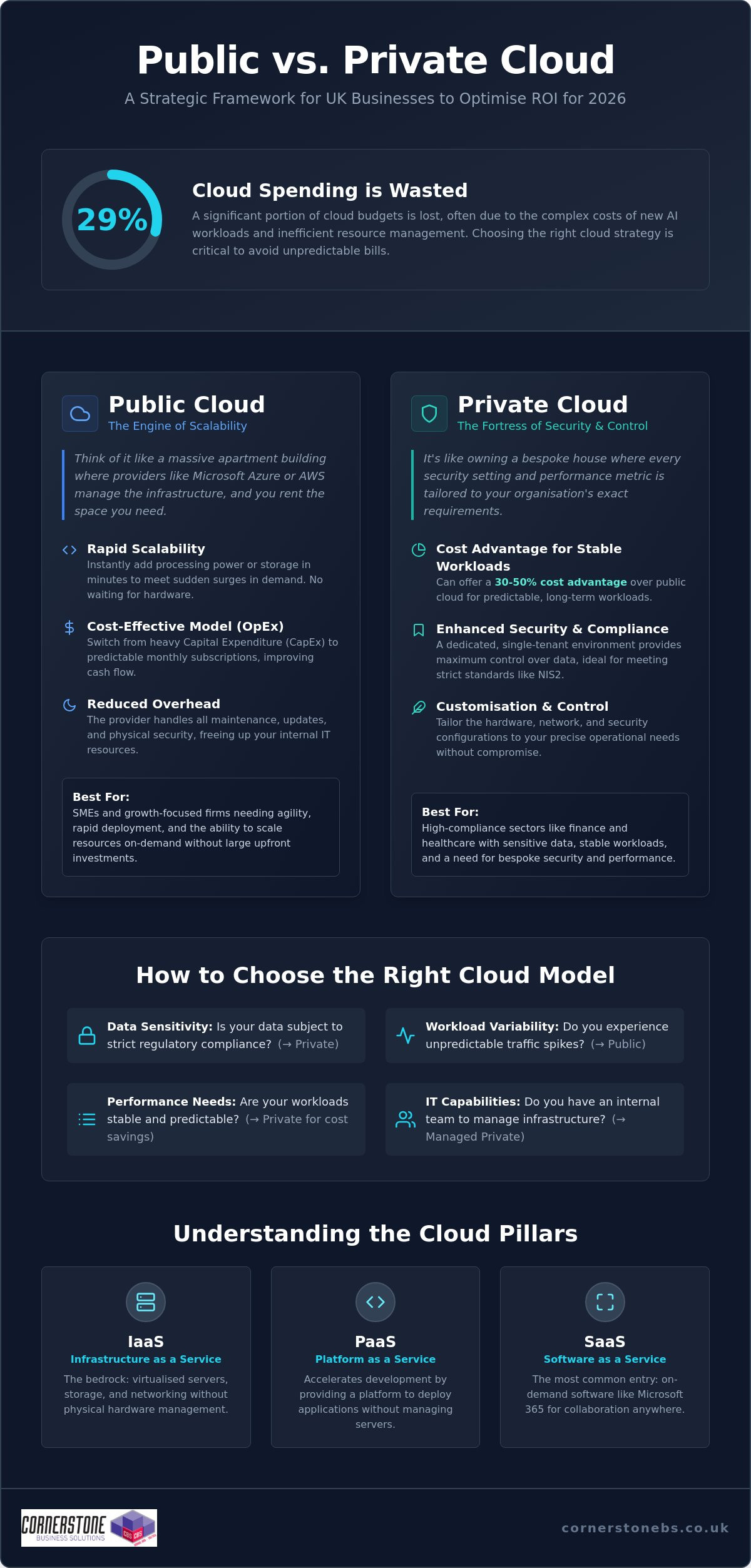
Did you know that 29% of cloud spending is now wasted, largely because of the complex costs tied to new AI workloads? When you’re weighing up private cloud vs public cloud for business, it’s easy to feel overwhelmed by unpredictable monthly bills and the strict pressure of UK compliance standards like NIS2. You want an infrastructure that protects your data without draining your budget, yet the choice often feels like a gamble between total flexibility and absolute control.
We understand that managing a multi-cloud environment is a massive task for any local business leader. You need more than just storage; you need a clear roadmap that ensures your systems are both secure and scalable. This guide breaks down the critical differences between these models to help you find the best ROI for 2026. We’ll explore how a managed private cloud can offer a 30-50% cost advantage for stable workloads and provide the peace of mind your team deserves. As your trusted regional experts, we’re here to simplify these technical shifts so you can focus on your long-term growth.
Key Takeaways
- Understand how public cloud models like Microsoft Azure allow SMEs to scale rapidly by switching from heavy capital costs to predictable monthly subscriptions.
- Explore why private cloud environments provide a dedicated security fortress for high-compliance sectors like finance and healthcare.
- Master the framework for choosing private cloud vs public cloud for business based on your data sensitivity and internal IT capabilities.
- Learn why a successful cloud transition depends on a proactive Managed IT Support strategy to maintain security and long-term ROI.
Beyond the Buzzwords: Understanding Cloud Infrastructure in 2026
By 2026, being “cloud-first” has become the baseline for UK business resilience. The conversation surrounding private cloud vs public cloud for business is no longer about choosing a single winner; it’s about strategic workload placement. Local firms are moving away from the “one size fits all” mentality to ensure their data is both accessible and protected. Modern cloud computing provides the flexibility to adapt as your company grows, making it a foundational partner in your success.
Public cloud operates as a shared, multi-tenant utility model. Think of it like a massive apartment building where providers like Microsoft Azure or AWS manage the infrastructure, while you rent the space you need. In contrast, a private cloud is a dedicated, single-tenant environment built exclusively for your organisation. It’s like owning a bespoke house where every security setting and performance metric is tailored to your exact requirements. Choosing between them requires a deep look at your specific operational needs.
The Three Pillars: IaaS, PaaS, and SaaS
Understanding how these models function helps you make better investment decisions. Infrastructure as a Service (IaaS) is the bedrock of migration, giving you virtualised servers and storage without the physical clutter. Platform as a Service (PaaS) accelerates your team’s ability to develop and deploy applications by removing the need to manage underlying servers. Finally, Software as a Service (SaaS) remains the most common entry point. Tools like Microsoft 365 allow your team to collaborate from any location, ensuring your business never misses a beat.
Why Business Leaders Are Moving Away from On-Premise
The days of the dusty server room are fading fast. Maintaining physical hardware involves significant hidden costs, from rising electricity bills for cooling to the expensive floor space required to house the racks. These traditional systems often lack the agility needed in a remote-work era, creating bottlenecks that slow down your team. Cloud computing is a resilient digital infrastructure that delivers computing services over the internet to ensure your business remains operational regardless of physical location or local hardware failure.
- Reduced Overhead: You stop paying for hardware maintenance and the staff time required to manage it.
- Instant Scalability: You can increase your capacity in minutes rather than waiting weeks for new parts to arrive.
- Enhanced Security: Cloud providers invest billions into physical and digital security that most SMEs simply couldn’t afford on their own.
By shifting to a modern cloud model, you gain a proactive partner in your technology journey. Whether you opt for the massive scale of the public cloud or the tailored isolation of a private environment, the goal is the same: stability, growth, and peace of mind.
Public Cloud: The Engine of Modern Business Scalability
One of the most significant benefits is the transition from Capital Expenditure (CapEx) to Operational Expenditure (OpEx). Instead of spending thousands on physical servers that depreciate the moment they’re installed, you pay a predictable monthly subscription. This keeps your cash flow healthy. It also ensures you aren’t stuck with “ghost hardware” that sits idle during quiet periods. According to the NIST definition of cloud computing, this “on-demand self-service” is what makes the public model so potent for growth-focused firms.
Scalability is where the public cloud truly shines. If your business experiences a sudden surge in demand, you can add processing power or storage in minutes. There’s no need to wait weeks for a courier to deliver a new drive or for an engineer to install it. This agility is backed by a global network of data centres, ensuring that your applications remain available even if one location faces an issue. If you’re looking to modernise your setup, our team can help you design Cloud Solutions that align perfectly with your expansion plans.
Key Benefits of the Public Model
The provider handles all the heavy lifting. You don’t have to worry about hardware updates, patching physical servers, or managing on-site security. This “zero maintenance” approach frees up your internal team to focus on projects that actually drive revenue. You also gain immediate access to cutting-edge innovation. Whether it’s AI-driven analytics or advanced machine learning tools, these features are built directly into the platform. It’s the most cost-efficient way to handle variable workloads because you only pay for the resources you actually consume.
The Trade-offs: What to Watch Out For
While the public cloud is powerful, it isn’t a silver bullet. You must understand the “shared responsibility” model. The provider secures the infrastructure, but you’re still responsible for the data you put inside it. Many businesses also fall into the trap of “bill shock” due to egress fees. These are costs charged when you move data out of the cloud, which can make a cheap entry point very expensive later on. Finally, public clouds are highly standardised. If your business requires a truly bespoke, deep-level customisation of the underlying hardware, you may find the public model a bit too restrictive for your needs.
Private Cloud: Building a Bespoke Security Fortress for Your Data
While the public cloud offers incredible scale, many firms find that a private environment provides the specific control they need to thrive. When evaluating private cloud vs public cloud for business, the private model stands out as a bespoke security fortress. It isn’t just a legacy solution for large corporations; it’s a modern, high-performance choice for any organisation that prioritises data isolation and customisation. As your local technology partner, we see more businesses choosing this route to gain total oversight of their digital estate.
This granular control extends from the hypervisor right up to the application layer. You can customise the entire infrastructure to support legacy software that might not be compatible with standard public cloud platforms. This ensures your essential business tools continue to run smoothly without requiring a total software overhaul. It’s about building a system that fits your business, rather than forcing your business to fit the system.
The Security and Compliance Edge
Data sovereignty is a top priority for UK businesses in 2026. With a private cloud, you know exactly where your data resides, often within local, highly secure data centres. This makes it much easier to meet stringent regulatory standards such as NIS2 or industry-specific audits. You aren’t just trusting a global provider’s general settings; you’re implementing dedicated firewalls and security protocols designed specifically for your risk profile. This proactive approach to Cyber Security ensures your most sensitive information remains under your direct oversight at all times.
Performance and Predictability
Resource-intensive workloads, such as large databases or CAD software, demand consistent, high-speed performance. A private cloud provides dedicated resources that never fluctuate, ensuring your team stays productive without frustrating lag. Perhaps most importantly for business owners, this model often follows a fixed-cost structure. You avoid the “variable billing” anxiety associated with public platforms, where a slight change in usage can lead to an unexpected spike in your monthly invoice. Private cloud infrastructure gives you the confidence that your data is safe and your costs are controlled, allowing you to focus entirely on your next big project.
Our team specialises in designing Cloud Solutions that provide this exact level of stability and protection for your growing firm.
The Decision Framework: How to Choose the Right Cloud Model
Selecting the right path between private cloud vs public cloud for business isn’t a decision you should make in a vacuum. It requires a clear look at your specific risk tolerance and where you want your company to be in three years. You need a framework that prioritises your data’s safety while keeping your operations agile. As a local partner, we believe the best choice is the one that lets you sleep soundly at night knowing your systems are stable and compliant.
Your risk profile is the most critical starting point. If you handle highly sensitive client data under UK GDPR or the 2026 NIS2 requirements, your need for oversight is absolute. While public providers offer robust security, they don’t always provide the same level of data sovereignty as a private environment. You must decide if you’re comfortable with a shared infrastructure or if your compliance obligations demand a dedicated, isolated space for your core assets.
Internal IT capability is another major factor. Managing a private stack requires a specific set of technical skills and constant oversight. If your team is already focused on driving innovation, adding the burden of infrastructure maintenance could lead to bottlenecks. Public cloud models shift this responsibility to the provider, which is often a better fit for firms that want to scale quickly without expanding their internal tech department. We can help you weigh these options through a detailed audit of your current Cloud Solutions.
Cost vs. Control: Finding the Sweet Spot
Public cloud models offer enticing short-term savings because they remove the need for initial hardware investment. They’re perfect for start-ups or projects with unpredictable growth. However, for established firms with stable workloads, the private cloud often delivers superior long-term ROI and price predictability. Many of our clients find that a hybrid compromise is the most effective strategy. This allows you to keep your most sensitive databases in a private fortress while leveraging public SaaS tools for daily collaboration. It’s about placing each workload where it performs best.
The Five Critical Questions for Your Leadership Team
Before you commit to a specific model, sit down with your stakeholders and answer these five essential questions. This clarity will prevent expensive migration mistakes later on.
- What are our specific compliance obligations for 2026? Ensure your choice meets the latest UK regulatory standards.
- What is the actual cost of one hour of downtime to our business? This helps determine how much you should invest in redundancy.
- How many of our applications are truly ‘cloud-native’? Some older software simply won’t run efficiently in a public environment.
- What is our expected growth over the next 24 months? Choose a model that can keep pace with your expansion.
- Who will be responsible for the day-to-day security patches? Be clear on where your team’s duties end and the provider’s begin.
If you’re unsure which direction is right for your firm, contact our approachable experts today for a friendly conversation about your infrastructure needs.
Navigating Your Cloud Journey with a Trusted IT Partner
Choosing between private cloud vs public cloud for business is a major strategic milestone, but the platform itself is only half the battle. Many cloud migrations fail to deliver on their promise because they lack a proactive Managed IT Support strategy. Without expert oversight, even the most advanced infrastructure can become a source of frustration rather than a catalyst for growth. We pride ourselves on being a multi-award-winning partner that designs bespoke technology solutions tailored to your unique regional roots and global ambitions.
Cornerstone Business Solutions bridges the gap between complex global brands like Microsoft, IBM, and Cisco and your specific business goals. Our team handles the technical noise of server maintenance, patching, and configuration, allowing you to stay focused on your core operations. This partnership approach moves away from transactional support and focuses on long-term stability. You gain the clarity of an expert who simplifies complex concepts so you can lead with confidence. We act as your dedicated long-term partner, ensuring your technology fuels your expansion rather than holding it back.
Strategic Migration and Ongoing Management
How you move to the cloud is just as important as where you move. A “Lift and Shift” approach might be the quickest way to migrate your data, but “Refactoring” your applications can often lead to better performance and lower costs in the long run. We work alongside you to determine the best path forward, ensuring that Cyber Security is a foundational element of your build from day one. Continuous monitoring means we spot potential issues before they impact your productivity, providing a level of emotional security that a standard service provider simply can’t offer. Collaborative partnerships always outperform transactional IT support because they align with your success.
Your Next Steps Toward a Secure Future
The journey to a more resilient business starts with a clear understanding of your current landscape. We recommend requesting a comprehensive IT infrastructure audit to identify gaps in your security or inefficiencies in your current spending. From there, we can develop a long-term roadmap for IT Company Solutions that evolves as your business grows. This proactive planning ensures that your choice between private cloud vs public cloud for business remains the right one as the market changes.
We’d love to hear about your cloud ambitions and help you decide which model best fits your future. Our doors are always open for an informal conversation about how we can support your team. Reach out to our local experts today, and let’s build something strong together. Your business stability is our priority, and we’re ready to help you navigate the complexities of 2026 and beyond.
Securing Your Competitive Edge in a Cloud-First World
Choosing between private cloud vs public cloud for business is a pivotal moment for your organisation’s growth and data security. We’ve explored how the public cloud’s scalability empowers SMEs and how the private cloud’s dedicated isolation meets the toughest compliance standards. The reality of 2026 is that your success depends on aligning your infrastructure with your specific risk profile and long-term goals. It’s about finding the right balance that protects your assets while keeping your team agile.
As a multi-award-winning IT services provider, we don’t just provide technology; we build long-term partnerships. Through our deep-rooted regional expertise and strategic partnerships with industry leaders like Microsoft, IBM, and Cisco, we design bespoke technology solutions that fuel UK business growth. We’re here to strip away the technical complexity and provide the emotional security that comes from knowing your systems are in safe, expert hands.
It’s time to move past the guesswork and start building a resilient digital foundation. Book a Cloud Strategy Consultation with our Award-Winning Team today to discover which model will best support your journey. We’re excited to help you navigate these choices and ensure your business remains strong, secure, and ready for whatever comes next.
Frequently Asked Questions
Is private cloud more secure than public cloud for business?
Private cloud is often perceived as more secure because it offers total physical and digital isolation for your data. In a private environment, you don’t share hardware with other users, which eliminates the “noisy neighbour” risk entirely. However, public providers like Microsoft Azure invest billions in security infrastructure that most SMEs couldn’t match alone. The real security comes from how you configure your specific environment to meet your unique risk profile.
What are the main cost differences between public and private cloud?
Public cloud typically follows an OpEx model with monthly subscriptions based on usage, which is excellent for cash flow. Private cloud often requires a fixed monthly fee for managed services or a higher initial investment. While public cloud seems cheaper at first, a managed private cloud can offer a 30-50% cost advantage for stable, predictable workloads by avoiding the variable billing fees found in public platforms.
Can my business use both public and private cloud at the same time?
Yes, most modern organisations now use a hybrid strategy that combines both models for maximum efficiency. You can keep your most sensitive financial or legal data in a secure private fortress while using the public cloud for scalable tools like Microsoft 365. This “best of both worlds” approach allows you to balance high-level security with the flexibility needed for daily collaboration and rapid growth.
How does cloud choice affect GDPR and UK compliance?
Your choice significantly impacts where your data is stored and who has access to it under UK GDPR and NIS2 regulations. Private clouds often offer better data sovereignty because you know exactly which local data centre houses your information. When weighing private cloud vs public cloud for business, you must ensure your provider offers UK-based residency to simplify audits and maintain strict compliance with regional laws.
What is a hybrid cloud and is it right for an SME?
A hybrid cloud is an intentional architecture that links private and public environments to share data and applications. It is often the ideal choice for an SME because it provides a cost-effective way to scale without compromising on security for core assets. By using a hybrid model, you can leverage the innovation of the public cloud while maintaining a bespoke, private layer for your most critical business functions.
How long does it take to migrate a business to the cloud?
Migration timelines vary depending on the complexity of your data and the number of applications involved. A simple transition for a small firm might take a few weeks, while a full refactoring of legacy software for a larger organisation could take several months. We focus on a phased approach to minimise downtime, ensuring your team remains productive and your systems stay stable throughout the entire transition process.
Do I need an internal IT team to manage a private cloud?
You don’t need a large internal team if you partner with a proactive managed service provider. We handle the day-to-day maintenance, security patching, and hardware monitoring of your private stack so your staff can focus on strategic projects. This managed approach gives you all the benefits of a bespoke private environment without the overhead of hiring and training specialised infrastructure engineers in-house.
What happens to my data if a public cloud provider has an outage?
Major public providers use global redundancy to protect your data, but local access can still be interrupted during a service outage. Your data is rarely lost, but it may become temporarily inaccessible if you don’t have a robust Disaster Recovery plan in place. We design resilient systems that include off-site backups and failover protocols to ensure your business remains operational even during a provider-level disruption.