Cornerstone Business Solutions

Cloud Storage

Business Document Storage: The Ultimate Guide to Secure Cloud Solutions in 2026

Posted on: September 12th, 2026 by Cornerstone

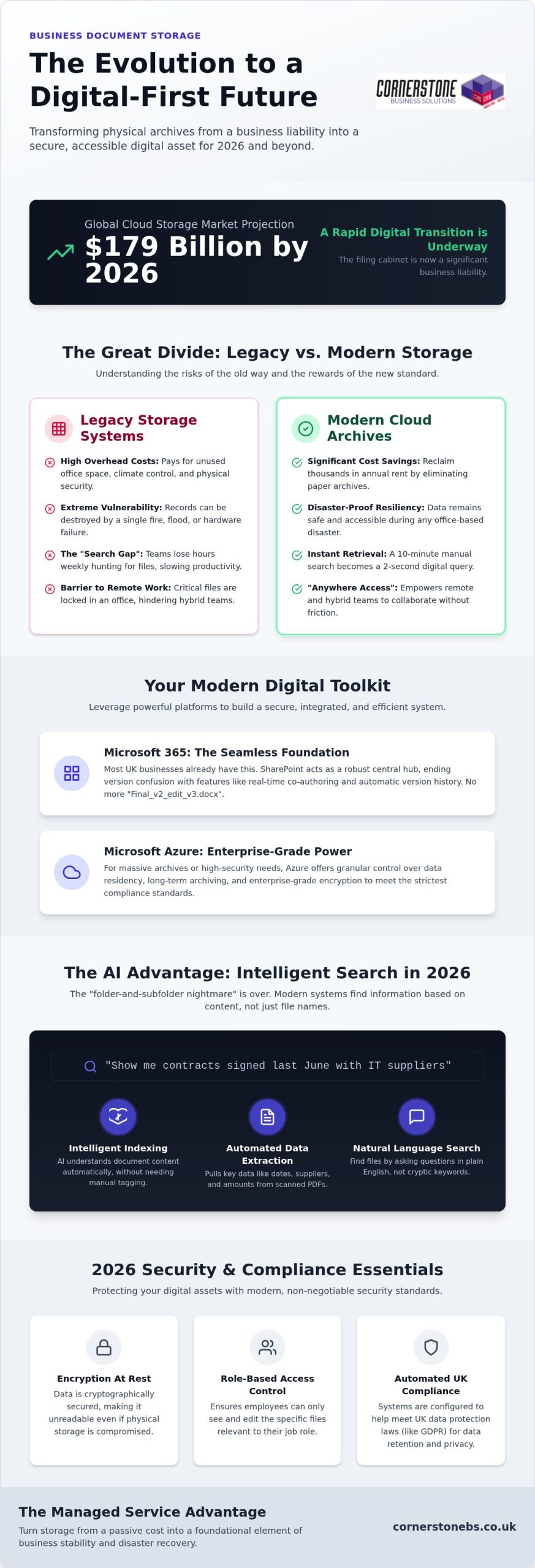
With the global cloud storage market projected to exceed $179 billion in 2026, the humble filing cabinet has officially transitioned from an office staple to a significant business liability. You likely feel the drain of rising office costs and the nagging worry that your physical business document storage is one leak or one GDPR audit away from a crisis. It’s a common frustration for many UK business owners who find themselves drowning in paper while their remote teams struggle to access vital information quickly.

As a multi-award-winning provider, we believe your digital infrastructure should be a foundation for growth, not a source of stress. This guide will show you exactly how to move toward a secure, cloud-managed archive that eliminates physical overhead and automates compliance with the latest UK data protection laws. We’ll walk through the specific steps to build a searchable digital ecosystem that protects your version control and keeps your data safe through a bespoke disaster recovery strategy.

Key Takeaways

  • Reframe physical filing as a hidden cost and learn how digital archives reclaim valuable office space while improving document retrieval speeds.
  • Identify how to leverage Microsoft 365 and Azure to build a secure, integrated business document storage system tailored to your specific industry needs.
  • Master the 2026 security essentials, including encryption at rest and Role-Based Access Control, to ensure your sensitive data remains fully compliant with UK laws.
  • Develop a bespoke data strategy by auditing your current files and selecting the ideal hybrid or public cloud model to support your remote teams.
  • Understand the proactive benefits of a managed service approach, turning your digital storage into a foundational element of business stability and disaster recovery.

The Evolution of Business Document Storage: Physical vs. Digital

The landscape of business document storage has shifted from dusty basements to dynamic digital environments. Ten years ago, a row of filing cabinets was a sign of a busy office. Now, it’s often a sign of wasted overhead. Physical storage forces you to pay for square footage, climate control, and insurance for boxes that rarely see the light of day. It’s a passive expense that does nothing to help your business grow. We’ve seen many firms reclaim thousands in annual rent just by clearing out their paper archives.

We’re now seeing a national move toward ‘Active Archives’. This concept moves storage from a static graveyard of paper to a functional tool. Modern systems ensure every piece of data is indexed and accessible within seconds. This shift also reflects a change in environmental responsibility. Maintaining a physical warehouse requires constant energy for lighting and security. Green cloud data centres are designed for efficiency, using renewable energy to lower your carbon footprint compared to traditional warehousing.

The Risks of Legacy Storage Systems

Physical paper is inherently fragile. A single burst pipe or electrical fire can wipe out decades of records in minutes. Even if you’ve moved to local servers, you might still be at risk. Local hardware often acts as a ‘middle ground’ that fails because it lacks the encryption and redundancy of the cloud. Then there’s the ‘Search Gap’. We’ve found that teams often lose several hours every week just hunting for specific files. A professional document management system eliminates this friction. It turns a ten minute manual search into a two second digital click.

Why Digital-First is the National Standard in 2026

The UK workforce is now hybrid by default. If your files are locked in a cabinet or a local server in an empty office, your remote team is effectively blind. Digital-first storage provides ‘anywhere’ access. This allows your staff to collaborate from home or on the road without delay. Modern client expectations have also evolved. They won’t wait days for a scanned copy of a contract; they want instant delivery. Digital business document storage is also the backbone of your business continuity. If an office disaster occurs, your data remains safe and reachable. Your operations stay stable, and your team stays productive.

Modern Cloud Solutions for Document Management

Modern business document storage isn’t just a place to dump files; it’s an engine for your business. In 2026, we’ve moved past the chaos of scattered folders and local drives. Leading solutions now integrate directly into your daily workflow, making data management an invisible, automated process. By following data security best practices, you ensure that this accessibility never comes at the cost of safety. It’s about creating a system where the right information finds the right person at the right time.

For businesses with massive archives or high-security requirements, Microsoft Azure offers a more powerful tier of business document storage. Azure allows for granular control over data residency and long-term archiving, which is essential for meeting strict compliance standards. It’s about building a bespoke environment where your most sensitive assets are protected by enterprise-grade encryption while remaining accessible to the right people. This managed approach ensures your digital archive remains lean, secure, and fully searchable.

Harnessing Microsoft 365 for Seamless Storage

Most UK businesses already have the tools they need within their existing subscriptions. SharePoint serves as a robust central hub, replacing the clunky shared drives of the past. One of the biggest wins for our clients is the elimination of version confusion. With real-time co-authoring and automatic version history, you’ll never have to hunt for ‘Final_v2_edit_v3’ again. If you’re looking to upgrade your setup, our Microsoft 365 Migration for Business UK guide provides a clear roadmap for this transition.

AI and Searchability in 2026

The “folder-and-subfolder nightmare” is finally over. Intelligent indexing now uses zero-shot extraction to understand what’s inside a document without manual tagging. This means AI can read a scanned PDF invoice and automatically extract the date, supplier, and amount. You can find files using natural language search. Simply ask the system for “contracts signed last June with IT suppliers” rather than remembering a specific filename. This level of efficiency requires a clean data structure, which is why we focus on preparing your environment for AI readiness from day one.

We also help you automate the entire document lifecycle. You can set policies that automatically move old files to cheaper storage tiers or securely delete them once they hit their retention limit. This proactive approach keeps your archive lean and reduces legal risk. If you’re ready to simplify your digital workspace, our team can help you design bespoke cloud solutions that fit your specific goals. It’s a steady, reliable way to ensure your business stays organized as it grows.
Business Document Storage: The Ultimate Guide to Secure Cloud Solutions in 2026

Security and Compliance: Protecting Your Business Assets

Security for business document storage has evolved far beyond simple password protection. In 2026, the standard for any professional archive is end-to-end encryption. This means your data is scrambled both “at rest” while it sits on a server and “in transit” while it’s being sent to a colleague. It’s a non-negotiable layer that ensures even if data is intercepted, it’s completely unreadable. We believe that this level of protection shouldn’t be complex for you to manage. It should be a silent, reliable guardian of your company’s hard work.

We also focus on Role-Based Access Control (RBAC). Not everyone in your company needs to see every payroll file or legal contract. RBAC allows us to set granular permissions, so staff only see what’s essential for their role. This reduces the risk of accidental leaks and internal data breaches. When combined with multi-factor authentication (MFA), which requires a second form of verification to log in, your digital assets become significantly harder to target. These layers work together to create a fortress around your sensitive information.

Defending Against Ransomware and Data Loss

Physical boxes can be shredded, but digital files can be “kidnapped” by ransomware. Modern cloud solutions prevent this through immutable backups and versioning. If a virus hits, we can simply roll your archive back to a clean state from minutes before the attack. We always advocate for the 3-2-1 backup rule: three copies of your data, on two different media types, with one copy stored off-site. This is a core part of our Cyber Security Services, ensuring your business remains resilient regardless of the threat.

Compliance as a Competitive Advantage

Meeting UK GDPR or industry-specific rules from the FCA or SRA shouldn’t be a manual chore. Managed business document storage allows you to set automated retention policies. If a document is legally required to be kept for seven years, the system flags it for secure deletion the moment that time expires. This reduces your liability and keeps your archive clean. Detailed audit trails also provide proof of who accessed which document and when. Working with an ISO-certified managed IT provider gives you the peace of mind that your data handling meets the highest national standards. It turns compliance from a headache into a badge of reliability for your clients.

Creating a Robust Document Storage Strategy

Building a successful strategy for business document storage starts with a clear-eyed look at your current assets. You can’t simply move a mess from a filing cabinet into the cloud and expect it to work. We recommend a thorough data audit as your first step. Categorise your files into three clear buckets: what needs to stay in physical form, what should be scanned for digital access, and what can be securely shredded. This process keeps your new digital archive lean and reduces storage costs from day one.

Choosing the right cloud model is your next vital decision. Public clouds like Microsoft 365 offer incredible scale and integration. Private clouds provide an extra layer of isolation for highly sensitive data. Many of our clients find their sweet spot in a hybrid model. This approach balances the convenience of the cloud with the control of local infrastructure. It’s about finding a bespoke fit that matches your specific industry requirements and compliance needs.

The 5-Step Migration Framework

Moving your data requires a structured approach to ensure nothing is lost or exposed. We follow a proven five-step framework to handle these transitions with precision:

  • Step 1: Data Discovery and Classification. We identify exactly what data you have and how sensitive it is.
  • Step 2: Infrastructure Selection. We determine if SharePoint, Azure, or a hybrid setup is the best home for your files.
  • Step 3: Secure Digitisation. We handle the high-speed scanning and indexing of legacy paper records.
  • Step 4: Protocol Implementation. We set up the security layers and access controls discussed in previous sections.
  • Step 5: Managed Monitoring. We provide ongoing support to ensure the system remains stable and secure.

Hybrid Storage: The Best of Both Worlds?

While we advocate for digital-first, we understand that some businesses still need to keep a small physical archive. This is common for legal ‘wet-ink’ originals or specific deeds that require a physical signature. The key is ensuring your local workflows sync perfectly with your cloud-based storage. We design systems where data flows seamlessly between your office and the cloud, so your team always has the most recent version at their fingertips. This ensures your business document storage strategy is both practical and future-proof.

The human element is the final piece of the puzzle. We provide team training to ensure everyone understands how to use the new system securely. Regular reviews are also essential. As your business grows, your storage needs will shift. We’re here as your long-term partner to help you scale your infrastructure and keep your data organised. If you’re ready to start your transition, our team is here to help you design bespoke cloud solutions that simplify your operations.

Why Managed IT is the Key to Stress-Free Storage

Buying a storage subscription is easy. Managing it effectively is where the real work begins. We’ve seen many companies treat business document storage as a static product. They buy the space and then forget about it until a file goes missing or a sync error occurs. A managed service approach changes this dynamic entirely. It turns your archive into a living part of your infrastructure that we monitor and maintain every single day. This proactive stance ensures your data remains an asset rather than a growing liability.

Proactive monitoring is our standard. Instead of waiting for a storage limit warning to disrupt your team, we catch these issues before they ever become downtime. This reliability is why we’re proud to be a multi-award-winning provider. We don’t just give you a digital folder; we give you a dedicated team that ensures your data is always accessible, encrypted, and backed up. It’s about providing the technical mechanism for success while you focus on running your business.

Bespoke solutions are essential for UK enterprises because no two organizations share the same workflow. We tailor your business document storage environment to match your specific growth targets and compliance needs. Whether you’re a growing firm or a large national organization, your storage should scale effortlessly. This partnership-focused style ensures you aren’t paying for features you don’t use while staying fully protected against modern threats. We’re here to simplify the technical side so you can enjoy the clarity of a well-organized office.

Beyond the Digital Folder

Integrating your storage with your wider Managed IT Services creates a unified defense for your company. When your storage is part of a broader security and disaster recovery plan, you gain emotional security as well as technical stability. Our role is to act as a trusted expert who understands your long-term goals. This deep connection allows us to provide better document security than a faceless software vendor ever could. We treat your data with the same care we treat our own, ensuring it’s a foundation for your business stability.

Ready to Secure Your Business Future?

Transitioning to a paperless, secure office environment is a major step toward resilience in 2026. It starts with a simple data audit and a clear roadmap for your digital migration. We’ve helped countless organizations move from the risks of physical filing to the confidence of a cloud-managed archive. A quick conversation is often all it takes to define your strategy and protect your assets for the years ahead. If you’re ready to modernize your archive and reclaim your office space, we invite you to book a consultation with our expert team today. Let’s build a secure, efficient future for your business together.

Secure Your Data and Reclaim Your Workspace

The transition to a modern business document storage system is more than just a technical upgrade; it’s a strategic move to future-proof your operations. By moving away from risky physical filing, you eliminate hidden overheads and empower your remote teams with instant, secure access. We’ve explored how a bespoke combination of Microsoft 365 and Azure, supported by proactive managed IT, can turn your archive into a robust foundation for growth.

As a multi-award-winning IT provider and certified partner of Microsoft, IBM, and Cisco, we specialise in building these secure digital ecosystems for UK businesses. We don’t just provide storage; we offer a long-term partnership that prioritises your business stability and emotional security. You deserve a system that works as hard as you do, catching issues before they impact your productivity. It’s time to stop worrying about compliance audits and start focusing on your next big project.

Secure your business data with Cornerstone’s award-winning Managed IT. We’re ready to help you simplify the complex and start your journey toward a truly paperless, protected office.

Frequently Asked Questions

Is cloud document storage safer than keeping physical files in the office?

Yes, cloud storage is significantly safer because it eliminates physical risks like fire, flood, or theft while providing enterprise-grade encryption. Unlike a locked cabinet, digital storage includes automated backups and audit trails that track exactly who accessed a file. We ensure your data is protected by multiple security layers, making it far more resilient than paper records that can be easily lost or destroyed in a single office accident.

How long are UK businesses legally required to store financial documents?

Most UK businesses are required to keep financial records for at least six years from the end of the last company financial year they relate to. However, specific industries or document types, such as those involving VAT or corporate tax, may have different retention periods. It’s vital to check the latest HMRC and Companies House guidance for your specific sector to ensure your digital archive remains fully compliant with current UK law.

What is the difference between document storage and document management?

Document storage is simply the act of keeping files in a digital location, whereas document management involves the active control and organisation of those files. A management system includes features like version control, intelligent indexing, and automated workflows. While storage provides the space, management provides the structure that allows your team to find, edit, and share documents efficiently. We focus on providing managed solutions that turn static files into a productive business tool.

Can I access my business documents offline if I use cloud storage?

Yes, you can access your business document storage offline by using sync features available in tools like SharePoint and OneDrive. These tools allow you to download specific folders to your device, where you can edit them without an internet connection. Once you’re back online, the system automatically syncs your changes to the cloud. This ensures your remote team stays productive whether they are in the office, at home, or traveling.

How does document storage impact GDPR compliance for UK SMEs?

Cloud-based business document storage simplifies GDPR compliance by providing built-in tools for data encryption, access control, and retention policies. It allows you to respond quickly to Subject Access Requests and ensures that personal data is deleted once it’s no longer needed. By using a managed service, you gain an audit trail that proves you are handling sensitive information responsibly, which is a legal requirement for all UK businesses under current data protection laws.

What happens to my stored documents if my business suffers a cyber attack?

If your business is hit by a cyber attack, our disaster recovery protocols allow us to roll your digital archive back to a clean state. We use immutable backups and the 3-2-1 rule to ensure your data is never truly lost. Instead of paying a ransom or losing years of work, you can restore your files quickly and continue operations. This proactive approach provides emotional security and technical stability during a crisis.

Is it better to use SharePoint or Azure for business document storage?

SharePoint is typically the best choice for daily collaboration and team file sharing, while Azure is better suited for large-scale, high-security data archiving. Most of our clients use a bespoke combination of both. SharePoint provides the user-friendly interface for your staff’s active work, and Azure handles the heavy lifting of long-term storage and complex data residency requirements. We help you find the right balance for your specific business goals.

How much does it cost to digitise a physical document archive?

The cost of digitisation depends on the volume of documents, the level of indexing required, and the condition of the paper records. While we don’t provide fixed pricing here, it’s helpful to view this as a one-time investment that eliminates recurring costs for office space and insurance. A professional audit can help you identify which files are essential to scan and which can be securely shredded, ensuring your digital transition is as cost-effective as possible.


SharePoint vs OneDrive for Business Use: The Complete 2026 Strategy Guide

Posted on: July 4th, 2026 by Cornerstone

Why does it feel like your most important business documents are always hiding in the one place you didn’t look? If your team is constantly clicking the “Sync” button without a clear strategy, you’re likely facing a digital sprawl that complicates your day and puts your data at risk. Mastering the balance of SharePoint vs OneDrive for business use is no longer just a technical chore. It’s the essential foundation for a secure, organized, and modern workplace.

We know how frustrating it is when a departing staff member’s files seem to vanish or when your team struggles to manage complex permissions. You want a system that stays organized without constant babysitting. This guide will show you exactly how to separate your personal “me” files from your collaborative “we” files to eliminate duplication and strengthen your security.

We’ll walk through the 2026 updates to Microsoft 365, including the retirement of standalone storage plans and the new AI-powered SharePoint experience. By the end, you’ll have a clear roadmap to streamline your collaboration and protect your business’s digital legacy.

Key Takeaways

  • Learn the “Me” vs. “We” framework to distinguish between your personal briefcase and the company filing cabinet.
  • Stay ahead of the 2026 Microsoft 365 storage plan retirements and the shift toward integrated AI experiences.
  • Protect your organization’s legacy by understanding who truly owns the data when employees depart.
  • Simplify your team’s daily workflow by using Microsoft Teams as the central hub for both storage platforms.
  • Implement a clear strategy for SharePoint vs OneDrive for business use to eliminate file sprawl and boost productivity.

Understanding the Microsoft 365 Storage Ecosystem in 2026

The way we work has changed. In 2026, we’ve moved past simple file storage into a world of integrated, AI-driven collaboration. Deciding between SharePoint vs OneDrive for business use isn’t about choosing one over the other. It’s about understanding how they work together to protect your data and keep your team moving. Microsoft builds these tools to serve two distinct purposes, yet they share the same powerful DNA.

Think of SharePoint as your company’s master filing cabinet. It’s the central hub for shared resources, departmental data, and every document that belongs to the organization. If a project requires input from three different people, it belongs in SharePoint. This ensures that the collective intelligence of your business stays accessible, even if a specific team member is out of the office or moves on to a new role.

OneDrive for Business is your personal briefcase. It’s a private space for your individual work, early drafts, and personal notes that aren’t ready for the whole team to see. Technically, your OneDrive is a specialized, personal site collection within the broader SharePoint framework. While they look different on your screen, they rely on the same underlying security and infrastructure to keep your files safe.

This division exists to balance privacy with transparency. Microsoft provides both environments because every professional needs a “me” space for focus and a “we” space for results. Without this distinction, your company data becomes a cluttered mess of unfinished drafts and misplaced folders. We help our partners configure these systems so that every file has a logical home from day one.

The Evolution of Cloud Storage

As we move through 2026, cloud standards have evolved far beyond basic file hosting. We’ve seen a massive shift away from traditional local servers toward proactive cloud environments that use AI to help you discover relevant content before you even search for it. The modern workplace is a deliberate blend of universal accessibility and ironclad security.

Common Misconceptions

The “Sync” button is often a trap for the unwary. Many employees believe that syncing every SharePoint folder to their PC is the best way to work, but this often leads to file sprawl and version conflicts. It’s much more efficient to use web access or the integrated “Files” tab in Teams for daily tasks. Additionally, OneDrive for Business is not just a backup for your desktop; it’s a dynamic workspace. Don’t confuse it with the personal OneDrive version you might use for family photos; the business version offers the enterprise-grade security and compliance your organization demands.

OneDrive vs SharePoint: The ‘Me’ vs ‘We’ Framework

Understanding the difference between these two platforms is much easier when you apply the “Me vs. We” framework. It’s a simple mental model that clears up the confusion of where to save a file. As highlighted in this university IT knowledge base article, OneDrive is your personal briefcase, while SharePoint acts as the organizational filing cabinet. When you’re deciding on SharePoint vs OneDrive for business use, you’re essentially deciding who needs to see the work right now.

The “Me” Zone is where your individual productivity happens. It’s the right place for files that only you are working on, such as a rough draft for a proposal or your personal professional development notes. In OneDrive, you are the owner. You control the privacy. While you can share a file with a colleague for a quick sanity check, the document still lives in your personal space. It’s about your tasks and your focus.

The “We” Zone is for everything that belongs to the company. This includes departmental records, client project folders, and company-wide policies. In SharePoint, the organization owns the data, not an individual. This is critical for business continuity. If a team member leaves the company, the files they worked on in SharePoint remain exactly where the rest of the team needs them. It’s the foundation for collective intelligence and long-term security.

The transition point happens when a document’s impact moves beyond your personal task list. Once a draft is ready for departmental review or becomes a formal record, it’s time to move it from OneDrive to SharePoint. This lifecycle management prevents file sprawl and ensures everyone is working from the same “source of truth.” If you need help mapping out these digital workflows, our experts at Cornerstone can help you design a system that fits your specific team culture.

Getting the balance of SharePoint vs OneDrive for business use right means your team spends less time hunting for files and more time actually working. It’s about creating a predictable environment where security and collaboration go hand in hand.

When to Use OneDrive for Business

OneDrive is perfect for drafting documents that aren’t ready for the spotlight. Use it for your private meeting notes, early-stage project ideas, or temporary files you only need to share with one person for five minutes. It’s your digital scratchpad. It keeps your messy drafts out of the clean, organized company archives until they’re actually finished.

When to Use SharePoint Online

SharePoint is the home for permanent company resources. Use it for your brand templates, published policies, and collaborative project sites where multiple people need to edit simultaneously. It’s also the best place to build a company intranet. This keeps everyone informed with news and resources that are accessible from any device, anywhere in the world.

SharePoint vs OneDrive for Business Use: The Complete 2026 Strategy Guide

Governance, Permissions, and Security: Why the Choice Matters

Choosing between SharePoint vs OneDrive for business use isn’t just about where you click “Save.” It’s a fundamental decision about who owns your company’s intellectual property. In SharePoint, the organization is the legal and technical owner of every file. In OneDrive, the data is tied to an individual’s account. This distinction might seem small during a busy Tuesday, but it becomes critical when your team structure changes.

Offboarding remains one of the biggest risks for modern firms. When an employee leaves, their OneDrive account eventually enters a deletion cycle. If they’ve been storing vital project files in their personal briefcase instead of the company filing cabinet, those documents can become “orphaned” or lost forever. SharePoint eliminates this administrative nightmare. Because the site collection exists independently of any single user, the data remains secure and accessible to the rest of the team without interruption.

Centralized control is where SharePoint truly shines for management. It provides a single pane of glass for IT administrators to monitor access levels and compliance. Managing permissions in OneDrive often feels like chasing shadows, as individual sharing links can create security dark spots that are difficult to track. SharePoint allows for broad, group-based permissions that are easier to audit and much harder to mess up. This ensures that your SharePoint vs OneDrive for business use strategy supports long-term growth rather than creating technical debt.

Security Best Practices in 2026

Protecting your digital assets requires a proactive approach. We recommend integrating comprehensive cyber security services with your cloud storage strategy to ensure total resilience. In 2026, we use Sensitivity Labels to wrap security around the data itself, meaning a file stays protected even if it’s moved or shared. Combined with Multi-Factor Authentication (MFA), these tools ensure that only the right people can access your sensitive business information.

External Sharing: SharePoint vs OneDrive

Sharing files with clients or partners requires a delicate touch. SharePoint is designed for this, offering secure Guest access through Microsoft Entra B2B. This allows outsiders to collaborate within a controlled environment without compromising your internal network. Sharing entire folders from a personal OneDrive can lead to “permission creep,” where you accidentally give someone more access than they need. Professional governance is the foundation of business stability.

The Third Pillar: How Microsoft Teams Unites Both

While we’ve explored the technical differences of SharePoint vs OneDrive for business use, most of your team won’t actually spend their day inside those specific apps. Instead, they’ll use Microsoft Teams. Think of Teams as the single window through which your staff views their entire digital world. It’s designed to bring these two storage engines together into one cohesive experience, reducing the friction that often slows down a busy workday.

There’s a specific logic to how Teams handles files that often trips up even the most tech-savvy managers. When you send a file in a 1:1 or group chat, that document is actually stored in the sender’s OneDrive. It’s a temporary, conversational exchange. However, files uploaded to a Team Channel are stored in a SharePoint site. Understanding this “Chat vs. Channel” logic is the key to maintaining a clean system. It ensures that collaborative project work stays in the “We” zone while quick, informal shares stay in the “Me” zone.

By using Teams as your primary hub, you simplify the daily grind. Your team doesn’t have to jump between browser tabs or hunt through different apps to find what they need. Everything is right there, secured by the same enterprise-grade protection we’ve already discussed. If you’re ready to optimize your setup, our local team at Cornerstone can help you configure a Teams environment that truly works for your business.

Simplifying the User Experience

Teams allows you to browse entire SharePoint libraries without ever leaving the application. This centralisation is a massive win for productivity. It reduces “app fatigue” and provides a unified search experience across your entire Microsoft 365 stack. Whether a file is in your personal drive or a team site, you can find it in seconds using the Teams search bar. This creates a stable and predictable rhythm for your staff, regardless of where they’re working from.

Strategic Migration Planning

Moving from a legacy file server to a modern, Teams-first structure is a big step for any organization. We always recommend a phased approach to prevent employee pushback and ensure data integrity. If you’re planning a move, check out our guide on Microsoft 365 migration for business UK for a step-by-step technical breakdown. A well-planned migration ensures your transition to the cloud is smooth, secure, and built for the future of SharePoint vs OneDrive for business use.

Implementing a Robust Document Strategy with Cornerstone

Knowing the theory behind SharePoint vs OneDrive for business use is a great start, but the real value lies in the execution. At Cornerstone Business Solutions, we’ve built a reputation for turning complex cloud hurdles into streamlined business assets. We don’t just hand you a login and wish you luck. Our award-winning team works alongside you to design a bespoke digital environment that reflects exactly how your staff operates. We’re proud of our regional roots and bring that same community-focused dedication to every project we manage.

A healthy file structure requires more than just initial setup; it needs proactive monitoring to stay secure. As your business grows, your data needs will shift. We provide the steady hand and expert analysis required to ensure your systems remain stable and efficient. By positioning ourselves as your long-term technology partner, we take the stress out of managing your digital infrastructure. This allows you to focus on your core business goals while we handle the technical heavy lifting behind the scenes.

We understand that every organization in our region has unique workflows. A generic, “one-size-fits-all” approach to cloud storage usually leads to the very file sprawl we’re trying to avoid. That’s why we prioritize customization. We look at your specific departmental needs, security requirements, and collaboration habits. This results in a system that feels natural to your team and provides the emotional security of knowing your data is exactly where it should be.

Our Proactive Approach to Microsoft 365

We go far beyond simple licensing. Our experts dive deep into governance and permissions to ensure your data stays in the right hands. This proactive configuration is a cornerstone of our managed IT services, providing the resilience you need to maintain business continuity. We also believe in empowering your staff. We provide clear, approachable training so everyone understands which tools to use for specific tasks. This eliminates confusion and builds a culture of digital confidence across your entire firm.

Ready to Organise Your Business Data?

There’s never been a better time to audit your current cloud storage usage. If you’re seeing duplicate files or struggling with “Sync” errors, it’s a sign that your current strategy needs a refresh. We invite you to join us for a collaborative conversation about your IT needs. Let’s look at your current SharePoint vs OneDrive for business use setup and find ways to make it work harder for you. Contact our expert team today to start streamlining your business technology and securing your digital future.

Secure Your Digital Future with a Clear Cloud Strategy

Mastering the balance of SharePoint vs OneDrive for business use is about more than just file storage. It’s about building a resilient foundation where your team can collaborate without friction. By adopting the “Me vs. We” framework and using Microsoft Teams as your primary hub, you eliminate the confusion that leads to data sprawl and security risks. You deserve a system that works as hard as you do, keeping your company’s intellectual property safe and organized for the long haul.

At Cornerstone, we bring over 20 years of experience in delivering bespoke technology solutions to our local business community. As a Microsoft Certified Partner and a multi-award-winning IT services provider, we’ve helped countless organizations navigate the complexities of the modern workplace. We don’t just set up software; we build long-term partnerships that ensure your technical infrastructure supports your growth every step of the way.

Don’t let disorganized data hold your team back. We’re here to help you audit your current setup and implement a strategy that delivers true peace of mind. Book a consultation with our multi-award-winning IT experts today to start your journey toward a more efficient, secure, and collaborative workplace. Let’s work together to make your technology your greatest competitive advantage.

Frequently Asked Questions

Is SharePoint more secure than OneDrive for business use?

Both platforms utilize the same high-level Microsoft security infrastructure to protect your data. However, SharePoint offers superior governance for the organization. It allows for granular, group-based permissions that are far easier to audit than individual OneDrive sharing links. This centralized management reduces the risk of human error and ensures your business data remains protected even as your team changes. It provides the administrative control that a growing firm needs to stay compliant.

Can I use OneDrive and SharePoint at the same time?

You absolutely should use both simultaneously as part of your daily workflow. OneDrive handles your private drafts and individual notes, while SharePoint serves as the hub for team collaboration and departmental records. Using them together ensures that your personal workspace stays organized and your team projects remain accessible to everyone who needs them. This combined approach is the most efficient way to manage your digital life and maintain a clear SharePoint vs OneDrive for business use strategy.

What happens to my OneDrive files if I leave the company?

When an employee departs, their OneDrive account enters a deletion cycle, typically lasting 30 days by default. Unless an administrator intervenes to move or back up those files, they will be permanently lost. This is why we recommend moving all project-related documents to SharePoint well before an offboarding process begins. It ensures your business’s collective intelligence stays within the company rather than being tied to a single person’s account.

Do I need a separate backup for SharePoint and OneDrive?

Yes, we strongly recommend a dedicated third-party backup solution for both platforms. While Microsoft provides a recycle bin and basic versioning, it does not offer the comprehensive disaster recovery features needed for total peace of mind. A separate backup protects you against accidental deletion, ransomware, and service outages. It is a foundational element of a robust business continuity plan that keeps your data safe regardless of the circumstances.

How much storage do I get with SharePoint vs OneDrive?

Most business plans provide 1 TB of storage per user for OneDrive. SharePoint uses a pooled model, offering a base of 1 TB plus an additional 10 GB for every licensed user in your organization. If you need more space, individual SharePoint sites can scale up to 25 TB. We can help you monitor these limits and purchase additional storage at the 2026 rate of $0.20 per GB if your business requires it.

Can I share SharePoint files with people outside my organisation?

Yes, SharePoint is designed for secure external collaboration. You can invite clients or partners as guests using Microsoft Entra B2B. This allows them to work on specific documents without gaining access to your entire internal network. It’s a much safer alternative to sending email attachments back and forth. You maintain full control over what they can see, and you can set expiration dates for their access to ensure long-term security.

Is SharePoint replacing OneDrive in 2026?

No, SharePoint is not replacing OneDrive. While Microsoft is integrating the two platforms more closely to create a seamless user experience, they still serve two distinct purposes. OneDrive remains the “Me” space for personal work, while SharePoint is the “We” space for organizational resources. The 2026 updates focus on making it easier to move between these two environments without losing your focus, rather than eliminating one of them.

How do I sync SharePoint files to my computer safely?

Use the OneDrive sync client to access SharePoint files directly from your File Explorer. To stay safe and save disk space, we recommend using the “Files On-Demand” feature. This allows you to see all your files without downloading them until you actually need to open them. It keeps your PC fast while ensuring you always have the latest version of your team’s work at your fingertips without cluttering your local drive.


Copyright © 2026 Cornerstone Business Solutions