Posted on: September 14th, 2026 by Cornerstone
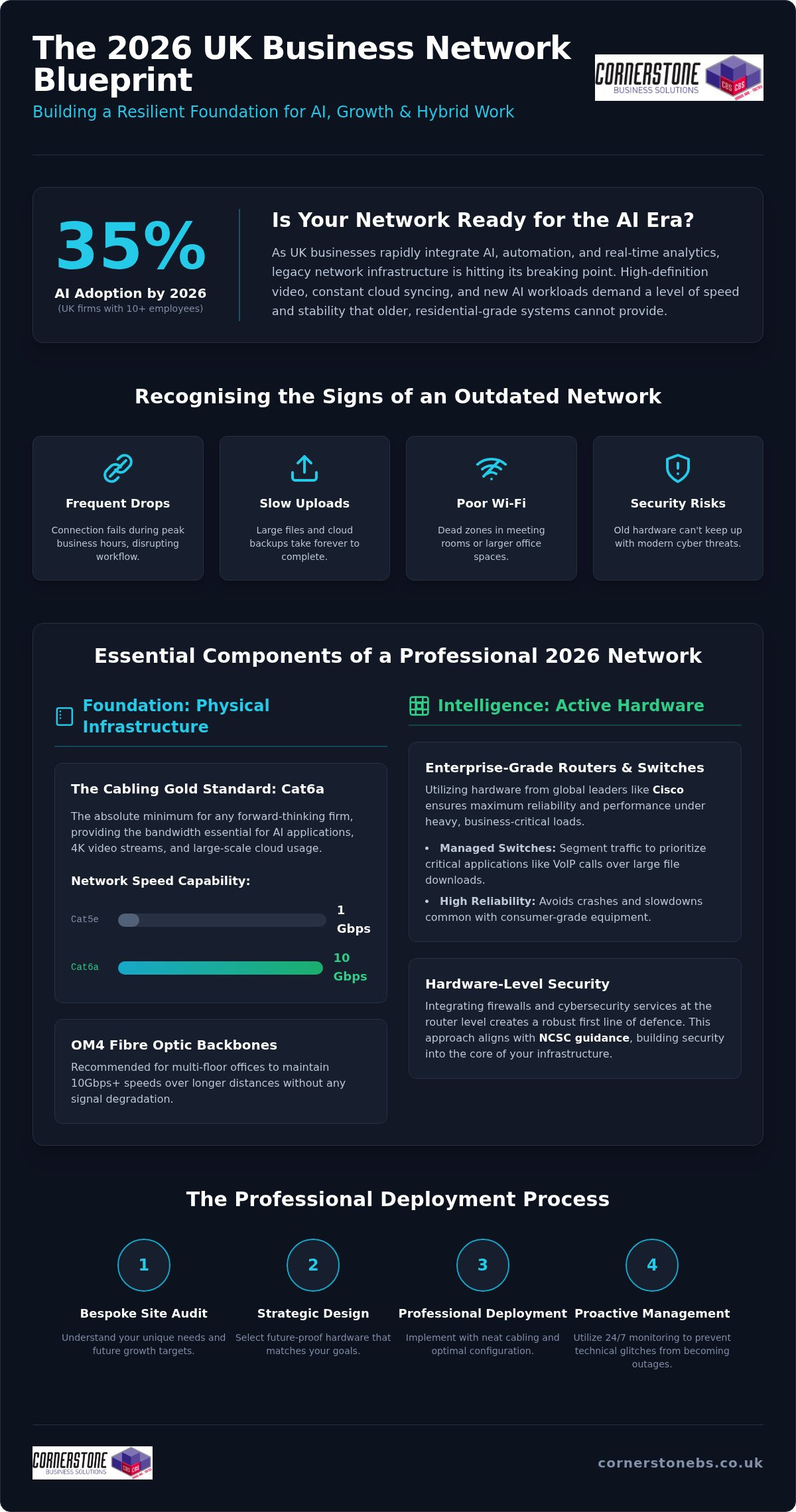
Did you know that AI adoption among UK businesses with 10 or more employees has surged to 35% in 2026? This massive leap in technology means your office infrastructure is likely working harder than ever before. It’s frustrating when slow internet speeds disrupt your team’s productivity or unreliable Wi-Fi coverage leaves your larger meeting rooms in the dark. You shouldn’t have to worry about security breaches just because your hardware can’t keep up with modern threats.
We understand that you need a system that simply works without constant troubleshooting. Investing in professional business network installation services provides the essential foundation for the security, speed, and scalable growth your firm deserves. It transforms your digital setup from a source of stress into a strategic asset. In this guide, we’ll walk through the 2026 strategy for UK firms; we will cover everything from the latest Cat6A cabling standards to future-proofing your office for AI and cloud expansion with a single, reliable point of contact.
Key Takeaways
- Understand why your network is a strategic asset that directly influences employee productivity and your company’s ability to adopt AI.
- Identify the essential hardware standards for 2026, including the shift toward Cat6a cabling and enterprise-grade routers from global leaders like Cisco.
- Learn how to balance office reliability with remote flexibility by implementing secure VPNs and high-speed wireless coverage for a hybrid workforce.
- Discover why professional business network installation services start with a bespoke site audit to ensure your infrastructure matches your specific growth targets.
- Explore the move toward proactive network management and 24/7 monitoring to stop technical glitches from turning into costly business outages.
Why Modern Business Network Installation is the Foundation of Growth
A professional network installation is more than just running cables and plugging in routers; it’s a strategic business project that defines your operational ceiling. In 2026, your digital infrastructure is the heartbeat of your company. When your network stays up, your team stays productive. We view a robust computer network as the silent engine behind every successful UK firm. If this foundation is weak, even the most advanced software won’t save your workflow from constant interruptions.
Data demands in 2026 are reaching a tipping point. As more firms integrate complex automation and real-time analytics, legacy systems are starting to crack under the pressure. High-definition video streams and constant cloud syncing require a level of stability that basic setups cannot provide. Professional business network installation services ensure your firm isn’t relying on residential-grade equipment for enterprise-level workloads. Enterprise-grade infrastructure offers the redundancy and management features needed to keep your operations running smoothly, no matter how much traffic you handle.
The Strategic Value of High-Performance Connectivity
High-performance connectivity is about reliability. When your team relies on Microsoft 365 or collaborative design tools, every second of lag hurts your bottom line. Lowering latency ensures cloud apps feel instant and responsive. This is essential for clear VoIP calls and stable video meetings with clients. By pairing your physical infrastructure with modern cloud solutions, you build a workspace where data moves freely and employees can focus on their work rather than their connection.
Recognising the Signs of an Outdated Network
Identifying bottlenecks is the first step toward growth. If your connection drops during peak hours or large files take ages to upload, your hardware is likely failing you. Unmanaged switches and basic routers are major risks because they lack the control and security of professional kits. Outdated cabling is another silent killer of performance. You can’t get 2026 speeds on 2010 wires. Professional business network installation services help you swap out these weak links for a managed, scalable system built for the next decade of growth.
Essential Components of a Professional Network Infrastructure
A high-performing network isn’t built on guesswork. It requires a deliberate selection of hardware and physical infrastructure designed to handle the heavy lifting of modern business. When we design business network installation services, we focus on creating a resilient ecosystem where every component, from the smallest cable to the main router, works in perfect harmony. This level of detail ensures your team isn’t held back by avoidable hardware failures or data bottlenecks.
Physical Infrastructure: The “Cabling Gold Standard”
Your cabling is the literal nervous system of your office. For 2026 environments, Cat6a has become the absolute minimum requirement for any forward-thinking firm. It supports 10Gbps speeds, which is essential as AI applications and large-scale cloud backups become standard. For multi-floor offices, we recommend OM4 multi-mode fibre optic backbones to maintain speed over longer distances. Neatness matters too. Proper cable management in your data cabinets prevents overheating and makes future upgrades a breeze rather than a technical headache.
Active Hardware: Routers, Switches, and Firewalls
Active hardware is where the intelligence of your network lives. We partner with global leaders like Cisco and IBM because their enterprise-grade equipment offers reliability that consumer routers simply cannot match. Managed switches allow us to segment your traffic, ensuring your VoIP calls aren’t interrupted by a large file download in another department. This level of control is vital for maintaining a stable environment that “just works” for every user.
Security must be baked into the hardware layer. By integrating cyber security services at the router level, you create a robust first line of defence against external threats. Following the NCSC cybersecurity guidance for UK businesses is a great starting point for any firm looking to bolster their resilience. If you’re unsure if your current hardware meets these standards, our team can audit your setup to ensure it’s fit for purpose. We believe in providing bespoke IT hardware solutions that grow alongside your business goals.
Wireless Access Points and Wi-Fi 7
Wireless connectivity has evolved beyond basic coverage. The transition to Wi-Fi 7 in 2026 provides the low latency and high capacity needed for dense office environments. By strategically placing Wireless Access Points, we eliminate dead zones and ensure a seamless transition for staff moving between desks and meeting rooms. This ensures your mobile workforce stays connected without the frustration of dropped signals or slow loading times during important presentations.
Designing Your Network for the Hybrid Workplace
The hybrid model is the standard for UK firms in 2026. Your office is no longer just a row of fixed desks; it’s a dynamic hub where staff move between collaborative zones and quiet areas. This fluidity requires a network that supports constant movement without dropping a single packet of data. When we provide business network installation services, we design with this flexibility in mind. We ensure your infrastructure handles the heavy load of staff who are in the building while simultaneously supporting those accessing local resources from home.
Security and performance go hand in hand here. A modern network must be segmented to protect your core data. We create isolated “tunnels” for different uses, such as a dedicated Guest Wi-Fi for visitors that never touches your internal servers. This approach is also essential for a secure “Bring Your Own Device” (BYOD) policy. By keeping personal smartphones and tablets on a separate segment, you reduce the risk of a compromised personal device affecting your primary business operations.
Wired vs. Wireless: Finding the Right Mix
Wired connections remain the gold standard for reliability. Desktop workstations and hardware used for data-intensive tasks still require dedicated Ethernet ports to avoid latency. However, your hot-desking areas and meeting rooms need high-capacity wireless coverage. We use Power over Ethernet (PoE) to streamline your setup. This technology allows a single cable to provide both data and electricity to your VoIP phones and security cameras, which keeps your workspace tidy and reduces installation complexity.
Secure Connectivity for Remote Teams
Remote access is now a foundational element of business stability. We implement robust VPN (Virtual Private Network) solutions that allow your team to work from anywhere as if they were sitting in the office. For firms with multiple locations, SD-WAN (Software-Defined Wide Area Network) technology is a game changer. It intelligently manages traffic across all your sites, ensuring your most important applications always have the bandwidth they need.
A successful Microsoft 365 migration relies on a network that is optimised for the cloud. If your local connection is sluggish, your cloud tools will feel slow too. Following Cisco’s guide to hybrid work technology, we focus on building a “security-first” architecture. This ensures that whether your team is in the office or working remotely, they have a seamless, high-speed experience that keeps your business moving forward.
The Step-by-Step Process of a Professional Network Deployment
Professional deployment is a meticulous process that transforms a technical plan into a high-performance reality. Unlike basic setups that skip straight to plugging in hardware, our business network installation services follow a structured lifecycle that ensures every square foot of your office is optimised. This methodical approach eliminates guesswork and prevents the technical debt that often leads to future outages. We treat every project as a partnership, ensuring the final result aligns with your long-term commercial goals.
Phase 1: Audit and Bespoke Design
Success begins with a deep dive into your current environment and future ambitions. We start by heat mapping your premises to identify potential signal obstacles like thick walls or electrical interference. This ensures your Wi-Fi signal remains strong in every corner of the building. We also calculate your expected user growth and data throughput requirements for the next five years. This foresight allows us to recommend the right hardware within our it company solutions, ensuring your infrastructure won’t need a costly overhaul as your team expands.
Phase 2: Installation and Testing
The physical installation is where precision meets efficiency. We often execute the most disruptive work out of hours to ensure your team’s daily workflow remains untouched. Once the cables are pulled and hardware is mounted, we move into a rigorous testing phase. We use industry-standard Fluke testing on every data point to certify 100% data integrity. This step confirms that your cabling is performing at its rated speed without packet loss or interference.
Security configuration happens simultaneously. We set up your firewalls and Virtual Local Area Networks (VLANs) to segment traffic and protect your sensitive data from the moment the network goes live. After the technical work is complete, we provide a full handover. This includes comprehensive documentation of your network map and staff training to ensure your team feels confident. If you’re ready to upgrade, you can book a network infrastructure audit with our expert team today.
Future-Proofing and Maintaining Your Infrastructure
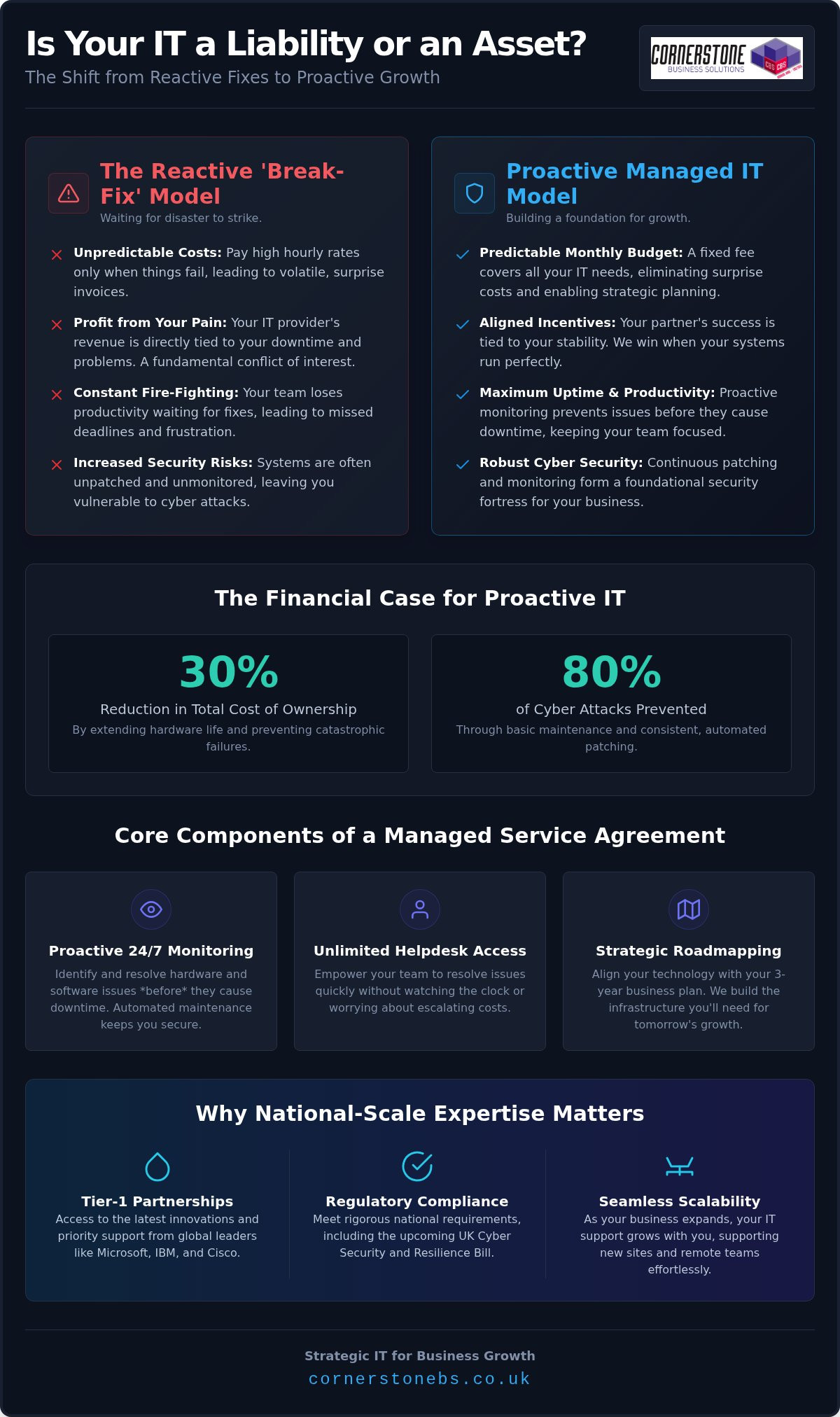
The completion of a physical build is just the start of your network’s journey. In the past, many firms operated on an “install and forget” basis, only calling for help when something broke. By 2026, this reactive approach is too risky for any competitive UK business. We advocate for a shift toward proactive management. When you combine professional business network installation services with a long-term Managed IT Support contract, you ensure that your foundation remains secure and efficient for years to come. This creates a single point of contact for both the initial project and the ongoing health of your systems.
Proactive Monitoring and Firmware Management
Patching your network hardware is just as vital as updating your PC’s operating system. Vulnerabilities in routers or switches can become easy entry points for threats if firmware is neglected. We use 24/7 remote monitoring to keep a close eye on every component. This allows us to identify failing hardware before it causes a full-scale outage. Our award-winning approach to system maintenance means we often fix issues before your staff even notice a slowdown. It’s about providing emotional security alongside technical stability; you can focus on your business while we handle the digital background.
Scalability: Building for the Next 5 Years
A truly future-proof network is modular. We design your infrastructure with the next five years of growth in mind, ensuring your data cabinets have the necessary rack space and cooling to handle additional hardware. As AI adoption continues to rise, your data throughput will inevitably increase. By planning for this expansion now, you avoid the need for another full-scale installation in 2028 or 2029. We look at your business goals and build a system that scales alongside you. This foresight prevents your technology from becoming a bottleneck as your team expands.
Ready to upgrade? Speak to our experts for a bespoke consultation. We pride ourselves on being more than just a service provider; we are a dedicated long-term partner in your success. Our team is ready to help you build a high-speed, secure network that “just works” so you can get back to what you do best. Reach out today to start the conversation about your 2026 strategy.
Ready to Build Your 2026 Digital Foundation?
Your network is the silent engine of your business. It’s no longer just about basic connectivity; it’s about creating a secure, high-speed environment where your team can thrive. By investing in professional business network installation services, you move away from reactive technical fixes and toward a strategic infrastructure that scales with your ambitions. We’ve explored how the right cabling, enterprise-grade hardware, and proactive monitoring turn standard office systems into a genuine competitive advantage for UK firms.
As a multi-award-winning UK IT provider and certified partner of Cisco and Microsoft, we bring expert authority with a friendly, approachable touch. We don’t just install hardware; we provide the emotional security that comes with proactive 24/7 national support. You deserve a long-term partner who values your business stability as much as you do. It’s time to stop worrying about lag and start focusing on your future. We invite you to Book a Professional Network Consultation with Cornerstone today. Let’s have a conversation about how we can build a reliable, future-proofed foundation for your success.
Frequently Asked Questions
What is the difference between a business network and a home network?
The total investment depends on your specific office layout, the number of data points required, and your choice of hardware. Factors such as whether you need Cat6a or fibre optic cabling and the complexity of your server room setup will influence the final figure. We provide bespoke quotes following a detailed site audit to ensure your business network installation services align perfectly with your commercial goals and technical requirements.
How long does it take to install a new network in a medium-sized office?
A typical installation for a medium-sized office usually takes between three to five working days. This timeline includes the physical deployment of structured cabling, hardware mounting, and rigorous system testing. We focus on efficiency to ensure your new infrastructure is live as quickly as possible. Our team coordinates every phase of the project to meet your deadlines while maintaining the high standards expected of an award-winning provider.
Will my business experience downtime during a network upgrade?
We aim for minimal to zero disruption during your upgrade. Our engineers often perform the most critical switchovers and physical cabling work during evenings or weekends. This proactive approach ensures your team can continue working without interruptions. By planning the transition meticulously, we make sure your new, high-speed system is fully operational and tested before your staff start their next shift, protecting your productivity throughout the process.
What is structured cabling and why does my business need it?
Structured cabling is the organized infrastructure of wires and hardware that supports your entire digital environment. It provides a standardized way to manage your data traffic, reducing the risk of overheating and cable failure. By using modern standards like Cat6a, you ensure your office can handle the 10Gbps speeds required for 2026 data demands. It’s a vital foundation that makes future hardware upgrades and troubleshooting much simpler and more cost-effective.
Can I use my existing routers and switches in a new network installation?
It depends on the age and technical specifications of your current kit. During our initial audit, we evaluate your existing hardware to see if it supports modern security protocols and required data speeds. While we reuse viable equipment where possible, we often recommend upgrading to enterprise-grade hardware from Cisco or IBM. This ensures your business network installation services deliver the long-term reliability and manufacturer support your firm needs to grow.
How often should a business network be upgraded or replaced?
Most firms should look at a significant network refresh every five to seven years. Rapid changes in technology, such as the shift to Wi-Fi 7 and the increased bandwidth needs of AI, mean that older systems eventually become bottlenecks. Regular maintenance and proactive monitoring can extend the life of your hardware. However, if you notice frequent drops in speed or coverage, it’s likely time to consult an expert about a modern upgrade.
Do you provide network installation services for multi-site companies?
Yes, we provide comprehensive installation and support services nationally across the UK. We specialize in connecting multiple office locations using advanced technologies like SD-WAN. This creates a seamless, secure environment where staff can access shared resources as if they were in the same building. Whether you have two sites or twenty, our team ensures your entire national infrastructure is consistent, reliable, and managed by a single, expert point of contact.
Posted on: September 11th, 2026 by Cornerstone
Over 90% of mid-to-large enterprises now face costs exceeding $300,000 for just a single hour of system downtime. Following the wake-up call of the October 2025 AWS outage, it’s clear that old ways of managing IT simply don’t cut it anymore. We understand the anxiety of a potential data breach or the frustration of watching a manual backup crawl while your team sits idle. You need to know your operations are safe, no matter what happens in the digital world. Using cloud computing for business continuity is no longer a luxury; it’s the operational nervous system that makes downtime optional.
As a multi-award-winning UK provider, we’re here to simplify these complex challenges and act as your dedicated long-term partner. This guide explores how to leverage cloud technology to ensure your business remains operational, secure, and resilient against any disruption. We’ll walk you through achieving a zero-friction transition to remote work during outages and the steps for near-instant recovery of your critical data. By taking a managed, proactive approach to your IT resilience, you can stop worrying about technical glitches and focus on your goals with total confidence.
Key Takeaways
- Distinguish between disaster recovery and business continuity to keep your operations running smoothly during any disruption.
- See how cloud computing for business continuity uses geographic redundancy to keep your data safe and accessible within secure UK-based infrastructure.
- Move from unpredictable IT costs to a stable, scalable model that slashes your recovery time and gets your team back to work faster.
- Learn to identify your most critical business functions and build a resilient migration strategy that prioritises long-term stability.
- Discover the peace of mind that comes with proactive, managed monitoring, ensuring your security remains airtight without the complexity of DIY solutions.
Understanding the Role of Cloud Computing in Business Continuity
Many business owners confuse disaster recovery with business continuity. While they’re related, they serve different purposes. Disaster recovery focuses on getting your tech back online after it breaks. Business continuity is a broader strategy. It’s about keeping your entire operation running smoothly while the crisis is still happening. In 2026, relying on cloud computing for business continuity has become the standard for UK firms that refuse to let a technical glitch stop their progress.
Downtime is no longer just a minor inconvenience. It’s a direct threat to your brand’s reputation. UK customers now expect an “always-on” experience. If your systems go dark, your clients won’t wait; they’ll simply find a competitor who is still online. We see cloud technology as a proactive growth tool rather than a reactive safety net. It allows you to build a resilient foundation where stability is baked into your daily operations.
The Evolution of Business Resilience
The days of physical tape backups and manual rotations are behind us. These methods were slow, prone to damage, and often failed right when you needed them most. Modern resilience relies on real-time synchronisation. The widespread shift to hybrid work has also changed the landscape. Your team is no longer tied to a single office, so your data shouldn’t be either. By implementing managed cloud solutions, you ensure that your staff can access critical files from any location, keeping productivity high even if your physical headquarters is inaccessible. This flexibility is the hallmark of a modern, forward-thinking business.
Why Traditional BCP Often Fails
Traditional Business Continuity Plans (BCP) often crumble because they rely on single points of failure. A server room in your office is vulnerable to power cuts, floods, or hardware malfunctions. If that one room goes down, your whole business stops. Manual processes also introduce the “human error” factor. It’s easy for a busy employee to forget a backup schedule or misplace a drive. These gaps in IT disaster recovery strategies are why many on-premise systems fail during a real crisis. Business continuity is the ability to maintain essential functions during and after a disaster.
We believe in removing these risks through automation and geographic redundancy. Instead of hoping a manual backup worked, cloud computing for business continuity provides a managed environment where your data is constantly monitored and protected. This proactive approach doesn’t just save your data; it saves your time and your professional standing in a competitive market.
How Cloud Technology Powers Uninterrupted Operations
Cloud technology isn’t just about storage; it’s about agility and movement. When a crisis hits, your systems need to react instantly. Using cloud computing for business continuity allows your infrastructure to switch operations seamlessly through automated failover. If one server fails, another takes over without your clients ever noticing a flicker. This technology ensures that your business stays visible and operational, protecting your hard-earned reputation.
We ensure your data lives in multiple secure UK locations. This geographic redundancy means a local power cut or flood won’t take you offline. During an emergency, your resource needs might spike unexpectedly. Cloud systems offer rapid elasticity, scaling your processing power the moment you need it. This prevents system crashes during high-demand recovery periods, giving you the strength to handle any situation with confidence.
Data Redundancy and High Availability
We focus on multi-zone availability within the UK to provide the highest levels of protection. Real-time mirroring creates a live copy of your data, preventing any loss between scheduled backups. You might choose a “Hot” standby site for near-instant recovery of mission-critical systems, while a “Cold” site offers a cost-effective option for less urgent files. As highlighted by the Cloud Security Alliance, understanding this shared responsibility between you and your provider is vital for a truly robust strategy. We take the lead on this complexity so you don’t have to.
Enabling a Mobile Workforce
Modern resilience means your team stays productive from anywhere. Tools like Microsoft 365 keep communication channels open even if your physical office is forced to close. We also implement Business VoIP systems, so your team can answer client calls on their mobiles as if they were sitting at their desks. Our Managed IT Support protocols ensure every remote connection is secure, keeping your data safe while your team works from home. This virtualisation of your office ensures that a physical disruption never equals a total shutdown.
If you’re wondering how these specific tools can fit into your current setup, it’s always helpful to start a professional conversation about your long-term resilience goals.
Cloud vs. On-Premise: A Continuity Comparison
Two critical metrics define your resilience: Recovery Time Objective (RTO) and Recovery Point Objective (RPO). RTO measures how quickly you can get back to work. RPO determines how much data you can afford to lose. With cloud synchronisation, your data loss is often measured in seconds, whereas on-premise systems are limited by your last successful manual backup. While a cloud-based recovery typically takes just minutes to restore essential functions, an on-premise system often requires days of manual rebuilding and data restoration.
Legacy on-premise hardware carries hidden costs that often go overlooked. Beyond the initial purchase, you have to account for electricity, cooling, physical space, and the time your staff spends on manual maintenance. These systems also struggle to scale during a crisis. If you suddenly need more capacity to support a remote workforce, you can’t simply order more physical RAM and have it working in seconds. Cloud systems remove this friction, allowing you to scale up instantly to meet emergency demands without wasting money on idle hardware during normal operations.
Security and Compliance in 2026
There is a common myth that keeping a server in your own office is safer because you can physically see it. In reality, major cloud providers offer physical and digital security that far exceeds what most small businesses can build themselves. They employ dedicated teams to handle automatic security patching, ensuring your systems stay protected against the latest threats without you lifting a finger. Meeting UK data protection standards is much simpler when you leverage professional cyber security services integrated into your cloud environment. This managed approach ensures your business remains compliant and secure, providing the emotional and financial security you need to thrive.
Building Your Cloud-First Business Continuity Plan
Building a resilient plan doesn’t have to be overwhelming. We break it down into manageable steps that focus on your specific business needs. First, you need a Business Impact Analysis (BIA). This is simply a way to identify which parts of your business are most vulnerable to downtime. Next, identify your critical workloads. You don’t need to move every single file immediately. Focus on the data that keeps your lights on. Integrating cloud computing for business continuity ensures these vital assets are always protected.
A successful strategy often starts with a robust Microsoft 365 migration and backup plan. This ensures your team can communicate and collaborate from anywhere, regardless of what happens at your physical premises. Finally, you must commit to regular testing and employee training. A plan that only exists on paper is just a wish. Your team needs to know exactly how to access emergency protocols before a crisis hits.
Identifying Critical Business Functions
Not all data is created equal. You need to decide what must be back online within one hour and what can wait for 24 hours. While cloud systems typically offer an RTO of mere minutes, traditional on-premise systems can leave you waiting for days to recover. Mapping the dependencies between your software and hardware is vital. For example, your CRM might rely on a specific database that also needs to be in the cloud. We ensure our it company solutions are tailored to these specific workflows, so nothing gets left behind during a transition.
The “Test and Tweak” Cycle
Your Business Continuity Plan (BCP) is a living document. It shouldn’t sit on a shelf gathering dust. As your business grows, your IT needs will change. We recommend conducting “Tabletop Exercises” with your management team. These are low-stress simulations where you walk through a disaster scenario to find gaps in your protocols. This proactive approach ensures that when a real disruption occurs, your response is muscle memory rather than panic. Using cloud computing for business continuity means your strategy stays as flexible as your business. This is how you build true emotional and financial security for your organisation.
Ready to start your journey? Contact our local team for a professional conversation about your resilience strategy.
Partnering for Resilience: The Managed Cloud Advantage
Attempting a DIY approach to cloud computing for business continuity often leads to hidden security gaps that only appear during a crisis. While large global providers offer the basic tools, they don’t configure them to meet the specific risks of your unique business model. Misconfigurations can leave your data exposed to ransomware or lead to accidental deletion during a recovery attempt. We believe in taking that technical burden off your shoulders entirely. As a multi-award-winning UK provider, we don’t just sell you a software license; we build a resilient environment that protects your emotional and financial security. Our goal is to position ourselves as a dedicated long-term partner rather than just another service provider.
Proactive Monitoring vs. Reactive Repair
Most IT issues show warning signs before they become full-blown disasters. Our approach focuses on identifying these potential failures before they cause a single second of downtime. By leveraging award-winning managed IT services, you benefit from 24/7 monitoring and an expert helpdesk that knows your business by name. This proactive stance ensures your infrastructure evolves with 2026 technology trends, keeping you ahead of threats rather than just reacting to them. It’s the difference between a transactional service and a collaborative relationship designed for stability. We handle the complexity so you can focus on your core business goals.
Your Next Steps to a Resilient Future
Securing your business shouldn’t feel like a daunting technical hurdle that sits forever on your to-do list. It starts with a simple, professional conversation about your current setup and your specific goals for the future. During an initial IT resilience audit, our experts look for single points of failure and identify the most efficient cloud path for your critical workloads. We simplify the complex technical concepts so you can make informed decisions with total confidence. Our team is locally based and ready to help you build a foundation that supports your growth for years to come. This managed approach ensures that your infrastructure is always ready for whatever the future brings.
Ready to secure your business? Let’s have a chat about your cloud strategy and discover how cloud computing for business continuity can give you total peace of mind.
Future-Proof Your Operations Today
In 2026, business resilience is no longer defined by how well you react to a crisis, but by how effectively you’ve prepared for one. We’ve explored how moving away from physical hardware vulnerabilities to a flexible, automated environment is the only way to meet modern “always-on” expectations. By leveraging cloud computing for business continuity, you transform your IT from a potential point of failure into a robust engine for growth.
As a multi-award-winning IT support team with strategic partnerships with Microsoft, Cisco, and IBM, we provide the expert oversight needed to keep your systems secure. Our proactive 24/7 system monitoring identifies risks before they impact your bottom line, giving you the emotional and financial security to focus on your core goals. You don’t have to manage this complexity alone; we’re here to act as your dedicated long-term partner.
Take the first step toward a more stable and resilient organisation. Secure your business future with a bespoke cloud continuity plan from Cornerstone. We look forward to helping you build a foundation that stands strong against any disruption.
Frequently Asked Questions
What is the difference between cloud backup and cloud business continuity?
Cloud backup is a copy of your files stored offsite, primarily used for retrieving lost or deleted data. Cloud business continuity is a more comprehensive strategy that allows your entire operation to keep running during a major outage. While a backup might take hours or days to restore to new hardware, continuity systems switch to cloud-based virtual versions of your servers almost instantly. This ensures your team stays productive without waiting for a full system rebuild.
How much does cloud-based business continuity cost for a UK SME?
Pricing for these services typically follows a predictable monthly subscription model based on the number of users or the volume of data protected. This shift from large upfront capital costs to manageable operating expenses helps UK SMEs plan their budgets with confidence. Since every organisation has different recovery requirements, we recommend a professional audit to determine the specific scale of infrastructure needed to support your unique business workflows and resilience goals.
Is cloud computing secure enough for sensitive business data in 2026?
Cloud infrastructure in 2026 offers security levels that far exceed most on-premise setups. Leading providers invest billions in physical and digital protection, including automated patching and advanced encryption. Using cloud computing for business continuity means your data is housed in high-security facilities with 24/7 monitoring. We add an extra layer of protection through our managed cyber security protocols, ensuring your sensitive information remains compliant with the latest UK data residency and privacy standards.
Can cloud computing help my business recover from a ransomware attack?
Cloud solutions are one of the most effective defences against ransomware. By maintaining immutable backups that attackers cannot modify or delete, we can roll your entire system back to a point in time just before the infection occurred. This allows you to bypass the ransom demand and restore your operations quickly. Combining proactive monitoring with a cloud-first strategy ensures that a single malicious link doesn’t result in a permanent loss of your critical business data.
Do I need a high-speed internet connection for cloud business continuity to work?
A reliable internet connection is essential for synchronising data in real-time, but it doesn’t always require ultra-fast speeds for every task. Modern systems use smart compression and deduplication to minimise the amount of data sent over the wire. If your local connection is a concern, we can implement hybrid models that keep a local cache for speed while still ensuring a full, resilient copy exists in the cloud for emergency remote access.
How fast can a business be back online after a total server failure using the cloud?
Recovery times have improved significantly, with many businesses getting back to work in under 15 minutes following a total server failure. This is possible through virtualisation, where your server is “spun up” in the cloud environment almost immediately. Instead of waiting days for new hardware to arrive and be configured, your team simply logs into the cloud version of your office and continues their work with minimal disruption to your clients.
What are the main benefits of using Microsoft Azure for disaster recovery?
Microsoft Azure provides a massive global network that ensures your data is replicated across multiple secure UK data centres. It integrates seamlessly with Microsoft 365, making it easier to manage your entire IT estate from a single platform. The primary benefit is its scalability; you can increase your recovery capacity instantly during a crisis without owning any physical hardware. This makes it a foundational tool for any modern cloud computing for business continuity strategy.
Does my business still need an on-site server if we move to a cloud continuity model?
Many UK businesses are moving toward a completely “serverless” office by hosting everything in the cloud. However, some organisations prefer a hybrid model where a small on-site device handles daily local tasks while the cloud provides the heavy lifting for resilience and remote access. We assess your specific workflow needs to decide if retiring your physical server is the right move for your efficiency, security, and long-term financial goals.
Posted on: September 9th, 2026 by Cornerstone
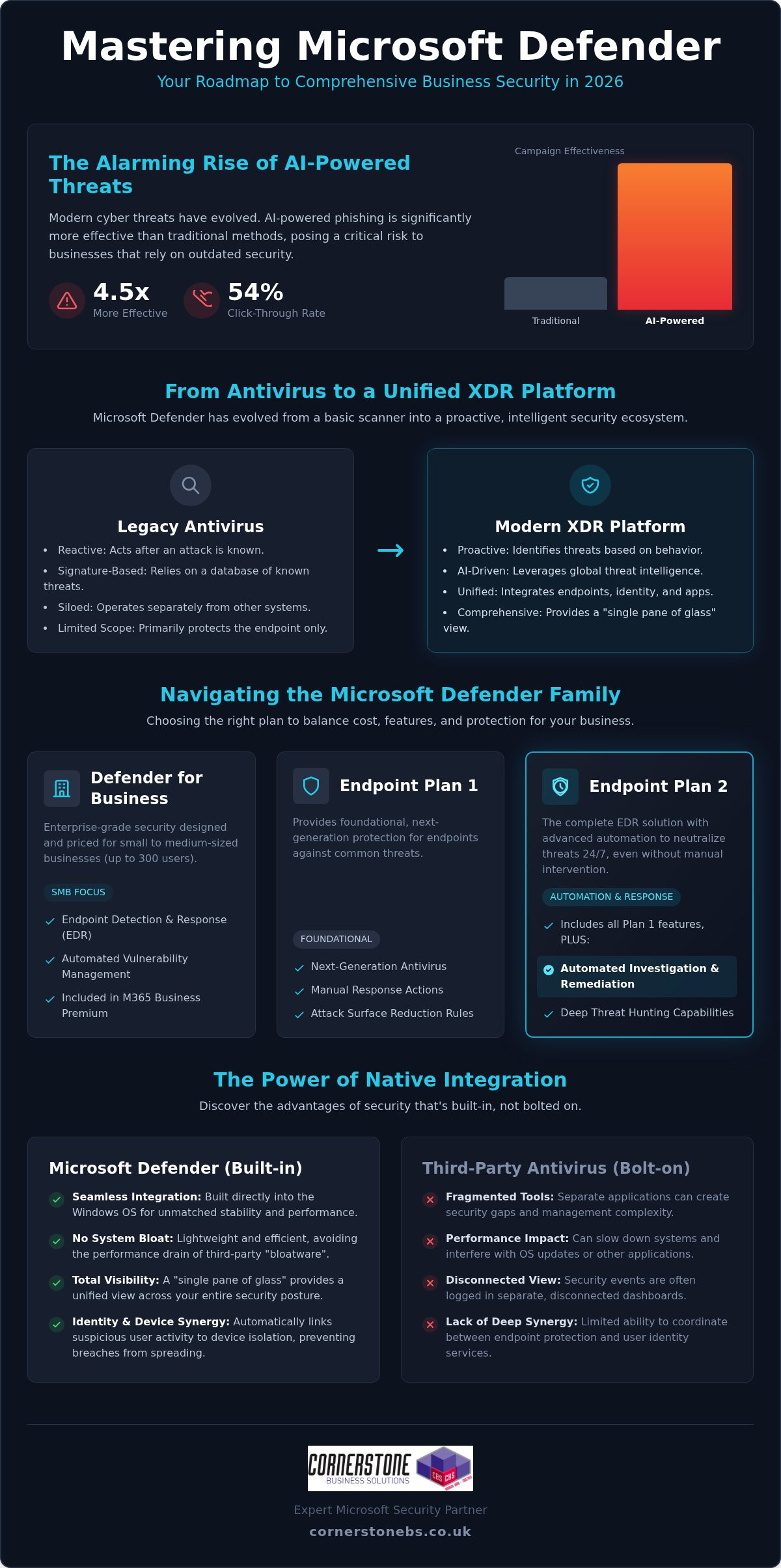
AI-powered phishing campaigns are now 4.5 times more effective than traditional methods, with click-through rates jumping to 54% in 2026. It’s a sobering reality that keeps many business owners awake at night, especially when paired with the constant threat of sophisticated ransomware. You likely already know that microsoft defender is a leader in the security world, but trying to navigate its confusing licensing tiers and complex policy configurations can feel like a full-time job you didn’t apply for.
We understand that you want robust protection without the headache of managing fragmented tools or worrying if your settings are actually correct. As a multi-award-winning Microsoft Partner, we’ve seen how the right setup provides true 24/7 peace of mind. This guide will help you master the entire Defender ecosystem, from Endpoint to Office 365. We’ll provide a clear roadmap for migrating from third-party antivirus software and explain exactly how to secure your infrastructure using expert-led insights. You’ll gain a straightforward strategy to keep your organisation resilient and your data safe.
Key Takeaways
- Discover how microsoft defender has evolved into a comprehensive XDR platform that protects your business far beyond traditional, signature-based antivirus.
- Clear the confusion around licensing tiers and identify exactly which version your organisation needs to balance cost with robust protection.
- Learn why native integration offers a “single pane of glass” advantage, reducing system bloat while giving you total visibility over your security posture.
- Establish a roadmap for enforcing a Zero Trust architecture, ensuring that every identity and device is verified before accessing your critical data.
- Understand the vital role of expert configuration and proactive monitoring in transforming a security tool into a 24/7 managed defence system.
Beyond Antivirus: What is Microsoft Defender in 2026?
If you look at the history of Microsoft Defender, you’ll see a tool that began as a basic, reactive scanner for home users. Fast forward to 2026, and the landscape has changed completely. It has evolved into a sophisticated Extended Detection and Response (XDR) platform that serves as the bedrock for modern business security. It’s no longer just about catching a virus that’s already known to the world; it’s about providing a unified shield across your entire digital estate.
Modern cyber threats are far too fast for old-school, signature-based scanning. Attackers now use AI to create unique, never-before-seen malware every second. Because microsoft defender is part of a global threat intelligence network, it processes trillions of signals daily from around the world. When a new threat is detected in one corner of the globe, your systems are protected almost instantly. This scale of data allows your organisation to stay one step ahead of even the most sophisticated criminal groups.
The Shift from Reactive to Proactive Defence
Legacy antivirus waits for a match in a database before it acts. Modern endpoint protection, however, looks for patterns. By 2026, AI-powered phishing campaigns have become 4.5 times more effective than traditional methods, according to recent industry benchmarks. We use the advanced behavioral analysis within microsoft defender to spot these attacks before they execute. It identifies “zero-day” threats by monitoring what a file does, rather than just what it is. This proactive approach is essential for stopping ransomware before it can lock your critical data.
A Core Component of Microsoft 365
Security shouldn’t be an afterthought or a separate piece of “bloatware” that slows down your team’s laptops. Because Defender is built directly into the Windows operating system, it offers a level of performance and stability that third-party tools can’t match. It creates a seamless synergy between identity protection and device security. For example, if a user account shows suspicious login activity, the system can automatically isolate that specific device to prevent a breach from spreading through your network. Microsoft Defender is a unified security platform that provides real-time, AI-driven protection across your entire digital infrastructure in 2026.
This deep integration means your security policies follow your staff, whether they’re working from the office or a local coffee shop. It ensures your business continuity remains intact without requiring your team to manage complex, disconnected security apps.
Navigating the Microsoft Defender Family: Which Version Do You Need?
Choosing the right version of microsoft defender often feels like looking at a restaurant menu with too many options. For most UK businesses, the goal is simple: total protection without paying for enterprise features they’ll never use. The “Defender” brand covers a wide family of tools, each protecting a specific part of your digital environment. It’s about total visibility. We aim to help you cut through the noise and find the exact fit for your needs.
Microsoft Defender for Business (SMB Focus)
If your company has up to 300 employees, this version is your strongest ally. It’s designed to bring enterprise-grade security to smaller firms without the need for a dedicated Security Operations Centre. It simplifies management by automating complex tasks like vulnerability management and endpoint detection. You get the same level of protection that global corporations enjoy, but at a price point and complexity level that fits your business model. Identifying the “sweet spot” for UK SMEs often leads to Microsoft 365 Business Premium. This bundle includes the full Defender for Business suite, providing a cost-effective way to secure your organisation without managing multiple separate invoices.
Defender for Endpoint Plan 1 vs. Plan 2
Understanding the difference between Plan 1 and Plan 2 is crucial for your long-term security roadmap. Plan 1 provides foundational protection, including next-generation antivirus and attack surface reduction. However, Plan 2 is where the real power lies. It introduces automated investigation and remediation, which means the system can automatically neutralise threats while your team sleeps. This is a game-changer for business continuity.
- Plan 1: Best for basic security needs and standard device protection.
- Plan 2: Essential for firms requiring deep threat hunting, sandboxing, and advanced forensics.
Choosing Plan 2 often helps organisations align more easily with national compliance standards like Cyber Essentials. It provides the detailed reporting and evidence needed to prove your security posture is robust. Protecting your devices is only half the battle. Defender for Office 365 focuses on your primary communication channels, shielding your team from malicious links in emails or dangerous files shared on Teams. If you’re unsure which tier fits your current growth stage, our team can provide a tailored cyber security assessment to clear up the confusion.
Microsoft Defender vs. Third-Party Antivirus: The 2026 Verdict
Many business owners ask if microsoft defender is truly “good enough” to replace long-standing names like Sophos or Norton. The short answer is yes. In fact, for most UK organisations, it’s often the superior choice. Managing multiple security consoles creates a fragmented view of your network. We call this “security sprawl,” and it’s a primary cause of missed alerts. Switching to a “single pane of glass” approach reduces the number of dashboards your team needs to monitor, ensuring that nothing slips through the cracks.
Performance is another critical factor. Third-party antivirus software often acts as “bloatware,” consuming significant system resources and fighting with the Windows kernel. Because Defender is built into the OS, it operates with surgical precision. It protects your devices without the sluggishness that frustrates staff. From a cost perspective, you’re likely already paying for these features through your existing Microsoft 365 seats. Cutting out redundant third-party subscriptions isn’t just about saving money; it’s about simplifying your entire IT infrastructure.
The Benefits of Ecosystem Integration
The real magic happens when you pair Defender with Microsoft Intune. This combination allows for seamless policy deployment across your entire fleet of devices. If a threat is detected, the system can trigger an automated response to neutralise the danger instantly. This closes the window of opportunity for attackers. It removes the manual “IT headache” of chasing down infected laptops. Your security posture becomes a proactive shield rather than a list of chores for your internal team.
Potential Drawbacks to Consider
We believe in being honest with our partners. Some worry about “putting all their eggs in one basket” by relying solely on Microsoft. While this is a valid concern, the depth of Microsoft’s global threat intelligence usually outweighs the risks of diversification. However, there is a learning curve. The advanced XDR features require expert setup to avoid “alert fatigue,” where your team becomes desensitised to constant notifications. Professional configuration ensures that only the most critical threats reach your desk. In high-risk industries, a benchmark from early 2026 showed that microsoft defender missed 59% fewer high-severity email threats than the next-closest secure email gateway. This level of accuracy is why we recommend it as the foundation of your cyber security strategy.
Implementation Strategy: Securing Your Infrastructure with Defender
A proper implementation doesn’t happen by accident. It begins with a comprehensive security audit to identify the hidden gaps in your current infrastructure. We treat microsoft defender as a precision tool, not a generic “install and forget” application. By mapping your specific risks, we can build a defence that supports your growth instead of hindering it. This proactive approach ensures that your security posture is robust from day one.
The Road to Zero Trust
The modern workspace is no longer confined to four walls. What is Zero Trust Security & Why Does It Matter? It’s a fundamental shift in how we handle access. Identity has become the new security perimeter. We use Defender for Identity to monitor user behaviour and stop credential theft in its tracks. Every single access request is verified, ensuring that being “on the network” no longer equates to having total trust. This model protects your data regardless of where your team is working.
We also enforce Attack Surface Reduction (ASR) rules to block the common infection vectors that hackers love. These rules stop malicious scripts and suspicious email attachments before they can cause damage. Crucially, we integrate this with a robust Multi-Factor Authentication (MFA) strategy. MFA is the foundation of your Defender ecosystem, providing an essential layer of emotional and technical security for your staff. It acts as the final lock on the door that keeps your business continuity intact.
Phased Deployment and Policy Tuning
Avoid the temptation to “flip the switch” on every policy at once. This often causes unnecessary friction for your team and can lead to blocked legitimate work. We prefer a phased rollout, starting with audit mode to monitor policy impacts without interrupting your daily operations. This allows us to tune alerts and eliminate “noise,” so your team only sees what truly matters. We focus on the following key areas during this phase:
- Policy Calibration: Adjusting settings to match your specific business workflows.
- Alert Refinement: Ensuring that your security dashboard is clear and actionable.
- Mobile Protection: Extending your security umbrella to every smartphone and tablet through Defender for Mobile.
Ensuring your mobile fleet is protected provides consistent security across every device your team uses. If you want to ensure your setup is handled by a multi-award-winning Microsoft Partner, contact us for an expert cyber security consultation today.
Managed Security: Why Expert Configuration is Non-Negotiable
Owning a powerful tool like microsoft defender is only the first step toward true resilience. It’s like purchasing a high-performance engine; it only delivers its full potential when tuned by a specialist. Many organisations struggle with “alert fatigue” because their security settings aren’t calibrated to their specific workflows. This leads to a dangerous environment where critical warnings are buried under a mountain of minor notifications. Expert configuration ensures that your security system acts as a silent, effective guardian rather than a source of constant frustration.
The real value lies in the shift from reactive cleanup to proactive threat hunting. Waiting for a breach to occur is a costly strategy that risks your business continuity and reputation. Proactive defence involves constantly scanning for anomalies and neutralising threats before they can execute. This level of oversight requires more than just software; it requires a dedicated partner who understands the evolving tactics of modern cyber criminals. We bridge the gap between complex security tools and the peace of mind you need to focus on your growth.
Cyber attacks don’t follow a 9-to-5 schedule. In fact, many sophisticated ransomware incidents are launched during weekends or bank holidays when internal teams are likely to be offline. Continuous 24/7 monitoring is the “missing link” in most business security plans. It ensures that every signal processed by microsoft defender is assessed in real-time, providing a foundational layer of emotional and technical security for your staff.
Award-Winning Managed IT Support
We specialise in turning technical complexity into business stability. By leveraging our Managed IT Services, you ensure that every alert is investigated by a professional who knows your infrastructure inside out. Our status as a multi-award-winning Microsoft Partner acts as a recurring signature of quality. We don’t believe in one-size-fits-all fixes. Instead, we provide bespoke technology solutions tailored to your unique risks, ensuring your organisation remains robust and compliant in an increasingly digital world.
Taking the Next Step
Securing your future starts with a clear strategy. If you are considering a Microsoft 365 migration for business UK, it’s the perfect time to put security at the forefront of your digital estate. We invite you to start a conversation with our team to assess your current posture and identify any hidden vulnerabilities. We would love to chat with you during a no-obligation security consultation to help you build a more resilient and secure organisation.
Building a Resilient Future for Your Organisation
Cyber security in 2026 demands more than just a passive shield; it requires a proactive, integrated ecosystem that evolves as fast as modern threats. By mastering the microsoft defender suite, you’ve taken the first step toward reducing complexity and strengthening your digital perimeter. You now understand that the true power of this platform lies in its seamless integration with your existing Microsoft 365 tools and the implementation of a strict Zero Trust model.
However, technology alone isn’t a silver bullet. The difference between a vulnerable system and a resilient one often comes down to expert configuration and proactive monitoring. As a multi-award-winning technology provider and a trusted Microsoft Partner, we specialise in bridging that gap. We provide the 24/7 support and bespoke solutions needed to keep your business continuity secure while you focus on growth. Don’t leave your security to chance. We invite you to secure your business with a professional Microsoft Defender strategy from Cornerstone. Let’s work together to ensure your organisation stays protected, resilient, and ready for whatever the future holds.
Frequently Asked Questions
Is Microsoft Defender free for business use?
No, the business versions are not free. While a basic home version exists, microsoft defender for Business is a paid service typically included in Microsoft 365 Business Premium or available as a standalone subscription. These commercial versions provide the advanced endpoint detection and response (EDR) capabilities that organisations need to stay resilient. Investing in a paid license ensures your company benefits from enterprise-level security features and automated remediation.
Does Microsoft Defender replace the need for other antivirus software?
Yes, it absolutely replaces traditional antivirus software. It has evolved far beyond basic scanning into a full Extended Detection and Response (XDR) platform. By using a single, native tool, you eliminate the performance “bloat” often caused by third-party applications. This integration provides a “single pane of glass” view, allowing your team to monitor all security signals from one dashboard while cutting the costs of redundant security subscriptions.
What is the difference between Microsoft Defender and Windows Defender?
The primary difference is the scope and sophistication of the protection. Windows Defender was the original, basic antivirus built into older versions of Windows. Today, microsoft defender is a comprehensive family of security tools that protect identities, emails, and cloud applications alongside your devices. It uses global threat intelligence and AI-driven behavioural analysis to stop modern attacks that legacy signature-based scanners simply cannot detect.
Is Microsoft Defender for Business included in Business Premium?
Yes, it is a core component of that plan. Microsoft 365 Business Premium includes the full version of Defender for Business, which is specifically tailored for companies with up to 300 employees. This bundle offers the best value for UK SMEs, combining productivity tools with enterprise-grade security. It’s an efficient way to secure your organisation without the complexity of managing multiple separate licenses or vendors.
Can Microsoft Defender protect Mac and mobile devices?
Yes, it provides cross-platform protection. You can secure Mac, Android, and iOS devices using the same security policies you apply to your Windows fleet. This ensures a consistent security posture across your entire organisation, regardless of which hardware your team prefers. By 2026, maintaining this unified shield is essential for protecting mobile workers who access sensitive business data from various locations and devices.
How does Microsoft Defender protect against ransomware?
It uses a multi-layered approach to neutralise ransomware. First, Attack Surface Reduction (ASR) rules block common infection vectors like malicious scripts. Then, behavioural analysis identifies suspicious activity, such as mass file encryption, in real-time. If a threat is detected, the system can automatically isolate the affected device to prevent the attack from spreading. This automated response is vital for maintaining business continuity during a sophisticated cyber attack.
Do I need a managed service provider to set up Microsoft Defender?
While you can configure it internally, a managed service provider is highly recommended for optimal results. We ensure your security policies are correctly tuned to avoid “alert fatigue” and missed threats. As a multi-award-winning Microsoft Partner, we provide the proactive 24/7 monitoring and expert configuration that most internal teams lack. This partnership transforms a security tool into a foundational element of your business stability and emotional security.
Posted on: September 7th, 2026 by Cornerstone
What if the very tools your team uses to collaborate are the quietest gateways for a 2026 ransomware attack? It’s a sobering thought for any UK business leader. You likely already feel the pressure of protecting sensitive company data, yet the recent July 2026 price increases and the confusion over licensing tiers can make the process feel like an uphill struggle. We believe security should be a foundation for growth, not a barrier to your daily operations.
You can achieve a secure, compliant digital environment that offers genuine peace of mind without compromising on efficiency. By mastering the essential microsoft 365 security features, you turn your subscription into a proactive shield against evolving threats. This guide provides a clear roadmap for the year ahead. We will break down the practical ROI of different licensing levels, explain how to leverage AI-driven protection, and show you how to build a resilient defence that your team will actually embrace. Let’s simplify your security so you can focus on leading your business with confidence.
Key Takeaways
- Learn how to defend your organisation against the rise of ‘Agentic’ AI and sophisticated social engineering threats emerging in 2026.
- Discover how to move beyond basic MFA by implementing Conditional Access policies that act as an intelligent, automated gateway for your business data.
- Master the core microsoft 365 security features like Defender for Business and Intune to provide enterprise-grade protection for every employee device.
- Understand how Microsoft Purview and Data Loss Prevention (DLP) keep your sensitive information secure by automatically classifying and protecting confidential files.
- Realise why proactive management is the final 50% of your security strategy, ensuring your defences are monitored and updated by experts in real-time.
The Modern Threat Landscape: Why Microsoft 365 Security Matters in 2026
Microsoft 365 security is far more than a simple antivirus program. It’s a comprehensive, integrated stack of identity, device, and data protection layers designed to work in harmony. As a cloud-first suite, Microsoft 365 requires a defence that follows your team wherever they work. Standard antivirus tools often fail because they only look for known files on a hard drive. In contrast, modern microsoft 365 security features provide a Zero Trust framework. This model assumes a breach could happen at any moment. It requires every request to be verified, regardless of where it originates or who is asking.
By 2026, the threat landscape has shifted towards Agentic AI. These are autonomous digital entities that can launch sophisticated, multi-stage attacks without human intervention. They can mirror your specific writing style to trick colleagues or probe your network for weaknesses at lightning speed. Relying on old-school perimeter defences like a simple office firewall is no longer enough when your data lives in the cloud and your team works from anywhere in the UK. You need a proactive system that thinks as fast as the attackers do.
From Passwords to Identity-First Security
Passwords have finally taken a backseat to more secure biometric signals. In 2026, your face or fingerprint is your primary key, making traditional character strings feel like relics of the past. Microsoft Entra ID manages this process, ensuring only the right people access your sensitive data at the right time. However, attackers have evolved too. They now focus on session hijacking, where they steal active login tokens to bypass multi-factor authentication entirely. This makes the continuous monitoring of microsoft 365 security features essential for staying one step ahead of identity theft.
The Cost of Inaction for UK SMEs
A data breach is no longer just a technical glitch; it’s a financial and reputational crisis. For a UK SME, the fallout from a ransomware attack often includes heavy regulatory fines and a permanent loss of client trust. While specific costs vary based on the size of the breach, industry reports indicate that recovery expenses for small firms can easily reach tens of thousands of pounds. Beyond the immediate financial hit, the time spent rebuilding systems can paralyse your growth for months. Microsoft 365 security serves as the foundational insurance policy for your digital operations.
Essential Identity and Access Features: Securing the Digital Front Door
In the digital age, your staff’s identity is the true perimeter of your business. Traditional firewalls can’t protect a remote team, but the identity-centric microsoft 365 security features can. We focus on ensuring that the right people have the right access, and nothing more. By 2026, simple SMS-based codes are no longer sufficient. Attackers easily intercept them. Instead, we advocate for the Microsoft Authenticator app or FIDO2 security keys, which provide a much sturdier lock for your digital front door.
AI now plays a massive role in identity protection. Microsoft 365 uses machine learning to spot “impossible travel” scenarios. If a user logs in from one region and then attempts a second login from a far-off region ten minutes later, the system flags it instantly. This level of automated threat hunting is a cornerstone of modern defence. To ensure your setup meets the highest standards, we often align configurations with CISA’s SCuBA Project, which provides a blueprint for secure cloud business applications. It’s about being proactive rather than reactive; for those looking to explore global best practices in this field, you can discover OAD Technologies and their strategic framework for 2026.
Conditional Access: The Smart Security Guard
Think of Conditional Access as an intelligent security guard that checks more than just an ID card. It uses “if-then” logic to decide whether to grant entry. For example, if an employee tries to access sensitive financial data from an unmanaged personal laptop, the system can automatically block them. You can also set policies to restrict logins from high-risk geographical regions. This dynamic risk scoring adjusts security requirements in real-time based on user behaviour, ensuring your data stays within the safe hands of your organisation.
The End of MFA Fatigue
We’ve all felt the frustration of constant login prompts. In 2026, “MFA fatigue” is a genuine risk where employees blindly approve requests just to clear their screens. To combat this, we implement number matching. This requires the user to type a specific code shown on the login screen into their app, preventing accidental approvals of hack attempts. We also help teams transition to passwordless authentication using Windows Hello for Business. This lets your staff modernise their security without the headache of remembering complex strings. If you’re unsure where to start, our team can help you optimise your access controls to balance safety with a smooth user experience.
Finally, Privileged Identity Management (PIM) adds a vital layer for those with administrative rights. Instead of having permanent “keys to the kingdom,” PIM provides “just-in-time” access. Admin rights are granted only when needed and for a limited duration. This significantly reduces the damage an attacker can do if an admin account is ever compromised.
Defending the Endpoint: Microsoft Defender for Business and Intune
Protecting your business in 2026 requires looking far beyond the physical walls of your office. Every laptop, smartphone, and tablet is a potential entry point for cyber criminals. This is where the endpoint protection layers of the microsoft 365 security features suite come into play. Microsoft Defender for Business provides enterprise-level security that’s specifically built for the needs of SMEs. It moves beyond simple scanning to offer Endpoint Detection and Response (EDR). While standard antivirus waits for a known virus to appear, EDR actively hunts for suspicious behaviour, such as a script suddenly trying to encrypt your files or a strange process attempting to access your memory.
One of the most powerful tools in this arsenal is Automated Investigation and Remediation (AIR). When a threat is detected, the system doesn’t just send an alert to an inbox that might not be checked until morning. It starts an automated investigation, isolates the affected device, and begins the clean-up process immediately. This proactive approach ensures that a small incident doesn’t spiral into a full-blown breach while your team is offline. It’s like having a security team that never sleeps, working to keep your organisation safe around the clock.
Securing Remote and Hybrid Work
Hybrid working is the standard for many UK organisations, but it introduces significant risks. Microsoft Intune acts as your central command centre, allowing you to manage every device from a single cloud console. Before a laptop can even connect to your company data, Intune checks that it meets your specific security standards. If the operating system is out of date or encryption is turned off, access is denied until the issue is fixed. This ensures that no “weak link” device can compromise your entire network.
Lost or stolen devices are an unfortunate reality of mobile work. With Intune, you can perform a remote wipe of business data without affecting the employee’s personal files. This is particularly vital for BYOD (Bring Your Own Device) policies. It creates a secure container for work emails and documents, ensuring your sensitive information stays protected even on a personal phone. You gain control over company data without invading the privacy of your staff.
Proactive Vulnerability Management
Hackers love to exploit unpatched software. Microsoft Defender provides a clear view of every vulnerability across your fleet, from an old version of a PDF reader to a missing Windows update. Instead of manually checking each machine, you can use automated patching to close these gaps instantly. This removes the security gap that attackers rely on. A managed endpoint is a secure endpoint, regardless of where the employee is working. By integrating these microsoft 365 security features, you create a resilient environment that scales with your business needs.
Data Governance and Compliance with Microsoft Purview
Securing your digital front door is vital, but what happens to the data once an employee is inside? Protecting the information itself is the next critical layer of the microsoft 365 security features stack. Microsoft Purview acts as the intelligent brain of your compliance strategy. It allows you to govern and protect your data throughout its entire lifecycle. With Data Loss Prevention (DLP), you can set automated rules that stop sensitive information, such as credit card numbers or National Insurance details, from ever leaving your organisation via email or chat.
Sensitivity labels take this protection a step further by classifying documents as ‘Public’, ‘Internal’, or ‘Highly Confidential’. These labels stay with the file regardless of where it’s stored or sent. If a document is marked as ‘Highly Confidential’, encryption ensures that even if the file is stolen or intercepted, it remains unreadable to unauthorised parties. As of August 2026, Purview’s auto-labelling capabilities have scaled significantly, now processing up to 500,000 files per day across SharePoint and OneDrive. This ensures your data stays protected at a pace that matches your business growth.
UK GDPR and Data Residency
For UK businesses, compliance isn’t optional. It’s a legal necessity. We ensure your Microsoft 365 data stays within UK-based data centres to satisfy strict residency requirements. Purview also simplifies the often-dreaded Subject Access Requests (SARs) by using advanced eDiscovery tools to find relevant data in minutes rather than days. In a world of AI-driven search, proper data classification is more important than ever. It ensures that tools like Microsoft Copilot only surface information to users who have the correct permissions, preventing internal data leaks before they happen.
Licensing Truths: Business Premium vs. Enterprise
Choosing the right license is often the biggest hurdle for business owners. For most UK SMEs in 2026, Microsoft 365 Business Premium remains the ‘sweet spot’. It includes the essential microsoft 365 security features like Intune, Defender for Business, and core Purview capabilities without the enterprise price tag. If your organisation requires advanced “heavy lifting,” such as automated data retention for legal holds or advanced risk management, an E5 license might be necessary. However, many firms find they can achieve 90% of their security goals with Business Premium alone.
Getting your licensing right from day one prevents wasted spend and security gaps. A professional Microsoft 365 migration ensures you aren’t paying for high-tier licenses you don’t actually use. If you want to ensure your setup is both cost-effective and fully compliant, you can speak with our compliance experts to find the perfect fit for your team.
The Cornerstone Approach: Managed Microsoft 365 Security
Technical toggles alone don’t stop a breach; people and processes do. While the microsoft 365 security features we’ve discussed are incredibly powerful, they only represent half of a robust defence. The other 50% comes from active, expert management. At Cornerstone, we don’t just set up your licenses and walk away. We act as your long-term partner, providing the proactive monitoring needed to catch suspicious activity before it escalates into a crisis. We turn those technical alerts into actionable security, ensuring your organisation stays resilient.
Our approach integrates these features into a broader managed IT support strategy. This means your security isn’t a standalone project; it’s a foundational part of your business stability. We conduct regular audits and optimise your settings based on real-world data. It’s about moving from a “set and forget” mindset to a state of continuous vigilance. By choosing a multi-award-winning partner, you gain access to specialists who understand how to balance high-level protection with the daily needs of a busy UK workforce.
Building a Security-First Culture
Technology can only do so much if a staff member accidentally hands over their credentials. We help you build a “human firewall” through regular phishing simulations and tailored training. These sessions aren’t about catching people out. They’re about empowering your team to spot the subtle signs of a 2026-style AI attack. We also work alongside you to draft clear acceptable use policies that protect both the business and the employee. Having a dedicated account manager means you always have someone who understands your specific business risks and can offer practical, jargon-free advice when you need it most.
Continuous Optimisation in 2026
The digital landscape moves fast, and your defences must move faster. We use the Microsoft Secure Score as a benchmark for your progress. This tool provides a clear percentage ranking of your security posture. Our team works to help you climb those rankings by implementing high-impact changes that don’t disrupt your workflow. We focus on the microsoft 365 security features that offer the highest return on investment for your specific industry.
We hold quarterly reviews to ensure your security settings keep pace with new threats and Microsoft updates. It’s a collaborative process that gives you full visibility into your protection levels. If you’re ready to move beyond basic settings and build a truly resilient business, we’d love to help. We invite you to have a no-obligation security conversation with the Cornerstone team. Let’s talk about how we can simplify your technology and give you the peace of mind you deserve.
Securing Your Future in the 2026 Digital Landscape
Protecting your organisation in 2026 requires more than just a strong password. It’s about building a resilient ecosystem that covers every identity, device, and file. By harnessing the full power of microsoft 365 security features, you’ve already taken the first step toward a more secure and compliant future. While the technology provides the shield, it’s the proactive management and a security-first culture that keep your business truly safe from sophisticated AI threats. You don’t have to face these challenges alone.
As a multi-award-winning UK IT support provider and a Certified Microsoft Solutions Partner, we specialise in simplifying these complex layers for you. Our proactive 24/7 security monitoring ensures that your digital environment remains stable and secure around the clock. We’re here to be your long-term partner, helping you turn technology into a source of confidence rather than stress. Our team is ready to help you navigate these changes with clarity and ease.
Secure your business today. Speak to our Microsoft 365 security experts for a bespoke audit.
Let’s work together to build a secure foundation that supports your business growth for years to come.
Frequently Asked Questions
Is Microsoft 365 secure enough for businesses without extra software?
Microsoft 365 is incredibly secure, but it requires professional configuration to reach its full potential. The built-in microsoft 365 security features are designed to replace many third-party tools, saving you money and reducing complexity. However, default settings often leave gaps. You don’t necessarily need extra software, but you do need an expert to align the platform with your specific business risks and compliance needs to ensure your data stays protected.
What is the difference between Microsoft Defender and standard antivirus?
Standard antivirus software typically looks for known malicious files on your hard drive. Microsoft Defender for Business goes much further by providing Endpoint Detection and Response (EDR). It uses AI to monitor for suspicious activities, such as a script trying to encrypt files or an unusual login. This proactive approach allows the system to isolate threats that traditional scans would miss, keeping your remote and office-based teams much safer in a cloud-first environment.
Does Microsoft 365 security help with UK GDPR compliance?
Microsoft 365 provides a robust framework for UK GDPR compliance through the Microsoft Purview suite. You can ensure your data remains within UK-based data centres to satisfy residency requirements. These tools help you classify sensitive information and automate the discovery process for Subject Access Requests. By using these features correctly, you protect your organisation from the heavy fines and reputational damage associated with data breaches and regulatory failures in the UK market.
What is Conditional Access and do I need it for my small business?
Conditional Access is a smart gatekeeper that decides who can access your data based on specific conditions. For example, it can block logins from countries where you don’t do business or require a managed device for sensitive financial tasks. Even for a small business, this is essential. It prevents hackers from using stolen passwords to gain entry, acting as a critical second layer of defence beyond simple multi-factor authentication for your staff.
How much does it cost to implement full Microsoft 365 security?
The cost depends on your current licensing and the complexity of your setup. For many UK SMEs, the most cost-effective route is Microsoft 365 Business Premium, which bundles advanced microsoft 365 security features into a single monthly fee. While there are professional service fees for the initial audit and configuration, this investment often pays for itself by preventing costly downtime and replacing expensive standalone security subscriptions you no longer need.
Can Microsoft 365 protect my business from ransomware?
Microsoft 365 offers multi-layered protection against ransomware. Microsoft Defender detects and blocks the encryption processes used by attackers, while OneDrive and SharePoint allow you to roll back files to a clean version if an incident occurs. Automated Investigation and Remediation (AIR) can also isolate infected devices instantly. When combined with a robust disaster recovery plan, these tools provide a powerful shield that minimises the impact of an attack on your operations.
Do I need a specialised IT company to set up these security features?
While you can enable basic features yourself, a specialised IT partner ensures your security is comprehensive and doesn’t disrupt your team. We help you navigate complex licensing and optimise your Microsoft Secure Score. Our role as a certified Microsoft Solutions Partner is to provide proactive monitoring and regular audits. This ensures your settings stay ahead of new threats, giving you the peace of mind that your company data is always protected.
What happens if a staff member loses their phone with company data on it?
If a staff member loses a phone, Microsoft Intune allows you to perform a remote wipe of all company data immediately. This process removes work emails and documents without touching the employee’s personal photos or apps. It ensures that your sensitive business information doesn’t fall into the wrong hands. This capability is vital for modern hybrid working, allowing your team to use mobile devices without compromising your organisational security or staff privacy.
Posted on: September 6th, 2026 by Cornerstone
In 2026, waiting for your technology to break before fixing it isn’t just an inconvenience; it’s a deliberate choice to let your competitors overtake you. You’ve likely felt the sting of unpredictable IT costs or the frustration of a helpdesk that takes hours to respond while your team sits idle. It’s exhausting to worry about the next data breach or wonder if your current systems are simply holding you back. Finding the right partner for comprehensive managed IT services shouldn’t feel like a gamble with your company’s stability.
We understand that you need more than just a fix-it team; you need a strategic ally. This guide reveals how Cornerstone Business Solutions, as a proactive, national-scale managed IT partner, can eliminate downtime and secure your business growth. We’ll show you how to move from reactive fire-fighting to a model of predictable monthly budgeting and robust cyber security. You’ll learn how to implement a clear three-year technology roadmap that aligns with new UK regulations like the Cyber Security and Resilience Bill. Let’s explore how award-winning support can turn your digital infrastructure from a headache into your greatest competitive advantage.
Key Takeaways
- Move beyond the costly ‘Break-Fix’ cycle by adopting a holistic managed IT model that prioritises business continuity and long-term stability.
- Learn to leverage proactive monitoring to identify potential hardware failures and software conflicts before they cause expensive downtime.
- Evaluate potential partners based on strategic benchmarks, including high-level certifications from industry leaders like Microsoft, IBM, and Cisco.
- Discover how a security-first approach to cloud strategy and Microsoft 365 can protect your data while empowering your team to work from anywhere.
- Understand how national-scale managed it services newcastle provide the infrastructure and expertise needed to scale your operations without increasing technical complexity.
Defining Managed IT Support in a High-Growth Business Context
For years, many SMEs relied on the ‘break-fix’ model. It felt simple. You wait for something to fail, call a technician, and pay an hourly rate to get back online. This creates a fundamental conflict of interest. Your provider actually profits from your downtime. In contrast, a modern Managed IT Support partnership flips this script. It’s a holistic, outsourced technology relationship designed for high-growth enterprises. Instead of reacting to disasters, the focus is entirely on prevention. This shift from technical troubleshooting to strategic business enablement is why ambitious firms seek managed it services newcastle to anchor their 2026 growth plans.
Fixed-fee models provide total alignment between your goals and our incentives. When your systems run perfectly, both parties win. This allows for predictable monthly budgeting. It removes the fear of ‘surprise’ invoices after a server crash or a security scare. By treating technology as a foundational element of your stability rather than a recurring headache, you can focus on what you do best: growing your business.
The Core Components of a Managed Service Agreement
A robust agreement focuses on business continuity and emotional security for the business owner. It includes several critical elements:
- Proactive 24/7 monitoring: We identify hardware failures or software conflicts before they cause downtime. Automated maintenance keeps your systems patched and secure without manual intervention.
- Unlimited helpdesk access: Your team can resolve issues quickly without escalating costs or watching the clock. This ensures productivity remains high across the entire organisation.
- Strategic roadmapping: Regular reviews ensure your technology aligns with your three-year growth plan. We don’t just manage your current estate; we build the infrastructure you’ll need tomorrow.
Why National Expertise Matters for Business Success
Choosing a partner with national scale offers advantages that smaller setups can’t provide. You gain access to higher-tier global partnerships with industry leaders like Microsoft, IBM, and Cisco. These relationships mean your business benefits from the latest innovations and priority support. We also implement standardised security protocols that meet rigorous national compliance requirements. This is vital as the UK regulatory environment becomes more complex with the 2026 Cyber Security and Resilience Bill. Finally, national expertise ensures seamless scalability. As your business expands across the country, your managed it services newcastle provider can support new sites and remote teams with a unified, high-performance network infrastructure.
Proactive Maintenance: The Shift from Reactive to Preventative IT
Reactive IT is a silent profit killer. When you wait for a server to crash or a network to crawl before taking action, you aren’t just paying for the repair; you’re paying for lost wages, missed deadlines, and potential reputational damage. Proactive maintenance changes this dynamic entirely. By choosing high-quality managed it services newcastle, you move away from the chaos of emergency fixes and into a state of continuous system health. This shift ensures your technology works for you, rather than against you.
Our monitoring tools work tirelessly in the background, identifying hardware failures or software conflicts before they impact your workflow. Automated patching ensures every device remains up-to-date, which is a core part of a modern Cyber Security and Cloud Strategy. This preventative approach is often called ‘Foundational Security’. It’s highly effective, as industry data suggests that basic maintenance and consistent patching can prevent up to 80% of common cyber attacks. By securing the basics, you build a fortress that protects your business growth.
The Financial Case for Proactive IT
Switching to a managed model transforms your IT spend from a volatile burden into a strategic asset. You move from unpredictable CAPEX ’emergency’ expenses to a predictable monthly fee that fits your budget perfectly. Proactive monitoring reduces the total cost of ownership by 30% by extending the life of your hardware and preventing catastrophic failures. This stability allows for better long-term planning and investment. If your business operates across multiple locations, you might also be interested in our guide to Managed IT Services in Teesside.
Reducing Employee Frustration and Productivity Loss
Technology should empower your team, not frustrate them. Slow systems and constant ‘IT friction’ drain staff morale and kill productivity. When employees know they have a dedicated long-term partner to call, the psychological weight of tech issues disappears. We prioritise a ‘First-Time Fix’ goal because resolution speed is the ultimate metric for business continuity. Our team acts as an extension of your own, ensuring that managed it services newcastle provide the emotional security your workforce needs to thrive. if you’re ready to leave the ‘break-fix’ headaches behind, our Managed IT Support team is here to help you build a more resilient future.
Key Criteria for Selecting a National IT Support Partner
Selecting a partner for managed it services newcastle is one of the most critical decisions you’ll make for your company’s stability. It’s not just about finding a technician; it’s about finding a long-term strategic ally. Start by looking for technical certifications. Partnerships with global leaders like Microsoft, IBM, and Cisco are essential benchmarks. They prove your provider has the high-level expertise to manage complex digital infrastructure and secure your future growth.
Industry recognition also matters. Our multi-award-winning status acts as a recurring signature of quality. It shows that industry experts have validated our work, giving you the confidence that your systems are in safe hands. When reviewing Service Level Agreements (SLAs), look deeper than just ‘response times’. A response is simply an acknowledgement. Resolution time is the metric that actually protects your productivity and keeps your team moving.
A true partner offers dedicated account management. You don’t want a simple helpdesk that only resets passwords. You want a strategic expert who understands your three-year technology roadmap. Because business growth often involves national expansion, ensure your provider has the national reach to support remote teams and new locations across the entire UK without a drop in service quality.
Evaluating Cybersecurity Credentials
In 2026, security is a foundational element of business stability. Your provider should be Cyber Essentials Plus certified. This isn’t just a badge; it’s proof they follow rigorous national standards to protect your data. Robust Cyber Security Services should also include integrated Disaster Recovery. If the worst happens, you need to know your systems can be restored quickly to ensure zero downtime. This level of preparation provides the emotional security every business owner deserves.
Cultural Fit and Communication Style
Technical expertise is vital, but communication is what builds trust. Avoid providers who hide behind dense jargon or academic phrasing. You need professional authority blended with approachable warmth. A human-focused helpdesk simplifies complex technical concepts so you can make informed decisions. We believe the initial consultation is the best ‘vibe check’ for your business. It’s an informal invitation to a conversation where you can see if our proactive attitude matches your own ambition. Finding a partner for managed it services newcastle should feel like a natural extension of your team.
Integrating Cyber Security and Cloud Strategy into IT Support
In 2026, the line between daily technical support and high-level cyber security has vanished. Every password reset, software update, or hardware installation must be viewed through a security-first lens. Treating security as a separate ‘add-on’ is a risk your business cannot afford. When you partner with an expert for managed it services newcastle, you ensure that every interaction strengthens your digital perimeter. This integrated approach is essential as the UK implements the Cyber Security and Resilience Bill, which mandates stricter oversight for managed service providers and their clients alike.
Modern productivity relies on a seamless transition to the cloud. Managed support acts as the catalyst for a secure cloud migration, moving your data away from vulnerable on-site servers to resilient environments. However, cloud adoption without a strategy leads to ‘cloud sprawl’ and security gaps. Support is only effective if it’s backed by a robust, tested disaster recovery plan. We ensure your backups are not just running, but are actually recoverable, providing the emotional security you need to lead with confidence.
The Microsoft 365 Ecosystem
Microsoft 365 is the heartbeat of the modern UK workplace. It offers far more than just email; it’s a unified platform for national collaboration through Teams, SharePoint, and Azure. Our role is to manage these licenses and permissions meticulously. This prevents unauthorised access and ensures you aren’t paying for features you don’t use. If you’re planning a transition, our Microsoft 365 Migration for Business UK guide provides a clear roadmap for a secure deployment.
Building Business Resilience
Resilience is the ability to maintain operations during any crisis. We implement a ‘Zero Trust’ model, which is now the gold standard for national organisations. This framework assumes that every access request, whether internal or external, must be fully verified. It’s particularly vital in a hybrid working world where staff use mobile devices and remote connections. By protecting every endpoint, we ensure your team can work safely from anywhere. If you want to see how an integrated strategy can protect your growth, explore our Cyber Security and Cloud Solutions today.
Scaling Your Business with Managed Technology Solutions
Growth is a stress test for your digital infrastructure. If your systems aren’t ready for national expansion, the cracks will show quickly through slow response times and frequent outages. Robust managed it services newcastle provide the stability you need to scale without the friction of technical debt. We focus on streamlining your network infrastructure, ensuring it supports more users and devices without adding unnecessary complexity. This allows you to focus on your commercial objectives while we handle the digital heavy lifting. It’s about building a foundation that stays strong, no matter how fast you move.
From Small Business to Enterprise
Transitioning from ad-hoc, reactive IT to a fully managed model is a major milestone for any growing firm. It replaces volatile, ‘break-fix’ repair costs with a predictable monthly fee structure. This makes financial planning much simpler for your board. We also help you manage hardware lifecycles. By anticipating when servers or workstations need replacing, you avoid sudden, large capital outlays that can disrupt your cash flow. For major infrastructure upgrades, we provide clear professional service project fees. You’ll always know exactly what you’re investing in and what the outcome will be.
Next Steps: Your Journey to Better IT
Your path to more resilient technology starts with a comprehensive IT audit. We’ll examine your current digital infrastructure to identify hidden risks and opportunities for efficiency. From there, we work with you to define your business goals and technology needs for the next 12 to 36 months. This creates a clear, actionable roadmap for success. Booking a consultation with an award-winning national IT partner is the first step toward that security. It’s an informal invitation to discuss how managed it services newcastle can support your long-term vision. Let’s start the conversation and build a foundation that lasts.
Secure Your Competitive Edge for 2026 and Beyond
In 2026, technology is the foundation of your business stability. We’ve explored how moving from the outdated break-fix model to proactive maintenance can eliminate downtime and protect your bottom line. By integrating cyber security and cloud strategy into your daily operations, you don’t just solve technical problems; you build a platform for national expansion. Choosing a partner for managed it services newcastle is about more than just fixing laptops. It’s about finding an ally who understands your three-year roadmap.
As a multi-award-winning national provider, we take pride in being a dedicated long-term partner for your business. Our strategic partnerships with Microsoft, IBM, and Cisco ensure you have access to global expertise, while our proactive 24/7 system monitoring keeps your operations running smoothly. Our team provides a friendly, accessible face that makes sophisticated technology feel reachable for every enterprise. You deserve the emotional security that comes from knowing your digital infrastructure is in expert hands.
We’d love to help you turn your technology into your greatest asset. Book a free IT consultation with our award-winning team today and let’s start a conversation about your future growth. Your success is our success, and we’re ready to help you lead with confidence.
Frequently Asked Questions
What is the average response time for IT support Newcastle businesses should expect?
Resolution speed is the metric that truly matters for business continuity. While many providers focus on how quickly they acknowledge a ticket, our award-winning team prioritises fixing the issue the first time. We define these expectations clearly in our Service Level Agreements (SLAs). By providing unlimited helpdesk access, we ensure your team isn’t left waiting while productivity drops. This proactive approach is a hallmark of high-quality managed it services newcastle.
How much does managed IT support cost per user in 2026?
Our pricing model is designed for total transparency and predictable monthly budgeting. Instead of volatile hourly rates, we use a fixed-fee structure based on the number of users or devices in your organisation. This aligns our incentives with yours; we both want your systems to run perfectly. While specific costs depend on your infrastructure’s complexity, this model moves IT from a chaotic capital expense to a manageable operational cost.
Is cyber security included in a standard IT maintenance plan?
We integrate cyber security into every aspect of our maintenance plans because security isn’t an optional add-on in 2026. Our security-first approach includes automated patching and 24/7 system monitoring to block threats before they reach your network. We focus on foundational security protocols that meet national compliance standards. This ensures that every support ticket we handle strengthens your digital perimeter rather than just fixing a simple technical glitch.
Can a national IT provider support my remote employees across the UK?
Yes, our national reach allows us to support your workforce across the entire United Kingdom. We specialise in creating a unified digital environment for remote and hybrid teams using secure cloud solutions and business VoIP. Whether your staff are in a central office or working from home, they receive the same high-tier support. This scalability is essential for businesses looking for managed it services newcastle that can grow alongside their national ambitions.
What is the difference between a helpdesk and a managed service provider?
A helpdesk is typically a reactive service that waits for you to report a problem. A managed service provider like Cornerstone acts as a long-term strategic partner. We don’t just fix what’s broken; we use proactive monitoring to prevent issues from occurring. We also provide a clear three-year technology roadmap. This ensures your digital infrastructure supports your business goals rather than just acting as a basic technical necessity.
How long does it take to switch IT support providers?
Transitioning to a new provider is a structured process that usually takes between two and four weeks. We begin with a comprehensive IT audit of your current digital infrastructure to identify any immediate risks. Our team handles the heavy lifting, including the migration of licenses and the implementation of our monitoring tools. We aim for a seamless handover that minimises disruption, ensuring your team stays productive throughout the entire switch.
Do you provide hardware like business laptops and servers as part of the service?
We provide a full range of IT hardware, including high-performance business laptops, workstations, and servers. Because we partner with global leaders like Microsoft, IBM, and Cisco, we can source and configure the exact equipment your business needs. Our professional service project fees cover the deployment and installation of this hardware. This ensures your new equipment is integrated perfectly into your existing network infrastructure from the very first day.
How does Microsoft 365 integration improve my business security?
Microsoft 365 significantly improves your security by centralising identity management and data permissions. It allows us to implement a Zero Trust model, where every access request is verified regardless of where it originates. We manage your cloud environment to prevent cloud sprawl and ensure that sensitive data stays protected within SharePoint and Teams. This unified approach to data security is essential for maintaining resilience in a modern, hybrid workplace.
Posted on: September 1st, 2026 by Cornerstone
Did you know that reactive IT support can cost your business up to five times more than a planned, preventive strategy? When downtime can drain as much as £4,000 every single minute, waiting for something to break before fixing it isn’t just a risk; it’s a direct drain on your growth. We understand the frustration of unpredictable monthly bills and the constant worry of cyber attacks like those that hit 43% of UK firms last year. You deserve a partner who focuses on your long-term goals rather than just your gadgets. By integrating the right business it solutions sunderland, you can move beyond basic support toward a resilient, scalable infrastructure.
As a multi-award-winning provider and official partner to Microsoft, IBM, and Cisco, we’ve designed this 2026 strategy guide to help you secure a competitive edge. This article breaks down the impact of the latest Data (Use and Access) Act 2025 and the Cyber Security and Resilience Bill. You’ll learn how to achieve predictable costs, eliminate downtime, and build a security posture that protects your reputation on a national scale. We’ll show you how modern cloud solutions and proactive monitoring can turn your technology from a source of stress into your greatest asset for growth.
Key Takeaways
- Learn how modern business it solutions sunderland have evolved from simple support tools into integrated ecosystems that drive national growth and operational efficiency.
- Discover why proactive system monitoring and unlimited helpdesk access are essential for eliminating downtime and keeping your team productive.
- Explore how leveraging Microsoft 365 and Azure creates a scalable, future-proof infrastructure that supports seamless business continuity.
- Understand the core pillars of cyber security and why a robust disaster recovery framework is the ultimate safety net for every modern SME.
- Find out how to select a multi-award-winning IT partner that acts as a strategic extension of your business rather than just a technical vendor.
Defining Modern Business IT Solutions for the 2026 Landscape
In 2026, your technology is no longer a back-office afterthought. It’s an integrated ecosystem where hardware, software, and expert support work in harmony to power your daily operations. Effective business it solutions sunderland have moved far beyond the traditional “IT guy” model. Today, technology has evolved from a simple support tool into the primary driver of business efficiency. It dictates how fast you can respond to clients, how safely you store data, and how effectively your team collaborates across the country.
Managed IT Solutions serve as a proactive strategic framework that empowers SMEs to align their digital infrastructure with their long-term commercial objectives. We don’t believe in one-size-fits-all packages. True success comes from bespoke technology solutions tailored to your specific organisational goals, ensuring every penny spent on your infrastructure delivers a measurable return on investment. It’s about building a partnership that values your growth as much as you do.
The Components of a Comprehensive IT Strategy
A resilient strategy requires more than just a helpdesk. It starts with Managed IT Support as the bedrock of your operations, providing the maintenance and monitoring needed to keep things running smoothly. On top of this foundation, we layer cloud solutions like Microsoft 365 and Azure to offer the flexibility your team needs for modern remote work. Finally, cyber security acts as a non-negotiable layer of protection. It’s the digital shield that keeps your business reputation intact while meeting the strict requirements of the Data (Use and Access) Act 2025.
Why National Businesses are Moving Away from Break-Fix
The old “break-fix” model is a gamble that most modern firms can’t afford to take. When you wait for a system to fail before calling for help, you’re already losing money. Beyond the immediate repair bill, the The Hidden Costs of Downtime article highlights how lost productivity and missed opportunities can cripple a balance sheet. Reactive support is always more expensive in the long run because it lacks the foresight of managed IT services.
National businesses are rapidly shifting toward fixed-term contracts to gain predictable budgeting. This move provides emotional and financial security. You get a partner who understands your goals and prevents issues before they disrupt your day. Transitioning to business it solutions sunderland means trading unpredictable emergency fees for a steady monthly spend that covers everything from hardware updates to proactive security monitoring.
The Proactive Edge: Why Managed IT Support Beats Reactive Repairs
Traditional repairs happen after the damage is done. Proactive monitoring flips the script. Our systems watch your infrastructure 24/7, identifying potential hardware failures or software glitches before they snowball into a shutdown. This includes automated patching and critical updates that happen in the background. By maintaining system health silently, we reduce the “noise” of small IT niggles. This ensures your team stays in their flow state. Much of this modern monitoring relies on robust architectures, often aligned with NIST’s definition of cloud computing, to provide real-time visibility across your entire network.
Unlimited Helpdesk: Empowering Your Workforce
When employees worry that every call to support adds to a mounting bill, they stop asking for help. They find “workarounds” that decrease efficiency and increase security risks. Our fixed-fee model removes this barrier entirely. Unlimited helpdesk access encourages your staff to flag issues early. This isn’t just about fixing PCs; it’s about supporting people. Fast response times boost company-wide morale because your team feels valued and equipped. They know that expert help is just a phone call away, which keeps productivity high and frustration low.
Beyond the daily helpdesk, we provide a dedicated account manager to act as your long-term technology partner. They help you plan for the next three to five years, ensuring your hardware and software evolve alongside your ambitions. We focus on your future, not just your current tickets. If you’re tired of waiting for things to break, it might be time to explore a more proactive partnership with a team that truly understands your business goals.
Future-Proofing Infrastructure: Cloud Solutions and Scalable Networks
Growth in 2026 demands a foundation that scales as fast as your ambitions. Your business it solutions sunderland strategy must move beyond simply “keeping the lights on” to creating a flexible environment that supports a national workforce. A future-proof infrastructure is the silent engine behind your success. It ensures that whether your team is in the office or working remotely, they have the same high-speed access to the tools they need. We focus on building these resilient systems so you can focus on leading your industry.
The Power of Microsoft 365 and Azure
Global platforms like Microsoft 365 and Azure have redefined business continuity. As official partners with Microsoft, IBM, and Cisco, we help you leverage these tools to simplify your hardware lifecycle management. Instead of worrying about server refreshes every few years, cloud subscriptions allow you to scale your resources up or down instantly. This ensures data accessibility across your entire organisation without compromising on security. If you are considering making the switch, our Microsoft 365 Migration Guide provides a clear roadmap for a seamless transition that protects your historical data.
Building a Reliable Network Foundation
Cloud-heavy businesses are only as strong as their connectivity. A robust network infrastructure, including professional cabling, managed Wi-Fi, and dedicated leased lines, is essential for long-term stability. Poorly installed networks lead to intermittent dropouts that frustrate staff and drive up costs. We integrate your network strategy with Business VoIP and mobile communications to create a single, unified experience. This level of integration doesn’t just improve speed; it enhances your overall security posture. Following FTC cybersecurity guidance, we ensure your network foundation is built with “security by design” at every touchpoint. High-speed connectivity is the baseline, but intelligent network management is what truly drives 26% increases in production efficiency for modern firms.
Investing in business it solutions sunderland means choosing a partner that looks at the big picture. We don’t just sell hardware; we design bespoke technology solutions that act as a springboard for your growth. By aligning your network and cloud strategies, you create a secure, scalable environment that’s ready for whatever 2026 throws your way. It’s about building strength into your systems today so you can enjoy stability tomorrow.
Building Resilience: Cyber Security and Disaster Recovery Frameworks
Cyber security in 2026 is no longer a luxury for the few; it’s the foundation of trust between you and your clients. With the Cyber Security and Resilience Bill now in effect, businesses face stricter requirements to demonstrate their defensive posture. Integrating robust business it solutions sunderland allows you to build this resilience into your daily workflow. We see security not just as a technical barrier, but as the emotional security you need to lead your company with confidence. It’s about knowing that even if the worst happens, your reputation and your data remain protected.
Proactive Threat Protection
Modern threats move at lightning speed, requiring more than just a standard antivirus. We use advanced threat detection to spot anomalies before they escalate into full-blown breaches. Multi-factor authentication (MFA) is now a non-negotiable standard for every login, acting as a vital checkpoint for your digital perimeter. However, technology is only half the battle. Your team is your first line of defence. We provide employee training to help staff recognise sophisticated phishing attempts that often bypass traditional filters. This proactive approach ensures you remain compliant with national standards and avoid the increased PECR fines, which can now reach £17.5 million for serious data breaches.
Disaster Recovery: Beyond Simple Backups
Many business owners confuse backing up data with true business continuity. A backup is just a copy of a file; disaster recovery is the strategic plan that gets your staff back to work in minutes, not days. We focus on creating a safety net that every SME requires to survive a catastrophic event. This involves:
- Recovery Time Testing: We regularly test how fast your systems can be restored to ensure minimal operational impact.
- Continuous Data Protection: Moving beyond daily backups to real-time syncing.
- Expert Response: Having a managed provider handle the immediate technical aftermath of a breach while you manage your team.
Regular audits and compliance checks are the only way to prove your systems are as strong as you claim. They provide the evidence needed for insurance and supply chain requirements, positioning you as a reliable national partner. For a deeper look at protecting your digital assets, see our Cyber Security Services guide. By choosing the right business it solutions sunderland, you move from a reactive stance to a resilient one. If you want to strengthen your digital perimeter, talk to our security experts today about a bespoke resilience audit.
Selecting an IT Partner: From Helpdesk to Strategic Growth
Choosing the right team to manage your digital infrastructure is one of the most critical decisions you’ll make this year. While many providers focus on geographic proximity, the real value lies in technical capability and a shared vision for your success. In 2026, your provider shouldn’t just be a vendor you call when a screen goes blank. They should be a dedicated long-term partner that understands your commercial objectives. High-quality business it solutions sunderland are defined by a commitment to excellence that goes beyond the basics of technical support. You need a framework for evaluation that looks at certifications, industry recognition, and the ability to scale alongside your ambitions.
We believe that multi-award-winning service should be the baseline for your expectations. Accolades aren’t just for show; they act as a recurring signature of quality and reliability. When you work with a recognized leader, you gain the confidence that your systems are in expert hands. This allows you to focus on leading your industry while we ensure your foundation remains unshakable. It’s about moving away from transactional support and toward a relationship built on trust and proven performance.
The Value of Global Partnerships
Certifications from industry giants like IBM, Cisco, and Microsoft are more than just badges on a website. They represent a deep, verified understanding of the systems that power modern commerce. These partnerships are vital for your business because they provide direct access to enterprise-level technology on an SME budget. You shouldn’t have to settle for second-rate tools just because of your company size. Our national reach ensures you get the most advanced business it solutions sunderland, while our community-focused approach ensures you receive the personal, approachable care you deserve. This combination gives you the technical muscle of a global firm with the heart of a local partner.
Aligning IT with Business Objectives
We’re proud of the systems we manage, but we’re even more proud of the success our clients achieve. We invite you to move away from transactional IT and toward a collaborative partnership. Let’s have a chat about where you want your business to be by the end of 2027. We won’t give you a sales pitch; we’ll give you an expert analysis of how technology can get you there. You can book a discovery call with our team today to start that conversation.
Securing Your Competitive Edge for 2027 and Beyond
The landscape of 2026 has shown that technology is the heartbeat of any successful national operation. By moving from a reactive mindset to a proactive strategy, you protect your team from the emotional and financial stress of downtime. We’ve explored how integrated business it solutions sunderland provide the scalability you need to grow without fear. Leveraging global partnerships with leaders like Microsoft, IBM, and Cisco ensures that your infrastructure is as resilient as it is efficient.
As a multi-award-winning national provider, we don’t just offer support; we offer a long-term partnership. Our commitment to proactive system monitoring as standard and unlimited helpdesk access ensures your business stays stable while you focus on the big picture. It’s time to stop worrying about your hardware and start focusing on your goals. You deserve a platform that empowers your staff rather than one that holds them back.
Book a consultation with our award-winning IT team to see how we can simplify your digital journey. We’re ready to help you build a future that’s both secure and limitless. Let’s start the conversation today and ensure your business is ready for whatever comes next.
Frequently Asked Questions
What is included in a monthly managed IT support fee?
How does proactive monitoring differ from traditional IT support?
Proactive monitoring identifies technical failures before they disrupt your operations, whereas traditional support only responds after something breaks. Our systems watch your infrastructure 24/7, catching potential hardware issues or software glitches in real time. This “always-on” approach reduces the noise of small IT niggles and prevents catastrophic shutdowns. It moves your business away from the costly “break-fix” cycle toward a stable, reliable environment where technology acts as a foundation for growth.
Can a managed IT provider help with Microsoft 365 migration?
Yes, we specialise in seamless Microsoft 365 and Azure migrations for businesses of all sizes. Our professional service project fees cover everything from the initial network audit to the secure transfer of your historical data. We handle the technical heavy lifting, including setting up user permissions and integrating cloud solutions with your existing hardware. This ensures your transition to the cloud is smooth, secure, and completed without disrupting your daily business continuity.
Why should my business choose a partner with Microsoft or Cisco certifications?
Certifications from Microsoft, Cisco, and IBM prove that your provider has the verified expertise to manage complex digital systems. These partnerships allow us to deliver enterprise-level technology and robust security on an SME budget. When you choose a certified partner, you’re investing in a higher standard of reliability and technical capability. It ensures your business it solutions sunderland are built on global standards of excellence, providing the strength needed for national scalability.
How do IT solutions improve business cyber security?
Modern IT solutions improve your security by layering advanced threat detection with proactive defensive measures like multi-factor authentication (MFA). We provide regular cyber security audits and employee training to protect your digital perimeter against phishing attempts. These solutions also help you maintain compliance with national security standards, such as the Data (Use and Access) Act 2025. This comprehensive framework protects your reputation and ensures your data remains secure in an increasingly complex threat landscape.
What is the response time for a typical IT helpdesk?
Fast response times are a priority to ensure your team remains productive and morale stays high. While specific times vary based on the severity of the issue, our unlimited helpdesk model encourages staff to flag concerns early. We focus on “supporting people” rather than just “fixing PCs”, ensuring that expert help is always reachable when you need it most. This proactive approach minimises downtime and provides the emotional security that your technology is always being managed.
Is disaster recovery planning necessary for small businesses?
Absolutely, disaster recovery is a critical safety net that every SME requires to survive a catastrophic data loss or breach. Unlike simple backups, a recovery plan focuses on business continuity, getting your staff back to work in minutes rather than days. We regularly test recovery times to ensure your systems can be restored with minimal operational impact. This strategic planning is essential for maintaining trust with your clients and meeting the requirements of modern cyber insurance.
How do I switch IT providers without disrupting my business?
Switching providers is a structured process that begins with a strategic technology roadmap to avoid any service gaps. We work closely with your outgoing provider to manage the secure transfer of data, credentials, and network permissions. By planning every stage of the migration in advance, we ensure your team experiences a seamless transition to our managed IT support. Our goal is to provide a reassuring experience that enhances your stability from the very first day.
Posted on: August 31st, 2026 by Cornerstone
What if your next major contract is currently stalled on a procurement officer’s desk, simply waiting for proof of your security credentials? In 2026, iso 27001 compliance for uk businesses has shifted from a competitive edge to a non-negotiable requirement for entering enterprise supply chains. You’ve likely felt the mounting pressure from clients to demonstrate your certification, yet the prospect of managing the 93 Annex A controls while maintaining your daily operations can feel like an impossible balancing act.
We know the concern that the high costs and time commitment of iso 27001 compliance for uk businesses might seem daunting, particularly when you’re already stretched thin. This strategy guide clarifies the complexities, offering a practical roadmap to secure your sensitive data and successfully navigate rigorous UK tenders. You’ll discover the genuine ROI of certification and learn how a proactive approach to iso 27001 compliance for uk businesses builds a resilient framework that supports your long-term growth. We’ll preview the essential technical pillars and show you how to find a partner to handle the complex infrastructure requirements.
Key Takeaways
- Understand why 2026 is a pivotal year for updating your Information Security Management System to the latest 2022 standard.
- Master the 93 Annex A controls to streamline iso 27001 compliance for uk businesses and secure your digital infrastructure.
- Position your organisation to win lucrative UK public sector tenders by proving your commitment to robust data security.
- Follow a clear roadmap from initial gap analysis to proactive risk treatment to ensure a successful audit.
- Explore how managed services automate technical maintenance, providing the continuous evidence needed to sustain your certification.
What is ISO 27001 Compliance for UK Businesses in 2026?
Understanding What is ISO/IEC 27001? provides the foundation for your entire security strategy. It’s the globally recognised standard for an Information Security Management System (ISMS). While the 2013 version served the industry for a decade, the transition period officially ended in autumn 2025. This makes 2026 the first year where every new certification or renewal must align with the ISO/IEC 27001:2022 update. This version is specifically designed to address modern threats, focusing heavily on cloud security and complex supply chain risks.
We define an ISMS as a living framework of people, processes, and technology that evolves alongside your business risks. It’s not a static folder on a server; it’s the digital backbone of your organisation.
The Three Pillars of Information Security
Every control within the framework supports three core goals, often called the CIA triad. Balancing these ensures your security doesn’t get in the way of your productivity.
- Confidentiality: This ensures that only authorised users can access sensitive information. We help you implement strict access controls so your data stays in the right hands.
- Integrity: This protects your data from being altered or deleted by unauthorised parties. It’s about ensuring the information you rely on is accurate and untampered with.
- Availability: Security is useless if you can’t get to your data. This pillar ensures your IT systems are reliable, resilient, and accessible whenever your team needs them.
ISO 27001 vs. Cyber Essentials: Which Does Your Business Need?
Cyber Essentials is a fantastic starting point for any UK business. It focuses on basic technical controls like firewalls, secure configuration, and patch management. It’s your “digital front door” security. ISO 27001 is far more comprehensive. It moves beyond technical fixes to look at how your management team handles risk, training, and continuous improvement.
The Core Requirements of the ISO 27001:2022 Framework
Risk assessment sits at the very centre of the framework. It’s the pulse that keeps your security strategy relevant and effective. Instead of blindly applying every rule, you evaluate your specific threats and decide how to treat them. This proactive approach is what makes iso 27001 compliance for uk businesses so powerful; it’s tailored to your unique risks. The standard is split into two distinct parts: the mandatory management clauses (4-10) and the Annex A controls.
Clauses 4 through 10 establish the “Management” in Information Security Management System. They require your leadership to show commitment, set clear objectives, and provide the necessary resources to keep data safe. You’ll also need to prove you’re evaluating your performance and constantly looking for ways to improve your defences. It’s about building a culture of security, not just a list of rules.
Then come the 93 Annex A controls. These are the practical safeguards you put in place to mitigate risks. The 2022 update simplified these into four clear categories: Organisational, People, Physical, and Technological. For a deeper look at the transition to these updated controls, the BSI guide to ISO 27001 certification offers excellent technical detail on the international expectations for modern businesses.
Defining Your ISMS Scope
You must decide exactly which parts of your business the certification covers. This is your “scope.” If your scope is too narrow, you might fail to satisfy a client who wants to see your entire operation secured. If it’s too broad, you’ll spend more time and money than necessary. Modern cloud solutions have changed the game here. They often blur the lines of your traditional network perimeter, meaning you must carefully define where your responsibility ends and your provider’s begins.
The Statement of Applicability (SoA) Explained
The SoA is the most vital document during an audit. It lists every Annex A control and states whether it applies to your business. If you exclude a control, you must justify why. For example, if your team works entirely remotely, you might exclude certain physical controls related to on-site data centres. It’s not a “set and forget” document. It requires continuous documentation to prove you’re still managing those risks effectively as your business grows.
Keeping your SoA up to date can feel like a full-time job. Our managed IT support ensures your technical documentation stays current, so you’re always ready for an auditor’s visit.
Why UK Businesses Prioritise ISO 27001 Compliance
We’ve seen that businesses with a robust Information Security Management System (ISMS) recover faster from incidents. They have a clear plan, defined roles, and a roadmap for continuity. This level of preparation turns a potential disaster into a managed event, protecting your reputation when it matters most.
Financial Resilience and Risk Mitigation
Let’s talk about the bottom line. The cost of a data breach for a UK SME can be devastating. Beyond the immediate technical recovery, you face legal fees, loss of reputation, and potential fines. Implementing the standard provides a framework to meet and exceed UK GDPR requirements. For official guidance on these obligations, the ICO’s Guide to Data Security is the essential resource for understanding the “security principle” of data protection. It bridges the gap between legal necessity and technical excellence.
Investing in compliance builds long-term stability. It ensures your team follows repeatable, secure processes that protect your most valuable assets. This proactive stance can also lead to direct savings on professional indemnity and cyber security services insurance premiums. Insurers are much more likely to offer better rates to companies that can prove they have a robust, audited ISMS in place. Protecting your client confidentiality is no longer just a defensive move; it’s a proactive growth strategy that secures your future.
A Step-by-Step Roadmap to Achieving ISO 27001 Compliance
- Phase 1: Gap Analysis. We identify exactly where your current security posture fails to meet the standard’s 93 controls.
- Phase 2: Risk Assessment & Treatment. You decide how to handle identified threats, whether that’s through technical fixes, insurance, or process changes.
- Phase 3: Documentation & ISMS Build. This is where we create the policies and technical evidence needed to satisfy an auditor.
- Phase 4: Internal Audit. A vital “dress rehearsal” where you test your own systems to find flaws before the official visit.
- Phase 5: External Audit. The final Stage 1 (documentation review) and Stage 2 (evidence of practice) certification process.
Conducting a Meaningful Gap Analysis
You can’t fix what you haven’t found. Relying on internal guesswork often leads to “blind spots” that cause audit failures. We recommend using a professional eye to compare your current it company solutions against the rigorous Annex A controls. This phase gives you a realistic timeline for remediation. It ensures you don’t waste resources on unnecessary tools, focusing instead on the specific gaps that matter most to your business continuity.
Preparing for the Stage 1 and Stage 2 Audits
The external audit is a two-part evaluation. Stage 1 is a high-level review to ensure your ISMS is designed correctly. Stage 2 is the deep dive. The auditor will ask for proof that your team actually follows the policies you’ve written. If they find “non-conformities,” see them as a roadmap for improvement rather than a failure. Certification is a three-year cycle, requiring annual surveillance visits to ensure your standards don’t slip. It’s a commitment to being better every single day.
Our experts are here to handle the technical heavy lifting, ensuring your systems are audit-ready from day one. Let’s start building your resilient information security framework today.
How Managed IT Support Simplifies ISO 27001 Maintenance
Maintaining iso 27001 compliance for uk businesses shouldn’t be a manual burden for your internal team. While the audit focuses heavily on your policies, those policies only hold weight if your technical infrastructure supports them every single day. This is where managed support transforms from a utility into a strategic partnership. We provide the “continuous logging” and proactive monitoring required by Annex A, ensuring you have a digital paper trail for every event on your network. It’s about having the right evidence ready before an auditor even asks for it.
Technical Controls and Evidence Collection
Auditors don’t just want to hear about your security; they want to see the data. Our Managed IT services generate the granular reports needed to prove your multi-factor authentication (MFA) and encryption protocols are active. We take the heavy lifting of technical documentation off your shoulders. Instead of your staff spending hours pulling logs, we provide a streamlined stream of evidence. This allows your team to focus on their core roles while we maintain the technical backbone of your iso 27001 compliance for uk businesses.
The Role of Professional Services in Remediation
Sometimes, the initial gap analysis reveals that your legacy network infrastructure isn’t up to the task. We use professional services to overhaul your systems, ensuring they meet the rigorous standards of the 2022 framework. This often involves implementing robust cloud backup solutions as part of a comprehensive disaster recovery plan. Business continuity is a core requirement of the standard, and we ensure your data is recoverable even in a worst-case scenario. We don’t just find the problems; we build the solutions that keep you compliant.
We’re proud to act as the technical engine for our clients’ success. Contact Cornerstone for a friendly, no-pressure consultation on how our bespoke technology solutions support your compliance goals. Let’s have a conversation about securing your business for the long term.
Building a Secure Future for Your Business
As the digital landscape evolves, staying ahead of security threats is no longer optional. We’ve explored how the transition to the 2022 standard and the new Data (Use and Access) Act 2025 have reshaped the requirements for iso 27001 compliance for uk businesses. By following a structured roadmap and leveraging technical automation, you can transform a complex audit into a repeatable, efficient process that wins tenders and protects your reputation. It’s about more than just a certificate; it’s about the stability of knowing your data is safe.
Our multi-award-winning cyber security expertise ensures your organisation isn’t just following rules but building genuine resilience. We provide bespoke technology solutions tailored to UK compliance standards, backed by proactive managed IT support for long-term resilience that handles the technical evidence so you don’t have to. We’re proud to act as a dedicated partner for our clients, simplifying the technical heavy lifting so you can focus on growth.
Secure your business and start your journey to ISO 27001 compliance with Cornerstone today. We’re here to help you turn security into your strongest competitive advantage and look forward to having a conversation about your specific needs.
Frequently Asked Questions
How much does ISO 27001 compliance cost for a UK business?
External certification fees from UKAS-accredited bodies typically range between £6,800 and £10,000 for a small UK business in 2026. The total investment depends on your organisation’s size and current technical maturity. While these audit fees are paid to the certifying body, you also need to account for the internal resources or professional support required to build your framework. We focus on providing the robust technical infrastructure that ensures you’re ready for that investment.
How long does it take to become ISO 27001 certified?
Most UK organisations take between six and twelve months to achieve full certification. This timeline depends on the complexity of your operations and the results of your initial gap analysis. Small businesses with simple IT setups might move faster, while larger enterprises require more time for documentation and staff training. It’s vital to allow enough time for the “evidence of practice” phase before your official Stage 2 audit begins.
Can a small business achieve ISO 27001 compliance?
Is ISO 27001 a legal requirement in the UK?
ISO 27001 is the main standard that contains the requirements for your management system and is the only one you can be certified against. ISO 27002 is a supporting document that provides detailed guidance on how to implement the 93 controls found in Annex A. Think of 27001 as the “what” you must achieve and 27002 as the “how” you actually put those security measures into practice across your company.
Does ISO 27001 cover UK GDPR requirements?
It covers many aspects but not everything. ISO 27001 is excellent for meeting the “security of processing” requirements under UK GDPR, but it doesn’t specifically address data subject rights or lawful bases for processing. We recommend using the standard as a robust technical foundation for your privacy strategy. It ensures your data is protected, which makes meeting your broader legal obligations under the Data (Use and Access) Act 2025 much simpler.
What happens if we fail an ISO 27001 audit?
Failing an audit usually means the auditor has found “non-conformities.” Major non-conformities mean your certification is paused until you fix the issue and undergo a follow-up visit. Minor non-conformities won’t stop you from getting certified, provided you create a clear plan to address them before the next surveillance visit. It’s a collaborative process designed to improve your systems, and we’re here to help you remediate any technical gaps found during the audit.
How often do we need to renew our ISO 27001 certification?
Your certificate is valid for three years, but you must undergo annual surveillance audits to keep it active. These smaller audits ensure your organisation is still following its policies and adapting to new threats. At the end of the three-year cycle, you’ll complete a full recertification audit. This cycle encourages continuous improvement, ensuring that iso 27001 compliance for uk businesses remains a living part of your organisation’s culture and provides the long-term resilience your clients expect.
Posted on: August 30th, 2026 by Cornerstone
What if your mobile workforce never had to worry about a hardware failure or a security breach during a critical client pitch? Most business owners understand the headache of unpredictable repair costs and the genuine risk of unpatched remote devices. It’s a constant struggle to balance employee productivity with the technical demands of robust business laptop support. As an award-winning IT partner, we believe your technology should provide emotional security, not just technical utility. We’ve seen how the right strategy transforms a fleet from a liability into a competitive advantage.
This guide reveals how proactive management and strategic fleet planning can eliminate downtime while securing your remote team. You’ll discover how to extend the lifespan of your assets and maintain predictable IT budgets through 2026 and beyond. We’ll preview the latest standards in endpoint protection, including the governance requirements of NIST CSF 2.0 and the impact of the Digital Operational Resilience Act (DORA). It’s time to turn your hardware into a reliable, high-performance engine for your business growth. Let’s look at how a modern strategy keeps your team moving forward.
Key Takeaways
- Understand why proactive business laptop support has evolved into a critical security-first model for the modern mobile workforce.
- Explore the technical pillars of fleet health, including how AI-driven threat hunting replaces traditional antivirus to protect remote endpoints.
- Compare the stability of managed support against the “single point of failure” risks inherent in small, in-house IT departments.
- Follow our five-step strategy to audit and standardise your hardware assets, ensuring predictable budgets and extended device lifespans.
- Learn how partnering with an award-winning UK expert provides the multi-vendor knowledge needed to keep your business resilient and high-performing.
Why Business Laptop Support is the Foundation of Modern Work in 2026
In 2026, the traditional office has dissolved into a network of portable powerhouses. Every laptop in your fleet isn’t just a piece of hardware; it’s a critical business endpoint that carries your company’s data, reputation, and productivity. This shift means that business laptop support is no longer a reactive “fix it when it breaks” service. It has evolved into a proactive, security-first management model that ensures your team stays connected regardless of where they work. We’ve moved beyond simple technical support into an era of continuous optimization. This approach provides the emotional security of knowing that your mobile workforce is backed by award-winning experts who anticipate problems before they cause downtime. It’s about building a foundation where technology empowers your staff rather than slowing them down with avoidable glitches.
The Difference Between Residential and Professional Support
Many business owners mistakenly assume that a local consumer-grade repair shop can handle their fleet. However, these shops rarely understand the stringent Service Level Agreement (SLA) requirements that a modern company demands. Professional support prioritizes data sovereignty and strict GDPR compliance, ensuring that sensitive client information never leaves a secure environment. Unlike a high-street shop, a dedicated IT partner manages the entire lifecycle of the device, from deployment to secure decommissioning. Business laptop support is a strategic operational necessity that protects your digital assets and keeps your operations fluid.
Addressing the #1 Objection: The Cost of Proactivity vs. Reactivity
It’s easy to view IT costs through the lens of individual repairs, but this overlooks the hidden financial drain of “shadow IT” and unmanaged devices. When employees use unpatched laptops, they open doors to security risks that can lead to a cascading failure of your entire network infrastructure. A proactive strategy avoids these pitfalls by identifying hardware fatigue and software vulnerabilities early. By investing in comprehensive Managed IT Support, you replace unpredictable emergency bills with a stable, manageable budget. This transition from a reactive “break-fix” mindset to a long-term partnership ensures your fleet remains a high-performance asset rather than a liability. It’s the difference between waiting for a disaster and preventing one. We don’t just fix tools; we secure your company’s ability to thrive in a competitive market.
The Technical Pillars of Professional Laptop Management
Remote Monitoring and Management (RMM) Explained
Think of RMM as the silent guardian of your hardware health. It works in the background, constantly checking for signs of trouble that an employee might miss. For instance, our systems can detect early indicators of SSD failure or battery degradation before they lead to a total system crash. This allows our award-winning team to apply “silent” fixes that resolve issues without ever interrupting your staff’s workday. By catching these problems early, proactive RMM can reduce your total helpdesk tickets by as much as 40%. It’s about maintaining a steady rhythm of productivity instead of reacting to sudden hardware failures.
Securing the Mobile Perimeter
In 2026, the perimeter of your office is wherever your team opens their laptops. Basic antivirus software is no longer enough to stop modern, AI-driven threats. We implement robust cyber security services that move beyond simple signatures to active threat hunting. This includes enforcing Multi-Factor Authentication (MFA) and Zero Trust protocols at the hardware level. We also ensure every device uses disk encryption, such as BitLocker, to protect your data if a device is lost or stolen. If you’re concerned about your current security posture, you can always start a conversation with our team about your fleet’s resilience.
Patch management is another critical pillar of our strategy. With a mobile workforce, you can’t rely on users to click “update” on their own. Our centralized system pushes critical security patches to every device, regardless of their location or connection type. This ensures your fleet remains compliant with the latest standards, such as the 2026 NIST CSF 2.0 guidelines. Finally, we handle hardware lifecycle management. By tracking the age and performance of every unit, we help you plan for obsolescence. This prevents the “crisis” of a sudden, large-scale hardware failure that could cripple your operations. It’s a structured approach that provides both technical stability and emotional security for your business.
Evaluating the Commercial Impact: In-House vs. Managed Laptop Support
Choosing between an internal hire and an external partner is a pivotal decision for any growing UK business. Small in-house IT teams often create a “Single Point of Failure” that puts your operations at risk. If your only IT technician is away or overwhelmed, a single hardware failure can bring a department to a standstill. Professional business laptop support removes this bottleneck by providing a team of experts rather than a solitary individual. You gain immediate access to multi-vendor expertise through our established partnerships with industry leaders like Microsoft, IBM, and Cisco. This collaborative approach ensures that no matter how complex the issue, we have the specialized knowledge to resolve it quickly. It’s about moving away from a transactional relationship and into a long-term partnership that prioritizes your stability.
Scalability is another major commercial advantage. As your company grows, your fleet expands, but your IT management shouldn’t require a constant increase in headcount. Managed support scales effortlessly with your business, allowing you to add new users and devices without the overhead of hiring additional staff. This shift also transforms your financial outlook. You move from unpredictable Capital Expenditure (CapEx) on emergency repairs and hardware to a predictable, monthly Operational Expenditure (OpEx). This clarity allows for better long-term budgeting and ensures that your technology remains an asset rather than a financial drain.
The Real Cost of Downtime
A dedicated support partner helps you maximize the Return on Investment (ROI) for every device you purchase. We guide you through selecting hardware that actually suits your team’s workload, avoiding the trap of over-speccing or buying underpowered consumer units. We prioritize business-grade warranties and “Next Business Day” on-site support to minimize disruption. This strategic oversight is a core component of our comprehensive IT company solutions. By planning for the full lifecycle of your hardware, we ensure your mobile fleet remains high-performing and secure throughout its entire lifespan.
5 Steps to Securing and Optimising Your Business Laptop Fleet
Optimising your fleet requires a structured roadmap. It’s not just about buying the latest gear. It’s about making sure every device contributes to your stability. By following these five steps, you can turn a chaotic collection of devices into a streamlined, high-performance engine. In 2026, this process includes managing the unique security requirements of AI-enabled hardware, which often carries sensitive data within local models. Our business laptop support ensures these advanced features remain an asset rather than a vulnerability.
Step 1: The Fleet Audit
Start with a comprehensive audit of your current hardware. You need to identify “end-of-life” devices that no longer receive critical firmware updates. These units are a major security risk. We also look for software bloatware that drains battery life and frustrates your employees. By documenting battery health and storage capacity across your entire organisation, we can predict which laptops will fail next. This allows you to replace hardware on your terms, not during an emergency. It’s about taking control of your technology lifecycle before it takes control of your schedule.
Step 2: Standardisation and Security
Managing twenty different laptop models is a recipe for inefficiency. It complicates spare parts management and makes update cycles unpredictable. To ensure a steady supply of high-quality components, you can visit GenX Systems LLC for professional hardware solutions. A Standard Operating Environment (SOE) is a defined set of software and configurations applied to every business laptop to ensure consistency and security. When every device runs the same core setup, troubleshooting becomes faster and more reliable. We also focus on hardening your devices against 2026-era phishing and ransomware. This involves firmware-level protection and securing the dedicated AI chips now standard in professional hardware.
Step 3: Centralised Policy and Refresh Cycles
Implement a centralised endpoint security policy with enforced Multi-Factor Authentication (MFA). This ensures that your data remains safe even if a laptop is stolen from a train or a café. Beyond security, you must establish a 3-to-5-year hardware refresh cycle. Laptops used daily often see a performance drop-off after the three-year mark. Planning these refreshes prevents the “performance tax” that slow computers levy on your staff. Finally, you should partner with a multi-award-winning IT provider for proactive 24/7 monitoring. This gives you the emotional security of knowing an expert team always has your back. You can secure your hardware fleet with Cornerstone to ensure your business stays resilient and high-performing.
Future-Proofing Your Mobile Workforce with Cornerstone Business Solutions
Transitioning from an unpredictable reactive model to a professional managed service is a smooth, guided process. We handle the migration and setup, ensuring there’s zero disruption to your team’s daily productivity. You’ll quickly experience the emotional security and peace of mind that comes with having a multi-award-winning UK-based support team on your side. We’ve seen firsthand how a secure, high-performance fleet boosts employee morale and safeguards sensitive company data. It’s time to move away from technical anxiety and embrace absolute operational confidence. We invite you to start a conversation with our experts today for a comprehensive fleet health check. Let’s ensure your business laptop support is a robust engine for your future growth.
Your mobile fleet should be a catalyst for growth, not a source of technical anxiety. We’ve explored how shifting from reactive repairs to a proactive management model ensures your team stays productive and your data remains secure. By implementing technical pillars like RMM and AI-driven endpoint protection, you turn every device into a reliable asset. Professional business laptop support is the foundation of this stability, providing the emotional security that comes from expert oversight.
As a multi-award-winning IT services provider with deep partnerships with Microsoft, IBM, and Cisco, our UK-based expert helpdesk is ready to simplify your tech. We’re here to help you move away from the break-fix cycle and into a long-term partnership built on trust. It’s time to ensure your hardware is ready for the challenges of 2026. We’ve seen how the right strategy protects your bottom line and empowers your workforce.
Book a Fleet Health Check with Cornerstone’s Award-Winning Support Team and let’s start a conversation about your business resilience. Your team deserves technology that works as hard as they do.
Frequently Asked Questions
What is included in a typical business laptop support contract?
A comprehensive contract typically includes proactive system monitoring, unlimited helpdesk access, and hardware lifecycle management. Our award-winning team handles security patches, endpoint protection, and remote troubleshooting to ensure your technology remains stable. We focus on bespoke solutions that simplify your tech while protecting your business continuity. This ensures your business laptop support is a foundational element of your stability rather than a reactive expense.
How does remote laptop support work for employees who are travelling?
Remote support works through secure Remote Monitoring and Management software installed on every device. This allows our expert team to diagnose and fix software issues over any stable internet connection, regardless of where your employee is working. We use encrypted tunnels to ensure data privacy during the support session. If a hardware failure occurs while someone is travelling, we coordinate rapid assistance to keep them productive.
Is it better to repair an old business laptop or replace it?
Deciding whether to repair or replace depends on the device’s age and the specific hardware issue. For many consumer-grade electronics and laptops, a specialist can often provide a cost-effective fix that extends the unit’s utility. You can learn more about Pleasanton Computer Repair to see how professional repair services handle these hardware challenges. If the repair cost exceeds half the value of a new machine, replacement is usually the better strategic move for a business fleet.
How can I secure my company’s laptops against a data breach?
Securing your fleet requires a multi-layered approach starting with disk encryption and Multi-Factor Authentication. We implement AI-driven endpoint protection that hunts for threats in real-time rather than relying on old antivirus signatures. Our business laptop support also includes enforcing strict Zero Trust policies. This ensures that only authorised users can access your sensitive data, protecting your perimeter wherever your team chooses to work.
Does managed laptop support include software updates and licensing?
Yes, our managed services cover the full lifecycle of your software, including automated patching and license management for platforms like Microsoft 365. We track your subscriptions to ensure you aren’t paying for unused seats while keeping your applications updated against vulnerabilities. This proactive oversight is included in our monthly fees, allowing you to move from unpredictable costs to a stable, manageable IT budget.
What happens if a managed laptop is lost or stolen?
If a laptop is lost or stolen, our team can initiate a remote wipe command to erase sensitive data immediately. Because we enforce BitLocker disk encryption as a standard, your information remains unreadable to unauthorised parties even if they have physical access to the device. We then work with you to deploy a pre-configured replacement, ensuring your employee is back to work with minimal disruption.
Can you support a mix of Windows and Apple Mac hardware?
We provide expert support for both Windows and Apple Mac hardware to ensure your entire team stays productive. Our partnerships with global brands like Microsoft and Cisco give us the multi-vendor knowledge needed to manage diverse fleets. We apply the same high standards of security and proactive monitoring to every device. This unified approach simplifies your IT management and provides a consistent experience for all employees.
How quickly can an IT support provider respond to a hardware failure?
Response times are governed by a Service Level Agreement that prioritises critical issues to keep your business moving. For hardware failures, we often provide Next Business Day on-site support or immediate access to a loaner device programme. Our goal is to eliminate downtime by having a pre-configured laptop ready for your employee as soon as a problem is reported. This rapid response is a hallmark of our service.
Posted on: August 29th, 2026 by Cornerstone
With 43% of UK businesses reporting a cyber breach in the last year, the old “castle and moat” security model has officially crumbled. If you feel overwhelmed by technical jargon or worry that your remote team is a walking security risk, you aren’t alone. Most small business owners feel caught between rising threats and tight budgets. We understand that your priority is growth, not deciphering complex code. That’s why zero trust implementation for smbs is no longer a luxury reserved for tech giants; it’s the foundation of a resilient, modern business in 2026.
We agree that security should feel like a supportive partner, not a confusing hurdle. You deserve the peace of mind that comes from knowing your data is secure in a hybrid world, without needing an enterprise-sized bank account to achieve it. This guide strips away the complexity to show you exactly how to move beyond outdated passwords to a “never trust, always verify” model. We’ll walk through a realistic, jargon-free roadmap that aligns with the latest 2026 NCSC guidance and the Data (Use and Access) Act 2025. You’ll discover how to protect your team and your reputation with practical steps you can start taking today.
Key Takeaways
- Shift your security strategy from a “castle and moat” model to a “never trust, always verify” approach that secures data in a hybrid world.
- Discover how zero trust implementation for smbs prioritises identity verification and device health to block unauthorised access before it happens.
- Learn why modern Zero Trust Network Access (ZTNA) offers better protection than traditional VPNs by providing granular access to specific applications.
- Follow a clear 5-step roadmap to audit your current permissions and implement mandatory multi-factor authentication across all cloud services.
- Understand the value of a long-term partnership with a managed IT provider to ensure your security infrastructure is proactive and resilient.
What is Zero Trust Security and Why Does It Matter for SMBs?
Zero Trust isn’t just a technical upgrade. It’s a fundamental shift in how we protect your hard-earned business. For decades, the “Castle and Moat” model was the standard. You built a strong perimeter around your office and assumed everyone inside was safe. But in 2026, that wall has effectively disappeared. With teams working from home and data living in the cloud, there is no longer a single “inside” to protect. A Zero Trust Architecture operates on a simple, powerful rule: never trust, always verify. Every request for access is treated as a potential threat until the system proves otherwise.
We help our partners adopt an “Assume Breach” mindset. This isn’t about being pessimistic. It’s about being proactive. By designing your systems as if a threat is already present, you stop a single compromised password from becoming a company-wide disaster. For UK small businesses, zero trust implementation for smbs is the most effective way to protect your reputation and ensure long-term financial stability. It provides the peace of mind you need to focus on growth while we handle the digital heavy lifting.
The Three Core Principles of Zero Trust
To build a resilient business, we follow three non-negotiable rules. First, we verify explicitly. This means authenticating every user based on their identity, location, and device health every time they log in. Second, we apply least privilege access. We ensure your staff only have access to the specific data they need for their roles. This uses Just-In-Time and Just-Enough-Access (JIT/JEA) protocols to keep your most sensitive files locked away. Finally, we assume breach. We segment your network to minimise the “blast radius” of any potential attack, ensuring your core operations stay stable even during an incident.
Why Traditional Security is No Longer Enough
The old ways of working simply don’t match the modern threat environment. Sophisticated phishing and ransomware attacks now target UK small businesses with alarming precision. As you moved your operations to Microsoft 365 and other cloud platforms, the traditional security perimeter broke. Your data is now accessed from various devices and locations, making the “insider threat” a very real concern. Identity has become the new security boundary. Relying on a basic VPN or a single firewall leaves you vulnerable. If a hacker steals one set of credentials, they can often roam freely across your entire network. Zero Trust stops this movement in its tracks, keeping your data where it belongs.
The Core Pillars of a Zero Trust Implementation
A successful zero trust implementation for smbs relies on four foundational pillars: identity, devices, applications, and data. These elements must work in harmony to create a seamless security blanket around your organisation. While the technical details are complex, the goal is simple. We want to ensure that only the right people, using the right devices, can access your sensitive information at the right time. This framework aligns with the global standards defined in NIST Special Publication 800-207, which serves as the definitive guide for modern digital defences.
- Identity: Every login attempt is a moment of truth. We use Multi-Factor Authentication (MFA) and biometrics to verify that your staff are who they say they are, every single time.
- Devices: We check the “health” of every laptop, tablet, and phone. If a device is missing a critical update or lacks encryption, it doesn’t get in.
- Applications: Whether you use cloud tools like Microsoft 365 and Xero or older on-premise software, access is granted on a per-app basis rather than giving away the keys to the whole network.
Identity as the New Perimeter
Passwords are no longer enough to keep your business safe in 2026. We move your team toward robust Multi-Factor Authentication (MFA) to block the vast majority of identity-based attacks. The real intelligence happens with Conditional Access policies. These “if, then” rules act as a smart filter for your business. For example, if a staff member tries to log in from an unrecognised location on an unmanaged device, the system can automatically block access or demand extra biometrics. Identity Protection is the gatekeeper of the modern business. By securing the user, we secure the primary entry point to your entire operation.
Securing the “Anywhere” Workforce with Endpoint Management
The rise of hybrid work has made unmanaged personal devices (BYOD) a significant risk for UK small businesses. If an employee’s personal tablet is infected with malware, it could easily spread to your company files the moment they log in. We solve this by using professional endpoint management tools like Microsoft Intune. This allows us to set and enforce strict security standards for any device touching your data. We automate updates and patches, closing the door on known vulnerabilities before hackers can exploit them. This proactive approach ensures your team can work from anywhere with total confidence. If you’re concerned about your current device security, our team can provide a clear cyber security review to help you identify any hidden gaps.
Zero Trust vs. Traditional VPNs: Making the Switch
Most UK small businesses still rely on traditional VPNs to connect their remote teams in 2026. While these tunnels were once the standard, they now represent a significant security gap. The problem is that VPNs usually grant “flat” network access. Once a user verifies their identity at the gate, they can often roam across your entire server. If a single device is compromised, your whole firm is at risk. Moving to a more modern approach isn’t just a technical upgrade; it’s a vital step for your long-term stability.
The Problem with “Trust but Verify”
Traditional firewalls struggle in a world where your data lives in the cloud and your staff work from various locations. They rely on a “trust but verify” model that is too easily exploited. Hackers love VPNs because they allow for lateral movement. This means one stolen credential can lead to a full-scale ransomware attack. By following the NCSC’s Zero Trust Architecture design principles, we help you move toward a model built for business resilience and peace of mind. It’s about ensuring an incident on one laptop doesn’t bring down your entire operation.
Zero Trust Network Access (ZTNA) Explained
Zero Trust Network Access (ZTNA) is the modern alternative that provides granular control. Instead of connecting a user to your whole network, ZTNA creates a “segment of one” for every session. Your staff only see the specific applications they need to do their jobs. A major benefit is that ZTNA hides your applications from the public internet entirely. Attackers can’t hack what they can’t see. This makes a zero trust implementation for smbs much more effective than simply patching an old, vulnerable VPN.
Making the switch also improves your daily operations. ZTNA is typically faster and more reliable than clunky VPN clients that frequently drop out. Your team will enjoy a smoother experience, and you’ll save money by retiring expensive, high-maintenance hardware. We recommend a phased approach for businesses with existing infrastructure. You don’t have to rip and replace everything overnight. We can start by securing your most sensitive cloud apps first, then gradually move your legacy systems over. This steady transition ensures your business remains stable while your security grows stronger.
A 5-Step Zero Trust Implementation Roadmap for SMBs
Step 1: Identity Discovery. We start by auditing every user account and permission level. You’ll likely find old accounts or “permission creep” where staff have access they no longer need. We enforce Multi-Factor Authentication (MFA) across all cloud services immediately. This aligns with the 2026 Cyber Essentials requirement where MFA is now mandatory for all cloud users.
Step 2: Device Inventory. We identify every device touching your company data. By setting strict health standards, we ensure that only encrypted, patched, and managed devices can connect to your systems.
Step 3: Implement Least Privilege. We remove local admin rights from standard user accounts. This simple step stops 90% of malware from installing itself silently. We restrict access to sensitive folders so staff only see what they need to do their jobs.
Step 4: Network Micro-segmentation. We break your network into smaller, isolated zones. If a breach occurs in one area, it’s trapped. The rest of your business stays safe and operational.
Step 5: Continuous Monitoring. We use proactive system monitoring to spot unusual behaviour in real-time. If a user logs in from an unexpected location or starts downloading unusual amounts of data, our tools flag it instantly.
Starting with Microsoft 365 Business Premium
For most UK small businesses, Microsoft 365 Business Premium is the ultimate “Zero Trust starter pack.” It provides enterprise-grade tools like Defender for Business and Intune at a price point that makes sense for smaller firms. You don’t need to juggle a dozen different third-party security tools when everything is integrated into one platform. If you’re planning a Microsoft 365 Migration for Business UK, choosing this license is the smartest move you can make for your 2026 security roadmap.
Building a Security-Centric Culture
Technology is only half the battle. A zero trust implementation for smbs fails if your team doesn’t understand the “why” behind the new rules. We help you frame security as a collaborative effort rather than a set of chores. When staff understand that verifying their identity protects their own work and the company’s reputation, they become your strongest line of defence. We recommend short, jargon-free training sessions that focus on practical tips for staying safe in a hybrid world. If you’re ready to secure your future, our managed IT support team is ready to help you build a roadmap that fits your specific business needs.
The Cornerstone Approach: Your Partner in Zero Trust
Choosing the right partner for your zero trust implementation for smbs is the difference between a box-ticking exercise and true business resilience. At Cornerstone, we don’t just act as a transactional supplier. We position ourselves as a dedicated long-term partner, invested in the stability and growth of your organisation. Our multi-award-winning team brings the confidence of global partnerships with industry leaders like Microsoft, IBM, and Cisco directly to your doorstep. We combine this high-level expertise with the approachable, regional warmth you expect from a local team that understands your specific challenges.
We know that every business operates differently. A “one size fits all” security plan usually fits no one well. We tailor our Zero Trust roadmap to match your specific data flows, staff requirements, and growth plans for 2026. Whether you are managing a fully remote team or a hybrid office, we design a framework that protects your assets without slowing down your people. To ensure complete transparency, our professional service project fees provide clear, upfront costs for your implementation. You can explore our full range of Cyber Security Services to see how we build resilience into every layer of your organisation.
Ready to Secure Your Future?
Moving toward a “never trust, always verify” model is a journey, not a single event. Our award-winning team is here to guide you through every step with a reassuring and proactive attitude. We pride ourselves on being highly organised and technologically advanced, yet we remain friendly and reachable for every client we serve. We invite you to have an informal conversation with us about your current security posture. It’s a chance to simplify the complex and see how modern security can actually empower your business. If you’re ready to take the first step toward a more secure 2026, you can contact Cornerstone for a Cyber Security Audit today. Let’s work together to make your company data the most secure it has ever been.
Secure Your Business Resilience for 2026 and Beyond
Transitioning to a modern security model is about more than just technology; it’s about protecting your company’s hard-earned reputation and future. We’ve explored how replacing clunky, vulnerable VPNs with granular, identity-based verification streamlines your operations while keeping hackers at bay. A successful zero trust implementation for smbs is not a one-time project but a proactive partnership that evolves alongside your business growth.
As a multi-award-winning IT support provider and Microsoft Solutions Partner, we have the expertise to simplify this journey for you. You gain unlimited proactive helpdesk access and a local team dedicated to your long-term stability. It’s time to replace outdated security models with a robust framework built for the modern, hybrid world. Book Your Proactive Cyber Security Audit Today and let’s start a conversation about your long-term success. We’re here to help you lead with confidence and total peace of mind.
Frequently Asked Questions
Is Zero Trust too expensive for a small business?
Zero Trust is highly cost-effective when managed correctly. Most small businesses already own the necessary tools through their existing Microsoft 365 subscriptions. Instead of expensive hardware, we focus on smart configuration and proactive monitoring. This approach makes zero trust implementation for smbs a strategic investment in business continuity rather than a drain on your budget. It protects you from the massive costs of data breaches and downtime.
Will implementing Zero Trust slow down my employees?
Modern security should empower your team, not hinder them. Zero Trust Network Access (ZTNA) is typically much faster and more reliable than traditional, clunky VPNs that often drop out. Features like biometrics and single sign-on (SSO) allow your staff to access their tools securely with just a touch or a glance. We aim to create a seamless experience where security happens in the background, keeping your workforce productive and happy.
Do I need to replace all my hardware to start a Zero Trust journey?
You don’t need to rip and replace your existing IT hardware to begin. We use cloud-based management tools to check the health and security status of your current laptops and mobile devices. If a device meets your security standards, it gets in. If it needs an update, the system prompts the user to fix it first. This allows you to build a resilient architecture while respecting your current technology investments.
How does Zero Trust help with UK data protection compliance?
Zero Trust is a powerful tool for meeting the latest UK data protection standards. By enforcing granular access and continuous verification, you stay in line with the Data (Use and Access) Act 2025 and NCSC design principles. This model provides the detailed auditing and control that the Information Commissioner’s Office (ICO) expects from modern businesses. It gives you the confidence that your company data is handled with the highest level of care.
Can I implement Zero Trust if I still have an on-site server?
You can absolutely implement this model with a hybrid setup. We don’t require you to move everything to the cloud at once. We secure your on-site server by placing it behind a Zero Trust gateway. This ensures that even staff in the office must be verified before they can access sensitive folders. It’s a practical way to modernise your security while maintaining the legacy systems your business relies on every day.
What is the first step an SMB should take toward Zero Trust?
The first step is always an identity and access audit. We help you identify exactly who has access to your data and remove any unnecessary permissions. Enforcing Multi-Factor Authentication (MFA) across all your accounts is the single most effective action you can take right now. This foundation allows us to build a more complex zero trust implementation for smbs over time, ensuring your most vulnerable entry points are locked down immediately.
How does Zero Trust protect against ransomware?
Zero Trust stops ransomware in its tracks by blocking “lateral movement.” In a traditional network, once a hacker gets inside, they can move freely to encrypt all your files. With Zero Trust, we segment your network into isolated zones. Even if one laptop is compromised, the threat is trapped in a “segment of one.” This limits the damage and ensures your core business operations can continue without interruption.
Does Zero Trust replace my existing antivirus and firewall?
It doesn’t replace them; it makes them smarter. Traditional firewalls and antivirus tools are still useful, but they aren’t enough on their own in 2026. Zero Trust adds a vital layer of identity and device health verification that traditional tools simply don’t have. We integrate these elements into a single, proactive system that monitors your entire digital environment. This creates a much stronger, multi-layered defence than relying on old-fashioned perimeter security alone.
Posted on: August 28th, 2026 by Cornerstone
Would your business survive if a sophisticated AI-powered phishing attack bypassed your team’s defenses tomorrow morning? It’s a sobering thought that keeps many UK business owners awake at night. As the Data (Use and Access) Act 2025 introduces stricter requirements for handling data protection complaints, the stakes for your digital infrastructure have never been higher. You likely already know that Microsoft’s own data shows MFA blocks over 99% of account compromise attacks, yet managing these settings across a remote workforce feels increasingly complex. We believe that robust security is the foundation of your emotional and business stability. That’s why we’ve developed this guide to microsoft 365 security best practices, designed to help you build a resilient environment that protects your team and your reputation.
You’ll gain a clear, expert-led roadmap to navigate the complexities of modern identity protection and evolving UK cyber standards. We’ll walk you through the non-negotiable settings you need right now, including the mandatory April 2026 Cyber Essentials MFA requirements and the shift toward passwordless authentication. By the end of this guide, you’ll have a proactive strategy to secure your data and the confidence of a long-term partner standing by your side. Let’s simplify these technical challenges and turn your security into a source of strength.
Key Takeaways
- Secure your digital perimeter by shifting to phishing-resistant authentication that meets the latest UK Cyber Essentials standards.
- Manage the Data (Use and Access) Act 2025 with confidence by aligning your governance policies with current UK legal requirements.
- Implement microsoft 365 security best practices to protect your team from sophisticated, AI-generated deepfake phishing attacks.
- Automate your data protection with sensitivity labels to ensure your confidential information stays secure across Teams, email, and SharePoint.
- Partner with a multi-award-winning team to transform your IT from a simple helpdesk into a proactive security foundation that provides true peace of mind.
Why Microsoft 365 Security is No Longer Optional in 2026
The traditional castle-and-moat security model is officially a relic of the past. In our hybrid work era, the office walls no longer define your security boundary. Your team works from home, local hubs, and on the move, which makes identity the new perimeter. Relying on the standard, out-of-the-box setup of the Microsoft 365 platform leaves gaps that modern attackers are incredibly quick to exploit. We’ve seen many businesses assume that a subscription alone equals safety. It doesn’t. Microsoft provides the tools, but you remain responsible for the configuration.
By 2026, the threat landscape has shifted gears. We’re now seeing a surge in AI-driven phishing that’s virtually indistinguishable from legitimate business emails. Automated credential harvesting tools can test thousands of stolen passwords in seconds, looking for any crack in your armor. If you’re still using default settings, you’re essentially leaving your front door unlocked. Implementing microsoft 365 security best practices is the only way to ensure your business stays resilient against these evolving tactics.
A breach isn’t just a technical headache. It’s a financial and reputational crisis that can halt your operations overnight. For a UK business, the fallout includes recovery costs, lost client trust, and potential fines under the Data (Use and Access) Act 2025. We believe that robust security is the foundation of your emotional and business stability. It’s about protecting the hard work you’ve put into your company and ensuring your team feels safe while they work.
The Concept of Zero Trust in Microsoft 365
Zero Trust is the gold standard for modern protection. It operates on a simple, proactive principle: never trust, always verify. Trust is a risk. Every access request, regardless of where it originates, is fully authenticated and authorized before any data is shared. This approach is vital because it prevents lateral movement within your network. If one account is compromised, the attacker can’t easily jump to your most sensitive financial files or client databases. It creates the layered defense you need for true peace of mind. You can find more detail on this in our guide on Zero Trust security.
Compliance Requirements for UK Businesses
Securing the Digital Front Door: Identity and Access Management
Identity is the master key that unlocks your entire business. In 2026, it’s no longer enough to guard your network; you must guard the person behind the screen. Microsoft Entra ID provides the centralised control you need to manage every user, device, and application from a single, secure location. This visibility is essential for maintaining microsoft 365 security best practices while ensuring your team stays productive. We understand that adding security can sometimes feel like adding friction. However, with the right setup, you can protect your data without slowing down your people. It’s about creating a environment where safety and efficiency work hand in hand.
Implementing Phishing-Resistant MFA
Standard Multi-Factor Authentication (MFA) using SMS is no longer the gold standard. Attackers have found ways to intercept codes or trick users into approving fake prompts through “push bombing.” To meet the April 2026 Cyber Essentials mandate, MFA must be active on all cloud services that support it. Following CISA’s security recommendations, we suggest moving toward phishing-resistant methods to prevent credential theft.
- Step 1: Audit current methods. Identify which users are still relying on vulnerable SMS or voice call authentication.
- Step 2: Disable legacy protocols. Turn off older authentication methods that allow attackers to bypass your MFA prompts entirely.
- Step 3: Move to Authenticator or FIDO2. Roll out the Microsoft Authenticator app or physical FIDO2 keys for a more secure, passwordless experience.
- Step 4: Educate your team. Train users to recognise “MFA fatigue” so they don’t accidentally approve a fraudulent login attempt.
Conditional Access: The Smart Way to Manage Risk
Conditional Access is the intelligent bouncer for your business data. Instead of a simple “yes or no” to a password, it evaluates every login attempt in real-time based on specific signals. You can create policies that check user location, device health, and login risk levels before granting access. For instance, you can automatically block logins from high-risk countries or prevent access from unmanaged devices that haven’t been patched. This proactive approach ensures that only the right people, on the right devices, get to your sensitive information. If you’re looking for a partner to help configure these complex settings, our experts at Cornerstone can design a bespoke framework that fits your unique workflow. Implementing these microsoft 365 security best practices creates a foundation of trust that allows your business to grow without fear.
Protecting Your Assets: Data Governance and DLP Strategies
Once you’ve secured the digital front door, you must ensure the data inside doesn’t slip out the back. Accidental data leaks through email, Teams, or SharePoint are often the result of simple human error rather than malice. To prevent this, we recommend following a prioritized security roadmap that focuses on automated protection. Sensitivity labels are a cornerstone of this approach. They allow you to classify documents based on their level of confidentiality, ensuring that a “Highly Confidential” file cannot be shared with external stakeholders without proper encryption and authorization. This creates a safety net that protects your team while they focus on their daily tasks.
Securing your data is about more than just preventing leaks; it’s about ensuring your business can bounce back if the worst happens. Our team focuses on building microsoft 365 security best practices into the very fabric of your organization. This includes integrating robust cloud solutions and backup strategies to ensure business continuity. When your data is protected and backed up, you gain the emotional security of knowing your hard work is safe from both cyber threats and accidental deletion.
Licensing for Security: Business Premium vs. Enterprise
Choosing the right license is a strategic decision for your business stability. For most UK small and medium enterprises, Microsoft 365 Business Premium is the “sweet spot” for security. It includes essential tools like Intune for device management and Defender for Business, which were previously only available in more expensive Enterprise tiers. The ROI is clear: the cost of a higher-tier license is a fraction of the potential financial fallout from a single data breach.
| Feature |
Business Standard |
Business Premium |
Enterprise (E5) |
| Conditional Access |
No |
Yes |
Yes |
| Intune Device Management |
No |
Yes |
Yes |
| Defender for Business |
No |
Yes |
Yes |
| Data Loss Prevention (DLP) |
Basic |
Full |
Advanced |
| Sensitivity Labels |
Manual |
Automated |
Advanced AI |
Data Loss Prevention (DLP) Policies That Work
DLP policies act as a silent guardian for your sensitive information. You can configure rules that automatically detect and block the sharing of National Insurance numbers or credit card data across your microsoft 365 security best practices framework. We favor using “Override” options where appropriate. This allows a user to share data if they provide a valid business reason, turning a potential security block into a teachable moment that improves awareness without halting productivity. It’s about being proactive and supportive, rather than just restrictive.
Defending Against AI-Driven Threats and Phishing
By 2026, the days of spotting a phishing attempt by its poor grammar or blurry logos are long gone. Attackers now use generative AI to create perfectly written, highly personalised spear-phishing emails that can fool even the most tech-savvy professionals. We’re also seeing a rise in “Deepfake” phishing, where AI-generated audio or video mimics a senior leader to authorise urgent wire transfers. Staying ahead of these sophisticated tactics requires more than just luck. It demands the consistent application of microsoft 365 security best practices to build a multi-layered defence that protects your team and your assets.
The integration of Microsoft Copilot brings incredible productivity gains, but it also introduces new risks. AI tools are exceptionally good at finding and summarising information, which means they can inadvertently surface sensitive data to unauthorised users if your permissions aren’t tight. This is known as the “over-sharing” problem. Before you fully embrace AI, you must audit your internal permissions to ensure users only have access to the data they truly need for their roles. Establishing clear company policies for Generative AI use is a vital step in your microsoft 365 security best practices framework, ensuring your innovation doesn’t come at the cost of your security.
Phishing Simulations and Staff Training
Technology alone isn’t enough to stop a determined attacker. We’ve found that monthly phishing simulations are far more effective than annual training sessions. These brief, realistic exercises keep security at the front of your team’s minds, helping them recognise the subtle signs of modern social engineering. We encourage a “no-blame” culture where staff feel comfortable reporting suspicious activity immediately, rather than hiding a potential mistake out of fear. This transparency is essential for a quick response and long-term resilience. The Human Firewall is the final line of defence against modern social engineering.
Building a secure environment is a journey we take together as partners. If you want to ensure your AI tools are configured safely and your team is ready for 2026 threats, contact our expert team at Cornerstone for a bespoke security review. We’re here to provide the professional authority and regional warmth you need to feel truly secure.
Implementing a Proactive Security Posture with Cornerstone
Security isn’t a one-time project; it’s a continuous commitment to your business’s future. While we’ve discussed the technical aspects of microsoft 365 security best practices, the real challenge lies in consistent, expert management. This is where Cornerstone steps in. We don’t just act as a reactive helpdesk that waits for things to break. Instead, we position ourselves as your dedicated long-term partner, providing the proactive oversight needed to keep your operations stable. Our multi-award-winning approach to managed IT services ensures that your digital infrastructure is built on a foundation of strength and reliability.
Every business has unique risks. A generic checklist won’t provide the protection you deserve. We conduct bespoke security audits to tailor Microsoft 365 to your specific operational needs. Our team provides 24/7 proactive monitoring, allowing us to identify and neutralise threats before they can impact your team. This rapid incident response is designed to give you total peace of mind, knowing that national-level experts are watching over your data around the clock. We’re proud of our Microsoft Solutions Partner status, which reflects our deep expertise and commitment to quality.
Our Microsoft 365 Management Framework
We use a structured framework to maintain your security posture. This includes regular reviews of your Microsoft Secure Score, where we identify and implement optimisations to harden your environment. If you’re currently using older systems, we provide comprehensive M365 migration support to move your team to a more secure, modern platform safely. Beyond the technical setup, we host ongoing strategy sessions. These meetings ensure your leadership team understands the evolving threat landscape and how microsoft 365 security best practices can support your long-term growth.
Next Steps: Secure Your Business Today
Ready to move beyond basic protection? Getting started is as simple as scheduling a professional security audit. We’ll look under the hood of your current configuration, identify any gaps in your “Human Firewall,” and provide a clear roadmap for improvement. The Cornerstone promise is simple: we provide reliable, award-winning expertise with a friendly, accessible face. We’re a national provider with deep roots, and we’re genuinely interested in the success of your business. We’d love to invite you to a friendly, informal conversation about your IT needs. Let’s work together to build a secure foundation that gives you the confidence to lead your team forward.
Securing Your Business Future with Confidence
Securing your business in 2026 is about more than just checking boxes. It’s about building a resilient environment where your team can thrive without the constant fear of a data breach. We’ve explored how shifting to identity-based protection and automating your data governance through microsoft 365 security best practices creates a solid foundation for growth. By staying ahead of AI-driven phishing and deepfake threats, you protect not just your files, but your reputation and your team’s hard work.
As a multi-award-winning IT provider and Microsoft Solutions Partner, we’re here to turn these complex technical challenges into a clear roadmap for success. Our proactive 24/7 monitoring ensures that your systems remain stable, giving you the emotional security to focus on what you do best. We’d love to help you take the next step toward a more secure digital future. Please Book a Microsoft 365 Security Audit with Our Award-Winning Team today. Let’s start a friendly conversation about how we can protect your business together. You’ve built something great; let’s make sure it’s built to last.
Frequently Asked Questions
Is Microsoft 365 secure enough for my business by default?
Microsoft 365 is not fully secure by default because of the shared responsibility model. While Microsoft protects the physical datacenters and underlying software, you are responsible for securing your data, devices, and user identities. Leaving settings at their factory defaults often leaves doors open for attackers. We work with you to configure microsoft 365 security best practices that close these gaps and ensure your environment is tailored to your specific business needs.
What is the single most important security setting in Microsoft 365?
Multi-factor authentication (MFA) is the single most important security setting you can enable. It blocks over 99% of account compromise attacks by requiring a second form of verification. In 2026, we recommend moving beyond simple SMS codes to phishing-resistant methods like the Microsoft Authenticator app or physical FIDO2 keys. This simple step provides an immediate and massive boost to your overall business stability and provides true peace of mind.
How much does it cost to implement professional M365 security?
The cost of implementing professional security depends on your current licensing and the complexity of your team’s setup. Many UK businesses find that upgrading to Microsoft 365 Business Premium offers the best value, as it bundles advanced tools like Intune and Defender into a single monthly cost. Investing in a managed partnership ensures these tools are actually configured correctly, which is far more cost-effective than dealing with the fallout of a breach.
Will MFA make it harder for my staff to do their jobs?
MFA shouldn’t hinder your team’s productivity if you use Conditional Access policies correctly. These smart settings only prompt for a second factor when something changes, such as a login from a new device or an unusual location. For a standard day at the office on a trusted machine, your staff won’t be constantly interrupted. It’s about finding that perfect balance between high-level security and a smooth, efficient workflow for your busy professionals.
What is the difference between Microsoft 365 Business Standard and Premium security?
Microsoft 365 Business Premium is the baseline for security-conscious organisations. While Business Standard provides core productivity apps, Premium adds essential protection layers like Microsoft Intune for device management and Defender for Business for advanced threat protection. It also includes Conditional Access, which acts as an intelligent bouncer for your data. For most UK SMEs, the additional security features in Premium provide a much higher return on investment and greater business resilience.
Can Microsoft 365 protect my business from ransomware?
Yes, Microsoft 365 provides several layers of protection against ransomware. Microsoft Defender for Office 365 scans attachments for malicious code, while OneDrive and SharePoint include versioning features that allow you to roll back files to a point before they were encrypted. However, technology alone isn’t a silver bullet. A proactive strategy that includes regular backups and staff training is essential to ensure your business can recover quickly from any sophisticated attack.
How do I know if my Microsoft 365 environment has already been compromised?
You can identify a compromise by monitoring your Entra ID sign-in logs for unusual activity, such as “impossible travel” logins. Other red flags include:
- Unexpected mailbox forwarding rules.
- Sudden drops in your Microsoft Secure Score.
- Unfamiliar devices appearing in your management portal.
Our proactive 24/7 monitoring service tracks these signals in real-time, allowing us to neutralise unauthorised access before any significant damage is done to your business.
Do I still need a separate antivirus if I use Microsoft Defender?
You typically don’t need a separate antivirus if you’re using Microsoft Defender, as it’s consistently ranked as a leading endpoint detection and response (EDR) solution. It provides robust, built-in protection that’s deeply integrated with the rest of the microsoft 365 security best practices framework. The real value comes from having a professional partner monitor the alerts Defender generates, ensuring that potential threats are investigated and resolved with the expert authority your business requires.