

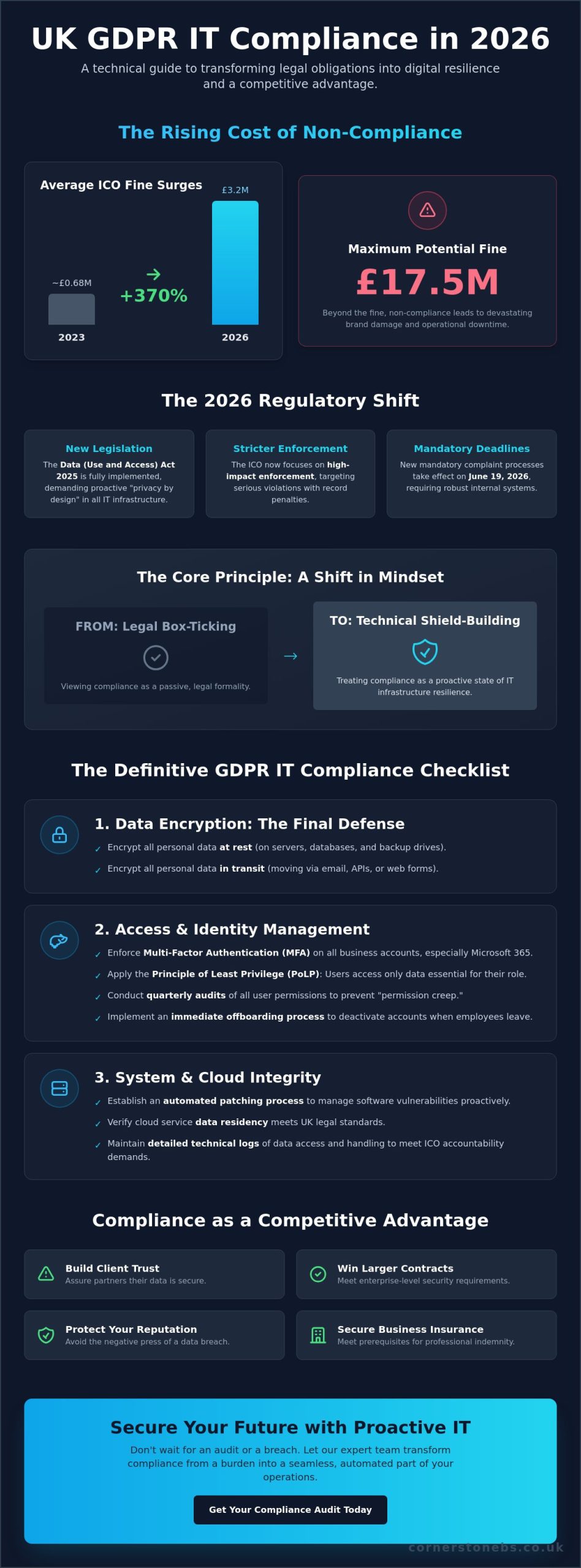
Did you know the average ICO fine has surged to nearly £3.2 million in 2026? That is a staggering 370% increase since 2023, proving that maintaining a GDPR IT compliance checklist for UK businesses is no longer just a legal formality; it’s a fundamental pillar of your digital resilience. As a local team that prides itself on keeping our regional partners secure, we know how daunting these shifting regulations and high-stakes penalties can feel.
It’s perfectly natural to feel overwhelmed by the technical jargon of the Data (Use and Access) Act 2025 or to worry about the complexities of cloud data residency. You want to focus on serving your customers, not on the fear of a £17.5 million penalty. This guide moves past the legalese to provide a clear, technical to-do list for your modern infrastructure. We’ll walk you through the essential system updates, from automated decision-making safeguards to the mandatory complaint processes taking effect on June 19, 2026. You’ll gain a robust framework for business continuity and the peace of mind that comes from being truly prepared for the year ahead.
Key Takeaways
- Move beyond legal theory by treating compliance as a proactive technical state of IT infrastructure resilience.
- Build a secure foundation using essential technical controls, specifically focusing on advanced encryption for data at rest and in transit.
- Use our GDPR IT compliance checklist for UK businesses to audit your hardware and software assets and locate every piece of personal data.
- Navigate cloud complexities with confidence by verifying your data residency meets the specific requirements of the latest UK legal standards.
- Ensure long-term stability by positioning managed IT support as a proactive monitoring strategy rather than just a technical necessity.
Understanding UK GDPR IT Compliance in 2026
Think of UK GDPR IT compliance as the digital fortress that surrounds your business operations. It isn’t just about having a privacy policy tucked away in a filing cabinet; it’s the technical implementation of every data protection principle within your actual network. While the Data Protection Act 2018 provides the legal foundation, IT compliance is the mechanism that enforces those laws through encryption, access controls, and secure backups. In 2026, the gap between “saying” you are compliant and “being” compliant has never been wider.
Why Compliance is a Competitive Advantage
The Role of the ICO in 2026
The ICO’s current focus is on high-impact enforcement, targeting the most serious violations with record-breaking penalties. The accountability principle now demands that you maintain detailed technical logs to prove exactly how data is accessed and handled. If you can’t show the logs, the ICO assumes the protection wasn’t there. Beyond the £17.5 million maximum fine, the real cost of non-compliance lies in the devastating blow to your brand and the operational downtime that follows a breach. We want to help you avoid that stress by making compliance a seamless, proactive part of your daily operations.
Technical Controls: The Foundation of Digital Privacy
While legal policies provide the rules, technical controls are the actual locks on your digital doors. In 2026, the ICO expects more than just a signed document; they want to see robust, active defenses. Any effective GDPR IT compliance checklist for UK businesses must start with the hardware and software settings that protect your data from the inside out. We help our local partners move beyond theory by implementing the specific technical measures that keep sensitive information out of the wrong hands.
Encryption acts as your final line of defense. You must ensure that all personal data is encrypted both at rest, such as on your servers and backup drives, and in transit, when it’s moving through email or web forms. This ensures that even if a data packet is intercepted, it remains completely unreadable. Coupling this with Multi-Factor Authentication (MFA) across every business account creates a formidable barrier. MFA is no longer an optional extra. It’s a fundamental requirement for securing your Microsoft 365 environment and preventing unauthorized access from stolen credentials.
Hackers look for the easiest path. Often, that’s through unpatched software. A proactive approach to vulnerability management means your systems aren’t left open to known exploits. Regular, automated patching keeps your infrastructure resilient and stable. If managing these technical layers feels like a full-time job, our team provides the expert Cyber Security support you need to stay ahead of emerging threats without losing focus on your daily operations.
Access Control and Identity Management
We recommend the Principle of Least Privilege (PoLP) for every business network. This means users only have access to the specific data required for their job role, and nothing more. For those using Microsoft 365 or local servers, you should audit user permissions quarterly to prevent “permission creep.” When an employee leaves your organization, their accounts must be deactivated immediately. Leaving a dormant account active is a massive security hole that the ICO’s Guide to the GDPR specifically warns against.
Endpoint Security and Device Management
Hybrid work has made endpoint security a top priority. Laptops and mobile devices are easily lost or stolen, making them high-risk targets. You should use Mobile Device Management (MDM) to maintain control over these assets, allowing for remote data wiping if a device disappears. To meet strict compliance standards, you must implement full-disk encryption on all portable hardware to ensure data remains protected even if the physical device is compromised. These small technical steps provide immense emotional and financial security for your business.
Cloud Infrastructure and Data Residency Requirements
Storing your data in the cloud isn’t just about convenience; it’s about geography. Data residency refers to the physical location where your information sits. For UK businesses, ensuring your cloud provider uses UK-based data centers is a vital part of any modern GDPR IT compliance checklist for UK businesses. Platforms like Microsoft Azure and Microsoft 365 allow you to select specific UK data regions. This keeps your client information within our borders, which simplifies your legal obligations and provides a clear audit trail for the ICO. You should also remember that using any SaaS provider makes them a “data processor.” This requires a solid third-party agreement to ensure they meet the same high standards for security and privacy that you do.
Managing these cloud environments requires a proactive approach to ensure data doesn’t drift into unapproved regions. We help our local partners configure their cloud settings to prioritize regional storage, providing the peace of mind that comes from knowing exactly where your data lives. This technical oversight is a foundational element of business stability. It ensures you aren’t caught out by shifting international data transfer rules that can change without much notice.
Microsoft 365 Compliance Features
Microsoft 365 is more than just a set of productivity tools. It includes powerful security features like Microsoft Purview and Data Loss Prevention (DLP) settings. These tools allow you to set up auto-labeling, which automatically detects and protects sensitive business data like financial records or personal IDs. If you’re planning a move to a more secure environment, our Microsoft 365 Migration for Business UK guide offers a complete strategy for a secure transition. These built-in features help you stay organized and demonstrate your commitment to data protection.
Backup and Disaster Recovery as a GDPR Requirement
GDPR isn’t just about privacy; it’s about availability. If your systems go down and you can’t access personal data when a customer requests it, you’re technically in breach. A simple backup is a great start, but a compliant disaster recovery plan ensures your business can actually keep running during a crisis. We align our Cloud Solutions for UK Businesses with the NCSC’s 10 Steps to Cyber Security to ensure your infrastructure is resilient. This level of technical support provides the emotional and financial security you need to focus on growth. It transforms a technical necessity into a long-term partnership for success.
The Definitive GDPR IT Compliance Checklist for UK Businesses
While we’ve discussed the theory and cloud residency, compliance ultimately comes down to the specific settings on your devices and servers. To help you build a resilient foundation, we’ve compiled this GDPR IT compliance checklist for UK businesses. It moves beyond paperwork to focus on the technical enforcement required to satisfy the ICO in 2026. Start by auditing every piece of hardware and software in your building. You must identify exactly where personal data resides, whether it’s on a local desktop, a legacy server, or a staff member’s mobile phone.
Your next step is implementing end-to-end encryption for all email communications and file sharing. This ensures that sensitive information remains secure from the moment it leaves your network until it reaches the intended recipient. Combine this with a strict password policy and universal MFA deployment across every single business application. Finally, don’t wait for a crisis to test your defenses. Schedule regular Cyber Security audits and penetration testing to find the cracks before a hacker does. Proactive testing isn’t just a technical necessity; it’s a foundational element of your business stability.
Data Mapping and Asset Discovery
You can’t protect what you can’t see. “Shadow IT” often creeps into organisations when staff use unauthorized personal apps or hardware for work tasks. To combat this, create a technical data flow diagram for your IT network that maps every point where personal data enters, moves through, and leaves your systems. Robust IT inventory management is the only way to ensure your GDPR IT compliance checklist for UK businesses covers 100% of your digital footprint. It gives you the clarity of an expert and the confidence of a leader.
The 72-Hour Breach Notification Rule
The law requires you to report most data breaches within 72 hours, but you can’t report what you haven’t detected. This requires real-time technical monitoring to catch unauthorized access as it happens. Under technical guidelines, a reportable breach is defined as any security incident that leads to the accidental or unlawful destruction, loss, alteration, or unauthorized disclosure of personal data. If you aren’t sure if your current systems can spot these triggers, our Cyber Security Services provide the proactive monitoring you need for true peace of mind. We invite you to have a conversation with our local team to see how we can strengthen your defenses today at cornerstonebs.co.uk.
Securing Your Future: Proactive Managed IT as a Compliance Strategy
Completing a GDPR IT compliance checklist for UK businesses is a fantastic milestone, but true data protection is never a “one and done” task. Compliance is a living state of your infrastructure. To maintain the high standards required by the ICO in 2026, your systems need constant, proactive oversight. Managed IT Support bridges the gap between having a plan and actually living it. It provides the continuous monitoring necessary to detect unauthorized access attempts or system vulnerabilities the moment they appear, rather than weeks after a breach has occurred.
Think of an outsourced partner as providing “compliance-as-a-service.” At Cornerstone Business Solutions, we deliver bespoke technology solutions that go beyond generic software fixes. We understand that every organisation has a unique digital footprint. Our multi-award-winning expertise allows us to navigate complex technical audits with the clarity of a long-term partner. We don’t just sell you a license; we build a resilient framework that supports your business continuity and provides the emotional security you need to lead with confidence.
From Reactive Repairs to Proactive Compliance
The old “break-fix” model of IT support is now a major compliance risk. If you only call for help when something stops working, you’ve likely already left a window open for a data breach. GDPR demands “availability” and “integrity,” which are impossible to guarantee with reactive repairs. Moving to a fixed-term contract ensures your system health and security patches are always current. While we are proud of our roots and provide industry-leading Managed IT Services in Teesside, our technical reach and compliance expertise support businesses on a national scale. This proactive approach keeps your network stable and your data locked down tight.
Your Next Steps for 2026
The most effective way to start your journey toward total resilience is with a professional security audit. We’ll help you identify the specific gaps in your current setup and refine your GDPR IT compliance checklist for UK businesses to match your actual operational needs. Our award-winning support team is ready to simplify the technical hurdles of the Data (Use and Access) Act 2025, turning complex regulations into a clear path forward. We invite you to a conversation about your digital future. It’s time to move away from the fear of fines and toward the peace of mind that comes from expert protection. Book a consultation with our compliance experts today and let’s build something secure together.
Build a Resilient Future Through Technical Excellence
The transition toward strict technical enforcement in 2026 proves that data protection is no longer just a legal task. It’s a fundamental part of your business’s digital health. By moving from reactive repairs to a proactive GDPR IT compliance checklist for UK businesses, you ensure your infrastructure remains stable, secure, and ready for growth. You’ve learned that robust encryption, regional data residency, and universal MFA are the pillars of modern privacy by design.
We believe that every local business deserves the peace of mind that comes from expert protection. As a multi-award-winning IT services provider and strategic partner with industry leaders like Microsoft, IBM, and Cisco, we offer the 24/7 proactive monitoring required to stay ahead of evolving threats. We don’t just fix problems; we prevent them from happening in the first place. This collaborative approach turns a regulatory necessity into a powerful engine for client trust and operational stability.
Your journey toward total resilience starts with a single conversation. Start your journey to total technical compliance with a Cornerstone IT audit. Let’s work together to secure your data and protect your reputation for the long term. You’ve got this, and we are right here to support you every step of the way.
Frequently Asked Questions
Is UK GDPR compliance different from EU GDPR in 2026?
Yes, the Data (Use and Access) Act 2025 has created a distinct UK framework that diverges from the EU version. While the core principles of privacy remain, the UK has relaxed rules on automated decision-making and introduced “recognised legitimate interests” to simplify processing for specific cases like crime prevention. It is vital to ensure your systems reflect these specific UK legislative updates rather than relying on generic EU guidance.
Does a small business with fewer than 10 employees need a GDPR IT checklist?
Absolutely, because data protection laws apply to every organisation regardless of its size. A GDPR IT compliance checklist for UK businesses ensures that even the smallest team protects sensitive client data from rising cyber threats. Smaller businesses are often targeted because they lack robust defenses, so having a clear technical plan provides essential security and prevents devastating financial penalties.
What are the technical requirements for “Privacy by Design”?
Privacy by Design requires you to integrate data protection into your system architecture from the moment of purchase or development. This includes implementing pseudonymisation, setting automatic data deletion periods, and ensuring that default settings are always the most private options available. It moves privacy from a manual task to an automated technical standard within your network infrastructure.
Can I store UK customer data on US-based cloud servers?
You can store data in the US, provided you use appropriate safeguards like the UK-US Data Bridge or specific standard contractual clauses. However, the most reliable way to ensure compliance is to select a UK-based data region within your cloud platform. This keeps your information within our borders and simplifies your residency requirements under current UK law.
How often should we conduct a technical GDPR audit?
We recommend a full technical audit at least once a year or whenever you implement significant changes to your IT infrastructure. Regular quarterly reviews of user permissions and software patches are also essential. This proactive rhythm ensures your GDPR IT compliance checklist for UK businesses stays relevant as new cyber threats emerge throughout the year.
Is Multi-Factor Authentication (MFA) a legal requirement under GDPR?
While the law doesn’t name “MFA” specifically, it mandates that you use “appropriate technical measures” to protect personal data. In 2026, the ICO considers MFA a basic industry standard for any business network. Failing to implement it can be viewed as negligence, making it much harder to defend your actions if a breach occurs via stolen credentials.
What happens if our business suffers a data breach but we followed the checklist?
Following a technical checklist demonstrates that you took “reasonable and proportionate” steps to protect your data. While you must still report a reportable breach to the ICO within 72 hours, having a documented audit trail of your technical controls significantly reduces the likelihood of heavy fines. It proves you acted as a responsible and proactive data controller.
How does Managed IT Support help with GDPR accountability?
Managed IT Support provides the technical logging and continuous monitoring required to prove your compliance to regulators. By outsourcing to a local expert, you gain a detailed audit trail of every security patch, backup, and access request. This satisfies the accountability principle by providing concrete evidence that your systems are actively managed and secured 24/7.