
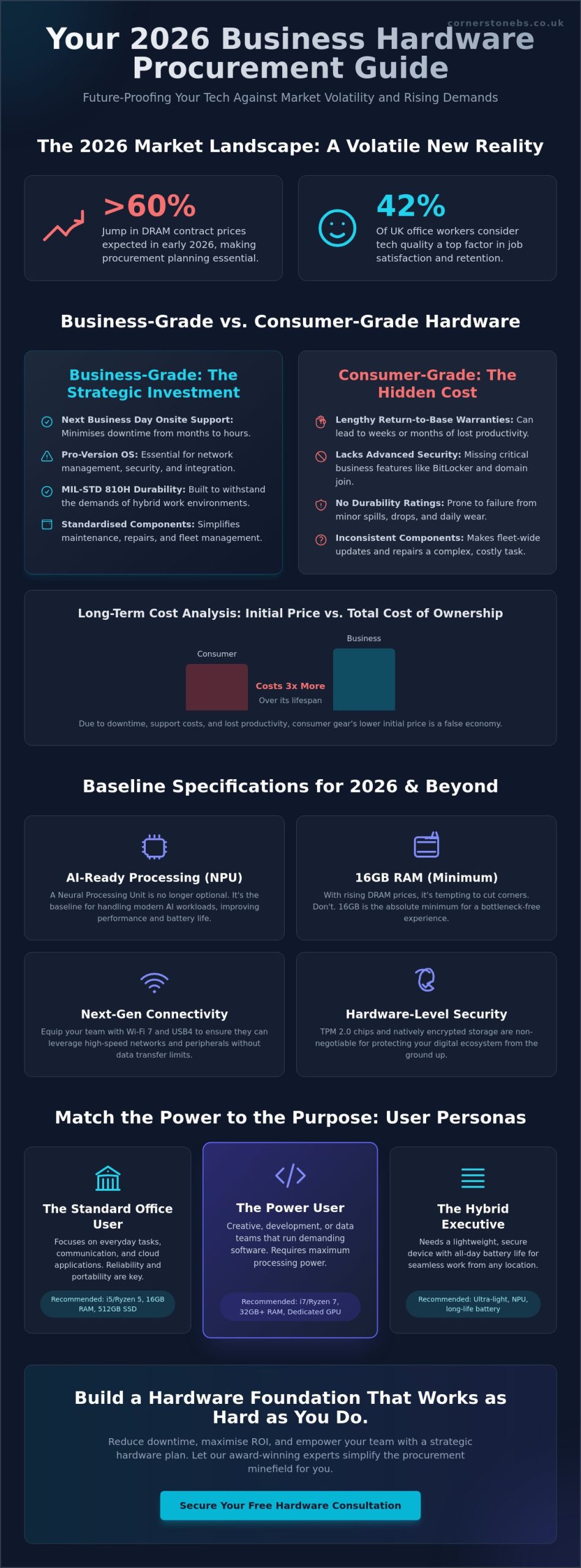
What if your next IT upgrade costs 20% more than your last one, yet fails to handle the AI tools your team needs by next Christmas? With DRAM contract prices jumping by over 60% in early 2026, securing a robust business hardware supply is no longer just about buying boxes; it’s about protecting the entry points to your entire digital ecosystem. You’ve likely felt the frustration of lead times stretching into months or discovered that your new laptops don’t play nice with your existing cloud software. It’s a headache that drains your budget and slows down your team’s momentum.
Our award-winning team knows that technology should provide peace of mind, not a pile of invoices. This guide helps you master your procurement strategy so you can choose, secure, and manage high-performance gear that actually lasts. We’ll show you how to reduce downtime and improve ROI despite the current market volatility. From meeting the new NIST CSF 2.0 standards to hitting the UK’s 532,882-tonne WEEE collection target, we’ve got the expert insights you need to keep your business moving forward. Let’s have a chat about how to build a hardware foundation that works as hard as you do.
Key Takeaways
- Learn why treating hardware procurement as a strategic partnership directly improves employee productivity and long-term retention across your team.
- Discover how to tailor your business hardware supply using specific user personas and the latest Neural Processing Units (NPUs) to future-proof your tech.
- Secure your digital ecosystem from the ground up with essential hardware-level defences like TPM 2.0 chips and encrypted storage.
- Maximise your ROI by moving to a proactive refresh cycle and standardising your fleet for easier maintenance and significantly less downtime.
- See how an award-winning local partner provides the peace of mind you need by simplifying the complex procurement minefield.
The Strategic Role of Business Hardware Supply in 2026
Successful procurement in 2026 isn’t a race to the bottom on price. It’s a calculated investment in your company’s future. When you view business hardware supply as a strategic partnership rather than a simple transaction, you gain a competitive edge that keeps your operations stable. Modern e-procurement strategies now focus on long-term value, ensuring your team has the tools to excel without fighting their equipment every morning. Our award-winning team at Cornerstone Business Solutions knows that the right gear doesn’t just sit on a desk; it powers your growth.
Business-Grade vs. Consumer-Grade: The Real Difference
- Next Business Day onsite support: Minimises downtime by getting a technician to your door immediately.
- Pro-version operating systems: Essential for network management, advanced security, and seamless integration.
- Standardised internal parts: Simplifies maintenance and ensures your entire fleet remains consistent.
The Cost of “Making Do” with Outdated Gear
Old gear creates a massive “Downtime Tax” that many owners overlook. Legacy laptops struggle to run modern cloud solutions, leading to synchronisation errors and security vulnerabilities. When your hardware can’t keep up with your software, your productivity plateaus. In 2026, the average lifespan of a business laptop is exactly 36 to 48 months before performance degradation begins to outweigh the cost of replacement. We help you plan these cycles proactively so you’re never left scrambling when a critical machine fails.
Choosing the Right Specifications: A 2026 Buyer’s Guide
Memory and storage have also hit a new tipping point. With 2026 DRAM contract prices rising by over 55% in the first quarter, it’s tempting to cut corners. Don’t. In 2026, 16GB of RAM is the absolute minimum for a productive office environment. Anything less will cause bottlenecks as modern browsers and background security tools fight for resources. We recommend pairing this with Wi-Fi 7 and USB4 connectivity to ensure your team can take full advantage of the high-speed networks we install across the North East. If you’re unsure which path fits your growth plans, our award-winning experts are always ready to chat about your hardware needs.
Laptops and Desktops: Matching Power to Purpose
Servers and Infrastructure: The Backbone of Your Business
While many firms move toward cloud solutions, on-premise hardware still plays a vital role for businesses needing local data control or high-speed internal access. We always recommend redundancy features like dual power supplies and RAID configurations to prevent a single component failure from stopping your operations. For growing SMEs, hyper-converged infrastructure offers a streamlined way to combine compute, storage, and networking into one easy-to-manage system that scales as you do.
Infrastructure and Security: Why Your Supply Chain Matters
Grey market hardware might save a few pounds upfront, but it carries a massive risk of pre-installed malware or unverified components. This is why your hardware partner must be an integrated part of your cyber security services strategy. We only source from trusted global leaders to guarantee that features like TPM 2.0 chips and hardware-encrypted storage are present and active. These tools provide the peace of mind that your data remains safe, even if a device is physically lost or stolen. Our award-winning team doesn’t just deliver a box; we deliver a secure foundation for your business to thrive.
Securing the Remote Entry Point
Network Hardware: Beyond the Basic Router
Procurement and Lifecycle Management: Maximising ROI
Total Cost of Ownership (TCO) vs. Purchase Price
The sticker price is only the beginning. You have to factor in the time spent on deployment, software licensing, and ongoing technical support. Our award-winning it company solutions reduce the TCO by handling the heavy lifting of imaging and setup before the gear even reaches your office. We also leverage manufacturer-direct warranties. These protect your investment by ensuring that if a part fails, it’s replaced with genuine components at no extra cost to you. It’s about securing long-term value, not just a short-term bargain.
Hardware as a Service (HaaS): A Modern Alternative
Many local businesses are shifting away from large upfront costs. Hardware as a Service (HaaS) moves your tech spend from a capital expenditure (CapEx) to an operational one (OpEx). This keeps your cash flow healthy and predictable. This model provides an “evergreen” fleet where devices are automatically refreshed every three years. It integrates perfectly with our managed IT services, giving you a single monthly fee for both your gear and your support. If you want to stop worrying about obsolescence, it’s time to optimise your hardware lifecycle with a partner you can trust.
Partnering with Cornerstone for Award-Winning Hardware Solutions
More Than Just a Supplier: A Technology Partner
We believe your physical gear must work in harmony with your software ecosystem. We align your hardware choices with your Microsoft 365 migration and long-term cloud goals to prevent compatibility issues. Our proactive monitoring systems often alert us to a failing hard drive or a battery issue before you even notice a flicker. This gives you the peace of mind that your foundation is stable, secure, and tailored to your specific needs. We’re here to ensure your technology supports your growth, not hinders it.
Get Started with a Hardware Audit
Secure Your Competitive Edge for 2026
As a multi-award-winning IT provider and official partner with Microsoft, IBM, and Cisco, we’re here to simplify this complexity for you. Our managed plans include proactive 24/7 system monitoring to catch hardware failures before they disrupt your day. Don’t let outdated gear or long lead times hold your North East business back. Book a free technology consultation with our award-winning team today. We’re ready to help you build a robust, high-performance future that works as hard as you do.
Common Questions About Business Hardware Procurement
What are the essential hardware components for a small business in 2026?
Is it better to lease or buy business IT hardware?
Choosing between leasing and buying depends entirely on your cash flow strategy. Leasing through Hardware as a Service (HaaS) turns technology costs into predictable monthly OpEx payments, which keeps your capital free for other investments. Buying gives you full asset ownership but requires significant upfront capital. Most North East businesses we partner with prefer the “evergreen” nature of leasing to ensure their fleet is automatically refreshed every three years.
How often should a business refresh its laptop and desktop fleet?
What is the difference between consumer and enterprise-grade hardware?
Can a business hardware supplier help with software licensing as well?
What should I do with old business hardware when it reaches end-of-life?
You must use professional recycling and certified data destruction services to meet the UK’s 2026 WEEE collection target of 532,882 tonnes. Simply throwing old gear away risks a major data breach and environmental fines. Our award-winning team manages the entire disposal process, providing you with certificates of destruction for total peace of mind and regulatory compliance.
How do I ensure my new hardware is compatible with my existing cloud systems?
We ensure compatibility by conducting a full technology audit before suggesting any new business hardware supply. This process verifies that your processors and memory can handle the specific processing demands of your cloud software. It prevents performance bottlenecks and ensures your team can access their files and applications without frustrating lag or synchronisation errors.
What are the current lead times for enterprise-grade servers and networking gear?
Current lead times for enterprise-grade servers and networking gear typically range from 3 to 6 months. High demand for AI-specific components and memory has created a structural shift in the global market. We recommend planning your procurement at least two quarters in advance to avoid being caught out by these industry-wide delays.