

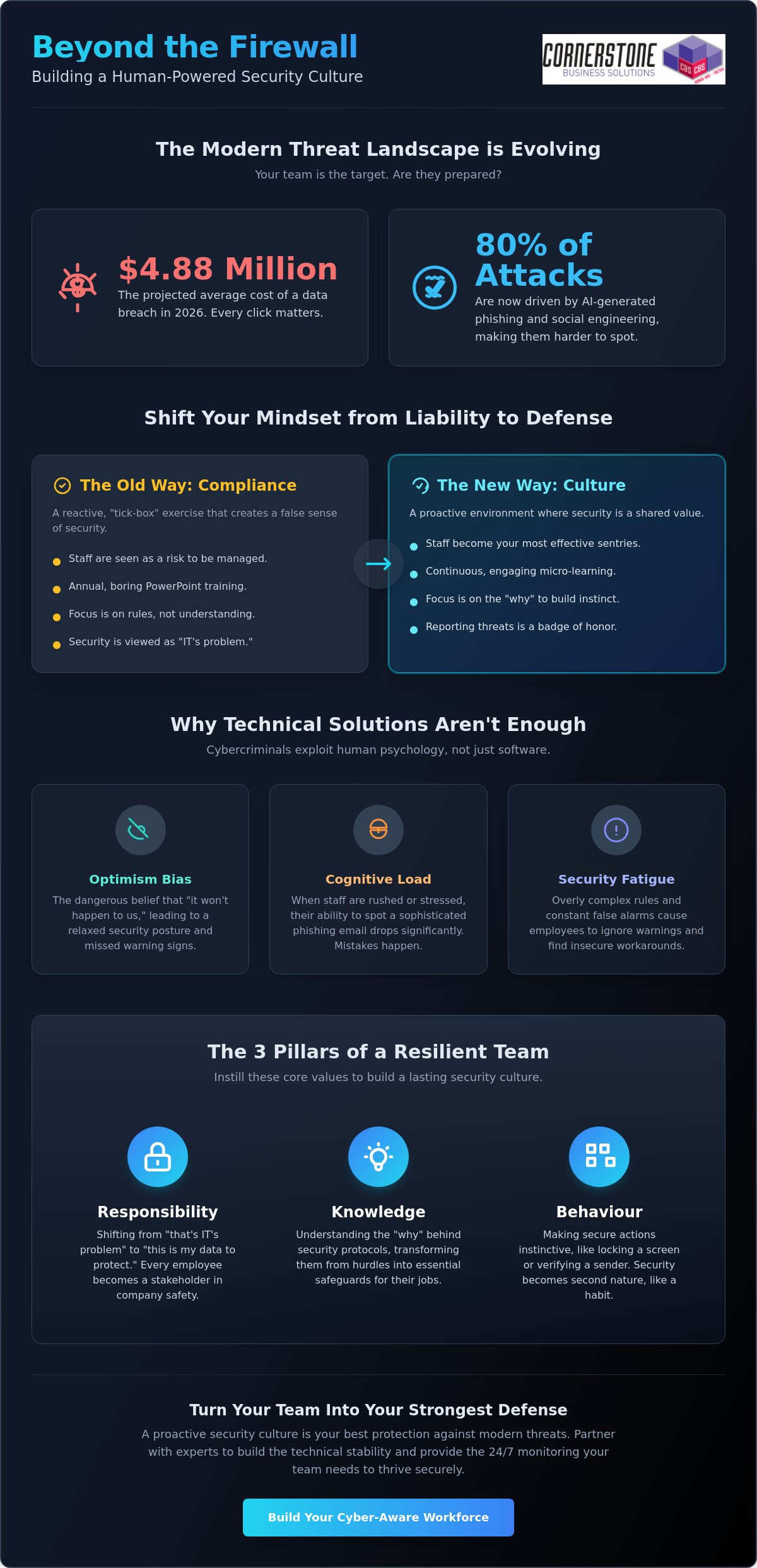
What if your team’s next click cost your business $4.88 million? With the average cost of a data breach reaching that staggering figure in 2026, the stakes for your local company have never been higher. You likely feel the frustration of staff skimming through mandatory training or clicking on the AI-generated phishing links that now drive 80% of attacks. It’s exhausting when security feels like just another IT chore rather than a shared responsibility. We know that building a security awareness culture at work isn’t about more PowerPoint slides; it’s about shifting the mindset of your most valuable asset.
We’re here to help you turn that liability into your strongest line of defense. This guide shows you how to move past the “compliance box-ticking” phase and create a proactive environment where reporting a suspicious email is a badge of honor. We’ll explore how leadership can simplify complex technical threats and foster a no-blame culture that reduces human error. From understanding the rise of AI-powered threats to implementing a Zero Trust mindset, you’ll learn how to protect your business continuity while keeping your team engaged and empowered.
What You Will Learn:
- How to shift your perspective from seeing staff as a risk to treating them as your most effective sentries against digital threats.
- The impact of “Optimism Bias” and how cognitive load leads to the human errors that bypass even the best technical firewalls.
- Why building a security awareness culture at work creates a level of true safety that annual “tick-box” compliance training simply cannot match.
- A clear, five-step framework to identify your internal Security Champions and baseline your organization’s current cyber attitudes.
- The role professional Managed IT Support plays in providing the technical stability and 24/7 monitoring your team needs to feel confident.
Beyond the Firewall: What Building a Security Awareness Culture at Work Actually Means
The Three Pillars of a Cyber-Aware Workforce
To build a resilient team, you need to focus on three core areas that drive long-term change:
- Responsibility: This is about individual ownership. It moves the needle from “that is an IT problem” to “this is my data to protect.” When every employee feels like a stakeholder in the company’s safety, your risk profile drops significantly.
- Knowledge: Staff need to understand the “why” behind the rules. Using Security Awareness as a foundational concept helps them recognize that a protocol isn’t a hurdle to their productivity; it’s a safeguard for their livelihood.
- Behaviour: The ultimate goal is to make secure actions instinctive. Locking a screen when walking away or double-checking a sender’s address should be second nature, much like putting on a seatbelt when you get into a car.
Why 2026 Demands a Cultural Shift
The threat landscape has evolved with terrifying speed. We are now seeing a massive rise in deepfake phishing and AI-generated social engineering attacks that look and sound exactly like a trusted colleague or manager. Hybrid working has also permanently removed the traditional “office perimeter,” making every home office and coffee shop a potential entry point for criminals. Modern cyber security services must be human-centric to be effective. Technology provides the essential foundation, but a proactive culture ensures that when AI-powered attacks try to trick your team, your people have the confidence and the presence of mind to say “no” and report the incident immediately.
The Psychology of Cyber Risk: Why Technical Solutions Aren’t Enough
Stress and cognitive load play a massive role in security failures. If your team is rushing to meet a Friday afternoon deadline, their ability to spot a fraudulent email drops significantly. They are mentally exhausted, and that’s when mistakes happen. 80% of phishing attacks now use AI to create highly personalized, convincing messages that target people when they are most distracted. We also have to combat “Security Fatigue.” When you force over-complicated password policies or bombard staff with constant, irrelevant alerts, they’ll naturally look for workarounds. They might start writing passwords on sticky notes or ignoring warnings just to get their work done. Creating a Culture of Security requires us to recognize these human limitations and design systems that support people rather than burden them.
Building Psychological Safety: The No-Blame Approach
Punishing an employee for clicking a suspicious link is a recipe for long-term disaster. If a staff member feels they will be reprimanded, they will hide their mistake. This gives a virus hours or even days to spread through your network undetected. Building a security awareness culture at work relies on psychological safety. You want a culture where “I think I made a mistake” is met with immediate support. By rewarding “near-miss” reporting, you turn every error into a learning opportunity and identify vulnerabilities before they can be exploited by criminals.
Overcoming the “Productivity vs. Security” Conflict
Compliance vs. Culture: Moving Beyond the ‘Tick-Box’ Training Mentality
When you create a culture of security, you bridge the gap between “knowing the rules” and “following them under pressure.” In the heat of a busy morning, an employee shouldn’t have to recall a slide from six months ago to know that an attachment looks suspicious. They need an instinctive sense of caution fostered through regular, bite-sized updates and open communication. Think of Cyber Essentials as your floor, not your ceiling. It sets the technical baseline, but your culture determines how high you can actually build your defenses.
Measuring What Matters: Beyond Phishing Click Rates
Many managers panic when a phishing simulation shows a high click rate. While a high number of clicks isn’t ideal, it’s not the only metric that matters. You should focus on your “Reporting Rate.” If ten people click but twenty people report the email to your IT team, your culture is actually performing well. Reporting rates show that your team is engaged and proactive. We also recommend using brief, anonymous surveys to gauge how important security feels to different departments. This data tells you where you need to focus your efforts more than a simple pass or fail test ever could.
The Role of Leadership in Setting the Tone
Security culture must start in the boardroom, not the server room. If the leadership team treats security as a nuisance, the rest of the staff will follow suit. One of the biggest cultural killers is the “Executive Exception.” This happens when directors bypass multi-factor authentication or share passwords because they’re “too busy” for the rules. This sends a clear message that security is optional for those at the top. When leaders lead by example, they turn protection into a core business value. This proactive stance transforms security from a burden into a competitive advantage, setting a standard for modern it company solutions that prioritize long-term resilience over quick fixes.
A Practical 5-Step Framework for Building a Cyber-Aware Workforce
Identifying and Empowering Security Champions
Your champions are the heartbeat of your security culture. They don’t need to be IT experts. Instead, look for staff members who are respected and approachable. When a peer mentions a secure habit, it carries more weight than a directive from the IT department. Give these champions the tools and authority to mentor their colleagues. They also act as a vital feedback loop, telling you which protocols are working and which ones are causing frustration on the front line.
Gamification: Making Security Engaging
Security doesn’t have to be dull. Use leaderboards or department challenges to foster healthy competition. You might offer a “Catch of the Month” award for the person who flags the most sophisticated phishing attempt. Keep the rewards low-cost but high-impact, like a coffee voucher or an early finish. It’s vital to keep the tone positive. You want to celebrate the “sentries” who protect the business, ensuring those who struggle feel supported rather than alienated. If you’re ready to see how a proactive approach can safeguard your business, reach out to our local team for a friendly conversation about your security strategy.
Scaling Your Security Culture with Professional Managed IT Support
Culture doesn’t exist in a vacuum. While the mindset of your team is the most critical variable, that mindset needs a stable, reliable foundation to thrive. This is where managed IT services Teesside play a pivotal role. By providing a robust technical framework, you remove the friction that often leads to “security fatigue.” When your systems work exactly as they should, your employees can focus on being vigilant sentries rather than fighting with their tools. Building a security awareness culture at work becomes much easier when your team knows that a dedicated group of experts is watching the perimeter 24/7. This creates a sense of emotional security, allowing staff to report concerns without the fear that they are “bothering” the IT department.
The Technical Safety Net
Cornerstone: Your Partner in Cyber Resilience
Secure Your Future by Empowering Your People
As a multi-award-winning IT provider partnered with industry leaders like Microsoft, IBM, and Cisco, we specialize in simplifying these complex transitions for local businesses. We provide the proactive 24/7 system monitoring and expert guidance you need to lead with total confidence. You don’t have to face these evolving cyber challenges alone. We’re here to act as your long-term partner in stability and growth. Book a free cyber security consultation with our award-winning team today to discuss how we can strengthen your business together. Your team is ready to step up; let’s give them the tools to succeed.
Frequently Asked Questions
How long does it take to build a security awareness culture?
Building a security awareness culture at work is a continuous journey rather than a one-time project. While you can implement technical changes in weeks, genuine behavioral shifts typically take 6 to 12 months to become fully embedded. This timeline depends on your starting point and the frequency of your engagement. We focus on steady, sustainable progress to ensure that secure habits become second nature for your team over the long term.
What is the most effective way to train employees on cyber security?
Continuous micro-learning is the most effective method for training your workforce. Traditional annual seminars are often forgotten within weeks. Instead, we recommend short, monthly updates and real-world simulations that reflect current 2026 threats like AI-driven phishing. This approach keeps security at the front of your team’s minds without overwhelming them. It turns complex technical concepts into manageable, daily habits that protect your business continuity.
How do I deal with employees who repeatedly fail phishing tests?
Supportive, targeted coaching is the best way to help repeat offenders. Punitive measures often backfire because they discourage staff from reporting real incidents. We suggest having a friendly, one-on-one conversation to understand why they are struggling. It might be a result of high workload or a specific misunderstanding of the threat. Providing extra resources or a “Security Champion” mentor can help turn these vulnerabilities into strengths.
Is security awareness training a legal requirement for UK businesses?
Yes, training is effectively a requirement under UK GDPR and various industry standards. GDPR mandates that organizations implement appropriate technical and organizational measures to protect data. This includes ensuring your staff are trained to handle information securely. Additionally, frameworks like Cyber Essentials highlight the importance of user awareness. Keeping your team informed isn’t just about safety; it’s a foundational element of your legal and regulatory obligations.
Can a small business afford a professional security culture programme?
What are the most common human errors that lead to data breaches?
Weak password management and clicking on sophisticated phishing links remain the most common errors. In 2026, we also see a rise in accidental data exposure through misconfigured cloud sharing settings. These mistakes often happen when employees are stressed or rushing. By building a security awareness culture at work, you help your team recognize these high-pressure moments and take the necessary steps to verify their actions before clicking.
How do I get senior management buy-in for security culture?
What role does HR play in building a security culture?
HR plays a central role in embedding security into the employee lifecycle. They handle everything from secure onboarding and offboarding to communicating clear acceptable use policies. Most importantly, HR helps foster the “no-blame” environment we discussed earlier. By working closely with your IT partner, HR ensures that security becomes a core part of your company’s values and a positive aspect of your workplace culture.