Did you know that the ICO now has the power to issue fines of up to £17.5 million for simple communication breaches? With the Data (Use and Access) Act 2025 now in full effect, staying ahead of the law requires more than just basic firewalls. It’s easy to feel overwhelmed by these shifting rules, especially when you’re trying to find a reliable it compliance checklist for uk businesses that actually makes sense for your daily operations. You need a strategy that protects your reputation and your bottom line without slowing down your team.
We understand that you want peace of mind, not a legal textbook. Our award-winning team has developed a guide that replaces uncertainty with absolute confidence. This framework simplifies complex technical requirements into clear, actionable steps that benefit your business. We break down the latest “Danzell” Cyber Essentials updates, explain the new 30-day data subject complaint window, and show you how proactive managed IT support acts as a continuous compliance engine. Let’s move past the jargon and ensure your business is resilient, legal, and ready for growth.
Key Takeaways
- Learn why being “secure” isn’t the same as being “compliant” and how to avoid the ICO’s increased £17.5 million fining powers.
- Get up to speed with the Data (Use and Access) Act 2025, including the strict new 30-day timeline for handling data subject complaints.
- Follow our it compliance checklist for uk businesses to perform essential operational audits on user permissions and hardware lifecycles.
- See how the latest Cyber Essentials “Danzell” update mandates Multi-Factor Authentication for all cloud users, not just admins.
- Shift from a “set and forget” mindset to a proactive model that uses managed IT services to maintain continuous operational resilience.
Understanding IT Compliance in the 2026 UK Landscape
We’ve moved beyond the original 2018 General Data Protection Regulation (GDPR) baseline. Since February 5, 2026, the Data (Use and Access) Act 2025 has introduced stricter requirements for data subject complaints and incident reporting. This shift means your it compliance checklist for uk businesses needs to account for these updated mandates. For directors, this is about more than just avoiding legal trouble. It’s about emotional security. Knowing your systems are robust and compliant allows you to focus on growth without the constant fear of a regulatory audit hanging over your head.
The Consequences of Non-Compliance
The Data Protection Pillar: GDPR and the 2025 Data Act
The Data (Use and Access) Act 2025 (DUAA) officially became the primary influence on UK data protection on February 5, 2026. It’s not a total rewrite of the rules you already know. Instead, it amends the UK GDPR and the Data Protection Act 2018 to better suit our modern economy. For any business owner, this means your it compliance checklist for uk businesses must account for these specific refinements. The Act aims to reduce “red tape” for low-risk data usage while strengthening the protections around sensitive personal information. One of the biggest shifts involves how you justify data collection. You need to re-audit your “Lawful Basis for Processing” to ensure your reasons for holding data still align with the streamlined definitions provided by the new Act.
Handling Subject Access Requests (SARs) and data complaints has also become more structured. As of June 19, 2026, you’re legally required to acknowledge any data subject complaint within 30 days. You then have to provide a full response without undue delay. This isn’t just about avoiding fines; it’s about showing your customers that you value their privacy. We always recommend following the official ICO guidance on UK GDPR to stay on the right side of these evolving expectations. Clear communication builds the foundation of a long-term partnership with your clients.
The 72-Hour Breach Reporting Rule
Speed is your best friend when a security incident occurs. Under the current 2026 guidelines, you must report any breach that risks the rights and freedoms of individuals to the ICO within 72 hours. This window is incredibly tight if you’re relying on manual checks. We use automated monitoring to detect anomalies instantly, giving you the best chance to meet this deadline. A proactive response plan ensures your team knows exactly who to call and what to do the moment a red flag appears. If you’re worried about your current detection speed, our Cyber Security audits can identify gaps before they turn into reportable incidents.
Data Governance and Documentation
Cyber Essentials is no longer just a “nice to have” recommendation. It’s the bedrock of any it compliance checklist for uk businesses. Since the Danzell update took effect in April 2026, the requirements have sharpened significantly to meet modern threats. We view this certification as a quality signature. It proves to your partners and customers that you take their digital safety seriously. While the standard version involves a verified self-assessment, we often recommend Cyber Essentials Plus for businesses handling sensitive data. This higher tier includes a hands-on technical audit, providing the absolute certainty that your defences are as strong as you claim.
Even if your business is strictly UK-based, you’re likely part of a broader supply chain affected by international shifts. Regulations like NIS2 and the Digital Operational Resilience Act (DORA) are rippling through the UK market in 2026. These mandates require larger firms to prove their suppliers are secure. Meeting the Cyber Essentials scheme standards ensures you don’t get locked out of lucrative contracts due to compliance gaps. It positions your company as a reliable, long-term partner in a competitive landscape.
Technical Controls for Compliance
Modern compliance demands concrete technical evidence rather than vague promises. Multi-Factor Authentication (MFA) is now a mandatory check under the Danzell update for all cloud services. It’s not enough to enable it for administrators; every single user must have it active to pass an audit. We also focus on robust encryption for data both at rest and in transit. This prevents unauthorized access even if data is intercepted. Patch management is another critical area with zero room for error. You must apply all high-risk and critical security updates within 14 days of release. Failing to do so results in an automatic assessment failure, leaving your business both vulnerable and non-compliant.
Zero Trust Architecture in 2026
The Step-by-Step IT Compliance Checklist for 2026
Phase 1: Discovery and Documentation
Once you have a clear map, you must harden your defences. Enforce Multi-Factor Authentication (MFA) across all cloud subscriptions, including Microsoft 365 and Azure environments, to meet the mandatory Danzell update requirements. Standardise device encryption for all business mobiles and laptops to protect data in transit. This phase also involves an operational audit of user access levels. We advocate for “Least Privilege” policies, ensuring staff only have access to the data they need for their specific roles. To maintain this standard without manual effort, consider setting up automated patch management via Managed IT Support. This ensures critical security updates are applied within the required 14-day window.
Phase 3: Training and Culture
Technology alone isn’t enough; your people are your first line of defence. Deliver quarterly cyber security awareness training to help staff recognise evolving threats like AI-driven phishing. We recommend simulating phishing attacks to test your organisational resilience in a safe environment. The goal is to create a transparent culture where reporting a mistake is encouraged over hiding a breach. Finally, ensure your disaster recovery plan is more than just a document. Test your backup restoration at least annually to guarantee you can recover quickly from any incident. If you want to ensure your infrastructure meets every requirement, request a comprehensive IT audit from our expert team today.
Maintaining Compliance with Managed IT Services
Compliance isn’t a destination; it’s a constant state of readiness. The dangerous myth of “set and forget” compliance often leads to the very breaches and ICO fines we’ve discussed. In a 2026 regulatory environment, your digital infrastructure changes every day. New patches are released, user permissions shift, and data flows evolve. To stay legal and secure, you need a system that breathes with your business. Proactive monitoring identifies non-compliance markers before they escalate into a reportable incident. This approach transforms your it compliance checklist for uk businesses from a static document into a living, breathing shield for your organization.
At Cornerstone Business Solutions, we act as your long-term compliance partner. We don’t just fix things when they break; we ensure they’re built to meet the highest standards from the ground up. We leverage our multi-award-winning expertise to simplify complex technical audits, giving you the clarity you need to make informed decisions. By positioning managed IT support as your “continuous compliance engine,” we provide the emotional security that comes from knowing your systems are always under expert watch.
The Benefits of a Managed Compliance Approach
Taking a managed approach to your regulatory obligations offers several strategic advantages that benefit your bottom line. You gain predictable monthly costs, which is a far better alternative to the high price of emergency compliance fixes after a failed audit. You also get direct access to our team of Microsoft and Cisco certified engineers who understand the nuances of the 2025 Data Act. Our service includes:
- Expert Guidance: Real-time advice on how new technologies impact your legal standing.
- Regular Reporting: Clear, jargon-free documentation for your board of directors or stakeholders.
- Automated Safeguards: Systems that enforce MFA and encryption standards without manual intervention.
Next Steps: Your Compliance Audit
Navigating the 2026 regulatory environment doesn’t have to be a source of constant anxiety for your leadership team. We’ve shown that staying ahead of the Data (Use and Access) Act 2025 and the latest “Danzell” Cyber Essentials updates is about building a culture of resilience. By following a structured it compliance checklist for uk businesses, you protect your professional reputation and your bottom line. It’s about moving away from a reactive mindset and embracing a proactive partnership that supports your long-term growth and stability. Compliance is the foundation that allows you to innovate with absolute confidence.
As a multi-award-winning IT provider and certified Microsoft and Cisco partner, we’re trusted by businesses and educational institutions nationwide to simplify these complex technical hurdles. We understand the pressure of meeting 30-day complaint windows and 72-hour breach reporting rules. Our team is here to provide the clarity and emotional security you need to focus on your core goals. Book your 2026 IT Compliance Audit with our award-winning team today. Let’s start a conversation about securing your digital future and ensuring your systems are as robust as your ambitions. You’ve built a great business; let’s work together to keep it protected and compliant.
Frequently Asked Questions
Is GDPR still relevant in the UK in 2026?
Yes, UK GDPR remains the foundational law for data protection, though it was amended by the Data (Use and Access) Act 2025. It still dictates how you collect, store, and process personal information. While the 2025 Act streamlined some administrative tasks, the core principles of transparency and security remain. You must continue to document your processing activities to stay on the right side of the ICO’s current enforcement policies.
What is the Data (Use and Access) Act 2025 and how does it affect my business?
The Data (Use and Access) Act 2025 is the latest evolution of UK data law, coming into full force on February 5, 2026. It introduces a formal process for data subject complaints and requires an acknowledgment within 30 days. It also clarifies the lawful basis for processing for common business tasks. This act aims to reduce red tape while maintaining high standards, making it a key part of any it compliance checklist for uk businesses.
Does my small business really need Cyber Essentials certification?
Yes, Cyber Essentials is a critical baseline for any organization, as the NCSC estimates it can block 80% of common cyberattacks. In 2026, many government and private sector contracts require this certification as a mandatory condition. The “Danzell” update now requires Multi-Factor Authentication for all cloud users. Beyond securing your systems, it acts as a quality signature that builds trust with your clients and professional partners.
How often should we conduct an IT compliance audit?
You should conduct a comprehensive IT compliance audit at least once a year, or whenever you make significant changes to your infrastructure. Regulatory environments move fast, and a set and forget approach is dangerous. Regular audits identify gaps in hardware lifecycles or software patches before they become liabilities. For businesses in high-risk sectors like finance or law, quarterly reviews are often the gold standard for maintaining continuous operational resilience.
Can Managed IT services help with legal compliance?
Managed IT services act as a continuous compliance engine by providing proactive monitoring and automated security updates. We handle the technical heavy lifting, such as enforcing encryption and managing patch cycles within the required 14-day window. This ensures your it compliance checklist for uk businesses is always up to date. By partnering with experts, you gain the emotional security of knowing your legal obligations are met without distracting from your core business goals.
What are the penalties for a data breach in the UK in 2026?
The ICO has enhanced powers in 2026, with maximum fines reaching £17.5 million or 4% of global turnover. These penalties now apply to breaches of the Privacy and Electronic Communications Regulations (PECR) as well as GDPR. Beyond the financial cost, you face permanent reputational damage and potential service shutdowns. Regulators are now moving from policy reviews to verifying evidence, so having a proactive response plan is essential to minimize these risks.
Is Microsoft 365 automatically compliant with UK laws?
No, Microsoft 365 provides the tools for compliance, but the responsibility for correct configuration lies with your business. You must actively enable features like Multi-Factor Authentication and data loss prevention policies to meet UK standards. Simply purchasing a subscription doesn’t satisfy the Data (Use and Access) Act 2025. We work as certified partners to harden your Microsoft 365 environment, ensuring your cloud setup is both secure and legally robust.
What should be included in an IT disaster recovery plan for compliance?
A compliant disaster recovery plan must include a clear restoration timeline, a communication strategy for stakeholders, and a full hardware inventory. You are legally required to test your backup restoration at least annually to prove your business can recover from an incident. The plan should detail how you’ll meet the 72-hour breach reporting window. Having these documented processes ensures continuity and provides the evidence regulators look for during a formal audit.
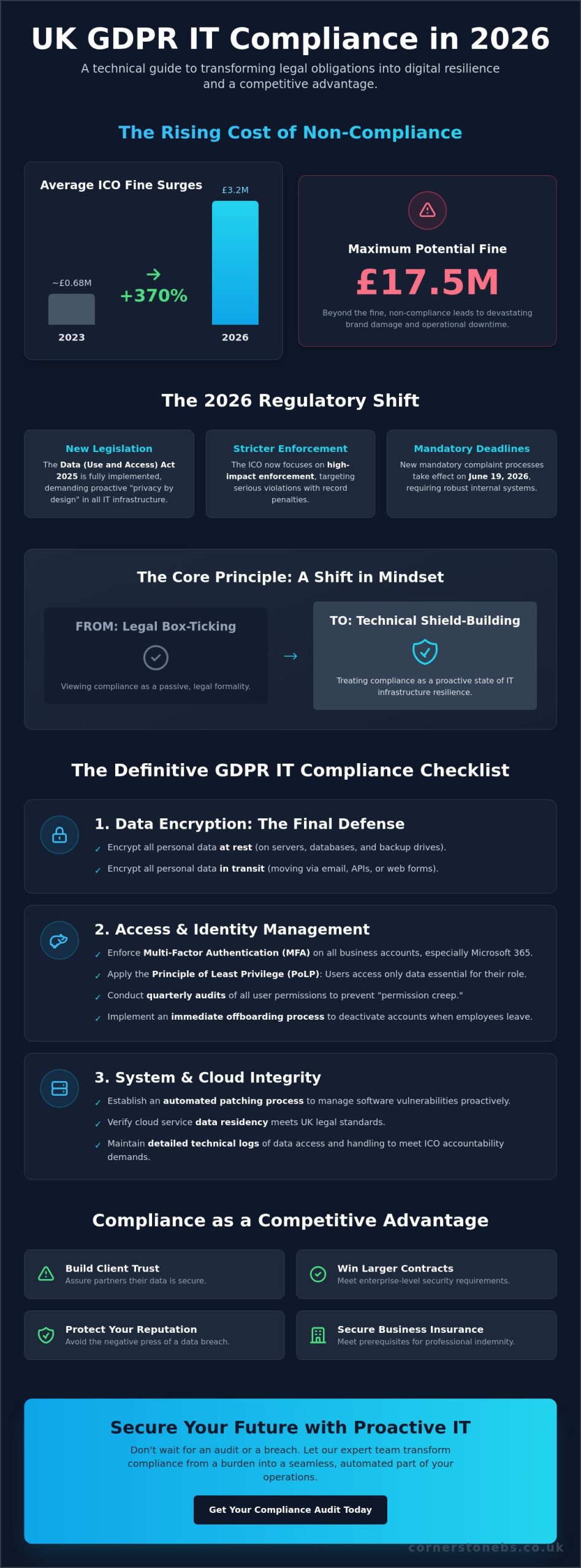
Did you know the average ICO fine has surged to nearly £3.2 million in 2026? That is a staggering 370% increase since 2023, proving that maintaining a GDPR IT compliance checklist for UK businesses is no longer just a legal formality; it’s a fundamental pillar of your digital resilience. As a local team that prides itself on keeping our regional partners secure, we know how daunting these shifting regulations and high-stakes penalties can feel.
It’s perfectly natural to feel overwhelmed by the technical jargon of the Data (Use and Access) Act 2025 or to worry about the complexities of cloud data residency. You want to focus on serving your customers, not on the fear of a £17.5 million penalty. This guide moves past the legalese to provide a clear, technical to-do list for your modern infrastructure. We’ll walk you through the essential system updates, from automated decision-making safeguards to the mandatory complaint processes taking effect on June 19, 2026. You’ll gain a robust framework for business continuity and the peace of mind that comes from being truly prepared for the year ahead.
Key Takeaways
- Move beyond legal theory by treating compliance as a proactive technical state of IT infrastructure resilience.
- Build a secure foundation using essential technical controls, specifically focusing on advanced encryption for data at rest and in transit.
- Use our GDPR IT compliance checklist for UK businesses to audit your hardware and software assets and locate every piece of personal data.
- Navigate cloud complexities with confidence by verifying your data residency meets the specific requirements of the latest UK legal standards.
- Ensure long-term stability by positioning managed IT support as a proactive monitoring strategy rather than just a technical necessity.
Understanding UK GDPR IT Compliance in 2026
Think of UK GDPR IT compliance as the digital fortress that surrounds your business operations. It isn’t just about having a privacy policy tucked away in a filing cabinet; it’s the technical implementation of every data protection principle within your actual network. While the Data Protection Act 2018 provides the legal foundation, IT compliance is the mechanism that enforces those laws through encryption, access controls, and secure backups. In 2026, the gap between “saying” you are compliant and “being” compliant has never been wider.
Why Compliance is a Competitive Advantage
The Role of the ICO in 2026
The ICO’s current focus is on high-impact enforcement, targeting the most serious violations with record-breaking penalties. The accountability principle now demands that you maintain detailed technical logs to prove exactly how data is accessed and handled. If you can’t show the logs, the ICO assumes the protection wasn’t there. Beyond the £17.5 million maximum fine, the real cost of non-compliance lies in the devastating blow to your brand and the operational downtime that follows a breach. We want to help you avoid that stress by making compliance a seamless, proactive part of your daily operations.
Technical Controls: The Foundation of Digital Privacy
While legal policies provide the rules, technical controls are the actual locks on your digital doors. In 2026, the ICO expects more than just a signed document; they want to see robust, active defenses. Any effective GDPR IT compliance checklist for UK businesses must start with the hardware and software settings that protect your data from the inside out. We help our local partners move beyond theory by implementing the specific technical measures that keep sensitive information out of the wrong hands.
Encryption acts as your final line of defense. You must ensure that all personal data is encrypted both at rest, such as on your servers and backup drives, and in transit, when it’s moving through email or web forms. This ensures that even if a data packet is intercepted, it remains completely unreadable. Coupling this with Multi-Factor Authentication (MFA) across every business account creates a formidable barrier. MFA is no longer an optional extra. It’s a fundamental requirement for securing your Microsoft 365 environment and preventing unauthorized access from stolen credentials.
Hackers look for the easiest path. Often, that’s through unpatched software. A proactive approach to vulnerability management means your systems aren’t left open to known exploits. Regular, automated patching keeps your infrastructure resilient and stable. If managing these technical layers feels like a full-time job, our team provides the expert Cyber Security support you need to stay ahead of emerging threats without losing focus on your daily operations.
Access Control and Identity Management
We recommend the Principle of Least Privilege (PoLP) for every business network. This means users only have access to the specific data required for their job role, and nothing more. For those using Microsoft 365 or local servers, you should audit user permissions quarterly to prevent “permission creep.” When an employee leaves your organization, their accounts must be deactivated immediately. Leaving a dormant account active is a massive security hole that the ICO’s Guide to the GDPR specifically warns against.
Endpoint Security and Device Management
Hybrid work has made endpoint security a top priority. Laptops and mobile devices are easily lost or stolen, making them high-risk targets. You should use Mobile Device Management (MDM) to maintain control over these assets, allowing for remote data wiping if a device disappears. To meet strict compliance standards, you must implement full-disk encryption on all portable hardware to ensure data remains protected even if the physical device is compromised. These small technical steps provide immense emotional and financial security for your business.
Cloud Infrastructure and Data Residency Requirements
Storing your data in the cloud isn’t just about convenience; it’s about geography. Data residency refers to the physical location where your information sits. For UK businesses, ensuring your cloud provider uses UK-based data centers is a vital part of any modern GDPR IT compliance checklist for UK businesses. Platforms like Microsoft Azure and Microsoft 365 allow you to select specific UK data regions. This keeps your client information within our borders, which simplifies your legal obligations and provides a clear audit trail for the ICO. You should also remember that using any SaaS provider makes them a “data processor.” This requires a solid third-party agreement to ensure they meet the same high standards for security and privacy that you do.
Managing these cloud environments requires a proactive approach to ensure data doesn’t drift into unapproved regions. We help our local partners configure their cloud settings to prioritize regional storage, providing the peace of mind that comes from knowing exactly where your data lives. This technical oversight is a foundational element of business stability. It ensures you aren’t caught out by shifting international data transfer rules that can change without much notice.
Microsoft 365 Compliance Features
Microsoft 365 is more than just a set of productivity tools. It includes powerful security features like Microsoft Purview and Data Loss Prevention (DLP) settings. These tools allow you to set up auto-labeling, which automatically detects and protects sensitive business data like financial records or personal IDs. If you’re planning a move to a more secure environment, our Microsoft 365 Migration for Business UK guide offers a complete strategy for a secure transition. These built-in features help you stay organized and demonstrate your commitment to data protection.
Backup and Disaster Recovery as a GDPR Requirement
GDPR isn’t just about privacy; it’s about availability. If your systems go down and you can’t access personal data when a customer requests it, you’re technically in breach. A simple backup is a great start, but a compliant disaster recovery plan ensures your business can actually keep running during a crisis. We align our Cloud Solutions for UK Businesses with the NCSC’s 10 Steps to Cyber Security to ensure your infrastructure is resilient. This level of technical support provides the emotional and financial security you need to focus on growth. It transforms a technical necessity into a long-term partnership for success.
The Definitive GDPR IT Compliance Checklist for UK Businesses
While we’ve discussed the theory and cloud residency, compliance ultimately comes down to the specific settings on your devices and servers. To help you build a resilient foundation, we’ve compiled this GDPR IT compliance checklist for UK businesses. It moves beyond paperwork to focus on the technical enforcement required to satisfy the ICO in 2026. Start by auditing every piece of hardware and software in your building. You must identify exactly where personal data resides, whether it’s on a local desktop, a legacy server, or a staff member’s mobile phone.
Your next step is implementing end-to-end encryption for all email communications and file sharing. This ensures that sensitive information remains secure from the moment it leaves your network until it reaches the intended recipient. Combine this with a strict password policy and universal MFA deployment across every single business application. Finally, don’t wait for a crisis to test your defenses. Schedule regular Cyber Security audits and penetration testing to find the cracks before a hacker does. Proactive testing isn’t just a technical necessity; it’s a foundational element of your business stability.
Data Mapping and Asset Discovery
You can’t protect what you can’t see. “Shadow IT” often creeps into organisations when staff use unauthorized personal apps or hardware for work tasks. To combat this, create a technical data flow diagram for your IT network that maps every point where personal data enters, moves through, and leaves your systems. Robust IT inventory management is the only way to ensure your GDPR IT compliance checklist for UK businesses covers 100% of your digital footprint. It gives you the clarity of an expert and the confidence of a leader.
The 72-Hour Breach Notification Rule
The law requires you to report most data breaches within 72 hours, but you can’t report what you haven’t detected. This requires real-time technical monitoring to catch unauthorized access as it happens. Under technical guidelines, a reportable breach is defined as any security incident that leads to the accidental or unlawful destruction, loss, alteration, or unauthorized disclosure of personal data. If you aren’t sure if your current systems can spot these triggers, our Cyber Security Services provide the proactive monitoring you need for true peace of mind. We invite you to have a conversation with our local team to see how we can strengthen your defenses today at cornerstonebs.co.uk.
Securing Your Future: Proactive Managed IT as a Compliance Strategy
Completing a GDPR IT compliance checklist for UK businesses is a fantastic milestone, but true data protection is never a “one and done” task. Compliance is a living state of your infrastructure. To maintain the high standards required by the ICO in 2026, your systems need constant, proactive oversight. Managed IT Support bridges the gap between having a plan and actually living it. It provides the continuous monitoring necessary to detect unauthorized access attempts or system vulnerabilities the moment they appear, rather than weeks after a breach has occurred.
Think of an outsourced partner as providing “compliance-as-a-service.” At Cornerstone Business Solutions, we deliver bespoke technology solutions that go beyond generic software fixes. We understand that every organisation has a unique digital footprint. Our multi-award-winning expertise allows us to navigate complex technical audits with the clarity of a long-term partner. We don’t just sell you a license; we build a resilient framework that supports your business continuity and provides the emotional security you need to lead with confidence.
From Reactive Repairs to Proactive Compliance
The old “break-fix” model of IT support is now a major compliance risk. If you only call for help when something stops working, you’ve likely already left a window open for a data breach. GDPR demands “availability” and “integrity,” which are impossible to guarantee with reactive repairs. Moving to a fixed-term contract ensures your system health and security patches are always current. While we are proud of our roots and provide industry-leading Managed IT Services in Teesside, our technical reach and compliance expertise support businesses on a national scale. This proactive approach keeps your network stable and your data locked down tight.
Your Next Steps for 2026
The most effective way to start your journey toward total resilience is with a professional security audit. We’ll help you identify the specific gaps in your current setup and refine your GDPR IT compliance checklist for UK businesses to match your actual operational needs. Our award-winning support team is ready to simplify the technical hurdles of the Data (Use and Access) Act 2025, turning complex regulations into a clear path forward. We invite you to a conversation about your digital future. It’s time to move away from the fear of fines and toward the peace of mind that comes from expert protection. Book a consultation with our compliance experts today and let’s build something secure together.
Build a Resilient Future Through Technical Excellence
The transition toward strict technical enforcement in 2026 proves that data protection is no longer just a legal task. It’s a fundamental part of your business’s digital health. By moving from reactive repairs to a proactive GDPR IT compliance checklist for UK businesses, you ensure your infrastructure remains stable, secure, and ready for growth. You’ve learned that robust encryption, regional data residency, and universal MFA are the pillars of modern privacy by design.
We believe that every local business deserves the peace of mind that comes from expert protection. As a multi-award-winning IT services provider and strategic partner with industry leaders like Microsoft, IBM, and Cisco, we offer the 24/7 proactive monitoring required to stay ahead of evolving threats. We don’t just fix problems; we prevent them from happening in the first place. This collaborative approach turns a regulatory necessity into a powerful engine for client trust and operational stability.
Your journey toward total resilience starts with a single conversation. Start your journey to total technical compliance with a Cornerstone IT audit. Let’s work together to secure your data and protect your reputation for the long term. You’ve got this, and we are right here to support you every step of the way.
Frequently Asked Questions
Is UK GDPR compliance different from EU GDPR in 2026?
Yes, the Data (Use and Access) Act 2025 has created a distinct UK framework that diverges from the EU version. While the core principles of privacy remain, the UK has relaxed rules on automated decision-making and introduced “recognised legitimate interests” to simplify processing for specific cases like crime prevention. It is vital to ensure your systems reflect these specific UK legislative updates rather than relying on generic EU guidance.
Does a small business with fewer than 10 employees need a GDPR IT checklist?
Absolutely, because data protection laws apply to every organisation regardless of its size. A GDPR IT compliance checklist for UK businesses ensures that even the smallest team protects sensitive client data from rising cyber threats. Smaller businesses are often targeted because they lack robust defenses, so having a clear technical plan provides essential security and prevents devastating financial penalties.
What are the technical requirements for “Privacy by Design”?
Privacy by Design requires you to integrate data protection into your system architecture from the moment of purchase or development. This includes implementing pseudonymisation, setting automatic data deletion periods, and ensuring that default settings are always the most private options available. It moves privacy from a manual task to an automated technical standard within your network infrastructure.
Can I store UK customer data on US-based cloud servers?
You can store data in the US, provided you use appropriate safeguards like the UK-US Data Bridge or specific standard contractual clauses. However, the most reliable way to ensure compliance is to select a UK-based data region within your cloud platform. This keeps your information within our borders and simplifies your residency requirements under current UK law.
How often should we conduct a technical GDPR audit?
We recommend a full technical audit at least once a year or whenever you implement significant changes to your IT infrastructure. Regular quarterly reviews of user permissions and software patches are also essential. This proactive rhythm ensures your GDPR IT compliance checklist for UK businesses stays relevant as new cyber threats emerge throughout the year.
Is Multi-Factor Authentication (MFA) a legal requirement under GDPR?
While the law doesn’t name “MFA” specifically, it mandates that you use “appropriate technical measures” to protect personal data. In 2026, the ICO considers MFA a basic industry standard for any business network. Failing to implement it can be viewed as negligence, making it much harder to defend your actions if a breach occurs via stolen credentials.
What happens if our business suffers a data breach but we followed the checklist?
Following a technical checklist demonstrates that you took “reasonable and proportionate” steps to protect your data. While you must still report a reportable breach to the ICO within 72 hours, having a documented audit trail of your technical controls significantly reduces the likelihood of heavy fines. It proves you acted as a responsible and proactive data controller.
How does Managed IT Support help with GDPR accountability?
Managed IT Support provides the technical logging and continuous monitoring required to prove your compliance to regulators. By outsourcing to a local expert, you gain a detailed audit trail of every security patch, backup, and access request. This satisfies the accountability principle by providing concrete evidence that your systems are actively managed and secured 24/7.