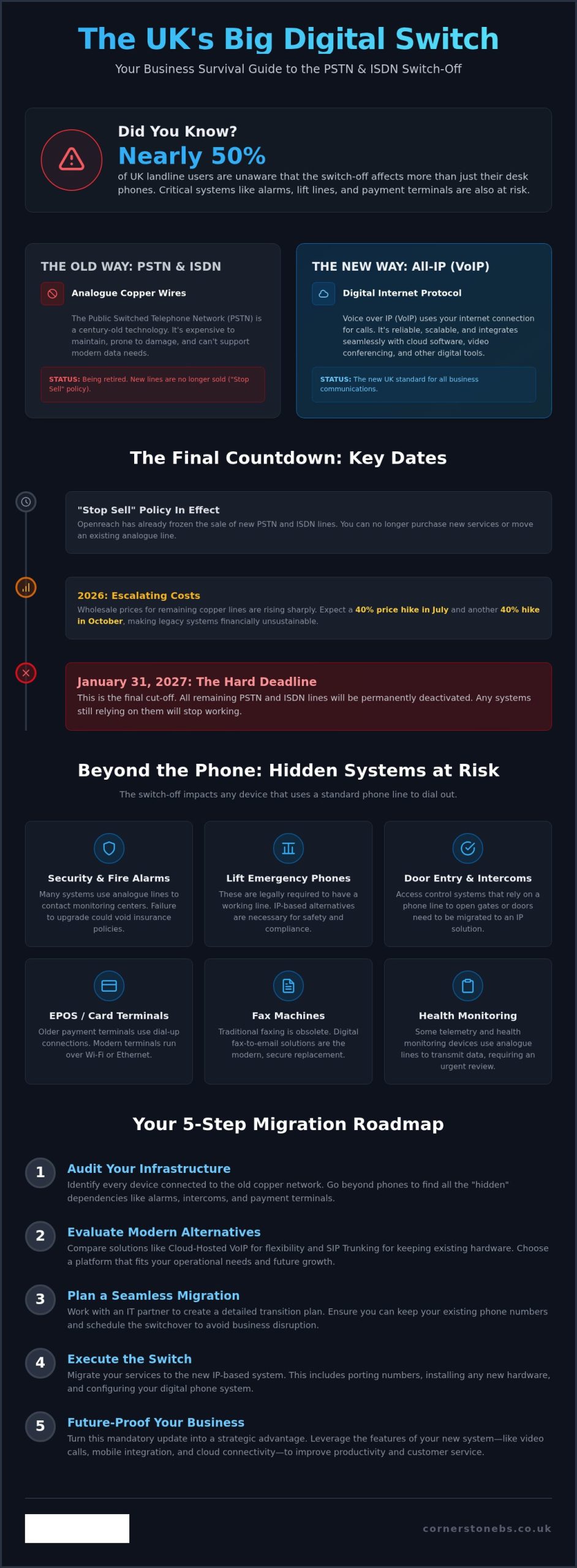
Nearly half of UK landline users still don’t realize that the PSTN switch-off affects much more than just their desk phones, making upgrading to voip from pstn a critical priority for 2026. With the final January 31, 2027 deadline looming, the pressure is on to secure your business communications before the old copper network is retired for good.
It’s natural to feel concerned about the complexity of this transition. You might worry about losing service for critical systems like lift phones and alarms, or feel frustrated by the 40% price hikes hitting legacy lines this October. We know that technical jargon like SoGEA and SIP can feel overwhelming when you’re just trying to keep your business running smoothly. As your local technology partner, we’re here to simplify the process and ensure your operations remain uninterrupted.
This guide gives you a clear, jargon-free roadmap for the 2026 landscape. You’ll discover how to migrate legacy hardware without the stress and gain the confidence to choose a scalable platform that fits your needs. We’ll show you how to turn this technical requirement into a strategic advantage that protects your business and prepares it for the future.
Key Takeaways
- Understand why the January 2027 deadline is a hard cutoff and how it impacts your existing infrastructure.
- Identify the hidden risks to your business, including alarms and lift lines, that rely on the aging copper network.
- Learn the practical steps for upgrading to voip from pstn while maintaining your existing phone numbers and hardware.
- Compare modern alternatives like SIP Trunking and cloud-hosted VoIP to find the best fit for your operational needs.
- Discover how a proactive IT partner can manage your migration to ensure total business stability without technical headaches.
Understanding PSTN and the 2026 Reality for UK Businesses
PSTN, or Public Switched Telephone Network, is the traditional copper-wire system that has powered UK communications for decades. It relies on physical lines and analogue signals to connect calls. Today, we are in the final stages of the national Big Switch Off. Openreach is decommissioning this legacy network to make room for a faster, more reliable digital alternative. Every business across the country must move from analogue signals to IP (Internet Protocol) based communication.
PSTN was the 20th-century foundation of UK voice calls that is no longer fit for a digital-first economy.
Why the Analogue Era is Officially Ending
The aging copper infrastructure is becoming a burden. It is increasingly difficult and expensive for Openreach to maintain these physical lines, especially when they are prone to weather damage and wear. Modern businesses don’t just need voice; they need data-heavy applications that analogue lines simply cannot handle. High-definition video calls, cloud software, and instant file sharing require the bandwidth of a digital network. By moving to an all-IP system, the UK aligns with global standards already adopted by other developed nations. This transition is a foundational step for businesses looking to implement modern it company solutions that drive growth and security.
The 2026 Timeline: Where Does Your Business Stand?
We have reached the final call for legacy lines. While the ultimate deadline is January 31, 2027, 2026 is the year businesses must act to avoid escalating costs and service risks. Wholesale prices for copper lines rose by 40% in July 2026, with another 40% hike expected in October. You might have already encountered the “Stop Sell” policy. This means you can no longer buy new traditional PSTN services or move an existing line. Openreach has frozen these services to ensure everyone prioritises the digital transition.
It is important to understand that both PSTN and ISDN (Integrated Services Digital Network) are being retired simultaneously. While ISDN was once the “high-speed” choice for business, it still relies on the same underlying copper infrastructure. For many, upgrading to voip from pstn is the only logical path forward. The UK PSTN switch-off isn’t just a technical update; it’s a complete change in how your business connects to the world. If you are still on copper, your connectivity is on borrowed time. Making the move now ensures you aren’t caught in the final rush as the 2027 cutoff approaches.
Beyond Voice Calls: The Strategic Impact of the Analogue Retirement
Many business owners assume the PSTN retirement only impacts their desk phones. This is a dangerous misconception. The switch-off is a complete shift in how your building functions. Any device that plugs into a standard wall socket and dials out is at risk. Failing to act creates a significant operational gap. If your business hasn’t planned for this, critical systems could simply stop working without warning once your local exchange is deactivated. Official guidance on analogue to digital landlines makes it clear that the responsibility for this transition lies with the business owner.
Viewing this as a technical chore misses the bigger picture. This transition acts as a strategic gateway. It allows for tighter integration with your managed IT support, creating a unified environment where voice and data work together seamlessly. It is also a necessary prerequisite for adopting high-performance cloud solutions that help your business scale securely. By modernising now, you turn a forced change into a competitive advantage.
Legacy Systems at Risk: The Hidden PSTN Dependencies
Connectivity as the New Business Backbone
Transitioning these complex systems requires a proactive approach to prevent downtime. If you are unsure which devices in your office still rely on copper, our team can help you audit your setup to ensure a smooth path when upgrading to voip from pstn. We focus on building a resilient network that supports your long-term growth.
Evaluating Your Options: Business VoIP, SIP Trunking, and Mobile Integration
Deciding how to move forward when upgrading to voip from pstn requires understanding the two main paths available to UK businesses. While the UK Parliament briefing on the digital switchover highlights the necessity of the change, it doesn’t dictate the specific technology you must use. Most organisations find that Hosted VoIP offers the cleanest break from the past, while others prefer the phased approach of SIP Trunking. The best choice depends on your current hardware investment and future growth plans.
Hosted VoIP: The Modern Standard
Hosted VoIP is now the modern standard for business communication. Because the system lives in the cloud, you don’t need to maintain a physical phone system in your office. This significantly reduces overheads and makes scaling your team as simple as adding a new user in a digital dashboard. You get access to advanced features like auto-attendants and call recording without the need for complex hardware. For many, this transition is a natural part of a wider Microsoft 365 migration for business UK. It allows your phone system to integrate directly with Microsoft Teams, creating a single hub for all your internal and external conversations.
SIP Trunking: For the Legacy-Invested Business
SIP Trunking is the ideal solution if you have recently invested in an expensive on-site PBX system. Instead of replacing your entire hardware setup, SIP allows you to keep your physical handsets and server while ditching the copper PSTN lines. You gain the cost savings and reliability of a digital connection without a massive upfront capital expenditure. Migrating to SIP requires expert oversight to ensure your existing hardware is compatible and secure. It acts as a bridge, allowing you to move to a digital backbone while sweating your current assets for a few more years.
Modern digital systems also solve the problem of the “tethered” worker. With Business Mobile integration, your office number follows you everywhere. By using smartphone apps, your team can make and receive calls on their business line from any location. This ensures a professional image and better work-life balance, as staff don’t have to give out personal mobile numbers. When upgrading to voip from pstn, this mobility becomes a standard feature rather than a paid extra. It turns your communication system into a flexible tool that supports your business wherever it operates.
A 5-Step Roadmap for Upgrading to VoIP from PSTN
- Audit: Identify every device in your building that uses a copper line.
- Connectivity Check: Verify your internet bandwidth can handle high-quality voice traffic alongside daily data.
- Provider Selection: Partner with a firm that understands both IT and Telecoms to avoid compatibility issues.
- Hardware Migration: Replace old handsets or use ATA adapters for legacy analogue devices.
- Staff Training: Ensure your team is comfortable with new digital features and collaboration tools.
Conducting a Full Infrastructure Audit
Success starts with a thorough audit. Many businesses have “invisible” lines they’ve forgotten about. Franking machines, panic buttons, and building monitoring sensors often rely on the same copper network as your phones. If these aren’t identified now, they will stop working the moment the PSTN is switched off. This is also the perfect time to review your existing contracts. You might find you’re still paying for lines and services that are no longer in use. Consulting with an expert IT partner allows you to map these dependencies accurately before the deadline hits.
Testing and Quality of Service (QoS)
Once you’ve identified your hardware, you must look at your network’s performance. Voice traffic is sensitive to delays. To avoid jitter or dropped calls, your network must prioritise voice data over standard web browsing. This is known as Quality of Service (QoS). You’ll need routers and switches that support modern IP telephony standards to manage this traffic effectively. Reliability is the foundation of business stability. We always recommend planning for redundancy by implementing 4G or 5G failover. This ensures that if your primary fibre line goes down, your communication stays up.
Our proactive approach prevents switch-off downtime by handling the technical heavy lifting for you. If you want to ensure your business is fully prepared, speak to our local team of experts about managing your migration today.
Future-Proofing Business Communications with Cornerstone
Choosing the right partner for your digital transition is as important as the technology itself. At Cornerstone Business Solutions, we provide a unified approach to IT and Comms. This eliminates the common frustration of finger-pointing between different service providers. When you are upgrading to voip from pstn, you need a team that understands how your phone system interacts with your wider network infrastructure. Our multi-award-winning team ensures your transition is proactive. We identify potential hurdles and solve them before they cause downtime for your business.
Security is a primary concern when moving voice calls to the internet. We integrate our bespoke cyber security services directly into your communication platform. This protects your IP-based voice traffic from modern threats and ensures your data remains private. We don’t believe in one-size-fits-all packages. Instead, we build technology solutions tailored to the specific operational requirements of your UK business.
The Benefit of Unified IT and Telecoms
Working with us gives you a single point of contact for all your business technology. Whether you have a query about your helpdesk or your phone line, you call one number. We specialise in Microsoft 365 migrations and cloud-hosted voice, creating a streamlined digital office where everything works together. Our proactive monitoring catches connectivity issues before they affect your business continuity. This level of oversight provides the emotional security of knowing your systems are in expert hands.
Beyond the Switch-Off: What is Next?
The 2027 deadline is just the beginning of your digital journey. Once your communication is digital, you can leverage AI and data analytics to gain better customer insights. You’ll see patterns in call volumes and customer interactions that were invisible on analogue lines. To see how these innovations are being put into practice, check out NeverMissACall.ie and their AI virtual receptionist solution. Scalability becomes your new reality. You can add new users or locations in minutes. You no longer have to wait weeks for physical line installations from Openreach.
As you navigate upgrading to voip from pstn, Cornerstone Business Solutions acts as your long-term technology partner. We focus on sustainable growth and ensuring your business remains at the forefront of modern communication. Our team stays connected to our geographical roots while delivering world-class technology. This blend of local trust and technical expertise makes us the ideal choice for UK businesses ready to embrace the digital future. We invite you to start a conversation with our experts to secure your communications today.
Securing Your Business Connectivity for the Digital Decade
The transition from copper to cloud is no longer a distant prospect. It’s a fundamental shift that protects your critical systems, from emergency lift phones to modern payment terminals. By acting now, you avoid the rush of the January 2027 deadline and the sharply rising costs of legacy lines. upgrading to voip from pstn isn’t just about avoiding a service cutoff; it’s about building a scalable foundation for future growth.
As a multi-award-winning UK IT provider with over 15 years of business technology excellence, we understand the nuances of this migration. Our status as Cisco and Microsoft Gold Partners ensures your transition is handled with the highest level of technical expertise and care. We’re ready to help you navigate this change with confidence. Book a free Comms Audit with our national experts today to ensure your business stays connected. The digital future is bright, and with the right partner, your move to modern communications will be seamless and rewarding.
Frequently Asked Questions
Is the PSTN switch-off definitely happening in 2026?
Yes, the retirement of the copper network is in its final stages with a hard deadline of January 31, 2027. While 2026 is the final full year for transition, Openreach has already implemented stop-sell orders across the country. Businesses remaining on legacy lines will face significant wholesale price increases in October 2026. We recommend completing your migration as soon as possible to avoid potential service loss and engineer shortages.
Will my existing business phone numbers change when I move to VoIP?
You can keep your existing business phone numbers when upgrading to voip from pstn through a process called number porting. It is vital that you don’t cancel your old analogue contracts until the porting process is complete, or you risk losing your number forever. Our team manages this transition for you, ensuring your customers can still reach you on the familiar digits they’ve used for years without any interruption.
What happens to my business alarm system after the PSTN switch-off?
Traditional alarm systems that use analogue diallers or red-care signalling will stop working once the copper network is deactivated. These systems rely on the specific voltage of an analogue line to send alerts to monitoring centres. To stay compliant with your insurance policy, you’ll need to upgrade to an IP-based signalling unit. We can help you identify these hidden dependencies during a full audit to keep your premises secure.
Do I need to buy all new handsets for a digital phone system?
Not necessarily, though modern IP handsets offer the best features and audio quality. If you want to keep your existing analogue phones, you can use Analog Telephone Adapters (ATAs) to connect them to your new digital network. However, many of our clients find that switching to softphones on laptops or mobile apps is a more flexible solution. We’ll help you decide if new IT hardware is a better long-term investment for your business.
Can I still use my traditional fax machine on a digital line?
You can use an ATA adapter to connect a physical fax machine, but results can be inconsistent due to how digital lines compress data. We usually recommend moving to a cloud-based e-fax service instead. This integrates perfectly with your Microsoft 365 environment and allows you to send or receive faxes via email. It’s a more reliable, secure, and cost-effective way to handle documents without needing paper, toner, or a dedicated line.
What is the difference between PSTN, ISDN, and VoIP?
PSTN is the old analogue network using copper wires for basic voice calls. ISDN was a digital upgrade that still used those same copper lines to carry more data. VoIP, or Voice over IP, bypasses the copper network entirely by sending your voice as data over your broadband. Since PSTN and ISDN are being retired due to their age, VoIP is the only future-proof choice that offers the scalability your business needs to grow.
How much bandwidth does a standard VoIP call actually use?
A standard high-quality VoIP call uses roughly 100kbps of bandwidth, which is a very small fraction of a modern fibre connection. The key isn’t just the amount of data, but how your network handles it. You need routers that support Quality of Service (QoS) to ensure voice traffic is prioritised over standard web browsing. We audit your network infrastructure to guarantee that your calls remain crystal clear, even during your busiest office hours.
What should I do if my business is still on analogue lines in 2026?
You should start the process of upgrading to voip from pstn immediately to avoid the risk of losing service. Begin by auditing every device in your building that plugs into a phone socket, including lift phones and credit card terminals. With the 2027 deadline approaching, hardware and engineer availability will become limited. Contacting a proactive managed IT partner now will help you secure your communications before the final October price hikes take effect.
With over 2.4 million lines still to be migrated as of May 2026, the countdown to the UK’s digital transformation is no longer a distant concern; it’s a pressing operational reality. We know that technical jargon like PSTN, ISDN, and VoIP can feel like a maze, especially when you’re worried about the potential for pstn switch off business disruption or hidden costs for replacing legacy hardware. It’s natural to feel a bit of pressure as Openreach increases wholesale prices throughout 2026 to encourage the move away from our ageing copper network.
This guide cuts through the noise to help you understand why the Public Switched Telephone Network is retiring and how you can safeguard your company. As a dedicated local partner, we’ll provide a clear roadmap for migrating to modern digital solutions like VoIP, positioning this change as a tool for growth rather than just a technical chore. You’ll gain the peace of mind that comes from knowing your essential systems, including alarms and payment terminals, are ready for the January 31, 2027 deadline. Let’s look at how we can turn this transition into a foundational win for your business stability.
Key Takeaways
- Understand why the UK is retiring the traditional copper-wire network and how the January 2027 deadline affects your current setup.
- Identify the “hidden” systems like alarms and lift phones that could fail during the pstn switch off business transition if you don’t audit them properly.
- Explore how digital alternatives like Business VoIP do more than just replace old lines; they provide a foundation for better productivity and scalability.
- Follow our 5-step migration roadmap to secure your infrastructure and avoid the rising costs of legacy lines throughout 2026.
What is the Public Switched Telephone Network (PSTN)?
The Public Switched Telephone Network (PSTN) is the traditional analog telephone system that has powered the UK for over a century. It’s the familiar network of copper wires, telegraph poles, and local exchanges that most of us grew up with. Originally built to carry nothing but voice, it eventually became the unexpected backbone for early internet dial-up and basic data services. Today, the PSTN is the analog legacy network being replaced by digital IP technology. Understanding this transition is essential for any pstn switch off business strategy, as the infrastructure we’ve relied on for decades reaches its final chapter.
How the PSTN Works
When you make a call on a traditional line, your voice travels as an analog signal through copper wires to a local exchange. This system uses circuit switching. This means the network creates a dedicated physical path between you and the person you’re calling for the entire duration of the conversation. While this was revolutionary in the early 20th century, it’s incredibly inefficient by modern standards because it ties up resources regardless of how much data is being sent. You might also have heard of ISDN (Integrated Services Digital Network). While ISDN was a digital upgrade that allowed for faster data and clearer voice, it still relies on the same aging copper lines. This means it’s also part of the retirement plan.
Why PSTN is Reaching End-of-Life
The primary reason for the switch-off is simple: the copper infrastructure is wearing out. Openreach finds it increasingly difficult and expensive to maintain a network that was never meant to last this long. Modern businesses demand high-speed data and seamless connectivity that analog lines physically cannot handle. The physical limits of copper simply cannot keep pace with the needs of a modern office.
Reliability is also a major factor. According to Ofcom’s Connected Nations 2023 report, PSTN incidents increased by 20% in a single year, while the hours lost to outages jumped by 60%. As spare parts for these legacy systems become obsolete, the risk to your business continuity grows. Moving to a digital setup isn’t just a requirement; it’s a proactive step to ensure your communications remain stable and secure. We see this change as an opportunity to build a more resilient foundation for your pstn switch off business planning, moving away from fragile wires toward robust, cloud-based stability.
The UK PSTN Switch-Off: What Happens in 2027?
Openreach has set the final date. January 31, 2027, marks the end of the line for the UK’s legacy copper network. This isn’t just a suggestion; it’s a mandatory shift for every business and household in the country. To successfully navigate the pstn switch off business leaders must realise that every traditional phone line must transition to a digital IP network. This is a massive national infrastructure project, comparable to the digital TV switch-over, and it requires proactive planning to avoid disruption.
Since September 2023, “stop-sell” orders have been active across many exchanges. You can no longer order new analog lines or ISDN services. This measure ensures that the number of legacy lines doesn’t grow while engineers work to migrate existing users. If your business is currently using an older system, you’re effectively on borrowed time. The network is being dismantled piece by piece, and the hardware that supports it is becoming increasingly difficult to repair.
The Timeline for UK Businesses
The process involves two clear phases. The Stop-Sell phase prevents new analog connections, while the migration phase moves existing users to digital. The 2027 deadline is the hard stop for total network withdrawal. The official government advice on Moving landlines to digital technologies highlights that this is an industry-led change aimed at creating a more reliable, modern network. It’s a collective effort to replace 19th-century technology with 21st-century capability.
Why You Should Not Wait Until the Deadline
Don’t leave it to the last minute. As we get closer to 2027, engineer availability will become scarce. Hardware lead times for routers and handsets will likely increase as demand spikes across the UK. Moving early allows for a calm, controlled transition. You’ll avoid the stress of emergency downtime and the risk of lost client calls during the busiest periods. Planning ahead is the best way to handle the pstn switch off business owners are facing, ensuring every piece of hardware is compatible and ready.
A smooth migration requires a bird’s-eye view of your entire network. This is why many local firms rely on our managed IT support to provide expert oversight. We handle the technical heavy lifting, from auditing your current lines to setting up your new digital environment. It’s about more than just phones; it’s about securing your long-term stability and ensuring your team stays connected. If you’re ready to start the conversation, our team of local experts is here to help you transition to a modern Business VoIP solution with confidence.
The Hidden PSTN Dependencies: It is Not Just About Phones
One of the biggest misconceptions we encounter is the belief that the 2027 deadline only affects the handsets sitting on your desks. In reality, the PSTN retirement is a whole-office infrastructure audit requirement that reaches far beyond simple voice calls. Many business-critical systems rely on the Public Switched Telephone Network without owners even realising it, often hidden away in plant rooms or tucked under retail counters. If these dependencies aren’t identified early, the pstn switch off business owners face could lead to unexpected security breaches or significant safety risks.
The Ofcom guide to the digital landline switch makes it clear that any device using an analog signal to dial out will be impacted. Without a physical copper path, these devices simply won’t be able to communicate with their monitoring centres or servers. It’s not just a matter of poor call quality; it’s a total loss of functionality for hardware that might be vital to your daily operations.
Common Systems Affected by the Switch-Off
Your security and safety protocols are likely at the top of the list. Intruder alarms and fire monitoring systems, particularly those using older Redcare services, are often hardwired into analog lines. When the network goes dark, these systems lose their ability to alert the authorities in an emergency. This can have serious implications for your insurance coverage and general peace of mind.
Similarly, emergency “yellow” phones in lifts and entry intercoms for buildings are frequently overlooked. These are vital for health and safety compliance, yet they often run on the same aging copper wires as your old desk phones. We also see many legacy EPOS systems and older credit card terminals that still require a dial-up connection to process transactions. A failure to update these could literally stop your ability to trade or take payments overnight.
Industrial and Remote Monitoring
Beyond the front office, the impact stretches into industrial and specialized settings. Telemetry units used in manufacturing and utilities for remote reporting often rely on PSTN to send data back to a central hub. Even fax machines, which remain a staple for secure document transfer in the legal and medical sectors, will need a digital alternative to function in a post-2027 world.
Don’t forget the smaller pieces of office hardware either. Franking machines and remote diagnostic equipment for photocopiers often use hidden phone lines for updates and billing. Because these devices dial out infrequently, it’s easy to forget they exist until they stop working. We recommend a thorough walk-through of your premises to identify every jack point and cable. Spotting these hidden links now ensures that the pstn switch off business transition remains a smooth, proactive upgrade rather than a reactive crisis.
Modern Alternatives: Transitioning to VoIP and Cloud Voice
While the retirement of the copper network might seem like a hurdle, it’s actually an invitation to upgrade your productivity. Voice over Internet Protocol (VoIP) is the primary successor to the PSTN. Instead of relying on physical wires, VoIP converts your voice into data packets and sends them over your internet connection. This shift to digital means you can finally ditch the bulky, expensive on-premise hardware that often clutters back offices. Modern cloud-hosted systems are streamlined, efficient, and built for the way we work today. Navigating the pstn switch off business requirements is simpler when you view it as a strategic tech upgrade rather than a forced change.
These digital platforms offer much more than just a dial tone. You can integrate your phone system directly with Microsoft 365 and Microsoft Teams, creating a unified workspace. Features like mobile twinning allow your office number to ring on your mobile device simultaneously. This ensures you never miss a client call, whether you’re at your desk or out on a site visit. It’s about turning the pstn switch off business challenge into a competitive advantage for your team and ensuring your communication remains a foundational element of stability.
The Benefits of Switching to Business VoIP
The transition brings immediate financial and operational rewards. You’ll see significant cost savings by eliminating traditional line rentals and reducing international call charges. Flexibility is another major win. Your team can work from home, a local coffee shop, or a client’s site while keeping their professional office number. Scalability is just as simple. You can add or remove users instantly through a web portal, avoiding the need for engineer visits or new physical line installations. This agility is vital for any growing UK enterprise.
Preparing Your Network for Digital Voice
Success in a digital-first environment depends on the strength of your foundation. A robust network infrastructure is essential for maintaining crystal-clear call quality. Without proper setup, your voice traffic might compete with large file downloads, leading to jitter or dropped calls. We often recommend SIP trunking for businesses that want to keep their existing PBX systems while still connecting to the digital world. This acts as a bridge, allowing your legacy hardware to communicate via the internet.
Ensuring your internet bandwidth can handle concurrent voice and data traffic is a vital first step. We help local businesses audit their current speeds to ensure they’re ready for the increase in digital demand. If you want to ensure your migration is handled by award-winning local experts, explore our Business VoIP solutions today to secure your company’s future and keep your operations running smoothly.
Your 5-Step PSTN Migration Strategy
Success in the digital era requires more than just swapping a handset; it’s about a total rethink of your connectivity. We’ve developed a tactical checklist to help you navigate the pstn switch off business owners are currently facing. This ensures your transition is efficient, secure, and completed well before the 2027 deadline. Each step is designed to protect your continuity and set a foundation for future growth.
- Step 1: Audit every device. Walk through your premises and identify every single item connected to a phone line. This includes the obvious desk phones, but also the “hidden” systems like intruder alarms, fire panels, and entry intercoms discussed earlier.
- Step 2: Evaluate your connectivity. Digital voice relies entirely on your internet connection. We’ll help you check your current bandwidth to ensure it can handle concurrent calls alongside your daily data needs without any loss in quality.
- Step 3: Consult the experts. Don’t try to guess your way through technical specifications. Speak with a managed provider to choose a VoIP or Cloud solution that fits your specific workflow and budget.
- Step 4: Test non-voice systems. Your lifts and alarms might need digital-compatible converters to work on the new network. Testing these early prevents safety risks and insurance headaches later.
- Step 5: Maximise your ROI through training. Once the hardware is in place, show your team how to use the new features. From mobile twinning to CRM integration, the real value lies in using the technology to its full potential.
Choosing the Right Partner
Your choice of partner is just as important as the technology itself. You need a provider that understands the intersection of telecoms and cyber security to protect your new digital lines from modern threats. Digital voice is a data service, which means it must be secured just like your email or servers to prevent unauthorised access.
Prioritise local experts who offer proactive monitoring. This ensures that any potential issues are spotted and resolved before they impact your operations. Finally, make sure your new system integrates seamlessly with your existing Microsoft 365 environment. This level of cohesion turns your phone system into a powerful productivity tool rather than a standalone silo.
How Cornerstone Simplifies the Switch
We pride ourselves on being more than just a service provider; we’re your dedicated long-term partner. Our team provides a seamless transition from legacy PSTN to robust Business VoIP, handling the technical heavy lifting so you can stay focused on running your company. We take charge of the full infrastructure audit, ensuring that no critical device is left behind in the move to digital. As an award-winning UK provider, we bring the clarity and reliability you need to move forward with confidence. Speak to our experts today for a PSTN readiness audit and let’s get your pstn switch off business strategy on the right track.
Secure Your Business Future Before the 2027 Deadline
The January 2027 deadline is approaching fast, but it doesn’t have to be a source of stress for your team. By auditing your current setup and identifying those hidden analog dependencies like lift phones and alarms, you’ve already taken the most important first step toward digital resilience. Transitioning to modern alternatives like Business VoIP isn’t just about avoiding the pstn switch off business disruption; it’s about giving your company the tools to thrive in a more flexible, connected world.
As an award-winning UK provider and certified partner with Microsoft, IBM, and Cisco, we’re here to ensure your migration is handled with expert precision. We provide proactive 24/7 system monitoring to keep your operations stable and secure during every phase of the switch. Don’t wait for the rush in 2026 to start your journey. We’d love to help you build a communication foundation that lasts for decades. Book a PSTN Readiness Audit with Cornerstone to get started today. We’re ready to help you turn this technical necessity into a lasting business win.
Frequently Asked Questions
Will my current phone hardware work after the PSTN switch-off?
Most traditional analog handsets won’t work directly with a digital line once the transition happens. While it’s sometimes possible to use an Analog Telephone Adapter (ATA) to bridge the gap, we usually recommend upgrading to modern IP handsets. These devices are designed specifically for digital voice, providing much better sound quality and access to advanced features that old hardware simply cannot support.
Do I need to change my business phone number when I switch to VoIP?
You don’t need to change your number; you can port your existing business digits over to your new digital service. This process is standard practice and ensures your customers can still reach you without any confusion or need for new marketing materials. Keeping your established number is a vital part of maintaining continuity during the pstn switch off business transition, so we handle the porting for you to keep things simple.
What happens to my internet connection if it currently runs over a PSTN line?
Your current broadband will stop working if it relies on a traditional copper phone line, such as ADSL or standard FTTC. You’ll need to migrate to a data-only connection like SOGEA or Full Fibre (FTTP). These modern connections are faster and more reliable, providing the stable foundation needed for your cloud services and digital voice calls to function without interruption or lag.
Is VoIP as reliable as the old PSTN system for business use?
VoIP is incredibly reliable for professional use, often exceeding the stability of aging copper networks when backed by a high-quality internet connection. Because digital systems aren’t vulnerable to the physical decay and weather-related issues of underground copper wires, you’ll experience fewer crackly lines. We provide proactive monitoring to ensure your network stays healthy and your communications remain a rock-solid part of your daily operations.
Can I still use my fax machine after the 2027 deadline?
You won’t be able to use a traditional fax machine directly over a digital line because analog signals don’t translate well into digital data packets. Most businesses now move to Fax-to-Email services, which are more secure and far more efficient. If your sector still requires physical faxing, you’ll need a specialized adapter, though we suggest digital alternatives to ensure your documents are transmitted reliably every time.
What is the difference between PSTN and ISDN?
PSTN is the basic analog network used for standard landlines, while ISDN was a digital upgrade that allowed for multiple channels over the same copper wires. While ISDN offered better quality and features like Direct Dialling In (DDI), it still relies on the same physical infrastructure as the PSTN. Both systems are being retired simultaneously by January 2027 to make way for a fully IP-based national network.
How much does it cost to switch from PSTN to a digital system?
The cost of switching depends on your current infrastructure and how many users you need to migrate. While there might be an initial investment in new IP handsets or network upgrades, most businesses find that monthly operational costs actually decrease. You’ll save by removing expensive line rentals and benefiting from lower call rates. We’ll provide a clear, benefit-driven breakdown of the long-term savings during our initial readiness audit.
What should I do if my lift or alarm system uses a phone line?
Contact your equipment provider immediately to check if your hardware is digital-ready. Many older lift phones and intruder alarms rely on the constant voltage of an analog line to function. You might need to install a GSM unit or a digital-compatible interface to maintain safety standards. Addressing this now is essential for your safety compliance and ensures your pstn switch off business planning covers every critical system on your premises.