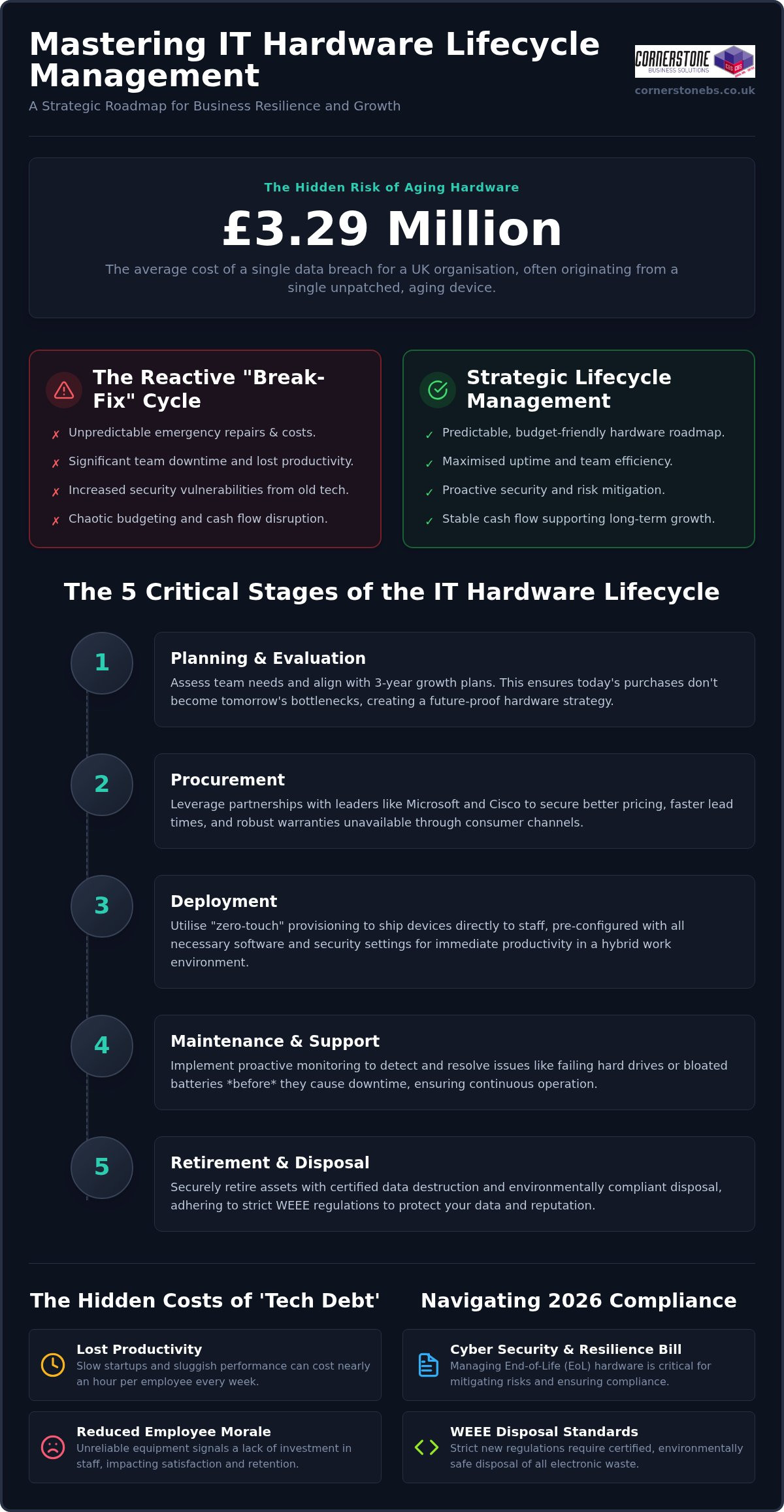
Did you know the average cost of a data breach for UK organisations has reached £3.29 million? This staggering figure often begins with something as simple as an unpatched, aging laptop left on a desk for one season too many. We know how frustrating it is when your team’s productivity stalls due to sluggish devices, or when an unexpected invoice for emergency repairs disrupts your monthly cash flow. It often feels like you’re playing a constant game of catch-up with your own technology. By mastering it hardware lifecycle management, you can stop reacting to these IT headaches and start building a resilient, secure foundation for your business.
Building on our recognition as a multi-award-winning service provider, we’ve helped local firms move from chaotic tech debt to streamlined efficiency. This 2026 guide reveals how to align your hardware roadmap with business growth while navigating strict new WEEE disposal standards and the latest requirements of the UK’s Cyber Security and Resilience Bill. You’ll learn how to create a predictable budget that eliminates downtime and protects your professional reputation. We’ll walk you through everything from procurement to certified data destruction, simplifying the technical details so you can lead your team with total confidence.
Key Takeaways
Master the five critical stages of it hardware lifecycle management to turn unpredictable tech expenses into a strategic, budget-friendly roadmap.
Identify the hidden triggers of ‘tech debt’ that lead to increased helpdesk calls and lost productivity for your team.
Navigate the complexities of the 2026 WEEE regulations and the Cyber Security and Resilience Bill to keep your business compliant and secure.
Learn how to transition from reactive ‘break-fix’ repairs to a predictable financial model that supports long-term business growth.
Discover the security benefits of professional data destruction and why manufacturer ‘End-of-Life’ dates are a critical milestone for your risk management.
Why IT Hardware Lifecycle Management is the Backbone of Business Continuity
Many business owners view their servers and laptops as simple tools, much like office furniture. In reality, your hardware is the engine room of your entire operation. it hardware lifecycle management is the strategic process of overseeing an IT asset from the moment a need is identified until its final, secure disposal. It’s about moving away from a chaotic “break-fix” approach that leaves your team stranded when a critical device fails. Reactive models are silent budget killers; they force you to pay for emergency shipping and premium repair rates while your billable hours vanish. By the time you’ve identified a failure, the damage to your productivity is already done.
Effective IT asset management ensures that every piece of kit is accounted for, maintained, and replaced before it becomes a liability. We define hardware “Tech Debt” as the accumulated financial and operational cost of maintaining obsolete equipment that prevents your business from adopting more efficient, modern workflows. In the 2026 hybrid work era, the link between your hardware and your business resilience is unbreakable. If your infrastructure isn’t reliable, your business continuity plan is little more than a wish list.
Moving from Transactional Buying to Strategic Assets
Shifting from an “expense” mindset to an “investment” mindset changes how you grow. Instead of seeing a laptop as a one-off cost, we view it as a four-year productivity tool. A structured lifecycle prevents the “replacement shock” that happens when fifty laptops, all purchased during a previous expansion, fail within the same month. The right it company solutions provide a clear roadmap, ensuring your upgrades are staggered and your cash flow remains predictable. This proactive stance turns your IT from a source of stress into a foundation for stability.
The 2026 Productivity Gap: Why Old Tech Costs You Talent
The 5 Critical Stages of the IT Hardware Lifecycle
Managing your technology shouldn’t feel like a series of emergencies. When you implement a formal it hardware lifecycle management strategy, you’re essentially creating a predictable rhythm for your business. This process isn’t just about buying and binning kit; it’s a circular journey that ensures every device in your office is performing at its peak. By breaking this down into five distinct stages, we can help you move away from guesswork and toward a stable, high-performing environment.
Stage 1: Planning & Evaluation. We start by assessing what your team actually needs. A graphic designer requires a different set of specifications than a remote sales agent. We look at your growth plans for the next three years to ensure today’s purchase doesn’t become tomorrow’s bottleneck.
Stage 2: Procurement. This is where we leverage our deep partnerships with global leaders like Microsoft, IBM, and Cisco. We don’t just find the best price; we secure better lead times and robust warranties that consumer-grade shops simply can’t offer.
Stage 3: Deployment. Gone are the days of manually setting up every laptop. We use “zero-touch” provisioning to ship devices directly to your staff, pre-configured with your security tags and software. It’s efficient, professional, and perfect for the hybrid era.
Stage 4: Maintenance & Support. We don’t wait for things to break. Our proactive monitoring catches a failing hard drive or a bloated battery before it causes a single minute of downtime for your staff.
Stage 5: Retirement & Disposal. When a device reaches the end of its life, we handle the secure data wiping and WEEE-compliant recycling. This ensures your company data stays private and your environmental obligations are met.
Procurement: Why Your Choice of Vendor Matters
It’s tempting to grab a laptop from a high-street retailer when you’re in a rush. However, consumer-grade hardware isn’t built for the 40-plus hours of weekly use a professional environment demands. By standardising your fleet through a trusted partner, you simplify everything from spare parts management to software updates. If you’re looking to refresh your office kit, our team can help you select high-performance IT Hardware that’s built to last.
Proactive Maintenance: The Secret to Extending Asset Life
Stability is born from attention to detail. We use remote monitoring tools to track the health of your assets in real-time, looking at everything from storage capacity to firmware versions. Regular updates are non-negotiable; they keep your hardware stable and ensure your devices are compatible with our latest cyber security services. Catching a minor driver issue today prevents a total system crash next month, keeping your team focused on their work rather than their workstations.
Identifying the Hidden Costs of Tech Debt and Aging Assets
The true cost of an aging laptop isn’t just the price of a replacement. It’s the “iceberg” of hidden expenses lurking beneath the surface. We see it across the region every day: a business tries to save money by stretching a three-year-old fleet into its fifth year, only to find their support costs skyrocketing. Industry data indicates that devices older than three years generate three times as many helpdesk calls as newer models. These aren’t just quick fixes; they are often complex hardware failures or driver conflicts that pull your IT team away from high-value projects. This is where it hardware lifecycle management proves its worth by identifying these drains before they impact your bottom line.
Modern processors from Intel and AMD in 2026 are significantly more power-efficient than those from just a few years ago. For a company running dozens or hundreds of workstations, the extra electricity required to power “legacy” kit adds up. This isn’t just a financial issue; it directly affects your ESG (Environmental, Social, and Governance) goals. Furthermore, the risk of a cyber breach is higher than ever. With 43% of UK businesses identifying a breach in the last twelve months, cyber insurers have become incredibly strict. Many providers now refuse to renew coverage if you’re running “End-of-Life” hardware that no longer receives security patches at the BIOS or CPU level.
Calculating the Total Cost of Ownership (TCO)
Looking only at the sticker price of a new PC is a mistake. To understand the real impact on your budget, you must look at the Total Cost of Ownership. This includes the time spent on initial setup, ongoing support, software licensing, and even the cost of electricity. Year four is typically the “sweet spot” where the cost of maintaining a device exceeds the cost of replacing it. The Total Cost of Ownership for a standard business laptop is the sum of its initial procurement price plus the cumulative expenses of deployment, technical support, energy consumption, and secure disposal over its useful life.
The Environmental Cost: Green IT and WEEE Compliance
The UK generates 24.5 kg of e-waste per person, one of the highest rates globally. Because of this, the government has introduced stricter WEEE (Waste Electrical and Electronic Equipment) regulations for 2026. From October 2026, digital waste tracking becomes mandatory for all business hardware movements. Failing to comply can result in fines of up to £5,000 per offence. A professional approach to it hardware lifecycle management ensures you remain compliant while potentially recovering value. We often help clients gain credit for their old, functional hardware, which can then be put toward the purchase of new, energy-efficient equipment.
Security and Compliance: Managing the Risks of End-of-Life Hardware
The “End-of-Life” (EOL) trap is a silent threat to UK businesses in 2026. When a manufacturer stops providing security patches for a specific model, that device becomes a permanent open door for attackers. It’s not just about software anymore. Modern threats often target the BIOS and the Trusted Platform Module (TPM) at the hardware level. If your equipment is too old to receive these critical firmware updates, no amount of antivirus software can fully protect you. A proactive it hardware lifecycle management policy ensures that no device stays on your network past its safety expiration date.
Physical security is the other half of the battle. In a world of hybrid work, laptops and mobile devices are constantly moving between homes, offices, and coffee shops. You must be able to track every asset and ensure that company data doesn’t simply walk out the door. If a device is lost or stolen, having modern hardware with built-in encryption and remote-wipe capabilities is your last line of defence. This level of control provides the emotional security of knowing your reputation is protected, even when the worst happens.
Vulnerabilities You Can’t Patch
Older chips are often susceptible to hardware-level exploits that cannot be fixed with a simple download. These legacy systems struggle to run the latest, most secure cloud solutions, which often require modern hardware-based multi-factor authentication (MFA) to function correctly. The UK’s new Cyber Security and Resilience Bill, expected to receive Royal Assent in 2026, introduces a two-tier penalty system for breaches. Running unpatchable hardware is increasingly seen as negligence, potentially exposing your business to fines of up to 4% of global turnover.
Disposal as a Security Strategy
Simply deleting files or formatting a hard drive is not enough to meet the standards of the Data Use and Access Act 2025. To remain compliant with UK GDPR, you need certified data destruction that follows best practices like the NIST SP 800-88 Rev. 2 guidelines. We recommend a strict decommissioning checklist for every retired asset:
Remove the device from all active network inventory and “ghost” accounts.
Perform a NIST-compliant data wipe or physical shredding of the drive.
Obtain a formal certificate of destruction for your compliance audit trail.
Ensure the asset is recycled according to the latest 2026 WEEE standards.
Security is the foundation of business stability. If you’re concerned about the age of your current fleet, we invite you to talk to our local team about a secure hardware refresh.
How a Managed Partner Streamlines Your Hardware Strategy
Managing a fleet of devices is a full-time job that often falls on the shoulders of someone already stretched too thin. By choosing a dedicated partner for your it hardware lifecycle management, you effectively outsource the technical and administrative headaches. We track every warranty, monitor every refresh date, and handle the complex logistics of procurement so you don’t have to. This shift allows your business to move away from unpredictable capital expenditure (CapEx) and toward a stable, predictable operating expense (OpEx) model. You gain the clarity of knowing exactly what your IT spend will be months or even years in advance.
As a multi-award-winning provider, we use our deep-rooted partnerships with global leaders like Cisco, IBM, and Microsoft to give you access to enterprise-grade kit and support. We don’t just sell boxes; we build a bespoke roadmap that aligns your technology with your three-year business plan. This roadmap isn’t just a list of dates. It’s a strategic document that considers your cash flow, your hiring plans, and your specific industry requirements. We help you avoid the tech debt mentioned earlier by ensuring you’re always one step ahead of obsolescence, allowing you to focus on leading your team rather than managing your machines.
Proactive Monitoring vs. Reactive Repair
Our proactive system monitoring is designed to catch hardware failures before your users even notice a glitch. We maintain an automated inventory that tells us exactly what you own, where it is, and how it’s performing in real-time. If a workstation shows signs of a failing component, we can arrange a rapid replacement to keep your downtime to an absolute minimum. It’s about providing the emotional security that comes from knowing your systems are being watched by experts who care about your continuity. This level of oversight ensures that no “ghost” devices linger on your network to create security gaps.
Your Invitation to a Better Hardware Strategy
With the 2026 regulatory changes and the increasing demands of AI-driven tools, there has never been a better time to audit your current fleet for readiness. We are proud of our regional roots and our reputation for simplifying complex tech for our clients. We want to see your business succeed, and that starts with a stable, secure foundation. Let’s have a chat about your hardware lifecycle and how we can build a more resilient future together. Our team is ready to help you turn your IT from a source of stress into a powerful engine for growth.
Take Control of Your Business Resilience Today
Securing your business for the future isn’t just about software; it’s about the physical foundation of your office kit. By adopting a proactive approach to it hardware lifecycle management, you eliminate the surprise costs of failing devices and ensure your team has the power they need to stay productive. You’ll also stay ahead of the curve with 2026 WEEE regulations and the latest cyber security standards, protecting both your data and your professional reputation.
As a multi-award-winning IT service provider, we pride ourselves on being more than just a vendor. We’re a dedicated long-term partner. Our strategic partnerships with global brands like Microsoft, IBM, and Cisco allow us to bring enterprise-level technology to your local business. Combined with our expert proactive monitoring and support, we give you the peace of mind to focus on what you do best. It’s time to move away from reactive repairs and toward a stable, strategic roadmap. Ready to future-proof your business? Let’s talk about your IT strategy today.
Frequently Asked Questions
What is the typical lifespan of business IT hardware in 2026?
In 2026, the typical lifespan for business laptops and workstations is three to four years. For power users who rely on intensive AI-driven tools, a refresh cycle of two to three years is often necessary to maintain peak performance. Servers and networking equipment generally remain viable for five to six years with proper maintenance and proactive monitoring.
Is it cheaper to repair or replace a 4-year-old business laptop?
It’s almost always more cost-effective to replace a four-year-old laptop than to repair it. By the fourth year, the cumulative cost of maintenance, energy inefficiency, and lost productivity typically exceeds the price of a modern replacement. This is the stage where “tech debt” begins to drain your budget and frustrate your employees with sluggish performance.
What are the security risks of using ‘End-of-Life’ hardware?
Using “End-of-Life” hardware exposes your business to vulnerabilities at the BIOS and CPU level that software updates cannot fix. Many modern cyber insurance providers now refuse coverage for organisations running hardware that no longer receives manufacturer security patches. These legacy systems create an unpatchable entry point for attackers, significantly increasing your risk of a data breach.
How does hardware lifecycle management help with GDPR compliance?
Effective it hardware lifecycle management supports GDPR compliance by ensuring every device is tracked and every hard drive is professionally wiped. Under the Data Use and Access Act 2025, you must have a statutory data-protection process in place. This includes obtaining certificates of destruction for all retired assets to prove that personal data is irrecoverable and managed responsibly.
Can I lease IT hardware instead of buying it outright?
Yes, leasing is an excellent way to move your hardware costs from a large capital expenditure (CapEx) to a predictable operating expense (OpEx). This model ensures your team always has access to the latest technology without the “replacement shock” of buying a whole new fleet at once. It also simplifies the disposal process, as the leasing partner typically handles the retirement phase.
What is WEEE compliance and why does my business need it?
WEEE stands for Waste Electrical and Electronic Equipment, and it’s a legal requirement for UK businesses to dispose of tech responsibly. From October 2026, mandatory digital waste tracking comes into force, with fines of up to £5,000 for non-compliance. Following these standards protects the environment, supports your sustainability goals, and shields your business from significant legal and financial liability.
How do I start a hardware audit for my company?
You can start a hardware audit by creating a comprehensive inventory of every device on your network, including its age, specification, and current user. We recommend using remote monitoring tools to gather real-time data on battery health and storage capacity. This baseline allows you to identify which machines are nearing their “End-of-Life” and prioritize your refresh roadmap for the coming year.
What should be included in a hardware retirement policy?
A robust hardware retirement policy should include a strict decommissioning checklist that covers NIST-compliant data wiping and WEEE-certified recycling. It must also detail the removal of the device from your network inventory and all active security accounts. Finally, ensure you receive and file a formal certificate of destruction for every retired drive to maintain a clear audit trail for compliance purposes.
Did you know that by mid-2026, the average UK business is effectively throwing away 29% of its cloud budget on idle resources and inefficient scaling? It is a staggering amount of wasted capital that could be fueling your next big project instead of padding a provider’s bottom line. At Cornerstone Business Solutions, we understand the frustration of watching an unpredictable monthly bill climb while having zero visibility into which departments are driving the spike. You want a high-performing system, but the fear that cutting costs might lead to downtime often keeps you stuck in a cycle of overspending.
We believe your IT infrastructure should be a foundation for stability, not a source of financial stress. This guide explores how professional cloud cost optimisation services can transform your uncontrolled IT spend into strategic growth capital. You will learn how to rightsize your environment and implement proactive monitoring that ensures you only pay for what you actually use. We are going to walk you through the latest FinOps trends and the G-Cloud 15 framework, showing you how to achieve a predictable, manageable budget and clear reporting that justifies every penny to your board.
Key Takeaways
Understand why 2026 is a critical year for IT budgets as AI-driven compute costs and “cloud sprawl” begin to drain corporate resources.
Identify the “silent killers” of your budget, specifically the over-provisioning trap that leads to paying for power you don’t actually use.
Discover how professional cloud cost optimisation services use rightsizing to match your infrastructure perfectly to your actual workload profiles.
Learn to implement a sustainable FinOps framework that brings financial accountability and predictability to your monthly cloud spend.
See how bespoke technology solutions and proactive monitoring can transform wasted IT spend into strategic capital for your business growth.
What are Cloud Cost Optimisation Services and Why are They Vital in 2026?
The Shift from Reactive to Proactive Management
Waiting for your monthly bill to arrive before checking your usage is a recipe for budget failure. By the time you see the total, the money is already gone. Strategic optimisation is different from simple cost-cutting; it’s about making informed choices that protect system performance while trimming fat. We use proactive monitoring to identify “zombie resources”, which are instances that are running but doing no actual work. Our bespoke technology solutions ensure that these idle assets don’t drain your funds. This proactive stance allows you to maintain a lean, efficient environment where every penny spent contributes to a specific business outcome.
The Economic Impact of Cloud Sprawl
Cloud sprawl is the uncontrolled proliferation of cloud instances, services, and storage buckets across an organisation. It usually starts small, with a forgotten test environment or a storage volume left over from a completed project. These hidden costs add up quickly and can easily overwhelm an IT budget. Managing the challenges of cloud computing requires a firm grip on visibility across all departments. Beyond the financial drain, sprawl creates significant security risks by leaving unmonitored entry points into your network. Effective cloud cost optimisation services treat sprawl as both a financial and a security necessity, ensuring every resource is accounted for, necessary, and protected.
At Cornerstone Business Solutions, we’ve seen how easily “cloud sprawl” can quietly erode the profit margins of even the most successful UK businesses. It’s why we focus on bespoke management that looks at your specific goals. We don’t believe in one-size-fits-all automated tools that might cut the wrong resources. Instead, we act as your long-term partner, providing the clarity you need to justify IT spend to your board while keeping your systems running at peak performance.
Identifying the Silent Killers of Your Cloud Budget
Many UK business owners view their monthly cloud bill as a fixed, unavoidable tax on growth. In our experience as a local partner, we’ve found that overspending isn’t usually caused by one massive error. Instead, it’s driven by dozens of “silent killers” that slowly drain your capital. One of the most prevalent is the over-provisioning trap. It’s tempting for developers to select a larger instance than necessary to guarantee performance, but this “just in case” mentality often becomes the default setting. It leads to paying for compute power that sits idle for 90% of the day while your budget disappears.
Professional cloud cost optimisation services look beyond the surface to find these hidden inefficiencies. For instance, data egress management is frequently overlooked by busy teams. While putting data into the cloud is often free, moving it out or between specific regions can trigger unexpected charges on your Azure or AWS bills. To keep your infrastructure truly efficient, your cloud solutions must be tightly integrated with your wider IT strategy. This ensures that data flows are logical and cost-effective rather than accidental. When evaluating your current setup, the UK Government’s Digital Marketplace serves as a helpful reference for the standards and transparency you should expect from a service provider.
Zombie Resources and Orphaned Snapshots
Zombie resources are cloud instances that are still running but no longer performing any useful work. They usually appear when a project ends but the developer forgets to “turn off the lights” on the virtual machines. Similarly, orphaned snapshots are old backups that stay in your storage long after they’ve lost their value for disaster recovery. These individual costs act like a leaky tap, wasting hundreds of pounds every month. We use automated discovery tools to flag these leftovers for immediate deletion. This keeps your storage lean and ensures you’re only paying for data that actually protects your business continuity.
Misaligned Licensing and Subscriptions
Paying for premium features your team never touches is a fast way to bleed capital. We often see businesses paying for top-tier licenses when a mid-range option would serve them perfectly. A regular licensing audit can reveal significant monthly savings without impacting your daily operations. If you’re planning a transition or an upgrade, our Microsoft 365 migration guide offers best practices for choosing the right tier from the start. If you’re unsure where your budget is going, a quick chat about our Managed IT Support might be the first step toward regaining control of your IT spend.
Proven Strategies for Reducing Cloud Spend Without Risk
Once you have identified the silent killers draining your budget, the next step is to deploy active reduction strategies. We focus on three main levers to drive efficiency: Rightsizing, Purchasing Models, and Modernisation. These aren’t just technical adjustments. They’re business decisions that protect your performance while freeing up capital. Effective cloud cost optimisation services ensure that your infrastructure is lean, fast, and perfectly suited to your daily operations. By taking a proactive approach, you can reduce your monthly spend without the fear of system downtime or performance bottlenecks.
Rightsizing is the cornerstone of this process. It involves matching your instance types and sizes to your actual workload profiles. Many organisations fall into the trap of choosing a “standard” instance size and never looking back. We analyse your CPU, memory, and disk usage to find the “Goldilocks” zone where you have exactly enough power to thrive. It isn’t about simply cutting resources; it’s about precision. When you rightsize, you eliminate the cost of idle capacity while ensuring your applications have the headroom they need to scale during peak times.
Choosing the Right Purchasing Model
The way you buy cloud capacity is just as important as how much you use. While Pay-As-You-Go offers maximum flexibility, it’s often the most expensive way to run a stable business. For predictable workloads, commitment-based discounts like Reserved Instances (RIs) or Savings Plans are far more effective. By committing to a 1-year or 3-year term, you can unlock significant discounts on your Azure environment. It’s a simple way to gain budget predictability. For non-critical, interruptible workloads like data processing or testing, Spot Instances can offer up to 90% savings for specific use cases. This mix of models allows you to balance cost and flexibility based on the priority of each project.
Storage Tiering and Data Life Cycle Management
Storage is another area where costs can spiral if left unmanaged. Not all data needs to be instantly accessible on high-performance drives. We help you move “cold” data, such as old project files or compliance records, to lower-cost tiers like Azure Archive Storage. This keeps your primary storage fast and affordable. Automating your data deletion policies also helps you stay compliant with GDPR, ensuring you don’t keep sensitive information longer than necessary. This disciplined approach to storage optimisation supports a robust cyber security services posture by reducing your data footprint. When there’s less data to manage, there’s less for a potential attacker to target, which strengthens your overall business resilience.
Implementing a Sustainable Cloud Governance Framework
Cloud governance is the set of rules and policies that keep your cloud spend in check while ensuring your systems remain secure and compliant. It isn’t about creating red tape or slowing down your developers. Instead, it’s about creating a clear environment where everyone knows the boundaries of acceptable spending. A governance framework acts as the guardrails for business innovation, allowing your team to move fast without veering off-track financially. Without these standards, even the best cloud cost optimisation services will only provide temporary relief before old habits return and costs climb again.
A core part of this framework is the “FinOps” philosophy. This approach brings financial accountability to the variable, often chaotic, spend of the cloud. In the past, IT departments managed fixed hardware budgets. Today, every developer can spin up a new server with a single click, which shifts the responsibility of cost management across the entire business. FinOps encourages IT, Finance, and leadership to collaborate. It ensures that every pound spent on digital infrastructure is a deliberate investment in growth rather than an accidental expense. It turns cloud management into a continuous conversation rather than a monthly surprise.
To make this work, you need granular data. This is where “Tagging” becomes your most powerful tool. By assigning specific labels to every resource, such as “Marketing-Project-Alpha” or “Sales-CRM-Backup”, you can see exactly which department or project is driving your bill. This level of detail makes cost allocation simple. It allows you to hold specific teams accountable for their usage and justifies IT spend to the board with hard data. Professional cloud cost optimisation services use these tags to build a map of your spending that is easy for non-technical stakeholders to understand.
Visibility and Real-Time Reporting
Building a Culture of Cost-Awareness
The most effective governance is cultural. It involves educating your staff on the cost implications of their architectural choices. When developers understand that a specific database configuration costs five times more than an alternative, they make more efficient choices. Our managed IT services provide the necessary oversight to maintain these standards day-in and day-out. We recommend establishing a regular “Cloud Cost Review” meeting between IT and Finance to align goals and celebrate savings. If you want to see how these guardrails can protect your bottom line, explore our bespoke cloud solutions and start your journey toward a more predictable budget.
How Cornerstone’s Managed Cloud Services Deliver Strategic Savings
Cornerstone Business Solutions acts as your dedicated long-term partner. We don’t just offer software; we provide a proactive service that removes the burden of manual oversight from your team. Our multi-award-winning expertise ensures your cloud is secure, stable, and cost-effective. By choosing our cloud cost optimisation services, you gain access to a team that treats your budget with the same care as our own. We focus on bespoke technology solutions that align perfectly with your specific business goals. This personalised approach sets us apart from impersonal, automated platforms that often miss the nuances of your daily operations. We understand the regional business landscape and the need for technology that drives actual growth.
Bespoke Optimisation Roadmaps
Every project starts with a deep-dive audit of your current cloud environment. We don’t believe in guesswork. Our team identifies exactly where capital is trapped and where performance can be improved. We then create a tailored plan that prioritises high-impact, low-risk savings first. This ensures you see immediate results without any disruption to your service. Business continuity is our priority. We guarantee that every optimisation step we take maintains or enhances your system performance. You get the benefit of a leaner budget without the risk of system lag or downtime. Our goal is to make your infrastructure a source of strength, not a drain on resources.
Long-Term Partnership and Proactive Support
Cloud optimisation is a journey, not a destination. Your business evolves, and your infrastructure must keep pace. A setup that was efficient last year might be wasteful today as your team grows or your projects change. This is why we provide a dedicated team to monitor your spend 24/7/365. We catch spikes before they become bills. This level of oversight is a foundational element of business stability and emotional security. It fits perfectly into our broader IT company solutions, ensuring your entire technology stack works in harmony. We stay connected to your team, providing the clarity you need to justify every penny of IT spend.
We are proud of our regional roots and our reputation for clarity. We want to simplify these complex technical concepts so you can focus on running your business. Our team is always reachable and ready to help. If you are tired of unpredictable billing and want to reclaim your IT budget for strategic growth, let’s have a chat. We invite you to an informal conversation about your goals. We can explore how our cloud cost optimisation services can provide the stability and predictability your board demands. There’s no hard sell here; just a friendly expert ready to help you succeed.
Secure Your Business Growth by Mastering Cloud Efficiency
Cloud spending doesn’t have to be a source of monthly anxiety. By identifying silent killers like over-provisioning and idle resources, you can reclaim your budget and reinvest it where it matters most. We’ve explored how a robust governance framework and strategic rightsizing provide the stability your business needs to scale safely in 2026. As a multi-award-winning IT services provider, Cornerstone Business Solutions is here to help you navigate these complexities with clarity and confidence.
Our proactive, bespoke technology solutions are trusted by businesses and educational institutions nationwide to deliver high-performing systems that stay within budget. We believe that professional cloud cost optimisation services should be a foundational pillar of your long-term success, not just a one-time fix. It’s time to move past the fear of unpredictable billing and embrace a future where your IT spend is a clear, justified investment in your company’s resilience.
We’d love to hear about your specific challenges and help you build a roadmap for the future. Start a conversation with our multi-award-winning team about your cloud strategy today and see how we can transform your digital infrastructure into a strategic asset. Your growth is our priority, and we’re ready to partner with you every step of the way.
Frequently Asked Questions
What is the difference between cloud cost management and cloud cost optimisation?
Cloud cost management focuses on visibility and tracking, while optimisation is about taking strategic action. Management tells you exactly how much you are spending and where, but cloud cost optimisation services actively align that spend with your actual business demand. It is the difference between simply reading a monthly bill and actually tuning your infrastructure to eliminate waste.
How much can a typical UK business save through cloud cost optimisation services?
Savings vary depending on your current setup, but industry research shows that wasted cloud spend has climbed to 29% in 2026. By identifying idle resources and rightsizing your environment, it is common to reclaim nearly a third of your IT budget. This released capital can then be used as growth capital for innovation or local community projects.
Will cloud cost optimisation affect the performance of my business applications?
No, professional optimisation actually improves system stability rather than hindering it. Our proactive approach ensures that we only trim the fat, never the muscle of your operations. By matching resource allocation to your actual workload profiles, we create high-performing systems that scale efficiently during your busiest periods without wasting money during quiet times.
What is rightsizing in the context of cloud infrastructure?
Rightsizing is the process of matching your cloud instance types and sizes to your actual performance requirements. Many businesses pay for premium power they never use because they’ve over-provisioned their servers “just in case”. We analyse your CPU and memory data to find the perfect fit for your apps, ensuring you have enough headroom to grow without the unnecessary costs.
Is cloud cost optimisation only for large enterprises or can SMEs benefit too?
SMEs often see the most significant impact because they need every pound of their budget to drive growth. While large corporations have massive bills, smaller businesses can use cloud cost optimisation services to free up vital cash flow. We specialise in bespoke technology solutions for SMEs, making enterprise-level efficiency accessible to our regional partners.
How often should our business perform a cloud cost audit?
Continuous monitoring is the only way to stay ahead of “cloud sprawl” in a modern business. While we recommend a deep-dive financial review every quarter, our team provides proactive oversight 24/7. This constant attention prevents “bill shock” mid-month and ensures that your infrastructure stays lean as your business requirements evolve.
Can cloud cost optimisation help with our ESG and sustainability goals?
Reducing your digital waste is a powerful way to support your environmental and sustainability targets. Every idle server you turn off reduces the energy demand on data centres, which lowers your company’s overall carbon footprint. Efficient cloud management is inherently green, allowing you to save money while protecting the planet for future generations.
What tools does Cornerstone use to monitor and optimise cloud spend?
We use a combination of industry-standard Microsoft native tools and our own bespoke technology solutions. As a trusted partner, we leverage advanced monitoring systems to track your Azure usage in real-time. This gives us the clarity we need to provide proactive support, ensuring your environment remains secure, stable, and perfectly aligned with your budget.
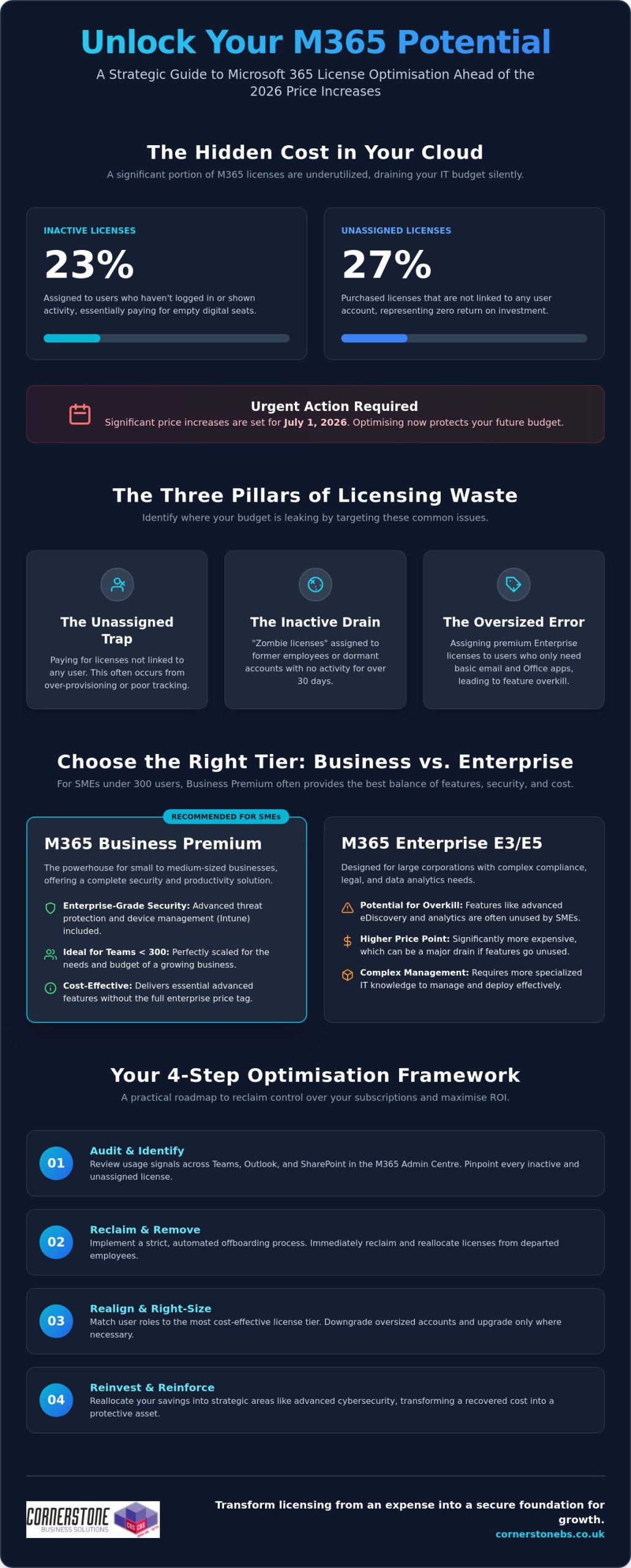
Did you know that 23% of Microsoft 365 licenses are currently inactive, while another 27% sit unassigned? For a UK business, that is essentially like paying for a row of empty desks in your office every single month. With significant price increases set to hit most plans on July 1, 2026, Microsoft 365 license optimisation isn’t just a technical task; it’s a vital strategy for protecting your bottom line. We understand how frustrating it is to navigate complex tiers only to find you’re paying for premium features that your staff never actually open.
You deserve to know that every pound spent on your digital infrastructure delivers real value. This guide will show you exactly how to eliminate licensing waste, align your costs with actual usage, and maximise your ROI without compromising on security. We’ll explore the latest 2026 pricing shifts, including why Business Premium remains a powerhouse for teams under 300 users, and provide a clear roadmap to a leaner, more efficient IT budget.
Key Takeaways
Understand why 2026 is a critical turning point for your IT budget and how Microsoft 365 license optimisation helps you stay ahead of shifting cloud costs.
Pinpoint the specific areas where your budget is leaking by identifying unassigned seats and inactive accounts that no longer serve your business.
Discover why Business Premium is the standout choice for UK SMEs, providing enterprise-grade security without the enterprise-level price tag.
Follow our practical audit framework to reclaim control over your subscriptions using real-time data from the Microsoft 365 Admin Centre.
Explore how a proactive partnership with an award-winning IT team transforms your licensing from a monthly expense into a secure foundation for growth.
What is Microsoft 365 License Optimisation and Why Does it Matter in 2026?
Microsoft 365 license optimisation is the continuous practice of auditing your cloud environment to ensure every user has exactly the tools they need, and nothing more. It is the process of matching user roles to the most cost-effective license tier available. In 2026, this has become a non-negotiable part of a robust managed IT support strategy. As Microsoft introduces significant price adjustments on July 1, 2026, businesses that ignore their license counts will see their margins tighten unnecessarily. We view this as a vital health check for your business stability.
We often encounter “zombie licenses” during our initial audits. These are paid seats assigned to staff who left the company months ago or accounts that haven’t been touched in weeks. They drain your budget silently. By refining your Microsoft 365 environment, you stop these leaks before they impact your yearly projections. It’s about taking a proactive stance to ensure your technology supports your growth rather than weighing it down with hidden costs.
The Financial Impact of Licensing Waste
Industry data from research firms like CoreView suggests that nearly 20% of M365 expenditure is wasted on inactive or unassigned licenses. This is a classic sunk cost that adds no value to your operations. However, when we reclaim that budget through Microsoft 365 license optimisation, it becomes a strategic investment. You can reallocate those saved funds into advanced cyber security services. This allows you to fortify your business against modern threats without actually increasing your total IT spend. It is a win for both your security posture and your finance director.
Moving Beyond Simple Cost-Cutting
Optimisation is about more than just the monthly bill. It’s about productivity and precision. Giving a warehouse manager an Enterprise E5 license when they only need basic email is overkill. Conversely, a remote finance director needs the advanced data protection found in Business Premium to work safely from anywhere. Proper alignment ensures everyone has the right tools for their specific role.
This approach also keeps you on the right side of data governance and compliance. When you know exactly who has access to which apps, managing your data becomes much simpler. We treat optimisation as a proactive business habit. It keeps your Teesside business lean, secure, and ready for the technical challenges of the coming year. It’s the difference between being reactive and being truly in control of your digital infrastructure.
Identifying the Three Pillars of Licensing Waste
Licensing waste isn’t always obvious. It often hides in the corners of your admin portal, quietly draining your monthly budget. While many UK businesses believe their subscriptions are lean, the reality is often different. Effective Microsoft 365 license optimisation starts by shining a light on the three primary areas where money leaks out: empty seats, incorrect tiers, and duplicate services. We’ve helped many local firms reclaim these funds, and the process always begins with identifying these hidden drains.
The first pillar is the “Unassigned Trap.” This happens when you pay for seats that aren’t linked to any active user account. Research shows that up to 27% of licenses sit unassigned in typical corporate environments. Closely related is the “Inactive Drain,” where licenses remain assigned to former employees or accounts that haven’t shown a login signal in over 30 days. Finally, the “Oversized Error” occurs when staff are given high-level Enterprise features they never use. You might be paying for advanced analytics for a user who only needs basic email and Word. This is often backed by Gartner research on optimizing M365 costs, which emphasises the importance of user profiling to prevent over-licensing.
Tackling Inactive and Unassigned Seats
To stop the bleed, you need to look for specific “usage signals.” Check your admin centre for activity across Teams, Outlook, and SharePoint. If an account shows zero activity for a month, it’s a prime candidate for removal. A strict offboarding process is your best defence here. When a team member leaves, their license should be reclaimed immediately as part of your standard IT checklist. License Harvesting is the automated recovery of unused software seats to ensure your budget stays lean. If you’re unsure how to set this up, our team can help you assess your current setup to find these quick wins.
Right-Sizing Your User Tiers
Successful Microsoft 365 license optimisation requires categorising your workforce based on their actual daily tasks. Most employees fall into one of three buckets:
Frontline (F3): Perfect for staff who only need mobile access or basic web apps.
Standard (Business Standard): Ideal for typical office roles requiring desktop apps.
Power Users (Business Premium): Essential for those requiring advanced security and device management.
Be careful not to “under-license” either. While cutting costs is the goal, stripping away essential security features from a remote worker creates a massive risk. We always recommend a “needs-first” approach. By understanding the specific requirements of each role, you ensure your team stays productive without overpaying for “just in case” features.
Choosing the Right Tier: Business Premium vs. Enterprise (E3/E5)
Selecting the right tier is a fundamental part of Microsoft 365 license optimisation. It’s the difference between having a secure, efficient team and overpaying for features that sit on a digital shelf. For the vast majority of our clients in the North East and across the UK, the decision hinges on understanding the 300-user limit and the specific security needs of a modern workforce. With the 2026 price updates showing a 0% increase for Business Premium, its value proposition has never been stronger for SMEs looking to stay lean and secure.
Why Business Premium is the SME Sweet Spot
For most UK businesses with fewer than 300 staff, Microsoft 365 Business Premium offers the most robust security-to-price ratio available in 2026. It includes Microsoft Defender for Business and Intune for remote device management. While Business Standard is popular, it leaves a significant security gap for remote teams. Without Intune, you can’t easily enforce security policies on home laptops or remotely wipe a lost mobile phone. Upgrading to Premium is often significantly more cost-effective than buying these security tools as separate add-ons. It’s a proactive way to build your cloud solutions on a foundation of reliability and trust.
When to Step Up to Enterprise E5
You only need to look at Enterprise tiers like E3 or E5 if you cross that 300-user threshold or have very specific technical requirements. E5 is the “everything” license. It includes Power BI Pro for advanced analytics and sophisticated voice capabilities for your business phone systems. It also brings in Security Copilot, which is an AI-powered assistant for security operations. However, we often see “E5 Bloat.” This happens when a company pays for these top-tier licenses but never actually implements the complex compliance or analytics tools included. It’s a silent drain on your budget that delivers zero actual value to your staff.
Our it company solutions focus on bridging this gap. We ensure you only step up to Enterprise when your business operations truly demand those high-level features. We’ll help you determine if you need the heavy-duty analytics of E5 or if the streamlined efficiency of Business Premium is your perfect fit. By matching the license to the actual job role, you ensure that every pound spent on your Microsoft environment is working as hard as your team does.
A Step-by-Step Framework for a Microsoft 365 License Audit
Conducting a thorough audit is the most effective way to turn your cloud environment into a lean, high-performing asset. While the technical side is important, the human element of how your staff join and leave the business is where most waste accumulates. A successful Microsoft 365 license optimisation audit follows a logical path from raw data to automated efficiency. We recommend following these five essential steps to reclaim your budget.
Step 1: Inventory. Log into the M365 Admin Centre. Export a full list of your active and unassigned licenses to see exactly what you’re paying for right now.
Step 2: Usage Analysis. Review the “Last Activity Date” for every user. If a seat hasn’t accessed Teams, OneDrive, or Exchange in 30 days, it’s a prime candidate for removal.
Step 3: Role Mapping. Match your license tiers to actual job descriptions. Does a part-time staff member really need the full desktop suite, or would the web-only version suffice?
Step 4: Consolidation. Remove unassigned seats immediately. Downgrade oversized accounts to a tier that matches their actual security and productivity requirements.
Step 5: Automation. Build a bridge between your HR and IT teams. Implement automated onboarding and offboarding workflows to ensure licenses are assigned and reclaimed the moment a staff member’s status changes.
If you’re ready to stop the budget leak, you can book a professional audit with our team to identify these savings today.
Leveraging Usage Data for Smarter Decisions
Interpreting Microsoft 365 Usage Reports doesn’t have to be overwhelming. Focus on identifying “Silent Users.” These are employees who primarily use their mobile phones or tablets for work. They often only need a web-only license (F3) rather than a full desktop suite. We also suggest reviewing your third-party app integrations. Many businesses pay for separate file-sharing or project management tools that overlap with features already included in your M365 subscription. Eliminating these redundancies is a quick win for your bottom line.
Establishing a Quarterly Review Cycle
Strategic Licensing Management with Cornerstone Business Solutions
Managing a cloud environment shouldn’t feel like a full-time job for your internal team. At Cornerstone Business Solutions, we’ve built our reputation as an award-winning partner by simplifying the complex world of Microsoft licensing for businesses across the region. We don’t just sell you a seat and walk away. We take a proactive approach to ensure your environment stays lean, secure, and perfectly aligned with your goals. Our status as a trusted partner with global brands like Microsoft means you always receive the most up-to-date advice and best-in-class support.
Microsoft 365 license optimisation is a foundational element of our managed service. We believe in building long-term relationships rather than transactional exchanges. This means we’re constantly looking for ways to save you money while strengthening your security posture. We invite you to have a no-obligation conversation with us about your current cloud spend. It’s an informal chance to see how a few strategic changes can transform your IT budget from a drain into a driver for growth.
Our Proactive Monitoring Advantage
Tracking your license usage is a standard part of our maintenance plans. We monitor activity levels and seat counts so you don’t have to. This gives you total peace of mind knowing that your Microsoft 365 migration and daily management are in expert hands. Our commitment to exceptional customer service means we provide bespoke technology solutions tailored to your specific needs. We treat your business continuity as our top priority, ensuring your systems are always stable and reliable.
Ready to Optimise Your IT Budget?
The benefits of a structured review are immediate. You’ll see lower monthly costs, tighter security through better tier alignment, and clear visibility into your software assets. We’re here to act as your dedicated technology partner, providing the clarity you need to make confident business decisions. You don’t have to navigate the 2026 price changes alone. Our team is ready to help you build a more efficient digital future. We take pride in our local roots and our ability to deliver world-class technical support with a friendly, accessible face.
Success in 2026 requires a lean, agile approach to your technology. We’ve explored how identifying unassigned seats and matching user roles to the right tiers can stop the silent drain on your finances. By embracing a regular audit cycle, you ensure that your IT spend remains a strategic investment rather than a mounting overhead. Effective Microsoft 365 license optimisation is about more than just cutting costs; it’s about building a secure, high-performing foundation that empowers your team to do their best work.
As a multi-award-winning IT services provider and Microsoft Certified Partner, we specialise in delivering bespoke technology solutions that align perfectly with your business goals. We’re proud of our regional roots and dedicated to helping local firms thrive in an ever-changing landscape. Our experts are ready to simplify the technical jargon and provide the clarity you need to move forward with confidence.
Let’s work together to make your infrastructure more efficient. Optimise your Microsoft 365 licensing with Cornerstone and discover the peace of mind that comes from a truly proactive partnership. We’re here to help your business reach its full potential.
Frequently Asked Questions
What is an inactive Microsoft 365 license?
An inactive license is a paid subscription assigned to a user who hasn’t logged in or interacted with any Microsoft services for a specific period, typically 30 days. These accounts represent a direct monthly cost with zero return on investment. Identifying these accounts is a priority for any business looking to reduce waste and keep their IT budget lean.
Can I mix different Microsoft 365 license tiers within the same company?
Yes, you can mix and match different license tiers to suit the specific roles within your organisation. This is a core part of Microsoft 365 license optimisation. It allows you to provide Business Premium for remote staff needing high security while keeping warehouse or part-time staff on more basic, cost-effective plans that fit their daily tasks.
How often should my business perform a license optimisation audit?
We recommend performing a formal license audit at least once every quarter. This frequency helps you catch “zombie licenses” from former employees and adjust your seat counts before they accumulate into significant annual waste. Aligning these reviews with your financial planning keeps your technology spend predictable and stable throughout the year.
Will downgrading a license cause a user to lose their data?
Downgrading a license won’t typically cause data loss, but it may restrict access to certain features or storage capacities. For example, moving from a plan with 100GB of mailbox storage to one with 50GB could cause issues if the user’s mailbox is already near that lower limit. We always verify storage levels and feature dependencies before making any tier changes to ensure business continuity.
Is Microsoft 365 Business Premium better than Business Standard for SMEs?
Business Premium is generally the superior choice for modern SMEs because it includes advanced security and device management tools that Business Standard lacks. While Standard covers the basics, Premium provides the essential protection needed for remote work and mobile device security. It’s a proactive way to secure your business without the high cost of separate security add-ons.
What happens to a license when an employee leaves the company?
When an employee leaves, their license remains active and continues to incur costs until it is manually unassigned in the Admin Centre. It’s vital to have a strict offboarding process that includes reclaiming the license immediately. Once unassigned, the seat stays in your pool until you either reassign it to a new hire or remove it from your subscription to save money.
How can I see which Microsoft 365 features my staff are actually using?
You can track feature usage through the “Usage” reports section in the Microsoft 365 Admin Centre. These reports provide granular data on how often your team uses Teams, SharePoint, and Exchange. This visibility is essential for identifying staff members who may be over-licensed for their actual daily requirements, allowing you to make smarter, data-driven decisions.
Does Microsoft 365 license optimisation affect my cyber security compliance?
Yes, Microsoft 365 license optimisation directly impacts your security posture by ensuring every user has the correct level of protection for their risk profile. By aligning roles with the right tiers, you close security gaps that often occur when users are under-licensed. This proactive approach helps you maintain compliance with industry standards and protects your business from modern threats.
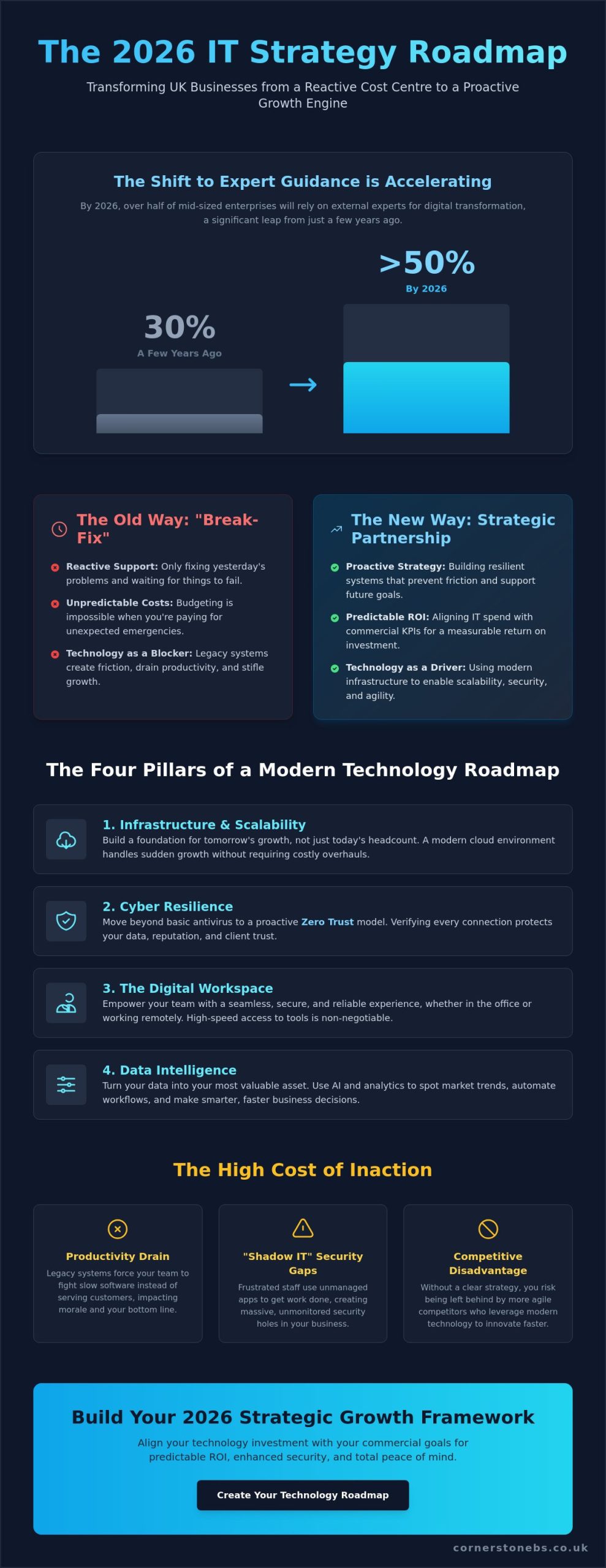
By 2026, over half of mid-sized enterprises are expected to rely on external experts to navigate their digital transformation, a sharp rise from just 30% a few years ago. We understand that for many local firms, technology often feels like a budget black hole. You see competitors adopting AI-native defences while your own IT strategy consulting for UK business needs more focus to ensure your spend actually supports your commercial objectives. It’s frustrating to feel like you’re playing catch-up with cloud and AI while trying to manage daily operations.
We agree that your technology should work as hard as you do. Our 2026 Strategic Growth Framework is designed to change the narrative. This article explains how expert guidance aligns your technology investment with your goals to drive scalability, security, and measurable ROI. We’ll preview a clear, 3-year technology roadmap that simplifies complex requirements like the new UK Sustainability Reporting Standards and DORA compliance. You’ll discover how to achieve predictable IT budgeting and enhanced operational efficiency, turning your digital infrastructure into a foundation for long-term stability and growth.
Key Takeaways
Learn how to transition from reactive “break-fix” maintenance to a proactive strategic partnership that fuels long-term business growth.
Discover the importance of building a scalable infrastructure and implementing Zero Trust security to ensure your operations remain resilient.
Understand why specialized IT strategy consulting for UK business offers the objective perspective and deep expertise needed to outpace competitors.
Follow a structured two-phase approach that starts with a Discovery Audit to eliminate technical debt and align IT spend with your commercial goals.
Gain the tools to create a predictable three-year technology roadmap that delivers measurable ROI and total peace of mind.
Think of your technology as the engine room of your business. If the engine isn’t tuned to the course you’re steering, you’ll burn fuel without making headway. If you’re asking what is a technology strategy?, it’s helpful to view it as a comprehensive blueprint. It ensures every piece of software, every server, and every cloud subscription serves a specific commercial purpose. For local firms, IT strategy consulting for UK business has evolved. It’s no longer just about having an expert to call when a printer fails; it’s about having a partner who understands your three-year growth plan.
The old “break-fix” model is a relic of the past. Relying on reactive support means you’re only ever fixing yesterday’s problems. A proactive strategic partnership looks forward. We don’t just wait for things to go wrong; we build systems that prevent friction in the first place. This shift is vital for businesses in 2026. With new regulations like the UK Sustainability Reporting Standards (UK SRS) coming into play, your tech stack must be able to track and report data with precision. A simple technical audit might tell you what you have, but a strategic consultation tells you what you need to win.
The Core Objectives of Strategic IT Advisory
We focus on three primary goals to ensure your technology delivers a competitive edge. First, we align your digital infrastructure with your commercial KPIs. If your goal is to scale by 20% this year, your network must handle that load without a hiccup. Second, we identify hidden operational risks. We look for the single points of failure that could cause costly downtime. Finally, we optimise your spend. We ensure every pound you invest in technology delivers a measurable ROI, cutting out the “bloatware” and focus on tools that actually drive efficiency. This is where award-winning managed IT services provide the engine for execution.
Why “Doing Nothing” is a Strategic Risk
Sticking with the status quo is a decision in itself, and it’s often a costly one. Legacy systems act as a silent drain on employee productivity. When your team spends more time fighting with slow software than serving customers, your retention rates and bottom line suffer. Without a clear IT strategy consulting for UK business plan, you also risk the rise of “Shadow IT.” This happens when frustrated staff use their own unmanaged apps to get work done, creating massive security holes. By acting now, you position your business to capitalise on 2026 trends like Agentic AI and cloud sovereignty, rather than being left behind by more agile competitors.
The Four Pillars of a Modern Technology Roadmap
A roadmap provides the structural integrity needed to turn a commercial vision into a technical reality. It aligns your specific goals with the broader UK’s national digital strategy, ensuring your business remains competitive in an increasingly digital economy. When we deliver IT strategy consulting for UK business, we focus on four essential pillars that support long-term stability.
Pillar 1: Infrastructure and Scalability. We don’t build for today’s headcount. We build for tomorrow’s potential. Your foundation must handle sudden growth without requiring a total, costly overhaul every two years.
Pillar 2: Cyber Resilience. We’ve moved far beyond basic antivirus. A modern strategy employs a Zero Trust model, where every connection is verified. This protects your reputation as much as your data.
Pillar 3: The Digital Workspace. Empowering your team means providing a seamless experience. Whether they’re in a central Manchester office or a home study in the Cotswolds, your staff need reliable, high-speed access to every tool.
Pillar 4: Data Intelligence. In 2026, data is your most valuable asset. Using AI and analytics to spot market trends or automate repetitive workflows isn’t just for tech giants; it’s standard practice for agile SMEs.
Cloud Solutions as a Foundation for Growth
Adopting cloud solutions is no longer an optional upgrade. It’s the baseline for modern agility. Transitioning from aging on-premise hardware to a scalable cloud environment allows your business to pivot instantly. It also provides an inherent safety net. With robust cloud-based disaster recovery, your business stays operational even if your physical site faces a disruption. It’s about ensuring continuity, no matter what happens.
Security-First Strategic Planning
Security should never be a bolt-on feature. We integrate cyber security services into the very fabric of your business planning. This proactive stance helps you meet national compliance standards while protecting against sophisticated 2026 threats. A major part of this is the human element. We focus on employee training to ensure your team is an active part of your security posture, rather than a vulnerability.
Modern Communications and Connectivity
A unified communication strategy brings your distributed team together. By integrating business VoIP and mobile solutions, we ensure that collaboration feels natural and immediate. We also evaluate your underlying network infrastructure. It must be strong enough to handle the bandwidth demands of 2026 applications. If you’re concerned your current setup is holding you back, you might want to chat with our local team to see how these pillars could support your specific growth targets.
In-House vs. Outsourced IT Strategy Consulting
Deciding whether to hire a full-time Chief Technology Officer (CTO) or partner with an external expert is a pivotal moment for any growing firm. While having someone on-site feels reassuring, it often leads to a narrow focus. Internal IT managers frequently get buried in daily support tickets, which leaves little room for high-level planning. This is where IT strategy consulting for UK business adds immediate value. An external partner brings a fresh set of eyes to your infrastructure, identifying bottlenecks that your internal team might have simply learned to live with over time.
Accessing a broader knowledge pool is another significant advantage. An external consultant works with hundreds of different environments every year. They’ve seen what works in manufacturing, finance, and professional services, allowing them to bring best-of-breed solutions to your boardroom. This isn’t about replacing your current team. Many of our most successful partnerships involve co-managed IT. We bridge the gap by handling the complex strategic roadmap while your internal staff focuses on core business projects and user support. This collaborative approach ensures your business stays agile without the heavy overheads of a senior executive salary.
The Value of an External Perspective
Objectivity is the cornerstone of a successful audit. Internal departments can sometimes be influenced by office politics or a “this is how we’ve always done it” mentality. An external consultant provides an unbiased view of your technical debt and security risks. By aligning your local operations with the UK Government’s Digital Strategy, we help you stay ahead of national trends in digital skills and infrastructure. This perspective ensures your technology spend is always directed toward growth rather than just maintaining the status quo. It’s about turning your IT budget into a strategic investment.
Choosing a Partner, Not Just a Vendor
Trust is vital when you’re discussing the future of your business. You need a partner with a proven track record of supporting national firms. Look for multi-award-winning expertise that proves a commitment to quality. It’s also important to seek vendor-neutral advice. Whether you use Microsoft, Cisco, or IBM, your consultant should recommend the tool that fits your goals, not the one that pays the highest commission. We pride ourselves on being a dedicated long-term partner, offering the clarity of an expert with the friendly, accessible face of a local team. This combination of national-level skill and regional warmth creates an atmosphere of total reliability.
How to Build and Execute Your 2026 IT Strategy
A common mistake many firms make is treating their technology plan as a static PDF that sits in a drawer. In reality, effective IT strategy consulting for UK business is a continuous, living process. It must evolve as your business grows and as new technologies emerge. We’ve developed a five-phase framework to ensure your technology remains an asset rather than a liability.
Phase 1: The Discovery Audit. We start by uncovering your technical debt. This means identifying old hardware, redundant software, and security gaps that slow you down.
Phase 2: Goal Alignment. We sit down with your leadership to define what success looks like. If you’re planning a merger or launching a new service, your tech must be ready to support it.
Phase 3: The Multi-Year Roadmap. We prioritise projects based on their commercial impact. We balance your budget against the need for high-impact upgrades.
Phase 4: Implementation and Managed Support. This is where plans become reality. Our team handles the heavy lifting, ensuring new systems are integrated with minimal fuss.
Phase 5: Continuous Review. We don’t just “set and forget.” We meet regularly to adapt your strategy to new shifts, such as the rise of Agentic AI or changes in UK data regulations.
Conducting a Comprehensive IT Audit
Before we can look forward, we have to know exactly where you stand. Our audit goes deep into your hardware lifecycles and software licensing. Many businesses find they’re paying for subscriptions they no longer use or running servers that are past their prime. We also pinpoint performance bottlenecks that frustrate your staff. The discovery audit serves as the critical baseline for all strategic decisions, providing the factual foundation needed to build a resilient future.
Developing the Technology Roadmap
Your roadmap balances “Quick Wins” with long-term infrastructure overhauls. We might start with a Microsoft 365 migration for business UK to boost immediate collaboration. From there, we plan for hardware refreshes and network upgrades over a three-year period. This phased approach makes budgeting predictable and keeps your operations running smoothly. It’s about making steady, calculated improvements that compound into significant growth. Ready to stop guessing and start growing? Book your discovery session with our local experts today to begin your roadmap.
Why Cornerstone is the Strategic Partner for UK Business Growth
A strategy is only as good as the team that executes it. We don’t just hand you a document and walk away; we act as your dedicated long-term partner. By turning complex roadmaps into tangible results, we ensure your investment delivers. Our managed IT services serve as the engine for your strategic execution. This ensures that every upgrade we’ve discussed, from cloud transitions to cyber resilience, is implemented with precision and care. We’re here to make sure your technology works as hard as you do.
By choosing Cornerstone, you’re getting the backing of global powerhouses. We leverage our partnerships with Microsoft, IBM, and Cisco to bring enterprise-grade technology to your organisation. This provides the strength and customization needed for business stability. We’re proud of our regional roots, and we use that local focus to simplify complex concepts for you. It’s about building a relationship based on trust and reliability. When you need IT strategy consulting for UK business, you need a partner who understands both the global tech landscape and your local market needs.
A Multi-Award-Winning Approach to IT
Our industry recognition isn’t just for show. These accolades act as a recurring signature of quality, translating into reliability for your organisation. We maintain a proactive “helpdesk-first” culture that prioritises your team’s needs. This means we often resolve issues before they impact your productivity. We’ve seen the real-world impact of this approach, helping firms eliminate fragmented “Shadow IT” and regain control over their digital infrastructure. This level of award-winning support provides the emotional security of knowing your business is in expert hands.
Your Next Steps to a Smarter IT Strategy
Starting a partnership shouldn’t feel overwhelming. We invite you to book a strategic consultation to evaluate your current roadmap. In your first 90 days, you can expect a thorough onboarding process that stabilises your current systems and sets the stage for future growth. We’ll identify the “quick wins” that provide immediate relief to your team while planning for long-term success. If you’re ready to move away from transactional IT and toward a collaborative partnership, we’d love to hear from you. Contact our local team for an informal discussion about your 2026 technology goals and business continuity.
Secure Your Business Future with a 2026 Technology Roadmap
Your technology shouldn’t be a source of stress. It should be the foundation of your success. We’ve explored how a proactive roadmap turns IT from a budget drain into a growth engine. By focusing on the four pillars of modern infrastructure and choosing the right external perspective, you gain the clarity needed to outpace competitors. Expert IT strategy consulting for UK business provides more than just a plan; it offers the emotional security of knowing your systems are resilient and compliant.
As a multi-award-winning IT provider and strategic partner with Microsoft, IBM, and Cisco, we bring national-level expertise to your doorstep. Our team provides national UK coverage combined with proactive monitoring that keeps your operations stable around the clock. Book your strategic IT consultation with our award-winning team today. Let’s start a conversation about your future. We’re ready to help you build a smarter, more secure business for 2026 and beyond.
Frequently Asked Questions
What is included in an IT strategy consulting engagement?
An engagement typically includes a full discovery audit, commercial goal alignment, and the delivery of a multi-year technology roadmap. We examine your current hardware lifecycles, software efficiency, and security gaps to create a blueprint for growth. This process ensures your digital infrastructure supports your specific business objectives rather than just maintaining the status quo.
How much does IT strategy consulting cost for a UK business?
Costs vary based on the complexity of your organisation and the expertise required. In 2026, the national median day rate for consultants is approximately £550, though specialist rates for cloud architecture or cybersecurity can range from £90 to £160 per hour. Senior specialists often command day rates up to £1,500 depending on the project scope. We recommend focusing on the long-term ROI rather than just the initial outlay.
How often should a business review its technology roadmap?
You should review your roadmap at least once a year to ensure it remains aligned with your commercial goals. However, many agile UK firms prefer quarterly check-ins to stay ahead of rapid shifts in AI and new regulations like the UK Sustainability Reporting Standards. Regular reviews prevent your strategy from becoming a static document and keep your tech stack flexible.
Can an IT strategy help reduce my overall business costs?
Yes, effective IT strategy consulting for UK business identifies and eliminates “zombie” software subscriptions and redundant hardware. By moving from a reactive “break-fix” model to a proactive plan, you avoid expensive emergency repairs and downtime. It ensures every pound of your budget is invested in tools that drive measurable efficiency and employee productivity.
What is the difference between an IT consultant and a managed service provider?
An IT consultant focuses on high-level advisory, audits, and long-term planning. A managed service provider (MSP) handles the daily execution, technical support, and system maintenance. For the best results, you need a partner who can provide both. This ensures that the strategic vision created in the boardroom is successfully implemented in your daily operations.
How long does it take to develop a full technology roadmap?
Developing a comprehensive roadmap usually takes between four and eight weeks. This timeframe allows for a deep-dive audit of your existing systems and several collaborative workshops with your leadership team. We take the time to understand your unique challenges so the final plan is both realistic and ambitious for your 2026 targets.
Does my small business really need an IT strategy?
Small businesses often need a strategy more than large enterprises because they have less room for wasted budget. Without a plan, it’s easy to fall into the trap of buying disjointed tools that don’t talk to each other. A clear IT strategy consulting for UK business approach helps you build a secure, scalable foundation that grows alongside your company.
How does IT strategy consulting improve cyber security?
Strategy consulting shifts security from a reactive “bolt-on” product to a core design principle. We implement frameworks like Zero Trust and ensure your business meets 2026 compliance standards such as DORA. By assessing your risks proactively, we protect your reputation and ensure your data remains secure against increasingly sophisticated AI-native threats.
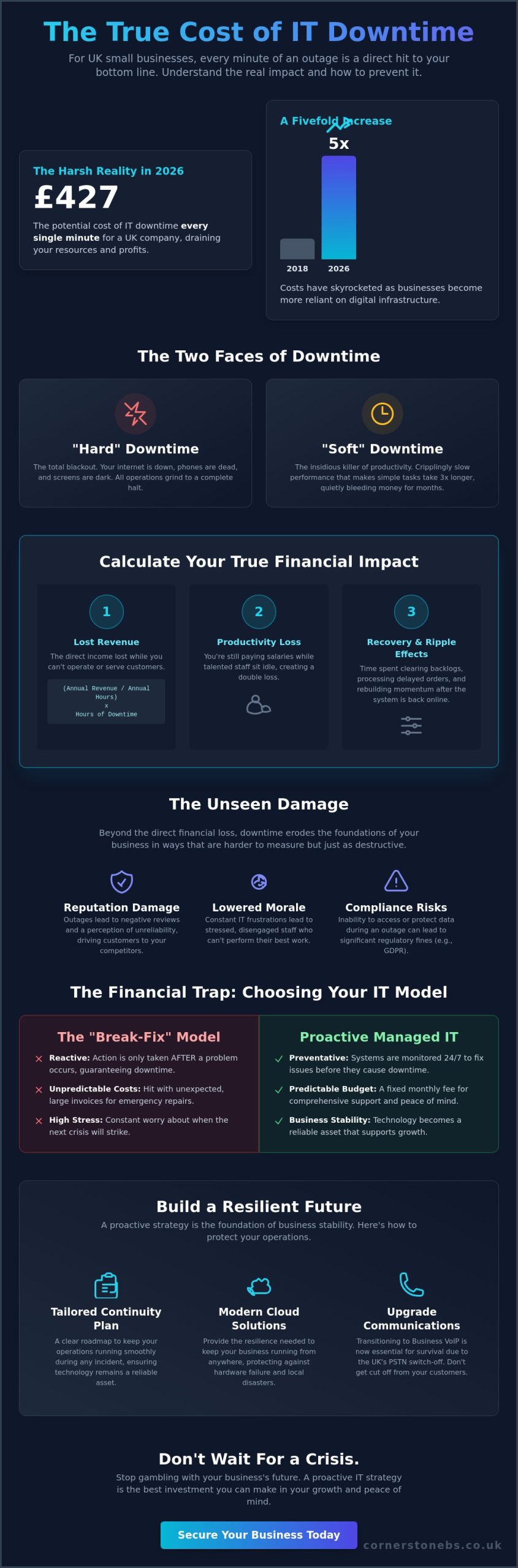
Would you willingly throw £427 into the bin every single minute? For many UK companies, that is the harsh reality of a system outage in 2026. The cost of IT downtime for small business has skyrocketed, seeing a fivefold increase since 2018 as we all become more dependent on digital infrastructure. While a “break-fix” engineer might eventually get you back online, the damage to your bank balance and your reputation often starts long before they arrive at your door.
We understand the frustration of watching talented staff sit idle while customer trust slips away. It’s a stressful position for any business owner, especially when you’re hit with an unexpected invoice for emergency repairs. This guide will show you how to calculate the true financial impact of these outages and why proactive Managed IT Support is the foundation of business stability. We’ll explore the hidden drains on your productivity and provide a clear roadmap to keep your operations running smoothly, ensuring your technology remains a reliable asset for your team. By the end, you’ll have a clear financial justification for IT investment that protects your growth and your peace of mind.
Key Takeaways
Understand the critical difference between a total “hard” blackout and the subtle “soft” downtime that quietly drains your team’s daily productivity.
Learn the precise formula to calculate the true cost of IT downtime for small business, accounting for both lost revenue and the hidden “wage drain” of idle staff.
Discover how system reliability directly impacts your brand reputation and why preventing outages is essential for maintaining positive customer reviews.
Identify why the reactive “break-fix” model is a financial trap and how a proactive approach creates a more predictable, stress-free budget.
Explore how a tailored Business Continuity Plan and modern Cloud Solutions provide the resilience needed to keep your business running from anywhere.
What is IT Downtime and Why Does It Hit Small Businesses Hardest?
Technology is the engine of your business. When that engine stalls, your entire operation grinds to a halt. To understand the cost of IT downtime for small business, we first need to define the problem clearly. What is IT Downtime? It is any period where your digital infrastructure fails to support your core business functions. It isn’t just about a server being “off”; it’s about the inability to serve your customers or keep your team productive.
We see two distinct types of outages in the local business community. “Hard downtime” is the total blackout; your internet is gone, your phones are dead, and your screens are dark. However, “soft downtime” is often more insidious. This is the cripplingly slow performance that makes simple tasks take three times longer than they should. Both versions bleed money, but soft downtime often goes unmeasured for months. While a large corporation might have a backup for every system, a small business often relies on a single point of failure.
Smaller firms feel this impact more acutely because they lack the expensive redundant systems that protect global corporations. In 2026, we find that most outages aren’t caused by natural disasters. Instead, they stem from complex cloud misconfigurations or the silent failure of legacy hardware that has been pushed past its limit. Without a dedicated partner to monitor these systems, a small glitch can quickly snowball into a multi-day crisis. According to 2024 data, 92% of UK businesses require more than 24 hours to recover from a significant IT incident, a delay that most small budgets simply cannot absorb.
Common Triggers of Outages in 2026
Modern outages are rarely random. They are typically the result of three specific vulnerabilities:
Cyber Security breaches: Ransomware and sophisticated phishing attacks remain the primary drivers of unplanned outages. One wrong click can lock your entire network.
Hardware failure: Running end-of-life equipment is a gamble. We often see businesses struggling with aging servers or routers that simply cannot handle 2026 data demands.
Human error: A lack of regular staff training is a major internal vulnerability. Accidental deletions or incorrect settings can be just as damaging as an external attack.
The 2026 Comms Crisis: Legacy Systems
The UK’s PSTN switch-off has permanently changed the landscape for business telecommunications. Companies still clinging to older analogue lines now face total communication isolation as those services are retired. Transitioning to a modern Business VoIP telephone system is no longer just an upgrade; it is a necessity for business continuity. Without it, you risk losing the ability to talk to your customers entirely. This creates a state of total isolation that makes recovery nearly impossible without a modern, cloud-based infrastructure in place.
Calculating the Direct Financial Impact: Revenue and Productivity
We’ve all seen that spinning loading icon and felt a twinge of frustration. In a busy UK office, that tiny icon represents a significant drain on your resources. For a local firm in 2026, the average cost of IT downtime for small business ranges from £137 to £427 per minute. That isn’t just a theoretical figure; it’s cash leaving your business in real-time. To find your specific risk, use the “Lost Revenue” formula: divide your gross annual revenue by your annual business hours, then multiply that by the hours of downtime. It’s a simple calculation that often yields a sobering result.
Beyond direct sales, you must account for the “Wage Drain.” You’re still paying your team’s salaries while they wait for a fix. This creates a double loss: you’re paying for labour that isn’t producing anything. This financial bleed continues even after the “on” switch is flipped. We call this “Recovery Time.” It takes significant effort to clear the backlog of emails, process delayed orders, and regain momentum. This “Butterfly Effect” can even lead to missed deadlines that haunt your contract renewals months later. Understanding The True Cost Of Downtime involves looking at these ripples, not just the initial splash.
The Productivity Drain
Direct Recovery Expenses
If you rely on the reactive “break-fix” model, expect a sting in the tail. Emergency call-out fees are notoriously high, and if your backups fail, specialized data recovery services can cost thousands. Your Recovery Time Objective (RTO) is the maximum acceptable length of time that your business can be offline before the damage becomes irreversible. Investing in robust Disaster Recovery solutions ensures that your RTO remains measured in minutes, not days, protecting your bottom line from unexpected shocks.
The Hidden Costs: Reputation, Morale, and Compliance
The visible invoice for a technical repair is only the tip of the iceberg. When we look at the true cost of IT downtime for small business, the most painful losses are often the ones that don’t appear on a balance sheet immediately. We’re talking about your reputation. In our local community, word travels fast. In 2026, we live in the “Social Proof” era where a single hour of system failure can lead to a permanent 1-star Google review. Potential clients won’t hear your explanation about a server glitch; they’ll simply see a “business that doesn’t answer” and move to your competitor.
Then there is the human element. Your team wants to do a good job, but constant technical hurdles make that impossible. We’ve seen how recurring IT issues lead to deep-seated frustration and, eventually, high staff turnover. It’s exhausting to spend your day “firefighting” instead of focusing on your actual role. For a business owner, this emotional toll is just as heavy. Instead of working on strategic growth, you’re stuck managing a crisis you didn’t ask for. This constant state of high alert leads to burnout and prevents you from being the proactive leader your company needs.
Customer Confidence and Retention
Customers in 2026 have zero patience for the “our systems are down” excuse. They expect seamless digital interaction. If you can’t provide it, the long-term value loss is staggering. A client who has been with you for years might finally decide to move to a more “digitally stable” rival after one too many outages. Conversely, you can use your system reliability as a powerful marketing tool. Showing that you’ve invested in your infrastructure tells your clients that you are a stable, professional partner they can trust for the long haul.
Compliance and Legal Penalties
We must also address the legal risks. Downtime isn’t just an inconvenience; it’s often a red flag for regulators. If an outage results in data loss or a breach of GDPR or NIS2 standards, the financial penalties can be life-changing for a small firm. Think of robust Cyber Security Services as an essential insurance policy. They protect you from the regulatory fallout that follows an unmanaged incident. Investing in your digital safety isn’t just a technical choice; it’s a foundational part of your legal and emotional security.
Why the “Break-Fix” Model is a Financial Trap for SMEs
Waiting for something to break before calling for help feels like a cost-saving measure. In reality, it is a financial trap that leaves your business vulnerable to the highest possible expenses. This reactive approach, often called the “break-fix” model, ensures that you only see your IT technician when your productivity has already hit zero. By the time they arrive, the cost of IT downtime for small business has already begun to spiral through lost sales and idle staff. It is a sticking plaster approach that ignores the underlying health of your digital infrastructure.
The fundamental flaw of break-fix is its lack of strategic planning. A reactive engineer’s goal is to get the specific broken part working again as quickly as possible. They aren’t incentivised to look at why it failed or how to prevent the next crash. This leads to a cycle of “patchwork” IT where systems are held together by temporary fixes rather than a solid foundation. This lack of foresight often results in a “budgeting nightmare” for business owners. You might go three months with no IT costs, only to be hit with a massive, unbudgeted invoice when a critical server finally gives up the ghost.
The Conflict of Interest
In a break-fix relationship, your goals and your provider’s goals are completely misaligned. The technician only makes money when your systems fail. If your network is running perfectly, they aren’t getting paid. This creates a subtle but dangerous conflict of interest. Conversely, our model for Managed IT Services in Teesside aligns our success with yours. We’re incentivised to keep you online because our fixed-fee structure means we work hardest when things are stable. We become a proactive partner invested in your long-term continuity rather than a distant contractor waiting for your next crisis.
Predictable vs. Volatile Spending
Switching to a managed model transforms your IT from an unpredictable “black hole” of expense into a predictable monthly line item. This stability is vital for healthy cash flow management. Proactive maintenance also ensures that your IT Hardware lasts longer, as we identify and resolve minor issues before they cause permanent damage. Emergency repairs are not just stressful; they are expensive. On average, an emergency call-out and a rushed fix cost three times more than a planned, proactive upgrade. You can protect your bottom line by choosing a partner who prevents fires instead of just fighting them. If you are ready to move away from the stress of reactive repairs, contact our local team today for a straightforward chat about your needs.
Building a Resilient Future: How to Eliminate Downtime
Eliminating downtime isn’t about luck; it’s about strategy. A bespoke Business Continuity Plan (BCP) is your first line of defence. This isn’t just a dusty document for corporate giants. It’s a proactive roadmap designed to keep your doors open when others are forced to close. By identifying risks early, you can significantly reduce the potential cost of IT downtime for small business. We work alongside you to build this resilience, ensuring your technology supports your growth instead of hindering it.
Proactive monitoring is the heartbeat of a stable network. We use advanced tools to watch your infrastructure around the clock, catching silent failures before they escalate into full-blown crises. This “always-on” approach means we’re often resolving issues before your staff even arrive at their desks. As a multi-award-winning partner, we take that weight off your shoulders. This allows you to focus on leading your business with total confidence in your system reliability.
Modern Cloud & Disaster Recovery
Modern Cloud Solutions have revolutionised resilience for local firms. Platforms like Microsoft 365 and Azure provide built-in redundancy that protects your data from local hardware failures. We always implement the “3-2-1” backup rule for Disaster Recovery. You should have three copies of your data, stored on two different types of media, with one copy safely off-site. This simple but powerful framework ensures your information remains secure and accessible, no matter what happens at your physical office.
Partnering for Success
Generic, off-the-shelf fixes rarely solve complex business challenges. You need technology that is as unique as your company. Our team provides bespoke solutions and a dedicated helpdesk that knows your business personally. We don’t just fix computers; we build long-term partnerships rooted in our regional community. If you’re concerned about your current system reliability, we invite you to a no-obligation conversation to audit your current risk level. Let’s talk about how we can secure your future together.
Secure Your Business Stability Today
Your company deserves more than just “getting by” with reactive repairs. We’ve explored how the true cost of IT downtime for small business reaches far beyond the technical fix, impacting your brand reputation and team morale. By shifting from the “break-fix” trap to a proactive partnership, you turn your technology into a silent engine of growth rather than a constant source of anxiety.
As a multi-award-winning IT services provider, we combine our local roots with global strength through strategic partnerships with Microsoft, IBM, and Cisco. Our proactive 24/7 system monitoring identifies potential threats before they interrupt your workday, providing the emotional security you need to focus on your goals. It’s about building a foundation that doesn’t just survive an outage but prevents it from happening in the first place.
How do you calculate the hourly cost of IT downtime?
You can calculate this by adding your lost revenue to your total wage drain. Divide your gross annual revenue by your annual business hours to find your hourly revenue risk. Add the hourly salary costs of all idle staff members during the outage to find the true hourly impact on your bottom line.
What are the most common causes of IT downtime for small businesses in the UK?
Cyber security breaches, such as ransomware, and the failure of legacy hardware are the primary triggers in 2026. Many local firms also face outages due to cloud misconfigurations or issues related to the PSTN switch-off. Human error, often caused by a lack of staff training, remains a significant internal vulnerability for smaller teams.
How can managed IT services actually reduce my business costs?
Managed support replaces unpredictable emergency repair bills with a fixed, predictable monthly fee. Proactive monitoring catches minor glitches before they escalate into expensive crises, which significantly lowers the overall cost of IT downtime for small business. This approach also extends the lifespan of your hardware through regular, expert maintenance.
Is “soft downtime” like slow internet as expensive as a total outage?
Soft downtime is often more expensive over the long term because it acts as a silent drain on productivity. While a total blackout is obvious, slow systems cause daily “micro-downtime” that disrupts concentration and employee morale. These small delays can add up to dozens of lost hours per employee every single year.
Does cyber insurance cover the cost of lost productivity during downtime?
Cyber insurance policies vary, so you must check for specific “business interruption” clauses in your agreement. While many policies cover data recovery and legal fees, they don’t always compensate for the daily productivity lost while systems are offline. It is better to use proactive security as your primary defence and insurance as a final safety net.
How often should a small business test its disaster recovery plan?
We recommend testing your plan at least once a year or whenever you implement major system changes. Regular testing confirms that your backups are healthy and that your team knows their specific roles during an emergency. This practice ensures that a real incident feels like a practiced drill rather than a chaotic crisis.
What is the difference between RTO and RPO in business continuity?
RTO stands for Recovery Time Objective, which is the target time for getting your systems back online. RPO, or Recovery Point Objective, refers to the maximum amount of data you can afford to lose, measured in time. For instance, if you back up your data every four hours, your RPO is four hours.
Can cloud migration help eliminate IT downtime?
Cloud migration significantly reduces downtime by removing reliance on a single piece of local hardware. Platforms like Microsoft 365 allow your team to remain productive from any location if your physical office faces an issue. This built-in redundancy provides a level of resilience that was previously only available to large corporations.
What if the technology meant to power your business is actually the biggest bottleneck in your day? Most local business owners we speak with are tired of unpredictable monthly invoices and helpdesks that seem to vanish when a crisis hits. You deserve better than a reactive fix for your business IT support packages; you need a strategic foundation that lets you sleep soundly. We understand that tech jargon often makes these decisions feel like a gamble, but choosing the right plan is the smartest move you can make for your team’s productivity.
We agree that your focus should be on your customers, not on whether your server will survive the afternoon. This guide will show you exactly how to evaluate and select an IT plan that secures your continuity and fuels your growth in 2026. We’ll explore the latest security standards like NIST CSF 2.0, explain why proactive management beats the old break-fix model, and give you a clear framework to find a partner that treats your business goals as their own. It is time to move past the fear of cyber attacks and start building a resilient future with a team that truly knows your name.
Key Takeaways
Understand why the reactive “break-fix” model is a liability in 2026 and how proactive management acts as an insurance policy for your digital assets.
Learn to identify the core components of modern business IT support packages, focusing on unlimited helpdesk access and multi-layered cyber security.
Evaluate the difference between user-based and device-based billing to select the most cost-effective structure for your specific team size.
Spot hidden “out-of-scope” charges before you sign, ensuring your monthly fee remains fixed and predictable.
Discover why bespoke technology plans outperform rigid pricing tiers by aligning your IT infrastructure with your actual business growth goals.
The Evolution of Business IT Support Packages: Why Break-Fix is a Risk in 2026
Ten years ago, you called an IT person when your computer wouldn’t turn on. Today, that approach is a recipe for disaster. Modern business IT support packages have evolved into a proactive insurance policy for your digital assets. We don’t just wait for things to break; we ensure they stay running. This shift is driven by the sheer complexity of modern networks and the speed at which cyber threats move. If you’re waiting for a system to fail before you fix it, you’re already losing money. You need a partner who sees the storm coming before the first raindrop hits.
The transition toward Managed services represents a fundamental change in how local businesses view their technology. It’s no longer a utility you pay for only when it fails. It’s a strategic partnership. Our award-winning support team focuses on building resilience, ensuring your infrastructure is strong enough to handle rapid growth. We identify bottlenecks in your network before your staff even notices a slowdown. This keeps productivity high and your team focused on what they do best. By investing in the right business IT support packages, you’re choosing stability over chaos.
Understanding Proactive vs. Reactive Support
Reactive IT is inherently stressful. It leads to unpredictable monthly bills and hidden financial leaks that drain your budget. When a server goes down, the cost isn’t just the repair bill; it’s the hours of lost work. We embrace an “Always-On” mentality. Through 24/7 monitoring, we spot a failing hard drive or a suspicious login attempt at 3:00 AM. By the time your team starts work at 9:00 AM, the issue is often already resolved. This moves IT from a cost centre that eats your profits to a growth enabler that supports your scaling.
The True Cost of Downtime
The Anatomy of a Modern IT Support Package: What’s Actually Inside?
One often overlooked element is the synergy between communication and infrastructure. While some providers treat your phone system and your internet as separate entities, a truly modern support plan merges them. We integrate Business VoIP and mobile solutions into your core IT strategy. This means your team stays connected whether they are in the office or on the road. When your business IT support packages cover the full spectrum of your digital needs, you eliminate the finger-pointing that often happens between different vendors. If you are curious about how this fits your specific setup, you can always explore our approach to regional support.
The Core Pillar: Unlimited Managed IT Support
True ‘unlimited’ support means exactly that. There are no hidden overages or surprise invoices at the end of the month. This predictable cost model allows you to budget with confidence while knowing your infrastructure is in expert hands. We leverage partnerships with global leaders like Microsoft, IBM, and Cisco to bring enterprise-grade stability to local firms. Robust managed IT services act as the bedrock for your entire operation, ensuring that your hardware and network infrastructure remain fast and reliable. When you remove the ‘per-ticket’ cost barrier, your staff feels empowered to report small issues before they grow into expensive problems.
Security and Disaster Recovery
In 2026, security isn’t an optional add-on. It’s the most critical part of the package. Comprehensive cyber security services must be baked into every level of your support. This goes far beyond basic antivirus. We include multi-layered protection, automated backups, and regular security audits as standard features. Following best practices, like those found in the FTC cybersecurity guide, ensures your business stays resilient against evolving threats. If the worst happens, our disaster recovery protocols ensure you’re back on your feet in minutes. We provide the emotional and operational security you need to scale with confidence.
How to Evaluate and Compare IT Support Plans for Your Organisation
Choosing between different business IT support packages shouldn’t feel like a guessing game. You need a clear framework to compare apples with apples. Start by looking at how you’re billed. Most providers offer “per-user” or “per-device” pricing. If your team uses multiple gadgets, like a laptop, tablet, and smartphone, a per-user model is often more cost-effective. Conversely, if you have shared workstations in a warehouse or retail setting, per-device billing might save you money. We help you map out these requirements so your plan fits your actual workflow, not a generic template.
Scalability is another non-negotiable factor. Your technology should never be a ceiling on your growth. Ask yourself if the provider can easily add new staff members or support a second location without a complete contract overhaul. A local partner who understands the regional market will be more agile in helping you expand. You also need to strike the right balance between on-site and remote support. While 90% of issues are now fixed remotely, having an expert who can be at your office quickly when hardware fails provides invaluable peace of mind. High-quality business IT support packages must provide this safety net.
The SLA Trap: Response vs. Resolution
Many contracts boast a “one-hour response time,” but you should be careful. A response often just means an automated email or a quick “we’ve received your ticket” from a dispatcher. What actually matters to your bottom line is the resolution time. You need a partner committed to getting you back up and running, not just acknowledging the problem. Check the fine print on emergency on-site visits to ensure they aren’t hidden behind extra fees. We provide a dedicated account manager who learns your specific business goals. This human connection ensures that when you call, you’re talking to someone who already knows your infrastructure inside out.
Infrastructure and Hardware Integration
Your choice of support should align with your physical tech. Effective IT company solutions should include hardware procurement and lifecycle management. It’s frustrating to buy a top-tier support plan only to find your existing network infrastructure can’t handle the load. We assess your cabling, routers, and servers to ensure they’re up to the task. There’s also a massive efficiency gain in using a single provider for your IT, mobile, and telecommunications. It simplifies your billing, reduces vendor finger-pointing, and ensures every piece of your tech stack works in perfect harmony.
Beyond the Price Tag: Identifying Hidden Costs and Value-Adds
Don’t let a low monthly headline price fool you. When comparing business IT support packages, the real value lies in what happens when you need something outside of the daily grind. Many providers lure you in with a cheap rate, only to hit you with ‘out-of-scope’ fees the moment you want to set up a new workstation or move an office. We believe in total transparency. A truly collaborative partner identifies these potential traps early, ensuring your budget remains predictable even as your needs change. It’s about looking beyond the initial invoice to see the long-term impact on your bottom line.
A thorough onboarding process is another area where quality shines. While some might see an initial audit fee as a hurdle, it is actually a vital investment. This deep dive into your infrastructure allows us to find the ‘ghosts in the machine’ that cause recurring issues. We also take the burden of vendor management off your shoulders. Instead of you spending hours on the phone with an internet provider or a software company, we handle those conversations for you. This frees your time to focus on regional growth while we manage the technical heavy lifting. If you want to see how a transparent plan can work for your team, view our full range of support options.
Strategic IT Consulting
Your support plan should include regular ‘vCIO’ (Virtual CIO) sessions to ensure your tech stays aligned with your business goals. These meetings help you plan for major milestones, such as Microsoft 365 migrations, without the stress of an emergency spend. By mapping out a clear technology roadmap, you avoid ‘technical debt’—the costly habit of patching up old systems rather than investing in modern solutions. We act as your long-term partner, helping you choose the right tools today so you don’t have to replace them tomorrow.
Training and Empowerment
Modern business IT support packages should focus on people as much as hardware. We provide cyber security awareness training that significantly reduces the number of support tickets caused by accidental clicks. When your staff understands how to use cloud solutions effectively, they become more productive and less frustrated. An educated workforce that understands digital risks becomes your business’s strongest and most cost-effective firewall. We take pride in simplifying complex concepts so your team feels confident and empowered every time they log in.
Choosing a partner is an act of trust. That trust is why we lead with our multi-award-winning service and third-party validation as a prefix to everything we do. It isn’t just about technical skill; it is about the confidence that comes from working with a regional expert who has a proven track record of excellence. When you move away from a transactional relationship to a partnership model, the first 90 days are transformative. We spend this time stabilising your environment, eliminating recurring “niggles,” and setting a clear baseline for your future tech strategy. You aren’t just buying a service; you’re gaining a dedicated team that cares about your success.
The Power of Bespoke Design
Your Next Steps to Tech Stability
The path to a more reliable future starts with a simple, informal conversation. We don’t believe in high-pressure sales; we believe in solving problems. Our process begins with a comprehensive audit to uncover the gaps in your existing support and identify where your current tech might be holding you back. This isn’t just a technical check; it’s a strategic review of how your systems impact your staff’s daily lives.
Initiate a Conversation: Tell us about the bottlenecks that frustrate your team.
The Audit Process: We conduct a deep dive into your infrastructure to find hidden risks.
Collaborative Roadmap: We build a plan that aligns your IT with your business goals for 2026.
Moving away from transactional IT means you no longer have to worry about the “what ifs.” You can focus on your regional community and your customers while we ensure your digital world remains secure, fast, and always on.
Take Control of Your Digital Future Today
Choosing between different business IT support packages is about more than just comparing prices; it’s about finding a dedicated partner who understands your regional roots and your global ambitions. You’ve seen how the move from reactive “break-fix” repairs to proactive management creates a foundation for genuine stability. By prioritising bespoke solutions over rigid tiers, you ensure every part of your tech stack, from Microsoft 365 to your network infrastructure, works for your bottom line. Transparency in your contract and a focus on resolution times will protect you from hidden costs and unnecessary downtime.
As a multi-award-winning IT services provider, we take pride in our strong partnerships with industry leaders like Microsoft, IBM, and Cisco. We don’t believe in one-size-fits-all. We believe in building resilient, custom-tailored systems that give you the emotional and operational security to focus on your growth. It’s time to stop worrying about your technology and start leveraging it as a competitive advantage. Ready for a bespoke IT solution? Let’s start a conversation today. We look forward to helping you build a stronger, more secure future for your team.
Frequently Asked Questions
What are business IT support packages?
Business IT support packages are bundled service agreements where a provider takes full responsibility for your digital environment for a fixed monthly fee. They replace the old, expensive model of paying for every individual repair. You receive a suite of services including helpdesk access, network monitoring, and security management. This approach provides the operational stability you need to focus on your core business goals.
How much do business IT support packages typically cost?
The investment for these plans varies based on your total number of users and the specific level of security your industry requires. Most providers use per-user or per-device billing models to keep your costs predictable and transparent. We don’t believe in generic pricing because every local business has unique infrastructure needs. We focus on creating a bespoke plan that delivers the best value for your specific growth strategy.
Is unlimited helpdesk support really unlimited?
Yes, in a genuine managed service model, unlimited helpdesk support means your staff can reach out for remote assistance as often as they need. There are no surprise invoices or “per-ticket” charges that discourage your team from seeking help. This open line of communication allows us to fix small glitches before they cause major downtime. It’s a collaborative way to keep your productivity high and your tech frustration low.
Do IT support packages include hardware repairs?
Can I change my IT support package as my business grows?
Flexibility is a major advantage of modern business IT support packages. You can easily scale your plan up or down as your team size changes or as you move into new premises. We design our solutions to be agile, ensuring your technology supports your expansion rather than holding you back. It’s easy to add new services like Microsoft 365 seats or Business VoIP as your needs evolve.
What is the difference between remote and on-site IT support?
Remote support allows our technicians to fix software and configuration issues instantly via a digital connection. It is the fastest way to resolve the majority of daily tech hurdles. On-site support involves a physical visit to your office for hardware repairs or network infrastructure tasks. A quality plan provides both, giving you the speed of remote fixes and the security of a local expert on your doorstep when needed.
Are cyber security services included in standard IT support plans?
Foundational security like antivirus and email filtering is often part of a standard plan, but we recommend more robust protection in 2026. High-quality business IT support packages should integrate multi-layered cyber security services to defend against evolving threats. We bake these protections into your infrastructure to ensure your data remains secure and your business stays compliant with the latest industry regulations.
How do I switch from my current IT provider to a new support package?
Switching to a new provider is a managed, stress-free process that we handle on your behalf. We perform a thorough audit of your current systems and work with your existing vendor to transfer all necessary credentials and documentation. Our goal is to ensure zero downtime during the transition. You’ll feel the difference of a proactive partnership from the very first day of your new agreement.
Would you pay £65,000 for a single IT generalist when you could access an entire team of specialists for a third of that price? By January 2026, the cost of a competent internal hire has climbed to between £45,000 and £65,000 once you factor in National Insurance and pension contributions. It’s a heavy price to pay for one person who still needs holidays, sick leave, and constant training. This 2026 in-house vs outsourced IT support cost analysis reveals why many North East businesses are moving away from the traditional hiring model to find better value and more reliable protection.
We know that managing technology often feels like a constant battle against recruitment headaches and rising cyber security threats. You want predictable monthly spending and the peace of mind that comes from award-winning expertise. This guide delivers a full financial and strategic breakdown to help you choose the model that actually supports your growth. We will explore the hidden costs of internal teams, from £5,000 annual training budgets to the £200,000 per hour risk of downtime. We also show you how a proactive partnership delivers the robust security your insurance requires. Let’s get into the numbers so you can make an informed decision for your organization’s future.
Key Takeaways
Compare the actual cost of a £65,000 internal hire against the predictable monthly investment of an award-winning managed service provider.
Identify the “hidden 30%” of internal IT spending, including National Insurance and the recruitment overheads that often catch businesses off guard.
Use our 2026 in-house vs outsourced IT support cost analysis to determine which model delivers the best ROI for your specific headcount.
Learn how to eliminate “Key Person Risk” and gain access to a full suite of experts for cyber security, cloud solutions, and strategic planning.
Discover the framework for choosing a model that provides long-term peace of mind and supports your business growth without technical stagnation.
The 2026 IT Landscape: Why the In-House vs Outsourced Debate Matters
Choosing between these models requires a balance of three critical factors: cost, control, and capability. While having a dedicated person in the office feels reassuring, the sheer breadth of knowledge required today is staggering. One person cannot be an expert in Microsoft 365, advanced cloud infrastructure, and 24/7 cyber security monitoring all at once. We believe that technology should provide peace of mind, not a constant source of recruitment stress. This analysis helps you find that balance, ensuring your IT investment delivers a genuine return rather than just becoming a line item on a balance sheet.
The Evolution of IT Support Expectations
The old “IT guy in the basement” model is officially obsolete. In 2026, your team expects 24/7 uptime and seamless remote access from any location. If your systems go down for even an hour, the financial fallout for a UK firm can reach £200,000 depending on the sector. This “always-on” culture means IT has moved from a back-office expense to a front-line driver of efficiency. Our guide to managed IT services Teesside explores how local businesses are adapting to these higher stakes by moving toward proactive, rather than reactive, support models.
Defining the Models: DIY vs. Managed Partnership
Understanding the terminology is the first step toward a smart decision. The business practice of outsourcing involves hiring an external provider to handle your technology needs. Here is how the three main models look for a modern North East business:
In-house IT: You hire internal employees. This offers direct control and deep company-specific knowledge; however, it comes with high fixed overheads, pension contributions, and significant recruitment challenges.
Outsourced IT: You partner with an award-winning Managed Service Provider (MSP). This provides access to a full team of experts for a predictable monthly fee, eliminating the need for internal training and recruitment.
Hybrid or Co-managed: This is often the “best of both worlds” for larger SMEs. Your internal IT manager handles day-to-day helpdesk tasks while a proactive partner manages heavy-duty security, disaster recovery, and infrastructure.
The True Cost of In-House IT Support in 2026
Calculating the price of an internal team often starts with a single salary figure. However, a realistic in-house vs outsourced IT support cost analysis for 2026 must look far beyond the basic pay packet. While a generalist might command a salary between £30,000 and £45,000, a truly competent engineer capable of managing modern infrastructure now costs between £45,000 and £65,000. These figures reflect the intense competition in the UK managed services market, where a persistent skills gap continues to drive wage inflation across the technology sector.
The Salary Trap: Why One Person is Never Just One Salary
Hiring for IT in 2026 often forces SMEs into a difficult choice. You can hire a junior technician for £35,000, but they may lack the expertise to handle high-level strategic planning or complex cyber security audits. To get that level of seniority, you’ll likely need to pay upwards of £55,000 for a mid-level professional. Even then, you are only buying the knowledge of one individual. If they fall ill or take a holiday, your business is left vulnerable. This “Key Person Risk” can lead to expensive downtime that far outweighs the cost of a proactive partnership.
Continuous Professional Development (CPD) Costs
Technology moves fast. To keep an internal staff member effective, you must invest £2,000 to £5,000 every year in certifications for Microsoft 365, Azure, or Cisco. Without this, your team’s skills will stagnate, leaving your business behind the curve. You also need to provide the tools for them to do the job. Essentials like remote monitoring (RMM), ticketing systems, and security software add another £3,000 to £8,000 to your annual overheads per technician.
The Total Cost of Ownership for a single competent IT hire in 2026 averages between £75,000 and £95,000 after combining salary, statutory contributions, recruitment amortisation, and essential software licensing. If these numbers feel daunting, it might be time to chat with a local expert about a more predictable, award-winning model that scales with your growth.
Financial Analysis of Outsourced Managed IT Support
Switching focus to the other side of our in-house vs outsourced IT support cost analysis, we see a model built for total predictability. Outsourcing replaces the volatile expenses of recruitment and training with a clear, per-user monthly fee. For a typical 20-user business in the UK, fully managed support costs between £1,100 and £1,700 per month. That totals roughly £13,200 to £20,400 per year. Compare that to the £75,000 minimum total cost of a single in-house hire we discussed earlier. You’re getting an entire department of experts for less than a third of the price of one person.
Scalability is another massive financial win for North East firms. If your team grows by five people tomorrow, your costs increase by a fixed, known amount. If you downsize, your bill drops immediately. You don’t have to worry about the £5,000 to £10,000 recruitment fees or the headache of interviewing. We handle the talent hunt and the continuous training, so you don’t have to. It’s a seamless way to ensure your business always has the right level of support without the burden of fixed overheads or employer’s National Insurance.
The Managed Service Advantage: Beyond the Helpdesk
A proactive partnership offers far more than just fixing what’s broken. Our cyber security services are built into the model, providing robust protection that satisfies modern insurance requirements. You get 24/7/365 monitoring without the massive overtime bills or holiday cover issues associated with internal staff. Specialists also manage your cloud solutions more efficiently, ensuring you aren’t overpaying for licenses or storage you don’t need. It’s award-winning expertise that keeps your business moving.
Comparing the Capital Expenditure (CapEx) vs. Operational Expenditure (OpEx)
CFOs generally prefer the Operational Expenditure (OpEx) model because it keeps cash flow steady. You avoid the “emergency spend” cycle where an unmanaged server failure leads to a sudden £10,000 bill. Instead, you pay a consistent monthly rate that covers maintenance and upgrades. Our team also leverages existing partnerships with giants like Microsoft and Cisco. This means you benefit from enterprise-level tools and pricing that are usually out of reach for smaller firms. It’s about getting the best technology for your business while maintaining total financial control and peace of mind.
The Efficiency Gap: Opportunity Costs and Risk Factors
Direct expenses like salaries and software licenses are easy to track, but the hidden costs of inefficiency often hit harder. A thorough in-house vs outsourced IT support cost analysis must weigh the financial impact of “Key Person Risk.” When your internal IT manager is on holiday, ill, or simply busy with a basic helpdesk ticket, who handles a critical system failure? For many North East businesses, this single point of failure creates a dangerous bottleneck that stalls productivity and threatens growth.
There is also the “Breadth vs Depth” problem to consider. In 2026, it is practically impossible for one person to stay expert in cloud infrastructure, hardware maintenance, and the latest cyber security protocols simultaneously. Internal staff often fall into a “best effort” support cycle. In contrast, a proactive partnership with an award-winning team provides guaranteed Service Level Agreements (SLAs). You aren’t just buying time; you are buying a commitment to performance and 24/7 availability that a single hire simply cannot match.
The Cost of Downtime: A Proactive vs. Reactive Comparison
Downtime is a silent profit killer. Recent data shows that IT failures cost UK businesses between £4,000 and £200,000 per hour depending on their sector and size. If your internal team is reactive, they only start working once the damage is done. Our proactive monitoring identifies and resolves vulnerabilities before they impact your bottom line. This level of oversight provides the peace of mind that comes from knowing your network is being watched by specialists who never take a day off. It turns IT from a source of stress into a foundation for business continuity.
Cyber Security and Compliance Risks
The landscape of digital threats is more hostile than ever in 2026. Data breaches now carry heavy financial penalties and can destroy a local brand’s reputation in days. Implementing robust it company solutions ensures your business remains compliant with strict regulations like NIS2 and Cyber Essentials. Managing these requirements internally is a massive administrative burden that often leads to corners being cut.
Professional IT management naturally reduces your cyber insurance premiums by proving to underwriters that your infrastructure is managed to enterprise standards. If you want to stop worrying about the next big threat and start focusing on your business, it’s time to chat with our local experts about a tailored support plan.
The Verdict: Which Model Wins for Your Business?
Choosing the right path depends on your specific scale and long-term goals. Our in-house vs outsourced IT support cost analysis shows that for the majority of UK SMEs, the decision comes down to the balance between overhead and expertise. If you are a large enterprise with over 500 users and highly bespoke legacy systems, an internal team might offer the deep, singular focus you need. However, for high-growth firms and security-conscious sectors, the managed model is almost always the superior choice for both ROI and reliability.
The data from January 2026 is clear. At the 20-user mark, outsourcing your technology needs costs roughly a third of a single in-house hire. Even at 50 users, where costs begin to equalize, the outsourced model still wins on value. You aren’t just paying for a person to sit at a desk; you are buying access to an award-winning department of specialists. This eliminates the “Efficiency Leak” where your business pays premium salaries for basic helpdesk tasks while strategic projects and cyber security fall by the wayside.
Making the Transition: From Stress to Strategy
Moving from a reactive, stressed IT environment to a proactive strategy starts with an honest audit of your current spend. Look beyond the obvious invoices. Calculate the time your management team spends on recruitment and the cost of every hour your systems were offline in the last twelve months. When you present these figures to your stakeholders, the conversation shifts from “what does this cost” to “what is this costing us to ignore.” Finding a partner with a local feel and national-level capabilities ensures you get the personal touch of a North East team with the robust infrastructure of a major provider.
Cornerstone: Your Award-Winning IT Partner
At Cornerstone, we believe technology should be a foundational element of your peace of mind. We blend professional authority with the approachable warmth of our North East roots to create a partnership that feels like an extension of your own team. Our proactive monitoring and tailored cloud solutions ensure your business stays ahead of the curve without the recruitment headaches or unpredictable break-fix bills. We are proud of our award-winning status, but we are even prouder of the success our clients achieve through reliable, secure technology.
Secure Your Business Future with a Smarter IT Strategy
Your technology should be the engine of your growth, not a source of constant financial worry. This in-house vs outsourced IT support cost analysis has shown that while a £65,000 internal hire offers direct control, it cannot match the collective depth of an entire department. You gain access to specialists in cyber security, cloud solutions, and network infrastructure for a fraction of the cost of a single senior employee. It’s about moving from a reactive “break-fix” mindset to a proactive strategy that protects your bottom line.
As a multi-award-winning IT services provider with deep North East roots, we provide the proactive 24/7 monitoring you need to avoid that £200,000 per hour downtime risk. Our strong partnerships with Microsoft, IBM, and Cisco ensure your business uses enterprise-level tools that stay current with 2026 standards. We don’t just fix computers; we build the digital foundation your organization needs to scale securely and efficiently.
Is it cheaper to outsource IT or hire in-house in 2026?
Outsourcing is significantly more cost-effective for the vast majority of UK SMEs. Our in-house vs outsourced IT support cost analysis shows that a 100-user business typically invests between £60,000 and £90,000 per year for a full team of specialists. Hiring an equivalent internal team would require at least three staff members, likely pushing your annual expenditure well over £150,000 once you include all employer contributions and overheads.
What are the hidden costs of hiring an internal IT manager?
Beyond the base salary, you must budget for a 13.8% Employer National Insurance contribution and at least 3% for pension auto-enrolment. There are also recruitment fees that often reach 20% of the starting salary and an annual training budget of £2,000 to £5,000 to keep their skills current. You also pay for the software tools they need, which can cost your business an additional £8,000 every year.
Can a managed IT service provider really understand my specific business needs?
A true partnership model ensures your provider understands your operations as deeply as any internal hire. We use regular strategic reviews and on-site visits across the North East to align your technology with your specific growth goals. It’s about building a long-term relationship where we act as your trusted local experts, not just a distant helpdesk.
What happens to my existing IT staff if I decide to outsource?
You don’t have to choose one or the other; many firms opt for a co-managed approach. Your existing staff can focus on high-value internal projects while we handle the 24/7 monitoring and helpdesk tickets. If you decide to move fully to an outsourced model, we can help you navigate the TUPE regulations to ensure a smooth and professional transition for everyone involved.
How do outsourced IT costs scale as my business grows?
Costs scale linearly on a per-user basis, which gives you total budget clarity as you expand. For a 50-user business in 2026, the monthly investment typically ranges from £2,750 to £4,250 depending on the level of support required. This flexibility means you can add or remove users instantly without the stress of recruitment or the risk of being overstaffed during quieter periods.
Is outsourced IT support as responsive as having someone in the office?
Outsourced support is often more responsive because you have an entire team of award-winning experts available at all times. An internal hire might be stuck in a meeting, off sick, or on holiday when a crisis hits. Our proactive monitoring systems identify and fix most issues before your team even notices them, ensuring your productivity never skips a beat.
Does outsourcing IT help with cyber security insurance requirements?
Yes, professional management is now a standard requirement for most 2026 cyber insurance policies. Insurers want to see that your business has robust disaster recovery plans and proactive security monitoring in place. Partnering with an expert team ensures you meet these strict compliance standards, which often helps in securing coverage and potentially reducing your premiums.
What is co-managed IT support and is it right for me?
Co-managed IT is a hybrid model where we support your existing internal IT manager rather than replacing them. It’s a great fit for businesses with 50 or more staff that need extra help with specialized areas like cloud solutions or complex network infrastructure. This model typically costs between £30 and £80 per user per month and provides your internal team with the tools and backup they need to succeed.
Did you know that for a small business in 2026, every single minute of IT downtime costs an average of $427? It’s a staggering figure that proves the old “break-fix” model is no longer a viable strategy; it’s a liability. You’re likely tired of unpredictable monthly invoices and the constant worry that a silent cyber threat is lurking in your network. We understand that frustration because our team has helped countless North East businesses move past the stress of system failures and into a new era of stability.
By switching to award-winning proactive IT support services, your company can reduce overall IT costs by 40% to 60% and save between $15,000 and $50,000 annually. In this article, you’ll discover how shifting your focus from emergency fixes to continuous monitoring eliminates downtime and secures your growth. We’ll outline the 2026 strategy for achieving predictable budgeting and zero-interruption workflows, ensuring your technology acts as a foundation for peace of mind rather than a hurdle to overcome.
Key Takeaways
Learn how shifting from reactive “break-fix” repairs to continuous oversight prevents system failures before they impact your daily operations.
Discover how AI-driven Remote Monitoring and Management (RMM) identifies potential hardware issues like disk failures before they cause a shutdown.
Calculate the real ROI of proactive IT support services and see how a fixed-fee model provides predictable budgeting for your business.
Identify the critical features of a modern IT plan, including 36-month strategic roadmapping and robust disaster recovery solutions.
Understand why a tailored partnership with an award-winning North East team provides the foundational peace of mind your growth requires.
What are Proactive IT Support Services and Why Do They Matter?
Proactive IT support services represent a fundamental shift in how your business handles technology. Instead of waiting for a server to crash or a network to lag, our award-winning team maintains a continuous, vigilant oversight of your entire digital estate. We act as your long-term partner, identifying and resolving potential vulnerabilities before they ever reach your screen. This approach transforms your IT from a “cost centre” that only demands money when things go wrong into a “business enabler” that fuels your daily growth.
The traditional model of IT support is purely reactive. It relies on failure to trigger action. If a system doesn’t break, it doesn’t get attention. Modern business demands more than just a repairman on speed dial. By managing your infrastructure on a proactive basis, we ensure your systems are robust, secure, and always available. This transition provides the foundational peace of mind you need to focus on your North East business without the constant fear of a digital shutdown.
The Reactive Trap: Why Waiting for Failure is Expensive
The “break-fix” model is a financial trap. It might seem cheaper on the surface because you only pay when you call for help, but the hidden costs are staggering. When a system fails, your employees sit idle, yet you’re still paying their wages. Research from April 2026 shows that small businesses lose an average of $427 every single minute their systems are down. These emergency scenarios often lead to “band-aid” solutions that address the symptoms rather than the root cause, ensuring the problem will return. Beyond the invoices, technical instability takes a heavy psychological toll on your team, crushing morale and slowing down your overall output.
The Core Pillars of a Proactive IT Strategy
A truly proactive strategy isn’t just about watching a dashboard; it’s about active, tailored management. We focus on three essential pillars to keep your business moving:
Continuous 24/7 Monitoring: We watch your servers, networks, and endpoints around the clock to catch glitches before they become outages.
Automated Patch Management: Our systems automatically deploy software updates to close security loopholes as soon as they’re discovered.
Regular Strategic Reviews: We sit down with you to ensure your technology aligns with your business goals for the next 12 to 36 months.
Adopting proactive IT support services can reduce your overall IT costs by 40% to 60% compared to the old reactive ways. It’s about being prepared, staying secure, and keeping your workflow seamless every day of the week.
The Mechanism: How Modern Proactive Monitoring Works
Understanding how proactive IT support services actually function requires a look under the bonnet at Remote Monitoring and Management (RMM) technology. Think of RMM as the digital eyes of our award-winning team. These tools reside on your network, constantly gathering data from every server, laptop, and mobile device. Unlike the old days of waiting for a blue screen, this software alerts us to “pre-failure” conditions. If a hard drive starts showing signs of excessive heat or a server’s memory usage spikes unexpectedly, we receive a real-time alert before the hardware actually dies.
This shift toward proactive experience management ensures that your employees never have to deal with the frustration of a sudden system crash. We often perform what we call a “Silent Fix.” This is where our engineers resolve an underlying software conflict or clear a stuck print queue in the background. Your team continues their work without ever knowing a potential crisis was averted. It’s a seamless way to maintain productivity while we handle the technical heavy lifting.
Predictive Maintenance and AI Integration
By April 2026, Artificial Intelligence has become the backbone of our monitoring strategy. We define Predictive Maintenance as the use of data to forecast equipment failure before it occurs. Our AI systems identify subtle patterns that human eyes might miss, such as a 5% increase in network latency that often precedes a larger breach. Instead of “scheduled” maintenance that might happen when it isn’t needed, we provide “needs-based” intervention. This precision keeps your infrastructure lean and robust, which is a major reason the proactive services market is projected to reach $9.18 billion this year.
Automated Patch Management and Security
Internal teams often suffer from “Update Fatigue,” where important software patches are ignored because they seem inconvenient. Automation solves this by deploying critical updates across all devices, including remote hardware, during off-peak hours. This is vital for closing security loopholes that hackers love to exploit. In 2025, organizations saw a 47% year-over-year increase in cyberattacks, making it essential to integrate professional cyber security services directly into your proactive loop. Keeping your systems current isn’t just about new features; it’s about building a digital fortress around your data.
If you’re curious about how these tools would look in your specific setup, feel free to chat with our North East team for a tailored evaluation of your current network health.
Proactive vs. Reactive IT: Calculating the Real ROI
Calculating the return on investment for your technology often feels like guesswork, but the data in 2026 tells a very clear story. If you’re still operating on a reactive model, you’re essentially playing a high-stakes game with your profit margins. As we mentioned earlier, downtime costs the average small business $427 per minute. That means a single hour of system failure can wipe out over $25,000 in potential revenue and productivity. By contrast, proactive IT support services turn these volatile risks into a fixed, manageable line item. Most of our partners see a positive ROI within just three to six months of making the switch.
The financial benefits extend far beyond avoiding crashes. Proper maintenance prevents the “run-to-fail” cycle that forces businesses into expensive, unplanned hardware refreshes. When your infrastructure is monitored and patched correctly, you extend the lifespan of your servers and workstations by an average of 25%. This long-term care is a core component of a robust IT disaster recovery plan, ensuring that your capital expenditure remains predictable and your business stays resilient against unexpected failures.
Fixed Costs vs. Unpredictable Invoices
One of the biggest hurdles for North East business owners is the “bill shock” associated with break-fix IT. Reactive support creates a fundamental conflict of interest; the provider only profits when your systems fail. Our award-winning proactive model flips this script. Because we charge a flat monthly fee, we’re financially incentivised to keep your network running perfectly. If your systems are down, it costs us time and resources. This alignment of goals transforms our relationship from a simple transaction into a true partnership focused on your stability and cash flow management.
Productivity Gains and Employee Retention
Technology should be invisible. When it works perfectly, your team stays in a “flow state,” moving through tasks without the friction of slow logins or crashing apps. This reliability is directly linked to employee engagement. In 2026, talented professionals have little patience for “clunky” systems that hinder their work. By integrating tailored cloud solutions, we facilitate a seamless remote working experience that keeps your team connected and productive, no matter where they’re based. Reducing IT friction isn’t just a technical win; it’s a strategic move that protects your most valuable asset: your people.
Key Features to Look for in a Proactive IT Support Plan
Choosing the right proactive IT support services isn’t just about checking technical tick-boxes. It’s about finding a partner who understands your specific business trajectory and provides a safety net that catches small glitches before they turn into the $427-per-minute disasters we discussed earlier. A truly effective plan should handle everything from day-to-day helpdesk tickets to high-level strategic decisions. We believe your IT provider should act as a single point of contact, even managing your third-party vendors like internet providers or software companies, so your team can stay focused on their actual jobs.
Unlimited helpdesk access is another non-negotiable feature. When staff feel they can’t report a “minor” bug because it might trigger an extra invoice, those small issues fester into major system failures. By removing the barrier to support, we encourage a culture where problems are solved instantly. This approach is a cornerstone of business continuity, ensuring that your workflow remains uninterrupted and your staff stay productive without the friction of unresolved technical “niggles.”
Strategic Roadmapping and Consultancy
Proactive support must include a “Virtual CIO” or strategic advisor role to be truly effective. We don’t just fix what you have; we plan for what you’re becoming. This involves aligning our it company solutions with your specific business KPIs over the next 12 to 36 months. Through regular business reviews, we ensure your technology stack remains fit for purpose as you scale, preventing the “technical debt” that often slows down growing North East enterprises.
Cyber Resilience and Disaster Recovery
There’s a massive difference between a simple “backup” and a true “business continuity” plan. While a backup might save your data, a continuity plan ensures you can actually work while that data is being restored. Our award-winning approach includes proactive threat hunting and dark web monitoring as standard. We also ensure that major projects, such as a Microsoft 365 migration for business UK, are backed by a robust recovery strategy. This ensures that even if the worst happens, your business is back on its feet in minutes, not days.
Why Cornerstone Business Solutions is Your Proactive IT Partner
Choosing an IT provider is one of the most significant strategic decisions your business will make. At Cornerstone, we’ve spent years moving away from the transactional, “pay-as-you-go” support model. We don’t just want to be a name in your contacts list; we aim to be a dedicated long-term partner that shares your ambition for growth. Our proactive IT support services are built on a foundation of trust, local expertise, and a relentless drive to simplify complex technology for our clients. We’re proud of our North East roots, and we bring that regional warmth and “can-do” attitude to every business we support across the UK.
We believe technology should be a robust tool that supports your daily operations, not a source of constant frustration. This is why we focus on delivering foundational peace of mind. By the time you sit down at your desk in the morning, our team has already performed dozens of checks and updates to ensure your day runs without a hitch. We don’t believe in “one size fits all” technology. Instead, we take the time to understand your unique workflows and challenges, crafting a bespoke strategy that secures your digital infrastructure while facilitating seamless growth.
Award-Winning Expertise and Global Partnerships
Bespoke Solutions for National Growth
If you’re ready to stop worrying about your network and start focusing on your future, let’s have a chat. We offer a no-obligation conversation to discuss your current IT challenges and show you how a tailored, proactive approach can transform your operations. Contact our award-winning team today and let’s build a more secure, efficient future together.
Ready to Transform Your Technology into a Growth Engine?
Moving away from the unpredictable “break-fix” cycle is the most effective way to protect your bottom line in 2026. By choosing proactive IT support services, you aren’t just fixing computers; you’re investing in a strategy that eliminates downtime and secures your business continuity. We’ve explored how AI-driven predictive maintenance and strategic roadmapping provide the predictable budgeting you need to scale with confidence.
As a multi-award-winning IT provider and strategic partner with Microsoft, IBM, and Cisco, our team is ready to help you build a more robust digital estate. We offer unlimited helpdesk access as standard, ensuring your staff always has the support they need without extra costs. It’s time to stop reacting to failures and start leading with a seamless, tailored technology plan. Our “can-do” attitude and North East expertise are just a phone call away.
What is the difference between managed IT and proactive IT support?
Managed IT is the broad service where an external provider handles your technology, but proactive IT support services are the specific strategy within that service focused on prevention. While some managed providers still wait for you to call them when things break, a proactive approach uses constant monitoring to neutralize threats before they impact your workflow. It’s the difference between having a fire alarm that calls the station and a system that prevents the fire from starting.
How does proactive monitoring actually prevent cyber attacks?
Our systems identify vulnerabilities like unpatched software or suspicious login attempts in real time. By closing these gaps automatically, we prevent 90% of common entry points for hackers. We use advanced threat hunting to scan for anomalies, ensuring that silent threats are neutralized before they can encrypt your data or disrupt your business operations. This continuous vigilance creates a robust digital fortress around your company’s sensitive information.
Is proactive IT support more expensive than break-fix services?
While the monthly fee is a consistent cost, it’s significantly cheaper than the unpredictable bills and downtime of a break-fix model. Businesses that adopt proactive IT support typically reduce their overall IT spend by 40% to 60%. You avoid emergency call-out fees and the massive productivity losses that occur when your team can’t work. It transforms your IT from a volatile expense into a predictable, manageable line item.
Can proactive IT support help with remote and hybrid teams?
Yes, our monitoring tools extend to every endpoint, whether your staff is in the office or working from home. We manage secure connections and ensure every laptop has the latest security updates, regardless of its physical location. This creates a seamless and secure environment for your entire team, maintaining high performance and security standards across all your remote hardware and cloud applications.
What happens if a problem occurs that your proactive monitoring didn’t catch?
You have immediate access to our award-winning helpdesk. While our automated systems catch the vast majority of issues, our human experts are always on standby to resolve complex user problems or unique glitches. We prioritize rapid response times to ensure that any unforeseen issue is handled quickly, keeping your business continuity intact and your staff productive without lengthy delays.
Do I still need an internal IT person if I have proactive support?
Not necessarily, though we often work alongside internal teams in a “co-managed” capacity. We handle the repetitive maintenance and 24/7 monitoring, which frees up your internal staff to focus on high-level business projects and strategy. For many small and medium enterprises in the North East, our team completely replaces the need for a full-time internal IT salary, providing a broader range of expertise.
How often will we receive reports on our system health?
You’ll receive detailed monthly reports that outline your network’s performance, security status, and any “silent fixes” we performed in the background. We also hold regular strategic reviews to discuss your 12 to 36-month roadmap. This transparency ensures you’re always informed about the health of your digital estate and the value our partnership provides to your daily operations.
What is included in a typical proactive IT maintenance checklist?
Our comprehensive checklist covers everything from automated patch management to daily backup verification. We perform routine security scans, hardware health checks, and network optimization to prevent lag before it starts. Every proactive IT support services plan we design also includes rigorous testing of your disaster recovery protocols to ensure they work perfectly if you ever need to use them.
What if your last “fixed-price” IT invoice actually cost you 22% more than the quote because of “out-of-scope” surcharges? It’s a common headache for UK business owners who find themselves trapped by hidden fees and slow helpdesk response times during critical failures. We agree that you deserve better than a guessing game when it comes to your technology budget. You need a predictable monthly cost that covers everything from proactive cyber security to daily support without any nasty surprises.
This strategy of leveraging external specialists extends beyond just IT. Many businesses also outsource their physical marketing and branding to ensure a professional image. For example, specialist firms like KR Graphics provide expert vehicle branding and signage, another key area where dedicated expertise delivers superior results.
This principle even applies to areas like corporate gifting and office branding, where sourcing unique items from a specialist retailer like Koolthings can make a memorable impression that off-the-shelf solutions can’t match.
The same logic applies to maintaining the building itself. When critical issues like a leaking roof arise, outsourcing to a dedicated contractor is far more effective than relying on a general handyman. For those considering their options for property upkeep, it’s helpful to see how specialists operate; you can visit Archers Roofing Services Ltd to understand the professional approach to commercial roofing solutions.
The principle of using specialized tools to manage costs and compliance also applies to operational expenses. For instance, accurately tracking business mileage for tax deductions is crucial for many companies, and platforms like MileageWise are designed to create audit-proof logs, maximizing savings and minimizing administrative work.
This same principle of seeking out specialists for clarity and peace of mind extends into our personal lives. For example, during a pregnancy, many expectant parents will explore Early Reassurance Scan services at a dedicated clinic to get detailed information and confidence that goes beyond routine checks.
Even when it comes to corporate hospitality or rewarding your team, the same logic of choosing specialists applies; booking a dedicated venue like The Comedy Attic provides a curated entertainment experience that a generic office gathering simply cannot replicate.
Our award-winning team has designed this 2026 guide to give you total clarity. We’ll show you exactly how to use an IT support cost calculator UK to build a transparent pricing framework that fits your specific needs. You’ll discover which security features are essential for your protection and how our North East based experts organise technology to fuel your business growth. We’re moving away from transactional fixes to provide the genuine partnership and peace of mind you’ve been looking for.
Key Takeaways
Get a clear benchmark of current UK market averages for managed services to ensure your business is receiving fair value in 2026.
Use our IT support cost calculator UK framework to accurately map out your expenses based on user count, device complexity, and industry-specific requirements.
Identify the common “out-of-scope” charges and hidden fees that often make budget-priced ad-hoc support far more expensive than a fixed-fee model.
Compare the pros and cons of per-user and per-device pricing structures to determine which model offers the best scalability for your organisation.
Learn why moving away from generic calculators toward a bespoke, award-winning partnership provides the long-term peace of mind your business deserves.
Understanding IT Support Costs in the UK for 2026
Budgeting for technology shouldn’t feel like a shot in the dark. As we move through 2026, the average UK business spends between £45 and £150 per user, per month on managed IT services. These figures reflect a shift toward comprehensive coverage that protects every corner of your digital workspace. While “cheap” ad-hoc support might look tempting on a spreadsheet, it often leads to 40% higher long-term costs due to unmanaged downtime and emergency call-out fees. We see it all the time; a small savings today results in a massive bill when a server fails on a Friday afternoon.
Our IT support cost calculator UK helps you move beyond these hidden traps by focusing on IT peace of mind. This isn’t just a buzzword; it’s a measurable business benefit that reduces staff frustration and keeps your operations seamless. The 2026 technology landscape has changed the game, with 78% of UK firms now operating hybrid models that require advanced AI-driven security. Pricing now reflects the need for 24/7 protection against sophisticated threats that didn’t exist even two years ago. Investing in a robust partnership ensures your business stays resilient and ready for growth.
The Shift from Reactive to Proactive IT Maintenance
Moving from a reactive to a proactive model is like servicing your car. You wouldn’t wait for the engine to seize on the A19 before checking the oil, yet many businesses treat their IT the same way. The old “Break-Fix” model is inherently flawed because the provider only makes money when your systems fail. In contrast, managed IT support aligns our goals with yours. We succeed when your systems are running perfectly.
This proactive approach typically reduces critical system failures by 65%, ensuring your team stays productive without the hidden cost of waiting for a technician to arrive. We use advanced monitoring tools to spot a failing hard drive or a security vulnerability before it halts your business. It’s about being on the front foot, keeping your North East business moving while others are stuck in the pits.
Why National UK Businesses are Outsourcing Their Helpdesk
Hiring a single in-house IT manager in the UK now costs upwards of £55,000 annually when you include National Insurance, pension contributions, and ongoing training. For a fraction of that investment, your business gains access to our award-winning team of specialists. You aren’t just getting one person; you’re getting a whole department of experts, from cybersecurity pros to cloud architects, all dedicated to your success.
Choosing an outsourced partner provides 24/7 monitoring that internal teams rarely manage alone. Most in-house staff want to go home at 5 PM, but cyber threats don’t keep office hours. Our local, North East based team acts as a dedicated long-term partner, offering a level of redundancy and expertise that scales with you. Let’s have a chat about how we can provide the award-winning support your business deserves.
Key Variables: How to Calculate Your IT Support Requirements
Calculating your budget requires more than a finger in the wind. Most North East businesses find that user count, device complexity, and data volume dictate 85% of their monthly spend. Every business has a unique footprint. High-compliance sectors like finance face 20% higher costs due to strict regulatory requirements compared to a standard retail setup. Old technology also drains resources. Maintaining a legacy server often costs 40% more in reactive labour than modern alternatives. Establishing comprehensive managed IT services provides the stable baseline your business needs to grow without surprise invoices.
Our award-winning team sees these variables as the foundation of any reliable partnership. We don’t just look at the numbers; we look at how your staff uses technology. If your team works remotely 3 days a week, your support needs differ wildly from a fixed-site manufacturing plant. Using an IT support cost calculator UK helps you visualise these differences before you sign a contract.
Counting Your Users vs. Your Devices
Per-user pricing has become the industry standard for 2026. It’s simple and scales as you hire. Per-device models often penalise modern teams where one person uses a laptop, tablet, and smartphone. “Bring Your Own Device” (BYOD) policies also add security layers that an IT support cost calculator UK must account for. To get an accurate figure, you need a clear inventory. If you’re unsure about your hardware lifecycle, it’s worth having a quick chat with our local team to see where you can save.
Total staff count, including part-time and contractors.
Number of active workstations and laptops in daily use.
Mobile devices accessing company email or secure apps.
Specialist hardware like CAD machines or EPOS terminals.
Assessing Your Infrastructure and Cloud Needs
Shifting to secure cloud solutions removes the heavy burden of physical hardware maintenance. Supporting an on-site server typically costs £150 more per month than managing a Microsoft 365 or Azure environment. You must also factor in data backup. A robust disaster recovery plan ensures your business stays online even during a local outage. We prioritise proactive monitoring to catch issues before they cause downtime. This approach provides the peace of mind that your data is safe and your costs are predictable.
Infrastructure isn’t just about cables and boxes. It’s about the flow of your business. A 2026 audit should look at your bandwidth requirements and your cybersecurity posture. These elements are no longer optional extras. They’re core components of a modern IT budget that protects your reputation and your bottom line.
Comparing UK IT Support Pricing Models: Per User vs Per Device
Choosing the right pricing structure is the most critical step when using an IT support cost calculator UK to plan your 2026 budget. Most award-winning MSPs now favour the per-user model, but you will still encounter per-device and ad-hoc options across the North East and the wider UK market. Understanding the mechanics behind these costs ensures you aren’t paying for “ghost” devices or suffering from hidden reactive fees.
The Per-User Monthly Retainer: The Gold Standard
The per-user monthly retainer remains the preferred choice for 92% of modern UK businesses. In 2026, professional rates typically sit between £40 and £100 per user. This bracket covers the individual rather than the hardware, which is vital as the average UK office worker now uses 2.3 devices for work. This model provides total peace of mind because it covers a person’s laptop, mobile, and tablet under one flat fee. It simplifies budgeting for CFOs and aligns our goals with yours. We want your systems to work perfectly so we can focus on proactive improvements rather than just fixing broken tech.
Ad-Hoc and Block-Hour Models: When Do They Work?
Ad-hoc or block-hour models often feel like a saving, but they are frequently a false economy for growing teams. These reactive services usually place you in a “priority queue” where contract-holding partners always come first. Research from 2024 indicated that businesses on reactive plans suffer 30% more downtime than those on managed contracts. Block hours can also lead to lazy IT management. Without a proactive partnership, small issues linger until they become expensive disasters. This model only makes sense for micro-businesses with fewer than 5 employees and zero reliance on real-time cloud data.
To build your own internal IT support cost calculator UK logic, you can use these three primary variables to estimate your monthly spend:
Base Headcount: Multiply your total staff by a mid-tier rate of £65 to find your foundation cost.
Infrastructure Complexity: Add £150 to £500 per month for physical server management or advanced cloud environment oversight.
Security Baseline: Ensure your per-user cost includes Cyber Essentials certification readiness, as this is now a requirement for 70% of UK supply chain contracts.
Our local team always suggests focusing on the “Fully Managed” flat-fee approach. It eliminates the friction of unexpected invoices and allows our experts to act as your internal IT department. This proactive stance is exactly what has earned us our award-winning reputation. We don’t just fix problems; we prevent them from occurring in the first place, ensuring your North East business stays resilient and competitive.
The True Cost of “Cheap” IT: Spotting Hidden Fees and Exclusions
We often hear the same objection during a consultation: “I’ve found a provider for half that price.” It’s a tempting proposition for any budget conscious business owner. However, standard IT support cost calculator UK models often fail to account for the “budget” trap. Low-cost providers typically strip away the proactive elements that keep your business running. This leaves you with a reactive service that costs more in downtime than you save in monthly fees.
Cheap quotes frequently hide “out-of-scope” charges that inflate your final bill. You might find yourself charged extra for:
On-site visits that aren’t included in “remote-only” base rates.
New user setups, often billed at £75 to £150 per person.
Major software updates or essential server migrations.
Account management and long-term strategic planning.
Service Level Agreements (SLAs) also dictate the price. A provider offering a “best effort” response is cheaper than an award-winning partner like Cornerstone that guarantees a fix within specific timeframes. Reliability has a price, but it pays for itself. According to 2024 industry data, UK businesses lose an average of £3,600 for every hour of IT downtime. Paying a premium for guaranteed uptime is simply a smart insurance policy for your productivity.
Onboarding Fees and Initial System Audits
A professional onboarding process isn’t just a “setup fee.” It’s a deep dive into your infrastructure. We’ve seen businesses skip the £2,000 audit only to face £10,000 in emergency repairs six months later. This “technical debt” accumulates when systems aren’t documented or stabilised from day one. A thorough audit ensures your IT support cost calculator UK estimate is accurate and prevents nasty surprises during your first year of partnership.
Cyber Security: The Non-Negotiable Cost
Basic IT support without advanced security is a liability. The 2024 UK Government Cyber Security Breaches Survey found that the average cost of a single breach for medium sized firms is £10,830. Cutting corners on Cyber Essentials certification or 24/7 monitoring is a false economy. Our award-winning approach integrates robust security into every contract. We focus on proactive protection because one successful phishing attack can dwarf ten years of support fees in a single afternoon.
Don’t settle for a service that leaves you vulnerable. Chat with our North East experts to get a transparent, all-inclusive quote for your business.
Securing Fixed-Price Managed IT Support with Cornerstone
Most online tools designed as an IT support cost calculator UK offer a generic estimate that often shifts once a real engineer looks at your systems. At Cornerstone, we’ve built our reputation on being the transparent, award-winning alternative to these opaque pricing models. We don’t rely on automated algorithms to value your business. Instead, we focus on building genuine partnerships that prioritise your long-term growth over short-term contracts. Our team ensures a seamless transition during onboarding, so your staff experience zero downtime while we implement robust security protocols across your entire network.
We’ve spent over 20 years refining a service model that eliminates the hidden “bolt-on” fees common in the industry. Whether you are a small firm in Teesside or a multi-site corporation across the North East, our fixed-price approach provides the financial predictability you need to scale. We move away from transactional fixes and toward proactive management, ensuring your technology stays ahead of potential threats before they impact your bottom line.
Why Our Bespoke Technology Solutions Win Awards
Our status as an award-winning provider isn’t just for show; it’s a reflection of our deep-rooted partnerships with global technology leaders. We hold silver and gold competencies with Microsoft, Cisco, and IBM, giving your business direct access to enterprise-grade infrastructure. We tailor our support to your specific 2026 business goals rather than just counting your laptops or head count. Every client benefits from a dedicated account manager who understands your specific operational rhythm. This personal connection means we provide solutions that actually fit, such as:
Strategic Roadmapping: We plan your hardware refreshes three years in advance to prevent budget spikes.
Priority Response: Our local North East service desk resolves 92% of issues on the first call.
Cyber Security: We implement multi-layered defences that meet Cyber Essentials Plus standards as a baseline.
Ready to Organise Your IT Budget for 2026?
Planning your 2026 expenditure requires more than a rough guess from a generic IT support cost calculator UK. To get the most accurate picture of your future spend, we recommend auditing your current software licences and identifying any “end-of-life” hardware due for replacement in the next 12 months. This preparation allows us to offer a fixed-fee contract that guarantees peace of mind. You’ll know exactly what’s leaving your bank account every month, with no surprise invoices for “out-of-scope” work.
We invite you to skip the high-pressure sales pitches and have a proactive chat with our expert team. We’ll discuss your current pain points and show you how a tailored proposal can streamline your operations. Let’s work together to make your technology a silent partner in your success.
Future-Proof Your 2026 IT Budget
Navigating the complexities of modern pricing doesn’t have to be a headache for North East business owners. By 2026, the shift towards per-user pricing models will be standard, helping companies avoid the 15% average cost creep often seen in outdated per-device contracts. While using an IT support cost calculator UK provides a vital baseline, the real value lies in eliminating those hidden fees that frequently catch SMEs off guard. We’ve seen regional businesses save up to £2,000 annually just by switching to a transparent, fixed-fee model that includes proactive maintenance.
Cornerstone is a multi-award-winning IT service provider and a strategic partner with Microsoft, IBM, and Cisco. We don’t just fix computers; we build long-term partnerships that deliver total peace of mind. Our team brings world-class expertise with a friendly, North East touch that ensures your technology drives growth. It’s time to swap unpredictable invoices for robust, fixed-price support that puts you in control of your bottom line.
What is the average cost of IT support per user in the UK?
You can expect to pay between £35 and £75 per user per month for managed IT support in the UK in 2026. This price range depends on your required response times and the complexity of your infrastructure. Our award-winning team provides tailored packages that ensure your North East business stays competitive without hidden fees. Using an IT support cost calculator UK helps you see how these monthly figures scale as your workforce grows.
Does IT support pricing include Microsoft 365 licensing?
Most IT support contracts don’t include Microsoft 365 licensing as standard because these are third-party subscription costs paid directly to Microsoft. You’ll usually see these as a separate line item on your invoice, ranging from £4.90 to £19.40 per user depending on the specific plan you choose. We manage these licences for you to ensure you only pay for what your team actually uses, keeping your overheads lean and efficient.
Are there extra charges for emergency out-of-hours support?
Standard IT contracts typically cover 09:00 to 17:00, while emergency out-of-hours support usually incurs an additional fee. You might pay a fixed monthly premium of 30% for 24/7 coverage, or a per-call rate starting around £150 per hour for late-night assistance. We recommend proactive monitoring to catch issues before they become midnight emergencies, giving you total peace of mind and predictable costs.
How much should a small business budget for IT support annually?
A small business with 10 employees should budget between £6,000 and £12,000 annually for comprehensive IT support and security. This total includes your monthly support fees, essential data backups, and basic cyber security measures. Investing this amount ensures your technology acts as a foundation for growth rather than a source of constant downtime. It’s a small price for the security of an award-winning partnership.
Is cyber security protection included in a standard IT support contract?
Essential security like antivirus and firewall management is standard, but advanced protection often requires a separate tier. In 2026, 85% of our clients opt for enhanced packages that include multi-factor authentication and dark web monitoring. We treat security as a proactive partnership, helping you meet Cyber Essentials standards to protect your local reputation and client data from modern threats.
What are the typical onboarding costs for a new IT provider?
Typical onboarding costs for a new provider range from £500 to £2,500, or roughly the equivalent of one month’s service fee. This covers the initial audit, documentation of your systems, and the installation of our proactive monitoring tools. Our award-winning onboarding process is designed to be seamless, ensuring zero disruption to your daily operations while we get your systems up to our high standards.
Can I reduce my IT support costs by moving to the cloud?
Moving to the cloud can reduce your long-term IT costs by eliminating expensive server hardware refreshes every five years. You’ll save roughly 22% on energy and maintenance costs, though your monthly subscription fees will increase slightly. It’s a strategic shift from large capital outlays to predictable operational spending that scales perfectly with your business. We’ve helped hundreds of North East firms make this transition to improve their bottom line.
Why do some UK IT companies charge per device instead of per user?
Some companies charge per device because it’s easier to track hardware maintenance for specific machines like servers or specialised workstations. However, 70% of modern UK businesses prefer per-user pricing as it covers an employee across their laptop, tablet, and mobile. This approach offers better value for money and reflects the flexible, mobile way our local partners work today. An IT support cost calculator UK can help you compare these two different models side by side.
What if the “affordable” IT contract you signed last year is actually costing your business over £1,500 every month in hidden fees and lost productivity? It’s a frustrating reality for many directors who find that a low monthly retainer often leads to slow response times and a constant fear of the next cyber attack. You deserve to know exactly how much should I pay for IT support UK wide to ensure your business stays protected and profitable.
We understand that you want technology to be a silent, reliable partner that supports your growth rather than a drain on your resources. This 2026 pricing guide provides the clarity you need to move away from transactional fixes and toward a proactive model that delivers genuine value. Our award-winning team has helped hundreds of North East firms transform their IT from a confusing cost centre into a robust foundation for success.
You’ll discover current UK pricing benchmarks and a clear framework to justify your IT spend to the board. We will also show you how to achieve predictable monthly billing that eliminates financial surprises once and for all.
Key Takeaways
Discover why proactive managed services have overtaken reactive ‘Break-Fix’ models as the 2026 industry standard for reliable business growth.
Compare typical hourly rates against managed fees to determine exactly how much should I pay for IT support UK to ensure long-term value.
Uncover the “true cost” of budget-tier support and how hidden factors like ‘Shadow IT’ can silently inflate your total cost of ownership.
Master your IT budgeting by learning how to allocate a realistic percentage of revenue and compare MSP quotes like-for-like.
Learn how partnering with an award-winning, North East-based expert provides the peace of mind and technical expertise your business deserves.
Understanding IT Support Pricing Models in the UK (2026)
Choosing a technology partner requires more than just a quick price comparison. You’re likely asking, “how much should I pay for IT support UK” to ensure your business remains competitive and secure. By 2026, the industry has firmly shifted away from reactive fixes. Most UK businesses now prioritise proactive managed services to avoid the disruption of unexpected downtime. Our award-winning team sees this daily; firms that invest in strategic partnerships grow faster than those stuck in a cycle of emergency repairs.
Ad-hoc or “Break-Fix” support typically costs between £85 and £150 per hour in the UK. While this might seem cheaper on paper, it often results in higher long-term costs due to unpredictable invoices and emergency premiums. Modern Technical support models now focus on “Strategic IT” which includes AI implementation and regular cyber security auditing as standard features. A fixed monthly fee provides the predictable cash flow that 74% of UK SMEs now prefer for their financial planning. It’s a shift from just keeping the lights on to using technology as a genuine engine for growth.
Break-Fix vs. Fully Managed IT Support
The break-fix model is riddled with hidden expenses. You’ll often find yourself facing call-out fees and 50% premiums for out-of-hours emergencies. Our “All-You-Can-Eat” managed service model eliminates these surprises by covering everything from remote helpdesk support to complex server maintenance. Managed IT Support is a proactive insurance policy for business continuity that prevents downtime before it impacts your profit. It’s about peace of mind, knowing our North East based experts are monitoring your systems 24/7 to catch issues before they escalate.
Per-User vs. Per-Device Pricing Structures
Per-user pricing is now the dominant model for the modern, mobile-first UK workforce. It’s simple and scales as you hire. Typical 2026 benchmarks range from £35 to £75 per user per month, depending on the depth of cyber security and cloud integration required. Per-device pricing still holds value in specific sectors like manufacturing or retail where multiple staff members share a single workstation on a factory floor. We’ll help you decide which structure fits your specific local operations during a quick chat about your goals. We’re here to simplify the complex and make sure your investment delivers real value.
Key Factors That Influence Your Monthly IT Support Fees
Your IT environment’s complexity is the primary driver of cost. A business running legacy on-site servers requires more hands-on maintenance than one fully migrated to the cloud. When calculating how much should I pay for IT support UK, you’ll find that Service Level Agreements (SLAs) also play a massive role. Opting for a guaranteed 1-hour response time instead of a 4-hour window typically increases monthly fees by 18%. This investment ensures your team stays productive during critical failures. Our award-winning status reflects a commitment to reducing your long-term risk, which often saves businesses £2,400 per year in avoided downtime. If your operations require 24/7 monitoring or out-of-hours support, expect your bill to reflect the specialised staffing needed to keep your systems robust overnight.
Cyber Security and Compliance Requirements
In 2026, basic antivirus is no longer enough to protect your reputation. Most reputable providers now include Cyber Essentials and NIS2 compliance monitoring as standard to meet strict UK regulations. There’s a clear cost difference between entry-level protection and advanced Endpoint Detection and Response (EDR). While EDR might add £5 to £10 per user, it provides the proactive threat hunting required by modern insurers. Cutting costs here creates uninsurable risks that could bankrupt a small firm. Following the NCSC’s Small Business Guide to Cyber Security is a brilliant starting point for baseline safety, but professional managed services ensure these standards are met every single day without fail. This proactive approach provides the peace of mind you need to focus on growth.
Cloud Management and Microsoft 365 Integration
The role of a Managed Service Provider (MSP) has shifted heavily towards software optimisation. We spend a significant portion of our time managing complex Microsoft 365 licencing and Azure environments to ensure you aren’t overpaying for seats you don’t use. Supporting advanced AI tools like Microsoft Copilot requires specialised expertise that is now a standard billable component of modern IT contracts. Since January 2026, we’ve seen a 40% increase in demand for AI-specific support as businesses look to boost efficiency. We handle the heavy lifting of Azure management and AI integration, which you can explore further in our Cloud Solutions guide. This ensures your infrastructure remains scalable and secure as your team expands. If you’re unsure which level of support fits your current setup, you can always have a quick chat with our North East team for some tailored advice.
The ‘True Cost’ of Cheap IT Support: Beyond the Monthly Invoice
Opting for the cheapest quote often creates a financial trap that costs your business more in the long run. When you ask how much should I pay for IT support UK, you’re looking for a figure that protects your profit, not just a low-cost line item. A “budget” provider usually operates on a reactive model. They wait for things to break before they act. This leads to a higher Total Cost of Ownership (TCO) because you’re paying for emergency fixes rather than preventing them.
Our award-winning team frequently sees the fallout of “Shadow IT” in North East businesses. This happens when frustrated employees try to fix technical glitches themselves. Research indicates that the average UK worker loses 21 days a year to tech issues. If your staff spends three hours a week playing amateur IT technician, you’re paying full salary for zero output. Poor maintenance also shortens hardware lifespans. Systems that aren’t proactively patched or cleaned fail 30% sooner, forcing you into unexpected capital expenditure for new servers or workstations.
Reputational damage is the final, most expensive hidden cost. For UK service industries, a system failure during a client deadline isn’t just a nuisance; it’s a breach of trust. One afternoon of “offline” status can lead to negative reviews and lost contracts that take years to rebuild.
Calculating the Cost of Business Downtime
You can’t manage what you don’t measure. To understand the stakes, use this simple formula: (Number of Employees x Average Hourly Rate) + Lost Revenue per Hour = Total Downtime Cost. If you have 20 employees earning an average of £25 per hour and you lose £1,000 in sales every hour you’re offline, a four-hour outage costs you £3,000. Suddenly, a £500 monthly support contract looks like a bargain compared to a £3,000 afternoon of total silence. Our proactive managed services aim to eliminate these “invisible” costs by stopping issues before they reach your staff.
The Productivity Drain of Unresolved Issues
Persistent IT niggles create a “frustration factor” that destroys office morale. When a helpdesk takes 48 hours to respond to a simple password reset or a printer error, it creates a bottleneck for your entire operation. This lag time often leads to talented staff looking for roles elsewhere. High employee turnover is a massive expense for any UK business. Balancing your budget requires understanding that how much should I pay for IT support UK depends entirely on the level of risk your business can afford to take. Efficient IT support is the foundation of a high-performance work culture. It provides the peace of mind your team needs to focus on growth rather than troubleshooting.
Want to stop the drain on your productivity? Let’s have a chat about a tailored plan that protects your North East business.
How to Budget for IT Support: A Guide for UK Business Leaders
Budgeting for technology shouldn’t feel like a guessing game. For most UK SMEs, a realistic IT spend sits between 4% and 7% of total annual revenue. This range ensures your infrastructure supports growth rather than hindering it. When you’re asking how much should I pay for IT support UK, remember that the lowest headline price often masks hidden costs. To compare quotes effectively, you must compare “apples with apples.” Look beyond the monthly per-user fee. Check if the price includes proactive monitoring, security patches, and unlimited remote support. A cheaper quote that charges extra for every phone call will quickly exceed a fixed-price premium service.
Expect to pay an initial onboarding fee. This isn’t a simple “plug-and-play” charge. Our award-winning team uses this phase to conduct deep-dive audits, create comprehensive documentation, and establish a robust security baseline. It’s about setting you up for long-term success from day one. This initial investment prevents expensive “fire-fighting” later on, providing the peace of mind you need to focus on your core business goals.
Scaling Your IT Costs with Business Growth
Fixed, rigid contracts are a relic of the past. You need a flexible agreement that allows you to add or remove users as your team changes. This agility protects your cash flow during seasonal shifts or rapid expansion. You also need to plan for the future. Most hardware and server environments require a refresh every 3 to 5 years to maintain peak performance. For a deeper look at how these cycles impact your bottom line, read our Managed IT Services pillar.
Questions to Ask Your Potential IT Partner
Don’t settle for a mere supplier. You want a partner who cares about your North East business as much as you do. Ask these specific questions before signing any contract:
Are backup and disaster recovery included? Many MSPs list these as additional extras, which can add £100s to your monthly bill.
What is your track record? Look for award-winning accolades as proof of service quality and reliability.
How often do we have technology strategy meetings? You need regular reviews to ensure your IT roadmap aligns with your 2026 business targets.
A true partner provides more than just a helpdesk; they offer a foundation for stability. They help you see IT as an investment in efficiency rather than just a technical necessity. Chat with our local team today to see how we can tailor a proactive support package for your business.
Why Cornerstone Offers the Best Value for UK IT Support
Finding the right balance between cost and quality is the biggest challenge for any business owner. When you ask yourself how much should I pay for IT support UK, the answer shouldn’t just be a fixed monthly fee. It’s about the return on investment you get from a stable, secure, and high-performing infrastructure. Since our founding in 2004, Cornerstone has spent over two decades refining a model that moves beyond the traditional ticket-based system. We act as your strategic partner, ensuring your technology drives your business growth rather than holding it back.
Award-Winning Support You Can Trust
We’re proud of our North East roots and our reputation as a multi-award-winning service provider. This isn’t just about trophies on a shelf; it’s a guarantee of technical excellence and a “can-do” attitude that has led to a 98% client retention rate. We maintain top-tier partnerships with global giants like Microsoft, IBM, and Cisco, giving you access to enterprise-grade solutions at a price point that makes sense for SMEs. Our team brings a human face to complex technology. We don’t hide behind jargon. Instead, we focus on faster resolutions and proactive maintenance that prevents 85% of common IT issues before they ever impact your workflow.
Next Steps: Let’s Have a Chat
Every business is unique, which is why we don’t believe in “one size fits all” packages. We take the time to understand your specific goals and challenges before proposing a solution. Whether you’re looking to migrate to the cloud or need a total security overhaul, we’ll design a bespoke plan that fits your requirements perfectly. Understanding how much should I pay for IT support UK starts with a simple, no-obligation conversation about your needs. We’re here to listen, not to sell. Book a consultation with our award-winning team today and find out how we can simplify your technology and help your business thrive.
Secure Your Business Growth with Smart IT Investment
Choosing the right technology partner is a defining decision for your company’s trajectory in 2026. You’ve seen that while entry-level remote support often starts around £25 per user, the most resilient UK businesses opt for fully managed services that protect their bottom line. When considering how much should I pay for IT support UK market trends suggest that investing in quality saves significant money over time. A single day of downtime can cost a small firm over £5,000; making cheap support a risky gamble that your budget shouldn’t have to carry.
Cornerstone delivers a multi-award-winning service that blends global expertise with our proud North East roots. Our strategic partnerships with Microsoft, IBM, and Cisco ensure your infrastructure remains world-class at every level. We provide proactive 24/7 monitoring to stop problems before they disrupt your team, giving you total peace of mind to focus on your core goals. We don’t just fix hardware; we build the foundations for your success through a genuine partnership. It’s time to stop worrying about your tech and start focusing on your growth.
We’re ready to help your business reach its full potential.
Frequently Asked Questions
What is the average cost of IT support per user in the UK for 2026?
In 2026, you should expect to pay between £45 and £90 per user per month for comprehensive managed IT services. This pricing range depends on your specific requirements for response times and the complexity of your network. Our award-winning team provides tailored packages that ensure your North East business stays productive. Determining how much should I pay for IT support UK wide often depends on the level of proactive monitoring included in your partnership.
Are there any hidden costs I should look out for in an IT support contract?
Watch out for setup fees, hardware disposal charges, and on-site travel expenses that aren’t mentioned upfront. Some providers hide these costs in the small print, but we believe in total transparency for our partners. Initial onboarding often incurs a one-off fee equal to 100% of one month’s service. Always ask if emergency call-outs are bundled or billed at a premium rate to avoid unexpected 20% budget spikes.
Is it cheaper to hire an in-house IT person or outsource to an MSP?
Outsourcing to a Managed Service Provider is typically 40% more cost-effective than hiring a dedicated in-house technician. A qualified UK IT Manager earns an average salary of £48,000, excluding National Insurance and pension contributions. For a smaller monthly investment, you gain access to our entire award-winning department. This partnership gives you 24/7 expertise without the heavy overheads of a full-time employee.
These staffing considerations extend beyond just the IT department. If your business needs strategic support with wider employment matters, from hiring and retention to managing overall staffing costs, you can check out Pioneer HR.
Does IT support pricing include the cost of software licences like Microsoft 365?
Most IT support contracts exclude the direct cost of software licences like Microsoft 365 or Adobe Creative Cloud. You’ll typically see these as a separate line item on your monthly invoice. For example, Microsoft 365 Business Premium currently costs approximately £18.10 per user. We handle the administration and seat management for you. This ensures your team always has the right tools without paying for unused accounts.
How much should a UK small business spend on cyber security within their IT budget?
Small businesses should allocate 12% to 15% of their total IT spend specifically to cyber security measures. Protecting your data is a foundational necessity for any modern company. With 2024 government data showing that the average cost of a breach for UK SMEs is £4,200, proactive protection is a vital investment. We build these robust defences into our core services to give you total peace of mind.
Can I get a fixed-price quote for a one-off IT project?
You can certainly get a fixed-price quote for defined projects like cloud migrations or office moves. We provide clear, upfront pricing so you don’t face budget creep halfway through the job. Project rates often start at £150 for simple tasks, while complex infrastructure upgrades can exceed £5,000. It’s the most reliable way to keep your capital expenditure predictable while benefiting from our award-winning expertise.
What happens to the price if we need support outside of standard UK business hours?
Support outside of standard UK business hours usually incurs a surcharge of 25% to 50% on your monthly retainer. Most businesses operate between 09:00 and 17:00, but we know technical issues don’t always stick to a schedule. If you need 24/7 coverage, we offer tailored extensions to your contract. This ensures our local experts are ready to help whenever your team is working, day or night.
Is IT support a tax-deductible business expense for UK companies?
IT support is a 100% tax-deductible business expense for UK companies. HMRC classifies these professional services as allowable operating costs, which means you can deduct the full amount from your turnover when calculating Corporation Tax. When considering how much should I pay for IT support UK businesses find that these tax savings make professional managed services even more affordable. It’s a smart way to invest in your long-term growth.