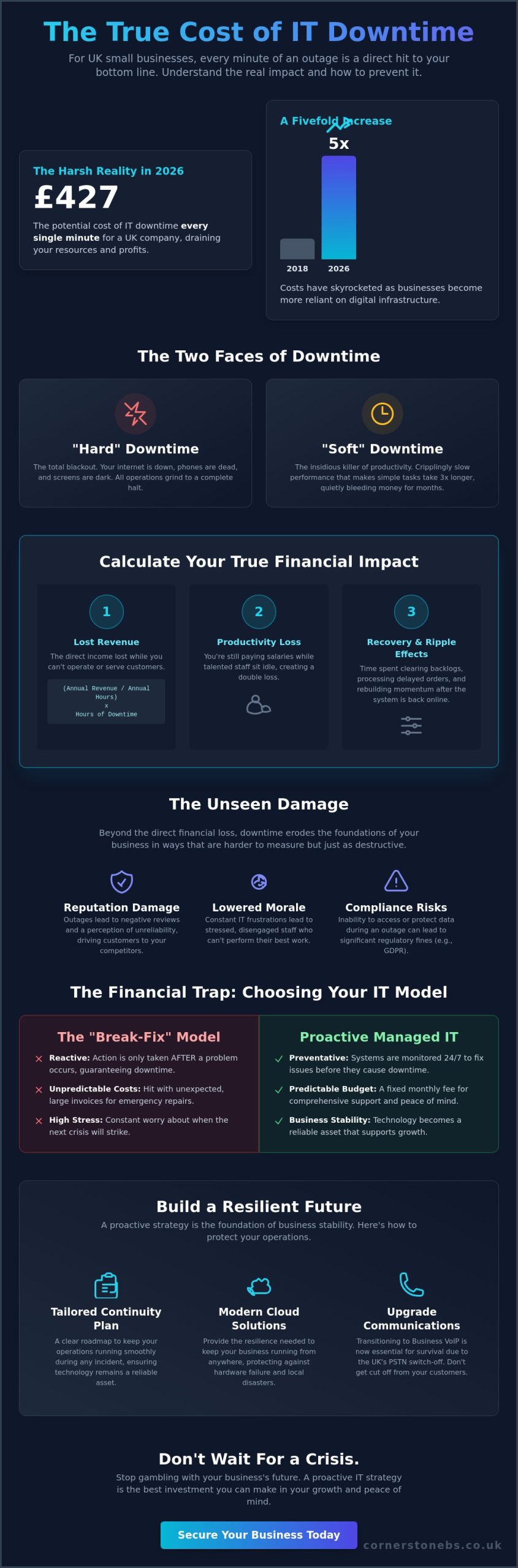
Would you willingly throw £427 into the bin every single minute? For many UK companies, that is the harsh reality of a system outage in 2026. The cost of IT downtime for small business has skyrocketed, seeing a fivefold increase since 2018 as we all become more dependent on digital infrastructure. While a “break-fix” engineer might eventually get you back online, the damage to your bank balance and your reputation often starts long before they arrive at your door.
We understand the frustration of watching talented staff sit idle while customer trust slips away. It’s a stressful position for any business owner, especially when you’re hit with an unexpected invoice for emergency repairs. This guide will show you how to calculate the true financial impact of these outages and why proactive Managed IT Support is the foundation of business stability. We’ll explore the hidden drains on your productivity and provide a clear roadmap to keep your operations running smoothly, ensuring your technology remains a reliable asset for your team. By the end, you’ll have a clear financial justification for IT investment that protects your growth and your peace of mind.
Key Takeaways
Understand the critical difference between a total “hard” blackout and the subtle “soft” downtime that quietly drains your team’s daily productivity.
Learn the precise formula to calculate the true cost of IT downtime for small business, accounting for both lost revenue and the hidden “wage drain” of idle staff.
Discover how system reliability directly impacts your brand reputation and why preventing outages is essential for maintaining positive customer reviews.
Identify why the reactive “break-fix” model is a financial trap and how a proactive approach creates a more predictable, stress-free budget.
Explore how a tailored Business Continuity Plan and modern Cloud Solutions provide the resilience needed to keep your business running from anywhere.
What is IT Downtime and Why Does It Hit Small Businesses Hardest?
Technology is the engine of your business. When that engine stalls, your entire operation grinds to a halt. To understand the cost of IT downtime for small business, we first need to define the problem clearly. What is IT Downtime? It is any period where your digital infrastructure fails to support your core business functions. It isn’t just about a server being “off”; it’s about the inability to serve your customers or keep your team productive.
We see two distinct types of outages in the local business community. “Hard downtime” is the total blackout; your internet is gone, your phones are dead, and your screens are dark. However, “soft downtime” is often more insidious. This is the cripplingly slow performance that makes simple tasks take three times longer than they should. Both versions bleed money, but soft downtime often goes unmeasured for months. While a large corporation might have a backup for every system, a small business often relies on a single point of failure.
Smaller firms feel this impact more acutely because they lack the expensive redundant systems that protect global corporations. In 2026, we find that most outages aren’t caused by natural disasters. Instead, they stem from complex cloud misconfigurations or the silent failure of legacy hardware that has been pushed past its limit. Without a dedicated partner to monitor these systems, a small glitch can quickly snowball into a multi-day crisis. According to 2024 data, 92% of UK businesses require more than 24 hours to recover from a significant IT incident, a delay that most small budgets simply cannot absorb.
Common Triggers of Outages in 2026
Modern outages are rarely random. They are typically the result of three specific vulnerabilities:
Cyber Security breaches: Ransomware and sophisticated phishing attacks remain the primary drivers of unplanned outages. One wrong click can lock your entire network.
Hardware failure: Running end-of-life equipment is a gamble. We often see businesses struggling with aging servers or routers that simply cannot handle 2026 data demands.
Human error: A lack of regular staff training is a major internal vulnerability. Accidental deletions or incorrect settings can be just as damaging as an external attack.
The 2026 Comms Crisis: Legacy Systems
The UK’s PSTN switch-off has permanently changed the landscape for business telecommunications. Companies still clinging to older analogue lines now face total communication isolation as those services are retired. Transitioning to a modern Business VoIP telephone system is no longer just an upgrade; it is a necessity for business continuity. Without it, you risk losing the ability to talk to your customers entirely. This creates a state of total isolation that makes recovery nearly impossible without a modern, cloud-based infrastructure in place.
Calculating the Direct Financial Impact: Revenue and Productivity
We’ve all seen that spinning loading icon and felt a twinge of frustration. In a busy UK office, that tiny icon represents a significant drain on your resources. For a local firm in 2026, the average cost of IT downtime for small business ranges from £137 to £427 per minute. That isn’t just a theoretical figure; it’s cash leaving your business in real-time. To find your specific risk, use the “Lost Revenue” formula: divide your gross annual revenue by your annual business hours, then multiply that by the hours of downtime. It’s a simple calculation that often yields a sobering result.
Beyond direct sales, you must account for the “Wage Drain.” You’re still paying your team’s salaries while they wait for a fix. This creates a double loss: you’re paying for labour that isn’t producing anything. This financial bleed continues even after the “on” switch is flipped. We call this “Recovery Time.” It takes significant effort to clear the backlog of emails, process delayed orders, and regain momentum. This “Butterfly Effect” can even lead to missed deadlines that haunt your contract renewals months later. Understanding The True Cost Of Downtime involves looking at these ripples, not just the initial splash.
The Productivity Drain
Direct Recovery Expenses
If you rely on the reactive “break-fix” model, expect a sting in the tail. Emergency call-out fees are notoriously high, and if your backups fail, specialized data recovery services can cost thousands. Your Recovery Time Objective (RTO) is the maximum acceptable length of time that your business can be offline before the damage becomes irreversible. Investing in robust Disaster Recovery solutions ensures that your RTO remains measured in minutes, not days, protecting your bottom line from unexpected shocks.
The Hidden Costs: Reputation, Morale, and Compliance
The visible invoice for a technical repair is only the tip of the iceberg. When we look at the true cost of IT downtime for small business, the most painful losses are often the ones that don’t appear on a balance sheet immediately. We’re talking about your reputation. In our local community, word travels fast. In 2026, we live in the “Social Proof” era where a single hour of system failure can lead to a permanent 1-star Google review. Potential clients won’t hear your explanation about a server glitch; they’ll simply see a “business that doesn’t answer” and move to your competitor.
Then there is the human element. Your team wants to do a good job, but constant technical hurdles make that impossible. We’ve seen how recurring IT issues lead to deep-seated frustration and, eventually, high staff turnover. It’s exhausting to spend your day “firefighting” instead of focusing on your actual role. For a business owner, this emotional toll is just as heavy. Instead of working on strategic growth, you’re stuck managing a crisis you didn’t ask for. This constant state of high alert leads to burnout and prevents you from being the proactive leader your company needs.
Customer Confidence and Retention
Customers in 2026 have zero patience for the “our systems are down” excuse. They expect seamless digital interaction. If you can’t provide it, the long-term value loss is staggering. A client who has been with you for years might finally decide to move to a more “digitally stable” rival after one too many outages. Conversely, you can use your system reliability as a powerful marketing tool. Showing that you’ve invested in your infrastructure tells your clients that you are a stable, professional partner they can trust for the long haul.
Compliance and Legal Penalties
We must also address the legal risks. Downtime isn’t just an inconvenience; it’s often a red flag for regulators. If an outage results in data loss or a breach of GDPR or NIS2 standards, the financial penalties can be life-changing for a small firm. Think of robust Cyber Security Services as an essential insurance policy. They protect you from the regulatory fallout that follows an unmanaged incident. Investing in your digital safety isn’t just a technical choice; it’s a foundational part of your legal and emotional security.
Why the “Break-Fix” Model is a Financial Trap for SMEs
Waiting for something to break before calling for help feels like a cost-saving measure. In reality, it is a financial trap that leaves your business vulnerable to the highest possible expenses. This reactive approach, often called the “break-fix” model, ensures that you only see your IT technician when your productivity has already hit zero. By the time they arrive, the cost of IT downtime for small business has already begun to spiral through lost sales and idle staff. It is a sticking plaster approach that ignores the underlying health of your digital infrastructure.
The fundamental flaw of break-fix is its lack of strategic planning. A reactive engineer’s goal is to get the specific broken part working again as quickly as possible. They aren’t incentivised to look at why it failed or how to prevent the next crash. This leads to a cycle of “patchwork” IT where systems are held together by temporary fixes rather than a solid foundation. This lack of foresight often results in a “budgeting nightmare” for business owners. You might go three months with no IT costs, only to be hit with a massive, unbudgeted invoice when a critical server finally gives up the ghost.
The Conflict of Interest
In a break-fix relationship, your goals and your provider’s goals are completely misaligned. The technician only makes money when your systems fail. If your network is running perfectly, they aren’t getting paid. This creates a subtle but dangerous conflict of interest. Conversely, our model for Managed IT Services in Teesside aligns our success with yours. We’re incentivised to keep you online because our fixed-fee structure means we work hardest when things are stable. We become a proactive partner invested in your long-term continuity rather than a distant contractor waiting for your next crisis.
Predictable vs. Volatile Spending
Switching to a managed model transforms your IT from an unpredictable “black hole” of expense into a predictable monthly line item. This stability is vital for healthy cash flow management. Proactive maintenance also ensures that your IT Hardware lasts longer, as we identify and resolve minor issues before they cause permanent damage. Emergency repairs are not just stressful; they are expensive. On average, an emergency call-out and a rushed fix cost three times more than a planned, proactive upgrade. You can protect your bottom line by choosing a partner who prevents fires instead of just fighting them. If you are ready to move away from the stress of reactive repairs, contact our local team today for a straightforward chat about your needs.
Building a Resilient Future: How to Eliminate Downtime
Eliminating downtime isn’t about luck; it’s about strategy. A bespoke Business Continuity Plan (BCP) is your first line of defence. This isn’t just a dusty document for corporate giants. It’s a proactive roadmap designed to keep your doors open when others are forced to close. By identifying risks early, you can significantly reduce the potential cost of IT downtime for small business. We work alongside you to build this resilience, ensuring your technology supports your growth instead of hindering it.
Proactive monitoring is the heartbeat of a stable network. We use advanced tools to watch your infrastructure around the clock, catching silent failures before they escalate into full-blown crises. This “always-on” approach means we’re often resolving issues before your staff even arrive at their desks. As a multi-award-winning partner, we take that weight off your shoulders. This allows you to focus on leading your business with total confidence in your system reliability.
Modern Cloud & Disaster Recovery
Modern Cloud Solutions have revolutionised resilience for local firms. Platforms like Microsoft 365 and Azure provide built-in redundancy that protects your data from local hardware failures. We always implement the “3-2-1” backup rule for Disaster Recovery. You should have three copies of your data, stored on two different types of media, with one copy safely off-site. This simple but powerful framework ensures your information remains secure and accessible, no matter what happens at your physical office.
Partnering for Success
Generic, off-the-shelf fixes rarely solve complex business challenges. You need technology that is as unique as your company. Our team provides bespoke solutions and a dedicated helpdesk that knows your business personally. We don’t just fix computers; we build long-term partnerships rooted in our regional community. If you’re concerned about your current system reliability, we invite you to a no-obligation conversation to audit your current risk level. Let’s talk about how we can secure your future together.
Secure Your Business Stability Today
Your company deserves more than just “getting by” with reactive repairs. We’ve explored how the true cost of IT downtime for small business reaches far beyond the technical fix, impacting your brand reputation and team morale. By shifting from the “break-fix” trap to a proactive partnership, you turn your technology into a silent engine of growth rather than a constant source of anxiety.
As a multi-award-winning IT services provider, we combine our local roots with global strength through strategic partnerships with Microsoft, IBM, and Cisco. Our proactive 24/7 system monitoring identifies potential threats before they interrupt your workday, providing the emotional security you need to focus on your goals. It’s about building a foundation that doesn’t just survive an outage but prevents it from happening in the first place.
How do you calculate the hourly cost of IT downtime?
You can calculate this by adding your lost revenue to your total wage drain. Divide your gross annual revenue by your annual business hours to find your hourly revenue risk. Add the hourly salary costs of all idle staff members during the outage to find the true hourly impact on your bottom line.
What are the most common causes of IT downtime for small businesses in the UK?
Cyber security breaches, such as ransomware, and the failure of legacy hardware are the primary triggers in 2026. Many local firms also face outages due to cloud misconfigurations or issues related to the PSTN switch-off. Human error, often caused by a lack of staff training, remains a significant internal vulnerability for smaller teams.
How can managed IT services actually reduce my business costs?
Managed support replaces unpredictable emergency repair bills with a fixed, predictable monthly fee. Proactive monitoring catches minor glitches before they escalate into expensive crises, which significantly lowers the overall cost of IT downtime for small business. This approach also extends the lifespan of your hardware through regular, expert maintenance.
Is “soft downtime” like slow internet as expensive as a total outage?
Soft downtime is often more expensive over the long term because it acts as a silent drain on productivity. While a total blackout is obvious, slow systems cause daily “micro-downtime” that disrupts concentration and employee morale. These small delays can add up to dozens of lost hours per employee every single year.
Does cyber insurance cover the cost of lost productivity during downtime?
Cyber insurance policies vary, so you must check for specific “business interruption” clauses in your agreement. While many policies cover data recovery and legal fees, they don’t always compensate for the daily productivity lost while systems are offline. It is better to use proactive security as your primary defence and insurance as a final safety net.
How often should a small business test its disaster recovery plan?
We recommend testing your plan at least once a year or whenever you implement major system changes. Regular testing confirms that your backups are healthy and that your team knows their specific roles during an emergency. This practice ensures that a real incident feels like a practiced drill rather than a chaotic crisis.
What is the difference between RTO and RPO in business continuity?
RTO stands for Recovery Time Objective, which is the target time for getting your systems back online. RPO, or Recovery Point Objective, refers to the maximum amount of data you can afford to lose, measured in time. For instance, if you back up your data every four hours, your RPO is four hours.
Can cloud migration help eliminate IT downtime?
Cloud migration significantly reduces downtime by removing reliance on a single piece of local hardware. Platforms like Microsoft 365 allow your team to remain productive from any location if your physical office faces an issue. This built-in redundancy provides a level of resilience that was previously only available to large corporations.
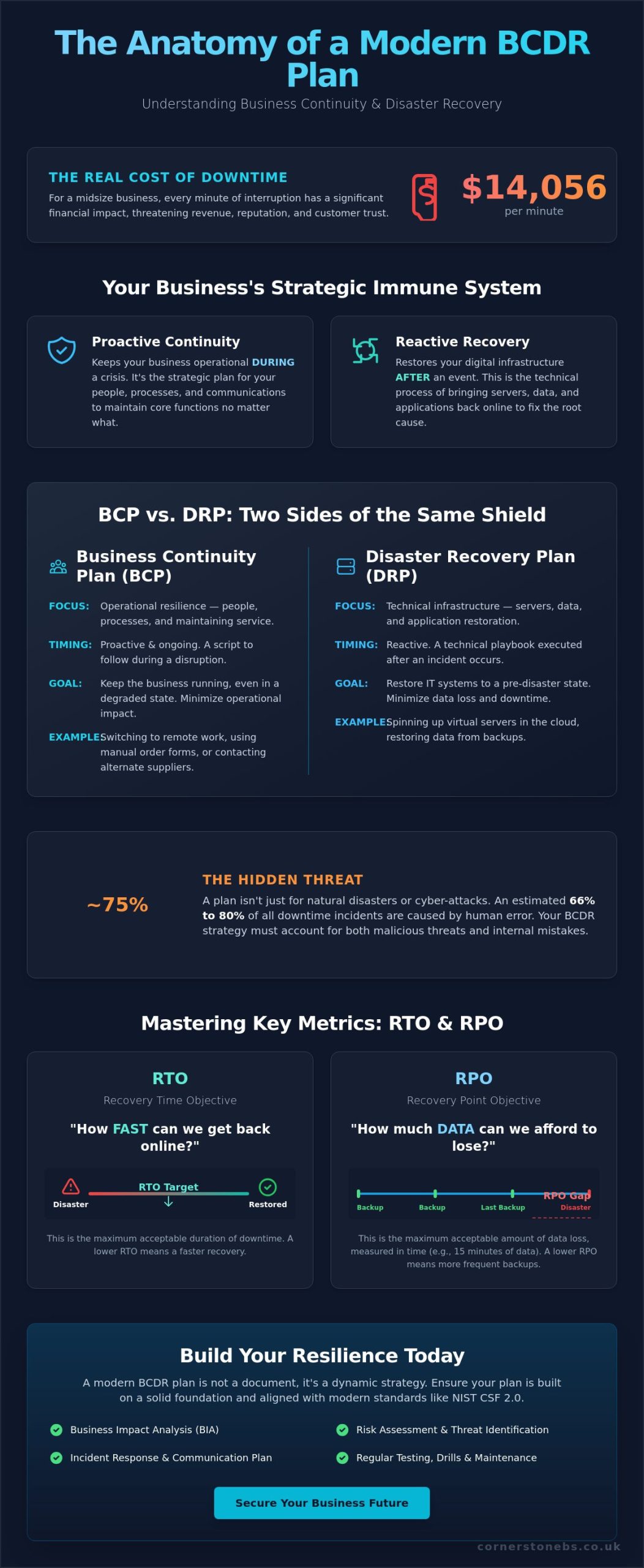
Did you know that for a midsize business, the average cost of IT downtime has climbed to a staggering $14,056 per minute? It’s a terrifying figure that keeps many local business owners awake at night. You likely already feel the weight of this risk every time a server lags or a new cyber threat hits the headlines. To protect your future, you need to understand exactly what is a business continuity and disaster recovery plan and how it serves as your company’s strategic immune system. Between the fear of data loss and the confusion of technical jargon like RTO and RPO, it’s easy to feel like you’re just waiting for the next crisis to strike.
We’re here to clear the air and provide a clear roadmap for your protection. You’ll discover how a unified BCDR strategy keeps your doors open, your data safe, and your team productive. We will break down the essential components of a modern plan, from the latest NIST CSF 2.0 standards to the May 2026 updates for NIST SP 800-172. Our goal is to replace that anxiety with the peace of mind that comes from knowing your business is built to survive and thrive right here in our community.
Key Takeaways
Gain a clear understanding of what is a business continuity and disaster recovery plan and why it’s the foundation of modern business resilience.
Learn the vital difference between proactive continuity planning and reactive technical recovery to keep your operations running smoothly during a crisis.
Calculate the true impact of downtime on your revenue and brand reputation to prioritize your most critical business functions.
Master essential metrics like RTO and RPO to set clear, achievable targets for getting your digital infrastructure back online.
Identify how a professional audit reveals hidden blind spots in your current setup, ensuring your long-term stability and peace of mind.
Defining Business Continuity and Disaster Recovery (BCDR)
Think of your business as a living organism. In a world where digital threats and physical disruptions are constant, your organization needs more than just a simple backup. It needs an immune system. To truly understand what is a business continuity and disaster recovery plan, you have to look at it as a unified strategy for resilience. A healthy immune system doesn’t just wait for a virus to strike. It constantly monitors for threats, responds instantly when an intrusion occurs, and manages the recovery process so the body can return to full strength. BCDR performs these exact functions for your company.
The “Business Continuity” Element
Business continuity is the operational side of the shield. Its primary goal is to keep the lights on while a crisis is unfolding. This involves your people, your processes, and your communication channels. It’s about maintaining operational resilience so that your core functions don’t grind to a halt. Business continuity planning ensures that every team member knows their role when the unexpected occurs. It provides a clear script for a difficult day, reducing panic and protecting your brand’s integrity.
Remote Work Shifts: Instantly moving your team to home-based setups if your office becomes inaccessible.
Manual Workarounds: Having processes in place to take orders or provide service even if specific software is temporarily offline.
The “Disaster Recovery” Element
While continuity focuses on the “now,” disaster recovery focuses on the “how.” This is the technical restoration of your digital infrastructure after an event. It’s the process of bringing your servers, data, and applications back online in a prioritized, orderly fashion. Disaster recovery is what fixes the underlying cause of the disruption. Modern cloud solutions have revolutionized this process. By leveraging secure off-site environments, we can often spin up virtual versions of your entire network in minutes. This ensures that your technical heartbeat remains strong, even if your physical hardware fails.
BCP vs DRP: Understanding the Critical Differences
Many business owners ask what is a business continuity and disaster recovery plan, often assuming these two terms are interchangeable. They aren’t. While they share the same goal of protecting your livelihood, they operate on different levels. Think of Business Continuity (BCP) as the strategy for your people and processes. It’s the proactive roadmap that keeps your operations moving during a crisis. Disaster Recovery (DRP), on the other hand, is the technical subset. It’s the reactive process of restoring your digital heartbeat after an event has occurred. You don’t just need one or the other; you need a unified strategy that bridges the gap between your staff and your servers.
Feature
Business Continuity (BCP)
Disaster Recovery (DRP)
Focus
Operational resilience and people
Technical infrastructure and data
Timing
Immediate and ongoing
Post-event restoration
Stakeholders
HR, Operations, Management
IT Team, Vendors, Support Partners
Primary Goal
Keeping the business open
Restoring specific IT systems
Scope and Timing: Who Does What and When?
The moment a disruption is detected, your BCP springs into action. This plan dictates how your team communicates and where they go to work. It’s about containment and survival. Once the initial crisis is stable, your DRP kicks in to handle the heavy lifting of data restoration. This phase involves your technical partners working to bring your servers and applications back online. It’s a relay race where the BCP handles the first lap and the DRP brings you across the finish line. If you’re ready to create a business continuity plan, you must involve both your operations managers and your IT experts from day one.
Why One Cannot Succeed Without the Other
Restoring your data is a technical victory, but it’s hollow if your staff don’t know how to access it from a remote location. Conversely, having a perfect remote work policy is useless if your servers are offline and your files are inaccessible. This is why a unified managed IT services approach is so valuable. It ensures your technical recovery and operational plans are perfectly synchronized. When these two elements work in harmony, you eliminate the confusion that often leads to costly delays. We’ve seen that businesses with integrated plans recover significantly faster than those that treat IT and operations as separate silos. If you’re concerned about your current setup, a quick conversation with a local expert can often reveal simple ways to tighten these connections.
The Real Cost of Downtime: Why Your Business Needs a Plan
Operating without a plan is like driving without a seatbelt. You might be fine for years, but the one time you need it, nothing else matters. We’ve seen that over 90% of midsize and large companies report that just one hour of downtime costs them more than $300,000. These figures are why local business owners are increasingly treating BCDR as a foundational investment rather than an optional expense. By securing your operations today, you’re not just buying software; you’re buying the future of your company.
Beyond the Ransomware Threat
While ransomware gets the headlines, it’s often the simpler things that bring a business to its knees. Network outages account for 31% of all IT service incidents. Even more common is human error, which contributes to between 66% and 80% of all downtime. This is where our cyber security services integrate directly with your recovery strategy. We don’t just build walls; we build paths for recovery. Resilience is the ability to absorb a shock and keep moving. It means that when a server fails or a staff member clicks the wrong link, your operations don’t collapse. Instead, your systems adapt and recover without the customer ever noticing a glitch.
The Emotional Security of a Robust Plan
There’s an often-overlooked human element to what is a business continuity and disaster recovery plan: emotional security. When a crisis hits, the “panic factor” in the boardroom can be just as damaging as the technical failure itself. A robust plan provides a clear, step-by-step script that replaces chaos with calm, decisive action. Your leadership team can breathe easier knowing exactly what happens next. Your staff feel supported because they have the tools and instructions to keep working safely, even during major operational shifts. By staying steady when others might falter, you turn a potential disaster into a powerful demonstration of your reliability. It shows your clients that you’re a stable, long-term partner they can depend on, no matter what happens in the wider world.
Key Components of an Effective BCDR Strategy
Building a resilient business requires more than just good intentions. It demands a structured approach. When you look at what is a business continuity and disaster recovery plan from a practical perspective, it’s actually a collection of five core pillars. These pillars ensure that your response isn’t based on guesswork but on verified data and pre-defined steps. Without these components, even the most talented team will struggle to stay organized during a major outage. We focus on building these foundations so you can lead with confidence when it matters most.
Understanding RTO and RPO: The Two Most Important Metrics
These are the two most important technical metrics in your strategy. Recovery Time Objective (RTO) defines how quickly you must be back up and running. Recovery Point Objective (RPO) determines how much data loss your business can actually tolerate. For example, if your RPO is 4 hours, you cannot afford to lose more than 4 hours of work. If you only back up once every 24 hours, your RPO is 24 hours. That’s a catastrophic gap for most modern firms. We work with you to align these technical targets with your real-world business needs.
The Business Impact Analysis (BIA) Framework
Building these components into a unified strategy is how we help local businesses stay strong. If you aren’t sure where your current recovery targets stand, our team can help you define these goals with a professional disaster recovery assessment.
Implementing BCDR with a Managed IT Partner
You now have a clear picture of what is a business continuity and disaster recovery plan, but the real challenge lies in execution. DIY strategies often fail because they lack the rigorous testing and maintenance that a complex digital environment requires. It’s easy to overlook a small configuration error that could lead to a massive data loss during a crisis. An external audit provides the fresh perspective needed to find these blind spots before they become liabilities. As an award-winning team with deep regional roots, we take pride in being a proactive partner for our clients. We don’t just fix problems; we build systems that prevent them from occurring in the first place.
Moving from transactional IT support to a long-term resilience partnership is a strategic shift for any business owner. It means you aren’t just calling someone when a server breaks. Instead, you have an expert team constantly refined by industry accolades and local experience working to secure your future. This collaborative approach ensures that your technical support is a foundational element of your business stability. We want you to feel the confidence that comes from knowing your operations are backed by a team that truly cares about your success in our community.
The Advantage of Proactive Monitoring
Our proactive monitoring doesn’t just respond to disasters; it stops them before they happen. Through predictive maintenance, we identify potential hardware failures or network bottlenecks before they cause downtime. This level of oversight is a foundational element of your emotional security. For instance, a successful Microsoft 365 migration must include built-in backup protocols to ensure your cloud data is just as protected as your on-site files. Expert oversight means you don’t have to worry about whether your backups ran last night. We’ve already verified them for you.
Next Steps: From Strategy to Action
Taking action is the only way to secure your business future. We recommend starting with a comprehensive resilience audit to benchmark your current state against industry standards. This isn’t a one-size-fits-all process. We customize every strategy to your specific industry and risk profile, ensuring your plan is as unique as your business. It’s time to replace anxiety with a clear roadmap. We invite you to book a consultation with our expert team for a friendly conversation about your continuity goals. Let’s work together to make sure your business stays strong, no matter what challenges come our way.
Building Your Business’s Strategic Immune System
You’ve seen the data and the risks. Protecting your operations means moving beyond simple backups toward a unified strategy that bridges the gap between your people and your technical infrastructure. Now that you understand what is a business continuity and disaster recovery plan, you have the knowledge to move from a reactive stance to a proactive one. Every minute saved during an outage protects your reputation and your revenue. Resilience isn’t just about surviving a crisis; it’s about maintaining the trust you’ve built with your customers and your community.
As a multi-award-winning IT services provider with deep regional roots, we’re here to help you navigate these complexities. Our partnerships with industry leaders like Microsoft, IBM, and Cisco ensure you receive world-class solutions tailored to your local needs. We use proactive system monitoring to identify threats before they impact your workflow. Secure your business resilience with a professional BCDR audit from Cornerstone. Taking this first step gives you the peace of mind that your company is built to last. Let’s start a conversation today to ensure your organization remains strong, stable, and ready for whatever comes next.
Frequently Asked Questions
What is the main difference between business continuity and disaster recovery?
Business continuity keeps your operations running during a disruption while disaster recovery restores your technical infrastructure afterward. Think of continuity as the plan for your staff to work from home using business mobile devices. Disaster recovery is the technical process of spinning up your servers from a cloud backup. Both are essential parts of a unified resilience strategy for any local organization.
How much does a business continuity plan cost to implement?
The cost varies based on your business size, complexity, and the specific recovery targets you set. Factors include the volume of data you protect and the speed of recovery required. We recommend a professional audit to determine the right investment for your specific risk profile. This ensures you aren’t overspending on unnecessary tools while leaving critical gaps in your security and operational stability.
Does my business need a BCDR plan if we use cloud services like Microsoft 365?
Yes, because cloud providers are responsible for the infrastructure while you remain responsible for your own data. Microsoft 365 protects against their system failures, but it doesn’t protect you from accidental deletion or ransomware within your own account. A formal plan ensures you have independent backups and a roadmap to restore access if your primary cloud login is compromised by a cyber threat.
How often should we test our disaster recovery plan?
You should test your plan at least once or twice a year, or whenever you make significant changes to your IT environment. Regular “fire drills” ensure that your staff remembers their roles and that your technical backups actually work. Testing reveals hidden bottlenecks in your recovery process before a real emergency strikes. It turns a theoretical document into a proven operational tool you can trust.
What is a Recovery Time Objective (RTO) and why does it matter?
RTO is the maximum amount of time your business can afford to be offline before the damage becomes terminal. It matters because it dictates the type of technology you need to invest in. A short RTO might require instant failover systems, while a longer RTO allows for slower restoration from off-site storage. Defining this clearly helps you balance your budget with your actual survival needs.
Can a small business survive without a formal BCDR plan?
While some survive by luck, most small firms struggle to recover from a major data loss or a week of downtime. Without a plan, the “panic factor” often leads to poor decisions that escalate the initial crisis. A formal strategy provides the structure needed to stay calm and follow a proven path to recovery. It is the difference between a temporary setback and a permanent closure.
What are the most common causes of business disruption in 2026?
Who should be responsible for the BCDR plan within our company?
Responsibility should be shared between a senior leader who understands business priorities and an IT partner who manages the technical execution. This ensures that the plan covers both operational needs and digital infrastructure. While the leadership team makes the final decisions on recovery objectives, your managed IT provider handles the day to day monitoring and testing. Collaboration is the key to a plan that actually works.
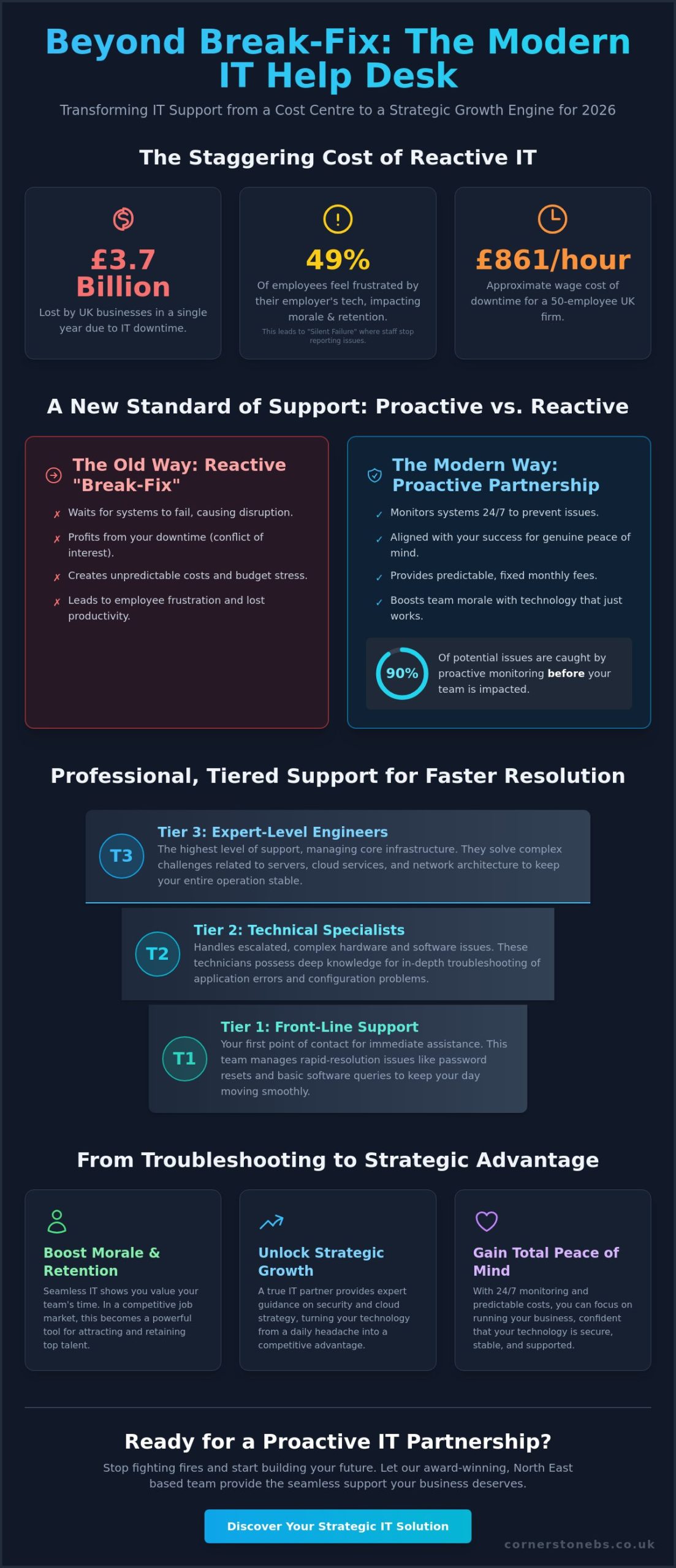
Your IT help desk shouldn’t just be a digital fire brigade waiting for something to break. You likely already feel that even a 5 percent drop in staff productivity due to recurring tech glitches is far too much. It’s a common frustration for many UK leaders, especially when research from Beaming shows that IT downtime cost British businesses £3.7 billion in a single year. You deserve systems that stay up, costs that stay level, and a local team that answers the phone before the second ring.
We’re here to show you that proactive support is the only standard that matters for 2026. This guide reveals how our award-winning approach transforms technical support into a strategic engine for your business growth. You’ll discover how to achieve seamless technology that just works, gain total peace of mind with predictable monthly fees, and get expert guidance on the latest security trends. We’ll walk you through how a true partnership turns your IT from a daily headache into your biggest competitive advantage.
Key Takeaways
Learn how a modern it help desk has evolved from a simple repair service into a proactive, strategic engine for your company’s growth.
Identify the hidden costs of “silent failure” and discover how high-quality support directly improves employee morale and long-term retention.
Compare the benefits of in-house staff against an award-winning managed service provider to bridge the expertise gap in cloud and security.
Use our 2026 evaluation checklist to look beyond basic SLAs and understand the crucial difference between response times and actual resolution.
Explore how a partnership with a dedicated North East expert ensures your systems are monitored 24/7, providing total peace of mind.
What is a Modern IT Help Desk? Beyond the “Break-Fix” Mentality
A modern it help desk is no longer just a reactive repair shop. It functions as a single point of contact (SPOC) for every technological hurdle your team faces. This evolved form of Technical support ensures your staff stay productive rather than staring at loading screens. It acts as the vital bridge between your complex cloud infrastructure and your daily output. By centralising support, you eliminate the frustration of staff not knowing who to call when a laptop fails or a software update goes wrong.
The old “break-fix” model is a relic of the past. In that outdated system, a provider only turned up when something failed. This created a conflict of interest because they profited from your downtime. Today, we focus on a proactive, managed service approach. Our award-winning team monitors your systems 24/7. We identify potential glitches before they become expensive disasters. This shift delivers genuine peace of mind for North East business owners. You get multi-channel support through phone, email, and live chat. Your team gets help exactly how they want it, when they need it.
Help Desk vs. Service Desk: Understanding the Difference
The Core Components of a Professional IT Support Tier
A structured support system ensures your queries don’t get lost in a void. We organise our expertise into three distinct tiers to provide the fastest possible resolution:
Tier 1: This is the front line. These technicians handle basic troubleshooting and immediate resolutions. They manage password resets and simple software queries that keep your day moving.
Tier 2: These specialists handle more complex hardware and software challenges. They possess the specialist knowledge to dive deeper into configurations and application errors.
Tier 3: This is expert-level support. These engineers manage your server, cloud, and network infrastructure. They solve the high-level challenges that underpin your entire operation.
Our North East based team brings this structured, professional approach to every client. We don’t just close tickets; we build relationships. This ensures your technology remains a foundation for success, not a source of stress. It’s about providing a seamless experience that respects your time and your budget.
The Business Impact: From Troubleshooting to Strategic Growth
A high-performing it help desk does more than fix broken laptops; it builds a culture of efficiency. When technology works, your team stays focused and motivated. When it fails, morale drops quickly. Research from Ivanti indicates that 49% of employees feel frustrated by the tech provided by their employer, which directly impacts staff retention. In the competitive North East job market, providing seamless IT is a powerful tool for keeping your best talent. It shows your team that you value their time and their professional experience.
Many organisations suffer from “silent failure.” This happens when staff stop reporting glitches because they’ve lost faith in the fix. They develop “workarounds” that waste time and compromise security. Our award-winning team uses data-driven insights to spot these recurring technical bottlenecks. If ten people report the same minor lag, we don’t just fix it ten times; we identify the root cause to eliminate the problem for good. This proactive approach is a core pillar of our managed IT services strategy, turning your IT from a cost centre into a growth engine.
Reducing the Real Cost of Downtime
The cost of an idle workforce is staggering. Based on the 2024 ONS average UK salary of £35,828, a firm with 50 employees loses roughly £861 in basic wages for every hour the network is down. That doesn’t account for lost sales or reputational damage. Our systems use proactive monitoring to catch 90% of potential issues before your team even notices a flicker. Proactive Maintenance is the act of solving tomorrow’s problems today.
The Help Desk as Your First Line of Cyber Defence
Your it help desk is often the first to spot a coordinated attack. In 2024, the Cyber Security Breaches Survey reported that 84% of UK businesses experienced phishing attempts. When an employee calls about a suspicious email, our agents provide immediate guidance, stopping a breach before it starts. We handle rapid patch management and software updates behind the scenes to close vulnerabilities instantly. This responsiveness is vital to the success of your broader cyber security services, ensuring your business remains resilient against evolving threats and giving you total peace of mind. If you’re worried about your current setup, we’re always happy to have a quick chat about your needs.
Outsourced vs. In-House IT Help Desks: A Comparative Analysis
Deciding between hiring an internal technician or partnering with an award-winning managed service provider is a pivotal moment for any growing UK business. Many owners start by looking for a “lone wolf” IT person to sit in the office. However, the “expertise gap” in 2026 makes this a risky strategy. A single employee simply cannot master every niche, from complex cybersecurity protocols and hardware repairs to intricate cloud infrastructure. When you choose a professional it help desk, you aren’t just hiring a person; you’re gaining a team of specialists.
Operational continuity is another major hurdle for internal teams. If your lone IT manager takes a holiday, attends a training day, or calls in sick, your technical support effectively vanishes. This leaves your staff vulnerable and your operations at a standstill. By contrast, an outsourced team provides seamless 24/7 coverage that keeps your business running regardless of individual schedules. Integrating strategic IT company solutions allows your business to scale with confidence, knowing the foundational support is always there to catch you.
Cost Efficiency and Predictable Budgeting
The financial reality of an internal hire often surprises business owners. A mid-level IT professional in the UK typically commands a salary between £30,000 and £40,000. When you add Employer National Insurance contributions, pension auto-enrolment, and the cost of ongoing training, the total investment often exceeds £50,000 per year. That doesn’t even include the workspace or equipment they need to do the job.
Outsourcing flips this model. It turns a heavy capital expenditure into a predictable, fixed monthly operational expense. For most SMEs, an “unlimited support” contract offers far better value than a single salary. You get a full department’s worth of knowledge for a fraction of the cost of one senior hire, making your budget much easier to manage as you grow.
Access to Enterprise-Grade Tools and Knowledge
Partnering with a dedicated it help desk gives you immediate access to high-end ticketing, monitoring, and security software. These tools are often too expensive for a single business to license individually, but MSPs provide them as part of the service. You benefit from a “collective brain” where solutions discovered for one client are proactively applied to your own systems.
This depth of expertise is essential for complex projects that go beyond daily fixes. Whether you are planning a Microsoft 365 migration for business UK or overhaulng your remote work security, having a team that has successfully completed these tasks hundreds of times is invaluable. It ensures your projects are delivered on time and without the costly trial-and-error often seen with smaller, internal teams.
How to Evaluate an IT Help Desk Provider: The 2026 Checklist
Choosing the right it help desk partner in 2026 requires looking past the glossy brochures. You need a team that acts as an extension of your own office. While many providers promise speed, the best ones deliver results that actually move your business forward. Evaluation starts with understanding the fine print of a Service Level Agreement (SLA). A robust SLA shouldn’t just promise a quick reply; it must guarantee quality. You deserve a partner who values your uptime as much as you do.
Distinguishing between response time and resolution time is vital. A response is simply an acknowledgement that your ticket exists. Resolution time tracks how long it takes to actually fix the problem. In 2025, industry data showed that 74% of UK business owners felt frustrated by “fast” responses that led to days of waiting for a solution. Look for an award-winning team that prioritises getting you back to work, not just ticking a box.
Key Performance Indicators (KPIs) That Actually Matter
First-Contact Resolution (FCR): This is the ultimate gold standard. We aim to solve your issue during the very first interaction. High FCR rates indicate a highly skilled technical team rather than a simple call-logging service.
Customer Satisfaction (CSAT) Scores: Don’t just take their word for it. Ask for verified CSAT data. A provider that cares about the user experience will consistently maintain scores above 95% in the UK market.
Ticket Volume Trends: A proactive partner works to put themselves out of a job. If your ticket volumes aren’t decreasing over time, your provider isn’t performing enough preventative maintenance.
Security and Compliance Standards
Your data is your most valuable asset. Verify that any potential partner holds ISO 27001 certification and is accredited with Cyber Essentials Plus. These aren’t just badges; they prove the provider follows rigorous security frameworks. Ask to see their disaster recovery and business continuity plans. If they can’t protect their own business, they can’t protect yours. SLA Transparency is the provider’s willingness to share real-time performance data through a live dashboard or portal. This openness builds the foundation of a trusted partnership.
Cultural fit is the final piece of the puzzle. Technical skills are a baseline, but “human” communication is what makes a partnership thrive. You want a local expert who speaks your language, avoids unnecessary jargon, and understands the North East business landscape. Technology should simplify your life, not complicate it. We pride ourselves on being approachable, professional, and deeply committed to the success of our community.
Ready to experience a different level of support? Chat with our award-winning team today to see how we can streamline your business technology.
Seamless Support with Cornerstone: Your Award-Winning IT Partner
Cornerstone Business Solutions isn’t just another name in a directory. We’re a multi-award-winning national IT provider that prides itself on delivering excellence with a personal touch. We understand that a modern it help desk must be more than a reactive safety net. Our approach is built on proactive vigilance. We monitor your systems 24/7 to identify and squash potential threats before they ever cross your radar. In fact, our proactive monitoring prevents the vast majority of common system failures from causing any downtime at all, keeping your team productive around the clock.
We reject the “one-size-fits-all” mentality. Your business has its own rhythm, goals, and requirements. Our bespoke philosophy means we build your IT infrastructure from the ground up to match your specific operational needs. To ensure this high standard, we maintain strategic partnerships with global tech giants including Microsoft, Cisco, and IBM. This gives you enterprise-grade power paired with local, dedicated service. Our clients benefit from:
Round-the-clock system health checks and performance monitoring.
Direct access to certified engineers who know your business by name.
Tailored hardware and software roadmaps designed for long-term ROI.
Proactive security patching that stays ahead of 2026’s emerging threats.
The Cornerstone Difference: Professional Authority, Regional Warmth
We’ve built our reputation on a unique blend of high-level technical expertise and approachable, regional warmth. While we operate on a national scale, our North East roots define our “can-do” attitude. We’re here to provide genuine peace of mind. When you trust us with your systems, you’re free to focus entirely on business growth rather than troubleshooting. We’ve established ourselves as a premier partner for IT solution support across the UK, supporting over 250 organisations to manage their digital environments with total confidence.
Ready for a Better IT Experience?
If your current it help desk feels like a bottleneck, it’s time to elevate your expectations. A seamless and robust IT infrastructure isn’t a luxury; it’s a necessity for staying competitive in 2026. We’d love to have a chat about the specific challenges you’re facing right now. Whether you’re worried about cybersecurity vulnerabilities or looking to migrate to more efficient cloud systems, we have the tools and the team to help. Book a discovery call with the Cornerstone team today and let’s build a partnership that lasts.
Future-Proof Your Business Support for 2026
Your business deserves more than a reactive fix when things go wrong. Moving into 2026, the right it help desk acts as a strategic engine for growth, shifting focus from simple troubleshooting to proactive system health. By using a structured evaluation checklist and choosing a partner with 24/7 system monitoring, you ensure your team stays productive and your data remains secure. It’s about finding that perfect balance between global expertise and local reliability.
As a multi-award-winning IT services provider, Cornerstone Business Solutions brings professional authority to your North East operations. We aren’t just another vendor; we’re strategic partners with industry giants like Microsoft, IBM, and Cisco. This allows us to deliver robust, tailored solutions that provide genuine peace of mind. We’ve built our reputation on being approachable experts who simplify complex tech so you can focus on your core goals.
Let’s have a chat about how we can protect your infrastructure and power your success. Your journey toward seamless technology starts with a single conversation.
Frequently Asked Questions
What is the standard response time for an IT help desk?
Standard response times for an it help desk depend on your Service Level Agreement (SLA), but most UK providers aim for a 15 minute response for critical issues. For standard tickets, you’ll typically see a response within 4 hours. Our award-winning team focuses on rapid resolution because we know every minute of downtime impacts your bottom line. We use proactive monitoring to catch 82% of issues before you even notice them.
Can an IT help desk support remote and hybrid workers?
Yes, modern IT support is built to empower remote and hybrid teams across the UK. We use secure remote access tools and cloud-based management to fix issues whether your staff are in the office or at home. This ensures your team stays productive and secure on any network. We’ve seen a 45% increase in remote support requests since 2022, and our systems are fully optimized for this flexible way of working.
What is the difference between an IT help desk and a service desk?
An it help desk focuses on tactical, immediate fixes for technical problems, while a service desk takes a broader, strategic approach to your entire IT lifecycle. Think of the help desk as the team that fixes your laptop, whereas the service desk manages the overall service delivery and business goals. Both are essential for a seamless technology experience. We provide a blend of both to ensure your business stays operational and future-proof.
How much does outsourced IT help desk support cost in the UK?
Outsourced IT support in the UK typically costs between £20 and £75 per user, per month, according to 2024 industry benchmarks. These prices vary based on the level of cover, such as 24/7 monitoring or basic business hours support. Choosing a fixed-fee model provides peace of mind and makes budgeting simple for North East business owners. This investment often results in a 30% reduction in long-term infrastructure costs.
Do I need a local IT help desk provider, or can they work remotely?
You don’t strictly need a local provider for daily tasks, but having a North East based team offers a massive advantage for hardware failures. While 95% of IT issues are resolved remotely, physical presence matters when a server goes down or a router fails. We combine the efficiency of remote support with the reassurance of local engineers who can be on-site quickly. This hybrid approach gives you the best of both worlds.
What happens if my IT help desk can’t fix a problem remotely?
If a problem can’t be fixed remotely, we dispatch an engineer to your site to handle the hardware or connectivity issue in person. Our award-winning service includes rapid on-site response times to minimize your downtime. We keep a stock of critical spares to ensure we can swap out faulty equipment immediately. This proactive approach ensures your business continuity isn’t threatened by physical equipment failure.
How does an IT help desk help with cyber security compliance?
An it help desk maintains your cyber security compliance by managing regular software patches, multi-factor authentication, and antivirus updates. We help UK businesses meet Cyber Essentials standards, which can reduce cyber risks by up to 80% according to government data. Our team acts as a proactive shield, monitoring your network for threats around the clock. This partnership ensures your data remains safe and your business stays compliant with UK regulations.
What information should I have ready when calling the help desk?
You should have your asset tag or computer name, a brief description of the error, and any specific error codes ready when you call. It’s also helpful to know exactly what you were doing when the problem started. Providing these details helps our experts jump straight to the solution. This clear communication allows us to resolve your ticket faster and gets your day back on track without unnecessary delays.