
What if the most expensive part of your IT contract isn’t the monthly fee, but the silence you hear when a critical system fails? We’ve seen too many local businesses struggle with sluggish response times and “out of scope” invoices that make budgeting impossible. You likely feel the weight of rising cyber threats and want a partner who offers clear security guidance rather than just jargon. Finding the right fit starts with the specific questions to ask a potential IT support company to ensure they can handle the complexities of 2026.
We promise to provide a comprehensive vetting framework that identifies a proactive, secure, and strategic partner for your business. Whether it’s managing new regulations like the Texas Responsible AI Governance Act or shifting from old-school SLAs to modern Experience-Level Agreements, you need an award-winning team that stays ahead of the curve. This guide previews 21 essential questions designed to help you secure predictable costs and total peace of mind. Let’s find an IT partnership that supports your growth and keeps your North East business thriving.
Key Takeaways
- Learn how to move beyond reactive “break-fix” support by choosing a partner that aligns with your specific industry growth goals.
- Master the essential questions to ask a potential IT support company to uncover hidden costs in hardware, licensing, or site visits.
- Ensure your business stays resilient and compliant with 2026 regulations by vetting a provider’s internal security standards and expertise.
- Discover the difference between simple response times and actual resolution times to keep your team productive.
- Identify the red flags in IT contracts and what an award-winning, seamless onboarding process should look like for your business.
The Vetting Process: Why Asking the Right IT Questions Matters in 2026
The days of calling a technician only when a server goes dark are long gone. In 2026, business moves too fast for reactive “break-fix” models that only address problems after they’ve caused damage. You need a proactive approach that stops issues before they interrupt your morning coffee. This shift defines why your vetting process is so critical. When you prepare your list of questions to ask a potential IT support company, you aren’t just looking for a repairman. You’re searching for a long-term technology partner who understands your specific North East business goals and regional challenges.
Choosing the wrong provider based solely on a low monthly invoice often leads to hidden costs that dwarf the initial savings. A single afternoon of downtime can cost thousands in lost productivity and missed opportunities. We believe IT should be a predictable investment, not a source of constant financial surprises. By asking the right questions now, you ensure your technology acts as a sturdy foundation rather than a fragile ceiling. It’s about finding a team that values your uptime as much as you do.
Moving Beyond the Helpdesk
Technical expertise has become a baseline requirement. Most providers can reset a password or set up a laptop without much trouble. What differentiates an award-winning managed service provider is their ability to align technology with your commercial strategy. They should speak your language, not just code. This partnership-first mindset means they care about your bottom line and your future scalability. A strategic IT partner acts as a powerful catalyst for your business growth.
The Consequences of Getting It Wrong
A poor fit doesn’t just mean slow internet or a grumpy helpdesk. It exposes your business to severe risks that can take years to recover from. Consider these common pitfalls of a weak partnership:
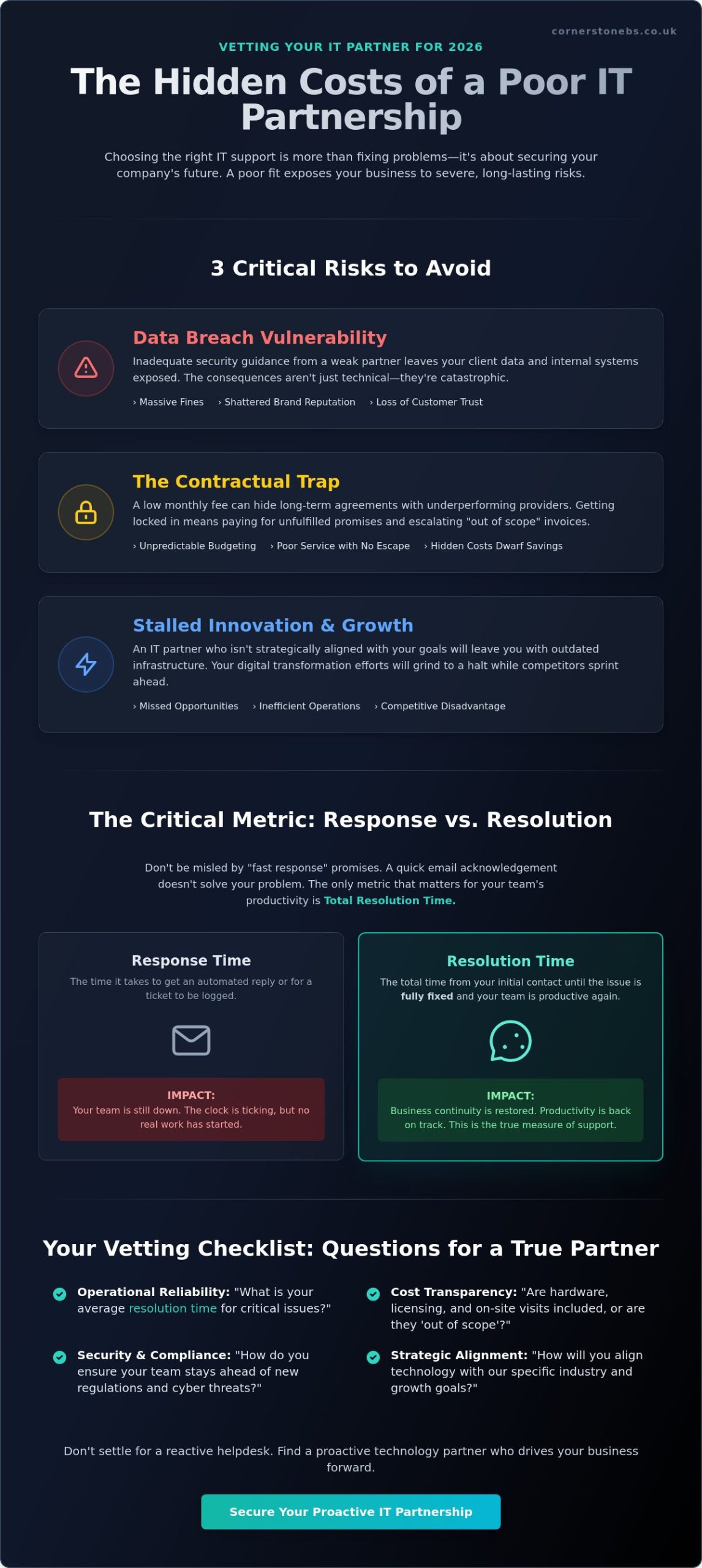
- Data Breach Vulnerability: Inadequate security guidance leaves your client data exposed, leading to massive fines and a shattered brand reputation.
- Contractual Trap: Many businesses find themselves locked into long-term agreements with underperforming providers who don’t deliver on their promises.
- Stalled Innovation: If your IT infrastructure is outdated, your digital transformation efforts will grind to a halt while competitors sprint ahead.
Essential Operational Questions: Testing Reliability and Response Times
When your systems go down, every minute feels like an hour. You need more than just a friendly voice on the other end of the line; you need results. As you gather questions to ask a potential IT support company, focus on the mechanics of their daily operations. It’s easy to promise fast support, but delivering it consistently requires a robust infrastructure and a dedicated team. We’ve found that the best partnerships are built on transparency and clear expectations from day one.
The first hurdle is distinguishing between response and resolution. A provider might promise a “15-minute response,” but if that’s just an automated email saying your ticket was received, it doesn’t help your team get back to work. Ask specifically: “What is your average resolution time for critical issues?” This helps you evaluate your ideal technology partner based on tangible outcomes rather than marketing slogans. You should also verify how they handle emergencies outside of the standard 9-to-5. If your server fails on a Sunday night, will someone be working on it before your staff arrives Monday morning?
Understanding Service Level Agreements (SLAs)
Don’t let the technical jargon in an SLA overwhelm you. Look past the “guaranteed” 99.9% uptime figures and find out what happens when things actually break. Does “response” mean a ticket was logged, or that a qualified engineer has started working on the fix? A proactive partner will link these metrics directly to your business continuity and peace of mind. This clarity ensures you aren’t left guessing while your productivity stalls. We believe an SLA should be a promise of performance, not just a legal shield for the provider.
Account Management and Communication
Reliability isn’t just about fixing broken PCs; it’s about strategic guidance. Ask if you’ll have a dedicated account manager who understands your business history or if you’ll be treated as just another number in a general helpdesk queue. We believe in the power of regular strategic reviews, often called vCIO services, to ensure your technology evolves with your goals. For example, our approach to managed IT services Teesside demonstrates how deep regional expertise creates a more tailored experience for local firms. If you’re tired of explaining your setup to a different person every time you call, it’s time for a more personal touch. You can always chat with our award-winning team to see how a dedicated partnership feels.
Finally, always ask for recent case studies or references from your specific sector. A provider who excels in retail might not understand the compliance nuances of a law firm or the high-speed demands of a manufacturing plant. Seeing how they’ve solved problems for businesses like yours is the ultimate proof of their reliability. This level of sector-specific insight is what separates a generic service from a tailored, award-winning solution.
Proactive Strategy and Security: Vetting for Resilience and Compliance
Disaster recovery is another area where generic answers won’t cut it. Ask for specific Recovery Time Objectives (RTO) and Recovery Point Objectives (RPO). If your system fails, how quickly are you back online and how much data might you lose? We believe in setting these targets clearly so you have total peace of mind. Additionally, find out how they use AI and automation. In 2026, global spending on AI infrastructure has surged. Your provider should be using these tools to detect threats faster and automate routine tasks to boost your team’s efficiency.
The Cyber Security Baseline
Security isn’t an optional add-on; it’s the bedrock of every service we provide. Every provider you interview should be a vocal advocate for robust cyber security services. They should move you toward a Zero Trust architecture where every access request is verified, not just assumed safe. Check their backup protocols too. We recommend off-site storage and frequent testing to ensure your data is actually recoverable when you need it most. It’s about building layers of protection that keep your North East business safe from evolving threats.
Future-Proofing and Scalability
Your business won’t stay the same size forever, and your IT shouldn’t either. Ask how they manage cloud solutions to help you scale without massive hardware costs. A partner with strong ties to global leaders like Microsoft and Cisco can offer better insights into emerging tech. Most importantly, ask about their 3-5 year roadmap for your technology. A proactive partner doesn’t just react to today’s problems. They prepare you for tomorrow’s opportunities, ensuring your infrastructure is always one step ahead of your growth plans.
The Onboarding and Contract Framework: Spotting Red Flags Early
The honeymoon period of a new partnership often ends the moment the contract is signed. To avoid a messy breakup later, you need total clarity on the transition process before you commit. When reviewing questions to ask a potential IT support company, pay close attention to how they handle the first 90 days. A professional onboarding isn’t just a quick software install; it’s a deep dive into your network infrastructure to document every device, user, and security gap. If a provider can’t give you a clear, written timeline for this phase, they likely don’t have a repeatable process for success.
Cost transparency is where many local businesses get caught out. We’ve seen providers lure clients in with low monthly fees, only to hit them with unexpected invoices for site visits or “emergency” hardware setups. A good answer to your cost questions should be all-encompassing. It should cover everything from Microsoft 365 licensing to how they handle the transition from your current provider. You want a partner who takes full responsibility for the handover, ensuring no data is lost and no downtime occurs during the switch. This proactive approach is what provides true peace of mind.
Contract Transparency and Costs
Avoid the trap of “per-incident” billing. This model creates a conflict of interest where your provider makes more money when your systems fail. Instead, look for fixed-fee managed services that align your goals with theirs. You should also explore it company solutions that offer hardware leasing. This keeps your technology fresh without huge upfront capital outlays. An award-winning partner will also audit your Microsoft 365 environment regularly to ensure you aren’t paying for licenses your team no longer uses.
Red Flags to Watch For
Keep a sharp eye out for “The Ghost.” This is the provider who is incredibly attentive during the sales process but disappears the moment you need support. If they lack clear documentation or use proprietary hardware locks to keep you from leaving, walk away immediately. Another warning sign is a vague SLA that doesn’t define what “emergency” support actually looks like. If they seem under-staffed for a business of your size, your tickets will inevitably sit in a queue while your team stays idle. We believe in being an open book from the start. If you want a partner who values honesty and regional expertise, book a discovery call with Cornerstone today.
Finally, always ask about notice periods and exit fees. A confident provider doesn’t need to “trap” you with predatory exit clauses or data migration fees. They should earn your business every month through high-quality service and robust security. If the contract feels one-sided, it probably is. Your IT support should be a foundational element of your business growth, not a legal anchor that holds you back.
Finding Your Long-Term Technology Partner with Cornerstone
Choosing the right partner is about more than just a list of questions to ask a potential IT support company; it’s about finding a team that truly cares about your success. At Cornerstone Business Solutions, we don’t just fix computers. We build robust, award-winning bespoke technology foundations that empower North East businesses to thrive. Our proactive approach means we’re monitoring your systems every second of the day. We identify and resolve potential issues before they ever reach your desk, giving you the peace of mind to focus on your core operations.
Our elite partnerships with global leaders like Microsoft, Cisco, and IBM give our clients a distinct competitive edge. You gain direct access to enterprise-grade expertise and cutting-edge tools, all delivered with our signature regional warmth. We combine this professional authority with a genuine “can-do” attitude that simplifies the most complex technical challenges. Whether you need seamless cloud migrations or a more reliable network infrastructure, our team acts as a dedicated extension of your own staff.
Bespoke Solutions for Every Sector
We understand that a manufacturing plant in Teesside has different needs than a professional services firm in Newcastle. That’s why we tailor our IT maintenance and mobile communications specifically for UK SMEs. We’re committed to exceptional customer service and clear, jargon-free communication that keeps everyone on the same page. Cornerstone Business Solutions is a multi-award-winning provider known for simplifying complex technology into reliable business results. We take pride in our North East roots and the long-term partnerships we’ve built across the region.
Next Steps: Start a Conversation
Ready to move beyond a generic helpdesk? The next step is booking a strategic IT audit with our expert team. During your first consultation, we’ll perform a deep dive into your current setup to identify security gaps and efficiency bottlenecks. We won’t just hand you a sales pitch; we’ll provide a roadmap for how technology can support your specific goals over the next three years. It’s an opportunity to see how our proactive strategy can transform your daily operations.
If you’re tired of slow response times and want to secure your company’s future, we’re here to help. We’d love to hear about your business goals and show you how a true technology partnership feels. Invite our team for a chat today and let’s get your IT working exactly the way it should.
Secure Your Business Future with the Right Partnership
As a multi-award-winning IT services provider with deep North East roots, we’re ready to help you turn these insights into action. Our elite partnerships with industry leaders like Microsoft, IBM, and Cisco allow us to deliver enterprise-grade solutions tailored for local SMEs. We offer unlimited helpdesk access and a “can-do” attitude that simplifies your digital transformation. It’s time to gain total peace of mind and focus on what you do best. Book a free strategic IT consultation with our award-winning team today. Let’s start a conversation that moves your business forward.
Frequently Asked Questions
How much should business IT support cost in the UK?
Managed IT services typically range between £75 and £250 per user per month depending on your specific security and compliance requirements. Basic support plans usually sit at the lower end of that scale; however, comprehensive packages that include advanced cyber security and disaster recovery often reach £200 or more. For small businesses, the average monthly investment generally falls between £95 and £230 per user. We always suggest a fixed-fee model to ensure your costs remain predictable and transparent.
Is it better to have an in-house IT person or an outsourced company?
Outsourcing to a managed service provider offers a broader range of expertise and 24/7 coverage that a single in-house hire simply cannot match. While an internal staff member knows your office culture, an outsourced team provides a deep bench of specialists in cloud solutions and network infrastructure. You benefit from the collective knowledge of an award-winning team for a fraction of the cost of a senior engineer’s salary. This approach provides better scalability as your North East business grows.
What is a typical response time for a managed IT service provider?
A reputable provider should acknowledge critical issues within 15 to 60 minutes to minimize business disruption. You should distinguish between a simple ticket acknowledgement and actual resolution time. High-performing partners aim to resolve most remote issues within four hours; this keeps your team productive and your systems stable. We focus on these resolution outcomes to provide true peace of mind for our partners.
Can I switch IT providers if I am currently in a contract?
You can switch providers, but you’ll need to review your current agreement for notice periods and potential exit fees. Most professional contracts require a 30 to 90-day notice period to facilitate a seamless handover of credentials and system documentation. We frequently manage this transition for new clients by coordinating directly with their outgoing provider. This ensures there are no security gaps or service drops during the migration process.
What certifications should a reputable IT support company have?
Look for providers holding Cyber Essentials Plus and ISO 27001 certifications to verify their commitment to robust data security. These credentials prove the company follows strict government and industry standards for protecting client information. It’s also essential to check for elite partnerships with global brands like Microsoft and Cisco. These relationships demonstrate high-level technical competence and ensure your provider has direct access to the latest technology roadmaps.
How does an IT company handle data security for remote workers?
We secure remote teams by implementing Zero Trust architecture and mandatory multi-factor authentication (MFA) for all applications. This ensures every access request is verified regardless of the user’s location. Proactive monitoring tools allow us to manage security patches on remote laptops and secure company data on business mobiles. We provide the same level of robust protection for a home office as we do for your main headquarters.
What happens to my data if I leave my IT support provider?
Your data always belongs to you, and a professional provider should facilitate a clean, documented export of all files and configurations. You must ensure there are no proprietary hardware locks that would prevent a new partner from managing your systems. One of the most vital questions to ask a potential IT support company is how they handle the offboarding process and credential handovers. A confident partner will never use your data as a “hostage” to prevent you from leaving.
Do IT support companies provide hardware as well as software support?
Yes, a full-service provider manages both your software environment and your physical network infrastructure. This includes everything from Microsoft 365 management to the maintenance of servers, firewalls, and business VoIP hardware. By handling both aspects, we act as a single point of contact for all your technology needs. This unified approach simplifies troubleshooting and ensures your entire system works together seamlessly.