Did you know that 65% of medium-sized UK businesses identified a cyber breach or attack in the last twelve months? For many businesses, technology has shifted from a silent engine of growth to a source of constant anxiety. Whether you’re struggling with unpredictable monthly bills or the fear of a ransomware attack, finding the right business IT support can feel like a high-stakes gamble. You deserve more than a technician who only shows up when things break; you need a strategic partner who understands the unique challenges businesses face and the global threats we all confront in 2026.
We at Cornerstone Business Solutions understand that your technology should be an enabler, not a bottleneck that slows your team down. You’re likely looking for a way to move away from reactive cycles and toward a model that offers fixed monthly costs and absolute peace of mind. This guide will show you exactly how to evaluate a high-performance IT partner that prioritises zero downtime and robust security. We’ll explore the critical 2026 standards, from the new Danzell Cyber Essentials framework to building a technology roadmap that actually drives your business growth.
Key Takeaways
Discover why the outdated “break-fix” model is a liability in 2026 and how a proactive partnership ensures your operations stay resilient.
Analyse the true ROI of outsourcing compared to the significant salary and overhead costs of an in-house IT hire.
Learn how to vet a provider for business IT support Darlington by identifying critical industry accreditations and guaranteed resolution times.
Gain the tools to evaluate Service Level Agreements (SLAs) that protect your productivity rather than just ticking a box.
Understand how a bespoke technology roadmap transforms your digital infrastructure from a bottleneck into a strategic engine for growth.
Beyond the Helpdesk: Why Strategic Business IT Support is Essential in 2026
In 2026, the traditional image of an IT technician arriving with a toolkit to fix a crashed server is a relic of the past. Modern Managed services represent a fundamental shift from reactive repairs to a continuous, strategic partnership. This model ensures your digital infrastructure is monitored every second of the day, catching vulnerabilities before they can be exploited by ransomware or hardware failure. Selecting high-quality business IT support Darlington means securing a team that acts as your virtual CTO, aligning your technology with your growth ambitions rather than just managing helpdesk tickets.
The old “break-fix” approach is now a significant liability. In a high-security environment, waiting for something to fail before acting leaves your data exposed and your operations at a standstill. Proactive monitoring provides the emotional peace of mind that comes from knowing experts are watching your systems 24/7. This strategic alignment doesn’t just keep the lights on. It ensures your business remains competitive on a national scale by leveraging enterprise-grade tools. Investing in reliable business IT support Darlington is the most effective way to secure this competitive edge.
The Hidden Cost of Reactive Technology
IT as a Foundation for Business Stability
Reliable technology is a primary driver of employee morale. Nothing frustrates a talented team more than slow systems or recurring technical glitches that prevent them from doing their jobs. By providing seamless tools, you improve staff retention and create a more energetic workplace. This stability extends to your clients too. In an era where 65% of medium-sized businesses face attacks, demonstrating that you have secure, stable systems builds immense trust. Whether they are interacting with your website or waiting for a quote, a consistent and fast experience is vital. Viewing your technology as a strategic asset rather than a monthly expense builds the resilience needed for long-term success.
Proactive Monitoring vs. Break-Fix: The Evolution of IT Maintenance
The days of calling a technician only after a server has failed are gone. In 2026, high-performance business IT support Darlington relies on AI-driven alerts that analyze system patterns in real-time. These intelligent tools identify anomalies, such as a hard drive showing signs of physical wear or a processor running at unusual temperatures, before they trigger an outage. By catching these signals early, we perform maintenance during scheduled windows rather than during your busiest trading hours. This proactive approach ensures your team stays productive and your customers receive uninterrupted service.
Regular system health checks complement these automated tools. We don’t just wait for an alert; we actively hunt for potential points of failure. This includes verifying that your hardware is operating within optimal parameters and that your network infrastructure is ready for future scaling. When you have unlimited helpdesk access, your staff can report minor glitches immediately. This prevents small annoyances from snowballing into major technical roadblocks, keeping the daily rhythm of your office steady and efficient.
Integrating Next-Gen Cyber Security
Modern support isn’t just about speed; it’s about resilience. Today, cyber security services are no longer an optional add-on but a foundational layer of all managed support. We’ve shifted toward a “Zero Trust” architecture, which is essential for Darlington firms managing remote or hybrid workforces. This framework operates on the principle of “never trust, always verify,” ensuring that every user and device is authenticated before accessing your data. Using international resources like Cybersecurity for Small Business as a benchmark for best practice helps us build robust defenses. Proactive patch management is a key part of this, as keeping software updated prevents over 90% of common cyber threats from gaining a foothold.
Predictable Budgeting with Managed Services
One of the biggest frustrations for business owners is the unpredictability of hourly IT billing. If a major problem occurs, you’re hit with a massive, unplanned invoice. Managed services flip this model on its head by providing a fixed-fee structure. This allows for accurate annual IT budget forecasting, giving you the clarity to invest in other areas of your business. You essentially gain an entire team of senior engineers and security specialists for a fraction of the cost of a single full-time hire. If you’re looking for a partner to provide these bespoke technology solutions, we’re here to help you move away from the stress of the break-fix cycle. This model aligns our goals with yours: we both want your systems to run perfectly 100% of the time.
The ROI of Outsourcing: In-House IT vs. Managed IT Partners
Choosing between an internal hire and an external partner is a pivotal decision for any growing firm. While having a dedicated person in the office feels reassuring, the financial reality in 2026 is often startling. A fully-loaded in-house IT manager with a £55,000 salary actually costs your business between £75,000 and £85,000 annually. This figure accounts for National Insurance, pension contributions, ongoing training, and the expensive software tools required to do the job. When you invest in business IT support Darlington, you gain an entire department of specialists for a fraction of that cost. It’s a move that replaces a significant fixed overhead with a scalable, predictable monthly fee.
Relying on a single internal employee also creates a “single point of failure.” If your IT lead is on annual leave or falls ill during a system crisis, your operations are left vulnerable. High-performance managed partners eliminate this risk by providing a deep bench of experts who are always available. This continuity is essential because The True Cost Of Downtime extends far beyond lost hours; it erodes customer trust and stalls your momentum. Outsourcing provides instant scalability, allowing you to deploy enterprise-grade cloud solutions without the massive upfront capital expenditure usually required for new infrastructure.
When the Hybrid Model Makes Sense
For larger organisations, the choice isn’t always binary. A co-managed approach allows your internal IT leads to focus on high-level business strategy while an MSP handles the “heavy lifting” of day-to-day maintenance. We take care of the relentless patch management, 24/7 monitoring, and helpdesk tickets. This partnership empowers your staff to drive innovation rather than being bogged down by password resets or server updates. It’s a collaborative way to strengthen your business IT support Darlington while keeping internal talent focused on growth.
Measuring Technology ROI
True ROI is found in the efficiency your team gains when their tools work perfectly. Reliable systems reduce the friction that slows down your workforce, leading to measurable gains in productivity. By looking at how managed IT services Teesside and Darlington providers drive competitive advantage, you’ll see a shift from capital expenditure (CapEx) to operational expenditure (OpEx). This keeps your cash flow healthy. You’re no longer paying for potential problems; you’re paying for guaranteed uptime and a secure foundation that supports long-term resilience.
The 2026 Selection Framework: How to Vet a High-Performance IT Partner
Selecting the right partner for your business IT support Darlington requires looking beneath the surface of a polished website. You need to scrutinise their Service Level Agreements (SLAs) with a critical eye. Many providers guarantee a “response time,” which simply means they’ve acknowledged your ticket. In 2026, you should demand “resolution times.” This is a commitment to how quickly the problem will actually be fixed. A high-performance partner also prioritises a bespoke technology roadmap. This isn’t a generic list of upgrades; it’s a strategic plan that aligns your digital infrastructure with your specific three-year growth goals.
Your chosen provider must demonstrate a heavy focus on proactive security and disaster recovery. Ask them to explain their recovery time objectives (RTO). If a server fails, exactly how many minutes will pass before your team is back online? This level of detail separates a basic service provider from a dedicated business partner. When your business IT support Darlington is handled by experts who plan for the worst, you gain the freedom to focus entirely on the best-case scenarios for your growth.
Vetting Technical Expertise and Partnerships
A partner’s technical depth is often proven by their official associations. Look for established partnerships with global leaders like Microsoft, Cisco, and IBM. These aren’t just badges; they represent access to high-level support and the latest enterprise-grade tools. For example, a successful Microsoft 365 migration for business UK requires specialist knowledge to ensure data integrity and security. Don’t be afraid to ask for case studies from companies at a similar growth stage to yours. Seeing how they’ve helped others in the region provides the reassurance you need to move forward. Our multi-award-winning status serves as a recurring signature of the quality you can expect.
Cultural Fit and Communication
Technical skill is only half the battle. You need a team that speaks your language, not a sea of confusing jargon. Clear, direct communication ensures that you always understand the “why” behind a technical recommendation. This is why a UK-based helpdesk is so valuable. It facilitates efficient problem-solving and ensures that your staff feel supported rather than intimidated by their own technology. Your IT provider should feel like an extension of your own team, sharing your regional pride and your drive for success. If you’re ready to see how a local expert can transform your operations, we invite you to start a conversation with our Darlington team today. We focus on building long-term relationships that provide the emotional security your business needs to thrive.
Future-Proofing with Cornerstone: Bespoke Technology Solutions for UK Growth
Your business doesn’t stand still, and your technology shouldn’t either. At Cornerstone Business Solutions, we specialise in creating bespoke technology roadmaps that act as a blueprint for your future longevity. We don’t believe in off-the-shelf packages that force your operations into a rigid box. Instead, our business IT support Darlington focuses on understanding your specific goals. As a multi-award-winning team, we provide the reassurance of unlimited, proactive support that keeps your systems resilient as you scale. This long-term partnership ensures that your digital foundation is always ready for the next challenge.
A truly modern infrastructure goes beyond just servers and security. It involves a seamless integration of all your communication tools. By unifying your systems through our it company solutions, you can bring Business VoIP and Business Mobile under one roof. This holistic approach eliminates the frustration of dealing with multiple vendors. When your IT hardware, cloud solutions, and communication channels work in perfect harmony, your team can collaborate more effectively, regardless of their location.
Scalable Infrastructure for National Success
Your Next Steps to Peace of Mind
Moving from a legacy setup or an unreliable provider can feel like a daunting task. We’ve refined our onboarding process to make the transition as smooth as possible. Our team handles the technical migration, ensuring that your data is secure and your workflow remains uninterrupted. We believe that high-quality business IT support Darlington should be accessible and transparent. This starts with a clear understanding of your current environment and where it can be improved to drive more value for your business.
We invite you to take the first step toward a more secure and efficient future. Let’s have a conversation about your goals and how our proactive approach can protect your bottom line. We offer a professional, jargon-free technology audit to identify exactly how we can strengthen your systems. Reach out to our Darlington team today to book your consultation and discover the peace of mind that comes with a truly dedicated IT partner.
Securing Your Digital Future in Darlington
The technological landscape is evolving rapidly. By 2026, simply reacting to technical failures is no longer a viable strategy for growth. We’ve seen how a proactive managed model eliminates the stress of unpredictable costs while providing the robust security your data requires. Selecting the right partner for business IT support Darlington is about more than just finding a helpdesk; it’s about securing a strategic ally that understands your regional roots and your national ambitions.
As a multi-award-winning national provider, we combine the strength of global partnerships with Microsoft, IBM, and Cisco with the personal touch of a local team. You’ll benefit from unlimited UK-based helpdesk support and a bespoke roadmap that ensures your systems are always ready for what’s next. We’re here to strip away the jargon and provide the clarity you need to make informed decisions for your business. Book a jargon-free IT consultation with our award-winning team today. Let’s work together to turn your technology into your greatest competitive advantage. We’re ready when you are.
Frequently Asked Questions
What is typically included in a business IT support contract?
A comprehensive contract usually covers proactive 24/7 monitoring, unlimited helpdesk access, and robust cyber security management. It’s designed to be a total safety net for your operations. You should also expect regular software patching, data backup verification, and strategic technology reviews to ensure your digital tools are always aligned with your business growth.
How much does managed IT support cost for a UK small business?
Managed IT support is typically structured as a fixed monthly fee per user or device. This model replaces the stress of unpredictable hourly billing with a predictable operational expense. While costs across the UK vary based on the complexity of your network infrastructure and security needs, the primary financial benefit is the significant reduction in downtime and the avoidance of expensive emergency repairs.
Do I need a local IT company if my team works remotely?
Yes, having a local partner is vital even for a distributed or remote workforce. While we resolve most technical issues through our helpdesk, a local presence is essential for physical hardware failures or network infrastructure upgrades. A regional partner also provides a higher level of accountability and understands the specific Darlington business environment in a way that national call centres cannot.
What is the difference between an IT helpdesk and managed IT services?
An IT helpdesk is primarily reactive, focusing on fixing technical problems after they have already disrupted your team. Managed services represent a proactive partnership where the goal is to prevent those problems from occurring in the first place. High-performance business IT support Darlington should always integrate both elements to ensure your systems stay resilient and your staff remain productive.
How quickly should an IT support company respond to a critical issue?
For a critical issue that stops your business from operating, you should expect an initial response within 15 to 30 minutes. These guarantees are clearly defined in your Service Level Agreement (SLA). It is important to look for a partner who distinguishes between “response time,” which is an acknowledgement of the ticket, and “resolution time,” which is the actual fix.
Does business IT support include protection against ransomware?
Modern IT support must include multi-layered cyber security as a foundational element. Because 43% of UK businesses identified a breach or attack in the last twelve months, we focus on proactive threat hunting, employee training, and secure disaster recovery plans. This ensures that even if an attack occurs, your data is protected and your business can be restored with minimal disruption.
Can an IT provider help with Microsoft 365 licensing and migration?
Yes, a qualified provider will manage your entire Microsoft 365 environment, from the initial migration to ongoing security and license optimisation. We ensure that your transition to the cloud is seamless and that your data remains fully protected throughout the process. This allows your team to leverage powerful collaboration tools without the headache of managing the underlying technical complexity.
What happens to our IT support if we move offices or expand?
Your IT support should scale effortlessly as your business grows or relocates. We handle the technical heavy lifting of office moves, including the setup of new network infrastructure and ensuring your cloud solutions are ready for the new location. This proactive planning prevents downtime during the move and ensures your technology is a foundational element of your expansion rather than a bottleneck.
What if the ‘cheap’ laptop repair you just paid for is actually costing your business thousands in hidden productivity losses? You likely already feel the strain of frequent hardware failures and the constant worry of a security breach on a remote worker’s device. It’s frustrating when inconsistent updates cause performance lag, leaving your team stuck while the clock is ticking.
As an award-winning IT partner, we understand that reliable business laptop support is about more than just fixing screens; it’s the foundation of your company’s stability. You deserve a proactive strategy that delivers predictable monthly costs and rapid response times. This 2026 guide reveals how to secure your fleet, maintain peak performance, and significantly extend the lifespan of your expensive hardware assets. We will walk you through the essential steps to move from reactive repairs to a sophisticated management model that keeps your local business moving forward.
Key Takeaways
Understand why modern fleet management requires a shift from simple repairs to a comprehensive service model that includes proactive health checks.
Learn how to harden your mobile workforce by enforcing strict update schedules and implementing Multi-Factor Authentication across all portable devices.
Compare the commercial realities of hiring internal IT staff against the efficiency of a professional business laptop support partner to eliminate single points of failure.
Discover the power of Remote Monitoring and Management for proactive threat hunting and maintaining peak hardware performance.
See how award-winning, UK-based expertise can transform your IT from a reactive cost center into a stable foundation for business growth.
What is Business Laptop Support and Why Does it Matter?
Understanding What is Business Laptop Support involves looking beyond simple hardware repairs. It’s a proactive ecosystem that keeps your team’s hardware healthy, their software updated, and their technical questions answered immediately. Think of it as the invisible engine room of your company. When your business laptop support is handled correctly, your staff don’t even notice the complexity involved; they simply open their lids and get to work.
The commercial landscape in the UK has shifted. We’ve moved from rows of static office desktops to agile, mobile fleets. This flexibility is brilliant for growth, but it makes IT management more complex. The old ‘break-fix’ model, where you only call a technician when something stops working, is failing modern firms. In a fast-paced environment, even a few hours of downtime can ripple through your client commitments and damage your reputation. You can’t afford to wait for a failure to happen before you take action.
Professional support also plays a massive role in employee retention. When a team member struggles with a lagging machine or a flickering screen, their productivity drops and their frustration rises. Providing reliable, high-performance tech shows your staff that you value their time and their contribution. It creates an atmosphere of professional respect and efficiency that helps you keep your best talent.
The Difference Between Residential and Business Support
Residential support is often transactional. You take a device to a shop, and they fix it when they can. Business support is entirely different because it focuses on continuity. We use enterprise-grade security protocols and full-disk encryption to protect your sensitive data. Most importantly, professional business laptop support is bound by Service Level Agreements (SLAs). This means you have a guaranteed response time, ensuring your business stays operational no matter what happens.
Why 2026 Demands a Mobile-First IT Strategy
Hybrid work is now the standard, but it introduces new risks. Home networks are rarely as secure as office environments, making remote laptops a primary target for cyber threats. A robust strategy ensures a seamless Microsoft 365 migration so your team can access cloud files securely from anywhere. We also manage hardware performance to ensure resource-intensive applications run smoothly, preventing the performance lag that often plagues older or unmanaged mobile devices.
Core Components of a Professional Laptop Support Service
A professional support service is built on four pillars: monitoring, security, automation, and asset management. These components ensure that your business laptop support is truly proactive rather than a series of frantic fire fighting exercises. When these systems work together, your team stays productive and your data remains secure without you needing to manage the technical minutiae yourself.
Remote Monitoring and Management (RMM)
RMM acts as the silent guardian of business hardware. It continuously monitors internal temperatures, disk health, and memory usage across your entire fleet. If a component starts to drift outside of normal parameters, our team receives an alert before the user even notices a slowdown. We can perform background maintenance, such as clearing temporary files or optimising startup processes, without interrupting your employees’ workday.
Endpoint Protection and Cyber Security
Security is no longer just a software add-on; it must be baked directly into the device. By integrating cyber security services into your laptop management, we protect every endpoint regardless of the network it uses. This includes managed firewalls, anti-malware, and proactive threat hunting. If a laptop is lost or stolen, we can trigger remote wipe capabilities to ensure your sensitive company data never falls into the wrong hands.
Hardware Lifecycle Management
Many businesses struggle with the ‘hidden’ costs of ageing hardware. We help you standardise laptop models, which simplifies support and makes parts replacement much faster. Following Best Practices for Maintaining a Productive Laptop Fleet, we typically recommend a three to five year hardware refresh cycle. This prevents the performance dip that occurs as hardware ages. When a device reaches the end of its life, we handle secure decommissioning and certified data destruction to maintain your compliance standards.
Managing a growing fleet doesn’t have to be a source of stress. A quick chat with our managed IT support team can help you map out a lifecycle and security plan that fits your specific business goals. We focus on the tech so you can focus on your growth.
Automated patch management for all core software.
Real time hardware health alerts.
Inventory tracking for every device in your organisation.
Strategic planning for future hardware investments.
In-House vs. Managed Laptop Support: A Commercial Comparison
Choosing between an internal hire and an outsourced partner is one of the most significant commercial decisions a business leader makes. While having a technician in the next room feels convenient, the true cost of a full-time employee includes recruitment, training, benefits, and expensive diagnostic software. For many small and medium-sized enterprises, this creates a ‘single point of failure’ risk. If your only IT person is on holiday or unwell when a critical hardware failure occurs, your productivity grinds to a halt.
Effective business laptop support requires a team rather than a single individual. An outsourced model provides access to a wider pool of expertise and ensures that support is always available, regardless of staff holidays. This scalability is vital; as your headcount grows, your support capacity expands instantly without the need for additional recruitment cycles. It’s about building a resilient foundation that allows you to scale with confidence. You gain a partner invested in your long-term success, not just a person to fix a broken screen.
Cost Predictability and Scaling
One of the biggest advantages of outsourcing is the shift from unpredictable capital expenditure to stable operational costs. Our Managed IT services replace fluctuating emergency repair bills with a fixed monthly fee per user. This approach eliminates the need for you to purchase expensive internal diagnostic tools or maintain a spare parts inventory. It provides ‘enterprise-level’ support for SMEs, giving you the same high-tier tools used by global corporations but at a price point that makes sense for a local business.
Access to Multi-Vendor Expertise
Technology moves fast. It’s difficult for a single internal technician to stay expert in everything. By partnering with an MSP, you gain access to specialists who maintain deep partnerships with Microsoft, Dell, HP, and Lenovo. This collective knowledge is essential when managing complex cloud solutions that internal staff may lack the time to master. When deciding between In-House vs. Managed Laptop Support, consider the value of a shared knowledge base. If we solve a complex issue for one client, that solution is immediately available to every business we support. This leads to much faster troubleshooting and significantly less downtime for your team.
Best Practices for Maintaining a Productive Laptop Fleet
Implementing a high-performing fleet requires a shift in mindset. you shouldn’t wait for a hardware failure to take action. Instead, you need a rigorous schedule that targets the underlying health of your machines. This starts with enforcing strict BIOS and firmware update schedules. These low-level updates often fix critical stability issues and security vulnerabilities that standard Windows updates might miss. By keeping this foundational software current, you ensure your hardware communicates perfectly with your operating system, which is a core pillar of effective business laptop support.
Security must remain a top priority for any mobile workforce. Implement Multi-Factor Authentication (MFA) on every portable device without exception. It’s one of the most effective ways to prevent unauthorised access if a device is misplaced. Additionally, you should regularly audit hardware performance to identify ‘bottleneck’ machines. If a laptop is consistently hitting 100% CPU usage during normal tasks, it’s a sign that the hardware is no longer fit for purpose. Replacing these machines before they fail completely keeps your team productive and happy.
Proactive Maintenance Schedules
Consistency is the secret to longevity. We recommend monthly performance reviews and disk health checks for every device in your fleet. This includes clearing temporary files and optimising startup programmes to ensure rapid boot times. Industry professionals often find that proactive maintenance extends laptop life by 20%, saving you significant capital expenditure over the long term. This level of attention is what separates a basic repair service from professional business laptop support.
Standardising Hardware for Efficiency
Running a mix of ten different laptop brands is a support nightmare. It complicates everything from driver updates to spare parts inventory. We suggest standardising on a few specific laptop builds. This allows you to use universal docking stations and ensures all peripherals are compatible across the entire office. Standardisation also enables ‘hot-swapping.’ If a staff member’s laptop requires a physical repair, you can simply hand them an identical spare. They can sign in and be back to work in minutes, not hours.
Protecting your data is just as vital as protecting the hardware. Utilise cloud-based backups for every device to ensure that a hardware crash doesn’t lead to a total loss of work. If you want to see how a structured approach can transform your operations, take a look at our Managed IT Support options. We can help you build a fleet that is secure, standardised, and ready for growth.
Enforce MFA on all portable business devices.
Standardise hardware models to simplify peripheral compatibility.
Schedule monthly health checks to catch failing components early.
Use cloud backups to decouple your data from physical hardware risks.
Cornerstone Business Solutions’ Approach to Seamless Hardware and Software Support
At Cornerstone Business Solutions, we don’t believe in one-size-fits-all IT. Your business laptop support should reflect your unique goals and the specific way your team works. We position ourselves as a dedicated long-term partner, moving away from transactional relationships to focus on your sustained growth. Our role is to provide the technical stability you need to lead your industry with confidence. We treat your hardware with the same care as our own, ensuring every device is a tool for progress rather than a source of frustration.
We’ve spent years refining our it company solutions to ensure they integrate seamlessly into your daily operations. This isn’t just about fixing a device; it’s about ensuring your entire digital infrastructure supports your commercial objectives. Our regional roots mean we’re always reachable, offering a friendly face and a level of accountability that large national corporations often lack. We combine this local warmth with the sophisticated tools of a modern IT powerhouse, giving you the best of both worlds.
Award-Winning Support Standards
Our multi-award-winning helpdesk is staffed by experts right here in the UK. We provide unlimited access through our fixed-fee contracts, which means your team can reach out whenever they need help without you worrying about an escalating bill. This creates emotional security for your staff, knowing they have an expert friend to call when things go wrong. We pride ourselves on transparency, providing clear reporting on ticket resolution and the overall health of your systems. You’ll always know exactly how your hardware is performing through our detailed metrics and regular reviews.
Bespoke Technology Roadmaps
We help you look beyond the immediate fix. Our team works with you to create three-year technology roadmaps, ensuring your hardware investments align with your wider business strategy. This proactive planning prevents the ‘tech debt’ that occurs when businesses react to failures rather than preparing for expansion. We help you budget for the future, making IT costs predictable and manageable. It’s about building a foundation that allows you to scale your business laptop support alongside your headcount.
Take Control of Your Fleet’s Future
Managing a mobile workforce in 2026 requires more than just reactive fixes. It demands a proactive strategy built on robust endpoint security, standardised hardware, and real time monitoring. By moving away from the ‘break-fix’ cycle, you secure your company’s data and ensure your team remains productive without the frustration of constant technical lag. You’ve seen how standardisation and lifecycle planning can turn a chaotic IT environment into a stable, predictable asset.
Choosing the right partner for your business laptop support provides the stability your organization needs to scale. As a multi-award-winning service provider and strategic partner with Microsoft and Cisco, we offer the expertise of a global leader with the approachable warmth of a local team. Our UK-based helpdesk is ready to act as your long-term technology partner, helping you plan for the years ahead. It’s time to stop worrying about downtime and start focusing on your growth.
Comprehensive business laptop support includes real time health monitoring, automated software patching, and endpoint security alongside unlimited helpdesk access. We don’t just wait for things to break; we proactively manage the health of your machines. This covers everything from ensuring your operating system is secure to troubleshooting peripheral issues with docking stations or printers.
Is managed IT support cheaper than hiring an internal technician?
Managed support is typically much more cost effective because you only pay for the service you need without the burden of a full time salary. Hiring an internal technician involves recruitment fees, training, and equipment costs that often exceed a fixed monthly contract. By partnering with us, you gain an entire team of experts for a fraction of the cost of one senior hire.
How do you support laptops for remote or hybrid workers?
We support remote and hybrid workers through cloud management tools that allow us to update and secure devices regardless of their physical location. As long as the laptop has an internet connection, our team can provide remote assistance and monitor for threats. This ensures that your staff in the field receive the same high level of protection as those in the office.
Can you provide hardware repairs as well as software support?
We offer a complete hardware and software solution, including the procurement of new devices and physical repairs for existing ones. Our partnerships with industry leaders like Microsoft and Cisco ensure you get enterprise grade hardware that is fully supported. We handle the entire lifecycle, from the initial setup to the secure decommissioning of old assets.
What happens if a business laptop is lost or stolen?
If a device is lost or stolen, we immediately initiate a remote wipe to protect your sensitive business data. This protocol ensures that even if the physical hardware is gone, your company’s information remains inaccessible to unauthorised users. We also assist with the rapid deployment of a replacement device to get your employee back to work quickly.
Do you support both Windows and Mac laptops for business?
What are the typical response times for laptop support tickets?
Our response times are governed by strict SLAs that prioritise critical issues to keep your business moving. We understand that a non functional laptop is a major barrier to productivity, so our UK based helpdesk aims for rapid resolution. You receive transparent reporting on every ticket, so you can track our performance against our guaranteed service standards.
What if your current IT support isn’t actually an asset, but a ticking time bomb of hidden costs and security gaps? It’s a valid fear for many UK business owners who feel trapped by slow response times and the mounting anxiety of a potential data breach. You aren’t alone in wanting a partner who treats your systems with the same care you do. With the 2026 Cyber Security and Resilience Bill shifting the regulatory landscape, using a comprehensive managed service provider checklist is no longer just a technical choice; it’s a foundational element of your business stability and emotional security.
We understand that you need a reliable IT foundation with predictable monthly costs, not more jargon or unexpected invoices. This guide provides an expert-backed framework to help you move past the frustration of “break-fix” models toward a proactive partnership that offers true peace of mind. We’ll preview the essential security standards, operational requirements, and strategic qualities you must demand to ensure experts are watching your systems 24/7. You’ll gain the clarity needed to choose a provider that simplifies complex tech and fuels your long-term growth.
Key Takeaways
Understand why shifting from reactive repairs to proactive management is the only way to secure your business future in 2026.
Use our expert-backed managed service provider checklist to verify technical credentials, including Cyber Essentials Plus and Azure cloud maturity.
Learn to look past simple response times and demand resolution-focused SLAs that keep your team working without interruption.
Discover how an unlimited helpdesk model eliminates the anxiety of hidden costs while providing the peace of mind that experts are watching your systems.
Find out why third-party accolades and a strong cultural fit are the best indicators of a partner who truly cares about your local success.
What is a Managed Service Provider (MSP) and Why Use a Checklist?
Most business owners think of IT support as the person they call when a printer stops working or a password needs resetting. In 2026, that’s a dangerous misconception that can leave your company vulnerable. A true What is a Managed Service Provider (MSP) acts as a strategic anchor for your entire digital infrastructure. They don’t just fix what’s broken; they prevent the break from happening in the first place. This shift from a reactive “break-fix” model to proactive managed services is the difference between a business that merely survives and one that scales with confidence.
Choosing the wrong partner leads directly into the “hidden cost” trap. You might see a low monthly headline figure, only to find yourself billed for every minor adjustment or security patch. A robust managed service provider checklist ensures you’re looking at the full picture, from AI integration to how they handle the complexities of hybrid work. It’s about finding a partner who understands the modern UK business environment, where the Cyber Security and Resilience Bill has raised the stakes for every medium and large enterprise. You need an expert who simplifies these complex technical concepts so you can focus on your actual job.
The Business Value of Managed IT Support
Predictable budgeting is the most immediate win for your bottom line. You replace volatile, emergency repair bills with a fixed monthly fee that makes financial planning simple. Beyond the balance sheet, you gain access to a deep pool of high-level expertise that would be impossible to fund with a single internal hire. We often see business owners carry an immense emotional cost when systems fail. Handing that responsibility to a multi-award-winning provider provides foundational stability. You get the peace of mind that comes from knowing experts are watching your systems 24/7, treating your business continuity as their top priority.
Managed Services vs. Internal IT: A Hybrid Reality
You don’t always have to choose between an internal team and an MSP. Many successful UK firms use managed services to augment their existing staff. This approach eliminates the “single point of failure” risk where all your technical knowledge sits with one individual. If that person is on holiday or moves on, your business shouldn’t grind to a halt. A local, community-focused MSP provides a stable, permanent foundation. We work collaboratively with your team to fill skills gaps and manage heavy lifting like network infrastructure. Using a managed service provider checklist helps you identify where a partner can best support your internal talent as you grow.
The Essential Technical Checklist: Infrastructure, Cloud, and Security
Moving from the strategic overview to the “engine room” of your business requires a sharp focus on technical capability. Your managed service provider checklist should prioritize infrastructure that doesn’t just work, but actively protects and scales. In 2026, a basic antivirus is no longer enough. You need a partner who provides proactive threat hunting and holds Cyber Essentials Plus as a minimum standard. This level of security ensures your digital assets remain safe while you focus on daily operations. It’s about building a resilient foundation that supports your growth rather than creating bottlenecks.
Connectivity and cloud maturity are equally vital. A reliable provider manages your business VoIP and mobile communications seamlessly, ensuring your team stays connected regardless of their location. This integration is a core part of any modern business guide to MSPs, as it directly impacts your customer service and internal efficiency. When evaluating technical specs, look for deep expertise in cloud solutions and Azure environments to avoid the common trap of fragmented, unmanaged systems.
Security and Compliance Standards
Your MSP must navigate the increasingly complex UK regulatory landscape, including the Cyber Security and Resilience Bill. Verify their certifications like ISO 27001 and their specific approach to cyber security services. They should enforce multi-factor authentication (MFA) across all entry points and demonstrate readiness for NIS2 requirements. Don’t settle for vague promises; ask for evidence of how they handle compliance for businesses in your specific sector. This proactive stance provides the emotional security you need to lead your company with confidence.
Cloud Ecosystem Management
Effective cloud management goes beyond simple storage. It involves a strategic Microsoft 365 migration for business UK that prioritizes correct licensing and permission structures. With research indicating that the average enterprise overspends its cloud budget by 32% due to under-managed infrastructure, your MSP should offer clear cost-optimization strategies. They need to audit your Azure or hybrid setups regularly to ensure you aren’t paying for resources you don’t use. This level of detail keeps your monthly costs predictable and your systems lean.
Finally, ensure your checklist includes a rigorous disaster recovery plan. A “backup” is just data sitting on a drive; a recovery plan is a tested, documented process for restoration. Your provider should demonstrate exactly how they would get your business back online after a total system failure. If you’re concerned about your current technical resilience, our team is always available for a friendly conversation about your IT support needs.
Evaluating Service Standards: SLAs, Support Desks, and Proactive Monitoring
You shouldn’t have to wonder if your IT partner will answer the phone when a critical system fails. High technical specifications mean very little if the service delivery falls short during a crisis. A robust managed service provider checklist helps you verify that their service standards match your business pace. We believe that true support is about more than just a voice on the line; it is about a commitment to keeping your operations fluid and your team productive. This requires a shift in focus from how quickly a provider answers to how effectively they resolve the underlying issue.
Transparency is the bedrock of a long-term partnership. You deserve clear insights into how your systems are performing and where your investment is going. A reliable provider uses proactive monitoring to identify and neutralize threats before they impact your workflow. This approach transforms IT from a source of stress into a foundational element of your business stability. Regular reporting ensures you stay informed without needing to learn the technical jargon yourself.
Understanding Service Level Agreements (SLAs)
A Service Level Agreement (SLA) is a foundational promise of reliability that dictates how your partner responds to pressure. When reviewing an SLA, look specifically for resolution times rather than just response times. A “response” can be an automated email; a “resolution” is a fix that gets you back to work. Your contract should clearly define “Critical” vs. “Standard” issues to ensure priority is given where it matters most. As a multi-award-winning provider, we suggest looking for uptime guarantees that protect your bottom line and provide emotional security for your leadership team.
The Helpdesk Experience
The structure of a helpdesk defines your daily interaction with technology. Many providers use a “pay-per-ticket” model that discourages you from seeking help for minor issues, leading to long-term system decay. We advocate for an unlimited helpdesk access model. This encourages your staff to report problems early, allowing experts to maintain a healthy environment. Availability is equally vital. Ensure you have access to local experts who understand your specific regional context. You should be able to reach support through multiple channels:
Direct Phone Lines: Speaking to a human expert immediately.
Dedicated Portals: Tracking ticket progress in real-time.
Email Support: For non-urgent queries and documentation.
This “human-first” approach ensures that your team feels supported and valued. It removes the frustration of speaking to robots or navigating endless automated menus. When your IT support feels like a natural extension of your own office, you gain the peace of mind that your digital infrastructure is in safe hands.
Strategic Partnership & Due Diligence: Beyond the Technical Specs
Trust is built on a foundation of proven success and strong industry ties. We believe that an award-winning pedigree isn’t just for show; it’s a recurring signature of quality that provides third-party validation for your peace of mind. Look for a provider that maintains deep, collaborative relationships with technology giants like Microsoft, IBM, and Cisco. These partnerships ensure you receive the most robust, forward-thinking solutions available, backed by the global strength of industry leaders but delivered with our signature regional warmth.
Identifying Red Flags in a Potential MSP
You can often spot a poor fit before you even sign a contract. A significant warning sign is a lack of transparency in pricing or the sudden appearance of “hidden” project fees that weren’t in the initial proposal. Pay close attention to their communication during the sales process. If they’re slow to respond when they are trying to win your business, they’ll likely be even slower when you have a critical technical issue. Another major red flag is a provider that can’t show clear evidence of proactive it maintenance. Without a focus on prevention, you’re just waiting for the next expensive breakdown.
The Reference Check: Asking the Right Questions
Don’t just ask for a list of happy clients; ask to speak with businesses that have been with the provider for several years. Longevity is the ultimate proof of a reliable partnership. When you speak to these references, ask them about a “worst-case scenario” response. How did the MSP handle a total system failure or a security scare? You want evidence of bespoke solutions that address specific business goals, not a cookie-cutter approach that treats every company the same. This due diligence ensures your IT foundation is built for stability and emotional security.
If you’re ready to move away from transactional support and toward a dedicated long-term partner, we invite you to explore our bespoke IT support solutions and see how we can secure your business future.
Implementing Your Decision: Transitioning to Your New MSP
Once you have completed your managed service provider checklist and selected a partner, the transition phase begins. This is where the strategic plan turns into operational reality. A successful transition starts with a deep dive into your current system health. We call this the onboarding audit. It’s a critical period where we identify the security gaps or outdated hardware that your previous provider might have overlooked. You need a clean break from the reactive cycle to establish your new, reliable IT foundation. This process requires a structured knowledge transfer to ensure all administrative credentials and network maps are securely handed over without disrupting your daily operations. We manage this handover professionally to minimize any friction with your outgoing provider.
User training is the final piece of the puzzle. Your staff are your first line of defence. Getting them up to speed with new security protocols and MFA requirements is vital for business continuity. The first 90 days of your new partnership set the tone for the future. It’s a time for continuous improvement where we fine-tune your infrastructure and establish a steady communication rhythm. This proactive approach ensures you feel the immediate benefits of predictable costs and expert 24/7 monitoring. We want you to feel the weight lift off your shoulders as you realize your systems are finally in capable hands. It’s about building that emotional security that allows you to focus on your actual business goals.
The Onboarding Roadmap
We follow a clear, three-step process to ensure your transition is seamless and stress-free:
Step 1: A comprehensive infrastructure and security audit to baseline your current environment and identify immediate risks.
Step 2: Deployment of proactive monitoring tools and critical security patches to lock down your network and prevent downtime.
Step 3: Full documentation of all hardware, software, and licenses to eliminate any future “hidden” surprises and ensure total transparency.
Why Cornerstone Business Solutions is Your Ideal UK Partner
We don’t just provide services; we build long-term partnerships rooted in our regional identity. Our multi-award-winning approach to bespoke technology ensures that your IT support is as unique as your business. We combine professional authority with an approachable, local warmth that makes us feel like a natural part of your team. You get the confidence of working with partners of Microsoft, IBM, and Cisco, delivered by experts who actually care about your success. This blend of global expertise and community focus is what sets us apart in the UK market. We invite you to take the first step toward total peace of mind with a simple, no-obligation conversation about your future.
Secure Your Business Future with a Strategic IT Anchor
Choosing the right IT partner is a pivotal decision that impacts your company’s long-term stability and growth. You now have the necessary tools to evaluate potential partners based on their security certifications, cloud maturity, and commitment to proactive maintenance. By following this managed service provider checklist, you can avoid the hidden cost trap and ensure your digital infrastructure is ready for the regulatory demands of 2026. You deserve a reliable foundation that offers predictable monthly costs and the emotional security of knowing experts are watching your systems 24/7.
As a multi-award-winning IT services provider and trusted partner of Microsoft, IBM, and Cisco, we’re dedicated to helping UK businesses scale securely. Our unlimited UK-based helpdesk support ensures your team always has access to local experts who understand your unique challenges. We’re ready to help you transition from a reactive “break-fix” mindset to a proactive partnership built on trust and reliability. This collaborative approach ensures your technology remains an asset, not a bottleneck.
What should be included in a managed service provider checklist?
A comprehensive managed service provider checklist must cover technical infrastructure, cyber security standards, and service level agreements. You need to verify their proactive threat hunting capabilities and ensure they offer an unlimited helpdesk access model rather than a pay-per-ticket system. It’s also vital to evaluate their cultural fit and their ability to scale alongside your UK business as you grow.
How much does managed IT support cost in the UK for 2026?
Managed IT support costs in 2026 depend on your specific user count and the complexity of your digital infrastructure. Most providers utilize tiered monthly fees, often on a per-user or per-device basis. You should look for transparent pricing that includes both remote and on-site support to avoid the hidden project fees that frequently disrupt predictable budgeting for small and medium enterprises.
What is the difference between an MSP and a traditional IT company?
Traditional IT companies typically operate on a reactive “break-fix” model where they only intervene when something fails. An MSP acts as a proactive, long-term partner that manages your systems 24/7 to prevent issues before they occur. This shift provides foundational stability and emotional security, ensuring your technology remains a tool for growth rather than a source of constant frustration.
Can an MSP help with Microsoft 365 migration and licensing?
Yes, a qualified partner manages your entire Microsoft 365 ecosystem, from the initial data migration to ongoing license optimization. They ensure your permission structures are secure and that you aren’t overspending on unused licenses. As experts in cloud solutions, we help you leverage the full power of these tools to support hybrid work and improve team collaboration across your organization.
What certifications should I look for in a UK managed service provider?
You should prioritize providers who hold Cyber Essentials Plus and ISO 27001 certifications as a minimum standard. These credentials demonstrate that the provider is ready to comply with the 2026 Cyber Security and Resilience Bill. It’s also beneficial to look for multi-award-winning firms that maintain official partnerships with industry leaders like Microsoft, IBM, and Cisco to ensure high-level technical expertise.
How do I switch IT providers without causing business downtime?
Switching providers is a seamless process when you follow a structured onboarding roadmap. Your new partner should conduct a deep-dive audit of your system health and manage a professional knowledge transfer from your previous provider. This ensures all administrative credentials and network maps are securely moved, allowing for a clean break without any interruption to your daily business operations.
What is proactive IT maintenance and why does it matter?
Proactive IT maintenance involves the continuous monitoring and patching of your network to neutralize threats before they impact your workflow. It matters because it prevents the costly downtime associated with hardware failures or data breaches. By using a managed service provider checklist to verify these proactive measures, you secure a reliable IT foundation that supports business continuity and long-term scaling.
Does an MSP provide hardware like laptops and servers?
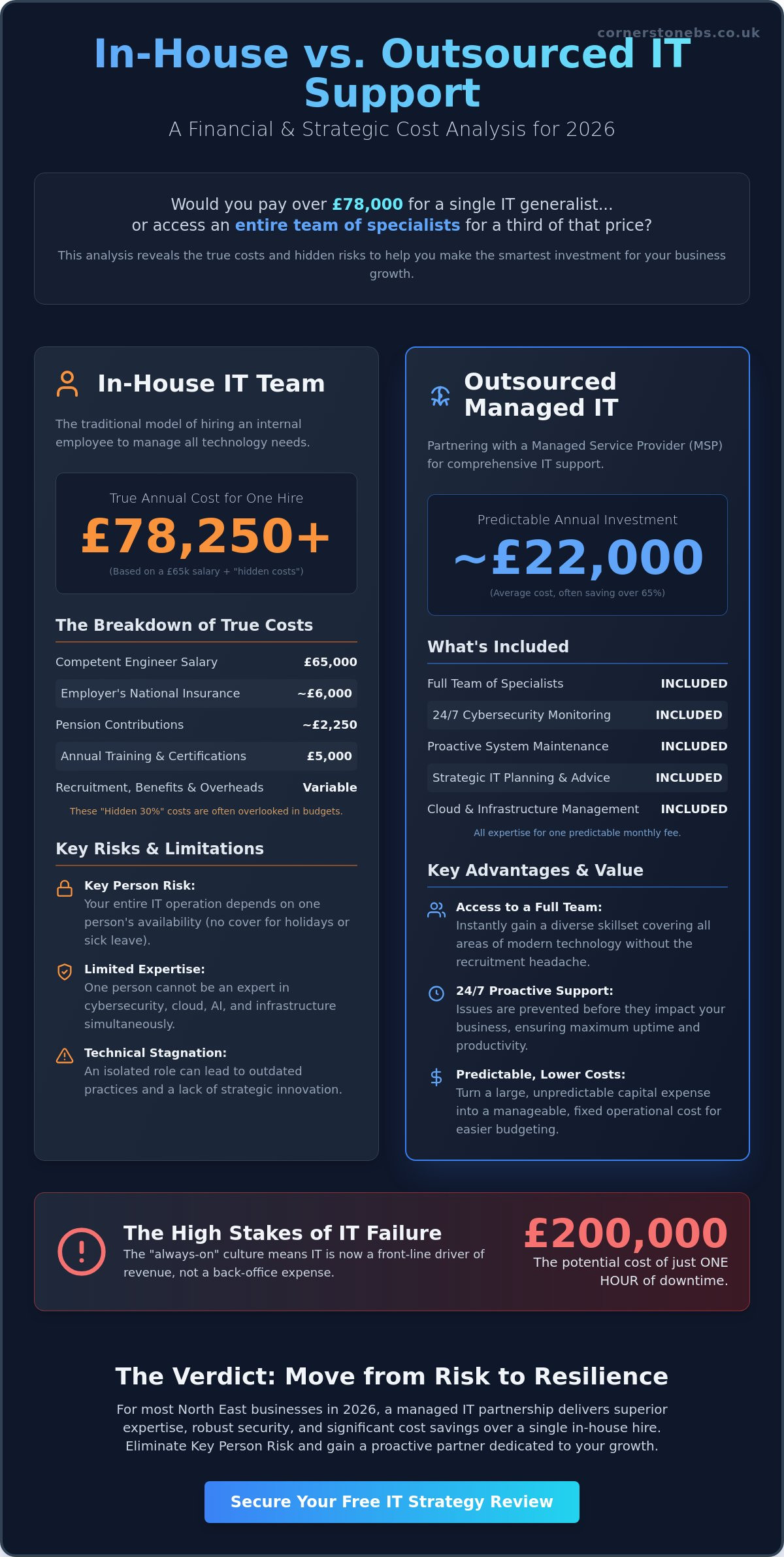
Would you pay £65,000 for a single IT generalist when you could access an entire team of specialists for a third of that price? By January 2026, the cost of a competent internal hire has climbed to between £45,000 and £65,000 once you factor in National Insurance and pension contributions. It’s a heavy price to pay for one person who still needs holidays, sick leave, and constant training. This 2026 in-house vs outsourced IT support cost analysis reveals why many North East businesses are moving away from the traditional hiring model to find better value and more reliable protection.
We know that managing technology often feels like a constant battle against recruitment headaches and rising cyber security threats. You want predictable monthly spending and the peace of mind that comes from award-winning expertise. This guide delivers a full financial and strategic breakdown to help you choose the model that actually supports your growth. We will explore the hidden costs of internal teams, from £5,000 annual training budgets to the £200,000 per hour risk of downtime. We also show you how a proactive partnership delivers the robust security your insurance requires. Let’s get into the numbers so you can make an informed decision for your organization’s future.
Key Takeaways
Compare the actual cost of a £65,000 internal hire against the predictable monthly investment of an award-winning managed service provider.
Identify the “hidden 30%” of internal IT spending, including National Insurance and the recruitment overheads that often catch businesses off guard.
Use our 2026 in-house vs outsourced IT support cost analysis to determine which model delivers the best ROI for your specific headcount.
Learn how to eliminate “Key Person Risk” and gain access to a full suite of experts for cyber security, cloud solutions, and strategic planning.
Discover the framework for choosing a model that provides long-term peace of mind and supports your business growth without technical stagnation.
The 2026 IT Landscape: Why the In-House vs Outsourced Debate Matters
Choosing between these models requires a balance of three critical factors: cost, control, and capability. While having a dedicated person in the office feels reassuring, the sheer breadth of knowledge required today is staggering. One person cannot be an expert in Microsoft 365, advanced cloud infrastructure, and 24/7 cyber security monitoring all at once. We believe that technology should provide peace of mind, not a constant source of recruitment stress. This analysis helps you find that balance, ensuring your IT investment delivers a genuine return rather than just becoming a line item on a balance sheet.
The Evolution of IT Support Expectations
The old “IT guy in the basement” model is officially obsolete. In 2026, your team expects 24/7 uptime and seamless remote access from any location. If your systems go down for even an hour, the financial fallout for a UK firm can reach £200,000 depending on the sector. This “always-on” culture means IT has moved from a back-office expense to a front-line driver of efficiency. Our guide to managed IT services Teesside explores how local businesses are adapting to these higher stakes by moving toward proactive, rather than reactive, support models.
Defining the Models: DIY vs. Managed Partnership
Understanding the terminology is the first step toward a smart decision. The business practice of outsourcing involves hiring an external provider to handle your technology needs. Here is how the three main models look for a modern North East business:
In-house IT: You hire internal employees. This offers direct control and deep company-specific knowledge; however, it comes with high fixed overheads, pension contributions, and significant recruitment challenges.
Outsourced IT: You partner with an award-winning Managed Service Provider (MSP). This provides access to a full team of experts for a predictable monthly fee, eliminating the need for internal training and recruitment.
Hybrid or Co-managed: This is often the “best of both worlds” for larger SMEs. Your internal IT manager handles day-to-day helpdesk tasks while a proactive partner manages heavy-duty security, disaster recovery, and infrastructure.
The True Cost of In-House IT Support in 2026
Calculating the price of an internal team often starts with a single salary figure. However, a realistic in-house vs outsourced IT support cost analysis for 2026 must look far beyond the basic pay packet. While a generalist might command a salary between £30,000 and £45,000, a truly competent engineer capable of managing modern infrastructure now costs between £45,000 and £65,000. These figures reflect the intense competition in the UK managed services market, where a persistent skills gap continues to drive wage inflation across the technology sector.
The Salary Trap: Why One Person is Never Just One Salary
Hiring for IT in 2026 often forces SMEs into a difficult choice. You can hire a junior technician for £35,000, but they may lack the expertise to handle high-level strategic planning or complex cyber security audits. To get that level of seniority, you’ll likely need to pay upwards of £55,000 for a mid-level professional. Even then, you are only buying the knowledge of one individual. If they fall ill or take a holiday, your business is left vulnerable. This “Key Person Risk” can lead to expensive downtime that far outweighs the cost of a proactive partnership.
Continuous Professional Development (CPD) Costs
Technology moves fast. To keep an internal staff member effective, you must invest £2,000 to £5,000 every year in certifications for Microsoft 365, Azure, or Cisco. Without this, your team’s skills will stagnate, leaving your business behind the curve. You also need to provide the tools for them to do the job. Essentials like remote monitoring (RMM), ticketing systems, and security software add another £3,000 to £8,000 to your annual overheads per technician.
The Total Cost of Ownership for a single competent IT hire in 2026 averages between £75,000 and £95,000 after combining salary, statutory contributions, recruitment amortisation, and essential software licensing. If these numbers feel daunting, it might be time to chat with a local expert about a more predictable, award-winning model that scales with your growth.
Financial Analysis of Outsourced Managed IT Support
Switching focus to the other side of our in-house vs outsourced IT support cost analysis, we see a model built for total predictability. Outsourcing replaces the volatile expenses of recruitment and training with a clear, per-user monthly fee. For a typical 20-user business in the UK, fully managed support costs between £1,100 and £1,700 per month. That totals roughly £13,200 to £20,400 per year. Compare that to the £75,000 minimum total cost of a single in-house hire we discussed earlier. You’re getting an entire department of experts for less than a third of the price of one person.
Scalability is another massive financial win for North East firms. If your team grows by five people tomorrow, your costs increase by a fixed, known amount. If you downsize, your bill drops immediately. You don’t have to worry about the £5,000 to £10,000 recruitment fees or the headache of interviewing. We handle the talent hunt and the continuous training, so you don’t have to. It’s a seamless way to ensure your business always has the right level of support without the burden of fixed overheads or employer’s National Insurance.
The Managed Service Advantage: Beyond the Helpdesk
A proactive partnership offers far more than just fixing what’s broken. Our cyber security services are built into the model, providing robust protection that satisfies modern insurance requirements. You get 24/7/365 monitoring without the massive overtime bills or holiday cover issues associated with internal staff. Specialists also manage your cloud solutions more efficiently, ensuring you aren’t overpaying for licenses or storage you don’t need. It’s award-winning expertise that keeps your business moving.
Comparing the Capital Expenditure (CapEx) vs. Operational Expenditure (OpEx)
CFOs generally prefer the Operational Expenditure (OpEx) model because it keeps cash flow steady. You avoid the “emergency spend” cycle where an unmanaged server failure leads to a sudden £10,000 bill. Instead, you pay a consistent monthly rate that covers maintenance and upgrades. Our team also leverages existing partnerships with giants like Microsoft and Cisco. This means you benefit from enterprise-level tools and pricing that are usually out of reach for smaller firms. It’s about getting the best technology for your business while maintaining total financial control and peace of mind.
The Efficiency Gap: Opportunity Costs and Risk Factors
Direct expenses like salaries and software licenses are easy to track, but the hidden costs of inefficiency often hit harder. A thorough in-house vs outsourced IT support cost analysis must weigh the financial impact of “Key Person Risk.” When your internal IT manager is on holiday, ill, or simply busy with a basic helpdesk ticket, who handles a critical system failure? For many North East businesses, this single point of failure creates a dangerous bottleneck that stalls productivity and threatens growth.
There is also the “Breadth vs Depth” problem to consider. In 2026, it is practically impossible for one person to stay expert in cloud infrastructure, hardware maintenance, and the latest cyber security protocols simultaneously. Internal staff often fall into a “best effort” support cycle. In contrast, a proactive partnership with an award-winning team provides guaranteed Service Level Agreements (SLAs). You aren’t just buying time; you are buying a commitment to performance and 24/7 availability that a single hire simply cannot match.
The Cost of Downtime: A Proactive vs. Reactive Comparison
Downtime is a silent profit killer. Recent data shows that IT failures cost UK businesses between £4,000 and £200,000 per hour depending on their sector and size. If your internal team is reactive, they only start working once the damage is done. Our proactive monitoring identifies and resolves vulnerabilities before they impact your bottom line. This level of oversight provides the peace of mind that comes from knowing your network is being watched by specialists who never take a day off. It turns IT from a source of stress into a foundation for business continuity.
Cyber Security and Compliance Risks
The landscape of digital threats is more hostile than ever in 2026. Data breaches now carry heavy financial penalties and can destroy a local brand’s reputation in days. Implementing robust it company solutions ensures your business remains compliant with strict regulations like NIS2 and Cyber Essentials. Managing these requirements internally is a massive administrative burden that often leads to corners being cut.
Professional IT management naturally reduces your cyber insurance premiums by proving to underwriters that your infrastructure is managed to enterprise standards. If you want to stop worrying about the next big threat and start focusing on your business, it’s time to chat with our local experts about a tailored support plan.
The Verdict: Which Model Wins for Your Business?
Choosing the right path depends on your specific scale and long-term goals. Our in-house vs outsourced IT support cost analysis shows that for the majority of UK SMEs, the decision comes down to the balance between overhead and expertise. If you are a large enterprise with over 500 users and highly bespoke legacy systems, an internal team might offer the deep, singular focus you need. However, for high-growth firms and security-conscious sectors, the managed model is almost always the superior choice for both ROI and reliability.
The data from January 2026 is clear. At the 20-user mark, outsourcing your technology needs costs roughly a third of a single in-house hire. Even at 50 users, where costs begin to equalize, the outsourced model still wins on value. You aren’t just paying for a person to sit at a desk; you are buying access to an award-winning department of specialists. This eliminates the “Efficiency Leak” where your business pays premium salaries for basic helpdesk tasks while strategic projects and cyber security fall by the wayside.
Making the Transition: From Stress to Strategy
Moving from a reactive, stressed IT environment to a proactive strategy starts with an honest audit of your current spend. Look beyond the obvious invoices. Calculate the time your management team spends on recruitment and the cost of every hour your systems were offline in the last twelve months. When you present these figures to your stakeholders, the conversation shifts from “what does this cost” to “what is this costing us to ignore.” Finding a partner with a local feel and national-level capabilities ensures you get the personal touch of a North East team with the robust infrastructure of a major provider.
Cornerstone: Your Award-Winning IT Partner
At Cornerstone, we believe technology should be a foundational element of your peace of mind. We blend professional authority with the approachable warmth of our North East roots to create a partnership that feels like an extension of your own team. Our proactive monitoring and tailored cloud solutions ensure your business stays ahead of the curve without the recruitment headaches or unpredictable break-fix bills. We are proud of our award-winning status, but we are even prouder of the success our clients achieve through reliable, secure technology.
Secure Your Business Future with a Smarter IT Strategy
Your technology should be the engine of your growth, not a source of constant financial worry. This in-house vs outsourced IT support cost analysis has shown that while a £65,000 internal hire offers direct control, it cannot match the collective depth of an entire department. You gain access to specialists in cyber security, cloud solutions, and network infrastructure for a fraction of the cost of a single senior employee. It’s about moving from a reactive “break-fix” mindset to a proactive strategy that protects your bottom line.
As a multi-award-winning IT services provider with deep North East roots, we provide the proactive 24/7 monitoring you need to avoid that £200,000 per hour downtime risk. Our strong partnerships with Microsoft, IBM, and Cisco ensure your business uses enterprise-level tools that stay current with 2026 standards. We don’t just fix computers; we build the digital foundation your organization needs to scale securely and efficiently.
Is it cheaper to outsource IT or hire in-house in 2026?
Outsourcing is significantly more cost-effective for the vast majority of UK SMEs. Our in-house vs outsourced IT support cost analysis shows that a 100-user business typically invests between £60,000 and £90,000 per year for a full team of specialists. Hiring an equivalent internal team would require at least three staff members, likely pushing your annual expenditure well over £150,000 once you include all employer contributions and overheads.
What are the hidden costs of hiring an internal IT manager?
Beyond the base salary, you must budget for a 13.8% Employer National Insurance contribution and at least 3% for pension auto-enrolment. There are also recruitment fees that often reach 20% of the starting salary and an annual training budget of £2,000 to £5,000 to keep their skills current. You also pay for the software tools they need, which can cost your business an additional £8,000 every year.
Can a managed IT service provider really understand my specific business needs?
A true partnership model ensures your provider understands your operations as deeply as any internal hire. We use regular strategic reviews and on-site visits across the North East to align your technology with your specific growth goals. It’s about building a long-term relationship where we act as your trusted local experts, not just a distant helpdesk.
What happens to my existing IT staff if I decide to outsource?
You don’t have to choose one or the other; many firms opt for a co-managed approach. Your existing staff can focus on high-value internal projects while we handle the 24/7 monitoring and helpdesk tickets. If you decide to move fully to an outsourced model, we can help you navigate the TUPE regulations to ensure a smooth and professional transition for everyone involved.
How do outsourced IT costs scale as my business grows?
Costs scale linearly on a per-user basis, which gives you total budget clarity as you expand. For a 50-user business in 2026, the monthly investment typically ranges from £2,750 to £4,250 depending on the level of support required. This flexibility means you can add or remove users instantly without the stress of recruitment or the risk of being overstaffed during quieter periods.
Is outsourced IT support as responsive as having someone in the office?
Outsourced support is often more responsive because you have an entire team of award-winning experts available at all times. An internal hire might be stuck in a meeting, off sick, or on holiday when a crisis hits. Our proactive monitoring systems identify and fix most issues before your team even notices them, ensuring your productivity never skips a beat.
Does outsourcing IT help with cyber security insurance requirements?
Yes, professional management is now a standard requirement for most 2026 cyber insurance policies. Insurers want to see that your business has robust disaster recovery plans and proactive security monitoring in place. Partnering with an expert team ensures you meet these strict compliance standards, which often helps in securing coverage and potentially reducing your premiums.
What is co-managed IT support and is it right for me?
Co-managed IT is a hybrid model where we support your existing internal IT manager rather than replacing them. It’s a great fit for businesses with 50 or more staff that need extra help with specialized areas like cloud solutions or complex network infrastructure. This model typically costs between £30 and £80 per user per month and provides your internal team with the tools and backup they need to succeed.
Did you know that 50% of UK small businesses suffered a cyber attack in 2024? It is a sobering figure that proves the old “break-fix” model is no longer fit for purpose. You likely feel the frustration of unpredictable invoices every time a printer fails or a server stutters. Waiting hours for a helpdesk response while your team sits idle isn’t just annoying; it costs the average UK firm £1,200 per day in lost productivity. Finding reliable, outsourced IT support for small business UK has become about more than just fixing laptops; it’s about protecting your livelihood.
We know you want total confidence and a predictable monthly spend that stays within budget. This 2026 buying guide helps you discover how to select the perfect IT partner to secure your infrastructure, reduce costs, and provide total peace of mind for your UK small business. We’ll explore how award-winning, proactive monitoring prevents downtime before it starts and why a strategic partner is essential for scaling. You’ll gain a clear roadmap to turn your technology from a source of stress into a seamless engine for growth.
Key Takeaways
Discover why successful UK SMEs are moving away from reactive repairs toward proactive managed services to fuel their 2026 growth.
Master the five essential criteria for selecting outsourced IT support for small business UK, ensuring your partner offers the technical expertise and response guarantees your team deserves.
Uncover the true ROI of outsourcing by comparing fixed monthly fees against the cost of an in-house team, helping you stabilise cash flow and protect your bottom line.
Identify the right IT model for your specific needs and learn how 24/7 monitoring provides the total peace of mind required to prevent costly downtime before it strikes.
See how partnering with an award-winning, local expert can transform your technology from a daily headache into a bespoke engine for long-term success.
Why UK Small Businesses are Moving to Outsourced IT Support in 2026
The era of the reactive “break-fix” model has officially ended for the ambitious UK business owner. Waiting for a server to fail or a laptop to blue-screen before calling for help is a strategy that belongs in the last decade. By early 2026, 88% of high-growth SMEs in the UK have migrated to fully managed services to mitigate the risk of costly downtime. Technology is no longer a back-office function; it’s the primary engine for your growth and competitive advantage. If your systems are slow, your business is standing still while your competitors accelerate.
For many firms, the most valuable deliverable we provide isn’t just a patched server or a new firewall. It’s peace of mind. You need to know that your data is secure and your team is productive without having to understand the nuts and bolts of the infrastructure. Many firms now rely on outsourced technical support to bridge the gap between their current capabilities and the demands of a global, digital-first market. We’ve seen that when a business owner stops worrying about IT, they find the mental space to double their turnover.
Choosing outsourced IT support for small business UK isn’t just about fixing problems. It’s about a long-term partnership. We focus on proactive monitoring to stop issues before they even reach your desk. This shift ensures your operations remain seamless and your staff stay frustrated-free.
The Rising Complexity of the UK Tech Landscape
Cloud-hybrid work environments are now the standard for 72% of UK businesses, making simple internal setups obsolete. Managing a team that splits time between a Teesside office and a home kitchen requires sophisticated security and connectivity that a basic router can’t handle. We’ve also seen a massive surge in AI integration, with over 60% of SMEs now using tools like Microsoft 365 Copilot in their daily workflows. A single “IT person” simply can’t stay expert in cybersecurity, cloud architecture, and AI prompt engineering simultaneously. You need a team with broad, specialised knowledge to keep your edge.
Addressing the Digital Skills Gap in Small Teams
According to the 2024 UK Digital Skills Report, 52% of businesses struggle to recruit staff with the necessary technical expertise, creating a significant bottleneck for regional growth. Our outsourced IT support for small business UK solves this by giving you instant access to an award-winning team of specialists for a fraction of the cost of a single senior hire. You don’t just get a helpdesk; you get a “can-do” attitude from professionals who genuinely care about your success. We’re proud of our North East roots and bring that local, hard-working energy to every project. It’s about getting the job done right the first time so you can get on with your day. Let’s have a chat about how we can support your journey.
Evaluating IT Support Models: Which is Right for Your Business?
Choosing the right model for outsourced IT support for small business UK is a vital step for any ambitious business owner. It defines whether you spend your days firefighting technical glitches or focusing on your growth. The decision usually comes down to how much value you place on uptime and predictable costs.
Managed IT Services vs. Traditional Break-Fix
The traditional break-fix model is a reactive gamble. You only pay when something snaps. While this feels cheaper on the surface, the hidden costs of downtime are often staggering. Emergency call-out fees in the UK can easily exceed £150 per hour, and that doesn’t include the cost of lost staff productivity. In contrast, our award-winning managed IT services focus on long-term stability through a proactive partnership. You get unlimited helpdesk access for a fixed monthly fee. This removes the “fear of the bill” that often stops employees from reporting minor glitches. When staff feel empowered to call for support, small issues are resolved before they snowball into site-wide outages.
The Federation of Small Businesses (FSB) frequently highlights that digital resilience is a top priority for modern firms. Proactive 24/7 monitoring is the engine of that resilience. We often spot a failing hard drive or a security vulnerability at 3:00 AM, resolving the threat before your team even starts their morning brew. This level of oversight prevents the average £4,469 loss that small UK firms face during significant cyber incidents or system failures.
Remote Support vs. On-Site Maintenance
Speed is the primary benefit of remote support. Statistics show that roughly 85% of daily IT issues, such as password resets or cloud access problems, are resolved instantly through secure remote sessions. This keeps your momentum high and your overheads low. However, you can’t fix a physical server fault or a complex network cabling issue over the phone. A hybrid approach ensures your business systems remain robust regardless of the challenge.
We believe in a “local-first” philosophy. While remote fixes handle the majority of tasks, having a North East team ready for on-site maintenance is essential for hardware deployments and infrastructure audits. This combination provides the most reliable foundation for any small business. Fixed-fee contracts are now the gold standard for UK business budgeting because they turn IT from a volatile variable into a steady operational cost. This financial clarity provides genuine peace of mind for directors.
If you’re tired of waiting for things to break, we’d love to have a friendly chat about your current setup and how we can help you stay ahead of the curve.
5 Essential Criteria for Selecting a UK IT Support Partner
Choosing the right provider for outsourced IT support for small business UK is a decision that dictates your company’s trajectory for years. You need more than a simple helpdesk; you need a strategic ally. Start by verifying technical pedigree through global brand partnerships. A partner carrying Microsoft Solutions Partner or Cisco Premier Integrator status has proven they meet rigorous international standards. Our award-winning team at Cornerstone Business Solutions leverages these relationships to give you enterprise-grade tools at a price point that respects your budget.
Service Level Agreements (SLAs) are your guarantee of stability. In a market where 60% of UK small businesses experience significant downtime annually, waiting hours for a callback isn’t an option. Look for guarantees like 15-minute response times for critical issues. Beyond the numbers, evaluate the cultural fit. You want an expert who speaks your language, not just “tech-speak.” As a North East based firm, we pride ourselves on being approachable and clear. We focus on building a relationship where we feel like an extension of your own office. This “human” face of technology is why 98% of our clients remain with us year after year.
Award-winning status serves as a vital benchmark for quality. When a provider is recognised by industry bodies, it validates their commitment to excellence and reliability. It’s a badge of trust that proves they’ve delivered consistent results for businesses just like yours. We believe this external validation provides the peace of mind you need when handing over the keys to your digital infrastructure.
Cyber Security Credentials and Compliance
Security isn’t optional. Your provider must be an expert in UK GDPR and the emerging NIS2 standards, which will impact supply chains throughout 2025. We recommend following the NCSC Small Business Guide to establish your baseline safety. A proactive partner conducts regular audits to protect your reputation and your data. By 2026, Zero Trust will be the mandatory standard for secure business operations, requiring every user and device to be strictly verified before gaining access to the network.
Scalability and Proactive Infrastructure Planning
Your IT should look ahead. A quality partner helps you plan for the next 3 to 5 years, ensuring your infrastructure doesn’t become a bottleneck as you hire. This includes seamless Microsoft 365 migrations and cloud scalability. If your headcount grows by 20% next year, your IT must scale instantly without a £5,000 surprise bill for new hardware. We focus on robust, tailored setups that grow as you do. This proactive approach ensures your outsourced IT support for small business UK remains a catalyst for growth rather than a recurring cost.
This strategic planning extends beyond internal infrastructure. As businesses grow, many look to expand their digital footprint through online sales. Partnering with a specialist for this, such as the Shopify experts at NB eCommerce & Design, ensures your ecommerce platform is as robust and scalable as your internal IT systems. Similarly, a dedicated growth consultancy like Eightfold Marketing can help you build on that foundation to reach new customers and expand your market share. For business owners managing complex financial risks, Neil Jesani Tax Resolution provides the expert tax dispute resolution needed to protect your assets as you grow.
Calculating the ROI: The True Cost of Outsourcing IT
Finding reliable outsourced IT support for small business UK is often the turning point for a growing company. Hiring a full-time IT Manager in the UK is a major financial commitment. According to 2024 salary data from recruitment specialists like Reed, an experienced IT professional expects a base salary of at least £42,000. When you add Employers’ National Insurance at 13.8%, pension contributions, and recruitment fees, your annual bill easily exceeds £50,000. For most SMEs, that’s a heavy price for a single point of failure. If that person is on holiday or ill, your support vanishes instantly.
Partnering with our award-winning team changes the equation. You gain access to a whole department of experts for a fixed monthly fee. This shift from capital expenditure to operational expenditure keeps your cash flow steady. It’s about getting more for less. You’ll access high-level strategy and 24/7 monitoring that no single employee could provide alone. Our outsourced IT support for small business UK model focuses on preventing issues, not just fixing them after they’ve broken your budget.
The real value lies in avoiding downtime. Research from 2023 suggests that system failures cost UK small firms roughly £1,200 per hour in lost revenue and wasted wages. Proactive maintenance is 60% cheaper than emergency disaster recovery. We fix the leaks in your infrastructure before they flood your office. It’s the difference between a routine boiler service and a burst pipe on Christmas Eve.
Hidden Costs of “Cheap” IT Support
Low-cost providers often look tempting on paper, but these budget options usually hide a sting in the tail. They frequently charge extra for “out-of-scope” tasks like setting up new users or managing cloud backups. You might also find they lack robust professional indemnity insurance, leaving your business exposed if a breach occurs. We believe in transparency. Our all-inclusive plans ensure you aren’t hit with unexpected bills when you need us most.
Predictable Budgeting with Managed Service Agreements
Most UK providers use a simple per-user or per-device pricing model. This makes scaling your business effortless. If you hire three new staff members, you know exactly how your IT costs will change. These recurring fees cover your helpdesk access, cloud licences, and vital security updates. It gives your finance team total peace of mind. To see what a professional setup looks like, check out our IT maintenance plans checklist.
Partnering with Cornerstone: Award-Winning Support for Your Growth
Choosing the right partner for your technology journey is a pivotal decision for any company. We don’t view ourselves as a mere service provider. We act as a dedicated, long-term extension of your own team. Our award-winning outsourced IT support for small business UK is built on the foundation of regional pride and global expertise. We’ve spent years honing bespoke technology solutions that align perfectly with your unique commercial goals. This isn’t a one-size-fits-all service; it’s a tailored strategy designed to scale as you do.
Our status as a trusted partner to global giants like IBM and Microsoft gives your business a distinct competitive edge. You gain access to world-class infrastructure and cloud capabilities that were once reserved for large corporations. We translate these complex tools into simple, effective assets for your daily operations. This blend of professional authority and North East warmth ensures you receive high-level technical skill without the confusing jargon. It’s about providing the “peace of mind” you need to focus on what you do best.
Our Proactive Approach to Business Continuity
Peace of mind comes from knowing your systems are guarded around the clock. We use sophisticated monitoring protocols that identify and resolve 98.5% of technical glitches before they ever reach your desktop. Our focus on robust disaster recovery means your data is protected against everything from cyber threats to hardware failure. We also provide integrated business mobile solutions to keep your remote teams productive and connected. You’ll experience our “can-do” attitude in every interaction, ensuring that IT remains an enabler, not a hurdle. We prioritise your uptime because we know that even an hour of lost connectivity can cost a UK small business upwards of £3,500 in lost productivity and missed opportunities.
This level of professional support allows business owners to focus on growth, whether that means expanding into new markets or simply taking a well-deserved holiday. Ensuring all aspects of your life are managed with similar care is key to true peace of mind. For pet owners, this might mean finding a trusted sitter. As a great example of a service built on this principle, you can check out Mission Cats In-Home Care.
Getting Started: The Seamless Onboarding Process
Moving your systems to a new provider can feel daunting, but our process is designed for total stability. We begin with a deep-dive audit of your current hardware and software to spot hidden vulnerabilities or performance bottlenecks. Our engineers then build a transition plan that guarantees zero downtime for your staff. In the last 12 months, we’ve successfully onboarded 64 new partners across the North East, maintaining 100% business continuity during every migration. We take care of the technical heavy lifting so you don’t have to worry about a thing. If you’re ready for a more reliable, local way to manage your technology, invite us for a chat to discuss your IT needs today.
Secure Your Competitive Edge for 2026
Navigating the tech landscape of 2026 requires more than just a quick fix; it demands a strategic alliance that scales with your ambitions. You now understand how the right outsourced IT support for small business UK transforms technology from a potential bottleneck into a powerful growth engine. By prioritising 24/7 proactive system monitoring, you can reduce unexpected downtime by as much as 45% compared to traditional reactive models. We bring the expertise of a multi-award-winning IT services provider directly to your team, combining our deep North East roots with world-class technical resources.
Our engineers leverage elite partnerships with Microsoft, IBM, and Cisco to deliver robust, tailored solutions that protect your bottom line. We don’t just manage your systems; we provide the foundational peace of mind that allows you to innovate without fear. It’s time to move away from transactional support and embrace a partnership built on trust and technical excellence. Let’s ensure your business is ready for every challenge the next year brings.
What is the average cost of outsourced IT support for a small business in the UK?
Managed IT support for a small business in the UK typically costs between £25 and £50 per user, per month. For a company with 20 employees, this equates to a monthly investment of approximately £500 to £1,000. These fixed costs help you plan your budget with confidence while covering essential services like helpdesk support, security monitoring, and cloud management. This predictable pricing model prevents the shock of unexpected repair bills and ensures your technology stays reliable.
Does my small business really need 24/7 IT monitoring?
Your business needs 24/7 monitoring because cyber threats and system failures don’t stop when your office closes at 5:00 PM. Our award-winning monitoring tools work through the night to identify and resolve vulnerabilities before they impact your morning productivity. Since 43% of UK cyberattacks target small enterprises, this proactive approach is vital for your security. It provides total peace of mind that your data is safe and your backups are running correctly every single day.
How quickly should an IT helpdesk respond to a critical issue?
An IT helpdesk should respond to critical, business-stopping issues within 15 to 30 minutes to minimise your downtime. We prioritise urgent tickets to get your team back to work immediately, as even an hour of lost productivity can be expensive. Industry data shows that IT downtime costs UK small businesses an average of £4,200 per hour in lost revenue and staff wages. Our team focuses on rapid resolution to keep your operations running smoothly and efficiently.
Can an outsourced IT provider help with UK GDPR and cyber compliance?
An outsourced IT provider helps you meet UK GDPR requirements by implementing robust encryption, access controls, and secure data handling processes. We guide you through the Cyber Essentials certification, a government-backed scheme that can reduce your cyber risk by 80%. Our experts ensure your systems align with the Data Protection Act 2018, protecting you from potential fines and reputational damage. This partnership ensures your compliance documentation is always accurate and up to date.
Is it better to have an in-house IT person or an outsourced team?
Outsourcing is generally more effective for small firms because it provides access to an entire team of award-winning experts for less than the cost of one salary. A single in-house IT manager in the UK earns an average salary of £35,000, which doesn’t include the costs of recruitment, training, or holiday cover. When you choose outsourced IT support for small business UK, you benefit from collective knowledge and 24/7 availability. You get a proactive partner rather than a single point of failure.
What happens to our data if we switch IT support providers?
Your data remains your property and stays completely secure during the transition to a new provider. We manage the migration process using a structured 30-day handover plan to ensure there’s no loss of information or service interruption. This involves the professional transfer of administrative credentials, backup archives, and system documentation. Most reputable UK providers follow strict exit protocols that make the move to a more proactive partner a seamless and stress-free experience. For organising important personal documents with the same level of security, platforms like SafeKeep offer a dedicated solution.
Does outsourced IT support include hardware repairs and laptop maintenance?
Most outsourced IT support for small business UK plans include remote maintenance and software troubleshooting for your hardware. While the monthly fee covers the expert labour to diagnose faults, physical parts are usually replaced under manufacturer warranties or through a separate hardware agreement. We act as your single point of contact for all equipment issues, managing the repair process from start to finish. This saves your team from the hassle of dealing with multiple vendors and manufacturers.
Can you support our employees if they are working from home?
We provide full technical support for your remote employees using secure, encrypted tools to resolve issues as if we were in the room with them. Whether your staff are based in the North East or working from a home office elsewhere in the UK, they get the same rapid response times. We manage the secure VPN connections and cloud platforms that make flexible working possible. This ensures your remote team stays productive, connected, and protected against cyber threats at all times.