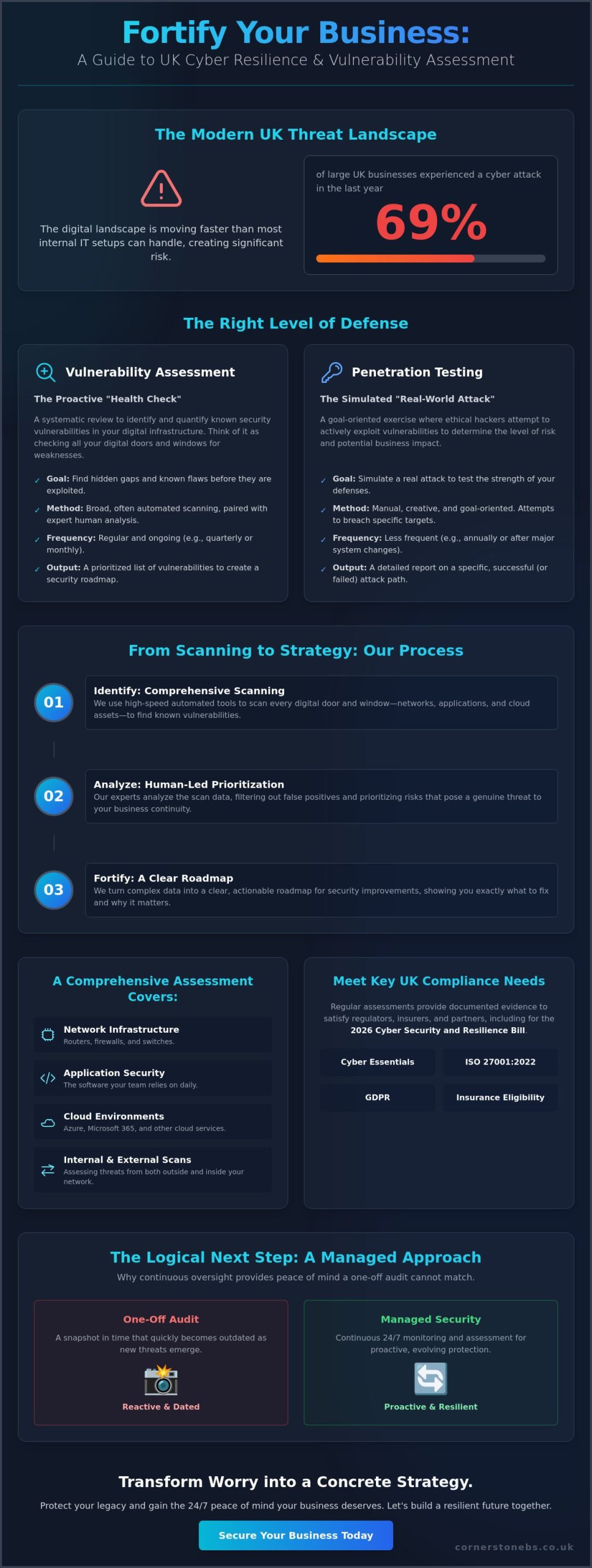

Did you know that small organizations represent 96% of ransomware victims according to the 2026 Verizon Data Breach Investigations Report? It is a startling figure that challenges the common belief that smaller firms fly under the radar of global cybercriminals. We understand that as a local business owner, you likely feel the weight of protecting your team and your customers, often while navigating a sea of confusing technical jargon and tight budget constraints. You want to know that your digital doors are locked, but you don’t want to overspend on tools that feel like overkill.
The good news is that penetration testing for small business is not just a luxury for the corporate giants; it is a vital insurance policy for your continuity. This guide simplifies the complex, showing you how identifying hidden vulnerabilities today builds the long-term resilience you need to protect your reputation. We will provide a clear roadmap for implementation and explain the tangible ROI of securing your systems. By the end, you will have the confidence to show your clients that your business is resilient, secure, and ready for whatever the 2026 threat landscape holds.
Key Takeaways
- Understand how a controlled, ethical attack identifies hidden vulnerabilities before real-world cybercriminals can exploit them.
- Learn how to define the right scope for penetration testing for small business so you only invest in the specific security checks your SME actually needs.
- Discover why automated vulnerability scans often leave dangerous blind spots that only expert manual testing can effectively uncover.
- Get a practical roadmap for setting rules of engagement to ensure your security audit is completed without any disruption to your daily operations.
- See how proactive cyber security measures build long-term resilience and prove your commitment to data protection to your own clients.
What is Penetration Testing for Small Business?
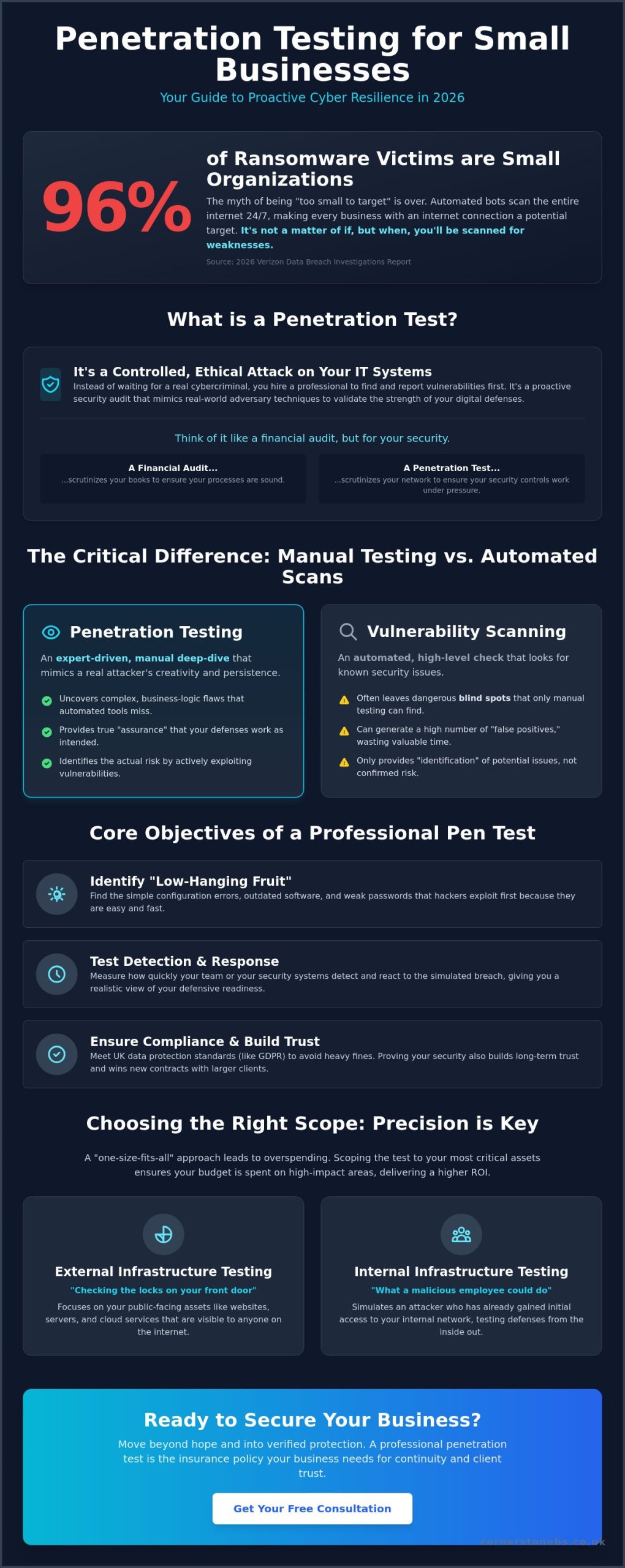
At its heart, penetration testing is a controlled, ethical attack on your IT infrastructure. Instead of waiting for a cybercriminal to find a way into your systems, you hire a professional to do it first. We often describe this to our local partners as a proactive security audit that mimics real-world adversary techniques to validate the strength of your digital defenses. It is about moving beyond hope and into the territory of verified protection.
Many business owners find the perfect analogy in a financial audit. Just as an accountant scrutinizes your books to ensure every penny is accounted for and your processes are sound, an ethical hacker scrutinizes your network. They aren’t just looking for problems; they are providing “assurance” that your existing security controls actually work under pressure. This is a significant step up from simple “identification” where you might just list the tools you have in place without knowing if they’ll hold up during a breach. For a deeper dive into the methodology, you can explore the foundational concepts of What is a Penetration Test? on Wikipedia.
Our role as your security partner is to act as the “Ethical Hacker.” We use the same tools and tactics as the bad guys, but we do it with your permission and your business interests in mind. This process protects your hard-earned reputation by ensuring that when a real threat arrives, your doors are firmly bolted. It is a foundational element of modern business stability.
Why SMEs Can No Longer Fly Under the Radar
The myth of being “too small to target” has been firmly debunked in 2026. Today’s cybercriminals use automated attack bots that scan the entire internet 24/7, looking for any open door regardless of the company’s size. If you have an internet connection, you are on their radar. We also see a massive rise in “Supply Chain” risk. Your larger clients and partners now face immense pressure to secure their own networks, which means they are increasingly demanding proof of penetration testing for small business from every vendor they work with. Security is no longer just a technical need; it is a requirement for winning new contracts.
The Core Objectives of a Professional Pen Test
A professional test focuses on three vital areas to keep your SME resilient:
- Identifying “low-hanging fruit”: We find the simple configuration errors or unpatched software that hackers exploit first because they are easy and fast.
- Testing response times: It isn’t just about the “hack.” We measure how quickly your team or systems detect the simulated breach, giving you a realistic view of your defensive readiness.
- Ensuring compliance: Regular testing helps you meet UK data protection standards and GDPR requirements, protecting you from the heavy fines that follow a data leak.
The Different Types of Testing: Choosing the Right Scope
Precision is everything when it comes to securing your business. Not all tests are created equal, and for an SME, a “one size fits all” approach usually leads to overspending on unnecessary checks. The key is scoping. By narrowing the focus to your most critical assets, you ensure your budget is spent on high-impact areas rather than generic scans. According to the NIST definition of penetration testing, these assessments are designed to identify the most efficient way to circumvent your security features. It’s about finding the path of least resistance before a criminal does.
Your business model dictates your testing needs. An e-commerce platform requires deep web application testing to protect customer payment data. In contrast, a professional consultancy might prioritize document security and email integrity. We help our partners match the test type to their specific operations, ensuring that penetration testing for small business remains a practical, high-ROI investment. If you’re looking to strengthen your overall resilience, integrating these tests into a broader Managed IT Support strategy ensures your defenses are always up to date.
External vs. Internal Infrastructure Testing
Think of external testing as checking the locks on your front door. It focuses on your public-facing assets like websites, email servers, and remote access points. Internal testing, however, asks a tougher question: what happens if a hacker already has a foot in the door? This simulates the actions of a disgruntled employee or someone who has stolen a staff member’s credentials. With the rise of remote teams in 2026, prioritizing VPN and cloud access testing is no longer optional; it’s a foundational requirement for business continuity.
Social Engineering and Phishing Simulations
Your technology might be robust, but your “Human Firewall” is often the most vulnerable point. The 2026 Verizon Data Breach Investigations Report reveals that human behavior contributes to 62% of breaches. To combat this, we simulate real-world phishing attacks to train your staff in a safe, controlled environment. These simulations are eye-opening. For instance, phishing attempts via text messages and phone calls now have a 40% higher success rate than those sent via email. We also test physical security by checking if a stranger could walk into your office and plug a rogue USB into a workstation. Testing the human element is just as vital as testing your servers.
Penetration Testing vs. Vulnerability Scanning
One of the most frequent conversations we have with local business owners revolves around a simple misunderstanding. Many people believe that running an automated security scan is the same thing as a full penetration test. While both are essential parts of a robust penetration testing for small business strategy, they serve very different purposes. A vulnerability scan is like a smoke alarm that listens for a specific signal, while a penetration test is more like a fire marshal inspecting your entire building to find out how a fire might start in the first place.
Relying solely on automated tools creates dangerous “blind spots” in your security. Machines are excellent at finding known software bugs or missing patches, but they lack the intuition to understand business logic. A machine might see a secure login page and move on, whereas a human expert might realize that the “password reset” function is poorly designed and could be exploited. We help you filter out the “noise” of false positives, which are security alerts that machines flag but don’t actually pose a risk. By removing this clutter, we ensure your team only focuses on the fixes that truly matter. This balanced approach is a core part of our cyber security services, providing you with both efficiency and deep protection.
Automated Scans: Your Daily Security Baseline
Automated scans are your high-frequency, low-cost guardians. They work by comparing your system against a database of thousands of known vulnerabilities. These tools are fantastic for constant monitoring, especially if you regularly add new hardware or update your software. However, their limitations are clear. Machines cannot think creatively. They can’t perform “chained” attacks, where a hacker uses three small, seemingly harmless flaws in a row to gain total control of your server. Scans give you the “what,” but they often miss the “how.”
Manual Pen Testing: The Expert Deep-Dive
This is where the “Ethical Hacker” truly shines. Manual penetration testing for small business involves a specialist using their experience to think outside the box. They probe your bespoke software and complex network configurations just like a real adversary would. This deep-dive is essential for identifying those complex logic flaws that automated tools simply cannot see. The real value lies in the final report. Instead of a 200-page list of technical errors, you receive a prioritized, easy-to-read document that explains exactly how to fix your most critical issues. It’s about giving you a clear, actionable path to resilience without the technical headache.
How to Prepare Your Business for a Security Audit
Preparing for a security audit can feel like inviting a professional burglar to test your house alarms. It is natural to feel a bit of anxiety about the process. However, professional testers are highly trained to avoid system downtime. We work within strictly defined “Rules of Engagement” that act as a legal and technical contract. These rules ensure that we only test what you want, when you want, and how you want. When planning penetration testing for small business, honesty is always the best policy. Providing your testers with accurate network maps and asset lists doesn’t “cheat” the test. Instead, it allows us to spend more time finding deep vulnerabilities rather than wasting your budget on basic discovery.
Communication is key to a smooth audit. You don’t necessarily need to tell every employee that a test is happening, especially if you are testing your “Human Firewall” through phishing simulations. However, your internal IT team or your Cyber Security partner must be in the loop. This prevents “friendly fire” incidents where your defenders accidentally shut down the test thinking it is a real attack. We act as your long-term partner, ensuring the entire process is transparent and supportive.
Defining the Scope and Goals
The first step is identifying your “crown jewels.” These are the data sets or systems that would cause the most damage if lost, such as customer payment info or proprietary designs. We help you set a timeframe that avoids your busiest periods, like year-end accounting or seasonal sales peaks. You will also need to choose your methodology. A “Black Box” test provides the tester with zero prior knowledge, mimicking an outside attacker. A “White Box” test provides full info, allowing for a much deeper and more efficient audit of your internal configurations.
The Post-Test Roadmap: Remediation and Resilience
Once the test is complete, don’t panic when you see the list of findings. Every professional test will find vulnerabilities; that is exactly what you are paying for. The goal isn’t a perfect score but a clear path to improvement. We help you prioritize the “Critical” and “High” risks first, ensuring you maximize your budget where it matters most. Finally, never skip the re-test. This is a shorter follow-up that confirms your team has implemented the fixes correctly. It closes the loop on your penetration testing for small business and ensures your resilience is truly verified before you share your security credentials with clients.
Securing Your Future with Cornerstone Cyber Security
Choosing a security partner is about more than just checking boxes. It’s about finding a team that understands the local landscape and the specific pressures you face as a growing SME. As a multi-award-winning provider, we’ve built our reputation on delivering high-level protection with a friendly, community-focused approach. We pride ourselves on our regional roots, offering UK-based support that understands national regulations and the unique needs of our neighbors. When you invest in penetration testing for small business with us, you aren’t just getting a technical report. You’re gaining a long-term partner dedicated to your stability and peace of mind.
We believe in moving away from reactive “firefighting” and toward proactive managed IT services. Our experts strip away the dense technical jargon, providing clear and declarative statements about your security posture. This clarity allows you to focus on what you do best: growing your company. We handle the complex digital infrastructure, ensuring your systems are resilient, modern, and always one step ahead of emerging threats.
Integrating Testing into Your Managed IT Strategy
Effective security isn’t a one-time event; it’s a regular pulse check. By integrating penetration testing for small business into your wider IT strategy, we create a continuous cycle of improvement. We use the insights from our audits to strengthen your cloud solutions and network infrastructure. This creates a powerful synergy between high-level professional audits and our unlimited helpdesk support. If a test identifies a potential weakness, our team is already on hand to implement the fix, ensuring your business continuity remains unbroken.
Your Dedicated Partner for Business Continuity
Our commitment is to deliver bespoke technology solutions that fit your specific budget and goals. We don’t believe in transactional relationships. Instead, we work collaboratively to help you achieve vital certifications like Cyber Essentials. These accolades do more than just secure your data; they act as a badge of trust that helps you win more business from larger clients. We invite you to have an informal conversation with our local team about your current security posture. Let’s explore how we can build a resilient foundation for your future growth together.
Building a Resilient Future for Your SME
Securing your business in 2026 doesn’t have to be a source of constant stress. We’ve explored how identifying hidden vulnerabilities early protects your reputation and why manual testing beats automated scans for finding complex logic flaws. By choosing the right scope and preparing your team, you turn a technical necessity into a strategic advantage for your growth. penetration testing for small business is the foundation of this proactive approach, ensuring your digital doors stay locked against evolving threats.
As a multi-award-winning IT services provider, we bring the power of our partnerships with Microsoft, IBM, and Cisco directly to your local doorstep. Our approach blends global technical excellence with the approachable, regional warmth of a team that truly cares about your success. We provide proactive system monitoring and unlimited helpdesk access, ensuring that expert support is always just a phone call away. You deserve a dedicated long-term partner who values your business stability and emotional security as much as you do.
Ready to strengthen your defenses? Book a security consultation with our award-winning UK team today. We look forward to helping you build a safer, more resilient future for your business.
Frequently Asked Questions
How much does penetration testing cost for a small business?
The cost of penetration testing for small business depends entirely on the size and complexity of your IT infrastructure. We tailor the scope to focus on your most critical assets, such as your customer databases or payment systems, to ensure you receive a high-ROI service. Factors like the number of external IP addresses and the complexity of your web applications will influence the final investment needed to secure your firm.
Will a penetration test crash my business systems or cause downtime?
A professionally managed test is designed to avoid system crashes or any disruption to your daily operations. We establish strict Rules of Engagement before the project starts, which act as a technical contract for our testers. Our experts use controlled, non-disruptive methods to identify vulnerabilities while ensuring your team can continue working without even noticing the audit is taking place.
How often should my small business have a penetration test?
We generally recommend conducting a full test once a year to maintain a strong security baseline. It is also a proactive step to schedule a targeted audit after any major changes to your network, such as a significant software update or migrating to new cloud solutions. Regular checks ensure that your defenses evolve at the same pace as modern cyber threats.
Is penetration testing a legal requirement for UK SMEs?
While not a blanket legal requirement for all sectors, it is often mandated by specific industry standards and regulatory frameworks. For instance, the Digital Operational Resilience Act (DORA), which came into force in January 2025, requires firms in the financial supply chain to perform regular resilience testing. Many larger clients also require proof of testing as a condition of their procurement contracts.
What is the difference between an ethical hacker and a cybercriminal?
The primary difference is authorization and intent. An ethical hacker has your explicit written permission to probe your systems and works as your partner to improve your defenses. A cybercriminal operates illegally to steal data or cause damage. We act as your local “white hat” experts, using the same tactics as an adversary to find and fix weaknesses before they can be exploited.
How long does a typical small business penetration test take?
Most assessments for small and medium-sized enterprises are completed within three to ten working days. This timeframe includes the initial reconnaissance, the manual testing phase, and the creation of your prioritized report. We focus on efficiency to respect your time, providing a clear roadmap for remediation shortly after the technical work concludes.
Can penetration testing help my business achieve GDPR compliance?
Yes, it is a foundational part of meeting your GDPR obligations. The regulation requires you to regularly test and evaluate the effectiveness of the technical measures you use to protect personal data. A professional test provides the documented proof you need to show regulators and clients that you are taking proactive, reasonable steps to prevent a data breach.
Do I need a pen test if I already have antivirus and a firewall?
You absolutely need a test because antivirus and firewalls are defensive tools that can be bypassed through misconfigurations or human error. A penetration test identifies the “blind spots” that these automated tools miss, such as complex logic flaws in your software. It provides a realistic view of how a human attacker would actually try to break into your network.