Posted on: July 31st, 2026 by Cornerstone
What if the ‘cheap’ laptop repair you just paid for is actually costing your business thousands in hidden productivity losses? You likely already feel the strain of frequent hardware failures and the constant worry of a security breach on a remote worker’s device. It’s frustrating when inconsistent updates cause performance lag, leaving your team stuck while the clock is ticking.
As an award-winning IT partner, we understand that reliable business laptop support is about more than just fixing screens; it’s the foundation of your company’s stability. You deserve a proactive strategy that delivers predictable monthly costs and rapid response times. This 2026 guide reveals how to secure your fleet, maintain peak performance, and significantly extend the lifespan of your expensive hardware assets. We will walk you through the essential steps to move from reactive repairs to a sophisticated management model that keeps your local business moving forward.
Key Takeaways
- Understand why modern fleet management requires a shift from simple repairs to a comprehensive service model that includes proactive health checks.
- Learn how to harden your mobile workforce by enforcing strict update schedules and implementing Multi-Factor Authentication across all portable devices.
- Compare the commercial realities of hiring internal IT staff against the efficiency of a professional business laptop support partner to eliminate single points of failure.
- Discover the power of Remote Monitoring and Management for proactive threat hunting and maintaining peak hardware performance.
- See how award-winning, UK-based expertise can transform your IT from a reactive cost center into a stable foundation for business growth.
What is Business Laptop Support and Why Does it Matter?
Understanding What is Business Laptop Support involves looking beyond simple hardware repairs. It’s a proactive ecosystem that keeps your team’s hardware healthy, their software updated, and their technical questions answered immediately. Think of it as the invisible engine room of your company. When your business laptop support is handled correctly, your staff don’t even notice the complexity involved; they simply open their lids and get to work.
The commercial landscape in the UK has shifted. We’ve moved from rows of static office desktops to agile, mobile fleets. This flexibility is brilliant for growth, but it makes IT management more complex. The old ‘break-fix’ model, where you only call a technician when something stops working, is failing modern firms. In a fast-paced environment, even a few hours of downtime can ripple through your client commitments and damage your reputation. You can’t afford to wait for a failure to happen before you take action.
Professional support also plays a massive role in employee retention. When a team member struggles with a lagging machine or a flickering screen, their productivity drops and their frustration rises. Providing reliable, high-performance tech shows your staff that you value their time and their contribution. It creates an atmosphere of professional respect and efficiency that helps you keep your best talent.
The Difference Between Residential and Business Support
Residential support is often transactional. You take a device to a shop, and they fix it when they can. Business support is entirely different because it focuses on continuity. We use enterprise-grade security protocols and full-disk encryption to protect your sensitive data. Most importantly, professional business laptop support is bound by Service Level Agreements (SLAs). This means you have a guaranteed response time, ensuring your business stays operational no matter what happens.
Why 2026 Demands a Mobile-First IT Strategy
Hybrid work is now the standard, but it introduces new risks. Home networks are rarely as secure as office environments, making remote laptops a primary target for cyber threats. A robust strategy ensures a seamless Microsoft 365 migration so your team can access cloud files securely from anywhere. We also manage hardware performance to ensure resource-intensive applications run smoothly, preventing the performance lag that often plagues older or unmanaged mobile devices.
Core Components of a Professional Laptop Support Service
A professional support service is built on four pillars: monitoring, security, automation, and asset management. These components ensure that your business laptop support is truly proactive rather than a series of frantic fire fighting exercises. When these systems work together, your team stays productive and your data remains secure without you needing to manage the technical minutiae yourself.
Remote Monitoring and Management (RMM)
RMM acts as the silent guardian of business hardware. It continuously monitors internal temperatures, disk health, and memory usage across your entire fleet. If a component starts to drift outside of normal parameters, our team receives an alert before the user even notices a slowdown. We can perform background maintenance, such as clearing temporary files or optimising startup processes, without interrupting your employees’ workday.
Endpoint Protection and Cyber Security
Security is no longer just a software add-on; it must be baked directly into the device. By integrating cyber security services into your laptop management, we protect every endpoint regardless of the network it uses. This includes managed firewalls, anti-malware, and proactive threat hunting. If a laptop is lost or stolen, we can trigger remote wipe capabilities to ensure your sensitive company data never falls into the wrong hands.
Hardware Lifecycle Management
Many businesses struggle with the ‘hidden’ costs of ageing hardware. We help you standardise laptop models, which simplifies support and makes parts replacement much faster. Following Best Practices for Maintaining a Productive Laptop Fleet, we typically recommend a three to five year hardware refresh cycle. This prevents the performance dip that occurs as hardware ages. When a device reaches the end of its life, we handle secure decommissioning and certified data destruction to maintain your compliance standards.
Managing a growing fleet doesn’t have to be a source of stress. A quick chat with our managed IT support team can help you map out a lifecycle and security plan that fits your specific business goals. We focus on the tech so you can focus on your growth.
- Automated patch management for all core software.
- Real time hardware health alerts.
- Inventory tracking for every device in your organisation.
- Strategic planning for future hardware investments.
In-House vs. Managed Laptop Support: A Commercial Comparison
Choosing between an internal hire and an outsourced partner is one of the most significant commercial decisions a business leader makes. While having a technician in the next room feels convenient, the true cost of a full-time employee includes recruitment, training, benefits, and expensive diagnostic software. For many small and medium-sized enterprises, this creates a ‘single point of failure’ risk. If your only IT person is on holiday or unwell when a critical hardware failure occurs, your productivity grinds to a halt.
Effective business laptop support requires a team rather than a single individual. An outsourced model provides access to a wider pool of expertise and ensures that support is always available, regardless of staff holidays. This scalability is vital; as your headcount grows, your support capacity expands instantly without the need for additional recruitment cycles. It’s about building a resilient foundation that allows you to scale with confidence. You gain a partner invested in your long-term success, not just a person to fix a broken screen.
Cost Predictability and Scaling
One of the biggest advantages of outsourcing is the shift from unpredictable capital expenditure to stable operational costs. Our Managed IT services replace fluctuating emergency repair bills with a fixed monthly fee per user. This approach eliminates the need for you to purchase expensive internal diagnostic tools or maintain a spare parts inventory. It provides ‘enterprise-level’ support for SMEs, giving you the same high-tier tools used by global corporations but at a price point that makes sense for a local business.
Access to Multi-Vendor Expertise
Technology moves fast. It’s difficult for a single internal technician to stay expert in everything. By partnering with an MSP, you gain access to specialists who maintain deep partnerships with Microsoft, Dell, HP, and Lenovo. This collective knowledge is essential when managing complex cloud solutions that internal staff may lack the time to master. When deciding between In-House vs. Managed Laptop Support, consider the value of a shared knowledge base. If we solve a complex issue for one client, that solution is immediately available to every business we support. This leads to much faster troubleshooting and significantly less downtime for your team.
Best Practices for Maintaining a Productive Laptop Fleet
Implementing a high-performing fleet requires a shift in mindset. you shouldn’t wait for a hardware failure to take action. Instead, you need a rigorous schedule that targets the underlying health of your machines. This starts with enforcing strict BIOS and firmware update schedules. These low-level updates often fix critical stability issues and security vulnerabilities that standard Windows updates might miss. By keeping this foundational software current, you ensure your hardware communicates perfectly with your operating system, which is a core pillar of effective business laptop support.
Security must remain a top priority for any mobile workforce. Implement Multi-Factor Authentication (MFA) on every portable device without exception. It’s one of the most effective ways to prevent unauthorised access if a device is misplaced. Additionally, you should regularly audit hardware performance to identify ‘bottleneck’ machines. If a laptop is consistently hitting 100% CPU usage during normal tasks, it’s a sign that the hardware is no longer fit for purpose. Replacing these machines before they fail completely keeps your team productive and happy.
Proactive Maintenance Schedules
Consistency is the secret to longevity. We recommend monthly performance reviews and disk health checks for every device in your fleet. This includes clearing temporary files and optimising startup programmes to ensure rapid boot times. Industry professionals often find that proactive maintenance extends laptop life by 20%, saving you significant capital expenditure over the long term. This level of attention is what separates a basic repair service from professional business laptop support.
Standardising Hardware for Efficiency
Running a mix of ten different laptop brands is a support nightmare. It complicates everything from driver updates to spare parts inventory. We suggest standardising on a few specific laptop builds. This allows you to use universal docking stations and ensures all peripherals are compatible across the entire office. Standardisation also enables ‘hot-swapping.’ If a staff member’s laptop requires a physical repair, you can simply hand them an identical spare. They can sign in and be back to work in minutes, not hours.
Protecting your data is just as vital as protecting the hardware. Utilise cloud-based backups for every device to ensure that a hardware crash doesn’t lead to a total loss of work. If you want to see how a structured approach can transform your operations, take a look at our Managed IT Support options. We can help you build a fleet that is secure, standardised, and ready for growth.
- Enforce MFA on all portable business devices.
- Standardise hardware models to simplify peripheral compatibility.
- Schedule monthly health checks to catch failing components early.
- Use cloud backups to decouple your data from physical hardware risks.
Cornerstone Business Solutions’ Approach to Seamless Hardware and Software Support
At Cornerstone Business Solutions, we don’t believe in one-size-fits-all IT. Your business laptop support should reflect your unique goals and the specific way your team works. We position ourselves as a dedicated long-term partner, moving away from transactional relationships to focus on your sustained growth. Our role is to provide the technical stability you need to lead your industry with confidence. We treat your hardware with the same care as our own, ensuring every device is a tool for progress rather than a source of frustration.
We’ve spent years refining our it company solutions to ensure they integrate seamlessly into your daily operations. This isn’t just about fixing a device; it’s about ensuring your entire digital infrastructure supports your commercial objectives. Our regional roots mean we’re always reachable, offering a friendly face and a level of accountability that large national corporations often lack. We combine this local warmth with the sophisticated tools of a modern IT powerhouse, giving you the best of both worlds.
Award-Winning Support Standards
Our multi-award-winning helpdesk is staffed by experts right here in the UK. We provide unlimited access through our fixed-fee contracts, which means your team can reach out whenever they need help without you worrying about an escalating bill. This creates emotional security for your staff, knowing they have an expert friend to call when things go wrong. We pride ourselves on transparency, providing clear reporting on ticket resolution and the overall health of your systems. You’ll always know exactly how your hardware is performing through our detailed metrics and regular reviews.
Bespoke Technology Roadmaps
We help you look beyond the immediate fix. Our team works with you to create three-year technology roadmaps, ensuring your hardware investments align with your wider business strategy. This proactive planning prevents the ‘tech debt’ that occurs when businesses react to failures rather than preparing for expansion. We help you budget for the future, making IT costs predictable and manageable. It’s about building a foundation that allows you to scale your business laptop support alongside your headcount.
Take Control of Your Fleet’s Future
Managing a mobile workforce in 2026 requires more than just reactive fixes. It demands a proactive strategy built on robust endpoint security, standardised hardware, and real time monitoring. By moving away from the ‘break-fix’ cycle, you secure your company’s data and ensure your team remains productive without the frustration of constant technical lag. You’ve seen how standardisation and lifecycle planning can turn a chaotic IT environment into a stable, predictable asset.
Choosing the right partner for your business laptop support provides the stability your organization needs to scale. As a multi-award-winning service provider and strategic partner with Microsoft and Cisco, we offer the expertise of a global leader with the approachable warmth of a local team. Our UK-based helpdesk is ready to act as your long-term technology partner, helping you plan for the years ahead. It’s time to stop worrying about downtime and start focusing on your growth.
Book a free IT support consultation with our award-winning team to discover how we can simplify your fleet management. Your business deserves a foundation of reliability; let’s build it together.
Frequently Asked Questions
What is included in business laptop support?
Comprehensive business laptop support includes real time health monitoring, automated software patching, and endpoint security alongside unlimited helpdesk access. We don’t just wait for things to break; we proactively manage the health of your machines. This covers everything from ensuring your operating system is secure to troubleshooting peripheral issues with docking stations or printers.
Is managed IT support cheaper than hiring an internal technician?
Managed support is typically much more cost effective because you only pay for the service you need without the burden of a full time salary. Hiring an internal technician involves recruitment fees, training, and equipment costs that often exceed a fixed monthly contract. By partnering with us, you gain an entire team of experts for a fraction of the cost of one senior hire.
How do you support laptops for remote or hybrid workers?
We support remote and hybrid workers through cloud management tools that allow us to update and secure devices regardless of their physical location. As long as the laptop has an internet connection, our team can provide remote assistance and monitor for threats. This ensures that your staff in the field receive the same high level of protection as those in the office.
Can you provide hardware repairs as well as software support?
We offer a complete hardware and software solution, including the procurement of new devices and physical repairs for existing ones. Our partnerships with industry leaders like Microsoft and Cisco ensure you get enterprise grade hardware that is fully supported. We handle the entire lifecycle, from the initial setup to the secure decommissioning of old assets.
What happens if a business laptop is lost or stolen?
If a device is lost or stolen, we immediately initiate a remote wipe to protect your sensitive business data. This protocol ensures that even if the physical hardware is gone, your company’s information remains inaccessible to unauthorised users. We also assist with the rapid deployment of a replacement device to get your employee back to work quickly.
Do you support both Windows and Mac laptops for business?
What are the typical response times for laptop support tickets?
Our response times are governed by strict SLAs that prioritise critical issues to keep your business moving. We understand that a non functional laptop is a major barrier to productivity, so our UK based helpdesk aims for rapid resolution. You receive transparent reporting on every ticket, so you can track our performance against our guaranteed service standards.
Posted on: July 5th, 2026 by Cornerstone
If your team is still spending Monday mornings manually syncing spreadsheets, you aren’t just losing time; you’re paying a “hidden tax” on your business growth. With the global business process automation market projected to reach $22.3 billion in 2026, the competitive gap is widening between efficient firms and those bogged down by administrative tasks. Leveraging Power Automate for business process automation allows you to turn those wasted hours into a strategic advantage by using the tools you already own.
We understand the frustration of seeing talented staff stuck in a loop of manual data entry and approval delays. It’s a common hurdle that drains morale and invites human error into your systems. This strategy guide reveals how to eliminate those repetitive tasks and scale your operations using the Microsoft 365 ecosystem you already trust. As your local partner in IT stability, we’ll walk you through the 2026 roadmap for creating a “hands-off” workflow. You’ll discover how the latest AI agent authoring and self-healing flows can reduce your operational costs while giving you total visibility over your data.
- Learn how to unify your Microsoft 365 apps and third-party tools into a single, cohesive engine for maximum efficiency.
- Understand the difference between API-driven Digital Process Automation and bot-led Robotic Process Automation to choose the right fit for your specific workflows.
- Identify high-impact opportunities for automation, such as instant approval chains and seamless employee onboarding, that immediately reduce manual workloads.
- Master the audit and governance steps required to build a secure roadmap that prevents unmanaged flows and protects your business data.
- Discover why professional monitoring is the secret to scaling Power Automate for business process automation across your entire digital infrastructure.
Power Automate is the digital heartbeat of a modern, efficient office. It’s a low-code platform sitting within the Microsoft Power Platform ecosystem, designed to bridge the gap between your favorite applications. Think of it as the connective tissue that allows Outlook, SharePoint, Excel, and even third-party tools like Slack or Trello to talk to one another. By using Microsoft Power Automate, you can move data across these systems without manual intervention, effectively ending the era of “digital drudgery.”
For many of the local businesses we partner with, the most reassuring fact is that this technology is likely already sitting in your toolkit. Power Automate is included with most Microsoft 365 business licenses, including Business Basic, Business Standard, and Enterprise E3 or E5 plans. You don’t need a massive new investment to start. You just need a strategy to unlock the power you’re already paying for. By shifting from manual entry to proactive, automated workflows, your team can finally focus on the high-value work that actually drives growth.
The Three Pillars: Cloud Flows, Desktop Flows, and Business Process Flows
To master Power Automate for business process automation, you need to understand the three ways it moves your data. Each pillar serves a distinct purpose in your digital infrastructure:
- Cloud Flows: These are the most common automations. They trigger based on specific events in the cloud, such as a new email arriving or a file being updated in SharePoint.
- Desktop Flows: This is where Robotic Process Automation (RPA) comes into play. It’s perfect for older, legacy software that doesn’t have modern connection points. It records and mimics human clicks to handle repetitive tasks on your PC.
- Business Process Flows: These act as a guided roadmap for your staff. They ensure every team member follows the exact same steps in a sequence, like a standardized checklist for a new client intake.
Why 2026 is the Year of the “Automated SME”
The landscape of 2026 has made automation a survival requirement rather than a luxury. The global business process automation market is projected to reach $22.3 billion this year, driven largely by the accessibility of AI. With the integration of Microsoft Copilot and new AI agent authoring tools, building a complex workflow no longer requires a computer science degree. You can now describe the process you want, and the system helps build it for you.
In the UK, rising operational costs and the need for rapid service delivery have made manual processes a liability. Small and medium-sized enterprises are using automation to maintain their competitive edge. It’s about speed and reliability. When you automate a process, it runs the same way every time, 24 hours a day, without the risk of human error. This stability is the foundation of a scalable business.
When you begin your journey with Business Process Automation (BPA), you’ll quickly encounter two distinct paths: DPA and RPA. Understanding the difference is vital for your long term stability. One is a direct conversation between modern cloud systems; the other is a digital bot mimicking human actions on a screen. Most of our local partners find that choosing the right tool for the specific task prevents technical debt and keeps their operations running smoothly.
Using Power Automate for business process automation allows you to mix these two methods. However, we typically recommend a “cloud-first” strategy. By prioritizing modern connections, you build a foundation that is faster, more secure, and significantly easier to maintain as your business grows. If you aren’t sure where your current systems sit, seeking expert IT guidance can help you map out the most cost effective starting point.
When to Use Digital Process Automation (DPA)
Digital Process Automation is the gold standard for modern offices. It relies on APIs to share data behind the scenes. This is the “modern” way to work. It’s the best choice for any task involving Microsoft 365 native apps like Teams, SharePoint, or Excel. DPA is incredibly reliable because it doesn’t rely on what the software looks like on your monitor. If a software provider updates their interface and moves a button, your DPA flow won’t break. It continues to talk to the database directly, ensuring your workflows remain uninterrupted and your maintenance costs stay low.
When Robotic Process Automation (RPA) is Essential
There are times when the modern approach isn’t an option. Robotic Process Automation is your “legacy” bridge. It’s essential for older accounting software, bespoke industry applications, or local government portals that simply don’t have modern connection points. In these cases, Power Automate for business process automation uses “Desktop Flows” to record human actions. The bot will open the app, click the specific fields, and type in the data just like a staff member would.
RPA is particularly useful in two scenarios:
- High-volume data entry: When you have thousands of records to move into an old system that hasn’t changed in a decade.
- Transition periods: RPA acts as a perfect temporary fix during a Microsoft 365 migration. It allows you to keep your old on-premises software functional while you build out your new cloud infrastructure.
By using a hybrid approach, you get the best of both worlds. You can use the reliability of DPA for your daily communications while letting RPA handle the heavy lifting in your older, specialized software. This ensures no part of your business is left behind as you modernize.
Moving from theory to practice is where the real excitement begins. We often see local business owners light up when they realise how much “busy work” can simply vanish. Implementing Power Automate for business process automation isn’t just about high-level tech; it is about fixing the small, daily frictions that slow your team down. By connecting the apps you use every day, you create a seamless flow of information that requires zero manual intervention.
Here are five ways we see businesses transforming their daily operations right now:
- Automated Approval Workflows: Stop chasing managers for signatures. You can set up a flow that automatically pings a supervisor via Teams or email when an expense claim or contract is uploaded. They click “Approve,” and the system moves the file to the next stage instantly.
- Seamless Employee Onboarding: When you hire someone new, a single entry in a SharePoint list can trigger the creation of their user account, order their IT hardware, and send a welcome pack to their inbox.
- Real-Time Data Synchronisation: Forget manual CSV exports. You can keep your contact lists perfectly synced across Outlook, Excel, and your marketing tools so your data is always accurate and ready to use.
- Proactive Status Alerts: Stay ahead of deadlines. Set up a flow to notify your team in a specific Teams channel whenever a high-priority file is modified or a project milestone is approaching.
Streamlining Finance and Invoicing
The finance department often carries the heaviest burden of manual data entry. Power Automate changes this by using intelligent tools to read and process documents. You can set up a system that extracts data from PDF invoices and pushes it directly into your accounting software. AI Builder is an add-on that turns images into structured data. This technology significantly reduces “month-end” stress by automating bank reconciliation alerts and ensuring every penny is accounted for without a staff member needing to type a single number.
Enhancing Team Collaboration
Modern teamwork relies on information being in the right place at the right time. By integrating various cloud solutions into your daily communication, you remove the silos that cause confusion. You can automate “Daily Stand-up” prompts in Microsoft Teams to keep projects on track without hosting another meeting. More importantly, you can ensure all project documents are filed correctly in SharePoint. This happens automatically behind the scenes, so your digital workspace stays organised without any human effort. It makes your business more agile and much easier to manage.
Success with Power Automate for business process automation isn’t about how many flows you can build in a week. It’s about building the right ones securely. We always advise our local partners to start with a thorough audit phase. Look for the “low-hanging fruit.” These are the repetitive, rule-based tasks that consume the most staff hours. By identifying these high-volume bottlenecks first, you ensure your initial automation efforts deliver the fastest return on investment.
Security must be your foundation. You wouldn’t leave your office unlocked, and your digital workflows should be no different. A common mistake is allowing automation to bypass Multi-Factor Authentication (MFA) or existing data permissions. Your automated systems should respect the same security boundaries as your human staff. Once a flow is live, don’t just “set and forget” it. Regular testing and iteration ensure your processes remain efficient as your business evolves.
The Risk of Unmanaged Automation
While the “low-code” nature of Microsoft tools is a massive benefit, it also creates the risk of “Shadow IT.” This happens when employees create their own unmanaged flows without any professional oversight. A poorly designed automation could accidentally share sensitive client data with an external email address or a public folder. To prevent this, you need robust Data Loss Prevention (DLP) policies within your environment. These policies act as digital guardrails, stopping sensitive information from leaving your secure perimeter. Maintaining these high standards is a core part of our cyber security services, ensuring your innovation never compromises your safety.
Creating a “Center of Excellence”
Scaling your automation requires a structured approach. A Center of Excellence is a framework for governing low-code development across your entire organization. It establishes clear rules for who can create, trigger, and modify business-critical flows. This isn’t about slowing things down; it’s about providing a safe environment where your team can innovate. Proper documentation is a vital part of this framework. It ensures that the technical knowledge behind your workflows stays within the company, even if a key staff member moves on. If you’re ready to build a more resilient office, we invite you to start your automation audit with our team of experts today.
Building a workflow is just the start of the journey. To truly scale, you need a system that adapts as your business grows. As your it company solutions change and your team expands, your automated flows must keep pace. Managed IT support provides the continuous monitoring required to catch errors before they impact your customers. When you use Power Automate for business process automation, having an expert eye on your dashboard ensures that every trigger and action remains aligned with your live data.
Scaling means more than just adding more flows. It means ensuring those flows are resilient. We integrate automation into your broader business continuity and disaster recovery strategy. If a cloud service experiences downtime, your managed partner ensures your business processes have a failover or a manual backup ready to go. This proactive approach transforms technical support from a necessity into a strategic advantage. We identify new opportunities for efficiency that you might miss while focusing on your day-to-day operations.
Cornerstone: Your Partner in Proactive Technology
Our team brings multi-award-winning expertise to your Microsoft 365 environment. We’ve moved beyond the traditional “break-fix” model. Instead, we focus on strategic business process optimisation that aligns with your specific goals. By ensuring your automation is backed by robust network infrastructure and expert support, we provide the peace of mind you need to innovate. We pride ourselves on being a local partner that understands the unique challenges of UK businesses. Our goal is to make complex technology feel simple, reliable, and deeply connected to your success.
Getting Started with a Process Audit
The journey toward a “hands-off” workflow begins with a simple, honest conversation. We help businesses across the region identify the manual bottlenecks that are currently draining their resources and morale. Transitioning to an automated future doesn’t have to be overwhelming when you have a trusted expert by your side. We provide the clarity and technical strength needed to modernise your operations without the stress of doing it alone.
We invite you to contact our expert team today for a bespoke technology review. Let’s explore how Power Automate for business process automation can give your team the time they need to focus on what they do best. We are ready to help you build a more efficient, secure, and scalable future for your business.
The shift toward a more efficient office isn’t just about software; it’s about giving your team the freedom to do their best work. You’ve seen how choosing between DPA and RPA can bridge the gap between your legacy systems and the modern cloud. By establishing a secure roadmap with proper data governance, you protect your business while you innovate. Leveraging Power Automate for business process automation allows you to turn these technical tools into a reliable engine for growth.
As a multi-award-winning IT provider and Microsoft Certified Partner, we don’t just set up your flows and walk away. Our managed plans include 24/7 proactive monitoring to ensure your systems remain stable and secure around the clock. We are here to be your long-term partner in technology, helping you navigate the complexities of 2026 with confidence and clarity.
Book a free business process audit with our award-winning team to identify your manual bottlenecks. We’ll help you build a tailored strategy that fits your unique local roots and ambitious growth plans. Let’s start a conversation about making your business more efficient today.
Is Power Automate included in my Microsoft 365 business subscription?
Yes, most Microsoft 365 business subscriptions include a version of Power Automate. Plans like Business Standard or Enterprise E3 allow you to create standard cloud flows within the Microsoft ecosystem. However, advanced features like Robotic Process Automation (RPA) or connecting to certain premium third-party apps usually require a separate Premium or Process license. We can check your current licensing to see exactly what is available to you right now.
Do I need to be a coder to use Power Automate for business process automation?
You don’t need to be a developer to build effective workflows. Power Automate for business process automation uses a “low-code” interface with a visual, drag and drop designer. While complex logic might benefit from professional setup, most business owners can use pre-built templates to handle simple tasks like email notifications or file syncing. It’s designed to empower your team to solve their own daily bottlenecks without writing a single line of code.
Can Power Automate connect to non-Microsoft apps like Salesforce or Slack?
Power Automate connects to over 1,000 different applications, including popular non-Microsoft tools like Salesforce, Slack, and Trello. These connections happen through “connectors” that allow data to flow securely between disparate systems. While many of these are “Premium” and require additional licensing, they are essential for creating a truly unified digital workspace where your CRM and communication tools talk to each other automatically.
How secure is Power Automate for handling sensitive financial data?
Power Automate is built on the enterprise-grade security of the Microsoft Cloud. It inherits the same identity and access management protections you already use, such as Multi-Factor Authentication (MFA). To protect sensitive financial data, we implement Data Loss Prevention (DLP) policies. These guardrails prevent your staff from accidentally sharing internal data with external parties, ensuring your automation remains both efficient and compliant with UK data regulations.
What happens to my automated flows if the person who created them leaves the company?
Flows can stop working if they are tied to a specific individual’s user account who then leaves the company. This is a common pitfall that can disrupt your operations. This is why we recommend using “Service Accounts” or shared environments for business-critical workflows. By setting up your automation under a central company identity rather than a personal one, you ensure that your processes remain stable and accessible regardless of staff changes.
Is there a limit to how many flows I can run in a month?
Microsoft sets limits on the number of “requests” or runs allowed per user, but these are typically high enough for most small and medium-sized businesses. For example, a standard license might allow thousands of actions per day. If you find your business outgrowing these limits, we can help you move to a per-process license. This provides much higher capacity for the complex, high-volume operations that larger organisations require.
Can Power Automate work with my old on-premise servers?
You can absolutely connect Power Automate to your on-premises servers using an “On-premises Data Gateway.” This acts as a secure bridge between your local databases and the cloud. It allows you to automate tasks involving local SQL servers or file shares without moving all your data to the cloud at once. This is a perfect solution for businesses maintaining a hybrid IT environment while they modernise their infrastructure.
How long does it typically take to implement a basic approval workflow?
A basic approval workflow can often be designed and tested within a few hours. Simple tasks, like approving a holiday request or a small expense, use standard templates that require minimal customisation. More complex processes involving multiple departments or legacy software might take a few days of planning and testing. Our goal is always to get you up and running as quickly as possible while ensuring the system is robust and reliable.
Posted on: May 27th, 2026 by Cornerstone
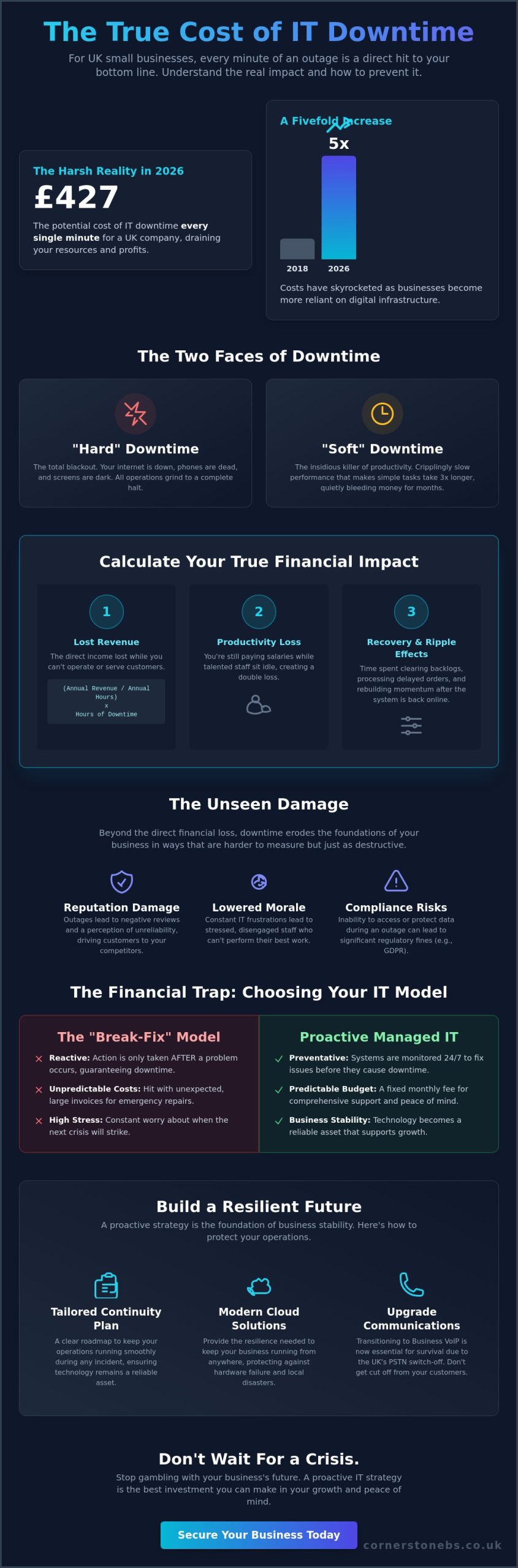
Would you willingly throw £427 into the bin every single minute? For many UK companies, that is the harsh reality of a system outage in 2026. The cost of IT downtime for small business has skyrocketed, seeing a fivefold increase since 2018 as we all become more dependent on digital infrastructure. While a “break-fix” engineer might eventually get you back online, the damage to your bank balance and your reputation often starts long before they arrive at your door.
We understand the frustration of watching talented staff sit idle while customer trust slips away. It’s a stressful position for any business owner, especially when you’re hit with an unexpected invoice for emergency repairs. This guide will show you how to calculate the true financial impact of these outages and why proactive Managed IT Support is the foundation of business stability. We’ll explore the hidden drains on your productivity and provide a clear roadmap to keep your operations running smoothly, ensuring your technology remains a reliable asset for your team. By the end, you’ll have a clear financial justification for IT investment that protects your growth and your peace of mind.
Key Takeaways
- Understand the critical difference between a total “hard” blackout and the subtle “soft” downtime that quietly drains your team’s daily productivity.
- Learn the precise formula to calculate the true cost of IT downtime for small business, accounting for both lost revenue and the hidden “wage drain” of idle staff.
- Discover how system reliability directly impacts your brand reputation and why preventing outages is essential for maintaining positive customer reviews.
- Identify why the reactive “break-fix” model is a financial trap and how a proactive approach creates a more predictable, stress-free budget.
- Explore how a tailored Business Continuity Plan and modern Cloud Solutions provide the resilience needed to keep your business running from anywhere.
What is IT Downtime and Why Does It Hit Small Businesses Hardest?
Technology is the engine of your business. When that engine stalls, your entire operation grinds to a halt. To understand the cost of IT downtime for small business, we first need to define the problem clearly. What is IT Downtime? It is any period where your digital infrastructure fails to support your core business functions. It isn’t just about a server being “off”; it’s about the inability to serve your customers or keep your team productive.
We see two distinct types of outages in the local business community. “Hard downtime” is the total blackout; your internet is gone, your phones are dead, and your screens are dark. However, “soft downtime” is often more insidious. This is the cripplingly slow performance that makes simple tasks take three times longer than they should. Both versions bleed money, but soft downtime often goes unmeasured for months. While a large corporation might have a backup for every system, a small business often relies on a single point of failure.
Smaller firms feel this impact more acutely because they lack the expensive redundant systems that protect global corporations. In 2026, we find that most outages aren’t caused by natural disasters. Instead, they stem from complex cloud misconfigurations or the silent failure of legacy hardware that has been pushed past its limit. Without a dedicated partner to monitor these systems, a small glitch can quickly snowball into a multi-day crisis. According to 2024 data, 92% of UK businesses require more than 24 hours to recover from a significant IT incident, a delay that most small budgets simply cannot absorb.
Common Triggers of Outages in 2026
Modern outages are rarely random. They are typically the result of three specific vulnerabilities:
- Cyber Security breaches: Ransomware and sophisticated phishing attacks remain the primary drivers of unplanned outages. One wrong click can lock your entire network.
- Hardware failure: Running end-of-life equipment is a gamble. We often see businesses struggling with aging servers or routers that simply cannot handle 2026 data demands.
- Human error: A lack of regular staff training is a major internal vulnerability. Accidental deletions or incorrect settings can be just as damaging as an external attack.
The 2026 Comms Crisis: Legacy Systems
The UK’s PSTN switch-off has permanently changed the landscape for business telecommunications. Companies still clinging to older analogue lines now face total communication isolation as those services are retired. Transitioning to a modern Business VoIP telephone system is no longer just an upgrade; it is a necessity for business continuity. Without it, you risk losing the ability to talk to your customers entirely. This creates a state of total isolation that makes recovery nearly impossible without a modern, cloud-based infrastructure in place.
Calculating the Direct Financial Impact: Revenue and Productivity
We’ve all seen that spinning loading icon and felt a twinge of frustration. In a busy UK office, that tiny icon represents a significant drain on your resources. For a local firm in 2026, the average cost of IT downtime for small business ranges from £137 to £427 per minute. That isn’t just a theoretical figure; it’s cash leaving your business in real-time. To find your specific risk, use the “Lost Revenue” formula: divide your gross annual revenue by your annual business hours, then multiply that by the hours of downtime. It’s a simple calculation that often yields a sobering result.
Beyond direct sales, you must account for the “Wage Drain.” You’re still paying your team’s salaries while they wait for a fix. This creates a double loss: you’re paying for labour that isn’t producing anything. This financial bleed continues even after the “on” switch is flipped. We call this “Recovery Time.” It takes significant effort to clear the backlog of emails, process delayed orders, and regain momentum. This “Butterfly Effect” can even lead to missed deadlines that haunt your contract renewals months later. Understanding The True Cost Of Downtime involves looking at these ripples, not just the initial splash.
The Productivity Drain
Direct Recovery Expenses
If you rely on the reactive “break-fix” model, expect a sting in the tail. Emergency call-out fees are notoriously high, and if your backups fail, specialized data recovery services can cost thousands. Your Recovery Time Objective (RTO) is the maximum acceptable length of time that your business can be offline before the damage becomes irreversible. Investing in robust Disaster Recovery solutions ensures that your RTO remains measured in minutes, not days, protecting your bottom line from unexpected shocks.
The Hidden Costs: Reputation, Morale, and Compliance
The visible invoice for a technical repair is only the tip of the iceberg. When we look at the true cost of IT downtime for small business, the most painful losses are often the ones that don’t appear on a balance sheet immediately. We’re talking about your reputation. In our local community, word travels fast. In 2026, we live in the “Social Proof” era where a single hour of system failure can lead to a permanent 1-star Google review. Potential clients won’t hear your explanation about a server glitch; they’ll simply see a “business that doesn’t answer” and move to your competitor.
Then there is the human element. Your team wants to do a good job, but constant technical hurdles make that impossible. We’ve seen how recurring IT issues lead to deep-seated frustration and, eventually, high staff turnover. It’s exhausting to spend your day “firefighting” instead of focusing on your actual role. For a business owner, this emotional toll is just as heavy. Instead of working on strategic growth, you’re stuck managing a crisis you didn’t ask for. This constant state of high alert leads to burnout and prevents you from being the proactive leader your company needs.
Customer Confidence and Retention
Customers in 2026 have zero patience for the “our systems are down” excuse. They expect seamless digital interaction. If you can’t provide it, the long-term value loss is staggering. A client who has been with you for years might finally decide to move to a more “digitally stable” rival after one too many outages. Conversely, you can use your system reliability as a powerful marketing tool. Showing that you’ve invested in your infrastructure tells your clients that you are a stable, professional partner they can trust for the long haul.
Compliance and Legal Penalties
We must also address the legal risks. Downtime isn’t just an inconvenience; it’s often a red flag for regulators. If an outage results in data loss or a breach of GDPR or NIS2 standards, the financial penalties can be life-changing for a small firm. Think of robust Cyber Security Services as an essential insurance policy. They protect you from the regulatory fallout that follows an unmanaged incident. Investing in your digital safety isn’t just a technical choice; it’s a foundational part of your legal and emotional security.
Why the “Break-Fix” Model is a Financial Trap for SMEs
Waiting for something to break before calling for help feels like a cost-saving measure. In reality, it is a financial trap that leaves your business vulnerable to the highest possible expenses. This reactive approach, often called the “break-fix” model, ensures that you only see your IT technician when your productivity has already hit zero. By the time they arrive, the cost of IT downtime for small business has already begun to spiral through lost sales and idle staff. It is a sticking plaster approach that ignores the underlying health of your digital infrastructure.
The fundamental flaw of break-fix is its lack of strategic planning. A reactive engineer’s goal is to get the specific broken part working again as quickly as possible. They aren’t incentivised to look at why it failed or how to prevent the next crash. This leads to a cycle of “patchwork” IT where systems are held together by temporary fixes rather than a solid foundation. This lack of foresight often results in a “budgeting nightmare” for business owners. You might go three months with no IT costs, only to be hit with a massive, unbudgeted invoice when a critical server finally gives up the ghost.
The Conflict of Interest
In a break-fix relationship, your goals and your provider’s goals are completely misaligned. The technician only makes money when your systems fail. If your network is running perfectly, they aren’t getting paid. This creates a subtle but dangerous conflict of interest. Conversely, our model for Managed IT Services in Teesside aligns our success with yours. We’re incentivised to keep you online because our fixed-fee structure means we work hardest when things are stable. We become a proactive partner invested in your long-term continuity rather than a distant contractor waiting for your next crisis.
Predictable vs. Volatile Spending
Switching to a managed model transforms your IT from an unpredictable “black hole” of expense into a predictable monthly line item. This stability is vital for healthy cash flow management. Proactive maintenance also ensures that your IT Hardware lasts longer, as we identify and resolve minor issues before they cause permanent damage. Emergency repairs are not just stressful; they are expensive. On average, an emergency call-out and a rushed fix cost three times more than a planned, proactive upgrade. You can protect your bottom line by choosing a partner who prevents fires instead of just fighting them. If you are ready to move away from the stress of reactive repairs, contact our local team today for a straightforward chat about your needs.
Building a Resilient Future: How to Eliminate Downtime
Eliminating downtime isn’t about luck; it’s about strategy. A bespoke Business Continuity Plan (BCP) is your first line of defence. This isn’t just a dusty document for corporate giants. It’s a proactive roadmap designed to keep your doors open when others are forced to close. By identifying risks early, you can significantly reduce the potential cost of IT downtime for small business. We work alongside you to build this resilience, ensuring your technology supports your growth instead of hindering it.
Proactive monitoring is the heartbeat of a stable network. We use advanced tools to watch your infrastructure around the clock, catching silent failures before they escalate into full-blown crises. This “always-on” approach means we’re often resolving issues before your staff even arrive at their desks. As a multi-award-winning partner, we take that weight off your shoulders. This allows you to focus on leading your business with total confidence in your system reliability.
Modern Cloud & Disaster Recovery
Modern Cloud Solutions have revolutionised resilience for local firms. Platforms like Microsoft 365 and Azure provide built-in redundancy that protects your data from local hardware failures. We always implement the “3-2-1” backup rule for Disaster Recovery. You should have three copies of your data, stored on two different types of media, with one copy safely off-site. This simple but powerful framework ensures your information remains secure and accessible, no matter what happens at your physical office.
Partnering for Success
Generic, off-the-shelf fixes rarely solve complex business challenges. You need technology that is as unique as your company. Our team provides bespoke solutions and a dedicated helpdesk that knows your business personally. We don’t just fix computers; we build long-term partnerships rooted in our regional community. If you’re concerned about your current system reliability, we invite you to a no-obligation conversation to audit your current risk level. Let’s talk about how we can secure your future together.
Secure Your Business Stability Today
Your company deserves more than just “getting by” with reactive repairs. We’ve explored how the true cost of IT downtime for small business reaches far beyond the technical fix, impacting your brand reputation and team morale. By shifting from the “break-fix” trap to a proactive partnership, you turn your technology into a silent engine of growth rather than a constant source of anxiety.
As a multi-award-winning IT services provider, we combine our local roots with global strength through strategic partnerships with Microsoft, IBM, and Cisco. Our proactive 24/7 system monitoring identifies potential threats before they interrupt your workday, providing the emotional security you need to focus on your goals. It’s about building a foundation that doesn’t just survive an outage but prevents it from happening in the first place.
Book a free IT health check with our award-winning team to discover how we can protect your productivity. We’re ready to help you build a more resilient, profitable future for your business.
Frequently Asked Questions
How do you calculate the hourly cost of IT downtime?
You can calculate this by adding your lost revenue to your total wage drain. Divide your gross annual revenue by your annual business hours to find your hourly revenue risk. Add the hourly salary costs of all idle staff members during the outage to find the true hourly impact on your bottom line.
What are the most common causes of IT downtime for small businesses in the UK?
Cyber security breaches, such as ransomware, and the failure of legacy hardware are the primary triggers in 2026. Many local firms also face outages due to cloud misconfigurations or issues related to the PSTN switch-off. Human error, often caused by a lack of staff training, remains a significant internal vulnerability for smaller teams.
How can managed IT services actually reduce my business costs?
Managed support replaces unpredictable emergency repair bills with a fixed, predictable monthly fee. Proactive monitoring catches minor glitches before they escalate into expensive crises, which significantly lowers the overall cost of IT downtime for small business. This approach also extends the lifespan of your hardware through regular, expert maintenance.
Is “soft downtime” like slow internet as expensive as a total outage?
Soft downtime is often more expensive over the long term because it acts as a silent drain on productivity. While a total blackout is obvious, slow systems cause daily “micro-downtime” that disrupts concentration and employee morale. These small delays can add up to dozens of lost hours per employee every single year.
Does cyber insurance cover the cost of lost productivity during downtime?
Cyber insurance policies vary, so you must check for specific “business interruption” clauses in your agreement. While many policies cover data recovery and legal fees, they don’t always compensate for the daily productivity lost while systems are offline. It is better to use proactive security as your primary defence and insurance as a final safety net.
How often should a small business test its disaster recovery plan?
We recommend testing your plan at least once a year or whenever you implement major system changes. Regular testing confirms that your backups are healthy and that your team knows their specific roles during an emergency. This practice ensures that a real incident feels like a practiced drill rather than a chaotic crisis.
What is the difference between RTO and RPO in business continuity?
RTO stands for Recovery Time Objective, which is the target time for getting your systems back online. RPO, or Recovery Point Objective, refers to the maximum amount of data you can afford to lose, measured in time. For instance, if you back up your data every four hours, your RPO is four hours.
Can cloud migration help eliminate IT downtime?
Cloud migration significantly reduces downtime by removing reliance on a single piece of local hardware. Platforms like Microsoft 365 allow your team to remain productive from any location if your physical office faces an issue. This built-in redundancy provides a level of resilience that was previously only available to large corporations.