

If your primary site went dark this second, would your business be back online before your next cup of coffee cooled down? For many UK business owners, the reality of a ransomware attack or hardware failure still means days of grueling downtime and lost revenue. It’s a heavy burden to carry, especially when you’ve already invested in complex backup systems that often fail the moment they’re actually needed. We understand that your digital infrastructure isn’t just a technical requirement; it’s the foundation of your team’s stability and your own peace of mind. That’s why modern virtual server disaster recovery has shifted from a simple backup to an automated continuity engine designed for the high-stakes environment of 2026.
You deserve a recovery time objective (RTO) measured in minutes, not days. This guide explores how a proactive, fully managed approach eliminates the complexity of multi-vendor environments and ensures your data remains secure right here in the UK. We’ll walk through the latest failover capabilities and show you how to build a tested, resilient plan that works every single time. By the end of this article, you’ll know exactly how to protect your operations and keep your business moving forward, no matter what challenges the digital landscape throws your way.
Key Takeaways
- Learn how virtual server disaster recovery transforms your strategy from simple file backups into a robust continuity engine that protects your entire operational environment.
- Understand the technical power of snapshots and replication to capture your server’s exact state and store it safely off-site for near-instant failover.
- Explore the cost-saving benefits of cloud-integrated solutions like Microsoft Azure to maintain a secure, scalable, and UK-based secondary site.
- Define clear RTO and RPO targets to ensure your recovery times are measured in minutes, shielding your business from prolonged downtime.
- Discover the peace of mind that comes with a fully managed plan, where proactive monitoring identifies and resolves risks before they become disasters.
What is Virtual Server Disaster Recovery and Why is it Essential in 2026?
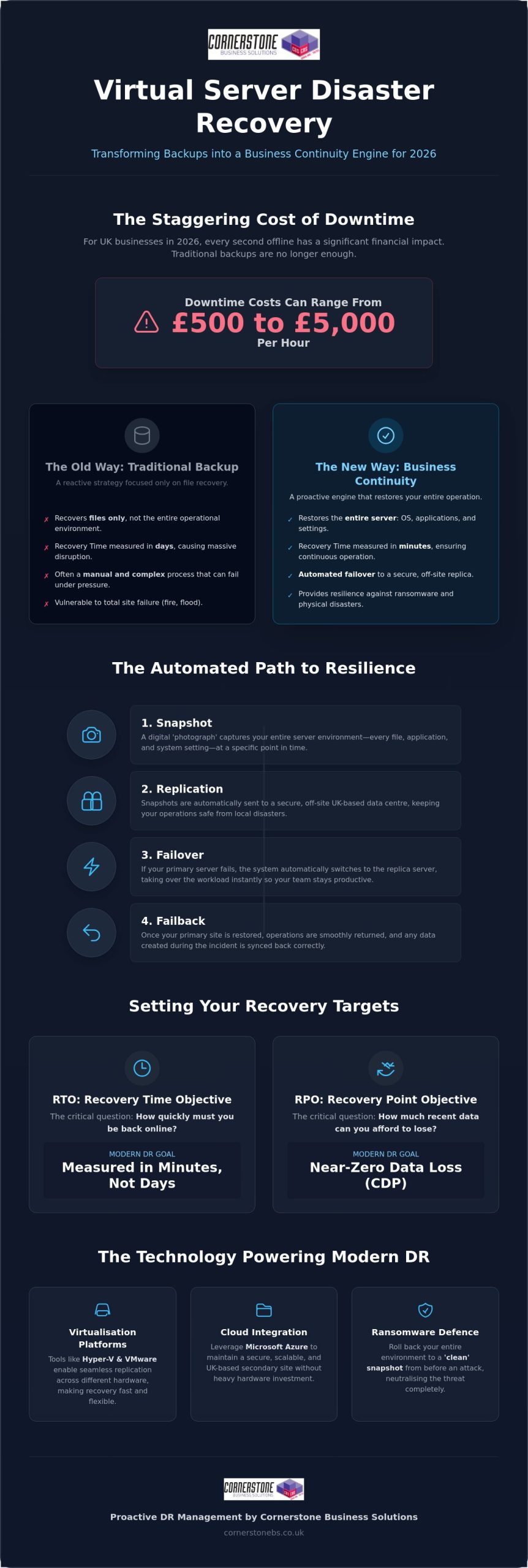
In the fast-paced business environment of 2026, simply having a copy of your files isn’t enough. Virtual server disaster recovery is the proactive process of replicating your entire virtual machine (VM) environment to a secure secondary site. This ensures that your operating systems, applications, and settings stay ready to go at a moment’s notice. It marks a vital shift from traditional data backup, which only stores files, to true business continuity, which restores your entire operation. We believe your digital infrastructure should be a source of confidence, not a cause for concern.
Think of it this way: traditional backup is like having a spare tyre in the boot, while business continuity is having a second car parked and running. For UK SMEs, the stakes have never been higher. Research shows that downtime costs in 2026 can range from £500 to £5,000 per hour. You can’t afford the ‘tape and transport’ recovery speeds of the past. Failover is the key mechanism here. It allows you to switch your operations to a replica server in seconds if your primary site fails. This strategy is built on fundamental disaster recovery principles that prioritise immediate uptime over slow, manual restoration.
Virtual vs. Physical Disaster Recovery: The Key Differences
The move to virtualisation has changed the game for resilience. Unlike physical recovery, which often requires identical hardware to be available, virtual machines are hardware-independent. This means your VMs can be restored to any host, anywhere. It eliminates the frantic search for matching server parts during a crisis. The speed of recovery is also incomparable. Instead of a manual OS reinstallation that takes hours, a VM can boot up almost instantly from a snapshot. This resource efficiency significantly reduces the cost of maintaining a secondary DR site, as you don’t need a 1:1 physical hardware match sitting idle.
The Role of Virtualisation in Modern Business Resilience
Platforms like Hyper-V and VMware have made seamless replication a reality for businesses of all sizes. These tools facilitate constant data movement across different hardware types, making it easier than ever to integrate a modern cloud solution that scales with your growth. As cybercriminals increasingly use AI to target SMEs, having ‘clean’ virtual snapshots becomes your best defence against ransomware. If an attack occurs, you don’t just recover data; you roll back your entire environment to a point before the infection took hold. This level of protection provides the emotional security and technical stability every business owner needs to thrive in 2026.
How Virtual DR Works: Replication, Snapshots, and Failover
Understanding the mechanics of your resilience provides the emotional security you need as a business owner. It starts with the snapshot. A snapshot is a digital ‘photograph’ of your entire server environment, capturing every file, application, and system setting at a specific microsecond. Unlike traditional file backups, this captures the state of the machine itself. It means you aren’t just saving data; you’re saving the ability to run that data immediately.
Once that snapshot is ready, the replication process takes over. This involves sending those snapshots to a secure, off-site location, such as a UK-based data centre. This ensures that even if your primary site is physically compromised, your operations stay safe. Failover is the automated process that kicks in when your primary server fails. Your replica server starts up instantly, taking over the workload so your team stays productive. Finally, failback allows you to return to normal operations once your primary site is restored, ensuring all data created during the incident is synced back correctly. If you’re unsure how these steps fit your current setup, our team can help you design a bespoke resilience strategy.
Continuous Data Protection (CDP) vs. Scheduled Backups
Continuous Data Protection (CDP) is the gold standard for businesses that can’t afford to lose a single transaction. It captures every change in real-time, offering near-zero data loss. In contrast, scheduled snapshots are better for less critical systems, balancing performance with protection. Point-in-Time Recovery is the ability to roll back your entire system to a specific healthy state before a corruption or infection occurred. This flexibility is a core benefit of modern virtual server disaster recovery, allowing you to choose the level of protection that fits each specific workload.
Ransomware Resilience Through Virtual Snapshots
In 2026, cybercriminals use AI to encrypt data at record speeds, making recovery a race against time. Immutable snapshots are your ultimate defence because they cannot be changed or deleted by ransomware once they’re written. We also use isolated ‘sandboxes’ to test these replicas before they go live. This ensures you aren’t just restoring an infected system back into your network. These robust cyber security services work hand-in-hand with your DR plan to provide a truly ‘clean’ recovery and total peace of mind.
Cloud-Integrated DR: Leveraging Azure for UK Business Continuity
Disaster Recovery as a Service (DRaaS) has fundamentally changed how UK businesses approach resilience. By moving your secondary site to the cloud, you eliminate the need for expensive physical hardware that sits idle in a back room. This cloud-integrated approach makes enterprise-level virtual server disaster recovery accessible for small and medium-sized firms. It removes the burden of maintaining a second set of servers, allowing you to focus on growing your business while we handle the technical heavy lifting. We see this as a foundational element of your emotional security, knowing your operations are backed by the world’s most robust infrastructure.
Microsoft Azure provides a scalable, secure secondary site that grows with your needs. One of the most compelling advantages is the ‘Pay-as-you-go’ model. In a traditional setup, you’d pay for the power and cooling of a secondary site 24/7. With Azure, you only pay for the storage of your replicas until a disaster occurs. You only pay for compute power when you actually trigger a failover or run a scheduled test. This efficiency ensures your budget is spent on active growth rather than ‘just in case’ hardware, providing a clear financial advantage for proactive organisations.
Data sovereignty remains a top priority in 2026, especially with the recent implementation of the Data (Use and Access) Act 2025. We ensure your virtual replicas remain strictly within UK borders. By utilising Azure’s UK South and UK West regions, we guarantee that your data never leaves the country. This compliance is essential for firms in regulated sectors like finance or legal, where data residency is a legal requirement. It’s about providing the clarity and trust you need to operate confidently in a complex regulatory landscape.
Hybrid Cloud DR Strategies
Combining your on-premise virtual servers with cloud-based recovery targets creates a flexible hybrid environment. This setup relies on high-speed connectivity to maintain low RPOs, ensuring your cloud replica is always just seconds behind your live data. Many of our partners choose to manage a Microsoft 365 migration alongside their server DR plan. This creates a unified, cloud-first strategy where your email, files, and server applications are all protected by the same resilient backbone.
Automating Failover with Azure Site Recovery
Azure Site Recovery (ASR) is the engine that automates the orchestration of complex server boots. In a crisis, you don’t want to be manually starting servers and checking dependencies. ASR uses ‘Recovery Plans’ to handle multi-tier applications, ensuring your database starts before your web server. Automation reduces human error during high-stress recovery events, which is when mistakes are most likely to happen. It turns a potential catastrophe into a controlled, predictable process that gets your team back to work in minutes.
Setting Your Targets: Understanding RTO and RPO Goals
Building a resilient business requires more than just buying software. It requires clear targets that reflect your specific operational needs. Your Recovery Time Objective (RTO) is the maximum amount of time your business can survive without its IT systems. Think of it as your “downtime tolerance.” On the other hand, your Recovery Point Objective (RPO) defines how much data you can afford to lose between backups. If you back up every hour, your RPO is 60 minutes. Setting these targets is a foundational step in any virtual server disaster recovery plan. It ensures your technical setup aligns with your commercial reality and provides the peace of mind you deserve.
Not every server needs the same level of protection. We recommend categorising your infrastructure into three distinct tiers to manage costs and recovery speeds effectively:
- Mission Critical: Systems that must be restored in minutes, such as customer-facing portals or ERP systems.
- Business Important: Systems that can stay offline for a few hours without halting the entire firm, like internal file shares.
- Non-Essential: Systems that can wait a day or more for restoration, such as archived data or legacy reporting tools.
Calculating the financial impact of downtime is vital for your strategy. As we mentioned earlier, downtime for UK SMEs in 2026 can cost up to £5,000 per hour. If your business loses £2,000 per hour in productivity and sales, a 4-hour RTO could cost you £8,000 per incident. Understanding these numbers helps you justify the investment in a proactive managed service that keeps your doors open. If you need help mapping out these objectives for your team, our experts can guide you through a comprehensive business impact analysis.
The 3-2-1-1-0 Rule for Modern Data Protection
Modern threats require modern rules. In 2026, we follow the 3-2-1-1-0 rule to ensure total resilience for your virtual environment. This means keeping 3 copies of your data on 2 different media, with 1 copy stored off-site. The critical additions for today’s landscape are 1 “air-gapped” copy and 0 errors. An air-gapped virtual copy is physically or logically isolated from your network, making it impossible for ransomware to reach. To achieve “0 errors,” we implement automated verification. This ensures your data isn’t just stored; it’s actually bootable and corruption-free when you need it most.
Testing Your DR Plan Without Disrupting Production
A disaster recovery plan is only as good as its last successful test. If you haven’t tested your recovery process in the last 6 months, you’re essentially flying blind. Virtualisation offers a massive advantage here through non-disruptive testing. We can spin up your replica servers in an isolated network “sandbox” to verify everything works perfectly without touching your live production environment. This allows us to refine your “Disaster Recovery Playbook,” which is a step-by-step guide your internal team can follow during a crisis. It turns potential panic into a practiced, calm routine.
Cornerstone Business Solutions: Proactive DR Management
Choosing the right technology is only half the battle. The true strength of your resilience lies in the hands of those who manage it. As a multi-award-winning IT provider, we don’t just sell software; we deliver a promise of continuity. Our partnerships with global leaders like Microsoft, IBM, and Cisco ensure your virtual server disaster recovery strategy is built on a world-class technology stack. We take pride in being more than a service provider. We’re your long-term partner, dedicated to shielding your business from the unexpected while you focus on your next big milestone.
Our proactive approach is designed to stop disasters before they start. We provide 24/7 system monitoring that identifies potential points of failure, such as storage bottlenecks or replication lag, in real-time. By fixing these issues before they escalate, we remove the emotional burden that often comes with managing complex IT infrastructure. You can rest easy knowing that a team of local experts is watching over your systems, ensuring your failover capabilities are always ready to trigger at a moment’s notice.
Bespoke DR Solutions for UK SMEs
A one-size-fits-all software package rarely accounts for the unique workflows that make your business successful. We believe every organisation requires a customised touch. Our process begins with a deep-dive audit of your current environment, followed by the design and implementation of a plan that fits your specific RTO and RPO targets. We don’t just set it and forget it. We provide ongoing management and regular testing to ensure your plan remains effective as your business evolves.
For many of our partners, the most effective way to maintain this resilience is by integrating it into a wider Managed IT Support framework. This holistic approach ensures that your disaster recovery plan isn’t a standalone silo but a foundational part of your entire digital strategy. It creates a seamless experience where security, performance, and continuity all work together to support your growth.
The Cornerstone Advantage: Award-Winning Support
We’ve built our reputation on a blend of technical excellence and approachable, regional warmth. We know that IT can feel overwhelming, so we make it our mission to simplify complex concepts. You won’t find us hiding behind dense jargon. Instead, you’ll find a friendly team that speaks clearly about what your business needs to stay stable and secure. Our commitment to exceptional customer service has earned us numerous accolades, but our greatest reward is the trust and success of the businesses we support.
Is your current resilience plan ready for the challenges of 2026? We’d love to help you find out. We invite you to an informal, no-obligation conversation about your current setup and how we can help you achieve total peace of mind. Let’s work together to ensure your data is stored securely in the UK and your operations are protected by a partner who truly cares about your success.
Build a Resilient Future for Your Business
Your operations deserve a strategy that treats uptime as a guarantee, not a gamble. We’ve explored how virtual server disaster recovery has evolved into a sophisticated engine for continuity, moving far beyond the slow, manual restores of the past. By setting clear RTO targets and leveraging cloud-integrated failover, you can ensure your team stays productive through any disruption. This isn’t just about technical specifications; it’s about the emotional security of knowing your hard work is protected by a plan that actually works when it counts.
As a multi-award-winning IT provider and expert partner to Microsoft, IBM, and Cisco, we’re here to guide you. Our 24/7 proactive system monitoring identifies risks before they become disasters, giving you the freedom to focus on your growth. It’s time to move away from “set and forget” software and toward a partnership built on reliability and local expertise. We invite you to secure your business continuity with a bespoke Disaster Recovery plan from Cornerstone. Let’s have a conversation and get your resilience strategy right together.
Frequently Asked Questions
What is the difference between backup and disaster recovery?
Backup is the process of storing copies of your files, while disaster recovery is the strategy for restoring your entire operation. A backup allows you to retrieve a lost document, but it won’t help you run your business if your server hardware fails. Disaster recovery ensures your applications and operating systems are ready to boot up immediately, keeping your team productive while the primary issue is resolved.
How often should we test our virtual server disaster recovery plan?
We recommend testing your plan at least every six months. Your IT environment changes constantly as you add new users, software, or data. Regular testing ensures that your virtual server disaster recovery process remains valid and that your team knows exactly what to do during a crisis. Automated testing in isolated “sandboxes” allows us to verify your resilience without ever disrupting your live production systems.
Can we use virtual DR to recover from a ransomware attack?
Yes, virtual DR is one of the most effective ways to recover from a ransomware attack. By using immutable snapshots, we can roll your entire server environment back to a “clean” state from just before the infection took hold. This allows you to bypass the need for a decryption key and get your business back online without paying a ransom or losing weeks of progress.
Is virtual server disaster recovery more expensive than traditional methods?
Virtual disaster recovery is often more cost-effective than traditional methods because it eliminates the need for expensive, idle hardware. In the past, you needed a second physical server room with matching equipment. Today, cloud-based solutions allow you to pay only for the storage you use, with compute costs only kicking in during an actual disaster or a scheduled test. It’s a smarter way to manage your budget.
What is a ‘failover’ and how long does it typically take?
Failover is the automated process of switching your operations from a failed primary server to a healthy replica. In a well-designed virtual server disaster recovery setup, this typically takes just a few minutes. It ensures that your critical applications stay available to your staff and customers even if your main office loses power or suffers a major hardware failure.
Does my business need a secondary physical site for disaster recovery?
No, you don’t need a secondary physical site of your own. Modern cloud platforms like Microsoft Azure act as your secondary location. We replicate your servers to secure UK data centres, which removes the cost and complexity of maintaining your own off-site facility. This approach provides enterprise-level resilience for small and medium-sized businesses without the traditional overhead.
How does virtual server DR help with UK compliance and data regulations?
It ensures your data stays within UK borders to meet strict sovereignty requirements. With the implementation of the Data (Use and Access) Act 2025, knowing exactly where your replicas are stored is vital for compliance. We use UK-based data centres to ensure your business remains on the right side of the law while providing the high level of security your clients expect.
Can Cornerstone manage my disaster recovery if my servers are already in the cloud?
Yes, we can manage your disaster recovery even if your primary servers are already in the cloud. We provide proactive monitoring and management for cloud-to-cloud or hybrid environments. Our team ensures that your cloud replicas are healthy, tested, and ready to go. We act as your long-term partner, handling the technical complexity so you can focus entirely on running your business.