

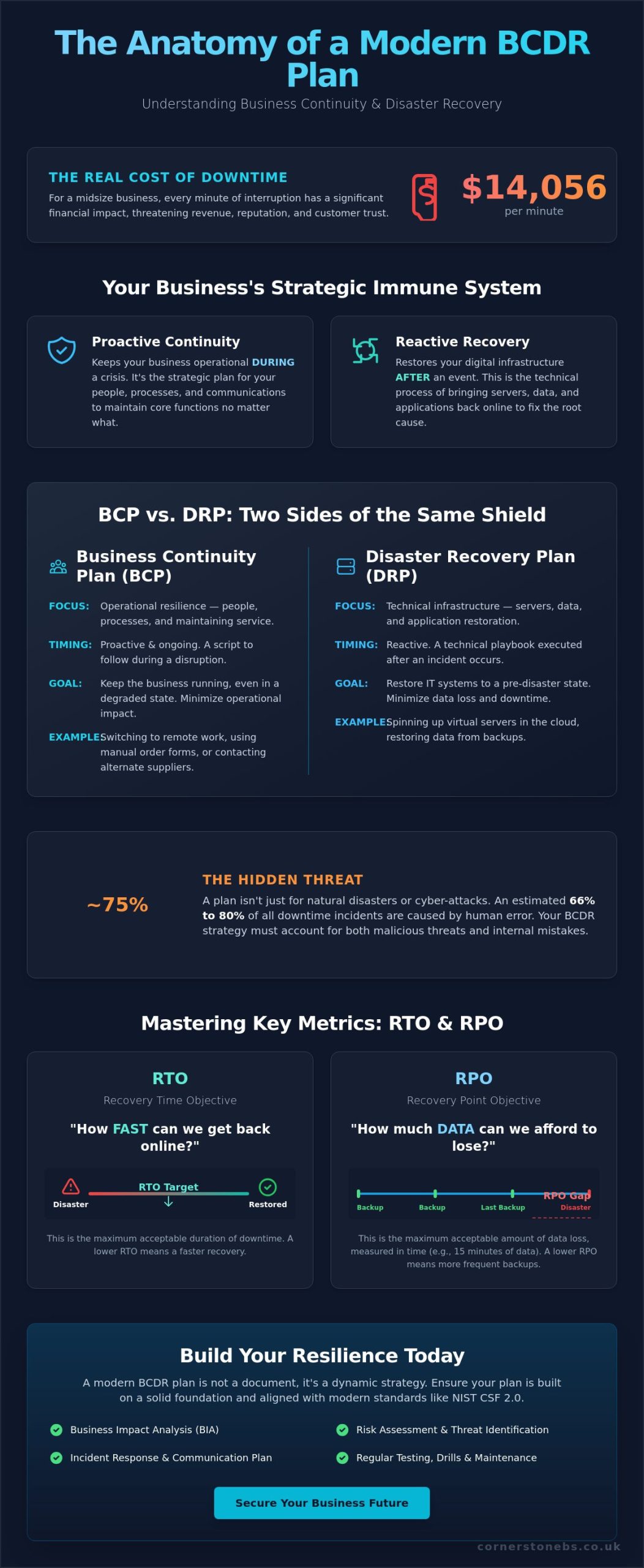
Did you know that for a midsize business, the average cost of IT downtime has climbed to a staggering $14,056 per minute? It’s a terrifying figure that keeps many local business owners awake at night. You likely already feel the weight of this risk every time a server lags or a new cyber threat hits the headlines. To protect your future, you need to understand exactly what is a business continuity and disaster recovery plan and how it serves as your company’s strategic immune system. Between the fear of data loss and the confusion of technical jargon like RTO and RPO, it’s easy to feel like you’re just waiting for the next crisis to strike.
We’re here to clear the air and provide a clear roadmap for your protection. You’ll discover how a unified BCDR strategy keeps your doors open, your data safe, and your team productive. We will break down the essential components of a modern plan, from the latest NIST CSF 2.0 standards to the May 2026 updates for NIST SP 800-172. Our goal is to replace that anxiety with the peace of mind that comes from knowing your business is built to survive and thrive right here in our community.
Key Takeaways
- Gain a clear understanding of what is a business continuity and disaster recovery plan and why it’s the foundation of modern business resilience.
- Learn the vital difference between proactive continuity planning and reactive technical recovery to keep your operations running smoothly during a crisis.
- Calculate the true impact of downtime on your revenue and brand reputation to prioritize your most critical business functions.
- Master essential metrics like RTO and RPO to set clear, achievable targets for getting your digital infrastructure back online.
- Identify how a professional audit reveals hidden blind spots in your current setup, ensuring your long-term stability and peace of mind.
Defining Business Continuity and Disaster Recovery (BCDR)
Think of your business as a living organism. In a world where digital threats and physical disruptions are constant, your organization needs more than just a simple backup. It needs an immune system. To truly understand what is a business continuity and disaster recovery plan, you have to look at it as a unified strategy for resilience. A healthy immune system doesn’t just wait for a virus to strike. It constantly monitors for threats, responds instantly when an intrusion occurs, and manages the recovery process so the body can return to full strength. BCDR performs these exact functions for your company.
The “Business Continuity” Element
Business continuity is the operational side of the shield. Its primary goal is to keep the lights on while a crisis is unfolding. This involves your people, your processes, and your communication channels. It’s about maintaining operational resilience so that your core functions don’t grind to a halt. Business continuity planning ensures that every team member knows their role when the unexpected occurs. It provides a clear script for a difficult day, reducing panic and protecting your brand’s integrity.
- Remote Work Shifts: Instantly moving your team to home-based setups if your office becomes inaccessible.
- Manual Workarounds: Having processes in place to take orders or provide service even if specific software is temporarily offline.
The “Disaster Recovery” Element
While continuity focuses on the “now,” disaster recovery focuses on the “how.” This is the technical restoration of your digital infrastructure after an event. It’s the process of bringing your servers, data, and applications back online in a prioritized, orderly fashion. Disaster recovery is what fixes the underlying cause of the disruption. Modern cloud solutions have revolutionized this process. By leveraging secure off-site environments, we can often spin up virtual versions of your entire network in minutes. This ensures that your technical heartbeat remains strong, even if your physical hardware fails.
BCP vs DRP: Understanding the Critical Differences
Many business owners ask what is a business continuity and disaster recovery plan, often assuming these two terms are interchangeable. They aren’t. While they share the same goal of protecting your livelihood, they operate on different levels. Think of Business Continuity (BCP) as the strategy for your people and processes. It’s the proactive roadmap that keeps your operations moving during a crisis. Disaster Recovery (DRP), on the other hand, is the technical subset. It’s the reactive process of restoring your digital heartbeat after an event has occurred. You don’t just need one or the other; you need a unified strategy that bridges the gap between your staff and your servers.
| Feature | Business Continuity (BCP) | Disaster Recovery (DRP) |
|---|---|---|
| Focus | Operational resilience and people | Technical infrastructure and data |
| Timing | Immediate and ongoing | Post-event restoration |
| Stakeholders | HR, Operations, Management | IT Team, Vendors, Support Partners |
| Primary Goal | Keeping the business open | Restoring specific IT systems |
Scope and Timing: Who Does What and When?
The moment a disruption is detected, your BCP springs into action. This plan dictates how your team communicates and where they go to work. It’s about containment and survival. Once the initial crisis is stable, your DRP kicks in to handle the heavy lifting of data restoration. This phase involves your technical partners working to bring your servers and applications back online. It’s a relay race where the BCP handles the first lap and the DRP brings you across the finish line. If you’re ready to create a business continuity plan, you must involve both your operations managers and your IT experts from day one.
Why One Cannot Succeed Without the Other
Restoring your data is a technical victory, but it’s hollow if your staff don’t know how to access it from a remote location. Conversely, having a perfect remote work policy is useless if your servers are offline and your files are inaccessible. This is why a unified managed IT services approach is so valuable. It ensures your technical recovery and operational plans are perfectly synchronized. When these two elements work in harmony, you eliminate the confusion that often leads to costly delays. We’ve seen that businesses with integrated plans recover significantly faster than those that treat IT and operations as separate silos. If you’re concerned about your current setup, a quick conversation with a local expert can often reveal simple ways to tighten these connections.
The Real Cost of Downtime: Why Your Business Needs a Plan
Operating without a plan is like driving without a seatbelt. You might be fine for years, but the one time you need it, nothing else matters. We’ve seen that over 90% of midsize and large companies report that just one hour of downtime costs them more than $300,000. These figures are why local business owners are increasingly treating BCDR as a foundational investment rather than an optional expense. By securing your operations today, you’re not just buying software; you’re buying the future of your company.
Beyond the Ransomware Threat
While ransomware gets the headlines, it’s often the simpler things that bring a business to its knees. Network outages account for 31% of all IT service incidents. Even more common is human error, which contributes to between 66% and 80% of all downtime. This is where our cyber security services integrate directly with your recovery strategy. We don’t just build walls; we build paths for recovery. Resilience is the ability to absorb a shock and keep moving. It means that when a server fails or a staff member clicks the wrong link, your operations don’t collapse. Instead, your systems adapt and recover without the customer ever noticing a glitch.
The Emotional Security of a Robust Plan
There’s an often-overlooked human element to what is a business continuity and disaster recovery plan: emotional security. When a crisis hits, the “panic factor” in the boardroom can be just as damaging as the technical failure itself. A robust plan provides a clear, step-by-step script that replaces chaos with calm, decisive action. Your leadership team can breathe easier knowing exactly what happens next. Your staff feel supported because they have the tools and instructions to keep working safely, even during major operational shifts. By staying steady when others might falter, you turn a potential disaster into a powerful demonstration of your reliability. It shows your clients that you’re a stable, long-term partner they can depend on, no matter what happens in the wider world.
Key Components of an Effective BCDR Strategy
Building a resilient business requires more than just good intentions. It demands a structured approach. When you look at what is a business continuity and disaster recovery plan from a practical perspective, it’s actually a collection of five core pillars. These pillars ensure that your response isn’t based on guesswork but on verified data and pre-defined steps. Without these components, even the most talented team will struggle to stay organized during a major outage. We focus on building these foundations so you can lead with confidence when it matters most.
Understanding RTO and RPO: The Two Most Important Metrics
These are the two most important technical metrics in your strategy. Recovery Time Objective (RTO) defines how quickly you must be back up and running. Recovery Point Objective (RPO) determines how much data loss your business can actually tolerate. For example, if your RPO is 4 hours, you cannot afford to lose more than 4 hours of work. If you only back up once every 24 hours, your RPO is 24 hours. That’s a catastrophic gap for most modern firms. We work with you to align these technical targets with your real-world business needs.
The Business Impact Analysis (BIA) Framework
Building these components into a unified strategy is how we help local businesses stay strong. If you aren’t sure where your current recovery targets stand, our team can help you define these goals with a professional disaster recovery assessment.
Implementing BCDR with a Managed IT Partner
You now have a clear picture of what is a business continuity and disaster recovery plan, but the real challenge lies in execution. DIY strategies often fail because they lack the rigorous testing and maintenance that a complex digital environment requires. It’s easy to overlook a small configuration error that could lead to a massive data loss during a crisis. An external audit provides the fresh perspective needed to find these blind spots before they become liabilities. As an award-winning team with deep regional roots, we take pride in being a proactive partner for our clients. We don’t just fix problems; we build systems that prevent them from occurring in the first place.
Moving from transactional IT support to a long-term resilience partnership is a strategic shift for any business owner. It means you aren’t just calling someone when a server breaks. Instead, you have an expert team constantly refined by industry accolades and local experience working to secure your future. This collaborative approach ensures that your technical support is a foundational element of your business stability. We want you to feel the confidence that comes from knowing your operations are backed by a team that truly cares about your success in our community.
The Advantage of Proactive Monitoring
Our proactive monitoring doesn’t just respond to disasters; it stops them before they happen. Through predictive maintenance, we identify potential hardware failures or network bottlenecks before they cause downtime. This level of oversight is a foundational element of your emotional security. For instance, a successful Microsoft 365 migration must include built-in backup protocols to ensure your cloud data is just as protected as your on-site files. Expert oversight means you don’t have to worry about whether your backups ran last night. We’ve already verified them for you.
Next Steps: From Strategy to Action
Taking action is the only way to secure your business future. We recommend starting with a comprehensive resilience audit to benchmark your current state against industry standards. This isn’t a one-size-fits-all process. We customize every strategy to your specific industry and risk profile, ensuring your plan is as unique as your business. It’s time to replace anxiety with a clear roadmap. We invite you to book a consultation with our expert team for a friendly conversation about your continuity goals. Let’s work together to make sure your business stays strong, no matter what challenges come our way.
Building Your Business’s Strategic Immune System
You’ve seen the data and the risks. Protecting your operations means moving beyond simple backups toward a unified strategy that bridges the gap between your people and your technical infrastructure. Now that you understand what is a business continuity and disaster recovery plan, you have the knowledge to move from a reactive stance to a proactive one. Every minute saved during an outage protects your reputation and your revenue. Resilience isn’t just about surviving a crisis; it’s about maintaining the trust you’ve built with your customers and your community.
As a multi-award-winning IT services provider with deep regional roots, we’re here to help you navigate these complexities. Our partnerships with industry leaders like Microsoft, IBM, and Cisco ensure you receive world-class solutions tailored to your local needs. We use proactive system monitoring to identify threats before they impact your workflow. Secure your business resilience with a professional BCDR audit from Cornerstone. Taking this first step gives you the peace of mind that your company is built to last. Let’s start a conversation today to ensure your organization remains strong, stable, and ready for whatever comes next.
Frequently Asked Questions
What is the main difference between business continuity and disaster recovery?
Business continuity keeps your operations running during a disruption while disaster recovery restores your technical infrastructure afterward. Think of continuity as the plan for your staff to work from home using business mobile devices. Disaster recovery is the technical process of spinning up your servers from a cloud backup. Both are essential parts of a unified resilience strategy for any local organization.
How much does a business continuity plan cost to implement?
The cost varies based on your business size, complexity, and the specific recovery targets you set. Factors include the volume of data you protect and the speed of recovery required. We recommend a professional audit to determine the right investment for your specific risk profile. This ensures you aren’t overspending on unnecessary tools while leaving critical gaps in your security and operational stability.
Does my business need a BCDR plan if we use cloud services like Microsoft 365?
Yes, because cloud providers are responsible for the infrastructure while you remain responsible for your own data. Microsoft 365 protects against their system failures, but it doesn’t protect you from accidental deletion or ransomware within your own account. A formal plan ensures you have independent backups and a roadmap to restore access if your primary cloud login is compromised by a cyber threat.
How often should we test our disaster recovery plan?
You should test your plan at least once or twice a year, or whenever you make significant changes to your IT environment. Regular “fire drills” ensure that your staff remembers their roles and that your technical backups actually work. Testing reveals hidden bottlenecks in your recovery process before a real emergency strikes. It turns a theoretical document into a proven operational tool you can trust.
What is a Recovery Time Objective (RTO) and why does it matter?
RTO is the maximum amount of time your business can afford to be offline before the damage becomes terminal. It matters because it dictates the type of technology you need to invest in. A short RTO might require instant failover systems, while a longer RTO allows for slower restoration from off-site storage. Defining this clearly helps you balance your budget with your actual survival needs.
Can a small business survive without a formal BCDR plan?
While some survive by luck, most small firms struggle to recover from a major data loss or a week of downtime. Without a plan, the “panic factor” often leads to poor decisions that escalate the initial crisis. A formal strategy provides the structure needed to stay calm and follow a proven path to recovery. It is the difference between a temporary setback and a permanent closure.
What are the most common causes of business disruption in 2026?
Who should be responsible for the BCDR plan within our company?
Responsibility should be shared between a senior leader who understands business priorities and an IT partner who manages the technical execution. This ensures that the plan covers both operational needs and digital infrastructure. While the leadership team makes the final decisions on recovery objectives, your managed IT provider handles the day to day monitoring and testing. Collaboration is the key to a plan that actually works.