
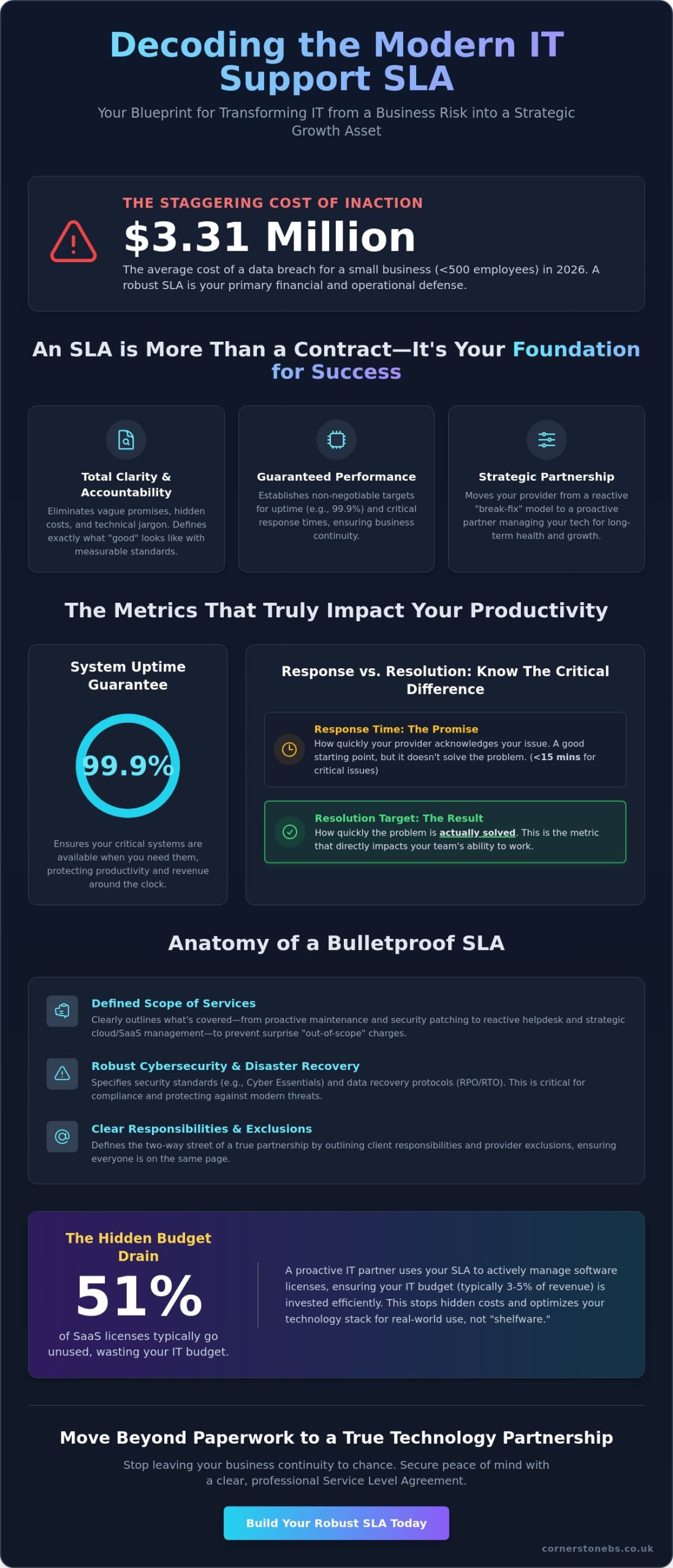
Did you know that for a business with under 500 employees, the average cost of a data breach has climbed to $3.31 million in 2026? It’s a staggering figure that highlights why your technology needs more than just a “best efforts” promise. You need a robust IT support service level agreement template that transforms your IT setup from a source of stress into a seamless foundation for growth. We understand that you’re likely frustrated with vague contracts and response times that stall your team’s productivity.
As an award-winning partner to businesses across the North East, we believe you deserve total clarity on your technology investment. You’re right to expect 99.9% uptime and critical response times within 15 minutes, rather than a sea of technical jargon that leaves you guessing. This guide will show you how to structure an SLA that eliminates hidden costs and ensures your provider manages your systems proactively. We’ll walk through the essential metrics and accountability frameworks you need to secure genuine peace of mind for your business continuity.
Key Takeaways
- Establish a clear foundation for business continuity by defining the formal commitments required from a professional managed IT service provider.
- Use a professional IT support service level agreement template to outline specific service scopes and performance metrics that eliminate hidden costs.
- Stop relying on vanity metrics by learning why resolution targets are far more important for your daily productivity than simple response times.
- Protect your organization from modern threats by ensuring your SLA includes tailored cybersecurity standards and robust disaster recovery protocols.
- Move beyond basic paperwork to create a strategic partnership that prioritizes proactive technology management and delivers genuine peace of mind.
What is an IT Support Service Level Agreement (SLA)?
An Service-level agreement (SLA) is far more than a dry legal contract. It’s a proactive commitment between your business and your technology partner that defines exactly what “good” looks like. While a Master Service Agreement (MSA) handles the broad commercial relationship, the SLA focuses on the daily reality of your operations. It sets the measurable standards for uptime, response times, and problem resolution. For any professional managed IT services provider, this document is the foundation of trust. It ensures you aren’t just paying for “support,” but for guaranteed business continuity.
Starting with a clear IT support service level agreement template allows you to skip the guesswork. It moves the conversation away from vague promises of “fast help” toward concrete figures like 99.9% system availability. Without this clarity, disputes are almost inevitable. When a server goes down at 2:00 PM on a Friday, you don’t want to be debating contract terms. You want to know that your provider is already working on a fix within the agreed window. This level of transparency is exactly how our award-winning team builds long-term partnerships across the North East.
The Purpose of an SLA in Modern Business
Accountability is the core of any successful partnership. A robust SLA provides a transparent framework to measure whether your provider is actually delivering value. Since research shows that 51% of SaaS licenses often go unused, a proactive agreement helps align your IT spending with your actual needs. It ensures every pound of your 3-5% annual revenue IT budget is working toward your growth.
Key benefits of a defined SLA include:
- Clearer budgeting without hidden emergency costs.
- Guaranteed response times for critical issues, typically between 15 and 60 minutes.
- A roadmap for long-term technology scaling and infrastructure health.
Who Needs a Formal IT Service Agreement?
Every organisation that relies on digital tools needs a formal agreement, but it’s critical for SMEs scaling their operations. If you’re handling sensitive data, an SLA ensures you meet strict compliance standards like GDPR or Cyber Essentials. With the average cost of a data breach for small firms hitting $3.31 million in 2026, you can’t afford a reactive approach. Using a professional IT support service level agreement template ensures your remote infrastructure remains as robust and secure as your main office network. It provides peace of mind for leaders who need their technology to just work.
Key Components of a Robust IT Support SLA Template
A standard IT support service level agreement template often misses the mark because it treats technology as a static utility. In reality, your business is a living thing that needs room to breathe and grow. A robust SLA should clearly outline the service scope, performance metrics, and the mutual responsibilities that make a partnership work. By following best practices for service-level agreements, you can ensure that your contract isn’t just a defensive document but a roadmap for high performance. It’s about setting the stage for a seamless experience where everyone knows exactly what to expect.
Defining the Scope of Services
Clarity is your best friend when defining what your IT partner actually does. Your IT support service level agreement template must distinguish between proactive maintenance and reactive helpdesk support. While fixing a broken laptop is important, your agreement should also cover the strategic management of cloud solutions and SaaS licenses. This prevents the common 2026 issue where 51% of software licenses go unused. Whether it’s managing your server infrastructure or ensuring end-user devices are patched and secure, the scope needs to be exhaustive to avoid “out-of-scope” surcharges that bloat your budget.
Responsibilities and Exclusions
Great IT support is a two-way street. A professional SLA outlines the client’s duties, such as providing physical access to on-site hardware or maintaining a suitable environment for server rooms. It also clearly states exclusions. Most providers won’t cover issues caused by unapproved hardware modifications or third-party software that hasn’t been vetted. You should also look for specific provisions regarding emergency support. In 2026, emergency rates typically range from $200 to $350 per hour. Knowing how these after-hours premiums are billed before you need them is vital for your peace of mind.
Performance metrics are the heartbeat of the agreement. We don’t just look at uptime guarantees of 99.9%. We look at the granular details that keep your team productive. This includes a sliding scale for service credits, a 2026 trend where compensation increases exponentially the longer a system stays down. This ensures your provider is financially incentivised to get you back online fast. If you’re wondering if your current setup measures up, we’re always here for a friendly chat about your business goals.
Finally, ensure the agreement includes clear termination and compensation clauses. You need a straightforward exit strategy if performance consistently dips below the agreed benchmarks. A partnership should be based on ongoing value, not a restrictive contract that holds your business hostage. By defining these terms upfront, you protect your investment and ensure your IT provider remains a dedicated, long-term partner in your success.
Defining Performance Metrics: Response Times vs. Resolution Targets
Many business owners get caught in the trap of “Response Time” guarantees. A provider might promise to answer your ticket within 15 minutes, but if that response is just an automated email saying “we’re looking into it,” your business is still at a standstill. When you look at an IT support service level agreement template, you must focus on Resolution Targets. This is the actual window of time it takes to fix the underlying issue and get your team back to work. In 2026, the benchmark for critical issues is a 15-minute to 1-hour first response, paired with a 2-4 hour resolution window. Anything less is just a vanity metric that doesn’t protect your bottom line.
Uptime is another critical figure that impacts your daily operations. A standard guarantee of 99.9% sounds impressive, but it still allows for nearly nine hours of downtime every year. For a North East firm, those hours can mean thousands in lost revenue. We aim for proactive management that prevents these outages before they occur. By categorising issues correctly, your provider can allocate resources where they matter most, ensuring that a minor glitch doesn’t take priority over a failing server infrastructure.
The Priority Matrix: How IT Issues Are Categorised
A professional matrix ensures your IT partner reacts with the appropriate urgency. We typically break these down into four levels:
- P1 Critical: A total system failure affecting all users, such as a complete network collapse. In 2026, these require a resolution within 4 hours.
- P2 High: A partial failure affecting a specific department or a critical business function, like your Business VoIP system going offline.
- P3 Standard: Individual user issues that are frustrating but don’t stop the whole business. A 24-business-hour resolution is the standard benchmark here.
- P4 Low: Minor requests or “how-to” questions that have no impact on service quality.
Service Credits and Accountability
An IT support service level agreement template is only effective if there are consequences for missing targets. A Service Credit is a pre-agreed financial penalty for SLA breaches. In 2026, we see a move toward sliding scales for these credits. If a provider misses a resolution target by an hour, you might receive a small credit. If they miss it by four hours, that credit increases exponentially. This keeps your IT partner focused on your success rather than just ticking boxes.
Accountability shouldn’t just happen when things go wrong. Regular service review meetings are essential to audit these metrics and ensure your technology is actually supporting your growth. It’s about having a “chat” about the data, not just the disasters. This award-winning approach ensures that your IT setup remains robust, tailored, and ready for whatever the business world throws at you next.
Common Pitfalls and How to Customise Your IT SLA
Signing a generic IT support service level agreement template is a risk you don’t need to take. While a standard document might cover the basics, it often fails to reflect the specific risk profile of your business. Most one-size-fits-all contracts are designed to protect the service provider’s margins rather than your operational uptime. You need a tailored agreement that evolves with your company. We’ve seen local firms across the North East struggle with contracts that lack the nuance required for modern, high-growth environments. Customisation isn’t just about adding clauses; it’s about ensuring your technology remains a seamless asset.
A major pitfall is ignoring the integration of cyber security services within the SLA. With data breach costs for small firms averaging $3.31 million in 2026, your agreement must specify incident response protocols and recovery time objectives. You should also watch out for hidden “fair use” clauses. Some providers cap the number of support tickets you can raise each month. This can lead to unexpected surcharges when you need help the most. Ensure your agreement explicitly includes data protection and GDPR compliance to safeguard your reputation and your bank balance.
Addressing Cloud and Hybrid Work Environments
In 2026, work happens everywhere. Your SLA must reflect this reality by defining support boundaries for employees working from home. Does your provider support home Wi-Fi issues, or only company-owned hardware? You should also demand clear uptime expectations for Microsoft 365 and Azure. If you’ve recently executed a Microsoft 365 migration, your SLA should align with your new cloud strategy. This ensures that your remote team stays productive and secure, no matter where they log in from.
The Importance of Flexibility and Scalability
Don’t settle for a contract that leaves you vulnerable to hidden costs or slow response times. Our award-winning team is ready to help you build a framework that offers true peace of mind. Contact Cornerstone Business Solutions today to discuss an IT partnership that actually fits your business goals.
Beyond the Template: Why Partnership Trumps Paperwork
An IT support service level agreement template provides a necessary legal framework, but it shouldn’t be the ceiling of your expectations. A contract exists to protect you when things go wrong; a true partnership exists to ensure they go right in the first place. We’ve seen many North East businesses get stuck in a cycle of “policing” their IT provider. They spend more time auditing response times than they do growing their operations. Our award-winning philosophy is different. We believe that if you’re constantly checking your SLA for breach penalties, the relationship has already lost its value. Peace of mind comes from knowing your systems are managed by a team that cares about your success as much as you do.
A proactive approach naturally reduces the need for SLA enforcement. When your technology is robust and tailored to your specific goals, the “break-fix” drama disappears. This shift in focus allows you to treat IT as a foundational element of your business continuity rather than a technical necessity that occasionally fails. By choosing a local partner who understands the regional landscape, you gain an ally who is invested in the community’s economic health. We don’t just hit targets; we aim to exceed them so your team can work without interruption.
The Cornerstone Approach to Service Excellence
We remove the “ticking clock” from your technology support. By offering unlimited helpdesk access, we encourage your staff to report minor glitches before they escalate into P1 critical failures. This transparency is backed by our proactive monitoring systems that work 24/7 to identify vulnerabilities. In 2026, the trend is moving toward predictable, flat-fee pricing models that range between $100 and $200 per user. This approach aligns our incentives with yours. We’re financially motivated to keep your systems running perfectly, not to wait for something to break so we can bill for extra hours.
Starting Your Journey to Better IT Support
Your first step toward better technology management is a thorough audit of your current agreement. Look for gaps where your current provider might be falling short, such as neglected hardware lifecycles or a lack of clear resolution targets. Most organisations should budget 3-5% of their annual revenue for IT costs, and you deserve to know exactly how that investment is being protected. We invite you to have a “chat” with our team about your current challenges and your long-term vision for growth.
Don’t let a vague contract hold your business back. It’s time to transition to a service model that prioritises your uptime and security above all else. Our experts are ready to help you build a framework that offers genuine reliability and support. Book a discovery session with our experts today to see how a proactive partnership can transform your business technology.
Secure Your Business Future with Clearer IT Standards
Your technology should be a silent engine for growth, not a source of constant frustration. By moving beyond a generic IT support service level agreement template, you ensure that your provider is held to resolution targets that actually protect your productivity. We’ve explored how prioritising proactive monitoring over reactive models can save your business from the $3.31 million average cost of a data breach. It’s about building a framework that offers total transparency and eliminates the fear of hidden costs or technical jargon.
As a multi-award-winning IT services provider, we’re proud of our North East roots and our status as partners with industry leaders like Microsoft, IBM, and Cisco. We don’t just provide paperwork; we deliver peace of mind through unlimited helpdesk access and a commitment to your long-term success. It’s time to demand more from your technology partner and secure the robust infrastructure your team deserves to stay competitive in 2026.
Ready to transform your IT setup? Download our guide to award-winning IT support and book a chat with our team to see how we can tailor a solution for you. Let’s have a friendly conversation about your goals and get your business moving forward with confidence.
Frequently Asked Questions
What is the difference between an SLA and an SLO?
An SLA is the formal agreement between a provider and a client, while an SLO (Service Level Objective) is a specific target within that contract. Think of the SLA as the overarching promise of quality and the SLO as the individual goal, such as a 99.9% uptime benchmark. While the SLA defines the consequences of failure, the SLO provides the technical team with a clear metric to track during daily operations.
How do I calculate service credits for an IT outage?
Service credits are usually calculated as a percentage of your monthly fee, based on the duration of the service breach. In 2026, many providers use a sliding scale where the credit amount increases the longer your systems remain offline. You apply these percentages to your total monthly spend as defined in your IT support service level agreement template, ensuring you’re financially compensated for lost productivity.
What is a typical response time for a P1 critical IT issue?
A typical response time for a P1 critical issue in 2026 ranges from 15 minutes to one hour. This metric confirms that an expert has acknowledged the ticket and begun active troubleshooting. It’s important to remember that this is just the “first response” window. You should also ensure your agreement includes a resolution target, which is typically set between two and four hours for total system failures.
Can I negotiate the terms in a standard IT support SLA template?
You can and should negotiate the terms in any IT support service level agreement template to reflect your unique business risks. Standard documents often miss the nuance of hybrid work or specific industry compliance requirements. Tailoring the metrics ensures your provider is accountable for the areas that matter most to your operations, rather than just following a generic list of services that might not fit your goals.
Does an SLA cover hardware replacement costs?
A standard SLA usually covers the labour and expertise required to resolve an issue, but it rarely includes the cost of new hardware parts. Unless you’ve opted for a specific managed hardware plan, you’ll likely be responsible for the price of replacement components. However, a proactive partner will monitor your infrastructure to identify aging hardware, helping you budget for replacements before they cause a critical system failure.
How often should an IT service level agreement be reviewed?
You should review your agreement at least once every 12 months to ensure it still aligns with your technology stack. As your business scales or adopts new cloud solutions, your support needs will change. Annual reviews help you identify unused SaaS licenses, which currently affect 51% of businesses, and allow you to update your security protocols to meet the latest 2026 industry standards and regulations.
What happens if my IT provider consistently misses their SLA targets?
Consistent failures typically trigger a series of financial penalties through service credits, eventually leading to a right-to-terminate clause. If a provider misses their targets for three consecutive months, most modern contracts allow you to exit the partnership without facing early termination fees. It’s essential to have these accountability measures clearly defined to ensure your business continuity isn’t compromised by poor performance or slow resolutions.
Is cyber security response usually included in a standard IT SLA?
Cyber security response is often treated as a tiered addition rather than a basic inclusion in standard agreements. With the average cost of a small business data breach reaching $3.31 million in 2026, you shouldn’t leave this to chance. Check that your agreement specifically outlines incident response times for security threats and disaster recovery protocols. This ensures your provider is ready to act immediately if your data is compromised.