

Did you know that 80% of phishing attacks now use AI-generated content to trick your team? It’s a sobering reality in 2026, where a single accidental click can bypass even the most expensive firewall. You likely already know that your staff are your first line of defense, but without clear rules, they can also be your biggest vulnerability. That is why learning how to create a cyber security policy for employees isn’t just a checkbox for HR. It’s a vital move to protect your local business from a global $10.5 trillion crime wave.
We understand the pressure of trying to balance tight security with a productive, happy workplace. It’s easy to feel overwhelmed by complex regulations like NIS2 or the threat of $50,120 per day FTC penalties. You want to keep your data safe without making your team feel like they’re working in a digital fortress. This guide will show you how to build a robust, compliant, and practical policy that empowers your workforce instead of slowing them down. We will walk through the essential components of a 2026-ready policy, from AI acceptable use to zero trust basics, ensuring your business stays resilient and your team stays confident.
Key Takeaways
- Transform your team into a “Human Firewall” by establishing a clear, formal agreement that defines everyone’s role in your business security.
- Follow our step-by-step guide on how to create a cyber security policy for employees that secures your “crown jewel” data without disrupting daily workflows.
- Identify the essential components of a 2026-ready policy, including Acceptable Use rules and modern data classification tiers.
- Discover why Security Awareness Training is the secret to turning a static document into a proactive defensive culture.
- Learn how to bridge the gap between paper policies and technical reality using automated tools like MFA and managed cloud solutions.
What is an Employee Cyber Security Policy and Why is it Essential?
An employee cyber security policy is a formal agreement between your business and your staff. It outlines the ground rules for using company technology and handling sensitive data. Think of it as a Computer Security Policy tailored specifically for the people using your systems every day. While firewalls and antivirus software are vital, they can’t stop a staff member from handing over a password to a convincing AI-generated phishing email.
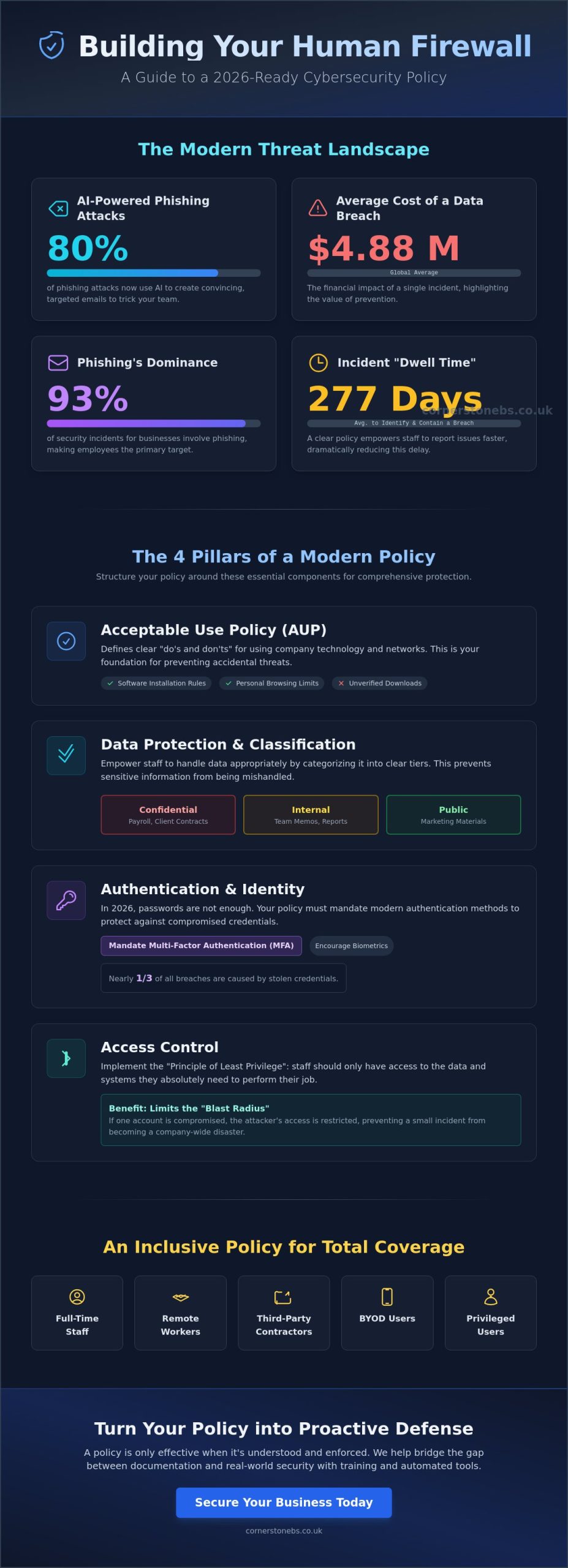
Building a “Human Firewall” is the goal. According to 2025 data, phishing is involved in 93% of incidents for businesses. This means your employees are your most frequent target. When you learn how to create a cyber security policy for employees, you’re giving your team the tools to spot these threats before they escalate. Prevention is always more cost-effective than recovery. The average cost of a data breach has now climbed to $4.88 million. For UK businesses, having this documentation isn’t just about safety; it’s about compliance. Standards like Cyber Essentials and GDPR expect you to have clear, written rules in place to protect personal data.
The Role of the Policy in Business Resilience
A solid policy does more than just prevent attacks; it helps you bounce back faster. On average, it takes organisations 277 days to identify and contain a security incident. Clear guidelines reduce this “dwell time” by teaching staff exactly how to spot and report suspicious activity. This proactive approach also makes your business more attractive to insurers. Many providers now require proof of formal cyber security services and policies before they will offer competitive premiums. It removes the panic from a crisis by providing a standard response protocol everyone can follow.
Who Should the Policy Cover?
Your policy must be inclusive to be effective. It should cover full-time staff, remote workers, and even third-party contractors who access your network. The “Bring Your Own Device” (BYOD) culture adds another layer of risk that needs specific rules. If an employee checks work emails on a personal phone, that device becomes a potential entry point for hackers. You also need to define “privileged users”. These are staff members with administrative access who carry extra responsibilities. Understanding how to create a cyber security policy for employees ensures every person connected to your business knows their specific role in keeping your data safe.
The Essential Components of a Modern Cyber Security Policy
A policy only works if it’s clear, actionable, and reflects the actual tech your team uses. When you look at how to create a cyber security policy for employees, start with an Acceptable Use Policy (AUP). This section defines exactly what is allowed on company systems. It covers everything from personal browsing habits to the software staff can install. By setting these boundaries early, you reduce the risk of accidental malware infections from unverified downloads.
Data protection is the next pillar. Your policy should categorise data into three tiers: public, internal, and confidential. Public data might be your marketing brochures, while confidential data includes payroll info or client contracts. Giving staff a clear framework helps them understand that a “confidential” document should never be stored on a personal cloud drive. If you’re feeling stuck on the structure, looking at official resources on how to create a cyber security policy can provide a solid baseline for these classifications.
Authentication is where many businesses fall short. In 2026, simple passwords aren’t enough. Your policy must mandate Multi-Factor Authentication (MFA) and encourage biometrics where possible. This is especially critical for email and communication. Since stolen credentials account for nearly one-third of all breaches, forcing an extra layer of identity verification is a simple way to stay resilient. We often help local firms implement these standards as part of our wider cyber security services to ensure the tech matches the talk.
Access Control and Identity Management
The “Principle of Least Privilege” is a vital concept here. It means staff only get access to the specific folders and apps they need to do their jobs. This limits the “blast radius” if an account is compromised. You also need a strict offboarding process. “Zombie accounts” from former employees are a huge security hole. Integrating these rules into your Microsoft 365 migration for business UK strategy ensures that permissions are managed centrally and securely from day one.
Addressing 2026 Threats: AI and Deepfakes
Your 2026 policy must address the rise of AI. With 80% of phishing attacks now using AI-generated content, staff need specific guidelines on using generative AI tools. They shouldn’t paste sensitive company data into public AI bots. Furthermore, establish a “double-check” protocol for urgent financial requests. If a “director” asks for a bank transfer via a video call or voice note, staff should verify this through a second, pre-approved channel to prevent deepfake fraud. Clear reporting mechanisms for these social engineering attempts will keep your team one step ahead of sophisticated hackers.
Step-by-Step: How to Create Your Cyber Security Policy
Creating a policy isn’t a one-size-fits-all job. It requires a deep dive into how your local team actually works. When you look at how to create a cyber security policy for employees, the process starts with listening, not just writing. A policy that looks good on paper but makes it impossible for your staff to do their jobs will simply be ignored. We want to build a framework that supports your growth while keeping the hackers at bay.
Phase 1: Discovery and Risk Assessment
Before you write a single word, you need to know what you are protecting. Start by auditing your current IT environment to identify your “crown jewel” data. This includes customer databases, financial records, and intellectual property. You must map out where this data lives, whether it is in the cloud, on-site servers, or accessed via mobile devices. A risk-first approach ensures you protect your most sensitive assets before worrying about low-impact vulnerabilities. Once you know where the risks are, you can map user roles to specific access requirements, ensuring no one has more power than they need.
Phase 2: Drafting for Clarity
The best policies are the ones people actually read. Avoid dense, academic language and “Thou Shalt Not” phrasing. Instead, use collaborative language that explains the “why” behind the rules. If employees understand that a rule exists to protect their own digital identity as well as the company, they are much more likely to follow it. Use “What to do if” scenarios to make the document actionable. For example, instead of a vague rule about phishing, provide a clear three-step process for what to do if a staff member clicks a suspicious link. Structure the document for quick reference so it serves as a helpful guide during a busy workday.
Once your draft is ready, don’t just hit “send” to the whole company. Consult with your department heads first. They will tell you if a new security measure, like a specific file-sharing restriction, will break a vital workflow. This consultation phase builds buy-in across the business. After adjusting for their feedback, review the document with your legal or IT partners. This ensures you meet UK standards like GDPR and Cyber Essentials. Finally, distribute the policy and collect signed acknowledgements. This isn’t just a formality; it’s a vital step in learning how to create a cyber security policy for employees that carries real weight and authority.
Implementation: Turning the Document into Defensive Action
Security Awareness Training (SAT) is the bridge that connects your written rules to real-world behaviour. It turns abstract guidelines into muscle memory. Since 80% of phishing attacks now use AI-generated content, your training must be as modern as the threats. Regular, bite-sized sessions keep security at the front of your team’s minds. This is not a one-off event. It is a continuous effort to ensure your staff remains your strongest defensive asset.
How you handle non-compliance dictates the success of your policy. If an employee clicks a suspicious link and fears for their job, they will likely hide the error. This silence gives hackers more time to move through your network. We advocate for a “no-blame” reporting culture. You want your team to speak up the moment they suspect a mistake. This transparency allows your IT team to contain threats before they become full-scale breaches. Discipline has its place for wilful negligence, but safety comes from open communication.
Building a Security-First Culture
Monitoring and Enforcement Tools
You cannot manage what you do not measure. Automated tools can flag policy violations in real-time, such as an employee attempting to access a restricted cloud folder. This provides an opportunity for “just-in-time” training rather than just a reprimand. Many businesses rely on managed IT services Teesside to monitor these systems around the clock. Regular phishing tests also help you see where your policy is working and where your team needs more support. Finally, set a firm schedule for annual reviews. Technology moves fast, and your policy must keep pace with new AI developments and regulatory changes.
If you want to see how your current setup compares to 2026 standards, chat with our local team for a straightforward review of your security posture.
How Cornerstone Business Solutions Enforces Your Policy
A policy is only as strong as the systems that back it up. While the previous sections focused on how to create a cyber security policy for employees, the real challenge lies in making those rules impossible to ignore. We help you move beyond paper security by embedding your policy directly into your digital infrastructure. This means your security isn’t just a suggestion; it is a technical reality that works in the background while your team stays productive.
Automation is the secret to consistent enforcement. We use robust cloud solutions to handle the heavy lifting, such as mandating MFA, enforcing regular password rotations, and ensuring data encryption is always active. When these processes are automated, you remove the risk of human error or forgetfulness. Your employees don’t have to remember to be secure; the system does it for them. This creates a seamless experience where protection and performance go hand in hand.
Even the best policy can’t predict every variable. That is why we provide 24/7 monitoring to catch the subtle anomalies that humans might miss. Whether it’s an unusual login attempt at 3 AM or an unexpected data transfer, our team is already on it. We also offer expert guidance to align your internal rules with global standards like Cyber Essentials and ISO 27001. This level of oversight gives you the confidence that your business is not just following a guide, but leading the way in regional security standards.
Bespoke Cyber Security Audits
Every business has unique habits and workflows. We start by identifying the specific gaps between your current operations and your ideal security posture. Our bespoke audits look at how your data actually moves, allowing us to tailor technical controls that match your specific needs. This transition from reactive fixes to proactive it company solutions ensures your growth is never compromised by avoidable risks. We don’t believe in generic templates; we believe in custom-built resilience that respects your time.
Your Partner in Long-Term Resilience
Choosing a partner is about trust and local expertise. Our multi-award-winning team understands the specific challenges facing UK SMEs because we’re part of the same community. We don’t just set up a system and walk away. We provide a dedicated helpdesk where your employees can get fast, friendly answers to their security questions. This ongoing support reinforces your policy every single day, turning technical support into emotional security for your team. We’d love to help you take the next step. Invite us for a conversation about your cyber security strategy and see how we can turn your policy into a powerful business asset.
Build a Resilient Future for Your Business
A great policy is more than just a list of restrictions. It’s a strategic blueprint that protects your assets while giving your team the confidence to use technology safely. We’ve explored how to create a cyber security policy for employees that balances strict compliance with a practical, collaborative culture. By auditing your risks and automating your defences, you ensure that your business remains a difficult target for increasingly sophisticated AI-driven threats.
You don’t have to manage this journey alone. As a multi-award-winning IT provider and a trusted Microsoft, IBM, and Cisco Partner, we specialise in turning complex security needs into simple, effective solutions. Our proactive 24/7 system monitoring acts as a safety net, catching the risks that humans might miss. We’re here to act as your long-term partner, helping you stay ahead of the curve in an ever-changing digital world.
Take the proactive step today to safeguard your hard work. Secure Your Business with an Expert Cyber Audit. Let’s have a conversation about how we can empower your workforce and protect your growth for years to come.
Frequently Asked Questions
Is a cyber security policy a legal requirement for UK businesses?
While there isn’t a single law titled the “Cyber Security Policy Act,” having one is practically mandatory for legal compliance. GDPR requires you to demonstrate how you protect personal data through “technical and organisational measures.” A written policy is the primary evidence of those measures. If you’re aiming for Cyber Essentials certification or working within regulated sectors, a formal policy is a non-negotiable requirement for your business.
How often should we update our employee cyber security policy?
You should review and update your policy at least once every twelve months. However, 2026 has shown that technology moves faster than the calendar. If you adopt new generative AI tools or undergo a major cloud migration, you need an immediate update. Keeping the document current ensures your team isn’t following outdated rules while facing sophisticated modern threats like deepfake fraud.
What is the difference between an Acceptable Use Policy and a Cyber Security Policy?
An Acceptable Use Policy (AUP) is a specific subset of your broader security strategy. It focuses on day-to-day staff behaviour, such as which websites are permitted and how company devices should be handled. A full cyber security policy is the wider umbrella. It covers high-level strategy, including data encryption standards, incident response protocols, and how you manage third-party vendor risks across your entire network.
Can I use a generic template for my company’s security policy?
Templates are a helpful starting point, but they shouldn’t be your final document. Every business has different “crown jewel” data and unique operational workflows. When you learn how to create a cyber security policy for employees, you’ll find that customisation is what actually drives protection. A generic document won’t address your specific network infrastructure or the unique risks your local team faces daily.
How do I get employees to actually read the security policy?
Ditch the dense jargon and keep your language punchy and direct. Long, academic documents are usually ignored or skimmed. We recommend using “What to do if” scenarios and regular, bite-sized training sessions to make the content stick. When employees understand the “why” behind a rule, such as protecting their own digital identity, they’re much more likely to engage with the material.
What should be the disciplinary action for a policy breach?
Disciplinary action should be fair, transparent, and tiered based on the severity of the breach. For honest mistakes, like a first-time phishing click, re-training is the most effective path. For repeated or wilful negligence, formal warnings may be necessary. The goal is to maintain a “no-blame” reporting culture where staff feel safe admitting to errors so your IT team can contain threats quickly.
Does a cyber security policy help with GDPR compliance?
Yes, it’s a foundational element of your GDPR strategy. The regulation expects organisations to prove they’ve taken proactive steps to secure personal data. A well-documented policy shows the Information Commissioner’s Office (ICO) that you’ve established clear rules for data handling and protection. It acts as a vital shield, potentially reducing fines if a breach occurs despite your best efforts.
Should remote workers have a different security policy?
Remote workers don’t need a completely different document, but they do need specific sections tailored to their environment. Your core policy should include clear rules for home Wi-Fi security, VPN usage, and the physical safety of company hardware in public spaces. Learning how to create a cyber security policy for employees that covers both the office and the home is essential for maintaining business resilience in 2026.