

Treating your business phone system as an isolated app is the fastest way to frustrate hybrid staff and trigger administrative chaos. With roughly 350,000 business sites facing Openreach’s revised 31 January 2027 PSTN switch-off deadline, deploying unified communications as a service (UCaaS) UK organisations can depend on has shifted from a routine IT review into an urgent operational priority.
You’re likely exhausted by managing disconnected subscriptions for voice, video, and team messaging, all while absorbing punitive legacy line price hikes and troubleshooting dropped calls for remote teams. UCaaS only truly succeeds when integrated into a unified, secure IT ecosystem rather than treated as a piecemeal add-on. Telecom migrations shouldn’t come with the fear of lost numbers or unexpected downtime.
In this guide, you’ll discover how to evaluate, select, and deploy the right UCaaS platform to streamline operations, cut telecom overhead, and secure hybrid working across your workforce. We will walk you through top platform capabilities, essential network readiness benchmarks, and a dependable migration roadmap to future-proof your business telephony with total confidence.
Key Takeaways
- Understand the urgent operational drivers behind modern cloud telephony, including Openreach penalty surcharges and legacy network switch-offs.
- Discover how deploying unified communications as a service (UCaaS) UK solutions consolidates voice, video, chat, and Microsoft 365 into one predictable monthly expense.
- Identify the core network readiness metrics, from jitter control to latency thresholds, required to eliminate dropped calls and choppy audio.
- Follow a practical 5-step transition roadmap covering contract audits, number porting, and hardware assessments to prevent unexpected business downtime.
- Learn why partnering with an established managed IT provider eliminates vendor blame-shifting and creates a resilient, single-point-of-contact communications environment.
The UCaaS Business Case: Why UK Organisations Are Modernising Communications in 2026
Unified Communications as a Service merges cloud telephony, video conferencing, chat, and file sharing into a single host environment. Instead of maintaining discrete vendors for calling and collaboration, UK businesses use unified communications platforms to handle external and internal conversations through one intuitive interface. Combining this telephony framework with wider cloud solutions allows organisations to consolidate scattered infrastructure, replace bulky on-premises equipment, and shift telecom spending into a stable, predictable monthly operational model.
Drivers of Modernisation: The PSTN Switch-Off and Distributed Teams
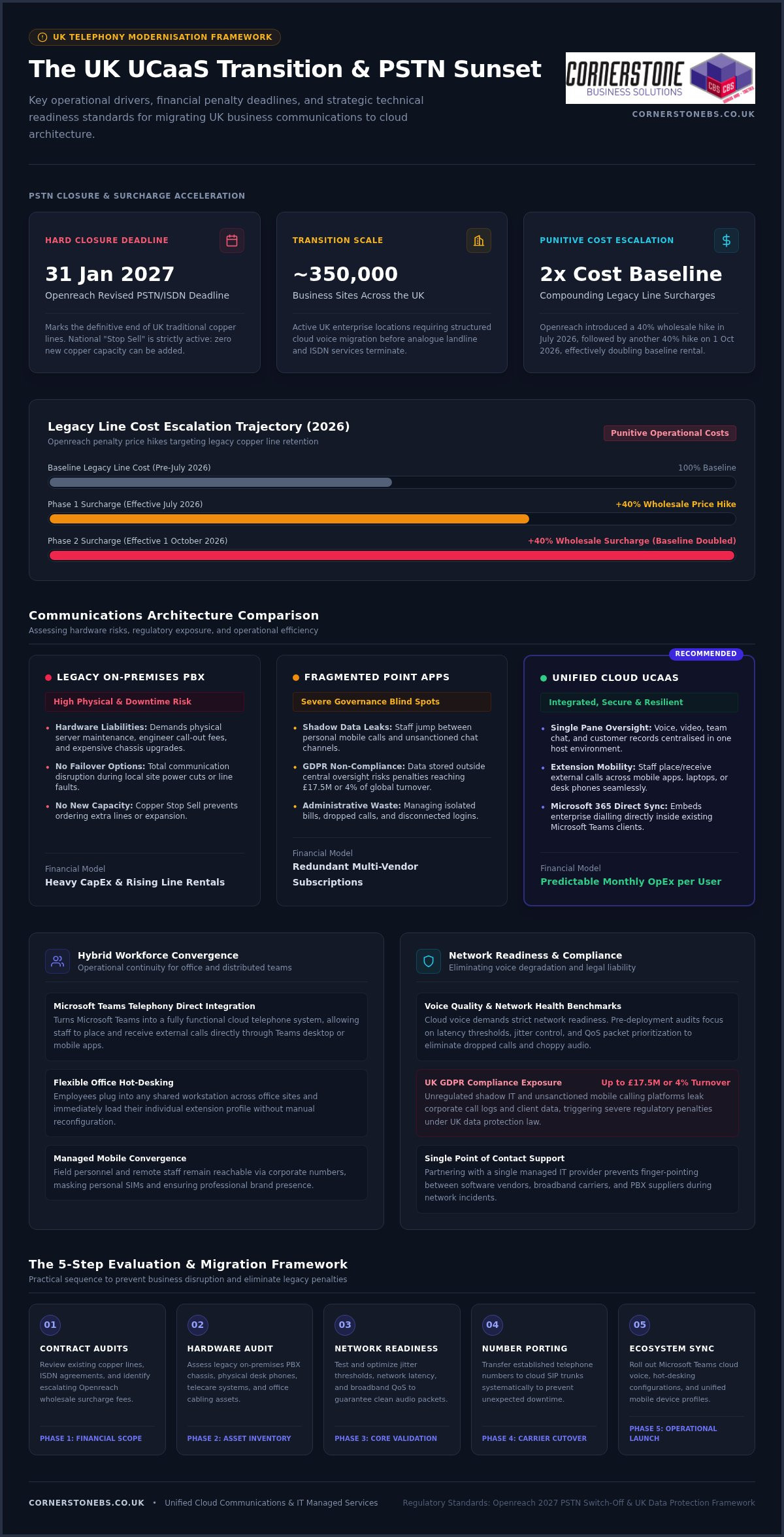
The operational push toward cloud voice isn’t merely about convenience; it’s a regulatory necessity. Openreach’s revised PSTN and ISDN closure date of 31 January 2027 marks the definitive end of the UK’s traditional copper telephone lines. While this revision gave telecare providers essential breathing room, the national “Stop Sell” remains strictly active. You can no longer purchase or add new copper-based capacity.
Delaying action brings direct financial consequences. Openreach introduced a 40% wholesale line rental price hike in July 2026, matched by another 40% increase on 1 October 2026, effectively doubling the baseline cost of legacy line rental. Beyond avoiding these penalty fees, adopting a modern unified communications as a service (UCaaS) UK platform solves the friction of hybrid working. Staff receive full extension mobility, answering customer calls seamlessly on mobile apps, laptops, or desk phones without revealing personal numbers or wrestling with disconnected logins.
Legacy On-Premises PBX vs Fragmented Apps vs Unified UCaaS
Sticking with legacy Private Branch Exchange (PBX) units or relying on unlinked software subscriptions creates significant liabilities for growing companies:
- Hardware liabilities: Traditional PBX systems demand physical server maintenance, engineer call-out fees, and expensive chassis upgrades that lack failover options during power cuts.
- Security and governance blind spots: When staff jump between unsanctioned chat apps and personal mobile calls, company data leaks outside central oversight. This triggers major compliance risks under UK GDPR, where fines can reach £17.5 million or 4% of global turnover.
- Unified operational efficiency: Adopting consolidated unified communications as a service (UCaaS) UK architecture gives IT teams total visibility. Voice, team channels, and customer records sit in one pane, lowering administration workloads while slashing software licensing waste.
Key Features to Look for in a UK UCaaS Platform
Selecting the right communication stack means looking beyond basic dial tones to ensure your tools actively support how modern teams work. As organisations adapt to the official UK transition from analogue to digital landlines, the most effective platforms weave telephony directly into day-to-day productivity software, removing the friction of standalone apps.
Cloud Telephony, Microsoft Teams Integration, and Mobile Convergence
For organisations already invested in Microsoft’s ecosystem, bridging business voice directly into that workspace offers unmatched efficiency. Integrating cloud voice with your Microsoft 365 migration for business UK strategy turns Microsoft Teams into a fully functional cloud telephone system.
Employees place and receive external calls directly within their Teams desktop client or mobile app, using their standard company telephone number. Flexible hot-desking features allow staff to plug into any office workstation and instantly load their unique extension profile. Pairing this setup with managed business mobile devices ensures field staff and office personnel remain seamlessly reachable under one corporate umbrella.
Intelligent Call Routing, Analytics, and Customer Contact Features
First impressions matter. A modern unified communications as a service (UCaaS) UK setup provides enterprise-level call management without the complexity of traditional switchboards:
- Dynamic auto-attendants and IVR: Guide callers to the right department effortlessly, routing after-hours calls to on-call mobiles or automated voicemail-to-email channels.
- Hunt groups and queue management: Distribute inbound calls evenly across departments to slash hold times and avoid abandoned customer inquiries.
- Live supervisory dashboards: Track queue volumes, answer speeds, and missed calls in real time so supervisors can adjust staffing on the fly.
- Native CRM integration: Trigger screen pops when a customer rings, showing recent tickets, account history, and order notes before your team even says hello.
Centralised Administration and Scalable User Management
Managing extensions should never require an external engineer visit. Modern UCaaS portals let your internal IT team add, reassign, or remove user licences with a few clicks. Role-based access controls keep sensitive call recordings and customer details secure, preventing unauthorised downloads or leaks.
Because cloud licensing operates on predictable per-seat monthly billing, scaling up for seasonal demand or down during restructures happens without penalising hardware overheads. If you want to see how these capabilities can fit your existing workflows, you can explore tailored options through our team at Cornerstone to build a dependable setup tailored to your operational goals.
Overcoming Technical and Security Hurdles: Network Readiness and Compliance
The biggest dread when migrating to cloud voice isn’t the software interface; it’s the fear of jittery calls, robotic audio, and dropped client conversations. While software vendors often claim their tools work over any internet connection, enterprise-grade unified communications as a service (UCaaS) UK deployments demand a resilient local network foundation. Without proper infrastructure planning, even the most advanced voice platform will struggle under daily office traffic.
Broadband Bandwidth, VLAN Configuration, and Quality of Service (QoS)
Voice traffic is uniquely sensitive to network congestion. To deliver crystal-clear conversations that hit the industry-standard 4.0+ Mean Opinion Score (MOS), your local area network (LAN) and wide area network (WAN) must satisfy strict performance benchmarks:
- Bandwidth allocation: Budget approximately 100 kbps symmetric bandwidth per concurrent standard voice call, alongside 1.5 to 3.0 Mbps per HD video stream.
- Latency and jitter thresholds: Keep one-way latency below 150 ms (ideally under 100 ms) and network jitter strictly under 30 ms. Packet loss must remain below 1% to prevent clipping.
- Voice VLANs and QoS prioritisation: Configure managed network switches to isolate voice traffic onto dedicated Virtual Local Area Networks (VLANs). Router-level Quality of Service (QoS) tagging then prioritises voice packets over heavy background file downloads or software updates.
- Local infrastructure health: High-performance Wi-Fi 6 access points and modern structured Cat6 cabling prevent local bottlenecks that broadband speed tests alone won’t reveal.
UK GDPR Compliance, Data Encryption, and Secure Call Recording
Every recorded conversation, voicemail file, and automated meeting transcript represents sensitive corporate data. Deploying cloud communication requires strict alignment with UK GDPR and the Data Protection Act 2018. Businesses face severe exposure here: an estimated 67% of UK SMEs lack a formal, compliant recording and consent policy for digital voice channels.
To keep communications safe and compliant, platforms must meet recognized frameworks such as the NCSC Cloud Security Principles. Media streams require transport layer security (TLS) alongside Secure Real-Time Transport Protocol (SRTP) for voice encryption in transit, paired with AES-256 encryption for stored recordings.
For organisations processing card payments, automated pause-and-resume mechanisms must stop recording while financial details are read aloud, satisfying PCI-DSS standards. Tying these controls into comprehensive cyber security services ensures granular role-based access permissions, preventing unauthorised staff from downloading, listening to, or tampering with sensitive client records.
The 5-Step Evaluation and Migration Framework for UK Businesses
Migrating to cloud communications shouldn’t feel like a high-wire act without a net. When leadership worries about cut lines and lost customer calls, structured execution is everything. Following a methodical, five-step migration framework ensures your unified communications as a service (UCaaS) UK transition protects business continuity while moving your operations smoothly into modern cloud telephony.
Stage 1 to 3: Audit, Connectivity Readiness, and UK Number Porting
A flawless deployment begins with rigorous discovery well before any software goes live across your estate:
- Step 1: The holistic telecoms audit: Catalog every active number, direct dial-in (DDI) range, and existing supplier contract term. Don’t overlook ancillary lines plugged into lift panic buttons, security alarms, or legacy payment terminals. These analogue connections will drop dead if migrated incorrectly. Check your emergency location records (999/112) to verify all site addresses match current records.
- Step 2: Local connectivity and LAN readiness: Audit real-time ISP throughput and stress-test local switches. Segregate voice data onto dedicated VLANs, apply QoS priorities, and assess whether high-density Wi-Fi 6 points or structured cabling are required to handle simultaneous media streams.
- Step 3: Coordinated UK number porting: Porting rejections cause the majority of cloud telephony delays. A single mismatched billing postcode or misspelled business name on a Letter of Authority (LOA) can reset an Openreach porting cycle by weeks. Verify your exact billing data with your incumbent carrier before submitting formal port orders.
Stage 4 to 5: Phased Deployment, Staff Training, and Go-Live Cutover
Once porting dates and networks are locked down, the final stages focus on execution and adoption:
- Step 4: Controlled user pilots and role-based training: Spin up a pilot group containing power users, receptionists, and remote workers. Test hunt group rings, call forwarding, and desktop softphone stability. Run tailored training sessions so staff feel confident transferring calls, setting out-of-hours messages, and using mobile apps before company-wide launch day.
- Step 5: Planned cutover and live engineer support: Execute the final switchover during an out-of-hours maintenance window. Technicians monitor number port completions, test inbound carrier routing, and verify emergency call paths. When your team logs on the next morning, active helpdesk support catches user queries immediately, ensuring a calm, painless launch.
If you’re ready to modernize your telecom infrastructure without risking operational downtime, speak with our team at Cornerstone to plan your tailored migration roadmap.
Choosing Your UK UCaaS Partner: Managed IT vs Direct Software Vendors
Buying directly from a global software vendor looks straightforward on paper, but it frequently leads to frustration when technical issues crop up. If a remote worker experiences garbled audio or dropped calls, the software vendor invariably blames your local internet provider or office firewall. Meanwhile, your broadband supplier insists the line is healthy and points the finger back at the software application. This leaves your internal team stranded in the middle with no clear fix.
The Danger of Fragmented Support: Resolving the Voice vs Network Dilemma
When you align cloud telephony with strategic it company solutions, the voice versus network dilemma disappears completely. A single managed IT partner diagnoses faults across your entire operational chain, from the user’s laptop and headset drivers to managed switches, firewall routing rules, and cloud infrastructure.
Bundling IT support with your business telephony and Microsoft 365 licensing also removes wasteful administrative duplication. Your business gains a single monthly operational invoice and one dependable helpdesk team for every technical request, eliminating multi-vendor finger-pointing for good.
Evaluating Provider SLA Guarantees and Proactive Maintenance
Strong Service Level Agreements (SLAs) are vital when evaluating telecom providers. A meaningful SLA goes well beyond theoretical platform uptime; it specifies rapid incident response times, guaranteed engineer escalation paths, and automated disaster recovery routing during broadband outages. Key metrics to verify include:
- Target response and resolution times: Check contractually backed commitments for critical voice issues, not just generic email ticket acknowledgements.
- Proactive network monitoring: Ensure your partner actively tracks latency spikes and switch port health to fix connection drops before staff notice.
- Disaster recovery automation: Confirm automated failover routing to business mobile numbers if an office suffers an unexpected power cut.
As an award-winning national IT services provider with tier-one technology partnerships across Microsoft, Cisco, and IBM, Cornerstone Business Solutions bridges the gap between cloud voice and day-to-day IT resilience. Deploying unified communications as a service (UCaaS) UK systems through an accountable technology partner gives your teams reliable tools, proven migration support, and complete operational peace of mind.
Future-Proof Your Business Communications Today
Modernising your business telephony isn’t simply about replacing old desk handsets. It’s about securing an agile operational foundation. Bringing your voice, video, and collaboration under a dependable unified communications as a service (UCaaS) UK platform eliminates fragmented software subscriptions, protects your organisation against legacy copper line price hikes, and empowers hybrid staff everywhere.
A smooth transition hinges on working with an experienced partner that manages the entire technical chain, from local VLAN priorities to Microsoft 365 licensing. Founded in 2008, Cornerstone Business Solutions is a multi-award-winning national IT and communications provider holding tier-one technology partnerships with Microsoft, Cisco, and IBM. Backed by proactive helpdesk and network specialists, we deliver fully managed UK deployments with zero guesswork.
Take control of your telephony before legacy deadlines bite. Speak with our UK technology team to plan your seamless UCaaS migration and secure the reliable, connected future your business deserves.
Frequently Asked Questions
What is the difference between VoIP and UCaaS for a UK business?
VoIP focuses specifically on transmitting voice phone calls over an internet connection rather than legacy copper wires. In contrast, unified communications as a service (UCaaS) UK solutions combine business VoIP with video meetings, team chat, presence status, and file sharing in a single software environment. VoIP acts as the calling engine, while UCaaS provides the complete collaboration workspace for your organisation.
Will our existing UK business phone numbers be retained during a UCaaS migration?
Yes, your business can keep all existing geographic and non-geographic telephone numbers through the UK number porting process. Regulated by Ofcom, number porting transfers your active main switchboard numbers and direct dial ranges from your current telecoms supplier to your new cloud platform. Submitting exact billing records and account details avoids porting delays and ensures uninterrupted inbound calling.
How does the UK PSTN switch-off affect our current office telephone system?
Openreach will permanently retire the traditional Public Switched Telephone Network and ISDN lines by 31 January 2027. If your office still connects to wall-mounted copper lines or an on-premises PBX box, your incoming and outgoing lines will stop functioning after that date. Migrating early helps you avoid escalating wholesale line surcharges and engineer backlogs heading into late 2026.
Can a UCaaS solution integrate directly with our Microsoft 365 licensing?
Yes, modern cloud telephony connects directly into Microsoft Teams using Operator Connect or Direct Routing architectures. This allows your staff to make and receive external calls straight from their Teams interface on laptops, tablets, or mobiles. It eliminates the need for separate calling software while making full use of your existing Microsoft 365 user licences.
What minimum internet speed does a UK company need to run UCaaS reliably?
A reliable deployment requires roughly 100 kbps symmetric bandwidth per concurrent standard voice call, plus 1.5 to 3.0 Mbps for each HD video session. Beyond pure broadband download speeds, stable performance depends on low latency (under 100 ms), minimal jitter (under 30 ms), and packet loss below 1%. Configuring router-level Quality of Service prioritises this traffic above general internet browsing.
Is UCaaS secure enough to meet UK GDPR and financial compliance standards?
Enterprise cloud telephony platforms satisfy UK GDPR through end-to-end data encryption, using Transport Layer Security for transmissions and AES-256 for call recordings and transcripts. To comply with privacy rules and PCI-DSS standards, systems feature role-based access permissions, audit logs, and automated pause-and-resume controls that stop recordings while customers read payment card details over the phone.
What hardware do our employees need to use a cloud communications platform?
Employees only need a standard computer, laptop, or mobile smartphone equipped with a certified USB or Bluetooth headset. Staff can manage calls, video, and messages using softphone applications without physical handsets on their desks. However, companies preferring traditional setups can still deploy plug-and-play IP desk phones that connect directly into office network ports.