

Did you know that 43% of UK businesses experienced a cyber attack in the last year, with many now facing potential fines of up to £17 million under new regulations? You likely feel the pressure of the upcoming Cyber Security and Resilience Bill, especially with its mandatory 24-hour incident reporting requirements. Securing the right ransomware recovery services UK business leaders need is no longer a luxury; it’s the foundation of your operational survival. We understand that the fear of total data loss and crippling downtime keeps many local business owners awake at night.
We agree that the stakes have never been higher, particularly as the UK government moves toward a partial ban on ransomware payments. This guide provides a comprehensive roadmap to help you navigate the recovery process, restore your systems, and ensure long-term digital resilience. You’ll learn how to handle the new reporting mandates, minimize your downtime through robust disaster recovery, and maintain full compliance with evolving UK data laws. We’ve designed this guide to turn technical complexity into a clear path forward for your business stability and peace of mind.
Key Takeaways
- Stop the spread immediately by isolating infected systems and using forensic tools to identify the specific ransomware strain within the first hour.
- Ensure guaranteed data restoration by leveraging immutable backups and full system imaging instead of relying on unstable decryption keys from criminals.
- Navigate complex 2026 regulations with professional ransomware recovery services UK to meet strict ICO reporting windows and protect your reputation.
- Shift from emergency recovery to proactive digital strength by integrating award-winning Cyber Security and Disaster Recovery into your daily operations.
Immediate Steps: What to Do in the First Hour of a Ransomware Attack
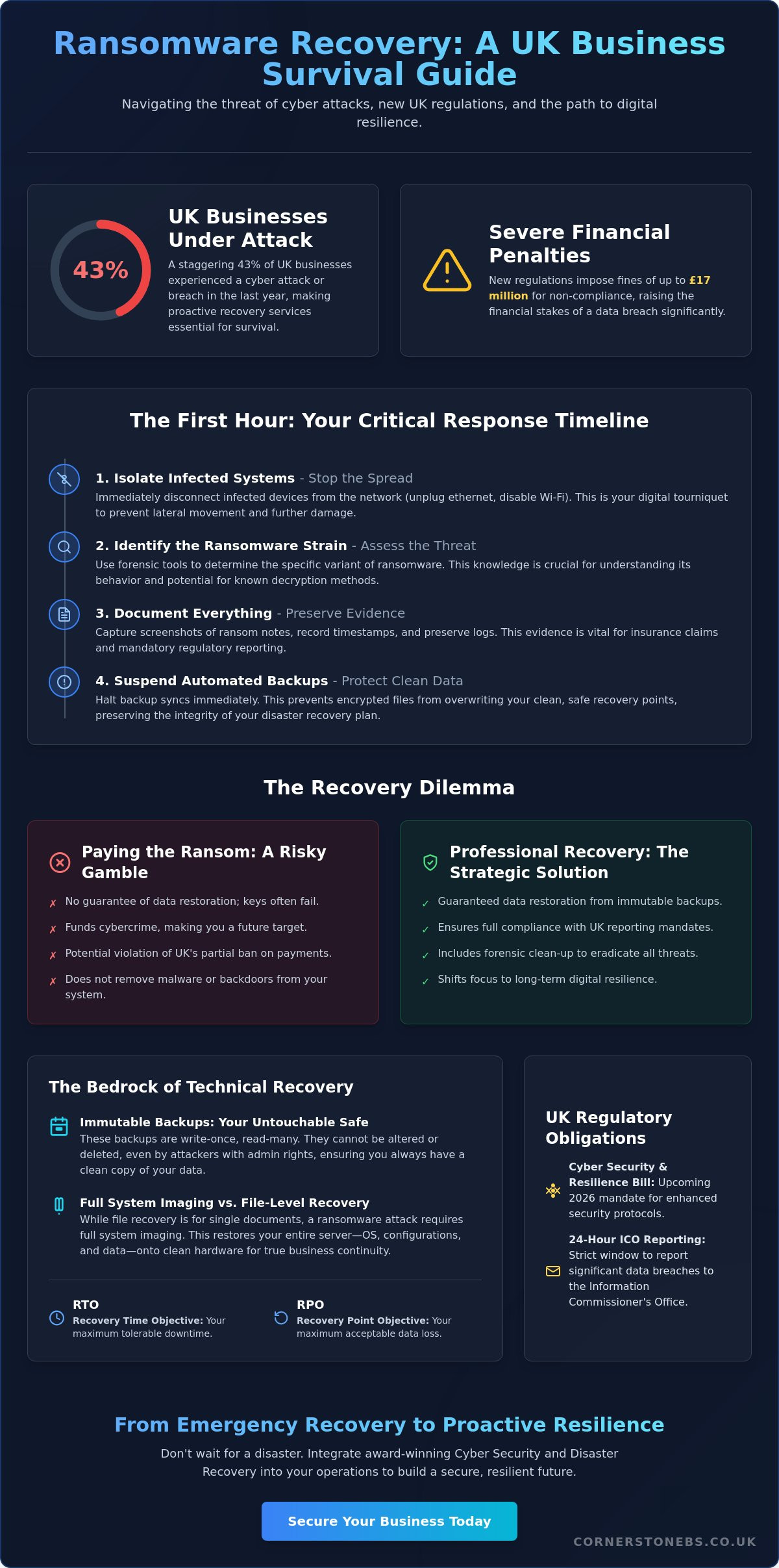
The first hour of a ransomware attack is often the most stressful period a business owner will ever face. You might see strange file extensions appearing in your folders or a glaring ransom note on your desktop. Stay calm. Your first job is to stop the bleeding. You must isolate infected machines immediately to prevent the malware from moving laterally through your network infrastructure. If you don’t act fast, a single infected device can compromise your entire server array. This is where the right ransomware recovery services UK expertise becomes the difference between a minor hiccup and a total shutdown.
Identifying the specific strain is the next priority. Using professional forensic tools helps determine if there’s a known remedy for the What is Ransomware? variant you’re facing. Our local team focuses on documenting every screen, message, and timestamp. This evidence is essential for your insurance claim and your 24-hour reporting mandate under the 2026 Cyber Security and Resilience Bill. You should avoid the temptation to speak with attackers directly. They’re professional manipulators, and direct contact often leads to higher ransom demands or further security risks. We’re here to help you manage these initial steps with the clarity of a long-term partner.
The Critical Containment Phase
Containment acts as the digital tourniquet for business survival, stopping the spread before it claims your entire network. You need to physically disconnect ethernet cables and disable Wi-Fi protocols on all suspected devices. It’s also vital to suspend your automated backup syncs immediately. If your system keeps syncing during an active attack, you risk overwriting your clean archives with encrypted data. Halting these processes preserves the integrity of your Disaster Recovery points and keeps your clean data safe from corruption.
Initial Assessment and Triage
Once the spread is contained, we assess the scope of the breach. We differentiate between files that are simply locked and data that has been exfiltrated to external servers. Our experts look across your UK-based servers and Microsoft 365 cloud environments to map the infection accurately. We then help you prioritise your restoration queue. By focusing on critical business functions first, we ensure your most important operations are back online while we continue the deeper cleaning process. This structured approach helps you maintain business continuity even under extreme pressure.
Technical Recovery Mechanisms: Restoring Business Continuity
Restoring your business operations involves much more than just clicking ‘undo’ on a hacker’s encryption. While many focus solely on data, true continuity requires a structured approach to rebuilding your entire digital environment. Leading ransomware recovery services UK providers rely on immutable backups as the first line of defence. These backups are specifically designed to be unchangeable; once written, they cannot be modified or deleted, even by someone with stolen administrative credentials. This ensures you always have a clean, untouchable copy of your history to fall back on.
We distinguish between simple file-level recovery and full system imaging. File-level recovery works for accidental deletions, but after a total ransomware sweep, you need system imaging. This process restores your entire server environment, including the operating system and configurations, onto clean hardware. By utilising cloud-based Disaster Recovery, we can often spin up these images in a virtual environment, allowing your team to work while we sanitise your physical on-site servers. This dual-track approach slashes the time you spend in operational limbo.
Understanding RTO and RPO in 2026
Success in recovery is measured by two vital metrics: RTO and RPO. Think of the Recovery Time Objective (RTO) as the ‘clock of downtime.’ It’s the maximum amount of time your business can survive without its systems before the damage becomes irreversible. Recovery Point Objective (RPO) is your ‘threshold of data loss,’ representing how much work you’re willing to lose between your last backup and the attack. We work as your long-term partner to align these metrics with your specific commercial needs, ensuring your protection matches your pace of growth.
The Forensic Clean-Up Process
You can’t simply restore data into an environment that might still be compromised. We follow UK government guidance on mitigating ransomware by thoroughly sanitising every server and workstation. This involves identifying ‘sleeper’ malware that may have been lurking in your backup sets for weeks before the final payload was delivered. By extracting data into sandboxed environments, we verify its integrity before it ever touches your live network. This rigorous verification process ensures that when you reconnect to the UK internet backbone, you do so with total confidence in your system’s purity.
Professional Recovery Services vs. Paying the Ransom
When you’re staring at a frozen screen and a multi-million pound demand, the pressure to pay can feel overwhelming. You want your business back, and the hackers promise a quick fix. However, paying a ransom is a high-stakes gamble that rarely delivers the clean break you’re hoping for. Statistics from early 2026 show that only 17% of UK organisations chose to pay the ransom, a sharp decline from previous years. This shift isn’t just about ethics; it’s about the cold reality that partnering with ransomware recovery services UK experts is a more reliable investment in your business’s future. Paying doesn’t just fund criminal enterprises; it marks your company as a “proven payer,” often leading to repeat attacks within months.
The technical reality is that decryption keys provided by attackers are notoriously unstable. They’re often poorly coded and can corrupt your files during the decryption process. Research from 2025 indicates that only about 60% of organisations that pay a ransom successfully recover all their data. You might spend $1.5 million (the median UK ransom payment in 2025) and still end up with a shattered database. Beyond the data loss, you face the risk of “double extortion,” where criminals take your money but still leak your sensitive information or demand a second payment to stop a public data dump. Investing in professional restoration through your Managed IT Support partner ensures your systems are rebuilt on a clean, secure foundation rather than a patched-up crime scene.
The Myth of the “Honest Hacker”
Don’t fall for the idea that hackers have a reputation to uphold. They aren’t service providers; they’re criminals. Even if they give you a key, they often leave “sleeper” malware behind. These backdoors allow them to bypass your Cyber Security and strike again once you’ve resumed operations. Professional recovery focuses on a “clean start” by wiping infected environments and restoring from immutable backups. This method ensures that no hidden threats remain to jeopardise your long-term stability.
Legal Risks for UK Businesses
The legal landscape in the UK has become significantly more complex. You must consider the UK government financial sanctions guidance before even discussing a payment. Paying a ransom to a sanctioned entity can lead to severe legal penalties, regardless of your intentions. Additionally, many UK insurance providers now exclude ransomware payments from their coverage. Working with a certified recovery partner is often a prerequisite for a successful insurance claim, as it proves you’ve taken reasonable steps to mitigate the damage through legitimate channels.
UK Regulatory Obligations and Data Breach Compliance
Recovering your data is only half the battle. In the UK, the legal aftermath of a ransomware attack can be just as daunting as the technical breach itself. You’re likely aware of the UK GDPR requirements, but the 2026 regulatory landscape has added new layers of urgency. Under the Cyber Security and Resilience Bill, many organisations now face a mandatory 24-hour incident reporting window. This sits alongside the existing 72-hour ICO notification requirement for personal data breaches. If you miss these deadlines, or if you can’t prove you took “reasonable care” to protect your infrastructure, the financial penalties can be staggering.
Engaging professional ransomware recovery services UK experts ensures you aren’t just restoring files; you’re building a robust legal defence. We help you document every step of the incident, from the initial discovery to the final system sanitisation. This detailed paper trail is vital when you communicate the breach to clients, stakeholders, and your employees. Transparency is your best tool for preserving trust. We ensure your response aligns with the latest National Cyber Security Centre (NCSC) standards, providing the structured approach that regulators expect from a responsible business.
Navigating the ICO Reporting Process
Reporting a breach shouldn’t be a guessing game. The ICO notification form requires specific details about the nature of the breach, the categories of data involved, and your mitigation steps. We guide you through this process, ensuring your technical recovery documentation supports your claim of proactive management. By being clear and transparent in your UK-wide communication, you manage the narrative and reduce the risk of long-term reputational fallout. This structured approach helps satisfy the authorities while protecting your brand’s integrity.
Compliance as a Recovery Milestone
A successful recovery is the perfect time to harden your defences for the long term. Many of our clients use this transition to achieve Cyber Security Services certification, turning a vulnerability into a verified strength. We’ll help you update your internal data processing registers and ensure you’re aligned with standards like NIS2 or DORA if your sector requires it. This isn’t just about ticking boxes; it’s about building a resilient future where your business is better protected than ever before. If you’re concerned about your current compliance posture, reach out for a chat with our local experts to see how we can strengthen your digital foundations.
Building a Ransomware-Resilient Future with Cornerstone
Surviving a cyber attack is a major milestone, but the ultimate goal is ensuring it never happens again. We believe that the most effective ransomware recovery services UK businesses rely on should lead directly into a proactive security posture. Our multi-award-winning support isn’t just about reacting to alarms; it’s about building a digital fortress around your daily operations. We help you transition from the stress of emergency recovery to the stability of managed IT. By implementing a Zero Trust architecture across your network, we ensure that every user and device is verified. This strategy significantly reduces the risk of lateral movement, keeping your core assets safe even if a single endpoint is compromised.
Proactive Monitoring and Threat Hunting
We leverage elite global partnerships with industry leaders like Cisco and Microsoft to bring world-class protection to your local network. Our UK-based helpdesk monitors your systems around the clock, identifying anomalies and hunting for “sleeper” threats before they have a chance to encrypt your files. For many local leaders, this journey toward total resilience starts with Managed IT Services Teesside to establish a rock-solid foundation. We act as your dedicated security eyes and ears, allowing you to focus on your commercial goals with total confidence.
Tailored Disaster Recovery Planning
True resilience requires moving beyond basic backups into a sophisticated Cloud Solutions environment. We customise your recovery protocols to match your specific RTO and RPO requirements. We don’t just hope the plan works; we run regular “fire drill” testing to prove it. These simulations ensure that your team knows exactly what to do and that your data can be restored within minutes. We’d love to invite you to a no-pressure conversation about your current risk level. Let’s have a friendly chat about how we can strengthen your digital foundations for the years ahead.
Secure Your Digital Legacy and Business Continuity
Navigating a ransomware attack is one of the toughest challenges any business leader will face. We’ve explored how immediate containment, technical restoration through immutable backups, and strict adherence to UK regulatory reporting can turn a potential disaster into a managed recovery. By choosing professional restoration over the risks of paying a ransom, you protect your business from double extortion and ensure your systems are rebuilt on a clean, secure foundation. Securing the right ransomware recovery services UK experts provide is the most effective way to meet the 2026 reporting mandates while preserving your professional reputation.
As a multi-award-winning IT provider and strategic partner with Microsoft, IBM, and Cisco, we’re here to be your long-term technology partner. Our UK-based proactive support team focuses on building a resilient future for your organisation, moving you from emergency response to a Zero Trust environment. Don’t wait for a crisis to test your defences. We invite you to talk to our award-winning UK experts about your recovery plan and discover how we can strengthen your digital foundations together. Your business stability is our priority, and we’re ready to help you thrive with confidence.
Frequently Asked Questions
Is it illegal for a UK business to pay a ransomware demand?
Paying a ransom isn’t universally illegal, but it’s a high-risk legal minefield that the UK government strongly discourages. If you unknowingly pay a group that is on the UK’s financial sanctions list, your business could face criminal prosecution. Under the 2026 Cyber Security and Resilience Bill, organisations must also report any intention to pay a ransom to the authorities before the transaction occurs. We focus on restoration through secure backups to keep your business on the right side of the law.
How long does professional ransomware recovery typically take?
Recovery timelines depend on the volume of data and the complexity of your network, but 59% of UK businesses achieved a full recovery within one week in 2025. While simple file restoration might happen quickly, a full forensic sanitisation of your servers ensures that no “sleeper” malware remains. Our local team prioritises your most critical business functions so you can resume operations while the deeper cleaning of your infrastructure continues in the background.
Will my cyber insurance cover the cost of recovery services?
Most cyber insurance policies cover the professional fees for ransomware recovery services UK providers offer to rebuild your systems. However, a growing number of UK insurers now specifically exclude the cost of the ransom payment itself. You should review your policy to confirm it covers digital forensics, data restoration, and the temporary hardware needed to maintain business continuity during the rebuild. Working with a recognised partner often makes the claims process much smoother.
Can ransomware infect my cloud backups like Microsoft 365 or Azure?
Yes, ransomware can compromise cloud environments if your automated sync processes remain active during an attack. If your local files are encrypted, the cloud service may simply sync those “changes,” overwriting your clean versions with encrypted ones. We prevent this by using immutable cloud backups and Disaster Recovery solutions that are isolated from your live sync environment. This ensures you always have a version of your data that the malware cannot touch.
What is the difference between data recovery and ransomware recovery?
Data recovery is the technical act of retrieving lost or deleted files, while ransomware recovery is a comprehensive strategic restoration of your entire business environment. Ransomware recovery involves forensic analysis to find the entry point, sanitising the network to remove backdoors, and verifying the integrity of every system. It’s a structured move toward long-term resilience rather than just a simple file restore. We treat it as a business continuity project to ensure your digital foundations are stronger than before.
Do I need to report a ransomware attack to the police or the ICO?
You must report any breach involving personal data to the ICO within 72 hours under the UK GDPR. For many sectors, the 2026 regulations have shortened this to a 24-hour mandatory reporting window for the initial incident. You should also report the attack to Action Fraud, which is the UK’s national reporting centre for cybercrime. These reports are essential for your legal compliance and can be vital when making a claim on your cyber insurance policy.
How can I tell if my backups are safe from a current infection?
Your backups are only truly safe if they are immutable or physically air-gapped from your primary network. We use forensic scanning tools to check your backup sets for “sleeper” malware that might have been planted weeks before the attack. If your backups were connected to the network during the infection without specific write-protection, there’s a risk they could be compromised. Regular “fire drill” testing is the most reliable way to verify your recovery points.
What are the first three things I should do if I see a ransom note?
First, isolate the infected devices by disconnecting ethernet cables and disabling Wi-Fi to stop the spread. Second, take photos of the ransom note and any on-screen messages to provide evidence for the police and your insurance provider. Third, contact your Managed IT Support partner immediately to begin the professional containment phase. These steps act as a digital tourniquet, protecting your remaining network infrastructure from lateral movement while you prepare for a secure restoration.