Posted on: November 3rd, 2026 by Cornerstone
The common IT outsourcing mistakes to avoid start with handing over work before you’ve defined what success looks like. Unclear responsibilities, weak service-level agreements, poor cultural fit and choosing functions without considering their business impact can all create avoidable friction. Outsourcing works best when expectations are clear from the start.
It is reasonable to expect an IT support provider to bring expertise and ease pressure on your team. A successful partnership still depends on clear goals, practical communication and careful decisions about which responsibilities to outsource.
This guide explains how to define service expectations, assess working styles and identify repeatable tasks that could be handled externally. It also shows how to keep the relationship on track, so the support you bring in strengthens your business rather than adding complexity.
Key Takeaways
- Compare providers on the reliability, security and practical value they bring, not price alone.
- Write service-level agreements around clear responsibilities, response times and measurable performance targets.
- Set shared communication habits early to reduce misunderstandings and build a productive working relationship.
- Start with repeatable tasks that are suitable to hand over, while keeping essential business decisions in-house.
1. What Are the Most Common Mistakes of Outsourcing?
The common IT outsourcing mistakes to avoid often start with choosing the lowest-priced provider without comparing service quality. Poorly planned outsourcing can cost up to 30% more than expected in its first year. Nearly 45% of outsourcing projects partially fail because of insufficient preparation or follow-up. Assess value through scope, experience, security procedures and measurable performance, not price alone.
Define the provider’s role before work begins. The Supply Chain Resource Cooperative recommends considering a programme’s purpose and scope, intended results and delivery approach. Specify which systems the provider supports, what your staff remain responsible for and how urgent issues are escalated. Clear boundaries reduce delays and help the partnership run smoothly.
For UK outsourcing, agreements should reflect applicable data protection and cybersecurity requirements. Set out who can access personal data, how access is controlled, which security procedures apply and how incidents are reported. Put these responsibilities in the contract instead of assuming the provider will interpret them as you do.
Compare costs on a like-for-like basis. Match each proposal’s scope, support hours and included tasks, and clarify charges for out-of-scope work, onboarding and changes. One of the common IT outsourcing mistakes to avoid is relying on a headline rate that excludes essential work. Comparing the full scope helps reveal additional costs.
Instructions need context, examples, owners and deadlines. For a system update, name the system, describe the outcome, identify the approver and set a completion date. Arrange early staff support, then use monthly training sessions to explain how an outsourced team’s platform or process works. This helps employees understand new responsibilities and reduces avoidable handover confusion.
Choose a provider whose experience and working approach fit the task. Testing the partnership before full outsourcing can reduce partnership failures by 45%. Use the trial to assess communication, delivery against agreed metrics and how the team handles exceptions. Address any gaps before expanding the scope.
2. Setting clear service-level agreements
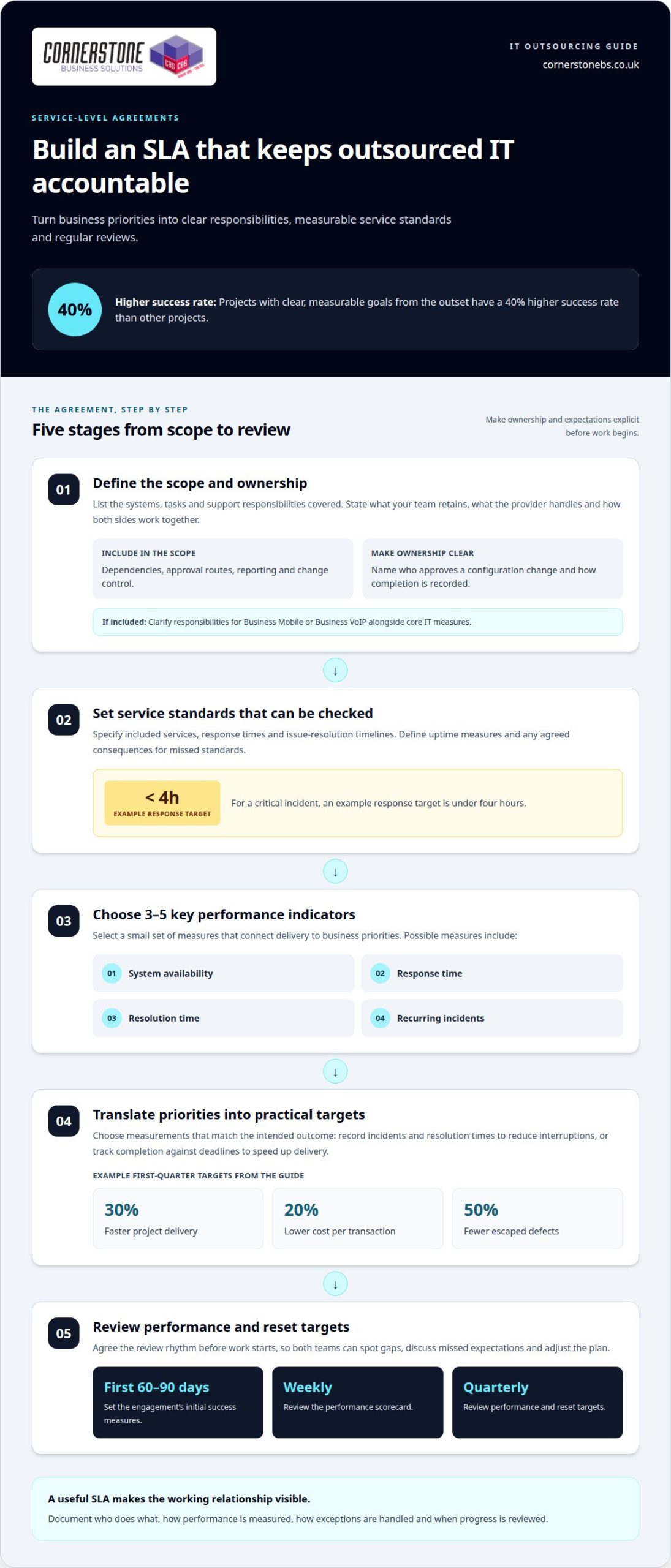
Define the scope by listing the systems, tasks and support responsibilities covered by the agreement. State what your team retains, what the provider handles and how both sides will work together to meet the objectives.
A service-level agreement should set expectations for included services, response times and issue-resolution timelines. It should also define uptime measures and any agreed consequences for missed standards. For a critical incident, an example response target is under four hours.
Choose three to five key performance indicators that connect delivery to business priorities. These could track system availability, response time, resolution time or recurring incidents. Projects with clear, measurable goals from the outset have a 40% higher success rate than other projects.
Agree how progress will be reviewed before work starts. Set success measures for the first 60–90 days of an engagement, review a performance scorecard weekly and use quarterly reviews to reset targets. Regular collaboration gives both teams a chance to address missed expectations and adjust the plan.
Scope should also cover dependencies, approval routes, reporting and change control. For example, specify who approves a configuration change and how the provider records its completion. This prevents small requests from becoming disputed extra work or delaying a wider project.
Where the agreement includes staff connectivity, clarify responsibilities for Business Mobile or Business VoIP alongside core IT measures. Explore business communications support as part of a joined-up service discussion.
3. Cultural compatibility and shared values
Culture shapes how an outsourced team communicates, makes decisions and handles pressure. Poor communication or insufficient cultural understanding accounts for 60% of tensions in international teams. That makes fit a practical delivery concern, not simply a question of whether people get along. Agree how both teams will raise risks and resolve disagreements.
Assess fit through practical examples, not broad claims about shared values. Ask the team to explain how it would handle a missed deadline, an urgent security concern or a change in priorities. Notice whether its responses are clear, candid and consistent with your organisation’s approach to accountability and customer care.
Different communication styles can create friction even when everyone shares the same goal. One team might flag a problem immediately, while another waits for a scheduled review. Agree on a channel for urgent updates, a regular meeting schedule and who makes decisions when the usual contact is unavailable.
Compare expectations around ownership and escalation. If your business expects staff to suggest improvements but the provider waits for detailed instructions, useful opportunities may be missed. Discuss a real task, such as restoring access after a user lockout, and agree who investigates, who updates colleagues and when the issue is escalated.
Language and time differences can also affect daily collaboration. Use plain wording, define technical terms and record decisions after meetings. If teams work across time zones, set realistic handover windows and identify an agreed contact for time-sensitive incidents. These steps help prevent delays caused by assumptions or unclear ownership.
Build feedback into the relationship from the start. During the initial engagement, hold brief retrospectives every two weeks to discuss what is working, where expectations differ and what should change. Keep the conversation specific: review one recent handover, identify the friction point and agree an action owner. Shared priorities become visible through consistent behaviour, not promises alone.
4. Deciding which core business functions to outsource
Start with tasks that are repeatable, documented and separate from core business decisions. Examples include routine account administration, device setup and recurring IT maintenance. Keep strategic choices, sensitive approvals and customer commitments under direct business ownership. The aim is to free your team for work that depends on its specialist knowledge.
List tasks that staff find difficult, are behind on or another team could handle more efficiently. Then assess each task by its business impact, security sensitivity, frequency and the effort needed to explain it. If a process is failing because nobody owns it, outsourcing alone will not fix the gap. Define an owner and a successful outcome first.
Managed, repeatable work is often easier to transfer than tasks requiring constant judgement. A documented new-starter setup, for example, can have clear inputs, steps and completion criteria. By contrast, deciding which customers receive priority service relies on business context and should remain closely controlled.
Outsourcing can cost up to 60% less than hiring additional staff in an office. Treat this as a possible comparison, not a promised saving: the right choice depends on the task, operating model and work location. Compare the full scope and responsibilities, not just the staffing alternative.
Protect access, data and intellectual property through written contract terms and controlled permissions. Specify who may access each system, limit access to what the work requires, and record how information will be returned or deleted at the end of the arrangement. Keep ownership of business data, documentation and credentials clear throughout.
Provider lock-in can make a change difficult if systems, records or processes cannot be transferred. Plan the exit before work starts: specify usable data exports, handover documentation, access transfer, transition responsibilities and how ongoing work will continue. This gives your business a practical route if the relationship ends.
Choose one suitable process for an initial handover, then review its quality, staff impact and operational risks before widening the scope. For help deciding which IT responsibilities to manage externally, discuss your managed IT support needs.
Cornerstone Business Solutions: Managed IT Support
Cornerstone Business Solutions provides Managed IT Support for businesses seeking dependable help with day-to-day technology and clear ownership of IT tasks. It can be a practical next step when internal teams are stretched, recurring issues interrupt work or responsibilities between staff and external support need to be defined.
Support can sit alongside Microsoft 365, Cyber Security and Business Mobile, helping businesses consider their technology needs together. The right scope depends on which systems need attention, what your team manages internally and where specialist support would make the biggest difference. Clear responsibilities and regular communication keep the working relationship aligned with your priorities.
If you are reviewing how your business manages IT, contact Cornerstone Business Solutions to discuss Managed IT Support.
Build outsourcing into your next stage of growth
Outsourcing decisions should evolve with your business. A process that works today may need a different level of support as your systems, team or customer needs change. Make ownership of the relationship part of your planning, not an afterthought.
Choose someone internally to keep business priorities visible, record decisions and raise changing needs. Use that perspective to spot when an outsourced arrangement no longer fits the work. Common IT outsourcing mistakes to avoid often begin when nobody revisits the original purpose. Regular reviews can help you decide whether to refine the arrangement, expand it or bring responsibilities back in-house.
Cornerstone Business Solutions can help you consider how managed IT support fits your organisation’s needs. Contact Cornerstone Business Solutions to explore a practical next step for your business. With clear ownership and a willingness to adapt, outsourcing can support a confident path forward.
Frequently Asked Questions
What Are the Most Common Mistakes of Outsourcing?
Common mistakes include unclear ownership, choosing a provider on price alone and treating handover as a one-off event. Another risk is assuming outsourced work removes your responsibility for business decisions. A provider might maintain a system, for example, while your team still approves access and decides which users receive it. Define those boundaries before work transfers.
What are the most common IT outsourcing mistakes businesses make?
Businesses can overlook the knowledge their staff hold about everyday exceptions. A process document may cover routine requests but miss what happens when an employee leaves without returning equipment. Record unusual cases and who handles each one before transferring the task. This helps prevent repeated queries, incomplete handovers and extra reliance on individual staff members.
How can you choose and vet an IT outsourcing provider in the UK?
Assess relevant experience, delivery arrangements and security procedures against the work you plan to outsource. Ask how long the provider has delivered outsourced services, whether it has its own operational presence, and how it measures uptime. Discuss a realistic scenario, such as a system outage, to understand how the team communicates, investigates and escalates issues.
What should an IT outsourcing contract and SLA include?
Include service boundaries, named responsibilities, escalation routes, reporting arrangements and a process for approving changes. Cover confidentiality, data access and how information will be returned at the end of the relationship. For example, specify who owns system documentation and who provides it during a handover. Make any service credits or other agreed remedies clear in the contract.
How can businesses manage communication, time zones and cultural differences with outsourced IT teams?
Agree on a shared handover format that records the issue, business impact, action taken and next owner. Mark urgent requests clearly and state the time zone for deadlines or meetings. For example, a Friday handover should name the person responsible for the next update. Written decisions also help colleagues who could not attend a meeting follow the same plan.
How should a business monitor outsourced IT performance and service quality?
Compare service results with an agreed starting point, then look for patterns rather than judging isolated incidents. Group tickets by type, business impact and recurrence. If password resets rise while account access issues persist, the trend may point to a process or training gap. Record corrective actions, assign owners and review whether the changes improve service.
Posted on: May 14th, 2026 by Cornerstone
Switching your IT support provider shouldn’t feel like a high-stakes gamble with your business continuity. Many business owners delay a necessary change because they aren’t sure how to switch IT support providers UK without triggering a technical meltdown or exposing sensitive data. It is a valid concern. You have likely stayed with a mediocre partner longer than you should have just to avoid the headache of migration or those dreaded hidden exit fees.
We understand that anxiety, especially with the 2026 updates to the Data (Use and Access) Act and the new Cyber Essentials v3.3 standards making compliance more complex. This guide will show you how to navigate a stress-free transition to a superior, proactive IT partner without risking data loss or operational downtime. We have built our reputation as a trusted local expert by simplifying these transitions for growing businesses. You are about to discover a clear roadmap for a seamless migration that keeps your team productive and your infrastructure secure from day one.
Key Takeaways
- Identify the critical warning signs that your current partnership is failing, from sluggish response times to a reactive ‘break-fix’ mindset.
- Learn exactly how to switch IT support providers UK using a proven five-step roadmap that guarantees zero operational downtime.
- Navigate complex contractual obligations with confidence by identifying hidden exit fees and managing notice periods effectively.
- Discover why industry accolades and global vendor partnerships are essential benchmarks for selecting a reliable technology partner in 2026.
- Protect your business continuity with a structured onboarding process that prioritizes data security and emotional peace of mind.
Signs It’s Time to Switch Your IT Support Provider
Your technology should work as hard as you do. If you feel like you are constantly shouting into a void when a system fails, you aren’t alone. Many UK businesses tolerate subpar service because they fear the transition process. However, staying with a provider that only reacts when things break is a recipe for stagnation. Learning how to switch IT support providers UK starts with identifying the friction points that are quietly draining your productivity and profit.
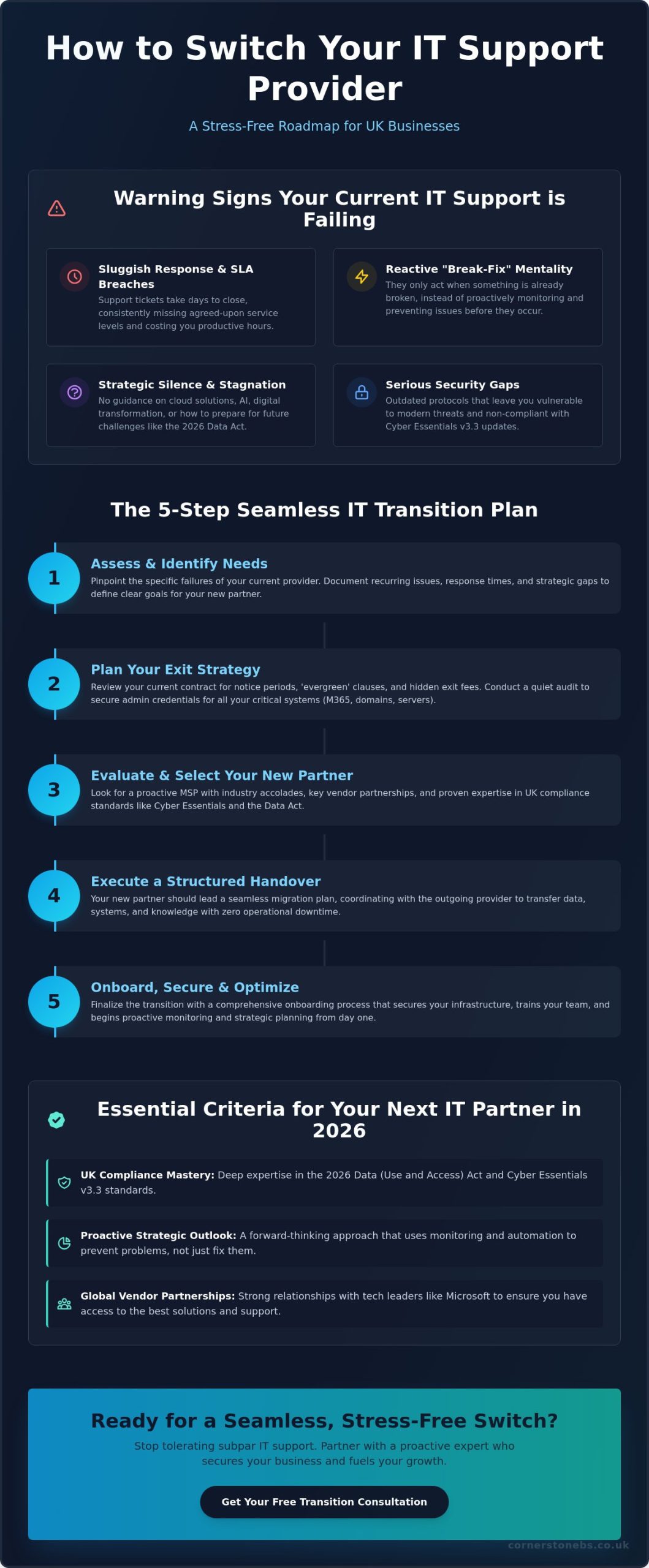
Signs of trouble often start small. Maybe it’s a support ticket that takes three days to close, or a recurring ‘glitch’ that never quite gets fixed. Eventually, these small annoyances become systemic failures. In 2026, the stakes are higher than ever. If your provider hasn’t mentioned the April 2026 Cyber Essentials v3.3 updates or helped you navigate the Data (Use and Access) Act 2025, they are leaving you legally and financially exposed. Common red flags include:
- A persistent ‘break-fix’ mentality: They only show up when something is already broken, rather than preventing the issue in the first place.
- SLA breaches: Slow response times that consistently miss the targets agreed upon in your contract.
- Strategic silence: A total lack of guidance on cloud solutions, digital transformation, or how to use AI to drive efficiency.
- Security gaps: Outdated protocols that don’t account for modern threats like deepfake vishing or sophisticated ransomware.
The Cost of Outgrowing Your Current Provider
The Proactivity Test: Is Your IT Support Reactive?
A true Managed Service Provider (MSP) doesn’t wait for your phone call to start working. They use proactive monitoring to kill problems in the cradle. In 2026, waiting for a system to fail is a high-risk strategy that leads to emergency repair costs and reputational damage. There is a massive difference between a basic helpdesk and a strategic technology partner. While a helpdesk fixes what is broken, a partner looks at your three-year growth plan and builds the infrastructure to support it. Proactive maintenance doesn’t just save time; it provides the emotional security of knowing your systems are resilient and ready for whatever comes next.
Navigating Contractual Obligations and Offboarding Requirements
Contracts shouldn’t feel like handcuffs. Yet, many business owners find themselves trapped in agreements with hidden exit fees or restrictive notice periods. Understanding how to switch IT support providers UK requires a clinical look at your current paperwork before you make a move. Start by identifying your notice period. While 30 to 90 days is standard, some contracts include ‘evergreen’ clauses that automatically renew your commitment for another year if you miss a narrow cancellation window. Spotting these traps early is the best way to ensure your exit remains on your terms.
Beyond the timeline, look for financial hurdles. Some providers charge ‘offboarding fees’ to release your data or return hardware. Knowing these costs upfront prevents budget surprises during your transition. As highlighted in the Forbes guide on Breaking Up With Your Managed Services Provider, the goal is a clean break that protects your operational integrity. If you are unsure about the fine print, our team at Cornerstone Business Solutions can help you review your current agreement to identify potential risks.
The Asset and Credentials Audit
Who actually owns your digital assets? You’d be surprised how often businesses discover they don’t have the global admin rights to their own Microsoft 365 tenant or domain names. Before giving notice, conduct a quiet audit of your credentials. You must secure administrative access to your firewall, local servers, and cloud accounts. If your current provider holds these ‘keys to the kingdom’ exclusively, you may face delays during the handover. Ensure you have a documented list of all third-party vendor relationships, such as your internet service provider or business VoIP host, to maintain continuity.
Managing the Notice Period Professionally
Once you decide to move, keep the communication professional and transparent. You still rely on your outgoing provider for support during the notice period, so maintaining a collaborative tone is vital. Clearly outline your expectations for the handover, including the transfer of technical documentation and the decommissioning of remote monitoring tools. Legal considerations for data portability are also paramount. Under the 2026 UK data protection standards, your outgoing provider has a responsibility to facilitate a ‘reasonable and proportionate’ transfer of information. A structured handover protocol ensures that no data is lost in the gap between the old contract and the new partnership.
Evaluating Your Next Partner: Criteria for UK Businesses in 2026
Selecting a new technology partner is one of the most significant decisions you will make for your business stability this year. It’s not a mere swap of service tickets. It’s a strategic upgrade. When researching how to switch IT support providers UK, you must look beyond basic helpdesk functions. You need a partner who combines regional warmth with the technical muscle of a national leader. In 2026, the benchmark for excellence is defined by those who hold multi-award-winning status and maintain deep partnerships with global innovators like Microsoft, IBM, and Cisco.
Avoid ‘one-size-fits-all’ packages that treat your unique infrastructure like a commodity. Your business deserves a bespoke solution tailored to your specific growth goals. A superior provider doesn’t just maintain your hardware; they integrate robust cyber security into every layer of your network. This unified approach ensures that your Managed IT Support, Business VoIP, and Cloud Solutions work in harmony, creating a resilient foundation for your daily operations. You aren’t just buying support; you’re investing in a team that values your uptime as much as you do.
Accreditations and Security Standards
Compliance is no longer optional. In 2026, ISO certifications and Cyber Essentials Plus are the baseline for trust. Your new partner must demonstrate a deep understanding of the evolving UK regulatory environment. This includes navigating the complexities of the NIS2 directive and the Digital Operational Resilience Act (DORA) if you operate within critical supply chains. These standards protect your reputation. We recommend choosing a provider that undergoes regular third-party quality audits. This validation proves they don’t just claim to be the best; they have the accolades to back it up.
The Partnership Approach vs. Transactional Support
The 5-Step Seamless IT Transition Plan
A successful transition is built on precision, not luck. When you are figuring out how to switch IT support providers UK, you need a methodology that eliminates the ‘fear of the unknown’. We treat every onboarding as a structured project rather than a reactive event. This ensures that your team stays productive while we migrate your systems to a more robust, proactive environment. Our multi-award-winning team follows a clear roadmap to guarantee that your business continuity remains the top priority from the first conversation to the final optimization.
- Step 1: The Discovery Phase – We perform a deep dive into your current infrastructure to identify every asset, software licence, and potential bottleneck.
- Step 2: Coordination – We establish a clear timeline and communicate with your outgoing provider to ensure a professional, documented handover.
- Step 3: Security & Data Migration – We move your digital assets with zero data loss, prioritizing your critical business information and sensitive client records.
- Step 4: The Onboarding – We set up your new helpdesk and deploy our proactive monitoring tools across your entire network.
- Step 5: Post-Switch Review – We optimize every system for peak performance, ensuring your technology aligns perfectly with your 2026 growth goals.
Step 1: The Comprehensive IT Audit
You can’t protect what you haven’t mapped. Our discovery phase identifies legacy hardware or outdated software that might be holding you back or creating security vulnerabilities. Performing a comprehensive pre-switch audit prevents unexpected downtime by uncovering hidden technical debt before it can disrupt the migration process. We map out your entire network infrastructure to create a stable foundation for future it company solutions. This level of detail ensures that when the switch happens, there are no surprises.
Ensuring Zero Downtime During Migration
Operational silence is the goal of any switch. Modern cloud solutions allow us to facilitate seamless data transfers without pulling the plug on your daily work. We often use redundant systems during the critical ‘cut-over’ period. This dual-running strategy means your team can continue accessing Microsoft 365 and your business VoIP systems while we finalize the back-end transition. It’s about maintaining momentum and removing the emotional stress of a ‘big bang’ switch. If you want to see how this roadmap fits your specific business, invite our team for an informal conversation about your current setup.
Experience a Stress-Free Switch with Cornerstone Business Solutions
Choosing a new technology partner is more than a technical migration. It’s a commitment to your future growth. We understand that the process of how to switch IT support providers UK can feel daunting, which is why we’ve refined our onboarding to be as quiet and efficient as the systems we manage. You won’t find any hidden ‘onboarding fees’ or long-term contractual traps here. Instead, you get a dedicated team focused on maintaining your business continuity while we build a more resilient infrastructure for your team.
Our multi-award-winning approach is built on the belief that technology should empower people, not frustrate them. We provide bespoke technology solutions that integrate your cloud environment, business communications, and cyber security services into one seamless platform. This unified strategy removes the friction of managing multiple vendors. By lead-loading our expertise during the transition, we ensure that your systems are optimized for performance from the very first day of our partnership.
Award-Winning Support for Every UK Sector
We take immense pride in our regional roots and our ability to support a diverse range of organizations. From fast-growing SMEs to large educational institutions, our team delivers the same level of professional authority and approachable warmth. Our global partnerships with industry leaders like Microsoft and Cisco ensure you receive world-class technology, while our local presence means we are always reachable when you need us most. It’s about bringing global standards to your doorstep with a community-focused heart.
Your Invitation to a Better IT Experience
Our clients don’t just see us as a supplier. They view us as a foundational element of their business stability. This shift from transactional support to a collaborative partnership provides the emotional security you need to focus on your core goals. You shouldn’t have to worry about your data security or system uptime; that’s our job. We offer a proactive, forward-thinking service that anticipates challenges before they impact your bottom line. It’s time to move away from the anxiety of reactive IT and experience the peace of mind that comes with a truly dedicated partner.
Ready for a more reliable partner? Book an informal conversation with our experts today and let’s discuss how we can simplify your technology landscape.
Secure Your Business Future with a Seamless Transition
Transitioning to a new IT partner is a strategic move that protects your bottom line and your team’s sanity. By following a structured audit and managing your notice period with professional clarity, you eliminate the risks of data loss or downtime. You’ve seen that understanding how to switch IT support providers UK is less about technical complexity and more about choosing a partner that prioritizes your growth. Since 2008, we’ve delivered bespoke solutions that replace reactive helpdesks with proactive, multi-award-winning support.
As official partners with Microsoft, IBM, and Cisco, we bring global technical excellence to our local community. We don’t just fix computers; we build resilient foundations that allow you to scale with confidence. You deserve a partner that cares about your business continuity as much as you do. Our team is ready to guide you through every step of the migration with the regional warmth and expert authority you expect.
Switch to an award-winning IT partner today and experience the difference of a truly collaborative relationship. We’re here to make your next chapter the most stable and successful one yet.
Frequently Asked Questions
How long does it typically take to switch IT providers in the UK?
A full transition usually takes between 30 and 90 days, depending primarily on the notice period in your current contract. While our technical team can complete the onboarding and data migration in as little as two to four weeks, we align our roadmap with your existing agreement to ensure you don’t pay for two services at once. This timeframe allows for a deep-dive audit and a relaxed training period for your staff.
Will there be any downtime for my staff during the transition?
You should experience zero downtime during a professionally managed switch. We use a parallel onboarding process where our proactive monitoring tools and security protocols are deployed while your old service is still active. This redundant approach ensures that the final “cut-over” of your network and cloud solutions is seamless, often taking place outside of your core business hours to protect your productivity.
What happens if my current IT company refuses to hand over passwords?
Your outgoing provider is legally obligated to return your digital assets, but we recommend securing your global administrative credentials before you formally give notice. If a provider becomes uncooperative, our experts can often work directly with vendors like Microsoft to verify your ownership and regain control of your tenants. Knowing how to switch IT support providers UK safely involves having a partner who understands these technical recovery protocols.
How do I know if a new MSP is actually proactive or just selling a dream?
A truly proactive partner will provide transparent reporting on issues they have resolved before you even knew they existed. Look for multi-award-winning providers who hold current Cyber Essentials Plus and ISO certifications. These accolades are third-party proof that the company invests in the sophisticated monitoring tools and automated workflows required to maintain your system stability 24/7, rather than just waiting for your call.
Is it possible to switch IT providers mid-contract?
Yes, you can switch mid-contract, though it typically involves a financial settlement for the remaining term. We often help business owners review their current agreements to identify any persistent SLA breaches that might allow for an earlier, penalty-free exit. Even if fees apply, many businesses find that the productivity gains from a superior service far outweigh the one-off cost of leaving a failing partnership.
What is the most important document I need from my outgoing provider?
The Technical Site Documentation is the most vital asset you need for a smooth handover. This document should include your full network map, administrative logins for all hardware, and an up-to-date software licence register. Having this information ready is a cornerstone of how to switch IT support providers UK without friction, as it allows your new partner to support your infrastructure from day one without guesswork.
How does a new provider handle my existing Microsoft 365 or cloud licences?
We manage your existing Microsoft 365 or cloud environment through a simple administrative transfer. There is no need to move data, change email addresses, or deal with user downtime. We simply take over the billing and management of your current tenant through our partner portal. This back-end swap is invisible to your employees and ensures that all your files and collaborative tools remain fully intact.
Can I switch my business phone system at the same time as my IT support?
Absolutely, and consolidating these services is often the most efficient way to upgrade your technology stack. Integrating your Business VoIP and Business Mobile with your Managed IT Support creates a unified communication strategy. This reduces the number of vendors you have to manage and ensures that your connectivity is just as secure and resilient as your core computer network, all supported by a single local team.
Posted on: May 12th, 2026 by Cornerstone
What if the most expensive part of your IT contract isn’t the monthly fee, but the silence you hear when a critical system fails? We’ve seen too many local businesses struggle with sluggish response times and “out of scope” invoices that make budgeting impossible. You likely feel the weight of rising cyber threats and want a partner who offers clear security guidance rather than just jargon. Finding the right fit starts with the specific questions to ask a potential IT support company to ensure they can handle the complexities of 2026.
We promise to provide a comprehensive vetting framework that identifies a proactive, secure, and strategic partner for your business. Whether it’s managing new regulations like the Texas Responsible AI Governance Act or shifting from old-school SLAs to modern Experience-Level Agreements, you need an award-winning team that stays ahead of the curve. This guide previews 21 essential questions designed to help you secure predictable costs and total peace of mind. Let’s find an IT partnership that supports your growth and keeps your North East business thriving.
Key Takeaways
- Learn how to move beyond reactive “break-fix” support by choosing a partner that aligns with your specific industry growth goals.
- Master the essential questions to ask a potential IT support company to uncover hidden costs in hardware, licensing, or site visits.
- Ensure your business stays resilient and compliant with 2026 regulations by vetting a provider’s internal security standards and expertise.
- Discover the difference between simple response times and actual resolution times to keep your team productive.
- Identify the red flags in IT contracts and what an award-winning, seamless onboarding process should look like for your business.
The Vetting Process: Why Asking the Right IT Questions Matters in 2026
The days of calling a technician only when a server goes dark are long gone. In 2026, business moves too fast for reactive “break-fix” models that only address problems after they’ve caused damage. You need a proactive approach that stops issues before they interrupt your morning coffee. This shift defines why your vetting process is so critical. When you prepare your list of questions to ask a potential IT support company, you aren’t just looking for a repairman. You’re searching for a long-term technology partner who understands your specific North East business goals and regional challenges.
Choosing the wrong provider based solely on a low monthly invoice often leads to hidden costs that dwarf the initial savings. A single afternoon of downtime can cost thousands in lost productivity and missed opportunities. We believe IT should be a predictable investment, not a source of constant financial surprises. By asking the right questions now, you ensure your technology acts as a sturdy foundation rather than a fragile ceiling. It’s about finding a team that values your uptime as much as you do.
Moving Beyond the Helpdesk
Technical expertise has become a baseline requirement. Most providers can reset a password or set up a laptop without much trouble. What differentiates an award-winning managed service provider is their ability to align technology with your commercial strategy. They should speak your language, not just code. This partnership-first mindset means they care about your bottom line and your future scalability. A strategic IT partner acts as a powerful catalyst for your business growth.
The Consequences of Getting It Wrong
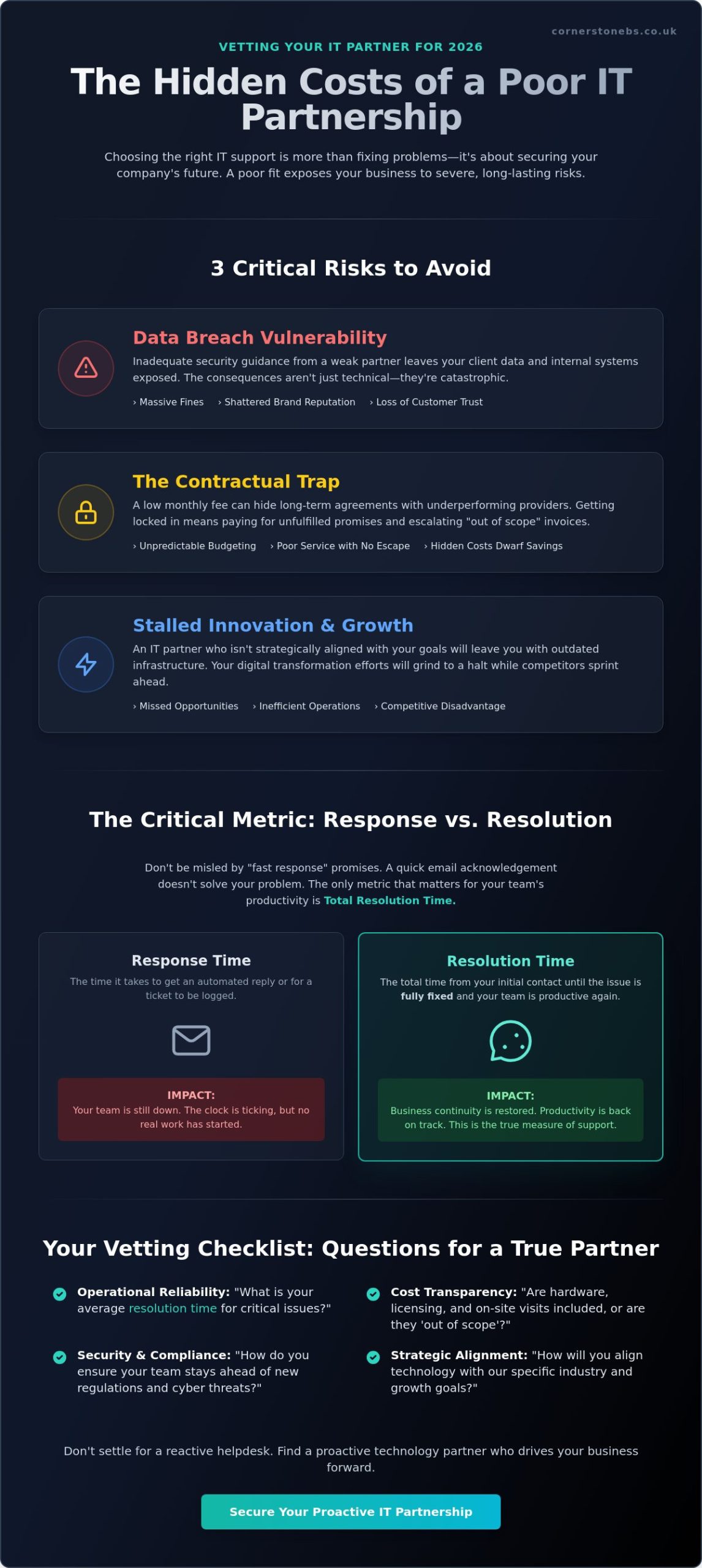
A poor fit doesn’t just mean slow internet or a grumpy helpdesk. It exposes your business to severe risks that can take years to recover from. Consider these common pitfalls of a weak partnership:
- Data Breach Vulnerability: Inadequate security guidance leaves your client data exposed, leading to massive fines and a shattered brand reputation.
- Contractual Trap: Many businesses find themselves locked into long-term agreements with underperforming providers who don’t deliver on their promises.
- Stalled Innovation: If your IT infrastructure is outdated, your digital transformation efforts will grind to a halt while competitors sprint ahead.
Essential Operational Questions: Testing Reliability and Response Times
When your systems go down, every minute feels like an hour. You need more than just a friendly voice on the other end of the line; you need results. As you gather questions to ask a potential IT support company, focus on the mechanics of their daily operations. It’s easy to promise fast support, but delivering it consistently requires a robust infrastructure and a dedicated team. We’ve found that the best partnerships are built on transparency and clear expectations from day one.
The first hurdle is distinguishing between response and resolution. A provider might promise a “15-minute response,” but if that’s just an automated email saying your ticket was received, it doesn’t help your team get back to work. Ask specifically: “What is your average resolution time for critical issues?” This helps you evaluate your ideal technology partner based on tangible outcomes rather than marketing slogans. You should also verify how they handle emergencies outside of the standard 9-to-5. If your server fails on a Sunday night, will someone be working on it before your staff arrives Monday morning?
Understanding Service Level Agreements (SLAs)
Don’t let the technical jargon in an SLA overwhelm you. Look past the “guaranteed” 99.9% uptime figures and find out what happens when things actually break. Does “response” mean a ticket was logged, or that a qualified engineer has started working on the fix? A proactive partner will link these metrics directly to your business continuity and peace of mind. This clarity ensures you aren’t left guessing while your productivity stalls. We believe an SLA should be a promise of performance, not just a legal shield for the provider.
Account Management and Communication
Reliability isn’t just about fixing broken PCs; it’s about strategic guidance. Ask if you’ll have a dedicated account manager who understands your business history or if you’ll be treated as just another number in a general helpdesk queue. We believe in the power of regular strategic reviews, often called vCIO services, to ensure your technology evolves with your goals. For example, our approach to managed IT services Teesside demonstrates how deep regional expertise creates a more tailored experience for local firms. If you’re tired of explaining your setup to a different person every time you call, it’s time for a more personal touch. You can always chat with our award-winning team to see how a dedicated partnership feels.
Finally, always ask for recent case studies or references from your specific sector. A provider who excels in retail might not understand the compliance nuances of a law firm or the high-speed demands of a manufacturing plant. Seeing how they’ve solved problems for businesses like yours is the ultimate proof of their reliability. This level of sector-specific insight is what separates a generic service from a tailored, award-winning solution.
Proactive Strategy and Security: Vetting for Resilience and Compliance
Disaster recovery is another area where generic answers won’t cut it. Ask for specific Recovery Time Objectives (RTO) and Recovery Point Objectives (RPO). If your system fails, how quickly are you back online and how much data might you lose? We believe in setting these targets clearly so you have total peace of mind. Additionally, find out how they use AI and automation. In 2026, global spending on AI infrastructure has surged. Your provider should be using these tools to detect threats faster and automate routine tasks to boost your team’s efficiency.
The Cyber Security Baseline
Security isn’t an optional add-on; it’s the bedrock of every service we provide. Every provider you interview should be a vocal advocate for robust cyber security services. They should move you toward a Zero Trust architecture where every access request is verified, not just assumed safe. Check their backup protocols too. We recommend off-site storage and frequent testing to ensure your data is actually recoverable when you need it most. It’s about building layers of protection that keep your North East business safe from evolving threats.
Future-Proofing and Scalability
Your business won’t stay the same size forever, and your IT shouldn’t either. Ask how they manage cloud solutions to help you scale without massive hardware costs. A partner with strong ties to global leaders like Microsoft and Cisco can offer better insights into emerging tech. Most importantly, ask about their 3-5 year roadmap for your technology. A proactive partner doesn’t just react to today’s problems. They prepare you for tomorrow’s opportunities, ensuring your infrastructure is always one step ahead of your growth plans.
The Onboarding and Contract Framework: Spotting Red Flags Early
The honeymoon period of a new partnership often ends the moment the contract is signed. To avoid a messy breakup later, you need total clarity on the transition process before you commit. When reviewing questions to ask a potential IT support company, pay close attention to how they handle the first 90 days. A professional onboarding isn’t just a quick software install; it’s a deep dive into your network infrastructure to document every device, user, and security gap. If a provider can’t give you a clear, written timeline for this phase, they likely don’t have a repeatable process for success.
Cost transparency is where many local businesses get caught out. We’ve seen providers lure clients in with low monthly fees, only to hit them with unexpected invoices for site visits or “emergency” hardware setups. A good answer to your cost questions should be all-encompassing. It should cover everything from Microsoft 365 licensing to how they handle the transition from your current provider. You want a partner who takes full responsibility for the handover, ensuring no data is lost and no downtime occurs during the switch. This proactive approach is what provides true peace of mind.
Contract Transparency and Costs
Avoid the trap of “per-incident” billing. This model creates a conflict of interest where your provider makes more money when your systems fail. Instead, look for fixed-fee managed services that align your goals with theirs. You should also explore it company solutions that offer hardware leasing. This keeps your technology fresh without huge upfront capital outlays. An award-winning partner will also audit your Microsoft 365 environment regularly to ensure you aren’t paying for licenses your team no longer uses.
Red Flags to Watch For
Keep a sharp eye out for “The Ghost.” This is the provider who is incredibly attentive during the sales process but disappears the moment you need support. If they lack clear documentation or use proprietary hardware locks to keep you from leaving, walk away immediately. Another warning sign is a vague SLA that doesn’t define what “emergency” support actually looks like. If they seem under-staffed for a business of your size, your tickets will inevitably sit in a queue while your team stays idle. We believe in being an open book from the start. If you want a partner who values honesty and regional expertise, book a discovery call with Cornerstone today.
Finally, always ask about notice periods and exit fees. A confident provider doesn’t need to “trap” you with predatory exit clauses or data migration fees. They should earn your business every month through high-quality service and robust security. If the contract feels one-sided, it probably is. Your IT support should be a foundational element of your business growth, not a legal anchor that holds you back.
Finding Your Long-Term Technology Partner with Cornerstone
Choosing the right partner is about more than just a list of questions to ask a potential IT support company; it’s about finding a team that truly cares about your success. At Cornerstone Business Solutions, we don’t just fix computers. We build robust, award-winning bespoke technology foundations that empower North East businesses to thrive. Our proactive approach means we’re monitoring your systems every second of the day. We identify and resolve potential issues before they ever reach your desk, giving you the peace of mind to focus on your core operations.
Our elite partnerships with global leaders like Microsoft, Cisco, and IBM give our clients a distinct competitive edge. You gain direct access to enterprise-grade expertise and cutting-edge tools, all delivered with our signature regional warmth. We combine this professional authority with a genuine “can-do” attitude that simplifies the most complex technical challenges. Whether you need seamless cloud migrations or a more reliable network infrastructure, our team acts as a dedicated extension of your own staff.
Bespoke Solutions for Every Sector
We understand that a manufacturing plant in Teesside has different needs than a professional services firm in Newcastle. That’s why we tailor our IT maintenance and mobile communications specifically for UK SMEs. We’re committed to exceptional customer service and clear, jargon-free communication that keeps everyone on the same page. Cornerstone Business Solutions is a multi-award-winning provider known for simplifying complex technology into reliable business results. We take pride in our North East roots and the long-term partnerships we’ve built across the region.
Next Steps: Start a Conversation
Ready to move beyond a generic helpdesk? The next step is booking a strategic IT audit with our expert team. During your first consultation, we’ll perform a deep dive into your current setup to identify security gaps and efficiency bottlenecks. We won’t just hand you a sales pitch; we’ll provide a roadmap for how technology can support your specific goals over the next three years. It’s an opportunity to see how our proactive strategy can transform your daily operations.
If you’re tired of slow response times and want to secure your company’s future, we’re here to help. We’d love to hear about your business goals and show you how a true technology partnership feels. Invite our team for a chat today and let’s get your IT working exactly the way it should.
Secure Your Business Future with the Right Partnership
As a multi-award-winning IT services provider with deep North East roots, we’re ready to help you turn these insights into action. Our elite partnerships with industry leaders like Microsoft, IBM, and Cisco allow us to deliver enterprise-grade solutions tailored for local SMEs. We offer unlimited helpdesk access and a “can-do” attitude that simplifies your digital transformation. It’s time to gain total peace of mind and focus on what you do best. Book a free strategic IT consultation with our award-winning team today. Let’s start a conversation that moves your business forward.
Frequently Asked Questions
How much should business IT support cost in the UK?
Managed IT services typically range between £75 and £250 per user per month depending on your specific security and compliance requirements. Basic support plans usually sit at the lower end of that scale; however, comprehensive packages that include advanced cyber security and disaster recovery often reach £200 or more. For small businesses, the average monthly investment generally falls between £95 and £230 per user. We always suggest a fixed-fee model to ensure your costs remain predictable and transparent.
Is it better to have an in-house IT person or an outsourced company?
Outsourcing to a managed service provider offers a broader range of expertise and 24/7 coverage that a single in-house hire simply cannot match. While an internal staff member knows your office culture, an outsourced team provides a deep bench of specialists in cloud solutions and network infrastructure. You benefit from the collective knowledge of an award-winning team for a fraction of the cost of a senior engineer’s salary. This approach provides better scalability as your North East business grows.
What is a typical response time for a managed IT service provider?
A reputable provider should acknowledge critical issues within 15 to 60 minutes to minimize business disruption. You should distinguish between a simple ticket acknowledgement and actual resolution time. High-performing partners aim to resolve most remote issues within four hours; this keeps your team productive and your systems stable. We focus on these resolution outcomes to provide true peace of mind for our partners.
Can I switch IT providers if I am currently in a contract?
You can switch providers, but you’ll need to review your current agreement for notice periods and potential exit fees. Most professional contracts require a 30 to 90-day notice period to facilitate a seamless handover of credentials and system documentation. We frequently manage this transition for new clients by coordinating directly with their outgoing provider. This ensures there are no security gaps or service drops during the migration process.
What certifications should a reputable IT support company have?
Look for providers holding Cyber Essentials Plus and ISO 27001 certifications to verify their commitment to robust data security. These credentials prove the company follows strict government and industry standards for protecting client information. It’s also essential to check for elite partnerships with global brands like Microsoft and Cisco. These relationships demonstrate high-level technical competence and ensure your provider has direct access to the latest technology roadmaps.
How does an IT company handle data security for remote workers?
We secure remote teams by implementing Zero Trust architecture and mandatory multi-factor authentication (MFA) for all applications. This ensures every access request is verified regardless of the user’s location. Proactive monitoring tools allow us to manage security patches on remote laptops and secure company data on business mobiles. We provide the same level of robust protection for a home office as we do for your main headquarters.
What happens to my data if I leave my IT support provider?
Your data always belongs to you, and a professional provider should facilitate a clean, documented export of all files and configurations. You must ensure there are no proprietary hardware locks that would prevent a new partner from managing your systems. One of the most vital questions to ask a potential IT support company is how they handle the offboarding process and credential handovers. A confident partner will never use your data as a “hostage” to prevent you from leaving.
Do IT support companies provide hardware as well as software support?
Yes, a full-service provider manages both your software environment and your physical network infrastructure. This includes everything from Microsoft 365 management to the maintenance of servers, firewalls, and business VoIP hardware. By handling both aspects, we act as a single point of contact for all your technology needs. This unified approach simplifies troubleshooting and ensures your entire system works together seamlessly.