

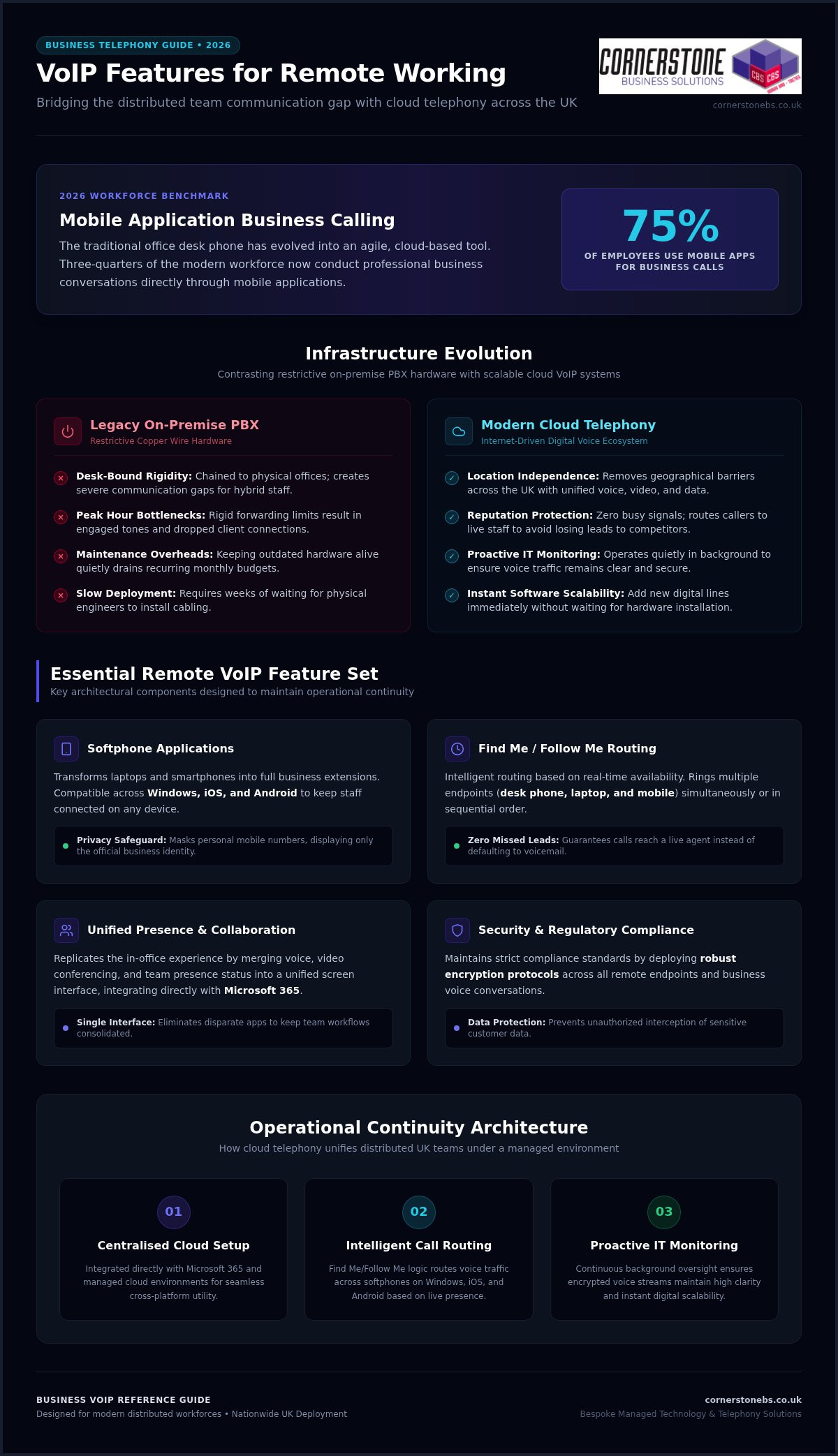
Did you know that 75 percent of employees now use mobile applications for their business calls? As we move through 2026, the traditional office phone has evolved from a desk fixture into a powerful, cloud-based tool. If you’ve struggled with dropped calls during client meetings or worried about staff using personal devices for work, you aren’t alone. Finding the right VoIP features for remote working is no longer just a technical tick-box exercise. It’s about building a reliable foundation for your team’s success across the UK.
We understand that you need more than just a digital dialler; you need a system that offers clarity and security. In this guide, we’ll share a clear framework for selecting communication tools that actually work for distributed teams. You’ll discover how to improve staff collaboration, track essential call metrics, and integrate your phone system with your existing Microsoft 365 or cloud setup. We’ve simplified the complex tech so you can focus on what matters most: growing your business with a trusted local partner by your side.
Key Takeaways
- Transition from restrictive desk-bound hardware to agile cloud telephony to ensure operational continuity for your distributed team.
- Identify the essential VoIP features for remote working that protect sensitive business data while providing staff with professional, flexible communication tools.
- Bridge the collaboration gap by merging voice, video, and presence status into a single, unified platform that replicates the in-office experience.
- Maintain strict security and regulatory compliance by implementing robust encryption standards across all remote endpoints and business conversations.
- Discover how a bespoke, managed technology environment allows your communication infrastructure to scale seamlessly as your business grows across the UK.
Overcoming the Distributed Team Communication Gap with Cloud Telephony
Traditional on-premise PBX systems keep your team chained to physical office desks, which simply doesn’t work for modern business structures. When staff work from home or split their time across locations, this rigid infrastructure creates a massive communication gap. Modern distributed workforces require agile, cloud-based communication to maintain operational continuity and deliver excellent service. By implementing the right VoIP features for remote working, you can transform your telephone setup into a unified platform for voice, video, and data. We view business telephony as an integrated component of your broader managed cloud environment. To keep these communication lines crystal clear, proactive IT infrastructure monitoring works quietly in the background, ensuring your voice traffic remains consistent, secure, and completely clear.
The Limitations of Legacy Landlines for Hybrid Teams
Relying on legacy copper wires presents serious operational hurdles for growing companies. Physical landlines offer very little flexibility when trying to forward multiple calls during peak business hours, often leading to frustrating engaged tones or dropped connections for your customers. When you adopt tailored VoIP features for remote working, you eliminate these bottlenecks entirely. Beyond the daily operational headaches, the hidden maintenance overheads of keeping outdated hardware alive can quietly drain your monthly budget. There’s also a significant professional impact to consider. Missed client calls directly damage your business reputation, making an established firm look unorganized. If a prospect can’t reach your team on the first try, they’ll simply call a competitor.
Defining Cloud-Based Business VoIP for Operational Agility
Cloud-based Voice over IP is an internet-driven communication ecosystem that routes your voice calls over secure digital networks rather than traditional telephone cables. This shift to cloud hosting completely removes geographical barriers for expanding UK firms, allowing your team to collaborate seamlessly from any location. It provides incredible scalability advantages that legacy systems can’t match. Instead of waiting weeks for engineers to install physical wiring, you can add new digital lines instantly via software. This means your communication system scales immediately alongside your business growth, giving you the agility to respond to market demands without delay.
Essential VoIP Features for Remote Working: The 2026 Roundup
Replicating the energy and efficiency of a busy office in a home environment requires more than just a laptop and a headset. It’s about the specific VoIP features for remote working that bridge the physical gap between your colleagues. In 2026, unified software interfaces are the gold standard for UK businesses. They reduce the need for disparate apps and keep your team focused on one screen. Selecting the right combination of these tools directly impacts your daily output and protects your sensitive business data. As this FCC guide on VoIP explains, the technology has evolved far beyond simple digital calling to include complex, automated workflows that keep you connected.
Advanced Call Routing and Find Me/Follow Me Services
Mobile and Desktop Softphone Applications
A softphone is a clever application that transforms your laptop or smartphone into a full business extension. It provides cross-platform compatibility across Windows, iOS, and Android, so your team stays connected on whatever device they prefer. Crucially, these apps preserve privacy by masking personal mobile numbers. When your staff call a client, the customer sees your official business number, not a private one. If you’re looking for a setup that scales, our Business VoIP solutions offer this level of professional flexibility as standard for teams of all sizes.
Unified Messaging and Voicemail-to-Email Delivery
Speed is everything in a fast-paced market. Unified messaging converts audio voicemails into digital email attachments, allowing you to “read” your messages in seconds. This is incredibly useful during meetings where you can’t listen to audio but need to know why a client is calling. These digital records also improve your customer relationship management. By having a clear, searchable trail of communication, your team can maintain better records and provide a more personalised service. It’s a simple change that makes a massive difference to your daily record-keeping.
Collaborative Synergy: Integrating Video Conferencing and Presence Status
Voice calling alone cannot sustain deep collaboration within fully distributed corporate teams. While standard audio calls handle basic updates, modern operations require a richer connection to maintain momentum. Leading platforms now merge standard telephony with visual and textual communication channels into a single interface. This consolidated approach gives your team a unified space for daily interactions, making them feel like they’re working side by side. By selecting the best business VoIP services that offer these built-in tools, you also reduce total software licensing costs across your entire digital environment. This means less clutter for your staff and a healthier bottom line for your firm.
Real-Time Presence Indicators for Reduced Friction
Internal communication friction often happens when staff don’t know who is available. Real-time presence indicators solve this by showing clear status markers, such as whether a colleague is busy, away, or in a meeting. This simple visibility streamlines internal workflows for remote administrative staff who need to route client calls quickly. It completely eliminates unnecessary call attempts and phone tag. Because your team can see who is free instantly, internal instant messaging response times improve, keeping project momentum moving forward without delay.
Native Video Conferencing vs Third-Party Platform Integration
When reviewing VoIP features for remote working, choosing between built-in video modules and standalone enterprise video applications is a key decision. Built-in modules keep your workflows consolidated, while external apps can create data silos. The most critical factor is ensuring smooth data synchronization with your broader cloud solutions, which keeps all files and schedules aligned. Use this quick checklist when assessing your video setup:
- Verify that video call stability holds up during low-bandwidth conditions.
- Check that screen-sharing security features allow users to lock down specific windows.
- Ensure the platform integrates directly with your team’s shared calendars.
- Confirm that host controls allow for easy management of external participants.
Securing Remote Communications: Infrastructure and Compliance Requirements
Connecting a team across the UK brings incredible flexibility, but it also creates fresh security vulnerabilities. Every home office acts as a new endpoint that could potentially expose your corporate digital network to external threats. To stay safe, you need a phone system that treats security as a foundational element of your business stability. Data compliance regulations require strict encryption standards for all business conversations to protect sensitive client information. Robust cybersecurity controls prevent unauthorised access to your communication systems, ensuring that your private calls stay private. It’s not just about making calls; it’s about protecting the reputation you’ve worked hard to build.
Implementing Encryption and Secure Endpoint Access
Transport Layer Security (TLS) protects your voice data packets by encrypting them as they travel across the internet, making them unreadable to anyone trying to intercept them. We also recommend implementing Multi-Factor Authentication (MFA) for every remote softphone login. This simple step ensures that only authorised staff can access your business lines, even if a password is compromised. When your team operates on home Wi-Fi networks, you should ensure they use strong, unique passwords and updated router firmware to secure corporate data. By combining these VoIP features for remote working, you turn a vulnerable home office into a secure extension of your professional premises.
Optimising Networks with Quality of Service (QoS) Controls
Quality of Service (QoS) is the technical prioritisation of voice data over less time-sensitive internet traffic, such as large file downloads or software updates. To prevent jitter and latency during important client meetings, you can configure home routers to give your VoIP traffic a dedicated “fast lane.” This ensures that your voice remains clear even when the household internet is busy. For permanent remote executives or staff handling high volumes of sensitive calls, a dedicated business broadband line is often a smart investment to guarantee stability. It’s about building a managed environment where technology supports your team’s output rather than slowing them down. If you want to ensure your setup is fully protected, you can secure your business mobile and VoIP systems with our expert team today.
We believe that security shouldn’t be a headache for business owners. Our proactive monitoring keeps a close eye on your infrastructure, catching potential issues before they disrupt your day. This gives you the emotional security to focus on growth, knowing your communication lines are strong, stable, and completely compliant with UK standards. We aren’t just here to provide a service; we’re here to be your long-term partner in maintaining a resilient digital workspace.
Selecting a Strategic Business VoIP Partner for National Deployment
Deploying a national remote phone system requires expert planning and continuous engineering support to keep your operations running smoothly. It isn’t just about buying a digital dialler; it’s about building a resilient communication backbone. You need a partner who understands that your system must scale seamlessly alongside your business growth. We focus on rapid troubleshooting and proactive monitoring to ensure minimal downtime for your distributed team. A truly comprehensive management approach combines hardware deployment, software licensing, and proactive security auditing into one reliable package. This gives you the peace of mind to focus on your clients while we handle the technical heavy lifting behind the scenes.
The Value of Award-Winning Managed IT Support
Working with a multi-award-winning IT services provider ensures a level of service consistency that standard providers struggle to match. Since 2008, we’ve focused on delivering professional authority with a friendly, local face. By combining your telecom services with our comprehensive it company solutions, you create a unified managed environment where every tool works in harmony. Our strategic partnerships with global technology brands like Microsoft, IBM, and Cisco ensure your team has access to the most advanced communication hardware available. This isn’t just about having the latest gadgets. It’s about ensuring your VoIP features for remote working are backed by the world’s most reliable infrastructure. We treat your business stability as our top priority, providing the emotional security you need to lead your team with confidence.
Designing Custom Systems for Long-Term Business Stability
Every organisation has a unique internal structure, so a one-size-fits-all setup rarely delivers the best results. We design bespoke configurations that match your call routing paths to your specific organisational needs. This ensures that every client call reaches the right person at the right time, regardless of where they’re located in the UK. The transition from physical lines to cloud telephony shouldn’t be a source of stress for your staff. We manage the entire migration process so you can move to the cloud without dropping active calls or losing connection with your customers. This level of customisation ensures the VoIP features for remote working you implement actually drive productivity and growth. We project the image of a modern, forward-thinking organisation because that’s exactly what we help you become. We invite you to begin a strategic conversation with us today to discuss your remote infrastructure needs. Let’s work together to build a secure, scalable phone system that supports your long-term success.
Building a Resilient Future for Your Distributed Team
Success in the modern UK market depends on more than just a fast internet connection; it requires a communication strategy that stays strong across every location. You’ve seen how the right VoIP features for remote working, such as intelligent call routing and unified messaging, bridge the gap between home offices and the boardroom. By moving away from restrictive physical lines and embracing secure, cloud-based ecosystems, you ensure your team remains productive and your client data stays protected.
We’ve been delivering bespoke technology solutions since 2008. As a multi-award-winning IT services provider, we take pride in our strategic partnerships with global leaders like Microsoft, IBM, and Cisco. We don’t just provide tools; we act as your dedicated partner to simplify complex tech and support your ongoing growth. Discover how our multi-award-winning team can transform your communication infrastructure; explore our Business VoIP solutions today. Let’s start a conversation that puts your business stability first. We’re here to help you lead with confidence in a connected world.
Frequently Asked Questions
What are the most important VoIP features for remote working teams?
Can remote employees use their personal mobile phones with a business VoIP system?
How much internet speed does an employee need for reliable VoIP calls from home?
Reliable voice calls require very little bandwidth, typically around 100 Kbps per user for both upload and download speeds. However, the stability of the home internet connection matters far more than raw speed. High latency or network jitter caused by heavy household usage can disrupt call quality. Implementing Quality of Service configuration on home routers helps prioritise voice data over less urgent internet traffic.
Is business VoIP secure enough for remote workers handling sensitive financial data?
Yes, business VoIP systems are highly secure when deployed within a properly managed cloud environment. Modern platforms protect your voice data packets using Transport Layer Security encryption to prevent interception. When combined with strict cybersecurity controls like Multi-Factor Authentication, your remote endpoints remain fully compliant with UK data regulations. This allows your staff to handle sensitive financial details safely from any home office.
What happens to our phone system if a remote worker loses power or internet?
If a remote worker experiences a power cut or internet outage, your cloud phone system stays up and runs unaffected. Because the infrastructure is hosted in the cloud rather than on a physical office server, calls are automatically rerouted. The system instantly redirects incoming traffic to backup devices, such as a colleague’s handset or a business mobile app, ensuring complete operational continuity.
How does integrating VoIP with Microsoft 365 benefit a distributed workforce?
Integrating your phone system with Microsoft 365 creates a highly efficient, single digital workspace for your team. It syncs your business contacts, user permissions, and staff calendars directly with your communication tools. This integration allows remote workers to launch voice calls or video conferences straight from their daily applications, reducing administrative friction and boosting collaborative synergy across your entire national workforce.