Posted on: October 9th, 2026 by Cornerstone
43% of UK businesses reported a cyber breach or attack in the previous 12 months, according to the UK Government’s Cyber Security Breaches Survey 2025/2026. A network security audit can help uncover weaknesses before they disrupt your business, but only if it looks beyond a quick scan. The right network security audit checklist checks whether key controls work in practice and records evidence of what needs attention.
Your network includes more than routers and firewalls. User access, devices, cloud services, backups and supplier connections can all affect security. A list of technical findings is only useful if your team can see what to fix first and who should take action.
This guide explains how to scope a network security audit and walks you through practical checks for gathering evidence and spotting gaps. You’ll also learn how to prioritise remediation, create an action plan and recognise when specialist support can help. The aim is to make improvements that strengthen security and suit your business.
Key Takeaways
- Use a network security audit checklist to review assets, access, network configuration and ongoing security maintenance.
- For each check, record evidence, an owner, the review date and any gap, so findings lead to clear next steps.
- Choose an assessment method that fits your goal: self-review, audit, vulnerability assessment and penetration testing have different purposes.
- Prioritise fixes by considering business impact, exposure, exploitability and the safeguards already in place.
- Bring in expert support when your team lacks capacity, the network is complex or technical findings are hard to turn into a practical plan.
What a network security audit checklist should help your business uncover
A network security audit is a structured review of the systems, access controls and working practices that protect your business network. It helps identify weaknesses that could interrupt essential services, expose sensitive information or make recovery harder after an incident. A useful network security audit checklist gives your team a consistent way to examine these areas and record what needs attention.
A checklist organises the review, but it can’t prove that a network is risk-free. Its value comes from examining how controls work in practice, finding gaps and making them easier to address. An audit reviews the wider effectiveness of security controls; a technical scan checks systems for known weaknesses. These methods can support each other, but they answer different questions.
What is included in a network security audit?
Start by defining the environment you need to review. Include the people who use the network, the systems they rely on and the connections between them. Scope the review around how your business operates, what information needs protection and which services or suppliers your operations depend on.
A practical review may cover:
- Network devices and configurations: Routers, switches, firewalls and the rules controlling traffic between systems.
- Access controls: User accounts, permissions, administrator access, remote access and the process for removing access when someone changes role or leaves.
- Endpoints and wireless networks: Computers and other connected devices, plus the protections and settings on business Wi-Fi.
- Cloud-connected services and external connections: Online systems that store or process business information, supplier links and connections used by remote workers.
- Security processes: How your team manages updates, reviews access, monitors activity and responds to suspected incidents.
For each area, note what’s in scope and how it supports business operations. A cloud service used for day-to-day work, for example, may be as important to review as network equipment. The Information security audit overview also describes areas such as logical security, remote access and special user accounts that can help inform your scope.
When should a business review network security?
Plan reviews at regular intervals that suit your business and its risk profile. A scheduled review helps you check whether systems, responsibilities and safeguards have changed since the last assessment. It also gives your team a routine opportunity to revisit overlooked areas instead of relying on memory when a concern arises.
Review the scope after meaningful changes, such as a major system upgrade, a new business location, changes to user access, a new supplier connection or the introduction of a cloud service. An incident can also reveal that a control or process needs closer examination.
Security conditions change as systems, users and external connections evolve. A completed review is a point-in-time record, not permanent assurance. Revisit findings, check that agreed improvements have been made and update the review when your business environment changes.
Network security audit checklist: map assets, access and core controls
Start with an accurate picture of what connects to your business network and who is responsible for it. Complete asset visibility is the foundation of a meaningful security review. Don’t leave unknown or unmanaged devices out of the review. Record them as an investigation item until you understand their purpose, ownership and risk.
Use the checks below to guide your review. For every item, capture four details: the evidence you examined, the person responsible, the date reviewed and any gap found. Evidence might include an asset register, configuration record, access list, support status or monitoring log. If evidence is missing, record that rather than treating the control as effective.
Inventory network assets and document the environment
Build your inventory around how the business actually works. Include equipment, connections and dependencies across remote working and cloud-connected services. For each asset, record its business purpose, location, owner and known lifecycle or support status. This makes it easier to spot forgotten equipment and understand which services could be affected if a component fails.
- Devices: Check routers, switches, firewalls, wireless access points, servers and connected endpoints against the inventory. Record the evidence, owner, review date and any unlisted or unsupported asset.
- Connections: Map network segments, internet connections, remote access routes and links to suppliers or cloud services. Record the network diagram or connection records reviewed, their owner, date and any unknown route.
- Dependencies: Identify which systems support essential business activities and what depends on them. Record the relevant service or process, evidence, owner, date and any unclear dependency.
Review access, configurations and maintenance
Next, check whether security controls are documented and working as intended. Compare settings with approved records and look for exceptions without a clear owner or business reason. If a system’s purpose, support status or configuration can’t be established, mark it for follow-up instead of assuming it’s safe.
- Access: Review administrator accounts, user permissions, authentication and account removal processes. Record the access list or process evidence, owner, date and any excessive, shared or unexplained access.
- Configuration: Examine firewall rules, default settings, network segmentation and secure configuration records. Record the settings reviewed, responsible owner, date and any rule or exception that needs explanation.
- Maintenance and resilience: Check patch records, unsupported systems, backup coverage and who owns monitoring. Record the relevant logs or plans, owner, date and any overdue update, coverage gap or unclear responsibility.
Recording each gap gives your team a trail to investigate and act on. A structured cyber security audit can also help connect technical observations with business priorities, especially where ownership or evidence is unclear.
Choose the right audit checks: self-review, vulnerability assessment or penetration test
Different assessment methods answer different security questions. A self-review helps your team check whether expected controls and processes are in place. A formal audit examines those controls more broadly and considers supporting evidence. Technical testing can reveal weaknesses that a document review may miss, but it doesn’t replace a review of ownership, procedures or business context.
Use the network security audit checklist to define what you need to understand, then choose an appropriate level of review. Consider network complexity, the business impact of disruption, exposure to external connections and the technical expertise available internally. These methods can complement one another, but they aren’t interchangeable.
What can a checklist review establish on its own?
A checklist can show whether documented controls, assigned owners and routine processes appear to be in place and supported by evidence. It can flag missing records, unclear responsibilities and areas that need technical investigation. For example, a written access review process is useful evidence, but it doesn’t prove that every account has the right permissions. A checklist alone can’t validate every configuration or detect every exploit.
Method
What it can reveal
What it cannot establish
Self-review
Whether expected controls, records and responsibilities appear to be in place, and where evidence is missing.
Whether technical settings are correct or the network is free of exploitable weaknesses.
Formal audit
How well controls, policies, processes and evidence align with the agreed review scope.
That every possible weakness has been found, particularly outside the scope or methods used.
Vulnerability assessment
Known technical weaknesses identified in the systems and conditions examined.
That a weakness can be exploited in your specific environment, or that wider governance controls are effective.
Penetration test
How far a controlled attempt to exploit weaknesses can progress within defined systems and scope.
That untested systems are secure or that all possible attack paths have been explored.
When may technical testing add useful evidence?
A vulnerability assessment can help identify known technical weaknesses, such as missing updates or exposed services, across the systems included in the assessment. A penetration test goes further by safely simulating attempts to exploit weaknesses within an agreed scope. Both provide technical evidence, but neither replaces a review of processes and controls.
Before testing begins, agree which systems are included, what activity is authorised and what safety controls will apply. This is especially important when systems support essential business operations or connect to suppliers. Pairing technical findings with audit evidence gives decision-makers a clearer view of what needs attention and why.
Turn audit findings into a prioritised network security action plan
An audit finding only improves security when someone understands its business impact and takes responsibility for the next step. Use a simple action workflow to move from observation to verified improvement. Keep immediate risks separate from longer-term upgrades so urgent containment doesn’t get lost in a general maintenance list.
How should a business prioritise audit findings?
For each finding, consider what could happen if it remains unresolved. Could it interrupt an essential service, expose sensitive information or affect a key supplier connection? Note the assets involved, how exposed they are, whether the weakness could be exploited, which safeguards already reduce the risk and which business processes depend on those assets. This gives decision-makers context without relying on an unsupported universal score.
- Record the finding: Describe the observed gap, affected systems and supporting evidence. Separate confirmed facts from assumptions that need investigation.
- Assess business impact: Consider possible operational disruption, data exposure and effects on services or dependencies. Note exposure, exploitability and existing safeguards.
- Choose the response: Separate urgent containment from planned improvements and routine control maintenance. For example, an exposed account may need prompt restriction, while a configuration improvement can be scheduled and a regular review added to ongoing maintenance.
- Assign an owner and deadline: Name the person accountable for progress, agree a realistic next action and set a target date. If action depends on another team or supplier, record that dependency.
- Retest and retain evidence: Recheck the relevant control after remediation. Record the result and any remaining risk rather than closing the finding solely because a task was marked complete.
Include people and recovery arrangements in the review, not just technology. Check whether staff know how to report a suspected incident, response responsibilities are clear, and recovery arrangements account for critical systems and dependencies. Record the evidence and gaps, then assign follow-up actions. These checks connect network findings with the business’s ability to respond and resume essential work.
How can teams track remediation and verify progress?
Use a risk register or action log to track each finding. Include its description, affected assets, business impact, existing mitigations, owner, next action, deadline, status and review date. Attach or reference evidence, such as a configuration record or retest result. Keep updates concise so managers can see what is open, blocked or ready for verification.
After a change, recheck the control that produced the finding. If an access issue was resolved, review the updated permissions; if a configuration gap was addressed, examine the revised settings. Retain the result and note any limitations. A finding may need more action if the control still doesn’t work as intended.
Repeat reviews help reveal recurring gaps and changes in the environment, such as new systems, altered access or changed dependencies. Use your network security audit checklist to connect findings with clear ownership and follow-through. Cornerstone Business Solutions can help turn audit evidence into proportionate improvements through a cyber security audit.
When expert support can strengthen a network security audit
A checklist gives your team a clear starting point, but completing and interpreting it can be difficult alongside day-to-day responsibilities. Expert support may be useful when internal capacity is limited, the network spans multiple locations or cloud services, or findings are too technical to translate into business decisions. It can also help when teams disagree about which gaps matter most or how to verify that a fix has worked.
A professional cyber security audit brings these strands together. The aim is to understand the environment, examine relevant evidence and connect technical observations with your business priorities. This can turn an unclear list of issues into a documented plan, with actions proportionate to the risks and the way your organisation operates.
What to expect from a collaborative security review
A useful review starts by agreeing what’s in scope and understanding the services, information and business processes that depend on the network. The audit team can then examine relevant technical records and controls, discuss unclear evidence with your staff and explain where further investigation may be needed. Findings should be presented in plain English, with priorities and practical next steps your team can understand and track.
Make sure recommendations reflect operational realities. A proposed change may affect staff access, supplier connections or a service your organisation relies on. Discussing those dependencies helps shape a workable plan rather than a set of generic instructions. The purpose is to support informed decisions, not to promise that every risk can be removed or that a network will remain protected from every threat.
Connect audit findings with wider cyber security planning
Audit actions are easier to sustain when they fit into your wider security and IT plans. Some findings may call for a focused configuration change; others may point to clearer responsibilities, ongoing monitoring or regular access reviews. Cornerstone’s cyber security audits can help your team understand gaps and shape practical improvements, while managed IT support can help keep agreed controls and maintenance tasks part of ongoing operations.
Use your completed network security audit checklist to focus the discussion. Share the areas you reviewed, the evidence you gathered and the questions that remain. This gives the conversation a practical starting point, whether you need help interpreting a finding, setting priorities or connecting improvements with day-to-day IT management.
To discuss a tailored next step, talk with Cornerstone about a network security audit.
Build a stronger security routine from your next step
Your next security decision doesn’t need to solve everything at once. Use the network security audit checklist to start a conversation between the people who manage your technology and those responsible for business priorities. Agree what needs attention first, who will take it forward and when progress will be reviewed.
That shared understanding can help make security an ongoing part of how your organisation plans for change. As systems, suppliers and working practices evolve, revisit open actions and keep the review relevant. If you’re unsure how to interpret a finding or where specialist input would make the biggest difference, a collaborative discussion can help clarify the way forward.
Cornerstone Business Solutions works with businesses on cyber security audits and practical IT improvements. Explore a tailored network security audit with Cornerstone and take the next step towards a more resilient business.
Frequently Asked Questions
What is included in a network security audit checklist?
A network security audit checklist typically covers the systems, people and processes that protect business technology. Alongside technical controls, consider change approvals, incident records and how sensitive information moves between systems. Tailor the scope to your operations, then record what was reviewed and any limits to the review. This helps distinguish a checked control from an area that still needs investigation.
How often should a business carry out a network security audit?
Set a review schedule that reflects your network’s complexity, business impact and rate of change. There’s no single interval that suits every organisation. Include a review in your governance calendar, then bring it forward if important systems, responsibilities or business dependencies change. Assign someone to own the schedule and follow up on overdue reviews rather than leaving the timing informal.
Is a network security audit the same as a penetration test?
No. An audit examines a broader set of controls, processes and evidence, while a penetration test is a controlled attempt to exploit weaknesses within agreed systems and boundaries. For example, a test might examine whether a defined route into a system can be exploited, while an audit considers how access is governed and reviewed. Choose the method according to the question you need answered.
Can a small business complete a network security audit itself?
Yes, a small business can conduct an initial self-review if it has people who understand its systems and can gather reliable evidence. Keep the first pass manageable by focusing on business-critical services and recording areas the team can’t confidently assess. Internal review can identify obvious gaps, but complex configurations or unclear technical findings may need a deeper assessment to avoid mistaking incomplete evidence for assurance.
What happens if a network security audit finds vulnerabilities?
First, establish whether the finding is accurate and understand which systems it affects. If it suggests an active exposure, consider proportionate containment while the team plans a lasting fix. Check that a proposed change won’t disrupt an essential service, document who will act and verify the result afterwards. If some risk remains, record why, who has accepted it and when it will be reviewed.
Does a network security audit guarantee compliance with UK data protection requirements?
No. A network security audit can provide useful evidence about technical safeguards and how they’re managed, but it can’t guarantee compliance with UK data protection requirements. Compliance depends on your organisation’s circumstances, including how it handles personal information and the controls beyond the network. Use audit findings to inform your wider data protection work, and involve the person responsible for privacy or data protection when findings relate to personal data.
What evidence should a business collect during a network security audit?
Collect records that show both how a control is intended to work and how it operates in practice. Useful examples include dated configuration exports, access review records, change approvals, update reports and backup or monitoring logs. Note the system each item relates to and who supplied it. Store evidence securely, redact credentials and sensitive personal information, and retain enough context for someone else to understand what was checked.
Posted on: June 7th, 2026 by Cornerstone
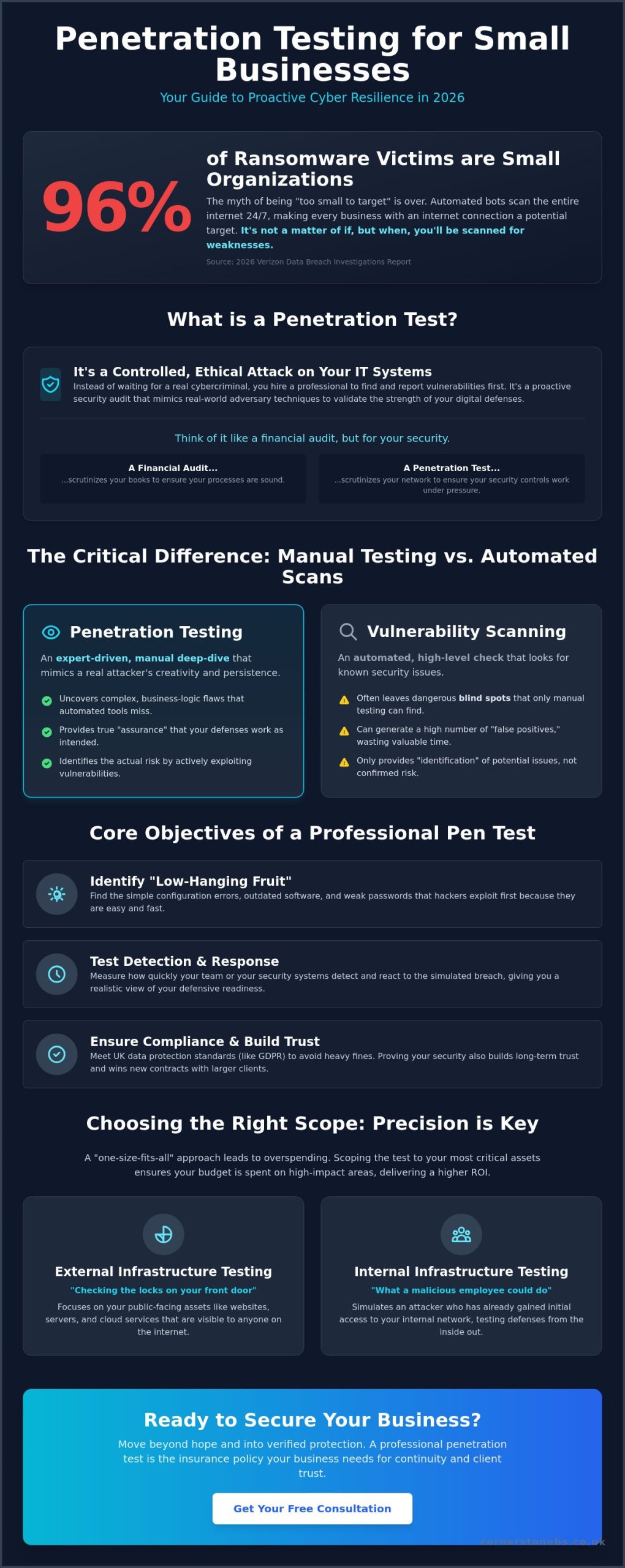
Did you know that small organizations represent 96% of ransomware victims according to the 2026 Verizon Data Breach Investigations Report? It is a startling figure that challenges the common belief that smaller firms fly under the radar of global cybercriminals. We understand that as a local business owner, you likely feel the weight of protecting your team and your customers, often while navigating a sea of confusing technical jargon and tight budget constraints. You want to know that your digital doors are locked, but you don’t want to overspend on tools that feel like overkill.
The good news is that penetration testing for small business is not just a luxury for the corporate giants; it is a vital insurance policy for your continuity. This guide simplifies the complex, showing you how identifying hidden vulnerabilities today builds the long-term resilience you need to protect your reputation. We will provide a clear roadmap for implementation and explain the tangible ROI of securing your systems. By the end, you will have the confidence to show your clients that your business is resilient, secure, and ready for whatever the 2026 threat landscape holds.
Key Takeaways
- Understand how a controlled, ethical attack identifies hidden vulnerabilities before real-world cybercriminals can exploit them.
- Learn how to define the right scope for penetration testing for small business so you only invest in the specific security checks your SME actually needs.
- Discover why automated vulnerability scans often leave dangerous blind spots that only expert manual testing can effectively uncover.
- Get a practical roadmap for setting rules of engagement to ensure your security audit is completed without any disruption to your daily operations.
- See how proactive cyber security measures build long-term resilience and prove your commitment to data protection to your own clients.
What is Penetration Testing for Small Business?
At its heart, penetration testing is a controlled, ethical attack on your IT infrastructure. Instead of waiting for a cybercriminal to find a way into your systems, you hire a professional to do it first. We often describe this to our local partners as a proactive security audit that mimics real-world adversary techniques to validate the strength of your digital defenses. It is about moving beyond hope and into the territory of verified protection.
Many business owners find the perfect analogy in a financial audit. Just as an accountant scrutinizes your books to ensure every penny is accounted for and your processes are sound, an ethical hacker scrutinizes your network. They aren’t just looking for problems; they are providing “assurance” that your existing security controls actually work under pressure. This is a significant step up from simple “identification” where you might just list the tools you have in place without knowing if they’ll hold up during a breach. For a deeper dive into the methodology, you can explore the foundational concepts of What is a Penetration Test? on Wikipedia.
Our role as your security partner is to act as the “Ethical Hacker.” We use the same tools and tactics as the bad guys, but we do it with your permission and your business interests in mind. This process protects your hard-earned reputation by ensuring that when a real threat arrives, your doors are firmly bolted. It is a foundational element of modern business stability.
Why SMEs Can No Longer Fly Under the Radar
The myth of being “too small to target” has been firmly debunked in 2026. Today’s cybercriminals use automated attack bots that scan the entire internet 24/7, looking for any open door regardless of the company’s size. If you have an internet connection, you are on their radar. We also see a massive rise in “Supply Chain” risk. Your larger clients and partners now face immense pressure to secure their own networks, which means they are increasingly demanding proof of penetration testing for small business from every vendor they work with. Security is no longer just a technical need; it is a requirement for winning new contracts.
The Core Objectives of a Professional Pen Test
A professional test focuses on three vital areas to keep your SME resilient:
- Identifying “low-hanging fruit”: We find the simple configuration errors or unpatched software that hackers exploit first because they are easy and fast.
- Testing response times: It isn’t just about the “hack.” We measure how quickly your team or systems detect the simulated breach, giving you a realistic view of your defensive readiness.
- Ensuring compliance: Regular testing helps you meet UK data protection standards and GDPR requirements, protecting you from the heavy fines that follow a data leak.
The Different Types of Testing: Choosing the Right Scope
Precision is everything when it comes to securing your business. Not all tests are created equal, and for an SME, a “one size fits all” approach usually leads to overspending on unnecessary checks. The key is scoping. By narrowing the focus to your most critical assets, you ensure your budget is spent on high-impact areas rather than generic scans. According to the NIST definition of penetration testing, these assessments are designed to identify the most efficient way to circumvent your security features. It’s about finding the path of least resistance before a criminal does.
Your business model dictates your testing needs. An e-commerce platform requires deep web application testing to protect customer payment data. In contrast, a professional consultancy might prioritize document security and email integrity. We help our partners match the test type to their specific operations, ensuring that penetration testing for small business remains a practical, high-ROI investment. If you’re looking to strengthen your overall resilience, integrating these tests into a broader Managed IT Support strategy ensures your defenses are always up to date.
External vs. Internal Infrastructure Testing
Think of external testing as checking the locks on your front door. It focuses on your public-facing assets like websites, email servers, and remote access points. Internal testing, however, asks a tougher question: what happens if a hacker already has a foot in the door? This simulates the actions of a disgruntled employee or someone who has stolen a staff member’s credentials. With the rise of remote teams in 2026, prioritizing VPN and cloud access testing is no longer optional; it’s a foundational requirement for business continuity.
Social Engineering and Phishing Simulations
Your technology might be robust, but your “Human Firewall” is often the most vulnerable point. The 2026 Verizon Data Breach Investigations Report reveals that human behavior contributes to 62% of breaches. To combat this, we simulate real-world phishing attacks to train your staff in a safe, controlled environment. These simulations are eye-opening. For instance, phishing attempts via text messages and phone calls now have a 40% higher success rate than those sent via email. We also test physical security by checking if a stranger could walk into your office and plug a rogue USB into a workstation. Testing the human element is just as vital as testing your servers.
Penetration Testing vs. Vulnerability Scanning
One of the most frequent conversations we have with local business owners revolves around a simple misunderstanding. Many people believe that running an automated security scan is the same thing as a full penetration test. While both are essential parts of a robust penetration testing for small business strategy, they serve very different purposes. A vulnerability scan is like a smoke alarm that listens for a specific signal, while a penetration test is more like a fire marshal inspecting your entire building to find out how a fire might start in the first place.
Relying solely on automated tools creates dangerous “blind spots” in your security. Machines are excellent at finding known software bugs or missing patches, but they lack the intuition to understand business logic. A machine might see a secure login page and move on, whereas a human expert might realize that the “password reset” function is poorly designed and could be exploited. We help you filter out the “noise” of false positives, which are security alerts that machines flag but don’t actually pose a risk. By removing this clutter, we ensure your team only focuses on the fixes that truly matter. This balanced approach is a core part of our cyber security services, providing you with both efficiency and deep protection.
Automated Scans: Your Daily Security Baseline
Automated scans are your high-frequency, low-cost guardians. They work by comparing your system against a database of thousands of known vulnerabilities. These tools are fantastic for constant monitoring, especially if you regularly add new hardware or update your software. However, their limitations are clear. Machines cannot think creatively. They can’t perform “chained” attacks, where a hacker uses three small, seemingly harmless flaws in a row to gain total control of your server. Scans give you the “what,” but they often miss the “how.”
Manual Pen Testing: The Expert Deep-Dive
This is where the “Ethical Hacker” truly shines. Manual penetration testing for small business involves a specialist using their experience to think outside the box. They probe your bespoke software and complex network configurations just like a real adversary would. This deep-dive is essential for identifying those complex logic flaws that automated tools simply cannot see. The real value lies in the final report. Instead of a 200-page list of technical errors, you receive a prioritized, easy-to-read document that explains exactly how to fix your most critical issues. It’s about giving you a clear, actionable path to resilience without the technical headache.
How to Prepare Your Business for a Security Audit
Preparing for a security audit can feel like inviting a professional burglar to test your house alarms. It is natural to feel a bit of anxiety about the process. However, professional testers are highly trained to avoid system downtime. We work within strictly defined “Rules of Engagement” that act as a legal and technical contract. These rules ensure that we only test what you want, when you want, and how you want. When planning penetration testing for small business, honesty is always the best policy. Providing your testers with accurate network maps and asset lists doesn’t “cheat” the test. Instead, it allows us to spend more time finding deep vulnerabilities rather than wasting your budget on basic discovery.
Communication is key to a smooth audit. You don’t necessarily need to tell every employee that a test is happening, especially if you are testing your “Human Firewall” through phishing simulations. However, your internal IT team or your Cyber Security partner must be in the loop. This prevents “friendly fire” incidents where your defenders accidentally shut down the test thinking it is a real attack. We act as your long-term partner, ensuring the entire process is transparent and supportive.
Defining the Scope and Goals
The first step is identifying your “crown jewels.” These are the data sets or systems that would cause the most damage if lost, such as customer payment info or proprietary designs. We help you set a timeframe that avoids your busiest periods, like year-end accounting or seasonal sales peaks. You will also need to choose your methodology. A “Black Box” test provides the tester with zero prior knowledge, mimicking an outside attacker. A “White Box” test provides full info, allowing for a much deeper and more efficient audit of your internal configurations.
The Post-Test Roadmap: Remediation and Resilience
Once the test is complete, don’t panic when you see the list of findings. Every professional test will find vulnerabilities; that is exactly what you are paying for. The goal isn’t a perfect score but a clear path to improvement. We help you prioritize the “Critical” and “High” risks first, ensuring you maximize your budget where it matters most. Finally, never skip the re-test. This is a shorter follow-up that confirms your team has implemented the fixes correctly. It closes the loop on your penetration testing for small business and ensures your resilience is truly verified before you share your security credentials with clients.
Securing Your Future with Cornerstone Cyber Security
Choosing a security partner is about more than just checking boxes. It’s about finding a team that understands the local landscape and the specific pressures you face as a growing SME. As a multi-award-winning provider, we’ve built our reputation on delivering high-level protection with a friendly, community-focused approach. We pride ourselves on our regional roots, offering UK-based support that understands national regulations and the unique needs of our neighbors. When you invest in penetration testing for small business with us, you aren’t just getting a technical report. You’re gaining a long-term partner dedicated to your stability and peace of mind.
We believe in moving away from reactive “firefighting” and toward proactive managed IT services. Our experts strip away the dense technical jargon, providing clear and declarative statements about your security posture. This clarity allows you to focus on what you do best: growing your company. We handle the complex digital infrastructure, ensuring your systems are resilient, modern, and always one step ahead of emerging threats.
Integrating Testing into Your Managed IT Strategy
Effective security isn’t a one-time event; it’s a regular pulse check. By integrating penetration testing for small business into your wider IT strategy, we create a continuous cycle of improvement. We use the insights from our audits to strengthen your cloud solutions and network infrastructure. This creates a powerful synergy between high-level professional audits and our unlimited helpdesk support. If a test identifies a potential weakness, our team is already on hand to implement the fix, ensuring your business continuity remains unbroken.
Your Dedicated Partner for Business Continuity
Our commitment is to deliver bespoke technology solutions that fit your specific budget and goals. We don’t believe in transactional relationships. Instead, we work collaboratively to help you achieve vital certifications like Cyber Essentials. These accolades do more than just secure your data; they act as a badge of trust that helps you win more business from larger clients. We invite you to have an informal conversation with our local team about your current security posture. Let’s explore how we can build a resilient foundation for your future growth together.
Building a Resilient Future for Your SME
Securing your business in 2026 doesn’t have to be a source of constant stress. We’ve explored how identifying hidden vulnerabilities early protects your reputation and why manual testing beats automated scans for finding complex logic flaws. By choosing the right scope and preparing your team, you turn a technical necessity into a strategic advantage for your growth. penetration testing for small business is the foundation of this proactive approach, ensuring your digital doors stay locked against evolving threats.
As a multi-award-winning IT services provider, we bring the power of our partnerships with Microsoft, IBM, and Cisco directly to your local doorstep. Our approach blends global technical excellence with the approachable, regional warmth of a team that truly cares about your success. We provide proactive system monitoring and unlimited helpdesk access, ensuring that expert support is always just a phone call away. You deserve a dedicated long-term partner who values your business stability and emotional security as much as you do.
Ready to strengthen your defenses? Book a security consultation with our award-winning UK team today. We look forward to helping you build a safer, more resilient future for your business.
Frequently Asked Questions
How much does penetration testing cost for a small business?
The cost of penetration testing for small business depends entirely on the size and complexity of your IT infrastructure. We tailor the scope to focus on your most critical assets, such as your customer databases or payment systems, to ensure you receive a high-ROI service. Factors like the number of external IP addresses and the complexity of your web applications will influence the final investment needed to secure your firm.
Will a penetration test crash my business systems or cause downtime?
A professionally managed test is designed to avoid system crashes or any disruption to your daily operations. We establish strict Rules of Engagement before the project starts, which act as a technical contract for our testers. Our experts use controlled, non-disruptive methods to identify vulnerabilities while ensuring your team can continue working without even noticing the audit is taking place.
How often should my small business have a penetration test?
We generally recommend conducting a full test once a year to maintain a strong security baseline. It is also a proactive step to schedule a targeted audit after any major changes to your network, such as a significant software update or migrating to new cloud solutions. Regular checks ensure that your defenses evolve at the same pace as modern cyber threats.
Is penetration testing a legal requirement for UK SMEs?
While not a blanket legal requirement for all sectors, it is often mandated by specific industry standards and regulatory frameworks. For instance, the Digital Operational Resilience Act (DORA), which came into force in January 2025, requires firms in the financial supply chain to perform regular resilience testing. Many larger clients also require proof of testing as a condition of their procurement contracts.
What is the difference between an ethical hacker and a cybercriminal?
The primary difference is authorization and intent. An ethical hacker has your explicit written permission to probe your systems and works as your partner to improve your defenses. A cybercriminal operates illegally to steal data or cause damage. We act as your local “white hat” experts, using the same tactics as an adversary to find and fix weaknesses before they can be exploited.
How long does a typical small business penetration test take?
Most assessments for small and medium-sized enterprises are completed within three to ten working days. This timeframe includes the initial reconnaissance, the manual testing phase, and the creation of your prioritized report. We focus on efficiency to respect your time, providing a clear roadmap for remediation shortly after the technical work concludes.
Can penetration testing help my business achieve GDPR compliance?
Yes, it is a foundational part of meeting your GDPR obligations. The regulation requires you to regularly test and evaluate the effectiveness of the technical measures you use to protect personal data. A professional test provides the documented proof you need to show regulators and clients that you are taking proactive, reasonable steps to prevent a data breach.
Do I need a pen test if I already have antivirus and a firewall?
You absolutely need a test because antivirus and firewalls are defensive tools that can be bypassed through misconfigurations or human error. A penetration test identifies the “blind spots” that these automated tools miss, such as complex logic flaws in your software. It provides a realistic view of how a human attacker would actually try to break into your network.
Posted on: June 6th, 2026 by Cornerstone
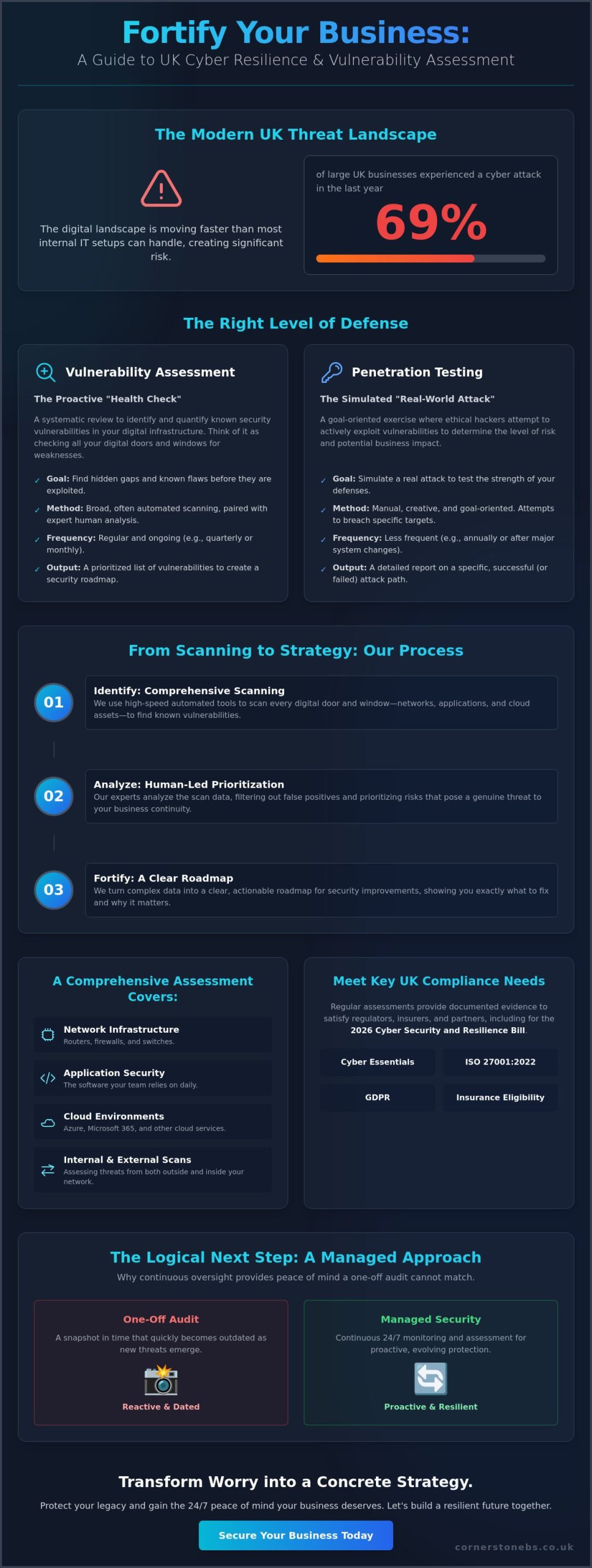
Did you know that 69% of large UK businesses experienced a cyber attack in the last year? It is a sobering figure that confirms what many local business owners already feel; the digital landscape is moving faster than most internal IT setups can handle. You have worked hard to build your brand, and the fear of a data breach causing lasting reputational damage is a heavy burden to carry, especially when technical jargon makes security feel like a closed book. We understand that you want to protect your legacy without getting lost in complex code.
We believe security should be a source of confidence rather than confusion. That is why professional vulnerability assessment services UK are essential for identifying hidden gaps before hackers can exploit them. By choosing a proactive approach, you can transform that nagging worry into a concrete strategy for growth. This guide provides a clear roadmap to fortify your business against evolving threats. We will show you how to ensure compliance with the 2026 Cyber Security and Resilience Bill while gaining the peace of mind your stakeholders deserve.
Key Takeaways
- Learn how professional vulnerability assessment services UK identify hidden gaps in your network and applications before they can be exploited.
- Understand the vital distinction between automated scanning and manual penetration testing to ensure you’re investing in the right level of defense.
- Discover how to turn complex scan data into a clear roadmap for security improvements by prioritizing risks that actually impact your business continuity.
- Explore why moving to a managed approach for your cyber security provides the 24/7 peace of mind that a one-off audit simply cannot match.
Understanding Vulnerability Assessment Services in the Modern UK Landscape
A vulnerability assessment is a systematic, proactive evaluation of your digital infrastructure designed to find known security weaknesses before they cause trouble. In 2026, simply reacting to problems as they happen is no longer a viable strategy for any UK business. The shift from reactive firefighting to proactive management is about more than just technology; it is about business continuity. Professional vulnerability assessment services UK provide the clarity you need to move forward with confidence. By combining high-speed automated scanning with the nuanced insight of expert human analysis, we ensure that your foundational systems remain robust and reliable.
There is a deep sense of relief that comes from knowing your systems aren’t just “working”, but are actively defended by experts who care about your local reputation. It isn’t just about code. It’s about the people who rely on your services every day. According to the UK Government Cyber Security Breaches Survey 2025/2026, approximately 43% of UK businesses reported a breach in the last year. For medium and large firms, that number jumps to over 65%. These aren’t just statistics; they represent real businesses facing real disruptions. A managed approach turns these risks into manageable tasks.
The Core Purpose: Identifying Before Exploitation
Think of an assessment as a comprehensive check of every digital door and window in your organisation. These services find the “open doors” in your network that cybercriminals are actively searching for. The window of opportunity for a hacker is the precise time between a developer announcing a security flaw and your IT team successfully applying the fix. Without full visibility across your cloud and on-premise assets, you’re essentially flying blind. Regular scans close those windows, turning potential disasters into minor, scheduled updates. This visibility is the first step toward true resilience.
Compliance and Regulatory Requirements in the UK
Staying on the right side of the law is a top priority for any local business owner. In 2026, regulatory pressures have intensified with the introduction of the Cyber Security and Resilience Bill. Regular assessments help you meet the rigorous standards of modern business. It isn’t just about avoiding fines; it’s about proving your commitment to data safety to your customers and partners.
- Cyber Essentials: A foundational requirement that is often a prerequisite for government contracts.
- ISO 27001:2022: Maintaining this certification requires regular, documented evidence of security testing.
- GDPR: Protecting personal data starts with knowing where your infrastructure is weakest.
- Insurance Eligibility: Many cyber insurance providers now require proof of regular vulnerability assessment services UK before they will offer or renew a policy.
By satisfying these stakeholder demands for due diligence, you protect your eligibility for insurance and maintain the trust that keeps your business growing.
The Critical Scope: What a Comprehensive Assessment Should Cover
A thorough evaluation goes far beyond a simple checklist. It requires a deep dive into every corner of your digital estate to ensure no stone is left unturned. High-quality vulnerability assessment services UK examine your entire network infrastructure. We look for tiny misconfigurations in routers, firewalls, and switches that could lead to a major breach. We also scrutinise application security. The software your team relies on every day often contains hidden flaws that, if left unaddressed, provide an easy path for attackers. Cloud environments like Azure and Microsoft 365 require specific attention too. Misconfigured permissions or disabled security features can leave your data exposed to the world without you even realising it.
You can’t just guard the front gate and ignore the backyard. While external scans check your public-facing assets, internal scans are equally vital. They simulate what happens if an attacker gains a foothold inside your network. This “inside-out” perspective is a core recommendation from the National Cyber Security Centre (NCSC). It helps us ensure that your internal defenses are strong enough to stop a local incident from becoming a national headline. Every laptop and mobile device connected to your network must be a brick in your wall, not a hole in it. If you want to see how your current setup measures up, our experts are ready to help you strengthen your Cyber Security posture with a local, personal touch.
Network and Wireless Infrastructure Audits
Rogue devices and unauthorised access points are more common than you might think. A single unmanaged switch or an old router can create a massive blind spot. Our audits focus on identifying these outliers and testing the strength of your internal segmentation. By preventing lateral movement, we ensure that a single compromised endpoint doesn’t lead to a total system failure. We also check for outdated firmware in your hardware. This is a frequently ignored vulnerability that hackers love to exploit because many businesses forget that physical kit needs updates just as much as software does.
Securing the Remote Workforce
Remote work has changed the security perimeter forever. Your office is now wherever your employees happen to be sitting. This means assessing VPNs and remote desktop protocols for potential leaks is a non-negotiable part of modern security. Implementing a Microsoft 365 migration for business UK is a fantastic way to set a secure foundation, but constant vigilance is required to keep those cloud environments safe. We ensure your mobile devices and laptops are not just tools for productivity, but hardened endpoints that resist intrusion. This proactive approach keeps your team connected and your data locked down tight.
Vulnerability Assessment vs. Penetration Testing: Which Does Your Business Need?
Choosing between a vulnerability assessment and a penetration test often feels like a technical riddle. It doesn’t have to be. To keep your business safe, you need to understand that these two tools serve very different purposes. A vulnerability assessment is a wide-reaching, automated scan. It answers the question: “What is wrong?” It looks at your entire digital footprint to find known weaknesses. On the other hand, a penetration test is a manual, targeted “ethical hack”. It answers the question: “How would a breach actually happen?” While a scan identifies the holes, a pen test tries to jump through them.
Timing is everything in security. We recommend that vulnerability assessment services UK are conducted on a monthly or quarterly basis. This ensures you catch new flaws as they emerge in the ever-changing digital landscape. Penetration tests are much more intensive and are typically an annual event, or something you trigger after a major system change. By aligning the frequency of these tests with your actual risk, you ensure your security scales alongside your business growth without unnecessary complexity.
Breadth vs. Depth: A Strategic Choice
Think of an assessment as a wide-angle lens. It provides continuous monitoring across a large number of assets, giving you a bird’s-eye view of your security posture. This breadth is essential for day-to-day safety. Deep-dive validation is where pen testing shines, specifically for high-value systems like payment gateways or sensitive client databases. Both of these elements feed directly into a robust cyber security services strategy that leaves no room for guesswork or blind spots.
Cost-Effectiveness for UK SMEs
For many local firms, budget and return on investment are primary concerns. Automated assessments offer the best ROI for routine security hygiene because they cover so much ground quickly and efficiently. You don’t want to “over-test” and waste resources on manual exercises that aren’t necessary for your current risk level. Experts agree that ongoing vulnerability assessments are the most reliable way to maintain a sound security posture without breaking the bank. Automated tools significantly reduce the overhead of manual security audits, allowing your team to focus on growth while we handle the technical heavy lifting.
From Scanning to Strategy: Turning Data into Business Continuity
Data without direction is just noise. One of the biggest mistakes we see is “report fatigue”. A 200-page automated scan might look impressive on a desk, but it is practically useless without expert interpretation. Professional vulnerability assessment services UK don’t just hand you a list of problems; they provide a clear, prioritized path to a more secure future. We use the Common Vulnerability Scoring System (CVSS) to rank threats. This allows you to focus your resources on “Critical” and “High” risks first, ensuring your business continuity is never left to chance.
Effective security requires a partnership between scanning and ongoing IT maintenance. Once a flaw is discovered, it must be patched. This is where the real work begins. If you are looking for a team to handle both the discovery and the cure, our Cyber Security experts are ready to secure your infrastructure today.
Interpreting the Findings for Stakeholders
Your board of directors doesn’t need to know the technical specifics of a CVE code. They need to understand how a specific vulnerability impacts the bottom line. We translate complex technical data into concise business risk summaries. Every audit we produce includes a punchy executive summary designed for decision-makers. This clarity empowers you to present security progress to investors with total confidence. It turns a technical necessity into a clear demonstration of professional due diligence.
Building a Remediation Roadmap
Fixing everything at once is impossible. You need a realistic timeline for patching and system upgrades. This is where managed IT services Teesside and across the UK provide immense value. These services automate the “fix” phase, ensuring that discovered flaws are closed quickly without disrupting your daily operations. Once the remediation is complete, a follow-up scan is essential. This verifies that the fix actually worked and that no new issues were introduced during the update. It is a continuous cycle of improvement that keeps your business stable and resilient.
Why a Managed Approach to Cyber Security is the Logical Next Step
A point-in-time scan provides a helpful snapshot, but digital threats don’t take breaks. Moving away from occasional checks toward a 24/7 proactive posture is the logical next step for any organisation that values its stability. When you work with a team that understands your business history and local infrastructure, security becomes a continuous conversation rather than a stressful chore. Our approach ensures that vulnerability assessment services UK are woven into the very fabric of your daily operations. We don’t just look for holes; we build a foundation that prevents them from forming in the first place.
The “Cornerstone” philosophy is built on a simple promise. We combine professional authority with a supportive, collaborative tone that makes complex tech feel manageable. We aren’t just a faceless service provider. We are your dedicated long-term partner. This means our it company solutions integrate security into every hardware and software choice you make. Whether you are upgrading your network or rolling out new cloud tools, security is the starting point, not an afterthought. This integration creates a seamless shield that protects your revenue and your reputation simultaneously.
The Value of Bespoke Technology Solutions
Generic security bundles often miss the mark because they ignore the nuances of your specific industry. Specialist sectors have unique risks that a “one size fits all” approach simply cannot address. No two UK businesses have identical security needs, and your defense strategy should reflect that reality. We customize scan frequencies and depths to match your specific risk profile. This ensures you aren’t paying for tools you don’t need, while remaining fully protected where it matters most. It is about precision and efficiency, ensuring your budget works as hard as you do.
Your Partner in Long-Term Resilience
Proactive system monitoring is the ultimate insurance policy for your digital estate. It prevents downtime before it impacts your revenue or upsets your loyal customers. There is a profound sense of emotional security in knowing that expert help is always just a phone call away. We provide the reassurance of unlimited helpdesk access for any security concerns your team might face. You aren’t alone in this journey. We are here to simplify the complex and keep your business moving forward with confidence. Ready to start? We invite our experts for a conversation about your security to see how we can support your long-term growth and resilience.
Step into 2026 with Total Digital Confidence
The digital landscape in 2026 moves fast, but your security strategy can move faster. You now understand that professional vulnerability assessment services UK are the foundation of a resilient business. It isn’t just about ticking a compliance box; it’s about protecting the brand you’ve worked so hard to build. By prioritizing “High” and “Critical” threats and moving toward a managed security posture, you ensure that your operations remain stable even as cyber threats evolve. You don’t have to face these technical challenges alone.
We invite you to work with a multi-award-winning IT provider that acts as a true extension of your team. As strategic partners with Microsoft, IBM, and Cisco, we combine national UK coverage with the approachable, regional warmth you expect from a local expert. Our proactive, partner-led approach means we’re always looking ahead to keep your infrastructure secure and your stakeholders at ease. Book a Security Conversation with Our Award-Winning UK Team today. Let’s build a secure, thriving future for your business together.
Frequently Asked Questions
How often should my UK business perform a vulnerability assessment?
You should aim for monthly or quarterly assessments to stay ahead of emerging threats. Regular testing ensures that new software updates or network changes haven’t introduced fresh weaknesses into your environment. Some industries with high data sensitivity may even require continuous scanning to maintain a robust security posture throughout the year.
Will a vulnerability scan slow down my network or affect employee productivity?
No, modern scans are designed to be lightweight and typically run in the background without affecting your daily operations. We often schedule these assessments during off-peak hours or configure them to use minimal bandwidth. This proactive approach ensures your team can keep working efficiently while we verify the strength of your digital infrastructure.
What is the average cost of vulnerability assessment services in the UK?
The investment for vulnerability assessment services UK varies based on the size of your network and the complexity of your digital assets. Factors such as the number of IP addresses, cloud environments, and the depth of analysis required will influence the final scope. We recommend a brief conversation to determine a plan that fits your specific business needs and budget.
Can a vulnerability assessment guarantee my business won’t be hacked?
No assessment can provide a 100% guarantee, but it significantly reduces your risk by closing the gaps attackers actively seek. It is an essential part of a layered defense strategy. By identifying and fixing known flaws, you make your business a much harder target and ensure your systems are as resilient as possible.
Do I need a vulnerability assessment if I already have an antivirus and firewall?
Yes, because firewalls and antivirus tools are reactive defenses, while assessments are proactive. Antivirus software stops known malware, but it won’t find a misconfigured cloud server or an unpatched piece of software. Assessments find the structural holes that your existing tools are simply not designed to see.
What is the difference between an internal and external vulnerability scan?
An external scan checks your public-facing assets like websites and email servers, while an internal scan looks at your network from the inside. External scans find “open doors” that anyone on the internet could potentially exploit. Internal scans simulate what happens if an attacker gets past your perimeter, ensuring they cannot move easily through your systems.
How long does a typical vulnerability assessment take to complete?
A standard scan can take anywhere from a few hours to a couple of days, depending on the scale of your infrastructure. Once the automated portion is finished, our experts spend time interpreting the data to create your prioritized roadmap. You’ll receive a clear, actionable report shortly after the technical phase of the assessment concludes.
Are vulnerability assessments a legal requirement for UK companies?
While not every business has a direct legal mandate, vulnerability assessment services UK are often necessary to comply with GDPR and the 2026 Cyber Security and Resilience Bill. Many industry standards and cyber insurance policies also require regular testing as proof of due diligence. Staying proactive helps you avoid the legal and financial fallout of a preventable data breach.