Posted on: May 29th, 2026 by Cornerstone
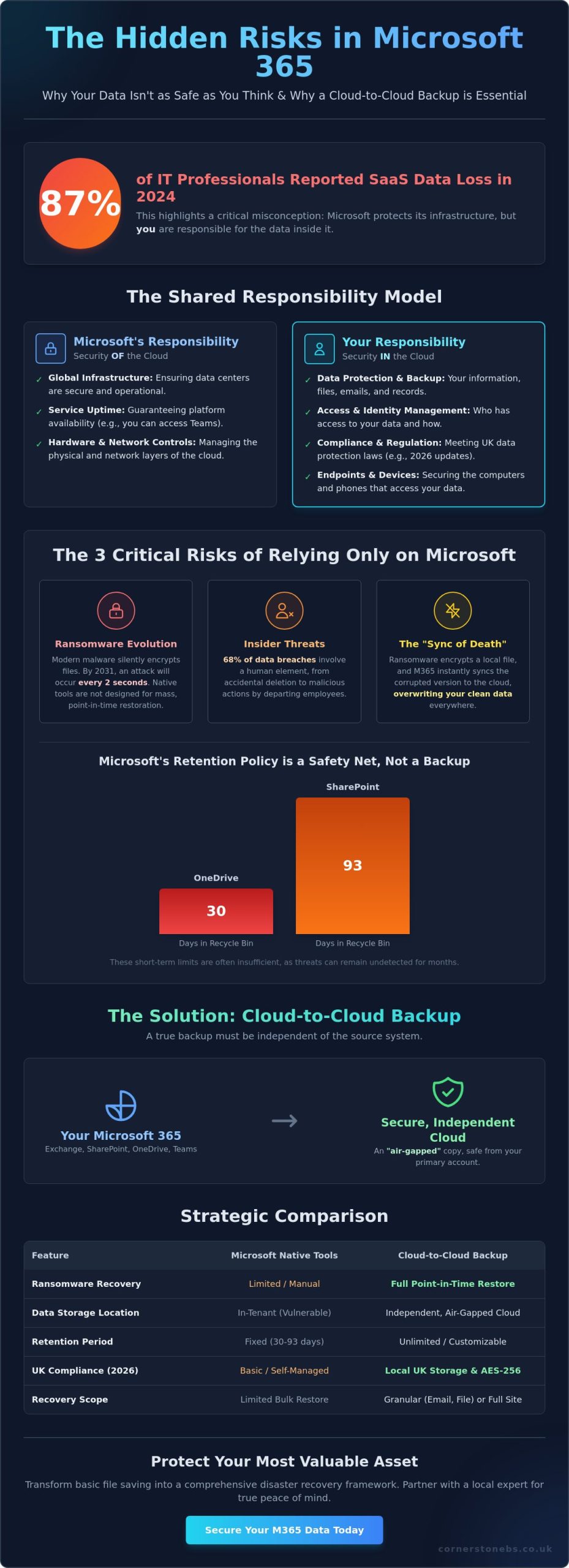
Did you know that 87% of IT professionals reported data loss within their SaaS applications in 2024? It is a startling figure that highlights a common misconception: the belief that Microsoft is solely responsible for your data. While Microsoft manages the platform infrastructure, you own the information inside it. If a ransomware attack encrypts your files or a team member accidentally deletes a critical folder, the default 93-day retention limit for SharePoint can expire before you even notice the gap. That is where a proactive cloud to cloud backup for Microsoft 365 becomes your most valuable asset.
We understand the pressure you face to stay compliant with the UK’s latest 2026 data protection updates while keeping your business resilient. It is natural to feel anxious about recovery limits, but you don’t have to face these risks alone. This guide explains exactly why third-party protection is essential for your business continuity and how to secure your Exchange and SharePoint environments. We will walk you through the Shared Responsibility Model and show you how to build a recovery plan that offers true peace of mind for your local team.
Key Takeaways
- Clarify the Shared Responsibility Model to understand exactly where Microsoft’s duties end and your data protection responsibilities begin.
- Protect your business from ransomware and internal errors by implementing a dedicated cloud to cloud backup for Microsoft 365.
- Evaluate the strategic benefits of storing backups in an independent cloud versus relying on native in-tenant retention policies.
- Stay ahead of 2026 UK compliance requirements by ensuring your sensitive data is stored locally and protected by AES-256 encryption.
- Learn how partnering with a local expert transforms basic file saving into a comprehensive disaster recovery framework for long-term stability.
The Shared Responsibility Model: Why Microsoft 365 Data Isn’t Automatically Safe
Many business owners believe that moving to the cloud solves every security headache. While it certainly simplifies your IT setup, it doesn’t remove your responsibility for the data itself. In 2026, the shared responsibility model remains the most important concept to understand. This framework clearly divides duties between you and Microsoft. They handle the “security of the cloud,” while you handle the “security in the cloud.” That is why cloud to cloud backup for Microsoft 365 is no longer optional for modern firms.
Think of it like a rented office. The landlord ensures the building is structurally sound, the locks work, and the electricity stays on. However, if you leave your laptop on a desk and someone steals it, the landlord isn’t responsible for your lost files. Microsoft provides the resilient “building” of their global infrastructure, but the digital assets you store inside are your business’s problem. Relying on the platform to protect itself is a gamble that 87% of IT professionals have lost at least once in recent years.
What Microsoft Guarantees (And What It Doesn’t)
Microsoft focuses heavily on uptime and service availability. They are world-class at ensuring you can log in to Outlook or Teams whenever you need to. But availability is not the same as data protection. If a file is deleted, Microsoft only holds it for a limited time. SharePoint data stays in the Recycle Bin for 93 days, while OneDrive data often disappears after just 30 days. These are short-term safety nets, not a backup strategy. If a ransomware attack strikes and stays hidden for months, those native tools won’t help you recover. They aren’t designed to combat sophisticated data encryption or malicious internal deletions.
The Definition of Cloud-to-Cloud Backup
A true backup must be independent of the source. Cloud-to-cloud backup works by taking a snapshot of your Microsoft 365 environment and mirroring it to a completely separate, secure cloud. This creates what we call an “air-gapped” copy. If your primary Microsoft account is compromised, your backup remains safe because it lives on a different platform with its own security protocols. Implementing a dedicated cloud to cloud backup for Microsoft 365 ensures your recovery points are stored independently. Cloud-to-cloud backup acts as a strategic safeguard that decouples your business data from the platform where it lives.
We see this as the foundation of business stability. By moving your recovery data to a separate environment, you gain the ability to restore individual emails or entire SharePoint sites within minutes. It’s about emotional security as much as technical necessity. Knowing your data is safe elsewhere allows you to focus on growth rather than worrying about the “sync of death” overwriting your good files with corrupted ones.
The 3 Critical Risks of Relying Solely on Native Retention
While Microsoft’s native tools offer a basic safety net, they aren’t a substitute for a true disaster recovery plan. Relying on them alone exposes your business to vulnerabilities that can lead to permanent data loss. The most dangerous scenario is the “sync of death.” This occurs when ransomware encrypts a file on a local device and Microsoft 365 instantly syncs that corrupted version to the cloud. Without a dedicated cloud to cloud backup for Microsoft 365, you risk losing your clean data forever as the encrypted files overwrite your healthy ones across the entire network.
Ransomware Evolution in 2026
Malware has become incredibly sophisticated and aggressive. By 2031, research from Invenio IT projects that a ransomware attack will occur every 2 seconds. Modern threats don’t just lock your screen; they silently encrypt your OneDrive and SharePoint libraries in the background. Native tools often struggle with mass-encryption events because they aren’t built for bulk, point-in-time restoration. You need the ability to “roll back” your entire digital environment to the exact minute before the infection took hold. This level of granularity is what separates a simple storage tool from a professional resilience strategy.
The Insider Threat: Accidental and Malicious Deletion
Human error remains a constant challenge for local businesses. According to the 2026 Verizon DBIR, 68% of data breaches involve a human element. This isn’t always a simple mistake. Sometimes, a departing employee might maliciously delete folders or purge the Recycle Bin to disrupt operations. Once those items are purged from the native bin, they are gone for good. Hunting for missing data costs your team hours of wasted productivity and unnecessary stress. A robust cloud to cloud backup for Microsoft 365 allows you to restore those assets instantly, regardless of what an individual does to the live environment.
There is also the risk of configuration errors. Many organizations forget that Entra ID (formerly Azure AD) settings and user permissions are just as vital as the files themselves. If these settings are lost or misconfigured, your entire workflow grinds to a halt. When you consider that Microsoft’s default retention for OneDrive is only 30 days, it is clear that native tools rarely meet strict UK compliance needs. Building a strong business case for data backups starts with acknowledging these functional gaps. If you are unsure where your current strategy stands, our team can help you evaluate your Managed IT Support needs to ensure your business resilience is fully up to date.
Cloud-to-Cloud Backup vs. Microsoft 365 Backup: A Strategic Comparison
Choosing between native tools and third-party solutions is a critical decision for your 2026 resilience strategy. Microsoft recently introduced its own native backup storage, which offers impressive speed for massive data sets. However, keeping your backups in the same tenant as your live data creates a single point of failure. If your entire Microsoft environment is compromised or suffers a major outage, your backups might be inaccessible right when you need them most. A dedicated cloud to cloud backup for Microsoft 365 removes this risk by storing your data in a completely independent environment.
We often talk to business owners who are surprised to learn about the “all eggs in one basket” risk. While native tools are convenient, they don’t provide the platform independence required for true disaster recovery. If the platform itself fails, you need a way to access your files from a separate location. This is where the strategic value of third-party services really shines, providing a safety net that operates entirely outside of the Microsoft ecosystem.
Native Microsoft 365 Backup: Pros and Cons
The primary advantage of Microsoft’s native solution is its integration. It lives directly within the Microsoft 365 Admin Center, making it easy for your internal IT team to manage. It is also built for speed, allowing you to recover entire site collections or large Exchange databases rapidly. But there’s a catch. Native storage is priced as a pay-as-you-go service at $0.15 per GB per month. For businesses with large archives, these costs can spiral quickly. More importantly, it doesn’t offer the air-gap protection that many compliance frameworks now require for sensitive data.
Third-Party C2C Backup: The Independent Advantage
Third-party solutions offer a different level of control. They provide much deeper granularity, allowing you to find and restore a single email or a specific version of a document without affecting the rest of the site. These services also capture vital metadata for Teams and SharePoint, ensuring that permissions and structures remain intact after a restore. Many of our clients find that cloud to cloud backup for Microsoft 365 is more cost-effective because it typically uses a flat-rate per-user model rather than charging for every gigabyte of storage.
Beyond just the files, these independent platforms often include advanced discovery tools. You can search across your entire backup history with ease, which is a massive help for legal requests or internal audits. If you are currently planning a Microsoft 365 migration for business UK, this is the perfect time to build independent backup into your new infrastructure. Decoupling your data from the platform it lives on isn’t just a technical preference; it’s a foundational element of business stability and emotional security for your team.
Choosing the Right C2C Solution for UK Compliance
Compliance is not just a box-ticking exercise; it is the backbone of your business’s legal and emotional security. For UK organisations, the regulatory landscape in 2026 has become more defined. On April 29, 2026, the ICO published updated guidance incorporating changes from the Data (Use and Access) Act 2025. These updates place a heavy emphasis on how you manage storage and access technologies. If your cloud to cloud backup for Microsoft 365 stores data in the wrong jurisdiction, you could inadvertently breach UK GDPR requirements. Choosing the right partner means ensuring your data stays within the lines of these evolving rules.
Data Sovereignty and UK Data Centres
Data sovereignty is a non-negotiable priority for local firms. You need to know exactly where your backup files live. Many global providers route data through overseas servers, which can complicate your compliance posture. Prioritising vendors with UK-based data centres ensures your information remains under the protection of UK law. This is a foundational element of our cyber security services. Beyond location, look for solutions that offer AES-256 encryption and mandatory Multi-Factor Authentication (MFA). These features act as a digital vault, keeping your sensitive business information safe from unauthorised eyes.
Evaluating Vendor Reliability and Support
A backup is only as good as its ability to restore. Automated daily backups are standard, but you should also look for on-demand snapshot capabilities for critical periods. During a data crisis, you don’t want to be stuck in a generic support queue. You need experts who understand the urgency of business continuity. We recommend performing a “Restore Drill” at least once a quarter to test your recovery speed and data integrity. This proactive approach ensures your team knows exactly what to do when the pressure is on.
Integration is the final piece of the puzzle. Your backup strategy should work in harmony with your wider managed IT services to create a seamless safety net. This ensures that if a breach occurs, your recovery is handled as a “restore-as-a-service” priority rather than a DIY technical headache. If you are ready to secure your digital assets with a partner who understands the local landscape, we invite you to contact our team for a conversation about your resilience strategy. Getting your cloud to cloud backup for Microsoft 365 right today prevents a compliance catastrophe tomorrow.
Securing Your Digital Assets with Cornerstone’s Managed Backup
Protecting your business data requires more than just a software subscription; it demands a strategy tailored to your specific operations. We don’t believe in one-size-fits-all solutions. Instead, our team builds bespoke frameworks that align with your unique risk profile and operational needs. By integrating a robust cloud to cloud backup for Microsoft 365 into your wider business continuity plan, we move you beyond simple file saving. We create a full disaster recovery framework designed to keep your business running, no matter what challenges the digital world throws your way.
Proactive care is the cornerstone of our service. While many providers wait for you to report a problem, our systems monitor your infrastructure proactively to catch potential issues. We aim to find and resolve glitches before they ever reach your desk or disrupt your team. This proactive stance ensures that your backups are always current, verified, and ready for immediate restoration. It turns a technical necessity into a foundational element of your emotional security, knowing that your digital assets are being watched over by a team that genuinely cares about your success.
Award-Winning Managed IT and Cloud Expertise
Our identity as a trusted regional expert is backed by years of industry recognition and accolades. We maintain strong partnerships with global leaders like Microsoft and Cisco, bringing world-class technology to our local community with a personal touch. Businesses across the UK trust our proactive system monitoring because we combine high-tech sophistication with a friendly, accessible face. Choosing a managed service from a dedicated partner provides the ultimate peace of mind, allowing you to focus on growth while we handle the complexities of your digital safety.
Start Your Resilience Conversation
Getting started is simpler than you might think. We begin with a tailored audit of your current Microsoft 365 environment to identify gaps in your retention policies and security settings. From there, we manage the entire migration to a professional cloud to cloud backup for Microsoft 365, ensuring zero disruption to your daily workflow. Our goal is to make your transition to a resilient infrastructure as smooth and efficient as possible. We invite you to take the first step toward total data security today. Let’s discuss your Microsoft 365 backup strategy and build a plan that protects your business for the long term.
Build Your 2026 Business Resilience Strategy
Taking ownership of your digital assets is the single most important step you can take for your organisation’s future. We have seen how the Shared Responsibility Model places the burden of data protection on your shoulders. You can’t afford to leave your data to chance. Without a dedicated cloud to cloud backup for Microsoft 365, your business remains exposed to ransomware syncs and evolving UK compliance risks. True stability comes from decoupling your data from the platform it lives on, creating a secure, air-gapped safety net for your team.
As a multi-award-winning IT provider and Microsoft Certified Partner, we pride ourselves on being a dedicated partner for local firms. Our proactive 24/7 system monitoring ensures your recovery points are always verified and ready for action. We invite you to secure your business data with a professional Microsoft 365 backup audit. It’s time to replace technical anxiety with the confidence of a professional disaster recovery framework. Let’s start a conversation today to ensure your business stays protected and resilient.
Frequently Asked Questions
Does Microsoft 365 back up my data automatically?
Microsoft does not provide a traditional point-in-time backup for your data. They focus on service availability and infrastructure resilience, ensuring the platform stays online. You are responsible for protecting the information you store within that platform. Without an external solution, data lost to user error or malicious intent can become unrecoverable once native retention windows close. This is why we recommend a proactive approach to data ownership.
How long does Microsoft keep deleted emails and files?
Retention periods depend on the specific application you are using. SharePoint and OneDrive typically keep deleted items in the Recycle Bin for 93 days before they are purged forever. Exchange Online usually holds deleted emails for 14 days by default, though this can be extended to 30 days. Once these periods expire, Microsoft cannot recover your files, making a separate recovery plan essential for long-term safety.
What is the difference between archiving and backup in Microsoft 365?
Archiving moves older data to a separate storage area within the live system, while backup creates a completely independent copy elsewhere. Archiving is great for managing mailbox quotas and keeping your workspace tidy. However, if the live environment is compromised, your archives are often at risk too. A true backup ensures your data survives even if the primary platform suffers a major failure or security breach.
Can cloud-to-cloud backup protect against ransomware?
Yes, a professional cloud to cloud backup for Microsoft 365 provides a vital layer of protection against ransomware. It stores an “air-gapped” copy of your files in a separate cloud environment that malware cannot infect. If your live data is encrypted, you can simply roll back to a clean version from a previous point in time. This allows your business to recover quickly without paying a ransom or losing weeks of work.
Does cloud-to-cloud backup include Microsoft Teams chats and files?
Yes, high-quality backup solutions protect your entire Teams environment. This includes the files shared in channels, conversation histories, and SharePoint site data associated with each team. Because Teams is a complex mix of different Microsoft services, a dedicated backup ensures all these moving parts are captured. You can restore specific chats or entire channels, keeping your collaborative projects on track even after an accidental deletion or malicious purge.
Is third-party backup a requirement for GDPR compliance?
GDPR requires organisations to have a plan for restoring access to personal data quickly after a technical incident. While the regulation doesn’t specify a brand of software, it places the responsibility for data availability on your business. Using an independent backup is the most effective way to demonstrate you have taken “appropriate technical measures” to protect sensitive information. It provides the documented recovery process that UK regulators expect to see from a responsible business.
What happens to my data if my Microsoft 365 subscription expires?
Your data is typically purged by Microsoft 90 days after a subscription is cancelled or expires. This deprovisioning process is permanent, and there is no way to retrieve files once the window closes. An independent backup allows you to keep a historical record of your business data for as long as you need. This is especially useful for meeting long-term retention requirements or managing business transitions smoothly without losing your digital legacy.
How often should cloud-to-cloud backups be performed?
We recommend performing backups at least three times every day to ensure your recovery points are as accurate as possible. Frequent snapshots reduce the amount of work your team has to redo if a restore is needed. Our cloud to cloud backup for Microsoft 365 runs automatically in the background, so you don’t have to worry about manual updates. This consistent rhythm is what builds true business resilience and emotional security for your local team.
Posted on: May 28th, 2026 by Cornerstone
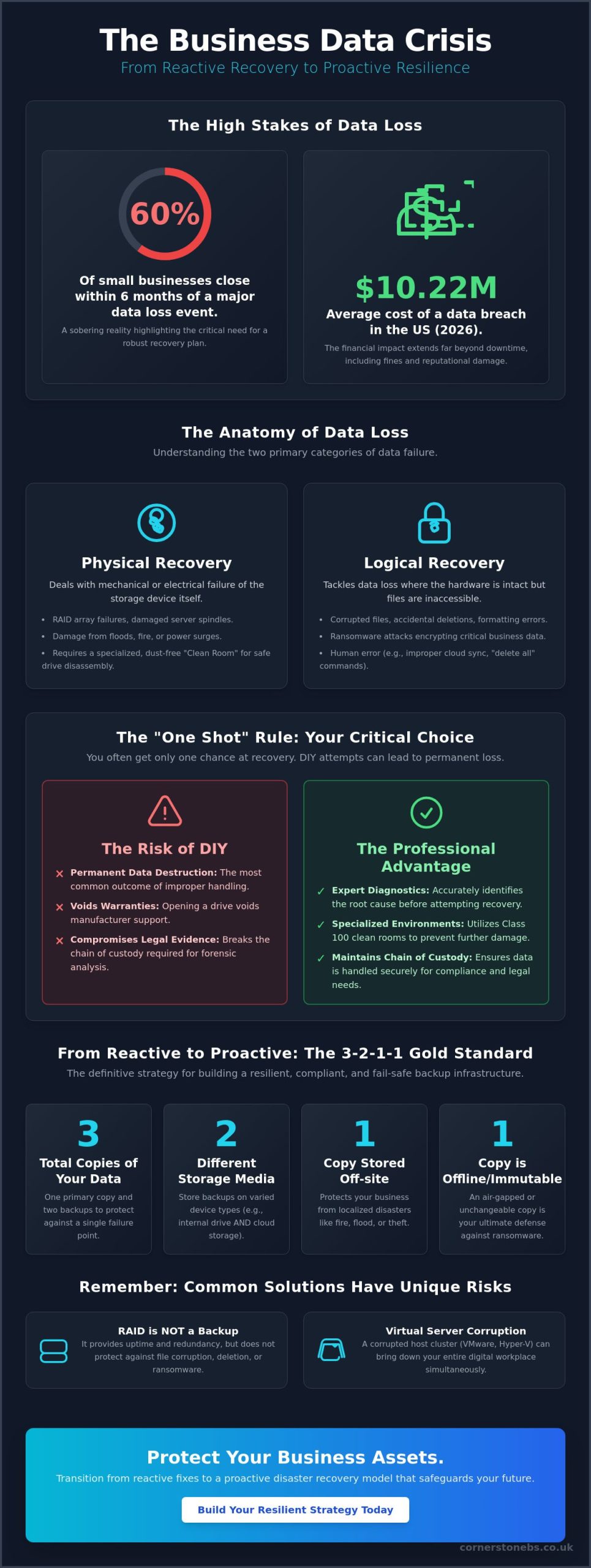
Sixty percent of small businesses that experience a major data loss event close their doors within just six months. It is a sobering reality, especially when you consider that the average cost of a data breach in the United States has climbed to $10.22 million in 2026. You have likely felt the mounting pressure of keeping up with strict regulations like California’s SB 446 while searching for professional business data recovery services that truly understand the cost of operational downtime. It is natural to feel protective of the assets you have worked so hard to build within our community.
We believe that your data security should be a source of confidence, not a constant worry. This guide will show you how to recover critical business assets and build a fail-safe infrastructure using expert disaster recovery strategies. We will explore the gold-standard 3-2-1-1 rule and simplify the technical steps needed to ensure your operations remain resilient against modern threats. By the end of this article, you will have a clear roadmap to protect your business’s financial future and maintain total regulatory compliance.
Key Takeaways
- Distinguish between physical hardware failures and logical data corruption to select the most effective path for business data recovery services.
- Learn how expert restoration of RAID arrays and SQL databases prevents long-term operational downtime for your core infrastructure.
- Understand the “One Shot” rule and why professional diagnostics are essential to avoid the permanent loss often caused by DIY recovery attempts.
- Discover how to transition from reactive fixes to a proactive disaster recovery model that safeguards your business assets before a crisis hits.
- Implement the 3-2-1-1 backup gold standard to ensure your organization remains resilient and compliant in an evolving digital landscape.
What Are Business Data Recovery Services in 2026?
Professional business data recovery services represent much more than just “fixing a broken drive.” At its core, What is Data Recovery involves the sophisticated process of salvaging inaccessible, lost, or corrupted information from business-grade storage systems. While a consumer might focus on saving personal photos, your organization needs to restore entire SQL databases, virtualized environments, and encrypted archives to maintain operational continuity. We see this as a foundational element of your business stability, not just a technical fix.
We categorize these efforts into two distinct areas. Physical recovery deals with mechanical failure; imagine a server damaged by a localized flood or a RAID array with multiple failed spindles. This work often requires a specialized “Clean Room” environment. These labs are designed to keep the air completely free of dust particles that could ruin sensitive drive platters during an open-drive procedure. Logical recovery, however, tackles corrupted files, accidental deletions, or data held hostage by ransomware. In 2026, business data recovery services must be agile enough to handle both scenarios across complex hybrid-cloud setups.
The scale of business recovery is what sets it apart. You aren’t just dealing with higher volumes of data; you are dealing with layers of encryption and strict compliance requirements. A local expert understands that your data isn’t just a collection of bits. It is your reputation, your intellectual property, and your legal responsibility.
The Evolution of Data Loss: More Than Just Hardware Failure
Data loss isn’t always a dramatic hardware crash. Simple human error remains a leading cause of downtime. Whether it’s an accidental “delete all” command or an improperly configured cloud sync, the results are equally devastating. We are also seeing a rise in “stealth ransomware” that sits dormant in your backups for months before activating. This makes “clean recovery” a vital part of your strategy, as it ensures you aren’t just restoring the same malware that caused the initial crisis. Logical corruption within complex virtualized environments is another growing hurdle that requires expert intervention to untangle.
Why Professional Services Are Non-Negotiable for UK Firms
Compliance is a major driver for professional intervention. With the 2026 updates to data protection laws, the financial penalties for losing client data are staggering. You need a partner who maintains a strict chain of custody. This is essential for legal and forensic evidence if a breach occurs. Trying a “DIY” fix on a failing drive usually results in permanent data destruction. You often get just one chance to get it right. We take that responsibility seriously, acting as your dedicated partner to ensure your data remains secure and your business stays compliant.
Critical Recovery Scenarios: RAID, Servers, and Cloud Infrastructure
Modern business storage is a complex web of interconnected systems. While these setups provide incredible speed and efficiency, they also create unique challenges when things go wrong. Professional business data recovery services must look beyond simple file retrieval to understand the architectural nuances of your NAS, SAN, and server environments. We know that for a local business, every hour your SQL database or Exchange server is offline is an hour of lost opportunity. Our goal is to bridge that gap with expert precision and local reliability.
RAID and Enterprise Storage Challenges
Many business owners believe that RAID is a substitute for a backup. It isn’t. RAID provides uptime, not data protection. If a multi-disk failure occurs in a RAID 5 or RAID 6 configuration, the “rebuild” process itself can often stress the remaining healthy drives to the point of total collapse. We specialize in reconstructing data from these striped and parity-based configurations, even when proprietary file systems are involved. Recovering an enterprise array requires a deep understanding of block-level data distribution. A solid disaster recovery strategy serves as your first line of defense, but when hardware fails, specialized reconstruction is the only way forward.
Server recovery extends to virtualized environments like VMware and Hyper-V. When a host cluster becomes corrupted, it doesn’t just affect one machine; it can bring down your entire digital workplace. We treat these virtual machine (VM) recoveries with the highest priority, untangling the corruption within the hypervisor to restore your proprietary business applications and data layers.
Recovering the Modern Hybrid Workspace
The SERP gap in most recovery discussions is the “cloud safety” myth. Just because your data lives in Microsoft 365, SharePoint, or Azure doesn’t mean it’s immune to loss. Accidental deletions, sync errors, and “SaaS Data Sprawl” can leave critical information scattered and inaccessible. We help you retrieve data from these cloud environments and remote worker devices, ensuring your mobile endpoints are back in the loop quickly.
Recovering data is only half the battle. In 2026, we must ensure that the restored information isn’t hiding dormant malware. Integrating robust cyber security services into the recovery process ensures that your “clean” data is actually safe to use. This proactive approach protects your infrastructure from immediate re-infection. If you’re concerned about the resilience of your current setup, we’d love to chat about our cloud solutions and how they can simplify your path to recovery.
The Business Case for Professional Recovery vs. DIY Attempts
The “Downtime Clock” starts the moment a system fails. For most organizations, the true cost of an outage isn’t just the IT bill. It’s the cumulative loss of productivity, missed deadlines, and the erosion of client trust. While it might be tempting to reach for a “free” tool found online, professional business data recovery services offer a level of certainty that software alone cannot match. We view data recovery as a critical component of your broader business stability. We want to ensure your operations return to normal with minimal friction.
Understanding the official disaster recovery plan definition highlights that true resilience is about more than just backups. It is about a structured, expert response. One of the most vital concepts we share with our partners is the “One Shot” rule. The first attempt at recovering data from a compromised device is statistically your most likely path to success. Every subsequent attempt, especially those made by untrained hands, significantly decreases the chances of a full restoration. A human engineer brings a level of diagnostic nuance that automated tools simply lack.
The Hidden Risks of DIY Recovery Software
Using automated software on a failing hard drive is often like trying to run a marathon on a broken leg. If the drive has a mechanical issue, such as a motor failure or a head crash, running software forces the device to spin at high speeds. This can cause the read heads to scrape across the data platters. This often turns your valuable information into literal dust. Unlike the generic advice found on public forums, we can identify these mechanical warnings before a single bit is read. This protects your hardware from permanent, irreversible damage.
Confidentiality and Compliance in the Recovery Process
Your intellectual property is the lifeblood of your company. When you partner with a local expert, you ensure that your sensitive data never leaves the UK. We use strict security protocols, including background-checked staff and robust Non-Disclosure Agreements (NDAs), to give you total peace of mind. Every recovered file is returned on an encrypted drive. This maintains a secure chain of custody from start to finish. This level of care is essential for meeting modern regulatory standards and protecting your professional reputation. We don’t just recover files; we protect your business’s future.
The Professional Data Recovery Process: What to Expect
When you reach out for business data recovery services, the first step is always a transparent conversation. We need to understand your specific timeline. Whether it’s a single database or an entire server cluster, we establish the criticality of the lost data to ensure our engineering resources are focused where they matter most for your continuity. This initial consultation isn’t just about technical specs; it’s about understanding how the loss impacts your team and your clients. We want to provide a clear path forward that eases the immediate stress of the situation.
Once we have your media in our lab, we move into the diagnostic phase. Our engineers identify the root cause of the failure, distinguishing between physical hardware damage and logical corruption. We then provide you with a comprehensive quote and a detailed file list. You’ll see exactly what is recoverable before you commit to the full service. During the actual recovery phase, we use specialized hardware to clone your device bit-by-bit. This allows us to extract data from a stable copy, protecting your original hardware from any further wear or risk. Finally, we verify the integrity of every file to ensure your data is ready for immediate use.
Diagnostic and Assessment: The Critical First 24 Hours
Our engineers use specialized “Read-Only” tools during the testing phase. These tools prevent the operating system from writing any new metadata to your drive, which is vital for preserving the current state of your files. You will receive a “File Tree” report that acts as a digital inventory of your recoverable assets. This transparency is a cornerstone of our service. Most professional partners operate on a “No Data, No Fee” structure, meaning you only pay for the successful retrieval of the information you actually need. It’s a proactive way to build trust during a difficult time.
Secure Delivery and Post-Recovery Support
We offer multiple options for the secure return of your data, including encrypted physical media or a direct, secure cloud transfer. We don’t just hand you a drive and consider the job done. Our team can work alongside your internal IT staff to assist with the re-integration of recovered databases or email archives into your existing network infrastructure. A certified Clean Room is a specialized laboratory environment that utilizes high-efficiency particulate air filtration to eliminate microscopic dust that would otherwise destroy exposed drive platters during physical repair. If you are dealing with a sudden outage, invite us to a conversation so we can start your diagnostic today.
Beyond Recovery: Building a Resilient Disaster Recovery Strategy
While expert business data recovery services act as a vital safety net, our ultimate goal is to build a system where you never have to experience the panic of data loss. We want to help you move away from a reactive “emergency fix” mindset. Instead, we focus on a proactive model that prioritizes total business continuity. We don’t just want to be the team you call after a crash; we want to be the partners who ensure your operations stay steady, no matter what happens in the digital landscape.
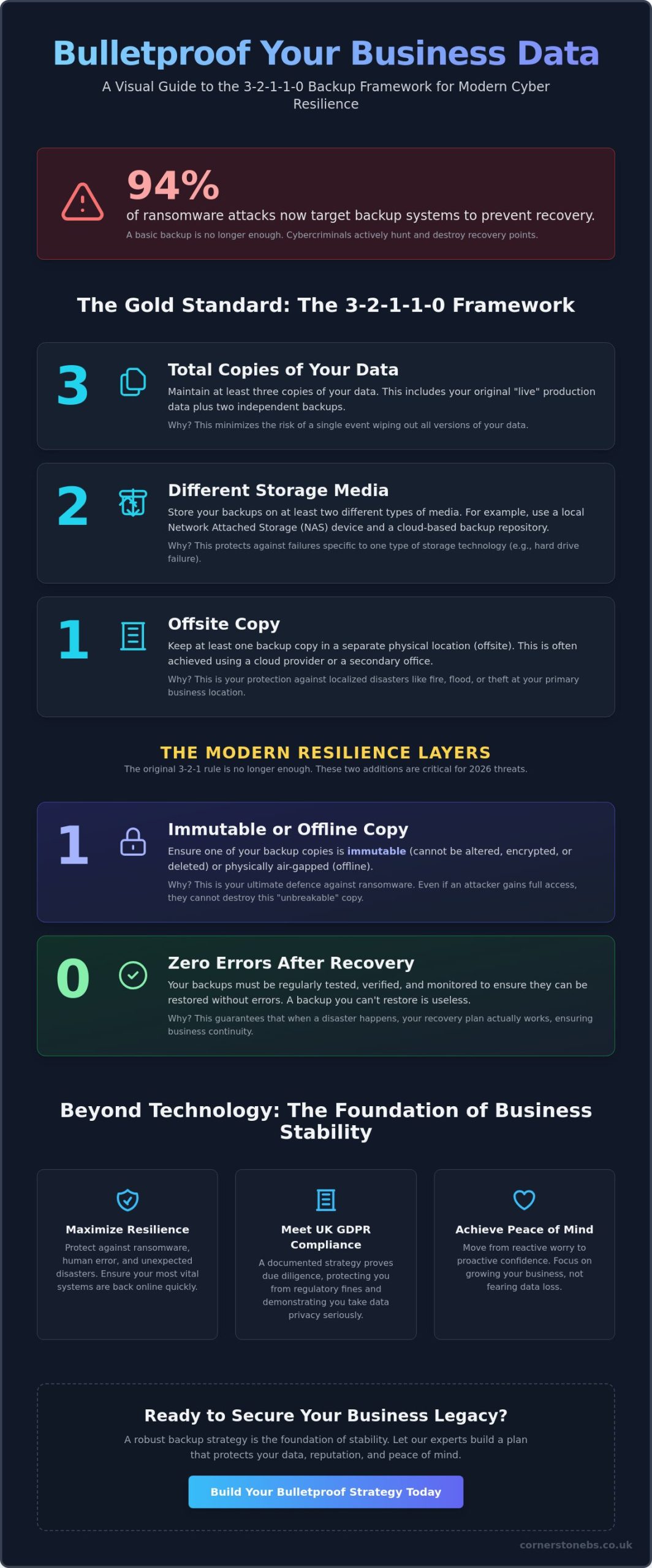
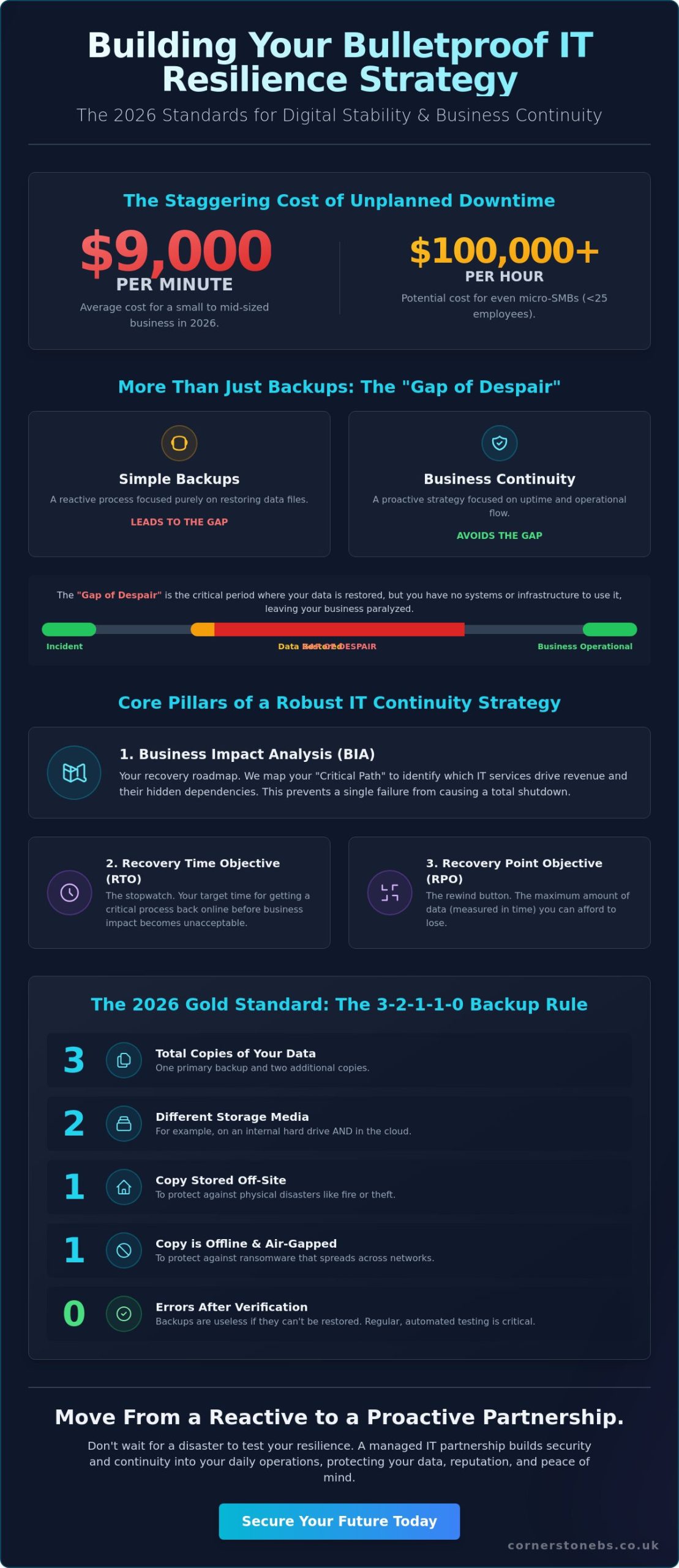
The 3-2-1 backup rule is still the gold standard for protection, but in 2026, we have taken it a step further. You should keep three copies of your data on two different media types, with at least one copy stored off-site and immutable. This air-gapped copy is your last line of defense against modern ransomware. For organizations that can’t afford even a few minutes of downtime, Disaster Recovery as a Service (DRaaS) provides a path to near-zero Recovery Time Objectives (RTO). It’s essentially a “standby” version of your digital environment, ready to activate the moment your primary systems falter.
Regular “fire drills” are the only way to know your plan actually works. We don’t just set up your backups and hope for the best. We test them. We simulate failures to verify that your data can be restored quickly and accurately. This ensures that when a real crisis hits, your team knows exactly what to do, and your systems respond with the reliability you expect.
The Role of Cloud Solutions in Business Continuity
Modern cloud solutions provide the foundation for this off-site safety. By utilizing tools like Microsoft Azure Site Recovery, we can provide instant failover for your most critical servers. If your physical hardware fails, your business simply keeps running in the cloud. We also find that a well-planned Microsoft 365 migration is a key step in decentralizing your data. It moves your essential files into a secure, redundant environment that your team can access from anywhere, safely.
Partnering for Long-Term Peace of Mind
Choosing an IT partner is about more than just technical specs. As a multi-award-winning team, we’re proud of our regional roots and our commitment to the success of our local business community. When you invest in business data recovery services, you’re really buying the emotional security that comes from knowing your assets are protected. We customize every recovery plan to fit your specific risk profile, ensuring you have the right level of protection without unnecessary complexity.
Our managed IT services are designed to provide the foundational stability your company needs to grow. We’d like to invite you to an informal, no-obligation conversation about your current backup resilience. Let’s make sure your business is ready for whatever 2026 brings.
Secure Your Future with Proactive Data Resilience
Your business data is more than just files on a drive; it’s the foundation of your hard-earned reputation and operational stability. We’ve explored how the 2026 regulatory landscape and sophisticated cyber threats make professional intervention essential. Whether you’re managing complex RAID arrays or navigating cloud-based SaaS sprawl, the right strategy ensures you aren’t just recovering data, but restoring confidence. Professional business data recovery services provide the technical precision needed to bypass the “One Shot” risk of DIY attempts while keeping your intellectual property securely within the UK.
As a multi-award-winning UK IT provider, we combine regional warmth with global expertise. Our deep partnerships with Microsoft, IBM, and Cisco allow us to build high-security environments that exceed standard GDPR requirements. We’re here to be your long-term partner, not just a one-time fix. It’s time to move from reactive worry to proactive peace of mind. Book a Disaster Recovery Audit with our Award-Winning Team today. Let’s work together to ensure your business remains resilient, secure, and ready for whatever comes next.
Frequently Asked Questions
How much do business data recovery services cost?
Pricing for business data recovery services depends on the complexity of your storage architecture and the specific nature of the failure. A logical file corruption on a single SSD requires a different engineering approach than a multi-disk RAID array with mechanical damage. We provide a transparent, fixed quote after the diagnostic phase so you know exactly what the investment will be before we begin the work.
Is data recovery 100% guaranteed for every business?
No professional provider can offer a 100% guarantee because physical damage can sometimes be irreversible. If a hard drive’s magnetic platters are physically scraped or “scored,” the data may be lost forever. However, our team uses specialized laboratory tools to maximize the chances of a successful retrieval. We operate with a proactive mindset to ensure we exhaust every technical possibility to get your files back.
How long does the business data recovery process typically take?
The timeline varies based on the volume of data and the severity of the hardware failure. A standard logical recovery might be completed in a few business days, while complex server reconstructions requiring donor parts can take longer. We establish a clear timeline during your initial consultation to help you manage operational downtime. We always balance speed with the precision needed for a clean result.
Can you recover data from a server that has been encrypted by ransomware?
Recovery from ransomware is often possible depending on the encryption strain and the state of your system’s shadow copies. Our experts analyze the infection to determine if a “clean recovery” can be performed without paying a ransom. We integrate this process with our cyber security protocols to ensure that once your data is restored, your entire network infrastructure remains protected from re-infection.
What is the difference between data backup and disaster recovery?
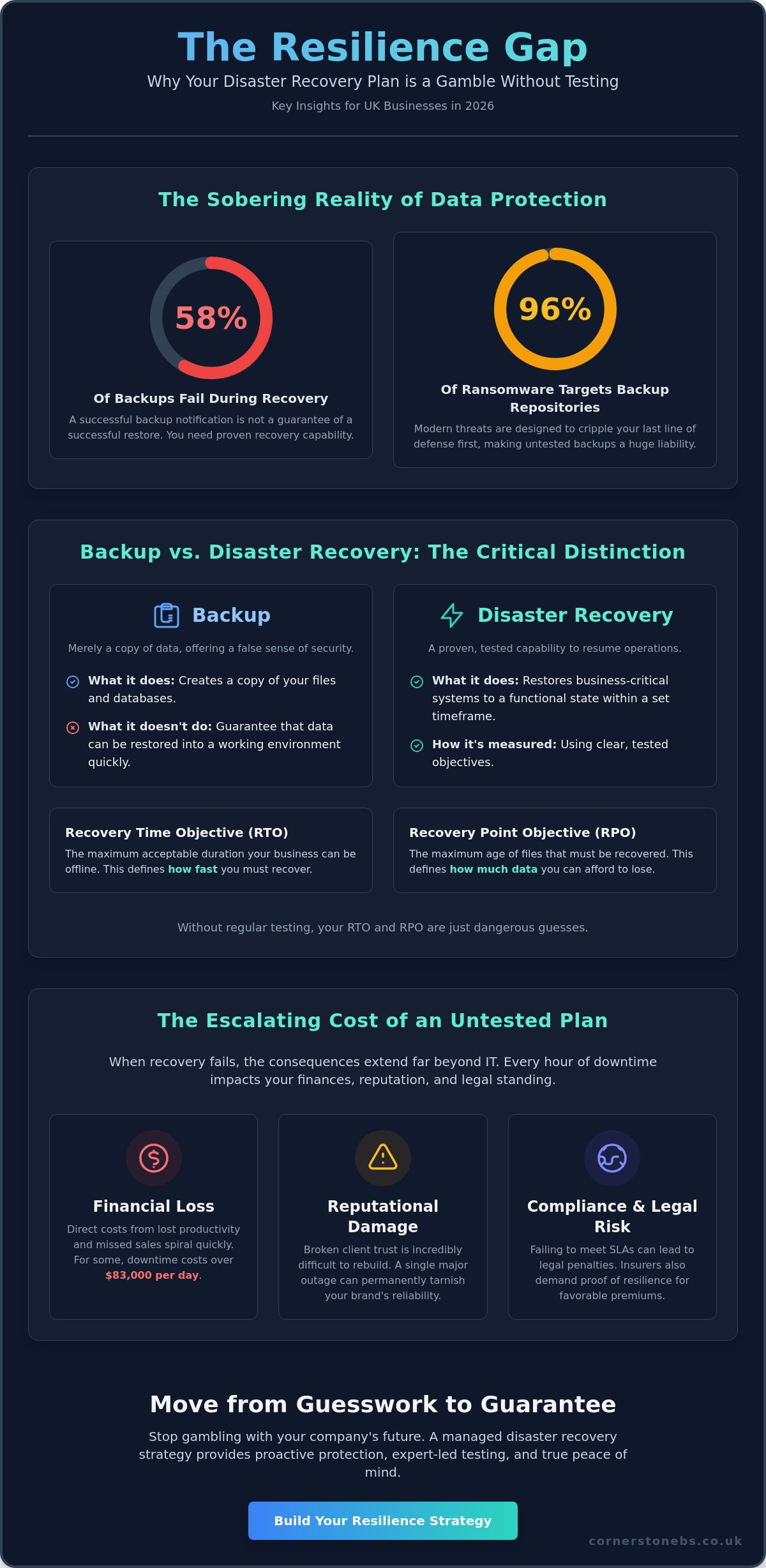
Data backup is the act of copying your files, while disaster recovery is the comprehensive plan and infrastructure used to restore your entire business operation. Think of backup as the spare tyre in your boot and disaster recovery as the expert roadside team that gets you back on the motorway. A robust strategy defines your Recovery Time Objective (RTO) to minimize the costs of prolonged operational downtime.
Will our business data remain confidential during the recovery process?
Confidentiality is a foundational element of our partnership. we use strict security protocols, including background-checked engineers and Non-Disclosure Agreements, to protect your intellectual property. Your sensitive data remains within the UK throughout the entire process. We return your recovered information on encrypted media to maintain a secure chain of custody and ensure you remain fully compliant with all data protection regulations.
What should I do immediately after discovering business data loss?
You should immediately power down the affected device and disconnect it from your network. Continued use of a failing drive or an infected server can cause permanent data destruction or allow malware to spread to other systems. Avoid the temptation to use “free” software tools, as these often overwrite the very files you need to save. Contact a local expert to begin a safe diagnostic process immediately.
Posted on: May 27th, 2026 by Cornerstone
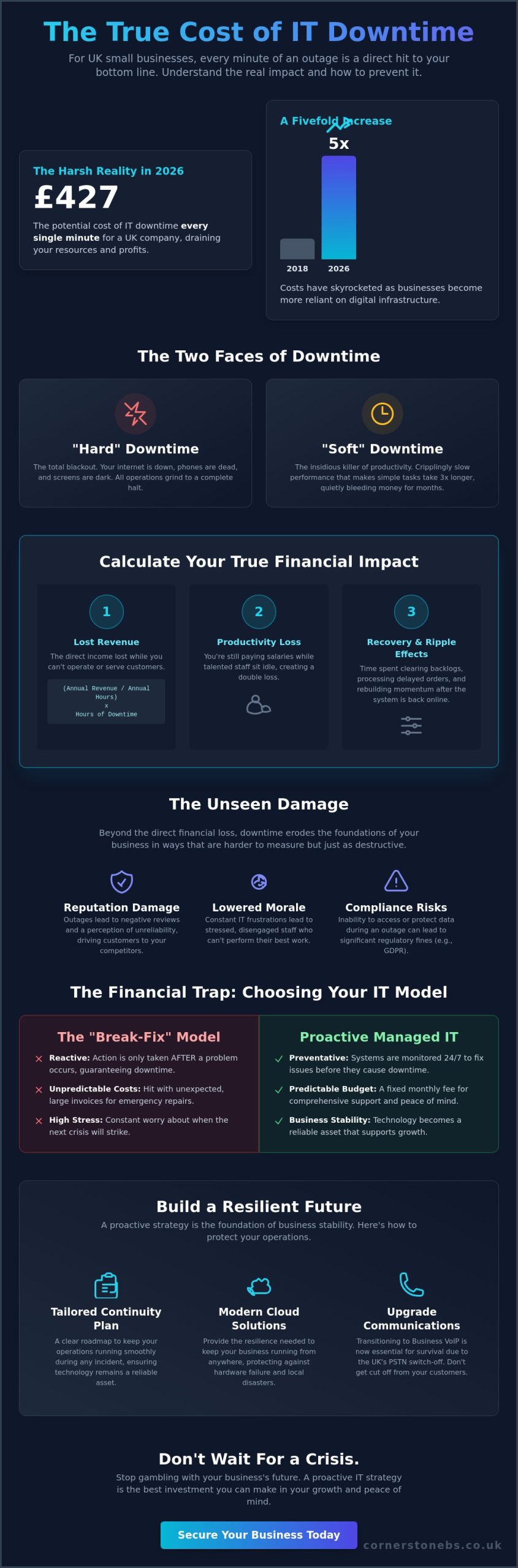
Would you willingly throw £427 into the bin every single minute? For many UK companies, that is the harsh reality of a system outage in 2026. The cost of IT downtime for small business has skyrocketed, seeing a fivefold increase since 2018 as we all become more dependent on digital infrastructure. While a “break-fix” engineer might eventually get you back online, the damage to your bank balance and your reputation often starts long before they arrive at your door.
We understand the frustration of watching talented staff sit idle while customer trust slips away. It’s a stressful position for any business owner, especially when you’re hit with an unexpected invoice for emergency repairs. This guide will show you how to calculate the true financial impact of these outages and why proactive Managed IT Support is the foundation of business stability. We’ll explore the hidden drains on your productivity and provide a clear roadmap to keep your operations running smoothly, ensuring your technology remains a reliable asset for your team. By the end, you’ll have a clear financial justification for IT investment that protects your growth and your peace of mind.
Key Takeaways
- Understand the critical difference between a total “hard” blackout and the subtle “soft” downtime that quietly drains your team’s daily productivity.
- Learn the precise formula to calculate the true cost of IT downtime for small business, accounting for both lost revenue and the hidden “wage drain” of idle staff.
- Discover how system reliability directly impacts your brand reputation and why preventing outages is essential for maintaining positive customer reviews.
- Identify why the reactive “break-fix” model is a financial trap and how a proactive approach creates a more predictable, stress-free budget.
- Explore how a tailored Business Continuity Plan and modern Cloud Solutions provide the resilience needed to keep your business running from anywhere.
What is IT Downtime and Why Does It Hit Small Businesses Hardest?
Technology is the engine of your business. When that engine stalls, your entire operation grinds to a halt. To understand the cost of IT downtime for small business, we first need to define the problem clearly. What is IT Downtime? It is any period where your digital infrastructure fails to support your core business functions. It isn’t just about a server being “off”; it’s about the inability to serve your customers or keep your team productive.
We see two distinct types of outages in the local business community. “Hard downtime” is the total blackout; your internet is gone, your phones are dead, and your screens are dark. However, “soft downtime” is often more insidious. This is the cripplingly slow performance that makes simple tasks take three times longer than they should. Both versions bleed money, but soft downtime often goes unmeasured for months. While a large corporation might have a backup for every system, a small business often relies on a single point of failure.
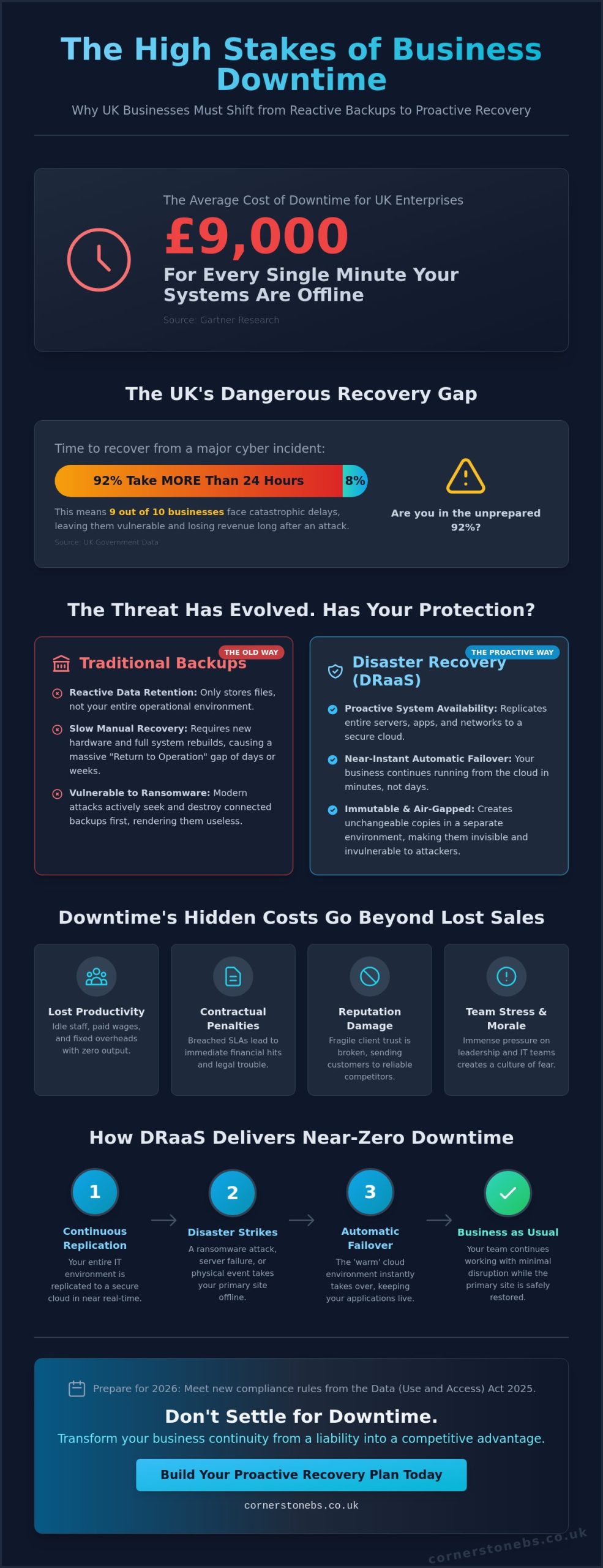
Smaller firms feel this impact more acutely because they lack the expensive redundant systems that protect global corporations. In 2026, we find that most outages aren’t caused by natural disasters. Instead, they stem from complex cloud misconfigurations or the silent failure of legacy hardware that has been pushed past its limit. Without a dedicated partner to monitor these systems, a small glitch can quickly snowball into a multi-day crisis. According to 2024 data, 92% of UK businesses require more than 24 hours to recover from a significant IT incident, a delay that most small budgets simply cannot absorb.
Common Triggers of Outages in 2026
Modern outages are rarely random. They are typically the result of three specific vulnerabilities:
- Cyber Security breaches: Ransomware and sophisticated phishing attacks remain the primary drivers of unplanned outages. One wrong click can lock your entire network.
- Hardware failure: Running end-of-life equipment is a gamble. We often see businesses struggling with aging servers or routers that simply cannot handle 2026 data demands.
- Human error: A lack of regular staff training is a major internal vulnerability. Accidental deletions or incorrect settings can be just as damaging as an external attack.
The 2026 Comms Crisis: Legacy Systems
The UK’s PSTN switch-off has permanently changed the landscape for business telecommunications. Companies still clinging to older analogue lines now face total communication isolation as those services are retired. Transitioning to a modern Business VoIP telephone system is no longer just an upgrade; it is a necessity for business continuity. Without it, you risk losing the ability to talk to your customers entirely. This creates a state of total isolation that makes recovery nearly impossible without a modern, cloud-based infrastructure in place.
Calculating the Direct Financial Impact: Revenue and Productivity
We’ve all seen that spinning loading icon and felt a twinge of frustration. In a busy UK office, that tiny icon represents a significant drain on your resources. For a local firm in 2026, the average cost of IT downtime for small business ranges from £137 to £427 per minute. That isn’t just a theoretical figure; it’s cash leaving your business in real-time. To find your specific risk, use the “Lost Revenue” formula: divide your gross annual revenue by your annual business hours, then multiply that by the hours of downtime. It’s a simple calculation that often yields a sobering result.
Beyond direct sales, you must account for the “Wage Drain.” You’re still paying your team’s salaries while they wait for a fix. This creates a double loss: you’re paying for labour that isn’t producing anything. This financial bleed continues even after the “on” switch is flipped. We call this “Recovery Time.” It takes significant effort to clear the backlog of emails, process delayed orders, and regain momentum. This “Butterfly Effect” can even lead to missed deadlines that haunt your contract renewals months later. Understanding The True Cost Of Downtime involves looking at these ripples, not just the initial splash.
The Productivity Drain
Small daily IT niggles are the silent killers of UK output. If each employee loses just 15 minutes a day to a slow PC or a glitchy app, that totals over 60 hours of lost productivity per person every year. These disruptions force “context switching,” which shatters concentration and makes it harder for your team to produce high-quality work. When your infrastructure is unreliable, your staff spend more time fighting the tools than using them.
Direct Recovery Expenses
If you rely on the reactive “break-fix” model, expect a sting in the tail. Emergency call-out fees are notoriously high, and if your backups fail, specialized data recovery services can cost thousands. Your Recovery Time Objective (RTO) is the maximum acceptable length of time that your business can be offline before the damage becomes irreversible. Investing in robust Disaster Recovery solutions ensures that your RTO remains measured in minutes, not days, protecting your bottom line from unexpected shocks.
The Hidden Costs: Reputation, Morale, and Compliance
The visible invoice for a technical repair is only the tip of the iceberg. When we look at the true cost of IT downtime for small business, the most painful losses are often the ones that don’t appear on a balance sheet immediately. We’re talking about your reputation. In our local community, word travels fast. In 2026, we live in the “Social Proof” era where a single hour of system failure can lead to a permanent 1-star Google review. Potential clients won’t hear your explanation about a server glitch; they’ll simply see a “business that doesn’t answer” and move to your competitor.
Then there is the human element. Your team wants to do a good job, but constant technical hurdles make that impossible. We’ve seen how recurring IT issues lead to deep-seated frustration and, eventually, high staff turnover. It’s exhausting to spend your day “firefighting” instead of focusing on your actual role. For a business owner, this emotional toll is just as heavy. Instead of working on strategic growth, you’re stuck managing a crisis you didn’t ask for. This constant state of high alert leads to burnout and prevents you from being the proactive leader your company needs.
Customer Confidence and Retention
Customers in 2026 have zero patience for the “our systems are down” excuse. They expect seamless digital interaction. If you can’t provide it, the long-term value loss is staggering. A client who has been with you for years might finally decide to move to a more “digitally stable” rival after one too many outages. Conversely, you can use your system reliability as a powerful marketing tool. Showing that you’ve invested in your infrastructure tells your clients that you are a stable, professional partner they can trust for the long haul.
Compliance and Legal Penalties
We must also address the legal risks. Downtime isn’t just an inconvenience; it’s often a red flag for regulators. If an outage results in data loss or a breach of GDPR or NIS2 standards, the financial penalties can be life-changing for a small firm. Think of robust Cyber Security Services as an essential insurance policy. They protect you from the regulatory fallout that follows an unmanaged incident. Investing in your digital safety isn’t just a technical choice; it’s a foundational part of your legal and emotional security.
Why the “Break-Fix” Model is a Financial Trap for SMEs
Waiting for something to break before calling for help feels like a cost-saving measure. In reality, it is a financial trap that leaves your business vulnerable to the highest possible expenses. This reactive approach, often called the “break-fix” model, ensures that you only see your IT technician when your productivity has already hit zero. By the time they arrive, the cost of IT downtime for small business has already begun to spiral through lost sales and idle staff. It is a sticking plaster approach that ignores the underlying health of your digital infrastructure.
The fundamental flaw of break-fix is its lack of strategic planning. A reactive engineer’s goal is to get the specific broken part working again as quickly as possible. They aren’t incentivised to look at why it failed or how to prevent the next crash. This leads to a cycle of “patchwork” IT where systems are held together by temporary fixes rather than a solid foundation. This lack of foresight often results in a “budgeting nightmare” for business owners. You might go three months with no IT costs, only to be hit with a massive, unbudgeted invoice when a critical server finally gives up the ghost.
The Conflict of Interest
In a break-fix relationship, your goals and your provider’s goals are completely misaligned. The technician only makes money when your systems fail. If your network is running perfectly, they aren’t getting paid. This creates a subtle but dangerous conflict of interest. Conversely, our model for Managed IT Services in Teesside aligns our success with yours. We’re incentivised to keep you online because our fixed-fee structure means we work hardest when things are stable. We become a proactive partner invested in your long-term continuity rather than a distant contractor waiting for your next crisis.
Predictable vs. Volatile Spending
Switching to a managed model transforms your IT from an unpredictable “black hole” of expense into a predictable monthly line item. This stability is vital for healthy cash flow management. Proactive maintenance also ensures that your IT Hardware lasts longer, as we identify and resolve minor issues before they cause permanent damage. Emergency repairs are not just stressful; they are expensive. On average, an emergency call-out and a rushed fix cost three times more than a planned, proactive upgrade. You can protect your bottom line by choosing a partner who prevents fires instead of just fighting them. If you are ready to move away from the stress of reactive repairs, contact our local team today for a straightforward chat about your needs.
Building a Resilient Future: How to Eliminate Downtime
Eliminating downtime isn’t about luck; it’s about strategy. A bespoke Business Continuity Plan (BCP) is your first line of defence. This isn’t just a dusty document for corporate giants. It’s a proactive roadmap designed to keep your doors open when others are forced to close. By identifying risks early, you can significantly reduce the potential cost of IT downtime for small business. We work alongside you to build this resilience, ensuring your technology supports your growth instead of hindering it.
Proactive monitoring is the heartbeat of a stable network. We use advanced tools to watch your infrastructure around the clock, catching silent failures before they escalate into full-blown crises. This “always-on” approach means we’re often resolving issues before your staff even arrive at their desks. As a multi-award-winning partner, we take that weight off your shoulders. This allows you to focus on leading your business with total confidence in your system reliability.
Modern Cloud & Disaster Recovery
Modern Cloud Solutions have revolutionised resilience for local firms. Platforms like Microsoft 365 and Azure provide built-in redundancy that protects your data from local hardware failures. We always implement the “3-2-1” backup rule for Disaster Recovery. You should have three copies of your data, stored on two different types of media, with one copy safely off-site. This simple but powerful framework ensures your information remains secure and accessible, no matter what happens at your physical office.
Partnering for Success
Generic, off-the-shelf fixes rarely solve complex business challenges. You need technology that is as unique as your company. Our team provides bespoke solutions and a dedicated helpdesk that knows your business personally. We don’t just fix computers; we build long-term partnerships rooted in our regional community. If you’re concerned about your current system reliability, we invite you to a no-obligation conversation to audit your current risk level. Let’s talk about how we can secure your future together.
Secure Your Business Stability Today
Your company deserves more than just “getting by” with reactive repairs. We’ve explored how the true cost of IT downtime for small business reaches far beyond the technical fix, impacting your brand reputation and team morale. By shifting from the “break-fix” trap to a proactive partnership, you turn your technology into a silent engine of growth rather than a constant source of anxiety.
As a multi-award-winning IT services provider, we combine our local roots with global strength through strategic partnerships with Microsoft, IBM, and Cisco. Our proactive 24/7 system monitoring identifies potential threats before they interrupt your workday, providing the emotional security you need to focus on your goals. It’s about building a foundation that doesn’t just survive an outage but prevents it from happening in the first place.
Book a free IT health check with our award-winning team to discover how we can protect your productivity. We’re ready to help you build a more resilient, profitable future for your business.
Frequently Asked Questions
How do you calculate the hourly cost of IT downtime?
You can calculate this by adding your lost revenue to your total wage drain. Divide your gross annual revenue by your annual business hours to find your hourly revenue risk. Add the hourly salary costs of all idle staff members during the outage to find the true hourly impact on your bottom line.
What are the most common causes of IT downtime for small businesses in the UK?
Cyber security breaches, such as ransomware, and the failure of legacy hardware are the primary triggers in 2026. Many local firms also face outages due to cloud misconfigurations or issues related to the PSTN switch-off. Human error, often caused by a lack of staff training, remains a significant internal vulnerability for smaller teams.
How can managed IT services actually reduce my business costs?
Managed support replaces unpredictable emergency repair bills with a fixed, predictable monthly fee. Proactive monitoring catches minor glitches before they escalate into expensive crises, which significantly lowers the overall cost of IT downtime for small business. This approach also extends the lifespan of your hardware through regular, expert maintenance.
Is “soft downtime” like slow internet as expensive as a total outage?
Soft downtime is often more expensive over the long term because it acts as a silent drain on productivity. While a total blackout is obvious, slow systems cause daily “micro-downtime” that disrupts concentration and employee morale. These small delays can add up to dozens of lost hours per employee every single year.
Does cyber insurance cover the cost of lost productivity during downtime?
Cyber insurance policies vary, so you must check for specific “business interruption” clauses in your agreement. While many policies cover data recovery and legal fees, they don’t always compensate for the daily productivity lost while systems are offline. It is better to use proactive security as your primary defence and insurance as a final safety net.
How often should a small business test its disaster recovery plan?
We recommend testing your plan at least once a year or whenever you implement major system changes. Regular testing confirms that your backups are healthy and that your team knows their specific roles during an emergency. This practice ensures that a real incident feels like a practiced drill rather than a chaotic crisis.
What is the difference between RTO and RPO in business continuity?
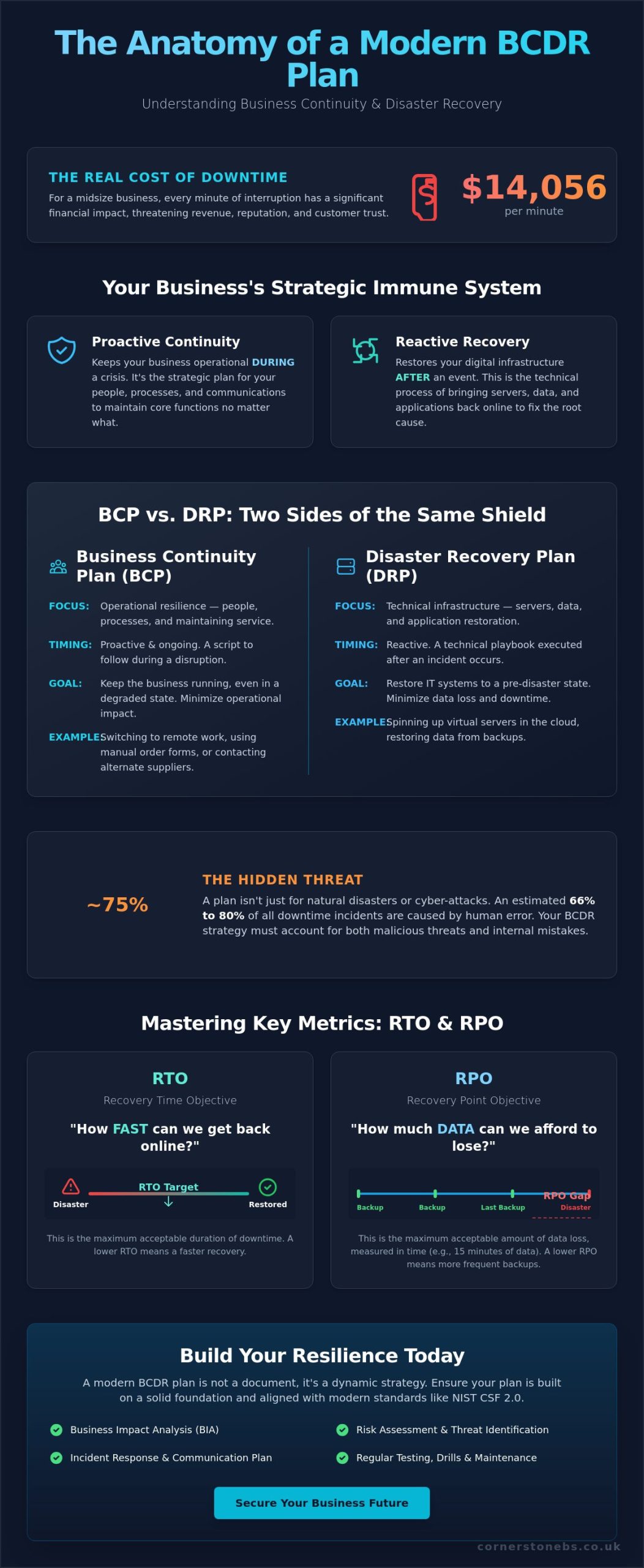
RTO stands for Recovery Time Objective, which is the target time for getting your systems back online. RPO, or Recovery Point Objective, refers to the maximum amount of data you can afford to lose, measured in time. For instance, if you back up your data every four hours, your RPO is four hours.
Can cloud migration help eliminate IT downtime?
Cloud migration significantly reduces downtime by removing reliance on a single piece of local hardware. Platforms like Microsoft 365 allow your team to remain productive from any location if your physical office faces an issue. This built-in redundancy provides a level of resilience that was previously only available to large corporations.
Posted on: May 26th, 2026 by Cornerstone
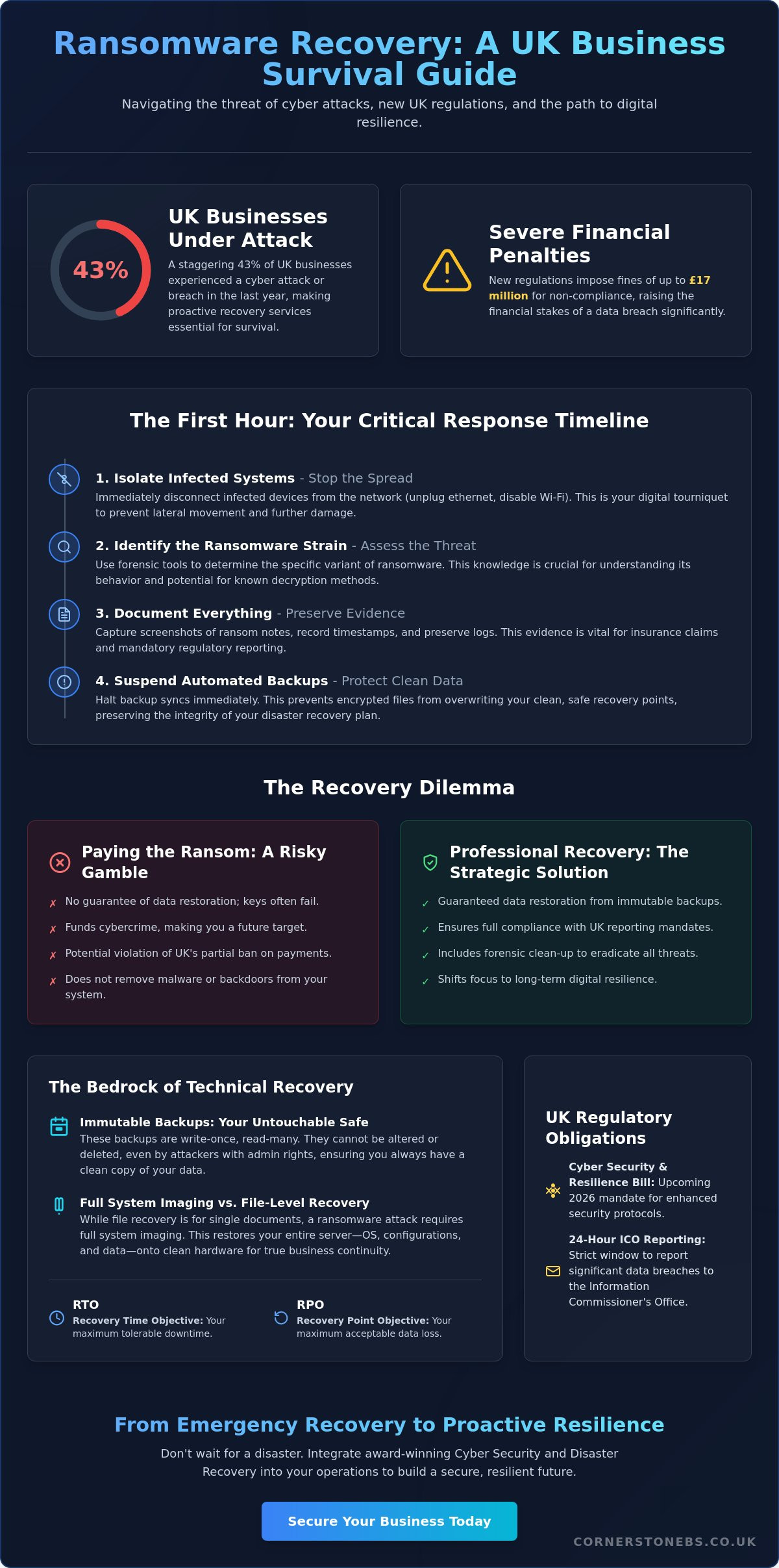
Did you know that 43% of UK businesses experienced a cyber attack in the last year, with many now facing potential fines of up to £17 million under new regulations? You likely feel the pressure of the upcoming Cyber Security and Resilience Bill, especially with its mandatory 24-hour incident reporting requirements. Securing the right ransomware recovery services UK business leaders need is no longer a luxury; it’s the foundation of your operational survival. We understand that the fear of total data loss and crippling downtime keeps many local business owners awake at night.
We agree that the stakes have never been higher, particularly as the UK government moves toward a partial ban on ransomware payments. This guide provides a comprehensive roadmap to help you navigate the recovery process, restore your systems, and ensure long-term digital resilience. You’ll learn how to handle the new reporting mandates, minimize your downtime through robust disaster recovery, and maintain full compliance with evolving UK data laws. We’ve designed this guide to turn technical complexity into a clear path forward for your business stability and peace of mind.
Key Takeaways
- Stop the spread immediately by isolating infected systems and using forensic tools to identify the specific ransomware strain within the first hour.
- Ensure guaranteed data restoration by leveraging immutable backups and full system imaging instead of relying on unstable decryption keys from criminals.
- Navigate complex 2026 regulations with professional ransomware recovery services UK to meet strict ICO reporting windows and protect your reputation.
- Shift from emergency recovery to proactive digital strength by integrating award-winning Cyber Security and Disaster Recovery into your daily operations.
The first hour of a ransomware attack is often the most stressful period a business owner will ever face. You might see strange file extensions appearing in your folders or a glaring ransom note on your desktop. Stay calm. Your first job is to stop the bleeding. You must isolate infected machines immediately to prevent the malware from moving laterally through your network infrastructure. If you don’t act fast, a single infected device can compromise your entire server array. This is where the right ransomware recovery services UK expertise becomes the difference between a minor hiccup and a total shutdown.
Identifying the specific strain is the next priority. Using professional forensic tools helps determine if there’s a known remedy for the What is Ransomware? variant you’re facing. Our local team focuses on documenting every screen, message, and timestamp. This evidence is essential for your insurance claim and your 24-hour reporting mandate under the 2026 Cyber Security and Resilience Bill. You should avoid the temptation to speak with attackers directly. They’re professional manipulators, and direct contact often leads to higher ransom demands or further security risks. We’re here to help you manage these initial steps with the clarity of a long-term partner.
The Critical Containment Phase
Containment acts as the digital tourniquet for business survival, stopping the spread before it claims your entire network. You need to physically disconnect ethernet cables and disable Wi-Fi protocols on all suspected devices. It’s also vital to suspend your automated backup syncs immediately. If your system keeps syncing during an active attack, you risk overwriting your clean archives with encrypted data. Halting these processes preserves the integrity of your Disaster Recovery points and keeps your clean data safe from corruption.
Initial Assessment and Triage
Once the spread is contained, we assess the scope of the breach. We differentiate between files that are simply locked and data that has been exfiltrated to external servers. Our experts look across your UK-based servers and Microsoft 365 cloud environments to map the infection accurately. We then help you prioritise your restoration queue. By focusing on critical business functions first, we ensure your most important operations are back online while we continue the deeper cleaning process. This structured approach helps you maintain business continuity even under extreme pressure.
Technical Recovery Mechanisms: Restoring Business Continuity
Restoring your business operations involves much more than just clicking ‘undo’ on a hacker’s encryption. While many focus solely on data, true continuity requires a structured approach to rebuilding your entire digital environment. Leading ransomware recovery services UK providers rely on immutable backups as the first line of defence. These backups are specifically designed to be unchangeable; once written, they cannot be modified or deleted, even by someone with stolen administrative credentials. This ensures you always have a clean, untouchable copy of your history to fall back on.
We distinguish between simple file-level recovery and full system imaging. File-level recovery works for accidental deletions, but after a total ransomware sweep, you need system imaging. This process restores your entire server environment, including the operating system and configurations, onto clean hardware. By utilising cloud-based Disaster Recovery, we can often spin up these images in a virtual environment, allowing your team to work while we sanitise your physical on-site servers. This dual-track approach slashes the time you spend in operational limbo.
Understanding RTO and RPO in 2026
Success in recovery is measured by two vital metrics: RTO and RPO. Think of the Recovery Time Objective (RTO) as the ‘clock of downtime.’ It’s the maximum amount of time your business can survive without its systems before the damage becomes irreversible. Recovery Point Objective (RPO) is your ‘threshold of data loss,’ representing how much work you’re willing to lose between your last backup and the attack. We work as your long-term partner to align these metrics with your specific commercial needs, ensuring your protection matches your pace of growth.
The Forensic Clean-Up Process
You can’t simply restore data into an environment that might still be compromised. We follow UK government guidance on mitigating ransomware by thoroughly sanitising every server and workstation. This involves identifying ‘sleeper’ malware that may have been lurking in your backup sets for weeks before the final payload was delivered. By extracting data into sandboxed environments, we verify its integrity before it ever touches your live network. This rigorous verification process ensures that when you reconnect to the UK internet backbone, you do so with total confidence in your system’s purity.
Professional Recovery Services vs. Paying the Ransom
When you’re staring at a frozen screen and a multi-million pound demand, the pressure to pay can feel overwhelming. You want your business back, and the hackers promise a quick fix. However, paying a ransom is a high-stakes gamble that rarely delivers the clean break you’re hoping for. Statistics from early 2026 show that only 17% of UK organisations chose to pay the ransom, a sharp decline from previous years. This shift isn’t just about ethics; it’s about the cold reality that partnering with ransomware recovery services UK experts is a more reliable investment in your business’s future. Paying doesn’t just fund criminal enterprises; it marks your company as a “proven payer,” often leading to repeat attacks within months.
The technical reality is that decryption keys provided by attackers are notoriously unstable. They’re often poorly coded and can corrupt your files during the decryption process. Research from 2025 indicates that only about 60% of organisations that pay a ransom successfully recover all their data. You might spend $1.5 million (the median UK ransom payment in 2025) and still end up with a shattered database. Beyond the data loss, you face the risk of “double extortion,” where criminals take your money but still leak your sensitive information or demand a second payment to stop a public data dump. Investing in professional restoration through your Managed IT Support partner ensures your systems are rebuilt on a clean, secure foundation rather than a patched-up crime scene.
The Myth of the “Honest Hacker”
Don’t fall for the idea that hackers have a reputation to uphold. They aren’t service providers; they’re criminals. Even if they give you a key, they often leave “sleeper” malware behind. These backdoors allow them to bypass your Cyber Security and strike again once you’ve resumed operations. Professional recovery focuses on a “clean start” by wiping infected environments and restoring from immutable backups. This method ensures that no hidden threats remain to jeopardise your long-term stability.
Legal Risks for UK Businesses
The legal landscape in the UK has become significantly more complex. You must consider the UK government financial sanctions guidance before even discussing a payment. Paying a ransom to a sanctioned entity can lead to severe legal penalties, regardless of your intentions. Additionally, many UK insurance providers now exclude ransomware payments from their coverage. Working with a certified recovery partner is often a prerequisite for a successful insurance claim, as it proves you’ve taken reasonable steps to mitigate the damage through legitimate channels.
UK Regulatory Obligations and Data Breach Compliance
Recovering your data is only half the battle. In the UK, the legal aftermath of a ransomware attack can be just as daunting as the technical breach itself. You’re likely aware of the UK GDPR requirements, but the 2026 regulatory landscape has added new layers of urgency. Under the Cyber Security and Resilience Bill, many organisations now face a mandatory 24-hour incident reporting window. This sits alongside the existing 72-hour ICO notification requirement for personal data breaches. If you miss these deadlines, or if you can’t prove you took “reasonable care” to protect your infrastructure, the financial penalties can be staggering.
Engaging professional ransomware recovery services UK experts ensures you aren’t just restoring files; you’re building a robust legal defence. We help you document every step of the incident, from the initial discovery to the final system sanitisation. This detailed paper trail is vital when you communicate the breach to clients, stakeholders, and your employees. Transparency is your best tool for preserving trust. We ensure your response aligns with the latest National Cyber Security Centre (NCSC) standards, providing the structured approach that regulators expect from a responsible business.
Navigating the ICO Reporting Process
Reporting a breach shouldn’t be a guessing game. The ICO notification form requires specific details about the nature of the breach, the categories of data involved, and your mitigation steps. We guide you through this process, ensuring your technical recovery documentation supports your claim of proactive management. By being clear and transparent in your UK-wide communication, you manage the narrative and reduce the risk of long-term reputational fallout. This structured approach helps satisfy the authorities while protecting your brand’s integrity.
Compliance as a Recovery Milestone
A successful recovery is the perfect time to harden your defences for the long term. Many of our clients use this transition to achieve Cyber Security Services certification, turning a vulnerability into a verified strength. We’ll help you update your internal data processing registers and ensure you’re aligned with standards like NIS2 or DORA if your sector requires it. This isn’t just about ticking boxes; it’s about building a resilient future where your business is better protected than ever before. If you’re concerned about your current compliance posture, reach out for a chat with our local experts to see how we can strengthen your digital foundations.
Building a Ransomware-Resilient Future with Cornerstone
Surviving a cyber attack is a major milestone, but the ultimate goal is ensuring it never happens again. We believe that the most effective ransomware recovery services UK businesses rely on should lead directly into a proactive security posture. Our multi-award-winning support isn’t just about reacting to alarms; it’s about building a digital fortress around your daily operations. We help you transition from the stress of emergency recovery to the stability of managed IT. By implementing a Zero Trust architecture across your network, we ensure that every user and device is verified. This strategy significantly reduces the risk of lateral movement, keeping your core assets safe even if a single endpoint is compromised.
We’re proud to act as your long-term technology partner rather than just a fix-it shop. Our team is deeply connected to our regional roots, and we take a genuine interest in the success of your business. We don’t just provide technical fixes. We offer the emotional security that comes from knowing your systems are managed by experts who care. This collaborative approach turns your IT infrastructure into a foundational element of your business growth, rather than a constant source of worry.
Proactive Monitoring and Threat Hunting
We leverage elite global partnerships with industry leaders like Cisco and Microsoft to bring world-class protection to your local network. Our UK-based helpdesk monitors your systems around the clock, identifying anomalies and hunting for “sleeper” threats before they have a chance to encrypt your files. For many local leaders, this journey toward total resilience starts with Managed IT Services Teesside to establish a rock-solid foundation. We act as your dedicated security eyes and ears, allowing you to focus on your commercial goals with total confidence.
Tailored Disaster Recovery Planning
True resilience requires moving beyond basic backups into a sophisticated Cloud Solutions environment. We customise your recovery protocols to match your specific RTO and RPO requirements. We don’t just hope the plan works; we run regular “fire drill” testing to prove it. These simulations ensure that your team knows exactly what to do and that your data can be restored within minutes. We’d love to invite you to a no-pressure conversation about your current risk level. Let’s have a friendly chat about how we can strengthen your digital foundations for the years ahead.
Secure Your Digital Legacy and Business Continuity
Navigating a ransomware attack is one of the toughest challenges any business leader will face. We’ve explored how immediate containment, technical restoration through immutable backups, and strict adherence to UK regulatory reporting can turn a potential disaster into a managed recovery. By choosing professional restoration over the risks of paying a ransom, you protect your business from double extortion and ensure your systems are rebuilt on a clean, secure foundation. Securing the right ransomware recovery services UK experts provide is the most effective way to meet the 2026 reporting mandates while preserving your professional reputation.
As a multi-award-winning IT provider and strategic partner with Microsoft, IBM, and Cisco, we’re here to be your long-term technology partner. Our UK-based proactive support team focuses on building a resilient future for your organisation, moving you from emergency response to a Zero Trust environment. Don’t wait for a crisis to test your defences. We invite you to talk to our award-winning UK experts about your recovery plan and discover how we can strengthen your digital foundations together. Your business stability is our priority, and we’re ready to help you thrive with confidence.
Frequently Asked Questions
Is it illegal for a UK business to pay a ransomware demand?
Paying a ransom isn’t universally illegal, but it’s a high-risk legal minefield that the UK government strongly discourages. If you unknowingly pay a group that is on the UK’s financial sanctions list, your business could face criminal prosecution. Under the 2026 Cyber Security and Resilience Bill, organisations must also report any intention to pay a ransom to the authorities before the transaction occurs. We focus on restoration through secure backups to keep your business on the right side of the law.
How long does professional ransomware recovery typically take?
Recovery timelines depend on the volume of data and the complexity of your network, but 59% of UK businesses achieved a full recovery within one week in 2025. While simple file restoration might happen quickly, a full forensic sanitisation of your servers ensures that no “sleeper” malware remains. Our local team prioritises your most critical business functions so you can resume operations while the deeper cleaning of your infrastructure continues in the background.
Will my cyber insurance cover the cost of recovery services?
Most cyber insurance policies cover the professional fees for ransomware recovery services UK providers offer to rebuild your systems. However, a growing number of UK insurers now specifically exclude the cost of the ransom payment itself. You should review your policy to confirm it covers digital forensics, data restoration, and the temporary hardware needed to maintain business continuity during the rebuild. Working with a recognised partner often makes the claims process much smoother.
Can ransomware infect my cloud backups like Microsoft 365 or Azure?
Yes, ransomware can compromise cloud environments if your automated sync processes remain active during an attack. If your local files are encrypted, the cloud service may simply sync those “changes,” overwriting your clean versions with encrypted ones. We prevent this by using immutable cloud backups and Disaster Recovery solutions that are isolated from your live sync environment. This ensures you always have a version of your data that the malware cannot touch.
What is the difference between data recovery and ransomware recovery?
Data recovery is the technical act of retrieving lost or deleted files, while ransomware recovery is a comprehensive strategic restoration of your entire business environment. Ransomware recovery involves forensic analysis to find the entry point, sanitising the network to remove backdoors, and verifying the integrity of every system. It’s a structured move toward long-term resilience rather than just a simple file restore. We treat it as a business continuity project to ensure your digital foundations are stronger than before.
Do I need to report a ransomware attack to the police or the ICO?
You must report any breach involving personal data to the ICO within 72 hours under the UK GDPR. For many sectors, the 2026 regulations have shortened this to a 24-hour mandatory reporting window for the initial incident. You should also report the attack to Action Fraud, which is the UK’s national reporting centre for cybercrime. These reports are essential for your legal compliance and can be vital when making a claim on your cyber insurance policy.
How can I tell if my backups are safe from a current infection?
Your backups are only truly safe if they are immutable or physically air-gapped from your primary network. We use forensic scanning tools to check your backup sets for “sleeper” malware that might have been planted weeks before the attack. If your backups were connected to the network during the infection without specific write-protection, there’s a risk they could be compromised. Regular “fire drill” testing is the most reliable way to verify your recovery points.
What are the first three things I should do if I see a ransom note?
First, isolate the infected devices by disconnecting ethernet cables and disabling Wi-Fi to stop the spread. Second, take photos of the ransom note and any on-screen messages to provide evidence for the police and your insurance provider. Third, contact your Managed IT Support partner immediately to begin the professional containment phase. These steps act as a digital tourniquet, protecting your remaining network infrastructure from lateral movement while you prepare for a secure restoration.
Posted on: May 25th, 2026 by Cornerstone
Did you know that 94% of ransomware attacks now specifically target backup systems to ensure you can’t recover? It’s a sobering reality that has many local business owners questioning if their current setup is truly secure. You’ve likely felt that nagging worry about whether your files are actually safe or if a single hardware failure could bring your operations to a standstill. Learning how to create a business data backup strategy is no longer just a technical tick-box exercise. It’s the foundation of your company’s long-term resilience and emotional security.
As a trusted local partner recognized for reliable service, we believe that protecting your hard work should be straightforward and stress-free. This guide will show you how to build a bulletproof 3-2-1-1-0 framework that guards against ransomware, human error, and unexpected disasters. We’ll walk through the balance between cloud and on-premise costs while ensuring you stay compliant with UK data protection standards. You’ll learn exactly how to achieve zero downtime and the total peace of mind that comes from knowing your recovery plan is tested, verified, and ready for anything.
Key Takeaways
- Adopt the 3-2-1-1-0 framework to ensure your data is not just backed up, but immutable and verified against 2026 cyber threats.
- Learn how to create a business data backup strategy that balances your recovery speed with your budget for maximum operational resilience.
- Categorise your data into mission-critical and archival tiers to ensure your most vital systems are back online first during a crisis.
- Move beyond simple backups to a proactive disaster recovery model that protects your business from the high costs of extended downtime.
Understanding the High Stakes of Business Data Backup in 2026
Your data is the heartbeat of your business. In 2026, it’s likely more valuable than your physical office or your fleet of vehicles. Yet, many local business owners still view data backup as a task for a rainy day. The threats have changed. We aren’t just worried about a dusty server failing or a spilled cup of tea on a laptop. Today, we face AI-driven ransomware that can bypass traditional filters in seconds. When you lose access to your files, you don’t just lose information. You lose time, client trust, and your hard-earned reputation. Learning how to create a business data backup strategy is about more than technology. It’s about protecting your legacy and ensuring your team can sleep soundly at night.
Stability comes from knowing a crisis won’t be fatal. A solid strategy acts as an insurance policy that you hope to never use but feel grateful to have. It provides the emotional security needed to focus on growth rather than fear. When systems go down, the hidden costs start piling up immediately. You face idle staff, missed deadlines, and the potential for long-term brand damage that no marketing campaign can easily fix. Proactive resilience is the only way to stay ahead.
The Reality of Data Loss in the Modern Workplace
Most data loss isn’t a Hollywood-style heist. It’s often a simple mistake, like an employee clicking a malicious link or a disgruntled insider deleting folders. Human error remains a leading cause of downtime. We often talk to owners who believe their files are safe because they use cloud storage. This is a dangerous misconception. While tools like OneDrive are great for collaboration, they aren’t backups. If ransomware hits your primary machine, it can encrypt your synced files in the cloud before you even notice. This is why we integrate cyber security services with a true backup solution to ensure multiple layers of protection.
Compliance and Legal Obligations for UK SMEs
The legal stakes are just as high as the operational ones. Under UK GDPR, you have a clear responsibility to ensure the availability and resilience of personal data. If a disaster strikes and you can’t restore your records, you could face significant regulatory fines from the ICO. This is especially true for firms in the financial, legal, or education sectors where data retention is strictly mandated. A documented plan on how to create a business data backup strategy serves as your proof of due diligence. It shows regulators, and your clients, that you take their privacy seriously. It’s the difference between a minor hiccup and a business-ending event.
The 3-2-1-1-0 Framework: The Gold Standard for Modern Data Protection
Years ago, the 3-2-1 rule was the gold standard. It was simple. You kept three copies of your data, on two different types of media, with one copy stored offsite. In 2026, this is simply the baseline. Cybercriminals now actively hunt for your backups to ensure you can’t recover without paying a ransom. This is why understanding how to create a business data backup strategy today requires the 3-2-1-1-0 framework. It adds two critical layers: one immutable or offline copy and zero restoration errors. It’s a proactive approach that moves you from basic storage to true cyber resilience. We see it as a foundational element of your business stability.
Let’s break down these numbers into actionable steps. You start with three copies of your data. This includes your primary live data and two separate backups. You should use at least two different media types, such as a local server and a cloud repository. One of these must be kept offsite to protect against physical disasters like fire or theft. By following data backup and security best practices, you ensure that no single point of failure can wipe out your business history. However, the real magic happens with the final two digits: 1 and 0.
The Power of Immutable Backups
An immutable backup is essentially “unbreakable” data. Once written, it cannot be altered, encrypted, or deleted for a set period. This uses Write-Once-Read-Many (WORM) technology. Even if a hacker gains administrative access to your network, they can’t touch these files. It’s your ultimate safety net against ransomware. We often recommend this as a core part of your how to create a business data backup strategy because it removes the “what if” from your security plan. If you’re concerned about your current protection levels, our team can help you explore cyber security services that include these modern safeguards.
Air-Gapping and Offline Security
Air-gapping takes security a step further by physically or logically disconnecting a backup from your main network. If there’s no path to the data, a virus can’t reach it. While old-school tape backups were the original air-gap, modern cloud air-gapping offers the same protection with much faster recovery times. This “reset button” ensures that even in a total network collapse, you have a clean copy of your business ready to go. The “0” in the framework stands for zero errors. This means your backups are automatically tested and verified every single day. A backup you haven’t tested isn’t a backup; it’s just a wish. We focus on these details so you can focus on running your business with total confidence.
Defining Your Recovery Objectives: RTO, RPO, and Technology Selection
A backup plan without clear recovery goals is like a ship without a compass. You might have the data, but you won’t know how to get it back in time to save your business. When deciding how to create a business data backup strategy, you must first define your recovery boundaries. These are measured by two critical metrics: Recovery Time Objective (RTO) and Recovery Point Objective (RPO). These aren’t just technical terms. They represent the heartbeat of your operations. RTO is the duration of time your business can survive being offline. If your systems go down at 9:00 AM, can you wait until 5:00 PM to be back up, or do you need to be running in minutes? RPO, on the other hand, defines how much data you can afford to lose. If your last backup was at midnight and you crash at noon, you’ve lost twelve hours of work. For a local pharmacy or a law firm, that loss could be devastating.
Balancing these objectives requires a honest look at your budget and your risks. High-speed, near-instant recovery costs more, but the price of downtime often far outweighs the investment. Many businesses fall into the trap of a “one size fits all” approach. They treat their archival files the same as their live customer database. This leads to wasted budget on low-priority data and dangerous gaps for mission-critical systems. By following established NIST data protection guidelines, we help you categorise your information so your resources go exactly where they are needed most.
Choosing the Right Backup Technology
The tools you choose must match your RTO and RPO goals. For many of our clients, this involves protecting Microsoft 365 and other SaaS data through cloud-to-cloud backups. It’s a common myth that cloud providers handle all your backups for you. In reality, you are still responsible for your data. Hybrid solutions are often the best fit for UK SMEs. They combine the local speed of on-site hardware with the long-term resilience of cloud solutions. This setup ensures that if a single file is lost, you can grab it instantly from your local network, but if your office is flooded, your entire business is safe in the cloud.
Evaluating On-Premise vs. Cloud Storage
Deciding between on-premise hardware and cloud storage is a matter of scale and stability. Local devices like NAS or SAN offer incredible speed for immediate recovery. However, they require physical maintenance and “Capex” investment in hardware. Cloud storage in UK-based data centres offers an “Opex” subscription model that scales as you grow. These facilities provide levels of physical security and power redundancy that most small businesses simply couldn’t afford on their own. We often recommend a blend of both to ensure your how to create a business data backup strategy is as robust as possible, giving you the best of both worlds without the overhead of managing it all yourself.
A Step-by-Step Roadmap to Implementing Your Backup Strategy
Execution is where many great plans falter. Knowing the theory of the 3-2-1-1-0 rule is a fantastic start, but the real protection comes from a structured rollout. Learning how to create a business data backup strategy that actually works requires a disciplined, step-by-step approach. It’s about moving from a vague idea of “saving files” to a documented, automated, and verified system that guards your business. We believe a clear roadmap is the best way to replace anxiety with confidence. By following these five essential steps, you’ll build a resilient foundation that stands up to 2026 cyber threats.
- Step 1: Data Audit. You can’t protect what you don’t know you have. Categorise your data by its importance to your daily operations.
- Step 2: Assign Ownership. Clearly define who is responsible for managing the backups and, more importantly, who leads the recovery process.
- Step 3: Establish the Schedule. Remove the risk of human error by automating your backups. Modern systems can run every few minutes without slowing you down.
- Step 4: Secure the Perimeter. Ensure all backup data is encrypted both while it’s moving (in transit) and while it’s stored (at rest).
- Step 5: Document the Plan. Create a physical and digital “What If” handbook that outlines every step your team needs to take during a crisis.
Conducting a Comprehensive Data Audit
The first hurdle is often “Shadow IT.” This refers to data stored on personal Dropbox accounts, local desktops, or even staff mobile phones. If it’s not on the map, it’s not being backed up. We recommend mapping all data flows across your it company solutions to identify every storage point. Prioritise your “Mission Critical” items first, such as live databases, financial records, and customer PII. Archival data is still important, but it shouldn’t jump the queue during a recovery event. This clarity ensures your resources are focused where they matter most.
The Testing Hierarchy: Is Your Data Actually Recoverable?
A “Backup Successful” email is a notification, not a guarantee. To be truly secure, you must move through a testing hierarchy. We suggest monthly file-level restores where you pick a random document and ensure it opens correctly. On a broader scale, you should perform an annual full-system disaster simulation. This tests your team’s response time and the integrity of your entire network. Using a “Sandbox” environment allows you to run these tests safely without affecting your live operations. If you want to ensure your business stays online no matter what, our team can help you design a custom Disaster Recovery plan that includes rigorous, automated testing.
Why Managed Backup is the Foundation of Business Stability
Building a resilient business shouldn’t be a lonely endeavour. While the technical steps of how to create a business data backup strategy are now clear, the day-to-day management can quickly become a heavy burden for a busy team. The old ‘break-fix’ model of IT is no longer enough to survive the threats of 2026. You need proactive managed resilience. This shift means that instead of waiting for a failure and then scrambling to fix it, we identify and resolve potential issues before they ever affect your operations. It turns a technical necessity into a foundational pillar of your business stability and emotional security.
Expert monitoring is the silent guardian of your data. We catch backup failures, storage bottlenecks, and connectivity issues in real-time. This level of oversight ensures that when you reach for that ‘reset button’ we discussed earlier, it actually works. Having a team of UK-based experts at your side means you aren’t shouting into a void during a crisis. Every second counts when your reputation is on the line. We see ourselves as more than just a service provider. We are your dedicated long-term partner, focused on your growth and the safety of your digital assets.
Freeing Your Team to Focus on Growth
Removing the weight of daily backup management allows your internal staff to focus on what they do best: driving your business forward. You gain access to enterprise-grade technology and high-level security without the massive enterprise-grade price tag. Our managed IT services provide a scalable path that evolves alongside your company. Whether you are expanding your local team or adopting a hybrid work model, your data protection remains constant, reliable, and invisible.
Taking the First Step Toward Total Peace of Mind
Now is the perfect time to audit your current backup effectiveness. Don’t wait for a hardware failure or a ransomware alert to discover the gaps in your armour. The Cornerstone promise is simple: we provide professional authority balanced with approachable, regional warmth. We speak clearly, avoid the dense jargon, and focus on the outcomes that matter to your bottom line. We invite you to start an informal conversation with our local team about your data resilience. Let’s work together to ensure your business is protected, compliant, and ready for whatever the future holds. It’s time to move forward with the confidence that your hard work is safe.
Secure Your Business Future with Proactive Resilience
Protecting your business legacy starts with a single, proactive decision. We’ve explored the necessity of the 3-2-1-1-0 framework and the vital importance of defining your recovery objectives to stay resilient against 2026 threats. Understanding how to create a business data backup strategy is the first step toward ensuring your operations never miss a beat during a crisis. It’s about more than just files; it’s about the stability of your team and the trust of your clients.
As a multi-award-winning IT services provider, we combine strategic partnerships with industry leaders like Microsoft, IBM, and Cisco to deliver world-class protection with a local, approachable face. Our experts provide proactive 24/7 system monitoring and a dedicated UK-based helpdesk to catch potential failures before they ever become disasters. Don’t leave your continuity to chance. We invite you to book a proactive data resilience audit with our expert team today to secure your growth. We’re ready to be your long-term partner in technology, helping you move forward with total peace of mind.
Frequently Asked Questions
What is the difference between data backup and disaster recovery?
Data backup is the process of creating a copy of your files, while disaster recovery is the comprehensive plan for how you use those copies to restore operations. Think of backup as the spare tyre in your boot and disaster recovery as the toolkit and knowledge needed to change it and get back on the road. Without a clear recovery plan, your backups are just stored data that might take days or weeks to reconfigure correctly.
How often should my business perform data backups?
You should perform backups as often as your business creates data you cannot afford to lose. For most UK SMEs, this means at least daily backups, though mission-critical systems often require continuous data protection that saves changes every few minutes. When you are learning how to create a business data backup strategy, your Recovery Point Objective (RPO) will dictate this schedule to ensure minimal work is lost during a crash.
Is cloud backup secure enough for sensitive financial data?
Cloud backup is highly secure for financial data when it includes end-to-end encryption and is stored in UK-based data centres. Modern providers use advanced security protocols that often exceed the physical and digital protection available in a standard office server room. We ensure your sensitive records are encrypted before they even leave your network, keeping you compliant with strict financial regulations and UK GDPR standards.
What is an immutable backup and why does my business need one?
An immutable backup is a version of your data that cannot be altered, encrypted, or deleted for a specific period after it is created. You need this because a vast majority of ransomware attacks now target backup files to prevent you from recovering without paying. By keeping an immutable copy, you ensure that even if a hacker gains admin access to your network, your “gold” copy remains untouched and ready for restoration.
Can I just use an external hard drive for my business backups?
Using only an external hard drive is not a recommended strategy because it creates a single point of failure and is vulnerable to physical theft, fire, or mechanical damage. While a drive can serve as one of your local copies, it doesn’t provide the automation, offsite resilience, or encryption needed for modern security. A professional approach involves automated systems that remove the risk of someone forgetting to plug in the drive at the end of the day.
How long does it typically take to recover data after a ransomware attack?
Recovery time varies based on your infrastructure and data volume, but a well-planned strategy can reduce downtime from weeks to just a few hours. Without a documented plan, businesses often face a median downtime of 18 days following a ransomware event. By investing in high-speed recovery tools and regular testing, we help you meet your specific Recovery Time Objective (RTO) to keep your team productive and your clients happy.
Do I need to back up my Microsoft 365 data separately?
Yes, you must back up your Microsoft 365 data separately because Microsoft’s primary focus is on service availability rather than long-term data retention. Their “Shared Responsibility Model” explicitly states that the data itself is your responsibility. If an employee accidentally deletes a folder or a mailbox is compromised, having an independent backup ensures you can restore that information quickly without relying on limited native recovery windows.
What should be included in a business disaster recovery plan?
A business disaster recovery plan should include a clear hierarchy of mission-critical systems, a hardware inventory, and a detailed list of staff responsibilities. It acts as a step-by-step manual that anyone on your team can follow when systems go down. When determining how to create a business data backup strategy, ensure your plan also includes emergency contact details for your IT partners and a verified timeline for restoring each department’s access.
Posted on: May 24th, 2026 by Cornerstone
Did you know that 58% of backups fail during the actual recovery process? It is a sobering reality for many business owners who believe they are protected, especially since 96% of ransomware attacks now specifically target backup repositories. We understand the pressure you feel to prove your resilience to stakeholders while managing a complex IT environment. You need more than just a digital safety net. You need the certainty that your operations can resume within hours of a failure.
This 2026 guide and disaster recovery plan testing checklist provides the expert led framework you need to move beyond simple backups and achieve true business resilience. We have designed this roadmap to help you meet UK data protection requirements and insurance mandates with ease. You will gain a clear, step by step strategy for conducting realistic simulations without draining your team’s limited time. We are here to simplify these complex technical challenges, giving you the confidence to lead your business forward with the support of a dedicated local partner.
Key Takeaways
- Understand why a written document alone cannot guarantee survival and how testing bridges the gap between a plan and a proven recovery capability.
- Follow our expert-led disaster recovery plan testing checklist to ensure your infrastructure, data, and team are fully prepared for any IT failure.
- Learn how to turn test failures into strategic advantages by conducting effective post-mortem meetings that strengthen your business resilience.
- Discover the benefits of shifting from complex DIY simulations to a managed disaster recovery strategy that provides proactive protection and peace of mind.
Why a Disaster Recovery Plan is Useless Without Regular Testing
Having a document titled “Disaster Recovery Plan” doesn’t mean your business is resilient. It just means you have a plan. In our experience as a local IT partner, we see a massive gap between having a strategy on paper and possessing a proven recovery capability. Many organizations realize too late that their documentation is outdated or that “shadow IT” apps, used by staff without central oversight, were never included in the original scope. If you haven’t verified your strategy against a disaster recovery plan testing checklist, you’re essentially gambling with your company’s future.
The 2026 threat landscape has made the “false sense of security” trap more dangerous than ever. Traditional backups are no longer enough because 96% of modern ransomware attacks now attempt to infect backup repositories first. Relying on an untested system is a risk your stakeholders won’t appreciate. Beyond just staying online, regular testing helps lower business insurance premiums. Insurers now demand evidence of proactive resilience before offering favorable rates. Proving you can recover isn’t just about IT; it’s a foundational element of your commercial stability and emotional security.
Backup vs. Disaster Recovery: The Critical Distinction
A successful backup notification in your inbox only tells you that data was copied. It doesn’t tell you if that data can be restored into a working environment within a useful timeframe. This is where Business Continuity Planning becomes vital. You must define your Recovery Time Objective (RTO) and Recovery Point Objective (RPO) to set clear expectations. Recovery Time Objective (RTO) defines the maximum duration your business can stay offline, while Recovery Point Objective (RPO) specifies the maximum age of files that must be recovered from backup for operations to resume. Without testing, these numbers are just guesses.
The Real Cost of Testing Failure
When recovery fails, the clock starts ticking on your bank balance. While specific costs vary, verified data shows that government entities lose approximately $83,600 for every single day of downtime. For a UK SME, the hourly cost of an outage can quickly spiral when you account for lost staff productivity and missed sales opportunities. The financial hit is often secondary to the reputational damage. Once client trust is broken due to a failed recovery, it’s incredibly difficult to win back. You may also face legal consequences if you fail to meet the Service Level Agreements (SLAs) promised to your own customers. Testing ensures these promises remain unbroken.
Pre-Test Phase: Setting the Stage for a Successful DR Drill
Preparation is the difference between a controlled drill and a chaotic scramble. Before you even look at your disaster recovery plan testing checklist, you must define exactly what you’re testing. Are you checking the recovery of a single critical database or simulating a total site failure? Narrowing your scope prevents your team from becoming overwhelmed and ensures the results are actually measurable. Industry reports show that many organizations still struggle with formal and consistent DR testing, often because they try to do too much at once without a clear starting point.
You also need the right people in the room. This isn’t just an IT task. Your DR team should include department heads who understand business workflows and external partners who manage your infrastructure. We recommend starting with a Tabletop Exercise where you talk through the scenario before moving to a Full-Scale Simulation. To keep your business running during the drill, always use an isolated sandbox environment. This protects your live production data from accidental corruption while you prove your systems can stand back up. If you’re unsure where to start, our team can help you design a safe testing environment tailored to your setup.
Inventory and Cloud Asset Mapping
Modern businesses rely on a complex web of cloud solutions and on-premises hardware. Your inventory must map every critical application, including Microsoft 365 and Azure environments. Don’t forget the hidden dependencies. If your CRM relies on a third-party API to process payments, that integration needs to be part of your disaster recovery plan testing checklist. Verifying your backup status across these platforms before you begin is a non-negotiable first step.
Establishing Success Criteria
A test is only successful if you know what a “pass” looks like. In 2026, stakeholders expect more than just a green light; they want data-driven proof of resilience. You need to set realistic timeframes for restoration based on your current infrastructure and staff availability. It’s also vital to define a Point of No Return. This is a pre-determined threshold where you stop the test if it risks impacting live operations. Clear boundaries protect your business and give your team the confidence to push the simulation to its limits.
The Essential Disaster Recovery Plan Testing Checklist for 2026
An effective disaster recovery plan testing checklist must be more than a technical to-do list; it’s a blueprint for business survival that bridges the gap between IT staff and non-technical managers. To gain true resilience, you must prioritise tasks based on their impact on immediate operations. We recommend timestamping every single action during your test. This creates a clear audit trail for regulators and helps you identify precisely where delays occur in your recovery timeline. This level of detail transforms a simple drill into a powerful tool for continuous improvement.
Technical and Infrastructure Verification
Your first priority is confirming that your core systems can actually stand back up. You should verify server restoration from cloud-based disaster recovery platforms to ensure your data is accessible. Once servers are live, check network connectivity and VPN access for your remote staff. It’s not enough for the server to be “on”; your team needs to reach it. Don’t forget to test the integrity of restored databases and file structures to ensure no data corruption occurred. Testing Multi-Factor Authentication (MFA) during a disaster recovery drill is vital because secure access must remain intact even when you’re working from secondary systems or unfamiliar networks.
Communication and Personnel Checklist
Technology often fails because people don’t know where to turn. Start by triggering your emergency notification system to all relevant staff to see if the message actually lands. You should validate the effectiveness of your “Call Tree” or automated alert system to ensure no one is left in the dark. A critical but often overlooked step is checking that staff can access the physical or digital DR plan document without relying on the main network. If your plan is stored on the very server that just went down, your recovery will stall before it even begins. We focus on these human elements because they are just as important as the digital ones.
Application and End-User Testing
The final proof of success lies with your users. Invite “Power Users” from different departments to log in to restored systems and verify core business functions. You need to know if printing, email, and VOIP systems are fully operational in the recovery environment. For businesses using modern cloud productivity tools, you must test the synchronisation of Microsoft 365 migration for business UK data. Ensuring that your latest documents and emails are present in the restored environment is the only way to guarantee your team can pick up exactly where they left off without losing a day of productivity.
Analyzing Results: Turning Test Failures into Business Resilience
Finding a flaw in your disaster recovery plan testing checklist during a simulation is a massive win for your security. It means you’ve identified a vulnerability in a safe, controlled environment rather than during a live crisis. We view every “failure” as a vital piece of intelligence that strengthens your business. Once the drill is complete, you must gather your team for a Post-Mortem meeting. This session isn’t about assigning blame. It’s about looking at the data objectively to see what went right and where the process stalled. These insights allow you to update your Master DR Plan, ensuring it remains a living document that evolves alongside your technology.
Documenting the Gap Analysis
The core of your analysis involves comparing your achieved results against your original targets. Did you meet your Recovery Time Objective (RTO)? If your target was four hours but it took six, you need to know why. Often, bottlenecks aren’t technical. They might stem from human error, slow internet speeds, or a lack of clear instructions for a specific piece of software. Identify these gaps and assign remediation tasks with firm deadlines to your IT team. This ensures that the same mistake never happens twice and that your recovery window continues to shrink.
Satisfying UK Regulatory Requirements
For UK firms, regular testing is no longer optional. Modern frameworks like NIS2 and DORA require businesses to prove they have a functional recovery strategy in place. Proving your resilience through testing data is also a key requirement for maintaining cyber insurance coverage in 2026. Aligning your results with cyber security services best practices ensures you meet these legal obligations while protecting your commercial reputation. We help local businesses bridge this gap, turning complex compliance into a straightforward, manageable process.
How Cornerstone’s Managed Disaster Recovery Provides Absolute Peace of Mind
Managing a disaster recovery plan testing checklist internally often feels like a full-time job. It is a complex cycle of documentation, simulation, and remediation that can easily distract you from your core business goals. We believe you shouldn’t have to choose between technical security and operational growth. Our multi-award-winning team takes the heavy lifting off your shoulders by moving your business from a DIY approach to a fully managed, proactive resilience strategy. We don’t just give you a list of tasks; we execute them alongside you as a dedicated long-term partner.
By integrating your DR testing into our wider managed IT services Teesside framework, we ensure your recovery capability remains as modern as your infrastructure. We understand the specific needs of local businesses because we share the same geographical roots. This regional focus, combined with our global technical expertise, allows us to provide a level of customization that generic providers cannot match. Our accolades act as a recurring signature of quality, proving that we have the skills to manage even the most complex IT failures with speed and precision.
Bespoke Technology Solutions for Recovery
We use enterprise-grade tools from industry leaders like Microsoft and Cisco to build your digital safety net. Every recovery plan we create is bespoke. We tailor the strategy to your specific industry requirements and user count, ensuring your protection is never a “one size fits all” solution. Our proactive monitoring means we catch potential issues before they require a recovery event. This keeps your disaster recovery plan testing checklist relevant and actionable as your business grows. We handle the technical mechanisms so you can enjoy the positive outcomes of a stable, reliable environment.
Start Your Resilience Conversation Today
We invite you to an informal chat about your current IT risks. A professional audit from our team can reveal hidden vulnerabilities in your backup strategy that might otherwise go unnoticed until it is too late. We want to remove the fear of technical failure from your daily operations. This allows you to lead your company with confidence and clarity. Our team is proud of our geographical roots and genuinely interested in the success of our clients. Reach out to us today to see how a local expert can provide the absolute peace of mind and foundational security your business deserves.
Build Your Business Resilience for a Confident Future
True business continuity isn’t found in a dusty folder on a shelf. It’s built through the rigorous, regular application of a disaster recovery plan testing checklist. You have learned that testing is the only way to bridge the gap between a written strategy and a proven recovery capability. By focusing on both your technical infrastructure and your people, you turn potential vulnerabilities into documented strengths that satisfy stakeholders and UK regulators alike.
As a multi-award-winning IT provider, we bring the expertise of a national UK partner with the personal touch of a local team. We are proud to be partnered with industry giants like Microsoft, IBM, and Cisco, ensuring your resilience strategy uses the most robust tools available. We invite you to move beyond the fear of data loss and focus on your business growth. Secure your business future with a professional Disaster Recovery Audit from Cornerstone. Let’s start a conversation today to ensure your operations remain stable, secure, and ready for whatever the future holds.
Frequently Asked Questions
How often should we test our disaster recovery plan?
You should test your plan at least once every six months to ensure it remains effective. Verified research shows that only 24% of organizations currently meet this standard, leaving many vulnerable to outdated strategies. Regular testing allows you to account for new hardware, software updates, and staff changes. This consistent schedule transforms your recovery document from a static file into a proactive shield for your business operations.
Is disaster recovery testing a legal requirement for UK businesses?
Yes, testing is a mandatory requirement for many sectors under regulations like NIS2 and DORA. Beyond specific industry laws, UK data protection standards and cyber insurance providers often require proof of regular testing to maintain your coverage. Providing a documented disaster recovery plan testing checklist serves as vital evidence that you are taking reasonable steps to protect sensitive client data and maintain business continuity.
What is the difference between a backup test and a full DR test?
A backup test only verifies that your data was copied correctly and isn’t corrupted. A full disaster recovery test evaluates your entire ability to resume operations, including network connectivity, staff communication, and application functionality. While backup tests are a great first step, only a full DR simulation proves that your business can actually function and serve customers during a major IT failure.
Do we need to shut down our business to run a DR test?
No, you don’t need to pause your operations to conduct a successful simulation. We use isolated sandbox environments to run tests without touching your live production data. This approach allows your team to practice recovery procedures in a realistic setting while your business continues to run as normal. It provides a safe way to identify weaknesses without risking accidental downtime or data loss.
What are the most common reasons a disaster recovery test fails?
Outdated documentation and “shadow IT” applications are the most frequent causes of failure. When staff use unauthorized software that isn’t included in the disaster recovery plan testing checklist, those critical tools are often missed during recovery. Other common issues include forgotten passwords, expired security certificates, and simple human error. Identifying these gaps during a test is exactly why we recommend regular simulations.
How much time should a typical DR test take to complete?
The duration varies based on your scope, but a tabletop exercise usually takes two to four hours. Full-scale simulations might require a dedicated day to complete a thorough walkthrough of all systems. We suggest starting with smaller, focused tests of critical servers before moving to more complex scenarios. This gradual approach builds your team’s confidence and ensures that every minute spent testing provides maximum value.
Can we outsource disaster recovery testing to a managed service provider?
Yes, many local businesses choose to outsource this task to gain access to expert-led frameworks and enterprise-grade tools. A managed partner handles the technical heavy lifting and coordination, which respects the limited time of your internal team. We act as a dedicated partner, providing the professional authority and proactive support needed to ensure your business remains resilient against modern cyber threats and hardware failures.
What documentation is required after a DR test is finished?
You must produce a detailed Post-Mortem report that records your achieved recovery times and any identified bottlenecks. This document should be paired with an updated Master DR Plan that incorporates the lessons learned during the simulation. This evidence trail is essential for satisfying insurance requirements and regulatory audits. It also provides your stakeholders with clear proof that your business is prepared for any technical challenge.
Posted on: May 23rd, 2026 by Cornerstone
Did you know that for a midsize business, the average cost of IT downtime has climbed to a staggering $14,056 per minute? It’s a terrifying figure that keeps many local business owners awake at night. You likely already feel the weight of this risk every time a server lags or a new cyber threat hits the headlines. To protect your future, you need to understand exactly what is a business continuity and disaster recovery plan and how it serves as your company’s strategic immune system. Between the fear of data loss and the confusion of technical jargon like RTO and RPO, it’s easy to feel like you’re just waiting for the next crisis to strike.
We’re here to clear the air and provide a clear roadmap for your protection. You’ll discover how a unified BCDR strategy keeps your doors open, your data safe, and your team productive. We will break down the essential components of a modern plan, from the latest NIST CSF 2.0 standards to the May 2026 updates for NIST SP 800-172. Our goal is to replace that anxiety with the peace of mind that comes from knowing your business is built to survive and thrive right here in our community.
Key Takeaways
- Gain a clear understanding of what is a business continuity and disaster recovery plan and why it’s the foundation of modern business resilience.
- Learn the vital difference between proactive continuity planning and reactive technical recovery to keep your operations running smoothly during a crisis.
- Calculate the true impact of downtime on your revenue and brand reputation to prioritize your most critical business functions.
- Master essential metrics like RTO and RPO to set clear, achievable targets for getting your digital infrastructure back online.
- Identify how a professional audit reveals hidden blind spots in your current setup, ensuring your long-term stability and peace of mind.
Defining Business Continuity and Disaster Recovery (BCDR)
Think of your business as a living organism. In a world where digital threats and physical disruptions are constant, your organization needs more than just a simple backup. It needs an immune system. To truly understand what is a business continuity and disaster recovery plan, you have to look at it as a unified strategy for resilience. A healthy immune system doesn’t just wait for a virus to strike. It constantly monitors for threats, responds instantly when an intrusion occurs, and manages the recovery process so the body can return to full strength. BCDR performs these exact functions for your company.
The “Business Continuity” Element
Business continuity is the operational side of the shield. Its primary goal is to keep the lights on while a crisis is unfolding. This involves your people, your processes, and your communication channels. It’s about maintaining operational resilience so that your core functions don’t grind to a halt. Business continuity planning ensures that every team member knows their role when the unexpected occurs. It provides a clear script for a difficult day, reducing panic and protecting your brand’s integrity.
- Remote Work Shifts: Instantly moving your team to home-based setups if your office becomes inaccessible.
- Manual Workarounds: Having processes in place to take orders or provide service even if specific software is temporarily offline.
The “Disaster Recovery” Element
While continuity focuses on the “now,” disaster recovery focuses on the “how.” This is the technical restoration of your digital infrastructure after an event. It’s the process of bringing your servers, data, and applications back online in a prioritized, orderly fashion. Disaster recovery is what fixes the underlying cause of the disruption. Modern cloud solutions have revolutionized this process. By leveraging secure off-site environments, we can often spin up virtual versions of your entire network in minutes. This ensures that your technical heartbeat remains strong, even if your physical hardware fails.
BCP vs DRP: Understanding the Critical Differences
Many business owners ask what is a business continuity and disaster recovery plan, often assuming these two terms are interchangeable. They aren’t. While they share the same goal of protecting your livelihood, they operate on different levels. Think of Business Continuity (BCP) as the strategy for your people and processes. It’s the proactive roadmap that keeps your operations moving during a crisis. Disaster Recovery (DRP), on the other hand, is the technical subset. It’s the reactive process of restoring your digital heartbeat after an event has occurred. You don’t just need one or the other; you need a unified strategy that bridges the gap between your staff and your servers.
| Feature |
Business Continuity (BCP) |
Disaster Recovery (DRP) |
| Focus |
Operational resilience and people |
Technical infrastructure and data |
| Timing |
Immediate and ongoing |
Post-event restoration |
| Stakeholders |
HR, Operations, Management |
IT Team, Vendors, Support Partners |
| Primary Goal |
Keeping the business open |
Restoring specific IT systems |
Scope and Timing: Who Does What and When?
The moment a disruption is detected, your BCP springs into action. This plan dictates how your team communicates and where they go to work. It’s about containment and survival. Once the initial crisis is stable, your DRP kicks in to handle the heavy lifting of data restoration. This phase involves your technical partners working to bring your servers and applications back online. It’s a relay race where the BCP handles the first lap and the DRP brings you across the finish line. If you’re ready to create a business continuity plan, you must involve both your operations managers and your IT experts from day one.
Why One Cannot Succeed Without the Other
Restoring your data is a technical victory, but it’s hollow if your staff don’t know how to access it from a remote location. Conversely, having a perfect remote work policy is useless if your servers are offline and your files are inaccessible. This is why a unified managed IT services approach is so valuable. It ensures your technical recovery and operational plans are perfectly synchronized. When these two elements work in harmony, you eliminate the confusion that often leads to costly delays. We’ve seen that businesses with integrated plans recover significantly faster than those that treat IT and operations as separate silos. If you’re concerned about your current setup, a quick conversation with a local expert can often reveal simple ways to tighten these connections.
The Real Cost of Downtime: Why Your Business Needs a Plan
Operating without a plan is like driving without a seatbelt. You might be fine for years, but the one time you need it, nothing else matters. We’ve seen that over 90% of midsize and large companies report that just one hour of downtime costs them more than $300,000. These figures are why local business owners are increasingly treating BCDR as a foundational investment rather than an optional expense. By securing your operations today, you’re not just buying software; you’re buying the future of your company.
Beyond the Ransomware Threat
While ransomware gets the headlines, it’s often the simpler things that bring a business to its knees. Network outages account for 31% of all IT service incidents. Even more common is human error, which contributes to between 66% and 80% of all downtime. This is where our cyber security services integrate directly with your recovery strategy. We don’t just build walls; we build paths for recovery. Resilience is the ability to absorb a shock and keep moving. It means that when a server fails or a staff member clicks the wrong link, your operations don’t collapse. Instead, your systems adapt and recover without the customer ever noticing a glitch.
The Emotional Security of a Robust Plan
There’s an often-overlooked human element to what is a business continuity and disaster recovery plan: emotional security. When a crisis hits, the “panic factor” in the boardroom can be just as damaging as the technical failure itself. A robust plan provides a clear, step-by-step script that replaces chaos with calm, decisive action. Your leadership team can breathe easier knowing exactly what happens next. Your staff feel supported because they have the tools and instructions to keep working safely, even during major operational shifts. By staying steady when others might falter, you turn a potential disaster into a powerful demonstration of your reliability. It shows your clients that you’re a stable, long-term partner they can depend on, no matter what happens in the wider world.
Key Components of an Effective BCDR Strategy
Building a resilient business requires more than just good intentions. It demands a structured approach. When you look at what is a business continuity and disaster recovery plan from a practical perspective, it’s actually a collection of five core pillars. These pillars ensure that your response isn’t based on guesswork but on verified data and pre-defined steps. Without these components, even the most talented team will struggle to stay organized during a major outage. We focus on building these foundations so you can lead with confidence when it matters most.
Understanding RTO and RPO: The Two Most Important Metrics
These are the two most important technical metrics in your strategy. Recovery Time Objective (RTO) defines how quickly you must be back up and running. Recovery Point Objective (RPO) determines how much data loss your business can actually tolerate. For example, if your RPO is 4 hours, you cannot afford to lose more than 4 hours of work. If you only back up once every 24 hours, your RPO is 24 hours. That’s a catastrophic gap for most modern firms. We work with you to align these technical targets with your real-world business needs.
The Business Impact Analysis (BIA) Framework
Building these components into a unified strategy is how we help local businesses stay strong. If you aren’t sure where your current recovery targets stand, our team can help you define these goals with a professional disaster recovery assessment.
Implementing BCDR with a Managed IT Partner
You now have a clear picture of what is a business continuity and disaster recovery plan, but the real challenge lies in execution. DIY strategies often fail because they lack the rigorous testing and maintenance that a complex digital environment requires. It’s easy to overlook a small configuration error that could lead to a massive data loss during a crisis. An external audit provides the fresh perspective needed to find these blind spots before they become liabilities. As an award-winning team with deep regional roots, we take pride in being a proactive partner for our clients. We don’t just fix problems; we build systems that prevent them from occurring in the first place.
Moving from transactional IT support to a long-term resilience partnership is a strategic shift for any business owner. It means you aren’t just calling someone when a server breaks. Instead, you have an expert team constantly refined by industry accolades and local experience working to secure your future. This collaborative approach ensures that your technical support is a foundational element of your business stability. We want you to feel the confidence that comes from knowing your operations are backed by a team that truly cares about your success in our community.
The Advantage of Proactive Monitoring
Our proactive monitoring doesn’t just respond to disasters; it stops them before they happen. Through predictive maintenance, we identify potential hardware failures or network bottlenecks before they cause downtime. This level of oversight is a foundational element of your emotional security. For instance, a successful Microsoft 365 migration must include built-in backup protocols to ensure your cloud data is just as protected as your on-site files. Expert oversight means you don’t have to worry about whether your backups ran last night. We’ve already verified them for you.
Next Steps: From Strategy to Action
Taking action is the only way to secure your business future. We recommend starting with a comprehensive resilience audit to benchmark your current state against industry standards. This isn’t a one-size-fits-all process. We customize every strategy to your specific industry and risk profile, ensuring your plan is as unique as your business. It’s time to replace anxiety with a clear roadmap. We invite you to book a consultation with our expert team for a friendly conversation about your continuity goals. Let’s work together to make sure your business stays strong, no matter what challenges come our way.
Building Your Business’s Strategic Immune System
You’ve seen the data and the risks. Protecting your operations means moving beyond simple backups toward a unified strategy that bridges the gap between your people and your technical infrastructure. Now that you understand what is a business continuity and disaster recovery plan, you have the knowledge to move from a reactive stance to a proactive one. Every minute saved during an outage protects your reputation and your revenue. Resilience isn’t just about surviving a crisis; it’s about maintaining the trust you’ve built with your customers and your community.
As a multi-award-winning IT services provider with deep regional roots, we’re here to help you navigate these complexities. Our partnerships with industry leaders like Microsoft, IBM, and Cisco ensure you receive world-class solutions tailored to your local needs. We use proactive system monitoring to identify threats before they impact your workflow. Secure your business resilience with a professional BCDR audit from Cornerstone. Taking this first step gives you the peace of mind that your company is built to last. Let’s start a conversation today to ensure your organization remains strong, stable, and ready for whatever comes next.
Frequently Asked Questions
What is the main difference between business continuity and disaster recovery?
Business continuity keeps your operations running during a disruption while disaster recovery restores your technical infrastructure afterward. Think of continuity as the plan for your staff to work from home using business mobile devices. Disaster recovery is the technical process of spinning up your servers from a cloud backup. Both are essential parts of a unified resilience strategy for any local organization.
How much does a business continuity plan cost to implement?
The cost varies based on your business size, complexity, and the specific recovery targets you set. Factors include the volume of data you protect and the speed of recovery required. We recommend a professional audit to determine the right investment for your specific risk profile. This ensures you aren’t overspending on unnecessary tools while leaving critical gaps in your security and operational stability.
Does my business need a BCDR plan if we use cloud services like Microsoft 365?
Yes, because cloud providers are responsible for the infrastructure while you remain responsible for your own data. Microsoft 365 protects against their system failures, but it doesn’t protect you from accidental deletion or ransomware within your own account. A formal plan ensures you have independent backups and a roadmap to restore access if your primary cloud login is compromised by a cyber threat.
How often should we test our disaster recovery plan?
You should test your plan at least once or twice a year, or whenever you make significant changes to your IT environment. Regular “fire drills” ensure that your staff remembers their roles and that your technical backups actually work. Testing reveals hidden bottlenecks in your recovery process before a real emergency strikes. It turns a theoretical document into a proven operational tool you can trust.
What is a Recovery Time Objective (RTO) and why does it matter?
RTO is the maximum amount of time your business can afford to be offline before the damage becomes terminal. It matters because it dictates the type of technology you need to invest in. A short RTO might require instant failover systems, while a longer RTO allows for slower restoration from off-site storage. Defining this clearly helps you balance your budget with your actual survival needs.
Can a small business survive without a formal BCDR plan?
While some survive by luck, most small firms struggle to recover from a major data loss or a week of downtime. Without a plan, the “panic factor” often leads to poor decisions that escalate the initial crisis. A formal strategy provides the structure needed to stay calm and follow a proven path to recovery. It is the difference between a temporary setback and a permanent closure.
What are the most common causes of business disruption in 2026?
Who should be responsible for the BCDR plan within our company?
Responsibility should be shared between a senior leader who understands business priorities and an IT partner who manages the technical execution. This ensures that the plan covers both operational needs and digital infrastructure. While the leadership team makes the final decisions on recovery objectives, your managed IT provider handles the day to day monitoring and testing. Collaboration is the key to a plan that actually works.
Posted on: May 22nd, 2026 by Cornerstone
Could your business survive a bill of £9,000 for every single minute your systems stay offline? For many UK enterprises, that is the staggering cost of downtime according to Gartner research. Despite this, recent government data shows that 92% of UK businesses still require more than 24 hours to recover from a major cyber incident. You shouldn’t have to settle for that kind of risk. By adopting a proactive strategy for disaster recovery as a service (DRaaS) UK, you can transform a potential catastrophe into a minor hiccup with near-instant recovery.
We understand the anxiety that comes with rising ransomware threats and the frustration of paying for expensive standby hardware that just sits idle. It’s a complex landscape to manage alone, especially with the Data (Use and Access) Act 2025 now introducing strict new requirements for 2026. This guide will show you how to achieve near-zero downtime through automatic cloud failover. We’ll explain how a managed approach keeps your data secure and compliant; allowing a dedicated local partner to handle the technical heavy lifting while you focus on your business.
Key Takeaways
- Understand the true financial impact of downtime and why modern ransomware threats require a more resilient approach than traditional backups.
- Learn the core mechanics of continuous data replication and how it keeps your business running during a primary system failure.
- Discover how to set precise recovery targets that align with the latest 2026 data sovereignty rules for disaster recovery as a service (DRaaS) UK.
- Follow a step-by-step implementation roadmap, starting with a Business Impact Analysis to identify and protect your most critical IT infrastructure.
- Shift from a reactive “break-fix” mentality to a proactive managed partnership that prioritises your long-term business continuity and growth.
The High Stakes of Downtime: Why UK Businesses Need DRaaS in 2026
The digital environment in 2026 has moved faster than many local businesses could have predicted. While traditional backup methods like physical tapes or basic offsite storage were once the gold standard, they simply cannot keep up with modern operational speeds. If your servers fail today, waiting days to retrieve data from a physical location isn’t just an inconvenience; it’s a business-ending event. This is why more organisations are turning to disaster recovery as a service (DRaaS) UK to bridge the gap between failure and restoration. You need a solution that doesn’t just store data but restores your entire work environment in minutes.
Ransomware: The Primary Driver for Disaster Recovery
Cyber threats have become industrialised. Ransomware-as-a-Service (RaaS) allows even low-level criminals to launch sophisticated attacks that easily bypass traditional perimeter defences. These modern breaches don’t just encrypt your files; they actively seek out and destroy your backups first. To counter this, a “recovery-first” mindset is essential. We focus on immutable backups, which are data copies that cannot be altered or deleted by any external threat. Understanding What is Recovery as a Service helps clarify how these cloud-native tools provide a secure, separate environment. This allows your business to reboot almost instantly while your primary site is scrubbed clean, ensuring you don’t have to pay a ransom to get back to work.
The True Cost of Business Interruption
Most business owners think of downtime in terms of lost sales. However, the “hidden costs” are often much more damaging to your bottom line. You have to consider staff productivity. When your systems are dark, your team sits idle while you continue to pay their wages and fixed overheads. In B2B environments, the stakes are even higher. A prolonged outage often triggers contractual penalties or breaches of Service Level Agreements (SLAs). These lead to immediate financial hits and potential legal headaches that can haunt a company for years.
Beyond the balance sheet, there is a heavy psychological toll. The stress placed on leadership and IT teams during a total system collapse is immense. It erodes morale and creates a culture of fear. Perhaps most importantly, client trust is fragile. If a customer can’t access your services, they won’t just wait; they’ll look for a competitor who invested in a more reliable infrastructure. We believe your business deserves better than a “best effort” recovery. You need a proactive strategy that treats continuity as a foundational element of your brand’s reputation and emotional security.
What is Disaster Recovery as a Service (DRaaS)? Definition and Core Mechanics
In simple terms, disaster recovery as a service (DRaaS) UK is a cloud computing model that creates a virtual safety net for your entire IT infrastructure. Unlike traditional methods that only save individual files, DRaaS replicates your servers, applications, and networking configurations to a secure, third-party cloud environment. This shift moves your business away from heavy capital expenditure (CAPEX) on idle standby hardware. Instead, you benefit from a predictable operational expense (OPEX) model. You only pay for the protection you actually need, ensuring your budget stays as resilient as your data.
DRaaS vs. Cloud Backup: Understanding the Critical Difference
It’s a common mistake to assume that having a backup means you have a disaster recovery plan. Backup is primarily about data retention; it’s your digital filing cabinet. If your primary site fails, a standard backup requires you to find new hardware and manually reinstall every piece of software. This creates a massive “Return to Operation” (RTO) gap that can keep your business offline for days. In contrast, DRaaS is about system availability. It ensures that your critical applications stay live even if your physical office is inaccessible. For a truly robust cloud solutions strategy, you need both: backups for long-term records and DRaaS for immediate survival.
How DRaaS Works in Real-Time
The process relies on a powerful replication engine. Rather than taking occasional “point-in-time” snapshots that might miss several hours of work, modern engines send data to the cloud in near real-time. This keeps your secondary site “warm” and ready to take over at a moment’s notice. As highlighted in IBM’s guide to DRaaS, this involves a sophisticated orchestration layer. This layer automates the boot order of your complex applications, ensuring your databases start before your front-end software to prevent system errors.
When a disaster strikes, you initiate a “failover.” This is the digital switch that redirects your users to the cloud-based replica. Your team continues working via their standard internet connections, often without even noticing a change in the underlying infrastructure. Once your primary site is repaired, a “failback” process synchronises any new data back to your local servers. This ensures a seamless return to normal operations without data gaps. If you’re ready to move beyond basic backups, our disaster recovery experts are here to help you build a plan that fits your specific regional needs.
Strategic Planning: RTO, RPO, and UK Data Sovereignty
Planning for the worst doesn’t have to be a dark or daunting task. Instead, think of it as defining the boundaries of your business’s resilience. To build an effective strategy for disaster recovery as a service (DRaaS) UK, you must first master two critical metrics: Recovery Time Objective (RTO) and Recovery Point Objective (RPO). RTO is your stopwatch. It measures how many minutes or hours your business can realistically stay offline before the damage becomes irreversible. RPO is your history book. It determines how much data loss you can tolerate. For a professional services firm, losing an hour of billable work might be a crisis. For a local retailer, a few minutes of transaction data could be the limit. We work with you to find the sweet spot where protection meets your specific budget.
Data Sovereignty and UK Regulations
UK businesses face a unique set of rules in 2026. Since the full implementation of the Data (Use and Access) Act 2025 in June 2026, where your data lives matters more than ever. If your DR provider stores your replicas in a different jurisdiction, you might inadvertently breach UK GDPR or the latest NIS2 standards. Choosing a partner with UK-based data centres ensures your information remains under local legal protection. This isn’t just about avoiding fines; it’s about maintaining cyber security services compliance that your clients expect. A local infrastructure also reduces latency, meaning your systems can failover faster when every second counts.
Setting Realistic Recovery Targets
Not all data is created equal. You shouldn’t pay the same premium to protect archived emails as you do for your live ERP system. We suggest tiering your workloads. Assign aggressive RTOs to your mission-critical applications while allowing more relaxed targets for non-essential systems. This tiered approach keeps costs manageable without sacrificing safety. It’s also vital to check your business insurance policy. Many modern providers now require documented RTO and RPO targets as a condition of coverage.
You can research how other firms handle these technical challenges by looking at Gartner DRaaS market reviews. Finally, remember that your office bandwidth dictates your RPO. If your internet connection is slow, replicating large volumes of data in real-time becomes difficult. We’ll help you audit your current infrastructure to ensure your recovery goals stay realistic and achievable. By aligning your technical settings with your business needs, you create a recovery plan that is both powerful and practical.
A Roadmap to Implementing DRaaS for Your Business
Implementing a strategy for disaster recovery as a service (DRaaS) UK requires more than just signing a contract. It’s a structured journey that starts with a deep dive into how your business actually functions. You can’t protect what you haven’t mapped out. We recommend starting with a thorough audit of your existing it company solutions and hardware. Are your current servers reaching end-of-life? Is your network infrastructure capable of handling high-speed replication? A proactive audit prevents technical bottlenecks from stalling your recovery when you need it most.
The Business Impact Analysis (BIA)
A Business Impact Analysis is the cornerstone of any disaster recovery plan. This process identifies the complex dependencies between different software and departments. For instance, your sales team might be unable to process orders if the inventory database stays down, even if their email is working. By estimating the financial impact of downtime per department, you can prioritise which systems must come back online first. This ensures your budget is spent protecting the areas that keep your revenue flowing.
Testing and Validation Protocols
In 2026, a static recovery document is a liability rather than an asset. You need active validation to ensure your plan actually works. Sandboxed testing allows us to spin up your recovery environment in a secure bubble. This lets us verify that every application boots correctly without affecting your live production data. Automated testing schedules are now the industry standard, ensuring your plan stays valid as your infrastructure evolves. We always review and update the DR plan after any significant infrastructure changes to maintain your resilience.
Choosing the right partner is the final piece of the puzzle. You should ask potential providers specific questions about their support levels and the frequency of their recovery drills. A partner who understands the unique challenges of UK businesses will prioritise proactive monitoring over a simple “break-fix” response. They should act as an extension of your team, not just another vendor. If you’re ready to secure your business future with a trusted local expert, reach out to us today to discuss our disaster recovery solutions.
The Cornerstone Approach: DRaaS as a Partnership for Growth
We believe that disaster recovery as a service (DRaaS) UK is far more than a technical insurance policy. It is a commitment to your business’s long-term growth and stability. Many providers treat disaster recovery as a transactional, set-and-forget product. We take a different path. We move entirely beyond the outdated “break-fix” mentality. Instead, we prioritise proactive system monitoring to identify and resolve potential vulnerabilities before they ever result in an outage. This forward-thinking approach integrates perfectly with our managed IT services. It creates a unified shield for your digital assets, providing the total peace of mind you need to focus on your core operations.
Choosing a multi-award-winning UK partner means you benefit from enterprise-level expertise delivered with genuine regional warmth. We’re proud of our geographical roots and our reputation for clarity. We speak the language of business owners, not just IT technicians. You get a dedicated UK team you can actually talk to; professionals who understand the local market and the specific pressures facing SMEs in 2026. This human connection is what transforms a service provider into a trusted ally.
Bespoke Solutions for Every Business
A “one size fits all” strategy is often the fastest route to failure in disaster recovery. Your workflows, data dependencies, and compliance needs are unique to your organisation. We specialise in customising DRaaS for complex hybrid environments. Whether you’re balancing on-premise hardware with cloud applications or finalising a Microsoft 365 migration strategy, we tailor the replication to fit. We ensure your recovery plan evolves alongside your infrastructure, so you’re never left with an obsolete safety net.
24/7/365 Proactive Resilience
Our helpdesk serves as the frontline of your business survival. We don’t just wait for an alarm to go off. We leverage our high-level global partnerships with industry leaders like Microsoft and Cisco to bring world-class resilience tools to your local doorstep. This provides a layer of emotional security that a simple backup drive can’t match. You’ll know that if the worst happens, an expert team is already executing a proven plan to get you back online. We see technical support as a foundational element of your business stability. It’s about more than just fixing servers; it’s about protecting your livelihood. We invite you to start a conversation with our friendly, local team today to see how a proactive disaster recovery as a service (DRaaS) UK strategy can secure your future.
Securing Your Business Future with Confidence
The digital landscape of 2026 doesn’t leave room for “what-ifs.” We’ve explored how the high costs of downtime and the complexity of new UK data regulations make a robust strategy for disaster recovery as a service (DRaaS) UK a necessity rather than a luxury. By defining clear recovery targets and moving to a managed cloud model, you shift the technical burden to a partner dedicated to your survival.
As a multi-award-winning IT services provider, we take pride in our regional identity and our ability to simplify complex infrastructure. We leverage strategic partnerships with industry leaders like Microsoft, IBM, and Cisco to deliver world-class resilience. Our team provides proactive monitoring and support to ensure your systems remain stable, no matter what challenges the future holds. We believe technical support is a foundational element of your business stability and emotional security.
Don’t wait for a crisis to test your business’s limits. We invite you to Book a Disaster Recovery Audit with our UK experts today and gain the security of a proven recovery plan. Let’s work together to keep your business moving forward.
Frequently Asked Questions
Is DRaaS the same as cloud backup?
No, they serve very different roles in your business continuity plan. Cloud backup is designed for long-term data retention; it’s where you go to find a file deleted three months ago. Disaster recovery as a service (DRaaS) UK is about system availability and speed. While backup requires you to manually rebuild your servers, DRaaS allows you to switch your entire operation to the cloud in minutes. It’s the difference between having a backup of your files and having a second, virtual office ready to go.
How much does DRaaS cost for a UK SME?
Pricing is always bespoke because it depends on your specific infrastructure. Factors that influence the cost include the number of servers you need to protect, the total volume of data being replicated, and your required recovery speed. Because this model uses a subscription-based OPEX structure, you don’t have to worry about the massive capital costs of purchasing and maintaining spare hardware. We provide a clear, predictable monthly fee that scales as your business grows.
Will DRaaS protect my business from ransomware?
Yes, it’s one of the most effective ways to recover from a sophisticated cyber-attack. If ransomware locks your primary systems, we can initiate a failover to a clean version of your environment from a point in time before the breach. This allows your staff to keep working while our experts sanitise your local network. By using immutable backups within the DRaaS framework, we ensure that your recovery data remains safe from encryption or deletion by hackers.
How often should we test our disaster recovery plan?
You should aim to test your plan at least twice a year, though many of our clients prefer quarterly drills. Regular testing is vital because your IT environment isn’t static; software updates and new hardware can change how your systems interact. We perform automated, sandboxed tests that don’t disrupt your live operations. These drills give you the confidence that your boot sequences and data links will work perfectly when a real emergency strikes.
Does my data have to stay in the UK for compliance?
For most UK businesses, keeping data on home soil is the most straightforward path to compliance. With the Data (Use and Access) Act 2025 now in full effect, using UK-based data centres ensures you meet strict data sovereignty requirements. This avoids the legal complexities of international data transfers and ensures your information is protected by UK law. It also keeps your connection speeds high, which is essential for fast data replication and recovery.
What is a good RTO (Recovery Time Objective) for a small business?
A good RTO depends entirely on how much an hour of downtime costs your specific business. For mission-critical systems like your payment gateway or primary database, you should aim for an RTO of less than 30 minutes. Less vital systems, such as archived files, might have a longer window of several hours. We help you categorise your workloads so you don’t pay for premium recovery speeds on data that isn’t essential for your immediate survival.
Can DRaaS handle both physical and virtual servers?
Yes, modern disaster recovery as a service (DRaaS) UK solutions are built for the hybrid reality of today’s businesses. We can replicate data from physical on-site servers, virtual machines, and even existing cloud platforms into a unified recovery environment. This ensures that no matter where your applications live, they can be restored together in the correct order. This holistic approach is the only way to guarantee that your complex business workflows will actually function during a failover.
How long does it take to implement a full DRaaS solution?
A typical implementation usually takes between four and eight weeks from the initial audit to the first successful test. This time allows us to conduct a proper Business Impact Analysis and configure the replication engine to match your specific needs. We don’t believe in cutting corners when it comes to your business survival. Once the initial setup and validation are complete, your systems are protected by proactive monitoring that stays active every second of the year.
Posted on: May 21st, 2026 by Cornerstone
Did you know that for a small to mid-sized business in 2026, a single minute of unplanned downtime costs an average of $9,000? It’s a staggering figure that proves why reactive recovery is no longer enough to protect your livelihood. We know the knot in your stomach that forms when you think about a cyber attack or a sudden system failure. As your local technology partners, we’ve seen how easy it is to feel overwhelmed by the difference between simple backups and a comprehensive business continuity planning IT strategy. You want your business to be resilient, not just lucky.
You’ve likely already realized that your IT isn’t just a department; it’s the nervous system of your entire operation. This guide provides the clear, actionable roadmap you need to build a bulletproof resilience strategy that protects your data and your reputation. We’ll walk you through the 2026 standards for digital stability, from the new 3-2-1-1-0 backup rule to the latest ISO 22301 and DORA compliance requirements. You’ll learn exactly how to minimize downtime and ensure your business remains steady, even during a major disruption.
Key Takeaways
- Learn why modern business continuity planning IT must evolve to protect against complex cloud and supply chain risks rather than just local server failures.
- Identify your most critical operations by conducting a Business Impact Analysis to determine exactly how long your systems can afford to be offline.
- Clarify the vital difference between keeping your business moving during a crisis and the technical process of restoring data through disaster recovery.
- Build a more resilient infrastructure by identifying single points of failure and implementing secure, redundant cloud solutions for your team.
- Move from a reactive “break-fix” mindset to a proactive partnership that prioritizes long-term operational security and your peace of mind.
Defining Business Continuity Planning in an IT-First World
In 2026, your business is a digital entity. Every client interaction, every sale, and every project relies on a stable technology stack. Business continuity planning for IT is the strategic framework that ensures your critical digital functions remain available during and after a disaster. It isn’t just a safety net; it’s the architecture of your survival. While disaster recovery focuses on fixing what’s broken, business continuity planning IT focuses on keeping the lights on so your customers never even notice a problem. It’s the difference between a temporary hiccup and a permanent closure.
The risks have shifted dramatically over the last few years. We’ve moved away from the era where a “disaster” meant a fire in the server room. Today, your risks are distributed across the cloud and your global supply chain. If a third-party software provider suffers an outage, your operations could grind to a halt. Relying on a “good enough” approach is a dangerous game. Simple backups are no longer a viable continuity strategy because they don’t address the speed of modern business. If it takes you three days to restore from a backup, your reputation may already be beyond repair. Resilience is now a competitive advantage that builds deep trust with your clients. They need to know that your service is unshakeable, regardless of the digital weather.
The 2026 Threat Landscape for UK Businesses
The threats facing UK firms have become incredibly sophisticated. We’re seeing AI-driven ransomware that can scan for vulnerabilities faster than any human, alongside social engineering tactics that are nearly impossible to spot. The rise of hybrid work has also expanded the attack surface. You now have to worry about securing the “home office” link just as much as your central office. Digital resilience is the ability to absorb, adapt, and evolve through disruption.
Why ‘Business Continuity’ is More Than Just ‘Backups’
It’s easy to fall into the trap of thinking your daily backup has you covered. It doesn’t. Backups are purely about data; continuity is about uptime and operational flow. We often talk about the “Gap of Despair.” This is the period where you have your data back, but you have no systems, hardware, or network infrastructure to run it on. You’re stuck with files you can’t use. This is where proactive managed IT services make the difference. By building resilience into your daily operations, we ensure that your business stays agile and ready for anything. We don’t just protect your data; we protect your ability to do business.
The Core Pillars of a Robust IT Continuity Strategy
Building a resilient business isn’t about buying every piece of software on the market. It’s about knowing exactly which parts of your setup keep your doors open. Effective business continuity planning IT starts with a cold, hard look at your operations. You need to identify which systems are the heartbeat of your company and which ones can wait a few hours if things go wrong. We help you move away from guesswork and toward a strategy built on data and clear priorities.
Performing a Business Impact Analysis (BIA)
A BIA is your roadmap for recovery. It maps your “Critical Path,” which is the sequence of IT services that drive revenue right now. For many of our local partners, this means looking at the hidden links between their CRM, email, and Business VoIP systems. If your phone lines go down, can you still take orders? If your CRM is offline, does your sales team stop dead? Identifying these dependencies prevents a small glitch in one area from cascading into a total business shutdown.
Setting Realistic Recovery Objectives (RTO & RPO)
Once you know what’s critical, you have to set your targets. These are known as Recovery Time Objectives (RTO) and Recovery Point Objectives (RPO). RTO is your stopwatch; it’s the target time for getting a process back online before the consequences become unacceptable. RPO is your rewind button; it’s the maximum amount of data you can afford to lose. For example, losing five minutes of data might be fine for a local retailer, but it could be catastrophic for a financial firm.
There’s always a trade-off between recovery speed and cost. Finding the “Sweet Spot” for your SME is essential. While an RTO of zero is technically possible through high-end failover systems, it’s often financially impractical for most firms. This is why leadership must agree on these targets. It’s a business decision, not just an IT one. Integrating these objectives into a formal IT Disaster Recovery Plan ensures everyone knows the goal when pressure is high. If you’re unsure where your single points of failure are, our Managed IT Support team can help you audit your current setup to find the gaps and strengthen your business continuity planning IT efforts.
Business Continuity vs. Disaster Recovery: Understanding the Difference
Many business owners use the terms “Business Continuity” and “Disaster Recovery” interchangeably, but they serve very different roles in your resilience strategy. Confusing the two is a common mistake that can lead to a false sense of security. If you only have a recovery plan, you might find yourself with restored data but no way to actually use it. Effective business continuity planning IT ensures that these two elements work in harmony. While one focuses on the technology, the other focuses on the survival of the business itself.
Think of it as a timeline of events. Business continuity starts the very moment a disruption is detected. It’s the immediate response that keeps your team productive. Disaster recovery, on the other hand, typically starts once a “disaster” has been officially declared and the focus shifts to rebuilding. Having a robust layer of cyber security services is your first line of defense, often preventing the need for disaster recovery altogether by stopping threats before they cause a shutdown. When prevention fails, you need both the playbook to keep working and the toolbox to fix the systems.
Strategic Planning vs. Tactical Execution
Business continuity is your strategic “Playbook.” It outlines the people, processes, and communication channels required to keep the business moving. For example, if your office becomes inaccessible, your business continuity plan might involve immediately redirecting staff to remote desktops so they can continue serving clients. Disaster recovery is your tactical “Toolbox.” It’s the technical process of restoring servers, networks, and data from your backups. You need the playbook to know what to do and the toolbox to get back to a state of normality.
Overcoming the ‘Too Small to Fail’ Misconception
We often hear smaller firms say they don’t need complex planning because they aren’t a global enterprise. In reality, SMEs are often more vulnerable to downtime. A large corporation can absorb a few days of disruption; a local business might never recover from the reputational damage. Small business IT environments frequently suffer from the “Single Point of Failure” trap, where one broken switch or a single compromised password can take down the whole operation. The good news is that you don’t need an enterprise budget to stay safe. Simplified business continuity planning IT frameworks can provide 80% of the protection for a fraction of the cost, ensuring your local business remains stable and reliable for your customers.
Steps to Implementing a 2026-Ready IT Continuity Plan
Building a resilient business isn’t a one-off project. It is a continuous cycle of improvement. Now that you understand the pillars of business continuity planning IT, it’s time to put those concepts into action. A 2026-ready plan focuses on agility and the reality of a cloud-first world. We follow a clear five-step process to ensure your operations are protected from the ground up.
Auditing Your Infrastructure for 2026 Risks
Your first step is a thorough audit of your current hardware and connections. We often look at the “Last Mile” of your internet connectivity. If your primary fiber line is cut, do you have a secondary connection that kicks in automatically? Network outages account for 31% of IT service interruptions, so redundancy here is vital. Even though many services have moved to the cloud, local power protection still matters. Uninterruptible Power Supplies (UPS) and battery backups ensure your local hardware stays safe during a surge or outage. Finally, evaluate your third-party vendor risks. If your SaaS providers or IT suppliers suffer a breach, you need to know how that impacts your own ability to serve clients.
Redundancy and Failover in the Cloud
The second step is designing for redundancy using modern cloud solutions. In 2026, we leverage tools like Microsoft 365 as a foundational continuity tool. Since your data is stored in the cloud, your team can work from any location with an internet connection. For more complex setups, we use Azure Site Recovery to automate the failover of your virtual servers. This ensures that if one data centre goes offline, your systems stay live in another. Geographic redundancy is no longer an enterprise-only luxury; it’s a standard requirement for any business that values its uptime.
Once your infrastructure is secure, you must document the plan. This playbook defines who does what, when, and how during an incident. It eliminates confusion when stress levels are high. However, a document on a shelf isn’t enough. You must train your team and simulate regular “Fire Drills” for your IT systems. These simulations allow us to test your failover mechanisms without causing actual downtime. Finally, review and evolve your plan. As you add new technology or your team grows, your business continuity planning IT strategy must adapt to stay effective. If you want to ensure your setup is truly bulletproof, we invite you to start a conversation with our local experts today.
Partnering for Resilience: How Managed IT Secures Your Future
The old days of the “break-fix” model are gone. Waiting for a system to fail before calling for help is a recipe for disaster in a world where every minute of downtime drains your revenue and damages your reputation. We’ve moved toward a model of proactive resilience. This means we don’t just fix problems; we prevent them from happening in the first place. By integrating business continuity planning IT into every IT company solution we provide, we ensure your business remains stable, secure, and ready for growth.
Many business owners find that their in-house teams are often overstretched, focusing on daily tickets rather than long-term strategy. Partnering with a team of outsourced experts provides you with a depth of knowledge and a range of specialized tools that are difficult to maintain internally. We act as your dedicated technology partner, providing the high-level oversight needed to keep your operations running smoothly. You gain the peace of mind that comes from knowing your digital infrastructure is in the hands of professionals who care about your success as much as you do.
The Role of Proactive Monitoring and Maintenance
Our approach centers on constant vigilance. We use advanced monitoring systems to identify hardware failure “pre-symptoms” long before they cause an actual outage. If a drive is starting to lag or a server is running hot, we catch it and resolve it during scheduled maintenance. Automated patching serves as your first line of defense, closing security gaps before they can be exploited by continuity-threatening breaches. Industry data suggests that proactive maintenance reduces emergency repair costs by up to 50%. This proactive stance keeps your budget predictable and your systems reliable.
Choosing a Long-Term Technology Partner
When you look for a partner to manage your resilience, credentials matter. You want a team with a proven track record and multi-award-winning expertise. We’re proud of our regional roots and our global partnerships with industry giants like Cisco, Microsoft, and IBM. These relationships allow us to bring enterprise-grade technology to local businesses with a personal, approachable touch. We don’t believe in one-size-fits-all packages. Every business has a unique risk profile, and your business continuity planning IT strategy should reflect that.
Future-Proof Your Business with Digital Resilience
Resilience is no longer a luxury for the few. It is a fundamental requirement for every local firm. We’ve mapped out how a thorough Business Impact Analysis and clear recovery objectives protect your revenue. By embracing a cloud-first approach and eliminating single points of failure, you turn potential disasters into manageable events. A proactive business continuity planning IT framework doesn’t just save data; it saves your reputation and your peace of mind.
You don’t have to face these technical challenges alone. As a multi-award-winning IT provider and official partner with Microsoft, IBM, and Cisco, we bring world-class expertise to our regional community. Our 24/7 proactive system monitoring works behind the scenes to keep your network stable and secure. Book a free IT resilience audit with our award-winning experts today to start your journey toward total digital stability. We’re ready to help you build a stronger, more resilient future.
Frequently Asked Questions
What is the difference between business continuity and disaster recovery?
Business continuity is your broad strategy for keeping the entire organization operational during a crisis, focusing on people, processes, and communication. Disaster recovery is a specific subset of that plan that deals with the technical restoration of your IT systems and data. You need the strategic playbook of continuity to ensure your team knows how to work while the tactical tools of recovery get your servers back online.
How much does a business continuity plan cost to implement?
The cost varies significantly based on the size of your business and the complexity of your digital infrastructure. We recommend viewing this as an investment in your company’s survival rather than a standard expense. A well-designed business continuity planning IT strategy is built to prevent the staggering costs of downtime, which can reach $1,670 per minute for micro-businesses and much more for larger firms.
Does my business need a BCP if all our data is in the cloud?
Yes, because being in the cloud doesn’t make you immune to service outages or data loss. While cloud providers manage the underlying hardware, you’re still responsible for managing your data and ensuring your team can access it if a specific platform goes down. A robust plan accounts for cloud-to-cloud backups and alternative access methods to keep your operations moving if your primary provider has a hiccup.
How often should we test our IT business continuity plan?
You should test your plan at least once a year, or whenever you make a significant change to your technology stack. Regular “fire drills” ensure that your failover mechanisms actually work and that your team remembers their roles under pressure. Testing allows us to identify and fix gaps in a controlled environment before a real emergency occurs, ensuring your resilience remains high as your business evolves.
Can a managed IT provider write our business continuity plan for us?
A managed IT provider acts as a dedicated partner to help you design and document the technical side of your plan. While we handle the infrastructure, redundancy, and recovery logistics, we collaborate closely with your leadership team to align these solutions with your specific business goals. This partnership ensures your technical resilience supports your actual operational needs without creating unnecessary complexity.
What are the most common causes of IT downtime in 2026?
Network outages are a leading cause of disruption, accounting for 31% of all IT service incidents. However, human error remains the most significant factor, contributing to between 66% and 80% of all downtime events. These figures show why your business continuity planning IT efforts must focus on both technical redundancy and comprehensive staff training to be truly effective.
Is a business continuity plan a legal requirement for UK businesses?
It depends on your industry, but regulations are becoming much stricter. For example, the Digital Operational Resilience Act (DORA) took effect in January 2025, mandating robust resilience planning for the financial sector. Many other industries must follow ISO 22301:2019 standards to meet insurance requirements or maintain specific professional certifications. You should check your industry-specific guidelines to ensure you stay compliant.
How does cyber security fit into a business continuity strategy?
Cyber security is your first line of defense, designed to stop the disruptions that would otherwise trigger your continuity plan. By implementing strong protections, you reduce the likelihood of needing to use your recovery tools. When a breach does occur, your continuity strategy provides the roadmap to isolate the threat and keep your business running while your security team resolves the incident.
Posted on: May 11th, 2026 by Cornerstone
Did you know that for a business with under 500 employees, the average cost of a data breach has climbed to $3.31 million in 2026? It’s a staggering figure that highlights why your technology needs more than just a “best efforts” promise. You need a robust IT support service level agreement template that transforms your IT setup from a source of stress into a seamless foundation for growth. We understand that you’re likely frustrated with vague contracts and response times that stall your team’s productivity.
As an award-winning partner to businesses across the North East, we believe you deserve total clarity on your technology investment. You’re right to expect 99.9% uptime and critical response times within 15 minutes, rather than a sea of technical jargon that leaves you guessing. This guide will show you how to structure an SLA that eliminates hidden costs and ensures your provider manages your systems proactively. We’ll walk through the essential metrics and accountability frameworks you need to secure genuine peace of mind for your business continuity.
Key Takeaways
- Establish a clear foundation for business continuity by defining the formal commitments required from a professional managed IT service provider.
- Use a professional IT support service level agreement template to outline specific service scopes and performance metrics that eliminate hidden costs.
- Stop relying on vanity metrics by learning why resolution targets are far more important for your daily productivity than simple response times.
- Protect your organization from modern threats by ensuring your SLA includes tailored cybersecurity standards and robust disaster recovery protocols.
- Move beyond basic paperwork to create a strategic partnership that prioritizes proactive technology management and delivers genuine peace of mind.
What is an IT Support Service Level Agreement (SLA)?
An Service-level agreement (SLA) is far more than a dry legal contract. It’s a proactive commitment between your business and your technology partner that defines exactly what “good” looks like. While a Master Service Agreement (MSA) handles the broad commercial relationship, the SLA focuses on the daily reality of your operations. It sets the measurable standards for uptime, response times, and problem resolution. For any professional managed IT services provider, this document is the foundation of trust. It ensures you aren’t just paying for “support,” but for guaranteed business continuity.
Starting with a clear IT support service level agreement template allows you to skip the guesswork. It moves the conversation away from vague promises of “fast help” toward concrete figures like 99.9% system availability. Without this clarity, disputes are almost inevitable. When a server goes down at 2:00 PM on a Friday, you don’t want to be debating contract terms. You want to know that your provider is already working on a fix within the agreed window. This level of transparency is exactly how our award-winning team builds long-term partnerships across the North East.
The Purpose of an SLA in Modern Business
Accountability is the core of any successful partnership. A robust SLA provides a transparent framework to measure whether your provider is actually delivering value. Since research shows that 51% of SaaS licenses often go unused, a proactive agreement helps align your IT spending with your actual needs. It ensures every pound of your 3-5% annual revenue IT budget is working toward your growth.
Key benefits of a defined SLA include:
- Clearer budgeting without hidden emergency costs.
- Guaranteed response times for critical issues, typically between 15 and 60 minutes.
- A roadmap for long-term technology scaling and infrastructure health.
Who Needs a Formal IT Service Agreement?
Every organisation that relies on digital tools needs a formal agreement, but it’s critical for SMEs scaling their operations. If you’re handling sensitive data, an SLA ensures you meet strict compliance standards like GDPR or Cyber Essentials. With the average cost of a data breach for small firms hitting $3.31 million in 2026, you can’t afford a reactive approach. Using a professional IT support service level agreement template ensures your remote infrastructure remains as robust and secure as your main office network. It provides peace of mind for leaders who need their technology to just work.
Key Components of a Robust IT Support SLA Template
A standard IT support service level agreement template often misses the mark because it treats technology as a static utility. In reality, your business is a living thing that needs room to breathe and grow. A robust SLA should clearly outline the service scope, performance metrics, and the mutual responsibilities that make a partnership work. By following best practices for service-level agreements, you can ensure that your contract isn’t just a defensive document but a roadmap for high performance. It’s about setting the stage for a seamless experience where everyone knows exactly what to expect.
Defining the Scope of Services
Clarity is your best friend when defining what your IT partner actually does. Your IT support service level agreement template must distinguish between proactive maintenance and reactive helpdesk support. While fixing a broken laptop is important, your agreement should also cover the strategic management of cloud solutions and SaaS licenses. This prevents the common 2026 issue where 51% of software licenses go unused. Whether it’s managing your server infrastructure or ensuring end-user devices are patched and secure, the scope needs to be exhaustive to avoid “out-of-scope” surcharges that bloat your budget.
Responsibilities and Exclusions
Great IT support is a two-way street. A professional SLA outlines the client’s duties, such as providing physical access to on-site hardware or maintaining a suitable environment for server rooms. It also clearly states exclusions. Most providers won’t cover issues caused by unapproved hardware modifications or third-party software that hasn’t been vetted. You should also look for specific provisions regarding emergency support. In 2026, emergency rates typically range from $200 to $350 per hour. Knowing how these after-hours premiums are billed before you need them is vital for your peace of mind.
Performance metrics are the heartbeat of the agreement. We don’t just look at uptime guarantees of 99.9%. We look at the granular details that keep your team productive. This includes a sliding scale for service credits, a 2026 trend where compensation increases exponentially the longer a system stays down. This ensures your provider is financially incentivised to get you back online fast. If you’re wondering if your current setup measures up, we’re always here for a friendly chat about your business goals.
Finally, ensure the agreement includes clear termination and compensation clauses. You need a straightforward exit strategy if performance consistently dips below the agreed benchmarks. A partnership should be based on ongoing value, not a restrictive contract that holds your business hostage. By defining these terms upfront, you protect your investment and ensure your IT provider remains a dedicated, long-term partner in your success.
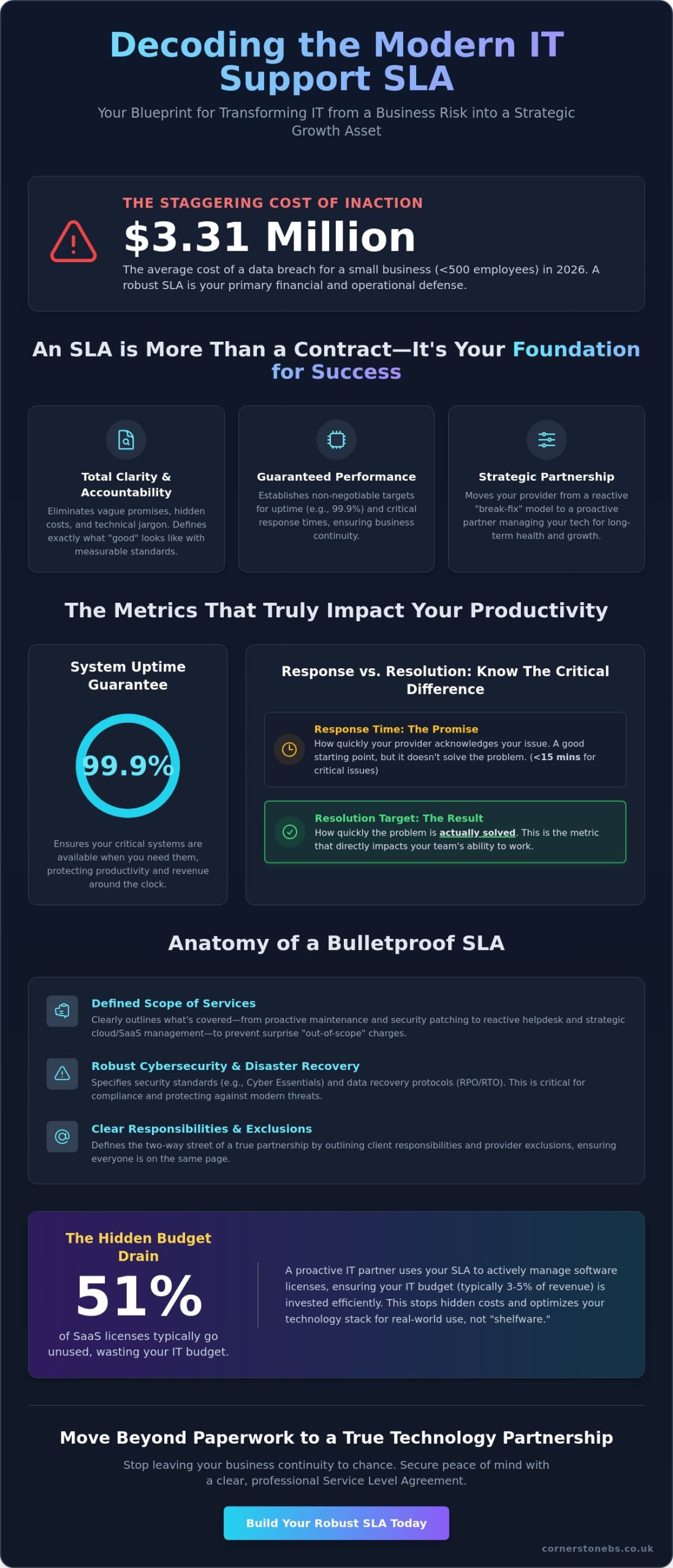
Many business owners get caught in the trap of “Response Time” guarantees. A provider might promise to answer your ticket within 15 minutes, but if that response is just an automated email saying “we’re looking into it,” your business is still at a standstill. When you look at an IT support service level agreement template, you must focus on Resolution Targets. This is the actual window of time it takes to fix the underlying issue and get your team back to work. In 2026, the benchmark for critical issues is a 15-minute to 1-hour first response, paired with a 2-4 hour resolution window. Anything less is just a vanity metric that doesn’t protect your bottom line.
Uptime is another critical figure that impacts your daily operations. A standard guarantee of 99.9% sounds impressive, but it still allows for nearly nine hours of downtime every year. For a North East firm, those hours can mean thousands in lost revenue. We aim for proactive management that prevents these outages before they occur. By categorising issues correctly, your provider can allocate resources where they matter most, ensuring that a minor glitch doesn’t take priority over a failing server infrastructure.
The Priority Matrix: How IT Issues Are Categorised
A professional matrix ensures your IT partner reacts with the appropriate urgency. We typically break these down into four levels:
- P1 Critical: A total system failure affecting all users, such as a complete network collapse. In 2026, these require a resolution within 4 hours.
- P2 High: A partial failure affecting a specific department or a critical business function, like your Business VoIP system going offline.
- P3 Standard: Individual user issues that are frustrating but don’t stop the whole business. A 24-business-hour resolution is the standard benchmark here.
- P4 Low: Minor requests or “how-to” questions that have no impact on service quality.
Service Credits and Accountability
An IT support service level agreement template is only effective if there are consequences for missing targets. A Service Credit is a pre-agreed financial penalty for SLA breaches. In 2026, we see a move toward sliding scales for these credits. If a provider misses a resolution target by an hour, you might receive a small credit. If they miss it by four hours, that credit increases exponentially. This keeps your IT partner focused on your success rather than just ticking boxes.
Accountability shouldn’t just happen when things go wrong. Regular service review meetings are essential to audit these metrics and ensure your technology is actually supporting your growth. It’s about having a “chat” about the data, not just the disasters. This award-winning approach ensures that your IT setup remains robust, tailored, and ready for whatever the business world throws at you next.
Common Pitfalls and How to Customise Your IT SLA
Signing a generic IT support service level agreement template is a risk you don’t need to take. While a standard document might cover the basics, it often fails to reflect the specific risk profile of your business. Most one-size-fits-all contracts are designed to protect the service provider’s margins rather than your operational uptime. You need a tailored agreement that evolves with your company. We’ve seen local firms across the North East struggle with contracts that lack the nuance required for modern, high-growth environments. Customisation isn’t just about adding clauses; it’s about ensuring your technology remains a seamless asset.
A major pitfall is ignoring the integration of cyber security services within the SLA. With data breach costs for small firms averaging $3.31 million in 2026, your agreement must specify incident response protocols and recovery time objectives. You should also watch out for hidden “fair use” clauses. Some providers cap the number of support tickets you can raise each month. This can lead to unexpected surcharges when you need help the most. Ensure your agreement explicitly includes data protection and GDPR compliance to safeguard your reputation and your bank balance.
Addressing Cloud and Hybrid Work Environments
In 2026, work happens everywhere. Your SLA must reflect this reality by defining support boundaries for employees working from home. Does your provider support home Wi-Fi issues, or only company-owned hardware? You should also demand clear uptime expectations for Microsoft 365 and Azure. If you’ve recently executed a Microsoft 365 migration, your SLA should align with your new cloud strategy. This ensures that your remote team stays productive and secure, no matter where they log in from.
The Importance of Flexibility and Scalability
Don’t settle for a contract that leaves you vulnerable to hidden costs or slow response times. Our award-winning team is ready to help you build a framework that offers true peace of mind. Contact Cornerstone Business Solutions today to discuss an IT partnership that actually fits your business goals.
Beyond the Template: Why Partnership Trumps Paperwork
An IT support service level agreement template provides a necessary legal framework, but it shouldn’t be the ceiling of your expectations. A contract exists to protect you when things go wrong; a true partnership exists to ensure they go right in the first place. We’ve seen many North East businesses get stuck in a cycle of “policing” their IT provider. They spend more time auditing response times than they do growing their operations. Our award-winning philosophy is different. We believe that if you’re constantly checking your SLA for breach penalties, the relationship has already lost its value. Peace of mind comes from knowing your systems are managed by a team that cares about your success as much as you do.
A proactive approach naturally reduces the need for SLA enforcement. When your technology is robust and tailored to your specific goals, the “break-fix” drama disappears. This shift in focus allows you to treat IT as a foundational element of your business continuity rather than a technical necessity that occasionally fails. By choosing a local partner who understands the regional landscape, you gain an ally who is invested in the community’s economic health. We don’t just hit targets; we aim to exceed them so your team can work without interruption.
The Cornerstone Approach to Service Excellence
We remove the “ticking clock” from your technology support. By offering unlimited helpdesk access, we encourage your staff to report minor glitches before they escalate into P1 critical failures. This transparency is backed by our proactive monitoring systems that work 24/7 to identify vulnerabilities. In 2026, the trend is moving toward predictable, flat-fee pricing models that range between $100 and $200 per user. This approach aligns our incentives with yours. We’re financially motivated to keep your systems running perfectly, not to wait for something to break so we can bill for extra hours.
Starting Your Journey to Better IT Support
Your first step toward better technology management is a thorough audit of your current agreement. Look for gaps where your current provider might be falling short, such as neglected hardware lifecycles or a lack of clear resolution targets. Most organisations should budget 3-5% of their annual revenue for IT costs, and you deserve to know exactly how that investment is being protected. We invite you to have a “chat” with our team about your current challenges and your long-term vision for growth.
Don’t let a vague contract hold your business back. It’s time to transition to a service model that prioritises your uptime and security above all else. Our experts are ready to help you build a framework that offers genuine reliability and support. Book a discovery session with our experts today to see how a proactive partnership can transform your business technology.
Secure Your Business Future with Clearer IT Standards
Your technology should be a silent engine for growth, not a source of constant frustration. By moving beyond a generic IT support service level agreement template, you ensure that your provider is held to resolution targets that actually protect your productivity. We’ve explored how prioritising proactive monitoring over reactive models can save your business from the $3.31 million average cost of a data breach. It’s about building a framework that offers total transparency and eliminates the fear of hidden costs or technical jargon.
As a multi-award-winning IT services provider, we’re proud of our North East roots and our status as partners with industry leaders like Microsoft, IBM, and Cisco. We don’t just provide paperwork; we deliver peace of mind through unlimited helpdesk access and a commitment to your long-term success. It’s time to demand more from your technology partner and secure the robust infrastructure your team deserves to stay competitive in 2026.
Ready to transform your IT setup? Download our guide to award-winning IT support and book a chat with our team to see how we can tailor a solution for you. Let’s have a friendly conversation about your goals and get your business moving forward with confidence.
Frequently Asked Questions
What is the difference between an SLA and an SLO?
An SLA is the formal agreement between a provider and a client, while an SLO (Service Level Objective) is a specific target within that contract. Think of the SLA as the overarching promise of quality and the SLO as the individual goal, such as a 99.9% uptime benchmark. While the SLA defines the consequences of failure, the SLO provides the technical team with a clear metric to track during daily operations.
How do I calculate service credits for an IT outage?
Service credits are usually calculated as a percentage of your monthly fee, based on the duration of the service breach. In 2026, many providers use a sliding scale where the credit amount increases the longer your systems remain offline. You apply these percentages to your total monthly spend as defined in your IT support service level agreement template, ensuring you’re financially compensated for lost productivity.
What is a typical response time for a P1 critical IT issue?
A typical response time for a P1 critical issue in 2026 ranges from 15 minutes to one hour. This metric confirms that an expert has acknowledged the ticket and begun active troubleshooting. It’s important to remember that this is just the “first response” window. You should also ensure your agreement includes a resolution target, which is typically set between two and four hours for total system failures.
Can I negotiate the terms in a standard IT support SLA template?
You can and should negotiate the terms in any IT support service level agreement template to reflect your unique business risks. Standard documents often miss the nuance of hybrid work or specific industry compliance requirements. Tailoring the metrics ensures your provider is accountable for the areas that matter most to your operations, rather than just following a generic list of services that might not fit your goals.
Does an SLA cover hardware replacement costs?
A standard SLA usually covers the labour and expertise required to resolve an issue, but it rarely includes the cost of new hardware parts. Unless you’ve opted for a specific managed hardware plan, you’ll likely be responsible for the price of replacement components. However, a proactive partner will monitor your infrastructure to identify aging hardware, helping you budget for replacements before they cause a critical system failure.
How often should an IT service level agreement be reviewed?
You should review your agreement at least once every 12 months to ensure it still aligns with your technology stack. As your business scales or adopts new cloud solutions, your support needs will change. Annual reviews help you identify unused SaaS licenses, which currently affect 51% of businesses, and allow you to update your security protocols to meet the latest 2026 industry standards and regulations.
What happens if my IT provider consistently misses their SLA targets?
Consistent failures typically trigger a series of financial penalties through service credits, eventually leading to a right-to-terminate clause. If a provider misses their targets for three consecutive months, most modern contracts allow you to exit the partnership without facing early termination fees. It’s essential to have these accountability measures clearly defined to ensure your business continuity isn’t compromised by poor performance or slow resolutions.
Is cyber security response usually included in a standard IT SLA?
Cyber security response is often treated as a tiered addition rather than a basic inclusion in standard agreements. With the average cost of a small business data breach reaching $3.31 million in 2026, you shouldn’t leave this to chance. Check that your agreement specifically outlines incident response times for security threats and disaster recovery protocols. This ensures your provider is ready to act immediately if your data is compromised.