
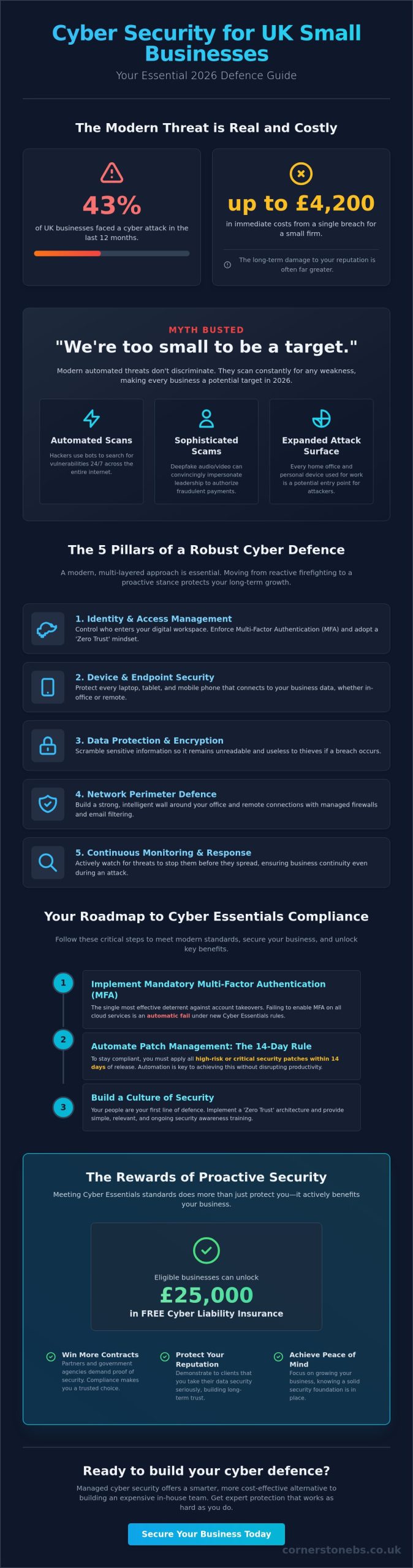
Did you know that 43% of UK businesses faced a cyber attack in the last 12 months? For a small firm, a single breach can cost up to £4,200 in immediate losses, but the damage to your hard earned reputation often hurts much more. You’re likely balancing the fear of data breaches with the confusion of shifting regulations like the latest Cyber Essentials updates. It’s frustrating when you want to stay secure but don’t have the budget for a massive, in-house IT department. We know you need protection that works as hard as you do.
This cyber security for small business UK guide offers a comprehensive roadmap to secure your digital assets, meet the latest 2026 standards, and gain total peace of mind. We’ll show you how to implement vital protections, from mandatory multi-factor authentication to the 14-day patching rule, without hindering your daily productivity. We’ll also explain how meeting these standards can even unlock £25,000 in free cyber liability insurance for eligible businesses. Let’s build a plan that turns security into a solid foundation for your future growth.
Key Takeaways
- Understand why modern automated threats mean no business is “too small” to target in 2026.
- Discover a proactive five-pillar framework that shifts your focus from simple antivirus to complete business stability.
- Follow our cyber security for small business UK guide to navigate Cyber Essentials compliance and secure your digital infrastructure.
- Learn how managed cyber security and proactive monitoring offer a smarter, more cost-effective alternative to building an expensive in-house team.
- Get a clear, actionable roadmap to protect your growth and achieve total peace of mind for your team and your customers.
The 2026 Cyber Threat Landscape for UK Small Businesses
In 2026, cyber security isn’t just a technical checkbox. It’s the engine room of your business continuity. For small firms across the UK, protecting your digital assets means protecting your ability to open the doors tomorrow morning. This cyber security for small business UK guide moves past the old idea that “it won’t happen to us.” Modern threats have changed. Five years ago, a clumsy email was the standard risk. Today, attackers use automated tools to scan for weaknesses every second of every day. Security is now about safeguarding your cash flow and your hard earned reputation.
Why 2026 is a Turning Point for SME Security
Small teams are facing a new level of sophistication. Deepfake technology now allows criminals to mimic the voice or even the video of a director in a call to the finance department. These “urgent” requests for bank transfers are incredibly convincing. Your hybrid workforce has also permanently expanded your attack surface. Every home office, personal laptop, and mobile device is a potential entry point for hackers. Additionally, larger partners and government agencies now demand proof of your security before signing contracts. Many businesses look to the Cyber Essentials scheme as a baseline to prove they’re a safe pair of hands for sensitive data.
The True Cost of a Breach in the UK
A breach costs much more than just the immediate recovery fee. While the average incident for a small firm ranges between £1,600 and £4,200 according to recent government data, the hidden costs are often far higher. These include:
- Lost Productivity: Days of downtime where your team can’t access files or email.
- Reputational Damage: The long term loss of trust from clients and partners.
- Legal Fees: Costs associated with data protection compliance and potential fines.
Recovering from that reputational hit takes years, not days. Partnering with a local expert for managed IT services helps you spot these threats before they become disasters. True cyber resilience is the ability to keep your business operating even while an attack is happening. It’s about staying strong and steady when things get difficult.
The Five Essential Pillars of a Robust SME Cyber Defence
Many business owners think a simple antivirus subscription is enough to keep them safe. In reality, modern protection requires a multi-layered approach that covers every corner of your operations. We use a structured framework to ensure no gaps are left open. This cyber security for small business UK guide breaks down your defence into five logical pillars. By focusing on these areas, you move from reactive “firefighting” to a proactive stance that protects your long term growth.
This approach aligns perfectly with the NCSC’s Small Business Guide, which provides the gold standard for UK firms. The five pillars are:
- Identity and Access Management: Controlling exactly who enters your digital workspace.
- Device and Endpoint Security: Protecting every laptop, tablet, and mobile phone your team uses.
- Data Protection and Encryption: Scrambling sensitive information so it remains useless to thieves.
- Network Perimeter Defence: Building a strong, intelligent wall around your office and remote connections.
- Continuous Monitoring and Response: Knowing exactly when a threat arrives so you can stop it before it spreads.
Securing the Human Element
Your people are your first line of defence. Multi-Factor Authentication (MFA) is the single most effective deterrent against account takeovers. Under the 2026 Cyber Essentials rules, failing to enable MFA on cloud services results in an automatic fail. We also advocate for a ‘Zero Trust’ architecture. This means your system never assumes a user is safe just because they’ve logged in once; it verifies every single request. This keeps your data secure even if a password is compromised. You can build a culture of security awareness by keeping training simple, relevant, and free from technical jargon.
Technical Safeguards Every SME Needs
Your hardware must be as smart as your team. Managed firewalls and advanced email filtering act as a digital sieve, catching the vast majority of phishing attempts before they ever reach an inbox. Automated patch management is also vital. To stay compliant in 2026, you must apply all high-risk security patches within 14 days of release. Integrating cloud solutions with built-in security protocols ensures your team stays productive from anywhere without leaving the door open. If you’re curious about how these layers fit your specific setup, our local cyber security team is always happy to help you find the right balance.
Debunking the ‘Too Small to Target’ Myth
One of the most dangerous phrases we hear in our local business community is: “We’re too small for hackers to care about.” It is a common belief that cyber criminals only chase big banks or global retailers. In reality, modern cyber crime is rarely personal. Most attacks are launched by automated bots that scan the entire internet for any open door. These scripts don’t check your turnover or your head count before they strike. For a hacker, a small business with weak defences is the perfect ‘low-hanging fruit’. It is an easy win that requires almost no effort compared to breaching a major corporation.
Think of these bots as digital burglars walking down a street, rattling every door handle. They don’t care if the house is a mansion or a bungalow. They only care about finding the one door that’s been left unlocked. This cyber security for small business UK guide is here to help you make sure your door is bolted tight. Security isn’t a luxury for the big players; it’s a fundamental requirement for staying in business today.
The SME as a Gateway
Your business might be a stepping stone to a much larger prize. Attackers frequently use a technique called ‘island hopping.’ They breach a smaller, less secure supplier to steal credentials or plant malware that eventually gives them access to a larger corporate partner’s network. Being identified as the ‘weak link’ in a supply chain can destroy your professional reputation overnight. This is why robust cyber security services are now a prerequisite for many UK tenders. If you cannot prove your systems are secure, you risk being locked out of lucrative contracts and partnerships.
Ransomware: The Equal Opportunity Threat
You might think your data isn’t worth stealing, but it is always valuable to you. Ransomware doesn’t necessarily aim to sell your data on the dark web. Instead, it locks you out of your own essential files. Imagine arriving at work to find your invoices, customer records, and emails are all encrypted and inaccessible. The psychological toll of seeing your operations grind to a halt is immense. According to the UK Government’s Cyber Security Breaches Survey 2025/2026, 43% of UK businesses experienced a cybersecurity breach or attack in the past 12 months. This statistic proves that no one is invisible. To help you build a solid foundation against these threats, the NCSC’s Small Business Guide provides a trusted starting point for protecting your livelihood.
A Practical Roadmap to UK Cyber Essentials and Compliance
Achieving a high standard of protection doesn’t have to be overwhelming. This cyber security for small business UK guide provides a clear path to securing your operations while building trust with your customers. By following a structured roadmap, you can transform your security from a source of anxiety into a competitive advantage. We recommend a step by step approach to ensure your defences are both thorough and manageable.
- Step 1: Conduct a comprehensive audit. You can’t protect what you don’t know you have. Start by listing all hardware, software, and cloud services your team uses.
- Step 2: Secure your internet connection. Use a managed firewall to create a boundary between your internal network and the outside world. Ensure all routers have their default passwords changed to something complex.
- Step 3: Control access. Limit admin privileges to only those who absolutely need them. Most staff should use standard user accounts for daily tasks to prevent accidental system wide changes.
- Step 4: Protect against malware. Deploy professional grade security software across all devices. This goes beyond simple antivirus to include active threat detection and email filtering.
- Step 5: Keep systems updated. As we mentioned earlier, applying high risk security patches within 14 days is essential. This prevents hackers from exploiting known vulnerabilities in your software.
Why Cyber Essentials Matters in 2026
Your certification is a badge of honour. It tells your partners, suppliers, and customers that you take their data seriously. Holding a government backed certification often gives you a commercial edge when bidding for new contracts. Many UK insurers also look favourably on certified firms, which can lead to more competitive premiums for your business. While the basic certification is a great start, Cyber Essentials Plus involves a hands on technical audit for even greater peace of mind.
Navigating UK GDPR and NIS2
Compliance is about more than just avoiding fines; it is about respecting the privacy of your clients. For small firms, this means having clear records of where data is stored and who can see it. A documented Incident Response Plan is also vital. It ensures your team knows exactly what to do if a breach occurs, which significantly reduces the impact on your business. Implementing a Microsoft 365 migration can help automate many of these compliance tasks by using built in labels and data protection policies. If you’re ready to secure your future, speak with our local cyber security experts today to start your journey toward total compliance.
Moving Beyond DIY: The Value of Managed Cyber Security
Managing your own digital safety is a full-time job. Many directors start with a “Break-Fix” mindset, only calling for help when something stops working or a file won’t open. This cyber security for small business UK guide highlights that reactive thinking is a dangerous gamble in 2026. Proactive Managed IT Support shifts the burden from your shoulders to a dedicated team of experts. We use continuous monitoring and threat detection to spot anomalies before they turn into business ending breaches. It’s the difference between calling the fire brigade and having a state-of-the-art sprinkler system already in place.
Cornerstone’s Proactive Shield
We’ve built our reputation on an award-winning approach to bespoke security. Our team doesn’t just provide a service; we act as your dedicated long-term partner. We take pride in our regional roots and our ability to simplify complex technical infrastructure into clear business benefits. We speak your language, not just “IT-speak.” This collaborative mindset ensures that your security feels like a foundational element of your stability rather than a technical hurdle. We’re here to help you navigate the 2026 landscape with confidence and clarity.
Taking the First Step Toward Security
A comprehensive security audit is the essential starting point for any ambitious growth strategy. It allows us to see exactly where you stand and what needs to be done to achieve total compliance. We’d love to have an informal conversation about your business goals and how we can help you protect them. There’s no pressure, just expert advice from a local team that cares about your success. When you’re ready to secure your digital assets for the long term, Book a Cyber Security Audit with Cornerstone Today and let’s start the conversation.
Secure Your Business Future and Fuel Your Growth
Cyber security in 2026 is no longer just a technical necessity; it’s the bedrock of your business’s emotional and financial stability. We’ve shown that automated threats don’t discriminate based on size and that proactive compliance is your ticket to better contracts and lower insurance. This cyber security for small business UK guide has outlined the roadmap, but you don’t have to walk it alone. Managing these risks yourself takes valuable time away from your core goals.
As a multi-award-winning IT services provider and strategic partner with Microsoft, IBM, and Cisco, we bring world-class expertise to our local community. Our UK-based helpdesk and proactive system monitoring ensure your operations stay smooth while you focus on what you do best. Let’s turn your digital defences into a powerful engine for long term growth. Secure your business future with a bespoke Cyber Security Audit from Cornerstone. We’re ready to help you build a safer, more resilient business today.
Frequently Asked Questions
Is cyber security expensive for a UK small business?
Cyber security is far less expensive than the cost of a successful breach. While there is an initial investment in tools like managed firewalls or email filtering, these costs are predictable and manageable compared to the average £4,200 loss a small firm faces after an attack. Implementing basic cyber security for small business UK guide practices, such as strong password policies and multi-factor authentication, actually costs very little but prevents the vast majority of common threats.
What is the most common cyber attack on UK SMEs?
Phishing is currently the most frequent threat, affecting 85% of UK businesses that reported a breach in the last year. These attacks use deceptive emails to trick your staff into revealing sensitive passwords or making fraudulent payments. Because these threats target people rather than just software, they require a combination of smart technical filters and regular awareness training for your team to stay safe.
Does my business really need Cyber Essentials certification?
Yes, holding this certification is rapidly becoming a standard requirement for doing business in the UK. Many government contracts and large corporate supply chains now insist on it as a minimum security baseline. Beyond opening doors to new tenders, it provides a clear framework that reduces your overall risk and can even help lower your professional indemnity insurance premiums.
How can I tell if my business has already been breached?
Signs of a breach are often subtle, such as unexpected password reset emails, slow system performance, or new software icons appearing without your permission. You might also hear from a client that they’ve received a suspicious email from your account. Proactive cyber security for small business UK guide monitoring is the most reliable way to catch these anomalies early before they cause significant damage to your operations.
Is antivirus software enough to protect my business in 2026?
Antivirus alone is no longer sufficient to stop modern, sophisticated cyber criminals. Today’s attacks often use “fileless” malware or social engineering tactics that can bypass traditional scanners entirely. You need a multi-layered defence strategy that includes managed firewalls, secure cloud solutions, and identity management to ensure your business remains resilient against evolving threats.
What should I do if I suspect a phishing email has been opened?
Disconnect the affected device from your network immediately to stop any potential malware from spreading. You should then change all passwords associated with that user from a different, secure device and alert your IT provider to perform a deep system scan. Reporting the incident to Action Fraud helps the wider UK business community by tracking these criminal patterns.
How does managed IT support differ from hiring an in-house IT person?
Managed IT support gives you access to a whole team of specialists with a wide range of skills for a fraction of the cost of one full-time salary. You don’t have to worry about holiday cover, training costs, or recruitment headaches. It is a scalable solution that provides high-level expertise and proactive monitoring, ensuring your systems stay stable as your business grows.
Can cyber security help me win more business contracts?
Absolutely, robust security is a major competitive advantage in the modern marketplace. Potential partners and clients are much more likely to trust a firm that can prove its data is handled securely. By demonstrating high security standards and certifications, you position your business as a reliable, low-risk partner, which is often the deciding factor in winning lucrative new contracts.
Tags: cyber attacks, Cyber Essentials, Cyber Security, Data Protection, small business, SME security, UK business