Your biggest cyber threat probably isn’t a sophisticated state-sponsored attack. It’s the routine vulnerability your business doesn’t know it has. For SMEs across the region, finding reliable cyber security services in North East England that genuinely understand your business, rather than offering a generic, off-the-shelf fix, remains one of the most pressing challenges of 2026.
You’re right to be concerned. The consequences of a serious data breach aren’t just financial; they can shake the confidence of your clients, disrupt your operations overnight, and leave you scrambling to meet UK compliance standards at the worst possible moment. That feeling of uncertainty is something business owners across the North East know all too well.
This guide is here to change that. Drawing on the expertise of multi-award-winning specialists with partnerships across Microsoft, IBM, and Cisco, we’ll walk you through what genuinely proactive cyber security looks like in practice, which threats are most relevant to your business right now, and how a bespoke security partnership can give you the peace of mind to focus on growth. By the end, you’ll know exactly what to look for in a trusted local partner and how to build a resilient, compliant security foundation for the year ahead.
Key Takeaways
- Traditional firewalls are no longer enough – modern cyber security demands a holistic, multi-layered defence strategy built for today’s cloud-first business environment.
- Businesses seeking reliable cyber security services across the UK should prioritise bespoke, proactive partnerships over generic, off-the-shelf solutions that leave critical gaps unaddressed.
- Managed security offers round-the-clock protection that in-house IT teams working standard hours simply cannot match against threats that don’t keep office hours.
- A structured cyber security audit is the essential first step toward building genuine business resilience – you can’t protect what you haven’t properly assessed.
- The right security partner acts as a long-term strategic ally, not just a vendor, giving you the confidence to focus on growth rather than risk.
Beyond the Firewall: Why Modern Cyber Security is Non-Negotiable
A firewall was once considered the cornerstone of business protection. Today, it’s closer to a locked front door on a building with open windows. The digital environment your business operates in has changed fundamentally, and a single perimeter defence simply can’t keep pace with the threats that exist in 2026.
Modern cyber security isn’t a product you install and forget. It’s a holistic, multi-layered defence strategy that wraps around every element of your business, from your cloud-hosted Microsoft 365 environment and remote working endpoints to your network infrastructure and the human behaviours of your own team. The shift from reactive “fixing” to proactive “prevention” isn’t just best practice; it’s the only approach that genuinely works.
The 2026 threat landscape has made this non-negotiable. AI-driven phishing attacks now generate highly personalised, convincing emails at scale, making it far harder for employees to spot the difference between a legitimate message and a malicious one. Automated ransomware tools can identify vulnerabilities, infiltrate systems, and encrypt critical data faster than a traditional IT team working standard hours can respond. These aren’t theoretical risks. They’re the daily reality for businesses across the UK.
The True Cost of a Data Breach
The financial damage from a breach extends far beyond any immediate ransom payment or regulatory fine. Operational downtime alone can cripple a business for days or weeks, with every idle hour translating directly into lost revenue and missed opportunities. Beyond the balance sheet, the reputational damage can be longer-lasting and harder to quantify. Clients who lose confidence in your ability to protect their data don’t always announce their departure; they simply don’t return. For SMEs, rebuilding that trust takes time that many businesses don’t have.
The Evolution of Digital Threats in 2026
Threats haven’t just grown more frequent; they’ve become sharper, faster, and more targeted at businesses that assume they’re too small to be noticed. Social engineering, where attackers manipulate people rather than technology to gain access to sensitive systems, has become one of the most effective and difficult-to-detect attack vectors in 2026. Defending against it requires more than software. It demands a security-first culture embedded throughout your organisation.
For businesses seeking cyber security services in North East England, this cultural shift is where genuine resilience begins. A bespoke security partnership, built around the specific shape of your business rather than a generic package, is what separates businesses that recover quickly from those that don’t recover at all. Understanding the true scope of modern threats is the first step toward building that foundation.
Proactive Protection: The Core Elements of a Secure Business Infrastructure
Knowing that threats exist is one thing. Having the infrastructure to stop them is another entirely. For SMEs across the region, the gap between awareness and genuine protection is often where breaches happen. Building a robust security stack isn’t about buying the most expensive tools; it’s about layering the right defences across every surface of your business, and maintaining them consistently.
This is where Security by Design becomes a practical philosophy rather than a buzzword. For growing businesses, it means building security into every new system, process, and digital workflow from the outset, rather than bolting it on as an afterthought when something goes wrong. Managed IT Support plays a critical role here, ensuring that security patches are applied promptly, configurations stay current, and vulnerabilities are closed before they’re exploited. A missed patch isn’t a minor oversight; it can be the precise entry point an attacker needs.
Cloud security deserves particular attention. Protecting a cloud-hosted environment isn’t simply a digital version of traditional on-premise security. Data flowing between users, applications, and cloud platforms creates a far broader and more dynamic attack surface. Access controls, identity verification, and data encryption all need to be actively managed, not assumed. If your business has migrated to cloud solutions without revisiting your security posture, that’s a gap worth addressing urgently.
Endpoint Security and Device Management
Every device connecting to your business network is a potential entry point. Laptops, mobile phones, tablets used by remote workers – each one represents a door that needs to be properly secured. For distributed teams, remote monitoring tools allow your security partner to detect unusual behaviour and respond before damage is done. Microsoft 365 includes a strong suite of built-in security features, from multi-factor authentication to device compliance policies, but these tools only deliver their full value when they’re correctly configured and actively managed as part of a wider strategy.
Network Integrity and Secure Connectivity
A secure network is the backbone of everything else. VPNs and encrypted Wi-Fi connections protect data in transit, particularly for employees working from home or client sites. Network infrastructure support ensures that your connectivity remains both fast and safe, without compromising one for the other. Regular security audits and structured penetration testing are equally essential; they reveal how your defences actually perform under pressure, not just how they look on paper.
For businesses exploring cyber security services in North East England, this layered approach is the difference between a security posture that holds and one that doesn’t. If you’d like to understand where your current infrastructure stands, speak to the team at Cornerstone Business Solutions about a thorough security assessment tailored to your business.
Managed Security vs. In-House IT: Evaluating the Best Path for Growth
There’s a fundamental mismatch at the heart of most SME IT setups. General IT maintenance and modern cyber security are not the same discipline. Keeping printers running, managing software licences, and troubleshooting connectivity issues are all valuable skills. But detecting a sophisticated intrusion attempt, responding to a zero-day exploit, or managing a security incident in real time requires an entirely different depth of specialist knowledge. Asking one person, or a small internal team, to do both well is an increasingly unrealistic expectation.
Cyber threats don’t observe office hours. Attacks frequently occur outside of the standard working day, precisely because that’s when defences are at their thinnest. An in-house IT team working a 9-to-5 schedule, however talented, creates a predictable window of reduced visibility. A managed security partner fills that gap with consistent, structured monitoring, ensuring that unusual activity doesn’t go unnoticed simply because it happened at the wrong time.
Outsourcing security also frees your internal team to focus on what drives your business forward. Instead of being pulled into reactive firefighting, they can concentrate on the projects, improvements, and operational goals that actually generate value. That’s not a reduction in capability; it’s a smarter allocation of it.
Access to Global Expertise and Partners
Working with a multi-award-winning provider that holds established partnerships with Microsoft, IBM, and Cisco means you’re not relying on a single person’s knowledge base. You’re accessing a pool of specialists who work across these platforms daily, who understand how global threat trends develop, and who receive early intelligence about emerging vulnerabilities before they become widespread problems. Internal IT teams, however capable, often carry a genuine knowledge gap in niche security disciplines simply because it’s not their primary focus. That gap is exactly where attackers look for opportunity. For businesses evaluating cyber security services in North East England, this breadth of expertise is one of the clearest advantages a managed provider delivers.
Predictable Costs and Scalable Protection
Fixed-fee managed security makes budgeting straightforward. You know what you’re spending each month, without the unpredictable costs that come with incident response, emergency consultancy, or unplanned recruitment. As your business grows, whether you’re adding new users, opening additional locations, or expanding your cloud footprint, your security provision scales with you rather than lagging behind. Compare that to the alternative: hiring a dedicated Chief Information Security Officer carries a significant salary commitment, and that’s before factoring in training, tooling, and ongoing development. For most SMEs, managed security delivers considerably more coverage for a more manageable investment.
The right partner doesn’t just protect your business. They grow alongside it, adjusting your security posture as your needs evolve and ensuring that resilience remains a constant, not a catch-up exercise.
Securing Your Future: A Practical Roadmap to Business Resilience
Awareness without action leaves your business exactly where it started. The good news is that building genuine resilience doesn’t require an overnight transformation. It requires a structured, prioritised approach that addresses your most critical vulnerabilities first and builds outward from there. Here’s what that looks like in practice.
Start with a comprehensive cyber security audit. You can’t protect what you haven’t properly mapped, and most SMEs are surprised by what a thorough assessment uncovers. Misconfigured cloud permissions, unpatched legacy systems, weak password policies across remote devices; these aren’t edge cases. They’re common findings that represent real, exploitable risk. Once you have a clear picture of your current posture, the path forward becomes considerably less daunting.
From there, prioritise high-impact changes that close the most dangerous gaps quickly. Multi-Factor Authentication is the single most effective step most businesses can take immediately. It doesn’t require complex infrastructure, but it dramatically reduces the risk of compromised credentials being used to access your systems. Pair that with updated access controls and a reviewed patching schedule, and you’ve already meaningfully reduced your exposure before moving on to more layered protections.
Disaster recovery sits at the far end of this roadmap, but it’s no less critical. Even the most robust defences aren’t a guarantee. A well-tested disaster recovery plan ensures that if the worst does happen, your business can restore operations quickly, with minimal data loss and without the panic that comes from having no plan at all.
Achieving Cyber Essentials and Compliance
The UK Government’s Cyber Essentials scheme gives businesses a clear, independently verified baseline of protection. Achieving certification isn’t just a security milestone; it’s increasingly a commercial one. Many public sector contracts and larger enterprise tenders now require suppliers to hold Cyber Essentials as a minimum. If you’re looking to grow your client base or win government work, certification can be the difference between being considered and being ruled out entirely. With NIS2 requirements also shaping how organisations across the UK and Europe manage and report cyber risk in 2026, building compliance into your security roadmap from the outset avoids costly reactive adjustments later. For businesses seeking cyber security services in North East England, a bespoke partner can guide you through the certification process efficiently, without it becoming a distraction from day-to-day operations.
Implementing a Zero Trust Architecture
Zero Trust is built on a simple but powerful principle: never trust, always verify. Rather than assuming that anyone inside your network is safe, every user and every device must prove they’re authorised, every time they request access. For businesses with remote workers connecting from multiple locations and devices, this approach closes the gaps that traditional perimeter-based security simply can’t address. It’s one of the most significant shifts in modern security thinking, and understanding what Zero Trust security means for your business is a strong next step toward building a genuinely resilient infrastructure.
Ready to take the first step? Talk to the team at Cornerstone Business Solutions about a tailored security audit that gives you a clear, honest picture of where your business stands and exactly what to do next.
Partnering for Peace of Mind: The Cornerstone Approach to Cyber Security
There’s a meaningful difference between buying a security product and building a security partnership. Products get installed and forgotten. Partners stay engaged, ask the right questions, and adapt as your business changes. That distinction sits at the heart of how Cornerstone Business Solutions works with clients across the region.
As a multi-award-winning provider with established partnerships across Microsoft, IBM, and Cisco, Cornerstone brings a depth of expertise that goes well beyond what any single vendor relationship can offer. But the accolades aren’t the point. What matters is how that expertise translates into practical, day-to-day protection for your business. Not a generic package handed over at sign-off. A bespoke security strategy built around the specific shape of how you operate.
Bespoke Solutions for Every Sector
Proactive monitoring sits at the centre of this. Rather than waiting for something to go wrong before responding, Cornerstone works to identify and address risk before it becomes an incident. That continuity of oversight is what keeps operations running without disruption. For businesses looking at broader IT support alongside their security needs, it’s worth exploring managed IT services in Teesside to understand the full scope of support available.
The Foundation of Your Business Growth
For businesses seeking cyber security services in North East England, Cornerstone offers something that’s harder to find than it should be: expert-level protection delivered with genuine regional understanding and a team that’s genuinely invested in your success. No jargon. No overselling. Just honest, practical guidance from people who know this landscape.
The first step is simply a conversation. If you’re ready to understand where your business stands and what a tailored security strategy could look like, book your security audit today and take the first step toward building something genuinely resilient.
Your Next Step Toward a More Resilient Business
The threat landscape isn’t waiting for businesses to catch up. Across the North East, SMEs that treat cyber security as a one-time purchase rather than an ongoing commitment are the ones that find themselves most exposed when something goes wrong. The businesses that thrive are those that build resilience into their foundations early, with the right partner alongside them.
Three things matter most as you move forward: knowing your current vulnerabilities through a proper audit, choosing protection that’s built around your business rather than borrowed from a template, and working with specialists who stay engaged long after the initial setup. That’s what genuine cyber security services in North East England should look like in practice.
Cornerstone Business Solutions brings multi-award-winning expertise, official partnerships with Microsoft, IBM, and Cisco, and proactive 24/7 system monitoring to every client relationship. Not as a vendor, but as a long-term partner invested in your growth.
The first conversation costs nothing. Book a bespoke cyber security audit with our multi-award-winning team and take the first confident step toward protecting everything you’ve built.
Frequently Asked Questions About Cyber Security Services in North East England
What is the difference between cyber security and IT support?
IT support keeps your systems running day to day, covering things like software updates, hardware troubleshooting, and connectivity issues. Cyber security is a specialist discipline focused specifically on protecting your business from threats, detecting intrusions, managing vulnerabilities, and ensuring your data stays safe. The two disciplines complement each other, but they’re not interchangeable, and assuming one covers the other is a gap attackers actively exploit.
Many SMEs discover this distinction at the worst possible moment. A capable IT support team may keep your printers working and your email flowing, but responding to a live ransomware incident or configuring a Zero Trust architecture requires a different depth of specialist knowledge entirely.
Is Cyber Essentials a legal requirement for UK businesses in 2026?
Cyber Essentials isn’t a blanket legal requirement for all UK businesses, but it functions as a commercial necessity for many. If your business supplies goods or services to the public sector, Cyber Essentials certification is typically a contractual requirement rather than optional. Some larger enterprise clients and insurers also require it as a minimum standard before entering into agreements.
Beyond contractual obligations, certification gives you an independently verified baseline of protection that carries genuine weight with clients and partners. For businesses actively seeking growth, achieving it removes a barrier that can otherwise quietly disqualify you from opportunities before you’ve had a chance to compete.
How often should my business conduct a cyber security audit?
At minimum, a thorough cyber security audit should happen annually. In practice, any significant change to your business, such as adopting new cloud platforms, expanding your team, opening additional locations, or onboarding a major new client, warrants a review of your security posture at that point too. Threats evolve quickly, and an audit that was accurate twelve months ago may not reflect your current risk exposure.
Regular audits aren’t a sign that something’s wrong. They’re how resilient businesses stay ahead of vulnerabilities rather than discovering them after an incident. Think of it as the same logic as a financial audit: essential, routine, and far cheaper than the alternative.
Can managed cyber security services help with insurance premiums?
Yes, demonstrably so in many cases. Cyber insurers assess risk when calculating premiums, and businesses that can evidence strong security controls, active monitoring, and certifications like Cyber Essentials typically present a lower risk profile. That can translate directly into more favourable terms or reduced premiums. Some insurers now ask detailed questions about your security posture as a standard part of the application process.
Beyond premiums, having documented security measures in place can also affect whether a claim is accepted if an incident does occur. Insurers increasingly scrutinise whether reasonable precautions were taken. A managed security arrangement provides that evidence trail in a way that ad hoc measures simply don’t.
What are the most common cyber threats facing UK SMEs right now?
Phishing remains the most prevalent threat, with attackers using increasingly convincing, personalised emails to trick employees into revealing credentials or authorising fraudulent payments. Ransomware continues to cause serious operational disruption, often entering through unpatched systems or compromised remote access tools. Business email compromise, where attackers impersonate senior staff or trusted suppliers to redirect payments, is also a growing concern for SMEs across the UK.
Social engineering more broadly, manipulating people rather than technology to gain access, is particularly difficult to defend against with software alone. It’s why staff awareness sits alongside technical controls as a core component of any credible security strategy for businesses seeking cyber security services in North East England.
How does Microsoft 365 help with business cyber security?
Microsoft 365 includes a strong set of built-in security features that, when properly configured, provide meaningful protection. Multi-Factor Authentication reduces the risk of compromised credentials being used to access your accounts. Device compliance policies help ensure that only authorised, up-to-date devices can connect to your environment. Threat protection tools within the platform can detect and respond to suspicious activity across email, files, and user behaviour.
The critical word is “configured.” These tools deliver their full value only when they’re actively set up and managed as part of a wider security strategy, not left at default settings. Many businesses are paying for Microsoft 365 licences that include security capabilities they’re not yet using, which is a straightforward gap worth closing.
What should I do if I suspect my business has been breached?
Act quickly and don’t attempt to investigate alone. Isolate any affected devices from your network immediately to limit the spread of any potential compromise, but don’t switch them off entirely, as this can destroy forensic evidence needed to understand what happened. Contact your IT security provider or managed security partner as your first call; they’ll have incident response processes to follow that protect both your systems and your legal position.
If personal data belonging to clients or employees may have been accessed, you have a legal obligation to assess whether the incident needs to be reported to the Information Commissioner’s Office within 72 hours under UK GDPR. Document everything from the moment you suspect a breach. A clear timeline of events is essential for both the investigation and any subsequent regulatory or insurance process.
How long does it take to implement a full cyber security strategy?
The honest answer is that it depends on the size and complexity of your business, but meaningful protection doesn’t have to wait for a complete strategy to be in place. High-impact measures like enabling Multi-Factor Authentication, reviewing access controls, and applying outstanding patches can be implemented quickly and reduce your exposure significantly in a short timeframe. These aren’t replacements for a full strategy; they’re the sensible first steps while the broader work progresses.
A comprehensive security strategy, covering network integrity, endpoint management, cloud security, staff awareness, and disaster recovery, typically takes several weeks to assess, design, and implement properly for an SME. Rushing it creates gaps. The right approach is prioritised and structured, addressing your most critical vulnerabilities first and building outward from there with a partner who understands your specific environment.
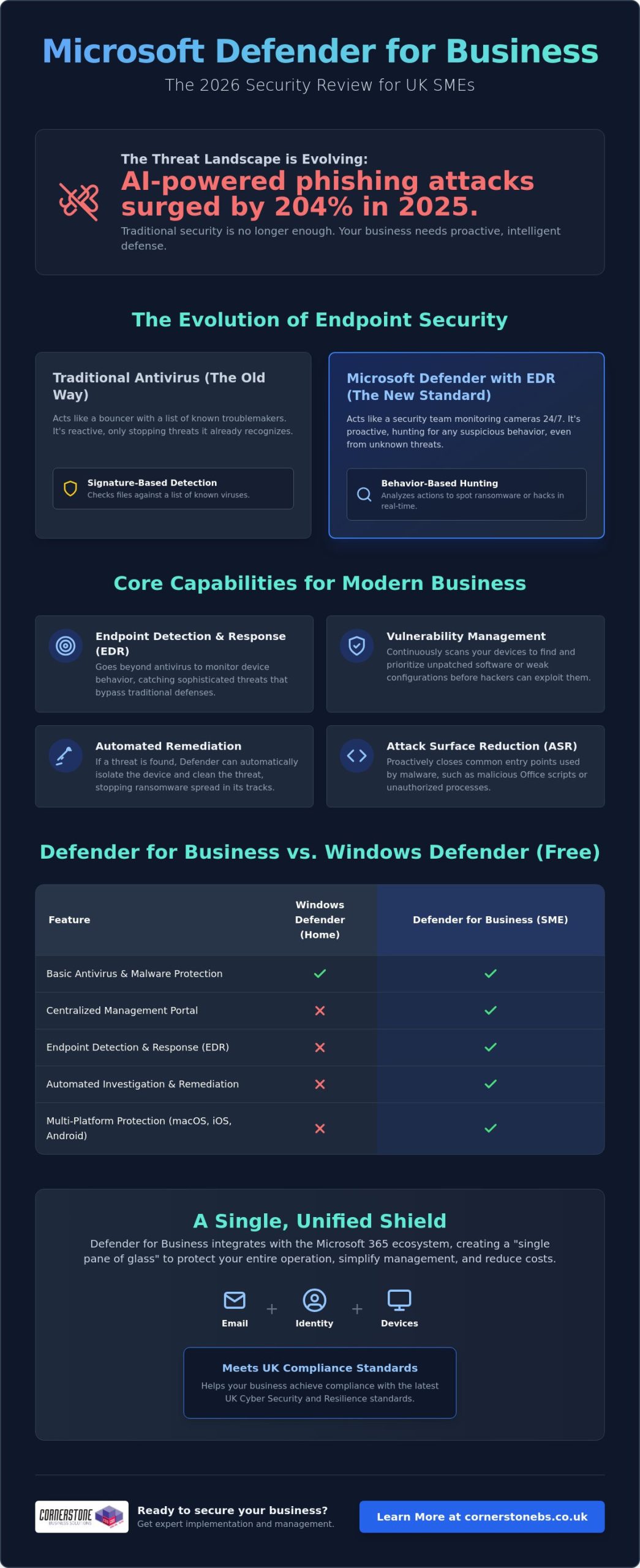
Did you know that AI-powered phishing attacks surged by 204% in 2025? For many UK business owners, keeping up with these sophisticated threats while managing a remote team and juggling multiple software subscriptions feels like an uphill struggle. You need enterprise-grade security that doesn’t break the bank or complicate your workday. This Microsoft Defender for Business review provides an expert, independent look at whether Microsoft’s 2026 security suite offers the robust protection your local business needs to stay safe and compliant.
It’s a common concern that “built-in” tools might not be enough to stop a modern ransomware attack. We’ll show you exactly how this platform has evolved into a sophisticated powerhouse. You’ll learn how features like automatic attack disruption and the new Defender Suite for Business Premium can help you consolidate your security stack to save money. We’ll also examine how it helps you meet the standards of the upcoming UK Cyber Security and Resilience Bill. By the end, you’ll know if this is the right foundation for your company’s stability and emotional security.
In this article, you will discover:
- How our Microsoft Defender for Business review identifies its evolution from a basic antivirus into a sophisticated EDR powerhouse for UK SMEs.
- The technical mechanism behind endpoint detection and response (EDR) and why it’s vital for spotting threats that bypass traditional perimeters.
- Ways to simplify your security management using the “single pane of glass” approach to consolidate email, identity, and device protection.
- A clear comparison of the true ROI between Microsoft’s integrated suite and third-party rivals like Sophos or CrowdStrike.
- Expert guidance on whether consolidating your security stack will help you achieve compliance with the latest UK cyber standards.
Microsoft Defender for Business isn’t just a basic antivirus tool. It’s a comprehensive, enterprise-grade security platform tailored for the specific needs of UK SMEs. If you’re running a company with up to 300 employees, this is Microsoft’s definitive answer to the sophisticated ransomware and phishing threats we see daily. You can access it as a standalone subscription or as a core component of the Microsoft 365 Business Premium package. This flexibility is a major reason why this Microsoft Defender for Business review ranks the tool so highly for growing teams.
The platform represents a massive shift in how we think about digital protection. Looking back at the history of Microsoft’s security software, the journey from basic scanners to a full Endpoint Detection and Response (EDR) system is impressive. In 2026, it doesn’t just wait for a virus to appear. It actively hunts for suspicious behaviour. EDR is the real game-changer here. Traditional antivirus only checks files against a list of known “bad” signatures. EDR looks at actions. If a laptop suddenly starts encrypting files at 2 AM, Defender for Business recognises that as ransomware behaviour and shuts it down instantly.
Defender for Business vs. Windows Defender
While the “free” Windows Defender is great for home users, it lacks the professional tools your business requires for compliance and oversight. Microsoft Defender for Business includes a centralised management portal. This allows your IT team or partner to see the health of every device from one screen. It also brings automated investigation and remediation to the table. This means the system can often fix a security issue before you even know it exists. Crucially, it protects your entire fleet. It covers macOS, iOS, and Android devices, not just your Windows PCs.
The 2026 Feature Set: AI and Beyond
In 2026, Microsoft Copilot for Security acts as an intelligent assistant that helps you understand and respond to complex technical threats using natural language queries. This AI integration works alongside next-generation protection and Attack Surface Reduction (ASR) rules to harden your devices against common entry points for hackers. Because it’s part of the wider Microsoft 365 ecosystem, it shares data seamlessly with your email and identity settings. This Microsoft Defender for Business review finds that this level of integration creates a unified shield that’s incredibly difficult for attackers to penetrate. It turns your security from a collection of separate tools into a single, proactive defence system.
Traditional antivirus is like a lock on your front door. It’s useful, but it won’t stop someone who has already climbed through the window. That’s why this Microsoft Defender for Business review focuses heavily on Endpoint Detection and Response (EDR). Instead of just looking for known viruses, EDR monitors the behaviour of your devices. If a laptop suddenly starts communicating with a suspicious server in the middle of the night, the system flags it as a potential breach. This allows you to catch threats that have already bypassed your initial defences, providing a much higher level of security for your business data.
Vulnerability management is another heavy hitter in the 2026 feature set. Most successful attacks exploit unpatched software. Defender for Business constantly scans your entire fleet to identify outdated applications or weak configurations. It gives you a clear, prioritised list of what needs fixing. You don’t have to be a security expert to understand where your risks lie. The system also uses Attack Surface Reduction (ASR) rules to close the common “doors” hackers use, such as blocking malicious scripts in Office apps or stopping unauthorised processes from running on your servers.
The real magic happens with automated remediation. If the system detects a high-risk threat, it can “self-heal” by automatically isolating the infected device from the rest of your network. This stops the spread of ransomware in its tracks while the system investigates and cleans the threat. For a deeper look at how this performs in complex environments, The MSP Reality Check for Defender highlights how these automated tools save hours of manual investigation. If you’re looking to strengthen your local infrastructure, our team can help you implement these tools through managed IT support tailored for your specific needs.
Real-World Threat Protection
In 2026, Defender’s AI-driven alerts have significantly reduced “notification fatigue” for business owners. The system is smart enough to group related events into a single incident, so you aren’t buried under a mountain of minor warnings. It performs exceptionally well against zero-day exploits and modern ransomware variants. This proactive stance aligns perfectly with the UK National Cyber Security Centre (NCSC) guidelines for effective incident management and protective monitoring.
Cross-Platform Capabilities
Managing a hybrid team across the UK shouldn’t feel like a security nightmare. Defender for Business provides a consistent experience whether your staff are using company laptops or their own mobile devices (BYOD). It offers robust protection across Windows, Linux, macOS, iOS, and Android. You can manage every device from a single dashboard, ensuring your security standards remain high even when your team is working from a home office or a local coffee shop. This Microsoft Defender for Business review finds that this cross-platform reach is essential for modern, flexible UK SMEs.
Managing security shouldn’t feel like a second job for a busy business owner. One of the standout findings in our Microsoft Defender for Business review is the “single pane of glass” advantage. Instead of hopping between five different websites to check your antivirus, email filters, and user passwords, everything lives in one central portal. This level of integration is a breath of fresh air for teams that are already stretched thin. It allows your IT team or partner to see exactly what’s happening across your entire network without the friction of multiple logins.
Microsoft provides a simplified setup wizard that gets you up and running quickly. This is great for a start, but “set and forget” is a dangerous myth in the world of cyber security. While the wizard applies sensible defaults, it doesn’t understand the specific software your local business relies on. We often see companies struggle when a default policy accidentally blocks a legitimate line-of-business application. True security requires fine-tuning these policies to balance ironclad protection with daily productivity. Proactive monitoring is essential to ensure that your “exposure score” remains low as new threats emerge.
As a managed IT support provider, we use these tools to provide proactive care for our clients. We don’t just wait for an alarm to go off. We use the vulnerability management data to patch systems before a hacker can exploit them. This proactive stance is what turns a piece of software into a genuine business asset. It’s about creating an atmosphere of reliability where your staff can work without fear of a digital disaster.
Integration with Microsoft 365 Business Premium
The bundle is the most popular choice for UK SMEs because it offers incredible value. When you combine Defender with identity protection and conditional access, you create a ring-fence around your data. If you’re considering making the switch, our Microsoft 365 Migration for Business UK guide outlines how to move your team safely. This all-in-one approach ensures that security settings follow your staff, whether they’re in the office or working remotely across the UK.
The Learning Curve for Small Teams
Let’s be honest about the technical side. Defender for Business is a professional tool. While the interface is clean, the depth of features can be overwhelming for someone without a technical background. A common pitfall during initial deployment is misconfiguring the automated response levels, which can lead to unnecessary business downtime. If you don’t have a dedicated internal IT person, the platform’s advanced settings might feel a bit daunting. This is when a managed security service becomes a smart investment, giving you peace of mind that experts are handling the complexity for you.
The “Hidden Cost” of third-party suites often goes beyond the subscription fee. You have to account for the time your team spends on training, the complexity of integrating different platforms, and the potential for “blind spots” between disconnected tools. In 2026, performance benchmarks show that Defender for Business stacks up impressively against industry giants like Sophos and CrowdStrike. While those rivals offer excellent “best of breed” features, Microsoft wins on integration ROI. For a typical 50-user UK business, the Total Cost of Ownership (TCO) is significantly lower when security is baked into the existing productivity ecosystem rather than bolted on as an afterthought.
Feature Comparison: Integrated vs. Standalone
- EDR Capabilities: Defender for Business offers full endpoint detection and response, matching the sophisticated threat hunting found in premium standalone suites.
- AI Integration: Microsoft’s 2026 AI-driven alerts group related events together, reducing the manual workload compared to standard AV tools.
- Mobile Protection: While some niche rivals require extra plugins for mobile, Defender provides native protection for iOS and Android as part of the core package.
- Specialised Features: Standard AV might offer specific legacy support, but Microsoft wins on seamless identity and cloud integration.
ROI for UK SMEs
The return on investment isn’t just about lower software bills. It’s about business resilience. Implementing a robust EDR platform is a major step toward achieving Cyber Essentials certification. This can often lead to lower cyber insurance premiums for UK businesses. When you move away from fragmented security, you reduce the risk of a successful breach and the devastating downtime that follows. You can explore how these tools fit into a broader strategy in our Cyber Security Services guide. If you want to see how much you could save by consolidating your stack, chat with our local team today for a professional evaluation.
Our comprehensive Microsoft Defender for Business review concludes that for the vast majority of UK SMEs, this platform is the most logical choice for 2026. If your team already relies on the Microsoft 365 ecosystem for daily work, the integration benefits are simply too strong to ignore. You aren’t just buying another security tool; you’re activating a proactive defence system that understands your users, your data, and your devices. It’s the ideal fit for business owners who want to consolidate their technology stack and remove the “noise” of managing multiple, disconnected subscriptions.
This solution is best for SMEs looking to achieve enterprise-level protection without the enterprise-level price tag or complexity. It provides the peace of mind that comes from knowing your “front door” is locked and your internal systems are being monitored for suspicious behaviour. However, it might not be the right fit for highly specialised environments that require deep, non-Microsoft technical hooks or legacy support for very old, proprietary systems. For everyone else, the combination of EDR, automated remediation, and mobile protection makes it a foundational element of a modern business strategy.
Next Steps for Your Business
Auditing your current setup is the first logical step. You might be surprised to find you’re already paying for features you aren’t using; or worse, that you have overlapping subscriptions creating unnecessary complexity. Once you have a clear picture of your current licensing, you can plan a phased migration. We recommend starting with a pilot group to fine-tune your policies before rolling out Defender to your entire fleet. This ensures that your security stays tight without interrupting the flow of your business. We always invite local business owners to a conversation about bespoke security audits to help identify these hidden opportunities for improvement.
The Cornerstone Advantage
At Cornerstone, we pride ourselves on being more than just a service provider. We are a dedicated long-term partner for UK businesses. Our multi-award-winning expertise allows us to deliver bespoke technology solutions that are tailored to your geographical roots and specific industry needs. We view proactive monitoring as a foundational element of business stability and emotional security for our clients. We’re proud of our regional identity and our ability to simplify complex technical concepts for the benefit of the business owner. If you’re ready to strengthen your posture, you can book a Microsoft 365 Security Review with our experts to ensure your company remains resilient in the face of modern threats.
Protecting your company in 2026 requires more than just a passive antivirus; it demands a proactive, integrated defence system. We have seen how consolidating your security within the Microsoft ecosystem eliminates “blind spots” and reduces the unnecessary costs of multiple subscriptions. This Microsoft Defender for Business review confirms that the platform provides the enterprise-grade EDR and automated remediation necessary to keep your team safe, whether they’re in the office or working remotely across the UK.
As a multi-award-winning IT provider and Microsoft Gold Partner, we combine national-level expertise with the approachable, regional warmth you expect from a local partner. We believe that robust security is the foundation of your business stability and peace of mind. Our team is ready to help you navigate these technical choices and ensure your infrastructure is resilient enough to meet the latest UK standards. Secure your business with a Microsoft 365 expert today and take the first step toward a simpler, safer digital environment. We look forward to helping your business thrive with confidence.
Is Microsoft Defender for Business included in Microsoft 365 Business Standard?
No, it isn’t included in the Business Standard plan. To access these advanced security features, you need to upgrade to Microsoft 365 Business Premium or purchase it as a standalone subscription. While Business Standard offers basic productivity tools, it lacks the enterprise-grade endpoint detection and response (EDR) capabilities that our Microsoft Defender for Business review highlights as essential for modern protection.
Does Microsoft Defender for Business replace the need for an IT support company?
No, it’s a powerful tool that requires expert management to be effective. Think of it as a high-performance engine; it still needs a skilled driver to navigate complex threats and ensure the settings match your specific business needs. A managed IT support partner provides the proactive monitoring, strategic planning, and rapid incident response that software alone cannot offer. We handle the technical heavy lifting so you can focus on running your business with peace of mind.
Can I use Microsoft Defender for Business on my Mac or iPhone?
How much does Microsoft Defender for Business cost for a UK business in 2026?
The cost is based on a monthly per-user subscription model, which makes it highly scalable for growing teams. Because the pricing can vary based on your existing licensing and any current Microsoft promotions, we recommend checking the latest rates through a certified partner. This Microsoft Defender for Business review finds that the integrated nature of the suite often leads to significant savings by allowing you to cancel expensive third-party security contracts.
Does it protect against ransomware as well as third-party software?
Yes, it often outperforms traditional third-party antivirus because of its advanced EDR and automatic attack disruption features. In 2025, phishing attacks increased by 204%, and Defender has evolved specifically to counter these AI-powered threats. It doesn’t just scan for known viruses; it monitors for suspicious behaviour and can automatically isolate infected devices to stop ransomware from spreading through your network.
What happens if I have more than 300 employees?
If your team grows beyond 300 users, you’ll need to move to Microsoft’s enterprise-grade security solutions, such as Defender for Endpoint P1 or P2. These versions are designed for larger organisations with more complex infrastructure needs. We can help you manage this transition smoothly, ensuring your security remains robust and compliant as your business scales to the next level.
Is it difficult to migrate from my current antivirus to Defender?
The migration process is straightforward if you have a clear plan and the right technical guidance. Microsoft provides tools like Intune to help automate the deployment across your fleet. We often manage this in phases to ensure there’s no downtime for your team. By using a structured approach, we can move your devices from your old antivirus to Defender without leaving your data vulnerable during the switch.
Do I need a server to run Microsoft Defender for Business?
No, it’s a cloud-based solution that doesn’t require any on-site server hardware. This makes it an ideal choice for modern UK businesses that have moved away from traditional office servers in favour of cloud flexibility. All the management and monitoring happen through a central web portal. If you do still run on-premises servers, there’s an optional add-on available to extend your protection to those specific machines.
Posted on: June 7th, 2026 by Cornerstone
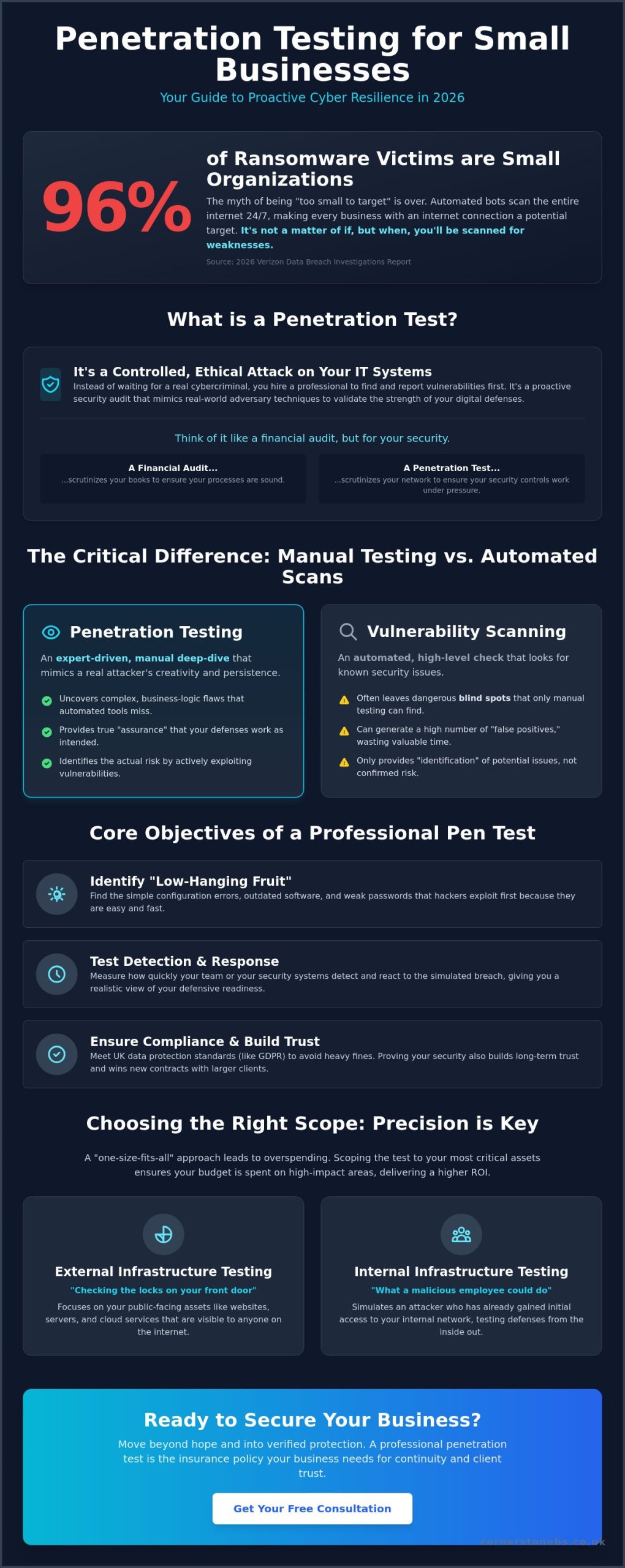
Did you know that small organizations represent 96% of ransomware victims according to the 2026 Verizon Data Breach Investigations Report? It is a startling figure that challenges the common belief that smaller firms fly under the radar of global cybercriminals. We understand that as a local business owner, you likely feel the weight of protecting your team and your customers, often while navigating a sea of confusing technical jargon and tight budget constraints. You want to know that your digital doors are locked, but you don’t want to overspend on tools that feel like overkill.
The good news is that penetration testing for small business is not just a luxury for the corporate giants; it is a vital insurance policy for your continuity. This guide simplifies the complex, showing you how identifying hidden vulnerabilities today builds the long-term resilience you need to protect your reputation. We will provide a clear roadmap for implementation and explain the tangible ROI of securing your systems. By the end, you will have the confidence to show your clients that your business is resilient, secure, and ready for whatever the 2026 threat landscape holds.
Key Takeaways
- Understand how a controlled, ethical attack identifies hidden vulnerabilities before real-world cybercriminals can exploit them.
- Learn how to define the right scope for penetration testing for small business so you only invest in the specific security checks your SME actually needs.
- Discover why automated vulnerability scans often leave dangerous blind spots that only expert manual testing can effectively uncover.
- Get a practical roadmap for setting rules of engagement to ensure your security audit is completed without any disruption to your daily operations.
- See how proactive cyber security measures build long-term resilience and prove your commitment to data protection to your own clients.
What is Penetration Testing for Small Business?
At its heart, penetration testing is a controlled, ethical attack on your IT infrastructure. Instead of waiting for a cybercriminal to find a way into your systems, you hire a professional to do it first. We often describe this to our local partners as a proactive security audit that mimics real-world adversary techniques to validate the strength of your digital defenses. It is about moving beyond hope and into the territory of verified protection.
Many business owners find the perfect analogy in a financial audit. Just as an accountant scrutinizes your books to ensure every penny is accounted for and your processes are sound, an ethical hacker scrutinizes your network. They aren’t just looking for problems; they are providing “assurance” that your existing security controls actually work under pressure. This is a significant step up from simple “identification” where you might just list the tools you have in place without knowing if they’ll hold up during a breach. For a deeper dive into the methodology, you can explore the foundational concepts of What is a Penetration Test? on Wikipedia.
Our role as your security partner is to act as the “Ethical Hacker.” We use the same tools and tactics as the bad guys, but we do it with your permission and your business interests in mind. This process protects your hard-earned reputation by ensuring that when a real threat arrives, your doors are firmly bolted. It is a foundational element of modern business stability.
Why SMEs Can No Longer Fly Under the Radar
The myth of being “too small to target” has been firmly debunked in 2026. Today’s cybercriminals use automated attack bots that scan the entire internet 24/7, looking for any open door regardless of the company’s size. If you have an internet connection, you are on their radar. We also see a massive rise in “Supply Chain” risk. Your larger clients and partners now face immense pressure to secure their own networks, which means they are increasingly demanding proof of penetration testing for small business from every vendor they work with. Security is no longer just a technical need; it is a requirement for winning new contracts.
The Core Objectives of a Professional Pen Test
A professional test focuses on three vital areas to keep your SME resilient:
- Identifying “low-hanging fruit”: We find the simple configuration errors or unpatched software that hackers exploit first because they are easy and fast.
- Testing response times: It isn’t just about the “hack.” We measure how quickly your team or systems detect the simulated breach, giving you a realistic view of your defensive readiness.
- Ensuring compliance: Regular testing helps you meet UK data protection standards and GDPR requirements, protecting you from the heavy fines that follow a data leak.
The Different Types of Testing: Choosing the Right Scope
Precision is everything when it comes to securing your business. Not all tests are created equal, and for an SME, a “one size fits all” approach usually leads to overspending on unnecessary checks. The key is scoping. By narrowing the focus to your most critical assets, you ensure your budget is spent on high-impact areas rather than generic scans. According to the NIST definition of penetration testing, these assessments are designed to identify the most efficient way to circumvent your security features. It’s about finding the path of least resistance before a criminal does.
Your business model dictates your testing needs. An e-commerce platform requires deep web application testing to protect customer payment data. In contrast, a professional consultancy might prioritize document security and email integrity. We help our partners match the test type to their specific operations, ensuring that penetration testing for small business remains a practical, high-ROI investment. If you’re looking to strengthen your overall resilience, integrating these tests into a broader Managed IT Support strategy ensures your defenses are always up to date.
External vs. Internal Infrastructure Testing
Think of external testing as checking the locks on your front door. It focuses on your public-facing assets like websites, email servers, and remote access points. Internal testing, however, asks a tougher question: what happens if a hacker already has a foot in the door? This simulates the actions of a disgruntled employee or someone who has stolen a staff member’s credentials. With the rise of remote teams in 2026, prioritizing VPN and cloud access testing is no longer optional; it’s a foundational requirement for business continuity.
Social Engineering and Phishing Simulations
Your technology might be robust, but your “Human Firewall” is often the most vulnerable point. The 2026 Verizon Data Breach Investigations Report reveals that human behavior contributes to 62% of breaches. To combat this, we simulate real-world phishing attacks to train your staff in a safe, controlled environment. These simulations are eye-opening. For instance, phishing attempts via text messages and phone calls now have a 40% higher success rate than those sent via email. We also test physical security by checking if a stranger could walk into your office and plug a rogue USB into a workstation. Testing the human element is just as vital as testing your servers.
Penetration Testing vs. Vulnerability Scanning
One of the most frequent conversations we have with local business owners revolves around a simple misunderstanding. Many people believe that running an automated security scan is the same thing as a full penetration test. While both are essential parts of a robust penetration testing for small business strategy, they serve very different purposes. A vulnerability scan is like a smoke alarm that listens for a specific signal, while a penetration test is more like a fire marshal inspecting your entire building to find out how a fire might start in the first place.
Relying solely on automated tools creates dangerous “blind spots” in your security. Machines are excellent at finding known software bugs or missing patches, but they lack the intuition to understand business logic. A machine might see a secure login page and move on, whereas a human expert might realize that the “password reset” function is poorly designed and could be exploited. We help you filter out the “noise” of false positives, which are security alerts that machines flag but don’t actually pose a risk. By removing this clutter, we ensure your team only focuses on the fixes that truly matter. This balanced approach is a core part of our cyber security services, providing you with both efficiency and deep protection.
Automated Scans: Your Daily Security Baseline
Automated scans are your high-frequency, low-cost guardians. They work by comparing your system against a database of thousands of known vulnerabilities. These tools are fantastic for constant monitoring, especially if you regularly add new hardware or update your software. However, their limitations are clear. Machines cannot think creatively. They can’t perform “chained” attacks, where a hacker uses three small, seemingly harmless flaws in a row to gain total control of your server. Scans give you the “what,” but they often miss the “how.”
Manual Pen Testing: The Expert Deep-Dive
This is where the “Ethical Hacker” truly shines. Manual penetration testing for small business involves a specialist using their experience to think outside the box. They probe your bespoke software and complex network configurations just like a real adversary would. This deep-dive is essential for identifying those complex logic flaws that automated tools simply cannot see. The real value lies in the final report. Instead of a 200-page list of technical errors, you receive a prioritized, easy-to-read document that explains exactly how to fix your most critical issues. It’s about giving you a clear, actionable path to resilience without the technical headache.
How to Prepare Your Business for a Security Audit
Preparing for a security audit can feel like inviting a professional burglar to test your house alarms. It is natural to feel a bit of anxiety about the process. However, professional testers are highly trained to avoid system downtime. We work within strictly defined “Rules of Engagement” that act as a legal and technical contract. These rules ensure that we only test what you want, when you want, and how you want. When planning penetration testing for small business, honesty is always the best policy. Providing your testers with accurate network maps and asset lists doesn’t “cheat” the test. Instead, it allows us to spend more time finding deep vulnerabilities rather than wasting your budget on basic discovery.
Communication is key to a smooth audit. You don’t necessarily need to tell every employee that a test is happening, especially if you are testing your “Human Firewall” through phishing simulations. However, your internal IT team or your Cyber Security partner must be in the loop. This prevents “friendly fire” incidents where your defenders accidentally shut down the test thinking it is a real attack. We act as your long-term partner, ensuring the entire process is transparent and supportive.
Defining the Scope and Goals
The first step is identifying your “crown jewels.” These are the data sets or systems that would cause the most damage if lost, such as customer payment info or proprietary designs. We help you set a timeframe that avoids your busiest periods, like year-end accounting or seasonal sales peaks. You will also need to choose your methodology. A “Black Box” test provides the tester with zero prior knowledge, mimicking an outside attacker. A “White Box” test provides full info, allowing for a much deeper and more efficient audit of your internal configurations.
The Post-Test Roadmap: Remediation and Resilience
Once the test is complete, don’t panic when you see the list of findings. Every professional test will find vulnerabilities; that is exactly what you are paying for. The goal isn’t a perfect score but a clear path to improvement. We help you prioritize the “Critical” and “High” risks first, ensuring you maximize your budget where it matters most. Finally, never skip the re-test. This is a shorter follow-up that confirms your team has implemented the fixes correctly. It closes the loop on your penetration testing for small business and ensures your resilience is truly verified before you share your security credentials with clients.
Securing Your Future with Cornerstone Cyber Security
Choosing a security partner is about more than just checking boxes. It’s about finding a team that understands the local landscape and the specific pressures you face as a growing SME. As a multi-award-winning provider, we’ve built our reputation on delivering high-level protection with a friendly, community-focused approach. We pride ourselves on our regional roots, offering UK-based support that understands national regulations and the unique needs of our neighbors. When you invest in penetration testing for small business with us, you aren’t just getting a technical report. You’re gaining a long-term partner dedicated to your stability and peace of mind.
We believe in moving away from reactive “firefighting” and toward proactive managed IT services. Our experts strip away the dense technical jargon, providing clear and declarative statements about your security posture. This clarity allows you to focus on what you do best: growing your company. We handle the complex digital infrastructure, ensuring your systems are resilient, modern, and always one step ahead of emerging threats.
Integrating Testing into Your Managed IT Strategy
Effective security isn’t a one-time event; it’s a regular pulse check. By integrating penetration testing for small business into your wider IT strategy, we create a continuous cycle of improvement. We use the insights from our audits to strengthen your cloud solutions and network infrastructure. This creates a powerful synergy between high-level professional audits and our unlimited helpdesk support. If a test identifies a potential weakness, our team is already on hand to implement the fix, ensuring your business continuity remains unbroken.
Your Dedicated Partner for Business Continuity
Our commitment is to deliver bespoke technology solutions that fit your specific budget and goals. We don’t believe in transactional relationships. Instead, we work collaboratively to help you achieve vital certifications like Cyber Essentials. These accolades do more than just secure your data; they act as a badge of trust that helps you win more business from larger clients. We invite you to have an informal conversation with our local team about your current security posture. Let’s explore how we can build a resilient foundation for your future growth together.
Building a Resilient Future for Your SME
Securing your business in 2026 doesn’t have to be a source of constant stress. We’ve explored how identifying hidden vulnerabilities early protects your reputation and why manual testing beats automated scans for finding complex logic flaws. By choosing the right scope and preparing your team, you turn a technical necessity into a strategic advantage for your growth. penetration testing for small business is the foundation of this proactive approach, ensuring your digital doors stay locked against evolving threats.
As a multi-award-winning IT services provider, we bring the power of our partnerships with Microsoft, IBM, and Cisco directly to your local doorstep. Our approach blends global technical excellence with the approachable, regional warmth of a team that truly cares about your success. We provide proactive system monitoring and unlimited helpdesk access, ensuring that expert support is always just a phone call away. You deserve a dedicated long-term partner who values your business stability and emotional security as much as you do.
Ready to strengthen your defenses? Book a security consultation with our award-winning UK team today. We look forward to helping you build a safer, more resilient future for your business.
Frequently Asked Questions
How much does penetration testing cost for a small business?
The cost of penetration testing for small business depends entirely on the size and complexity of your IT infrastructure. We tailor the scope to focus on your most critical assets, such as your customer databases or payment systems, to ensure you receive a high-ROI service. Factors like the number of external IP addresses and the complexity of your web applications will influence the final investment needed to secure your firm.
Will a penetration test crash my business systems or cause downtime?
A professionally managed test is designed to avoid system crashes or any disruption to your daily operations. We establish strict Rules of Engagement before the project starts, which act as a technical contract for our testers. Our experts use controlled, non-disruptive methods to identify vulnerabilities while ensuring your team can continue working without even noticing the audit is taking place.
How often should my small business have a penetration test?
We generally recommend conducting a full test once a year to maintain a strong security baseline. It is also a proactive step to schedule a targeted audit after any major changes to your network, such as a significant software update or migrating to new cloud solutions. Regular checks ensure that your defenses evolve at the same pace as modern cyber threats.
Is penetration testing a legal requirement for UK SMEs?
While not a blanket legal requirement for all sectors, it is often mandated by specific industry standards and regulatory frameworks. For instance, the Digital Operational Resilience Act (DORA), which came into force in January 2025, requires firms in the financial supply chain to perform regular resilience testing. Many larger clients also require proof of testing as a condition of their procurement contracts.
What is the difference between an ethical hacker and a cybercriminal?
The primary difference is authorization and intent. An ethical hacker has your explicit written permission to probe your systems and works as your partner to improve your defenses. A cybercriminal operates illegally to steal data or cause damage. We act as your local “white hat” experts, using the same tactics as an adversary to find and fix weaknesses before they can be exploited.
How long does a typical small business penetration test take?
Most assessments for small and medium-sized enterprises are completed within three to ten working days. This timeframe includes the initial reconnaissance, the manual testing phase, and the creation of your prioritized report. We focus on efficiency to respect your time, providing a clear roadmap for remediation shortly after the technical work concludes.
Can penetration testing help my business achieve GDPR compliance?
Yes, it is a foundational part of meeting your GDPR obligations. The regulation requires you to regularly test and evaluate the effectiveness of the technical measures you use to protect personal data. A professional test provides the documented proof you need to show regulators and clients that you are taking proactive, reasonable steps to prevent a data breach.
Do I need a pen test if I already have antivirus and a firewall?
You absolutely need a test because antivirus and firewalls are defensive tools that can be bypassed through misconfigurations or human error. A penetration test identifies the “blind spots” that these automated tools miss, such as complex logic flaws in your software. It provides a realistic view of how a human attacker would actually try to break into your network.
Posted on: May 30th, 2026 by Cornerstone
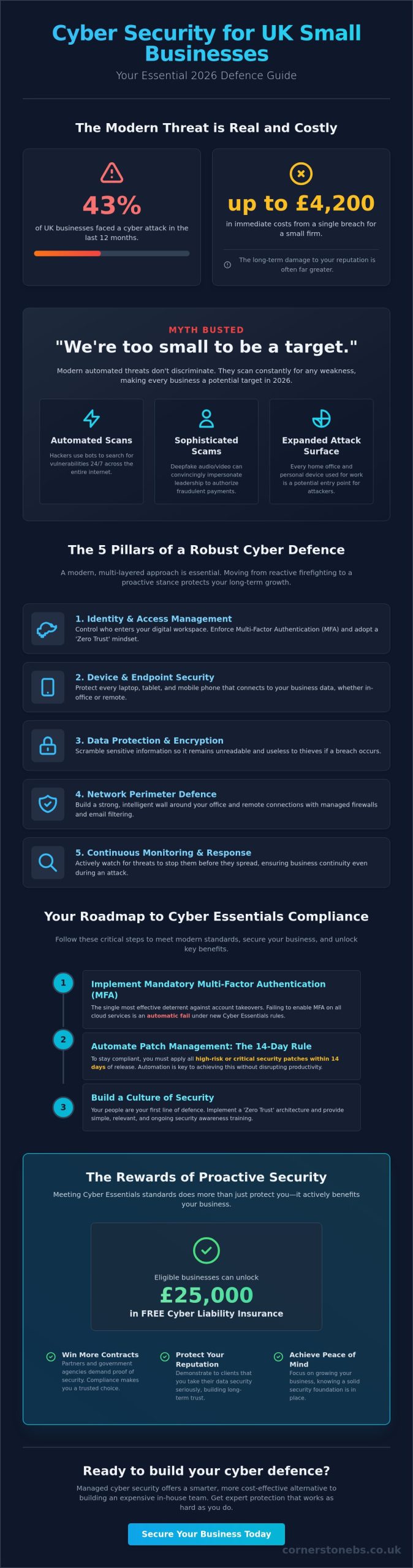
Did you know that 43% of UK businesses faced a cyber attack in the last 12 months? For a small firm, a single breach can cost up to £4,200 in immediate losses, but the damage to your hard earned reputation often hurts much more. You’re likely balancing the fear of data breaches with the confusion of shifting regulations like the latest Cyber Essentials updates. It’s frustrating when you want to stay secure but don’t have the budget for a massive, in-house IT department. We know you need protection that works as hard as you do.
This cyber security for small business UK guide offers a comprehensive roadmap to secure your digital assets, meet the latest 2026 standards, and gain total peace of mind. We’ll show you how to implement vital protections, from mandatory multi-factor authentication to the 14-day patching rule, without hindering your daily productivity. We’ll also explain how meeting these standards can even unlock £25,000 in free cyber liability insurance for eligible businesses. Let’s build a plan that turns security into a solid foundation for your future growth.
Key Takeaways
- Understand why modern automated threats mean no business is “too small” to target in 2026.
- Discover a proactive five-pillar framework that shifts your focus from simple antivirus to complete business stability.
- Follow our cyber security for small business UK guide to navigate Cyber Essentials compliance and secure your digital infrastructure.
- Learn how managed cyber security and proactive monitoring offer a smarter, more cost-effective alternative to building an expensive in-house team.
- Get a clear, actionable roadmap to protect your growth and achieve total peace of mind for your team and your customers.
The 2026 Cyber Threat Landscape for UK Small Businesses
In 2026, cyber security isn’t just a technical checkbox. It’s the engine room of your business continuity. For small firms across the UK, protecting your digital assets means protecting your ability to open the doors tomorrow morning. This cyber security for small business UK guide moves past the old idea that “it won’t happen to us.” Modern threats have changed. Five years ago, a clumsy email was the standard risk. Today, attackers use automated tools to scan for weaknesses every second of every day. Security is now about safeguarding your cash flow and your hard earned reputation.
Why 2026 is a Turning Point for SME Security
Small teams are facing a new level of sophistication. Deepfake technology now allows criminals to mimic the voice or even the video of a director in a call to the finance department. These “urgent” requests for bank transfers are incredibly convincing. Your hybrid workforce has also permanently expanded your attack surface. Every home office, personal laptop, and mobile device is a potential entry point for hackers. Additionally, larger partners and government agencies now demand proof of your security before signing contracts. Many businesses look to the Cyber Essentials scheme as a baseline to prove they’re a safe pair of hands for sensitive data.
The True Cost of a Breach in the UK
A breach costs much more than just the immediate recovery fee. While the average incident for a small firm ranges between £1,600 and £4,200 according to recent government data, the hidden costs are often far higher. These include:
- Lost Productivity: Days of downtime where your team can’t access files or email.
- Reputational Damage: The long term loss of trust from clients and partners.
- Legal Fees: Costs associated with data protection compliance and potential fines.
Recovering from that reputational hit takes years, not days. Partnering with a local expert for managed IT services helps you spot these threats before they become disasters. True cyber resilience is the ability to keep your business operating even while an attack is happening. It’s about staying strong and steady when things get difficult.
The Five Essential Pillars of a Robust SME Cyber Defence
Many business owners think a simple antivirus subscription is enough to keep them safe. In reality, modern protection requires a multi-layered approach that covers every corner of your operations. We use a structured framework to ensure no gaps are left open. This cyber security for small business UK guide breaks down your defence into five logical pillars. By focusing on these areas, you move from reactive “firefighting” to a proactive stance that protects your long term growth.
This approach aligns perfectly with the NCSC’s Small Business Guide, which provides the gold standard for UK firms. The five pillars are:
- Identity and Access Management: Controlling exactly who enters your digital workspace.
- Device and Endpoint Security: Protecting every laptop, tablet, and mobile phone your team uses.
- Data Protection and Encryption: Scrambling sensitive information so it remains useless to thieves.
- Network Perimeter Defence: Building a strong, intelligent wall around your office and remote connections.
- Continuous Monitoring and Response: Knowing exactly when a threat arrives so you can stop it before it spreads.
Securing the Human Element
Your people are your first line of defence. Multi-Factor Authentication (MFA) is the single most effective deterrent against account takeovers. Under the 2026 Cyber Essentials rules, failing to enable MFA on cloud services results in an automatic fail. We also advocate for a ‘Zero Trust’ architecture. This means your system never assumes a user is safe just because they’ve logged in once; it verifies every single request. This keeps your data secure even if a password is compromised. You can build a culture of security awareness by keeping training simple, relevant, and free from technical jargon.
Technical Safeguards Every SME Needs
Your hardware must be as smart as your team. Managed firewalls and advanced email filtering act as a digital sieve, catching the vast majority of phishing attempts before they ever reach an inbox. Automated patch management is also vital. To stay compliant in 2026, you must apply all high-risk security patches within 14 days of release. Integrating cloud solutions with built-in security protocols ensures your team stays productive from anywhere without leaving the door open. If you’re curious about how these layers fit your specific setup, our local cyber security team is always happy to help you find the right balance.
Debunking the ‘Too Small to Target’ Myth
One of the most dangerous phrases we hear in our local business community is: “We’re too small for hackers to care about.” It is a common belief that cyber criminals only chase big banks or global retailers. In reality, modern cyber crime is rarely personal. Most attacks are launched by automated bots that scan the entire internet for any open door. These scripts don’t check your turnover or your head count before they strike. For a hacker, a small business with weak defences is the perfect ‘low-hanging fruit’. It is an easy win that requires almost no effort compared to breaching a major corporation.
Think of these bots as digital burglars walking down a street, rattling every door handle. They don’t care if the house is a mansion or a bungalow. They only care about finding the one door that’s been left unlocked. This cyber security for small business UK guide is here to help you make sure your door is bolted tight. Security isn’t a luxury for the big players; it’s a fundamental requirement for staying in business today.
The SME as a Gateway
Your business might be a stepping stone to a much larger prize. Attackers frequently use a technique called ‘island hopping.’ They breach a smaller, less secure supplier to steal credentials or plant malware that eventually gives them access to a larger corporate partner’s network. Being identified as the ‘weak link’ in a supply chain can destroy your professional reputation overnight. This is why robust cyber security services are now a prerequisite for many UK tenders. If you cannot prove your systems are secure, you risk being locked out of lucrative contracts and partnerships.
Ransomware: The Equal Opportunity Threat
You might think your data isn’t worth stealing, but it is always valuable to you. Ransomware doesn’t necessarily aim to sell your data on the dark web. Instead, it locks you out of your own essential files. Imagine arriving at work to find your invoices, customer records, and emails are all encrypted and inaccessible. The psychological toll of seeing your operations grind to a halt is immense. According to the UK Government’s Cyber Security Breaches Survey 2025/2026, 43% of UK businesses experienced a cybersecurity breach or attack in the past 12 months. This statistic proves that no one is invisible. To help you build a solid foundation against these threats, the NCSC’s Small Business Guide provides a trusted starting point for protecting your livelihood.
A Practical Roadmap to UK Cyber Essentials and Compliance
Achieving a high standard of protection doesn’t have to be overwhelming. This cyber security for small business UK guide provides a clear path to securing your operations while building trust with your customers. By following a structured roadmap, you can transform your security from a source of anxiety into a competitive advantage. We recommend a step by step approach to ensure your defences are both thorough and manageable.
- Step 1: Conduct a comprehensive audit. You can’t protect what you don’t know you have. Start by listing all hardware, software, and cloud services your team uses.
- Step 2: Secure your internet connection. Use a managed firewall to create a boundary between your internal network and the outside world. Ensure all routers have their default passwords changed to something complex.
- Step 3: Control access. Limit admin privileges to only those who absolutely need them. Most staff should use standard user accounts for daily tasks to prevent accidental system wide changes.
- Step 4: Protect against malware. Deploy professional grade security software across all devices. This goes beyond simple antivirus to include active threat detection and email filtering.
- Step 5: Keep systems updated. As we mentioned earlier, applying high risk security patches within 14 days is essential. This prevents hackers from exploiting known vulnerabilities in your software.
Why Cyber Essentials Matters in 2026
Your certification is a badge of honour. It tells your partners, suppliers, and customers that you take their data seriously. Holding a government backed certification often gives you a commercial edge when bidding for new contracts. Many UK insurers also look favourably on certified firms, which can lead to more competitive premiums for your business. While the basic certification is a great start, Cyber Essentials Plus involves a hands on technical audit for even greater peace of mind.
Navigating UK GDPR and NIS2
Compliance is about more than just avoiding fines; it is about respecting the privacy of your clients. For small firms, this means having clear records of where data is stored and who can see it. A documented Incident Response Plan is also vital. It ensures your team knows exactly what to do if a breach occurs, which significantly reduces the impact on your business. Implementing a Microsoft 365 migration can help automate many of these compliance tasks by using built in labels and data protection policies. If you’re ready to secure your future, speak with our local cyber security experts today to start your journey toward total compliance.
Moving Beyond DIY: The Value of Managed Cyber Security
Managing your own digital safety is a full-time job. Many directors start with a “Break-Fix” mindset, only calling for help when something stops working or a file won’t open. This cyber security for small business UK guide highlights that reactive thinking is a dangerous gamble in 2026. Proactive Managed IT Support shifts the burden from your shoulders to a dedicated team of experts. We use continuous monitoring and threat detection to spot anomalies before they turn into business ending breaches. It’s the difference between calling the fire brigade and having a state-of-the-art sprinkler system already in place.
Cornerstone’s Proactive Shield
We’ve built our reputation on an award-winning approach to bespoke security. Our team doesn’t just provide a service; we act as your dedicated long-term partner. We take pride in our regional roots and our ability to simplify complex technical infrastructure into clear business benefits. We speak your language, not just “IT-speak.” This collaborative mindset ensures that your security feels like a foundational element of your stability rather than a technical hurdle. We’re here to help you navigate the 2026 landscape with confidence and clarity.
Taking the First Step Toward Security
A comprehensive security audit is the essential starting point for any ambitious growth strategy. It allows us to see exactly where you stand and what needs to be done to achieve total compliance. We’d love to have an informal conversation about your business goals and how we can help you protect them. There’s no pressure, just expert advice from a local team that cares about your success. When you’re ready to secure your digital assets for the long term, Book a Cyber Security Audit with Cornerstone Today and let’s start the conversation.
Secure Your Business Future and Fuel Your Growth
Cyber security in 2026 is no longer just a technical necessity; it’s the bedrock of your business’s emotional and financial stability. We’ve shown that automated threats don’t discriminate based on size and that proactive compliance is your ticket to better contracts and lower insurance. This cyber security for small business UK guide has outlined the roadmap, but you don’t have to walk it alone. Managing these risks yourself takes valuable time away from your core goals.
As a multi-award-winning IT services provider and strategic partner with Microsoft, IBM, and Cisco, we bring world-class expertise to our local community. Our UK-based helpdesk and proactive system monitoring ensure your operations stay smooth while you focus on what you do best. Let’s turn your digital defences into a powerful engine for long term growth. Secure your business future with a bespoke Cyber Security Audit from Cornerstone. We’re ready to help you build a safer, more resilient business today.
Frequently Asked Questions
Is cyber security expensive for a UK small business?
Cyber security is far less expensive than the cost of a successful breach. While there is an initial investment in tools like managed firewalls or email filtering, these costs are predictable and manageable compared to the average £4,200 loss a small firm faces after an attack. Implementing basic cyber security for small business UK guide practices, such as strong password policies and multi-factor authentication, actually costs very little but prevents the vast majority of common threats.
What is the most common cyber attack on UK SMEs?
Phishing is currently the most frequent threat, affecting 85% of UK businesses that reported a breach in the last year. These attacks use deceptive emails to trick your staff into revealing sensitive passwords or making fraudulent payments. Because these threats target people rather than just software, they require a combination of smart technical filters and regular awareness training for your team to stay safe.
Does my business really need Cyber Essentials certification?
Yes, holding this certification is rapidly becoming a standard requirement for doing business in the UK. Many government contracts and large corporate supply chains now insist on it as a minimum security baseline. Beyond opening doors to new tenders, it provides a clear framework that reduces your overall risk and can even help lower your professional indemnity insurance premiums.
How can I tell if my business has already been breached?
Signs of a breach are often subtle, such as unexpected password reset emails, slow system performance, or new software icons appearing without your permission. You might also hear from a client that they’ve received a suspicious email from your account. Proactive cyber security for small business UK guide monitoring is the most reliable way to catch these anomalies early before they cause significant damage to your operations.
Is antivirus software enough to protect my business in 2026?
Antivirus alone is no longer sufficient to stop modern, sophisticated cyber criminals. Today’s attacks often use “fileless” malware or social engineering tactics that can bypass traditional scanners entirely. You need a multi-layered defence strategy that includes managed firewalls, secure cloud solutions, and identity management to ensure your business remains resilient against evolving threats.
What should I do if I suspect a phishing email has been opened?
Disconnect the affected device from your network immediately to stop any potential malware from spreading. You should then change all passwords associated with that user from a different, secure device and alert your IT provider to perform a deep system scan. Reporting the incident to Action Fraud helps the wider UK business community by tracking these criminal patterns.
How does managed IT support differ from hiring an in-house IT person?
Managed IT support gives you access to a whole team of specialists with a wide range of skills for a fraction of the cost of one full-time salary. You don’t have to worry about holiday cover, training costs, or recruitment headaches. It is a scalable solution that provides high-level expertise and proactive monitoring, ensuring your systems stay stable as your business grows.
Can cyber security help me win more business contracts?
Absolutely, robust security is a major competitive advantage in the modern marketplace. Potential partners and clients are much more likely to trust a firm that can prove its data is handled securely. By demonstrating high security standards and certifications, you position your business as a reliable, low-risk partner, which is often the deciding factor in winning lucrative new contracts.