Is your IT infrastructure a springboard for your 2026 growth, or is it the invisible anchor holding your business back? Most leaders we speak with are tired of unpredictable downtime and the constant worry that a single cyber-attack could stall their operations. It’s frustrating when legacy systems fail to support hybrid teams or fall short of the latest UK security standards. You deserve a setup that just works, allowing you to focus on your customers instead of your servers.
We believe technology should be the silent engine of your success. As a multi-award-winning partner to Microsoft and Cisco, we’ve helped companies across the country turn technical debt into a competitive advantage. This guide explains how robust it infrastructure support uk provides the stability and security needed to scale with confidence. We’ll preview the impact of the 2026 Cyber Security and Resilience Bill and show you how to build an ‘invisible’ IT environment that meets the new Danzell requirements for Cyber Essentials. It’s time to move past reactive fixes and start building a roadmap for long-term resilience.
Key Takeaways
Discover how to transition from reactive troubleshooting to an ‘invisible’ IT environment that supports your team without constant manual intervention.
Learn why professional it infrastructure support uk is the essential springboard for onboarding new staff instantly and securing your hybrid workforce.
Compare the true costs of ‘break-fix’ models against proactive monitoring to see how a stable foundation protects your bottom line and operational sanity.
Explore the core 2026 technology pillars, including redundant connectivity and Cloud Solutions, that ensure your business stays resilient and compliant.
Identify the non-negotiable markers of a quality IT partner, from industry-leading Microsoft and Cisco certifications to the responsiveness of a dedicated UK-based helpdesk.
What is IT Infrastructure Support? The Foundation of Modern Business
Think of your business as a high-performance vehicle. While you focus on the road ahead, the engine under the bonnet handles the power, fuel, and cooling without you ever having to think about it. This is the “Invisible Engine” of your company. Expert it infrastructure support uk ensures that every server, cable, and cloud application operates at peak efficiency so you can focus on growth. It isn’t just about fixing things when they break. It’s about the proactive management of your entire technical environment to prevent those breaks from happening in the first place.
To understand the scope, we can look at the foundational definition of What is IT Infrastructure? which encompasses all the hardware, software, and network resources required for your business to function. This support acts as the bedrock for all other it company solutions. Without a stable foundation, even the most advanced AI tools or security protocols will struggle to perform. We view this as a strategic partnership where your technology is tailored to your specific regional roots and operational goals.
The Core Components of a Business Infrastructure
A resilient setup balances physical and virtual assets. Physical infrastructure includes the tangible items like cabling and it hardware like servers and workstations. Virtual infrastructure covers the digital side, such as your cloud storage and SaaS platforms. Together, they create a cohesive environment that supports your daily tasks. We simplify these complex concepts so you always know exactly what powers your desk.
Hardware: The physical backbone, from the laptops your team uses to the servers hosting your data. High-quality hardware reduces the risk of physical failure and keeps your staff productive.
Software: The tools that drive productivity, including operating systems and productivity suites like Microsoft 365. These must be kept up to date to ensure security and compatibility.
Networking: The circulatory system of your business. This includes routers, switches, and business VoIP systems that keep your team connected across the UK.
Why UK Businesses are Moving to Managed Infrastructure
The days of bulky, heat-generating server rooms are fading. Most UK businesses are transitioning to hybrid cloud environments that offer more flexibility and better security. In a 24/7 digital economy, you can’t afford to wait for a technician to arrive on-site on Monday morning if a system fails on Sunday night. Professional it infrastructure support uk provides the proactive monitoring needed to catch these issues before they impact your clients. This shift allows small and medium-sized enterprises to access the same level of technology as global corporations. Infrastructure support is the primary safeguard of your business continuity.
The Essential Pillars of Modern IT Infrastructure in 2026
The digital landscape moves fast. By 2026, the components that keep your business running have evolved from simple tools into essential pillars of growth. High-quality it infrastructure support uk now integrates connectivity, cloud, and security into a single, resilient framework. This alignment mirrors the broader goals of the UK’s National Infrastructure Strategy, which emphasizes the necessity of robust digital foundations for economic prosperity. We believe your technology should provide a sense of emotional security, knowing that your operations are built on a solid base.
Your connectivity is the first pillar. It’s no longer enough to have a single internet line. You need redundant, high-speed connections to ensure that if one provider fails, your business doesn’t stop. We build these networks to be stable and scalable. The second pillar is the embedding of cyber security services directly into your network fabric. Rather than adding security as an afterthought, we design it into every router and switch. This proactive approach protects your data from the moment it enters your environment.
Cloud-First Infrastructure and Microsoft 365
A modern office doesn’t live in a filing cabinet. It lives in the cloud. We see Microsoft 365 migration for business UK as the definitive move for companies wanting to stay agile. Microsoft 365 serves as your office backbone, while Azure provides the scalable computing power you need without the cost of physical hardware. This setup ensures your data stays within UK borders, meeting strict compliance and sovereignty requirements. If you’re curious about how these tools fit your specific needs, you might want to chat with our local experts about a bespoke setup.
Network Resilience and Cyber Security
In 2026, resilience is the priority. Your network must be ‘secure by design’ to handle modern threats and the demands of hybrid work. This includes automated cloud backups and a clear disaster recovery plan. With the 2026 impact of the PSTN switch-off now a reality, legacy phone lines are a thing of the past. We help businesses transition to modern Hosted VoIP and Business Mobile solutions that integrate seamlessly with your digital infrastructure. These communications tools ensure your team stays reachable, whether they’re in a Manchester office or working from home. We focus on making these transitions simple, so your technology supports your people, not the other way around. Our goal is to provide it infrastructure support uk that feels personal and reliable, regardless of where your team is located.
Proactive vs. Reactive Support: A Cost and Sanity Comparison
Many UK business owners fall into the “Break-Fix” trap without even realising it. This reactive model feels cost-effective on the surface because you only pay when something goes wrong. However, this approach is often the most expensive way to run a company. When your systems fail, you’re not just paying for a repair; you’re paying for the chaos that follows. Professional it infrastructure support uk shifts this dynamic entirely by focusing on prevention rather than just the cure. We believe your technology should be a source of confidence, not a cause of anxiety.
Proactive support involves 24/7 monitoring that identifies and resolves issues before they can disrupt your operations. By adhering to National Cyber Security Centre guidance, we ensure your systems aren’t just running, but are hardened against the latest threats. For example, the latest Cyber Essentials standards require high-risk security updates to be applied within 14 days. A reactive provider might miss that window, but a proactive partner handles it automatically. Whether you’re seeking managed IT services Teesside or support for a multi-site national operation, the goal is a stable environment that stays out of your way.
The Real Cost of Tech Downtime
Downtime is a silent profit killer. To calculate the true cost, you must look beyond the engineer’s invoice. If a team of 20 people is left idle for four hours because the server is down, that’s 80 man-hours of lost productivity. There is also the reputational damage to consider. In 2026, customers expect instant responses; if they can’t reach you because your systems are offline, they’ll simply call a competitor. We define proactive monitoring as the preventative medicine for your business technology.
Predictable Budgeting with Managed Infrastructure
Switching to managed it infrastructure support uk allows you to move from unpredictable CAPEX (large, sudden hardware purchases) to a steady OPEX model (predictable monthly subscriptions). This makes financial planning much simpler for small and medium-sized enterprises. A typical monthly fee usually includes:
Unlimited helpdesk access to keep staff morale high and frustrations low.
Continuous security patching and software updates.
Real-time monitoring of network health and performance.
Strategic reviews to ensure your tech still aligns with your growth.
This model doesn’t just protect your servers; it protects your bottom line. You gain access to a team of experts for a fraction of the cost of a full-time in-house department, all while enjoying the peace of mind that comes from a dedicated long-term partnership.
Scaling for Growth: How Infrastructure Support Enables Expansion
Growth is exciting, but it often puts immense pressure on your internal systems. If your technology isn’t ready, hiring ten new staff members can feel like a logistical nightmare rather than a milestone. Reliable it infrastructure support uk turns your technology into a springboard for expansion. We ensure that your systems are flexible enough to handle sudden spikes in demand, allowing you to onboard new team members in minutes rather than days. This agility is what separates businesses that scale smoothly from those that struggle with technical friction.
Geographic expansion no longer requires opening a physical office in every city. By leveraging bespoke cloud solutions, you can extend your reach across the country while maintaining a centralised, secure environment. Your data stays accessible, your team stays connected, and your security posture remains airtight. This approach allows small and medium-sized enterprises to compete on a national stage, using the same robust tools as much larger corporations. We focus on future-proofing your setup today so you’re ready for the AI and autonomous automation trends projected for 2027 and beyond.
Flexible Infrastructure for Hybrid Teams
The hybrid work model is here to stay, and it requires a different approach to management. We help you maintain control over your devices and data without hindering your remote workers. By using Azure Virtual Desktop, you provide a consistent, high-performance work environment for every employee, regardless of their location in the UK. This is supported by integrated Business Mobile and VoIP systems that ensure seamless communication. Your team can move between the office and home without ever missing a beat, keeping productivity high and frustration low.
Strategic IT Roadmapping
A true support partner does more than just manage your current setup; they act as a consultant for your future. We take on vCISO and vCTO roles to help you align your technology investments with your three-year and five-year business goals. This isn’t a one-time conversation. Through quarterly business reviews, we ensure your infrastructure remains in sync with your growth trajectory. We identify potential bottlenecks before they appear, ensuring your tech always supports your ambition. If you’re ready to build a tech strategy that grows with you, let’s start a conversation about your roadmap today.
This strategic oversight ensures that every pound spent on technology is an investment in your company’s resilience. Expert it infrastructure support uk provides the emotional security of knowing that as your business gets bigger, your systems will only get stronger. We pride ourselves on being a long-term partner that understands your regional roots and your global aspirations.
Choosing the Right IT Infrastructure Partner in the UK
Selecting a provider is one of the most critical decisions you’ll make for your company’s future. It’s about finding a long-term partner who treats your growth as their own. You need a team that offers more than just a helpdesk; you need strategic it infrastructure support uk that aligns with your specific regional needs. Look for industry-standard certifications from leaders like Microsoft, Cisco, and IBM. These accolades aren’t just badges. They’re a recurring signature of quality that proves your partner has the technical depth to handle complex challenges.
Helpdesk quality is paramount. Always ask where the support team is actually based. A UK-based helpdesk ensures that your engineers understand the local business environment and can respond with the speed your staff deserves. Avoid “one-size-fits-all” bundles. Your business is unique, and your technology should reflect that. A bespoke approach ensures you aren’t paying for services you don’t need while ensuring your critical systems are robustly protected. Prioritise partners who lead with a proactive first philosophy in their service level agreements, ensuring they’re incentivised to prevent issues rather than just bill for repairs.
Key Questions to Ask a Potential IT Partner
Before signing any contract, you need to dig into the operational reality of how a provider works. Use these questions to separate the true partners from the simple vendors:
“How do you monitor my systems for issues I haven’t noticed yet?” A quality partner should describe a 24/7 proactive monitoring setup that alerts them to failures before your team even starts their day.
“What is your process for disaster recovery and data backup?” They should provide a clear, jargon-free explanation of how they safeguard your business continuity.
“Can you show a track record of supporting businesses in my specific industry?” Experience in your sector means they already understand your regulatory requirements and common pain points.
The Cornerstone Difference: Award-Winning National Support
At Cornerstone, we’ve built our reputation on a seamless blend of professional authority and regional warmth. We project the image of a modern, forward-thinking organisation that remains deeply connected to its geographical roots. Our multi-award-winning approach to customer service and technical excellence isn’t just about winning trophies. It’s about our commitment to simplifying complex technology for our partners, creating an atmosphere of trust and reliability.
We don’t believe in transactional relationships. We move away from transactional language to act as a foundational element of your business stability and emotional security. Our team is proud but humble, sophisticated but reachable for small and medium-sized enterprises across the country. We provide the clarity of an expert who wants your business to succeed. If you’re ready to build a stronger foundation for your 2026 growth strategy, we’re here to help. Book a consultation with our experts today and let’s start a conversation about your future.
Ready to Build Your 2026 Digital Foundation?
Your technology should be the silent engine driving your growth, not a source of constant frustration. We’ve explored how moving from a reactive “break-fix” model to proactive monitoring protects your bottom line and provides essential emotional security for your team. By embracing Cloud Solutions and resilient network designs, you ensure your business is ready for the AI-driven trends of 2027 and beyond. It’s about building a setup that’s invisible because it’s so reliable.
Choosing the right it infrastructure support uk means finding a partner who understands your regional roots and your national ambitions. As a multi-award-winning provider and certified partner to Microsoft, IBM, and Cisco, we focus on bespoke solutions that simplify the complex. We’re here to ensure your systems are stable, secure, and ready to scale whenever you are. You don’t have to navigate these technical shifts alone; we’re here to act as your dedicated, long-term technology partner.
Let’s start a conversation about how we can support your long-term success. Your business vision deserves a foundation that just works every single day.
Frequently Asked Questions
What is the difference between IT support and IT infrastructure support?
IT support typically focuses on the end-user; think of things like password resets or software crashes on a single laptop. Infrastructure support is much broader, focusing on the health of your entire digital foundation, including servers, switches, and cloud environments. It ensures the ‘invisible engine’ of your business stays running so your team can work without interruption. We see it as the difference between fixing a tool and maintaining the entire workshop.
Does my small business really need 24/7 infrastructure monitoring?
Yes, because technical issues and cyber threats don’t respect office hours. Automated monitoring catches hardware failures or security breaches overnight, allowing us to resolve them before your team starts work the next morning. This proactive approach prevents the ‘Monday morning meltdown’ where staff arrive only to find they can’t access their files. It provides the emotional security of knowing your business is protected while you sleep.
How much does IT infrastructure support cost per month in the UK?
The cost of it infrastructure support uk depends on the size of your team and the complexity of your network. Most providers use a per-user or per-device monthly fee to provide predictable budgeting for your business. This usually covers proactive monitoring, security updates, and helpdesk access. While prices vary by region, choosing a managed model helps you move from unpredictable repair bills to a stable, monthly operating expense.
Can infrastructure support help with our transition to permanent hybrid work?
Absolutely. We specialise in setting up secure, flexible environments that allow your staff to work from anywhere in the UK. This involves implementing Cloud Solutions like Azure Virtual Desktop and secure VPNs to ensure data remains accessible but protected. We also integrate Business VoIP and mobile systems so your team stays connected as if they were in the same room, regardless of their physical location.
What happens to our infrastructure during a power cut or internet outage?
We build resilience into your network to handle these exact scenarios. This often involves uninterruptible power supplies (UPS) to protect hardware and secondary internet connections to keep you online. Because we prioritise Cloud Solutions, your team can often continue working from another location or via mobile data. Your critical business data remains safe and accessible in the cloud, even if your physical office is temporarily offline.
Is IT infrastructure support included in a standard managed IT contract?
Most comprehensive managed service agreements include infrastructure support as a core component. It’s the foundation that allows all other IT services to function correctly. When we partner with a business, we include proactive monitoring and maintenance of your servers and networks as standard. It’s always best to review your specific service level agreement to ensure it covers the proactive management of your entire technical environment.
How often should our business IT infrastructure be audited or upgraded?
You should audit your infrastructure at least once a year to ensure it still aligns with your growth goals. However, certain elements require more frequent attention. For instance, the 2026 Cyber Essentials standards mandate that all critical security updates are applied within 14 days. We use proactive monitoring to handle these smaller, vital upgrades automatically, preventing them from becoming major, disruptive projects later down the line.
Can you support our existing hardware, or do we need to buy everything new?
We can often support your current it infrastructure support uk and existing hardware, provided it meets modern security and performance standards. We won’t ask you to replace equipment that is still doing its job effectively. If we identify a piece of hardware that is a security risk or a significant bottleneck, we’ll work with you to create a phased, bespoke replacement plan that fits your budget and business goals.
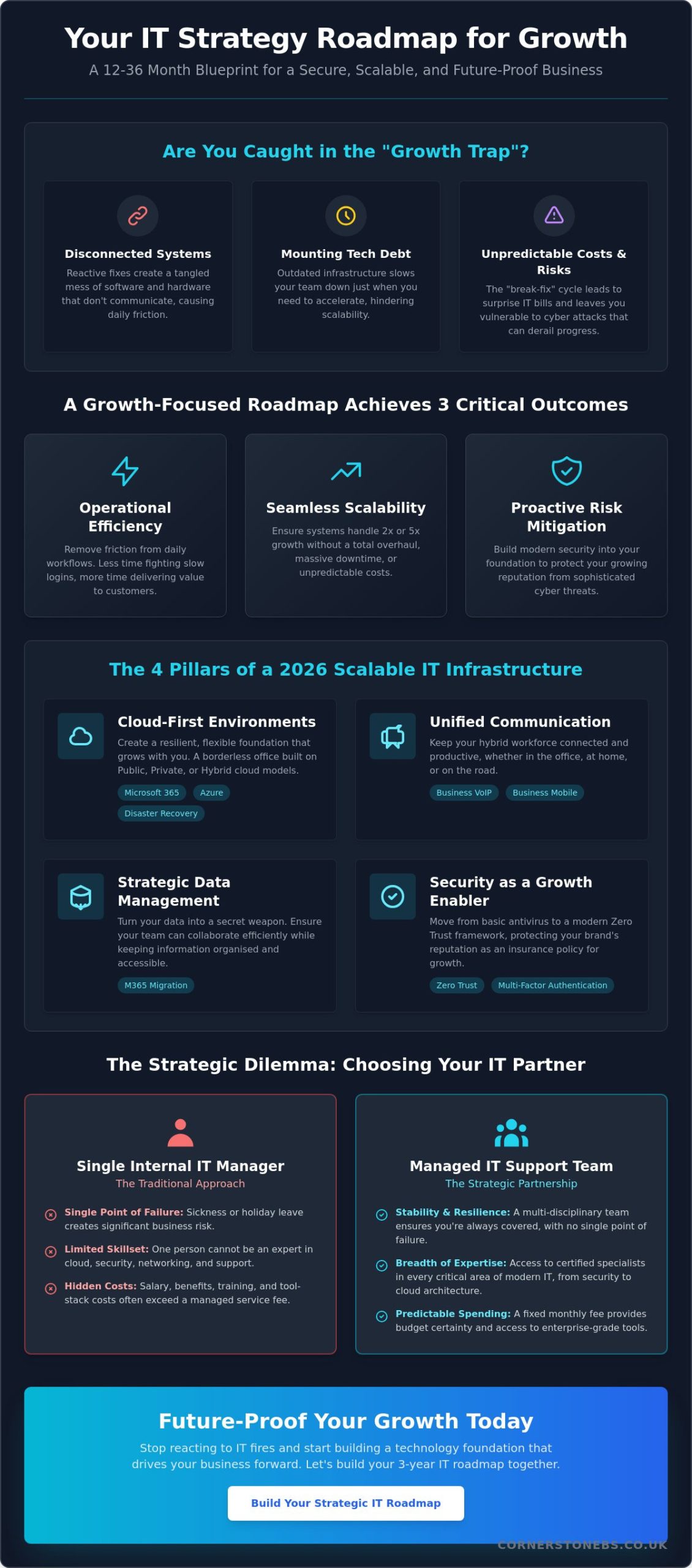
Your technology should be a growth engine, not a ball and chain that drags down your momentum. It’s frustrating when disconnected systems don’t talk to each other or when tech debt slows your team to a crawl just as you’re ready to scale. You’ve likely felt the sting of unpredictable IT costs or the nagging worry that a cyber attack could derail your progress. Developing a clear IT strategy roadmap for growing businesses is the only way to stop reacting to fires and start building for the future.
We understand that as a local business leader, you need clarity, not technical jargon. This guide shows you how to build a 12 to 36 month plan that ensures your technology investments actually align with your commercial goals. We’ll explore how to achieve seamless scalability and predictable spending while protecting your reputation with modern security standards like the NIST Cybersecurity Framework 2.0. By the end, you’ll have a blueprint for a secure, future-proof infrastructure that gives you total peace of mind.
Key Takeaways
Align your technology investments with specific business milestones to avoid the expensive growth trap of accumulated tech debt.
Discover how to build a scalable IT strategy roadmap for growing businesses that uses cloud solutions to create a resilient, flexible foundation.
Protect your reputation as you expand by moving from basic antivirus to a modern Zero Trust framework.
Compare the hidden costs of relying on a single internal IT manager against the stability of a multi-disciplinary managed IT support team.
Follow a clear, five-step process to audit your current hardware and software while mapping your tech to your three-year commercial goals.
What is an IT Strategy Roadmap and Why Does Your Growth Depend on It?
Scaling a business is exciting, but it often reveals hidden cracks in your foundation. If you’ve ever felt like your technology is holding you back rather than pushing you forward, you’re likely caught in the “Growth Trap.” This happens when companies add software or hardware as a reaction to immediate problems, creating a tangled mess of systems that don’t communicate. An IT strategy roadmap for growing businesses changes this dynamic. It’s a long-term vision that aligns every pound spent on technology with your specific business milestones.
Think of it as a Technology Roadmap that serves as a single source of truth for your leadership team. It moves your business away from the stressful “break-fix” cycle where you only call for help when something stops working. Instead, it fosters a proactive partnership where your IT infrastructure is built to support your expansion before it happens. This approach simplifies complex technical concepts so you can focus on your clients and your community.
The Core Objectives of a Growth-Focused Roadmap
A roadmap isn’t just about picking the right tools; it’s about achieving three critical outcomes that protect your business continuity and peace of mind:
Operational Efficiency: We remove the friction from daily workflows. This means your team spends less time fighting with slow logins and more time delivering value to your customers.
Scalability: We ensure your systems can handle 2x or 5x growth without requiring a total overhaul or causing massive downtime.
Risk Mitigation: As your reputation grows, so does your profile as a target for cyber threats. A solid roadmap builds security into the foundation of your expansion.
IT Strategy vs. IT Planning: Understanding the Difference
Many leaders confuse these two terms. An IT plan is a list of tasks, like a hardware replacement cycle or a software update schedule. It tells you what you’re doing. An IT strategy explains why you’re doing it. It focuses on business transformation rather than just keeping the lights on. An IT strategy roadmap is the bridge between your current technical capability and your future business ambition. It ensures that when you invest in Managed IT Support or Cloud Solutions, you’re doing so because it directly supports your 2026 growth blueprint.
The 4 Pillars of a Scalable IT Infrastructure in 2026
Building a scalable foundation requires more than just buying new laptops. It’s about four specific pillars that form your 2026 growth blueprint. When you follow a proven strategic plan template, you ensure that every technical decision supports your long-term commercial objectives. For many local firms, an IT strategy roadmap for growing businesses begins with shifting away from physical limitations and toward digital flexibility.
Modern infrastructure relies on cloud solutions that grow with you. This isn’t just about storage; it’s about creating a resilient foundation that allows your team to work from anywhere without losing performance. We also focus on unified communication. By integrating Business VoIP and Business Mobile, your hybrid workforce stays connected whether they’re in the office or on the road. Finally, data management becomes your secret weapon. A successful Microsoft 365 migration for business UK ensures your team can collaborate efficiently while keeping your sensitive information organized and accessible.
Cloud-First but Not Cloud-Only Environments
Security as a Growth Enabler, Not a Barrier
Many business owners view security as a series of “no’s” that slow them down. We see it differently. Robust cyber security services act as an insurance policy for your brand’s reputation. By moving to a Zero Trust framework, you protect your growing firm from increasingly sophisticated threats. Implementing multi-factor authentication (MFA) and high-level encryption should be your standard, not an afterthought. This proactive stance prepares you for compliance as you move into larger contracts and more regulated industries. If you’re unsure where your current security stands, you can always reach out to our local experts for a friendly chat about your options.
Your IT strategy roadmap for growing businesses should simplify these complex pillars into actionable steps. By focusing on infrastructure, security, communication, and data, you transform your IT from a cost center into a competitive advantage. This clarity allows you to lead with confidence, knowing your tech is ready for whatever 2026 brings.
The Strategic Dilemma: Internal Management vs. Managed IT Support
Many local firms reach a critical crossroads as they scale. You might have a dedicated IT person who has been with you since the start, often referred to as the “lone wolf.” While their loyalty is invaluable, this model often becomes a bottleneck for an IT strategy roadmap for growing businesses. The hidden costs of relying on one person include limited availability during holidays and a lack of specialized knowledge in rapidly changing fields. When your business expands, you need a depth of expertise that a single individual simply cannot provide alone.
The “Expertise Gap” is a very real challenge in 2026. One person cannot realistically be a master of cyber security, cloud architecture, and unified communications all at once. By transitioning to managed IT services, you gain access to a multi-disciplinary team of experts who live and breathe these technologies. This move replaces the “sticker shock” of emergency project work with predictable monthly fees. When you refine your IT strategic plan, you’ll find that having a team of specialists at your fingertips provides a level of stability that an internal manager can’t match.
When to Pivot to Managed IT Support
You’ll know it’s time to make a change when your internal team is drowning in a backlog of basic support tickets. If they’re too busy resetting passwords to discuss your three-year growth goals, your strategic progress has stalled. A Managed Service Provider (MSP) offers proactive maintenance and monitoring that catches issues before they cause downtime. We act as your virtual CIO, providing the high-level guidance you need to ensure your national operations remain seamless and secure.
Maximizing ROI Through Strategic Partnerships
Success comes from treating your IT provider as a long-term partner rather than just another utility vendor. This collaborative approach allows you to leverage our established relationships with global brands like Microsoft, Cisco, and IBM. We help you navigate complex licensing and hardware procurement so you always get the best value for your investment. Implementing comprehensive it company solutions reduces your total cost of ownership by streamlining your infrastructure and preventing expensive, reactive repairs. This partnership ensures your technology remains a foundational element of your business stability and emotional security as you reach for new milestones.
5 Steps to Building Your IT Strategy Roadmap
Step 1: The IT Audit. You can’t plan your journey without knowing your starting point. We begin by assessing your current hardware, software, and security posture. This identifies hidden risks and immediate needs. Step 2: Business Alignment. This is where we look at your commercial goals. If you plan to double your headcount or expand into new regions, your tech must be ready to scale with you. Step 3: Gap Analysis. We determine exactly what is missing between your current capability and your future ambition. Step 4: Prioritisation and Budgeting. We create a phased roll-out that respects your cash flow. You don’t need to do everything at once. Step 5: Execution and Review. We set quarterly milestones to keep the roadmap on track. It’s a living document that adapts as your business evolves.
Conducting a Meaningful IT Audit
A proper audit goes deeper than just counting laptops. We review legacy hardware to identify “end-of-life” risks that could cause sudden downtime. We also audit your software licenses to eliminate waste and close security loopholes. Finally, we assess your network infrastructure for capacity and speed bottlenecks. This ensures your foundation is strong enough to support modern tools like Business VoIP and cloud-based collaboration. If you haven’t looked under the bonnet of your IT lately, book a comprehensive IT audit with our locally based team to get started.
Phasing Your Implementation
We believe in a “crawl, walk, run” approach to technology. We start with Quick Wins. These address critical security gaps and immediate productivity killers that frustrate your team. Once the foundation is secure, we move to Medium-Term goals. This usually involves cloud migrations and communication upgrades that improve flexibility. Long-Term objectives focus on advanced data analytics and AI-driven automation. This phased approach ensures your IT strategy roadmap for growing businesses remains affordable and effective, providing the emotional security that comes from knowing your systems are built to last.
Future-Proofing Your Growth with Cornerstone Business Solutions
Building an IT strategy roadmap for growing businesses requires more than just technical knowledge; it demands a partner who understands the unique challenges of the UK business landscape. At Cornerstone Business Solutions, our multi-award-winning approach is designed specifically for firms that are ready to scale without the friction of technical debt. We don’t believe in one-size-fits-all packages. Instead, we provide bespoke technology solutions that align perfectly with your commercial milestones and regional roots.
The “Cornerstone Difference” lies in our proactive attitude. We don’t wait for systems to fail before we step in. Our team utilizes advanced monitoring to identify and resolve potential issues before they impact your team’s productivity. This proactive stance bridges the gap between complex digital infrastructure and your business objectives. We translate technical requirements into clear business benefits, ensuring you always understand the value behind every technology investment.
A Partnership Built on Trust and Accolades
We’ve built our reputation on a foundation of trust and consistent industry recognition. Our established partnerships with global tech leaders like Microsoft and Cisco mean we bring enterprise-level expertise directly to your doorstep. While we’re proud of our geographical origins, our national reach ensures your business is supported wherever your expansion takes you. You gain the peace of mind that comes from a dedicated, expert helpdesk that treats your business stability as a top priority.
Get Started on Your 2026 Roadmap Today
Don’t let technical frustration hold your ambition back. Moving from a reactive “firefighting” mode to strategic clarity is simpler than you might think. We’re here to help you navigate the complexities of Cyber Security, Cloud Solutions, and Network Infrastructure so you can lead with confidence. We invite you to an informal, no-obligation conversation about your business goals and how technology can help you reach them faster.
Your journey toward a more stable, secure, and scalable future starts with a single step. Whether you need to overhaul your communication with Business VoIP or protect your data through Disaster Recovery, we have the specialized expertise to lead the way. Contact our expert team to begin your strategic IT journey today and discover how we can help you build a resilient foundation for the years ahead.
Build Your Foundation for a Scalable Future
Your business deserves a technical foundation that supports your ambition rather than slowing it down. By shifting from reactive fixes to a proactive IT strategy roadmap for growing businesses, you ensure your infrastructure is ready to handle whatever the market brings in 2026. We’ve explored how aligning your technology with commercial milestones eliminates expensive tech debt. This approach provides the emotional security your leadership team needs to scale with confidence and clarity.
As a multi-award-winning IT services provider, we take pride in simplifying complex infrastructure for our local partners. Our deep relationships with global leaders like Microsoft, IBM, and Cisco allow us to bring enterprise-level strength to your unique roadmap. With our proactive 24/7 system monitoring, we catch potential issues before they impact your operations, keeping your growth on a steady, predictable path. It’s time to move beyond technical frustration and start building for the future.
Ready to transform your technology into a competitive advantage? Book a Strategic IT Consultation with our Award-Winning Team today. Let’s have a conversation about how we can support your long-term success with a plan that fits your business perfectly.
Frequently Asked Questions
How long should an IT strategy roadmap cover?
A standard IT strategy roadmap for growing businesses should cover a period of 12 to 36 months. This timeframe allows you to align technology investments with your medium-term commercial goals while remaining flexible enough to adapt to rapid market changes. A 12-month focus handles immediate security and efficiency needs; the 36-month view prepares your infrastructure for significant scaling and larger capital investments.
What is the biggest mistake businesses make when building an IT roadmap?
The most common error is viewing technology as an isolated expense rather than a growth engine. Many firms purchase software or hardware reactively to solve a single problem without considering how it fits into the wider ecosystem. This creates disconnected systems that don’t talk to each other. A successful roadmap requires you to start with your business objectives first, then select the tools that help you reach them.
How much does it cost to implement a professional IT strategy?
Can we build an IT roadmap if we already have an internal IT person?
Absolutely, and a roadmap often makes your internal IT person more effective. It provides them with a clear set of priorities and a strategic framework to follow. Many growing firms use a hybrid model where we provide high-level guidance and specialized support in areas like Cyber Security or Cloud Solutions. This partnership allows your internal staff to focus on daily operations while we handle the complex, long-term technical architecture.
How often should we review and update our IT strategy?
You should review your roadmap quarterly to ensure your projects remain on track and aligned with your current business performance. While the core strategy provides a long-term vision, the technical landscape changes quickly. An annual deep-dive update is essential to incorporate new advancements, such as AI-driven automation or updated security protocols. This regular rhythm ensures your technology remains a foundational element of your stability rather than becoming an outdated burden.
What are the most important IT priorities for a growing business in 2026?
In 2026, the top priorities are robust security, seamless scalability, and unified communication. Implementing a Zero Trust framework is no longer optional as cyber threats become more sophisticated. You also need cloud-first infrastructure that allows your team to collaborate effectively from any location. Finally, ensuring your Business VoIP and mobile systems are fully integrated supports a professional image and maintains client trust as you expand your national reach.
How does an IT roadmap help with cyber security compliance?
Is an IT roadmap necessary for a business with fewer than 50 employees?
Yes, a roadmap is arguably more critical for smaller teams where every investment must deliver maximum value. Without a plan, a business with fewer than 50 employees can easily outgrow its basic systems within months, leading to expensive and disruptive migrations. Starting with a clear strategy ensures you build your infrastructure correctly the first time. This saves money, reduces frustration, and allows your small team to compete with much larger organizations.
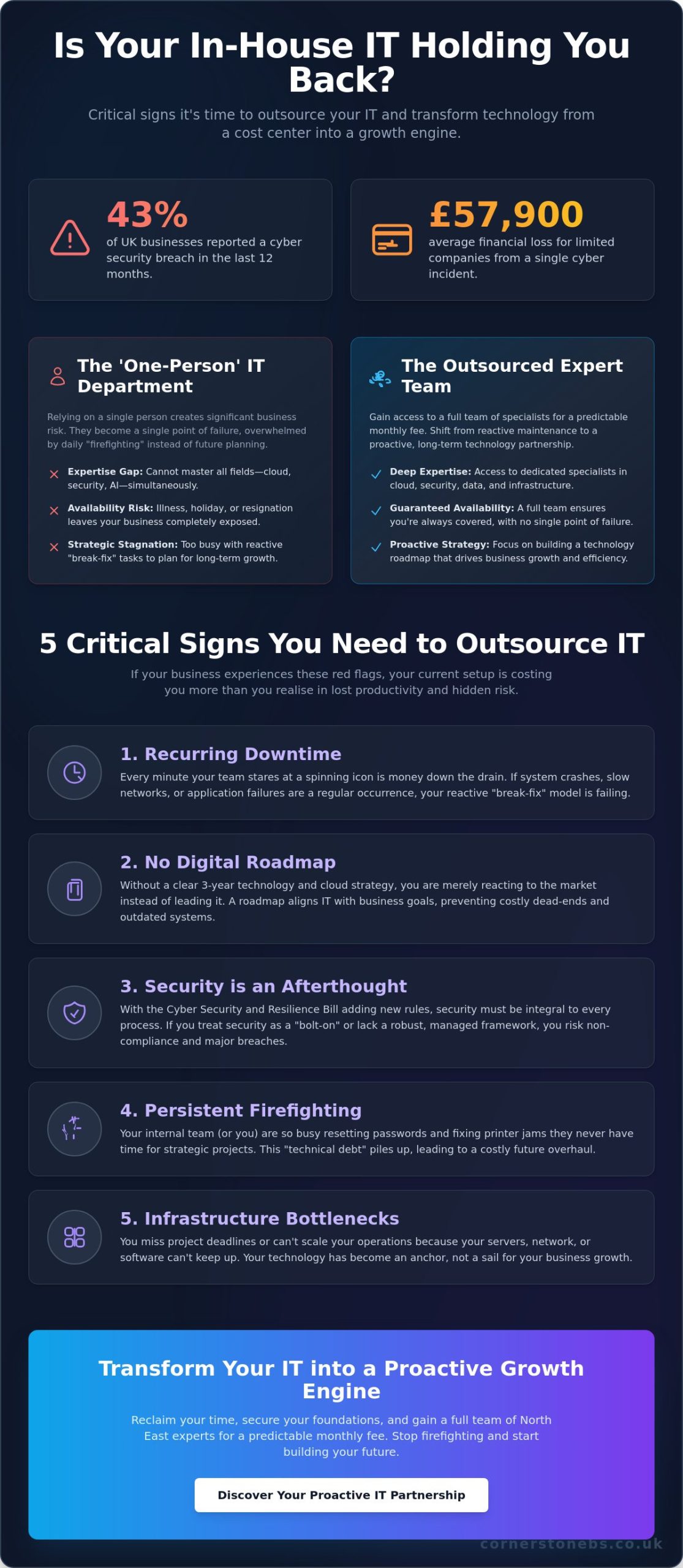
With 43% of UK businesses reporting a cyber security breach in the last 12 months, the cost of “getting by” with a struggling tech setup has never been higher. When a single incident now averages a £57,900 financial loss for limited companies, you can’t afford to ignore the clear signs you need to outsource your IT. Perhaps your in-house staff is buried under minor helpdesk tickets, or you’re feeling anxious about the mandatory 24 hour incident reporting rules introduced in the Cyber Security and Resilience Bill last November. These aren’t just technical glitches; they’re barriers to your company’s growth.
We understand how exhausting it is to manage unpredictable spending while worrying if your data is truly secure. You deserve technology that works as hard as you do. This guide identifies the critical red flags in your current infrastructure and explains how an award-winning partnership can transform your IT into a proactive growth engine. We’ll show you how to reclaim your time, secure your foundations against 2026’s regulatory shifts, and gain access to a full team of North East experts for a predictable monthly fee.
Key Takeaways
Spot the moment your internal IT hits its ceiling and starts hindering your ability to scale rather than enabling it.
Identify the five clear signs you need to outsource your IT, including persistent downtime and the absence of a long-term cloud roadmap.
Secure your business insurance eligibility by moving beyond “DIY” security to a robust, specialist-managed framework that handles 2026’s complex regulations.
Compare the financial logic of a single senior salary against the value of a full, award-winning team of experts and flexible OpEx cloud solutions.
Reclaim your time for core business strategy by shifting from reactive maintenance to a proactive, long-term technology partnership.
Recognising the Friction: Why Internal IT Often Hits a Ceiling
IT friction is the invisible anchor dragging down your business growth. It occurs the moment your technology stops being a tool for efficiency and starts becoming a hurdle for your team. Many UK businesses begin with a “DIY” approach, perhaps with a director managing the server or a tech-savvy manager looking after the emails. This works during the early days. However, as 2026 brings more complex digital demands, these makeshift systems often lead to the first clear signs you need to outsource your IT. Adopting the business practice of outsourcing allows you to move past these hurdles with ease.
When IT Issues Dictate Your Daily Schedule
The Limitations of the ‘One-Person’ IT Department
Relying on a single IT person is a significant business risk. If your only expert falls ill, goes on holiday, or leaves for a new role, your entire infrastructure is vulnerable. A single person simply cannot stay an expert in every field simultaneously. They can’t master complex cloud solutions while also managing business VoIP, hardware procurement, and evolving cyber threats. There’s a world of difference between “just about managing” and having a robust managed IT services strategy. We provide a full team of specialists, ensuring you always have the right expert for the task at hand.
Expertise Gap: One person can’t keep pace with 2026’s rapid tech evolution.
Availability Risk: Absence or resignation leaves your business totally exposed.
5 Critical Operational Signs You Need to Outsource Your IT
Identifying the signs you need to outsource your IT isn’t just about fixing broken computers. It’s about spotting when your business operations are red-lining. Experts often point to several clear signs it’s time to outsource, and for UK firms in 2026, these indicators are increasingly tied to regulatory compliance and competitive survival. If your business is experiencing any of the following five red flags, your current setup is likely costing you more than you realise.
Recurring Downtime: Every minute your team stares at a spinning icon is money down the drain. If system crashes are a weekly occurrence, your “break-fix” model is failing.
No Digital Roadmap: Without a three-year cloud solutions strategy, you’re merely reacting to the market rather than leading it.
Security as an Afterthought: With the 2025 Cyber Security and Resilience Bill now in full force, security must be baked into every process, not just added as a bolt-on.
Infrastructure Bottlenecks: You are missing project deadlines because your current servers or network can’t handle the workload of a growing team.
If these signs feel familiar, it’s often more effective to have a quick chat with our award-winning team about a more proactive approach to your technology.
Persistent Downtime and the ‘Break-Fix’ Cycle
Stalled Digital Transformation and Innovation
The Invisible Risks: Security, Compliance, and Data Protection
Insurance companies have noticed this shift too. To qualify for comprehensive cyber insurance today, many UK providers now mandate professional cyber security services. They want to see evidence of 24/7/365 threat detection and a transition toward Zero Trust architecture. This model assumes every login attempt is a potential threat until verified. It’s a level of scrutiny that in-house teams simply cannot maintain because they need to sleep, take holidays, and manage other tasks. An award-winning partner fills this gap, providing a robust shield that never blinks.
The Complexity of UK Regulatory Compliance
Navigating the UK’s shifting legal landscape is a full-time job. With the Data (Use and Access) Act 2025 introducing new phased requirements throughout 2026, the burden on internal staff is immense. We help North East businesses manage the specific demands of NIS2 and DORA, ensuring you stay on the right side of the law. Beyond avoiding fines, robust compliance acts as a powerful business enabler that helps you win larger contracts by proving your reliability to partners and stakeholders.
Disaster Recovery: Beyond Simple Backups
Zero Trust: Moving from basic antivirus to identity-based security.
Threat Detection: Constant monitoring that catches breaches before they spread.
Audit Readiness: Maintaining the logs and proof needed for UK regulations.
The Financial Logic: Comparing In-House Costs vs. Managed IT
Moving from CapEx to OpEx is a game-changer for 2026 budgeting. Instead of dropping £10,000 on a new server every few years, you shift to predictable cloud subscriptions. This keeps your cash flow steady and ensures you’re always using the latest technology without the “sticker shock” of hardware failures. Many UK tech leaders now prefer this model because it removes the burden of asset management. If you’re ready to stabilise your spending, you can view our managed IT support options to see how we can protect your margins.
Recruitment Fees: Hiring internal staff often costs 15% to 20% of the annual salary in agency fees.
Continuous Training: Keeping an internal person certified in 2026’s AI and security standards is a significant, ongoing expense.
Tooling Costs: Professional monitoring and management software carries high licensing fees for individual companies.
Predictable Budgeting and Scalability
The Hybrid Model: Supporting Your Existing Team
Choosing a Partner: Why Cornerstone is the Proactive Choice
A reliable partnership relies on a clear Service Level Agreement (SLA). You should look for a provider that offers firm uptime guarantees and rapid response times that respect your busy schedule. Our transition process is designed to be seamless. We begin with a deep-dive audit of your current setup to identify any hidden risks or inefficiencies. We then onboard your team with care, ensuring every staff member feels supported as we move your systems toward a more robust, proactive model.
The Cornerstone Business Solutions Difference: Award-Winning Support
Your Next Steps to IT Freedom
Reclaiming your time starts with a simple conversation. During our initial strategy session, we’ll define your specific business goals for 2026 so your technology can be tailored to support them. Whether you’re looking to meet the new requirements of the Data (Use and Access) Act 2025 or simply want to end the cycle of “firefighting” IT issues, we’re here to help. We’ll show you how to turn your IT from a source of anxiety into a strategic advantage. Book a chat with our expert team today to reclaim your peace of mind and start your journey toward a more secure, efficient future.
Global Standards, Local Heart: World-class tech from Microsoft and Cisco delivered by a North East team.
Seamless Onboarding: A structured audit process that ensures no data is lost and no time is wasted.
Proactive Peace of Mind: Monitoring that works 24/7 so you don’t have to worry about the next breach or crash.
Secure Your Growth with a Strategic IT Partnership
As a multi-award-winning IT services provider, Cornerstone Business Solutions brings the power of global partnerships with Microsoft, IBM, and Cisco directly to your North East doorstep. Our proactive 24/7 system monitoring identifies threats before they reach your network, giving you total peace of mind. We’re ready to help you move beyond firefighting and start innovating. Ready for IT peace of mind? Let’s have a chat about your bespoke solution.
Frequently Asked Questions
Is it cheaper to outsource IT or keep it in-house in 2026?
Will I lose control of my business data if I outsource my IT?
You retain full ownership and control of your data; your provider simply acts as a secure custodian. We implement robust access controls and ensure your systems comply with the Data (Use and Access) Act 2025. This partnership actually increases your control by providing clearer visibility through regular audits and real-time reporting that in-house setups often lack.
What is the difference between managed IT support and basic tech support?
Managed support is proactive and focuses on preventing issues before they happen through 24/7 monitoring and strategic planning. Basic tech support is typically “break-fix,” where you pay £80 to £150 per hour only when something fails. If you notice persistent downtime, these are clear signs you need to outsource your IT to a partner that prioritises your peace of mind.
How long does it take to transition to an outsourced IT provider?
A seamless transition typically takes between 30 and 90 days, depending on the complexity of your current infrastructure. We begin with a deep-dive audit of your network and security protocols to ensure no data is lost. This structured approach allows us to onboard your staff and deploy proactive monitoring tools without interrupting your daily business operations in the North East.
Can an IT outsourcing company work with my existing in-house IT manager?
What should be included in a standard managed IT service level agreement (SLA)?
A robust SLA must include specific response times, resolution guarantees, and clear uptime targets, such as 99.9%. It should also outline the scope of support for Microsoft 365, cyber security, and disaster recovery. We ensure our SLAs are transparent and benefit-driven, so you know exactly what level of award-winning service to expect from our local team every single month.
How does IT outsourcing improve my business’s cyber security?
Outsourcing provides access to advanced threat detection and Security Operations Centres (SOC) that most SMEs cannot afford in-house. With 43% of UK businesses facing breaches in 2026, having a partner that manages mandatory 24 hour incident reporting is vital. We implement Zero Trust architectures and proactive patching to protect your reputation and meet the strict requirements of the Cyber Security and Resilience Bill.
Do I need to be a large company to benefit from outsourced IT?
No, small and medium-sized enterprises often see the greatest benefit from outsourcing because it levels the playing field. It allows you to access the same robust network infrastructure and expert talent as global corporations without the massive price tag. Identifying the signs you need to outsource your IT early helps smaller firms scale faster by removing technical bottlenecks and securing their digital foundations.
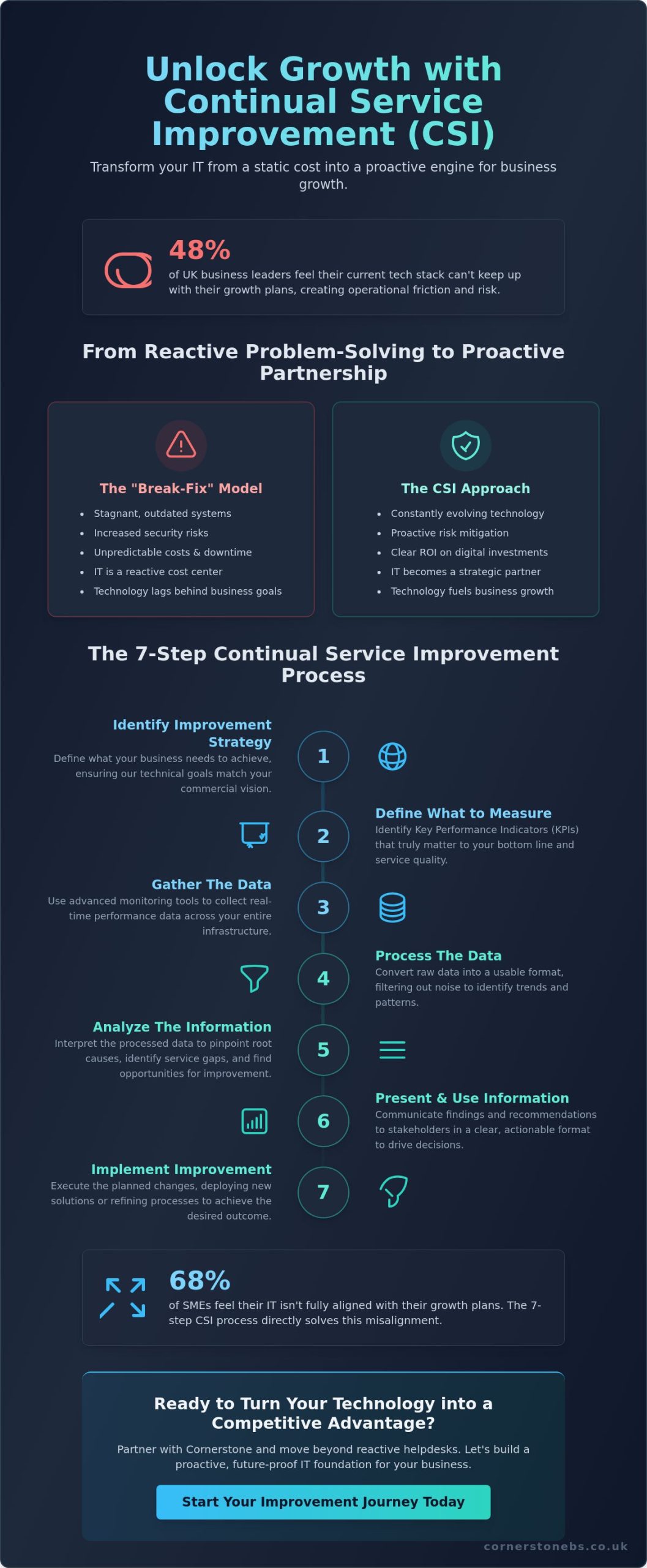
What if your IT department stopped being a drain on your monthly budget and started acting like your most ambitious business partner? We know it’s frustrating when technology feels stagnant, especially since a 2024 industry report found that 48% of UK business leaders feel their current tech stack can’t keep up with their growth plans. You likely agree that IT support shouldn’t just be a reactive “break-fix” service that you only hear from when things go wrong. That’s exactly where csi, or Continual Service Improvement, steps in. It’s a proactive mindset that ensures your systems never stand still while your competitors move forward.
At Cornerstone Business Solutions, our award-winning team is dedicated to turning technology into a foundation for your peace of mind. We’re proud of our North East roots and we’ve seen how this structured framework helps our partners reduce operational friction and finally see a clear ROI on their digital investments. This guide will show you how CSI transforms your IT from a static cost into a proactive engine for business growth. We’ll outline a clear path to better efficiency and reduced downtime, making sure your technology and business goals are always in perfect sync.
Key Takeaways
Understand how implementing csi transforms your IT from a static business cost into a proactive, data-driven engine for long-term growth.
Learn why the “set it and forget it” approach to technology creates security risks and how a structured improvement cycle protects your business.
Discover practical steps to boost employee productivity by aligning your IT systems with clear service level agreements and measurable performance goals.
Explore how our award-winning North East team acts as a dedicated partner, moving beyond reactive helpdesks to provide the technical foundation for your peace of mind.
What is CSI in IT? Defining Continual Service Improvement
In the world of managed IT services, csi stands for Continual Service Improvement. It’s a core stage of the ITIL (Information Technology Infrastructure Library) lifecycle. While some see IT as a set-and-forget utility, we view it as a living part of your business that requires constant refinement. It isn’t a one-off project or a reaction to a system failure. Instead, it’s a permanent commitment to making your technology work harder for you every single day.
You might wonder why we use the word “continual” rather than “continuous” in a professional context. There’s a vital distinction here. Continuous implies an unbroken, linear stream of activity without pause. Continual, however, describes a series of improvements with distinct start and end points, allowing for measurement and reflection. This rhythmic approach ensures that every change we make is backed by evidence and aligned with your specific commercial goals. Continual Service Improvement provides the framework needed to identify these opportunities and implement them without disrupting your daily operations.
The primary goal is simple. We align your IT services with your changing business needs by identifying and implementing improvements that support your growth. Whether you’re a small firm in Teesside or a large enterprise across the North East, your technology must evolve as you do. CSI is a data-driven method for refining IT efficiency and effectiveness over time.
The Core Objectives of a CSI Strategy
CSI vs. The TV Show: Why the Distinction Matters
While the acronym might bring to mind forensic investigators and crime scenes, the reality of IT improvement is much more proactive. In the tech world, if you’re looking at a “crime scene,” something has already gone wrong. Business leaders should look for “CSI-focused” IT partners to ensure long-term stability rather than just quick fixes. Our award-winning approach moves your business away from reactive troubleshooting and toward a future-proof environment. We stop being the people you call when things break and become the partners who ensure they don’t break in the first place. This transition from “crime scene” forensics to proactive improvement is what gives our clients true peace of mind.
The 7-Step Continual Service Improvement Process
Implementing csi isn’t about making random changes or chasing the latest tech trends. It’s a structured framework designed to ensure your IT infrastructure evolves in lockstep with your business goals. This seven-step cycle creates a vital feedback loop between your IT provider and your leadership team. It moves your technology from a static overhead to a proactive asset that fuels growth. By using this process, we ensure every technical adjustment provides measurable value and peace of mind.
Data-driven decision making sits at the heart of this cycle. A 2023 survey of UK SMEs found that 68% of business owners feel their IT isn’t fully aligned with their growth plans. The 7-step process solves this by grounding every improvement in hard evidence. It allows us to identify exactly where your systems are thriving and where they need a boost to keep your North East business competitive.
Steps 1-3: Strategy and Data Collection
The first half of the process focuses on alignment and gathering the right facts. We don’t just look at the tech; we look at your vision. If you’re aiming to reduce downtime by 20% over the next quarter, your improvement strategy must reflect that specific target.
Step 1: Identify the strategy for improvement. We define what your business actually needs to achieve, ensuring our goals match yours.
Step 2: Define what you will measure. We identify Critical Success Factors (CSFs) and Key Performance Indicators (KPIs) that matter to your bottom line.
Step 3: Gather the data. Our award-winning service desk uses advanced monitoring tools to collect real-time performance data across your entire network.
Steps 4-7: Analysis and Implementation
Once we have the data, we turn it into actionable intelligence. This metrics-driven methodology removes the guesswork from IT management. It’s about finding the “why” behind the numbers to ensure your investment is spent wisely.
Step 4: Process the data. We convert raw logs and ticket numbers into meaningful information that highlights trends.
Step 5: Analyse the information. Our experts look for gaps between your current performance and your desired business outcomes.
Step 6: Present and use the information. We provide clear, jargon-free reports to stakeholders, showing exactly where improvements will have the most impact.
Step 7: Implement improvement. We take decisive action to refine your services, completing the csi cycle and starting the next round of growth.
This disciplined approach ensures your IT remains robust and tailored to your local market needs. If you want to see how this framework can protect your business, feel free to have a chat with our team about your current setup.
Why “Good Enough” IT is a Risk to Your Business Growth
Many North East business owners view IT as a utility, much like water or electricity. You turn it on, it works, and you forget about it. This “set it and forget it” mentality is a silent growth killer. A system that worked perfectly in 2022 is likely a bottleneck in 2024. Stagnant IT doesn’t just slow you down; it creates friction that frustrates your team and stalls your momentum. Adopting csi isn’t about chasing every new gadget. It’s about ensuring your technology evolves alongside your goals. Customer feedback loops help us understand where your current setup fails to meet real-world demands. This proactive approach provides the foundational peace of mind you need to focus on scaling your business.
The Relationship Between CSI and Cyber Security
Cyber threats don’t stand still. Hackers constantly refine their methods, meaning a security setup that was robust six months ago might be porous today. Our award-winning approach integrates cyber security services directly into the csi lifecycle. We don’t just wait for an alarm to go off. We conduct regular service reviews to spot emerging vulnerabilities before they become headline-grabbing breaches. A stagnant security posture is an open invitation for modern ransomware attacks. By treating security as a moving target, we keep your data locked down and your reputation intact.
Operational Efficiency and ROI
Waste often hides in plain sight. We frequently find “zombie” software subscriptions costing SMEs over £2,000 annually for tools nobody uses. CSI shines a light on these redundant processes and budget drains. It’s not just about saving pennies; it’s about reclaiming time. Proactive improvements reduce helpdesk tickets by identifying root causes rather than just patching symptoms. For example, a refined Microsoft 365 migration strategy in 2024 saved a local partner 450 man-hours per year by automating repetitive data entry tasks. This isn’t an expensive luxury for big corporations. It’s a vital strategy for any UK business that wants to see a real return on their technology investment.
CSI identifies software bloat that wastes your budget.
Regular reviews prevent small glitches from becoming major downtime.
Proactive updates ensure your hardware supports the latest productivity tools.
Continuous monitoring aligns your IT spend with your actual business needs.
Practical Steps to Implement CSI in Your Organisation
Implementing csi doesn’t require a total system reboot. You can start by tackling the small “niggles” that drain your team’s productivity. We recommend focusing on one department first. This approach prevents your internal teams from feeling overwhelmed while proving the value of the process quickly. It’s about building momentum. When your staff see that reporting a minor issue leads to a permanent fix, they become more engaged with the process. We encourage a culture of open feedback where every employee feels empowered to report IT friction points without hesitation.
Your Service Level Agreements (SLAs) and Key Performance Indicators (KPIs) act as the heartbeat of this strategy. Don’t just look at how fast a ticket is closed; look at why it was opened in the first place. A 2023 industry report found that UK businesses focusing on root cause metrics reduced recurring IT issues by 22% within six months. Regular Service Review Meetings with your IT partner turn these numbers into a roadmap. These aren’t just catch-ups over a brew; they are strategic sessions designed to align your IT spend with your 2025 growth targets.
Choosing the Right Metrics for Success
Stop chasing vanity metrics. Knowing you closed 500 tickets this month is useless if 400 were for the same password reset issue. Focus on actionable data like uptime percentages and user satisfaction scores. We use the Plan-Do-Check-Act (PDCA) cycle to drive iterative wins. By planning a small change, doing it, checking the impact, and acting to make it permanent, you ensure progress is measurable. If your incident resolution speed has slowed by 12% since moving to a hybrid model, that’s a clear signal to adjust your support structure.
The Role of Technology in Automating CSI
Modern tools do the heavy lifting for you. Proactive monitoring catches performance dips before the 9:00 AM rush begins. This level of automation is a foundational element of business peace of mind. This is where cloud solutions become essential. They offer the scalability to implement improvements instantly without waiting for new hardware deliveries. Automated reporting keeps your stakeholders informed, showing exactly how csi investments are protecting your bottom line. We provide the award-winning expertise to help you automate these insights, turning your IT from a cost centre into a competitive advantage.
How Cornerstone Drives Business Growth Through CSI
At Cornerstone, we don’t believe in the old-school “break-fix” model. That reactive approach leaves your business vulnerable and stagnant. We operate as your dedicated long-term partner, focusing on how technology can actually fuel your bottom line. Our award-winning team integrates csi into the very fabric of every managed service contract. We aren’t just a helpdesk at the end of a phone; we’re a strategic extension of your own office.
The “Cornerstone Difference” lies in our dual-track approach. While our systems provide 24/7 proactive monitoring to catch issues before they disrupt your day, our consultants provide the strategic business advice you need to scale. We look at the data, identify recurring pain points, and implement permanent fixes. True professional Managed IT Services require this constant csi mindset to ensure your infrastructure evolves as fast as the UK market does. Our status as a multi-award-winning provider isn’t just for show; it’s a guarantee that we hold ourselves to the highest standards of service delivery in the North East and beyond.
Bespoke Technology Solutions Tailored to You
We avoid “cookie-cutter” IT because your business objectives are unique. A manufacturing firm in Teesside has different requirements than a professional services hub in Newcastle. Our expert team understands the UK business landscape intimately. We focus on simplifying complex technology, stripping away the jargon to give you total peace of mind. By aligning your IT roadmap with your specific growth targets, we turn your tech from a cost centre into a competitive advantage. This bespoke approach ensures you never pay for features you don’t need while staying protected against modern cyber threats.
Start Your Improvement Journey Today
It’s time to stop settling for “good enough” IT. We invite you to have a chat with us about your current challenges and where you want your business to be in the next three years. A fresh perspective from our specialists often uncovers hidden efficiencies in a network. In many cases, these small optimisations can reclaim hours of lost productivity every week. Whether you are looking to migrate to the cloud or harden your cybersecurity, we provide the clarity you need. Contact the award-winning Cornerstone team today and let’s build a more robust, efficient future for your business together.
Turn Your IT Strategy into a Competitive Advantage
Cornerstone is a multi-award-winning IT services provider with deep roots in the North East. We bring the expertise of a global partner, working closely with industry giants like Microsoft, IBM, and Cisco to deliver proactive, bespoke technology solutions. We don’t just fix problems. We partner with you to ensure your systems provide total peace of mind and a solid foundation for scaling your operations. Our team focuses on results that respect your time and your bottom line.
CSI stands for Continual Service Improvement, which is a structured method used to increase the efficiency and quality of IT services over time. It’s about looking at your current technology setup and finding ways to make it work better for your team. Our award-winning experts use this process to ensure your technology never stands still. We proactively refine your systems to support your long-term business growth.
Is Continual Service Improvement part of ITIL?
Yes, CSI is a core stage of the ITIL framework, which is currently used by 90% of FTSE 100 companies to manage their technology. It provides a clear roadmap for aligning your IT services with your changing business needs. By following these global standards, we bring professional structure to your North East business. It ensures every technical change adds real, measurable value to your daily operations.
How is CSI different from continuous improvement?
CSI is a specific, data-driven process within the ITIL framework, while continuous improvement is a general business philosophy like Kaizen. CSI focuses specifically on IT service lifecycles and uses a 7-step process to identify gaps in your technology. This structured approach ensures your IT budget works harder by targeting the specific areas that impact your productivity. It’s a more technical, metric-heavy version of the general improvement concept.
Why is CSI important for small businesses?
CSI is vital for small businesses because it prevents expensive technical debt from building up and slowing down your operations. UK SMEs lose an average of 5.5 days per year to IT downtime, according to 2023 industry reports. Implementing csi helps you spot these inefficiencies before they cost you money. It gives you a competitive edge by keeping your systems lean, responsive, and ready for any challenge.
What are the main benefits of implementing CSI?
The main benefits include higher service quality, reduced operational costs, and better alignment between your IT and business goals. You’ll see fewer recurring technical issues and a more motivated team. Our award-winning team has seen clients reduce service desk tickets by 25% after their first year of structured improvements. It turns your IT from a simple cost centre into a proactive engine that drives your business success.
Do I need a specific tool to manage CSI?
You don’t need a specific, high-cost tool to start, as you can manage csi using simple registers or spreadsheets. However, using professional ITSM software like HaloITSM or ServiceNow provides much better visibility into your data. These tools track your Key Performance Indicators automatically, making it easier to spot trends. We help you choose the right level of technology so you get the insights you need without unnecessary complexity.
How often should we review our IT services for improvement?
You should conduct formal service reviews at least every 90 days to stay ahead of technical shifts and business changes. Monthly check-ins on specific metrics like system uptime or ticket resolution speeds are also highly recommended. This quarterly rhythm ensures your technology evolves alongside your business plan. It’s a proactive habit that keeps your North East firm agile, secure, and ready for new opportunities as they arise.
Can CSI help with cyber security compliance?
Yes, CSI directly supports compliance with standards like Cyber Essentials or ISO 27001 by identifying and closing security gaps. Regular reviews ensure your patches are current and your firewalls meet 2024 security benchmarks. It’s a foundational part of maintaining peace of mind for your clients and partners. By constantly improving your defences, you protect your reputation and your bottom line from the latest evolving digital threats.