
Your technology should be a growth engine, not a ball and chain that drags down your momentum. It’s frustrating when disconnected systems don’t talk to each other or when tech debt slows your team to a crawl just as you’re ready to scale. You’ve likely felt the sting of unpredictable IT costs or the nagging worry that a cyber attack could derail your progress. Developing a clear IT strategy roadmap for growing businesses is the only way to stop reacting to fires and start building for the future.
We understand that as a local business leader, you need clarity, not technical jargon. This guide shows you how to build a 12 to 36 month plan that ensures your technology investments actually align with your commercial goals. We’ll explore how to achieve seamless scalability and predictable spending while protecting your reputation with modern security standards like the NIST Cybersecurity Framework 2.0. By the end, you’ll have a blueprint for a secure, future-proof infrastructure that gives you total peace of mind.
Key Takeaways
- Align your technology investments with specific business milestones to avoid the expensive growth trap of accumulated tech debt.
- Discover how to build a scalable IT strategy roadmap for growing businesses that uses cloud solutions to create a resilient, flexible foundation.
- Protect your reputation as you expand by moving from basic antivirus to a modern Zero Trust framework.
- Compare the hidden costs of relying on a single internal IT manager against the stability of a multi-disciplinary managed IT support team.
- Follow a clear, five-step process to audit your current hardware and software while mapping your tech to your three-year commercial goals.
What is an IT Strategy Roadmap and Why Does Your Growth Depend on It?
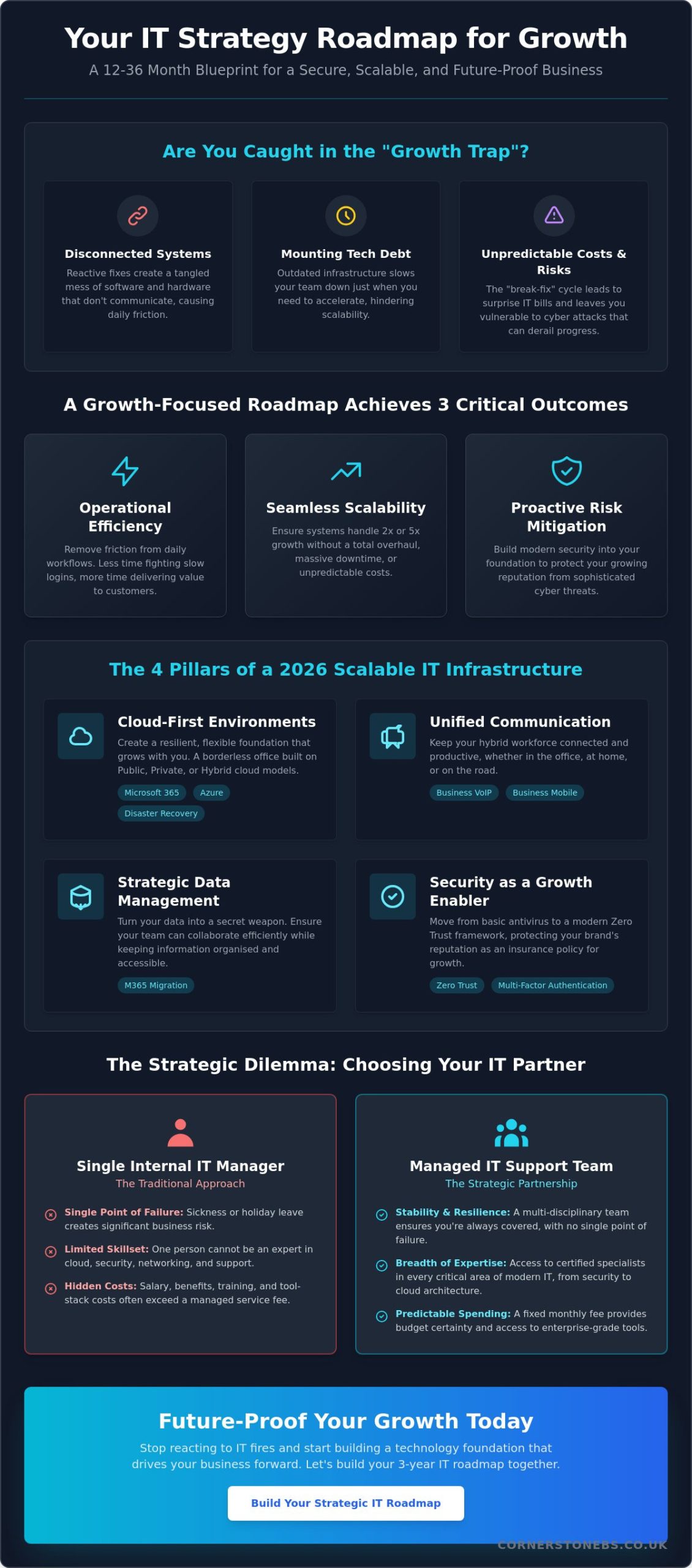
Scaling a business is exciting, but it often reveals hidden cracks in your foundation. If you’ve ever felt like your technology is holding you back rather than pushing you forward, you’re likely caught in the “Growth Trap.” This happens when companies add software or hardware as a reaction to immediate problems, creating a tangled mess of systems that don’t communicate. An IT strategy roadmap for growing businesses changes this dynamic. It’s a long-term vision that aligns every pound spent on technology with your specific business milestones.
Think of it as a Technology Roadmap that serves as a single source of truth for your leadership team. It moves your business away from the stressful “break-fix” cycle where you only call for help when something stops working. Instead, it fosters a proactive partnership where your IT infrastructure is built to support your expansion before it happens. This approach simplifies complex technical concepts so you can focus on your clients and your community.
The Core Objectives of a Growth-Focused Roadmap
A roadmap isn’t just about picking the right tools; it’s about achieving three critical outcomes that protect your business continuity and peace of mind:
- Operational Efficiency: We remove the friction from daily workflows. This means your team spends less time fighting with slow logins and more time delivering value to your customers.
- Scalability: We ensure your systems can handle 2x or 5x growth without requiring a total overhaul or causing massive downtime.
- Risk Mitigation: As your reputation grows, so does your profile as a target for cyber threats. A solid roadmap builds security into the foundation of your expansion.
IT Strategy vs. IT Planning: Understanding the Difference
Many leaders confuse these two terms. An IT plan is a list of tasks, like a hardware replacement cycle or a software update schedule. It tells you what you’re doing. An IT strategy explains why you’re doing it. It focuses on business transformation rather than just keeping the lights on. An IT strategy roadmap is the bridge between your current technical capability and your future business ambition. It ensures that when you invest in Managed IT Support or Cloud Solutions, you’re doing so because it directly supports your 2026 growth blueprint.
The 4 Pillars of a Scalable IT Infrastructure in 2026
Building a scalable foundation requires more than just buying new laptops. It’s about four specific pillars that form your 2026 growth blueprint. When you follow a proven strategic plan template, you ensure that every technical decision supports your long-term commercial objectives. For many local firms, an IT strategy roadmap for growing businesses begins with shifting away from physical limitations and toward digital flexibility.
Modern infrastructure relies on cloud solutions that grow with you. This isn’t just about storage; it’s about creating a resilient foundation that allows your team to work from anywhere without losing performance. We also focus on unified communication. By integrating Business VoIP and Business Mobile, your hybrid workforce stays connected whether they’re in the office or on the road. Finally, data management becomes your secret weapon. A successful Microsoft 365 migration for business UK ensures your team can collaborate efficiently while keeping your sensitive information organized and accessible.
Cloud-First but Not Cloud-Only Environments
Security as a Growth Enabler, Not a Barrier
Many business owners view security as a series of “no’s” that slow them down. We see it differently. Robust cyber security services act as an insurance policy for your brand’s reputation. By moving to a Zero Trust framework, you protect your growing firm from increasingly sophisticated threats. Implementing multi-factor authentication (MFA) and high-level encryption should be your standard, not an afterthought. This proactive stance prepares you for compliance as you move into larger contracts and more regulated industries. If you’re unsure where your current security stands, you can always reach out to our local experts for a friendly chat about your options.
Your IT strategy roadmap for growing businesses should simplify these complex pillars into actionable steps. By focusing on infrastructure, security, communication, and data, you transform your IT from a cost center into a competitive advantage. This clarity allows you to lead with confidence, knowing your tech is ready for whatever 2026 brings.
The Strategic Dilemma: Internal Management vs. Managed IT Support
Many local firms reach a critical crossroads as they scale. You might have a dedicated IT person who has been with you since the start, often referred to as the “lone wolf.” While their loyalty is invaluable, this model often becomes a bottleneck for an IT strategy roadmap for growing businesses. The hidden costs of relying on one person include limited availability during holidays and a lack of specialized knowledge in rapidly changing fields. When your business expands, you need a depth of expertise that a single individual simply cannot provide alone.
The “Expertise Gap” is a very real challenge in 2026. One person cannot realistically be a master of cyber security, cloud architecture, and unified communications all at once. By transitioning to managed IT services, you gain access to a multi-disciplinary team of experts who live and breathe these technologies. This move replaces the “sticker shock” of emergency project work with predictable monthly fees. When you refine your IT strategic plan, you’ll find that having a team of specialists at your fingertips provides a level of stability that an internal manager can’t match.
When to Pivot to Managed IT Support
You’ll know it’s time to make a change when your internal team is drowning in a backlog of basic support tickets. If they’re too busy resetting passwords to discuss your three-year growth goals, your strategic progress has stalled. A Managed Service Provider (MSP) offers proactive maintenance and monitoring that catches issues before they cause downtime. We act as your virtual CIO, providing the high-level guidance you need to ensure your national operations remain seamless and secure.
Maximizing ROI Through Strategic Partnerships
Success comes from treating your IT provider as a long-term partner rather than just another utility vendor. This collaborative approach allows you to leverage our established relationships with global brands like Microsoft, Cisco, and IBM. We help you navigate complex licensing and hardware procurement so you always get the best value for your investment. Implementing comprehensive it company solutions reduces your total cost of ownership by streamlining your infrastructure and preventing expensive, reactive repairs. This partnership ensures your technology remains a foundational element of your business stability and emotional security as you reach for new milestones.
5 Steps to Building Your IT Strategy Roadmap
Step 1: The IT Audit. You can’t plan your journey without knowing your starting point. We begin by assessing your current hardware, software, and security posture. This identifies hidden risks and immediate needs. Step 2: Business Alignment. This is where we look at your commercial goals. If you plan to double your headcount or expand into new regions, your tech must be ready to scale with you. Step 3: Gap Analysis. We determine exactly what is missing between your current capability and your future ambition. Step 4: Prioritisation and Budgeting. We create a phased roll-out that respects your cash flow. You don’t need to do everything at once. Step 5: Execution and Review. We set quarterly milestones to keep the roadmap on track. It’s a living document that adapts as your business evolves.
Conducting a Meaningful IT Audit
A proper audit goes deeper than just counting laptops. We review legacy hardware to identify “end-of-life” risks that could cause sudden downtime. We also audit your software licenses to eliminate waste and close security loopholes. Finally, we assess your network infrastructure for capacity and speed bottlenecks. This ensures your foundation is strong enough to support modern tools like Business VoIP and cloud-based collaboration. If you haven’t looked under the bonnet of your IT lately, book a comprehensive IT audit with our locally based team to get started.
Phasing Your Implementation
We believe in a “crawl, walk, run” approach to technology. We start with Quick Wins. These address critical security gaps and immediate productivity killers that frustrate your team. Once the foundation is secure, we move to Medium-Term goals. This usually involves cloud migrations and communication upgrades that improve flexibility. Long-Term objectives focus on advanced data analytics and AI-driven automation. This phased approach ensures your IT strategy roadmap for growing businesses remains affordable and effective, providing the emotional security that comes from knowing your systems are built to last.
Future-Proofing Your Growth with Cornerstone Business Solutions
Building an IT strategy roadmap for growing businesses requires more than just technical knowledge; it demands a partner who understands the unique challenges of the UK business landscape. At Cornerstone Business Solutions, our multi-award-winning approach is designed specifically for firms that are ready to scale without the friction of technical debt. We don’t believe in one-size-fits-all packages. Instead, we provide bespoke technology solutions that align perfectly with your commercial milestones and regional roots.
The “Cornerstone Difference” lies in our proactive attitude. We don’t wait for systems to fail before we step in. Our team utilizes advanced monitoring to identify and resolve potential issues before they impact your team’s productivity. This proactive stance bridges the gap between complex digital infrastructure and your business objectives. We translate technical requirements into clear business benefits, ensuring you always understand the value behind every technology investment.
A Partnership Built on Trust and Accolades
We’ve built our reputation on a foundation of trust and consistent industry recognition. Our established partnerships with global tech leaders like Microsoft and Cisco mean we bring enterprise-level expertise directly to your doorstep. While we’re proud of our geographical origins, our national reach ensures your business is supported wherever your expansion takes you. You gain the peace of mind that comes from a dedicated, expert helpdesk that treats your business stability as a top priority.
Get Started on Your 2026 Roadmap Today
Don’t let technical frustration hold your ambition back. Moving from a reactive “firefighting” mode to strategic clarity is simpler than you might think. We’re here to help you navigate the complexities of Cyber Security, Cloud Solutions, and Network Infrastructure so you can lead with confidence. We invite you to an informal, no-obligation conversation about your business goals and how technology can help you reach them faster.
Your journey toward a more stable, secure, and scalable future starts with a single step. Whether you need to overhaul your communication with Business VoIP or protect your data through Disaster Recovery, we have the specialized expertise to lead the way. Contact our expert team to begin your strategic IT journey today and discover how we can help you build a resilient foundation for the years ahead.
Build Your Foundation for a Scalable Future
Your business deserves a technical foundation that supports your ambition rather than slowing it down. By shifting from reactive fixes to a proactive IT strategy roadmap for growing businesses, you ensure your infrastructure is ready to handle whatever the market brings in 2026. We’ve explored how aligning your technology with commercial milestones eliminates expensive tech debt. This approach provides the emotional security your leadership team needs to scale with confidence and clarity.
As a multi-award-winning IT services provider, we take pride in simplifying complex infrastructure for our local partners. Our deep relationships with global leaders like Microsoft, IBM, and Cisco allow us to bring enterprise-level strength to your unique roadmap. With our proactive 24/7 system monitoring, we catch potential issues before they impact your operations, keeping your growth on a steady, predictable path. It’s time to move beyond technical frustration and start building for the future.
Ready to transform your technology into a competitive advantage? Book a Strategic IT Consultation with our Award-Winning Team today. Let’s have a conversation about how we can support your long-term success with a plan that fits your business perfectly.
Frequently Asked Questions
How long should an IT strategy roadmap cover?
A standard IT strategy roadmap for growing businesses should cover a period of 12 to 36 months. This timeframe allows you to align technology investments with your medium-term commercial goals while remaining flexible enough to adapt to rapid market changes. A 12-month focus handles immediate security and efficiency needs; the 36-month view prepares your infrastructure for significant scaling and larger capital investments.
What is the biggest mistake businesses make when building an IT roadmap?
The most common error is viewing technology as an isolated expense rather than a growth engine. Many firms purchase software or hardware reactively to solve a single problem without considering how it fits into the wider ecosystem. This creates disconnected systems that don’t talk to each other. A successful roadmap requires you to start with your business objectives first, then select the tools that help you reach them.
How much does it cost to implement a professional IT strategy?
Can we build an IT roadmap if we already have an internal IT person?
Absolutely, and a roadmap often makes your internal IT person more effective. It provides them with a clear set of priorities and a strategic framework to follow. Many growing firms use a hybrid model where we provide high-level guidance and specialized support in areas like Cyber Security or Cloud Solutions. This partnership allows your internal staff to focus on daily operations while we handle the complex, long-term technical architecture.
How often should we review and update our IT strategy?
You should review your roadmap quarterly to ensure your projects remain on track and aligned with your current business performance. While the core strategy provides a long-term vision, the technical landscape changes quickly. An annual deep-dive update is essential to incorporate new advancements, such as AI-driven automation or updated security protocols. This regular rhythm ensures your technology remains a foundational element of your stability rather than becoming an outdated burden.
What are the most important IT priorities for a growing business in 2026?
In 2026, the top priorities are robust security, seamless scalability, and unified communication. Implementing a Zero Trust framework is no longer optional as cyber threats become more sophisticated. You also need cloud-first infrastructure that allows your team to collaborate effectively from any location. Finally, ensuring your Business VoIP and mobile systems are fully integrated supports a professional image and maintains client trust as you expand your national reach.
How does an IT roadmap help with cyber security compliance?
Is an IT roadmap necessary for a business with fewer than 50 employees?
Yes, a roadmap is arguably more critical for smaller teams where every investment must deliver maximum value. Without a plan, a business with fewer than 50 employees can easily outgrow its basic systems within months, leading to expensive and disruptive migrations. Starting with a clear strategy ensures you build your infrastructure correctly the first time. This saves money, reduces frustration, and allows your small team to compete with much larger organizations.
Tags: Business Growth, Cybersecurity, IT Roadmap, IT strategy, managed IT services, Scalability, Small Business IT, Tech Debt