Posted on: September 6th, 2026 by Cornerstone
In 2026, waiting for your technology to break before fixing it isn’t just an inconvenience; it’s a deliberate choice to let your competitors overtake you. You’ve likely felt the sting of unpredictable IT costs or the frustration of a helpdesk that takes hours to respond while your team sits idle. It’s exhausting to worry about the next data breach or wonder if your current systems are simply holding you back. Finding the right partner for comprehensive managed IT services shouldn’t feel like a gamble with your company’s stability.
We understand that you need more than just a fix-it team; you need a strategic ally. This guide reveals how Cornerstone Business Solutions, as a proactive, national-scale managed IT partner, can eliminate downtime and secure your business growth. We’ll show you how to move from reactive fire-fighting to a model of predictable monthly budgeting and robust cyber security. You’ll learn how to implement a clear three-year technology roadmap that aligns with new UK regulations like the Cyber Security and Resilience Bill. Let’s explore how award-winning support can turn your digital infrastructure from a headache into your greatest competitive advantage.
Key Takeaways
- Move beyond the costly ‘Break-Fix’ cycle by adopting a holistic managed IT model that prioritises business continuity and long-term stability.
- Learn to leverage proactive monitoring to identify potential hardware failures and software conflicts before they cause expensive downtime.
- Evaluate potential partners based on strategic benchmarks, including high-level certifications from industry leaders like Microsoft, IBM, and Cisco.
- Discover how a security-first approach to cloud strategy and Microsoft 365 can protect your data while empowering your team to work from anywhere.
- Understand how national-scale managed it services newcastle provide the infrastructure and expertise needed to scale your operations without increasing technical complexity.
Defining Managed IT Support in a High-Growth Business Context
For years, many SMEs relied on the ‘break-fix’ model. It felt simple. You wait for something to fail, call a technician, and pay an hourly rate to get back online. This creates a fundamental conflict of interest. Your provider actually profits from your downtime. In contrast, a modern Managed IT Support partnership flips this script. It’s a holistic, outsourced technology relationship designed for high-growth enterprises. Instead of reacting to disasters, the focus is entirely on prevention. This shift from technical troubleshooting to strategic business enablement is why ambitious firms seek managed it services newcastle to anchor their 2026 growth plans.
Fixed-fee models provide total alignment between your goals and our incentives. When your systems run perfectly, both parties win. This allows for predictable monthly budgeting. It removes the fear of ‘surprise’ invoices after a server crash or a security scare. By treating technology as a foundational element of your stability rather than a recurring headache, you can focus on what you do best: growing your business.
The Core Components of a Managed Service Agreement
A robust agreement focuses on business continuity and emotional security for the business owner. It includes several critical elements:
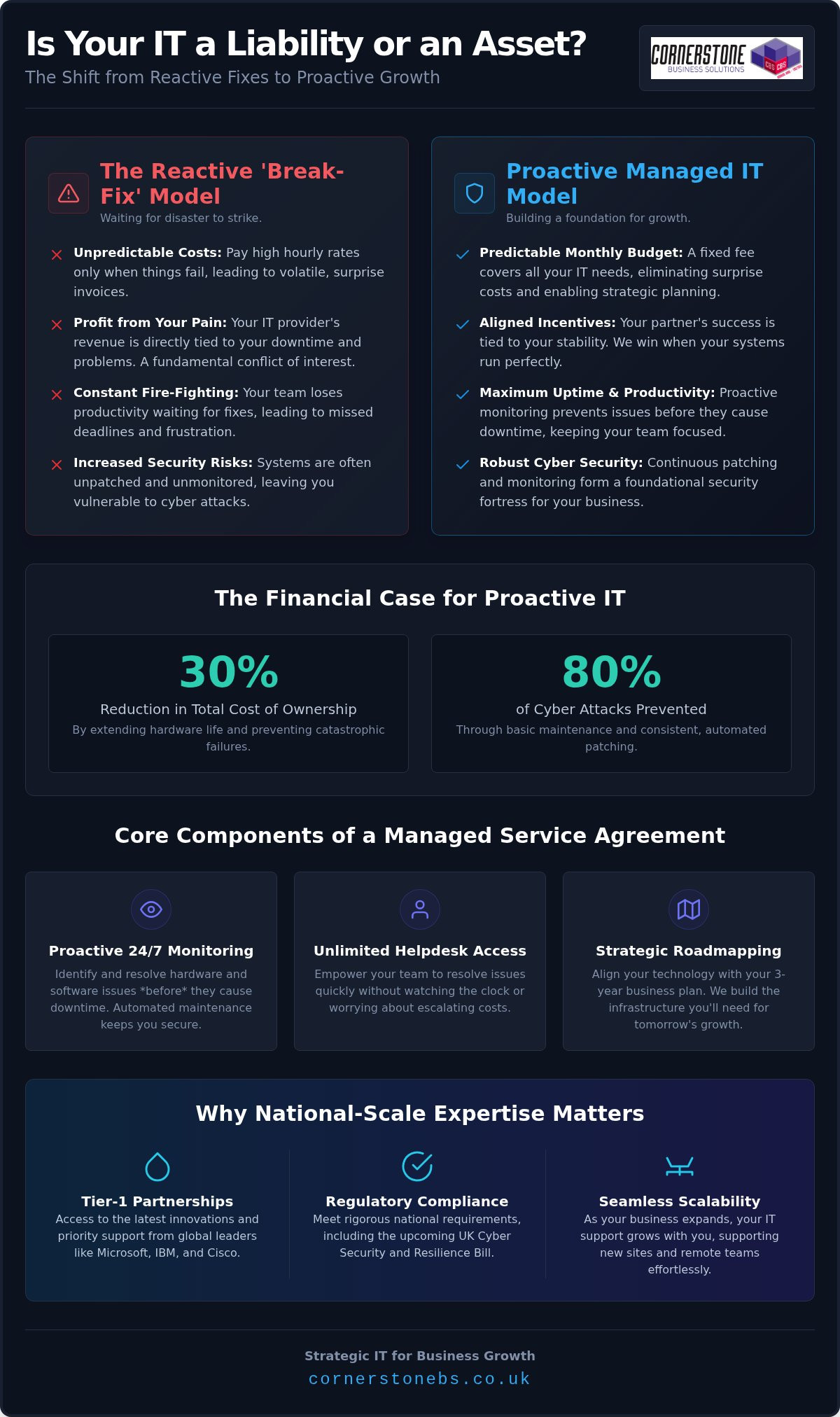
- Proactive 24/7 monitoring: We identify hardware failures or software conflicts before they cause downtime. Automated maintenance keeps your systems patched and secure without manual intervention.
- Unlimited helpdesk access: Your team can resolve issues quickly without escalating costs or watching the clock. This ensures productivity remains high across the entire organisation.
- Strategic roadmapping: Regular reviews ensure your technology aligns with your three-year growth plan. We don’t just manage your current estate; we build the infrastructure you’ll need tomorrow.
Why National Expertise Matters for Business Success
Choosing a partner with national scale offers advantages that smaller setups can’t provide. You gain access to higher-tier global partnerships with industry leaders like Microsoft, IBM, and Cisco. These relationships mean your business benefits from the latest innovations and priority support. We also implement standardised security protocols that meet rigorous national compliance requirements. This is vital as the UK regulatory environment becomes more complex with the 2026 Cyber Security and Resilience Bill. Finally, national expertise ensures seamless scalability. As your business expands across the country, your managed it services newcastle provider can support new sites and remote teams with a unified, high-performance network infrastructure.
Proactive Maintenance: The Shift from Reactive to Preventative IT
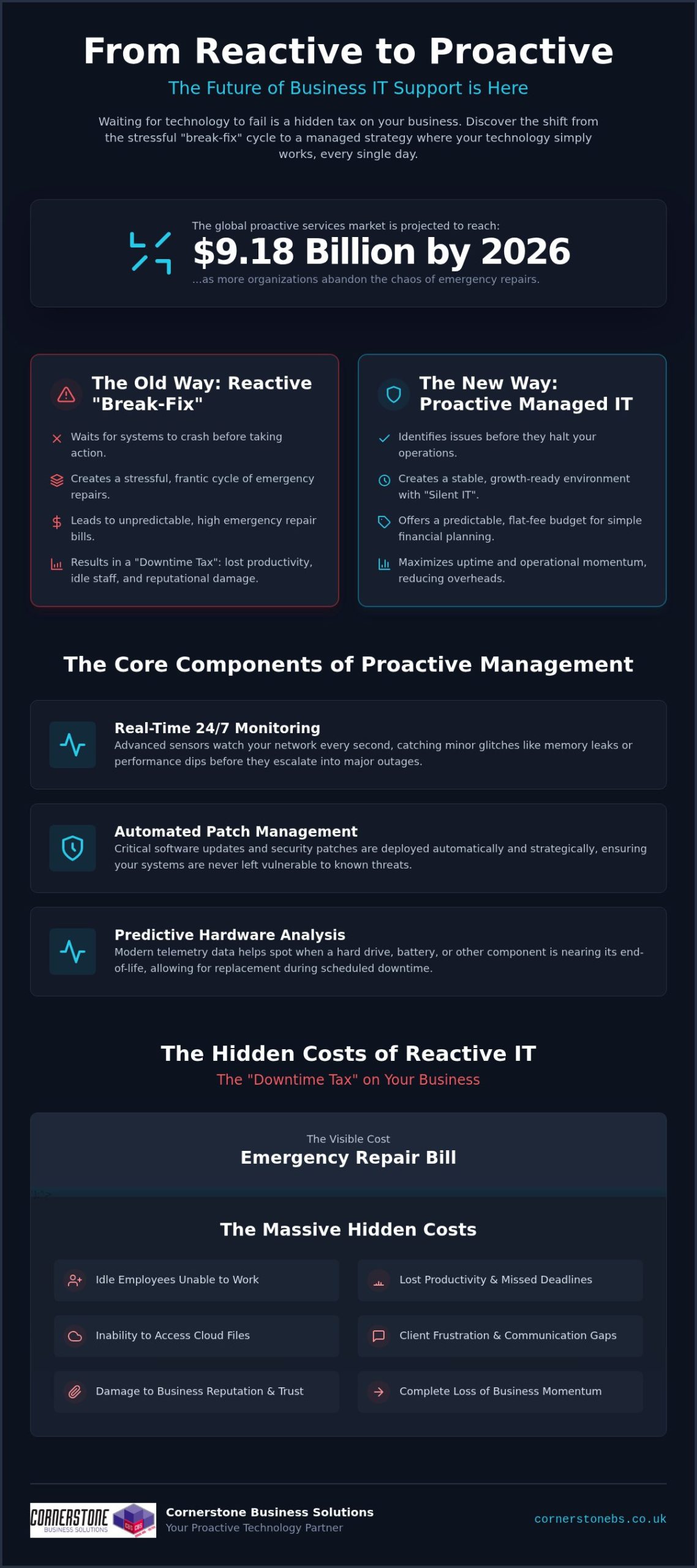
Reactive IT is a silent profit killer. When you wait for a server to crash or a network to crawl before taking action, you aren’t just paying for the repair; you’re paying for lost wages, missed deadlines, and potential reputational damage. Proactive maintenance changes this dynamic entirely. By choosing high-quality managed it services newcastle, you move away from the chaos of emergency fixes and into a state of continuous system health. This shift ensures your technology works for you, rather than against you.
Our monitoring tools work tirelessly in the background, identifying hardware failures or software conflicts before they impact your workflow. Automated patching ensures every device remains up-to-date, which is a core part of a modern Cyber Security and Cloud Strategy. This preventative approach is often called ‘Foundational Security’. It’s highly effective, as industry data suggests that basic maintenance and consistent patching can prevent up to 80% of common cyber attacks. By securing the basics, you build a fortress that protects your business growth.
The Financial Case for Proactive IT
Switching to a managed model transforms your IT spend from a volatile burden into a strategic asset. You move from unpredictable CAPEX ’emergency’ expenses to a predictable monthly fee that fits your budget perfectly. Proactive monitoring reduces the total cost of ownership by 30% by extending the life of your hardware and preventing catastrophic failures. This stability allows for better long-term planning and investment. If your business operates across multiple locations, you might also be interested in our guide to Managed IT Services in Teesside.
Reducing Employee Frustration and Productivity Loss
Technology should empower your team, not frustrate them. Slow systems and constant ‘IT friction’ drain staff morale and kill productivity. When employees know they have a dedicated long-term partner to call, the psychological weight of tech issues disappears. We prioritise a ‘First-Time Fix’ goal because resolution speed is the ultimate metric for business continuity. Our team acts as an extension of your own, ensuring that managed it services newcastle provide the emotional security your workforce needs to thrive. if you’re ready to leave the ‘break-fix’ headaches behind, our Managed IT Support team is here to help you build a more resilient future.
Key Criteria for Selecting a National IT Support Partner
Selecting a partner for managed it services newcastle is one of the most critical decisions you’ll make for your company’s stability. It’s not just about finding a technician; it’s about finding a long-term strategic ally. Start by looking for technical certifications. Partnerships with global leaders like Microsoft, IBM, and Cisco are essential benchmarks. They prove your provider has the high-level expertise to manage complex digital infrastructure and secure your future growth.
Industry recognition also matters. Our multi-award-winning status acts as a recurring signature of quality. It shows that industry experts have validated our work, giving you the confidence that your systems are in safe hands. When reviewing Service Level Agreements (SLAs), look deeper than just ‘response times’. A response is simply an acknowledgement. Resolution time is the metric that actually protects your productivity and keeps your team moving.
A true partner offers dedicated account management. You don’t want a simple helpdesk that only resets passwords. You want a strategic expert who understands your three-year technology roadmap. Because business growth often involves national expansion, ensure your provider has the national reach to support remote teams and new locations across the entire UK without a drop in service quality.
Evaluating Cybersecurity Credentials
In 2026, security is a foundational element of business stability. Your provider should be Cyber Essentials Plus certified. This isn’t just a badge; it’s proof they follow rigorous national standards to protect your data. Robust Cyber Security Services should also include integrated Disaster Recovery. If the worst happens, you need to know your systems can be restored quickly to ensure zero downtime. This level of preparation provides the emotional security every business owner deserves.
Cultural Fit and Communication Style
Technical expertise is vital, but communication is what builds trust. Avoid providers who hide behind dense jargon or academic phrasing. You need professional authority blended with approachable warmth. A human-focused helpdesk simplifies complex technical concepts so you can make informed decisions. We believe the initial consultation is the best ‘vibe check’ for your business. It’s an informal invitation to a conversation where you can see if our proactive attitude matches your own ambition. Finding a partner for managed it services newcastle should feel like a natural extension of your team.
Integrating Cyber Security and Cloud Strategy into IT Support
In 2026, the line between daily technical support and high-level cyber security has vanished. Every password reset, software update, or hardware installation must be viewed through a security-first lens. Treating security as a separate ‘add-on’ is a risk your business cannot afford. When you partner with an expert for managed it services newcastle, you ensure that every interaction strengthens your digital perimeter. This integrated approach is essential as the UK implements the Cyber Security and Resilience Bill, which mandates stricter oversight for managed service providers and their clients alike.
Modern productivity relies on a seamless transition to the cloud. Managed support acts as the catalyst for a secure cloud migration, moving your data away from vulnerable on-site servers to resilient environments. However, cloud adoption without a strategy leads to ‘cloud sprawl’ and security gaps. Support is only effective if it’s backed by a robust, tested disaster recovery plan. We ensure your backups are not just running, but are actually recoverable, providing the emotional security you need to lead with confidence.
The Microsoft 365 Ecosystem
Microsoft 365 is the heartbeat of the modern UK workplace. It offers far more than just email; it’s a unified platform for national collaboration through Teams, SharePoint, and Azure. Our role is to manage these licenses and permissions meticulously. This prevents unauthorised access and ensures you aren’t paying for features you don’t use. If you’re planning a transition, our Microsoft 365 Migration for Business UK guide provides a clear roadmap for a secure deployment.
Building Business Resilience
Resilience is the ability to maintain operations during any crisis. We implement a ‘Zero Trust’ model, which is now the gold standard for national organisations. This framework assumes that every access request, whether internal or external, must be fully verified. It’s particularly vital in a hybrid working world where staff use mobile devices and remote connections. By protecting every endpoint, we ensure your team can work safely from anywhere. If you want to see how an integrated strategy can protect your growth, explore our Cyber Security and Cloud Solutions today.
Scaling Your Business with Managed Technology Solutions
Growth is a stress test for your digital infrastructure. If your systems aren’t ready for national expansion, the cracks will show quickly through slow response times and frequent outages. Robust managed it services newcastle provide the stability you need to scale without the friction of technical debt. We focus on streamlining your network infrastructure, ensuring it supports more users and devices without adding unnecessary complexity. This allows you to focus on your commercial objectives while we handle the digital heavy lifting. It’s about building a foundation that stays strong, no matter how fast you move.
From Small Business to Enterprise
Transitioning from ad-hoc, reactive IT to a fully managed model is a major milestone for any growing firm. It replaces volatile, ‘break-fix’ repair costs with a predictable monthly fee structure. This makes financial planning much simpler for your board. We also help you manage hardware lifecycles. By anticipating when servers or workstations need replacing, you avoid sudden, large capital outlays that can disrupt your cash flow. For major infrastructure upgrades, we provide clear professional service project fees. You’ll always know exactly what you’re investing in and what the outcome will be.
Next Steps: Your Journey to Better IT
Your path to more resilient technology starts with a comprehensive IT audit. We’ll examine your current digital infrastructure to identify hidden risks and opportunities for efficiency. From there, we work with you to define your business goals and technology needs for the next 12 to 36 months. This creates a clear, actionable roadmap for success. Booking a consultation with an award-winning national IT partner is the first step toward that security. It’s an informal invitation to discuss how managed it services newcastle can support your long-term vision. Let’s start the conversation and build a foundation that lasts.
Secure Your Competitive Edge for 2026 and Beyond
In 2026, technology is the foundation of your business stability. We’ve explored how moving from the outdated break-fix model to proactive maintenance can eliminate downtime and protect your bottom line. By integrating cyber security and cloud strategy into your daily operations, you don’t just solve technical problems; you build a platform for national expansion. Choosing a partner for managed it services newcastle is about more than just fixing laptops. It’s about finding an ally who understands your three-year roadmap.
As a multi-award-winning national provider, we take pride in being a dedicated long-term partner for your business. Our strategic partnerships with Microsoft, IBM, and Cisco ensure you have access to global expertise, while our proactive 24/7 system monitoring keeps your operations running smoothly. Our team provides a friendly, accessible face that makes sophisticated technology feel reachable for every enterprise. You deserve the emotional security that comes from knowing your digital infrastructure is in expert hands.
We’d love to help you turn your technology into your greatest asset. Book a free IT consultation with our award-winning team today and let’s start a conversation about your future growth. Your success is our success, and we’re ready to help you lead with confidence.
Frequently Asked Questions
What is the average response time for IT support Newcastle businesses should expect?
Resolution speed is the metric that truly matters for business continuity. While many providers focus on how quickly they acknowledge a ticket, our award-winning team prioritises fixing the issue the first time. We define these expectations clearly in our Service Level Agreements (SLAs). By providing unlimited helpdesk access, we ensure your team isn’t left waiting while productivity drops. This proactive approach is a hallmark of high-quality managed it services newcastle.
How much does managed IT support cost per user in 2026?
Our pricing model is designed for total transparency and predictable monthly budgeting. Instead of volatile hourly rates, we use a fixed-fee structure based on the number of users or devices in your organisation. This aligns our incentives with yours; we both want your systems to run perfectly. While specific costs depend on your infrastructure’s complexity, this model moves IT from a chaotic capital expense to a manageable operational cost.
Is cyber security included in a standard IT maintenance plan?
We integrate cyber security into every aspect of our maintenance plans because security isn’t an optional add-on in 2026. Our security-first approach includes automated patching and 24/7 system monitoring to block threats before they reach your network. We focus on foundational security protocols that meet national compliance standards. This ensures that every support ticket we handle strengthens your digital perimeter rather than just fixing a simple technical glitch.
Can a national IT provider support my remote employees across the UK?
Yes, our national reach allows us to support your workforce across the entire United Kingdom. We specialise in creating a unified digital environment for remote and hybrid teams using secure cloud solutions and business VoIP. Whether your staff are in a central office or working from home, they receive the same high-tier support. This scalability is essential for businesses looking for managed it services newcastle that can grow alongside their national ambitions.
What is the difference between a helpdesk and a managed service provider?
A helpdesk is typically a reactive service that waits for you to report a problem. A managed service provider like Cornerstone acts as a long-term strategic partner. We don’t just fix what’s broken; we use proactive monitoring to prevent issues from occurring. We also provide a clear three-year technology roadmap. This ensures your digital infrastructure supports your business goals rather than just acting as a basic technical necessity.
How long does it take to switch IT support providers?
Transitioning to a new provider is a structured process that usually takes between two and four weeks. We begin with a comprehensive IT audit of your current digital infrastructure to identify any immediate risks. Our team handles the heavy lifting, including the migration of licenses and the implementation of our monitoring tools. We aim for a seamless handover that minimises disruption, ensuring your team stays productive throughout the entire switch.
Do you provide hardware like business laptops and servers as part of the service?
We provide a full range of IT hardware, including high-performance business laptops, workstations, and servers. Because we partner with global leaders like Microsoft, IBM, and Cisco, we can source and configure the exact equipment your business needs. Our professional service project fees cover the deployment and installation of this hardware. This ensures your new equipment is integrated perfectly into your existing network infrastructure from the very first day.
How does Microsoft 365 integration improve my business security?
Microsoft 365 significantly improves your security by centralising identity management and data permissions. It allows us to implement a Zero Trust model, where every access request is verified regardless of where it originates. We manage your cloud environment to prevent cloud sprawl and ensure that sensitive data stays protected within SharePoint and Teams. This unified approach to data security is essential for maintaining resilience in a modern, hybrid workplace.
Posted on: September 5th, 2026 by Cornerstone
Attackers targeted backup repositories in 96% of ransomware incidents over the last year, and they successfully breached them in 76% of those cases. It’s a sobering reality that keeps many UK business owners awake at night. You’ve likely felt the pressure of rising hardware costs and the headache of trying to decode complex technical jargon, but finding the right cloud backup solutions for business shouldn’t feel like a chore. We understand that your data isn’t just a collection of files; it’s the foundation of your hard-earned reputation and the lifeblood of your community presence.
This guide simplifies the path forward. You’ll learn how to secure your business data, ensure continuity, and scale your infrastructure with modern cloud backup strategies. We’re moving beyond simple storage to explore a 2026 strategy focused on true cyber resilience. We’ll cover everything from immutable backups to the shared responsibility model, giving you a clear, jargon-free roadmap to lower your IT overheads and protect your organisation’s future. It’s about more than just technology; it’s about the emotional security that comes from knowing your business is safe.
Key Takeaways
- Understand how automated, off-site data preservation converts heavy capital expenditure into a flexible, scalable operational strategy for your organisation.
- Learn to distinguish between SaaS, IaaS, and PaaS to create a bespoke technology stack that avoids the limitations of generic, off-the-shelf bundles.
- Compare public, private, and hybrid deployment models to find the right balance of data sovereignty, performance, and long-term cost-efficiency.
- Access a step-by-step framework for implementing cloud backup solutions for business that protects your continuity from the initial audit through to post-migration support.
- Discover the value of a collaborative partnership with a multi-award-winning national expert who prioritises proactive helpdesk support over reactive troubleshooting.
Why Cloud Backup Solutions are Critical for Business Resilience in 2026
Resilience in 2026 isn’t just about surviving a crisis; it’s about staying operational while others stumble. A modern remote backup service is an automated, off-site data preservation strategy that keeps your files safe in a secure, secondary location. These cloud backup solutions for business have evolved from simple storage into the backbone of organisational stability. By moving away from capital-heavy physical servers, you can shift costs to a predictable operational model that fits your budget perfectly.
This flexibility is vital for supporting the UK’s hybrid workforce. When your team works from various locations, your data shouldn’t stay locked in a physical box in a quiet office. You need a system that moves as fast as your people do. However, don’t fall for the “set and forget” myth. While the technology is automated, proactive monitoring is the only way to ensure your recovery points remain valid and ready when you need them most.
The Decline of the Physical Server
Cloud leaders like Microsoft and IBM now provide enterprise-grade encryption that was once only available to global corporations. This level of protection ensures your data is unreadable to anyone without the correct keys, even during transit. Automated patching is another silent hero here. It eliminates human error by ensuring your systems are always up to date with the latest security fixes without a manual check. Most SME premises can’t compete with the physical security of a dedicated data centre, which features biometric access and 24/7 surveillance to keep your digital assets safe. Choosing modern cloud backup solutions for business means you’re inheriting these world-class security standards as part of your standard setup.
The Three Pillars of Cloud Strategy: SaaS, IaaS, and PaaS Explained
Cloud jargon can feel like a barrier. However, it’s really just a way to categorise how your business uses technology to grow. Instead of settling for generic bundles, we focus on building a bespoke technology stack that fits your specific workflow. These three pillars work together to create a secure digital environment, often forming a core part of any robust Disaster Recovery Plan (DRP). Understanding these layers helps you choose the right cloud backup solutions for business without paying for features you don’t need.
Each pillar serves a different purpose, but they all share a common goal: removing the physical limitations of traditional IT. Whether you’re looking for better collaboration or a total infrastructure overhaul, these models provide the flexibility required for 2026. For a broader look at how these integrate with your physical setup, our guide on IT company solutions offers practical advice on hardware and software synergy.
Software as a Service (SaaS): Your Daily Tools
Software as a Service is likely what your team interacts with most. A prime example is Microsoft 365. It enables your national team to collaborate in real-time, whether they’re in a home office or on a site visit. One common misconception is that data in a SaaS platform is automatically backed up forever. It isn’t. Dedicated cloud backup solutions for business are essential here because they protect you against accidental deletion or internal threats that native tools might miss. SaaS keeps your tools accessible across every device while keeping your overheads low.
Infrastructure as a Service (IaaS): Virtual Foundations
Infrastructure as a Service is the virtual equivalent of your old server room. By using platforms like Microsoft Azure, you remove the need for noisy, hot hardware that requires constant maintenance and expensive electricity. You’re essentially renting the processing power and storage you need from a world-class data centre. IaaS allows businesses to adjust resources in real-time, meaning you only pay for what you actually use. This virtual foundation makes scaling your business much smoother than waiting for new physical hardware to arrive and be configured.
Platform as a Service (PaaS): Fueling Innovation
Platform as a Service is where custom innovation happens. It allows your business to develop and deploy custom applications without the headache of managing the underlying hardware or operating systems. This reduces the complexity and cost of bespoke software development significantly. You might transition to PaaS when standard SaaS tools no longer fit your unique business processes and you need something tailored to your specific industry. If you’re ready to build a more resilient foundation, consider how our bespoke IT solutions can streamline your transition to these modern cloud pillars.
Public, Private, or Hybrid? Navigating Your Strategic Path
Choosing the right architecture for your cloud backup solutions for business is a strategic decision that impacts your daily operations and long-term security. It’s not a one-size-fits-all choice. You need to balance the cost-efficiency of shared systems with the strict control required for sensitive data. Many business owners worry that public clouds are less secure than private ones, but this is a common misconception. In reality, the most resilient organisations often use a mix of both. Before committing to a path, you must audit your data sensitivity. Categorise your files into “critical and sensitive” versus “general operational data” to see where a hybrid approach might serve you best.
Public Cloud: Cost-Efficiency and Global Scale
Public cloud models use shared infrastructure to deliver incredible scale at a lower cost. They’re perfect for non-sensitive data and general applications that need to be accessible from anywhere. If you’re looking for the fastest route to digital transformation, this is it. Our Cloud Solutions simplify national expansion by removing the need for local hardware at every new site. It’s a plug-and-play model that grows with you. You don’t need to worry about hardware maintenance, as the provider handles all the heavy lifting behind the scenes.
Private and Hybrid: Tailored Control and Compliance
For regulated industries like finance or healthcare, the isolation of a private cloud is often a legal or operational necessity. You get dedicated resources that aren’t shared with any other organisation. However, many UK firms are now adopting a “Hybrid First” strategy. This allows you to keep sensitive legacy software on a local or private server while utilising the immense power of the cloud for everything else. It’s the best of both worlds. You maintain total control over your most sensitive assets while benefiting from the scalability of modern cloud backup solutions for business.
Managing this split environment doesn’t have to double your workload if you have the right management tools in place. Understanding Why Enterprise Recovery Plans Fail often reveals that architectural mismatches are the primary culprit. By aligning your deployment model with your specific compliance needs, you create a foundation that won’t buckle under pressure. We help you bridge the gap between your existing systems and the cloud, ensuring your data moves safely between environments without any service interruptions.
A Practical Framework for Implementing Cloud Backup and Migration
Moving your data to the cloud is a significant milestone for any UK organisation. It’s not just about moving files from one place to another; it’s about building a foundation that supports your future growth and stability. We follow a structured framework that takes you from an initial audit through to post-migration support. This proactive approach ensures your business stays online while implementing the best cloud backup solutions for business for your specific needs. Professional project management is the secret to a smooth transition, as it keeps every technical detail aligned with your commercial goals.
The Infrastructure Audit: Knowing What You Have
Before we move a single byte, we need to understand your current landscape. This involves evaluating your available bandwidth and identifying any legacy applications that might not play nicely with modern environments. We also look at the age of your hardware to see what’s worth keeping and what’s ready for retirement. This audit helps us decide which workloads are “cloud-ready” and which might need refactoring to work efficiently. By setting clear KPIs, such as specific cost reductions or improved access speeds, we ensure the migration delivers measurable value to your team.
Disaster Recovery: Planning for the Unexpected
A successful migration must have security at its core. We integrate our Cyber Security Services from day one to protect your data while it’s in transit. This is also the time to define your Recovery Point Objectives (RPO) and Recovery Time Objectives (RTO). These metrics tell us exactly how much data you can afford to lose and how quickly you need to be back online after an incident. Cloud-based disaster recovery ensures your business maintains continuity even during a total local hardware failure.
We don’t believe in “set and forget” systems. Automated, regular backup testing is a non-negotiable part of our framework. It’s the only way to guarantee data integrity and give you total peace of mind. When you choose modern cloud backup solutions for business, you’re investing in a system that’s actively monitored and tested against the latest threats. We’re here to manage the complexity so you can focus on running your business. Talk to us about your cloud migration today to ensure a secure transition.
Choosing a Long-Term Partner for Your Bespoke Cloud Infrastructure
Finding the right technology is only half the battle. The real value lies in the hands that manage it. As a multi-award-winning national IT provider, we don’t just sell cloud backup solutions for business; we build the digital safety nets that allow your organisation to thrive. We’ve spent years refining a proactive helpdesk model that prioritises prevention over cure. While others wait for a ticket to arrive, we’re already working behind the scenes to ensure your systems remain stable. This shift from reactive to proactive isn’t just a technical choice. It’s a commitment to your emotional security and business continuity.
Our status as a trusted partner is backed by deep relationships with industry giants like Microsoft, IBM, and Cisco. These global partnerships give us the tools to build world-class infrastructure, but it’s our regional warmth and community-focused style that makes the difference. We translate these high-level technologies into clear, benefit-driven strategies that any business owner can understand. It’s about making the complex feel simple and the uncertain feel secure. We position IT support as the foundational element of your stability, not just a technical necessity.
Bespoke Solutions vs. One-Size-Fits-All
Clarity and transparency are the hallmarks of our award-winning support. We believe that you should always know exactly how your data is being protected without having to wade through dense technical manuals. Our national reach ensures we have the resources to provide 24/7 proactive monitoring, catching potential issues before they become expensive problems. This constant vigilance provides a level of peace of mind that a standard helpdesk simply can’t match. We’re proud of our accolades and the trust we’ve built across the UK, and we’d love to help you secure your future.
Your journey to a more resilient, scalable cloud environment starts with a single conversation. We invite you to reach out to our team of experts to discuss how a bespoke cloud strategy can transform your operations. Let’s move away from transactional IT and toward a collaborative partnership that puts your success first. We’re ready to help you build a foundation that grows with your organisation.
Build a Resilient Foundation for 2026 and Beyond
Securing your data is no longer a back-office task; it’s the architectural insurance policy that keeps your organisation running. We’ve explored how the right mix of SaaS, IaaS, and PaaS creates a flexible environment that grows with you. By moving away from capital-heavy physical hardware and adopting a proactive framework, you can lower your IT overheads while gaining total peace of mind. Implementing modern cloud backup solutions for business ensures that your recovery points are always tested and ready, protecting your reputation from the ever-present threat of ransomware.
As a multi-award-winning national IT provider, we pride ourselves on being more than just a supplier. Our strategic partnerships with Microsoft, IBM, and Cisco allow us to deliver bespoke, proactive technology solutions that simplify the complex. We’re here to act as your long-term partner, providing the emotional security you need to focus on your core business goals. You don’t have to navigate these technical transitions alone. We invite you to Book a Cloud Strategy Consultation with Cornerstone Business Solutions to start your journey. Let’s work together to make your business more stable, scalable, and secure.
Frequently Asked Questions
What are the main benefits of cloud backup for a small business?
Cloud backup solutions for business provide automated protection without the need for manual intervention. You gain off-site security that keeps your data safe from local disasters or hardware failure. It also shifts your IT spending from heavy capital investment in servers to a predictable monthly operational cost. This flexibility allows your small business to scale resources as you grow, ensuring you only pay for the protection you actually use.
Is cloud storage the same as a cloud backup solution?
No, they serve different purposes. Cloud storage focuses on daily file access, syncing, and collaboration across your team. A cloud backup solution is designed for data preservation and disaster recovery. It creates a secure, versioned copy of your entire system that stays protected even if the original files are deleted or encrypted by ransomware. Backup provides the safety net you need to restore your operations quickly after a significant data loss event.
How much do cloud backup solutions cost for a UK SME?
Costs for a UK SME are typically calculated based on the number of users, devices, or the total volume of data being protected. Most providers offer these as monthly managed services, including proactive monitoring and helpdesk support. This subscription model helps you avoid large upfront hardware costs. While exact pricing depends on your bespoke requirements and data sensitivity, it remains a scalable investment that aligns with your organisation’s specific growth and security needs.
How secure is my data in a cloud environment compared to on-premise?
Data in the cloud is often more secure than on-premise hardware due to enterprise-grade encryption and 24/7 physical security at data centres. Global leaders like Microsoft and IBM invest billions in security infrastructure that most SMEs cannot replicate locally. These environments feature automated patching and advanced threat detection to stop breaches before they happen. By moving to the cloud, your business inherits these world-class standards, providing a much stronger defense against modern cyber threats.
What happens to our cloud backup if our internet connection goes down?
If your connection drops, most modern systems use local caching to store data changes temporarily. Once your internet is restored, the backup resumes automatically and syncs the new information to the cloud. You don’t lose any data during the downtime. For businesses that require constant uptime, we often recommend redundant connectivity options as part of a wider disaster recovery strategy to ensure your team stays productive even during a local outage.
Can we migrate our existing legacy software to a cloud solution?
Yes, most legacy applications can be migrated using Infrastructure as a Service (IaaS) platforms like Microsoft Azure. We start with a thorough infrastructure audit to check compatibility and determine if your software needs any refactoring for the best performance. This allows you to keep using the bespoke tools your business relies on while gaining the scalability and security of the cloud. It’s a practical way to modernise your operations without losing your existing workflows.
How do cloud solutions support remote and hybrid working?
Cloud solutions provide your team with secure access to their files and daily tools from any location with an internet connection. Platforms like Microsoft 365 enable real-time collaboration, allowing staff to work together seamlessly whether they’re in the office or at home. This removes the physical limitations of a central server, ensuring your national workforce stays connected. It also provides the emotional security of knowing your data is protected regardless of where your employees are working.
What is the difference between Azure, AWS, and Google Cloud for business?
Microsoft Azure is often the preferred choice for UK businesses because it integrates perfectly with existing Microsoft 365 environments. AWS offers a vast range of services and is popular for heavy development tasks, while Google Cloud excels in high-speed data analytics and machine learning. We focus on Azure for our clients because it provides a familiar, robust foundation that simplifies management and enhances security across your entire business stack without adding unnecessary complexity.
Posted on: September 2nd, 2026 by Cornerstone
By 2026, a “break-fix” approach to technology isn’t just outdated; it’s a genuine risk to your company’s survival. You need systems that don’t just work but actively drive your growth. If you’re currently searching for the kind of IT support Durham businesses can depend on, you’ve likely felt the sting of unpredictable bills and the anxiety of a spinning loading icon during a critical deadline. We believe technology should be the silent engine of your success, not a source of constant friction.
It’s exhausting to deal with slow response times or the looming threat of new regulations like the UK’s Cyber Security and Resilience Bill. You deserve fixed monthly budgets and the peace of mind that comes with expert guidance. This guide provides a strategic framework to help you master modern technology. We’ll show you how proactive management and national-grade support can transform your infrastructure into a scalable, secure asset that grows with you.
We’ll explore the shift toward zero-friction technology and how our award-winning partnerships with Microsoft, IBM, and Cisco provide the security your business deserves. From cloud solutions to disaster recovery, you’ll learn how to build a resilient foundation that lets you focus on your goals. Let’s look at how to turn your IT from a cost center into a lasting competitive advantage.
Key Takeaways
- Move from reactive repairs to a strategic, cloud-first partnership that aligns your digital infrastructure with your 2026 growth targets.
- Stop the cycle of unpredictable costs by shifting to proactive maintenance, which eliminates the emotional tax of frequent system downtime.
- Identify the essential benchmarks for a reliable partner, ensuring you choose the highest standard of IT support Durham businesses can rely on for national-grade excellence.
- Learn why cyber security and IT management are now a single, inseparable function focused on protecting your data through Zero Trust architecture.
- Unlock the full potential of Microsoft 365 and cloud solutions to build a scalable foundation that adapts as quickly as your market does.
Defining Managed IT Support in the Modern Business Landscape
In 2026, managed IT support isn’t just a utility you call when a printer fails. It’s a strategic partnership. We view technology as a foundational element of your business stability and emotional security. It moves beyond simple troubleshooting to become a proactive engine for growth. To understand the foundation of this model, you can review Wikipedia’s definition of Managed Services, but the modern reality is a total shift from physical hardware maintenance to cloud-first infrastructure management. This means your data and applications live in secure, scalable environments rather than on aging local servers.
We champion the concept of “Technology as a Service” (TaaS). This model provides you with fixed-term contracts for total budget predictability. You don’t have to worry about sudden, massive capital expenditures. Instead, you get a fixed monthly fee that covers everything from high-end hardware to advanced security. It’s about financial clarity. When you’re searching for the high-quality IT support Durham business leaders expect, you’re really looking for a partner who understands these national-grade standards and applies them to your specific goals.
The Core Components of a Managed Service
A true managed service is proactive, not reactive. We use 24/7 monitoring to identify and neutralize threats before your team even notices a flicker. It’s about staying ahead of the curve. We also provide unlimited helpdesk access, ensuring your employees stay productive because they aren’t waiting hours for a callback. Our role includes strategic account management, where we map out your technology roadmap for the next three years. We also take the lead on vendor management. We handle the heavy lifting with partners like Microsoft, IBM, and Cisco so you can focus on running your company.
Who Benefits Most from Outsourced IT?
Different sectors have unique needs, but the goal of resilience is universal. SMEs benefit by gaining enterprise-grade security and Cisco-level infrastructure without the massive internal payroll. Educational institutions find value in our ability to build robust, compliant digital environments that keep students and staff safe. Finally, rapidly scaling firms use our services to ensure their infrastructure grows as fast as their revenue. We provide the scalable systems that make expansion feel seamless. It’s about giving you the confidence to grow without worrying if your tech can keep up.
Proactive Maintenance vs. Break-Fix: Why Prevention is the New Standard
The “break-fix” model is a relic of a more predictable era. Waiting for a server to crash or a network to freeze before calling for help creates a cycle of high stress and even higher invoices. It’s a reactive trap that drains your resources and your focus. When you choose a model built on proactive IT maintenance, you’re investing in stability. This shift significantly reduces the “emotional tax” on business owners. You no longer have to live with the constant, low-level anxiety that a single hardware failure could derail your entire week.
Regular system audits are the heartbeat of this approach. They ensure your infrastructure performs at its peak, identifying bottlenecks before they throttle your team’s productivity. For those seeking the reliable IT support Durham professionals trust, this transition is the difference between constant firefighting and steady, confident growth. It’s about taking control of your environment rather than being at the mercy of it.
A 5-Step Framework for Proactive IT Health
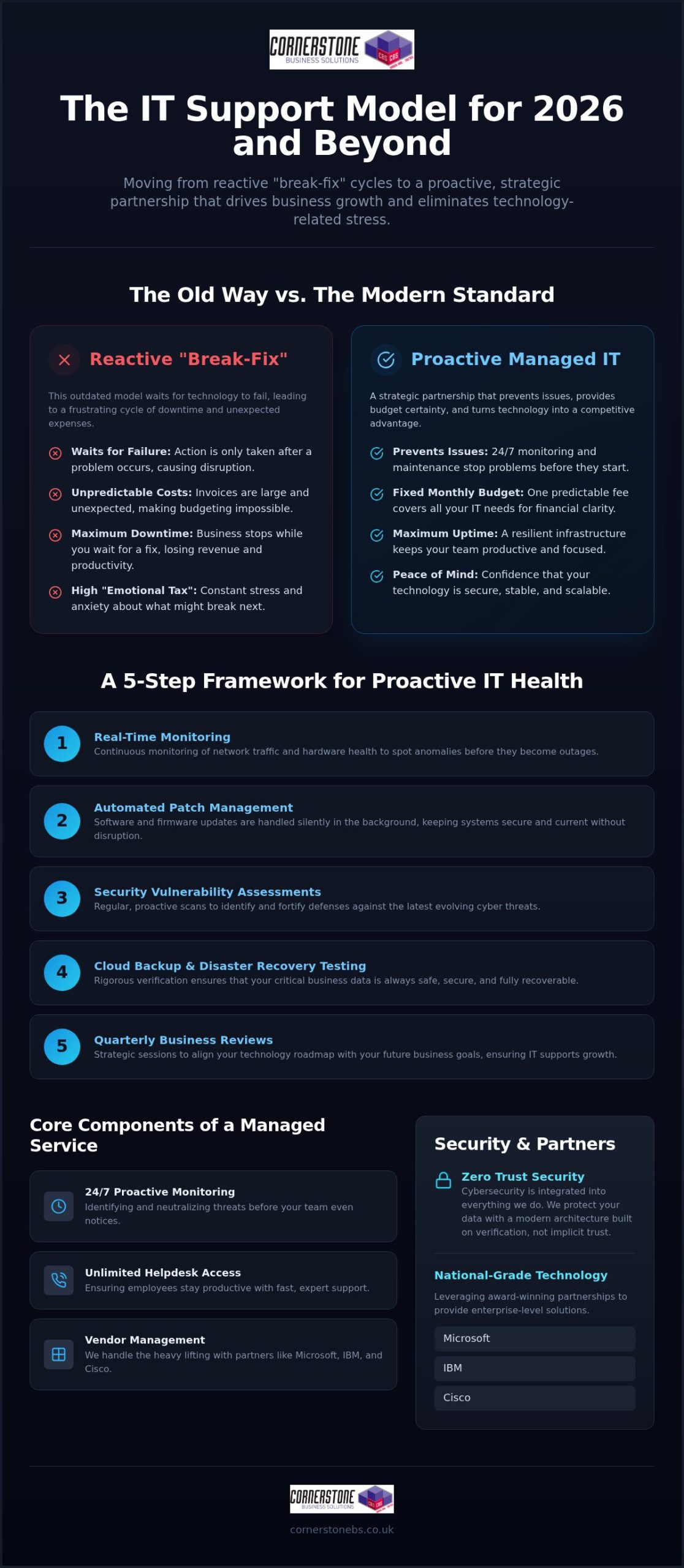
- Step 1: We implement real-time monitoring of your network traffic and hardware health to spot anomalies before they become outages.
- Step 2: Automated patch management handles software and firmware updates silently in the background, keeping your systems current.
- Step 3: We conduct regular security vulnerability assessments to keep your defenses sharp against evolving threats.
- Step 4: Our team performs cloud backup verification and rigorous disaster recovery testing to ensure your data is always recoverable.
- Step 5: Quarterly business reviews align your technology roadmap with your commercial objectives, ensuring your tech supports your goals.
The Financial Logic of Fixed-Fee Support
Budget surprises are the enemy of scaling. By using per-user or per-device pricing models, you gain total clarity over your monthly spend. The ROI of preventing just one hour of total business downtime often covers the cost of the service itself. It’s helpful to consult resources like the FTC cybersecurity guidelines to see how foundational these preventative measures are for modern enterprises. In 2026, Business Continuity is defined as a comprehensive financial and operational strategy that ensures your critical functions remain available to customers regardless of technical disruptions. If you’re ready to leave the stress of reactive IT behind, our team is here to help you build a more resilient future.
Key Criteria for Choosing a Reliable National IT Partner
Selecting an IT partner is one of the most critical decisions for your long-term business resilience. It’s about finding a team that acts as a dedicated extension of your own. As noted by Forbes on choosing an MSP, the right provider offers essential cost control and access to specialized skills. When you’re searching for the high-quality IT support Durham business leaders rely on, you shouldn’t settle for a transactional vendor. You need a partner who combines national-grade capability with an approachable, regional warmth that simplifies complex tech.
We believe that third-party validation is a recurring signature of quality. Being a multi-award-winning provider isn’t about pride; it’s about giving you the confidence that our systems are tested and proven. Look for a partner with deep multi-vendor expertise. If they aren’t fluent in Microsoft, IBM, and Cisco environments, they won’t be able to provide the seamless integration your scaling business requires. This breadth of knowledge ensures your infrastructure remains robust and unified.
Evaluating Technical Expertise and Accreditations
In 2026, a Microsoft Partner status is essential for managing modern cloud environments effectively. It guarantees that your provider has direct access to the latest tools and support. You should also prioritize Cyber Essentials and ISO certifications. These aren’t just badges; they’re proof of a commitment to rigorous security standards. When interviewing potential partners, ask specific questions about their helpdesk. Don’t just ask about response times. Ask about their first-contact resolution rates. High-quality support means getting back to work quickly, not just getting a “ticket received” email.
Service Level Agreements (SLAs) Explained
Understanding the fine print in an SLA is vital for your emotional security. You must distinguish between “Time to Respond” and “Time to Resolve.” A provider might respond in ten minutes but take ten hours to fix the actual issue. We advocate for tailored SLAs that reflect your unique technology solutions. Generic templates are a red flag. They often hide gaps in coverage or include exit clauses that favor the provider over the client. A reliable contract should be transparent, offering unlimited helpdesk access and proactive monitoring as standard. This clarity ensures there are no budget surprises when you need help the most, providing the reliable IT support Durham firms expect from a national leader.
Integrating Cyber Security into Your Managed IT Strategy
In 2026, treating IT support and security as separate entities is a gamble you can’t afford to take. We believe they’re inseparable functions. A system that isn’t secure isn’t truly functional, and a support team that doesn’t prioritize protection isn’t doing its job. When you invest in the kind of IT support Durham leaders trust, you’re buying more than just a helpdesk; you’re securing your entire digital perimeter. This integrated approach is essential for navigating modern regulations like NIS2 and the UK’s Cyber Security and Resilience Bill. We simplify these complex compliance requirements by building security into your daily workflows, ensuring your business stays on the right side of the law without the administrative headache.
We’ve seen a massive shift toward Zero Trust architecture for national businesses. This model operates on a simple principle: never trust, always verify. Every user and device must be authenticated before accessing your network, whether they’re in the office or working from home. Our cyber security services act as a foundational element of your emotional security, giving you the confidence to operate in an increasingly hostile digital landscape.
Managed Detection and Response (MDR)
Resilience requires more than just a passive firewall. We provide 24/7 threat hunting through Managed Detection and Response. This means our team actively looks for anomalies in your network traffic every second of every day. It’s particularly vital for protecting remote and hybrid workforces where traditional boundaries don’t exist. Human error remains the most persistent vulnerability in any network; proactive support provides the safety net that prevents a simple mistake from becoming a total system failure. By combining automated tools with expert analysis, we catch threats before they can take root. Our team provides the robust IT support Durham firms expect by identifying these risks before they impact your operations.
Disaster Recovery and Business Resilience
A backup is not a recovery plan. It’s just a copy of your data. True resilience comes from regular disaster recovery testing to ensure your systems can be restored in minutes, not days. We handle the heavy lifting of rapid post-breach restoration, focusing on data sovereignty and secure cloud storage. This ensures your information stays within the correct jurisdictions and remains accessible when you need it most. We don’t just store your data; we ensure it’s ready to be used the moment you need it. If you’re ready to protect your business with a unified strategy, you can speak with our security experts today to build a stronger foundation.
Scaling with Confidence: How Managed IT Drives Business Growth
Technology should never be a bottleneck. It’s a catalyst for your next big move. When you view your infrastructure as a cost center, you’re missing the opportunity to outpace your competitors. We position technology as a strategic asset that fuels your expansion. If you’re looking for the high-level IT support Durham companies use to reach a national stage, you need a framework that prioritizes flexibility. Microsoft 365 and our cloud solutions provide that foundation. They allow you to add new team members, launch departments, or open new sites with almost zero lead time. This zero-friction approach ensures your growth is limited only by your ambition, not your server capacity.
Modernising Communications with VoIP and Mobile
Business continuity relies on seamless communication. The UK PSTN switch-off is a major milestone that every business leader must navigate to avoid sudden disruption. We help you transition to Business VoIP and Business Mobile solutions that integrate your entire telephony stack into a single managed desk. This unified approach supports a national footprint, ensuring your clients receive a high-quality, professional experience whether your team is in the office or on the road. It’s about maintaining that approachable, reliable face for your brand while leveraging sophisticated, high-tech infrastructure. High-quality communication tools aren’t just for internal use; they are the primary interface for your client experience.
The Future of Managed IT: AI and Automation
Building Your Future-Proof Business Foundation
Transitioning from the chaos of reactive IT to a structured, managed partnership is the most significant step you can take for your company’s resilience in 2026. We’ve seen how proactive maintenance and integrated cyber security provide the emotional security you need to focus on your core goals. By leaving the “break-fix” trap behind, you gain predictable monthly budgets and enterprise-grade infrastructure that adapts as quickly as your market does. It’s about moving from simply surviving technical issues to thriving through strategic innovation.
Finding the high-quality IT support Durham business leaders depend on shouldn’t be a hurdle to your success. As multi-award-winning partners with Microsoft, IBM, and Cisco, we specialize in delivering bespoke technology solutions that drive tangible commercial results. We’re proud of our regional roots and dedicated to being the long-term partner your growth requires. You deserve technology that works as hard as you do.
Book a consultation with our award-winning experts today to start building your resilient technology roadmap. We’re ready to help you turn your digital infrastructure into your greatest competitive advantage.
Frequently Asked Questions
What is the difference between IT support and managed IT services?
Managed IT services represent a shift from a reactive “break-fix” model to a proactive, long-term partnership. While traditional support focuses on repairing systems after they fail, managed services involve 24/7 monitoring to identify and resolve threats before they impact your operations. This model provides budget predictability through fixed-term contracts and unlimited helpdesk access, ensuring your technology acts as a foundation for stability rather than a source of constant friction.
How much does managed IT support typically cost for a UK business?
Will managed IT support help with cyber security compliance?
Yes, security is a core component of modern managed support. We simplify compliance with regulations like NIS2 and the UK’s Cyber Security and Resilience Bill by integrating security into your daily workflows. Our team implements Zero Trust architecture and conducts regular vulnerability assessments. This proactive stance ensures your data sovereignty remains intact and your business meets the rigorous standards required for national-grade security and operational resilience.
Do I still need an internal IT manager if I outsource to a managed provider?
Many organizations opt for a “co-managed” model where we support an existing internal IT manager. We handle time-consuming tasks like proactive monitoring and helpdesk tickets, freeing your internal staff to focus on high-level business strategy. Alternatively, we can act as your entire IT department. This flexibility is a key reason why businesses seeking IT support Durham can rely on us to provide enterprise-grade expertise without the overhead of a full internal team.
How quickly can I expect a response to a critical IT issue?
We prioritize critical issues through clear Service Level Agreements (SLAs) that distinguish between “Time to Respond” and “Time to Resolve.” Our proactive monitoring often catches threats before they escalate into critical failures. You receive unlimited helpdesk access, ensuring that when an issue does arise, you’re connected with an expert immediately. This rapid response is essential for maintaining productivity and minimizing the emotional tax of unexpected system downtime.
Can managed IT services help my business migrate to the cloud?
Migration is a fundamental part of our offering. We manage the entire transition to Microsoft 365, Azure, or bespoke cloud solutions, ensuring your data is moved securely with minimal disruption. Moving to the cloud provides the scalability and flexibility needed for a modern, national footprint. Our team handles the complex technical mechanisms behind the migration, allowing you to enjoy the benefits of zero-friction technology and remote accessibility.
What happens if our business grows rapidly; can the support scale with us?
Our systems are designed to grow alongside your organization. We use scalable cloud infrastructure and flexible licensing models to ensure you can add new users or sites instantly. This “Technology as a Service” (TaaS) model means your IT support Durham never becomes a bottleneck for expansion. Whether you’re hiring your tenth employee or your hundredth, we provide the infrastructure and expertise to support your national growth with confidence.
Is managed IT support suitable for small businesses with fewer than 10 employees?
Small businesses often benefit the most from managed services because they gain access to enterprise-level tools and security without a massive payroll. We provide bespoke technology solutions tailored to smaller teams, ensuring you have the same level of protection as a global corporation. This professional foundation allows you to compete on a national stage, knowing your systems are monitored by experts and your budget remains completely predictable.
Posted on: September 1st, 2026 by Cornerstone
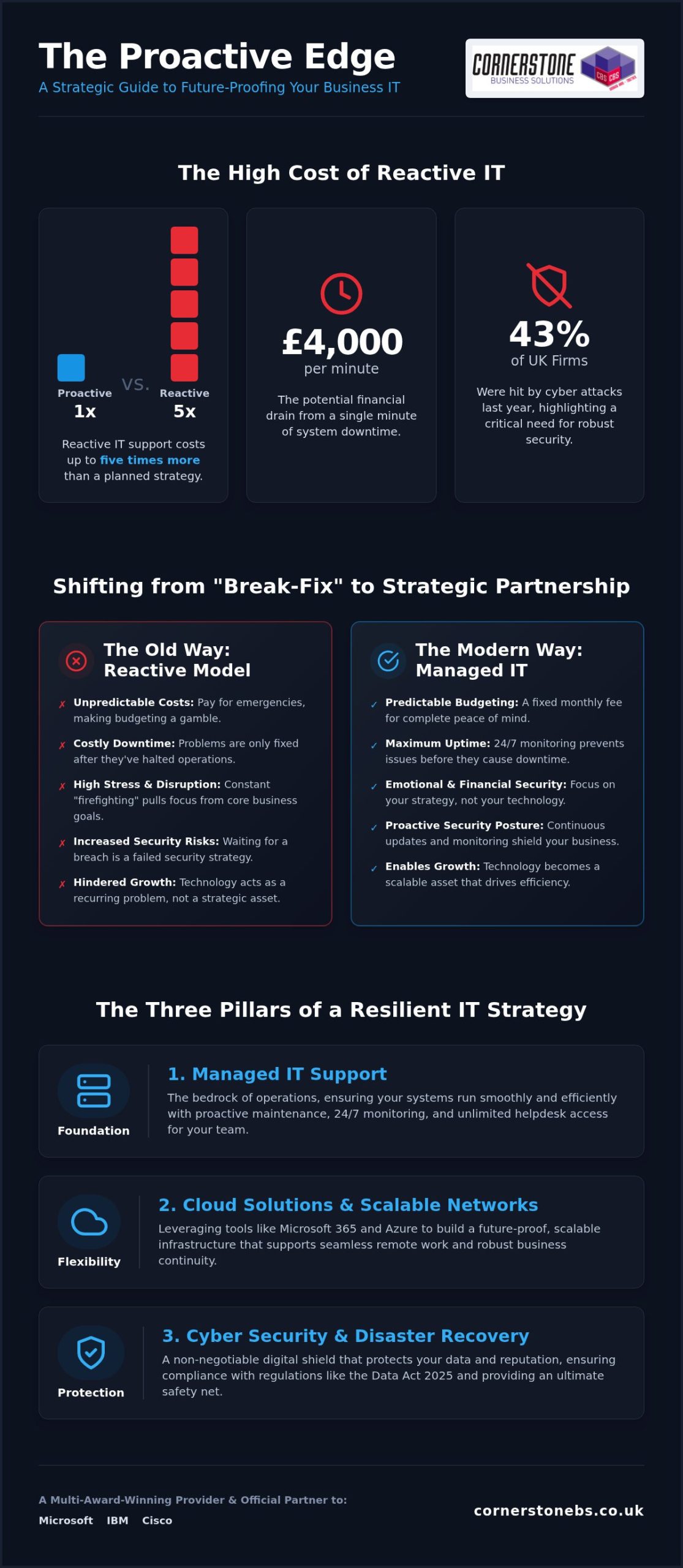
Did you know that reactive IT support can cost your business up to five times more than a planned, preventive strategy? When downtime can drain as much as £4,000 every single minute, waiting for something to break before fixing it isn’t just a risk; it’s a direct drain on your growth. We understand the frustration of unpredictable monthly bills and the constant worry of cyber attacks like those that hit 43% of UK firms last year. You deserve a partner who focuses on your long-term goals rather than just your gadgets. By integrating the right business it solutions sunderland, you can move beyond basic support toward a resilient, scalable infrastructure.
As a multi-award-winning provider and official partner to Microsoft, IBM, and Cisco, we’ve designed this 2026 strategy guide to help you secure a competitive edge. This article breaks down the impact of the latest Data (Use and Access) Act 2025 and the Cyber Security and Resilience Bill. You’ll learn how to achieve predictable costs, eliminate downtime, and build a security posture that protects your reputation on a national scale. We’ll show you how modern cloud solutions and proactive monitoring can turn your technology from a source of stress into your greatest asset for growth.
Key Takeaways
- Learn how modern business it solutions sunderland have evolved from simple support tools into integrated ecosystems that drive national growth and operational efficiency.
- Discover why proactive system monitoring and unlimited helpdesk access are essential for eliminating downtime and keeping your team productive.
- Explore how leveraging Microsoft 365 and Azure creates a scalable, future-proof infrastructure that supports seamless business continuity.
- Understand the core pillars of cyber security and why a robust disaster recovery framework is the ultimate safety net for every modern SME.
- Find out how to select a multi-award-winning IT partner that acts as a strategic extension of your business rather than just a technical vendor.
Defining Modern Business IT Solutions for the 2026 Landscape
In 2026, your technology is no longer a back-office afterthought. It’s an integrated ecosystem where hardware, software, and expert support work in harmony to power your daily operations. Effective business it solutions sunderland have moved far beyond the traditional “IT guy” model. Today, technology has evolved from a simple support tool into the primary driver of business efficiency. It dictates how fast you can respond to clients, how safely you store data, and how effectively your team collaborates across the country.
Managed IT Solutions serve as a proactive strategic framework that empowers SMEs to align their digital infrastructure with their long-term commercial objectives. We don’t believe in one-size-fits-all packages. True success comes from bespoke technology solutions tailored to your specific organisational goals, ensuring every penny spent on your infrastructure delivers a measurable return on investment. It’s about building a partnership that values your growth as much as you do.
The Components of a Comprehensive IT Strategy
A resilient strategy requires more than just a helpdesk. It starts with Managed IT Support as the bedrock of your operations, providing the maintenance and monitoring needed to keep things running smoothly. On top of this foundation, we layer cloud solutions like Microsoft 365 and Azure to offer the flexibility your team needs for modern remote work. Finally, cyber security acts as a non-negotiable layer of protection. It’s the digital shield that keeps your business reputation intact while meeting the strict requirements of the Data (Use and Access) Act 2025.
Why National Businesses are Moving Away from Break-Fix
The old “break-fix” model is a gamble that most modern firms can’t afford to take. When you wait for a system to fail before calling for help, you’re already losing money. Beyond the immediate repair bill, the The Hidden Costs of Downtime article highlights how lost productivity and missed opportunities can cripple a balance sheet. Reactive support is always more expensive in the long run because it lacks the foresight of managed IT services.
National businesses are rapidly shifting toward fixed-term contracts to gain predictable budgeting. This move provides emotional and financial security. You get a partner who understands your goals and prevents issues before they disrupt your day. Transitioning to business it solutions sunderland means trading unpredictable emergency fees for a steady monthly spend that covers everything from hardware updates to proactive security monitoring.
The Proactive Edge: Why Managed IT Support Beats Reactive Repairs
Traditional repairs happen after the damage is done. Proactive monitoring flips the script. Our systems watch your infrastructure 24/7, identifying potential hardware failures or software glitches before they snowball into a shutdown. This includes automated patching and critical updates that happen in the background. By maintaining system health silently, we reduce the “noise” of small IT niggles. This ensures your team stays in their flow state. Much of this modern monitoring relies on robust architectures, often aligned with NIST’s definition of cloud computing, to provide real-time visibility across your entire network.
Unlimited Helpdesk: Empowering Your Workforce
When employees worry that every call to support adds to a mounting bill, they stop asking for help. They find “workarounds” that decrease efficiency and increase security risks. Our fixed-fee model removes this barrier entirely. Unlimited helpdesk access encourages your staff to flag issues early. This isn’t just about fixing PCs; it’s about supporting people. Fast response times boost company-wide morale because your team feels valued and equipped. They know that expert help is just a phone call away, which keeps productivity high and frustration low.
Beyond the daily helpdesk, we provide a dedicated account manager to act as your long-term technology partner. They help you plan for the next three to five years, ensuring your hardware and software evolve alongside your ambitions. We focus on your future, not just your current tickets. If you’re tired of waiting for things to break, it might be time to explore a more proactive partnership with a team that truly understands your business goals.
Future-Proofing Infrastructure: Cloud Solutions and Scalable Networks
Growth in 2026 demands a foundation that scales as fast as your ambitions. Your business it solutions sunderland strategy must move beyond simply “keeping the lights on” to creating a flexible environment that supports a national workforce. A future-proof infrastructure is the silent engine behind your success. It ensures that whether your team is in the office or working remotely, they have the same high-speed access to the tools they need. We focus on building these resilient systems so you can focus on leading your industry.
The Power of Microsoft 365 and Azure
Global platforms like Microsoft 365 and Azure have redefined business continuity. As official partners with Microsoft, IBM, and Cisco, we help you leverage these tools to simplify your hardware lifecycle management. Instead of worrying about server refreshes every few years, cloud subscriptions allow you to scale your resources up or down instantly. This ensures data accessibility across your entire organisation without compromising on security. If you are considering making the switch, our Microsoft 365 Migration Guide provides a clear roadmap for a seamless transition that protects your historical data.
Building a Reliable Network Foundation
Cloud-heavy businesses are only as strong as their connectivity. A robust network infrastructure, including professional cabling, managed Wi-Fi, and dedicated leased lines, is essential for long-term stability. Poorly installed networks lead to intermittent dropouts that frustrate staff and drive up costs. We integrate your network strategy with Business VoIP and mobile communications to create a single, unified experience. This level of integration doesn’t just improve speed; it enhances your overall security posture. Following FTC cybersecurity guidance, we ensure your network foundation is built with “security by design” at every touchpoint. High-speed connectivity is the baseline, but intelligent network management is what truly drives 26% increases in production efficiency for modern firms.
Investing in business it solutions sunderland means choosing a partner that looks at the big picture. We don’t just sell hardware; we design bespoke technology solutions that act as a springboard for your growth. By aligning your network and cloud strategies, you create a secure, scalable environment that’s ready for whatever 2026 throws your way. It’s about building strength into your systems today so you can enjoy stability tomorrow.
Building Resilience: Cyber Security and Disaster Recovery Frameworks
Cyber security in 2026 is no longer a luxury for the few; it’s the foundation of trust between you and your clients. With the Cyber Security and Resilience Bill now in effect, businesses face stricter requirements to demonstrate their defensive posture. Integrating robust business it solutions sunderland allows you to build this resilience into your daily workflow. We see security not just as a technical barrier, but as the emotional security you need to lead your company with confidence. It’s about knowing that even if the worst happens, your reputation and your data remain protected.
Proactive Threat Protection
Modern threats move at lightning speed, requiring more than just a standard antivirus. We use advanced threat detection to spot anomalies before they escalate into full-blown breaches. Multi-factor authentication (MFA) is now a non-negotiable standard for every login, acting as a vital checkpoint for your digital perimeter. However, technology is only half the battle. Your team is your first line of defence. We provide employee training to help staff recognise sophisticated phishing attempts that often bypass traditional filters. This proactive approach ensures you remain compliant with national standards and avoid the increased PECR fines, which can now reach £17.5 million for serious data breaches.
Disaster Recovery: Beyond Simple Backups
Many business owners confuse backing up data with true business continuity. A backup is just a copy of a file; disaster recovery is the strategic plan that gets your staff back to work in minutes, not days. We focus on creating a safety net that every SME requires to survive a catastrophic event. This involves:
- Recovery Time Testing: We regularly test how fast your systems can be restored to ensure minimal operational impact.
- Continuous Data Protection: Moving beyond daily backups to real-time syncing.
- Expert Response: Having a managed provider handle the immediate technical aftermath of a breach while you manage your team.
Regular audits and compliance checks are the only way to prove your systems are as strong as you claim. They provide the evidence needed for insurance and supply chain requirements, positioning you as a reliable national partner. For a deeper look at protecting your digital assets, see our Cyber Security Services guide. By choosing the right business it solutions sunderland, you move from a reactive stance to a resilient one. If you want to strengthen your digital perimeter, talk to our security experts today about a bespoke resilience audit.
Selecting an IT Partner: From Helpdesk to Strategic Growth
Choosing the right team to manage your digital infrastructure is one of the most critical decisions you’ll make this year. While many providers focus on geographic proximity, the real value lies in technical capability and a shared vision for your success. In 2026, your provider shouldn’t just be a vendor you call when a screen goes blank. They should be a dedicated long-term partner that understands your commercial objectives. High-quality business it solutions sunderland are defined by a commitment to excellence that goes beyond the basics of technical support. You need a framework for evaluation that looks at certifications, industry recognition, and the ability to scale alongside your ambitions.
We believe that multi-award-winning service should be the baseline for your expectations. Accolades aren’t just for show; they act as a recurring signature of quality and reliability. When you work with a recognized leader, you gain the confidence that your systems are in expert hands. This allows you to focus on leading your industry while we ensure your foundation remains unshakable. It’s about moving away from transactional support and toward a relationship built on trust and proven performance.
The Value of Global Partnerships
Certifications from industry giants like IBM, Cisco, and Microsoft are more than just badges on a website. They represent a deep, verified understanding of the systems that power modern commerce. These partnerships are vital for your business because they provide direct access to enterprise-level technology on an SME budget. You shouldn’t have to settle for second-rate tools just because of your company size. Our national reach ensures you get the most advanced business it solutions sunderland, while our community-focused approach ensures you receive the personal, approachable care you deserve. This combination gives you the technical muscle of a global firm with the heart of a local partner.
Aligning IT with Business Objectives
We’re proud of the systems we manage, but we’re even more proud of the success our clients achieve. We invite you to move away from transactional IT and toward a collaborative partnership. Let’s have a chat about where you want your business to be by the end of 2027. We won’t give you a sales pitch; we’ll give you an expert analysis of how technology can get you there. You can book a discovery call with our team today to start that conversation.
Securing Your Competitive Edge for 2027 and Beyond
The landscape of 2026 has shown that technology is the heartbeat of any successful national operation. By moving from a reactive mindset to a proactive strategy, you protect your team from the emotional and financial stress of downtime. We’ve explored how integrated business it solutions sunderland provide the scalability you need to grow without fear. Leveraging global partnerships with leaders like Microsoft, IBM, and Cisco ensures that your infrastructure is as resilient as it is efficient.
As a multi-award-winning national provider, we don’t just offer support; we offer a long-term partnership. Our commitment to proactive system monitoring as standard and unlimited helpdesk access ensures your business stays stable while you focus on the big picture. It’s time to stop worrying about your hardware and start focusing on your goals. You deserve a platform that empowers your staff rather than one that holds them back.
Book a consultation with our award-winning IT team to see how we can simplify your digital journey. We’re ready to help you build a future that’s both secure and limitless. Let’s start the conversation today and ensure your business is ready for whatever comes next.
Frequently Asked Questions
What is included in a monthly managed IT support fee?
How does proactive monitoring differ from traditional IT support?
Proactive monitoring identifies technical failures before they disrupt your operations, whereas traditional support only responds after something breaks. Our systems watch your infrastructure 24/7, catching potential hardware issues or software glitches in real time. This “always-on” approach reduces the noise of small IT niggles and prevents catastrophic shutdowns. It moves your business away from the costly “break-fix” cycle toward a stable, reliable environment where technology acts as a foundation for growth.
Can a managed IT provider help with Microsoft 365 migration?
Yes, we specialise in seamless Microsoft 365 and Azure migrations for businesses of all sizes. Our professional service project fees cover everything from the initial network audit to the secure transfer of your historical data. We handle the technical heavy lifting, including setting up user permissions and integrating cloud solutions with your existing hardware. This ensures your transition to the cloud is smooth, secure, and completed without disrupting your daily business continuity.
Why should my business choose a partner with Microsoft or Cisco certifications?
Certifications from Microsoft, Cisco, and IBM prove that your provider has the verified expertise to manage complex digital systems. These partnerships allow us to deliver enterprise-level technology and robust security on an SME budget. When you choose a certified partner, you’re investing in a higher standard of reliability and technical capability. It ensures your business it solutions sunderland are built on global standards of excellence, providing the strength needed for national scalability.
How do IT solutions improve business cyber security?
Modern IT solutions improve your security by layering advanced threat detection with proactive defensive measures like multi-factor authentication (MFA). We provide regular cyber security audits and employee training to protect your digital perimeter against phishing attempts. These solutions also help you maintain compliance with national security standards, such as the Data (Use and Access) Act 2025. This comprehensive framework protects your reputation and ensures your data remains secure in an increasingly complex threat landscape.
What is the response time for a typical IT helpdesk?
Fast response times are a priority to ensure your team remains productive and morale stays high. While specific times vary based on the severity of the issue, our unlimited helpdesk model encourages staff to flag concerns early. We focus on “supporting people” rather than just “fixing PCs”, ensuring that expert help is always reachable when you need it most. This proactive approach minimises downtime and provides the emotional security that your technology is always being managed.
Is disaster recovery planning necessary for small businesses?
Absolutely, disaster recovery is a critical safety net that every SME requires to survive a catastrophic data loss or breach. Unlike simple backups, a recovery plan focuses on business continuity, getting your staff back to work in minutes rather than days. We regularly test recovery times to ensure your systems can be restored with minimal operational impact. This strategic planning is essential for maintaining trust with your clients and meeting the requirements of modern cyber insurance.
How do I switch IT providers without disrupting my business?
Switching providers is a structured process that begins with a strategic technology roadmap to avoid any service gaps. We work closely with your outgoing provider to manage the secure transfer of data, credentials, and network permissions. By planning every stage of the migration in advance, we ensure your team experiences a seamless transition to our managed IT support. Our goal is to provide a reassuring experience that enhances your stability from the very first day.
Posted on: August 30th, 2026 by Cornerstone
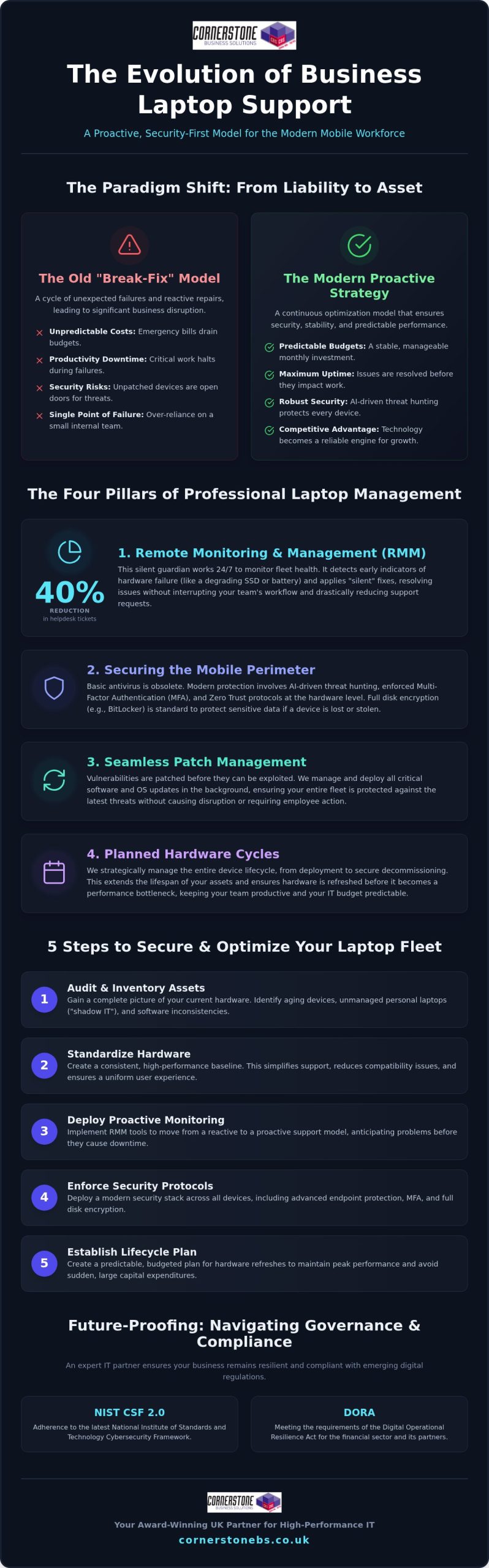
What if your mobile workforce never had to worry about a hardware failure or a security breach during a critical client pitch? Most business owners understand the headache of unpredictable repair costs and the genuine risk of unpatched remote devices. It’s a constant struggle to balance employee productivity with the technical demands of robust business laptop support. As an award-winning IT partner, we believe your technology should provide emotional security, not just technical utility. We’ve seen how the right strategy transforms a fleet from a liability into a competitive advantage.
This guide reveals how proactive management and strategic fleet planning can eliminate downtime while securing your remote team. You’ll discover how to extend the lifespan of your assets and maintain predictable IT budgets through 2026 and beyond. We’ll preview the latest standards in endpoint protection, including the governance requirements of NIST CSF 2.0 and the impact of the Digital Operational Resilience Act (DORA). It’s time to turn your hardware into a reliable, high-performance engine for your business growth. Let’s look at how a modern strategy keeps your team moving forward.
Key Takeaways
- Understand why proactive business laptop support has evolved into a critical security-first model for the modern mobile workforce.
- Explore the technical pillars of fleet health, including how AI-driven threat hunting replaces traditional antivirus to protect remote endpoints.
- Compare the stability of managed support against the “single point of failure” risks inherent in small, in-house IT departments.
- Follow our five-step strategy to audit and standardise your hardware assets, ensuring predictable budgets and extended device lifespans.
- Learn how partnering with an award-winning UK expert provides the multi-vendor knowledge needed to keep your business resilient and high-performing.
Why Business Laptop Support is the Foundation of Modern Work in 2026
In 2026, the traditional office has dissolved into a network of portable powerhouses. Every laptop in your fleet isn’t just a piece of hardware; it’s a critical business endpoint that carries your company’s data, reputation, and productivity. This shift means that business laptop support is no longer a reactive “fix it when it breaks” service. It has evolved into a proactive, security-first management model that ensures your team stays connected regardless of where they work. We’ve moved beyond simple technical support into an era of continuous optimization. This approach provides the emotional security of knowing that your mobile workforce is backed by award-winning experts who anticipate problems before they cause downtime. It’s about building a foundation where technology empowers your staff rather than slowing them down with avoidable glitches.
The Difference Between Residential and Professional Support
Many business owners mistakenly assume that a local consumer-grade repair shop can handle their fleet. However, these shops rarely understand the stringent Service Level Agreement (SLA) requirements that a modern company demands. Professional support prioritizes data sovereignty and strict GDPR compliance, ensuring that sensitive client information never leaves a secure environment. Unlike a high-street shop, a dedicated IT partner manages the entire lifecycle of the device, from deployment to secure decommissioning. Business laptop support is a strategic operational necessity that protects your digital assets and keeps your operations fluid.
Addressing the #1 Objection: The Cost of Proactivity vs. Reactivity
It’s easy to view IT costs through the lens of individual repairs, but this overlooks the hidden financial drain of “shadow IT” and unmanaged devices. When employees use unpatched laptops, they open doors to security risks that can lead to a cascading failure of your entire network infrastructure. A proactive strategy avoids these pitfalls by identifying hardware fatigue and software vulnerabilities early. By investing in comprehensive Managed IT Support, you replace unpredictable emergency bills with a stable, manageable budget. This transition from a reactive “break-fix” mindset to a long-term partnership ensures your fleet remains a high-performance asset rather than a liability. It’s the difference between waiting for a disaster and preventing one. We don’t just fix tools; we secure your company’s ability to thrive in a competitive market.
The Technical Pillars of Professional Laptop Management
Remote Monitoring and Management (RMM) Explained
Think of RMM as the silent guardian of your hardware health. It works in the background, constantly checking for signs of trouble that an employee might miss. For instance, our systems can detect early indicators of SSD failure or battery degradation before they lead to a total system crash. This allows our award-winning team to apply “silent” fixes that resolve issues without ever interrupting your staff’s workday. By catching these problems early, proactive RMM can reduce your total helpdesk tickets by as much as 40%. It’s about maintaining a steady rhythm of productivity instead of reacting to sudden hardware failures.
Securing the Mobile Perimeter
In 2026, the perimeter of your office is wherever your team opens their laptops. Basic antivirus software is no longer enough to stop modern, AI-driven threats. We implement robust cyber security services that move beyond simple signatures to active threat hunting. This includes enforcing Multi-Factor Authentication (MFA) and Zero Trust protocols at the hardware level. We also ensure every device uses disk encryption, such as BitLocker, to protect your data if a device is lost or stolen. If you’re concerned about your current security posture, you can always start a conversation with our team about your fleet’s resilience.
Patch management is another critical pillar of our strategy. With a mobile workforce, you can’t rely on users to click “update” on their own. Our centralized system pushes critical security patches to every device, regardless of their location or connection type. This ensures your fleet remains compliant with the latest standards, such as the 2026 NIST CSF 2.0 guidelines. Finally, we handle hardware lifecycle management. By tracking the age and performance of every unit, we help you plan for obsolescence. This prevents the “crisis” of a sudden, large-scale hardware failure that could cripple your operations. It’s a structured approach that provides both technical stability and emotional security for your business.
Evaluating the Commercial Impact: In-House vs. Managed Laptop Support
Choosing between an internal hire and an external partner is a pivotal decision for any growing UK business. Small in-house IT teams often create a “Single Point of Failure” that puts your operations at risk. If your only IT technician is away or overwhelmed, a single hardware failure can bring a department to a standstill. Professional business laptop support removes this bottleneck by providing a team of experts rather than a solitary individual. You gain immediate access to multi-vendor expertise through our established partnerships with industry leaders like Microsoft, IBM, and Cisco. This collaborative approach ensures that no matter how complex the issue, we have the specialized knowledge to resolve it quickly. It’s about moving away from a transactional relationship and into a long-term partnership that prioritizes your stability.
Scalability is another major commercial advantage. As your company grows, your fleet expands, but your IT management shouldn’t require a constant increase in headcount. Managed support scales effortlessly with your business, allowing you to add new users and devices without the overhead of hiring additional staff. This shift also transforms your financial outlook. You move from unpredictable Capital Expenditure (CapEx) on emergency repairs and hardware to a predictable, monthly Operational Expenditure (OpEx). This clarity allows for better long-term budgeting and ensures that your technology remains an asset rather than a financial drain.
The Real Cost of Downtime
A dedicated support partner helps you maximize the Return on Investment (ROI) for every device you purchase. We guide you through selecting hardware that actually suits your team’s workload, avoiding the trap of over-speccing or buying underpowered consumer units. We prioritize business-grade warranties and “Next Business Day” on-site support to minimize disruption. This strategic oversight is a core component of our comprehensive IT company solutions. By planning for the full lifecycle of your hardware, we ensure your mobile fleet remains high-performing and secure throughout its entire lifespan.
5 Steps to Securing and Optimising Your Business Laptop Fleet
Optimising your fleet requires a structured roadmap. It’s not just about buying the latest gear. It’s about making sure every device contributes to your stability. By following these five steps, you can turn a chaotic collection of devices into a streamlined, high-performance engine. In 2026, this process includes managing the unique security requirements of AI-enabled hardware, which often carries sensitive data within local models. Our business laptop support ensures these advanced features remain an asset rather than a vulnerability.
Step 1: The Fleet Audit
Start with a comprehensive audit of your current hardware. You need to identify “end-of-life” devices that no longer receive critical firmware updates. These units are a major security risk. We also look for software bloatware that drains battery life and frustrates your employees. By documenting battery health and storage capacity across your entire organisation, we can predict which laptops will fail next. This allows you to replace hardware on your terms, not during an emergency. It’s about taking control of your technology lifecycle before it takes control of your schedule.
Step 2: Standardisation and Security
Managing twenty different laptop models is a recipe for inefficiency. It complicates spare parts management and makes update cycles unpredictable. To ensure a steady supply of high-quality components, you can visit GenX Systems LLC for professional hardware solutions. A Standard Operating Environment (SOE) is a defined set of software and configurations applied to every business laptop to ensure consistency and security. When every device runs the same core setup, troubleshooting becomes faster and more reliable. We also focus on hardening your devices against 2026-era phishing and ransomware. This involves firmware-level protection and securing the dedicated AI chips now standard in professional hardware.
Step 3: Centralised Policy and Refresh Cycles
Implement a centralised endpoint security policy with enforced Multi-Factor Authentication (MFA). This ensures that your data remains safe even if a laptop is stolen from a train or a café. Beyond security, you must establish a 3-to-5-year hardware refresh cycle. Laptops used daily often see a performance drop-off after the three-year mark. Planning these refreshes prevents the “performance tax” that slow computers levy on your staff. Finally, you should partner with a multi-award-winning IT provider for proactive 24/7 monitoring. This gives you the emotional security of knowing an expert team always has your back. You can secure your hardware fleet with Cornerstone to ensure your business stays resilient and high-performing.
Future-Proofing Your Mobile Workforce with Cornerstone Business Solutions
Transitioning from an unpredictable reactive model to a professional managed service is a smooth, guided process. We handle the migration and setup, ensuring there’s zero disruption to your team’s daily productivity. You’ll quickly experience the emotional security and peace of mind that comes with having a multi-award-winning UK-based support team on your side. We’ve seen firsthand how a secure, high-performance fleet boosts employee morale and safeguards sensitive company data. It’s time to move away from technical anxiety and embrace absolute operational confidence. We invite you to start a conversation with our experts today for a comprehensive fleet health check. Let’s ensure your business laptop support is a robust engine for your future growth.
Your mobile fleet should be a catalyst for growth, not a source of technical anxiety. We’ve explored how shifting from reactive repairs to a proactive management model ensures your team stays productive and your data remains secure. By implementing technical pillars like RMM and AI-driven endpoint protection, you turn every device into a reliable asset. Professional business laptop support is the foundation of this stability, providing the emotional security that comes from expert oversight.
As a multi-award-winning IT services provider with deep partnerships with Microsoft, IBM, and Cisco, our UK-based expert helpdesk is ready to simplify your tech. We’re here to help you move away from the break-fix cycle and into a long-term partnership built on trust. It’s time to ensure your hardware is ready for the challenges of 2026. We’ve seen how the right strategy protects your bottom line and empowers your workforce.
Book a Fleet Health Check with Cornerstone’s Award-Winning Support Team and let’s start a conversation about your business resilience. Your team deserves technology that works as hard as they do.
Frequently Asked Questions
What is included in a typical business laptop support contract?
A comprehensive contract typically includes proactive system monitoring, unlimited helpdesk access, and hardware lifecycle management. Our award-winning team handles security patches, endpoint protection, and remote troubleshooting to ensure your technology remains stable. We focus on bespoke solutions that simplify your tech while protecting your business continuity. This ensures your business laptop support is a foundational element of your stability rather than a reactive expense.
How does remote laptop support work for employees who are travelling?
Remote support works through secure Remote Monitoring and Management software installed on every device. This allows our expert team to diagnose and fix software issues over any stable internet connection, regardless of where your employee is working. We use encrypted tunnels to ensure data privacy during the support session. If a hardware failure occurs while someone is travelling, we coordinate rapid assistance to keep them productive.
Is it better to repair an old business laptop or replace it?
Deciding whether to repair or replace depends on the device’s age and the specific hardware issue. For many consumer-grade electronics and laptops, a specialist can often provide a cost-effective fix that extends the unit’s utility. You can learn more about Pleasanton Computer Repair to see how professional repair services handle these hardware challenges. If the repair cost exceeds half the value of a new machine, replacement is usually the better strategic move for a business fleet.
How can I secure my company’s laptops against a data breach?
Securing your fleet requires a multi-layered approach starting with disk encryption and Multi-Factor Authentication. We implement AI-driven endpoint protection that hunts for threats in real-time rather than relying on old antivirus signatures. Our business laptop support also includes enforcing strict Zero Trust policies. This ensures that only authorised users can access your sensitive data, protecting your perimeter wherever your team chooses to work.
Does managed laptop support include software updates and licensing?
Yes, our managed services cover the full lifecycle of your software, including automated patching and license management for platforms like Microsoft 365. We track your subscriptions to ensure you aren’t paying for unused seats while keeping your applications updated against vulnerabilities. This proactive oversight is included in our monthly fees, allowing you to move from unpredictable costs to a stable, manageable IT budget.
What happens if a managed laptop is lost or stolen?
If a laptop is lost or stolen, our team can initiate a remote wipe command to erase sensitive data immediately. Because we enforce BitLocker disk encryption as a standard, your information remains unreadable to unauthorised parties even if they have physical access to the device. We then work with you to deploy a pre-configured replacement, ensuring your employee is back to work with minimal disruption.
Can you support a mix of Windows and Apple Mac hardware?
We provide expert support for both Windows and Apple Mac hardware to ensure your entire team stays productive. Our partnerships with global brands like Microsoft and Cisco give us the multi-vendor knowledge needed to manage diverse fleets. We apply the same high standards of security and proactive monitoring to every device. This unified approach simplifies your IT management and provides a consistent experience for all employees.
How quickly can an IT support provider respond to a hardware failure?
Response times are governed by a Service Level Agreement that prioritises critical issues to keep your business moving. For hardware failures, we often provide Next Business Day on-site support or immediate access to a loaner device programme. Our goal is to eliminate downtime by having a pre-configured laptop ready for your employee as soon as a problem is reported. This rapid response is a hallmark of our service.
Posted on: August 27th, 2026 by Cornerstone
What if the most productive day for your business was the one where your IT support team didn’t have to fix a single thing? Most leaders are used to the frantic “break-fix” cycle, but waiting for a crash to happen is a strategy that’s costing UK businesses thousands in lost hours every year. Shifting your focus to proactive IT support means identifying a failing hard drive or a security patch before it triggers a system-wide shutdown. It’s about moving away from reactive repairs and toward a model where your technology simply works, every single day.
We understand the anxiety that comes with unpredictable IT invoices and the constant threat of security breaches. As an award-winning provider, we believe you deserve a partner who’s looking at the horizon, not just the fire right in front of them. This 2026 guide reveals how bespoke technology solutions and a strategic approach to system management reduce your overheads while providing the rock-solid stability needed to scale. We’ll walk through the transition from a standard helpdesk to a dedicated technology partnership, ensuring your business stays resilient, secure, and ready for growth.
Key Takeaways
- Realise why the traditional break-fix model is a hidden drain on your resources and how proactive IT support creates a more stable, growth-ready environment.
- Discover how to swap unpredictable emergency repair bills for a predictable, flat-fee budget that simplifies your financial planning.
- Explore a multi-layered strategy that integrates cyber security directly into your system health monitoring, protecting everything from your endpoints to the cloud.
- Understand the vital role of a deep system audit in uncovering “ghost” issues before they have the chance to halt your operations.
- See how an award-winning technology partner builds a bespoke roadmap tailored to your specific business goals instead of offering a generic helpdesk.
Beyond the Break-Fix Model: Defining Proactive IT Support
Proactive IT support isn’t just a technical service; it’s a fundamental shift in how you maintain your business’s digital health. While the traditional model waits for a laptop to fail or a server to crash before calling for help, proactive management involves constant oversight. It aligns with the principles of IT Service Management (ITSM) to ensure that technology serves your business goals rather than hindering them. In 2026, the global proactive services market is projected to reach $9.18 billion, showing that more organisations are moving away from the chaos of emergency repairs.
The Core Components of Proactive Management
Modern proactive IT support relies on three main pillars to keep your business running smoothly:
- Real-time 24/7 monitoring: We use advanced sensors to watch your network every second, catching minor glitches before they become major outages.
- Automated patch management: Software updates and security patches are deployed automatically, ensuring your systems are never left vulnerable to known threats.
- Predictive hardware analysis: By using modern telemetry data, we can spot when a hard drive or battery is nearing the end of its life, allowing us to replace it during scheduled downtime.
Why Reactive IT is a “Downtime Tax” on Your Business
The Anatomy of a Modern Proactive IT Strategy
Proactive IT support is built on layers. It isn’t just a single software tool; it’s a holistic ecosystem designed to catch errors before they impact your bottom line. From the physical endpoint in your office to the complex cloud environments your team uses daily, every component needs consistent oversight. This integrated approach fosters trust and loyalty between you and your clients because they know your services are reliable. Effective Managed IT services combine this constant monitoring with a long-term technology roadmap, ensuring your infrastructure grows at the same pace as your ambitions.
We believe that technology should be a silent partner in your success. To achieve this, we move beyond the surface level to understand the unique heartbeat of your business operations. This involves regular, deep-dive audits that identify “ghost” issues, such as redundant software or aging hardware that’s quietly draining your efficiency. By maintaining a robust infrastructure through these strategic check-ups, we provide the emotional security that comes from knowing your data is safe and your systems are strong.
Continuous Monitoring and Predictive Analytics
Modern monitoring agents are far more sophisticated than simple “up or down” alerts. They use predictive analytics to identify memory leaks or early signs of disk failure before your staff even notices a slowdown. Instead of waiting for a total crash, we look at data trends to determine exactly when a system will need attention. This is particularly vital for remote work stability. By monitoring network performance in real-time, we ensure that your team stays connected to the central hub without the frustration of lag or dropped connections. It’s about shifting the conversation from “if it breaks” to “when it needs a scheduled tune-up.”
Strategic Patching and Vulnerability Management
Cyber Security is no longer an optional add-on; it’s the backbone of a resilient business. Relying on manual updates is a major security risk in 2026. Hackers move fast, and a single unpatched device is an open door for an exploit. We use automated deployment to push critical security patches across all your devices simultaneously. This eliminates the risk of human error and keeps your data locked down. For a deeper look at protecting your digital assets, our Cyber Security Services provide comprehensive insights into modern threat mitigation. If you’re ready to move away from the anxiety of “what if” and toward the confidence of “we’re protected,” it might be time to chat with a local expert about a bespoke technology roadmap.
The Financial Argument: Proactive vs. Reactive IT Support ROI
Many business owners view technology as a utility bill rather than a strategic investment. However, looking only at the monthly invoice ignores the Total Cost of Ownership (TCO). This includes the price of hardware and software licenses plus the massive hidden cost of lost productivity when systems fail. A proactive approach to IT management shifts the focus from fixing disasters to maintaining health. This prevents the “spiky” financial shocks of the break-fix model, where a single server failure can result in a four-figure emergency repair bill on top of lost business.
Predictable Budgeting for Business Growth
Shifting your IT from a “CapEx” (Capital Expenditure) nightmare to an “OpEx” (Operating Expenditure) model provides the financial clarity needed for scaling. Instead of facing surprise hardware replacement costs every few years, you benefit from a clear technology roadmap. This foresight allows you to plan upgrades during profitable periods rather than emergency situations. When combined with scalable Cloud Solutions, your IT budget becomes a predictable monthly line item. This stability allows you to reinvest your capital into your core business goals with total confidence.
Transitioning Your Business to a Proactive Technology Framework
Moving from a chaotic, reactive environment to a structured, managed one is the most significant step you’ll take toward business stability. It’s about taking control. Instead of being at the mercy of your technology, you begin to direct it. This transition requires a clear, phased approach that addresses both your technical stack and your company culture. By the end of this process, your team will stop seeing IT as a hurdle and start seeing it as the foundation of their success. The goal is to create a resilient environment where growth isn’t hampered by technical debt.
The foundation of any successful transition is a “Deep Audit.” We don’t just look at what’s on the surface; we dig into the architecture to find “ghost” issues that cause intermittent lag or security vulnerabilities. This involves identifying “End of Life” hardware that’s no longer supported by the manufacturer and software that lacks critical updates. We then map these IT company solutions against your specific business goals. By documenting your network architecture, we can eliminate “single points of failure” where one broken cable or switch could bring your entire operation to a standstill.
Step 2: Implementing Automation and Monitoring
Once the audit is complete, we move into the “Quiet Phase.” This is where we roll out monitoring agents across your network without disrupting your users’ workflow. These agents begin gathering data immediately, allowing us to set up automated backup protocols and verify recovery points. We also establish clear Service Level Agreements (SLAs). These define exactly how different issue severities are handled, ensuring that critical problems always get the immediate attention they require. This automation is the engine room of proactive IT support, working 24/7 to keep your systems healthy.
Even with the best maintenance, you need an ultimate safety net. A robust Disaster Recovery plan is a non-negotiable part of a proactive framework. It ensures that if the unthinkable happens, whether it’s a major cyber attack or a physical hardware disaster, your data is safe and your business can be back online in hours, not days. If you’re ready to stop fire-fighting and start building a stable future, chat with our experts about a bespoke technology roadmap today.
Partnering for Success: The Cornerstone Business Solutions Managed IT Approach
We don’t believe in transactional IT. At Cornerstone Business Solutions, we’ve built our reputation as a multi-award-winning national provider by treating every client as a dedicated long-term partner. This isn’t just about fixing a laptop or resetting a password; it’s about providing the foundational stability your business needs to thrive. When you choose proactive IT support with our team, you’re gaining a partner that’s as invested in your success as you are. We move beyond the traditional helpdesk model to offer a strategic relationship that prioritises your growth, security, and continuity.
Our philosophy is simple: your technology should work so well that you forget it’s even there. This “Silent IT” environment allows you to reclaim the hours once lost to technical glitches and administrative headaches. By positioning Cornerstone Business Solutions as an extension of your own team, we ensure that your digital infrastructure is always a step ahead of your needs. It’s about moving away from technical anxiety and toward a future where you can focus entirely on your core business goals.
Bespoke Technology Roadmaps for National Businesses
Every business follows a unique path, so your technology should be tailored to match. Cornerstone Business Solutions specialises in creating bespoke technology roadmaps that align your IT infrastructure with your specific 3-5 year growth plans. This foresight ensures you’re never caught off guard by outdated systems or sudden hardware requirements as you scale. Our approach combines unlimited helpdesk access for your daily needs with intensive, proactive background work that prevents issues before they ever reach your screen. By leveraging our partnerships with global leaders like Microsoft, IBM, and Cisco, we ensure your systems are built on the most robust and reliable technologies available today.
Exceptional Service as a Standard
While we’re proud of our technical expertise and multi-award-winning status, we never lose sight of the people behind the screens. Our clients value the “human face” of the technically advanced team at Cornerstone Business Solutions. We speak with the clarity of experts who want to simplify complex concepts, helping you make informed decisions without the jargon. This level of service provides the peace of mind that only comes from a trusted national provider. You get the strength and sophistication of a large organisation, balanced with the approachable, friendly style of a team that truly cares about your business.
It’s time to stop fire-fighting and start growing. Technology shouldn’t be a source of stress; it should be the engine that drives your business forward. We invite you to an informal conversation about your business technology future. Let’s discuss how a dedicated partnership with Cornerstone Business Solutions can help you eliminate downtime and build a stable foundation for the years ahead. Reach out to our expert team today to discover how we can transform your IT from a technical necessity into a powerful strategic asset.
Secure Your Business Growth with a Proactive Future
As a multi-award-winning national provider, we don’t just fix problems. We build bespoke technology roadmaps that align with your long-term ambitions. Our strategic partnerships with global leaders like Microsoft, IBM, and Cisco ensure your systems are robust, while our unlimited UK-wide helpdesk support provides the human connection your team needs. You deserve a partner that looks ahead so you can stay focused on what you do best.
It’s time to trade technical anxiety for strategic confidence. Book a conversation with our award-winning proactive IT experts today and let’s start building a stable foundation for your business success. We’re ready to help you scale securely.
Frequently Asked Questions
What is the difference between proactive and reactive IT support?
Reactive support waits for a failure to happen before fixing it, often leading to unpredictable costs and downtime. Proactive IT support involves continuous system management to identify and resolve issues before they disrupt your workflow. It’s the difference between calling a fire brigade and installing a sprinkler system. This approach provides a stable foundation for growth by ensuring your technology remains healthy, secure, and always available for your team.
How does proactive monitoring actually prevent cyber attacks?
Continuous monitoring detects unusual patterns, such as unauthorised login attempts or suspicious data transfers, in real-time. By identifying these red flags early, we can isolate threats before they breach your network. We also manage automated security patches to close vulnerabilities that hackers often exploit. This vigilant oversight acts as a digital shield, ensuring your Cyber Security remains robust and your sensitive business data stays protected against evolving threats.
Will my business experience downtime during the transition to proactive support?
We design the transition process to be virtually seamless, ensuring your business operations continue without interruption. Most monitoring agents are deployed in a “Quiet Phase,” running in the background while your team works as usual. Any necessary infrastructure changes or hardware upgrades are scheduled during out-of-hours windows to avoid impacting your productivity. Our goal is to move you to a managed framework while maintaining 100% system uptime throughout the entire process.
Is proactive IT support suitable for small businesses with under 10 employees?
We recommend a comprehensive infrastructure audit at least once a year, though we perform continuous smaller reviews as part of our daily monitoring. A deep annual audit identifies “ghost” issues, redundant software, and emerging security vulnerabilities that might not be visible during routine maintenance. This regular check-up ensures your network architecture remains aligned with your 3-5 year growth plans and continues to provide the stability your business requires.
Can proactive support help with Microsoft 365 migration and management?
Yes, we specialise in the full lifecycle of Microsoft 365, from the initial migration to ongoing administration and security. We ensure your cloud environment is configured correctly to maximise collaboration while maintaining strict data protection standards. As a strategic partner, we manage your licenses, user permissions, and feature updates in the background. This ensures your team always has access to the latest productivity tools without the administrative burden of managing them internally.
What happens if a problem occurs that the proactive monitoring didn’t catch?
While our agents catch the vast majority of issues, our fixed-term contracts include unlimited helpdesk access for anything that requires a human touch. If a unique glitch occurs, our expert team is ready to respond immediately to resolve it. Because we already have a deep understanding of your network architecture from our initial audit, we can troubleshoot and fix issues much faster than a traditional provider who is seeing your system for the first time.
Posted on: August 23rd, 2026 by Cornerstone
Did you know that DRAM contract prices surged by over 90% in the first quarter of 2026 alone? For many UK businesses, this volatility means that a quote received on Monday might be obsolete by Friday. You’ve likely felt the sting of hardware arriving late, with the wrong specifications, or requiring hours of internal staff time just to get a single PC onto the network. It’s a stressful experience that pulls your team away from their real work. As a multi-award-winning national provider, we know that hardware isn’t just a purchase; it’s the foundation for your growth.
We agree that your IT team shouldn’t spend their days unboxing monitors or chasing multiple warranty support lines. This 2026 guide promises to show you how a strategic IT hardware procurement service secures the best technology at a competitive price while stripping away the hidden costs of device management. We’ll preview the benefits of zero-touch deployment, explain how our partnerships with Microsoft, IBM, and Cisco drive better pricing, and outline a clear hardware refresh strategy to keep your business stable for the next three to five years.
Key Takeaways
- Shift from transactional “box buying” to a strategic lifecycle approach to shield your business from 2026’s market volatility and supply chain delays.
- Discover how a professional IT hardware procurement service implements zero-touch deployment, ensuring your staff receives pre-configured devices without draining internal resources.
- Identify the hidden financial risks of consumer-grade hardware and why a small upfront saving can result in thousands of pounds in lost productivity.
- Master the Total Cost of Ownership (TCO) calculation to look beyond the initial price tag and secure a better long-term return on your technology investment.
- Learn how leveraging award-winning partnerships with global leaders like Microsoft, IBM, and Cisco provides the supply chain security and expert advice your growth depends on.
What is an IT Hardware Procurement Service?
At its core, What is an IT Hardware Procurement Service? It’s much more than simply placing an order on a website. It’s a strategic, end-to-end process designed to identify, source, and deploy technology assets that actually support your business goals. In the fast-moving market of 2026, this service has evolved. It’s no longer about “buying boxes” and hoping they arrive on time. It’s about managing a complete technology lifecycle that protects your budget from extreme volatility.
The current market demands a proactive approach. With DRAM contract prices spiking by up to 95% in the first quarter of 2026, businesses without a dedicated procurement partner often find themselves overpaying for sub-par gear. We provide the transparency and vendor neutrality needed to navigate these supply chain shifts. We focus on what your business needs to grow, ensuring you aren’t locked into proprietary systems that don’t serve your long-term interests.
The Difference Between Buying and Procuring
Why Businesses are Moving to Managed Procurement
Many UK businesses are moving away from self-managed purchasing to reduce the heavy burden on internal staff. Your IT team’s time is valuable. They shouldn’t spend hours unboxing, tagging, and configuring new PCs. By leveraging the buying power of an award-winning national provider, you gain direct access to global supply chains through our partnerships with Cisco, IBM, and Microsoft.
We ensure every device is work-ready the moment it reaches your staff. This proactive model turns a traditionally stressful experience into a seamless transition. You get better pricing, guaranteed compatibility, and the emotional security of knowing your hardware is a foundation for growth, not a source of downtime. It’s about building a partnership that values your time as much as your technology.
The 5 Stages of a Strategic IT Procurement Lifecycle
Effective technology management isn’t a one-off event. It’s a continuous cycle that ensures your team always has the tools they need to succeed. While many treat buying a laptop like a quick trip to the high street, a professional IT hardware procurement service views every device through its entire lifespan. This lifecycle approach prevents technical debt and ensures your infrastructure remains a foundation for growth rather than a source of frustration.
Stage 1: Strategic Consultation
We start by listening. Jumping straight into a catalogue often leads to “over-speccing” expensive machines that your team won’t fully use, or “under-speccing” gear that slows down within months. Our initial audit prevents wasted capital expenditure by identifying exactly what your environment requires. We ensure your new hardware aligns perfectly with your cloud solutions strategy. This alignment ensures that every pound spent contributes to a faster, more secure network.
Once we understand your goals, we move to sourcing and negotiation. We use our award-winning partnerships with global leaders like Cisco, IBM, and Microsoft to secure enterprise-grade gear that isn’t always available to the general public. This stage protects you from the price volatility seen in 2026 by leveraging our national buying power to secure the best possible terms.
Stage 3: Professional Configuration
The fourth stage focuses on logistics and deployment. We provide national UK delivery and on-site setup to ensure your new systems are integrated correctly from day one. If you’re looking for a partner who takes the stress out of this process, our team is ready to help you streamline your IT infrastructure with a proactive approach.
Stage 5: Secure Disposal and Refresh
The lifecycle doesn’t end when a device gets old. In 2026, meeting UK GDPR requirements for data destruction is a non-negotiable priority. We manage the secure disposal of old hard drives and ensure full WEEE compliance for sustainable recycling. By planning your next refresh cycle three to five years in advance, we help you avoid “emergency buying” when equipment inevitably fails. This proactive strategy keeps your budget stable and your technology modern, providing the emotional security that comes with a reliable IT hardware procurement service.
Business-Grade vs. Consumer Hardware: The Real Cost of “Cheap” Options
It’s tempting to browse high-street retailers for the latest laptop deals. The prices look attractive, and the designs are sleek. However, for a growing UK business, these consumer-grade devices are often a false economy. They aren’t built for the rigours of a professional environment. When a device fails, the initial £500 you saved on the purchase price can quickly spiral into a £5,000 loss in productivity. This happens through downtime, frustrated staff, and the urgent need for a replacement.
The difference starts with build quality. While consumer laptops often use plastic chassis that flex and crack, business-grade machines feature magnesium alloy frames designed for durability. Warranty support is where the gap widens further. Consumer gear usually relies on “Return to Base” warranties, which can leave a staff member without a computer for two weeks. A strategic IT hardware procurement service ensures you receive “Next Business Day On-Site” support. This keeps your team working and your projects on track.
Internal Components and Longevity
Business-grade CPUs and SSDs are engineered for constant, 8-hour daily use. They handle the heat and stress of professional workloads far better than their domestic counterparts. This reliability is a cornerstone of our cyber security services, as business hardware often includes hardware-level encryption and security features that consumer models lack. Even your office connectivity benefits from this distinction. Enterprise-grade WiFi access points provide stable, multi-user connections that domestic routers simply can’t match, ensuring your video calls stay crisp and your data transfers stay fast.
Standardisation and Support
Choosing a professional IT hardware procurement service allows you to standardise your fleet. When every staff member uses a similar build, your IT helpdesk can troubleshoot issues much faster. You don’t have to worry about a dozen different driver versions or incompatible docking stations. Standardisation also simplifies your long-term planning. Business-grade hardware models remain “available” for much longer than consumer versions. This makes it easy to source matching spares or add new units that fit perfectly into your existing setup. It’s a proactive way to build a stable, scalable infrastructure that respects your time and your budget.
Maximising ROI: Total Cost of Ownership (TCO) in IT Procurement
Energy-efficient hardware isn’t just about your company’s sustainability goals; it’s a direct win for your bottom line. Choosing gear with lower power consumption reduces operational overheads over a three to five-year cycle. This is why leasing and Device as a Service (DaaS) models have become so popular this year. They allow you to keep your infrastructure modern and efficient without the massive upfront capital hit that can stifle a growing business. We help you find the balance between performance and power consumption to keep your costs predictable.
Vendor Neutrality and Impartial Advice
Brand bias is a real risk when you work with providers who only push one manufacturer. We believe in vendor neutrality. By leveraging our multi-award-winning partnerships with Cisco, IBM, and Microsoft, we find the hardware that actually fits your workflow. Our goal is to ensure your new equipment is fully compatible with your existing it company solutions, preventing expensive integration headaches later. We’re here to act as your partner, not just a supplier, ensuring every piece of gear serves your specific business needs.
Financing Your IT Infrastructure
Choosing between CAPEX and OPEX is a significant decision for any UK business owner. While buying outright (CAPEX) might suit some, hardware leasing (OPEX) offers superior cash flow management. It keeps your capital free for other growth initiatives while keeping your tech stack fresh. Additionally, tax-efficient procurement strategies can significantly lower the effective cost of your hardware by utilising available capital allowances to offset your investment. This approach turns a major expense into a manageable, strategic asset.
If you’re ready to secure a better return on your technology, explore our IT hardware procurement service and let’s have a conversation about your goals.
Streamline Your Infrastructure with Cornerstone’s Procurement Solutions
Choosing an IT hardware procurement service shouldn’t feel like a cold transaction. It’s a partnership that defines how your business operates every day. At Cornerstone, we provide multi-award-winning national support that treats you as a valued partner, not just another ticket number. We bridge the gap between high-level technology and the people who use it. By securing direct access to global supply chains through our partnerships with Cisco, IBM, and Microsoft, we ensure your business remains resilient even during the market volatility of 2026.
We manage the entire journey for you. Our team handles everything from the initial strategic audit to the final, secure disposal of your legacy assets. What truly sets us apart is how we integrate procurement with our proactive managed IT support. We don’t just deliver a box and walk away. We monitor the health of your systems, track warranties, and ensure every device remains a high-performing asset. This end-to-end approach provides total peace of mind, allowing you to focus on your core business goals while we manage the technical foundation.
The Cornerstone Advantage
We combine regional warmth with a national reach. This gives you the personal touch of a local team backed by the massive buying power of a UK leader. We understand that technology can be a source of stress, so we prioritise your “emotional security” by building systems that simply work. This commitment to continuity extends beyond hardware. For example, our Microsoft 365 migration services ensure your software environment is just as robust and modern as the physical devices we source for you.
Ready to Upgrade Your Business Technology?
Now is the perfect time to audit your aging hardware fleet. Don’t wait for a critical failure to force your hand. Emergency buying is expensive and often leads to compromised choices. Our process for getting a bespoke procurement quote is simple, transparent, and designed to respect your time. We invite you to a “no-jargon” conversation about your technology goals. We’ll listen to your challenges, explain the best options in plain English, and show you how a strategic approach to hardware can drive your success through 2026 and beyond. Let’s build a reliable foundation for your growth together.
Secure Your Business Foundation for 2026 and Beyond
Navigating the complexities of the 2026 hardware market doesn’t have to be a stressful experience. By shifting from reactive buying to a strategic lifecycle approach, you protect your budget and your team’s productivity. We’ve explored how business-grade technology and a focus on the total cost of ownership turn IT from a liability into a growth engine. It’s about building a technical foundation that supports your long-term goals without the hidden costs of downtime.
A professional IT hardware procurement service provides the supply chain security and technical expertise needed to stay ahead. As a multi-award-winning IT provider with national UK deployment capability, we’re proud to be strategic partners with Microsoft, Cisco, and IBM. We handle the configuration, deployment, and secure disposal so you can focus on leading your company with confidence. We treat your infrastructure with the same care we give our own, ensuring every device is a reliable tool for success.
It’s time to stop worrying about lead times and compatibility issues. We’re here to help you build a stable, scalable infrastructure that respects your budget and your time. Book a Free IT Cost Review with our Award-Winning Team and let’s start a conversation about your future.
Frequently Asked Questions
What is included in an IT hardware procurement service?
An IT hardware procurement service provides a complete end-to-end management cycle for your technology assets. It includes an initial strategic audit to understand your needs, sourcing through global partners like Cisco and IBM, and professional configuration before delivery. We also handle the logistics of national deployment and secure disposal. This proactive approach ensures your hardware is a foundation for growth rather than a source of administrative stress for your internal team.
Why shouldn’t I just buy business laptops from a retail website?
Retail websites often sell consumer-grade devices that lack the durability and security features required for a professional environment. Business-grade hardware features magnesium alloy chassis and enterprise-level encryption that retail models miss. Most importantly, retail warranties are usually “return to base”, leaving staff without tools for weeks. We provide business-grade equipment with “Next Business Day On-Site” support, ensuring your productivity never takes a hit due to a simple hardware failure.
How does a procurement service handle hardware warranties?
We act as your single point of contact for all hardware warranties, eliminating the need for you to chase multiple manufacturers. Our team tracks every device’s coverage and manages the repair or replacement process on your behalf. By leveraging our enterprise-level partnerships, we secure high-priority support like on-site repairs. This provides you with emotional security, knowing that any hardware issue will be resolved quickly by experts who understand your business continuity needs.
Can you help with hardware for remote and hybrid teams?
Yes, we specialise in supporting remote and hybrid teams across the UK through our zero-touch deployment model. As part of our IT hardware procurement service, we pre-configure every device with Microsoft 365, secure VPNs, and antivirus software before shipping it directly to your employee’s home. This ensures every staff member is “work-ready” the moment they unbox their laptop. It removes the logistical burden from your office manager and ensures security.
What is the typical lead time for business hardware in 2026?
Lead times in 2026 are heavily influenced by the global demand for AI-related components, causing volatility in the supply of memory chips and networking gear. While standard laptops are often available within days, specialised Cisco networking equipment can have longer lead times depending on current manufacturing capacity. We provide proactive monitoring of these supply chains to give you accurate estimates. This helps you plan refreshes early and avoid the risks of last-minute emergency buying.
Do you provide setup and installation as part of the service?
Setup and installation are foundational parts of our service, ensuring your gear is ready for immediate use. We don’t just deliver boxes; we provide fully imaged devices pre-loaded with your specific business applications and security protocols. Our team can also provide on-site installation for complex network infrastructure. This end-to-end management saves your internal staff hours of unboxing and configuration time, allowing them to focus on high-value projects instead of basic technical setup.
How do you ensure my old hardware is disposed of securely?
We follow a strict process for secure disposal that meets all current UK GDPR and WEEE environmental standards. Every old hard drive undergoes certified data destruction to ensure your sensitive business information is unrecoverable. We then manage the sustainable recycling of the physical components. This proactive approach protects your company from the legal and reputational risks associated with data breaches, providing a clean, documented end to the hardware lifecycle for your peace of mind.
Is it better to lease or buy IT hardware for my business?
The choice depends on your financial strategy, but many businesses in 2026 prefer leasing to manage cash flow effectively. Leasing moves your hardware spend from a large upfront capital expense (CAPEX) to a predictable monthly operational cost (OPEX). This makes it easier to stay on a 3 to 5 year refresh cycle, ensuring your team always has modern, efficient tools. We provide impartial advice to help you choose the most tax-efficient model for your goals.
Posted on: August 17th, 2026 by Cornerstone
In 2026, your it service provider shouldn’t be a vendor you only call when something breaks. If you’re still dealing with unpredictable costs, sluggish response times, or the constant fear of a security breach, your current setup is holding you back. We know you want technology that stays out of the way so your team can focus on what they do best. It’s about having total confidence that your systems are secure and your daily operations are seamless. You deserve a partner who treats your business continuity as a priority, not just a ticket number.
This guide shows you how to find a partner who moves beyond reactive fixes to provide foundational stability. We’ll explore the impact of the January 2026 ITIL 5 release and how to navigate new CMMC compliance rules without the headache. You’ll learn how to secure predictable spending while creating a clear roadmap for cloud and AI integration. We’ve designed this to help you identify a proactive partner who prevents problems before they occur. By the end, you’ll know exactly how to choose a multi-award-winning level of support that acts as a dedicated extension of your own team.
Key Takeaways
- Learn why shifting from a “break-fix” model to a strategic partnership is essential for financial stability and business growth in 2026.
- Discover the core pillars of modern support, including how a proactive it service provider uses multi-layered cyber security to stop threats before they reach your network.
- Master the art of evaluating technical authority by looking for Tier 1 partnerships with industry leaders like Microsoft, IBM, and Cisco.
- Uncover the 90-day onboarding roadmap that uses a full system audit to identify legacy risks and deliver immediate efficiency gains.
- Understand the value of bespoke technology solutions that are built around your specific business objectives rather than a one-size-fits-all approach.
Beyond the Helpdesk: The Evolving Role of an IT Service Provider
The days of calling a technician only when your screen turns blue are over. In 2026, the “break-fix” model is a dangerous relic that creates unnecessary financial risk. If you wait for a system to fail before seeking help, you’ve already lost money through lost productivity and frustrated staff. A modern it service provider focuses on prevention, not just repair. They operate as a proactive engine for your business, ensuring your digital infrastructure is always ready for the next challenge.
This evolution has redefined what it means to be a technical partner. By moving toward managed IT services, you align your provider’s goals with your own. They don’t profit from your downtime; they succeed when your systems are stable. With the release of ITIL 5 in early 2026, the industry has shifted toward AI-driven governance and automated monitoring. This means your support isn’t just fast; it’s often invisible because issues are resolved before they ever impact your staff.
The True Cost of Downtime in 2026
When systems fail, the immediate repair bill is only the tip of the iceberg. The real damage comes from employee inactivity and missed opportunities. If your team can’t access their cloud tools or your Business VoIP lines go silent, you’re still paying salaries for zero output. Beyond the ledger, reliability is now a core customer service metric. Clients equate system stability with professional competence. Proactive maintenance serves as a form of preventative business insurance that protects both your profit margins and your professional standing.
From Support to Strategy: The V-CIO Concept
A top-tier it service provider acts as your Virtual Chief Information Officer (v-CIO). They don’t just manage hardware; they help you plan for the next five years. This strategic alignment ensures that every pound spent on technology is an investment in your future scalability. Whether it’s integrating AI governance or optimizing your Network Infrastructure, your partner should lead the way with clear, actionable advice.
Selecting an it service provider involves looking for an integrated ecosystem rather than a list of isolated tools. In 2026, the most successful businesses rely on five core pillars to maintain their competitive edge. First, Managed IT Support has moved beyond simple troubleshooting. It now centers on unlimited helpdesk access to reduce employee friction and 24/7 proactive monitoring to catch system hiccups before they cause a shutdown. This foundational stability allows your team to work without the constant fear of technical interruptions.
Cyber Security represents the second pillar, utilizing multi-layered defenses like Endpoint Detection and Response (EDR) and Multi-Factor Authentication (MFA). Cloud Solutions follow, specifically managing Microsoft 365 and Azure to support a truly hybrid workforce. The final two pillars, Business Communications and robust Infrastructure, ensure your physical and virtual foundations are strong. Integrated VoIP and mobile solutions keep your team connected whether they’re in the office or working remotely. If you’re ready to upgrade your systems, you can view our full range of managed services to see how these pillars fit together.
The Security-First Infrastructure
Security is no longer a bolt-on feature; it’s the very bedrock of your digital environment. A reputable it service provider integrates security into every level of your network infrastructure. This includes a heavy focus on Disaster Recovery, ensuring that if the worst happens, your data is backed up and your operations can resume within minutes. In 2026, staying compliant with UK data protection standards requires constant vigilance and expert oversight. We focus on regular employee training and automated audits to ensure your business meets every regulatory requirement without slowing down your daily workflow.
Cloud and Connectivity Integration
Maximising the value of Microsoft 365 requires more than just a subscription. It needs expert management to ensure your team uses every collaboration tool effectively. We pair these cloud tools with hosted VoIP systems that support flexible, national operations. This integration relies on high-speed network infrastructure. Without a strong connection, even the best cloud tools will feel sluggish. By aligning your connectivity with your software, you create a seamless experience for your employees and a more professional interface for your customers.
Key Criteria: How to Evaluate a Potential IT Partner
Choosing an it service provider is a decision that impacts your business’s foundational stability for years to come. It’s not just about finding someone to fix a laptop; it’s about identifying a partner who scales alongside you. As you move from 10 users to 200, your technology needs will shift from basic connectivity to complex network architecture. You need a team that has already successfully guided businesses through that exact growth cycle. This ensures they won’t be learning on your time or at your expense.
Service Level Agreements (SLAs) are the first place to look for transparency. Many providers promise “instant response times,” but you must look closer. A response is merely an acknowledgement that they received your ticket. What truly matters is the resolution time. You want a partner who prioritizes getting you back to work, not just one who is quick to say “hello.” Beyond the numbers, consider the cultural fit. Technical expertise is vital, but regional warmth and approachable communication make the daily experience much smoother. You deserve an expert who simplifies complex concepts rather than hiding behind confusing jargon.
Certifications and Accreditations to Look For
In 2026, certain credentials have become non-negotiable for UK businesses. Microsoft Partner status is the gold standard for anyone managing cloud environments. It proves the team has direct access to high-level support and the latest training. You should also verify their commitment to security through Cyber Essentials and ISO certifications. These aren’t just badges; they’re evidence of a disciplined, professional approach to data protection. We believe industry awards and accolades act as a recurring signature of quality, providing third-party validation that the provider consistently delivers on their promises.
The Importance of Vendor Neutrality
Transitioning to a new it service provider shouldn’t feel like a leap into the unknown. It’s a structured journey designed to move your business from technical debt to operational excellence. We use a 90-day roadmap to ensure every transition is smooth, predictable, and transparent. This period isn’t just about technical migration; it’s about building trust and establishing the documentation that will serve as the foundation for your future support. We treat this phase as the most critical part of our partnership, setting the tone for years of reliable service.
Phase 1: Discovery and Audit
A dedicated it service provider starts by mapping every device, license, and security vulnerability within your network. We conduct a ‘Full System Audit’ to identify legacy risks and immediate quick wins that can boost your efficiency. A key part of this discovery is cleaning up ‘Shadow IT’, such as unmanaged cloud subscriptions or personal devices that put your data at risk. By identifying these gaps early, we set a clear baseline for performance and security metrics, ensuring we know exactly what we’re managing and why.
Phase 2: Stabilisation and Training
Once we understand your environment, we move to stabilisation. This involves implementing critical security patches and our multi-layered cyber security services. However, technology is only half the battle. We spend significant time introducing our helpdesk to your team to reduce friction. We train your staff on how to use the support portal and security tools, ensuring they feel confident from day one. Our goal is to stabilise the network and ensure consistent uptime while making your employees feel supported and heard.
The final piece of the onboarding puzzle is documentation and standardisation. We believe that knowledge shouldn’t be trapped in a single technician’s head. By creating a comprehensive knowledge base of your systems, we ensure that any member of our team can provide expert assistance instantly. This level of organisation is what separates a transactional vendor from a dedicated long-term partner. If you’re ready to start your journey toward foundational stability, contact our expert team today to discuss your custom onboarding plan.
Why Cornerstone is the National Choice for IT Excellence
A Proven Track Record of Success
Our multi-award-winning history serves as a recurring signature of quality and reliability. We’ve earned industry recognition through a consistent commitment to technical authority and exceptional customer service. This experience spans a diverse range of sectors, including finance and education, where we’ve managed complex compliance and high-availability requirements. We maintain an “approachable expert” persona because we believe technology shouldn’t be intimidating. We simplify complex concepts into clear, declarative statements, ensuring you always understand the “why” behind every recommendation we make.
Ready to Transform Your Business Technology?
We invite you to join us for an informal conversation about your business goals and the challenges you face. Our managed IT services are designed to provide the peace of mind that comes from knowing your systems are secure and your roadmap is clear. We don’t just fix problems; we prevent them from occurring in the first place through constant, proactive monitoring. This creates a zero-friction environment where your employees can perform at their best every single day.
Your it service provider should be a catalyst for your success, not a bottleneck. In a world of rapidly evolving AI and cloud integration, having a trusted expert in your corner is essential for long-term business continuity. Our final closing thought is simple: your technology should be the wind in your sails, driving you toward new opportunities, not the anchor holding you back. Let’s work together to build a digital foundation that is as strong and ambitious as your business itself.
Securing Your Digital Future in 2026
Finding the right partner is about more than just finding a technician who can fix a laptop. It’s about securing a strategic ally who understands that foundational stability is the key to your long-term success. You’ve learned how a proactive 90-day roadmap and a security-first approach can transform your operations from reactive to resilient. By focusing on resolution times and cultural fit, you ensure your technology finally starts working as hard as you do.
Your it service provider should act as a bridge to the future, not a weight from the past. As a multi-award-winning IT provider and Gold Partner with Microsoft, IBM, and Cisco, we bring enterprise-level authority with a friendly, local face. We provide unlimited helpdesk support as standard because your team deserves a zero-friction workplace every single day.
Book a free IT strategy consultation with our award-winning team to discover how we can build a bespoke roadmap for your growth. We’re ready to help you take the next step with confidence.
Frequently Asked Questions
What is the difference between an IT service provider and an MSP?
An IT service provider is a broad term for any company offering technical help, while an MSP specifically manages your infrastructure under a proactive contract. While some providers still work on a “pay-as-you-go” basis, an MSP focuses on foundational stability through continuous monitoring. This prevents issues before they disrupt your team. We position ourselves as a proactive partner, ensuring your technology acts as a catalyst for growth rather than a technical necessity.
How much does managed IT support typically cost for a UK business?
How much does managed IT support typically cost for a UK business?
Yes, helping you meet regulatory standards is a core part of our mission. A dedicated it service provider ensures your business complies with UK data protection laws and industry-specific frameworks like Cyber Essentials. We implement multi-layered defenses, including MFA and EDR, to protect your digital assets. This proactive oversight provides the emotional security of knowing your reputation is shielded from the growing threat of data breaches in 2026.
Will I have a dedicated account manager or just a helpdesk contact?
You receive both a dedicated account manager and unlimited helpdesk access. Your account manager focuses on long-term strategy and regular business reviews to align your technology with your growth goals. Meanwhile, our helpdesk team provides immediate technical assistance for daily queries. This dual approach ensures you have a trusted expert for strategic advice and a responsive team for technical support, creating a seamless partnership experience that respects your time.
What happens if our internal IT person leaves or we don’t have one?
We can act as your entire IT department or support your existing team through a co-managed model. If your internal expert leaves, we provide immediate continuity to prevent any service gaps. We document your entire infrastructure, so knowledge is never lost with a single individual. This ensures your business remains stable and secure regardless of internal staffing changes, providing a reliable foundation for your daily operations and long-term peace of mind.
How quickly can an IT service provider respond to an emergency outage?
Response times are defined in our Service Level Agreements (SLAs), which prioritize critical system failures. We use proactive monitoring to detect most issues before an outage even occurs. In the event of a total failure, our team acts instantly to restore your Network Infrastructure and Disaster Recovery systems. Our goal is to minimize downtime and ensure your business continuity, getting your team back to work with zero friction. We treat your stability as our priority.
Do you support remote and hybrid workers across the UK?
We can take over the management of your current licenses to optimize your spending and security. As Microsoft Gold Partners, we audit your existing subscriptions to ensure you aren’t paying for unused seats or unnecessary features. We also integrate these tools with your wider IT hardware and security protocols. This ensures your cloud environment is fully managed, secure, and perfectly tailored to support your business objectives while reducing unnecessary monthly overheads.
Posted on: August 16th, 2026 by Cornerstone
By the end of 2026, the price of the memory chips powering your office servers is projected to be 300% higher than it was just twelve months ago. This surge, driven by the global appetite for AI, means that haphazardly buying hardware is no longer a viable strategy for growth. Finding the right IT infrastructure solutions for business now requires a proactive, unified approach that treats your technology as a single, breathing system rather than a collection of separate parts.
You likely feel the pressure of rising cybersecurity anxieties and the frustration of systems that can’t keep up with your team’s hybrid work needs. We understand that downtime isn’t just a technical glitch; it’s a threat to your stability and peace of mind. This guide promises to show you how to build a resilient, always-on foundation that eliminates bottlenecks and stabilises your IT costs. We’ll explore how integrating award-winning managed support with robust cloud solutions and modernised hardware creates a future-proofed environment where your business can truly thrive.
Key Takeaways
- Modern IT infrastructure in 2026 is an integrated framework that prioritises cloud-first and hybrid models to ensure maximum operational flexibility.
- Unifying your IT support, cloud environments, and business telecommunications into a single system eliminates silos and creates a more resilient foundation for growth.
- Choosing between cloud, hybrid, or on-premise models requires a strategic evaluation of your specific operational needs to ensure long-term cost predictability.
- Strategic audits help identify “End-of-Life” systems, allowing you to replace vulnerable hardware before it creates security gaps or causes unexpected downtime.
- Bespoke IT infrastructure solutions for business work best when built on a long-term partnership rather than a transactional vendor relationship.
What is Modern IT Infrastructure in 2026?
Think of your IT setup as the digital nervous system of your organisation. In 2026, the answer to What is IT Infrastructure? has moved far beyond just cables and servers in a locked room. It’s now an integrated framework where hardware, software, and cloud environments breathe together. We view it as your business’s silent partner. When it’s designed correctly, it sits in the background and fuels growth without you ever having to worry about it. With global data creation projected to exceed 220 zettabytes this year, your systems must be robust enough to handle massive workloads without breaking a sweat.
The industry has seen a decisive shift away from “on-premise heavy” setups. Most modern IT infrastructure solutions for business now favour cloud-first or hybrid models. This change isn’t just about following a trend; it’s about survival. High-speed connectivity and AI-optimised servers are now baseline requirements. As AI-native development platforms become the standard for SMEs, your infrastructure must provide the raw computing power and low latency needed to run these advanced tools effectively.
The Core Components of a Business Network
A reliable environment depends on three distinct areas working in perfect harmony. We focus on creating synergy between these parts to ensure your team stays productive.
Network resources: Essential components like firewalls, switches, and high-speed internet connectivity keep your data moving securely.
Why Traditional Models are Failing
Sticking with legacy systems is becoming a risky and expensive strategy. Since late 2025, the global shortage of memory components has caused DDR5 prices to surge by over 300%. Maintaining older hardware is no longer a cost-saving measure; it’s a drain on your capital. Beyond the price tag, older systems often lack the sophisticated security features required to comply with 2026 regulations like the NIS2 Directive or the Digital Operational Resilience Act (DORA).
The Three Pillars of a Unified IT Solution
Many organisations struggle with fragmented systems where one vendor handles the internet, another manages the servers, and a third looks after the mobile phones. This siloed approach creates unnecessary complexity and hidden costs. We believe the most effective IT infrastructure solutions for business are built on three unified pillars: support, cloud, and communications. When these elements work together, you achieve true IT infrastructure for strategic agility, allowing your organisation to pivot quickly as market demands change. Building these three pillars into your IT infrastructure solutions for business ensures your foundation is resilient enough to fuel long-term growth.
Managed IT Support: Proactive vs. Reactive
In 2026, waiting for something to break before calling for help is a recipe for disaster. Unlimited helpdesk access is now the bare minimum for any professional service. We focus on proactive monitoring to stop the break-fix cycle before it starts. By identifying a failing hard drive or a security patch gap before it affects your team, we maintain a stable, always-on environment. Our multi-award-winning expertise ensures that your system maintenance isn’t just a checklist, but a foundational element of your business stability and emotional security.
Cloud Solutions: Azure, Microsoft 365, and Beyond
The cloud is no longer just a storage space; it’s where your team collaborates and grows. We specialise in Microsoft 365 migration for business UK, ensuring your transition is seamless and secure. Tools like Azure Virtual Desktop empower your workforce to be productive from any location, while cloud backup acts as your essential insurance policy. If the worst happens, your data remains safe and recoverable within minutes. This bespoke approach ensures you only pay for the resources you actually use.
Business Comms: VoIP and Mobile Integration
Your phone system shouldn’t be a separate bill or a technical afterthought. It’s a vital part of your network infrastructure. Hosted VoIP offers the scalability you need to add new users instantly without expensive hardware installs. By managing business mobile contracts as a secure extension of your network, we ensure your team stays connected safely. This synergy reduces complexity for the end-user and provides predictable monthly costs. If you’re ready to simplify your setup, our team can help you design a bespoke technology solution tailored specifically to your goals.
Cloud vs. Hybrid vs. On-Premise: Which is Right?
Deciding where your data lives is one of the most significant choices you’ll make for your organisation’s future. While the industry trend points toward the cloud, we know that every business has a unique rhythm and set of requirements. The right IT infrastructure solutions for business shouldn’t just follow a trend; they should align with your specific operational goals and budget. A modern IT infrastructure acts as the foundation for everything you do, from serving clients to protecting your sensitive data.
The Case for Cloud-First Infrastructure
Hybrid setups provide a vital “safety net” for organisations with specific needs. If you handle massive data files or use legacy applications that require local processing speed, keeping some hardware on-site is a smart move. This model combines local speed with cloud flexibility, ensuring you meet strict industry compliance rules while still enjoying remote access. We specialise in designing these bespoke environments to ensure your local and cloud assets work in perfect harmony.
A Step-by-Step IT Infrastructure Audit
Start by creating a complete inventory of every asset. Is your IT hardware still under warranty, or are you running on borrowed time? With the cost of memory components like DDR5 surging by over 300% recently, keeping older machines can be a false economy. Ensure every device is running Windows 11 or a modern equivalent, as older operating systems are now major security liabilities. You should also look for “Shadow IT”. This happens when employees use unauthorised apps because your official tools don’t meet their needs. Identifying these gaps allows you to provide better, supported alternatives.
Connectivity and Comms Assessment
Security and Compliance Review
Review your current cyber security services to identify any gaps in your defence. Multi-Factor Authentication (MFA) must be active across every single account in your organisation. It’s also vital to verify that your backup schedules aren’t just running, but are actually being tested. A backup is only useful if you can recover from it quickly during a crisis. If you’re unsure where to start with your review, you can book an expert IT audit with our multi-award-winning team to get a clear, professional roadmap for your technology.
Partnering for Success: The Cornerstone Approach
Choosing a provider for your technology shouldn’t feel like a simple transaction. It’s a long-term commitment. We move away from the traditional vendor-client dynamic and focus on a partnership-first mindset. This ensures your IT infrastructure solutions for business are always aligned with your commercial goals. By leveraging our global partnerships with industry giants like Microsoft, IBM, and Cisco, we bring world-class technology to your organisation. This gives you the technical muscle of a multinational with the personal, approachable service of a dedicated partner.
The Value of Expert IT Maintenance
Leadership teams need to focus on growth, not troubleshooting server errors. Our managed IT services provide the emotional security of knowing an expert team is watching over your systems. This proactive care significantly reduces the Total Cost of Ownership by preventing major failures before they happen. You gain access to a broad team of specialists, from cybersecurity experts to network engineers, for less than the cost of a single internal hire. It’s an efficient way to keep your organisation running smoothly without the overhead of a massive in-house department.
Building Your Future-Proof Foundation
We believe the best way to start is with a simple, informal invitation to a conversation. We want to understand your challenges and your vision for the future. This friendly, no-pressure chat allows us to see how we can best support your success. If you’re looking for a partner who cares as much about your uptime as you do, let’s talk. We’re here to help you build a technology foundation you can trust.
Secure Your Business Foundation for the Future
Building a resilient foundation isn’t just a technical task. It’s a strategic investment in your peace of mind. By unifying your support, cloud, and communication tools, you eliminate the friction that holds many organisations back. Whether you choose a cloud-first model or a hybrid setup, consistency and proactive care remain the keys to success. Regular audits keep your systems ahead of security risks while ensuring your data stays safe.
If you’re ready to move away from the break-fix cycle, we’d love to chat. Book a bespoke IT infrastructure consultation with our award-winning team today. Let’s build a technology foundation that fuels your success for years to come.
Frequently Asked Questions
What are the main types of IT infrastructure for businesses?
The three primary models are on-premise, cloud-hosted, and hybrid infrastructure. On-premise involves physical hardware like servers kept at your own location. Cloud solutions rely on remote data centres managed by global providers like Microsoft or IBM. Hybrid models combine both, allowing you to keep sensitive data local while using the cloud for scalability. Choosing the right IT infrastructure solutions for business depends on your security needs and how much flexibility your team requires.
How often should a business upgrade its IT infrastructure?
Most organisations should look at refreshing their physical hardware every three to five years to avoid performance drops and security risks. However, software and cloud environments require continuous updates to stay protected against new threats. With memory component prices rising significantly throughout 2026, waiting too long to upgrade can lead to higher costs and unexpected downtime. A proactive approach ensures your technology always supports your growth rather than acting as a bottleneck.
Is a cloud-based infrastructure more secure than on-premise?
Cloud-based systems often provide superior security because providers like Microsoft and Cisco invest billions in protection that most SMEs couldn’t afford alone. These platforms include automated patching, advanced encryption, and multi-factor authentication as standard features. While on-premise gives you physical control, it requires constant manual maintenance to stay safe. A well-configured cloud environment offers a stable, “always-on” security posture that protects your data from the latest sophisticated cyber threats.
What is the average cost of an IT infrastructure solution?
Market data for 2026 suggests that fully managed IT services typically range between £100 and £250 per user per month. The actual investment depends on your organisation’s size, security requirements, and the complexity of your network. Moving to a cloud-first model often shifts these costs from large upfront capital expenses to predictable monthly subscriptions. This helps you manage your cash flow while ensuring your team has access to the latest high-performance technology.
Can a small business benefit from enterprise-grade IT infrastructure?
Absolutely. Cloud technology has levelled the playing field, allowing smaller organisations to access the same robust tools used by global corporations. By using IT infrastructure solutions for business that leverage platforms like Azure or Microsoft 365, you get enterprise-grade security and reliability without the massive price tag. This foundation allows you to scale rapidly and compete effectively, knowing your systems are backed by world-class technology and professional, award-winning support.
How does IT infrastructure impact employee productivity?
Your infrastructure is the engine behind your team’s daily work. When systems are slow or communication tools are fragmented, productivity suffers and frustration grows. A modern, unified setup ensures that files load instantly and remote collaboration feels seamless. By eliminating downtime and providing reliable business VoIP and mobile integration, you allow your staff to focus on their tasks rather than fighting with their tech. Stable systems lead to a more efficient workforce.
What is the first step in migrating to a modern IT infrastructure?
The first step is always a thorough audit of your current assets and workflows. You need a clear picture of your existing hardware, software licences, and network performance before making any changes. This assessment identifies “End-of-Life” systems and security gaps that need urgent attention. Once you understand your starting point, you can build a bespoke roadmap that aligns your technology with your five-year business plan, ensuring a smooth transition without disrupting operations.
Do I need separate providers for IT support and business telecommunications?
You don’t need separate providers, and having one partner for both is usually more efficient. A unified approach eliminates the “blame game” between vendors when something goes wrong. We specialise in integrating managed IT support with business VoIP and mobile contracts. This creates a single point of contact for your entire digital environment. It simplifies your billing, reduces technical complexity, and ensures that your communication tools are as secure as the rest of your network.
Posted on: August 15th, 2026 by Cornerstone
Did you know that for the average UK business, a single minute of IT downtime can cost between £105 and £330 in lost revenue and wasted wages? That is a massive price to pay for a minor technical glitch. We know how draining it is to deal with unpredictable bill shock or the constant worry that a cyber attack is just one click away. It is frustrating when your team is too busy with basic support tickets to focus on the big picture. You deserve technology that supports your goals rather than holding you back. Exploring the benefits of managed IT services is the first step toward reclaiming your time and securing your company’s future.
This guide shows you how to transform your digital tools from a source of stress into a strategic engine for growth. As a multi-award-winning partner, we want to simplify the complex and give you total peace of mind. We will explore how proactive system monitoring, expert support, and a clear technology roadmap provide the security and predictability your business needs to thrive through 2026. From reducing downtime to ensuring compliance with the latest regulations, you will discover how a dedicated partnership turns technology into your greatest competitive advantage.
Key Takeaways
- Move from the reactive “break-fix” cycle to a proactive partnership that prevents technical issues before they disrupt your staff’s productivity.
- Gain total financial control by converting unpredictable IT repair bills into a fixed monthly fee, shifting your budget from capital expenditure to manageable operational spending.
- Discover the essential benefits of managed IT services in 2026, specifically how they provide the continuous cyber security and compliance monitoring needed to combat AI-driven threats.
- Unlock strategic growth by leveraging expert guidance to create a technology roadmap that aligns with your long-term business goals.
- Learn how to identify a multi-award-winning partner who offers more than just a helpdesk, ensuring a cultural fit that supports your company’s resilience.
Beyond the Helpdesk: Defining Managed IT Services in 2026
In 2026, the digital environment moves too quickly for traditional IT maintenance. You can’t afford to wait for a server to fail or a network to crash before calling for help. Modern Managed services represent a fundamental shift in how businesses handle technology. Instead of treating IT as a series of fires to be extinguished, we treat it as a garden to be tended. This proactive, subscription-based model ensures your systems are always healthy, secure, and ready to scale. One of the primary benefits of managed IT services is that it aligns our interests with yours. We succeed when your technology works perfectly, not when it breaks.
Managed IT vs. Break-Fix: A Strategic Shift
The old “break-fix” model is inherently flawed. It relies on a reactive mindset where you only pay when something goes wrong. This creates a natural conflict of interest; your IT provider makes more money when your systems fail. In 2026, this approach is genuinely dangerous. With cyber threats becoming more sophisticated by the hour, waiting for a failure often means waiting for a catastrophe. Managed support flips this on its head. By paying a flat monthly fee, you get a partner dedicated to preventing problems before they happen. This transition from “waiting for failure” to “guaranteeing uptime” is a cornerstone of modern business resilience.
The Core Pillars of Modern Managed Support
True managed support is built on three essential foundations. First is proactive monitoring. We use advanced tools to watch your infrastructure 24/7, spotting hardware warnings or software glitches before your staff even notice a slowdown. Second is the integration of specialist cyber security services. We don’t just install antivirus; we provide continuous threat detection and rapid response to keep your data safe. Finally, we handle the complexities of the cloud. Our team ensures your cloud solutions are fully optimised for both performance and cost.
As a multi-award-winning partner, we don’t aim to replace your internal team. Instead, we act as an extension of it. By handling the heavy lifting of updates, security, and maintenance, we free up your people to focus on innovation and growth. This partnership ensures you have expert support available whenever it’s needed, providing the stability required to explore the other benefits of managed IT services across your entire organisation.
Financial Control and Predictable IT Budgeting
Financial uncertainty is one of the biggest hurdles for any growing business. When you rely on a reactive model, your IT costs are a series of unpleasant surprises. One month you are fine; the next, a failed server or a security breach results in a bill for thousands of pounds. One of the most immediate benefits of managed IT services is the ability to trade these volatile expenses for a single, predictable monthly fee. This shift allows you to plan your cash flow with confidence, knowing exactly what your technology overhead will be for the year ahead.
This transition also transforms your financial strategy from Capital Expenditure (CapEx) to Operational Expenditure (OpEx). Instead of making massive, one-off investments in hardware that devalues the moment it’s installed, you pay for a service that keeps your infrastructure current. We help you manage hardware lifecycles and software licensing effectively, ensuring you get the maximum return on every pound spent. By removing the risk of “bill shock” from emergency repairs, you can reinvest that saved capital into areas that actually drive your business forward.
Reducing the Total Cost of Ownership (TCO)
Many business owners only look at the sticker price of a new laptop or server, but the true cost goes much deeper. Total Cost of Ownership represents the sum of all direct and indirect costs associated with a technology investment over its entire life cycle. When you manage IT internally, you aren’t just paying for hardware. You are paying for recruitment, ongoing training, employee benefits, and the time lost when your staff is pulled away from their primary roles to fix a printer. As a multi-award-winning partner, we provide enterprise-level tools and enhanced security and compliance at a fraction of the cost of building that same capability in-house.
Eliminating the Financial Impact of Downtime
The real value of managed support often appears in the costs you never have to pay. We have already seen that downtime can cost UK small businesses between £105 and £330 per minute. Over an hour, that loss is staggering. Beyond the direct revenue hit, there is a “productivity drain” as staff sit idle or try to troubleshoot their own technical issues. Proactive maintenance stops these catastrophic failures before they start. By preventing data loss and system crashes, we protect your bottom line from the hidden expenses of recovery. If you are tired of technology feeling like a black hole for your budget, it might be time to chat with our local team about a more stable approach.
Strengthening Cyber Resilience and Regulatory Compliance
By 2026, the threats facing UK businesses have evolved beyond simple viruses. Cybercriminals now use sophisticated AI to launch automated attacks that can bypass traditional defences in seconds. This is where the benefits of managed IT services become truly vital for your survival. We don’t just install a digital fence and walk away. We build a resilient, multi-layered fortress around your data, providing the peace of mind that allows you to work without fear.
A major part of this resilience is the “Zero Trust” security model. Since hybrid and remote working are now standard, we treat every connection as a potential risk until it’s verified. This protects your team’s devices whether they’re in the office or at a local cafe. If an incident does occur, our automated, off-site disaster recovery protocols ensure your business stays operational. We focus on total continuity, not just basic backups, so your systems can be restored in minutes rather than days.
Proactive Threat Detection and Response
Navigating the Compliance Landscape
UK regulations have become significantly more complex. Meeting the requirements for Cyber Essentials and Cyber Essentials Plus is no longer optional for many sectors; it’s a prerequisite for winning contracts. We also help you prepare for the strict standards of NIS2 and other updated data protection laws. One of the most practical benefits of managed IT services is having a multi-award-winning partner handle the heavy lifting of documentation. We ensure you’re always audit-ready, simplifying the reporting process and keeping your business on the right side of the law.
Operational Efficiency and Strategic Business Growth
Efficiency isn’t just about how fast your internet runs; it’s about where your team spends their energy. When your internal staff is bogged down by basic support tickets or software updates, they aren’t focusing on the projects that actually grow your revenue. One of the most significant benefits of managed IT services is the gift of time. By offloading the daily maintenance to a multi-award-winning partner, you allow your people to focus on core business objectives and innovation.
Technology as a Catalyst for Growth
To stay competitive in 2026, your digital tools must support seamless collaboration. This often starts with a robust Microsoft 365 migration for business UK. This transition does more than just move your email to the cloud; it opens up a world of automation that reduces manual tasks and eliminates operational bottlenecks. We ensure your network infrastructure is strong enough to support this increased demand, allowing your systems to scale effortlessly as your business expands or pivots.
Strategic Planning and the vCIO
Many small and medium-sized organisations lack a dedicated technology leader. This is where a Virtual CIO (vCIO) provides immense value. We don’t just fix what’s broken; we look ahead. Through annual and quarterly business reviews, we align your IT spend with your specific commercial targets. This ensures you aren’t just buying gadgets, but investing in a technology roadmap that supports long-term stability.
Improving Employee Morale
If you are ready to stop fighting with your technology and start using it as a growth engine, explore our managed IT solutions today. We are here to help you build a more efficient, resilient organisation.
Choosing the Right Managed IT Partner for Your Business
Selecting a Managed Service Provider (MSP) is one of the most important decisions you’ll make for your company’s resilience. It’s not just about finding someone to fix your laptops. You’re looking for a dedicated long-term partner who understands your business goals as well as you do. While many providers treat IT support as a utility, the real benefits of managed IT services come from a team that acts as an extension of your own. You need an expert who provides the clarity you need to simplify complex technical concepts and make informed commercial decisions.
Your Service Level Agreement (SLA) is essential, but it is only the starting point. An SLA defines the minimum response times you can expect, but a true partner aims for the ceiling, not the floor. They should be proactive, identifying potential bottlenecks before they disrupt your staff’s productivity. Reliability is built on trust, and trust is earned through consistent performance and clear communication. When your technology is managed by a team that takes pride in its work, you gain the emotional security of knowing your systems are in safe hands.
Evaluating Expertise and Accreditation
In a rapidly changing industry, third-party validation is a recurring signature of quality. You should look for an MSP that holds partnerships with global technology leaders like Microsoft, IBM, and Cisco. These certifications ensure your partner has direct access to the latest tools and high-level support. The significance of a multi-award-winning service cannot be overstated. Accolades and industry recognition act as a benchmark for reliability and excellence. Always check for verified testimonials and ask about their experience in your specific sector to ensure they understand your unique challenges.
The Onboarding Process: Setting the Foundation
A successful partnership starts with a solid foundation. During the first 90 days of a managed IT contract, you should expect a comprehensive initial system audit. This process isn’t just about checking hardware; it’s about understanding your entire digital infrastructure and identifying any hidden risks. We use this data to build your technology roadmap, ensuring your IT spend aligns with your growth targets from day one. This proactive approach ensures that the transition is smooth and that your team feels supported through every step of the change.
Ready to experience the managed IT services Teesside leaders trust? Book a consultation with Cornerstone today and discover how our award-winning team can secure your business’s future.
Secure Your Future with Strategic IT Partnership
The landscape of 2026 demands more than just a quick fix when things go wrong. It requires a resilient foundation that turns technology into a growth engine. We have explored how the benefits of managed IT services extend far beyond basic support, providing the financial control, cyber security, and strategic roadmap needed to stay competitive. By choosing a partner who understands your goals, you move from simply managing infrastructure to mastering it.
As a multi-award-winning IT provider, we take pride in being more than just a vendor. Our partnerships with Microsoft, IBM, and Cisco ensure you have access to the best tools available. With 24/7 proactive monitoring included as standard, we watch your systems so you don’t have to. This isn’t just about technical stability; it’s about the peace of mind that comes from knowing your business is protected by experts who care about your success.
Discover how our award-winning Managed IT Support can protect and grow your business today.
We’re ready to help you build a more resilient, successful business. Let’s start the conversation and turn your technology into your greatest asset.
Frequently Asked Questions
What is the difference between break-fix and managed IT services?
Break-fix is a reactive model where you call a technician only after something fails. This often leads to unpredictable bills and long periods of downtime. Managed IT services involve a proactive partnership where we monitor your systems 24/7 to prevent issues before they occur. One of the primary benefits of managed IT services is that it aligns our goals; we succeed when your technology works perfectly.
How much do managed IT services typically cost for a UK business?
Most providers charge a fixed monthly fee based on your number of users or devices. This predictable model eliminates “bill shock” from emergency repairs and allows you to budget with total confidence. While costs vary depending on your specific security needs and network complexity, this approach shifts IT spending from an unpredictable capital expense to a manageable operational cost that scales with your business.
Can managed IT services replace my existing internal IT staff?
Yes, they can act as your entire IT department or work alongside your current team. Many organisations use managed support to handle repetitive tasks like security patching and system monitoring. This frees up your internal staff to focus on high-value projects and strategic growth. We provide the specialist expertise and around-the-clock coverage that is often difficult for a small internal team to maintain alone.
What happens if our business grows—how do managed services scale?
Managed services are built to scale seamlessly at the same pace as your organisation. You don’t need to worry about outgrowing your support or facing massive infrastructure costs every time you hire new staff. You can simply add users or devices to your existing plan as needed. This flexibility ensures your technology remains a support for your expansion rather than a bottleneck that holds you back.
Are managed IT services more secure than having an on-site server?
Cloud-based managed services generally offer much higher security than traditional on-site setups. We provide enterprise-grade encryption, 24/7 threat detection, and automated disaster recovery protocols that are often too expensive for individual businesses to implement themselves. By moving to a managed environment, you reduce the risk of physical hardware failure and gain a multi-layered defence against the latest AI-driven cyber threats.
How do managed services help with UK data protection compliance like GDPR?
We help you navigate complex UK regulations by implementing the technical controls required for GDPR and NIS2 compliance. This includes managing data access, ensuring encryption is active, and maintaining detailed logs for audits. Our team also guides you through the Cyber Essentials certification process. Having an expert handle these requirements simplifies your documentation and reduces the risk of costly fines or data breaches.
What is included in a typical Managed IT Support contract?
A standard contract includes proactive system monitoring, unlimited helpdesk access, and robust cyber security. You also receive strategic guidance through a Virtual CIO to help with long-term technology roadmapping. We cover everything from Microsoft 365 management to network infrastructure stability. This comprehensive approach is one of the major benefits of managed IT services, ensuring every part of your technology stack is secure and efficient.
How quickly can I expect support when a problem arises?
Response times are clearly defined in your Service Level Agreement (SLA). We prioritise critical issues that affect your entire business, often responding within minutes to get you back online. Most technical problems are resolved remotely by our expert helpdesk, but we also provide on-site support when hardware needs physical attention. Our goal is always to minimise disruption and keep your staff productive throughout the working day.