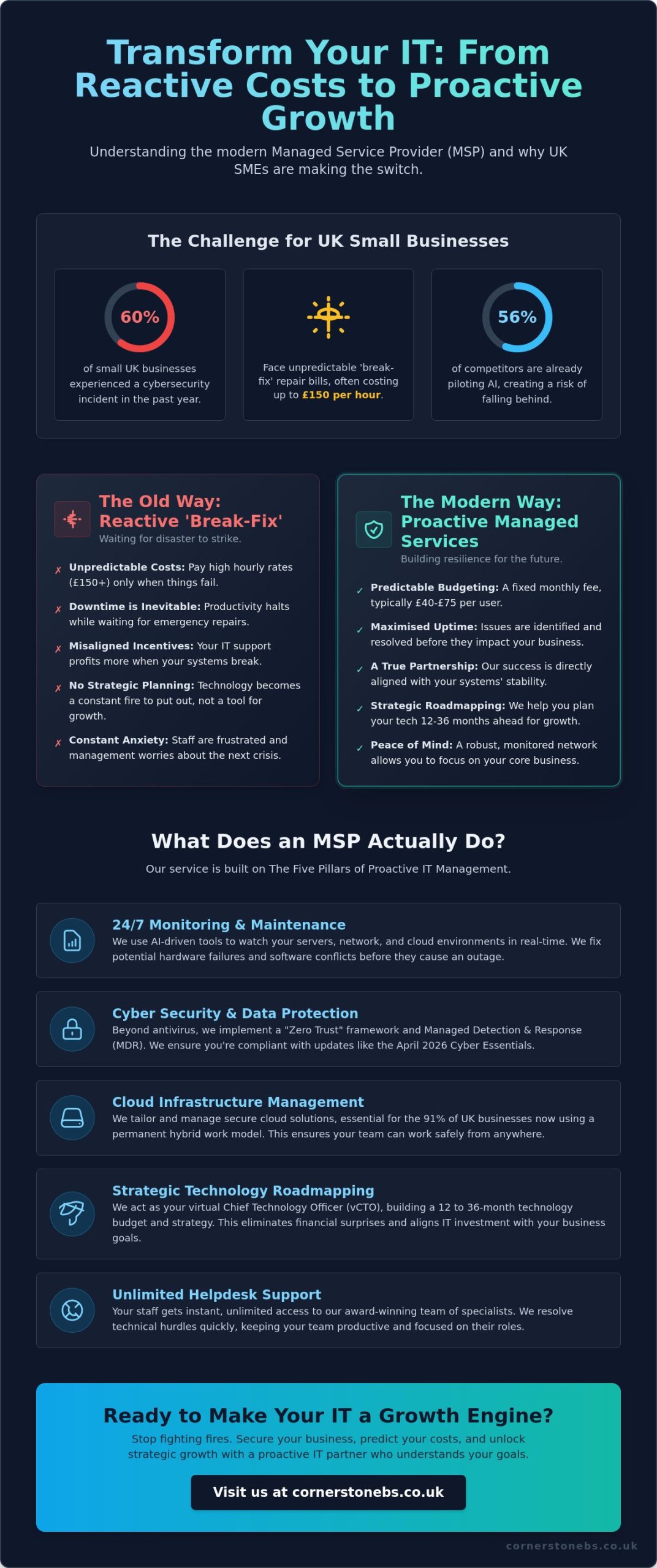
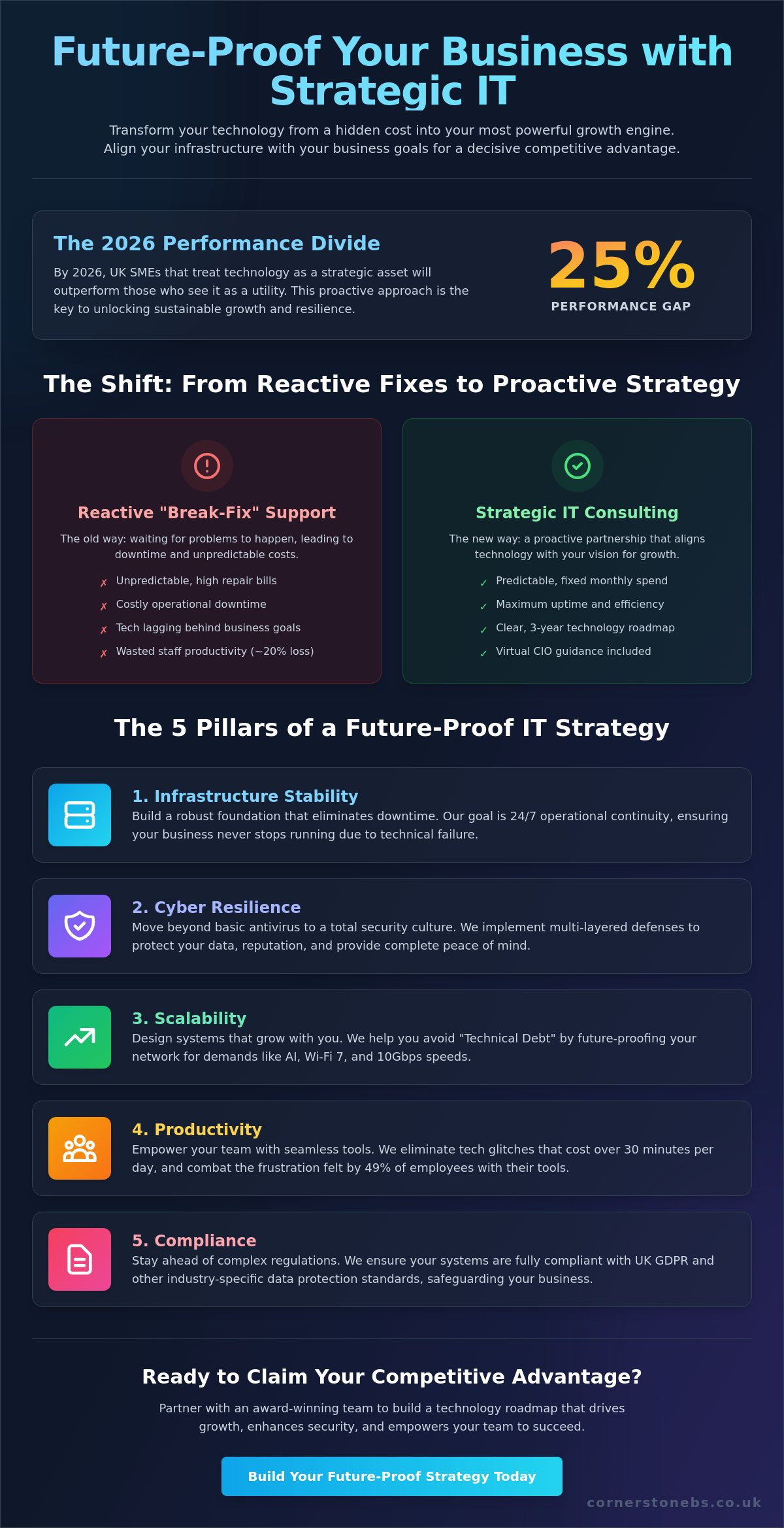
What if the cheapest IT support package costs more once your team needs help? The hidden costs of cheap IT support can sit outside the monthly fee, from on-site visits and project work to software licences or out-of-hours cover. If the scope is unclear, a low headline price may leave you unsure what happens when a problem interrupts work.
It’s sensible to keep IT spending under control. But the monthly fee alone won’t show whether a package covers the support your business needs, or what unresolved issues could mean for staff and customers. Compare the total cost and value: what’s included, what costs extra, who is responsible, and how the provider helps protect continuity.
This guide explains how to compare pricing models and support scope, spot potential extra charges, and assess response arrangements and accountability. You’ll also see how managed IT support can work alongside cyber security, cloud solutions and disaster recovery as part of a tailored, ongoing partnership. With a clearer picture of cost and coverage, you can choose support that fits your needs and helps reduce avoidable disruption.
Key Takeaways
The hidden costs of cheap IT support can include excluded work, licensing and hardware, as well as the business impact of delayed help.
Compare each proposal against the same list of users, devices, systems and support responsibilities.
Separate routine support from project work so you can see what the monthly fee covers and what may be charged separately.
Look for clear descriptions of support access, escalation and response commitments, and compare like with like.
Choose managed IT support that reflects your business priorities and can work alongside security, cloud and disaster recovery needs.
Why cheap IT support can cost more than its monthly fee
A low monthly fee isn’t automatically poor value. The key is what it covers. One quote may include ongoing monitoring and maintenance; another may only provide access to a helpdesk when someone reports a problem. If the scope differs, comparing headline figures alone won’t show which option better supports your business.
A Managed Service Provider (MSP) is commonly understood as a provider that takes ongoing responsibility for managing services. In IT, the practical distinction is whether support only responds to tickets or also covers agreed management responsibilities. The hidden costs of cheap IT support are often the staff time, risk or additional work that sits outside the stated fee.
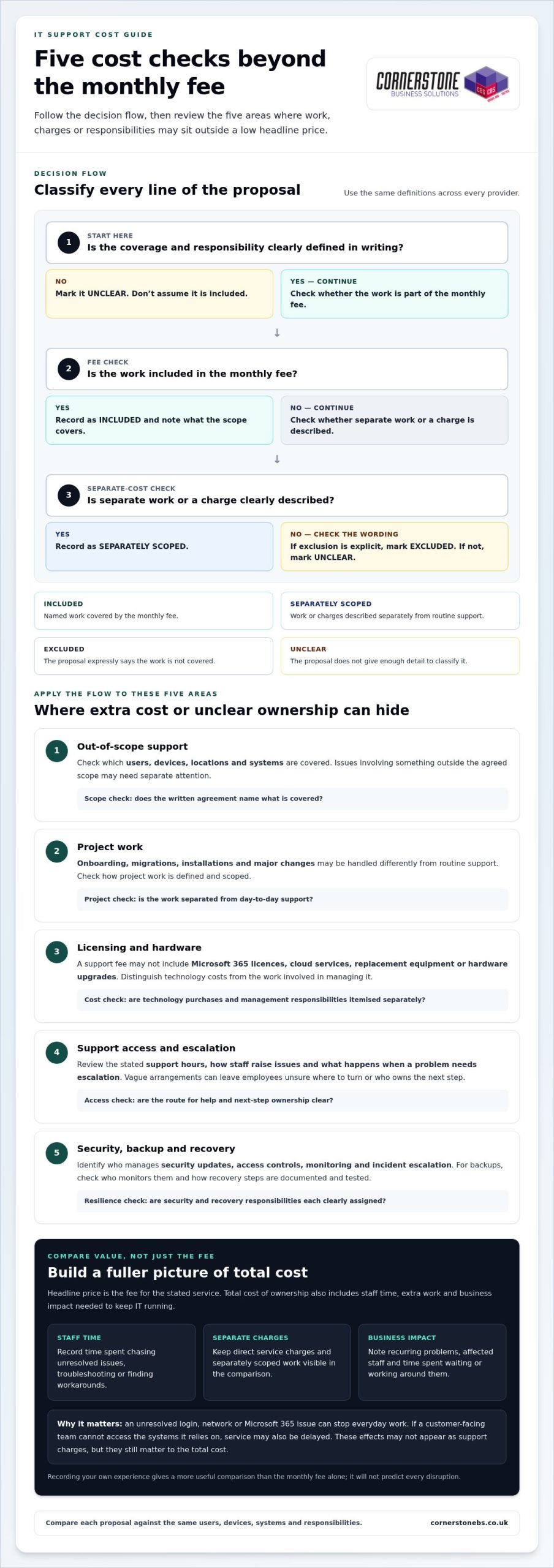
Headline price is what you pay for the stated service; total cost of ownership includes staff time, extra work and business impact needed to keep IT running. For a practical comparison, imagine one package has a lower monthly fee, but staff spend several hours each month chasing unresolved issues and finding workarounds. Record those hours and any separate service charges, then compare the overall picture with a package that covers more day-to-day management. You don’t need to assume one option is better; count what your business actually spends.
What does a cheap IT support package usually cover?
Inclusions vary. Helpdesk access may let staff report issues, while wider management can involve monitoring, maintenance or security tasks. Check the written scope against your users, devices, locations and business-critical systems—specialised enterprise platforms, for instance, often require dedicated oversight from providers such as Nuca Systems. Look for specific descriptions of what is monitored, maintained and protected. Broad phrases without defined responsibilities make it difficult to compare packages fairly or see where extra work could arise.
How can a low fee affect business continuity?
An unresolved login, network or Microsoft 365 issue can stop an employee completing everyday work. If a customer-facing team can’t access the systems it relies on, service may also be delayed. These effects aren’t always itemised as support charges, but they still matter to the total cost.
To estimate your own exposure, note how often recurring problems occur, how many staff they affect and the time spent waiting, troubleshooting or working around them. Record any direct charges separately. This won’t predict every disruption, but it gives you a more useful comparison than the monthly fee alone.
Five hidden costs to check before choosing cheap IT support
A low monthly fee can be good value when it covers the work your business needs. The risk is assuming every IT task is included. Review the agreement for five areas where extra work, separate charges or unclear responsibilities could affect overall value.
Out-of-scope support: Check which users, devices, locations and systems are covered. Issues involving something outside that scope may need separate attention.
Project work: Onboarding, migrations, installations and major changes may be handled differently from routine support. Check how project work is defined and scoped.
Licensing and hardware: A support fee may not include Microsoft 365 licences, cloud services, replacement equipment or hardware upgrades. Distinguish technology costs from the work involved in managing it.
Support access and escalation: Review the stated support hours, how staff raise issues and what happens when a problem needs escalation. Vague arrangements can leave employees unsure where to turn or who owns the next step.
Security, backup and recovery: Compare these as distinct responsibilities. Identify who manages security updates, access controls, monitoring and incident escalation, and how backups and recovery processes are documented and tested.
If a service is excluded from the agreement, don’t assume it’s included in the monthly fee. Making exclusions visible helps you spot the hidden costs of cheap IT support before they become unexpected work or disruption.
Which extra charges and exclusions should businesses look for?
Consider both current support needs and planned changes. A migration or installation may require separately scoped project work, while routine user support may be covered under different terms. Microsoft 365 licensing and cloud administration also represent distinct costs and responsibilities. Compare the wording in each proposal rather than assuming every provider uses “included support” in the same way.
What can gaps in security and recovery support mean?
Clear security and recovery responsibilities support business resilience. Check who applies updates, manages access, reviews alerts and escalates incidents. For backups, understand who monitors them and how recovery steps are recorded and tested. The UK’s National Cyber Security Centre offers guidance on choosing a managed service provider, including considerations for assessing the provider relationship.
Cornerstone Business Solutions provides tailored managed IT support built around business needs and continuity.
How to compare IT support providers beyond the headline price
Put every proposal into the same simple framework. This makes differences in coverage and responsibility easier to see, and helps you assess value beyond the monthly fee. Use the same labels for each area: included, excluded, separately scoped or unclear. “Unclear” is useful too. It shows where a proposal doesn’t give you enough detail for a fair comparison.
What should an IT support comparison include?
Start with the basics: covered users, devices, locations and systems, plus how staff access support. Then compare the work itself. For each area below, note its coverage status, who is responsible and what reporting or evidence is provided:
Helpdesk and escalation: Who logs, prioritises and escalates issues?
Proactive maintenance: Who carries out maintenance, and how is it reported?
Security: Who owns agreed security tasks and communicates actions?
Backup and recovery: Who oversees the process and records recovery arrangements?
Cloud administration: Who manages the systems and reports relevant changes?
Projects and major changes: Who scopes the work and tracks delivery?
Keep response commitments in a separate comparison field. Record the exact wording in each proposal, including how it defines a response, priority and resolution. Similar-sounding terms may not mean the same thing, so don’t treat them as directly comparable unless the commitments are clearly defined.
How do you compare service quality and accountability?
Look beyond the list of tools and services. A useful proposal explains how staff report an issue, how its priority is set, who escalates it and how progress is communicated. Reporting and regular service reviews can show whether recurring problems and agreed actions are tracked over time. The NCSC guidance on choosing an IT provider offers further UK-focused considerations for assessing a provider relationship.
Testimonials and awards may add confidence, but they can’t replace clear scope, named ownership and documented responsibilities. For tailored support built around business continuity, explore managed IT support.
A practical checklist for reviewing a low-cost IT support quote
A consistent review turns a stack of proposals into a practical decision. Before comparing fees, create a short inventory of your current IT environment and the problems that regularly slow work down. Include:
Users, devices and locations that need support.
Business-critical systems, including Microsoft 365 and cloud services.
Recurring issues, unresolved tickets and tasks staff currently handle themselves.
Security, backup and recovery responsibilities your business needs covered.
Compare identical requirements before deciding which proposal is cheaper. Mark each requirement as included, excluded, separately scoped or unclear, and record who is responsible. This gives you a fair basis for assessing the full scope and potential disruption without assuming every lower-priced quote has the same gaps.
What questions should you ask when reviewing the agreement?
Use the written agreement and proposal to check the details that affect everyday support and future changes:
Which users, devices, systems and locations are covered, and what is excluded?
What support hours and escalation steps are stated? How are issues prioritised and updates communicated?
How are service changes, new users, migrations, installations and project work handled?
Who is responsible for Microsoft 365 administration, cyber security, cloud systems, backups and recovery planning?
Log unclear terms in your procurement notes and resolve them through your normal review process before comparing proposals. Don’t fill gaps with assumptions.
How can you model disruption and plan a change?
Use your own operating context to estimate the effect of recurring IT issues. Note which roles and customer-facing tasks are affected, how many staff lose time, and whether work can continue another way. If a system outage delays order processing, for example, record the staff time spent waiting or using a workaround, plus any operational tasks left unfinished. Keep direct charges separate from lost staff capacity so the comparison stays clear.
If you change support arrangements, plan the handover before operational changes begin. Make responsibilities clear for transferring asset records, access information, system documentation and open support issues. Agree who communicates updates to staff and how outstanding problems will be tracked. A staged handover helps preserve important knowledge and reduce confusion. A managed IT services guide can provide broader context for planning ongoing support.
Choose managed IT support that protects your business as it grows
The right choice isn’t automatically the lowest monthly fee. It’s the proposal that clearly covers the systems your business depends on, explains who owns each responsibility and fits the way your organisation works. That clarity helps you weigh the hidden costs of cheap IT support against the support, security and continuity your team needs.
As your organisation changes, so can its IT requirements. New starters may need accounts and devices; business priorities may shift towards cloud services, stronger cyber security or more robust recovery planning. Managed IT support works best as an ongoing partnership, with responsibilities shaped around those needs rather than treated as a series of isolated tickets.
When is a managed IT support partnership worth considering?
Consider this approach if your organisation needs a consistent route for staff to get help and wants agreed proactive attention to its systems, not only a response after something breaks. A tailored support arrangement can bring helpdesk access together with relevant services such as Microsoft 365, cyber security, cloud solutions and disaster recovery. Clear ownership helps everyone understand who is responsible as users, devices and priorities change. It doesn’t guarantee savings or uninterrupted service, but it can make support responsibilities and continuity easier to manage.
What should the next step look like?
Bring a practical picture of your business to the conversation: the users and devices you support, the systems staff rely on, current pain points and the scope of any existing arrangements. Include questions about work that falls outside routine support and responsibilities that may sit across different technology services. This gives the discussion a useful focus: how IT support can align with operational priorities, where ownership should sit and what needs to be clear as your business develops.
At Cornerstone, managed IT support is tailored to client needs and built around an ongoing working relationship. The aim is to understand your requirements and connect support with the wider services that matter to your business, without making the decision on price alone.
Make your next IT support decision with confidence
The hidden costs of cheap IT support become easier to spot when you compare the full scope, not just the monthly fee. Check what’s included, what may be charged separately, and who owns important responsibilities such as security, backup and recovery. Then weigh those details against the time and disruption your business could face if problems remain unresolved.
The right support should fit your organisation’s needs today and adapt as they change. Cornerstone provides tailored managed IT support as an ongoing partnership, alongside services including Microsoft 365, cyber security, cloud solutions and disaster recovery. As a multi-award-winning IT services provider and partner to Microsoft, IBM and Cisco, Cornerstone brings experience across business technology, with continuity at the heart of the conversation.
Bring your current support scope, recurring challenges and business priorities into the discussion. Talk to Cornerstone about managed IT support and explore an approach shaped around your requirements. A clear comparison is a practical first step towards steadier, more confident IT decisions.
Frequently Asked Questions
Can cheap IT support end up costing a business more?
Yes, if the monthly fee leaves important work or responsibilities uncovered. Staff may spend time chasing unresolved issues or creating workarounds, while separate project, licensing or hardware charges add to the bill. These hidden costs of cheap IT support aren’t inevitable, though. Compare the full scope and account for the time your team spends managing IT problems, not just the recurring fee.
What is usually excluded from a low-cost IT support contract?
There’s no universal list, because packages differ. Potential exclusions include project work such as migrations or installations, hardware, software licences, cloud administration, on-site work and support outside stated hours. Security, backup and disaster recovery responsibilities may also be defined separately. Read the agreement for what is included, excluded or charged as additional work, and note any unclear wording before making a decision.
How can I compare IT support quotes fairly?
Give each quote the same requirements to address. List your users, devices, locations, critical systems, support needs and security or recovery responsibilities. Compare how each proposal covers helpdesk access, maintenance, projects, reporting and ownership. Record unclear or separately scoped items rather than treating them as included. Compare response commitments using the exact definitions in each proposal, since terms such as “response” and “resolution” can mean different things.
Does managed IT support include cyber security?
It depends on the agreed scope. Some arrangements may include defined security tasks, while other responsibilities may be set out separately. Check who manages updates, access controls, monitoring and incident escalation, and how those tasks are reported. Clear ownership matters: it helps your business understand how everyday support connects with cyber security and what work remains your responsibility.
Are Microsoft 365 licences usually included in IT support?
Not necessarily. A proposal may cover technical support or administration for Microsoft 365 without including the software licences themselves. Treat licensing, user and permission management, and help with service issues as separate items when reviewing the scope. The written agreement should make clear which costs and responsibilities sit within the support arrangement, so you can compare proposals on the same basis.
What should an IT support agreement say about response times?
It should define the response commitment in plain terms, including how a response is measured, when the clock starts and which support hours apply. Check whether it refers to acknowledgement, active work or resolution, and how priorities and escalations are handled. These are different milestones. Compare the exact wording across agreements rather than assuming similar labels promise the same level of service.
How can a business change IT support provider with less disruption?
Plan a handover before making operational changes. Set out who is responsible for transferring asset records, access information, system documentation and open support issues. Agree how staff will be informed and how unresolved problems will be tracked during the transition. A clear sequence helps preserve important knowledge and gives teams a route to follow if an issue arises while responsibilities are changing.
What if the laptop you’re paying to support is no longer being used by the person listed against it? For many SMEs, unclear records of devices, users, ownership and condition turn everyday IT decisions into guesswork. IT asset management for SMEs is more than building a device list. It’s an ongoing process that helps keep business technology visible, secure and useful throughout its lifecycle.
If renewals, replacements or support issues keep catching your team off guard, you’re not alone. It’s difficult to plan confidently when asset information is scattered across spreadsheets, inboxes and people’s memories. Accurate records give you a clearer view of what the business owns or uses, who’s responsible for it and what needs attention.
This practical guide explains how to track hardware, software and cloud assets, connect records with security and support, and make better-informed purchasing and lifecycle decisions. You’ll also compare approaches, from a simple inventory to dedicated tools or support from an IT partner, so you can choose a manageable fit for your SME.
Key Takeaways
IT asset management for SMEs goes beyond an inventory. It connects technology records with responsibility, maintenance and business decisions.
Follow each asset from planning and purchase through assignment, review and retirement to keep its history useful.
Choose between a spreadsheet, dedicated asset tool or managed IT support based on your team’s needs and ability to keep records updated.
Start with high-priority devices, agree who owns the process, then verify records and set a regular review routine.
When working with an IT support partner, clarify who updates asset information, how often it’s reviewed and how changes are reported.
What Is IT Asset Management for SMEs, and Why Does It Matter?
IT asset management is the process of recording, assigning, maintaining and reviewing an organisation’s technology throughout its business lifecycle. It gives an SME a practical way to understand what technology it relies on, who is responsible for it and what needs to happen next. This broader view of IT asset management connects asset records with everyday business decisions.
An inventory tells you what’s on a list. Lifecycle management keeps that information useful as assets are bought, assigned, supported, renewed or retired. That distinction matters: a device record that never changes can quickly become misleading. Current records help teams plan spending, coordinate support and respond to changes in staffing or technology with greater confidence.
Which IT assets should an SME include?
Start with the technology your people and business operations depend on. Depending on your setup, this may include:
Laptops, desktop computers, mobiles and peripherals such as monitors or printers.
Servers, routers, switches and other network equipment.
Software, cloud subscriptions and licences that need to be monitored or assigned.
How does an asset register support business decisions?
A useful asset register turns records into a working reference for purchasing, budgeting, support and replacement planning. Before approving a new laptop, for example, a manager can check whether suitable equipment is already available. When someone joins, changes role or leaves, clear assignment information helps the business review which devices and software access need attention.
Incomplete records can hide who is responsible for equipment, whether it’s still in use or when a subscription needs review. They can also make it harder for support teams to understand a device and its current status. Treat the register as a shared operational record with an agreed process for keeping it accurate, not a one-off spreadsheet task. That gives the business a clearer basis for decisions and connects technology ownership with day-to-day support.
How IT Asset Management Works Across the SME Asset Lifecycle
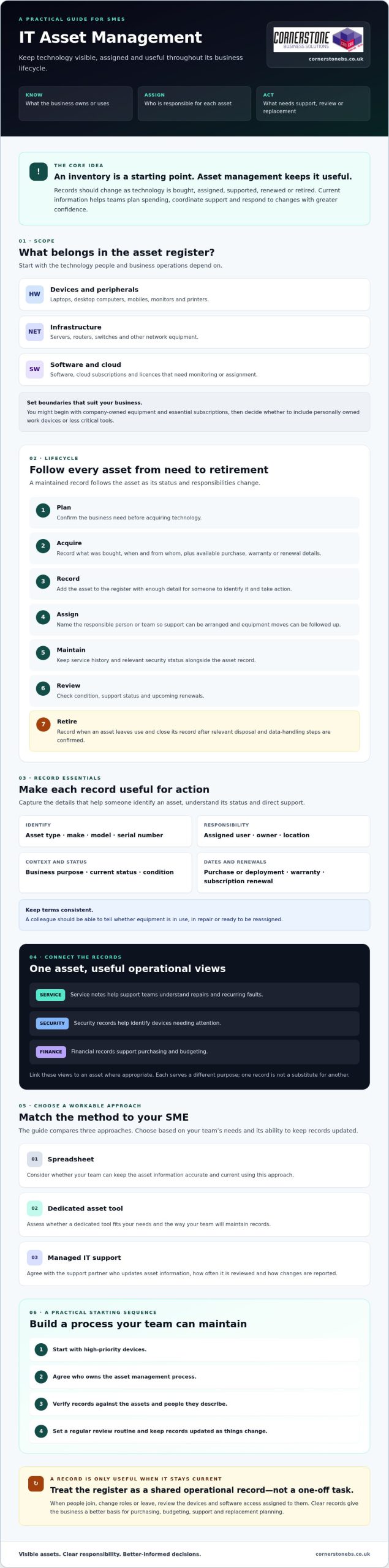
Once you’ve decided what to track, give each asset a clear route through the business. An asset register is a maintained record of technology and its status, not a one-off spreadsheet created at purchase. In practical IT asset management for SMEs, the lifecycle follows seven stages: plan, acquire, record, assign, maintain, review and retire.
Plan and acquire: Confirm the business need, then record what was bought, when and from whom, along with available purchase, warranty or renewal details.
Record and assign: Add the asset to the register and name the person or team responsible for it. Clear ownership makes it easier to arrange support and follow up when equipment moves.
Maintain and review: Keep service history and relevant security status alongside the asset record. Review the asset’s condition, support status and upcoming renewals.
Retire: Record when an asset leaves use and close its record once the relevant disposal and data-handling steps have been confirmed.
These records can inform one another, but they serve different purposes. Service notes help support teams understand repairs and recurring faults. Security records help identify devices needing attention. Financial records support purchasing and budgeting. Linking these views to an asset, where appropriate, helps the business make informed lifecycle decisions without treating one record as a substitute for another.
What information belongs in an SME asset register?
Capture enough detail to identify an asset and act on its record. Useful fields include asset type, make, model, serial number, assigned user, location, business purpose and current status. Add purchase or deployment dates, warranty details and software or subscription renewal information where relevant and available. Use consistent terms so a colleague can tell whether equipment is in use, in repair or ready to be reassigned.
Limit access to people who need the information to do their work, and collect only the employee or device details that serve a clear purpose. This keeps records practical and reduces unnecessary exposure of personal information.
When should an SME update or retire an asset?
Update the register after a purchase, transfer, repair, user role change or disposal. Set review points for equipment condition, support status and software renewals rather than waiting for a problem to surface. A replacement decision can then reflect both the device’s condition and its role in the business.
Before retiring equipment, confirm the appropriate data-erasure and disposal steps for the asset and your organisation. Record what was completed, when the asset left use and who handled the change. Check applicable requirements with a qualified adviser or disposal provider. If you’d like to review how managed IT support could help keep asset information aligned with maintenance and technology changes, Cornerstone Business Solutions is one partner to consider.
Spreadsheets, ITAM Software or Managed Support: Which Approach Fits an SME?
There’s no single right tool for every business. The best fit depends on how complex your technology estate is, how often it changes and who can keep records accurate. A proportionate start is enough: agree who owns the register and make sure updates happen consistently. Use the comparison below to choose a sensible next step for IT asset management for SMEs.
Approach
Suitable when
Strengths
Limitations
Spreadsheet
Your asset estate is straightforward and changes infrequently.
Simple to adapt; can fit existing ways of working.
Manual updates can be missed. Duplicate versions, limited reporting and broad access can weaken record quality and control.
Dedicated asset tool
You need structured records, repeatable workflows or clearer reporting as complexity grows.
May centralise information, support access controls and make records easier to search or review.
Needs configuration, ownership and regular updates. A tool won’t correct incomplete records by itself.
Managed IT support
You want asset information considered alongside ongoing IT maintenance and support.
An IT support partner may help coordinate records with support activity and technology changes.
Agree responsibilities, update routines and reporting. Support is not automatically a dedicated asset management platform.
When can a spreadsheet be enough for an SME?
A controlled spreadsheet can work well if the asset estate is manageable, a named person maintains it and colleagues know where the current version lives. Set access permissions, use consistent fields and schedule reviews. Without those basics, updates may be missed, multiple copies can drift apart and no one may know who is responsible for correcting errors.
When should an SME consider software or managed support?
Consider another approach if device numbers are growing, staff work across multiple locations or frequent user changes make manual updates hard to sustain. Asset software may improve search, reporting and repeatable workflows, but only if the underlying records and ownership stay current. Managed IT support may suit a business that wants asset information coordinated with wider support and maintenance. Compare the options against your existing processes, access needs and reporting priorities before deciding.
If you’re reviewing how asset records fit with your wider IT support needs, you could discuss the approach with Cornerstone Business Solutions.
How to Build a Practical IT Asset Management Process in Your SME
A useful asset register doesn’t need to be perfect before you start. Build it in manageable stages, focusing first on technology that supports essential work or needs regular support. This keeps the process practical and gives your team a reliable foundation to expand.
Agree the scope. Decide which devices, software, subscriptions and network equipment to include.
Assign ownership. Name a register owner and explain who must report purchases, transfers, repairs and disposals.
Gather records. Bring together purchasing information, support notes, device details and subscription records.
Verify the baseline. Check records with relevant users or teams, and flag details that are unknown or conflict.
Schedule reviews. Choose a regular review point and update records when business changes happen.
Start with high-priority assets, such as equipment used for essential operations, then add other items as the routine becomes manageable and useful. Connect updates to workflows that already exist: record a purchase as equipment is ordered, assign assets during onboarding, review access and equipment during offboarding, and update status after support work. A process that fits existing habits is easier to maintain than a separate task no one owns.
How can an SME create a reliable baseline inventory?
Pull together what you already have rather than starting from memory. Compare purchase records with device and support information, and include relevant software or subscription details. Ask users or the teams responsible for purchasing and IT support to confirm assignments and status. Mark uncertain entries for follow-up instead of guessing. Once checked, name a clear register owner and tell staff how to report changes, including a new device, a repair or a transfer to another colleague.
How should asset records connect with security and cloud services?
Accurate device and user records can help a team identify which equipment and accounts may need attention during access reviews or incident response. Keep the asset register connected to, but distinct from, security records and cloud service information. For example, a user’s departure can prompt a review of assigned devices and relevant account access. An incident can be easier to investigate when device ownership and status are known. Good records support security work, but they don’t prevent every incident. For broader planning, see this cyber security services guide.
How Managed IT Support Can Help Keep SME Asset Management on Track
An IT support partner can help keep asset information connected to the work happening around it. A support request may reveal that a device has been repaired or replaced, while a technology change may mean an asset record needs updating. Clear responsibilities and agreed routines help prevent these changes from disappearing into separate systems or inboxes.
Managed support isn’t automatically an IT asset management platform. Treat it as a potential working relationship for coordinating records with maintenance, cloud services and cyber security, and agree exactly what the service includes. This can help IT asset management for SMEs stay aligned with day-to-day operations.
What should SMEs ask a managed IT provider about asset records?
Ask direct questions before agreeing how the work will be shared:
Who maintains the records, and how are purchases, transfers, repairs and retirements captured?
What update routine is followed, and how can your team report a change?
What information or reports will you receive, and how can asset details support service requests, security reviews and replacement planning?
How are urgent asset-related issues escalated, and who is responsible for each next step?
Which tasks are included in the proposed service, and which remain your organisation’s responsibility?
Look for clear answers, not assumptions. Your business may still need to approve purchases, confirm user assignments or notify the provider when equipment moves. Agreeing those boundaries helps both sides keep information reliable.
How can an SME take the next step with Cornerstone?
Start by reviewing your existing records. Note what’s missing, which assets are most important to the business and where updates currently fall through. Those priorities give you a useful basis for discussing a manageable process with a support partner.
Cornerstone Business Solutions provides managed IT support to organisations across the UK, alongside IT maintenance, cloud services and cyber security. These services can support wider IT operations, but they aren’t a standalone asset management platform. If software subscriptions or a move to Microsoft 365 are part of your review, see this Microsoft 365 migration guidance for related planning considerations.
With your priorities in hand, you can discuss an IT support approach with Cornerstone. A conversation can help clarify how asset records, maintenance and technology changes might fit together for your SME.
Make Your IT Assets Easier to Manage
Good IT asset management for SMEs isn’t about building the most elaborate register. It’s about keeping useful records current, assigning clear responsibility and connecting asset changes with purchasing, support and security processes. Start with the technology your business relies on most, then build a review routine your team can sustain.
The right approach may be a well-managed spreadsheet, dedicated asset software or support from an IT partner. Choose based on the complexity of your technology and who can keep information accurate. Clear records help you plan renewals and replacements with more confidence, coordinate support and understand what needs attention.
Cornerstone Business Solutions is a multi-award-winning provider that partners with Microsoft, IBM and Cisco, and offers managed IT support alongside related services. If you’d like to discuss an IT support approach that fits your business, talk with Cornerstone about the right IT support approach for your business.
Frequently Asked Questions
What is IT asset management for SMEs?
IT asset management for SMEs is the ongoing process of recording, assigning, maintaining and reviewing business technology throughout its lifecycle. It goes beyond listing devices. It helps a business understand what technology it uses, who is responsible for it, its current status and what may need attention next. Keeping this information current can support purchasing, support coordination, security reviews and decisions about renewing or replacing equipment.
What should an SME include in an IT asset register?
Include the technology your business relies on, such as laptops, desktops, mobiles, servers, network equipment and relevant peripherals. You can also record software, cloud subscriptions and licences where tracking them is useful. For each asset, capture identifying details such as type, make, model and serial number, along with assigned user, location, business purpose and status. Add purchase, deployment and renewal information when relevant and available.
Can a small business manage IT assets with a spreadsheet?
Yes, a spreadsheet can be a practical starting point if the asset estate is straightforward and someone maintains it consistently. Name an owner, limit access to people who need it, agree where the current version is stored and set review points. Manual updates can be missed, and duplicate copies may conflict. If changes become difficult to track or reporting takes too much effort, review whether another approach would fit better.
How often should an SME update its IT asset register?
Update the register whenever an asset is purchased, assigned, transferred, repaired or retired, and when a relevant user or business change affects its record. Also schedule periodic checks to confirm listed devices remain in use and review support or renewal information. Choose a review rhythm your team can sustain, and agree who makes updates. The key is to avoid leaving changes unrecorded until an annual check.
Does IT asset management help with cyber security?
Accurate asset records can support cyber security by helping the business identify which devices it uses, who is responsible for them and what may need review. During an access review or security incident, current device and user details can help teams work out where to focus. Asset management doesn’t prevent every incident, but it can improve visibility and help connect technology records with wider security processes.
When should an SME move from spreadsheets to IT asset management software?
Consider dedicated software when manual updates become difficult to maintain, records are scattered across several files or your business needs more structured reporting and access controls. Growth in device numbers, multiple locations or frequent staff changes can also make a spreadsheet harder to manage. A tool is useful only if someone owns the process and keeps its information accurate. Compare its workflows with your existing purchasing and support routines before choosing.
Can a managed IT provider help maintain asset records?
Yes, a managed IT provider may help coordinate asset information with support activity, maintenance and technology changes. Before agreeing an approach, ask who updates records after purchases, transfers and retirements, how often information is reviewed, what reporting you’ll receive and what remains your responsibility. Cornerstone Business Solutions provides managed IT support and related services to organisations across the UK. It doesn’t offer a named IT asset management platform.
What if your server room was costing you more in wasted electricity and floor space than the actual data it processes? For many UK SMEs, the traditional model of “one server per application” has become a literal drain on resources. Implementing server virtualisation for small business is no longer a luxury reserved for big tech; it’s a vital step to avoid high maintenance fees and the constant fear that a single hardware failure could bring operations to a standstill. We know your priority is keeping the lights on and the orders flowing, not worrying about a buzzing rack of hardware in the corner of the office.
Consolidating your systems is the most effective way to reclaim that wasted budget. As an award-winning provider with strategic partnerships with Microsoft and IBM, we’ve seen how this technology allows you to run multiple systems on a single physical machine. It’s about more than just saving money; it’s about building a resilient foundation that protects your company from downtime. This 2026 guide explains how to streamline your infrastructure, boost your reliability, and prepare your business for a scalable future.
Key Takeaways
Learn how server virtualisation for small business turns multiple physical machines into a single, efficient unit to slash your energy bills and hardware costs.
Understand the mechanism behind dynamic resource scaling, ensuring your most critical applications always have the power they need to perform.
Discover the five essential steps to auditing your current setup and choosing the right hypervisor for your specific operational goals.
See why a managed approach to virtualisation acts as a foundational element for your disaster recovery plan, keeping your business running even if hardware fails.
Transition from reactive IT maintenance to a proactive model that supports long-term growth and technical stability.
For years, the standard approach to IT was simple but expensive. You bought a new physical server every time you needed a new major application. This “one server, one job” model created cluttered server rooms full of underutilised hardware. Most of these machines sit idle, using only a fraction of their processing power while still drawing full power from the grid. In a climate where UK energy costs remain a top concern for directors, running hardware at 15% capacity isn’t just inefficient; it’s bad for the bottom line.
Server virtualisation for small business changes this dynamic by decoupling your software from the physical hardware it runs on. Instead of one operating system per box, you use a special layer of software called a hypervisor. Think of the hypervisor as a digital traffic warden. It sits between the hardware and your applications, intelligently directing resources like CPU and memory to where they’re needed most. This allows a single high-performance machine to do the work of five, ten, or even fifteen older servers.
Why is 2026 the tipping point for this transition? The push for digital transformation and the need for rapid scalability mean that physical-only setups can’t keep pace. Modern SMEs need to deploy new services in minutes, not weeks. By moving away from rigid physical constraints, you gain the agility to grow without waiting for a hardware delivery or an expensive engineer visit every time you want to test a new system.
Physical vs. Virtual Servers: A Simple Analogy
Imagine a traditional physical server as a single-family detached house. It has its own foundation, roof, and utility connections. If only one person lives there, most of the rooms stay empty, yet you still pay to heat the whole building. It’s a waste of space and money. Server virtualisation for small business is more like a modern apartment complex. You have one strong foundation and one set of main utilities, but inside, multiple independent households live in their own private, secure spaces. Each apartment shares the building’s resources, but they don’t interfere with one another. This setup maximises every square inch of the “building,” ensuring nothing goes to waste.
The Core Components of a Virtual Environment
Building this environment requires three main elements working in harmony to deliver a stable experience:
Host Hardware: This is the physical engine. It’s a high-spec server with significant RAM and processing power that provides the raw resources for everything else.
Virtual Machines (VMs): These are the independent “servers” that your staff actually interact with. Each VM runs its own operating system and applications as if it were a standalone machine.
Hypervisor: This is the essential software layer that makes virtualisation possible. It manages the hardware’s resources and ensures each VM gets what it needs to run smoothly.
By combining these components, you create a flexible infrastructure that’s easier to manage and far more resilient than a room full of individual boxes.
How Virtualisation Actually Works (Without the Jargon)
Understanding the mechanics of server virtualisation for small business doesn’t require a computer science degree. At its heart, this technology breaks the rigid link between your software and the physical box it lives in. Once you separate these two elements, your IT environment becomes incredibly fluid. You’re no longer restricted by what one specific machine can do; instead, you’re looking at what your entire hardware setup can achieve as a single unit.
This flexibility enables dynamic resource scaling. If your accounts team is running intensive year-end reports, the system automatically redirects spare processing power from other areas to ensure their software doesn’t lag. It’s a proactive way to manage performance. This architecture also forms the backbone of modern cloud solutions, allowing your business to bridge the gap between on-site hardware and off-site accessibility seamlessly.
One of the most reassuring features for any business owner is the ‘Snapshot’. Think of this as a digital “undo” button. Before you perform a major software update or change a configuration, you take a snapshot of the server’s current state. If the update causes a crash, you can revert to that exact moment in seconds. It makes backups faster and significantly safer than traditional methods.
The Magic of the Hypervisor
The hypervisor is the brain of the operation. It sits directly on your hardware and carves out portions of CPU, RAM, and storage to hand over to individual Virtual Machines (VMs). We often work with industry-standard platforms like Microsoft Hyper-V and VMware to create these stable environments. A key benefit here is isolation. Because each VM is self-contained, a “blue screen” on your mail server won’t affect your file server or your database. Your office stays productive even if one specific application encounters a glitch.
Resource Pooling and Efficiency
Resource pooling is the strategic practice of combining your hardware’s total power into a single reservoir to maximise your return on investment. This approach eliminates the “idle time” that plagues traditional setups. It also offers a lifeline for legacy software. If your business relies on an older application that only runs on an outdated operating system, virtualisation allows that software to run in its own protected bubble on brand-new, high-speed hardware. If you’re unsure how your current kit stacks up, our team can provide managed IT support to audit your environment and find these hidden efficiencies.
The Business Case: Why SMEs are Moving to Virtual Servers
Running a business in 2026 requires a lean approach to overheads. Many UK business owners overlook the “silent” costs of their server room: the constant hum of cooling fans, the mounting electricity bills, and the physical space occupied by aging hardware. Transitioning to server virtualisation for small business allows you to condense your infrastructure significantly. Imagine turning five separate physical servers into just one high-performance machine. You aren’t just saving floor space; you’re cutting your energy consumption and reducing the number of components that can potentially fail.
This consolidation makes scaling your operations far more predictable. In a traditional setup, adding a new department or a major piece of software often meant ordering a new physical box, waiting for delivery, and paying for an engineer to install it. With a virtual environment, you simply allocate more resources from your existing pool. You can deploy a new server in minutes, not weeks. This agility ensures your IT infrastructure moves at the speed of your business, not the speed of a courier service.
Cost Savings: CAPEX vs. OPEX
The financial shift from heavy upfront capital expenditure (CAPEX) to manageable operational costs (OPEX) is a game-changer for SME cash flow. By reducing the number of physical machines you need to buy and replace every few years, you keep more capital inside your business. Your long-term maintenance and support fees also drop because your IT partner has less physical hardware to monitor and repair. This strategic shift is a core part of modern it company solutions that focus on efficiency rather than just selling more hardware.
Maximising Uptime and Business Continuity
Downtime is the enemy of growth. Server virtualisation for small business introduces a concept called High Availability (HA). If your primary physical server needs a hardware repair or a memory upgrade, your virtual servers can be moved to another piece of hardware while they’re still running. Your staff won’t even notice the switch. This level of resilience was once only available to global corporations, but it’s now an affordable standard for local businesses. It provides the emotional security of knowing that a single hardware glitch won’t result in a total business shutdown. You gain a robust Disaster Recovery foundation that ensures your data is portable, protected, and always accessible when you need it most.
Planning Your Virtualisation Strategy: A 5-Step Approach
Success in server virtualisation for small business isn’t just about the software you buy; it’s about the strategy you follow. A poorly planned migration can lead to unexpected downtime or performance bottlenecks that frustrate your team. We recommend a structured, business-first approach that prioritises your operational stability over technical flashiness. By following these five steps, you can ensure your transition is smooth, secure, and ready for future growth.
Step 1: Audit your current setup. You can’t move what you don’t understand. A thorough review identifies which physical machines are prime candidates for consolidation.
Step 2: Select the right hypervisor. Whether you choose Microsoft Hyper-V or VMware, the platform must align with your existing software ecosystem.
Step 3: Design for redundancy. Avoid creating a single point of failure. We always recommend using at least two host machines so that if one fails, the other automatically takes over.
Step 4: Perform the P2V migration. This is the process of converting your physical server data into a virtual format. It’s the “moving day” for your IT infrastructure.
Step 5: Proactive monitoring. Once live, your virtual environment needs constant oversight to ensure resources are balanced and security is maintained.
The Importance of an IT Audit
An audit is the foundation of a successful project. It’s during this phase that we identify “zombie servers” that consume power while doing very little. We also check the compatibility of your legacy software. Some older applications require specific configurations to run in a virtual environment. By mapping out your data storage requirements early, you avoid the cost of buying more capacity than you actually need. It’s about being efficient with your budget from day one.
Executing a Seamless Migration
The goal of any Physical-to-Virtual (P2V) migration is to minimise disruption. We often perform these transitions outside of your core business hours to keep your staff productive. Before the final switch, we test the virtual environment in a “sandbox” to catch any potential glitches. Security shouldn’t be an afterthought. We ensure your cyber security services are fully integrated into the new virtual network to protect your data as it moves. If you’re ready to modernise your infrastructure, speak to our award-winning team about a tailored migration plan.
Managed Virtualisation: Why a Partner Makes the Difference
Partnering with a multi-award-winning IT provider changes the equation. We provide 24/7 proactive monitoring that identifies potential hardware bottlenecks or software glitches before they impact your staff. This move from reactive “firefighting” to a managed model ensures your infrastructure remains stable. Our experts align your virtual strategy with your long-term growth plans. We ensure you never outgrow your technology by building systems that expand alongside your success.
Your Path to a Modern IT Infrastructure
Moving to a managed virtual environment provides more than just technical efficiency; it offers emotional security. You can rest easy knowing that your business continuity is backed by experts who understand the foundational role of IT in your stability. We focus on proactive system health. This ensures your network is resilient against hardware failure or cyber threats. It’s about giving you the freedom to focus on your business while we handle the digital engine powering it. We take the stress out of technology so you can lead with confidence.
Ready to consolidate your hardware and future-proof your operations? Book a consultation with our experts to discover how a tailored virtualisation strategy can transform your business.
Future-Proof Your Business with Scalable Infrastructure
Transitioning to server virtualisation for small business is about more than just clearing out the server room. It’s a strategic move that slashes your hardware costs and energy bills while providing the enterprise-level resilience your company deserves. By consolidating your physical machines, you create a flexible environment that scales at the speed of your growth. You gain the peace of mind that comes from knowing a single hardware failure won’t result in a total business shutdown.
As a multi-award-winning IT provider with strategic partnerships with Microsoft and Cisco, we specialise in delivering bespoke UK-wide business support. We don’t just set up the technology; we act as your dedicated partner to ensure your systems remain healthy and secure. It’s time to move from reactive repairs to a proactive, modern infrastructure that supports your long-term vision. Discover how our Managed IT Support can transform your infrastructure. We’re here to help you navigate this transition with confidence and clarity.
Frequently Asked Questions
Is server virtualisation safe for my sensitive business data?
Yes, virtualisation is inherently safe and often more secure than traditional setups. By isolating each application into its own virtual machine, you prevent a single security breach from spreading across your entire network. We integrate robust cyber security services into the virtual layer to ensure your sensitive data remains protected. This architecture also makes it much easier to implement strict access controls and regular, automated security patches without disrupting your whole office.
How many physical servers do I need to make virtualisation worthwhile?
You don’t need a room full of hardware to see the benefits. While the most dramatic savings occur when consolidating three or more machines, even businesses with two servers find value in the increased reliability. Implementing server virtualisation for small business allows you to run multiple roles on one powerful host while keeping a second for redundancy. This setup provides high availability that simply isn’t possible with a traditional “one server, one job” approach.
Will my existing business software work on a virtual server?
Most modern business applications are fully compatible with virtual environments. Whether you use standard office tools or specialised industry software, these programs usually run exactly as they did on physical hardware. Our team performs a comprehensive audit of your current software licenses and versions before any migration begins. This ensures that every piece of software is verified for the virtual layer, preventing any unexpected downtime or performance glitches during the transition.
How much does it cost to virtualise a small business server setup?
The investment depends on your specific requirements and the complexity of your current infrastructure. Typically, you’ll pay a professional service fee for the design and migration project, followed by recurring managed IT support fees for proactive monitoring. While we don’t provide flat rates, the long-term savings on energy, cooling, and hardware replacement often outweigh the initial setup costs. It’s about moving from unpredictable capital expenses to a stable, manageable operational budget.
What happens if the physical host server fails?
We prevent total failure by designing your system with redundancy in mind. In a professional setup, we use multiple physical host servers working together. If one physical machine encounters a hardware fault, the virtual servers automatically move to the remaining healthy host. This process happens in the background, often without your staff even noticing a flicker. It’s a foundational element of a modern disaster recovery plan that keeps your business running regardless of hardware glitches.
Do I still need a physical server if I move to the cloud?
How long does a server virtualisation project typically take?
Most projects are completed within a few days to two weeks, depending on the volume of data and the number of applications being moved. We start with a thorough audit to map your environment, followed by the actual migration, which we often schedule outside of your core business hours. This structured approach ensures that the transition is seamless and that your staff face minimal disruption while we modernise your digital infrastructure.
What is the difference between a virtual server and a virtual desktop?
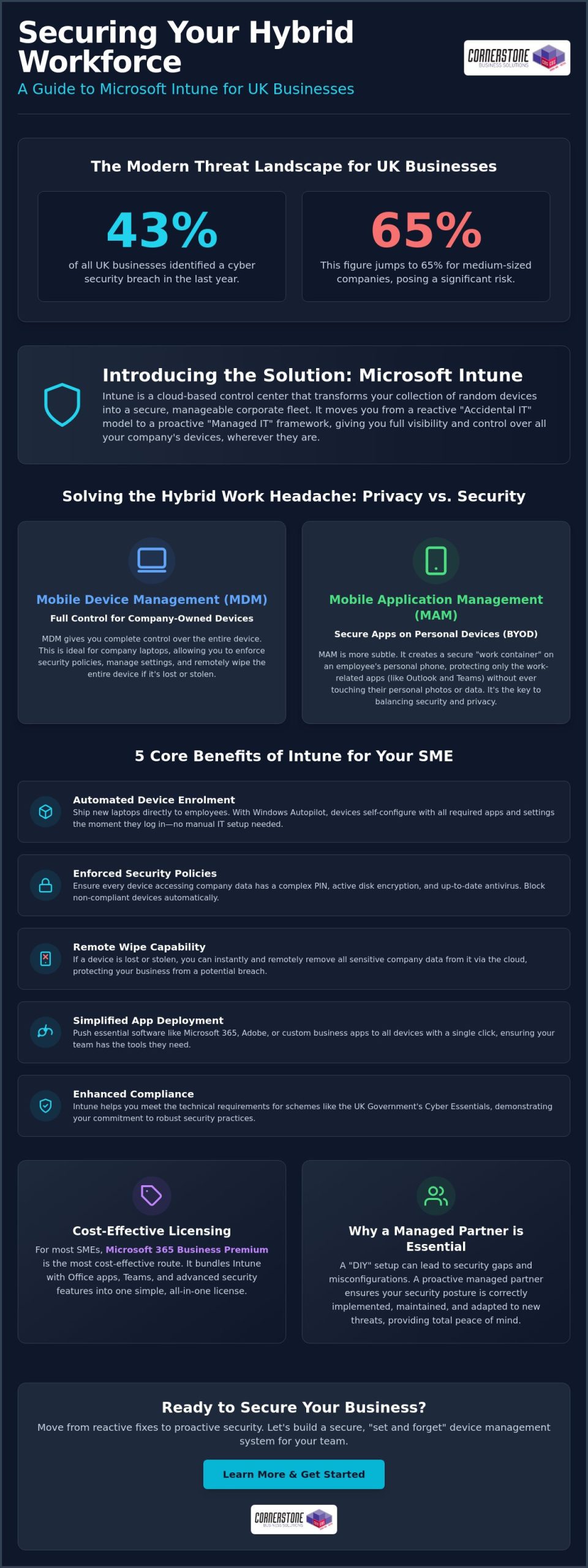
Did you know that 43% of UK businesses identified a cyber security breach in the last year? For medium-sized companies, that figure jumps to a staggering 65%. It’s a stressful reality for local business owners who want to focus on growth rather than the constant worry of a lost laptop or a data leak on an employee’s personal phone. You likely feel that setting up new starters manually is a massive drain on your time, and the permanent shift to hybrid work has only made tracking your hardware more difficult.
Key Takeaways
Master the art of managing your organisation’s endpoints, from laptops to tablets, through one simple cloud-based service.
Simplify your onboarding process with Microsoft Intune for small business, enabling new starters to receive self-configuring devices delivered straight to their door.
Balance security and privacy by creating secure work containers on personal devices, keeping company data safe while leaving personal photos and apps untouched.
Identify the most cost-effective licensing route for your SME, focusing on the all-in-one value provided by Microsoft 365 Business Premium.
Learn why a proactive managed partner is essential for maintaining your security posture and avoiding the common pitfalls of a “DIY” setup.
In technical circles, these devices are often called “endpoints.” This term simply refers to any hardware that connects to your network and handles data. Whether it’s a Windows laptop, an Apple iPad, or an Android smartphone, they are all endpoints that need a consistent layer of protection. For a deeper dive into the history and technical architecture of the platform, you can read more about What is Microsoft Intune? and how it has evolved into a global leader for device security.
The Shift from Office-Based to Hybrid Work
MDM vs. MAM: A Simple Distinction
Understanding the difference between Mobile Device Management (MDM) and Mobile Application Management (MAM) is the key to a smart strategy. MDM gives you control over the entire piece of hardware. This is perfect for company-owned laptops where you might need to wipe the whole drive if the device is lost. MAM is more subtle. It allows you to control only the work-related apps, such as Outlook or Teams, on a device. This is the ideal solution for personal phones. It protects your business data without ever touching an employee’s personal photos or private messages. This distinction helps build trust with your team while maintaining a robust security posture.
5 Core Benefits of Implementing Intune in Your SME
Automated Device Enrolment: You can ship a brand-new laptop directly to a staff member’s home and have it self-configure the moment they log in.
Enforced Security Policies: You gain the power to ensure every device has a complex PIN, active encryption, and up-to-date antivirus before it can touch your data.
Remote Wipe Capability: If a phone is left on a train or a laptop is stolen, you can instantly remove all company data from the device via the cloud.
Simplified App Deployment: Instead of manual installs, you can push essential software like Teams, Adobe, or custom business apps to all staff with one click.
Enhanced Compliance: Intune helps you meet the technical requirements for the UK Government’s Cyber Essentials scheme, proving your commitment to security.
Zero-Touch Provisioning with Windows Autopilot
Manual IT setup is a thing of the past. Windows Autopilot is a tool that allows IT to pre-configure devices without ever touching the hardware. This means your IT partner can register your new machines in the cloud so they are ready for use the moment they leave the box. It creates a fantastic first impression for new starters. Instead of waiting days for a “configured” machine, they receive a professional, ready-to-work device on day one. This streamlined approach saves your business significant time and removes the logistical headache of passing hardware back and forth through a central office.
Strengthening Your Cyber Security Resilience
Security is no longer a “set and forget” task. Intune acts as your first line of defence against modern threats like ransomware by ensuring that only “healthy” devices can access your network. By integrating these controls with our wider cyber security services, you create a multi-layered shield around your business.
One of the most powerful features is Conditional Access. This allows you to set strict rules; for example, a user can only access SharePoint if their device is encrypted and located in the UK. This level of control is vital for managing personal devices, and it aligns perfectly with the latest NCSC guidance on BYOD. If you want to see how these tools can fit your specific team, our experts are always ready to provide managed IT support tailored to your local roots.
Solving the BYOD Headache: Privacy vs. Security
“I don’t want my boss looking at my holiday photos.” It’s the number one objection we hear from teams across the UK. With 60% of companies now supporting Bring Your Own Device (BYOD) models, this friction between personal privacy and corporate security is a daily reality for many business owners. Employees are naturally protective of their private messages and personal apps. They don’t want to feel monitored.
Thankfully, Microsoft Intune for small business provides a sophisticated solution through Mobile Application Management (MAM). Instead of taking over the entire phone, Intune creates a secure container around your corporate applications. This means your business data stays inside professional tools like Outlook, Teams, and OneDrive, while the rest of the device remains completely private. You can’t see their personal apps, and they can’t accidentally leak your data.
App Protection Policies Explained
The magic of this system happens through selective wipes. If an employee leaves your company, you can instantly remove all corporate data from their device without touching a single family photo or personal contact. You can also enforce strict access rules; for example, requiring a fingerprint or FaceID to open work apps. This doesn’t just protect the data; it builds trust. Your team knows that their personal life is off-limits, and you know your business is secure and professional.
Maintaining GDPR Compliance on Mobile
Personal phones are often the biggest blind spot in a GDPR audit. If you don’t have visibility over where your data is stored, you’re at risk. UK regulators, including the ICO, look for proactive technical controls that prove you are taking data protection seriously. Intune provides the detailed audit logs you need to prove that business data is encrypted and managed. Since serious breaches can result in fines of up to £17.5 million or 4% of global worldwide turnover, having this level of oversight is a foundational element of your business stability and emotional security.
Microsoft Intune Pricing and Licensing for UK SMEs
Understanding the cost of Microsoft Intune for small business is often where the most significant savings are found. Many local business owners assume they need to purchase a standalone license for every security tool they use. In reality, savvy SMEs rarely buy Intune as a separate product. It is a cloud-based superpower that is most effective when integrated into your wider productivity suite. While Microsoft offers Intune Plan 1 for core management and Plan 2 for complex, specialty device needs, these are often less cost-effective for a growing team than a bundled approach.
The “sweet spot” for most UK companies is Microsoft 365 Business Premium. At £18.10 per user, per month as of June 2026, this plan includes the full version of Intune alongside your standard Office apps. If you compare this to Business Standard, which costs £11.55 but lacks any device management or advanced security, the value becomes clear. For a few extra pounds per month, you transform your IT from a collection of unmanaged laptops into a secure, professional fleet. It’s a proactive investment that simplifies your billing and strengthens your defences.
Is Microsoft 365 Business Premium the Best Choice?
This bundle is specifically designed for companies with up to 300 users. It provides a comprehensive security shield that goes far beyond simple device management. Alongside Intune, you receive Defender for Business for enterprise-grade antivirus and Microsoft Entra ID (formerly Azure AD) Premium for secure identity management. It’s a complete toolkit for the modern hybrid workplace. If you are currently on a different plan, our Microsoft 365 migration guide provides a clear strategy for making the switch without disrupting your daily operations.
Calculating the ROI of Managed Endpoints
The return on investment for Intune is found in the risks you avoid and the time you save. The median cost of a serious cyber breach for a UK SME is now £4,000, rising to £10,000 for medium-sized firms. Comparing these figures to a monthly license fee shows that Microsoft Intune for small business pays for itself by preventing just one lost laptop from becoming a data disaster. There are hidden savings too. By 2026, automated endpoint management can reduce IT device provisioning costs by up to 70% for small organisations. You spend less on helpdesk tickets and manual setups, allowing your team to focus on what they do best. To ensure your licenses are configured for maximum value, we invite you to explore our managed IT support options today.
Implementing Microsoft Intune: Why a Managed Partner Matters
We believe that technology should be a silent partner in your success, not a source of constant stress. By moving away from transactional, one-off fixes and into a long-term managed IT support relationship, you gain a dedicated team that understands your vision. We are a national UK partner with deep geographical roots in the SME community. This local connection allows us to provide a level of care and accountability that larger, more detached providers simply cannot match. We don’t just fix problems; we prevent them from happening in the first place.
A Bespoke Technology Roadmap
The Cornerstone Difference: Award-Winning Service
As a multi-award-winning IT provider, our reputation is built on a foundation of trust, clarity, and technical excellence. We take the complexity of modern cyber security and simplify it into clear, benefit-driven outcomes for the business owner. You shouldn’t have to be a technical expert to have a secure business. Our team acts as an extension of yours, providing the professional authority and approachable warmth you need to feel confident in your digital infrastructure. We invite you to start a conversation with our expert team today. Let’s work together to build a secure, efficient, and resilient future for your business.
Secure Your Fleet and Focus on Growth
As a multi-award-winning IT provider and Microsoft Gold Partner, Cornerstone Business Solutions is here to help you navigate these changes. We combine our technical expertise with proactive national UK support to ensure your systems are always one step ahead. We don’t just provide a service; we act as your long-term partner in growth. Ready to see where you stand? You can book a Microsoft 365 Security Audit with Cornerstone today to secure your fleet for the future.
Frequently Asked Questions
Is Microsoft Intune included in Microsoft 365 Business Standard?
No, Microsoft Intune is not included in the Microsoft 365 Business Standard plan. To access these management tools, you’ll need to upgrade to Microsoft 365 Business Premium or purchase a standalone license. Most of our local clients find Business Premium offers the best value as it bundles security and productivity together. It’s a proactive way to ensure your team has the right tools without managing multiple separate bills.
Can I use Microsoft Intune to manage Macs as well as Windows PCs?
Yes, you can manage macOS devices just as effectively as Windows PCs using Intune. It provides a unified console where you can push software updates, enforce encryption, and manage security settings for both platforms. This is ideal for hybrid teams who prefer using a mix of hardware. You get a single, clear view of every device in your business, ensuring that your security standards remain high across the entire fleet.
Does Microsoft Intune track my employees location?
No, Intune is not designed to be a tracking tool for your staff. While it can locate a lost or stolen company-owned device that has been fully enrolled, it does not track the real-time location of personal devices used for work. This distinction is vital for maintaining trust within your team. Your employees can use their personal phones for work with total confidence that their privacy is respected.
What happens to the data if an employee leaves the company?
When an employee leaves, you can perform a selective wipe via the Intune portal. This instantly removes all corporate emails, documents, and business apps from their device. Crucially, it leaves their personal photos, messages, and private data completely untouched. This process is clean, efficient, and protects your intellectual property without causing unnecessary stress or conflict. It’s a professional way to manage the offboarding process for hybrid teams.
How long does it take to set up Microsoft Intune for a small business?
A standard initial configuration for Microsoft Intune for small business typically takes a few days to get right. This includes setting up your security baselines and application policies. The full rollout then depends on your team size, but we aim for a smooth transition that doesn’t disrupt your daily operations. Our team works closely with you to ensure every endpoint is secured without causing technical friction for your staff.
Is Microsoft Intune better than a traditional VPN?
Can Intune help with Cyber Essentials certification?
Yes, Intune is a powerful ally for achieving Cyber Essentials certification. It allows you to enforce the specific technical controls required by the scheme, such as ensuring all devices are patched, encrypted, and protected by a PIN. It provides the documented proof that UK assessors look for during the certification process. Using Microsoft Intune for small business ensures your compliance is a foundational element of your security, not a last-minute scramble.
Do I need a server to run Microsoft Intune?
No, you don’t need any physical servers to run Intune. It is a 100% cloud-native service, which is a major benefit for SMEs looking to reduce their on-site hardware costs. You manage everything through a web browser, making it the perfect fit for modern, flexible businesses with remote or hybrid teams. This shift to the cloud provides the reliability and strength your business needs to grow without being held back by legacy infrastructure.
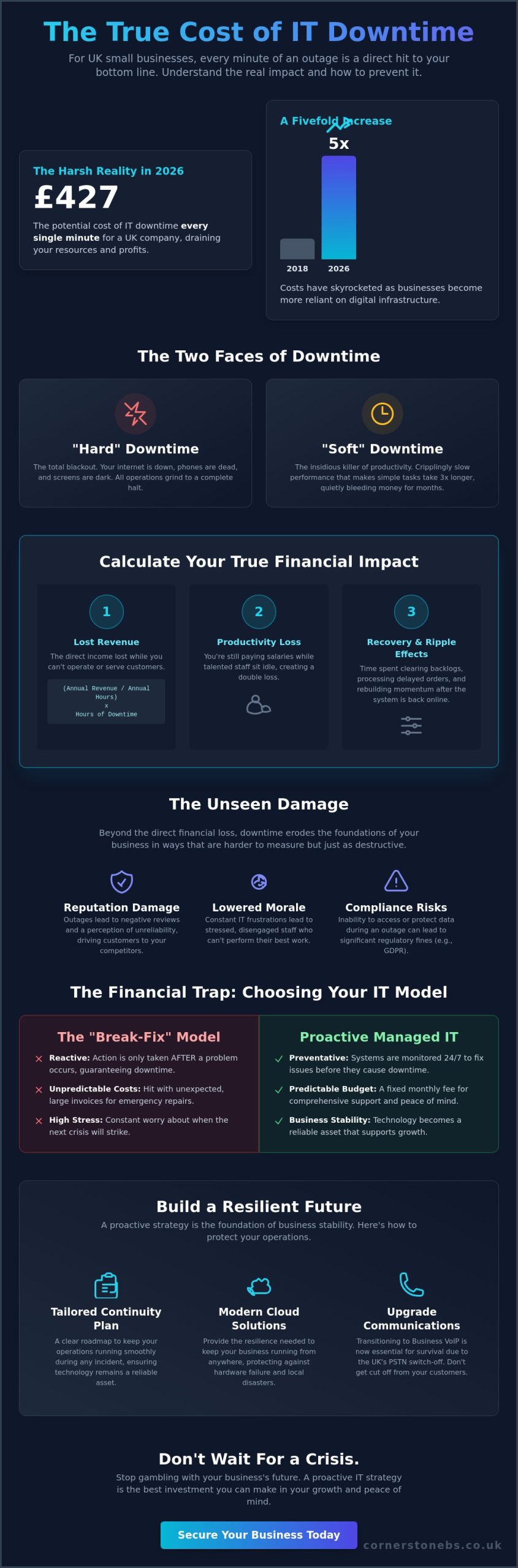
Would you willingly throw £427 into the bin every single minute? For many UK companies, that is the harsh reality of a system outage in 2026. The cost of IT downtime for small business has skyrocketed, seeing a fivefold increase since 2018 as we all become more dependent on digital infrastructure. While a “break-fix” engineer might eventually get you back online, the damage to your bank balance and your reputation often starts long before they arrive at your door.
We understand the frustration of watching talented staff sit idle while customer trust slips away. It’s a stressful position for any business owner, especially when you’re hit with an unexpected invoice for emergency repairs. This guide will show you how to calculate the true financial impact of these outages and why proactive Managed IT Support is the foundation of business stability. We’ll explore the hidden drains on your productivity and provide a clear roadmap to keep your operations running smoothly, ensuring your technology remains a reliable asset for your team. By the end, you’ll have a clear financial justification for IT investment that protects your growth and your peace of mind.
Key Takeaways
Understand the critical difference between a total “hard” blackout and the subtle “soft” downtime that quietly drains your team’s daily productivity.
Learn the precise formula to calculate the true cost of IT downtime for small business, accounting for both lost revenue and the hidden “wage drain” of idle staff.
Discover how system reliability directly impacts your brand reputation and why preventing outages is essential for maintaining positive customer reviews.
Identify why the reactive “break-fix” model is a financial trap and how a proactive approach creates a more predictable, stress-free budget.
Explore how a tailored Business Continuity Plan and modern Cloud Solutions provide the resilience needed to keep your business running from anywhere.
What is IT Downtime and Why Does It Hit Small Businesses Hardest?
Technology is the engine of your business. When that engine stalls, your entire operation grinds to a halt. To understand the cost of IT downtime for small business, we first need to define the problem clearly. What is IT Downtime? It is any period where your digital infrastructure fails to support your core business functions. It isn’t just about a server being “off”; it’s about the inability to serve your customers or keep your team productive.
We see two distinct types of outages in the local business community. “Hard downtime” is the total blackout; your internet is gone, your phones are dead, and your screens are dark. However, “soft downtime” is often more insidious. This is the cripplingly slow performance that makes simple tasks take three times longer than they should. Both versions bleed money, but soft downtime often goes unmeasured for months. While a large corporation might have a backup for every system, a small business often relies on a single point of failure.
Smaller firms feel this impact more acutely because they lack the expensive redundant systems that protect global corporations. In 2026, we find that most outages aren’t caused by natural disasters. Instead, they stem from complex cloud misconfigurations or the silent failure of legacy hardware that has been pushed past its limit. Without a dedicated partner to monitor these systems, a small glitch can quickly snowball into a multi-day crisis. According to 2024 data, 92% of UK businesses require more than 24 hours to recover from a significant IT incident, a delay that most small budgets simply cannot absorb.
Common Triggers of Outages in 2026
Modern outages are rarely random. They are typically the result of three specific vulnerabilities:
Cyber Security breaches: Ransomware and sophisticated phishing attacks remain the primary drivers of unplanned outages. One wrong click can lock your entire network.
Hardware failure: Running end-of-life equipment is a gamble. We often see businesses struggling with aging servers or routers that simply cannot handle 2026 data demands.
Human error: A lack of regular staff training is a major internal vulnerability. Accidental deletions or incorrect settings can be just as damaging as an external attack.
The 2026 Comms Crisis: Legacy Systems
The UK’s PSTN switch-off has permanently changed the landscape for business telecommunications. Companies still clinging to older analogue lines now face total communication isolation as those services are retired. Transitioning to a modern Business VoIP telephone system is no longer just an upgrade; it is a necessity for business continuity. Without it, you risk losing the ability to talk to your customers entirely. This creates a state of total isolation that makes recovery nearly impossible without a modern, cloud-based infrastructure in place.
Calculating the Direct Financial Impact: Revenue and Productivity
We’ve all seen that spinning loading icon and felt a twinge of frustration. In a busy UK office, that tiny icon represents a significant drain on your resources. For a local firm in 2026, the average cost of IT downtime for small business ranges from £137 to £427 per minute. That isn’t just a theoretical figure; it’s cash leaving your business in real-time. To find your specific risk, use the “Lost Revenue” formula: divide your gross annual revenue by your annual business hours, then multiply that by the hours of downtime. It’s a simple calculation that often yields a sobering result.
Beyond direct sales, you must account for the “Wage Drain.” You’re still paying your team’s salaries while they wait for a fix. This creates a double loss: you’re paying for labour that isn’t producing anything. This financial bleed continues even after the “on” switch is flipped. We call this “Recovery Time.” It takes significant effort to clear the backlog of emails, process delayed orders, and regain momentum. This “Butterfly Effect” can even lead to missed deadlines that haunt your contract renewals months later. Understanding The True Cost Of Downtime involves looking at these ripples, not just the initial splash.
The Productivity Drain
Direct Recovery Expenses
If you rely on the reactive “break-fix” model, expect a sting in the tail. Emergency call-out fees are notoriously high, and if your backups fail, specialized data recovery services can cost thousands. Your Recovery Time Objective (RTO) is the maximum acceptable length of time that your business can be offline before the damage becomes irreversible. Investing in robust Disaster Recovery solutions ensures that your RTO remains measured in minutes, not days, protecting your bottom line from unexpected shocks.
The Hidden Costs: Reputation, Morale, and Compliance
The visible invoice for a technical repair is only the tip of the iceberg. When we look at the true cost of IT downtime for small business, the most painful losses are often the ones that don’t appear on a balance sheet immediately. We’re talking about your reputation. In our local community, word travels fast. In 2026, we live in the “Social Proof” era where a single hour of system failure can lead to a permanent 1-star Google review. Potential clients won’t hear your explanation about a server glitch; they’ll simply see a “business that doesn’t answer” and move to your competitor.
Then there is the human element. Your team wants to do a good job, but constant technical hurdles make that impossible. We’ve seen how recurring IT issues lead to deep-seated frustration and, eventually, high staff turnover. It’s exhausting to spend your day “firefighting” instead of focusing on your actual role. For a business owner, this emotional toll is just as heavy. Instead of working on strategic growth, you’re stuck managing a crisis you didn’t ask for. This constant state of high alert leads to burnout and prevents you from being the proactive leader your company needs.
Customer Confidence and Retention
Customers in 2026 have zero patience for the “our systems are down” excuse. They expect seamless digital interaction. If you can’t provide it, the long-term value loss is staggering. A client who has been with you for years might finally decide to move to a more “digitally stable” rival after one too many outages. Conversely, you can use your system reliability as a powerful marketing tool. Showing that you’ve invested in your infrastructure tells your clients that you are a stable, professional partner they can trust for the long haul.
Compliance and Legal Penalties
We must also address the legal risks. Downtime isn’t just an inconvenience; it’s often a red flag for regulators. If an outage results in data loss or a breach of GDPR or NIS2 standards, the financial penalties can be life-changing for a small firm. Think of robust Cyber Security Services as an essential insurance policy. They protect you from the regulatory fallout that follows an unmanaged incident. Investing in your digital safety isn’t just a technical choice; it’s a foundational part of your legal and emotional security.
Why the “Break-Fix” Model is a Financial Trap for SMEs
Waiting for something to break before calling for help feels like a cost-saving measure. In reality, it is a financial trap that leaves your business vulnerable to the highest possible expenses. This reactive approach, often called the “break-fix” model, ensures that you only see your IT technician when your productivity has already hit zero. By the time they arrive, the cost of IT downtime for small business has already begun to spiral through lost sales and idle staff. It is a sticking plaster approach that ignores the underlying health of your digital infrastructure.
The fundamental flaw of break-fix is its lack of strategic planning. A reactive engineer’s goal is to get the specific broken part working again as quickly as possible. They aren’t incentivised to look at why it failed or how to prevent the next crash. This leads to a cycle of “patchwork” IT where systems are held together by temporary fixes rather than a solid foundation. This lack of foresight often results in a “budgeting nightmare” for business owners. You might go three months with no IT costs, only to be hit with a massive, unbudgeted invoice when a critical server finally gives up the ghost.
The Conflict of Interest
In a break-fix relationship, your goals and your provider’s goals are completely misaligned. The technician only makes money when your systems fail. If your network is running perfectly, they aren’t getting paid. This creates a subtle but dangerous conflict of interest. Conversely, our model for Managed IT Services in Teesside aligns our success with yours. We’re incentivised to keep you online because our fixed-fee structure means we work hardest when things are stable. We become a proactive partner invested in your long-term continuity rather than a distant contractor waiting for your next crisis.
Predictable vs. Volatile Spending
Switching to a managed model transforms your IT from an unpredictable “black hole” of expense into a predictable monthly line item. This stability is vital for healthy cash flow management. Proactive maintenance also ensures that your IT Hardware lasts longer, as we identify and resolve minor issues before they cause permanent damage. Emergency repairs are not just stressful; they are expensive. On average, an emergency call-out and a rushed fix cost three times more than a planned, proactive upgrade. You can protect your bottom line by choosing a partner who prevents fires instead of just fighting them. If you are ready to move away from the stress of reactive repairs, contact our local team today for a straightforward chat about your needs.
Building a Resilient Future: How to Eliminate Downtime
Eliminating downtime isn’t about luck; it’s about strategy. A bespoke Business Continuity Plan (BCP) is your first line of defence. This isn’t just a dusty document for corporate giants. It’s a proactive roadmap designed to keep your doors open when others are forced to close. By identifying risks early, you can significantly reduce the potential cost of IT downtime for small business. We work alongside you to build this resilience, ensuring your technology supports your growth instead of hindering it.
Proactive monitoring is the heartbeat of a stable network. We use advanced tools to watch your infrastructure around the clock, catching silent failures before they escalate into full-blown crises. This “always-on” approach means we’re often resolving issues before your staff even arrive at their desks. As a multi-award-winning partner, we take that weight off your shoulders. This allows you to focus on leading your business with total confidence in your system reliability.
Modern Cloud & Disaster Recovery
Modern Cloud Solutions have revolutionised resilience for local firms. Platforms like Microsoft 365 and Azure provide built-in redundancy that protects your data from local hardware failures. We always implement the “3-2-1” backup rule for Disaster Recovery. You should have three copies of your data, stored on two different types of media, with one copy safely off-site. This simple but powerful framework ensures your information remains secure and accessible, no matter what happens at your physical office.
Partnering for Success
Generic, off-the-shelf fixes rarely solve complex business challenges. You need technology that is as unique as your company. Our team provides bespoke solutions and a dedicated helpdesk that knows your business personally. We don’t just fix computers; we build long-term partnerships rooted in our regional community. If you’re concerned about your current system reliability, we invite you to a no-obligation conversation to audit your current risk level. Let’s talk about how we can secure your future together.
Secure Your Business Stability Today
Your company deserves more than just “getting by” with reactive repairs. We’ve explored how the true cost of IT downtime for small business reaches far beyond the technical fix, impacting your brand reputation and team morale. By shifting from the “break-fix” trap to a proactive partnership, you turn your technology into a silent engine of growth rather than a constant source of anxiety.
As a multi-award-winning IT services provider, we combine our local roots with global strength through strategic partnerships with Microsoft, IBM, and Cisco. Our proactive 24/7 system monitoring identifies potential threats before they interrupt your workday, providing the emotional security you need to focus on your goals. It’s about building a foundation that doesn’t just survive an outage but prevents it from happening in the first place.
How do you calculate the hourly cost of IT downtime?
You can calculate this by adding your lost revenue to your total wage drain. Divide your gross annual revenue by your annual business hours to find your hourly revenue risk. Add the hourly salary costs of all idle staff members during the outage to find the true hourly impact on your bottom line.
What are the most common causes of IT downtime for small businesses in the UK?
Cyber security breaches, such as ransomware, and the failure of legacy hardware are the primary triggers in 2026. Many local firms also face outages due to cloud misconfigurations or issues related to the PSTN switch-off. Human error, often caused by a lack of staff training, remains a significant internal vulnerability for smaller teams.
How can managed IT services actually reduce my business costs?
Managed support replaces unpredictable emergency repair bills with a fixed, predictable monthly fee. Proactive monitoring catches minor glitches before they escalate into expensive crises, which significantly lowers the overall cost of IT downtime for small business. This approach also extends the lifespan of your hardware through regular, expert maintenance.
Is “soft downtime” like slow internet as expensive as a total outage?
Soft downtime is often more expensive over the long term because it acts as a silent drain on productivity. While a total blackout is obvious, slow systems cause daily “micro-downtime” that disrupts concentration and employee morale. These small delays can add up to dozens of lost hours per employee every single year.
Does cyber insurance cover the cost of lost productivity during downtime?
Cyber insurance policies vary, so you must check for specific “business interruption” clauses in your agreement. While many policies cover data recovery and legal fees, they don’t always compensate for the daily productivity lost while systems are offline. It is better to use proactive security as your primary defence and insurance as a final safety net.
How often should a small business test its disaster recovery plan?
We recommend testing your plan at least once a year or whenever you implement major system changes. Regular testing confirms that your backups are healthy and that your team knows their specific roles during an emergency. This practice ensures that a real incident feels like a practiced drill rather than a chaotic crisis.
What is the difference between RTO and RPO in business continuity?
RTO stands for Recovery Time Objective, which is the target time for getting your systems back online. RPO, or Recovery Point Objective, refers to the maximum amount of data you can afford to lose, measured in time. For instance, if you back up your data every four hours, your RPO is four hours.
Can cloud migration help eliminate IT downtime?
Cloud migration significantly reduces downtime by removing reliance on a single piece of local hardware. Platforms like Microsoft 365 allow your team to remain productive from any location if your physical office faces an issue. This built-in redundancy provides a level of resilience that was previously only available to large corporations.
What if your technology stopped being a source of stress and started being your biggest competitive advantage? For many local firms, IT often feels like a series of expensive fires to put out, especially with 50% of mid-sized UK businesses facing a cyber breach in the last year. It’s time to change that perspective. Strategic IT infrastructure planning for small business is the difference between a system that hinders your staff and one that drives your growth. As a dedicated local partner, we’ve seen how the right foundation turns IT from a reactive cost into a proactive engine for success.
We know the frustration of unpredictable monthly spend and the nagging fear that a single security flaw could halt your operations. You deserve a stable, “always-on” environment where your data is secure and your costs are predictable. This guide provides a clear roadmap to achieving exactly that. We’ll walk you through the 2026 UK regulatory landscape, including the Cyber Security and Resilience Bill, and show you how to navigate upcoming Microsoft 365 price changes. By the end, you’ll have the confidence to build a resilient, scalable foundation that protects your business and empowers your team to work without limits.
Learn why shifting from reactive “break-fix” support to a proactive strategic partnership is essential for your organization’s resilience.
Discover the core pillars of IT infrastructure planning for small business, including cloud solutions and the final UK PSTN switch-off.
Identify the “silent tax” of slow systems. We’ll show you how proactive planning eliminates the high costs of unplanned downtime.
Follow our five-step framework to audit your current digital landscape and resolve single points of failure.
See how Cornerstone Business Solutions’ multi-award-winning approach provides the approachable, expert warmth your local business deserves.
What is IT Infrastructure Planning for Small Businesses?
Think of your technology as the digital backbone of everything you do. From the moment you open your email to the final backup of the day, your systems are working hard to keep your business moving. To understand the basics, we often look at What is IT Infrastructure as a combination of hardware, software, and network resources. For a local firm, this isn’t just “tech stuff.” It’s the very foundation of your service. Effective IT infrastructure planning for small business transforms these components from a messy collection of tools into a streamlined growth engine.
The Difference Between IT Support and IT Strategy
IT support is about the “now.” It’s the helpdesk fixing a printer or resetting a password. While essential, support alone won’t grow your business or drive digital transformation. IT strategy is about the “next.” It looks at where you want to be in twelve months and builds the path to get there. We use proactive system monitoring to stop issues before they even reach your desk. This keeps your staff productive and your operations smooth, ensuring your technology supports your goals rather than standing in the way.
Why Small Businesses Cannot Afford “Accidental” IT
Building a Resilient 2026 Technology Roadmap
A resilient roadmap isn’t just a list of hardware you want to buy. It’s a strategic shield that protects your operations from the unexpected. For 2026, effective IT infrastructure planning for small business rests on four critical pillars: Security, Cloud, Connectivity, and Continuity. When these elements work in harmony, your technology moves from being a source of friction to a driver of efficiency. You stop worrying about what might go wrong and start focusing on how much further your team can go.
One of the most urgent shifts for UK firms right now is the final move away from legacy systems. The UK’s old copper network is being phased out, making the transition to resilient VoIP telephone systems a necessity rather than a choice. Future-proofing your communications ensures you aren’t left behind when the final PSTN switch-off deadlines hit. By planning this transition now, you avoid the rush and ensure your business mobile and office lines remain crystal clear and fully integrated.
Surprise capital expenditure is the enemy of a healthy cash flow. We recommend aligning your hardware refresh cycles with your long-term financial planning. This prevents that sudden £2,000 bill when an old server finally gives up. Instead, you can spread costs and ensure your staff always have reliable, high-performance tools. In 2026, this also means adopting a “Zero Trust” security posture. With the Cyber Security and Resilience Bill now in force, even the smallest firms must verify every user and device. It’s about building a fortress around your data that remains invisible to your productive staff.
Cloud-First Strategy: Microsoft 365 and Azure
Your productivity hub should live where your people do: everywhere. Implementing a Microsoft 365 migration for business UK allows your team to collaborate securely from any location. By moving workloads to Azure, you eliminate the need for a noisy, expensive server room. We ensure your cloud environment is configured for maximum security and cost-efficiency, so you only pay for what you actually use. If you’re ready to modernize, we can help you start an expert IT roadmap session to plot your course.
Connectivity and Hybrid Work Infrastructure
Hybrid work is no longer a perk; it’s the standard. Your network must support seamless collaboration between the office and the home. This requires business-grade broadband that doesn’t buckle under the pressure of constant video calls. By integrating robust cloud solutions, you guarantee that your data is accessible and secure, no matter where your team logs in. This connectivity is the glue that keeps your modern business together.
The ROI of Strategic IT: Calculating the Cost of Doing Nothing
Ignoring your technology is a choice, but it’s an expensive one. Many owners view IT as a pure overhead; a necessary evil that drains the bank account every month. This perspective misses the “silent tax” that slow systems levy on your business every single day. When a staff member waits for a spinning wheel on their screen, or a slow network delays a customer quote, your profitability takes a hit. IT infrastructure planning for small business is about identifying these leaks and plugging them before they drain your margins.
Quantifying Downtime and Productivity Gaps
Downtime is easier to calculate than you might think. To find your true hourly cost of a system outage, use this simple formula: (Number of Employees x Average Hourly Rate) + Lost Revenue per Hour. For a firm with 15 staff, a single morning of downtime can easily cost over £2,000 in wasted wages and missed opportunities. By partnering with experts for managed IT services, you gain a measurable return on investment through increased uptime. Remember, “cheap” IT often ends up being the most expensive option over a three-year cycle when you factor in emergency repairs and lost productivity.
Security as a Foundation for Business Continuity
Peace of mind is perhaps the most valuable ROI of all. Knowing that your systems have 24/7 proactive threat monitoring allows you to sleep better at night. Our cyber security services act as the ultimate insurance for your hard-earned reputation. Beyond protection, a strong security posture is now a commercial requirement. With the Cyber Security and Resilience Bill tightening standards, having a certified, secure infrastructure helps you win larger contracts and pass rigorous supply chain audits with ease. Proactive IT infrastructure planning for small business ensures you’re always ready for the next big opportunity.
5 Steps to Building Your IT Infrastructure Plan
Creating a plan doesn’t have to be overwhelming. It’s about taking logical steps that lead to a massive improvement in your daily operations. Effective IT infrastructure planning for small business provides a clear map for your growth, ensuring you never feel stuck with outdated tools or vulnerable systems. By following a structured process, you move from “making do” to “moving forward” with total confidence.
Step 1: Conduct a comprehensive audit. You can’t plan for the future without knowing exactly where you stand today. This involves more than just counting laptops; it’s about understanding how data flows through your business.
Step 2: Identify business-critical risks. Locate your single points of failure. This could be an aging server, a single internet connection, or a lack of off-site backups. Identifying these gaps now prevents a crisis later.
Step 3: Define your technology goals. Where do you want to be in 12, 24, and 36 months? Your infrastructure should scale alongside your ambitions, whether you’re adding five new staff or opening a second location.
Step 4: Establish a sustainable budget. Shift your focus from “how much does this cost today” to “what is the total cost of ownership.” A sustainable budget avoids surprise bills and ensures your tech remains a reliable asset.
Step 5: Select a partner who specialises in SME growth. You need more than a vendor; you need a dedicated partner who understands the local landscape and treats your success as their own.
The Audit: Looking Beyond the Servers
A true audit starts with your people. We look for staff pain points where technology is currently slowing them down. This might be a slow login process or a clunky remote access system that frustrates your hybrid workers. We also review your software licensing. Many firms overpay for unused seats or “zombie” subscriptions that drain the budget. Finally, we check your compliance against UK standards like Cyber Essentials. This government-backed scheme is a vital baseline for any firm looking to prove their security credentials to clients and insurers alike.
Aligning Tech Spend with Your Growth Ambitions
Successful planning moves you away from unpredictable capital expenditure and toward a fixed-fee it company solutions model. This makes your monthly outgoings predictable and manageable. We help you prioritise investments based on business impact rather than technical novelty. It’s not about having the newest gadget; it’s about having the right tool for the job. Regular strategy reviews are essential to keep your plan on track. As your business evolves, your technology should evolve with it. If you’re ready to build a foundation that lasts, speak with our local team to begin your journey.
Why Cornerstone is the Trusted IT Strategy Partner for UK SMEs
Choosing a partner for your technology is one of the most important decisions you’ll make for your firm’s future. At Cornerstone, we’ve built our reputation on a multi-award-winning approach to proactive technology management. We don’t just offer support; we provide a dedicated long-term partnership. Our team blends professional authority with an approachable, regional warmth that makes us feel like a part of your own office. We believe that IT infrastructure planning for small business should be a collaborative journey, not a series of one-off transactions.
We focus on the long game. While other providers might focus on quick fixes, we look at how your infrastructure will support your growth over the next three to five years. This proactive attitude ensures your systems remain resilient against emerging threats and ready for new opportunities. We frame every technical solution within the context of your business continuity and emotional security, providing a foundation you can truly rely on.
Your Virtual CTO: Expert Advice Without the Executive Salary
Imagine having the insight of a seasoned Chief Technology Officer without the burden of an executive salary. We act as an extension of your own team, driving your technology forward with clear, benefit-driven advice. We speak the language of business, not just “tech-speak,” so you’ll always understand the “why” behind our recommendations. Through regular strategic reviews, we ensure your IT infrastructure planning for small business always matches your current ambition. We keep your systems aligned with your goals, helping you scale efficiently while avoiding expensive technical debt.
Start Your 2026 Strategy Conversation Today
The best time to plan your infrastructure is before you think you need to. Waiting for a system failure or a security breach to act is a risk your business doesn’t need to take. We invite you to an informal chat about your business goals and the challenges you’re currently facing. Whether you’re worried about the upcoming Cyber Security and Resilience Bill or need to modernize your hybrid work setup, we’re here to help. Our team is ready to listen and provide a reassuring, expert perspective on your digital future.
Your technology should be a source of confidence, not a constant worry. By shifting from reactive fixes to proactive IT infrastructure planning for small business, you ensure your organization is ready for the challenges of 2026. You’ve seen how a resilient roadmap protects your staff from downtime and how a clear audit can reveal hidden costs. This isn’t just about hardware. It’s about building a stable foundation that allows your local firm to compete with the giants.
As a multi-award-winning IT service provider, we specialize in bespoke UK SME technology solutions. Our strong partnerships with global leaders like Microsoft, IBM, and Cisco mean we bring world-class reliability right to your doorstep. We’re more than just a vendor; we’re your dedicated long-term partner. We take the stress out of compliance and security so you can focus on what you do best.
What exactly is included in an IT infrastructure plan for a small business?
A comprehensive plan acts as your digital blueprint. It includes a detailed inventory of your hardware, a review of your software licensing, and a clear map of your network infrastructure. We also build in robust security protocols and disaster recovery steps. This ensures every part of your technology, from your business VoIP to your cloud storage, works together to support your daily operations and long-term goals.
How much does IT infrastructure planning typically cost for a UK SME?
We only have 15 employees; are we too small for a formal IT strategy?
How often should a small business review its technology roadmap?
We recommend a formal review at least once every quarter. Technology moves fast, and your business goals can shift just as quickly. Regular check-ins ensure your IT infrastructure planning for small business remains aligned with your ambitions. These reviews also help you stay ahead of new UK regulations, such as the Cyber Security and Resilience Bill, ensuring your organization remains compliant and secure as the landscape evolves.
What is the difference between an IT audit and an IT strategy plan?
An audit is a snapshot of your technology as it exists today. It identifies aging hardware, security vulnerabilities, and software that needs updating. An IT strategy plan is the map that shows you where you’re going. While the audit finds the problems, the strategy provides the long-term solutions and the timeline to implement them. You need the audit to understand your starting point, but you need the strategy to reach your destination.
Can a better IT infrastructure plan help reduce our monthly technology bills?
How long does it take to develop and implement a full technology roadmap?
Creating the initial roadmap usually takes between two and four weeks. This allows us to conduct a thorough audit and understand your specific business challenges. Implementation is typically a phased process to avoid disrupting your staff. You might see security improvements within days, while larger projects, like migrating to a new server-less cloud environment, are carefully managed over several months to ensure a smooth and seamless transition.
What are the first signs that my business needs a formal IT infrastructure plan?
The most common red flag is a feeling of being “reactive” rather than “proactive.” If you’re constantly dealing with system slowdowns, unpredictable IT spend, or staff frustration, your current setup is likely struggling. Another sign is “accidental” growth, where you’ve added tools over time that don’t talk to each other. Moving to formal IT infrastructure planning for small business will replace this technical friction with a reliable, “always-on” environment.
Your technology should be a growth engine, not a ball and chain that drags down your momentum. It’s frustrating when disconnected systems don’t talk to each other or when tech debt slows your team to a crawl just as you’re ready to scale. You’ve likely felt the sting of unpredictable IT costs or the nagging worry that a cyber attack could derail your progress. Developing a clear IT strategy roadmap for growing businesses is the only way to stop reacting to fires and start building for the future.
We understand that as a local business leader, you need clarity, not technical jargon. This guide shows you how to build a 12 to 36 month plan that ensures your technology investments actually align with your commercial goals. We’ll explore how to achieve seamless scalability and predictable spending while protecting your reputation with modern security standards like the NIST Cybersecurity Framework 2.0. By the end, you’ll have a blueprint for a secure, future-proof infrastructure that gives you total peace of mind.
Key Takeaways
Align your technology investments with specific business milestones to avoid the expensive growth trap of accumulated tech debt.
Discover how to build a scalable IT strategy roadmap for growing businesses that uses cloud solutions to create a resilient, flexible foundation.
Protect your reputation as you expand by moving from basic antivirus to a modern Zero Trust framework.
Compare the hidden costs of relying on a single internal IT manager against the stability of a multi-disciplinary managed IT support team.
Follow a clear, five-step process to audit your current hardware and software while mapping your tech to your three-year commercial goals.
What is an IT Strategy Roadmap and Why Does Your Growth Depend on It?
Scaling a business is exciting, but it often reveals hidden cracks in your foundation. If you’ve ever felt like your technology is holding you back rather than pushing you forward, you’re likely caught in the “Growth Trap.” This happens when companies add software or hardware as a reaction to immediate problems, creating a tangled mess of systems that don’t communicate. An IT strategy roadmap for growing businesses changes this dynamic. It’s a long-term vision that aligns every pound spent on technology with your specific business milestones.
Think of it as a Technology Roadmap that serves as a single source of truth for your leadership team. It moves your business away from the stressful “break-fix” cycle where you only call for help when something stops working. Instead, it fosters a proactive partnership where your IT infrastructure is built to support your expansion before it happens. This approach simplifies complex technical concepts so you can focus on your clients and your community.
The Core Objectives of a Growth-Focused Roadmap
A roadmap isn’t just about picking the right tools; it’s about achieving three critical outcomes that protect your business continuity and peace of mind:
Operational Efficiency: We remove the friction from daily workflows. This means your team spends less time fighting with slow logins and more time delivering value to your customers.
Scalability: We ensure your systems can handle 2x or 5x growth without requiring a total overhaul or causing massive downtime.
Risk Mitigation: As your reputation grows, so does your profile as a target for cyber threats. A solid roadmap builds security into the foundation of your expansion.
IT Strategy vs. IT Planning: Understanding the Difference
Many leaders confuse these two terms. An IT plan is a list of tasks, like a hardware replacement cycle or a software update schedule. It tells you what you’re doing. An IT strategy explains why you’re doing it. It focuses on business transformation rather than just keeping the lights on. An IT strategy roadmap is the bridge between your current technical capability and your future business ambition. It ensures that when you invest in Managed IT Support or Cloud Solutions, you’re doing so because it directly supports your 2026 growth blueprint.
The 4 Pillars of a Scalable IT Infrastructure in 2026
Building a scalable foundation requires more than just buying new laptops. It’s about four specific pillars that form your 2026 growth blueprint. When you follow a proven strategic plan template, you ensure that every technical decision supports your long-term commercial objectives. For many local firms, an IT strategy roadmap for growing businesses begins with shifting away from physical limitations and toward digital flexibility.
Modern infrastructure relies on cloud solutions that grow with you. This isn’t just about storage; it’s about creating a resilient foundation that allows your team to work from anywhere without losing performance. We also focus on unified communication. By integrating Business VoIP and Business Mobile, your hybrid workforce stays connected whether they’re in the office or on the road. Finally, data management becomes your secret weapon. A successful Microsoft 365 migration for business UK ensures your team can collaborate efficiently while keeping your sensitive information organized and accessible.
Cloud-First but Not Cloud-Only Environments
Security as a Growth Enabler, Not a Barrier
Many business owners view security as a series of “no’s” that slow them down. We see it differently. Robust cyber security services act as an insurance policy for your brand’s reputation. By moving to a Zero Trust framework, you protect your growing firm from increasingly sophisticated threats. Implementing multi-factor authentication (MFA) and high-level encryption should be your standard, not an afterthought. This proactive stance prepares you for compliance as you move into larger contracts and more regulated industries. If you’re unsure where your current security stands, you can always reach out to our local experts for a friendly chat about your options.
Your IT strategy roadmap for growing businesses should simplify these complex pillars into actionable steps. By focusing on infrastructure, security, communication, and data, you transform your IT from a cost center into a competitive advantage. This clarity allows you to lead with confidence, knowing your tech is ready for whatever 2026 brings.
The Strategic Dilemma: Internal Management vs. Managed IT Support
Many local firms reach a critical crossroads as they scale. You might have a dedicated IT person who has been with you since the start, often referred to as the “lone wolf.” While their loyalty is invaluable, this model often becomes a bottleneck for an IT strategy roadmap for growing businesses. The hidden costs of relying on one person include limited availability during holidays and a lack of specialized knowledge in rapidly changing fields. When your business expands, you need a depth of expertise that a single individual simply cannot provide alone.
The “Expertise Gap” is a very real challenge in 2026. One person cannot realistically be a master of cyber security, cloud architecture, and unified communications all at once. By transitioning to managed IT services, you gain access to a multi-disciplinary team of experts who live and breathe these technologies. This move replaces the “sticker shock” of emergency project work with predictable monthly fees. When you refine your IT strategic plan, you’ll find that having a team of specialists at your fingertips provides a level of stability that an internal manager can’t match.
When to Pivot to Managed IT Support
You’ll know it’s time to make a change when your internal team is drowning in a backlog of basic support tickets. If they’re too busy resetting passwords to discuss your three-year growth goals, your strategic progress has stalled. A Managed Service Provider (MSP) offers proactive maintenance and monitoring that catches issues before they cause downtime. We act as your virtual CIO, providing the high-level guidance you need to ensure your national operations remain seamless and secure.
Maximizing ROI Through Strategic Partnerships
Success comes from treating your IT provider as a long-term partner rather than just another utility vendor. This collaborative approach allows you to leverage our established relationships with global brands like Microsoft, Cisco, and IBM. We help you navigate complex licensing and hardware procurement so you always get the best value for your investment. Implementing comprehensive it company solutions reduces your total cost of ownership by streamlining your infrastructure and preventing expensive, reactive repairs. This partnership ensures your technology remains a foundational element of your business stability and emotional security as you reach for new milestones.
5 Steps to Building Your IT Strategy Roadmap
Step 1: The IT Audit. You can’t plan your journey without knowing your starting point. We begin by assessing your current hardware, software, and security posture. This identifies hidden risks and immediate needs. Step 2: Business Alignment. This is where we look at your commercial goals. If you plan to double your headcount or expand into new regions, your tech must be ready to scale with you. Step 3: Gap Analysis. We determine exactly what is missing between your current capability and your future ambition. Step 4: Prioritisation and Budgeting. We create a phased roll-out that respects your cash flow. You don’t need to do everything at once. Step 5: Execution and Review. We set quarterly milestones to keep the roadmap on track. It’s a living document that adapts as your business evolves.
Conducting a Meaningful IT Audit
A proper audit goes deeper than just counting laptops. We review legacy hardware to identify “end-of-life” risks that could cause sudden downtime. We also audit your software licenses to eliminate waste and close security loopholes. Finally, we assess your network infrastructure for capacity and speed bottlenecks. This ensures your foundation is strong enough to support modern tools like Business VoIP and cloud-based collaboration. If you haven’t looked under the bonnet of your IT lately, book a comprehensive IT audit with our locally based team to get started.
Phasing Your Implementation
We believe in a “crawl, walk, run” approach to technology. We start with Quick Wins. These address critical security gaps and immediate productivity killers that frustrate your team. Once the foundation is secure, we move to Medium-Term goals. This usually involves cloud migrations and communication upgrades that improve flexibility. Long-Term objectives focus on advanced data analytics and AI-driven automation. This phased approach ensures your IT strategy roadmap for growing businesses remains affordable and effective, providing the emotional security that comes from knowing your systems are built to last.
Future-Proofing Your Growth with Cornerstone Business Solutions
Building an IT strategy roadmap for growing businesses requires more than just technical knowledge; it demands a partner who understands the unique challenges of the UK business landscape. At Cornerstone Business Solutions, our multi-award-winning approach is designed specifically for firms that are ready to scale without the friction of technical debt. We don’t believe in one-size-fits-all packages. Instead, we provide bespoke technology solutions that align perfectly with your commercial milestones and regional roots.
The “Cornerstone Difference” lies in our proactive attitude. We don’t wait for systems to fail before we step in. Our team utilizes advanced monitoring to identify and resolve potential issues before they impact your team’s productivity. This proactive stance bridges the gap between complex digital infrastructure and your business objectives. We translate technical requirements into clear business benefits, ensuring you always understand the value behind every technology investment.
A Partnership Built on Trust and Accolades
We’ve built our reputation on a foundation of trust and consistent industry recognition. Our established partnerships with global tech leaders like Microsoft and Cisco mean we bring enterprise-level expertise directly to your doorstep. While we’re proud of our geographical origins, our national reach ensures your business is supported wherever your expansion takes you. You gain the peace of mind that comes from a dedicated, expert helpdesk that treats your business stability as a top priority.
Get Started on Your 2026 Roadmap Today
Don’t let technical frustration hold your ambition back. Moving from a reactive “firefighting” mode to strategic clarity is simpler than you might think. We’re here to help you navigate the complexities of Cyber Security, Cloud Solutions, and Network Infrastructure so you can lead with confidence. We invite you to an informal, no-obligation conversation about your business goals and how technology can help you reach them faster.
Your journey toward a more stable, secure, and scalable future starts with a single step. Whether you need to overhaul your communication with Business VoIP or protect your data through Disaster Recovery, we have the specialized expertise to lead the way. Contact our expert team to begin your strategic IT journey today and discover how we can help you build a resilient foundation for the years ahead.
Build Your Foundation for a Scalable Future
Your business deserves a technical foundation that supports your ambition rather than slowing it down. By shifting from reactive fixes to a proactive IT strategy roadmap for growing businesses, you ensure your infrastructure is ready to handle whatever the market brings in 2026. We’ve explored how aligning your technology with commercial milestones eliminates expensive tech debt. This approach provides the emotional security your leadership team needs to scale with confidence and clarity.
As a multi-award-winning IT services provider, we take pride in simplifying complex infrastructure for our local partners. Our deep relationships with global leaders like Microsoft, IBM, and Cisco allow us to bring enterprise-level strength to your unique roadmap. With our proactive 24/7 system monitoring, we catch potential issues before they impact your operations, keeping your growth on a steady, predictable path. It’s time to move beyond technical frustration and start building for the future.
Ready to transform your technology into a competitive advantage? Book a Strategic IT Consultation with our Award-Winning Team today. Let’s have a conversation about how we can support your long-term success with a plan that fits your business perfectly.
Frequently Asked Questions
How long should an IT strategy roadmap cover?
A standard IT strategy roadmap for growing businesses should cover a period of 12 to 36 months. This timeframe allows you to align technology investments with your medium-term commercial goals while remaining flexible enough to adapt to rapid market changes. A 12-month focus handles immediate security and efficiency needs; the 36-month view prepares your infrastructure for significant scaling and larger capital investments.
What is the biggest mistake businesses make when building an IT roadmap?
The most common error is viewing technology as an isolated expense rather than a growth engine. Many firms purchase software or hardware reactively to solve a single problem without considering how it fits into the wider ecosystem. This creates disconnected systems that don’t talk to each other. A successful roadmap requires you to start with your business objectives first, then select the tools that help you reach them.
How much does it cost to implement a professional IT strategy?
Can we build an IT roadmap if we already have an internal IT person?
Absolutely, and a roadmap often makes your internal IT person more effective. It provides them with a clear set of priorities and a strategic framework to follow. Many growing firms use a hybrid model where we provide high-level guidance and specialized support in areas like Cyber Security or Cloud Solutions. This partnership allows your internal staff to focus on daily operations while we handle the complex, long-term technical architecture.
How often should we review and update our IT strategy?
You should review your roadmap quarterly to ensure your projects remain on track and aligned with your current business performance. While the core strategy provides a long-term vision, the technical landscape changes quickly. An annual deep-dive update is essential to incorporate new advancements, such as AI-driven automation or updated security protocols. This regular rhythm ensures your technology remains a foundational element of your stability rather than becoming an outdated burden.
What are the most important IT priorities for a growing business in 2026?
In 2026, the top priorities are robust security, seamless scalability, and unified communication. Implementing a Zero Trust framework is no longer optional as cyber threats become more sophisticated. You also need cloud-first infrastructure that allows your team to collaborate effectively from any location. Finally, ensuring your Business VoIP and mobile systems are fully integrated supports a professional image and maintains client trust as you expand your national reach.
How does an IT roadmap help with cyber security compliance?
Is an IT roadmap necessary for a business with fewer than 50 employees?
Yes, a roadmap is arguably more critical for smaller teams where every investment must deliver maximum value. Without a plan, a business with fewer than 50 employees can easily outgrow its basic systems within months, leading to expensive and disruptive migrations. Starting with a clear strategy ensures you build your infrastructure correctly the first time. This saves money, reduces frustration, and allows your small team to compete with much larger organizations.
What if the technology meant to power your business is actually the biggest bottleneck in your day? Most local business owners we speak with are tired of unpredictable monthly invoices and helpdesks that seem to vanish when a crisis hits. You deserve better than a reactive fix for your business IT support packages; you need a strategic foundation that lets you sleep soundly. We understand that tech jargon often makes these decisions feel like a gamble, but choosing the right plan is the smartest move you can make for your team’s productivity.
We agree that your focus should be on your customers, not on whether your server will survive the afternoon. This guide will show you exactly how to evaluate and select an IT plan that secures your continuity and fuels your growth in 2026. We’ll explore the latest security standards like NIST CSF 2.0, explain why proactive management beats the old break-fix model, and give you a clear framework to find a partner that treats your business goals as their own. It is time to move past the fear of cyber attacks and start building a resilient future with a team that truly knows your name.
Key Takeaways
Understand why the reactive “break-fix” model is a liability in 2026 and how proactive management acts as an insurance policy for your digital assets.
Learn to identify the core components of modern business IT support packages, focusing on unlimited helpdesk access and multi-layered cyber security.
Evaluate the difference between user-based and device-based billing to select the most cost-effective structure for your specific team size.
Spot hidden “out-of-scope” charges before you sign, ensuring your monthly fee remains fixed and predictable.
Discover why bespoke technology plans outperform rigid pricing tiers by aligning your IT infrastructure with your actual business growth goals.
The Evolution of Business IT Support Packages: Why Break-Fix is a Risk in 2026
Ten years ago, you called an IT person when your computer wouldn’t turn on. Today, that approach is a recipe for disaster. Modern business IT support packages have evolved into a proactive insurance policy for your digital assets. We don’t just wait for things to break; we ensure they stay running. This shift is driven by the sheer complexity of modern networks and the speed at which cyber threats move. If you’re waiting for a system to fail before you fix it, you’re already losing money. You need a partner who sees the storm coming before the first raindrop hits.
The transition toward Managed services represents a fundamental change in how local businesses view their technology. It’s no longer a utility you pay for only when it fails. It’s a strategic partnership. Our award-winning support team focuses on building resilience, ensuring your infrastructure is strong enough to handle rapid growth. We identify bottlenecks in your network before your staff even notices a slowdown. This keeps productivity high and your team focused on what they do best. By investing in the right business IT support packages, you’re choosing stability over chaos.
Understanding Proactive vs. Reactive Support
Reactive IT is inherently stressful. It leads to unpredictable monthly bills and hidden financial leaks that drain your budget. When a server goes down, the cost isn’t just the repair bill; it’s the hours of lost work. We embrace an “Always-On” mentality. Through 24/7 monitoring, we spot a failing hard drive or a suspicious login attempt at 3:00 AM. By the time your team starts work at 9:00 AM, the issue is often already resolved. This moves IT from a cost centre that eats your profits to a growth enabler that supports your scaling.
The True Cost of Downtime
The Anatomy of a Modern IT Support Package: What’s Actually Inside?
One often overlooked element is the synergy between communication and infrastructure. While some providers treat your phone system and your internet as separate entities, a truly modern support plan merges them. We integrate Business VoIP and mobile solutions into your core IT strategy. This means your team stays connected whether they are in the office or on the road. When your business IT support packages cover the full spectrum of your digital needs, you eliminate the finger-pointing that often happens between different vendors. If you are curious about how this fits your specific setup, you can always explore our approach to regional support.
The Core Pillar: Unlimited Managed IT Support
True ‘unlimited’ support means exactly that. There are no hidden overages or surprise invoices at the end of the month. This predictable cost model allows you to budget with confidence while knowing your infrastructure is in expert hands. We leverage partnerships with global leaders like Microsoft, IBM, and Cisco to bring enterprise-grade stability to local firms. Robust managed IT services act as the bedrock for your entire operation, ensuring that your hardware and network infrastructure remain fast and reliable. When you remove the ‘per-ticket’ cost barrier, your staff feels empowered to report small issues before they grow into expensive problems.
Security and Disaster Recovery
In 2026, security isn’t an optional add-on. It’s the most critical part of the package. Comprehensive cyber security services must be baked into every level of your support. This goes far beyond basic antivirus. We include multi-layered protection, automated backups, and regular security audits as standard features. Following best practices, like those found in the FTC cybersecurity guide, ensures your business stays resilient against evolving threats. If the worst happens, our disaster recovery protocols ensure you’re back on your feet in minutes. We provide the emotional and operational security you need to scale with confidence.
How to Evaluate and Compare IT Support Plans for Your Organisation
Choosing between different business IT support packages shouldn’t feel like a guessing game. You need a clear framework to compare apples with apples. Start by looking at how you’re billed. Most providers offer “per-user” or “per-device” pricing. If your team uses multiple gadgets, like a laptop, tablet, and smartphone, a per-user model is often more cost-effective. Conversely, if you have shared workstations in a warehouse or retail setting, per-device billing might save you money. We help you map out these requirements so your plan fits your actual workflow, not a generic template.
Scalability is another non-negotiable factor. Your technology should never be a ceiling on your growth. Ask yourself if the provider can easily add new staff members or support a second location without a complete contract overhaul. A local partner who understands the regional market will be more agile in helping you expand. You also need to strike the right balance between on-site and remote support. While 90% of issues are now fixed remotely, having an expert who can be at your office quickly when hardware fails provides invaluable peace of mind. High-quality business IT support packages must provide this safety net.
The SLA Trap: Response vs. Resolution
Many contracts boast a “one-hour response time,” but you should be careful. A response often just means an automated email or a quick “we’ve received your ticket” from a dispatcher. What actually matters to your bottom line is the resolution time. You need a partner committed to getting you back up and running, not just acknowledging the problem. Check the fine print on emergency on-site visits to ensure they aren’t hidden behind extra fees. We provide a dedicated account manager who learns your specific business goals. This human connection ensures that when you call, you’re talking to someone who already knows your infrastructure inside out.
Infrastructure and Hardware Integration
Your choice of support should align with your physical tech. Effective IT company solutions should include hardware procurement and lifecycle management. It’s frustrating to buy a top-tier support plan only to find your existing network infrastructure can’t handle the load. We assess your cabling, routers, and servers to ensure they’re up to the task. There’s also a massive efficiency gain in using a single provider for your IT, mobile, and telecommunications. It simplifies your billing, reduces vendor finger-pointing, and ensures every piece of your tech stack works in perfect harmony.
Beyond the Price Tag: Identifying Hidden Costs and Value-Adds
Don’t let a low monthly headline price fool you. When comparing business IT support packages, the real value lies in what happens when you need something outside of the daily grind. Many providers lure you in with a cheap rate, only to hit you with ‘out-of-scope’ fees the moment you want to set up a new workstation or move an office. We believe in total transparency. A truly collaborative partner identifies these potential traps early, ensuring your budget remains predictable even as your needs change. It’s about looking beyond the initial invoice to see the long-term impact on your bottom line.
A thorough onboarding process is another area where quality shines. While some might see an initial audit fee as a hurdle, it is actually a vital investment. This deep dive into your infrastructure allows us to find the ‘ghosts in the machine’ that cause recurring issues. We also take the burden of vendor management off your shoulders. Instead of you spending hours on the phone with an internet provider or a software company, we handle those conversations for you. This frees your time to focus on regional growth while we manage the technical heavy lifting. If you want to see how a transparent plan can work for your team, view our full range of support options.
Strategic IT Consulting
Your support plan should include regular ‘vCIO’ (Virtual CIO) sessions to ensure your tech stays aligned with your business goals. These meetings help you plan for major milestones, such as Microsoft 365 migrations, without the stress of an emergency spend. By mapping out a clear technology roadmap, you avoid ‘technical debt’—the costly habit of patching up old systems rather than investing in modern solutions. We act as your long-term partner, helping you choose the right tools today so you don’t have to replace them tomorrow.
Training and Empowerment
Modern business IT support packages should focus on people as much as hardware. We provide cyber security awareness training that significantly reduces the number of support tickets caused by accidental clicks. When your staff understands how to use cloud solutions effectively, they become more productive and less frustrated. An educated workforce that understands digital risks becomes your business’s strongest and most cost-effective firewall. We take pride in simplifying complex concepts so your team feels confident and empowered every time they log in.
Choosing a partner is an act of trust. That trust is why we lead with our multi-award-winning service and third-party validation as a prefix to everything we do. It isn’t just about technical skill; it is about the confidence that comes from working with a regional expert who has a proven track record of excellence. When you move away from a transactional relationship to a partnership model, the first 90 days are transformative. We spend this time stabilising your environment, eliminating recurring “niggles,” and setting a clear baseline for your future tech strategy. You aren’t just buying a service; you’re gaining a dedicated team that cares about your success.
The Power of Bespoke Design
Your Next Steps to Tech Stability
The path to a more reliable future starts with a simple, informal conversation. We don’t believe in high-pressure sales; we believe in solving problems. Our process begins with a comprehensive audit to uncover the gaps in your existing support and identify where your current tech might be holding you back. This isn’t just a technical check; it’s a strategic review of how your systems impact your staff’s daily lives.
Initiate a Conversation: Tell us about the bottlenecks that frustrate your team.
The Audit Process: We conduct a deep dive into your infrastructure to find hidden risks.
Collaborative Roadmap: We build a plan that aligns your IT with your business goals for 2026.
Moving away from transactional IT means you no longer have to worry about the “what ifs.” You can focus on your regional community and your customers while we ensure your digital world remains secure, fast, and always on.
Take Control of Your Digital Future Today
Choosing between different business IT support packages is about more than just comparing prices; it’s about finding a dedicated partner who understands your regional roots and your global ambitions. You’ve seen how the move from reactive “break-fix” repairs to proactive management creates a foundation for genuine stability. By prioritising bespoke solutions over rigid tiers, you ensure every part of your tech stack, from Microsoft 365 to your network infrastructure, works for your bottom line. Transparency in your contract and a focus on resolution times will protect you from hidden costs and unnecessary downtime.
As a multi-award-winning IT services provider, we take pride in our strong partnerships with industry leaders like Microsoft, IBM, and Cisco. We don’t believe in one-size-fits-all. We believe in building resilient, custom-tailored systems that give you the emotional and operational security to focus on your growth. It’s time to stop worrying about your technology and start leveraging it as a competitive advantage. Ready for a bespoke IT solution? Let’s start a conversation today. We look forward to helping you build a stronger, more secure future for your team.
Frequently Asked Questions
What are business IT support packages?
Business IT support packages are bundled service agreements where a provider takes full responsibility for your digital environment for a fixed monthly fee. They replace the old, expensive model of paying for every individual repair. You receive a suite of services including helpdesk access, network monitoring, and security management. This approach provides the operational stability you need to focus on your core business goals.
How much do business IT support packages typically cost?
The investment for these plans varies based on your total number of users and the specific level of security your industry requires. Most providers use per-user or per-device billing models to keep your costs predictable and transparent. We don’t believe in generic pricing because every local business has unique infrastructure needs. We focus on creating a bespoke plan that delivers the best value for your specific growth strategy.
Is unlimited helpdesk support really unlimited?
Yes, in a genuine managed service model, unlimited helpdesk support means your staff can reach out for remote assistance as often as they need. There are no surprise invoices or “per-ticket” charges that discourage your team from seeking help. This open line of communication allows us to fix small glitches before they cause major downtime. It’s a collaborative way to keep your productivity high and your tech frustration low.
Do IT support packages include hardware repairs?
Can I change my IT support package as my business grows?
Flexibility is a major advantage of modern business IT support packages. You can easily scale your plan up or down as your team size changes or as you move into new premises. We design our solutions to be agile, ensuring your technology supports your expansion rather than holding you back. It’s easy to add new services like Microsoft 365 seats or Business VoIP as your needs evolve.
What is the difference between remote and on-site IT support?
Remote support allows our technicians to fix software and configuration issues instantly via a digital connection. It is the fastest way to resolve the majority of daily tech hurdles. On-site support involves a physical visit to your office for hardware repairs or network infrastructure tasks. A quality plan provides both, giving you the speed of remote fixes and the security of a local expert on your doorstep when needed.
Are cyber security services included in standard IT support plans?
Foundational security like antivirus and email filtering is often part of a standard plan, but we recommend more robust protection in 2026. High-quality business IT support packages should integrate multi-layered cyber security services to defend against evolving threats. We bake these protections into your infrastructure to ensure your data remains secure and your business stays compliant with the latest industry regulations.
How do I switch from my current IT provider to a new support package?
Switching to a new provider is a managed, stress-free process that we handle on your behalf. We perform a thorough audit of your current systems and work with your existing vendor to transfer all necessary credentials and documentation. Our goal is to ensure zero downtime during the transition. You’ll feel the difference of a proactive partnership from the very first day of your new agreement.
Nearly 60% of small UK businesses experienced a cybersecurity incident in the past year, according to Air IT Group. For many business owners in the North East, this represents a constant anxiety about data breaches and productivity-killing downtime. You likely feel the strain of unpredictable IT costs, especially when ad-hoc repairs can run up to £150 per hour. If you find yourself asking what does a managed service provider do to stop these fires before they start, you aren’t alone. It’s frustrating to feel behind on AI adoption while 56% of your competitors are already piloting tools to scale their operations.
This award-winning guide explains how an MSP transforms your technology from a reactive cost into a proactive engine for growth. We’ll show you how to secure predictable monthly spending, typically ranging from £40 to £75 per user, while gaining a dedicated local partner. You’ll discover how the April 2026 Cyber Essentials update impacts your business and why a “zero trust” security model is the new baseline for peace of mind. We’re moving beyond simple tech support to explore how strategic IT management helps your business scale safely in a hybrid world.
Key Takeaways
Shift from a reactive “break-fix” mindset to a proactive partnership that identifies and resolves technical issues before they disrupt your operations.
Discover the answer to what does a managed service provider do by exploring the five pillars of proactive service, from 24/7 monitoring to robust security.
Replace unpredictable repair bills with a fixed monthly investment that grants your business instant access to an award-winning team of specialists.
Learn how to select a strategic technology partner who prioritizes your long-term business goals and understands the unique needs of the North East community.
Defining the Managed Service Provider: More Than Just IT Support
To understand what does a managed service provider do, you have to look beyond the image of a technician fixing a broken printer. In 2026, a Managed Service Provider (MSP) acts as a strategic engine for your business, providing proactive, 24/7 management of your entire digital environment. While 78% of UK SMEs are increasing their technology investment this year, many still fall into the trap of the ‘Break-Fix’ model. This reactive approach is a hidden profit killer; waiting for a system to fail before calling for help leads to unpredictable bills and frustrated staff. Instead of paying £150 per hour for emergency repairs, businesses are shifting toward subscription-based resilience that keeps the wheels turning without interruption.
A Managed Service Provider is a dedicated extension of your own team that proactively manages your infrastructure, security, and long-term technology strategy to ensure seamless business continuity.
Managed Services vs. Traditional IT Outsourcing
Traditional outsourcing is often transactional, focusing on specific projects or one-off tasks like migrating an email server. The managed model is fundamentally different because it creates shared risk and accountability. In a traditional setup, the provider makes more money when things break. With our award-winning managed services, our goals align perfectly with yours. We succeed when your systems stay online, creating a partnership where uptime is the only metric that matters. This subscription model ensures you aren’t just buying hours; you’re buying a guaranteed outcome.
The Core Philosophy: Proactive vs. Reactive
The most valuable work an MSP performs is often invisible to your staff. While your team focuses on their daily goals, we’re working behind the scenes to prevent the ‘Blue Screen of Death’ before a user even logs on. In 2026, we use AI-driven monitoring to identify hardware failure patterns and software conflicts early. If a hard drive in your North East office shows signs of degradation, we’ve already scheduled the replacement before the data is at risk. This proactive stance replaces the stress of sudden downtime with the quiet confidence of a robust, monitored network. We don’t just wait for the fire; we ensure the building is fireproof from the start.
What Does an MSP Do Day-to-Day? The Five Pillars of Service
If you’ve ever wondered what does a managed service provider do during a typical Tuesday afternoon, the answer lies in a complex layer of background operations that most staff never see. We act as your digital security guard, constantly scanning for vulnerabilities while your team focuses on meeting their own targets. This comprehensive approach is built on The Five Pillars of Service that ensure your business remains resilient, scalable, and secure. Understanding what does a managed service provider do on a day-to-day basis helps you see the value beyond simple troubleshooting; it’s about total environment health.
24/7 Monitoring: Real-time oversight of servers and cloud environments to stop issues before they become outages.
Cyber Security: Deploying robust cyber security services to defend against AI-crafted phishing attempts.
Cloud Infrastructure: Tailoring cloud solutions for the 91% of UK businesses now committed to permanent hybrid work.
Strategic Roadmapping: Building a 12 to 36-month technology budget so there are no nasty financial surprises.
Helpdesk Support: Giving your staff unlimited access to our award-winning experts whenever a technical hurdle appears.
Cyber Security and Data Protection
Modern protection goes far beyond basic antivirus software. We implement Managed Detection and Response (MDR) alongside a Zero Trust framework, which is essential given that nearly 60% of small UK businesses faced a cyber incident last year. With the April 2026 Cyber Essentials update introducing stricter MFA requirements, our role is to ensure you remain compliant and insured. We also conduct regular phishing simulations to keep your team sharp against the latest threats. This proactive layer provides the peace of mind you need to grow without fear of a data breach.
Cloud Management and Modern Workplace
As UK SMEs project to spend £12.4 billion on cloud services this year, expert management is vital for ROI. We focus on Microsoft 365 migration for business UK, ensuring your data moves seamlessly and stays secure in a hybrid environment. By managing Azure or private cloud setups, we target 99.9% uptime for your critical applications. This allows your team to work from anywhere, whether they are based in the North East or across the globe, with the same level of speed and reliability. If your current setup feels disjointed, it might be time for a friendly chat about a more integrated approach.
The Business Logic: Why UK SMEs Are Moving to Managed IT
Many business owners in the North East find themselves trapped in a cycle of “lumpy” IT spending. One month the budget looks healthy; the next, a server failure or a security breach results in a bill for thousands of pounds. When you ask what does a managed service provider do to solve this, the answer is financial stability. By moving from volatile capital expenditure to a fixed monthly operational cost, you gain total control over your cash flow. Instead of paying reactive rates of up to £150 per hour when things go wrong, you invest a predictable £40 to £75 per user for total peace of mind.
This shift isn’t just about the numbers; it’s about scalability. As your business grows, your technology must keep pace. Whether you are adding five new staff members or fifty, an award-winning MSP handles the licensing, hardware, and security onboarding seamlessly. You no longer have to worry about the technical debt that often accumulates during rapid growth. We ensure your foundation is robust enough to support your ambitions without the typical growing pains.
Predictable Budgeting and ROI
Eliminating the shock of emergency repair invoices is the first step toward a healthier balance sheet. Our it company solutions provide a clear technology roadmap that looks 12 to 36 months into the future. This allows you to plan upgrades and investments during profitable quarters rather than being forced into them by a system crash. Having one point of contact for your IT, mobile, and VoIP systems also creates massive efficiency. You save time on administration and gain a partner who understands how every part of your communication stack fits together.
Bridging the Skills Gap
Hiring and retaining high-level IT talent in-house is increasingly difficult and expensive. A single internal “IT guy” simply cannot be an expert in every field, especially with the rapid rise of AI and Zero Trust security. When you partner with an MSP, you gain instant access to a full team of Microsoft, Cisco, and IBM certified experts. This collective knowledge is vital because generalist internal staff often struggle with specialist cyber threats that are becoming more sophisticated in 2026. We provide the high-level expertise you need at a fraction of the cost of a full-time senior department, ensuring your business stays at the cutting edge of technology.
How to Choose the Right MSP for Your Business
Before signing a contract, verify that the provider practices what they preach. Ask to see their own security certifications. With the Cyber Security and Resilience Bill introducing fines of up to £17 million for serious breaches, your MSP must be a fortress. A true partner offers national coverage with a local, human face. You want to know that the person on the other end of the phone understands the North East business landscape and is personally invested in your success.
Partnership Approach: They should act as a strategic advisor, not just a helpdesk.
Award-Winning Status: Look for industry recognition as a recurring signature of quality.
Security Credentials: Ensure they are fully compliant with the April 2026 Cyber Essentials updates.
24/7 Availability: Technology doesn’t sleep; your support shouldn’t either.
The Importance of Service Level Agreements (SLAs)
A “Gold Standard” SLA in 2026 must be transparent and outcome-focused. It’s vital to distinguish between ‘Response Time’ (how quickly they answer the phone) and ‘Resolution Time’ (how quickly the problem is actually solved). We believe in total transparency; you should receive regular reports that prove your systems are hitting their uptime targets. Trust is built on data, not just promises. If a provider is vague about their response at 2 AM on a Sunday, they aren’t the right fit for a modern business.
Strategic Alignment and Roadmapping
Your technology should be a foundational element of your peace of mind. This is where a Virtual Chief Information Security Officer (vCISO) becomes invaluable. They ensure your managed IT services align with your specific industry requirements and long-term goals. Whether you’re navigating new data protection complaint deadlines or integrating AI into your workflow, your MSP should provide a clear roadmap. If you’re ready to move away from transactional IT and toward a dedicated partnership, let’s have a chat about your business goals.
The Cornerstone Difference: Proactive Partnership for UK Business
At Cornerstone Business Solutions, we believe that technology should be an invisible asset that powers your growth, not a constant source of stress. We’ve built our reputation by moving away from the transactional vendor model to become a dedicated, long-term technology partner for businesses across the North East. When you truly understand what does a managed service provider do, you realize it’s about more than just maintaining servers. It’s about providing a “can-do” attitude that resolves challenges before they ever impact your bottom line. Our award-winning approach focuses on bespoke technology solutions that simplify the complex, giving you the freedom to lead your business with total confidence.
We don’t just fix things; we build resilience. Whether you are navigating the 56% of SMEs already piloting AI or preparing for the stricter data protection complaint deadlines on June 19, 2026, we act as your strategic guide. We translate high-level technical jargon into clear, benefit-driven outcomes. This ensures your infrastructure is robust, your team is productive, and your data remains secure under our watchful eye. We take pride in our regional roots, combining professional authority with the approachable warmth you expect from a local expert.
Award-Winning IT Support You Can Trust
Our status as an award-winning provider is a recurring signature of the quality we bring to every partnership. We’ve cultivated strong relationships with global leaders like Microsoft and Cisco to ensure you receive world-class tools tailored to your local needs. By combining 24/7 proactive monitoring with unlimited helpdesk access, we eliminate the friction that slows your team down. Businesses across the UK choose us because we provide a human face to high-tech solutions. We aren’t just an outsourced department; we’re the trusted experts who know your systems inside and out.
Ready for a Conversation?
We believe the best partnerships start with a simple, honest chat rather than a high-pressure sales pitch. Our goal is to understand your specific ambitions and tailor a service package that fits your unique requirements. In 2026, transparency is key. We provide clear, predictable monthly fees, typically ranging from £40 to £75 per user for fully managed support, or £20 to £50 per device. This allows you to scale your costs alongside your growth without any hidden surprises. If you want to know what does a managed service provider do when they truly care about your success, it’s time to reach out. Book a consultation with our award-winning team today and let’s discuss how we can give you back your peace of mind.
Secure Your Business Future with Proactive IT
Moving away from the stress of reactive repairs is the most important step you can take for your business continuity in 2026. By now, the answer to what does a managed service provider do is clear. We act as your strategic partner to prevent downtime before it starts. You gain the stability of predictable monthly spending and the expertise of a team that stays ahead of evolving cyber threats. As a multi-award-winning IT services provider, we combine our North East roots with global partnerships from Microsoft, IBM, and Cisco to deliver a service that’s both sophisticated and approachable.
Our proactive 24/7 system monitoring and unlimited helpdesk access ensure your staff stays productive regardless of the technical landscape. We don’t just manage your infrastructure; we provide the foundational peace of mind you need to focus on your core goals. If you’re ready to transform your technology into a reliable engine for growth, we’re here to help. Discover how our award-winning Managed IT Support can give you peace of mind. Let’s have a chat today. Your business deserves a partner that’s as invested in your success as you are.
Frequently Asked Questions
What is the difference between an MSP and an IT consultant?
An IT consultant typically provides high-level strategic advice or manages specific, one-off projects. In contrast, a Managed Service Provider handles the ongoing, day-to-day operation and security of your technology. While a consultant tells you what you need, an MSP actually installs, monitors, and maintains those systems 24/7 to ensure continuous uptime.
Is a Managed Service Provider only for large companies?
Managed services are specifically designed to help SMEs access the same level of robust technology and security as major corporations. Because 78% of UK SMEs are increasing their technology investment in 2026, having a partner to manage that growth is essential. It allows smaller teams to scale without the massive overhead of a full in-house IT department.
How much does a Managed Service Provider typically cost?
Fully managed IT support in the UK typically costs between £40 and £75 per user per month. If your provider charges per device, you can expect to pay between £20 and £50 per month. These fixed costs are significantly more predictable than ad-hoc rates, which often range from £80 to £150 per hour for emergency repairs.
Can an MSP help with my business mobile and phone systems too?
Yes, a comprehensive MSP often manages your entire communication stack, including mobile contracts and VoIP phone systems. This unified approach ensures your remote and office-based teams stay connected seamlessly. It also simplifies your administration by providing one single point of contact for every piece of technology your business uses to communicate.
What happens to our current IT staff if we hire an MSP?
Hiring an MSP often leads to a “co-managed” arrangement rather than replacing your internal team. We handle the repetitive background tasks like 24/7 monitoring and security patching, which frees your internal staff to focus on high-level business strategy. This partnership provides your existing team with extra resources and specialist expertise when they need it most.
Do MSPs offer 24/7 support for remote workers?
We provide robust support for remote workers at any hour, which is vital since 91% of UK businesses expect hybrid work to remain permanent. Our tools allow us to resolve issues securely from a distance, ensuring your team stays productive whether they are at home or in the office. This “work from anywhere” support is a core part of what does a managed service provider do to maintain business continuity.
How does an MSP improve our cyber security posture?
We improve your security by implementing a “zero trust” framework and ensuring compliance with the April 2026 Cyber Essentials updates. Since nearly 60% of small UK businesses experienced a cybersecurity incident last year, we focus on proactive defenses like multi-factor authentication and identity threat detection. This layered approach protects your data from increasingly sophisticated AI-crafted phishing attempts.
What is included in a typical IT maintenance plan?
A typical plan includes 24/7 remote monitoring, automated software patching, and secure data backups. You also receive regular security audits and strategic roadmapping to plan your future technology investments. This award-winning approach ensures your infrastructure remains robust and your business stays ahead of the technology curve without any hidden surprises.
By 2026, the divide between UK firms that treat tech as a utility and those that treat it as a strategy will account for a 25% performance gap in the SME sector. It’s a daunting statistic if you’re currently dealing with sluggish systems or those nagging, unpredictable repair bills that always seem to land at the worst time. We know how it feels to worry that your North East business is falling behind because your tools just can’t keep up with your ambition.
The good news is that your technology doesn’t have to be a hidden cost. This guide explores how strategic IT consulting for small business transforms your infrastructure from a source of stress into a powerful growth engine. We’ll show you how our award-winning approach creates a clear technology roadmap, provides a predictable monthly spend, and ensures your team stays productive without the constant technical hitches. Let’s look at how you can claim your competitive advantage through better, smarter tools.
Key Takeaways
Learn how to shift from reactive “break-fix” support to a proactive partnership that transforms your technology into a powerful growth engine.
Discover how strategic IT consulting for small business identifies wasted software spend and “Shadow IT” to significantly improve your long-term ROI.
Master the 5 pillars of a future-proof strategy to ensure your infrastructure remains robust, reliable, and aligned with your 2029 business goals.
Understand the vital role of a Virtual CIO in building a culture of cyber resilience that provides total peace of mind for your UK-based enterprise.
See why an award-winning team with a “can-do” attitude offers the perfect blend of expert authority and regional warmth to support your growth.
What is Strategic IT Consulting for Small Business?
For years, many firms across the North East relied on “break-fix” support. You called a technician when a laptop died or the server went down. By 2026, this reactive approach is a recipe for stagnation. Our award-winning team sees strategic IT consulting for small business as a total shift in mindset. It moves technology from a cost centre to a growth engine. To understand the foundations, What is Strategic IT Consulting? It is the process of aligning your digital infrastructure with your long-term commercial goals.
This proactive partnership involves more than just keeping the lights on. It requires a Virtual CIO (vCIO) who understands the UK market. A vCIO provides senior-level guidance without the £95,000 average salary of a full-time executive. They identify hidden bottlenecks, such as legacy systems that waste roughly 20% of your staff’s productive hours. This high-level oversight ensures your technology roadmap stays ahead of the curve, providing the peace of mind you need to focus on your core operations.
Beyond the Helpdesk: The Strategic Difference
Helpdesks react to problems that already happened. Consulting prevents them from occurring in the first place. When we audit your setup, we focus on revenue drivers like seamless CRM integration and robust cloud infrastructure. We look for ways to automate repetitive tasks that drain your resources. Strategic IT consulting is the bridge between business vision and technical execution. It ensures your software choices actively contribute to your profit margins rather than just being a monthly expense.
When Should an SME Seek Strategic Advice?
You’ll know it’s time to seek expert advice when “good enough” IT starts costing you money. If your team relies on manual workarounds to share data or if your systems feel sluggish during peak hours, you’ve outgrown your current setup. By 2026, technology and business goals must be fully integrated to remain competitive. Several key signs indicate you need a more tailored approach:
Staff are losing more than 30 minutes a day to technical glitches.
Your current IT provider only speaks to you when something breaks.
You’re worried about meeting updated UK data protection standards.
You want to scale but don’t know if your current server can handle the load.
Relying on outdated hardware is often the biggest barrier to scaling. As we head toward 2026, strategic IT consulting for small business becomes essential for navigating trends like AI-driven automation and heightened cybersecurity threats. We’re here to have a chat and ensure your local business has the robust foundation it deserves.
The 5 Pillars of a Future-Proof IT Strategy
Building a resilient business in the North East requires more than just reactive fixes. It demands a proactive roadmap. Effective strategic IT consulting for small business ensures your technology acts as a springboard rather than a bottleneck. We focus on five core pillars to provide the award-winning reliability your team needs to thrive as we approach 2026.
Infrastructure Stability: We build a robust foundation that eliminates downtime and keeps your operations running 24/7.
Cyber Resilience: We move your firm beyond basic antivirus software toward a total security culture that protects your reputation.
Scalability: Our experts design systems that expand alongside your revenue without requiring a total “rip and replace” every two years.
Productivity: We empower your staff with seamless collaboration tools that make hybrid working feel natural and efficient.
Compliance: We keep you ahead of UK GDPR and industry-specific data regulations to ensure you stay protected and professional.
Infrastructure and Scalability
Modern growth depends on cloud solutions that adapt as your headcount changes. We help you avoid “Technical Debt,” which occurs when cheap, short-term hardware choices lead to expensive replacements within 18 to 24 months. By 2026, UK businesses will need networks capable of supporting Wi-Fi 7 and increased 10Gbps speeds to handle data-heavy AI applications. Investing in robust, tailored hardware now prevents massive reinvestment later. This forward-thinking approach provides the peace of mind that your network won’t buckle under future bandwidth demands.
Productivity and the Employee Experience
Staff retention remains a significant challenge for UK SMEs. Research from Ivanti shows that 49% of employees feel frustrated by the technology provided by their employers, which often leads to “quiet quitting.” A successful Microsoft 365 migration creates a modern, hybrid environment where collaboration is instant and secure. We also leverage AI and automation to remove the repetitive, “boring” tasks that drain morale. When your IT works perfectly, your team stays focused, happy, and productive. It’s about creating a culture where technology supports people, not the other way around.
Our proactive approach to strategic IT consulting for small business turns your tech stack into a competitive advantage. If you want to see how your current setup compares to 2026 standards, let’s have a quick chat about your goals.
Consulting vs. Traditional Support: The ROI Framework
Most firms view IT as a utility, like water or electricity. You only notice it when it stops working. This reactive “break-fix” model is a hidden drain on your capital. While traditional support focuses on patching holes, strategic IT consulting for small business focuses on building a foundation that doesn’t crack. The shift from a cost centre to a growth engine starts here. Our award-winning team at Cornerstone sees this transformation daily across the North East.
The primary objection to consulting is often the initial investment. However, the upfront cost is frequently offset by eliminating “Shadow IT.” This occurs when staff buy their own software tools because the company systems are too slow or complex. Industry data from 2024 indicates that UK businesses waste roughly 30% of their annual software budget on duplicate or unused subscriptions. A strategic partner identifies these redundancies, often saving more in monthly outgoings than the cost of the consultancy itself.
Beyond the balance sheet, there is the “Peace of Mind” factor. We aim to reduce the mental load on business owners. You shouldn’t spend your evenings worrying about data backups or system patches. We handle the technical complexity so you can focus on your core business goals. It’s a proactive partnership that replaces “what if” with “what’s next.”
Calculating the Real Cost of Downtime
Downtime is expensive. Research from Beaming suggests that a single day of total system failure can cost a UK small business upwards of £4,000 in lost productivity and missed opportunities. However, “slow time” is often more damaging. This is the period where staff struggle with lagging systems or unreliable connections. If a team of ten loses just 15 minutes a day to technical friction, you lose over 600 hours of productivity every year. Our managed IT services provide a predictable budget, turning volatile repair bills into a steady, manageable investment that prevents these losses before they happen.
Efficiency Gains Through Strategic Audits
A strategic audit is the first step in our partnership. We look deep into your infrastructure to find legacy hardware that costs more to maintain than to replace. We often find that fragmented communication tools are the biggest bottleneck. By implementing a unified business VoIP strategy, we remove the friction between office-based and remote staff.
The results are tangible. In a recent project, a 10-person professional services firm in Teesside saved 5 hours per employee every single week. We achieved this by automating their document workflows and upgrading their outdated network. That’s 50 hours of recovered time every week for the business. This isn’t just a technical fix; it’s a massive boost to their bottom line. We’d love to have a chat about how we can do the same for your team.
Building Your 3-Year Technology Roadmap: A Step-by-Step Approach
A technology roadmap isn’t just a list of hardware to buy; it’s a strategic plan that ensures your digital tools support your commercial ambition. Our award-winning team at Cornerstone helps North East firms move from reactive fixes to proactive growth. We use a structured five-step process to build your 36-month vision.
Step 1: The Comprehensive IT Audit. We assess your current state, looking at server health, cloud capacity, and security vulnerabilities.
Step 2: Business Goal Alignment. We define where you want to be in 2029. If you plan to double your staff, your infrastructure must scale ahead of that growth.
Step 3: Gap Analysis. This phase identifies exactly what’s missing. We compare your current “tech debt” against the tools required to meet your future targets.
Step 4: Budgetary Planning. We help you spread the £ investment across the three-year period. This manages your cash flow while ensuring you never fall behind.
Step 5: Execution and Continuous Review. Technology moves fast. We review the roadmap every quarter to ensure it still fits your evolving needs.
By using strategic IT consulting for small business, you stop wasting money on “sticky-tape” solutions. You start investing in a foundation that delivers long-term peace of mind.
The Audit and Goal Setting Phase
A professional consultant looks for more than just old PCs. During an initial audit, we examine data flow, backup reliability, and software licensing. We translate your business goals into technical requirements. For example, a desire to increase remote working leads to a robust cloud migration strategy. We also identify “Quick Wins.” These are small changes, like optimising Wi-Fi dead zones or streamlining login processes, that provide immediate relief to your staff and boost productivity within the first 30 days.
Phasing Your Investment
Successful businesses don’t try to change everything at once. Rapid, total overhauls often lead to staff burnout and technical glitches. We recommend a phased approach that prioritises cyber security services first. Protecting your existing assets is the most critical step before adding new features. By setting quarterly milestones, you can track the success of your roadmap clearly. This steady pace ensures your team remains confident and your systems stay stable as you grow.
Our strategic IT consulting for small business is designed to make complex technology simple and reliable. We act as your long-term partner, ensuring your North East business stays ahead of the curve through 2026 and beyond.
The Cornerstone Approach: Award-Winning Strategic Partnership
Technology should work for you, not the other way around. At Cornerstone, we combine a proactive “can-do” attitude with the regional warmth of our North East heritage. This makes us the ideal national partner for companies that value personality alongside performance. We don’t just fix servers; we act as a seamless extension of your internal team. Our multi-award-winning status reflects our commitment to solving SME challenges with precision. By choosing our strategic IT consulting for small business, you gain access to experts who prioritise your growth over technical complexity.
We operate as your outsourced IT department, minus the high overheads of a full internal team. Our engineers handle everything from 24/7 monitoring to long-term digital roadmaps. This allows your staff to stay productive and focused on their core roles. We take the time to understand your unique workflows, ensuring every piece of hardware and software serves a specific purpose in your 2026 growth plan.
A Partnership Built on Trust
Trust starts with a person, not a portal. Every client gets a dedicated account manager who understands their specific business goals. You won’t be passed around a faceless call centre or stuck in an endless ticketing queue. Our status as a multi-award-winning provider, including recent accolades for service excellence in 2024 and 2025, ensures you receive support that meets rigorous industry standards. We’re proud of our roots, and that community-focused mindset drives us to go the extra mile for every partner.
We believe in the “Cornerstone Chat.” This is our commitment to avoiding confusing jargon. We prefer clear, honest conversations that focus on results. It’s about giving you peace of mind. We translate technical “bits and bytes” into “pounds and pence,” showing exactly how a tech investment improves your bottom line. If a solution doesn’t add value to your business, we won’t recommend it.
Getting Started with Your Strategy
Your first strategic consultation is a deep dive into your current setup and future ambitions. We look at your 2026 growth targets and map out the technology required to reach them. This isn’t a one-size-fits-all approach. We tailor our managed services to fit your unique requirements, whether that involves complex cloud migration or enhanced cybersecurity protocols. During this initial session, we identify immediate efficiencies. We often find that SMEs can reduce operational downtime by 22 percent through proactive infrastructure optimisations identified in the first month of working with us.
We invite you to a no-obligation chat about your business future. Let’s discuss how our strategic IT consulting for small business can provide the foundation for your next stage of growth. We’re ready to help you build a more robust, efficient, and profitable company. Our team is standing by to help you turn technology from a cost centre into a genuine competitive advantage.
Secure Your Competitive Edge with a 2026 Technology Roadmap
Moving beyond reactive fixes to a proactive 3-year roadmap isn’t just a technical upgrade; it’s a vital commercial strategy. Businesses that align their tech with long-term goals often see significant productivity boosts, especially when leveraging the 20% efficiency gains typical of integrated cloud systems. Our multi-award-winning team provides the strategic IT consulting for small business that transforms IT from a cost centre into a growth engine. We combine proactive monitoring with official partnerships from Microsoft, Cisco, and IBM to ensure your infrastructure is both robust and future-proof. As a proud North East based partner, we focus on delivering the peace of mind you need to lead your company with confidence. We’ll handle the complex technical architecture while you focus on what you do best. Your business deserves a bespoke strategy that reflects your unique ambitions and local roots. Let’s start building that foundation today.
What is the difference between an IT consultant and an IT support provider?
IT support focuses on fixing immediate technical issues, while strategic IT consulting for small business builds a proactive roadmap for your future growth. Think of support as the mechanic who repairs your vehicle and the consultant as the navigator planning your most efficient route across the North East. Our award-winning team ensures your technology aligns with your 2026 commercial goals rather than just keeping the lights on.
How much does strategic IT consulting cost for a small business?
According to industry benchmarks from platforms like Clutch, UK IT consultancy rates typically range from £100 to £250 per hour. Costs vary based on your project scope and specific business size. We focus on providing a clear return on investment by eliminating wasteful spending on redundant systems. Our local team provides transparent pricing models that help small firms manage their budgets effectively without hidden surprises.
Does my small business really need a 3-year technology roadmap?
You definitely need a three year roadmap to prevent expensive panic buying when systems inevitably fail. A long term plan allows you to stagger investments and avoid the 40% budget wastage often seen in unplanned IT spending. This proactive approach ensures your infrastructure scales naturally as your company grows. It provides the peace of mind that comes from knowing your technology is ready for the 2026 market.
Can strategic IT consulting help with cyber security compliance?
Strategic consulting is essential for meeting UK standards like Cyber Essentials and GDPR requirements. We help you implement robust frameworks that protect your data and satisfy insurance providers. Our award-winning consultants audit your current setup to identify gaps before they become costly breaches. This proactive security stance builds trust with your clients and keeps your North East business compliant with the latest 2026 regulations.
How long does it take to see results from a new IT strategy?
You’ll often see immediate improvements in system stability, but full strategic ROI typically takes three to six months to realise. Initial wins come from fixing the bottlenecks that currently frustrate your staff. Long term benefits emerge as your streamlined processes reduce operational costs and improve service delivery. We track these milestones closely to ensure your new strategy delivers the exact growth you expect.
Will a consultant recommend that I replace all my current hardware?
A consultant won’t automatically tell you to scrap your current hardware. We evaluate your existing kit to see what can be optimised or moved to the cloud. If a device is over five years old and slowing down your team, we’ll recommend a phased replacement plan. Our goal is to create a seamless environment using the most cost effective tools available for your specific business needs.
What is a vCIO and do I need one for my small business?
A vCIO is a Virtual Chief Information Officer who provides high level technical leadership without the £80,000 plus salary of a full time executive. You need one if you want expert guidance on digital transformation and budget planning. Our award-winning vCIO services give you access to senior expertise on a flexible basis. It’s a smart way for small firms to get the strategic IT consulting for small business they need to compete.
How do I know if my current IT provider is being strategic or just reactive?
Your provider is reactive if you only hear from them when something breaks. A strategic partner schedules quarterly reviews and brings you new ideas before you ask for them. If your IT firm hasn’t mentioned 2026 security trends or efficiency upgrades in the last 90 days, they’re likely just a break-fix shop. We pride ourselves on being proactive partners who stay ahead of the curve for our North East clients.