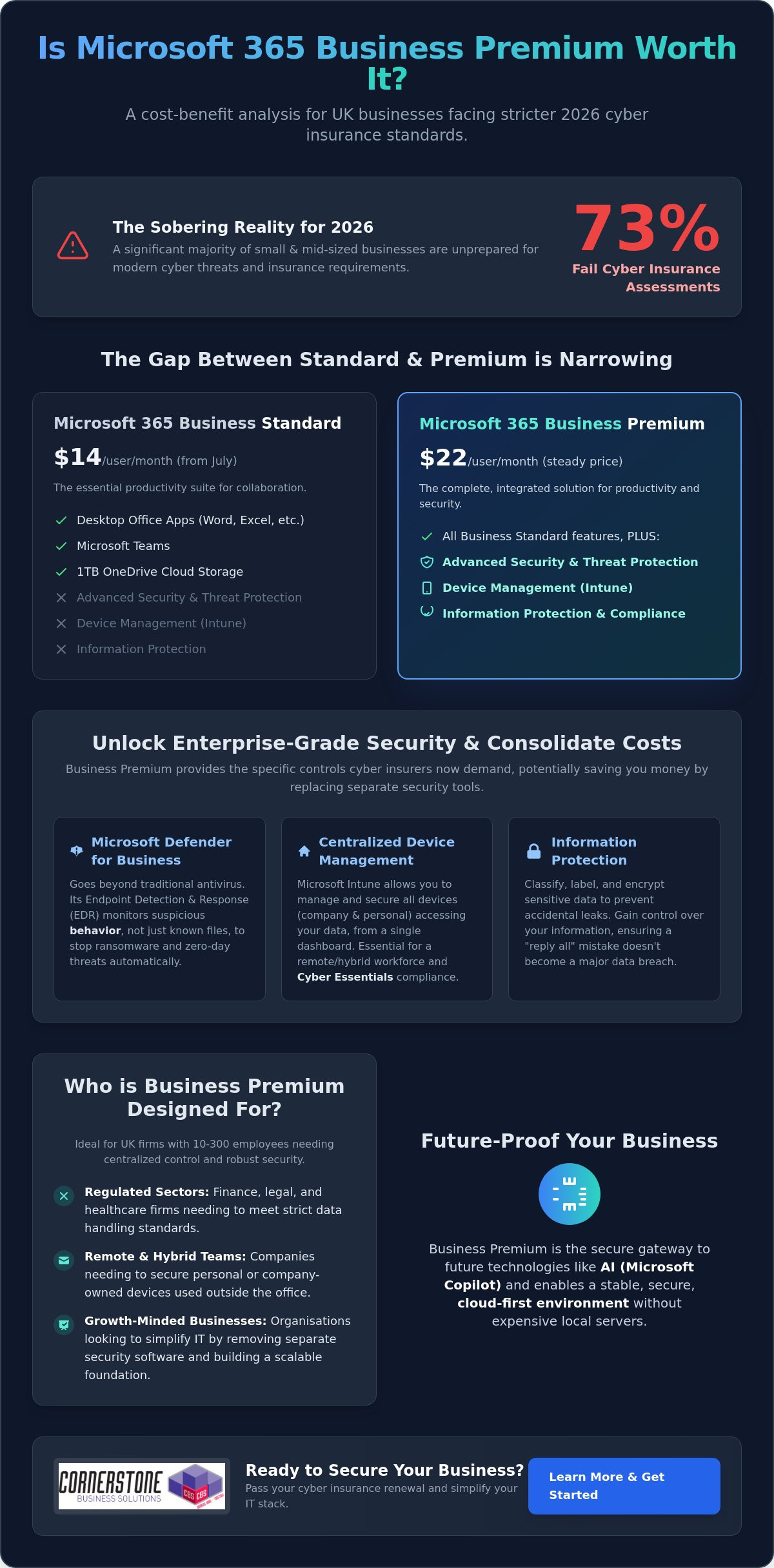
Did you know that 73% of small and mid-sized businesses are failing their cyber insurance assessments in 2026? It’s a sobering figure that highlights a growing gap between basic software and the robust security controls insurers now demand. As costs for separate security tools climb, you’re likely asking: is Microsoft 365 Business Premium worth it for your UK business? With the price of Business Standard rising to $14 this July while Premium holds steady at $22, that monthly difference has never looked smaller or more significant.
We understand the frustration of juggling multiple subscriptions just to keep your remote laptops secure and your team productive. You want a streamlined IT environment that meets standards like Cyber Essentials without the headache of a complex software stack. This guide explores how Business Premium’s integrated security, advanced device management, and AI-ready features can actually save you money by consolidating your tools. We’ll break down the 2026 cost-benefit reality to help you decide if making the switch is the smartest move for your company’s stability and long-term growth.
Key Takeaways
- Learn why modern cyber insurance providers now demand the advanced security controls found in Business Premium to approve your renewal.
- Discover how to calculate the savings from replacing separate security tools to help you decide once and for all: is Microsoft 365 Business Premium worth it for your team?
- See how Microsoft Intune simplifies managing a hybrid UK workforce, allowing you to secure company data on any device from a single dashboard.
- Get the facts on the 2026 pricing shifts and see why the narrowing gap between Standard and Premium makes the upgrade a more compelling choice.
- Find out how to start a low-risk transition with a pilot group to ensure your staff gets the most out of every feature without disrupting your daily operations.
The Gap Between Standard and Premium: What Changes in 2026?
Microsoft 365 Business Premium represents the high-water mark for small and medium-sized enterprises. It’s the most comprehensive license available for organizations with up to 300 users. While many business owners start with the Standard tier, the question of whether is Microsoft 365 Business Premium worth it usually arises when a company grows or faces stricter compliance audits. You keep everything you’re used to in the Microsoft 365 suite, like the desktop Office apps, Teams, and 1TB of cloud storage. However, the shift in 2026 isn’t just about productivity; it’s about building a fortress around your data.
Who is Business Premium Designed For?
We often recommend this tier to firms with between 10 and 300 employees who need centralized control. If your team is scattered across the UK, working from home or in a hybrid model, you need a way to manage those devices without seeing them in person. It’s particularly vital for:
- Regulated sectors: Finance, legal, and healthcare firms that must meet strict data handling standards.
The 2026 Microsoft Ecosystem: Where Premium Fits
Advanced Security Features: Why Your Insurance Provider Might Require Them
Insurers have become significantly more strict. In 2024, the global average cost of a data breach rose to $4.88 million. This financial pressure means UK insurance providers are no longer satisfied with a simple “yes” on a questionnaire. They want evidence of robust technical controls. When you look at the mounting requirements for Multi-Factor Authentication (MFA) and threat detection, you have to ask: is Microsoft 365 Business Premium worth it compared to buying separate tools? For most local businesses, the answer lies in how easily it helps you achieve Cyber Essentials certification.
Microsoft Defender for Business: Enterprise-Grade Protection
Traditional antivirus is like a list of known criminals. If a virus isn’t on the list, it gets through. Microsoft Defender for Business uses Endpoint Detection and Response (EDR) to change the game. Think of it as a smart CCTV system. It doesn’t just look for known “bad files.” It monitors behavior. If a program starts encrypting your documents at 2 AM, Defender recognizes the suspicious activity and shuts it down instantly. This automatic remediation means the system can isolate a threat before you even finish your morning coffee. It’s a foundational piece of security that protects against modern ransomware.
Conditional Access: The “Bouncer” for Your Data
Passwords alone are no longer enough to protect your company. Conditional Access acts as a digital bouncer for your data. It allows us to set intelligent rules about who can log in and under what circumstances. For example, you can block any login attempts from outside the UK or prevent access from unmanaged devices that don’t meet your security standards. By using Microsoft Intune to verify device health, Conditional Access can stop over 99% of identity-based attacks. This drastically reduces the risk of password-spraying and credential theft. When clients ask us is Microsoft 365 Business Premium worth it, we often point to the peace of mind that comes from knowing only trusted devices can touch your data.
If you’re feeling overwhelmed by these technical requirements, our team can help you implement Cyber Security measures that actually fit your business goals.
The Cost Comparison: Consolidating Your Security Stack
Many UK business owners look at the license price in isolation. This perspective often hides what we call the “Hidden Tax” of IT management. When you pay for Business Standard but then add standalone antivirus, a separate mobile device manager, and an encryption service, you aren’t saving money. You’re actually paying more for a fragmented system. To truly understand if is Microsoft 365 Business Premium worth it, you have to look at the total cost of your current software stack. Managing five different vendors with five different support lines is a drain on your time and your budget.
Consolidating your tools into one ecosystem doesn’t just lower your monthly outgoings. It also removes the friction of jumping between different dashboards. This streamlined approach is a key reason why PCMag’s review of Microsoft 365 Business highlights the suite’s efficiency for smaller teams. By bringing everything under one roof, you gain a single admin console for all IT functions. This visibility is vital for maintaining a secure and manageable environment. It allows you to see exactly what’s happening across your business without the headache of conflicting software reports.
Replacing Third-Party Subscriptions
Business Premium is designed to replace several high-cost standalone tools. For example, Microsoft Intune handles what products like Jamf or AirWatch do for device management. Meanwhile, Microsoft Defender for Business provides the enterprise-grade protection you might currently be getting from Sophos or Bitdefender. You also get integrated email encryption, which often removes the need for extra third-party plugins. This consolidation means you have one trusted partner to call if an issue arises. It simplifies your billing and your technical support in one stroke, providing the stability your business needs to flourish.
The ROI of Reduced Complexity
Hardware Management and Remote Work: The Intune Advantage
Zero-Touch Deployment with Windows Autopilot
Onboarding a new starter shouldn’t be a logistical nightmare. With Windows Autopilot, we can ship a laptop directly from the supplier to your new employee’s home. As soon as they log in to their Wi-Fi, the machine configures itself automatically with your company’s specific settings. This “zero-touch” approach eliminates the need for staff to travel into the office just for a technical setup. It saves hours for your HR and IT teams, allowing new hires to get straight to work with all the tools they need from day one.
Mobile Device Management (MDM) for Smartphones
Your team likely uses their personal phones for work emails. This creates a significant GDPR risk if those devices aren’t managed. Intune allows you to separate personal photos and messages from business data. You can enforce a rule that company emails are only accessible if the phone has a secure PIN or biometric lock. This protects your business without invading your employees’ privacy. It’s a proactive way to maintain compliance while supporting a flexible, modern work culture. With over 200 million devices already managed by Intune globally, it’s a proven solution for businesses that value stability.
If you’re ready to simplify your hardware setup and secure your remote team, our experts can provide the Managed IT Support you need to get everything running smoothly.
Making the Switch: How to Maximise Your Microsoft 365 Investment
Switching to a higher license tier shouldn’t be a shot in the dark. Before you commit your budget, we recommend performing a thorough license audit. Many organizations find they’re paying for features in other standalone subscriptions that Business Premium already includes. Once you’ve identified these overlaps, the question of whether is Microsoft 365 Business Premium worth it becomes a simple matter of strategic consolidation. We often suggest a “Pilot” approach for our partners. By testing Premium features with a small group of power users first, you can refine your security policies and workflows before rolling them out to the entire company.
A successful Microsoft 365 migration for business UK requires a clear, strategic roadmap. It’s not just about moving data; it’s about aligning your new technical capabilities with your specific business goals. Cornerstone acts as your trusted local partner to unlock these complex features. We ensure your configuration is robust, manageable, and tailored to your team’s needs. We’re here to turn a technical upgrade into a foundational element of your business stability.
Common Implementation Pitfalls to Avoid
Partnering for Success
Our managed IT services ensure your Premium license is configured correctly from the start. We take the guesswork out of complex setups like Intune and Defender for Business. This proactive approach provides the peace of mind that comes from 24/7 security monitoring and expert support. We’re proud to be a regional expert dedicated to the success of our clients. We don’t just manage systems; we build long-term partnerships that help your business grow with confidence. If you’re ready to see the real value of your software, you can book a Microsoft 365 licence review with the Cornerstone team today.
Securing Your Business Stability for 2026 and Beyond
As a multi-award-winning Microsoft Partner, we pride ourselves on delivering expert-led migration and configuration tailored to your specific regional needs. We provide proactive cyber security monitoring to ensure your data remains safe while your team stays productive. Let’s work together to simplify your software stack and protect the reputation you’ve worked so hard to build. Take the first step toward a more resilient future and get a free Microsoft 365 security audit for your business today. We’re ready to help you unlock the full potential of your technology.
Frequently Asked Questions
Is Microsoft 365 Business Premium worth it for a very small business (under 10 users)?
Yes, it’s absolutely worth it because your risk doesn’t shrink just because your team is small. Cyber criminals often target smaller UK businesses because they expect weaker defenses. Having enterprise-grade security like Defender for Business from day one ensures your company is built on a stable foundation. It’s a proactive way to protect your reputation and meet insurance requirements as you grow.
What is the main difference between Business Standard and Business Premium?
The primary difference is the addition of advanced security and device management tools. While Business Standard provides the Office apps and Teams you need for daily work, Premium adds Microsoft Intune and Defender for Business. These tools allow you to manage your hardware remotely and stop sophisticated threats. It moves your business from basic productivity into a comprehensive, secure ecosystem.
Can I mix and match Business Standard and Premium licences in the same organisation?
Yes, you can assign different licenses to different users within the same Microsoft 365 tenant. This can be useful if only a specific group needs advanced device management or higher security levels. However, we often find that a uniform environment is easier to manage and more secure. Having everyone on the same tier eliminates gaps where data could be exposed on unmanaged devices.
Does Business Premium include a Windows 11 Pro upgrade?
Yes, Business Premium includes upgrade rights for devices with a qualifying Windows 10 or 11 Home license to Pro. This is a significant benefit for businesses that purchase off the shelf hardware. It ensures every laptop in your fleet can be fully managed through Intune. This capability helps you maintain a professional, standardized IT environment across your entire team without extra hardware costs.
How does Microsoft Intune help with GDPR compliance?
Intune helps you meet GDPR requirements by providing technical controls over how company data is accessed and stored. You can enforce encryption on all devices and remotely wipe business data if a phone or laptop is lost. It also allows you to separate personal and professional data on employee-owned devices. These features provide the documented evidence of security that regulators and insurers look for.
Is Defender for Business included in Business Premium better than free antivirus?
Yes, it’s a significant step up because it uses Endpoint Detection and Response (EDR). Free antivirus tools usually only look for known signatures of old viruses. Defender for Business monitors behavior to stop brand-new ransomware and sophisticated attacks in real-time. It’s a proactive shield that fixes threats automatically, providing a level of stability that free tools simply can’t match.
Can I cancel my third-party antivirus if I upgrade to Business Premium?
How much does Microsoft 365 Business Premium cost per month in the UK?
Microsoft sets the global pricing for these licenses. Following the price adjustments in July 2026, the gap between Standard and Premium has narrowed, making the upgrade more cost-effective than ever. The best way to understand the total investment is to compare it against the separate security tools you currently pay for. We can help you audit your licenses to ensure you’re getting the best value for your specific needs.
Is paying more always better? When comparing Microsoft 365 Business Premium vs E3, many business owners assume the higher price tag of the Enterprise tier guarantees superior security. However, with the July 1, 2026, price increase pushing Microsoft 365 E3 to $39 per user, you might be surprised to learn that the $22 Business Premium plan often provides a more robust security suite for teams under 300 people. It’s a common misconception that can lead to significant overspending without the added protection you expect.
We understand the frustration of trying to manage a hybrid workforce while keeping IT costs under control. It’s stressful to worry about hitting the 300-user cap or wondering if your current setup leaves a backdoor open for cyber threats. You want a solution that works as hard as you do, backed by a partner who understands your needs. This article promises to clarify the critical differences in security, storage, and seat limits so you can make an informed, confident decision for your organization.
We’ll provide a clear decision framework to help you optimize your IT spend and strengthen your cyber security posture. From the “Security Paradox” to the latest 2026 pricing shifts, you’ll get the expert analysis needed to choose the right license for your long-term stability and growth.
Key Takeaways
- Identify why the “Security Paradox” often makes Business Premium a more comprehensive choice for cyber security than the standard E3 license.
- Master the 300-user threshold to avoid logistical headaches when choosing between Microsoft 365 Business Premium vs E3 as your organization scales.
- Compare storage and compliance features, such as E3’s 100GB mailboxes and unlimited archiving, to support your legal or financial data requirements.
- Learn how to implement a hybrid licensing strategy to maximize your ROI and keep your IT budget lean without sacrificing performance.
- Use our 2026 decision framework to select a license that protects your business continuity and supports your hybrid workforce efficiently.
Navigating the Microsoft 365 Licensing Maze in 2026
Choosing the right license for your team often feels like a full-time job. The Microsoft 365 suite has evolved significantly over the last few years, leading to a fundamental shift in how plans are categorized and sold. Many UK business owners see the “Enterprise” label on certain tiers and assume it’s the gold standard for every growing firm. That isn’t always the case. In 2026, the strategic debate usually centers on Microsoft 365 Business Premium vs E3, where the best choice depends more on your specific security needs and user count than just your company’s ambition.
The “Premium” tag in the Business tier is frequently overlooked by organizations on a growth trajectory. Some firms think they’ll outgrow it quickly, so they jump straight to Enterprise plans. However, for any organization with fewer than 300 employees, Business Premium is a powerhouse. It offers a level of protection that used to be reserved for the largest corporations. Many growing firms ignore this label, assuming it’s a mid-tier compromise. In reality, it’s a high-performance engine for businesses that value both security and efficiency. The decision between Microsoft 365 Business Premium vs E3 isn’t just a matter of price; it’s a strategic move for your digital infrastructure.
As a locally based partner, we focus on how these licenses fit into your daily operations and long-term goals. A proactive managed IT strategy isn’t just about fixing hardware when it fails. It’s about setting up a digital environment that grows with you. Both of these plans offer the core tools needed for UK business continuity, but they serve different logistical purposes. Choosing correctly now means you won’t face a sudden, expensive migration when your team expands or your security requirements change. We want to simplify these complex technical concepts so you can focus on running your business with total confidence.
What is Microsoft 365 Business Premium?
Think of this as the definitive “all-in-one” toolkit for the modern SME. It’s designed specifically for organizations with up to 300 users. You get the standard productivity apps you know, like Word and Excel, but the real value lies in advanced security and device management through Microsoft Intune. For local businesses looking for enterprise-grade protection without the enterprise-grade complexity, this is the absolute sweet spot for value and performance.
What is Microsoft 365 E3?
This is the entry-point for the Enterprise tier. It’s the mandatory choice once you hire your 301st employee because it has no seat limits. While it offers larger 100GB mailboxes and more advanced compliance tools, it doesn’t automatically include every security feature found in Business Premium. It requires a careful evaluation to ensure you aren’t paying more for less protection in specific areas. It’s a robust plan, but it works best when you truly need the scale of an enterprise environment.
The 300-User Threshold: Why Size Dictates Your Strategy
Size matters in the Microsoft ecosystem. If you’re currently weighing up Microsoft 365 Business Premium vs E3, your headcount is the first filter you must apply. Microsoft enforces a strict ceiling on its “Business” family of products, which includes Basic, Standard, and Premium tiers. Once you hit that 300th user, the door shuts on those specific licenses. It’s not a suggestion; it’s a technical hard stop that can catch growing firms off guard if they aren’t prepared for the logistical shift.
Planning for this transition is a hallmark of a proactive business leader. You don’t want to be in the middle of a major recruitment drive only to find your IT infrastructure has hit a wall. Moving from the Business tier to Enterprise isn’t just about changing a line item on an invoice; it’s about ensuring your team has uninterrupted access to the tools they need to stay productive. We often see local businesses struggle with the sudden jump in complexity, which is why we advocate for a clear roadmap well before you reach the limit.
The Hard Cap: 300 Users and Not One More
Microsoft counts seats across your entire tenant. If you have 150 users on Business Standard and 150 on Business Premium, you’ve reached the limit. You cannot add a 301st user on any Business plan. The 300-user limit is the primary differentiator between these two licenses. If you exceed this during a growth phase, you’ll need to move that additional staff member to an Enterprise license immediately to maintain service continuity.
Scaling Beyond 300: The Enterprise Leap
Moving to E3 becomes the mandatory baseline for larger UK workforces once they cross that 300-user mark. It’s a significant shift in your IT budget. Transitioning from Business Premium at $22 to E3 at $39, following the July 1, 2026 price increases, represents a 77% increase in per-user costs. This is where strategic oversight becomes vital. Utilizing Managed IT Support simplifies this transition, ensuring your licensing keeps pace with your recruitment without service drops. If you’re approaching this milestone, we’re always happy to have a chat about your growth plans to ensure your budget stays optimized.
Enterprise licenses like E3 offer total flexibility because they have no seat minimums or maximums. This makes them the ideal choice for firms that have moved past the SME stage and require the scale of a corporate environment. While the cost is higher, the removal of the seat cap provides the peace of mind that your growth will never be throttled by a licensing restriction.
The Security Paradox: Is Business Premium More Secure than E3?
Price doesn’t always equal protection. When comparing Microsoft 365 Business Premium vs E3, many leaders are shocked to find a “Security Gap” in the more expensive Enterprise plan. While Microsoft 365 E3 costs significantly more following the July 2026 price adjustments, it actually lacks some of the sophisticated security tools that come standard with Business Premium. This paradox exists because Microsoft designed Business Premium as a comprehensive “shield” for SMEs who might not have a dedicated, 24/7 security operations center.
The core of this difference lies in the version of Microsoft Defender included. Business Premium provides Defender for Business, a powerful tool that includes full Endpoint Detection and Response (EDR). In contrast, the standard E3 license only includes Defender for Endpoint Plan 1. To get the same level of protection in an Enterprise environment, you often need to purchase “Step-up” licenses or move all the way to E5. For a local firm looking to harden its cyber security posture, Business Premium often offers the most proactive defense for every pound spent.
Both plans utilize Microsoft Intune for device management, allowing you to wipe lost laptops or enforce security policies remotely. They also both support Conditional Access and Multi-Factor Authentication (MFA). These features are the bedrock of business resilience, ensuring that only the right people on the right devices can access your sensitive data. However, the way these tools are bundled makes Business Premium the clear winner for teams that want “out of the box” safety without managing complex add-ons.
Defender for Business: The SME Superpower
Business Premium’s inclusion of Defender for Business is a massive value win. It brings enterprise-grade EDR capabilities to smaller teams, allowing the system to identify and stop “zero-day” threats before they cause damage. Perhaps most importantly for lean IT teams, it features automated investigation and remediation. If a threat is detected, the system can automatically isolate the device and start the cleanup process, saving your team hours of manual work and reducing the risk of human error.
Information Protection and Compliance
Beyond Security: Mailboxes, Archiving, and Virtualization
While security is often the loudest part of the Microsoft 365 Business Premium vs E3 conversation, the practicalities of daily storage and infrastructure often decide the winner. For many local businesses, the choice comes down to how your team actually works. Do you have “digital hoarders” with decades of email? Are you running a remote desktop environment for a hybrid team? These operational needs are just as critical for business continuity as your firewall settings. We often see firms focus so much on the price per user that they forget to account for the logistical bottlenecks that stall productivity.
One of the most effective ways to manage your budget in 2026 is through a hybrid licensing strategy. You don’t have to assign the same license to every person in the building. By mixing and matching, you can provide E3 licenses to your power users while keeping standard office staff on Business Premium. This tailored approach ensures your IT spend remains lean without sacrificing performance. It’s a proactive way to manage growth while keeping your digital infrastructure agile and responsive to your specific needs.
Storage and Archiving for Long-term Compliance
Mailbox size is a frequent sticking point for growing organizations. Business Premium offers a 50GB mailbox, which is more than enough for most employees. However, power users in sectors like law or finance often find this limit restrictive as their history grows. E3 doubles this capacity to 100GB, providing significant breathing room for heavy communicators. Beyond the primary mailbox, E3 offers “In-Place Hold” and “Litigation Hold” features. These are essential for meeting strict UK regulatory standards during audits. While Business Premium is capped at 1.5TB of archive storage, E3 provides unlimited auto-expanding archiving to ensure you never lose a critical record.
Virtualization and Windows Enterprise Rights
If your firm uses Remote Desktop Services (RDS) or Citrix, virtualization rights become a non-negotiable factor. E3 includes “Shared Computer Activation,” which allows multiple users to access Office apps on a single virtual machine without licensing conflicts. It also grants rights to Windows 11 Enterprise, offering more granular control over desktop environments and updates than the Business version. This heavily impacts your Cloud Solutions architecture, especially when scaling a secure hybrid workforce. If you’re struggling to map out these technical requirements, our team is ready to help you design a custom licensing roadmap that fits your business perfectly.
Decision Framework: Which License Wins for Your Business?
Making the final choice between Microsoft 365 Business Premium vs E3 shouldn’t feel like a gamble. For the vast majority of UK SMEs with fewer than 300 employees, Business Premium is the undisputed value champion in 2026. It packs a punch with superior security features like Defender for Business while keeping your monthly overheads predictable. If your team is comfortably under the seat limit and you don’t require specialized virtualization or massive 100GB mailboxes, this plan offers everything you need to stay secure and productive.
However, growth often brings complexity. As you scale, you might find that “license bloat” starts to creep into your monthly invoice. This happens when businesses pay for high-tier enterprise features for every staff member, even those who only need basic email and document access. Auditing your current Microsoft 365 estate is a proactive way to trim the fat. We take pride in helping our partners identify these inefficiencies, ensuring that every pound of your IT budget is working toward your business continuity and success.
The Hybrid Licensing Strategy
You don’t have to choose just one path. Microsoft allows you to mix and match license types within a single environment. You can assign E3 licenses to your legal team for unlimited archiving and your remote engineers for virtualization rights, while keeping the rest of the staff on Business Premium. This approach maximizes your ROI by targeting high-capacity tools only where they’re actually needed. The key is maintaining a consistent Cyber Security posture across the whole firm, ensuring that no matter the license type, your data remains protected under a unified management policy.
Next Steps: Professional Licensing Audit
The July 2026 price increases mean that even small licensing errors can now cost thousands in unnecessary annual fees. A professional review of your tenant can uncover hidden savings and security gaps you might have missed. As a multi-award-winning Microsoft partner, we’ve built our reputation on simplifying these technical hurdles for our local community. We’d love to help you find the perfect balance for your team. You can book a Microsoft 365 licensing review with our experts today to ensure your organization is positioned for a stable, secure future.
Take Control of Your 2026 Licensing Strategy
Choosing between Microsoft 365 Business Premium vs E3 doesn’t have to be a headache. You now know that Business Premium often provides superior security value for teams under 300, while E3 offers the scale and storage needed for larger workforces. By adopting a hybrid licensing model, you can protect your bottom line without compromising on the tools your team needs to thrive. It’s about making your technology work for you, not the other way around.
As a multi-award-winning Microsoft Partner, we specialize in delivering bespoke technology solutions for UK businesses. Our proactive 24/7 monitoring and support ensure your systems stay stable, allowing you to focus on growth with absolute peace of mind. We’re proud of our regional roots and remain dedicated to acting as a long-term partner for your success. We want to simplify your digital infrastructure so you can lead with confidence.
Ready to stop overspending on unused features? Optimise your Microsoft 365 licensing with a free audit from Cornerstone today. Let’s have a friendly conversation about securing your organization’s future together.
Frequently Asked Questions
Can I upgrade from Business Premium to E3 without losing data?
You can upgrade from Business Premium to E3 without any data loss. Since both licenses exist within the same Microsoft 365 tenant, the transition is a simple administrative switch in your portal. Your emails, files, and settings remain exactly where they are. It’s a seamless process that ensures business continuity while your team scales beyond the 300-user limit.
Is Microsoft Defender for Endpoint included in Business Premium?
Business Premium includes Microsoft Defender for Business. This is a specialized version of Defender for Endpoint that provides enterprise-grade detection and response (EDR) for smaller firms. While it’s slightly different from the standalone Endpoint Plan 1 or 2, it offers more robust protection than the standard E3 package. It acts as a proactive shield for your company devices.
What happens to my E3 features if I have more than 300 users?
Your E3 features remain fully active regardless of how many users you have. Unlike Business plans, Enterprise tiers like E3 have no seat maximum. This makes E3 the mandatory choice once you hire your 301st employee. You keep all your advanced compliance, larger mailboxes, and virtualization rights as you continue to grow your workforce without any service interruptions.
Does Business Premium include Microsoft Teams and OneDrive?
Microsoft Teams and OneDrive are fully included in Business Premium. You get the same collaborative power for video calls and chat as larger enterprises. Each user also receives 1TB of OneDrive storage for their files. This ensures your team stays connected and productive whether they’re working from the office or a remote location. It’s a foundational part of a modern hybrid work environment.
Is E3 better for GDPR compliance than Business Premium?
E3 is often the better choice for strict GDPR compliance at scale. It includes advanced Data Loss Prevention (DLP) and eDiscovery tools that aren’t as comprehensive in the Business tier. If your firm handles sensitive financial or legal data across thousands of files, E3’s granular controls make it easier to meet UK regulatory requirements during a formal audit or data request.
Can I mix Business Premium and E3 licenses in the same organization?
You can absolutely mix Business Premium and E3 licenses within the same organization. This is a smart way to optimize your IT spend by assigning expensive Enterprise licenses only to power users who need 100GB mailboxes or virtualization. We frequently help our partners set up this “hybrid” approach to keep their digital infrastructure lean and efficient. It’s a proactive strategy for smart growth.
What is the price difference between Business Premium and E3 in 2026?
The price difference between Microsoft 365 Business Premium vs E3 is $17 per user, per month. As of July 1, 2026, E3 is priced at $39 while Business Premium remains at $22. This gap reflects the unlimited seat capacity and advanced compliance tools found in the Enterprise tier. Choosing the right plan ensures you aren’t overspending on features your team doesn’t actually use.
Does E3 include Windows 11 Enterprise?
Microsoft 365 E3 includes full rights to Windows 11 Enterprise. This version offers more advanced security and management features than the Pro or Business editions. It’s particularly useful for organizations requiring granular control over system updates and desktop environments. It provides a stable, uniform foundation for your entire corporate fleet, especially for those in high-compliance sectors needing extra control.