

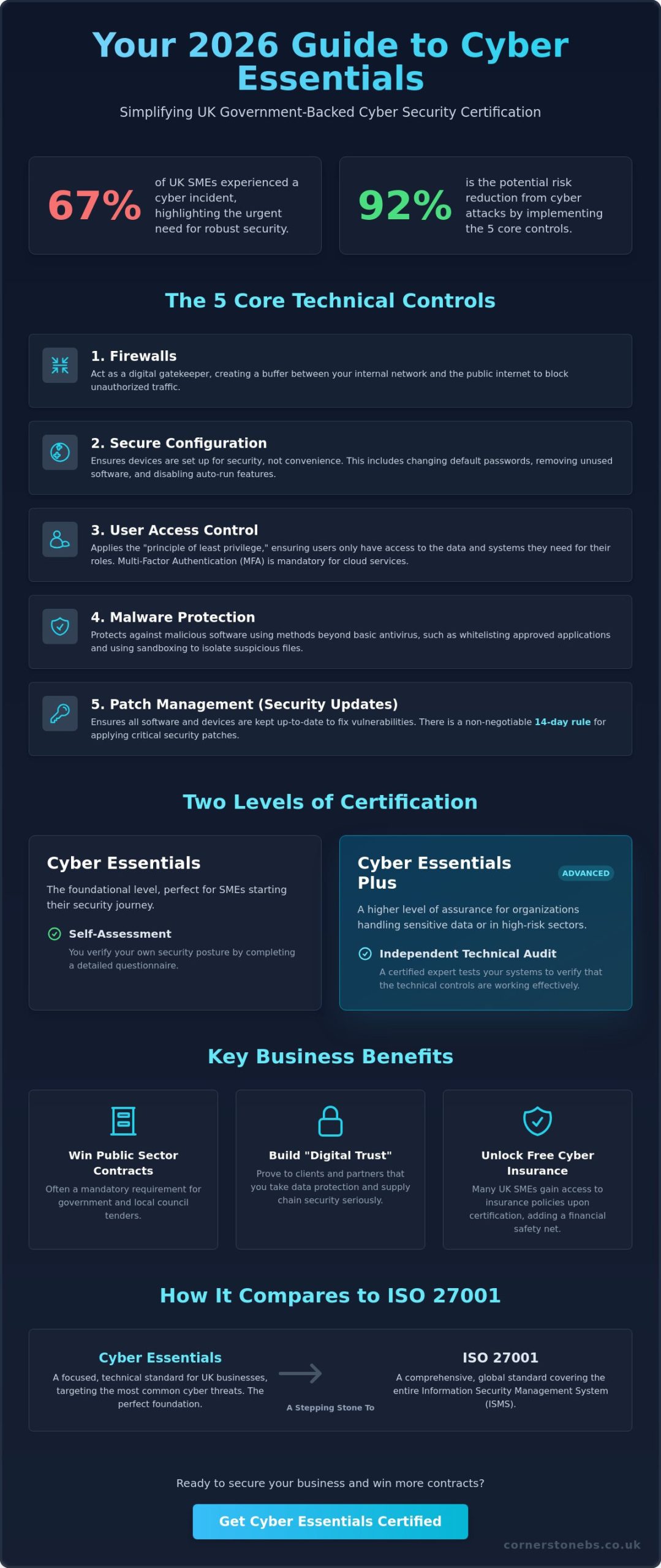
Did you know that 67% of UK SMEs experienced a cyber incident in 2025? It is a sobering figure that proves why securing your digital perimeter is no longer optional. If you are wondering how to get Cyber Essentials certified without drowning in technical jargon or losing your assessment fee, you are in the right place. We know that terms like “patch management” and the new “Danzell” question set can feel overwhelming when you are busy running a business. As your local technology partners, we believe that complex security should be made simple and accessible.
It’s frustrating to face a mountain of documentation when you’d rather be winning new government tenders. We agree that the 14 day patching deadline and mandatory multi-factor authentication requirements shouldn’t stand in the way of your success. This comprehensive 2026 guide promises to simplify the certification process, helping you master the five technical controls with confidence. We’ll walk you through the exact steps to pass the first time, from navigating the latest IASME costs to implementing real security that protects your livelihood and your reputation.
Key Takeaways
- Understand why this government-backed standard is now a vital requirement for securing public sector contracts and supply chain partnerships.
- Follow our clear, step-by-step roadmap on how to get Cyber Essentials certified, starting with a thorough gap analysis of your current systems.
- Demystify the five technical controls, from firewalls to security updates, and learn how to implement them without the headache of technical jargon.
- Learn the crucial differences between basic self-assessment and the independent technical audit required for Cyber Essentials Plus.
- Discover how proactive Managed IT Support keeps your business compliant throughout the year, preventing the risk of compliance drift between assessments.
What is Cyber Essentials and Why is it Essential in 2026?
Cyber Essentials is the UK’s primary government-backed security standard. It was created by the National Cyber Security Centre (NCSC) to help organizations protect themselves against the most common internet-based threats. While it began as a requirement for government suppliers, the 2026 business landscape has changed. Today, private sector firms are increasingly demanding this certification from their partners. They want to know that their supply chain isn’t a weak link. If you are researching Cyber Essentials, you’ll see it focuses on five core technical controls that act as a digital shield for your business.
There are two levels of certification to understand. The standard Cyber Essentials is a self-assessment option. You verify your own security posture through a detailed questionnaire. It’s an excellent first step for any small or medium-sized enterprise. The second level, Cyber Essentials Plus, takes things further. It involves an independent technical audit where an expert tests your systems to ensure the controls are working effectively. Learning how to get Cyber Essentials certified allows you to choose the level that best fits your current growth goals and client requirements.
The impact of these controls is significant. Research shows that correctly implementing the five technical controls can reduce the risk of a successful cyber attack by up to 92%. In 2026, hackers use automated tools to find easy targets. They don’t always care who you are; they just want to find a vulnerability. Cyber Essentials ensures you aren’t an easy target. It moves your security from a “best effort” approach to a proven, verifiable standard that protects your livelihood.
The Business Benefits Beyond Compliance
Certification offers massive commercial advantages that go far beyond basic IT security. It’s often a mandatory requirement for winning public sector tenders and local government contracts. By displaying the badge, you build “Digital Trust” with your stakeholders. It proves you take data protection seriously. For many UK-based SMEs, achieving the standard also unlocks access to free cyber insurance, providing an extra layer of financial and emotional security for your team.
Cyber Essentials vs. ISO 27001
Many business owners ask if they should pursue ISO 27001 instead. While ISO 27001 is a prestigious global standard, it’s also a massive undertaking that covers broad management systems. For most growing firms, it’s too complex as a starting point. Cyber Essentials is much more focused. It targets the technical vulnerabilities that cause the most damage. It’s the perfect foundation. You don’t have to choose one or the other; you can use the technical rigour of your journey to discover how to get Cyber Essentials certified as a stepping stone toward ISO 27001 later on.
The 5 Technical Controls: What You Need to Implement
Achieving certification isn’t just about ticking boxes. It’s about building a robust digital fortress for your business. The Cyber Essentials scheme focuses on five technical controls that address the most common points of failure. Understanding these requirements is the first real step in learning how to get Cyber Essentials certified for your UK business. We believe in making these concepts clear so you can take action without feeling overwhelmed.
First, firewalls act as your digital gatekeeper. They create a buffer between your internal network and the public internet, blocking unauthorized traffic. Next, secure configuration ensures your devices are only doing what they need to do. This means changing factory default passwords and removing unnecessary software that hackers love to exploit. You should also disable any “auto-run” features that could execute malicious code without your knowledge.
User access control is all about the principle of least privilege. You wouldn’t give every employee a master key to your office. The same applies to your data. Multi-factor authentication (MFA) is now mandatory for all cloud services to prevent unauthorized logins. Finally, malware protection goes beyond basic antivirus. It involves whitelisting approved applications and using sandboxing to isolate suspicious files before they can cause harm. If this sounds like a lot to manage, our Cyber Security services can help streamline the entire setup.
The Critical Importance of Patch Management
The 14 day rule is a non-negotiable part of the assessment. You must apply all critical security updates within two weeks of their release. Outdated software is the primary gateway for ransomware because it leaves known doors wide open for attackers to walk through. For a remote workforce, automating these updates is the only reliable way to maintain compliance without disrupting your team’s day. It ensures your protection is always current, not just an afterthought.
Securing Your Devices and Software
Your certification scope must include every device that touches company data. This includes Bring Your Own Device (BYOD) scenarios where staff use personal phones for work email. All cloud services must also meet the standard. Many firms find that a Microsoft 365 migration for business UK is the most efficient way to centralize control and ensure every user meets strict MFA requirements. By consolidating your tools, you simplify the path of how to get Cyber Essentials certified while improving your overall performance.
Step-by-Step: How to Get Cyber Essentials Certified
Moving from understanding the theory to actually holding the certificate requires a logical, phased approach. Many business owners feel a sense of dread when faced with the application portal, but the process is manageable when broken down into clear stages. If you are focused on how to get Cyber Essentials certified without the stress of a failed attempt, following a structured roadmap is your best strategy. It ensures you don’t miss a critical setting that could lead to a costly rejection.
The journey typically follows these five essential steps:
- Step 1: Define your scope. You must identify every piece of equipment and software that falls under the assessment.
- Step 2: Conduct a gap analysis. This is an honest look at where your current security meets the five controls and where it falls short.
- Step 3: Remediate technical issues. You’ll spend time fixing those gaps, such as updating old firmware or enforcing MFA.
- Step 4: Complete the self-assessment questionnaire (SAQ). This is your formal declaration of compliance.
- Step 5: Official submission. Your chosen certification body reviews your answers and issues your certificate.
While the administrative side is handled through a portal, the real work happens in the remediation phase. This is often the most time-consuming part of the process, especially for firms that haven’t updated their infrastructure recently. Taking the time to get these fixes right ensures your business is actually more secure, rather than just technically compliant.
Defining Your Certification Scope
Getting your scope right is vital. If you exclude devices that should be included, your certification won’t be valid. You must include all internet-connected devices, servers, and endpoints used by your team. This also covers third-party cloud applications and any hardware used in remote offices. According to the official UK government overview of the Cyber Essentials scheme, an incorrect scope is one of the most common reasons for assessment failure. We recommend being over-inclusive to ensure your digital perimeter is fully protected.
The Pre-Assessment Internal Audit
Don’t submit your application until you’ve run a mock assessment. We suggest creating a detailed checklist of every device and its current update status to catch any lingering issues. Test your firewall rules and verify that every user account has the correct permissions. Many local firms find peace of mind by using professional cyber security services to perform this internal audit. It’s a proactive way to discover how to get Cyber Essentials certified with total confidence, knowing your systems are ready for the official review.
Cyber Essentials Plus: Taking Security to the Next Level
While the basic certification is a fantastic start, Cyber Essentials Plus is the gold standard for UK businesses. It moves beyond simple self-declaration. Instead of just telling the certification body you’re secure, an independent assessor actually proves it. This involves a series of technical audits and vulnerability scans to verify that your controls are working as intended. It’s the ultimate way to demonstrate that your business takes data protection seriously.
If you’re learning how to get Cyber Essentials certified at the Plus level, timing is everything. You must complete the Plus audit within three months of achieving your basic certification. If you miss this window, you’ll likely have to start the process again. This timeline keeps the momentum going and ensures your security posture doesn’t slip. Higher-tier government contracts and many large private sector supply chains now mandate the “Plus” version. It provides a higher level of assurance that your defense is active and verified by an expert.
Is Cyber Essentials Plus Worth the Investment?
Many small business owners worry that the “Plus” tier is too difficult or expensive. In reality, it’s a powerful marketing tool. It tells your B2B clients that you’ve undergone rigorous external testing. This builds immense trust. For a local firm, it’s often the difference between being a “vendor” and a “trusted partner.” It isn’t too difficult if your foundations are solid. It just requires a more meticulous approach to your documentation and technical fixes. The investment pays for itself through increased contract wins and reduced risk.
Preparing for the Vulnerability Scan
The vulnerability scan is the heart of the Plus assessment. Assessors look for “low-hanging fruit” like default passwords or unpatched legacy systems that haven’t been updated in months. These are the easiest ways for a breach to occur. Preparing for this scan doesn’t have to be a solo mission. Utilizing it company solutions can streamline the entire audit process. We help you identify these fail points before the assessor finds them. This proactive approach is the smartest way to understand how to get Cyber Essentials certified while avoiding the stress of a failed audit. Invite us for a conversation to see how we can help you prepare.
Managed IT: The Secret to Continuous Compliance
Achieving your certificate is a milestone worth celebrating, but it’s only the beginning of the journey. Cyber Essentials is an annual commitment, not a one-off project. Many organizations fall into the trap of treating it like a driving test; they pass once and then slowly let their standards slip. This is what we call “compliance drift.” New devices are added, software updates are ignored, and suddenly, the digital fortress you built has gaps. If you’re looking at how to get Cyber Essentials certified and maintain that status, you need a strategy for the long haul.
Our proactive approach ensures your controls remain active every single day of the year. We don’t believe in “point-in-time” security. Instead, we position ourselves as your dedicated partner, monitoring your infrastructure to catch vulnerabilities before they become threats. This provides a level of emotional security that allows you to focus on your clients, knowing your back-end systems are stable and resilient. By making security a foundational part of your daily operations, you protect your reputation and your bottom line.
Automating the Five Controls
Manual security checks are a recipe for human error. We utilize Remote Monitoring and Management (RMM) tools to handle patch automation across your entire network. This ensures you always hit the mandatory 14 day deadline for critical updates without having to manually check every laptop or server. We also use centralized dashboards to track user access and MFA status in real-time. This level of automation significantly reduces the administrative burden on your internal team. It transforms a complex compliance task into a streamlined, background process that works while you do.
Working with a Trusted Cyber Advisor
The remediation phase of certification is often the most challenging part for any business owner. Having an expert advisor by your side prevents you from wasting resources on the wrong technical fixes. While we are deeply connected to our local community, providing managed IT services Teesside leaders rely on, our expertise supports the national growth of businesses across the UK. We simplify the technical jargon and provide a clear path to success.
Staying compliant shouldn’t be a source of stress. We invite you to an informal conversation about your current setup and your future goals. Contact our experts for a Cyber Essentials readiness review today. Let’s work together to ensure you know exactly how to get Cyber Essentials certified and stay protected for years to come.
Secure Your Business Future and Win More Contracts
Securing your organization’s future starts with a single, proactive decision. You’ve seen how the five technical controls act as a robust shield and why the “Plus” tier opens doors to high-value government and private sector contracts. Remember that certification is an annual commitment to excellence, not a one-time hurdle. It transforms your security from a technical necessity into a powerful commercial advantage that builds lasting digital trust with your stakeholders and clients.
Mastering how to get Cyber Essentials certified ensures your business remains resilient against the vast majority of common cyber threats. As a multi-award-winning IT provider and strategic partner with industry leaders like Microsoft, IBM, and Cisco, we bring deep expertise in national cyber security standards directly to your business. We don’t just provide a service; we act as a dedicated partner focused on your long-term stability and growth. Our team simplifies the complex so you can focus on what you do best. Ready to secure your business? Book a Cyber Essentials consultation with our award-winning team. Your path to a safer, more competitive business starts with a simple conversation. We look forward to helping you succeed.
Frequently Asked Questions
How much does Cyber Essentials certification cost in 2026?
The cost for basic certification is determined by your organization’s size. For micro-businesses with up to 9 employees, the fee is between £320 and £330 plus VAT. Small businesses pay £400 to £440; medium organizations pay £450 to £500; and large firms with over 250 employees pay between £500 and £600 plus VAT. Cyber Essentials Plus typically ranges from £1,500 to over £3,000 depending on the complexity of your IT environment.
How long does it take to get Cyber Essentials certified?
The administrative review usually takes between one and three working days once you submit your questionnaire. However, the preparation phase often takes several weeks. This time is spent conducting a gap analysis and fixing technical issues like outdated software or missing MFA. Planning ahead ensures you aren’t rushed when trying to understand how to get Cyber Essentials certified for a specific tender deadline.
What happens if my business fails the Cyber Essentials assessment?
If you fail, you generally have a two day window to rectify minor issues and resubmit without paying the full fee again. If the failures are significant or you miss this window, you must start a new application and pay the assessment fee once more. We recommend a pre-assessment audit to catch these errors early and protect your investment from unnecessary costs.
Does Cyber Essentials certification include cyber insurance?
Yes, UK-based organizations with a turnover under £20 million receive automatic cyber liability insurance of up to £25,000 upon certification. This is only applicable if you certify your entire organization rather than just a specific department. It provides a vital layer of financial and emotional security for smaller firms facing modern digital threats in the current business landscape.
Is Cyber Essentials a legal requirement for UK businesses?
No, it is not a legal requirement for all businesses, but it is often a mandatory contractual requirement. The UK government requires this certification for any supplier handling sensitive or personal information. Many private sector firms now follow this lead. This makes it a primary standard for anyone looking to join major supply chains or win public sector contracts in 2026.
How often do I need to renew my Cyber Essentials certificate?
You must renew your certification every 12 months to remain compliant. The threat landscape evolves quickly, and annual renewals ensure your technical controls are still effective against new vulnerabilities. Regular renewals also prevent compliance drift and keep your business eligible for ongoing government contracts and the associated cyber insurance benefits provided to smaller organizations.
Can I get certified if my employees work from home?
Yes, you can get certified with a remote workforce, but their home working devices are usually in scope. Any laptop, tablet, or desktop used to access organizational data must meet the five technical controls. This includes using supported operating systems and ensuring home routers have changed default administrative passwords to prevent unauthorized access to your business network.
What is the difference between Cyber Essentials and Cyber Essentials Plus?
The primary difference is how your security is verified. Basic Cyber Essentials is a self-assessment where you declare your own compliance through a questionnaire. Cyber Essentials Plus involves an independent technical audit and vulnerability scan by a qualified assessor. Achieving the Plus level is the most reliable way to demonstrate how to get Cyber Essentials certified with verified proof of your security posture.