

Choosing a cloud provider for UK data sovereignty takes more than checking a server’s postcode. If your cloud data sits in a UK data centre, it’s still important to understand who can access it, where backups and metadata go, which subprocessors are involved, and what laws may apply to the provider.
UK GDPR and the Data Protection Act 2018 shape the data protection framework, but a UK location claim alone won’t show how a cloud service works in practice. You need evidence of the provider’s legal, technical and operational controls, without losing sight of the flexibility and functionality your business needs.
This guide explains how to set requirements around your data, users, workloads and risk, then compare providers using practical evidence rather than broad marketing promises. It covers data locations and flows, support access, legal exposure, encryption, permissions, backups and subprocessors. It also shows how to make sovereignty part of ongoing cloud governance, security and business continuity, rather than a one-off hosting decision.
Key Takeaways
- Separate data residency, sovereignty and data protection to clarify what control your organisation actually needs.
- When choosing a cloud provider for UK data sovereignty, assess documented controls and contractual protections, not just claims about UK hosting.
- Compare public, private, hybrid and sovereign-cloud approaches against workload sensitivity, access, portability and resilience.
- Set requirements for sensitive data, users and critical services, then document answers on locations, support access, subprocessors, backups and incidents.
- Treat sovereignty as ongoing governance: review permissions, security and supplier arrangements as your workloads and business needs change.
What UK Data Sovereignty Means When Choosing a Cloud Provider
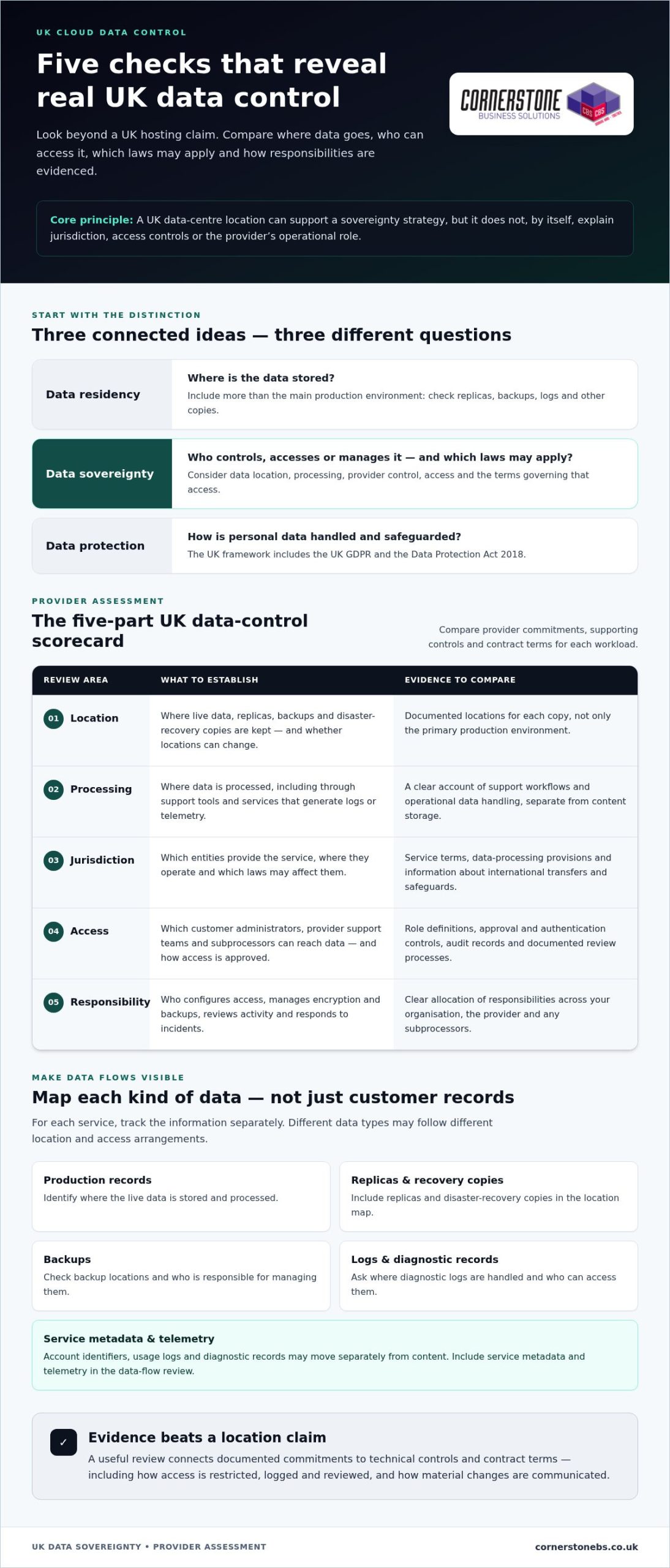
A UK data centre can support a sovereignty strategy, but it doesn’t settle every question. The provider’s corporate jurisdiction, where processing takes place, who can access the data, and the terms governing that access all matter. Start by separating three connected ideas: residency, sovereignty and data protection.
Data residency versus data sovereignty
Data residency describes where data is stored. Look beyond the main production environment to replicas, backups, logs and other copies. Data sovereignty considers the wider relationship between data, applicable laws, provider control and access. Digital sovereignty concerns meaningful control of digital infrastructure and data; the Wikipedia overview of digital sovereignty discusses how that control can apply to states, organisations and individuals.
UK data sovereignty means having clear, evidenced control over where data is stored and processed, which laws may apply, and who can access or manage it, rather than relying on a UK location alone. A service may store customer records in the UK while support staff access them remotely, or processing and service telemetry take place elsewhere. Metadata, such as account identifiers, usage logs or diagnostic records, may also move separately from content.
These distinctions have practical consequences. A business might keep working files and backups in UK regions but still need to know who can administer the environment, how support access is authorised, and where diagnostic information is handled. A location statement answers only part of the picture. It doesn’t, by itself, explain jurisdiction, access controls or the provider’s operational role.
Why sovereignty matters to UK organisations
Data protection focuses on how personal data is handled and safeguarded. In the UK, the central framework includes the UK GDPR and the Data Protection Act 2018. Data sovereignty is related but broader: it helps an organisation understand the legal and operational controls around its data, including when a cloud service involves several suppliers, teams or countries.
That understanding supports decisions about regulatory duties, contractual commitments and the expectations of customers, staff and partners. It can also help explain an organisation’s approach when reviewing security, continuity or supplier risk. The right level of control depends on the workload. Sensitive personal information may call for tighter access restrictions and a clearer picture of data flows than a low-risk internal collaboration tool.
There’s no single sovereignty setup for every organisation. Sector, data type, contractual terms, business impact and risk appetite all shape the requirement. Identify the information that matters most, then consider what could happen if it were accessed, unavailable or handled outside the expected boundaries. That gives you a practical basis for choosing a cloud provider for UK data sovereignty and turning broad concerns into requirements you can test and manage.
The Cloud Provider Criteria That Determine UK Data Control
A useful assessment turns broad promises into evidence you can compare. For each workload, record what the provider commits to, which technical controls support that commitment, and what the contract says if arrangements change. This makes choosing a cloud provider for UK data sovereignty a practical review, not a search for a reassuring label.
Use these criteria as a starting scorecard:
- Location: Identify the regions used for live data, replicas, backups and disaster recovery, and whether locations can change.
- Processing: Establish where data is processed, including through support tools and services that generate logs or telemetry.
- Jurisdiction: Understand which entities provide the service, where they operate, and which laws may affect them.
- Access: Map customer administrators, provider support teams and subprocessors, then record how permissions are restricted and approved.
- Responsibility: Clarify who configures access, manages encryption and backups, reviews activity, and responds to incidents.
Where data moves and who can access it
Build a data-flow map for each service. Include production records, replicas, disaster-recovery copies, backups, diagnostic logs and service metadata. Track each as a separate flow: a provider may document a UK location for primary storage but use different arrangements for support workflows or operational data.
Next, trace access routes. Record which administrator roles and support teams can reach data, whether subprocessors are involved, and what approval or authentication controls apply. Look for evidence that access is restricted, logged and reviewed, such as role definitions, audit records and documented review processes. “Secure access” is less useful than a clear explanation of how access is controlled and evidenced.
Jurisdiction, contracts and assurance evidence
Review service terms, data-processing provisions and subprocessor disclosures alongside the technical information. Check how the provider describes international transfers, which safeguards or transfer mechanisms it relies on, and how it communicates material changes. Use current Information Commissioner’s Office guidance in your review, particularly where personal data may be accessed or transferred across borders. Legal and procurement teams can assess how those arrangements fit the organisation’s obligations.
Read assurance documents in context. Check which service, locations and controls an audit report covers, when it was issued, and whether any exclusions affect your workloads. Certifications can support a review, but they don’t prove that every configuration meets your needs. Distinguish the provider’s contractual commitments from controls you can verify in the service, such as permissions, encryption settings and access logs.
Keep the evidence with the workload decision, including assumptions and gaps that need attention. As systems, users and suppliers change, revisit the data-flow map and controls rather than treating approval as permanent. Cornerstone’s cloud solutions can bring provider evidence together with permissions, backup and continuity planning.
How to Compare Sovereign Cloud Options Without Overlooking Trade-offs
No single cloud model automatically delivers the right balance of control, capability and resilience. Compare each option against the workload, the sensitivity of its data and the controls your organisation can operate consistently. A UK hosting location may support your requirements, but it isn’t proof on its own: assess the specific service, configuration, access arrangements and evidence.
Match cloud model to workload and risk
Separate workloads by purpose and sensitivity. A system holding highly sensitive records may need tighter access and retention controls than standard collaboration tools. A hybrid design can place workloads in different environments, but it also adds integration and management demands. Include user experience, links to existing systems, recovery arrangements and the effort needed to maintain controls in your comparison.
Use this table as a starting point, then assess each option against the service and contract under consideration. “Sovereign cloud” can describe different arrangements, so focus on documented boundaries rather than the label.
| Model | Jurisdiction | Service scope | Access model | Portability | Resilience | Evidence to review |
|---|---|---|---|---|---|---|
| Public cloud | Depends on selected regions and provider arrangements | Broad range of services, subject to configuration | Customer and provider roles need clear controls | Review dependencies on provider-specific services | Assess region design, backups and recovery | Service terms, location details, access and audit records |
| Private cloud | Depends on hosting and operating arrangements | Dedicated environment, with scope shaped by design | Can be tailored, but responsibilities must be explicit | Review platform and migration dependencies | Check separate recovery arrangements and testing | Architecture, operating model, contract and assurance |
| Hybrid cloud | Varies across connected environments | Workloads can span multiple services | Consistent identity and permissions become important | Integration may add complexity | Map dependencies and recovery across environments | Data flows, access design and end-to-end recovery evidence |
| Sovereign cloud | Defined by the specific service’s commitments | May have a narrower service scope | Review local operating and support controls | Check service dependencies and exit arrangements | Confirm recovery coverage and locations | Contractual commitments and service-specific controls |
Assess platforms and managed cloud approaches
Compare platforms on documented controls and workload fit, not brand recognition alone. Microsoft Azure is one option, but location, access and transfer commitments depend on the specific service and configuration. Review those details for the workloads in scope. Ongoing management matters too: permissions, security settings and cloud operations need regular oversight as users and business needs change.
Choosing a cloud provider for UK data sovereignty is a balance, not a hunt for a perfect label. A broader Cloud Solutions for UK Businesses guide can help frame general cloud decisions, while this comparison focuses on control, evidence and trade-offs. Choose an approach your team can manage, and include resilience and portability from the outset.
A Practical Due-Diligence Checklist for UK Cloud Buyers
A consistent process helps you compare providers against real requirements, especially when workloads have different levels of sensitivity. Start with the business need, gather evidence and record unresolved points. This gives technical, security and procurement teams a shared basis for making and reviewing the decision.
Five steps from requirements to shortlist
Work through these steps before approving a cloud service. They turn broad expectations into a practical assessment, clarify ownership and make remaining risks visible.
- Classify data and workloads. Identify sensitive information, who uses it, and the impact if it’s exposed, unavailable or altered. Separate critical services from lower-risk applications.
- Translate obligations into requirements. Review relevant legal, regulatory and contractual commitments with the appropriate people in your organisation. Convert them into assessable requirements, such as defined data locations, restricted support access or documented recovery arrangements.
- Compare providers consistently. Use the same questions for each option. Assess written commitments, service scope, technical controls and operational responsibilities rather than relying on marketing descriptions.
- Plan implementation and resilience. Map dependencies, migration steps, user access and testing. Include backup and recovery arrangements so the move supports business continuity as well as data control.
- Keep a decision log. Record the evidence reviewed, gaps, risk owners, approval decisions and a review date. Revisit the record when the service, supplier, users or workload changes.
Questions that turn claims into evidence
Use questions like these to assess the specific service and workloads in scope. Keep the responses and supporting documents with your assessment, and note who in your organisation owns each follow-up.
- Where are production data, backups, logs and metadata stored and processed? Can their locations change, and how are changes communicated?
- Which privileged roles, support routes and subprocessors can access data? How is access approved, restricted, logged and reviewed?
- What audit reports or security assurance documents cover the service, and what locations, features or controls are excluded?
- What do the contract and service terms say about international transfers, subprocessor changes, incident notification and responsibilities during an incident?
- How can your organisation retrieve data, maintain portability, and arrange deletion when the service ends? What evidence describes these processes?
Use the ICO’s current guidance when assessing personal data handling and transfers, and involve legal or procurement specialists where arrangements affect your obligations. Connect the provider review to internal security governance, including permissions, incident handling and backup oversight. This gives teams a fuller view of how cloud choices affect day-to-day security.
For an overview of how these requirements fit across different workloads, read about Cornerstone’s cloud planning. A collaborative review can bring data control, security and continuity considerations into one manageable plan.
Choose a Cloud Provider That Fits Your UK Sovereignty Requirements
The strongest choice is the one that meets your organisation’s documented requirements, not the one with the most reassuring “UK cloud” label. Use your assessment evidence to decide which workloads belong in which environments, who is accountable for each control, and how you’ll respond if arrangements change. Choosing a cloud provider for UK data sovereignty is the start of an operating approach, not a one-off procurement decision.
Turn provider selection into an operating plan
Once you’ve selected an approach, assign roles for access reviews, configuration, supplier oversight and evidence retention. Keep a record of decisions and ownership so the team knows who is responsible for each control. Set review triggers for new workloads, regulatory changes, acquisitions or supplier changes. This makes sovereignty a repeatable practice rather than something that depends on one person’s knowledge.
Connect the plan to everyday resilience. Backup and recovery arrangements should reflect the business impact of losing access to a service, while incident response should make responsibilities clear across your organisation and suppliers. Review whether arrangements still fit as systems and users change. A well-governed cloud environment supports business continuity as well as data control.
Plan the next step with a managed cloud partner
Before agreeing a target design, bring together your requirements, provider evidence and unresolved risks. Note which workloads need separate controls, how existing systems connect, and what migration or recovery planning involves. Cornerstone works collaboratively with UK organisations to shape tailored cloud solutions around business needs and existing systems, supported by managed IT and cloud expertise.
If Microsoft 365 is part of the plan, include migration considerations alongside data handling, user access and continuity. The Microsoft 365 Migration for Business UK guide can inform that part of your planning; ensure the migration approach fits the sovereignty requirements set for the workload.
Keep the decision under review after implementation. Changes to services, permissions, suppliers or business priorities can affect whether the original controls remain suitable. Assign ownership for reviews, keep evidence accessible, and update the operating plan when your environment changes. Ongoing oversight helps make sovereignty part of secure, manageable cloud operations.
Ready to discuss your requirements? Talk with Cornerstone about your cloud plans and take the next step towards an environment designed around your organisation.
Make Data Control Part of Your Cloud’s Future
Your cloud environment will evolve as teams, services and business priorities shift. Build sovereignty into that evolution by treating each significant change as a reason to revisit ownership, controls and supporting evidence. That way, choosing a cloud provider for UK data sovereignty becomes a foundation for decisions, rather than a box ticked during procurement.
Cornerstone Business Solutions is a multi-award-winning UK IT services provider, bringing together cloud solutions and managed IT, cyber security and disaster recovery expertise. Its work with Microsoft, IBM and Cisco supports a collaborative approach to designing cloud environments around business requirements, existing systems and operational priorities.
Bring your priorities, workloads and key concerns to a conversation with Cornerstone. Together, you can explore a practical next step that connects cloud choices with security and continuity.
Talk to Cornerstone about a cloud approach built around your business requirements. A clear plan can help your organisation move forward with confidence.
Frequently Asked Questions
Does storing data in the UK automatically make it sovereign?
No. UK storage tells you where a particular copy is held, but it doesn’t by itself establish which laws may apply to the provider or who can access the data. A UK-based service could, for example, involve overseas support or service components. Check the specific service terms and operational arrangements, and distinguish evidence about storage location from evidence about access, processing and provider control.
Does UK GDPR require every business to store all personal data in the UK?
No. UK GDPR doesn’t generally require every organisation to keep all personal data within the UK. An organisation may use services that process data elsewhere, but it must consider the applicable rules for international transfers and its responsibilities for protecting personal data. The right assessment depends on the data and service involved. Use current Information Commissioner’s Office guidance and obtain appropriate legal advice for complex arrangements.
Can a cloud provider’s support team access data from outside the UK?
Yes, depending on the service and its support arrangements. Access might occur during troubleshooting, maintenance or incident response, so review how support requests are handled and whether staff can view customer content. Look for controls such as approval requirements, time-limited permissions and access logs. If support access is outside your acceptable risk boundary, make that a clear service requirement and assess the provider’s documented options.
Do cloud backups and metadata need to be included in a sovereignty assessment?
Yes. Backups can contain the same sensitive information as live systems, while metadata may reveal account details, activity or service use. For example, a collaboration platform’s files and diagnostic logs may follow different handling arrangements. Include both in your data inventory, and account for retention and deletion as well as storage. This helps avoid overlooking information outside the main application or production database.
How can a business check where its cloud data is processed?
Start with documentation for the exact cloud service and configuration, rather than relying on a general provider statement. Review service-specific data-location information, terms, subprocessor disclosures and transfer details. Compare these with your records of enabled features and integrations, since connected tools may introduce additional processing. When choosing a cloud provider for UK data sovereignty, keep the evidence with the workload decision and record unanswered questions for follow-up.
Is a sovereign cloud necessary for every UK business?
No. The appropriate model depends on the organisation’s data, sector, contracts, operational needs and risk appetite. A business with highly sensitive workloads or strict customer commitments may need stronger controls than one handling lower-risk information. Some organisations can use different approaches for different systems. Define the outcome you need first, then assess whether a sovereign cloud or another well-governed cloud arrangement can meet it.
Can a business use Microsoft Azure while assessing UK data sovereignty?
Yes. Azure can be part of a UK sovereignty assessment, but suitability depends on the specific services, configuration and operating arrangements involved. Review service-specific information about data handling, support access, backups and relevant contractual terms. Also assess how identity settings, permissions and integrations are configured in your tenant. A platform name alone can’t establish that a particular workload meets your organisation’s requirements.