
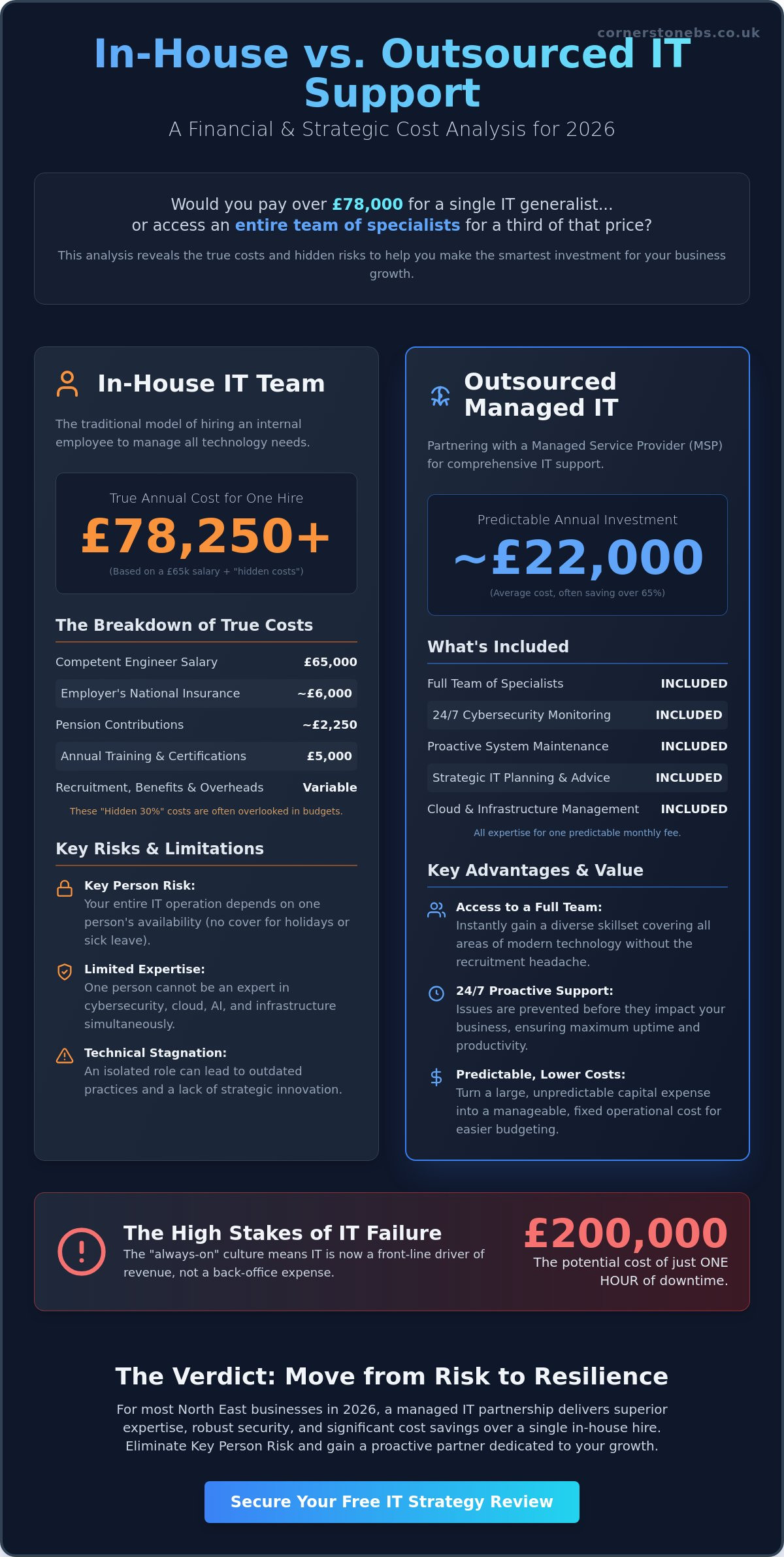
Would you pay £65,000 for a single IT generalist when you could access an entire team of specialists for a third of that price? By January 2026, the cost of a competent internal hire has climbed to between £45,000 and £65,000 once you factor in National Insurance and pension contributions. It’s a heavy price to pay for one person who still needs holidays, sick leave, and constant training. This 2026 in-house vs outsourced IT support cost analysis reveals why many North East businesses are moving away from the traditional hiring model to find better value and more reliable protection.
We know that managing technology often feels like a constant battle against recruitment headaches and rising cyber security threats. You want predictable monthly spending and the peace of mind that comes from award-winning expertise. This guide delivers a full financial and strategic breakdown to help you choose the model that actually supports your growth. We will explore the hidden costs of internal teams, from £5,000 annual training budgets to the £200,000 per hour risk of downtime. We also show you how a proactive partnership delivers the robust security your insurance requires. Let’s get into the numbers so you can make an informed decision for your organization’s future.
Key Takeaways
- Compare the actual cost of a £65,000 internal hire against the predictable monthly investment of an award-winning managed service provider.
- Identify the “hidden 30%” of internal IT spending, including National Insurance and the recruitment overheads that often catch businesses off guard.
- Use our 2026 in-house vs outsourced IT support cost analysis to determine which model delivers the best ROI for your specific headcount.
- Learn how to eliminate “Key Person Risk” and gain access to a full suite of experts for cyber security, cloud solutions, and strategic planning.
- Discover the framework for choosing a model that provides long-term peace of mind and supports your business growth without technical stagnation.
The 2026 IT Landscape: Why the In-House vs Outsourced Debate Matters
Choosing between these models requires a balance of three critical factors: cost, control, and capability. While having a dedicated person in the office feels reassuring, the sheer breadth of knowledge required today is staggering. One person cannot be an expert in Microsoft 365, advanced cloud infrastructure, and 24/7 cyber security monitoring all at once. We believe that technology should provide peace of mind, not a constant source of recruitment stress. This analysis helps you find that balance, ensuring your IT investment delivers a genuine return rather than just becoming a line item on a balance sheet.
The Evolution of IT Support Expectations
The old “IT guy in the basement” model is officially obsolete. In 2026, your team expects 24/7 uptime and seamless remote access from any location. If your systems go down for even an hour, the financial fallout for a UK firm can reach £200,000 depending on the sector. This “always-on” culture means IT has moved from a back-office expense to a front-line driver of efficiency. Our guide to managed IT services Teesside explores how local businesses are adapting to these higher stakes by moving toward proactive, rather than reactive, support models.
Defining the Models: DIY vs. Managed Partnership
Understanding the terminology is the first step toward a smart decision. The business practice of outsourcing involves hiring an external provider to handle your technology needs. Here is how the three main models look for a modern North East business:
- In-house IT: You hire internal employees. This offers direct control and deep company-specific knowledge; however, it comes with high fixed overheads, pension contributions, and significant recruitment challenges.
- Outsourced IT: You partner with an award-winning Managed Service Provider (MSP). This provides access to a full team of experts for a predictable monthly fee, eliminating the need for internal training and recruitment.
- Hybrid or Co-managed: This is often the “best of both worlds” for larger SMEs. Your internal IT manager handles day-to-day helpdesk tasks while a proactive partner manages heavy-duty security, disaster recovery, and infrastructure.
The True Cost of In-House IT Support in 2026
Calculating the price of an internal team often starts with a single salary figure. However, a realistic in-house vs outsourced IT support cost analysis for 2026 must look far beyond the basic pay packet. While a generalist might command a salary between £30,000 and £45,000, a truly competent engineer capable of managing modern infrastructure now costs between £45,000 and £65,000. These figures reflect the intense competition in the UK managed services market, where a persistent skills gap continues to drive wage inflation across the technology sector.
The Salary Trap: Why One Person is Never Just One Salary
Hiring for IT in 2026 often forces SMEs into a difficult choice. You can hire a junior technician for £35,000, but they may lack the expertise to handle high-level strategic planning or complex cyber security audits. To get that level of seniority, you’ll likely need to pay upwards of £55,000 for a mid-level professional. Even then, you are only buying the knowledge of one individual. If they fall ill or take a holiday, your business is left vulnerable. This “Key Person Risk” can lead to expensive downtime that far outweighs the cost of a proactive partnership.
Continuous Professional Development (CPD) Costs
Technology moves fast. To keep an internal staff member effective, you must invest £2,000 to £5,000 every year in certifications for Microsoft 365, Azure, or Cisco. Without this, your team’s skills will stagnate, leaving your business behind the curve. You also need to provide the tools for them to do the job. Essentials like remote monitoring (RMM), ticketing systems, and security software add another £3,000 to £8,000 to your annual overheads per technician.
The Total Cost of Ownership for a single competent IT hire in 2026 averages between £75,000 and £95,000 after combining salary, statutory contributions, recruitment amortisation, and essential software licensing. If these numbers feel daunting, it might be time to chat with a local expert about a more predictable, award-winning model that scales with your growth.
Financial Analysis of Outsourced Managed IT Support
Switching focus to the other side of our in-house vs outsourced IT support cost analysis, we see a model built for total predictability. Outsourcing replaces the volatile expenses of recruitment and training with a clear, per-user monthly fee. For a typical 20-user business in the UK, fully managed support costs between £1,100 and £1,700 per month. That totals roughly £13,200 to £20,400 per year. Compare that to the £75,000 minimum total cost of a single in-house hire we discussed earlier. You’re getting an entire department of experts for less than a third of the price of one person.
Scalability is another massive financial win for North East firms. If your team grows by five people tomorrow, your costs increase by a fixed, known amount. If you downsize, your bill drops immediately. You don’t have to worry about the £5,000 to £10,000 recruitment fees or the headache of interviewing. We handle the talent hunt and the continuous training, so you don’t have to. It’s a seamless way to ensure your business always has the right level of support without the burden of fixed overheads or employer’s National Insurance.
The Managed Service Advantage: Beyond the Helpdesk
A proactive partnership offers far more than just fixing what’s broken. Our cyber security services are built into the model, providing robust protection that satisfies modern insurance requirements. You get 24/7/365 monitoring without the massive overtime bills or holiday cover issues associated with internal staff. Specialists also manage your cloud solutions more efficiently, ensuring you aren’t overpaying for licenses or storage you don’t need. It’s award-winning expertise that keeps your business moving.
Comparing the Capital Expenditure (CapEx) vs. Operational Expenditure (OpEx)
CFOs generally prefer the Operational Expenditure (OpEx) model because it keeps cash flow steady. You avoid the “emergency spend” cycle where an unmanaged server failure leads to a sudden £10,000 bill. Instead, you pay a consistent monthly rate that covers maintenance and upgrades. Our team also leverages existing partnerships with giants like Microsoft and Cisco. This means you benefit from enterprise-level tools and pricing that are usually out of reach for smaller firms. It’s about getting the best technology for your business while maintaining total financial control and peace of mind.
The Efficiency Gap: Opportunity Costs and Risk Factors
Direct expenses like salaries and software licenses are easy to track, but the hidden costs of inefficiency often hit harder. A thorough in-house vs outsourced IT support cost analysis must weigh the financial impact of “Key Person Risk.” When your internal IT manager is on holiday, ill, or simply busy with a basic helpdesk ticket, who handles a critical system failure? For many North East businesses, this single point of failure creates a dangerous bottleneck that stalls productivity and threatens growth.
There is also the “Breadth vs Depth” problem to consider. In 2026, it is practically impossible for one person to stay expert in cloud infrastructure, hardware maintenance, and the latest cyber security protocols simultaneously. Internal staff often fall into a “best effort” support cycle. In contrast, a proactive partnership with an award-winning team provides guaranteed Service Level Agreements (SLAs). You aren’t just buying time; you are buying a commitment to performance and 24/7 availability that a single hire simply cannot match.
The Cost of Downtime: A Proactive vs. Reactive Comparison
Downtime is a silent profit killer. Recent data shows that IT failures cost UK businesses between £4,000 and £200,000 per hour depending on their sector and size. If your internal team is reactive, they only start working once the damage is done. Our proactive monitoring identifies and resolves vulnerabilities before they impact your bottom line. This level of oversight provides the peace of mind that comes from knowing your network is being watched by specialists who never take a day off. It turns IT from a source of stress into a foundation for business continuity.
Cyber Security and Compliance Risks
The landscape of digital threats is more hostile than ever in 2026. Data breaches now carry heavy financial penalties and can destroy a local brand’s reputation in days. Implementing robust it company solutions ensures your business remains compliant with strict regulations like NIS2 and Cyber Essentials. Managing these requirements internally is a massive administrative burden that often leads to corners being cut.
Professional IT management naturally reduces your cyber insurance premiums by proving to underwriters that your infrastructure is managed to enterprise standards. If you want to stop worrying about the next big threat and start focusing on your business, it’s time to chat with our local experts about a tailored support plan.
The Verdict: Which Model Wins for Your Business?
Choosing the right path depends on your specific scale and long-term goals. Our in-house vs outsourced IT support cost analysis shows that for the majority of UK SMEs, the decision comes down to the balance between overhead and expertise. If you are a large enterprise with over 500 users and highly bespoke legacy systems, an internal team might offer the deep, singular focus you need. However, for high-growth firms and security-conscious sectors, the managed model is almost always the superior choice for both ROI and reliability.
The data from January 2026 is clear. At the 20-user mark, outsourcing your technology needs costs roughly a third of a single in-house hire. Even at 50 users, where costs begin to equalize, the outsourced model still wins on value. You aren’t just paying for a person to sit at a desk; you are buying access to an award-winning department of specialists. This eliminates the “Efficiency Leak” where your business pays premium salaries for basic helpdesk tasks while strategic projects and cyber security fall by the wayside.
Making the Transition: From Stress to Strategy
Moving from a reactive, stressed IT environment to a proactive strategy starts with an honest audit of your current spend. Look beyond the obvious invoices. Calculate the time your management team spends on recruitment and the cost of every hour your systems were offline in the last twelve months. When you present these figures to your stakeholders, the conversation shifts from “what does this cost” to “what is this costing us to ignore.” Finding a partner with a local feel and national-level capabilities ensures you get the personal touch of a North East team with the robust infrastructure of a major provider.
Cornerstone: Your Award-Winning IT Partner
At Cornerstone, we believe technology should be a foundational element of your peace of mind. We blend professional authority with the approachable warmth of our North East roots to create a partnership that feels like an extension of your own team. Our proactive monitoring and tailored cloud solutions ensure your business stays ahead of the curve without the recruitment headaches or unpredictable break-fix bills. We are proud of our award-winning status, but we are even prouder of the success our clients achieve through reliable, secure technology.
Ready for a chat about your IT strategy? Contact our expert team today.
Secure Your Business Future with a Smarter IT Strategy
Your technology should be the engine of your growth, not a source of constant financial worry. This in-house vs outsourced IT support cost analysis has shown that while a £65,000 internal hire offers direct control, it cannot match the collective depth of an entire department. You gain access to specialists in cyber security, cloud solutions, and network infrastructure for a fraction of the cost of a single senior employee. It’s about moving from a reactive “break-fix” mindset to a proactive strategy that protects your bottom line.
As a multi-award-winning IT services provider with deep North East roots, we provide the proactive 24/7 monitoring you need to avoid that £200,000 per hour downtime risk. Our strong partnerships with Microsoft, IBM, and Cisco ensure your business uses enterprise-level tools that stay current with 2026 standards. We don’t just fix computers; we build the digital foundation your organization needs to scale securely and efficiently.
Book a free IT cost-analysis chat with our award-winning team today to find your efficiency leak. We look forward to helping your business achieve total peace of mind and long-term success.
Frequently Asked Questions
Is it cheaper to outsource IT or hire in-house in 2026?
Outsourcing is significantly more cost-effective for the vast majority of UK SMEs. Our in-house vs outsourced IT support cost analysis shows that a 100-user business typically invests between £60,000 and £90,000 per year for a full team of specialists. Hiring an equivalent internal team would require at least three staff members, likely pushing your annual expenditure well over £150,000 once you include all employer contributions and overheads.
What are the hidden costs of hiring an internal IT manager?
Beyond the base salary, you must budget for a 13.8% Employer National Insurance contribution and at least 3% for pension auto-enrolment. There are also recruitment fees that often reach 20% of the starting salary and an annual training budget of £2,000 to £5,000 to keep their skills current. You also pay for the software tools they need, which can cost your business an additional £8,000 every year.
Can a managed IT service provider really understand my specific business needs?
A true partnership model ensures your provider understands your operations as deeply as any internal hire. We use regular strategic reviews and on-site visits across the North East to align your technology with your specific growth goals. It’s about building a long-term relationship where we act as your trusted local experts, not just a distant helpdesk.
What happens to my existing IT staff if I decide to outsource?
You don’t have to choose one or the other; many firms opt for a co-managed approach. Your existing staff can focus on high-value internal projects while we handle the 24/7 monitoring and helpdesk tickets. If you decide to move fully to an outsourced model, we can help you navigate the TUPE regulations to ensure a smooth and professional transition for everyone involved.
How do outsourced IT costs scale as my business grows?
Costs scale linearly on a per-user basis, which gives you total budget clarity as you expand. For a 50-user business in 2026, the monthly investment typically ranges from £2,750 to £4,250 depending on the level of support required. This flexibility means you can add or remove users instantly without the stress of recruitment or the risk of being overstaffed during quieter periods.
Is outsourced IT support as responsive as having someone in the office?
Outsourced support is often more responsive because you have an entire team of award-winning experts available at all times. An internal hire might be stuck in a meeting, off sick, or on holiday when a crisis hits. Our proactive monitoring systems identify and fix most issues before your team even notices them, ensuring your productivity never skips a beat.
Does outsourcing IT help with cyber security insurance requirements?
Yes, professional management is now a standard requirement for most 2026 cyber insurance policies. Insurers want to see that your business has robust disaster recovery plans and proactive security monitoring in place. Partnering with an expert team ensures you meet these strict compliance standards, which often helps in securing coverage and potentially reducing your premiums.
What is co-managed IT support and is it right for me?
Co-managed IT is a hybrid model where we support your existing internal IT manager rather than replacing them. It’s a great fit for businesses with 50 or more staff that need extra help with specialized areas like cloud solutions or complex network infrastructure. This model typically costs between £30 and £80 per user per month and provides your internal team with the tools and backup they need to succeed.