Did you know that over 50% of medium-sized UK businesses were hit by a cyber attack in the last year? It’s a sobering statistic from the latest DSIT/NCSC findings, especially as we look toward the challenges of 2026. As a multi-award-winning IT provider, we see how the fear of ransomware and surging insurance premiums weighs on local business owners. That’s why a professional business cyber security audit uk has moved from a technical hurdle to a foundational asset for any company aiming to scale safely.
You’re likely feeling the pressure of complex new regulations like the Data (Use and Access) Act 2025 or the updated Cyber Security and Resilience Bill. It’s frustrating when compliance feels like a moving target. This guide promises to clear the fog, showing you how a bespoke audit protects your UK business from evolving 2026 threats while securing operational continuity. We’ll preview the roadmap to lower insurance premiums and the peace of mind that comes from knowing your digital estate is truly resilient.
Key Takeaways
Understand why evolving AI-driven threats and new UK legislation make a proactive approach essential for protecting your commercial reputation and client trust.
Learn the critical difference between a basic vulnerability scan and a comprehensive business cyber security audit uk that examines your people, processes, and technology.
Identify the vital components of a robust audit, from checking cloud infrastructure health to ensuring only the right people have access to your digital kingdom.
Get a clear, two-step roadmap to prepare your organisation for an audit, including how to define your scope and gather essential documentation efficiently.
Discover how to turn audit findings into a long-term resilience strategy by integrating expert recommendations into a bespoke Managed IT Support plan.
Why Your UK Business Needs a Cyber Security Audit in 2026
The digital world moves fast. By 2026, the traditional “basic antivirus” approach is no longer enough to keep your doors locked. Cyber criminals now use sophisticated AI-driven phishing and deepfakes to bypass standard filters, making it harder than ever for your team to spot a scam. A business cyber security audit uk provides the deep-dive analysis needed to identify these modern gaps before they’re exploited. It’s about moving from a reactive “hope for the best” stance to a proactive, multi-layered defence strategy that protects your hard-earned reputation.
There’s also a direct link between your security posture and your bottom line. In the current market, UK cyber insurance providers have significantly tightened their eligibility criteria. They don’t just want to see a policy document; they want proof of resilience. A professional Information security audit serves as that proof, often leading to lower premiums and better coverage terms. It shows insurers and partners alike that you take your digital responsibilities seriously.
Beyond Compliance: Security as a Competitive Edge
Winning new business in 2026 often depends on your ability to prove you’re a safe partner. Blue-chip clients and government bodies now routinely require supply chain security audits before they’ll even consider signing a contract. By demonstrating superior data stewardship, you turn security from a “cost centre” into a powerful brand differentiator. Supply chain risk in 2026 represents the danger that a security failure within a smaller, connected partner could provide a backdoor for attackers to breach a larger, high-value target. When you can prove your systems are robust, you become the low-risk, high-trust choice for ambitious partners.
The True Cost of a Data Breach in the UK
The financial impact of a breach goes far beyond a simple ransom demand. When you factor in the cost of total operational downtime, the investment in a professional audit looks like a wise insurance policy. Under the UK GDPR and the 2026 Cyber Security and Resilience Bill, regulatory fines are just the beginning. You also face the “hidden” costs of losing intellectual property and the long-term damage to your brand that takes years to repair. We’ve seen that 43% of UK businesses faced a cyber attack in the last year; the goal of an audit is to ensure you aren’t part of that statistic next year. It’s about protecting your cash flow, your staff, and your future.
The Core Components of a Comprehensive IT Security Audit
Data protection is another heavy hitter in our review process. We verify that your encryption is active and effective, making sensitive information unreadable to anyone without specific permission. In our hybrid working world, endpoint security is vital too. We assess the protection on laptops, mobiles, and remote devices that often sit outside the traditional office perimeter. This ensures your data stays safe, whether your team is at a desk in Teesside or working from a home office.
Evaluating Your Technical Controls
Technical controls are your first line of defence. We review firewall configurations and network segmentation to ensure a single breach can’t take down your entire system. A key part of this process involves checking your alignment with the NCSC Cyber Essentials scheme, which sets the gold standard for technical hygiene in the UK. We also look at Multi-Factor Authentication (MFA). It’s one of the most effective tools we have, but it only works if it’s applied consistently across all platforms. Finally, we check your patch management. Under the latest “Danzell” standards, high-risk security updates must be installed within 14 days of release. We make sure your business never leaves these doors open.
The Human Element: Policy and Awareness
Technology is only half the battle. We audit your internal security policies to make sure they aren’t just “shelfware” gathering dust. Are they actionable? Do your people actually know what’s in them? We review training records to see if your team is equipped to spot the latest deepfakes or phishing attempts. A strong culture of security is your best protection. We also stress-test your incident response plans. If a breach happens, your team needs to know exactly what to do to minimize downtime. If you’re looking to strengthen your foundations, a professional IT assessment is a great place to start. A business cyber security audit uk provides the clarity you need to move forward with total confidence.
Cyber Security Audit vs. Vulnerability Assessment: Which Do You Need?
One of the most common questions we get from business owners is about the difference between a scan and a full audit. Many believe they’re fully protected after a quick automated scan. While scans are useful, they only tell part of the story. Understanding the difference between a vulnerability assessment, a penetration test, and a business cyber security audit uk is the first step toward true resilience in 2026. Each serves a specific purpose. Choosing the wrong one can leave you with a false sense of security or a bill for services you don’t actually need yet.
A vulnerability assessment is essentially an automated “health check” for your network. It looks for known holes or missing patches. Think of it as a digital version of checking that all your windows and doors are shut. A penetration test goes a step further. It’s an active, ethical hacking attempt to see if those defences can actually be broken. However, a full security audit is the most comprehensive. It’s a deep-dive review that looks at your technology, your people, and your internal processes. Your choice depends on your specific risk profile. For example, if you process card payments, PCI DSS v4.0 mandates annual penetration testing. When assessing cybersecurity risks, you must consider your industry’s unique regulatory landscape and growth goals.
When to Choose a Vulnerability Scan
Vulnerability scans are ideal for regular maintenance. We often recommend them as monthly health checks between your major annual reviews. They’re a low-cost entry point for smaller firms just starting their security journey. If your main goal is identifying missing software patches or basic configuration errors, a scan is a great place to begin. It keeps your basic hygiene in check without the overhead of a full manual review. It’s a proactive way to keep the “low-hanging fruit” away from opportunistic hackers.
Why the Full Audit is the Gold Standard
A business cyber security audit uk is the gold standard because it captures the “why” behind your vulnerabilities. It doesn’t just list a problem; it explains the systemic failure that caused it. This level of detail is essential if you’re aiming for ISO 27001 or Cyber Essentials Plus. It provides your board with a strategic roadmap for investment. You’ll move away from “firefighting” individual bugs and toward a stable, growth-focused technology foundation. It’s the ultimate tool for long-term peace of mind.
How to Prepare Your Organisation for a Security Audit
Preparing for a business cyber security audit uk might feel like getting ready for a tax inspection, but it’s actually a far more collaborative process. When we step into a local office, our goal is to build resilience, not find fault. Success starts with a clear plan and a bit of internal housework. First, you must define your scope. Decide which parts of your operation are most critical, whether that’s your customer database or your remote worker infrastructure. Next, gather your documentation. Having your network maps, security policies, and third-party contracts ready saves hours of discovery time and ensures your business cyber security audit uk remains efficient.
Identify the key people who need to be available. This usually includes your IT lead and perhaps someone from HR to discuss policy enforcement. It’s also vital to review previous findings. If you had an audit last year, ensure those specific vulnerabilities are closed before the new assessment begins. Finally, brief your team. Make sure they understand this is a “no-blame” process designed to protect their jobs and the company’s future. When staff feel safe, they provide more honest insights into how they actually use technology on a daily basis.
Mapping Your Digital Assets
Shadow IT is a significant concern for UK businesses in 2026. Staff often use unauthorised AI tools or personal cloud storage to get work done faster, often without realising the risk. Mapping your digital assets means creating a complete inventory of every piece of hardware, every software license, and every cloud subscription. Comprehensive asset mapping acts as the mandatory foundation for any security audit because you cannot protect a device or service that you don’t know exists within your network.
Ensuring Business Continuity During the Audit
We know your business can’t stop just because we’re checking the locks. We schedule technical scans during low-traffic periods to avoid disrupting your daily operations or slowing down your network. Coordination is key here. We work closely with your internal team or current IT partner to ensure access is granted smoothly and securely. This proactive approach ensures you get the deep insights you need without the headache of system downtime. If you’re ready to see where your defences stand, start a conversation with our local experts today to plan your assessment.
Future-Proofing Your Business with Cornerstone’s Security Solutions
At Cornerstone, we don’t believe in “one and done” reports. A business cyber security audit uk is the start of a journey, not the end. We move from being your auditor to your long-term technology partner, focusing on the emotional security that comes from knowing your systems are stable. Our goal is to translate technical findings into a clear, jargon-free roadmap that empowers you to make informed decisions for your firm’s future. We want you to feel confident, not overwhelmed, by your technology.
The real value of an audit comes from the action you take afterward. By integrating our findings into a comprehensive Managed IT Support plan, we ensure that vulnerabilities are closed permanently. We leverage our elite partnerships with Microsoft and Cisco to implement enterprise-grade security that was once only available to global corporations. This proactive approach means we don’t just find problems; we provide the foundation for your business to grow without fear of digital disruption.
Bespoke Technology Solutions for UK Growth
Every industry has its own unique pressures. We tailor our security controls to your specific requirements, ensuring you meet compliance without slowing down your operations. As your business expands nationally, our systems scale with you. Our multi-award-winning team is proud of our regional roots, and we bring that community-focused dedication to every project we manage. You get the sophistication of a modern, forward-thinking organisation with the personal touch of a local expert who cares about your success.
Your Next Steps to a Secure Future
The transition from audit results to proactive system monitoring is seamless with our team by your side. We help you achieve and maintain the Cyber Essentials certification, ensuring you remain eligible for government contracts and large-scale supply chains. It’s about building a fortress around your digital assets while keeping your team productive. We invite you to have a no-obligation conversation with our approachable team about your current security posture. Let’s talk about how a business cyber security audit uk can become your strongest commercial asset in 2026.
Empowering Your Business Resilience for 2026
The digital landscape of 2026 demands more than just basic survival; it requires a strategy that turns security into a commercial advantage. We’ve explored how a business cyber security audit uk identifies hidden vulnerabilities, streamlines your path to insurance eligibility, and ensures your team is ready for the next wave of AI-driven threats. By mapping your assets and choosing a deep-dive audit over a surface-level scan, you aren’t just ticking a compliance box. You’re building a fortress that supports your long-term growth and protects your professional reputation.
As a multi-award-winning UK IT provider and official partner with Microsoft, IBM, and Cisco, we provide expert support for businesses of all sizes. We’re proud of our regional roots and dedicated to making complex technology feel accessible and safe. Don’t wait for a breach to test your defences. Book your comprehensive 2026 Cyber Security Audit with Cornerstone today and enjoy the peace of mind that comes from a truly resilient digital estate. We’re here to help you lead with confidence and look forward to securing your future together.
Frequently Asked Questions
How long does a typical business cyber security audit take to complete?
A typical business cyber security audit uk usually takes between one and four weeks to complete from start to finish. This timeline depends on the size of your organisation and the complexity of your digital infrastructure. We begin with a discovery phase to map your systems and conclude with a detailed, jargon-free report that outlines your specific resilience roadmap.
Is a cyber security audit a legal requirement for UK businesses?
While there isn’t a blanket requirement for every firm, the 2026 Cyber Security and Resilience Bill and UK GDPR Article 32 make regular assessments effectively mandatory for many. If you handle sensitive personal data or operate within critical supply chains, you must demonstrate “appropriate technical and organisational measures” to remain compliant with UK law and avoid significant regulatory fines.
What is the difference between Cyber Essentials and a full security audit?
Cyber Essentials is a foundational certification focused on five core technical controls, acting much like a digital MOT for your business. A full security audit is a deep-dive investigation that goes much further, reviewing your internal policies, staff awareness training, and complex cloud configurations. It identifies the systemic “why” behind vulnerabilities, providing a more strategic level of protection than a basic certification alone.
Will a security audit cause downtime for my employees?
No, a professional audit will not cause downtime or disrupt your team’s productivity. We schedule our technical scans during low-traffic periods to ensure your network remains fast and responsive for everyone. Our experts work quietly in the background, coordinating closely with your IT lead to gather information without interrupting your daily operations or causing system outages.
How often should a UK business conduct a professional security audit?
Most UK businesses should conduct a professional security audit at least once every twelve months to stay ahead of evolving threats. You should also consider a fresh review if you undergo major changes, such as migrating to new cloud services, opening a new regional office, or shifting your remote working policy. Continuous vigilance is the foundation of emotional and digital security in 2026.
What happens if the audit identifies major vulnerabilities in our system?
If we find major vulnerabilities, we don’t just hand you a list of problems; we provide a prioritised remediation plan to fix them. We act as your proactive partner, explaining the risks in plain English and helping you implement the necessary solutions. Our goal is to move you quickly from a position of risk to a state of total operational resilience.
Can a cyber security audit help lower my business insurance premiums?
Yes, a business cyber security audit uk is a highly effective tool for reducing your cyber insurance costs. Insurers are significantly raising premiums for businesses that cannot prove their resilience. By presenting a professional audit report and evidence of remediation, you demonstrate to insurers that your business is a lower-risk prospect, which often leads to better coverage terms and lower annual rates.
Do we need an audit if we already use cloud services like Microsoft 365?
You definitely still need an audit if you use cloud services. While providers like Microsoft secure the underlying infrastructure, you’re responsible for the “security in the cloud,” which includes user permissions, data sharing settings, and device access. An audit ensures your specific configurations aren’t leaving your sensitive data exposed due to simple human error or outdated access policies.
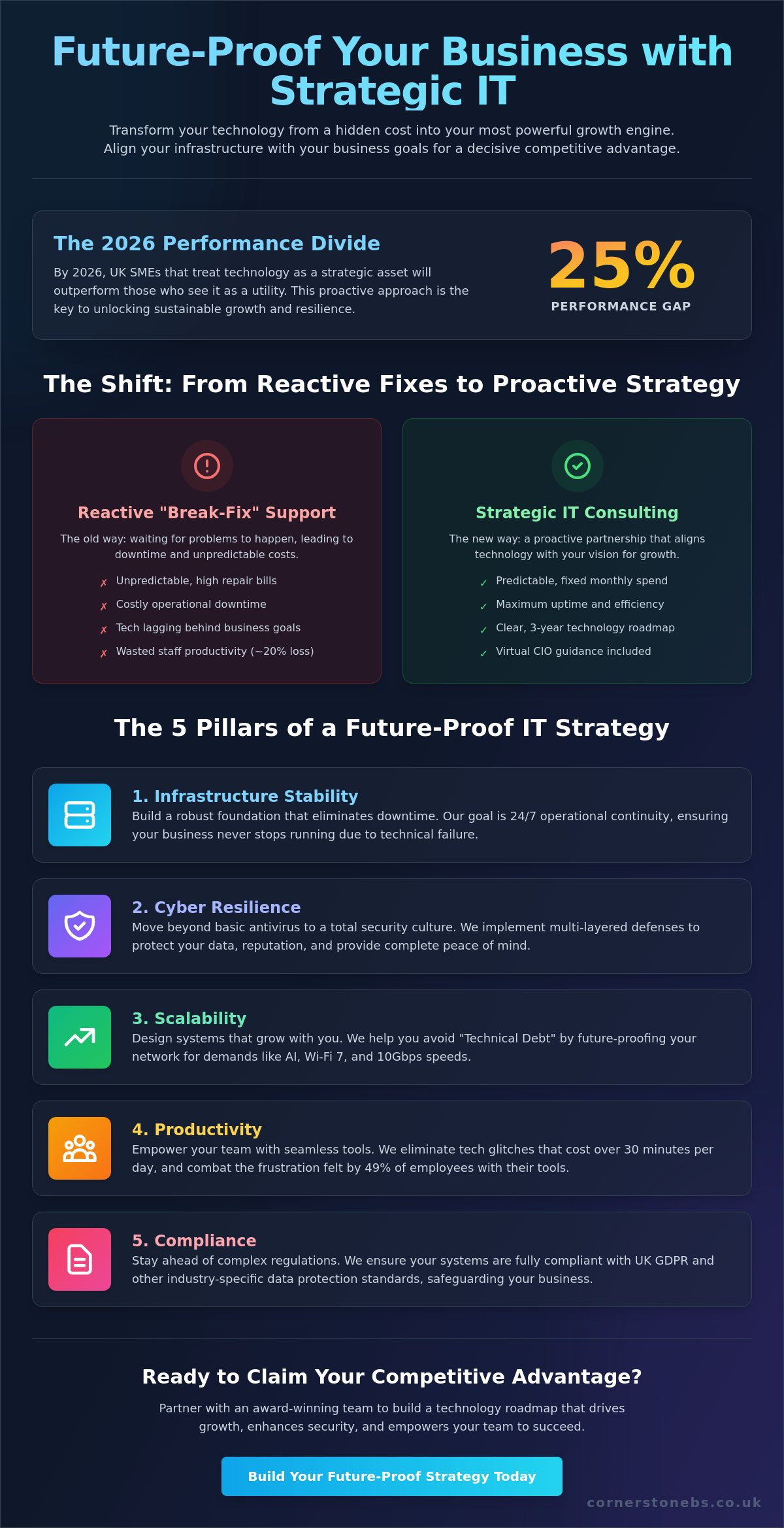
By 2026, the divide between UK firms that treat tech as a utility and those that treat it as a strategy will account for a 25% performance gap in the SME sector. It’s a daunting statistic if you’re currently dealing with sluggish systems or those nagging, unpredictable repair bills that always seem to land at the worst time. We know how it feels to worry that your North East business is falling behind because your tools just can’t keep up with your ambition.
The good news is that your technology doesn’t have to be a hidden cost. This guide explores how strategic IT consulting for small business transforms your infrastructure from a source of stress into a powerful growth engine. We’ll show you how our award-winning approach creates a clear technology roadmap, provides a predictable monthly spend, and ensures your team stays productive without the constant technical hitches. Let’s look at how you can claim your competitive advantage through better, smarter tools.
Key Takeaways
Learn how to shift from reactive “break-fix” support to a proactive partnership that transforms your technology into a powerful growth engine.
Discover how strategic IT consulting for small business identifies wasted software spend and “Shadow IT” to significantly improve your long-term ROI.
Master the 5 pillars of a future-proof strategy to ensure your infrastructure remains robust, reliable, and aligned with your 2029 business goals.
Understand the vital role of a Virtual CIO in building a culture of cyber resilience that provides total peace of mind for your UK-based enterprise.
See why an award-winning team with a “can-do” attitude offers the perfect blend of expert authority and regional warmth to support your growth.
What is Strategic IT Consulting for Small Business?
For years, many firms across the North East relied on “break-fix” support. You called a technician when a laptop died or the server went down. By 2026, this reactive approach is a recipe for stagnation. Our award-winning team sees strategic IT consulting for small business as a total shift in mindset. It moves technology from a cost centre to a growth engine. To understand the foundations, What is Strategic IT Consulting? It is the process of aligning your digital infrastructure with your long-term commercial goals.
This proactive partnership involves more than just keeping the lights on. It requires a Virtual CIO (vCIO) who understands the UK market. A vCIO provides senior-level guidance without the £95,000 average salary of a full-time executive. They identify hidden bottlenecks, such as legacy systems that waste roughly 20% of your staff’s productive hours. This high-level oversight ensures your technology roadmap stays ahead of the curve, providing the peace of mind you need to focus on your core operations.
Beyond the Helpdesk: The Strategic Difference
Helpdesks react to problems that already happened. Consulting prevents them from occurring in the first place. When we audit your setup, we focus on revenue drivers like seamless CRM integration and robust cloud infrastructure. We look for ways to automate repetitive tasks that drain your resources. Strategic IT consulting is the bridge between business vision and technical execution. It ensures your software choices actively contribute to your profit margins rather than just being a monthly expense.
When Should an SME Seek Strategic Advice?
You’ll know it’s time to seek expert advice when “good enough” IT starts costing you money. If your team relies on manual workarounds to share data or if your systems feel sluggish during peak hours, you’ve outgrown your current setup. By 2026, technology and business goals must be fully integrated to remain competitive. Several key signs indicate you need a more tailored approach:
Staff are losing more than 30 minutes a day to technical glitches.
Your current IT provider only speaks to you when something breaks.
You’re worried about meeting updated UK data protection standards.
You want to scale but don’t know if your current server can handle the load.
Relying on outdated hardware is often the biggest barrier to scaling. As we head toward 2026, strategic IT consulting for small business becomes essential for navigating trends like AI-driven automation and heightened cybersecurity threats. We’re here to have a chat and ensure your local business has the robust foundation it deserves.
The 5 Pillars of a Future-Proof IT Strategy
Building a resilient business in the North East requires more than just reactive fixes. It demands a proactive roadmap. Effective strategic IT consulting for small business ensures your technology acts as a springboard rather than a bottleneck. We focus on five core pillars to provide the award-winning reliability your team needs to thrive as we approach 2026.
Infrastructure Stability: We build a robust foundation that eliminates downtime and keeps your operations running 24/7.
Cyber Resilience: We move your firm beyond basic antivirus software toward a total security culture that protects your reputation.
Scalability: Our experts design systems that expand alongside your revenue without requiring a total “rip and replace” every two years.
Productivity: We empower your staff with seamless collaboration tools that make hybrid working feel natural and efficient.
Compliance: We keep you ahead of UK GDPR and industry-specific data regulations to ensure you stay protected and professional.
Infrastructure and Scalability
Modern growth depends on cloud solutions that adapt as your headcount changes. We help you avoid “Technical Debt,” which occurs when cheap, short-term hardware choices lead to expensive replacements within 18 to 24 months. By 2026, UK businesses will need networks capable of supporting Wi-Fi 7 and increased 10Gbps speeds to handle data-heavy AI applications. Investing in robust, tailored hardware now prevents massive reinvestment later. This forward-thinking approach provides the peace of mind that your network won’t buckle under future bandwidth demands.
Productivity and the Employee Experience
Staff retention remains a significant challenge for UK SMEs. Research from Ivanti shows that 49% of employees feel frustrated by the technology provided by their employers, which often leads to “quiet quitting.” A successful Microsoft 365 migration creates a modern, hybrid environment where collaboration is instant and secure. We also leverage AI and automation to remove the repetitive, “boring” tasks that drain morale. When your IT works perfectly, your team stays focused, happy, and productive. It’s about creating a culture where technology supports people, not the other way around.
Our proactive approach to strategic IT consulting for small business turns your tech stack into a competitive advantage. If you want to see how your current setup compares to 2026 standards, let’s have a quick chat about your goals.
Consulting vs. Traditional Support: The ROI Framework
Most firms view IT as a utility, like water or electricity. You only notice it when it stops working. This reactive “break-fix” model is a hidden drain on your capital. While traditional support focuses on patching holes, strategic IT consulting for small business focuses on building a foundation that doesn’t crack. The shift from a cost centre to a growth engine starts here. Our award-winning team at Cornerstone sees this transformation daily across the North East.
The primary objection to consulting is often the initial investment. However, the upfront cost is frequently offset by eliminating “Shadow IT.” This occurs when staff buy their own software tools because the company systems are too slow or complex. Industry data from 2024 indicates that UK businesses waste roughly 30% of their annual software budget on duplicate or unused subscriptions. A strategic partner identifies these redundancies, often saving more in monthly outgoings than the cost of the consultancy itself.
Beyond the balance sheet, there is the “Peace of Mind” factor. We aim to reduce the mental load on business owners. You shouldn’t spend your evenings worrying about data backups or system patches. We handle the technical complexity so you can focus on your core business goals. It’s a proactive partnership that replaces “what if” with “what’s next.”
Calculating the Real Cost of Downtime
Downtime is expensive. Research from Beaming suggests that a single day of total system failure can cost a UK small business upwards of £4,000 in lost productivity and missed opportunities. However, “slow time” is often more damaging. This is the period where staff struggle with lagging systems or unreliable connections. If a team of ten loses just 15 minutes a day to technical friction, you lose over 600 hours of productivity every year. Our managed IT services provide a predictable budget, turning volatile repair bills into a steady, manageable investment that prevents these losses before they happen.
Efficiency Gains Through Strategic Audits
A strategic audit is the first step in our partnership. We look deep into your infrastructure to find legacy hardware that costs more to maintain than to replace. We often find that fragmented communication tools are the biggest bottleneck. By implementing a unified business VoIP strategy, we remove the friction between office-based and remote staff.
The results are tangible. In a recent project, a 10-person professional services firm in Teesside saved 5 hours per employee every single week. We achieved this by automating their document workflows and upgrading their outdated network. That’s 50 hours of recovered time every week for the business. This isn’t just a technical fix; it’s a massive boost to their bottom line. We’d love to have a chat about how we can do the same for your team.
Building Your 3-Year Technology Roadmap: A Step-by-Step Approach
A technology roadmap isn’t just a list of hardware to buy; it’s a strategic plan that ensures your digital tools support your commercial ambition. Our award-winning team at Cornerstone helps North East firms move from reactive fixes to proactive growth. We use a structured five-step process to build your 36-month vision.
Step 1: The Comprehensive IT Audit. We assess your current state, looking at server health, cloud capacity, and security vulnerabilities.
Step 2: Business Goal Alignment. We define where you want to be in 2029. If you plan to double your staff, your infrastructure must scale ahead of that growth.
Step 3: Gap Analysis. This phase identifies exactly what’s missing. We compare your current “tech debt” against the tools required to meet your future targets.
Step 4: Budgetary Planning. We help you spread the £ investment across the three-year period. This manages your cash flow while ensuring you never fall behind.
Step 5: Execution and Continuous Review. Technology moves fast. We review the roadmap every quarter to ensure it still fits your evolving needs.
By using strategic IT consulting for small business, you stop wasting money on “sticky-tape” solutions. You start investing in a foundation that delivers long-term peace of mind.
The Audit and Goal Setting Phase
A professional consultant looks for more than just old PCs. During an initial audit, we examine data flow, backup reliability, and software licensing. We translate your business goals into technical requirements. For example, a desire to increase remote working leads to a robust cloud migration strategy. We also identify “Quick Wins.” These are small changes, like optimising Wi-Fi dead zones or streamlining login processes, that provide immediate relief to your staff and boost productivity within the first 30 days.
Phasing Your Investment
Successful businesses don’t try to change everything at once. Rapid, total overhauls often lead to staff burnout and technical glitches. We recommend a phased approach that prioritises cyber security services first. Protecting your existing assets is the most critical step before adding new features. By setting quarterly milestones, you can track the success of your roadmap clearly. This steady pace ensures your team remains confident and your systems stay stable as you grow.
Our strategic IT consulting for small business is designed to make complex technology simple and reliable. We act as your long-term partner, ensuring your North East business stays ahead of the curve through 2026 and beyond.
The Cornerstone Approach: Award-Winning Strategic Partnership
Technology should work for you, not the other way around. At Cornerstone, we combine a proactive “can-do” attitude with the regional warmth of our North East heritage. This makes us the ideal national partner for companies that value personality alongside performance. We don’t just fix servers; we act as a seamless extension of your internal team. Our multi-award-winning status reflects our commitment to solving SME challenges with precision. By choosing our strategic IT consulting for small business, you gain access to experts who prioritise your growth over technical complexity.
We operate as your outsourced IT department, minus the high overheads of a full internal team. Our engineers handle everything from 24/7 monitoring to long-term digital roadmaps. This allows your staff to stay productive and focused on their core roles. We take the time to understand your unique workflows, ensuring every piece of hardware and software serves a specific purpose in your 2026 growth plan.
A Partnership Built on Trust
Trust starts with a person, not a portal. Every client gets a dedicated account manager who understands their specific business goals. You won’t be passed around a faceless call centre or stuck in an endless ticketing queue. Our status as a multi-award-winning provider, including recent accolades for service excellence in 2024 and 2025, ensures you receive support that meets rigorous industry standards. We’re proud of our roots, and that community-focused mindset drives us to go the extra mile for every partner.
We believe in the “Cornerstone Chat.” This is our commitment to avoiding confusing jargon. We prefer clear, honest conversations that focus on results. It’s about giving you peace of mind. We translate technical “bits and bytes” into “pounds and pence,” showing exactly how a tech investment improves your bottom line. If a solution doesn’t add value to your business, we won’t recommend it.
Getting Started with Your Strategy
Your first strategic consultation is a deep dive into your current setup and future ambitions. We look at your 2026 growth targets and map out the technology required to reach them. This isn’t a one-size-fits-all approach. We tailor our managed services to fit your unique requirements, whether that involves complex cloud migration or enhanced cybersecurity protocols. During this initial session, we identify immediate efficiencies. We often find that SMEs can reduce operational downtime by 22 percent through proactive infrastructure optimisations identified in the first month of working with us.
We invite you to a no-obligation chat about your business future. Let’s discuss how our strategic IT consulting for small business can provide the foundation for your next stage of growth. We’re ready to help you build a more robust, efficient, and profitable company. Our team is standing by to help you turn technology from a cost centre into a genuine competitive advantage.
Secure Your Competitive Edge with a 2026 Technology Roadmap
Moving beyond reactive fixes to a proactive 3-year roadmap isn’t just a technical upgrade; it’s a vital commercial strategy. Businesses that align their tech with long-term goals often see significant productivity boosts, especially when leveraging the 20% efficiency gains typical of integrated cloud systems. Our multi-award-winning team provides the strategic IT consulting for small business that transforms IT from a cost centre into a growth engine. We combine proactive monitoring with official partnerships from Microsoft, Cisco, and IBM to ensure your infrastructure is both robust and future-proof. As a proud North East based partner, we focus on delivering the peace of mind you need to lead your company with confidence. We’ll handle the complex technical architecture while you focus on what you do best. Your business deserves a bespoke strategy that reflects your unique ambitions and local roots. Let’s start building that foundation today.
What is the difference between an IT consultant and an IT support provider?
IT support focuses on fixing immediate technical issues, while strategic IT consulting for small business builds a proactive roadmap for your future growth. Think of support as the mechanic who repairs your vehicle and the consultant as the navigator planning your most efficient route across the North East. Our award-winning team ensures your technology aligns with your 2026 commercial goals rather than just keeping the lights on.
How much does strategic IT consulting cost for a small business?
According to industry benchmarks from platforms like Clutch, UK IT consultancy rates typically range from £100 to £250 per hour. Costs vary based on your project scope and specific business size. We focus on providing a clear return on investment by eliminating wasteful spending on redundant systems. Our local team provides transparent pricing models that help small firms manage their budgets effectively without hidden surprises.
Does my small business really need a 3-year technology roadmap?
You definitely need a three year roadmap to prevent expensive panic buying when systems inevitably fail. A long term plan allows you to stagger investments and avoid the 40% budget wastage often seen in unplanned IT spending. This proactive approach ensures your infrastructure scales naturally as your company grows. It provides the peace of mind that comes from knowing your technology is ready for the 2026 market.
Can strategic IT consulting help with cyber security compliance?
Strategic consulting is essential for meeting UK standards like Cyber Essentials and GDPR requirements. We help you implement robust frameworks that protect your data and satisfy insurance providers. Our award-winning consultants audit your current setup to identify gaps before they become costly breaches. This proactive security stance builds trust with your clients and keeps your North East business compliant with the latest 2026 regulations.
How long does it take to see results from a new IT strategy?
You’ll often see immediate improvements in system stability, but full strategic ROI typically takes three to six months to realise. Initial wins come from fixing the bottlenecks that currently frustrate your staff. Long term benefits emerge as your streamlined processes reduce operational costs and improve service delivery. We track these milestones closely to ensure your new strategy delivers the exact growth you expect.
Will a consultant recommend that I replace all my current hardware?
A consultant won’t automatically tell you to scrap your current hardware. We evaluate your existing kit to see what can be optimised or moved to the cloud. If a device is over five years old and slowing down your team, we’ll recommend a phased replacement plan. Our goal is to create a seamless environment using the most cost effective tools available for your specific business needs.
What is a vCIO and do I need one for my small business?
A vCIO is a Virtual Chief Information Officer who provides high level technical leadership without the £80,000 plus salary of a full time executive. You need one if you want expert guidance on digital transformation and budget planning. Our award-winning vCIO services give you access to senior expertise on a flexible basis. It’s a smart way for small firms to get the strategic IT consulting for small business they need to compete.
How do I know if my current IT provider is being strategic or just reactive?
Your provider is reactive if you only hear from them when something breaks. A strategic partner schedules quarterly reviews and brings you new ideas before you ask for them. If your IT firm hasn’t mentioned 2026 security trends or efficiency upgrades in the last 90 days, they’re likely just a break-fix shop. We pride ourselves on being proactive partners who stay ahead of the curve for our North East clients.