Posted on: July 26th, 2026 by Cornerstone
Did you know that 73% of organizations reported at least one ransomware attack in 2024, and by June 2026, the number of active threat groups reached 146? It’s a staggering figure that makes the fear of total data loss feel very real for any business owner. As a multi-award-winning national IT provider, we understand that you’re likely juggling the complexities of hybrid cloud systems while worrying about the $1.7 million average cost of recovery. You need a ransomware recovery plan that works as hard as you do, providing a clear path back to full operations without the uncertainty of legal ransom debates.
We’re here to help you turn that anxiety into a proactive strategy. You’ll discover how to build a roadmap that protects your data, slashes your recovery time objectives, and ensures every file is verified for integrity after an incident. This guide provides a step by step look at modern business continuity, from implementing immutable backups to meeting the latest 72 hour CIRCIA reporting mandates. It’s about giving your team the confidence to stay focused on growth, knowing your digital foundations are rock solid and your operations are resilient.
Key Takeaways
- Understand why standard daily backups aren’t enough to stop modern triple-extortion tactics.
- Discover how to build a robust ransomware recovery plan that ensures operational continuity and eliminates the need to pay a ransom.
- Learn how immutable backups and Zero Trust architecture keep your data safe and unchangeable during an attack.
- Master the specific steps to isolate infected systems and identify the entry point to minimize downtime.
- See how proactive monitoring and specialized cyber security audits create a foundation for long-term business stability.
Why Your Business Needs a Ransomware Recovery Plan in 2026
The threat landscape has shifted dramatically over the last few years. To understand the foundational basics, you can explore What is Ransomware?, but for a business operating in 2026, the stakes are significantly higher than simple file encryption. Modern attackers now employ triple extortion tactics. They don’t just lock your systems; they steal sensitive data and threaten to leak it publicly or contact your clients directly to demand payment. This evolution means a traditional ransomware recovery plan must do more than just restore files. It has to manage a full scale business crisis while protecting your hard-earned reputation.
Daily backups were once the gold standard for safety. However, 2026 ransomware groups are more patient and calculated. They often spend weeks performing reconnaissance inside your network before launching an attack. Their first target is almost always your backup repository. If your data isn’t immutable or kept entirely separate from your main network, it’s a sitting duck. If your current strategy relies on a single daily sync, you’re essentially handing the keys to the burglars. Resilience requires a more sophisticated approach to data integrity.
The financial reality is sobering. Research shows the average cost to recover from a ransomware attack is now $1.7 million, and that doesn’t even include the ransom itself. When you factor in the median ransom demand of $1.32 million, the potential for total financial ruin is clear. Investing in a robust ransomware recovery plan isn’t just a technical expense. It’s a strategic move to protect your balance sheet. A documented plan minimizes the variables and gives your business the muscle memory to react instantly, which is the only way to keep downtime costs from spiralling out of control.
The Shift from Prevention to Resilience
Modern cyber security assumes a breach will happen. We call this the “when, not if” mentality. While stopping an attack is the goal, surviving one is what keeps you in business. A recovery plan acts as your digital insurance policy. It ensures that when a breach occurs, your team knows exactly how to keep the lights on. It’s the difference between a minor operational hiccup and a permanent closure. We focus on building the strength and customization needed to ensure your business remains standing, no matter what the digital world throws at it.
Regulatory Pressure and UK Compliance
The legal landscape is tightening for every UK business owner. The ICO maintains a strict stance on data protection, and failing to have a documented recovery process can lead to significant fines and legal scrutiny. Furthermore, many cyber insurance providers now demand a verified ransomware recovery plan before they’ll even consider issuing a policy. Following NCSC standards isn’t just about checking a box. It’s a foundational requirement for stability. We partner with you to ensure your systems meet these rigorous standards, providing emotional security alongside technical excellence.
The Anatomy of a Modern Ransomware Recovery Strategy
A modern ransomware recovery plan is much more than a technical backup script. It’s a coordinated playbook that aligns your technical response with your core business objectives. Think of it as an operational “muscle memory” exercise. When an attack occurs, your team shouldn’t be debating what to do; they should be executing a rehearsed series of steps. This strategy ensures that your business remains resilient, even when your primary systems are compromised.
To build this resilience, you must define two critical metrics: your Recovery Time Objective (RTO) and your Recovery Point Objective (RPO). RTO is the maximum amount of time your business can survive without its systems. RPO is the volume of data you can afford to lose, measured in time. For most modern enterprises, these numbers are now measured in minutes, not days. The “Golden Rule” of any strategy is simple: never rely on the attacker for decryption. Even if a ransom is paid, there is no guarantee of data recovery, and 69% of organizations now refuse to pay entirely. If you’re looking for a structured starting point, CISA’s Ransomware Guide provides excellent foundational checklists for these definitions.
Incident Response: The First 24 Hours
The first 24 hours are about containment and evidence. You must stop the malware from spreading laterally across your network. Don’t simply “wipe and reinstall” everything immediately. You need to preserve evidence to satisfy legal reporting requirements, such as the 72 hour CIRCIA mandate for critical infrastructure. Your Incident Response team should include IT experts, legal advisors, and senior leadership to ensure every decision is documented and compliant. If you need a partner to help manage these complexities, our Cyber Security services can provide the expert oversight required.
Disaster Recovery: The Restoration Phase
Restoration is a methodical process of bringing critical business functions back online. You don’t restore everything at once. Instead, you prioritise systems that are essential for revenue and operations. We advocate for the “Clean Room” concept. This involves restoring your data into a secure, isolated environment where it can be scanned and verified. This step is vital to ensure your “clean” backup doesn’t actually contain a dormant version of the original malware, preventing a secondary infection immediately after recovery.
Strategic Pillars: Immutable Backups and Zero Trust Architecture
A successful ransomware recovery plan relies on two non-negotiable pillars: data that cannot be deleted and an environment where no user is automatically trusted. In the past, having a copy of your data was enough. In 2026, that copy must be immutable. This means once the data is written, it cannot be changed, encrypted, or deleted for a set period. It creates a “gold copy” that remains untouched even if an attacker gains full administrative access to your network. Without immutability, your backups are just another target for the encryption process.
Identity resilience is the second half of this foundation. Attackers prioritize admin credentials because they provide the keys to the entire kingdom. We focus on protecting these identities through a Zero Trust model. This approach assumes that every user, device, and connection is a potential threat until proven otherwise. When you are recovering from a ransomware attack, a Zero Trust architecture ensures that the malware cannot piggyback on legitimate credentials to re-infect your systems during the restoration phase. It keeps your recovery environment isolated and clean.
Securing the Backup Infrastructure
Modern attackers hunt for backups before they ever trigger the encryption on your main servers. To counter this, we implement the 3-2-1-1 rule. This involves keeping three copies of your data on two different media types, with one copy offsite and one copy entirely immutable or air-gapped. Air-gapped storage remains physically or logically disconnected from the network, making it invisible to hackers. We also utilize Write-Once-Read-Many (WORM) storage, which provides a hardware-level guarantee that your records remain permanent and unalterable during a crisis.
Implementing Zero Trust in Recovery
Restoring data into a compromised network is like pouring clean water into a dirty bucket. Micro-segmentation allows us to divide your network into small, isolated zones. This prevents lateral movement, ensuring that if one segment is compromised, the rest of the business remains safe. Multi-Factor Authentication (MFA) is a non-negotiable requirement for every recovery tool and administrative login. Finally, we use continuous monitoring to detect any signs of re-infection while the data dump is in progress. This proactive oversight ensures that your ransomware recovery plan results in a stable, permanent restoration rather than a secondary breach.
Step-by-Step: Executing Your Ransomware Response and Restoration
When the red alert sounds, your ransomware recovery plan transitions from a strategic document into a vital lifeline. The first action is immediate containment. You must isolate the affected network segments to prevent the infection from reaching your clean backups or uncompromised servers. Once the spread is halted, your Incident Response team begins the forensic work of identifying the specific ransomware strain and the “patient zero” entry point. This knowledge is vital. It tells you if the attackers are still present and how to close the door behind them so they can’t return during the restoration.
Restoration follows a strict hierarchy. You don’t just flip a switch and hope for the best. Instead, you follow a methodical sequence to ensure stability:
- Assess backup integrity: Select the most recent clean recovery point that predates the infection.
- Restore foundational infrastructure: Prioritise Active Directory, DNS, and Email. Without these, nothing else works.
- Business-line applications: Gradually bring these back online in order of their importance to revenue and operations.
This staged approach ensures that your core systems are stable before you attempt to resume full business activities, reducing the risk of a secondary crash.
Communication and Legal Obligations
Managing the human element is just as critical as the technical restoration. You need a clear internal communication strategy to keep staff informed without triggering a panic. Externally, you must decide when and how to notify stakeholders and clients. Transparency builds trust, but it must be handled with professional care. Remember, the ICO requires you to report significant data breaches within 72 hours. Failing to meet this deadline can lead to severe penalties and lasting damage to your reputation. Our team can help you manage these Disaster Recovery requirements with the precision your business deserves.
Testing the Plan: The Tabletop Exercise
A plan that only exists on paper is a liability. You must test your strategy under pressure through regular “Tabletop Exercises”. These simulations involve senior leadership and IT staff walking through a hypothetical attack scenario. It helps you identify bottlenecks, such as slow data transfer speeds or unclear decision-making chains. Refining your ransomware recovery plan based on these test failures ensures that when a real attack happens, your team acts with the confidence of a well-drilled unit. It turns a potential disaster into a managed operational challenge.
Building Cyber Resilience with Cornerstone Business Solutions
While the technical pillars of a ransomware recovery plan are essential, the success of your restoration depends on the team managing the process. We understand that every business has unique vulnerabilities and operational requirements. That’s why we move beyond generic security scripts to build a bespoke resilience strategy that aligns with your specific goals. Our proactive approach ensures that you aren’t just prepared for an attack; you’re equipped to thrive despite one. We act as your dedicated long-term partner, providing the expert oversight needed to turn a complex technical challenge into a manageable business process.
National businesses trust us because we provide more than just software. We deliver peace of mind through a unified recovery strategy that integrates your Cloud Solutions and Microsoft 365 environments into one resilient ecosystem. This holistic view is vital for modern hybrid-cloud setups where data is often spread across multiple platforms. By centralising your defence and restoration protocols, we eliminate the confusion that often follows a breach. Our goal is to ensure that your data remains integral and your operations continue without the need to ever consider a ransom payment.
Bespoke Technology Solutions
Take the First Step Toward Resilience
Future Proof Your Business Continuity
Building a ransomware recovery plan is about more than just data; it’s about protecting the future of your company and the people who depend on it. We’ve explored how shifting from simple prevention to true resilience, backed by immutable storage and Zero Trust principles, can eliminate the fear of total data loss. By treating recovery as a practiced muscle memory exercise rather than a technical afterthought, you ensure your operations stay stable even during a crisis.
As a multi-award-winning IT services provider and expert partner to Microsoft, IBM, and Cisco, we’re here to help you navigate these complexities. Our proactive 24/7 system monitoring ensures your infrastructure is always under a watchful eye, grounded in our commitment to the success of our local business community. We pride ourselves on being more than a vendor; we’re a dedicated partner in your long-term stability.
Ensure your business is resilient with a professional Cyber Security Audit. You don’t have to face the evolving threats of 2026 alone. Let’s start a conversation today and build a foundation that keeps your business moving forward with confidence.
Frequently Asked Questions
Should we ever pay the ransom to recover our data?
You shouldn’t pay the ransom because there’s no guarantee that attackers will actually provide the decryption key. Paying also marks your business as a profitable target for future extortion. A robust ransomware recovery plan ensures you can restore your own systems without ever opening your wallet to criminals. Refusing to pay is now the standard for 69% of organizations, according to 2026 industry data.
How long does a typical ransomware recovery take?
Recovery timelines depend entirely on your defined Recovery Time Objective (RTO) and the scale of the infection. While some critical systems can be back online within hours, a full restoration of non-essential data often takes several days. The speed of your response is determined by the “muscle memory” of your team and the efficiency of your isolated recovery environment. Proper planning ensures you aren’t starting from scratch during a crisis.
Is a cloud backup enough to protect us from ransomware?
A standard cloud backup isn’t enough because modern malware can often sync to and encrypt your cloud repositories. You need immutable cloud storage that prevents data from being altered or deleted once it’s written. We recommend the 3-2-1-1 rule, which includes keeping one copy entirely offline or air-gapped. This ensures a “gold copy” of your data remains safe regardless of what happens to your live network.
What is the first thing we should do if we suspect an attack?
You must isolate the suspected device from the network immediately by disconnecting the ethernet cable or disabling the Wi-Fi. This simple action prevents the malware from spreading laterally to other servers or your backup infrastructure. Once the threat is contained, you should activate your incident response team to begin forensic analysis. Don’t restart the machine or wipe it yet, as you need to preserve evidence for legal reporting.
Can ransomware infect our backup files?
Ransomware can absolutely infect your backups if they are connected to your primary network during the attack. In fact, 2026 threat groups specifically hunt for backup credentials as their first priority. This is why having a ransomware recovery plan that includes immutable storage and air-gapped backups is non-negotiable. Without these protections, your safety net can be destroyed before you even realize a breach has occurred.
How often should we test our ransomware recovery plan?
We recommend testing your plan at least quarterly through tabletop exercises and full restoration drills. Your IT environment changes constantly with new hardware and software updates, so a plan from six months ago might already be outdated. Regular testing identifies bottlenecks in your restoration speed and ensures your team stays sharp. It’s about building the confidence to act decisively when every minute of downtime costs your business money.
Does cyber insurance cover the cost of a ransomware recovery plan?
Cyber insurance typically covers the costs of recovery after an attack, but most carriers now require a documented recovery plan as a condition of your policy. They want to see that you have proactive controls like MFA and immutable backups in place before they offer coverage. While the insurance offsets financial loss, it’s your internal strategy that determines how quickly you can actually get back to serving your clients.
What are the reporting requirements for a ransomware attack in the UK?
You must report a significant data breach to the Information Commissioner’s Office (ICO) within 72 hours of becoming aware of it. If your business falls under critical infrastructure, you’re also subject to CIRCIA mandates, requiring a report within the same timeframe. Failing to meet these deadlines can result in heavy fines and legal scrutiny. Having a clear reporting protocol within your business continuity guide ensures you stay compliant under pressure.
Posted on: May 28th, 2026 by Cornerstone
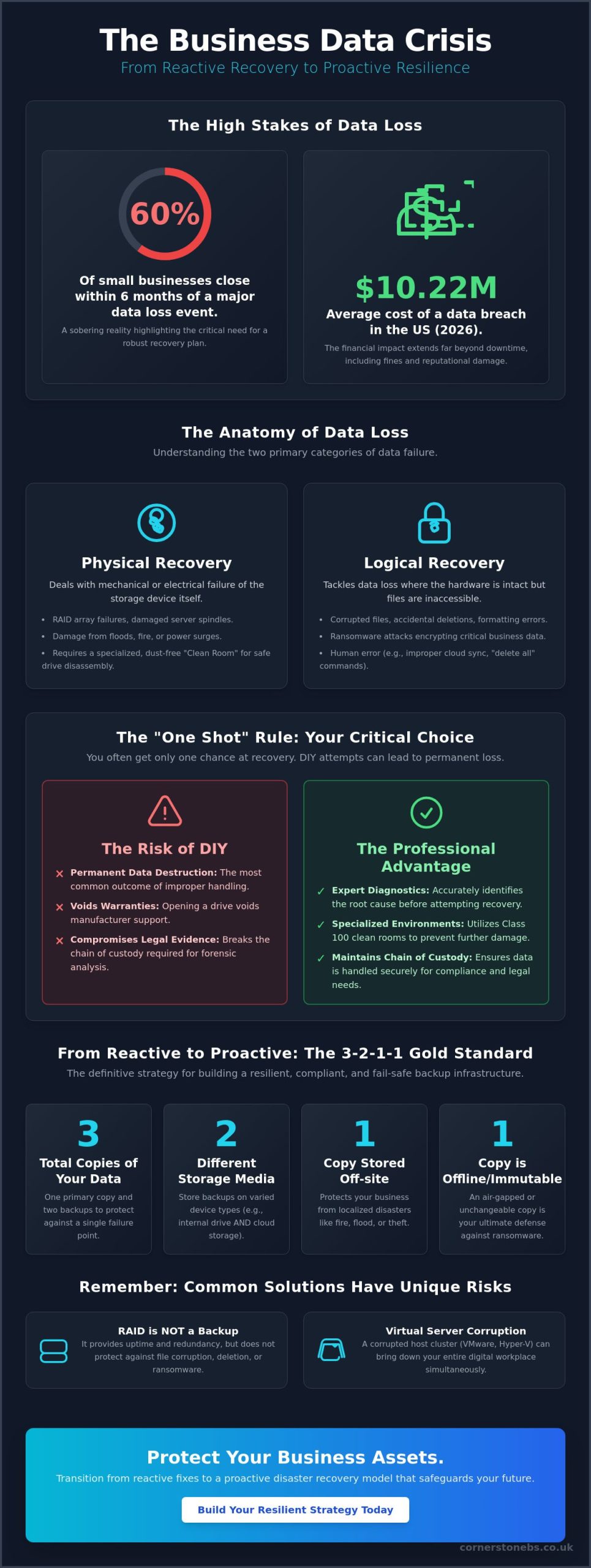
Sixty percent of small businesses that experience a major data loss event close their doors within just six months. It is a sobering reality, especially when you consider that the average cost of a data breach in the United States has climbed to $10.22 million in 2026. You have likely felt the mounting pressure of keeping up with strict regulations like California’s SB 446 while searching for professional business data recovery services that truly understand the cost of operational downtime. It is natural to feel protective of the assets you have worked so hard to build within our community.
Key Takeaways
- Distinguish between physical hardware failures and logical data corruption to select the most effective path for business data recovery services.
- Learn how expert restoration of RAID arrays and SQL databases prevents long-term operational downtime for your core infrastructure.
- Understand the “One Shot” rule and why professional diagnostics are essential to avoid the permanent loss often caused by DIY recovery attempts.
- Discover how to transition from reactive fixes to a proactive disaster recovery model that safeguards your business assets before a crisis hits.
- Implement the 3-2-1-1 backup gold standard to ensure your organization remains resilient and compliant in an evolving digital landscape.
What Are Business Data Recovery Services in 2026?
Professional business data recovery services represent much more than just “fixing a broken drive.” At its core, What is Data Recovery involves the sophisticated process of salvaging inaccessible, lost, or corrupted information from business-grade storage systems. While a consumer might focus on saving personal photos, your organization needs to restore entire SQL databases, virtualized environments, and encrypted archives to maintain operational continuity. We see this as a foundational element of your business stability, not just a technical fix.
We categorize these efforts into two distinct areas. Physical recovery deals with mechanical failure; imagine a server damaged by a localized flood or a RAID array with multiple failed spindles. This work often requires a specialized “Clean Room” environment. These labs are designed to keep the air completely free of dust particles that could ruin sensitive drive platters during an open-drive procedure. Logical recovery, however, tackles corrupted files, accidental deletions, or data held hostage by ransomware. In 2026, business data recovery services must be agile enough to handle both scenarios across complex hybrid-cloud setups.
The scale of business recovery is what sets it apart. You aren’t just dealing with higher volumes of data; you are dealing with layers of encryption and strict compliance requirements. A local expert understands that your data isn’t just a collection of bits. It is your reputation, your intellectual property, and your legal responsibility.
The Evolution of Data Loss: More Than Just Hardware Failure
Data loss isn’t always a dramatic hardware crash. Simple human error remains a leading cause of downtime. Whether it’s an accidental “delete all” command or an improperly configured cloud sync, the results are equally devastating. We are also seeing a rise in “stealth ransomware” that sits dormant in your backups for months before activating. This makes “clean recovery” a vital part of your strategy, as it ensures you aren’t just restoring the same malware that caused the initial crisis. Logical corruption within complex virtualized environments is another growing hurdle that requires expert intervention to untangle.
Why Professional Services Are Non-Negotiable for UK Firms
Compliance is a major driver for professional intervention. With the 2026 updates to data protection laws, the financial penalties for losing client data are staggering. You need a partner who maintains a strict chain of custody. This is essential for legal and forensic evidence if a breach occurs. Trying a “DIY” fix on a failing drive usually results in permanent data destruction. You often get just one chance to get it right. We take that responsibility seriously, acting as your dedicated partner to ensure your data remains secure and your business stays compliant.
Critical Recovery Scenarios: RAID, Servers, and Cloud Infrastructure
Modern business storage is a complex web of interconnected systems. While these setups provide incredible speed and efficiency, they also create unique challenges when things go wrong. Professional business data recovery services must look beyond simple file retrieval to understand the architectural nuances of your NAS, SAN, and server environments. We know that for a local business, every hour your SQL database or Exchange server is offline is an hour of lost opportunity. Our goal is to bridge that gap with expert precision and local reliability.
RAID and Enterprise Storage Challenges
Many business owners believe that RAID is a substitute for a backup. It isn’t. RAID provides uptime, not data protection. If a multi-disk failure occurs in a RAID 5 or RAID 6 configuration, the “rebuild” process itself can often stress the remaining healthy drives to the point of total collapse. We specialize in reconstructing data from these striped and parity-based configurations, even when proprietary file systems are involved. Recovering an enterprise array requires a deep understanding of block-level data distribution. A solid disaster recovery strategy serves as your first line of defense, but when hardware fails, specialized reconstruction is the only way forward.
Server recovery extends to virtualized environments like VMware and Hyper-V. When a host cluster becomes corrupted, it doesn’t just affect one machine; it can bring down your entire digital workplace. We treat these virtual machine (VM) recoveries with the highest priority, untangling the corruption within the hypervisor to restore your proprietary business applications and data layers.
Recovering the Modern Hybrid Workspace
The SERP gap in most recovery discussions is the “cloud safety” myth. Just because your data lives in Microsoft 365, SharePoint, or Azure doesn’t mean it’s immune to loss. Accidental deletions, sync errors, and “SaaS Data Sprawl” can leave critical information scattered and inaccessible. We help you retrieve data from these cloud environments and remote worker devices, ensuring your mobile endpoints are back in the loop quickly.
Recovering data is only half the battle. In 2026, we must ensure that the restored information isn’t hiding dormant malware. Integrating robust cyber security services into the recovery process ensures that your “clean” data is actually safe to use. This proactive approach protects your infrastructure from immediate re-infection. If you’re concerned about the resilience of your current setup, we’d love to chat about our cloud solutions and how they can simplify your path to recovery.
The Business Case for Professional Recovery vs. DIY Attempts
The “Downtime Clock” starts the moment a system fails. For most organizations, the true cost of an outage isn’t just the IT bill. It’s the cumulative loss of productivity, missed deadlines, and the erosion of client trust. While it might be tempting to reach for a “free” tool found online, professional business data recovery services offer a level of certainty that software alone cannot match. We view data recovery as a critical component of your broader business stability. We want to ensure your operations return to normal with minimal friction.
Understanding the official disaster recovery plan definition highlights that true resilience is about more than just backups. It is about a structured, expert response. One of the most vital concepts we share with our partners is the “One Shot” rule. The first attempt at recovering data from a compromised device is statistically your most likely path to success. Every subsequent attempt, especially those made by untrained hands, significantly decreases the chances of a full restoration. A human engineer brings a level of diagnostic nuance that automated tools simply lack.
The Hidden Risks of DIY Recovery Software
Using automated software on a failing hard drive is often like trying to run a marathon on a broken leg. If the drive has a mechanical issue, such as a motor failure or a head crash, running software forces the device to spin at high speeds. This can cause the read heads to scrape across the data platters. This often turns your valuable information into literal dust. Unlike the generic advice found on public forums, we can identify these mechanical warnings before a single bit is read. This protects your hardware from permanent, irreversible damage.
Confidentiality and Compliance in the Recovery Process
Your intellectual property is the lifeblood of your company. When you partner with a local expert, you ensure that your sensitive data never leaves the UK. We use strict security protocols, including background-checked staff and robust Non-Disclosure Agreements (NDAs), to give you total peace of mind. Every recovered file is returned on an encrypted drive. This maintains a secure chain of custody from start to finish. This level of care is essential for meeting modern regulatory standards and protecting your professional reputation. We don’t just recover files; we protect your business’s future.
The Professional Data Recovery Process: What to Expect
When you reach out for business data recovery services, the first step is always a transparent conversation. We need to understand your specific timeline. Whether it’s a single database or an entire server cluster, we establish the criticality of the lost data to ensure our engineering resources are focused where they matter most for your continuity. This initial consultation isn’t just about technical specs; it’s about understanding how the loss impacts your team and your clients. We want to provide a clear path forward that eases the immediate stress of the situation.
Once we have your media in our lab, we move into the diagnostic phase. Our engineers identify the root cause of the failure, distinguishing between physical hardware damage and logical corruption. We then provide you with a comprehensive quote and a detailed file list. You’ll see exactly what is recoverable before you commit to the full service. During the actual recovery phase, we use specialized hardware to clone your device bit-by-bit. This allows us to extract data from a stable copy, protecting your original hardware from any further wear or risk. Finally, we verify the integrity of every file to ensure your data is ready for immediate use.
Diagnostic and Assessment: The Critical First 24 Hours
Our engineers use specialized “Read-Only” tools during the testing phase. These tools prevent the operating system from writing any new metadata to your drive, which is vital for preserving the current state of your files. You will receive a “File Tree” report that acts as a digital inventory of your recoverable assets. This transparency is a cornerstone of our service. Most professional partners operate on a “No Data, No Fee” structure, meaning you only pay for the successful retrieval of the information you actually need. It’s a proactive way to build trust during a difficult time.
Secure Delivery and Post-Recovery Support
We offer multiple options for the secure return of your data, including encrypted physical media or a direct, secure cloud transfer. We don’t just hand you a drive and consider the job done. Our team can work alongside your internal IT staff to assist with the re-integration of recovered databases or email archives into your existing network infrastructure. A certified Clean Room is a specialized laboratory environment that utilizes high-efficiency particulate air filtration to eliminate microscopic dust that would otherwise destroy exposed drive platters during physical repair. If you are dealing with a sudden outage, invite us to a conversation so we can start your diagnostic today.
Beyond Recovery: Building a Resilient Disaster Recovery Strategy
While expert business data recovery services act as a vital safety net, our ultimate goal is to build a system where you never have to experience the panic of data loss. We want to help you move away from a reactive “emergency fix” mindset. Instead, we focus on a proactive model that prioritizes total business continuity. We don’t just want to be the team you call after a crash; we want to be the partners who ensure your operations stay steady, no matter what happens in the digital landscape.
The 3-2-1 backup rule is still the gold standard for protection, but in 2026, we have taken it a step further. You should keep three copies of your data on two different media types, with at least one copy stored off-site and immutable. This air-gapped copy is your last line of defense against modern ransomware. For organizations that can’t afford even a few minutes of downtime, Disaster Recovery as a Service (DRaaS) provides a path to near-zero Recovery Time Objectives (RTO). It’s essentially a “standby” version of your digital environment, ready to activate the moment your primary systems falter.
Regular “fire drills” are the only way to know your plan actually works. We don’t just set up your backups and hope for the best. We test them. We simulate failures to verify that your data can be restored quickly and accurately. This ensures that when a real crisis hits, your team knows exactly what to do, and your systems respond with the reliability you expect.
The Role of Cloud Solutions in Business Continuity
Modern cloud solutions provide the foundation for this off-site safety. By utilizing tools like Microsoft Azure Site Recovery, we can provide instant failover for your most critical servers. If your physical hardware fails, your business simply keeps running in the cloud. We also find that a well-planned Microsoft 365 migration is a key step in decentralizing your data. It moves your essential files into a secure, redundant environment that your team can access from anywhere, safely.
Partnering for Long-Term Peace of Mind
Choosing an IT partner is about more than just technical specs. As a multi-award-winning team, we’re proud of our regional roots and our commitment to the success of our local business community. When you invest in business data recovery services, you’re really buying the emotional security that comes from knowing your assets are protected. We customize every recovery plan to fit your specific risk profile, ensuring you have the right level of protection without unnecessary complexity.
Our managed IT services are designed to provide the foundational stability your company needs to grow. We’d like to invite you to an informal, no-obligation conversation about your current backup resilience. Let’s make sure your business is ready for whatever 2026 brings.
Secure Your Future with Proactive Data Resilience
Your business data is more than just files on a drive; it’s the foundation of your hard-earned reputation and operational stability. We’ve explored how the 2026 regulatory landscape and sophisticated cyber threats make professional intervention essential. Whether you’re managing complex RAID arrays or navigating cloud-based SaaS sprawl, the right strategy ensures you aren’t just recovering data, but restoring confidence. Professional business data recovery services provide the technical precision needed to bypass the “One Shot” risk of DIY attempts while keeping your intellectual property securely within the UK.
As a multi-award-winning UK IT provider, we combine regional warmth with global expertise. Our deep partnerships with Microsoft, IBM, and Cisco allow us to build high-security environments that exceed standard GDPR requirements. We’re here to be your long-term partner, not just a one-time fix. It’s time to move from reactive worry to proactive peace of mind. Book a Disaster Recovery Audit with our Award-Winning Team today. Let’s work together to ensure your business remains resilient, secure, and ready for whatever comes next.
Frequently Asked Questions
How much do business data recovery services cost?
Pricing for business data recovery services depends on the complexity of your storage architecture and the specific nature of the failure. A logical file corruption on a single SSD requires a different engineering approach than a multi-disk RAID array with mechanical damage. We provide a transparent, fixed quote after the diagnostic phase so you know exactly what the investment will be before we begin the work.
Is data recovery 100% guaranteed for every business?
No professional provider can offer a 100% guarantee because physical damage can sometimes be irreversible. If a hard drive’s magnetic platters are physically scraped or “scored,” the data may be lost forever. However, our team uses specialized laboratory tools to maximize the chances of a successful retrieval. We operate with a proactive mindset to ensure we exhaust every technical possibility to get your files back.
How long does the business data recovery process typically take?
The timeline varies based on the volume of data and the severity of the hardware failure. A standard logical recovery might be completed in a few business days, while complex server reconstructions requiring donor parts can take longer. We establish a clear timeline during your initial consultation to help you manage operational downtime. We always balance speed with the precision needed for a clean result.
Can you recover data from a server that has been encrypted by ransomware?
Recovery from ransomware is often possible depending on the encryption strain and the state of your system’s shadow copies. Our experts analyze the infection to determine if a “clean recovery” can be performed without paying a ransom. We integrate this process with our cyber security protocols to ensure that once your data is restored, your entire network infrastructure remains protected from re-infection.
What is the difference between data backup and disaster recovery?
Data backup is the act of copying your files, while disaster recovery is the comprehensive plan and infrastructure used to restore your entire business operation. Think of backup as the spare tyre in your boot and disaster recovery as the expert roadside team that gets you back on the motorway. A robust strategy defines your Recovery Time Objective (RTO) to minimize the costs of prolonged operational downtime.
Will our business data remain confidential during the recovery process?
Confidentiality is a foundational element of our partnership. we use strict security protocols, including background-checked engineers and Non-Disclosure Agreements, to protect your intellectual property. Your sensitive data remains within the UK throughout the entire process. We return your recovered information on encrypted media to maintain a secure chain of custody and ensure you remain fully compliant with all data protection regulations.
What should I do immediately after discovering business data loss?
You should immediately power down the affected device and disconnect it from your network. Continued use of a failing drive or an infected server can cause permanent data destruction or allow malware to spread to other systems. Avoid the temptation to use “free” software tools, as these often overwrite the very files you need to save. Contact a local expert to begin a safe diagnostic process immediately.
Posted on: May 26th, 2026 by Cornerstone
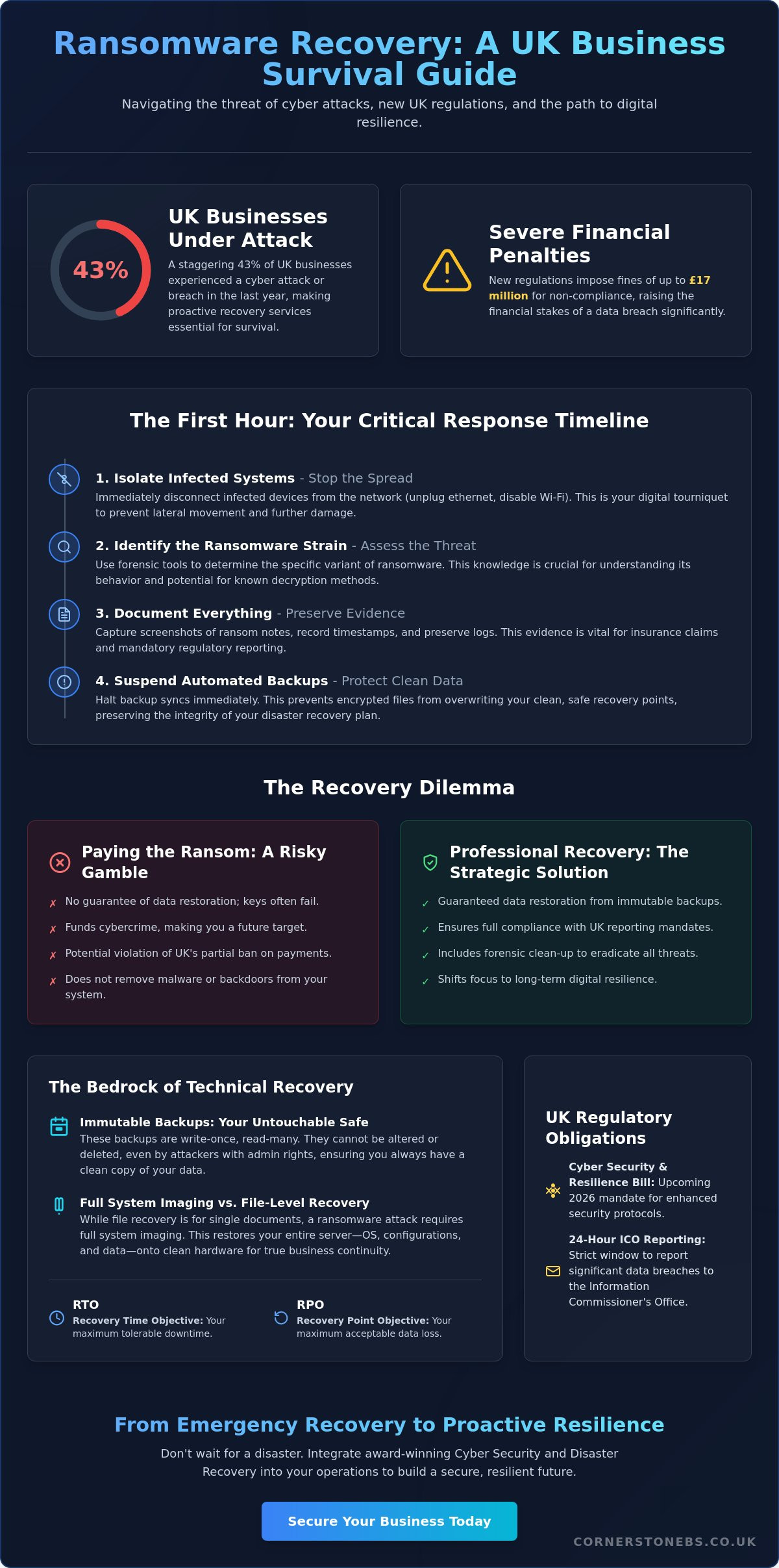
Did you know that 43% of UK businesses experienced a cyber attack in the last year, with many now facing potential fines of up to £17 million under new regulations? You likely feel the pressure of the upcoming Cyber Security and Resilience Bill, especially with its mandatory 24-hour incident reporting requirements. Securing the right ransomware recovery services UK business leaders need is no longer a luxury; it’s the foundation of your operational survival. We understand that the fear of total data loss and crippling downtime keeps many local business owners awake at night.
We agree that the stakes have never been higher, particularly as the UK government moves toward a partial ban on ransomware payments. This guide provides a comprehensive roadmap to help you navigate the recovery process, restore your systems, and ensure long-term digital resilience. You’ll learn how to handle the new reporting mandates, minimize your downtime through robust disaster recovery, and maintain full compliance with evolving UK data laws. We’ve designed this guide to turn technical complexity into a clear path forward for your business stability and peace of mind.
Key Takeaways
- Stop the spread immediately by isolating infected systems and using forensic tools to identify the specific ransomware strain within the first hour.
- Ensure guaranteed data restoration by leveraging immutable backups and full system imaging instead of relying on unstable decryption keys from criminals.
- Navigate complex 2026 regulations with professional ransomware recovery services UK to meet strict ICO reporting windows and protect your reputation.
- Shift from emergency recovery to proactive digital strength by integrating award-winning Cyber Security and Disaster Recovery into your daily operations.
The first hour of a ransomware attack is often the most stressful period a business owner will ever face. You might see strange file extensions appearing in your folders or a glaring ransom note on your desktop. Stay calm. Your first job is to stop the bleeding. You must isolate infected machines immediately to prevent the malware from moving laterally through your network infrastructure. If you don’t act fast, a single infected device can compromise your entire server array. This is where the right ransomware recovery services UK expertise becomes the difference between a minor hiccup and a total shutdown.
Identifying the specific strain is the next priority. Using professional forensic tools helps determine if there’s a known remedy for the What is Ransomware? variant you’re facing. Our local team focuses on documenting every screen, message, and timestamp. This evidence is essential for your insurance claim and your 24-hour reporting mandate under the 2026 Cyber Security and Resilience Bill. You should avoid the temptation to speak with attackers directly. They’re professional manipulators, and direct contact often leads to higher ransom demands or further security risks. We’re here to help you manage these initial steps with the clarity of a long-term partner.
The Critical Containment Phase
Containment acts as the digital tourniquet for business survival, stopping the spread before it claims your entire network. You need to physically disconnect ethernet cables and disable Wi-Fi protocols on all suspected devices. It’s also vital to suspend your automated backup syncs immediately. If your system keeps syncing during an active attack, you risk overwriting your clean archives with encrypted data. Halting these processes preserves the integrity of your Disaster Recovery points and keeps your clean data safe from corruption.
Initial Assessment and Triage
Once the spread is contained, we assess the scope of the breach. We differentiate between files that are simply locked and data that has been exfiltrated to external servers. Our experts look across your UK-based servers and Microsoft 365 cloud environments to map the infection accurately. We then help you prioritise your restoration queue. By focusing on critical business functions first, we ensure your most important operations are back online while we continue the deeper cleaning process. This structured approach helps you maintain business continuity even under extreme pressure.
Technical Recovery Mechanisms: Restoring Business Continuity
Restoring your business operations involves much more than just clicking ‘undo’ on a hacker’s encryption. While many focus solely on data, true continuity requires a structured approach to rebuilding your entire digital environment. Leading ransomware recovery services UK providers rely on immutable backups as the first line of defence. These backups are specifically designed to be unchangeable; once written, they cannot be modified or deleted, even by someone with stolen administrative credentials. This ensures you always have a clean, untouchable copy of your history to fall back on.
We distinguish between simple file-level recovery and full system imaging. File-level recovery works for accidental deletions, but after a total ransomware sweep, you need system imaging. This process restores your entire server environment, including the operating system and configurations, onto clean hardware. By utilising cloud-based Disaster Recovery, we can often spin up these images in a virtual environment, allowing your team to work while we sanitise your physical on-site servers. This dual-track approach slashes the time you spend in operational limbo.
Understanding RTO and RPO in 2026
Success in recovery is measured by two vital metrics: RTO and RPO. Think of the Recovery Time Objective (RTO) as the ‘clock of downtime.’ It’s the maximum amount of time your business can survive without its systems before the damage becomes irreversible. Recovery Point Objective (RPO) is your ‘threshold of data loss,’ representing how much work you’re willing to lose between your last backup and the attack. We work as your long-term partner to align these metrics with your specific commercial needs, ensuring your protection matches your pace of growth.
The Forensic Clean-Up Process
You can’t simply restore data into an environment that might still be compromised. We follow UK government guidance on mitigating ransomware by thoroughly sanitising every server and workstation. This involves identifying ‘sleeper’ malware that may have been lurking in your backup sets for weeks before the final payload was delivered. By extracting data into sandboxed environments, we verify its integrity before it ever touches your live network. This rigorous verification process ensures that when you reconnect to the UK internet backbone, you do so with total confidence in your system’s purity.
Professional Recovery Services vs. Paying the Ransom
When you’re staring at a frozen screen and a multi-million pound demand, the pressure to pay can feel overwhelming. You want your business back, and the hackers promise a quick fix. However, paying a ransom is a high-stakes gamble that rarely delivers the clean break you’re hoping for. Statistics from early 2026 show that only 17% of UK organisations chose to pay the ransom, a sharp decline from previous years. This shift isn’t just about ethics; it’s about the cold reality that partnering with ransomware recovery services UK experts is a more reliable investment in your business’s future. Paying doesn’t just fund criminal enterprises; it marks your company as a “proven payer,” often leading to repeat attacks within months.
The technical reality is that decryption keys provided by attackers are notoriously unstable. They’re often poorly coded and can corrupt your files during the decryption process. Research from 2025 indicates that only about 60% of organisations that pay a ransom successfully recover all their data. You might spend $1.5 million (the median UK ransom payment in 2025) and still end up with a shattered database. Beyond the data loss, you face the risk of “double extortion,” where criminals take your money but still leak your sensitive information or demand a second payment to stop a public data dump. Investing in professional restoration through your Managed IT Support partner ensures your systems are rebuilt on a clean, secure foundation rather than a patched-up crime scene.
The Myth of the “Honest Hacker”
Don’t fall for the idea that hackers have a reputation to uphold. They aren’t service providers; they’re criminals. Even if they give you a key, they often leave “sleeper” malware behind. These backdoors allow them to bypass your Cyber Security and strike again once you’ve resumed operations. Professional recovery focuses on a “clean start” by wiping infected environments and restoring from immutable backups. This method ensures that no hidden threats remain to jeopardise your long-term stability.
Legal Risks for UK Businesses
The legal landscape in the UK has become significantly more complex. You must consider the UK government financial sanctions guidance before even discussing a payment. Paying a ransom to a sanctioned entity can lead to severe legal penalties, regardless of your intentions. Additionally, many UK insurance providers now exclude ransomware payments from their coverage. Working with a certified recovery partner is often a prerequisite for a successful insurance claim, as it proves you’ve taken reasonable steps to mitigate the damage through legitimate channels.
UK Regulatory Obligations and Data Breach Compliance
Recovering your data is only half the battle. In the UK, the legal aftermath of a ransomware attack can be just as daunting as the technical breach itself. You’re likely aware of the UK GDPR requirements, but the 2026 regulatory landscape has added new layers of urgency. Under the Cyber Security and Resilience Bill, many organisations now face a mandatory 24-hour incident reporting window. This sits alongside the existing 72-hour ICO notification requirement for personal data breaches. If you miss these deadlines, or if you can’t prove you took “reasonable care” to protect your infrastructure, the financial penalties can be staggering.
Engaging professional ransomware recovery services UK experts ensures you aren’t just restoring files; you’re building a robust legal defence. We help you document every step of the incident, from the initial discovery to the final system sanitisation. This detailed paper trail is vital when you communicate the breach to clients, stakeholders, and your employees. Transparency is your best tool for preserving trust. We ensure your response aligns with the latest National Cyber Security Centre (NCSC) standards, providing the structured approach that regulators expect from a responsible business.
Navigating the ICO Reporting Process
Reporting a breach shouldn’t be a guessing game. The ICO notification form requires specific details about the nature of the breach, the categories of data involved, and your mitigation steps. We guide you through this process, ensuring your technical recovery documentation supports your claim of proactive management. By being clear and transparent in your UK-wide communication, you manage the narrative and reduce the risk of long-term reputational fallout. This structured approach helps satisfy the authorities while protecting your brand’s integrity.
Compliance as a Recovery Milestone
A successful recovery is the perfect time to harden your defences for the long term. Many of our clients use this transition to achieve Cyber Security Services certification, turning a vulnerability into a verified strength. We’ll help you update your internal data processing registers and ensure you’re aligned with standards like NIS2 or DORA if your sector requires it. This isn’t just about ticking boxes; it’s about building a resilient future where your business is better protected than ever before. If you’re concerned about your current compliance posture, reach out for a chat with our local experts to see how we can strengthen your digital foundations.
Building a Ransomware-Resilient Future with Cornerstone
Surviving a cyber attack is a major milestone, but the ultimate goal is ensuring it never happens again. We believe that the most effective ransomware recovery services UK businesses rely on should lead directly into a proactive security posture. Our multi-award-winning support isn’t just about reacting to alarms; it’s about building a digital fortress around your daily operations. We help you transition from the stress of emergency recovery to the stability of managed IT. By implementing a Zero Trust architecture across your network, we ensure that every user and device is verified. This strategy significantly reduces the risk of lateral movement, keeping your core assets safe even if a single endpoint is compromised.
Proactive Monitoring and Threat Hunting
We leverage elite global partnerships with industry leaders like Cisco and Microsoft to bring world-class protection to your local network. Our UK-based helpdesk monitors your systems around the clock, identifying anomalies and hunting for “sleeper” threats before they have a chance to encrypt your files. For many local leaders, this journey toward total resilience starts with Managed IT Services Teesside to establish a rock-solid foundation. We act as your dedicated security eyes and ears, allowing you to focus on your commercial goals with total confidence.
Tailored Disaster Recovery Planning
True resilience requires moving beyond basic backups into a sophisticated Cloud Solutions environment. We customise your recovery protocols to match your specific RTO and RPO requirements. We don’t just hope the plan works; we run regular “fire drill” testing to prove it. These simulations ensure that your team knows exactly what to do and that your data can be restored within minutes. We’d love to invite you to a no-pressure conversation about your current risk level. Let’s have a friendly chat about how we can strengthen your digital foundations for the years ahead.
Secure Your Digital Legacy and Business Continuity
Navigating a ransomware attack is one of the toughest challenges any business leader will face. We’ve explored how immediate containment, technical restoration through immutable backups, and strict adherence to UK regulatory reporting can turn a potential disaster into a managed recovery. By choosing professional restoration over the risks of paying a ransom, you protect your business from double extortion and ensure your systems are rebuilt on a clean, secure foundation. Securing the right ransomware recovery services UK experts provide is the most effective way to meet the 2026 reporting mandates while preserving your professional reputation.
As a multi-award-winning IT provider and strategic partner with Microsoft, IBM, and Cisco, we’re here to be your long-term technology partner. Our UK-based proactive support team focuses on building a resilient future for your organisation, moving you from emergency response to a Zero Trust environment. Don’t wait for a crisis to test your defences. We invite you to talk to our award-winning UK experts about your recovery plan and discover how we can strengthen your digital foundations together. Your business stability is our priority, and we’re ready to help you thrive with confidence.
Frequently Asked Questions
Is it illegal for a UK business to pay a ransomware demand?
Paying a ransom isn’t universally illegal, but it’s a high-risk legal minefield that the UK government strongly discourages. If you unknowingly pay a group that is on the UK’s financial sanctions list, your business could face criminal prosecution. Under the 2026 Cyber Security and Resilience Bill, organisations must also report any intention to pay a ransom to the authorities before the transaction occurs. We focus on restoration through secure backups to keep your business on the right side of the law.
How long does professional ransomware recovery typically take?
Recovery timelines depend on the volume of data and the complexity of your network, but 59% of UK businesses achieved a full recovery within one week in 2025. While simple file restoration might happen quickly, a full forensic sanitisation of your servers ensures that no “sleeper” malware remains. Our local team prioritises your most critical business functions so you can resume operations while the deeper cleaning of your infrastructure continues in the background.
Will my cyber insurance cover the cost of recovery services?
Most cyber insurance policies cover the professional fees for ransomware recovery services UK providers offer to rebuild your systems. However, a growing number of UK insurers now specifically exclude the cost of the ransom payment itself. You should review your policy to confirm it covers digital forensics, data restoration, and the temporary hardware needed to maintain business continuity during the rebuild. Working with a recognised partner often makes the claims process much smoother.
Can ransomware infect my cloud backups like Microsoft 365 or Azure?
Yes, ransomware can compromise cloud environments if your automated sync processes remain active during an attack. If your local files are encrypted, the cloud service may simply sync those “changes,” overwriting your clean versions with encrypted ones. We prevent this by using immutable cloud backups and Disaster Recovery solutions that are isolated from your live sync environment. This ensures you always have a version of your data that the malware cannot touch.
What is the difference between data recovery and ransomware recovery?
Data recovery is the technical act of retrieving lost or deleted files, while ransomware recovery is a comprehensive strategic restoration of your entire business environment. Ransomware recovery involves forensic analysis to find the entry point, sanitising the network to remove backdoors, and verifying the integrity of every system. It’s a structured move toward long-term resilience rather than just a simple file restore. We treat it as a business continuity project to ensure your digital foundations are stronger than before.
Do I need to report a ransomware attack to the police or the ICO?
You must report any breach involving personal data to the ICO within 72 hours under the UK GDPR. For many sectors, the 2026 regulations have shortened this to a 24-hour mandatory reporting window for the initial incident. You should also report the attack to Action Fraud, which is the UK’s national reporting centre for cybercrime. These reports are essential for your legal compliance and can be vital when making a claim on your cyber insurance policy.
How can I tell if my backups are safe from a current infection?
Your backups are only truly safe if they are immutable or physically air-gapped from your primary network. We use forensic scanning tools to check your backup sets for “sleeper” malware that might have been planted weeks before the attack. If your backups were connected to the network during the infection without specific write-protection, there’s a risk they could be compromised. Regular “fire drill” testing is the most reliable way to verify your recovery points.
What are the first three things I should do if I see a ransom note?
First, isolate the infected devices by disconnecting ethernet cables and disabling Wi-Fi to stop the spread. Second, take photos of the ransom note and any on-screen messages to provide evidence for the police and your insurance provider. Third, contact your Managed IT Support partner immediately to begin the professional containment phase. These steps act as a digital tourniquet, protecting your remaining network infrastructure from lateral movement while you prepare for a secure restoration.