Posted on: July 23rd, 2026 by Cornerstone
Could your business survive a £17.5 million fine? With the ICO now empowered to levy penalties of that scale or 4% of your global turnover, it’s no wonder many local leaders feel overwhelmed. We know the pressure you’re under. Between the updated Data Protection Act requirements that kicked in this June and the constant hum of cyber threats, managing it compliance requirements uk can feel like chasing a moving target. You want to protect your hard-earned reputation, but the technical jargon often gets in the way.
We’re here to simplify the complex and help you breathe easier. This guide offers a clear, proactive roadmap for 2026 to ensure your systems are resilient and your data stays locked down. We’ll compare key standards like Cyber Essentials and ISO 27001, explain the latest MFA mandates, and provide a practical checklist for your next audit. By the end, you’ll have the clarity needed to turn compliance from a box-ticking exercise into a strategic edge that helps you win bigger contracts and grow with confidence.
Key Takeaways
- Master the 2026 updates to the Data Protection Act to avoid high ICO fines and ensure your data handling remains transparent and secure.
- Navigate it compliance requirements uk with confidence by selecting the right security framework to protect your supply chain and win more contracts.
- Identify how new regulations like NIS2 and DORA impact your specific sector and what you must do to stay ahead of upcoming implementation deadlines.
- Use our practical roadmap to audit your infrastructure and map data flows, giving you total visibility over where your business information lives.
- Shift from reactive fixes to proactive resilience by leveraging Managed IT Support to maintain continuous compliance and operational stability.
The Foundation of UK IT Compliance: GDPR and the Data Protection Act
In 2026, staying ahead of it compliance requirements uk isn’t just about avoiding a legal headache. It’s a strategic move that builds deep trust with your clients and local partners. We define IT compliance today as the proactive management of your digital infrastructure to meet strict legal standards while ensuring business continuity. It’s the bedrock of a resilient organization. When your systems are compliant, they’re inherently more secure, efficient, and ready for growth.
The core of this framework remains the synergy between the UK GDPR and the Data Protection Act 2018. While the GDPR provides the broad strokes for data privacy, the Act tailors these rules for the UK. A critical update arrived on June 19, 2026, which granted data subjects a specific right to complain directly to a controller. You must now acknowledge these complaints within 30 days. This shift underscores why accountability is the most vital principle for company directors. You don’t just need to be compliant; you must be able to prove it at a moment’s notice.
The Seven Core Principles of Data Protection
Success starts with mastering the seven core principles. You must process data with lawfulness, fairness, and transparency. This means being open with people about how you use their information. Purpose limitation ensures you only collect data for specified, legitimate reasons. We often see businesses falling into the trap of storage limitation; keeping data “just in case” is now a major compliance risk. Finally, integrity and confidentiality demand robust technical security to prevent unauthorized access or accidental loss.
Individual Rights and Subject Access Requests (SARs)
Your IT systems must be built to respect individual rights, such as the right to erasure and the right to be informed. Handling a Subject Access Request (SAR) shouldn’t be a manual scramble. Modern infrastructure allows you to locate, verify, and export personal data quickly. This efficiency is essential for data portability, allowing your customers to move their information between services. If your systems are cluttered or disorganized, meeting the 30-day response deadline becomes nearly impossible.
Essential Security Frameworks: Cyber Essentials vs. ISO 27001
Choosing the right framework is a pivotal decision for your 2026 business strategy. Baseline security has evolved from a “nice to have” into a non-negotiable entry requirement for most UK supply chains. If you’re looking to scale, you’ll find that meeting it compliance requirements uk often starts with proving your technical mettle. Cyber Essentials is the minimum entry point for UK government contracts. This government-backed scheme provides a solid foundation, while ISO 27001 offers an internationally recognized Information Security Management System (ISMS) for those managing more complex risks.
The Cyber Essentials scheme focuses on five key technical areas that stop the majority of common cyber attacks. It’s practical, effective, and tailored for businesses of all sizes. Since April 27, 2026, the scheme has also mandated that multi-factor authentication (MFA) must be enabled on every cloud service that supports it. This proactive step significantly reduces the risk of unauthorized access. We see this as a foundational element of your digital stability.
The Five Technical Controls of Cyber Essentials
- Firewalls: These act as your digital perimeter, screening incoming traffic to block known threats before they reach your network.
- Secure Configuration: We ensure you strip away unnecessary software and change default passwords that hackers often exploit.
- User Access Control: You should follow the principle of least privilege; staff only get access to the data they need for their specific roles.
- Malware Protection: This involves keeping active, updated defenses across all your devices to catch viruses and ransomware.
- Patch Management: Closing software vulnerabilities quickly is essential. Most breaches happen because a known “hole” wasn’t plugged in time.
Moving Toward ISO 27001 Certification
For larger organizations or those handling sensitive intellectual property, ISO 27001 is the natural progression. It moves beyond just technical “fixes” to create a complete culture of security. It’s about how you manage people, processes, and technology together. This standard requires a rigorous risk assessment methodology. You identify your specific business threats and build a custom plan to mitigate them. It’s a living document that thrives on continuous improvement, ensuring your security evolves as quickly as the threats do. Exploring our cyber security services is a great way to start your journey toward this global standard. We’ll help you bridge the gap between where you are now and where you need to be for maximum resilience.
Navigating Sector-Specific Regulations: NIS2, DORA, and NHS DSPT
If you operate in critical sectors like energy, finance, or healthcare, the goalposts have moved. While general laws set the bar, sector-specific it compliance requirements uk are becoming significantly more stringent in 2026. The UK’s new Cyber Security and Resilience Bill, which aligns closely with the EU’s NIS2 directive, is expected to receive Royal Assent this year. This isn’t just another layer of red tape. It’s a vital response to the increasing complexity of our digital supply chains. We believe that understanding these nuances now will give your business a massive competitive advantage when bidding for high-value contracts.
Critical Infrastructure and the NIS2 Directive
NIS2 distinguishes between ‘Essential’ and ‘Important’ entities. If you provide services in transport, water, or digital infrastructure, you likely fall into the ‘Essential’ category, facing the strictest oversight. A major shift in 2026 is the focus on supply chain security. You’re now responsible for the security posture of your third-party vendors. The UK Government’s Cyber Essentials Scheme is a fantastic starting point to ensure your own vendors meet a baseline standard. Perhaps most importantly, management bodies now face personal liability for non-compliance, making cybersecurity a top-tier boardroom priority.
Compliance for Financial and Health Services
For our partners in the financial sector, the Digital Operational Resilience Act (DORA) is now in full swing. Even if you’re UK-based, DORA applies if you have EU operations or provide ICT services to EU financial entities. DORA requires firms to map their entire ICT asset landscape for compliance. This mapping ensures you know exactly where your vulnerabilities lie before a crisis hits. You’ll also need to demonstrate resilience through regular stress testing and rigorous audits of your third-party ICT providers. It’s about moving from “if we get hacked” to “how we continue to operate during a disruption”.
Healthcare suppliers face their own unique hurdles. The deadline for meeting the requirements of the NHS Data Security and Protection Toolkit (DSPT) version 8 is June 30, 2026. If you handle NHS patient data, this annual self-assessment is mandatory. It ensures you’re following the latest 10 data security standards. We’ve seen a growing focus on AI governance in this year’s toolkit, requiring clear documentation on how machine learning systems handle sensitive information. Staying on top of these it compliance requirements uk ensures you remain a trusted partner in the national health ecosystem. We’re here to help you navigate these audits with ease, providing the technical evidence you need to prove your systems are rock-solid.
A Practical Roadmap to Achieving and Maintaining Compliance
Step 1: The Internal Audit and Gap Analysis
Your journey starts with a deep dive into what you already have. Legacy hardware that no longer receives security updates is a silent killer of compliance. If a device can’t be patched, it’s a wide-open door for attackers. We also recommend a thorough review of your cloud licensing and user permissions. Within Microsoft 365, it’s easy for permissions to drift over time. You must ensure that only the right people have access to sensitive data. Don’t forget the physical side; your servers and network switches need to be in secure, restricted areas to prevent unauthorized physical access.
Step 2: Technical Implementation and Disaster Recovery
Once you’ve identified the gaps, it’s time to harden your defenses. Modern cloud solutions offer built-in compliance advantages, such as automated encryption and real-time threat detection. However, technology alone isn’t enough. You need a robust disaster recovery plan that defines your Recovery Time Objective (RTO) and Recovery Point Objective (RPO). This tells you exactly how much data you can afford to lose and how quickly you need to be back online. Regular penetration testing and vulnerability scanning are also essential. These tests find the “holes” in your armor before a criminal does.
The human element is often the weakest link in any security chain. Your team needs regular training on how to spot phishing attempts and follow acceptable use policies. When your staff understands the “why” behind the rules, they become your most effective firewall. Finally, establish a regular review cycle. Regulations change, and your business evolves. A quarterly check ensures you’re always one step ahead of new it compliance requirements uk. If you’re ready to secure your future, let’s have a conversation about a comprehensive compliance audit for your business today.
The Role of Managed IT Support in Continuous Compliance
Achieving compliance is one thing; keeping it is another. In 2026, it compliance requirements uk change too fast for a set-and-forget approach. You need 24/7 monitoring to ensure your security posture doesn’t slip when you aren’t looking. We see compliance as a byproduct of high-quality Managed IT Support. By partnering with a multi-award-winning provider, you gain a dedicated long-term partner who treats your business stability as their own. Proactive maintenance is the best defense against the data breaches that lead to the heavy penalties and reputation damage we discussed earlier.
Transitioning from a reactive “break-fix” model to a strategic foundation is essential for any growing organization. Instead of waiting for a system to fail or a vulnerability to be exploited, we monitor your infrastructure in real-time. This proactive stance identifies risks before they escalate into legal liabilities. It’s about building a future-proof environment that supports your growth while keeping you on the right side of the law. When your IT is managed properly, compliance feels like a natural part of your daily operations rather than a looming deadline.
Proactive Monitoring vs. Reactive Compliance
Real-time alerts allow us to identify compliance drift immediately. If a critical security patch is missed or a user attempts to bypass security controls, we know about it instantly. Automated patching ensures your defenses are always current without disrupting your workday. We ensure our it company solutions are built on world-class partnerships with leaders like Microsoft, IBM, and Cisco. This gives you access to the same robust technology used by global enterprises, tailored specifically for your local business needs and regional identity.
Choosing a Partner for the Long Term
When selecting a partner, look at their own commitment to excellence. A provider should hold the same high standards they recommend to you. A dedicated helpdesk is also vital for rapid incident response. If a breach occurs, you have a very tight window to report it to the ICO; having an expert team ready to act provides essential emotional and financial security. Our managed IT services provide the clear, detailed documentation you need for external audits. This evidence proves you’ve taken every reasonable step to protect your data, making the audit process smooth and stress-free. We’re proud to be a local team that remains deeply connected to our roots while delivering sophisticated support. We invite you to a conversation about securing your business for 2026 and beyond.
Building a Compliant Foundation for Your Business Future
The 2026 landscape for it compliance requirements uk is undeniably complex, but it doesn’t have to be a source of anxiety. By mastering the core principles of the Data Protection Act and adopting frameworks like Cyber Essentials, you transform a technical necessity into a strategic asset. You aren’t just ticking boxes; you’re building a resilient, trustworthy brand that partners and clients can rely on for the long term. We’ve seen how proactive maintenance and real-time monitoring prevent the breaches that lead to devastating fines.
As a multi-award-winning managed IT support provider and trusted partner to Microsoft, IBM, and Cisco, we specialize in simplifying these technical hurdles. We’re proud to be a local team that brings world-class security to our regional community. Our proactive 24/7 system monitoring ensures your infrastructure stays rock-solid while you focus on growth. Ready to eliminate the guesswork? We invite you to Book a Comprehensive IT Compliance Audit with our Award-Winning Team and gain total peace of mind. Let’s work together to make your business secure, compliant, and ready for whatever 2026 brings.
Frequently Asked Questions
What are the main IT compliance regulations for UK small businesses?
The primary it compliance requirements uk focus on the UK GDPR and the Data Protection Act 2018. These laws govern how you collect, store, and protect personal information. As of June 19, 2026, you’re legally required to acknowledge any data subject complaints within 30 days. Failing to meet these standards puts your business at risk of significant fines and reputational damage in our local community.
Is Cyber Essentials a legal requirement for all UK companies?
Cyber Essentials isn’t a legal requirement for every business, but it’s mandatory for anyone bidding on central government contracts. It acts as a baseline security standard that protects you against the majority of common cyber threats. Since April 27, 2026, the scheme requires multi-factor authentication on all cloud services. We recommend it as a foundational step for any organization wanting to prove their commitment to data security.
How often should a business conduct an IT compliance audit?
You should conduct a comprehensive audit at least once a year. However, significant infrastructure changes or new regulations like the 2026 Cyber Security and Resilience Bill might require more frequent checks. For those in the healthcare sector, the NHS DSPT requires a fresh submission by June 30 every year. Regular audits ensure your defenses stay ahead of evolving threats and prevent compliance drift before it becomes a problem.
What happens if my business fails a GDPR audit by the ICO?
The ICO can issue enforcement notices, stop you from processing data, or levy heavy financial penalties. Fines can reach up to £17.5 million or 4% of your global turnover. With the average GDPR fine sitting at approximately €2.4 million, the financial impact is often devastating for small firms. We focus on proactive monitoring to ensure you never face these high-stakes enforcement actions in the first place.
Can managed IT support help with sector-specific compliance like NIS2?
Yes, a managed partner is essential for navigating complex regulations like NIS2. These rules now place a massive emphasis on supply chain security and personal liability for management bodies. We help you map your entire ICT asset landscape and implement the technical controls required by law. This partnership moves compliance from a stressful manual task to a seamless, automated part of your business strategy.
Is Microsoft 365 inherently compliant with UK data protection laws?
Microsoft 365 is built with compliance in mind, but it isn’t compliant out of the box. You’re responsible for configuring the privacy settings, access controls, and retention policies correctly. We specialize in optimizing these cloud environments to ensure they meet it compliance requirements uk. Without professional setup, you might accidentally leave data exposed or fail to meet the strict storage limitation principles of the GDPR.
What is the difference between IT security and IT compliance?
IT security refers to the technical measures you use to protect your data, like firewalls and encryption. IT compliance is the process of proving those measures meet specific legal or industry standards. Think of security as the lock on your door and compliance as the certificate proving that lock meets your insurance company’s requirements. You need both to ensure your business remains resilient and legally protected.
How much does it cost to achieve IT compliance in the UK?
The cost depends on your organization’s size, the complexity of your network, and the specific certifications you need. Standard certification fees for schemes like Cyber Essentials are tiered based on employee headcount, while ISO 27001 requires a larger investment in audits and auditor day rates. We view these costs as an investment in your business’s stability and competitive edge rather than just another operational expense.
Posted on: June 17th, 2026 by Cornerstone
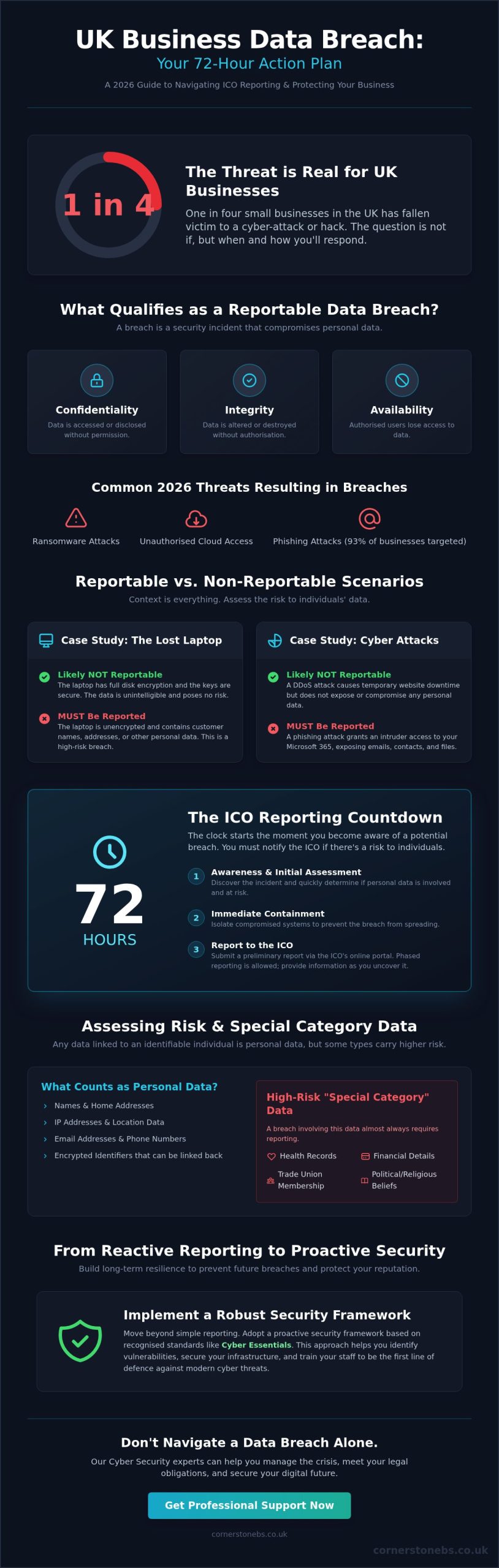
With one in four small businesses in the UK falling victim to a hack, the question isn’t just about prevention anymore; it’s about your immediate response. If you’ve just discovered a security incident, the pressure to understand how to report a business data breach UK can feel overwhelming while the clock ticks on your 72-hour ICO window. We understand that the fear of heavy GDPR fines or a damaged reputation is enough to keep any business owner awake. You want to protect your customers and your hard-earned local legacy, but the legal requirements can often seem like a complex maze.
We’re here to turn that uncertainty into a clear, actionable plan. This 2026 guide provides a professional roadmap to help you navigate the latest regulations, including the Data (Use and Access) Act, with the confidence of a dedicated partner. You’ll learn exactly how to qualify a breach, the specific steps for reporting to the Information Commissioner’s Office, and how to secure your digital infrastructure to prevent future issues. We will show you how to satisfy your legal obligations while keeping your business continuity and reputation firmly intact.
Key Takeaways
- Identify which security incidents qualify as reportable under UK GDPR, including common 2026 threats like ransomware and unauthorised cloud access.
- Navigate the 72-hour countdown with a step-by-step guide on how to report a business data breach UK using the ICO’s official reporting tools.
- Learn to assess risks to individual rights and freedoms to determine when mandatory notification to the ICO and affected parties is legally required.
- Implement immediate containment and recovery strategies to isolate compromised systems and restore business continuity without delay.
- Build long-term resilience by moving from reactive reporting to a proactive security framework based on Cyber Essentials standards.
Understanding What Constitutes a Reportable Business Data Breach
Not every IT glitch is a crisis, but knowing the difference is vital for your compliance. A personal data breach under UK GDPR is more than just a leak. It’s a security incident that compromises the confidentiality, integrity, or availability of personal information. If you are currently investigating an incident, your first priority is determining how to report a business data breach UK properly. This starts with a clear assessment of whether the data has been lost, destroyed, altered, or accessed without permission.
In 2026, the digital landscape presents new challenges for business owners. We see more sophisticated threats like unauthorised cloud access and complex ransomware attacks. These incidents don’t just steal data; they often lock you out of your own systems, which qualifies as a breach of “availability.” Gaining a foundational understanding of what a data breach is helps you separate a minor technical fault from a legal reporting obligation. Even if an employee accidentally sends a spreadsheet to the wrong client, you must conduct a formal assessment. The law doesn’t distinguish between a malicious hacker and a simple human error when it comes to your duty to protect data.
The Broad Definition of Personal Data
Personal data is any information that relates to an identifiable individual. This goes far beyond names and home addresses. In our modern infrastructure, this includes IP addresses, location data, and even encrypted identifiers that could be linked back to a person. According to the latest ICO guidance, personal data is any information relating to an identified or identifiable living individual. You should be particularly cautious with “special category” data. This includes health records, financial details, or trade union memberships, as these carry a much higher risk if exposed.
Examples of Reportable vs. Non-Reportable Incidents
Context is everything when deciding whether to notify the authorities. Consider these scenarios:
- The Lost Laptop: If a staff member loses a laptop with full disk encryption and the keys are secure, it’s likely not reportable because the data is unintelligible. If that same laptop is unencrypted and contains customer names, you have a reportable breach.
- Cyber Attacks: A DDoS attack that causes temporary website downtime but doesn’t expose data is a security incident, not a personal data breach. However, a phishing attack that grants an intruder access to your Microsoft 365 environment is almost certainly reportable.
The Cyber Security Breaches Survey 2025 found that 93% of businesses were targets of phishing. This highlights why a proactive assessment is necessary for every “near miss.” If the incident is likely to result in a risk to the rights and freedoms of your customers, the 72-hour clock begins the moment you become aware of it.
The ICO Reporting Process: The 72-Hour Countdown
The clock starts ticking the moment you realize something is wrong. Whether it’s a suspicious login or a missing folder, you have exactly 72 hours to notify the Information Commissioner’s Office if there’s a risk to individuals. This deadline is strict, but it shouldn’t cause panic. The goal is to provide the ICO with as much information as possible as early as possible. Many business owners wonder exactly how to report a business data breach UK when they don’t yet have all the facts. The ICO understands that forensic investigations take time, which is why they allow for phased reporting. You can submit a preliminary report and follow up as you uncover more details.
To start the process, you’ll need to visit the ICO data breach reporting portal. This online tool walks you through the necessary questions. You’ll be asked to describe the nature of the breach, the categories of data involved, and the approximate number of people affected. Learning how to report a business data breach UK involves understanding that the regulator values honesty and speed over a perfect, final report on day one. If you’re struggling to pull these logs together during a crisis, our team can provide the Cyber Security expertise needed to pinpoint the source of the leak quickly.
What to Include in Your ICO Report
Managing the Deadline During Weekends and Bank Holidays
Cybercriminals don’t work nine to five, and neither does the law. The 72-hour window includes weekends and bank holidays. If you discover a breach on a Friday evening, you cannot wait until Monday morning to start the clock. If you find yourself in a position where you must report late, you must provide a “reasoned justification” for the delay. The ICO may accept these reasons if they are valid, but it’s always better to submit a partial report within the timeframe than a complete one after the deadline has passed. Our local team is here to help you build a resilient infrastructure so you’re never caught off guard by these tight windows.
Assessing Risk to the Rights and Freedoms of Individuals
Determining whether an incident crosses the line from a technical glitch to a legal obligation is the most critical part of your response. It’s not just about the volume of data lost. It’s about the impact on the real people behind those records. Under UK GDPR, you only need to notify the ICO if the breach is likely to result in a risk to the rights and freedoms of individuals. If you’re currently weighing up how to report a business data breach UK, your first step is a thorough risk assessment. You must evaluate the potential for physical, material, or non-material damage to your customers or staff.
What does this “risk” actually look like in a business context? It encompasses a wide range of potential harms. This includes identity theft, financial loss, and even reputational damage to the individual. If sensitive data like health records or financial details are exposed, the risk of discrimination or fraud increases significantly. We recommend using a risk matrix to standardise your approach. By plotting the severity of the potential harm against the likelihood of it occurring, you can make an objective decision about how to report a business data breach UK without letting panic cloud your judgment. This structured method ensures your response is proportionate and legally sound.
When is a Breach “High Risk”?
There’s a vital distinction between a reportable breach and a “high-risk” breach. While a reportable breach requires you to notify the ICO, a high-risk breach triggers the additional requirement to inform the affected individuals directly. This is necessary when the incident is likely to result in a high risk to their rights and freedoms. In these cases, high-risk breaches require notification “without undue delay” to allow individuals to take their own protective measures, such as changing passwords or alerting their banks. This transparency, while difficult, is essential for maintaining long-term trust with your community.
The Role of Internal Documentation
Even if your assessment concludes that a breach isn’t reportable to the ICO, your work isn’t finished. You must document every single personal data breach in an internal register. This log should include the facts of the incident, its effects, and the remedial action you took. The ICO has the authority to audit these records at any time to ensure you’re making the right calls. Maintaining these logs is much easier when you have proactive managed IT services in place to track system changes and access logs. Following the NCSC incident management guidance ensures your internal processes meet the highest national standards, providing you with a solid foundation of evidence if your decisions are ever questioned.
While the 72-hour clock is running for the ICO, your technical team is fighting a different battle. Containment is your absolute priority. You need to stop the data from leaving your network immediately. This often means making tough calls, like isolating affected servers or disabling compromised accounts across the board. If you’re currently investigating how to report a business data breach UK, remember that the ICO expects you to take these containment steps as part of your formal response. They want to see that you’ve acted decisively to limit the damage from the very start.
Finding “patient zero” is essential for a complete and accurate report. You need to know exactly how the intruder got in. Was it a weak password, a phishing link, or a misconfigured firewall? Digital forensics plays a huge role here. However, you must be careful not to destroy evidence while you’re fixing the problem. We work closely with our partners to ensure that logs and system states are preserved correctly. This evidence is vital if the ICO or the police need to conduct a deeper investigation later. Coordinating with an expert IT partner ensures that your recovery is both fast and legally compliant.
Securing Your Perimeter Post-Breach
Once the immediate threat is contained, you must harden your defences. Start by resetting credentials for every user, prioritising those with administrative privileges. It’s also the time to review your firewall logs and cloud solutions for any lingering backdoors. Hackers often leave small entry points to return later. We recommend implementing temporary, heightened monitoring to catch any secondary attempts at entry. This proactive approach ensures that once you’ve closed the door, it stays locked. It’s about restoring stability and peace of mind for your team.
Notifying Affected Individuals
If your risk assessment shows a high risk to individuals, you must tell them. Drafting this notice requires a balance of transparency and calm. Tell them exactly what happened, what data was involved, and what you’re doing to fix it. Most importantly, give them clear instructions on how they can protect themselves, such as monitoring their bank accounts or changing passwords. Whether you choose email, post, or a public notice depends on the scale of the breach. A clear, honest message often does more to protect your reputation than staying silent ever could.
If you’re currently facing a breach and need an expert team to lead the containment, our Cyber Security services are ready to help you secure your infrastructure and meet your reporting duties.
Building a Proactive Cyber Security Framework for 2026
Reporting a breach is a legal necessity, but the real goal is to ensure you never have to do it again. Transitioning from a reactive “emergency mode” to a proactive framework is the best way to protect your local reputation. When you understand how to report a business data breach UK, you quickly realize that the most successful businesses are those that invest in cyber security services before an incident occurs. In 2026, a “set and forget” approach to IT simply doesn’t work. You need a dynamic strategy that evolves alongside new threats.
The foundation of any UK business’s security should be Cyber Essentials or Cyber Essentials Plus. These government-backed certifications provide a clear baseline for your digital safety. Beyond these basics, we advocate for Multi-Factor Authentication (MFA) and Zero Trust architectures. These systems operate on the principle of “never trust, always verify;” they make it significantly harder for an intruder to move through your network even if they steal a password. Small changes in your digital infrastructure create massive barriers for cybercriminals.
Technology is only half the battle. Your team is your first line of defence. Regular staff training is essential to reduce the human error that leads to most data leaks. When your employees know how to spot a sophisticated phishing attempt, your risk drops immediately. We believe in empowering your staff. This turns them from a potential vulnerability into a strong asset for your business’s stability. It’s about creating a culture where security is everyone’s responsibility.
The Value of Managed Security Providers
Disaster Recovery and Business Continuity
A tested backup strategy is your ultimate safety net. If a breach does occur, knowing your data is safe and recoverable allows you to focus on the legalities of how to report a business data breach UK without the fear of total data loss. Regularly auditing your data protection impact assessments (DPIAs) keeps your compliance sharp and your risks low. These audits help you identify gaps in your data handling before they become liabilities. We invite you to a conversation about your current setup. Contact Cornerstone for a proactive security audit today, and let’s build a resilient future for your business together.
Secure Your Resilience and Future Growth
Understanding how to report a business data breach UK is the first step in protecting your customers and your company’s hard-earned reputation. You’ve seen that the 72-hour ICO window is non-negotiable and that a thorough risk assessment is your best defence against unnecessary panic. By prioritising immediate containment and documenting every incident, you satisfy legal requirements while maintaining essential business continuity. Moving from a reactive stance to a proactive security framework ensures that your organisation remains strong in the face of evolving digital threats.
Our team brings the confidence of a multi-award-winning IT provider, backed by strategic partnerships with Microsoft, IBM, and Cisco. We offer proactive 24/7 monitoring and support that acts as a dedicated shield for your digital assets. You deserve the peace of mind that comes from knowing your security is managed by experts who genuinely care about your success. We’re proud to be your local partners, helping you navigate the complexities of 2026 with total confidence.
Secure your business with Cornerstone’s award-winning cyber security services. Let’s work together to build a safe, stable, and prosperous future for your business.
Frequently Asked Questions
Do I have to report a data breach if no data was actually stolen?
You must report a breach even if no data is stolen if the incident affects the availability or integrity of personal information. For instance, if a server failure permanently deletes customer records or ransomware encrypts them, this is a breach of availability. The law requires you to assess the risk to individuals’ rights regardless of whether a third party actually accessed the files. Integrity breaches, where data is altered without permission, also count.
What are the penalties for failing to report a data breach to the ICO in 2026?
Failing to notify the ICO of a reportable breach can result in a fine of up to £8.7 million or 2% of your global turnover, whichever is higher. This is separate from the fine for the actual security failure, which can reach £17.5 million or 4% of turnover. These penalties reflect the regulator’s focus on transparency and accountability. Reporting early acts as a mitigating factor in any enforcement action.
How much does it cost to report a data breach to the Information Commissioner?
There is no financial cost to report a data breach to the Information Commissioner’s Office. The online reporting tool is a free service provided to help businesses comply with their legal obligations. While the reporting itself is free, you may incur costs related to forensic investigations or technical recovery. We always recommend focusing on speed and accuracy rather than worrying about administrative fees. It’s an investment in your company’s long-term compliance.
Can I be fined if the breach was caused by a third-party software provider?
Yes, you can still be fined if the breach occurs through a third-party provider, as you remain the data controller responsible for the personal information. You must ensure your suppliers have robust security measures in place. If a provider suffers a breach, you are still the one who needs to know how to report a business data breach UK to protect your own customers. Your contracts should clearly outline the provider’s duty to notify you immediately.
How do I know if a breach is “likely to result in a risk” to individuals?
A breach results in a risk if it could lead to physical, material, or non-material damage for the individuals involved. Examples include potential identity theft, financial loss, or damage to reputation. You should consider the sensitivity of the data and the volume of records affected. If the data could be used to cause harm or distress, you must treat the incident as a reportable event. Documenting your decision-making process is vital for future audits.
What happens after I submit a report to the ICO?
Once you submit your report, the ICO will acknowledge receipt and assign a case officer to review the details. They may ask for more information or provide specific advice on how to mitigate the impact. In many cases, if you’ve taken proactive steps to contain the breach and notify individuals, the ICO may simply record the incident without taking further enforcement action. Their goal is to ensure you’ve learned from the event and improved your systems.
Do small businesses have different reporting requirements than large corporations?
No, the legal requirements for reporting a breach are the same for all organisations, regardless of their size. Whether you’re a local sole trader or a multinational corporation, the 72-hour window and the risk assessment thresholds apply equally. However, the ICO often provides more tailored support and guidance for small and medium-sized enterprises. They understand that smaller teams may have fewer resources to manage a complex technical response. We’re here to bridge that gap for local firms.
What is the first thing I should do if I suspect a ransomware attack?
Your first step is to isolate the affected systems by disconnecting them from your network and the internet to stop the encryption from spreading. Do not turn off the machines, as this can destroy volatile evidence needed for recovery. Once isolated, you can begin your investigation into how to report a business data breach UK while your IT partner works on restoring your latest clean backups. Quick containment is the key to minimising downtime.
Posted on: June 10th, 2026 by Cornerstone
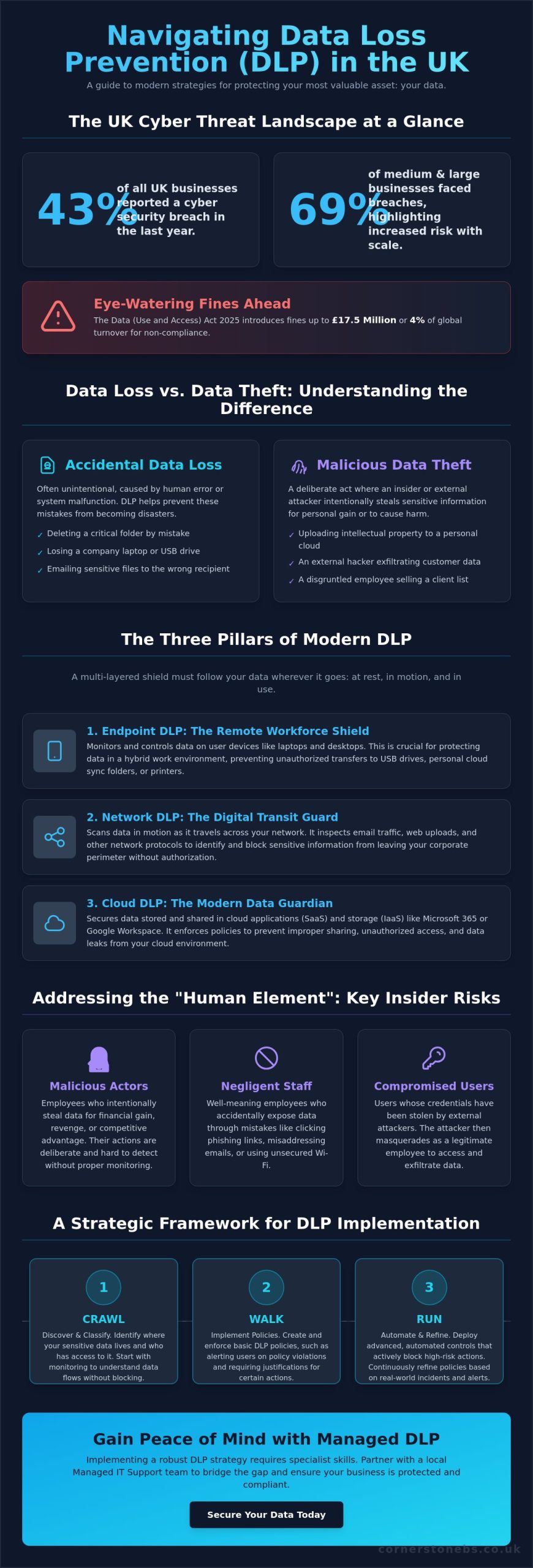
Did you know that 43% of UK businesses reported a cyber security breach over the last year? For medium and large organisations, that figure sits even higher at 69%. It’s a sobering reality that makes finding the right data loss prevention (DLP) solutions UK providers offer more than just a technical box to tick; it’s a fundamental part of your business’s survival. We understand the anxiety that comes with managing a hybrid workforce while trying to avoid the eye-watering £17.5 million fines introduced by the Data (Use and Access) Act 2025.
You shouldn’t have to choose between keeping your data safe and keeping your business moving. We believe that true security comes from having clear visibility into where your sensitive files live and how they travel, without creating hurdles for your staff. This guide will walk you through modern DLP strategies tailored specifically for our UK market. You’ll discover how to safeguard your most critical information, stay on the right side of the ICO, and finally gain the peace of mind that a single accidental click won’t lead to a major disaster.
Key Takeaways
- Understand the vital distinction between accidental data loss and malicious theft to better target your security efforts.
- Discover why effective data loss prevention (DLP) solutions UK businesses implement require a multi-layered approach across endpoints, networks, and the cloud.
- Identify how to mitigate the “human element” by addressing the specific risks posed by malicious actors, negligent staff, and compromised users.
- Learn how to use a “crawl, walk, run” framework to build a robust security strategy that protects your data without slowing down your operations.
Understanding Data Loss Prevention (DLP) in the UK Business Landscape
At its heart, Data loss prevention (DLP) software is a set of tools and processes designed to ensure that your sensitive data isn’t lost, misused, or accessed by unauthorised people. It’s about more than just building a digital wall; it’s about understanding how your data moves through your business every day. In the context of data loss prevention (DLP) solutions UK businesses need, this means having the visibility to stop a spreadsheet of customer details from being accidentally emailed to the wrong person or uploaded to a personal cloud drive. We see DLP as a proactive partner in your growth, keeping your intellectual property safe while your team focuses on what they do best.
The Regulatory Driving Force: UK GDPR and Beyond
Compliance isn’t just a box to tick; it’s a legal necessity that has become even more stringent recently. The Data (Use and Access) Act 2025, which came into force on 5 February 2026, reinforces the requirement for “appropriate technical and organisational measures” to protect data. The Information Commissioner’s Office (ICO) now expects businesses to prove they have these measures in place. If they don’t, the penalties are severe. PECR breaches can now result in fines of up to £17.5 million or 4% of global turnover. Many organisations find that implementing robust DLP controls is the most direct way to meet the requirements of Cyber Essentials Plus, which increasingly focuses on how data is handled at the endpoint.
Data Loss vs. Data Breach: Why the Distinction Matters
We often hear these terms used interchangeably, but they represent different challenges for your team. Data loss is frequently accidental, such as an employee deleting a folder or losing a laptop. Data theft, on the other hand, is a malicious act where someone intentionally exfiltrates information. Both are damaging. While a public data breach brings immediate reputational harm, “silent” data leaks of intellectual property can slowly erode your competitive advantage without you even realising it. Ultimately, DLP acts as the vital bridge between your technical security measures and your legal compliance requirements.
For the modern business owner, DLP is no longer an optional extra. It’s a foundational element of any resilient strategy. When evaluating data loss prevention (DLP) solutions UK organisations must consider how these tools integrate with their existing workflows. By monitoring data in three states (at rest, in motion, and in use) you create an environment where your team can work freely and securely. This proactive approach ensures that a simple human error doesn’t escalate into a business-ending event, providing the stability you need to scale. It’s a natural extension of our broader cyber security services, focused on keeping your local business protected and compliant.
The Three Pillars of Modern DLP: Endpoint, Network, and Cloud
Building a resilient strategy requires more than a single piece of software. It’s about creating a multi-layered shield that follows your data wherever it travels. As businesses move toward more flexible cloud solutions, the traditional “castle and moat” security model has crumbled. Today, the data loss prevention (DLP) solutions UK professionals recommend must cover three specific states of data. First is “Data at Rest”, which includes files sitting on your servers or cloud storage. Second is “Data in Motion”, which is information moving across your network. Finally, “Data in Use” refers to the data currently being handled by an employee on their device.
Modern systems use “content-aware” detection to spot sensitive strings like credit card numbers or sort codes. However, the most effective data loss prevention (DLP) solutions UK providers now implement are also “context-aware”. They don’t just see what the data is; they see who is moving it and where it’s going. This intelligence allows your team to work efficiently while the system quietly blocks risky actions in the background.
Endpoint DLP: Protecting the Modern Remote Worker
With so many of us working from home or local offices, the endpoint is often the most vulnerable point. Endpoint DLP monitors physical transfers to USB drives or external hard drives. It can even prevent a negligent employee from “copy-pasting” client details into an unauthorised web app or a personal AI tool. If a company laptop is lost on a train, robust encryption ensures that the data at rest remains unreadable to unauthorised users. We’ve seen many lessons from government data breaches where a simple lost device led to massive exposure because these endpoint controls weren’t active.
Network and Cloud DLP: Securing the Digital Perimeter
Your digital perimeter now extends far into the cloud. Network DLP scans outgoing email and web traffic for sensitive keywords or patterns. For many businesses, this protection starts with a secure Microsoft 365 migration for business UK. By integrating DLP directly into Teams and SharePoint, you can automatically block the sharing of sensitive files with external guests. This also helps identify “shadow IT”, which are the unauthorised apps your team might use without realising the security risk. If you’re looking to strengthen your defences, a quick chat with a local security partner can help clarify your next steps.
Beyond the Firewall: Addressing the ‘Human Element’ and Insider Risks
Most security incidents aren’t the result of sophisticated hackers bypassing your firewalls. They often start with a simple human error. In fact, the majority of UK data breaches involve a human element rather than a purely technical failure. This is why the most effective data loss prevention (DLP) solutions UK businesses use must look inward. We categorise these internal risks into three distinct groups. First is the Malicious Actor, someone intentionally stealing data for personal gain. Second is the Negligent Employee, who takes shortcuts or ignores policies to get work done faster. Finally, there’s the Compromised User, whose legitimate credentials have been stolen by an external attacker.
Modern DLP tools don’t just act as a digital police force; they serve as a coach. When an employee tries to upload a sensitive file to an unauthorised site, the system can provide “just-in-time” training. A simple pop-up explains the risk and suggests a safer, compliant alternative. This approach builds a culture of security without making your staff feel like they’re being constantly monitored. It’s about finding that vital balance between robust protection and employee trust. By empowering your team to make better decisions, you create a more resilient organisation from the inside out.
The ‘Accidental’ Insider: Stopping the Wrong Attachment
We’ve all had that moment of panic after hitting ‘send’ on an email. AI-driven DLP helps prevent these “oops” moments by flagging when an email recipient doesn’t match the attachment’s content. It looks for patterns that suggest a mistake is about to happen. These “nudge” factors can prevent up to 90% of accidental leaks by giving the user a second to think before the data leaves the business. Ultimately, an informed employee is a business’s strongest security layer.
Detecting Malicious Exfiltration and Unusual Behaviour
Sometimes, the risk is more intentional or the result of a hijacked account. Modern data loss prevention (DLP) solutions UK providers implement often include User and Entity Behaviour Analytics (UEBA). This technology identifies “bulk downloads” or unusual data movement that happens outside of standard UK working hours. For example, if a staff account suddenly accesses thousands of client records at 3 AM on a Sunday, the system can trigger an automatic alert or lockdown. This level of oversight is especially critical during employee offboarding or redundancy processes, ensuring that your intellectual property stays exactly where it belongs.
A Strategic Framework for Implementing DLP Solutions
Implementing data loss prevention (DLP) solutions UK businesses can trust is a marathon, not a sprint. We always advocate for a “crawl, walk, run” approach to avoid overwhelming your team. This measured pace ensures that your security grows alongside your operational needs without causing unnecessary friction. Before you commit to any it company solutions, a comprehensive data audit is essential. You need to define “Sensitive Information Types” that are unique to your industry, such as legal contracts, medical records, or specific financial data structures.
Step 1 & 2: Inventory and Classification
Step 3 & 4: Policy Creation and Monitoring
Effective policies must align with your actual business logic. For instance, your finance department may need to send encrypted documents to external partners, while your marketing team likely shouldn’t have that same requirement. We suggest starting in “Audit Only” mode. This allows you to observe how data moves through your business without blocking any legitimate work. It’s the perfect time to refine your rules and eliminate “false positives” that can frustrate your staff and slow down productivity.
Step 5: Enforcement and Continuous Optimisation
Once your policies are tuned, you can move from simple monitoring to active blocking for high-risk transfers. Regular reporting plays a vital role here, especially when demonstrating compliance to stakeholders or cyber insurers. Your DLP strategy shouldn’t be static. As your business grows and new threats emerge, your policies must evolve to keep your perimeter secure. If you’re looking for a dedicated partner to guide you through this process, we invite you to speak with our local experts today.
Why Managed DLP is the Logical Choice for Growing UK Businesses
Finding and retaining dedicated cyber security talent in the UK has become a significant challenge for many growing organisations. Most businesses simply don’t have the resources to run a 24/7 security operations centre or keep up with the rapid pace of regulatory change. This “skills gap” often leaves sensitive data vulnerable, even if you’ve already invested in security software. This is where managed data loss prevention (DLP) solutions UK providers like Cornerstone Business Solutions provide the most value. We bridge the vital gap between complex software and your actual business strategy. By choosing a managed approach, you gain proactive monitoring and immediate incident response without the overhead of a massive internal department.
Managed services turn a technical tool into a long-term partnership. We believe that security should act as a foundation for your growth, not a hurdle that slows your team down. When you work with a specialist team, you’re not just buying a license; you’re gaining a dedicated ally focused on your business continuity. This proactive oversight ensures that your data remains secure while you focus on scaling your operations and serving your customers.
The Cornerstone Business Solutions Approach: Bespoke Security, Not Off-the-Shelf
We don’t believe in one-size-fits-all security. Every business has unique operational workflows and specific goals. We align your DLP policies with how your team actually works every day. Our multi-award-winning expertise is backed by global partnerships with industry leaders like Microsoft, IBM, and Cisco. Despite these high-tech connections, we remain your local partner. We’re committed to clear, jargon-free communication. You’ll always understand exactly how we’re protecting your data and why it matters for your business’s stability. Our goal is to make complex technical concepts feel simple and manageable for every business leader.
Reducing ‘Alert Fatigue’ Through Managed Services
Most DIY DLP projects fail because of “alert fatigue.” When a system generates hundreds of false alarms every day, genuine risks get lost in the noise. It’s exhausting for a busy IT manager to investigate every single notification. Our team filters this data for you. We use our expertise to separate the noise from the genuine threats, only alerting you when a risk requires your attention. This allows your internal team to stay productive while we handle the technical heavy lifting. Investing in managed data loss prevention (DLP) solutions UK is ultimately an investment in your reputation. It ensures you remain a trusted partner for your clients. Ready to secure your data? Speak to our UK-based security experts at Cornerstone Business Solutions today to start the conversation.
Securing Your Business Legacy for 2026 and Beyond
The right data loss prevention (DLP) solutions UK businesses choose should feel like a natural extension of their daily operations. As a multi-award-winning IT provider, we combine our regional roots with global expertise through strategic partnerships with Microsoft, IBM, and Cisco. You don’t have to manage this complexity alone. Our team at Cornerstone Business Solutions provides proactive 24/7 system monitoring to filter out the noise and keep your perimeter secure. This allows you to focus on growth while we handle the technical heavy lifting.
We’re here to help you navigate these changes with the clarity of a local partner who truly cares about your success. Secure your business data with a bespoke DLP strategy from Cornerstone Business Solutions and let’s have a conversation about your goals. Your peace of mind is our priority.
Frequently Asked Questions
What is the difference between DLP and a standard firewall?
A firewall acts as a digital gatekeeper, controlling who can enter or exit your network based on IP addresses and ports. In contrast, DLP inspects the actual content of the data being moved. While a firewall stops unauthorised access, DLP ensures that a legitimate user doesn’t accidentally or intentionally send a spreadsheet of customer bank details to an external recipient. It’s the difference between guarding the door and checking what’s inside the outgoing post.
Is Data Loss Prevention a legal requirement for UK businesses under GDPR?
UK GDPR and the Data (Use and Access) Act 2025 require businesses to implement “appropriate technical and organisational measures” to safeguard personal information. While the law doesn’t explicitly name specific software, the Information Commissioner’s Office (ICO) expects robust controls. Using data loss prevention (DLP) solutions UK organisations trust is a standard way to prove you’ve taken necessary steps to prevent a breach, helping you avoid heavy fines.
Will implementing a DLP solution slow down my employees’ computers or internet?
You won’t notice a significant impact on your computer’s speed or internet performance with modern systems. Older tools were often resource-heavy, but today’s cloud-native agents are designed to be incredibly lightweight. They perform most of their analysis in the background or within the cloud itself. This ensures your team stays productive and focused on their tasks without the frustration of a lagging device or slow file transfers.
How much does a DLP solution typically cost for a UK SME?
Pricing for DLP is typically structured on a per-user, per-month subscription model. This makes it highly scalable for growing SMEs, as you only pay for the protection you actually need. The total investment depends on whether you require endpoint, network, or full cloud integration. We recommend a conversation to assess your specific risks, allowing us to find a cost-effective path that balances robust security with your business budget.
Can DLP protect data stored in personal cloud accounts like Dropbox or personal Gmail?
Yes, endpoint-based DLP provides visibility and control over data movement to personal accounts. It can prevent employees from dragging company files into a personal Dropbox folder or copy-pasting sensitive text into a personal Gmail window. This protection stays active even when staff are working remotely. It ensures that your business-critical information doesn’t bypass your security perimeter through “shadow IT” or personal web applications.
What happens if the DLP software incorrectly blocks a legitimate business email?
False positives can occur, but they are manageable with the right strategy. During the initial “Audit Only” phase, we identify these instances and refine the rules to match your actual workflows. If a legitimate email is blocked once enforcement is live, the system usually allows the employee to provide a business justification to release it. This creates an audit trail while ensuring that vital business communication never grinds to a halt.
How does DLP help with Cyber Essentials certification?
DLP significantly strengthens your application for Cyber Essentials and Cyber Essentials Plus. These certifications require evidence that you control how data is accessed and shared. By implementing data loss prevention (DLP) solutions UK providers recommend, you demonstrate a proactive approach to data security. It provides the technical proof that auditors look for, showing that you’ve mitigated the risk of accidental data leaks and unauthorised exfiltration.
Do I need a dedicated server to run a modern DLP solution?
You don’t need a dedicated on-site server to run modern DLP. Most contemporary solutions are cloud-delivered, meaning the management console and policy engines live in a secure data centre. This removes the need for expensive hardware maintenance and local storage. It’s an ideal setup for hybrid workforces, as it protects devices wherever they are located without requiring a constant connection to a central office server.
Posted on: May 26th, 2026 by Cornerstone
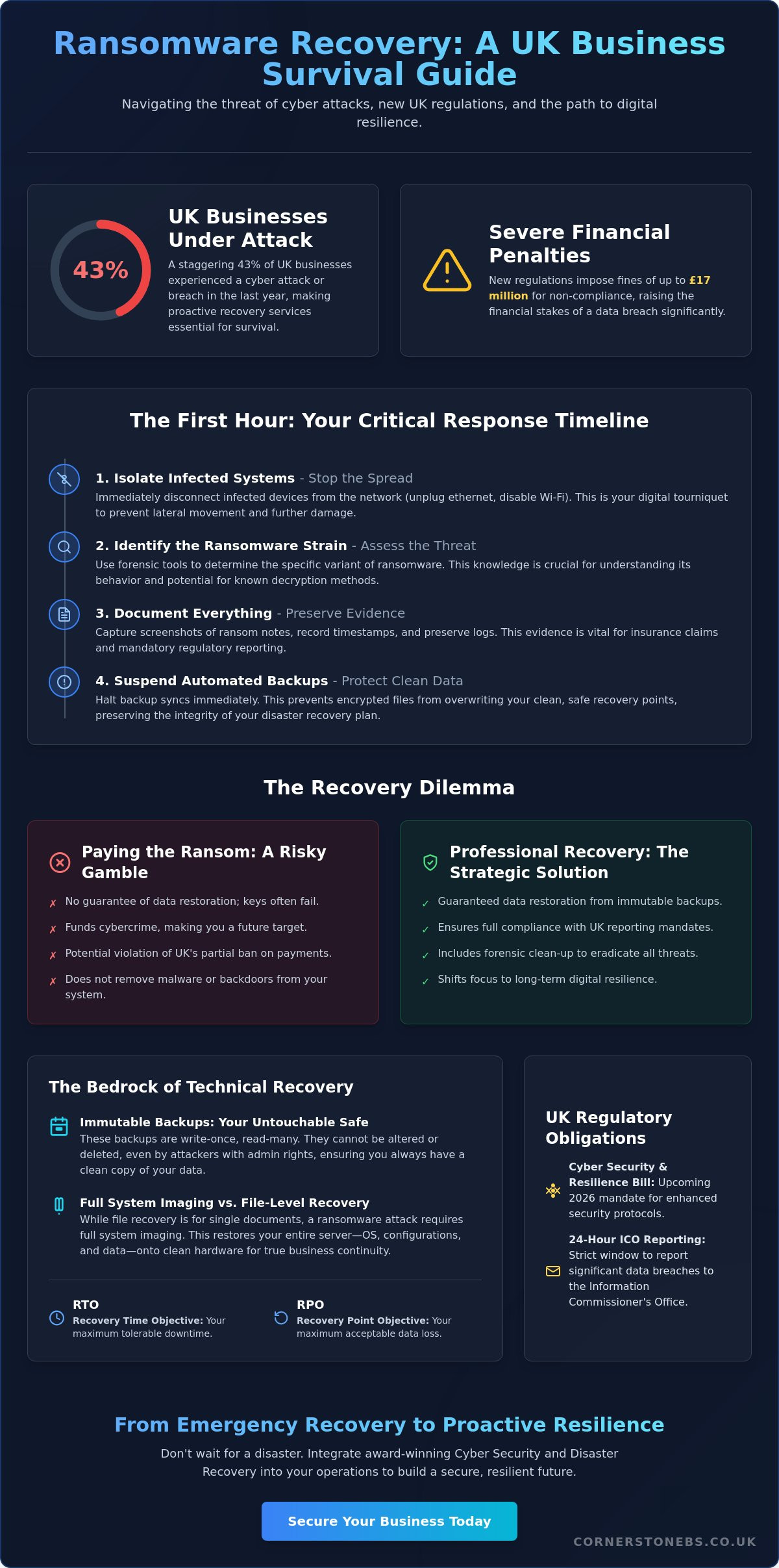
Did you know that 43% of UK businesses experienced a cyber attack in the last year, with many now facing potential fines of up to £17 million under new regulations? You likely feel the pressure of the upcoming Cyber Security and Resilience Bill, especially with its mandatory 24-hour incident reporting requirements. Securing the right ransomware recovery services UK business leaders need is no longer a luxury; it’s the foundation of your operational survival. We understand that the fear of total data loss and crippling downtime keeps many local business owners awake at night.
We agree that the stakes have never been higher, particularly as the UK government moves toward a partial ban on ransomware payments. This guide provides a comprehensive roadmap to help you navigate the recovery process, restore your systems, and ensure long-term digital resilience. You’ll learn how to handle the new reporting mandates, minimize your downtime through robust disaster recovery, and maintain full compliance with evolving UK data laws. We’ve designed this guide to turn technical complexity into a clear path forward for your business stability and peace of mind.
Key Takeaways
- Stop the spread immediately by isolating infected systems and using forensic tools to identify the specific ransomware strain within the first hour.
- Ensure guaranteed data restoration by leveraging immutable backups and full system imaging instead of relying on unstable decryption keys from criminals.
- Navigate complex 2026 regulations with professional ransomware recovery services UK to meet strict ICO reporting windows and protect your reputation.
- Shift from emergency recovery to proactive digital strength by integrating award-winning Cyber Security and Disaster Recovery into your daily operations.
The first hour of a ransomware attack is often the most stressful period a business owner will ever face. You might see strange file extensions appearing in your folders or a glaring ransom note on your desktop. Stay calm. Your first job is to stop the bleeding. You must isolate infected machines immediately to prevent the malware from moving laterally through your network infrastructure. If you don’t act fast, a single infected device can compromise your entire server array. This is where the right ransomware recovery services UK expertise becomes the difference between a minor hiccup and a total shutdown.
Identifying the specific strain is the next priority. Using professional forensic tools helps determine if there’s a known remedy for the What is Ransomware? variant you’re facing. Our local team focuses on documenting every screen, message, and timestamp. This evidence is essential for your insurance claim and your 24-hour reporting mandate under the 2026 Cyber Security and Resilience Bill. You should avoid the temptation to speak with attackers directly. They’re professional manipulators, and direct contact often leads to higher ransom demands or further security risks. We’re here to help you manage these initial steps with the clarity of a long-term partner.
The Critical Containment Phase
Containment acts as the digital tourniquet for business survival, stopping the spread before it claims your entire network. You need to physically disconnect ethernet cables and disable Wi-Fi protocols on all suspected devices. It’s also vital to suspend your automated backup syncs immediately. If your system keeps syncing during an active attack, you risk overwriting your clean archives with encrypted data. Halting these processes preserves the integrity of your Disaster Recovery points and keeps your clean data safe from corruption.
Initial Assessment and Triage
Once the spread is contained, we assess the scope of the breach. We differentiate between files that are simply locked and data that has been exfiltrated to external servers. Our experts look across your UK-based servers and Microsoft 365 cloud environments to map the infection accurately. We then help you prioritise your restoration queue. By focusing on critical business functions first, we ensure your most important operations are back online while we continue the deeper cleaning process. This structured approach helps you maintain business continuity even under extreme pressure.
Technical Recovery Mechanisms: Restoring Business Continuity
Restoring your business operations involves much more than just clicking ‘undo’ on a hacker’s encryption. While many focus solely on data, true continuity requires a structured approach to rebuilding your entire digital environment. Leading ransomware recovery services UK providers rely on immutable backups as the first line of defence. These backups are specifically designed to be unchangeable; once written, they cannot be modified or deleted, even by someone with stolen administrative credentials. This ensures you always have a clean, untouchable copy of your history to fall back on.
We distinguish between simple file-level recovery and full system imaging. File-level recovery works for accidental deletions, but after a total ransomware sweep, you need system imaging. This process restores your entire server environment, including the operating system and configurations, onto clean hardware. By utilising cloud-based Disaster Recovery, we can often spin up these images in a virtual environment, allowing your team to work while we sanitise your physical on-site servers. This dual-track approach slashes the time you spend in operational limbo.
Understanding RTO and RPO in 2026
Success in recovery is measured by two vital metrics: RTO and RPO. Think of the Recovery Time Objective (RTO) as the ‘clock of downtime.’ It’s the maximum amount of time your business can survive without its systems before the damage becomes irreversible. Recovery Point Objective (RPO) is your ‘threshold of data loss,’ representing how much work you’re willing to lose between your last backup and the attack. We work as your long-term partner to align these metrics with your specific commercial needs, ensuring your protection matches your pace of growth.
The Forensic Clean-Up Process
You can’t simply restore data into an environment that might still be compromised. We follow UK government guidance on mitigating ransomware by thoroughly sanitising every server and workstation. This involves identifying ‘sleeper’ malware that may have been lurking in your backup sets for weeks before the final payload was delivered. By extracting data into sandboxed environments, we verify its integrity before it ever touches your live network. This rigorous verification process ensures that when you reconnect to the UK internet backbone, you do so with total confidence in your system’s purity.
Professional Recovery Services vs. Paying the Ransom
When you’re staring at a frozen screen and a multi-million pound demand, the pressure to pay can feel overwhelming. You want your business back, and the hackers promise a quick fix. However, paying a ransom is a high-stakes gamble that rarely delivers the clean break you’re hoping for. Statistics from early 2026 show that only 17% of UK organisations chose to pay the ransom, a sharp decline from previous years. This shift isn’t just about ethics; it’s about the cold reality that partnering with ransomware recovery services UK experts is a more reliable investment in your business’s future. Paying doesn’t just fund criminal enterprises; it marks your company as a “proven payer,” often leading to repeat attacks within months.
The technical reality is that decryption keys provided by attackers are notoriously unstable. They’re often poorly coded and can corrupt your files during the decryption process. Research from 2025 indicates that only about 60% of organisations that pay a ransom successfully recover all their data. You might spend $1.5 million (the median UK ransom payment in 2025) and still end up with a shattered database. Beyond the data loss, you face the risk of “double extortion,” where criminals take your money but still leak your sensitive information or demand a second payment to stop a public data dump. Investing in professional restoration through your Managed IT Support partner ensures your systems are rebuilt on a clean, secure foundation rather than a patched-up crime scene.
The Myth of the “Honest Hacker”
Don’t fall for the idea that hackers have a reputation to uphold. They aren’t service providers; they’re criminals. Even if they give you a key, they often leave “sleeper” malware behind. These backdoors allow them to bypass your Cyber Security and strike again once you’ve resumed operations. Professional recovery focuses on a “clean start” by wiping infected environments and restoring from immutable backups. This method ensures that no hidden threats remain to jeopardise your long-term stability.
Legal Risks for UK Businesses
The legal landscape in the UK has become significantly more complex. You must consider the UK government financial sanctions guidance before even discussing a payment. Paying a ransom to a sanctioned entity can lead to severe legal penalties, regardless of your intentions. Additionally, many UK insurance providers now exclude ransomware payments from their coverage. Working with a certified recovery partner is often a prerequisite for a successful insurance claim, as it proves you’ve taken reasonable steps to mitigate the damage through legitimate channels.
UK Regulatory Obligations and Data Breach Compliance
Recovering your data is only half the battle. In the UK, the legal aftermath of a ransomware attack can be just as daunting as the technical breach itself. You’re likely aware of the UK GDPR requirements, but the 2026 regulatory landscape has added new layers of urgency. Under the Cyber Security and Resilience Bill, many organisations now face a mandatory 24-hour incident reporting window. This sits alongside the existing 72-hour ICO notification requirement for personal data breaches. If you miss these deadlines, or if you can’t prove you took “reasonable care” to protect your infrastructure, the financial penalties can be staggering.
Engaging professional ransomware recovery services UK experts ensures you aren’t just restoring files; you’re building a robust legal defence. We help you document every step of the incident, from the initial discovery to the final system sanitisation. This detailed paper trail is vital when you communicate the breach to clients, stakeholders, and your employees. Transparency is your best tool for preserving trust. We ensure your response aligns with the latest National Cyber Security Centre (NCSC) standards, providing the structured approach that regulators expect from a responsible business.
Navigating the ICO Reporting Process
Reporting a breach shouldn’t be a guessing game. The ICO notification form requires specific details about the nature of the breach, the categories of data involved, and your mitigation steps. We guide you through this process, ensuring your technical recovery documentation supports your claim of proactive management. By being clear and transparent in your UK-wide communication, you manage the narrative and reduce the risk of long-term reputational fallout. This structured approach helps satisfy the authorities while protecting your brand’s integrity.
Compliance as a Recovery Milestone
A successful recovery is the perfect time to harden your defences for the long term. Many of our clients use this transition to achieve Cyber Security Services certification, turning a vulnerability into a verified strength. We’ll help you update your internal data processing registers and ensure you’re aligned with standards like NIS2 or DORA if your sector requires it. This isn’t just about ticking boxes; it’s about building a resilient future where your business is better protected than ever before. If you’re concerned about your current compliance posture, reach out for a chat with our local experts to see how we can strengthen your digital foundations.
Building a Ransomware-Resilient Future with Cornerstone
Surviving a cyber attack is a major milestone, but the ultimate goal is ensuring it never happens again. We believe that the most effective ransomware recovery services UK businesses rely on should lead directly into a proactive security posture. Our multi-award-winning support isn’t just about reacting to alarms; it’s about building a digital fortress around your daily operations. We help you transition from the stress of emergency recovery to the stability of managed IT. By implementing a Zero Trust architecture across your network, we ensure that every user and device is verified. This strategy significantly reduces the risk of lateral movement, keeping your core assets safe even if a single endpoint is compromised.
Proactive Monitoring and Threat Hunting
We leverage elite global partnerships with industry leaders like Cisco and Microsoft to bring world-class protection to your local network. Our UK-based helpdesk monitors your systems around the clock, identifying anomalies and hunting for “sleeper” threats before they have a chance to encrypt your files. For many local leaders, this journey toward total resilience starts with Managed IT Services Teesside to establish a rock-solid foundation. We act as your dedicated security eyes and ears, allowing you to focus on your commercial goals with total confidence.
Tailored Disaster Recovery Planning
True resilience requires moving beyond basic backups into a sophisticated Cloud Solutions environment. We customise your recovery protocols to match your specific RTO and RPO requirements. We don’t just hope the plan works; we run regular “fire drill” testing to prove it. These simulations ensure that your team knows exactly what to do and that your data can be restored within minutes. We’d love to invite you to a no-pressure conversation about your current risk level. Let’s have a friendly chat about how we can strengthen your digital foundations for the years ahead.
Secure Your Digital Legacy and Business Continuity
Navigating a ransomware attack is one of the toughest challenges any business leader will face. We’ve explored how immediate containment, technical restoration through immutable backups, and strict adherence to UK regulatory reporting can turn a potential disaster into a managed recovery. By choosing professional restoration over the risks of paying a ransom, you protect your business from double extortion and ensure your systems are rebuilt on a clean, secure foundation. Securing the right ransomware recovery services UK experts provide is the most effective way to meet the 2026 reporting mandates while preserving your professional reputation.
As a multi-award-winning IT provider and strategic partner with Microsoft, IBM, and Cisco, we’re here to be your long-term technology partner. Our UK-based proactive support team focuses on building a resilient future for your organisation, moving you from emergency response to a Zero Trust environment. Don’t wait for a crisis to test your defences. We invite you to talk to our award-winning UK experts about your recovery plan and discover how we can strengthen your digital foundations together. Your business stability is our priority, and we’re ready to help you thrive with confidence.
Frequently Asked Questions
Is it illegal for a UK business to pay a ransomware demand?
Paying a ransom isn’t universally illegal, but it’s a high-risk legal minefield that the UK government strongly discourages. If you unknowingly pay a group that is on the UK’s financial sanctions list, your business could face criminal prosecution. Under the 2026 Cyber Security and Resilience Bill, organisations must also report any intention to pay a ransom to the authorities before the transaction occurs. We focus on restoration through secure backups to keep your business on the right side of the law.
How long does professional ransomware recovery typically take?
Recovery timelines depend on the volume of data and the complexity of your network, but 59% of UK businesses achieved a full recovery within one week in 2025. While simple file restoration might happen quickly, a full forensic sanitisation of your servers ensures that no “sleeper” malware remains. Our local team prioritises your most critical business functions so you can resume operations while the deeper cleaning of your infrastructure continues in the background.
Will my cyber insurance cover the cost of recovery services?
Most cyber insurance policies cover the professional fees for ransomware recovery services UK providers offer to rebuild your systems. However, a growing number of UK insurers now specifically exclude the cost of the ransom payment itself. You should review your policy to confirm it covers digital forensics, data restoration, and the temporary hardware needed to maintain business continuity during the rebuild. Working with a recognised partner often makes the claims process much smoother.
Can ransomware infect my cloud backups like Microsoft 365 or Azure?
Yes, ransomware can compromise cloud environments if your automated sync processes remain active during an attack. If your local files are encrypted, the cloud service may simply sync those “changes,” overwriting your clean versions with encrypted ones. We prevent this by using immutable cloud backups and Disaster Recovery solutions that are isolated from your live sync environment. This ensures you always have a version of your data that the malware cannot touch.
What is the difference between data recovery and ransomware recovery?
Data recovery is the technical act of retrieving lost or deleted files, while ransomware recovery is a comprehensive strategic restoration of your entire business environment. Ransomware recovery involves forensic analysis to find the entry point, sanitising the network to remove backdoors, and verifying the integrity of every system. It’s a structured move toward long-term resilience rather than just a simple file restore. We treat it as a business continuity project to ensure your digital foundations are stronger than before.
Do I need to report a ransomware attack to the police or the ICO?
You must report any breach involving personal data to the ICO within 72 hours under the UK GDPR. For many sectors, the 2026 regulations have shortened this to a 24-hour mandatory reporting window for the initial incident. You should also report the attack to Action Fraud, which is the UK’s national reporting centre for cybercrime. These reports are essential for your legal compliance and can be vital when making a claim on your cyber insurance policy.
How can I tell if my backups are safe from a current infection?
Your backups are only truly safe if they are immutable or physically air-gapped from your primary network. We use forensic scanning tools to check your backup sets for “sleeper” malware that might have been planted weeks before the attack. If your backups were connected to the network during the infection without specific write-protection, there’s a risk they could be compromised. Regular “fire drill” testing is the most reliable way to verify your recovery points.
What are the first three things I should do if I see a ransom note?
First, isolate the infected devices by disconnecting ethernet cables and disabling Wi-Fi to stop the spread. Second, take photos of the ransom note and any on-screen messages to provide evidence for the police and your insurance provider. Third, contact your Managed IT Support partner immediately to begin the professional containment phase. These steps act as a digital tourniquet, protecting your remaining network infrastructure from lateral movement while you prepare for a secure restoration.