
With the October 2025 transition deadline now behind us, any UK business still relying on the old 2013 standard is officially operating without a valid certificate. It’s a high-stakes reality that can stall commercial bids and leave your digital infrastructure vulnerable to modern threats. Achieving true ISO 27001 certification readiness in 2026 requires more than just a checkbox exercise. It demands a proactive shift toward the 2022 standard updates and the latest UK Data (Use and Access) Act requirements that came into force this February.
As a team recognized for our commitment to regional business excellence, we know it’s a challenge to document every process while keeping your daily operations running smoothly. It’s natural to feel some audit anxiety when you’re balancing growth with complex security controls. This guide is here to replace that uncertainty with a clear, strategic roadmap. You’ll discover how to benchmark your current security, close compliance gaps, and build a robust defense that protects your reputation. We’ve simplified the technical hurdles so you can achieve your goals with total confidence, treating your information security as the vital foundation of your business stability.
Key Takeaways
- Distinguish between identifying missing controls and verifying their performance through a formal readiness assessment before your audit begins.
- See how modern cloud solutions and Microsoft 365 configurations serve as the technical backbone for your compliance framework.
- Follow our five-step checklist to achieve ISO 27001 certification readiness while maintaining focus on your core business goals.
- Leverage the expertise of a local IT partner to automate evidence collection and handle the heavy lifting of digital security management.
- Build a culture where information security is a commercial advantage rather than just a technical necessity.
What is ISO 27001 Certification Readiness?
At its core, ISO 27001 certification readiness is the specific point where your Information Security Management System (ISMS) is fully documented, properly implemented, and supported by concrete evidence. It serves as the vital “pre-flight check” before you invite an external auditor for your formal Stage 1 and Stage 2 assessments. For businesses across the UK, achieving this state means you’ve moved past the planning phase and into a cycle of continuous improvement. This level of preparation is a significant commercial asset. It signals to your stakeholders and supply chain partners that you treat their data with the highest level of care. As your local expert, we believe this readiness creates the emotional security every business owner needs to grow with confidence.
The Shift to ISO/IEC 27001:2022
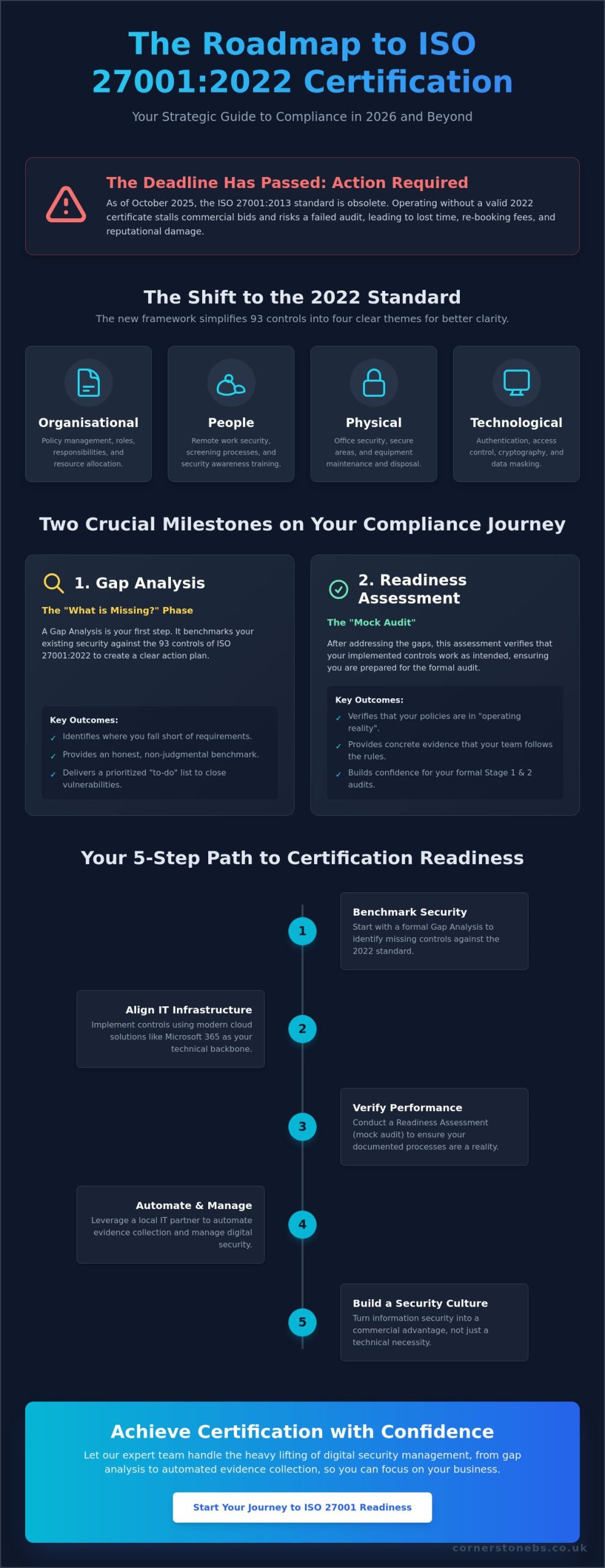
The recent shift to the ISO/IEC 27001:2022 standard changed the landscape for everyone. Since the transition deadline passed in October 2025, the old 2013 framework is no longer valid for new certifications. The 2022 update simplified the process by grouping 93 controls into four clear themes:
- Organisational controls like policy management and resource allocation.
- People controls such as remote working security and screening.
- Physical controls covering office security and equipment maintenance.
- Technological controls including authentication and data masking.
This structure makes it easier for business owners to understand where their responsibilities lie. Many firms fall into the trap of “false confidence,” assuming their old security habits will pass the new test. In reality, the 2022 standard requires a more integrated approach to modern digital risks and updated regulations like the Data (Use and Access) Act 2025. Modern readiness ensures your controls reflect the actual threats your business faces today.
Why Readiness Matters More Than Effort
Auditors are looking for “operating reality.” They want to see that your policies aren’t just sitting in a digital drawer. They’ll look for evidence that your team actually follows the rules you’ve set. If your documentation says you perform weekly backups, but you only have evidence for three out of the last four weeks, you’ll likely face a non-conformity. The cost of a failed audit goes far beyond the initial fee. You have to consider the time lost, potential re-booking charges, and the damage to your commercial reputation if a major contract is pending.
By focusing on ISO 27001 certification readiness, you turn your cyber security services into a permanent shield for your business. It ensures that when the auditor arrives, you can demonstrate your compliance with total ease. We view this as a foundational element of your stability, giving you the freedom to focus on your daily operations while we help manage the technical weight of compliance.
Readiness Assessment vs. Gap Analysis: Key Differences
Don’t mistake a gap analysis for a readiness assessment. While they share some DNA, they serve entirely different purposes on your journey toward compliance. We view these as distinct milestones in a bespoke technology roadmap, each designed to build your confidence and protect your investment. You can’t have a successful readiness assessment without first completing a thorough gap analysis; one identifies the work required, while the other verifies that the work actually functions as intended.
The Gap Analysis: Identifying the Holes
Think of the gap analysis as the “what is missing” phase. During this stage, we benchmark your existing security controls against the 93 controls defined in the official ISO 27001 standard. This isn’t about passing or failing; it’s about honest benchmarking. We look at your current digital infrastructure and identify where you fall short of the 2022 requirements.
The primary outcome of this phase is a prioritised “to-do” list for your IT team or managed partner. By using a formal risk assessment, we help you determine which gaps pose the greatest threat to your business continuity. This ensures you aren’t wasting resources on minor issues while major vulnerabilities remain open. If you’re feeling unsure about where to start, our local expert team is always available for an informal conversation to help you map out these initial steps.
The Readiness Assessment: The Mock Audit
Once you’ve implemented the necessary controls and policies, you move to the ISO 27001 certification readiness assessment. This is the “is it working” phase. We treat this as a full dress rehearsal conducted by an impartial expert who mimics the behaviour of a formal UKAS auditor. The focus shifts from “do you have a policy?” to “can you prove it’s working?”
During this mock audit, the expert will scrutinise your evidence, including:
- System logs and automated monitoring reports.
- Meeting minutes that show leadership engagement with security.
- Staff interviews to ensure your team understands their security responsibilities.
- Documented evidence of recent risk treatments.
This phase concludes with an Executive Briefing. This report gives you the green light to proceed or highlights specific areas that need one final polish. It’s the ultimate safety net that ensures you don’t pull the trigger on a formal audit until you’re absolutely certain of a positive outcome. This structured approach minimises disruption to your daily operations and keeps your certification journey on a steady, predictable path.
Aligning Your IT Infrastructure with 2026 Standards
Your digital foundation determines how smoothly you’ll reach the finish line. In 2026, a secure infrastructure isn’t just about speed; it’s about granular control and visibility. For most UK businesses, this starts with securing cloud solutions like Azure and AWS. These platforms offer incredible flexibility, yet they require expert configuration to ensure that data residency and access permissions align with your Information Security Management System (ISMS). When your infrastructure is built correctly, it acts as a silent partner in your ISO 27001 certification readiness journey.
A successful Microsoft 365 migration for business UK provides the perfect opportunity to bake security into your daily workflows. By moving away from legacy on-premise servers, you gain access to enterprise-grade tools that simplify the path to compliance. However, your chosen it company solutions must be designed to support these goals. If your technology stack is clunky or poorly integrated, your team will find workarounds that create security gaps and lead to audit failure. We’ve seen how a well-structured network provides the emotional security needed to scale without fear.
Securing the Microsoft 365 Ecosystem
Modern auditors love automation. Tools like Microsoft Intune and Purview allow you to automate the collection of evidence, proving that your devices are encrypted and your data is classified correctly. In a hybrid work environment, identity is the new perimeter. Protecting this perimeter requires Multi-Factor Authentication (MFA) and strict conditional access policies. Microsoft 365 Business Premium directly addresses at least five Annex A controls by managing access rights, securing authentication, protecting endpoint devices, automating information deletion, and restricting privileged access.
Network Infrastructure & Physical Security
The 5-Step ISO 27001 Readiness Checklist
Achieving ISO 27001 certification readiness doesn’t have to be an overwhelming ordeal. We’ve streamlined the process into five actionable steps that protect your time and your investment. By following this roadmap, you ensure that every part of your Information Security Management System (ISMS) is robust, compliant, and ready for the spotlight of a formal audit.
- Step 1: Define the Scope. Be precise about what you’re certifying. You don’t always need to include every department; focus on the areas that handle sensitive data or critical business processes.
- Step 2: Leadership & ISMS Policy. Auditors look for the “tone from the top.” Your senior management must demonstrate a clear commitment to security through documented policies and resource allocation.
- Step 3: Risk Assessment & Treatment. Identify the threats to your information and decide how to handle them. You must document why you chose to accept, transfer, or mitigate specific risks.
- Step 4: The Statement of Applicability (SoA). This is your auditor’s map. It lists which controls apply to your business and, crucially, which ones don’t.
- Step 5: Internal Audit & Management Review. This is your final check. You must conduct an internal audit to verify that your controls are working and present the findings to your leadership team.
If you’re worried about the technical burden of these steps, our locally based team can help you navigate the complexities with multi-award-winning expertise.
Mastering the Statement of Applicability (SoA)
The SoA is the most critical document you’ll present to a Stage 1 auditor. It lists which of the 93 Annex A controls from the 2022 standard are relevant to your operations. You cannot simply exclude controls because they seem difficult; every exclusion requires a valid, documented reason that the auditor will scrutinise. A well-crafted SoA proves you understand your unique risk landscape and have intentionally chosen the right safeguards to protect your business stability.
Preparing Your People for the Audit
Information security is as much about people as it is about technology. Staff awareness is a major component of ISO 27001 certification readiness. During a formal audit, the assessor may interview your team to see if they understand your security policies. We recommend regular training sessions and mock social engineering tests, such as simulated phishing emails, to keep security top of mind. You must document this training and any subsequent competency checks. This evidence shows the auditor that security is woven into your company culture, providing the emotional security your clients expect from a professional partner.
How Managed IT Support Accelerates Your Path to Certification
Achieving ISO 27001 certification readiness is often viewed as a daunting technical mountain to climb. However, partnering with a multi-award-winning managed IT provider shifts that weight off your shoulders. We don’t just give you a list of things to do; we implement the technical controls, configure the secure environments, and manage the ongoing monitoring that auditors demand. This proactive approach ensures your security controls are always active and functional, rather than just existing as words in a policy document. We treat your security as a foundational element of your business stability.
In the current 2026 threat landscape, staying ahead of sophisticated cyberattacks is a full-time commitment. Our team understands the specific nuances of the UK’s latest regulations, including the Data (Use and Access) Act 2025. We provide the technical evidence your auditor needs, from automated log reports to proof of encryption across all endpoints. This collaboration turns a complex certification process into a structured, manageable journey. We act as your long-term partner, ensuring your security foundation is strong enough to support your most ambitious growth plans while protecting your commercial reputation.
From Project to ‘Business as Usual’
Many businesses treat certification as a one-off project, but it’s actually a three-year cycle. After your initial success, you’ll face annual surveillance audits to prove you’re still meeting the standard. Managed IT support turns compliance into a standard operating procedure rather than a yearly scramble. Through regular technical audits and rigorous patch management, we ensure your systems remain secure every single day. This consistency removes the audit panic that often strikes when a surveillance date approaches. We keep the evidence trail warm so your ISO 27001 certification readiness is a permanent state, not a temporary achievement.
The Cornerstone Approach to Security
We pride ourselves on being more than just a service provider. Our approach blends professional authority with an approachable, regional warmth that makes complex technology feel manageable for any business owner. We design bespoke solutions that fit your specific needs, providing the emotional security that comes from knowing your digital assets are protected by experts. As a locally based team, we’re deeply invested in the success of our community’s businesses and the stability of their infrastructure.
Your path to a more secure, reputable, and commercially competitive business starts with a simple step. We invite you to have an informal conversation with our friendly team of experts. Let’s discuss your certification goals and see how we can build a resilient future together. Whether you’re just starting your gap analysis or looking to polish your final readiness assessment, we’re here to help you move forward with total confidence.
Securing Your Commercial Future with Confidence
Transitioning to the 2022 standard is more than a regulatory hurdle; it’s a strategic opportunity to build a more resilient, trustworthy organisation. We’ve explored how a robust Statement of Applicability and a well-configured Microsoft 365 environment provide the concrete evidence auditors demand. By shifting from a “project” mindset to a “business as usual” approach, you ensure your ISO 27001 certification readiness remains a constant state of excellence. This proactive stance protects your commercial edge and builds lasting trust with your stakeholders.
As a multi-award-winning IT services provider and certified partner for Microsoft, IBM, and Cisco, we provide the technical depth and national UK coverage needed to secure your infrastructure. We believe in a partner-led approach that prioritises your emotional security and business stability. You don’t have to navigate these complex global standards alone. Our team is here to simplify the technical mechanisms so you can focus on what you do best.
Book a consultation with our award-winning security experts to assess your ISO 27001 readiness.
We look forward to helping you turn compliance into a powerful engine for your long-term growth and success.
Frequently Asked Questions
How long does it take to achieve ISO 27001 certification readiness?
Most UK small and medium enterprises take between 6 and 12 months to reach full ISO 27001 certification readiness. The exact timeline depends on your current security maturity and the resources you can dedicate to the project. If you already have robust digital infrastructure in place, you might find the process moves much faster. We always recommend a steady pace to ensure your team truly adopts the new security culture.
Is ISO 27001 a legal requirement for UK businesses in 2026?
ISO 27001 isn’t a universal legal mandate, but it’s increasingly a commercial necessity for UK businesses. While the law doesn’t force you to certify, many public sector contracts and large corporate supply chains now require it. It also serves as powerful evidence that you’re meeting the “appropriate technical and organisational measures” required by the Data (Use and Access) Act 2025 and UK GDPR.
What is the difference between ISO 27001 and Cyber Essentials Plus?
Cyber Essentials Plus is a technical snapshot focused on five specific security areas, while ISO 27001 is a holistic management system. Think of Cyber Essentials as a vital baseline and ISO 27001 as the complete architecture for your business stability. The 2022 version of ISO 27001 manages 93 controls across people, physical, and digital domains, offering a much broader shield for your reputation.
How much does an ISO 27001 readiness assessment cost?
The cost of a readiness assessment depends on the size of your organisation and the complexity of your data processes. Larger firms with multiple sites or complex cloud environments will require more time for a thorough review. While audit day rates for UKAS accredited auditors have risen recently due to a shortage of qualified professionals, investing in a readiness assessment prevents the much higher costs of a failed formal audit.
Can a small business with under 10 employees get ISO 27001 certified?
Absolutely, businesses with fewer than 10 employees can and do achieve certification. The standard is designed to be scalable, meaning you only implement controls that are relevant to your specific risks. Small teams often reach ISO 27001 certification readiness faster than larger corporations because their communication lines are shorter and their internal structures are less complex.
What happens if we fail our ISO 27001 Stage 1 audit?
Failing a Stage 1 audit simply means you have some homework to do before the final assessment. Your auditor will provide a report detailing any non-conformities or areas where your documentation is thin. You’ll need to address these issues before you can proceed to Stage 2. It’s best to view this as a helpful safety net that prevents a more costly failure during the final certification stage.
Do we need to buy expensive software to manage our ISO 27001 compliance?
You don’t need to purchase dedicated compliance software to meet the standard. While automated platforms can be helpful, many successful businesses manage their compliance using their existing Microsoft 365 ecosystem. The key to ISO 27001 certification readiness is the quality of your processes and the evidence you produce, not the price tag of the software you use to track them.
How often do we need to renew our ISO 27001 certification?
Your ISO 27001 certificate follows a three-year cycle. Once you’re certified, you’ll undergo annual surveillance audits in years one and two to ensure your systems are still performing well. At the end of the third year, you’ll need a full recertification audit to maintain your status. This cycle ensures that your security remains a proactive, foundational element of your business rather than a one-off project.
Tags: Audit Preparation, Compliance, Data Protection, information security, ISO 27001, ISO 27001:2022, UK business