What if your next major contract is currently stalled on a procurement officer’s desk, simply waiting for proof of your security credentials? In 2026, iso 27001 compliance for uk businesses has shifted from a competitive edge to a non-negotiable requirement for entering enterprise supply chains. You’ve likely felt the mounting pressure from clients to demonstrate your certification, yet the prospect of managing the 93 Annex A controls while maintaining your daily operations can feel like an impossible balancing act.
We know the concern that the high costs and time commitment of iso 27001 compliance for uk businesses might seem daunting, particularly when you’re already stretched thin. This strategy guide clarifies the complexities, offering a practical roadmap to secure your sensitive data and successfully navigate rigorous UK tenders. You’ll discover the genuine ROI of certification and learn how a proactive approach to iso 27001 compliance for uk businesses builds a resilient framework that supports your long-term growth. We’ll preview the essential technical pillars and show you how to find a partner to handle the complex infrastructure requirements.
Key Takeaways
Understand why 2026 is a pivotal year for updating your Information Security Management System to the latest 2022 standard.
Master the 93 Annex A controls to streamline iso 27001 compliance for uk businesses and secure your digital infrastructure.
Position your organisation to win lucrative UK public sector tenders by proving your commitment to robust data security.
Follow a clear roadmap from initial gap analysis to proactive risk treatment to ensure a successful audit.
Explore how managed services automate technical maintenance, providing the continuous evidence needed to sustain your certification.
What is ISO 27001 Compliance for UK Businesses in 2026?
Understanding What is ISO/IEC 27001? provides the foundation for your entire security strategy. It’s the globally recognised standard for an Information Security Management System (ISMS). While the 2013 version served the industry for a decade, the transition period officially ended in autumn 2025. This makes 2026 the first year where every new certification or renewal must align with the ISO/IEC 27001:2022 update. This version is specifically designed to address modern threats, focusing heavily on cloud security and complex supply chain risks.
We define an ISMS as a living framework of people, processes, and technology that evolves alongside your business risks. It’s not a static folder on a server; it’s the digital backbone of your organisation.
The Three Pillars of Information Security
Every control within the framework supports three core goals, often called the CIA triad. Balancing these ensures your security doesn’t get in the way of your productivity.
Confidentiality: This ensures that only authorised users can access sensitive information. We help you implement strict access controls so your data stays in the right hands.
Integrity: This protects your data from being altered or deleted by unauthorised parties. It’s about ensuring the information you rely on is accurate and untampered with.
Availability: Security is useless if you can’t get to your data. This pillar ensures your IT systems are reliable, resilient, and accessible whenever your team needs them.
ISO 27001 vs. Cyber Essentials: Which Does Your Business Need?
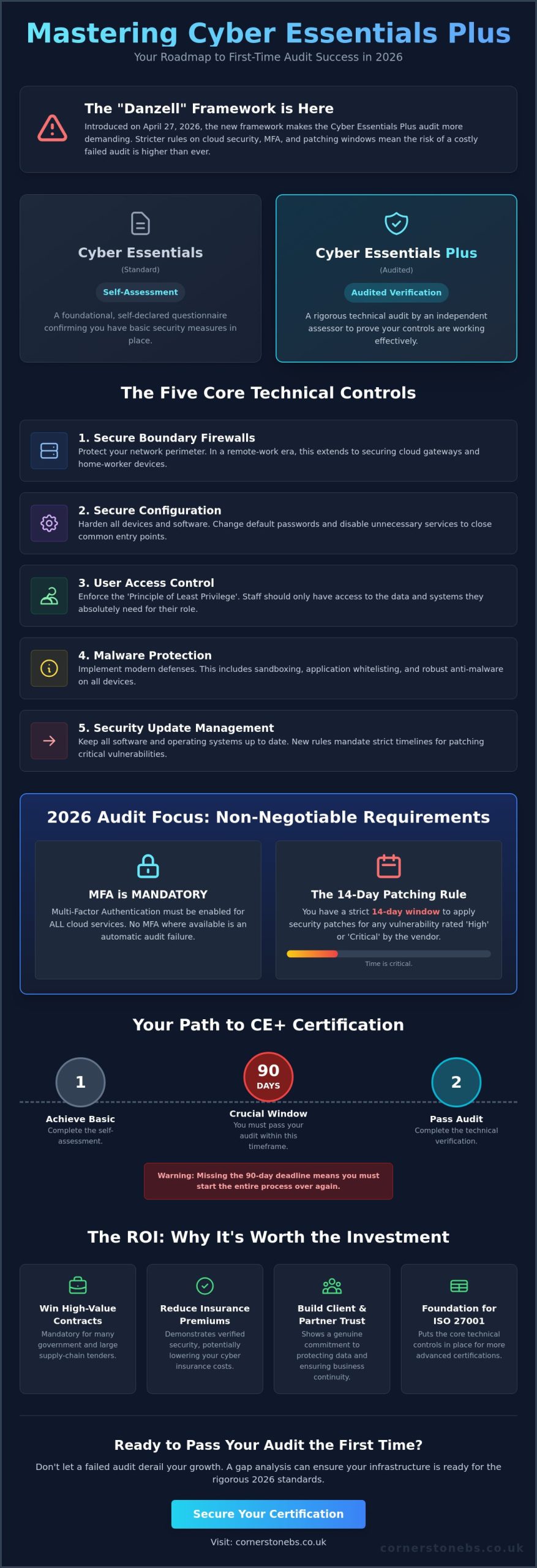
Cyber Essentials is a fantastic starting point for any UK business. It focuses on basic technical controls like firewalls, secure configuration, and patch management. It’s your “digital front door” security. ISO 27001 is far more comprehensive. It moves beyond technical fixes to look at how your management team handles risk, training, and continuous improvement.
The Core Requirements of the ISO 27001:2022 Framework
Risk assessment sits at the very centre of the framework. It’s the pulse that keeps your security strategy relevant and effective. Instead of blindly applying every rule, you evaluate your specific threats and decide how to treat them. This proactive approach is what makes iso 27001 compliance for uk businesses so powerful; it’s tailored to your unique risks. The standard is split into two distinct parts: the mandatory management clauses (4-10) and the Annex A controls.
Clauses 4 through 10 establish the “Management” in Information Security Management System. They require your leadership to show commitment, set clear objectives, and provide the necessary resources to keep data safe. You’ll also need to prove you’re evaluating your performance and constantly looking for ways to improve your defences. It’s about building a culture of security, not just a list of rules.
Then come the 93 Annex A controls. These are the practical safeguards you put in place to mitigate risks. The 2022 update simplified these into four clear categories: Organisational, People, Physical, and Technological. For a deeper look at the transition to these updated controls, the BSI guide to ISO 27001 certification offers excellent technical detail on the international expectations for modern businesses.
Defining Your ISMS Scope
You must decide exactly which parts of your business the certification covers. This is your “scope.” If your scope is too narrow, you might fail to satisfy a client who wants to see your entire operation secured. If it’s too broad, you’ll spend more time and money than necessary. Modern cloud solutions have changed the game here. They often blur the lines of your traditional network perimeter, meaning you must carefully define where your responsibility ends and your provider’s begins.
The Statement of Applicability (SoA) Explained
The SoA is the most vital document during an audit. It lists every Annex A control and states whether it applies to your business. If you exclude a control, you must justify why. For example, if your team works entirely remotely, you might exclude certain physical controls related to on-site data centres. It’s not a “set and forget” document. It requires continuous documentation to prove you’re still managing those risks effectively as your business grows.
Keeping your SoA up to date can feel like a full-time job. Our managed IT support ensures your technical documentation stays current, so you’re always ready for an auditor’s visit.
Why UK Businesses Prioritise ISO 27001 Compliance
We’ve seen that businesses with a robust Information Security Management System (ISMS) recover faster from incidents. They have a clear plan, defined roles, and a roadmap for continuity. This level of preparation turns a potential disaster into a managed event, protecting your reputation when it matters most.
Financial Resilience and Risk Mitigation
Let’s talk about the bottom line. The cost of a data breach for a UK SME can be devastating. Beyond the immediate technical recovery, you face legal fees, loss of reputation, and potential fines. Implementing the standard provides a framework to meet and exceed UK GDPR requirements. For official guidance on these obligations, the ICO’s Guide to Data Security is the essential resource for understanding the “security principle” of data protection. It bridges the gap between legal necessity and technical excellence.
Investing in compliance builds long-term stability. It ensures your team follows repeatable, secure processes that protect your most valuable assets. This proactive stance can also lead to direct savings on professional indemnity and cyber security services insurance premiums. Insurers are much more likely to offer better rates to companies that can prove they have a robust, audited ISMS in place. Protecting your client confidentiality is no longer just a defensive move; it’s a proactive growth strategy that secures your future.
A Step-by-Step Roadmap to Achieving ISO 27001 Compliance
Phase 1: Gap Analysis. We identify exactly where your current security posture fails to meet the standard’s 93 controls.
Phase 2: Risk Assessment & Treatment. You decide how to handle identified threats, whether that’s through technical fixes, insurance, or process changes.
Phase 3: Documentation & ISMS Build. This is where we create the policies and technical evidence needed to satisfy an auditor.
Phase 4: Internal Audit. A vital “dress rehearsal” where you test your own systems to find flaws before the official visit.
Phase 5: External Audit. The final Stage 1 (documentation review) and Stage 2 (evidence of practice) certification process.
Conducting a Meaningful Gap Analysis
You can’t fix what you haven’t found. Relying on internal guesswork often leads to “blind spots” that cause audit failures. We recommend using a professional eye to compare your current it company solutions against the rigorous Annex A controls. This phase gives you a realistic timeline for remediation. It ensures you don’t waste resources on unnecessary tools, focusing instead on the specific gaps that matter most to your business continuity.
Preparing for the Stage 1 and Stage 2 Audits
The external audit is a two-part evaluation. Stage 1 is a high-level review to ensure your ISMS is designed correctly. Stage 2 is the deep dive. The auditor will ask for proof that your team actually follows the policies you’ve written. If they find “non-conformities,” see them as a roadmap for improvement rather than a failure. Certification is a three-year cycle, requiring annual surveillance visits to ensure your standards don’t slip. It’s a commitment to being better every single day.
Our experts are here to handle the technical heavy lifting, ensuring your systems are audit-ready from day one. Let’s start building your resilient information security framework today.
How Managed IT Support Simplifies ISO 27001 Maintenance
Maintaining iso 27001 compliance for uk businesses shouldn’t be a manual burden for your internal team. While the audit focuses heavily on your policies, those policies only hold weight if your technical infrastructure supports them every single day. This is where managed support transforms from a utility into a strategic partnership. We provide the “continuous logging” and proactive monitoring required by Annex A, ensuring you have a digital paper trail for every event on your network. It’s about having the right evidence ready before an auditor even asks for it.
Technical Controls and Evidence Collection
Auditors don’t just want to hear about your security; they want to see the data. Our Managed IT services generate the granular reports needed to prove your multi-factor authentication (MFA) and encryption protocols are active. We take the heavy lifting of technical documentation off your shoulders. Instead of your staff spending hours pulling logs, we provide a streamlined stream of evidence. This allows your team to focus on their core roles while we maintain the technical backbone of your iso 27001 compliance for uk businesses.
The Role of Professional Services in Remediation
Sometimes, the initial gap analysis reveals that your legacy network infrastructure isn’t up to the task. We use professional services to overhaul your systems, ensuring they meet the rigorous standards of the 2022 framework. This often involves implementing robust cloud backup solutions as part of a comprehensive disaster recovery plan. Business continuity is a core requirement of the standard, and we ensure your data is recoverable even in a worst-case scenario. We don’t just find the problems; we build the solutions that keep you compliant.
We’re proud to act as the technical engine for our clients’ success. Contact Cornerstone for a friendly, no-pressure consultation on how our bespoke technology solutions support your compliance goals. Let’s have a conversation about securing your business for the long term.
Building a Secure Future for Your Business
As the digital landscape evolves, staying ahead of security threats is no longer optional. We’ve explored how the transition to the 2022 standard and the new Data (Use and Access) Act 2025 have reshaped the requirements for iso 27001 compliance for uk businesses. By following a structured roadmap and leveraging technical automation, you can transform a complex audit into a repeatable, efficient process that wins tenders and protects your reputation. It’s about more than just a certificate; it’s about the stability of knowing your data is safe.
Our multi-award-winning cyber security expertise ensures your organisation isn’t just following rules but building genuine resilience. We provide bespoke technology solutions tailored to UK compliance standards, backed by proactive managed IT support for long-term resilience that handles the technical evidence so you don’t have to. We’re proud to act as a dedicated partner for our clients, simplifying the technical heavy lifting so you can focus on growth.
How much does ISO 27001 compliance cost for a UK business?
External certification fees from UKAS-accredited bodies typically range between £6,800 and £10,000 for a small UK business in 2026. The total investment depends on your organisation’s size and current technical maturity. While these audit fees are paid to the certifying body, you also need to account for the internal resources or professional support required to build your framework. We focus on providing the robust technical infrastructure that ensures you’re ready for that investment.
How long does it take to become ISO 27001 certified?
Most UK organisations take between six and twelve months to achieve full certification. This timeline depends on the complexity of your operations and the results of your initial gap analysis. Small businesses with simple IT setups might move faster, while larger enterprises require more time for documentation and staff training. It’s vital to allow enough time for the “evidence of practice” phase before your official Stage 2 audit begins.
Can a small business achieve ISO 27001 compliance?
Is ISO 27001 a legal requirement in the UK?
ISO 27001 is the main standard that contains the requirements for your management system and is the only one you can be certified against. ISO 27002 is a supporting document that provides detailed guidance on how to implement the 93 controls found in Annex A. Think of 27001 as the “what” you must achieve and 27002 as the “how” you actually put those security measures into practice across your company.
Does ISO 27001 cover UK GDPR requirements?
It covers many aspects but not everything. ISO 27001 is excellent for meeting the “security of processing” requirements under UK GDPR, but it doesn’t specifically address data subject rights or lawful bases for processing. We recommend using the standard as a robust technical foundation for your privacy strategy. For sensitive staff and payroll records, utilising dedicated management platforms such as DuraSuite helps internal teams maintain strict access controls and accurate audit trails. It ensures your data is protected, which makes meeting your broader legal obligations under the Data (Use and Access) Act 2025 much simpler.
What happens if we fail an ISO 27001 audit?
Failing an audit usually means the auditor has found “non-conformities.” Major non-conformities mean your certification is paused until you fix the issue and undergo a follow-up visit. Minor non-conformities won’t stop you from getting certified, provided you create a clear plan to address them before the next surveillance visit. It’s a collaborative process designed to improve your systems, and we’re here to help you remediate any technical gaps found during the audit.
How often do we need to renew our ISO 27001 certification?
Your certificate is valid for three years, but you must undergo annual surveillance audits to keep it active. These smaller audits ensure your organisation is still following its policies and adapting to new threats. At the end of the three-year cycle, you’ll complete a full recertification audit. This cycle encourages continuous improvement, ensuring that iso 27001 compliance for uk businesses remains a living part of your organisation’s culture and provides the long-term resilience your clients expect.
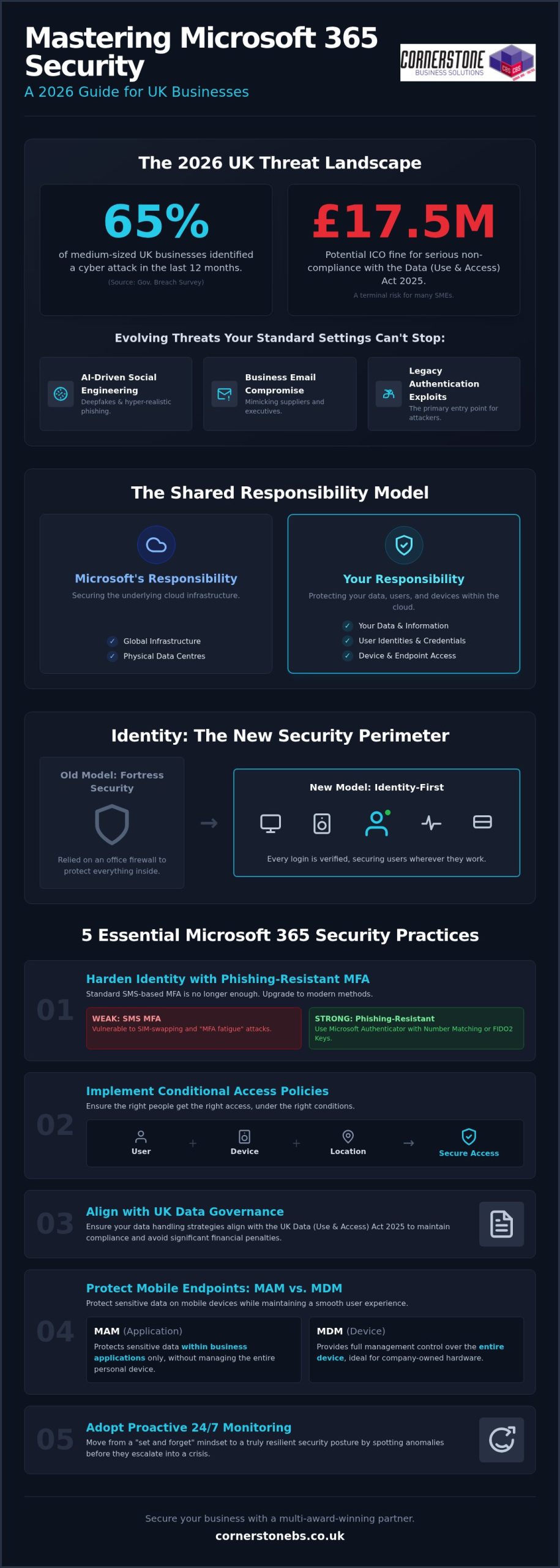
Did you know that 65% of medium-sized UK businesses identified a cyber attack in the last 12 months? It is a sobering statistic from the latest Government breach survey, and it makes implementing robust microsoft 365 security best practices for uk business more critical than ever. You likely feel the pressure of staying compliant with the new Data (Use and Access) Act 2025 while trying to decode which Microsoft licenses actually offer the protection you need. It is frustrating to manage complex settings when you should be focusing on leading your team.
We believe security should be proactive and empowering, not a source of constant stress. You deserve to know your data is safe from the £17.5 million fine potential of the ICO without spending every weekend in an admin portal. As a multi-award-winning partner, we are here to simplify the technical jargon into a strategy that actually works for your specific regional operations and goals.
This 2026 guide will help you master your security configurations from the ground up. We will cover everything from NCSC-backed passwordless logins to the latest Microsoft Teams protection updates. By the end, you will have a clear, actionable roadmap to ensure your business remains secure, compliant, and resilient in a changing digital landscape.
Key Takeaways
Identify the critical gaps in your current setup by mastering microsoft 365 security best practices for uk business that move beyond standard, out-of-the-box settings.
Learn how to implement phishing-resistant authentication and essential Conditional Access policies to secure your business identity against AI-driven social engineering.
Ensure your data governance strategies align with the latest UK Data (Use and Access) Act 2025 to maintain compliance and avoid significant financial penalties.
Discover the difference between MAM and MDM to protect sensitive business information on mobile devices while maintaining a smooth experience for your team.
Understand why proactive, 24/7 monitoring is the only way to move from a “set and forget” mindset to a truly resilient security posture.
The 2026 UK Threat Landscape: Why Standard Microsoft 365 Settings Aren’t Enough
Standard Microsoft 365 settings are built for convenience, not a 2026 threat environment. Relying on “out-of-the-box” configurations leaves your business exposed to sophisticated attacks that simple filters can’t catch. We’ve seen a massive shift toward AI-driven social engineering where hackers use deepfake technology to impersonate executives and trusted partners. Adopting microsoft 365 security best practices for uk business isn’t just a technical task; it’s a vital step to protect your local reputation and bottom line. A breach isn’t just an IT headache. Under the Data (Use and Access) Act 2025, the ICO can issue fines up to £17.5 million for serious non-compliance. For a UK SME, that financial hit combined with a lost reputation can be terminal.
Understanding the Shared Responsibility Model
A common mistake many UK directors make is assuming that Microsoft is responsible for all aspects of cloud safety. This isn’t the case. While Microsoft manages the physical data centres and global infrastructure, you are responsible for the data you store and the people who access it. Learning the basics of cloud security fundamentals helps you see where Microsoft’s job ends and yours begins. Without proper configuration, your sensitive files are essentially sitting in a secure building with the front door left unlocked.
The Shared Responsibility Model is a framework where Microsoft secures the underlying cloud infrastructure while you remain fully responsible for protecting your data, user identities, and device access.
Evolution of Cyber Threats in 2026
The 2026 threat landscape is dominated by Business Email Compromise (BEC) and “Shadow AI” risks. According to the UK Government Cyber Security Breaches Survey 2025/2026, 65% of medium-sized businesses identified a breach last year. Hackers no longer just send “dodgy” links; they use AI to draft perfectly phrased emails that mimic your suppliers. Legacy authentication remains the primary entry point for these criminals, as it lacks the modern safeguards needed to stop credential theft. Integrating professional cyber security services provides the proactive monitoring required to spot these anomalies before they escalate into a full-scale crisis.
Identity is now the new perimeter. We’ve moved past the days when a strong office firewall was enough. In a remote or hybrid world, your users’ credentials are the only thing standing between a hacker and your financial records. If you don’t secure the identity, you don’t have a perimeter. This identity-first approach ensures that every login attempt is verified, regardless of where the employee is working in the UK. It’s about moving from a reactive “on/off” switch to a proactive, identity-first governance model.
Hardening Identity: Implementing MFA and Conditional Access
Identity is the foundation of your digital estate. If a hacker steals a password, they essentially have a key to your office. In 2026, relying on a password alone is a massive risk. Implementing microsoft 365 security best practices for uk business starts with a robust identity strategy that assumes every login attempt could be a threat. We’ve moved past simple security; we now need “Identity-First” governance that verifies every user, every time, from every location.
Phishing-Resistant Multi-Factor Authentication
SMS-based multi-factor authentication (MFA) is no longer sufficient. Cybercriminals now use “MFA fatigue” attacks and SIM swapping to bypass these basic checks. For 2026, we recommend phishing-resistant methods. Microsoft Authenticator with Number Matching is now the standard. It requires the user to enter a specific code shown on the login screen into their phone app. This simple step prevents accidental approvals. For high-privilege accounts, like your global admins, using FIDO2 security keys provides the highest level of protection available. These physical keys ensure that even if a user is tricked by a fake login page, the attacker cannot gain access.
Conditional Access: The “If/Then” of Security
Conditional Access is the most powerful tool in your security arsenal. Think of it as an intelligent security guard that evaluates every login based on specific rules. It uses “If/Then” logic: If a user is logging in from an unknown country, then block access. For most UK SMEs, restricting logins to UK-only IP addresses is a quick win that stops thousands of automated offshore attacks. When planning a Microsoft 365 migration for business UK, auditing your existing identities and setting these rules early is vital for long-term stability.
Every UK business should implement these five essential Conditional Access policies:
Require MFA for all users: No exceptions, especially for guest accounts.
Block legacy authentication: Disable older protocols like IMAP or POP3 that hackers use to bypass MFA.
Geo-blocking: Restrict access to the UK unless your staff are actively travelling.
Device Compliance: Only allow access from managed, healthy devices that meet your security standards.
Risk-based sign-ins: Automatically block or challenge “impossible travel” attempts, such as a login from London followed by one from New York ten minutes later.
Eliminating legacy authentication is a non-negotiable step. These older protocols are the #1 entry point for credential theft because they simply don’t support modern MFA. By turning them off, you close a massive door that attackers love to exploit. If you’re unsure where to start with these configurations, our team can help you review your current identity posture to ensure you’re fully protected.
Data Governance and Compliance: Securing Sensitive UK Business Information
Data governance is often the missing piece in microsoft 365 security best practices for uk business. While hardening your identity stops intruders at the front door, governance ensures that your sensitive information doesn’t slip out through the back. With the Data (Use and Access) Act 2025 now in full effect, the Information Commissioner’s Office (ICO) has enhanced powers to penalise businesses that fail to manage data complaints or protect personal records. Proper configuration within Microsoft 365 isn’t just about safety; it’s about staying on the right side of UK law.
UK GDPR and Cyber Essentials Alignment
Data Loss Prevention (DLP) Strategies
Data Loss Prevention acts like a digital sieve, catching sensitive information before it leaves your network. We recommend setting up specific DLP policies that scan for UK-specific identifiers, such as National Insurance numbers and credit card details. If an employee tries to email a spreadsheet containing these details to a personal address, the system can automatically block the message or prompt for a justification. When we build bespoke cloud solutions for our partners, we prioritise these internal safeguards to mitigate the risk of “insider threats,” whether they are malicious or just accidental mistakes.
To truly master your data lifecycle, you should implement these three core governance tools:
Sensitivity Labels: Tag documents as “Confidential” or “Internal Only.” These labels follow the file wherever it goes, ensuring encryption remains active even if the document is shared externally.
Automated Retention Policies: UK GDPR requires that you don’t keep data longer than necessary. Set policies to automatically delete old CVs or project files after a set period, reducing your “data surface area” in the event of a breach.
Bulk-Download Alerts: Configure Microsoft Defender for Cloud Apps to trigger an alert if a user suddenly downloads an unusual volume of files. This is often the first sign of an employee preparing to leave or a compromised account.
Managing these settings manually can be a full-time job. By automating your retention and labelling, you take the guesswork out of compliance. It gives you the peace of mind that your business is meeting its legal obligations without requiring constant manual intervention from your team.
Endpoint and Collaboration Security: Protecting Teams and Devices
Securing your identity and data is only half the battle. Your employees interact with your business every day through endpoints: laptops, smartphones, and collaboration tools like Microsoft Teams. Implementing microsoft 365 security best practices for uk business means extending your protection to these digital workspaces. In 2026, hackers have shifted their focus to high-trust environments where users are more likely to click a link or download a file without a second thought. This makes the security of your collaboration apps just as vital as your office firewall.
Securing the “New Office”: Microsoft Teams
Microsoft Teams has become the primary hub for UK business communication. However, its default settings often allow external users to initiate contact, opening the door for sophisticated social engineering. As of January 12, 2026, Microsoft Teams automatically blocks high-risk file types by default, but you must still manage your guest access permissions. We recommend using private channels for sensitive department data to ensure that only specific team members can view financial or HR documents. Monitoring for malicious files is essential, as phishing remains the most common attack vector for UK organisations according to the 2026 Cyber Security Breaches Survey.
Managing the Remote Workforce with Intune
The rise of hybrid work across the UK has made the “Bring Your Own Device” (BYOD) model a standard practice. This creates a unique challenge: how do you protect business data on a personal phone? This is where the choice between Mobile Device Management (MDM) and Mobile Application Management (MAM) becomes vital. MDM gives you full control over a company-owned laptop, allowing for “Remote Wipe” capabilities if hardware is lost on a commute or stolen. MAM, however, allows you to secure only the business apps like Outlook and Teams on an employee’s personal device without touching their private photos or messages.
Enforcing BitLocker encryption on all business laptops is a non-negotiable step for 2026. Microsoft Defender for Business now provides enterprise-grade protection for SMEs, identifying vulnerabilities before they are exploited. Managing this level of detail across a growing team can be overwhelming. Our it company solutions simplify this process by automating device enrollment and policy enforcement. This ensures every device that touches your network is healthy and compliant from day one. If you want to ensure your remote team is truly secure, reach out to our local experts for a comprehensive device security audit today.
Proactive Protection: How Managed IT Support Sustains Your Security
Many businesses mistakenly believe that ticking the boxes for MFA and DLP means the security job is finished. It isn’t. Maintaining microsoft 365 security best practices for uk business is an ongoing journey that requires constant adjustments as the 2026 threat landscape shifts. A “set and forget” mindset often leads to configuration drift, where small changes over time create massive gaps in your defense. Proactive management ensures your settings stay hardened against new vulnerabilities the moment they emerge.
The Value of Continuous Security Monitoring
Microsoft 365 produces thousands of log entries every hour. While AI filters catch obvious threats, sophisticated attackers often hide in the “grey area” of legitimate-looking activity. Human expert analysis is what turns raw data into actionable intelligence. By leveraging specialised managed IT services, you gain access to specialists who monitor these patterns around the clock across the UK. This proactive stance slashes your Mean Time to Detect (MTTD), ensuring that if an anomaly occurs, it is neutralised before it can cause reputational damage or lead to a heavy ICO fine. Rapid incident response is the difference between a minor blip and a total system shutdown.
Building a Human Firewall
Your employees are your greatest asset, but they can also be your biggest vulnerability if they aren’t prepared for modern social engineering. We focus on bridging the gap between technical configurations and user behaviour. This involves ongoing security awareness training that feels relevant and accessible, rather than a dry compliance exercise. We use simulated phishing attacks to give your team hands-on experience in spotting the latest AI-generated lures. These simulations identify which staff members might need extra support, allowing us to strengthen your “human firewall” before a real attacker comes calling. Professional IT support is a foundational investment in your business stability and emotional security, providing the expert oversight needed to let you focus on your core goals.
Regular security audits are the final piece of the puzzle. These deep dives ensure your tenant remains aligned with the latest NCSC guidance and UK GDPR requirements. We don’t just look at the switches and toggles; we look at how your people interact with data every day. This holistic approach ensures that your Microsoft 365 environment remains a secure, productive space that supports your long-term growth. If you are ready to move beyond basic settings and embrace a truly resilient strategy, Cornerstone Business Solutions is here to guide you every step of the way.
Securing Your Business Future in a Changing Landscape
Securing your business for the challenges of 2026 is an ongoing journey, not a one-time task. We’ve explored why standard settings aren’t enough and how hardening your identity with phishing-resistant MFA is now a non-negotiable step. By aligning your data governance with the latest UK regulations, you protect both your reputation and your bottom line. Implementing microsoft 365 security best practices for uk business ensures that your team can collaborate safely without the fear of a costly breach.
As an Official Microsoft Partner, we pride ourselves on being more than just a provider; we’re your long-term security ally. Our multi-award-winning IT support team provides proactive 24/7 system monitoring to catch threats before they impact your operations. You don’t have to manage these complex configurations alone. We invite you to Book your expert Microsoft 365 security audit with Cornerstone Business Solutions today and take the first step toward total peace of mind. Let’s work together to build a resilient and secure future for your business.
Frequently Asked Questions
How much does Microsoft 365 security cost for a UK business?
The cost of security is primarily determined by your license choice. As of July 2026, Microsoft 365 Business Premium costs £16.90 per user per month, while Enterprise E5 is £47.80. While basic security features are included in lower tiers, the advanced protection needed for microsoft 365 security best practices for uk business typically requires the Premium or E5 levels. You should also factor in professional management to ensure these tools are configured correctly.
Is Microsoft 365 GDPR compliant for UK companies?
Microsoft 365 provides the tools to be GDPR compliant, but it isn’t compliant “out of the box.” You are responsible for configuring data residency, retention policies, and access controls. With the Data (Use and Access) Act 2025 now in force, you must use Microsoft Purview to manage Subject Access Requests and acknowledge them within 30 days. Compliance is a shared effort between the platform’s infrastructure and your specific internal settings.
What is the difference between Microsoft 365 Business Premium and Standard security?
Business Standard focuses on productivity apps and basic cloud storage. Business Premium is the true security tier for SMEs, adding Microsoft Intune for device management and Defender for Business for endpoint protection. Crucially, Premium includes Conditional Access, which allows you to set “If/Then” rules for logins. This makes it the minimum recommended level for any UK business that needs to protect sensitive data and manage a remote workforce effectively.
Can I secure Microsoft 365 without an IT department?
You can technically enable basic settings yourself, but the complexity of modern threats makes this risky for most business owners. Missing a single toggle in the admin portal can leave your data exposed to AI-driven phishing. Most UK SMEs find that partnering with a local expert is more efficient than hiring a full internal team. It provides the peace of mind that your systems are monitored 24/7 by specialists who understand the 2026 landscape.
How often should we perform a Microsoft 365 security audit?
We recommend a comprehensive security audit at least once a year. However, if you operate in the legal or financial sectors, quarterly reviews are much safer. Frequent audits help you stay ahead of “configuration drift,” where small changes by users or new feature releases create unintended vulnerabilities. Regular check-ups ensure your microsoft 365 security best practices for uk business remain aligned with the latest NCSC guidance and evolving cyber threats.
What is the best way to prevent ransomware in Microsoft 365?
Preventing ransomware requires a multi-layered approach. Start by enforcing phishing-resistant MFA and blocking legacy authentication protocols that hackers use to bypass security. Microsoft Defender for Business plays a vital role by identifying and isolating suspicious file behaviour in real-time. Combining these technical controls with regular employee awareness training creates a “human firewall” that is significantly harder for ransomware groups to penetrate. Proactive monitoring is your best defense against these attacks.
Does Microsoft 365 backup my data automatically?
No, Microsoft does not provide a traditional backup for your data. They ensure the service is available, but they aren’t responsible for data lost due to accidental deletion or ransomware. You need a dedicated Disaster Recovery solution to ensure your emails and files are recoverable. Relying solely on the Recycle Bin is a dangerous strategy that leaves your business vulnerable to permanent data loss if a breach occurs or a file is corrupted.
Is MFA mandatory for UK businesses using Microsoft 365?
While not a legal requirement for all, MFA is now a “pass or fail” requirement for Cyber Essentials certification as of April 2026. This means if you want to bid for government contracts or demonstrate a high level of security to your clients, MFA is mandatory. Beyond certification, the NCSC strongly advises all organisations to adopt it. It is the single most effective way to stop 99% of bulk credential attacks today.
Did you know that over 50% of medium-sized UK businesses were hit by a cyber attack in the last year? It’s a sobering statistic from the latest DSIT/NCSC findings, especially as we look toward the challenges of 2026. As a multi-award-winning IT provider, we see how the fear of ransomware and surging insurance premiums weighs on local business owners. That’s why a professional business cyber security audit uk has moved from a technical hurdle to a foundational asset for any company aiming to scale safely.
You’re likely feeling the pressure of complex new regulations like the Data (Use and Access) Act 2025 or the updated Cyber Security and Resilience Bill. It’s frustrating when compliance feels like a moving target. This guide promises to clear the fog, showing you how a bespoke audit protects your UK business from evolving 2026 threats while securing operational continuity. We’ll preview the roadmap to lower insurance premiums and the peace of mind that comes from knowing your digital estate is truly resilient.
Key Takeaways
Understand why evolving AI-driven threats and new UK legislation make a proactive approach essential for protecting your commercial reputation and client trust.
Learn the critical difference between a basic vulnerability scan and a comprehensive business cyber security audit uk that examines your people, processes, and technology.
Identify the vital components of a robust audit, from checking cloud infrastructure health to ensuring only the right people have access to your digital kingdom.
Get a clear, two-step roadmap to prepare your organisation for an audit, including how to define your scope and gather essential documentation efficiently.
Discover how to turn audit findings into a long-term resilience strategy by integrating expert recommendations into a bespoke Managed IT Support plan.
Why Your UK Business Needs a Cyber Security Audit in 2026
The digital world moves fast. By 2026, the traditional “basic antivirus” approach is no longer enough to keep your doors locked. Cyber criminals now use sophisticated AI-driven phishing and deepfakes to bypass standard filters, making it harder than ever for your team to spot a scam. A business cyber security audit uk provides the deep-dive analysis needed to identify these modern gaps before they’re exploited. It’s about moving from a reactive “hope for the best” stance to a proactive, multi-layered defence strategy that protects your hard-earned reputation.
There’s also a direct link between your security posture and your bottom line. In the current market, UK cyber insurance providers have significantly tightened their eligibility criteria. They don’t just want to see a policy document; they want proof of resilience. A professional Information security audit serves as that proof, often leading to lower premiums and better coverage terms. It shows insurers and partners alike that you take your digital responsibilities seriously.
Beyond Compliance: Security as a Competitive Edge
The True Cost of a Data Breach in the UK
The financial impact of a breach goes far beyond a simple ransom demand. When you factor in the cost of total operational downtime, the investment in a professional audit looks like a wise insurance policy. Under the UK GDPR and the 2026 Cyber Security and Resilience Bill, regulatory fines are just the beginning. You also face the “hidden” costs of losing intellectual property and the long-term damage to your brand that takes years to repair. We’ve seen that 43% of UK businesses faced a cyber attack in the last year; the goal of an audit is to ensure you aren’t part of that statistic next year. It’s about protecting your cash flow, your staff, and your future.
The Core Components of a Comprehensive IT Security Audit
Data protection is another heavy hitter in our review process. We verify that your encryption is active and effective, making sensitive information unreadable to anyone without specific permission. In our hybrid working world, endpoint security is vital too. We assess the protection on laptops, mobiles, and remote devices that often sit outside the traditional office perimeter. This ensures your data stays safe, whether your team is at a desk in Teesside or working from a home office.
Evaluating Your Technical Controls
Technical controls are your first line of defence. We review firewall configurations and network segmentation to ensure a single breach can’t take down your entire system. A key part of this process involves checking your alignment with the NCSC Cyber Essentials scheme, which sets the gold standard for technical hygiene in the UK. We also look at Multi-Factor Authentication (MFA). It’s one of the most effective tools we have, but it only works if it’s applied consistently across all platforms. Finally, we check your patch management. Under the latest “Danzell” standards, high-risk security updates must be installed within 14 days of release. We make sure your business never leaves these doors open.
The Human Element: Policy and Awareness
Technology is only half the battle. We audit your internal security policies to make sure they aren’t just “shelfware” gathering dust. Are they actionable? Do your people actually know what’s in them? We review training records to see if your team is equipped to spot the latest deepfakes or phishing attempts. A strong culture of security is your best protection. We also stress-test your incident response plans. If a breach happens, your team needs to know exactly what to do to minimize downtime. If you’re looking to strengthen your foundations, a professional IT assessment is a great place to start. A business cyber security audit uk provides the clarity you need to move forward with total confidence.
Cyber Security Audit vs. Vulnerability Assessment: Which Do You Need?
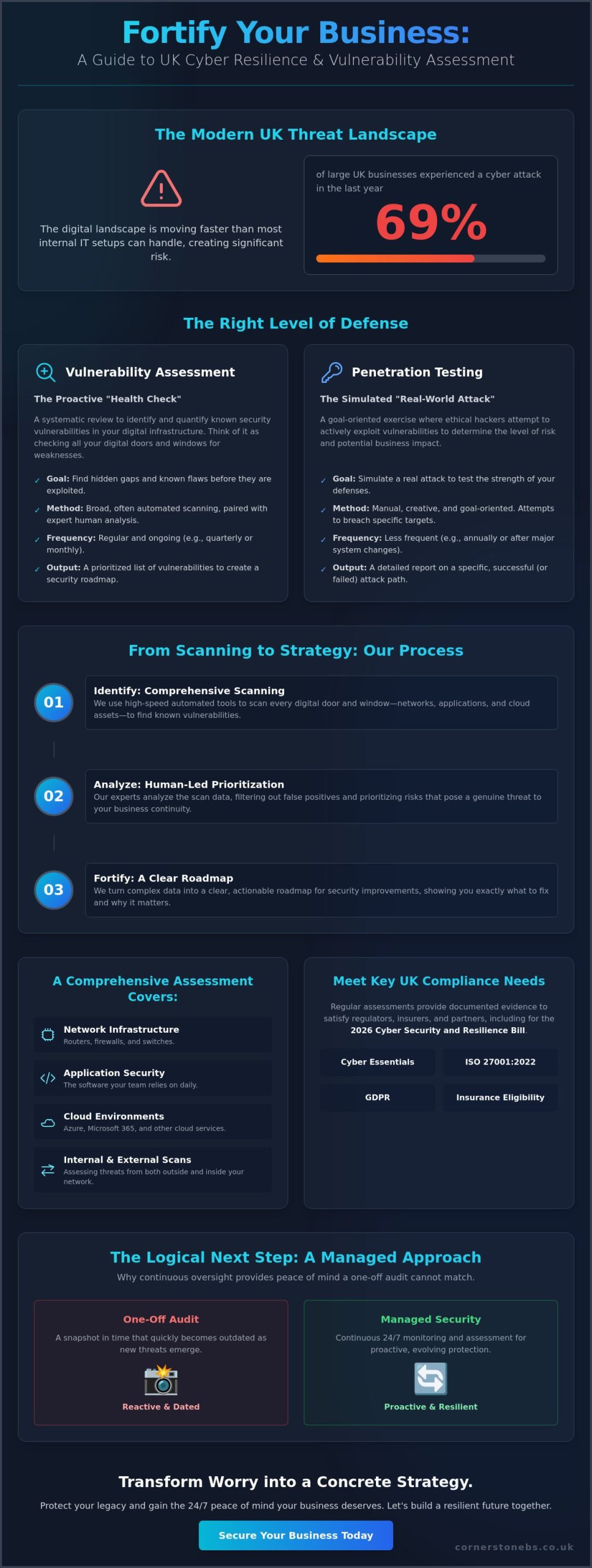
One of the most common questions we get from business owners is about the difference between a scan and a full audit. Many believe they’re fully protected after a quick automated scan. While scans are useful, they only tell part of the story. Understanding the difference between a vulnerability assessment, a penetration test, and a business cyber security audit uk is the first step toward true resilience in 2026. Each serves a specific purpose. Choosing the wrong one can leave you with a false sense of security or a bill for services you don’t actually need yet.
A vulnerability assessment is essentially an automated “health check” for your network. It looks for known holes or missing patches. Think of it as a digital version of checking that all your windows and doors are shut. A penetration test goes a step further. It’s an active, ethical hacking attempt to see if those defences can actually be broken. However, a full security audit is the most comprehensive. It’s a deep-dive review that looks at your technology, your people, and your internal processes. Your choice depends on your specific risk profile. For example, if you process card payments, PCI DSS v4.0 mandates annual penetration testing. When assessing cybersecurity risks, you must consider your industry’s unique regulatory landscape and growth goals.
When to Choose a Vulnerability Scan
Vulnerability scans are ideal for regular maintenance. We often recommend them as monthly health checks between your major annual reviews. They’re a low-cost entry point for smaller firms just starting their security journey. If your main goal is identifying missing software patches or basic configuration errors, a scan is a great place to begin. It keeps your basic hygiene in check without the overhead of a full manual review. It’s a proactive way to keep the “low-hanging fruit” away from opportunistic hackers.
Why the Full Audit is the Gold Standard
A business cyber security audit uk is the gold standard because it captures the “why” behind your vulnerabilities. It doesn’t just list a problem; it explains the systemic failure that caused it. This level of detail is essential if you’re aiming for ISO 27001 or Cyber Essentials Plus. It provides your board with a strategic roadmap for investment. You’ll move away from “firefighting” individual bugs and toward a stable, growth-focused technology foundation. It’s the ultimate tool for long-term peace of mind.
How to Prepare Your Organisation for a Security Audit
Identify the key people who need to be available. This usually includes your IT lead and perhaps someone from HR to discuss policy enforcement. It’s also vital to review previous findings. If you had an audit last year, ensure those specific vulnerabilities are closed before the new assessment begins. Finally, brief your team. Make sure they understand this is a “no-blame” process designed to protect their jobs and the company’s future. When staff feel safe, they provide more honest insights into how they actually use technology on a daily basis.
Mapping Your Digital Assets
Shadow IT is a significant concern for UK businesses in 2026. Staff often use unauthorised AI tools or personal cloud storage to get work done faster, often without realising the risk. Mapping your digital assets means creating a complete inventory of every piece of hardware, every software license, and every cloud subscription. Comprehensive asset mapping acts as the mandatory foundation for any security audit because you cannot protect a device or service that you don’t know exists within your network.
Ensuring Business Continuity During the Audit
We know your business can’t stop just because we’re checking the locks. We schedule technical scans during low-traffic periods to avoid disrupting your daily operations or slowing down your network. Coordination is key here. We work closely with your internal team or current IT partner to ensure access is granted smoothly and securely. This proactive approach ensures you get the deep insights you need without the headache of system downtime. If you’re ready to see where your defences stand, start a conversation with our local experts today to plan your assessment.
Future-Proofing Your Business with Cornerstone’s Security Solutions
At Cornerstone, we don’t believe in “one and done” reports. A business cyber security audit uk is the start of a journey, not the end. We move from being your auditor to your long-term technology partner, focusing on the emotional security that comes from knowing your systems are stable. Our goal is to translate technical findings into a clear, jargon-free roadmap that empowers you to make informed decisions for your firm’s future. We want you to feel confident, not overwhelmed, by your technology.
The real value of an audit comes from the action you take afterward. By integrating our findings into a comprehensive Managed IT Support plan, we ensure that vulnerabilities are closed permanently. We leverage our elite partnerships with Microsoft and Cisco to implement enterprise-grade security that was once only available to global corporations. This proactive approach means we don’t just find problems; we provide the foundation for your business to grow without fear of digital disruption.
Bespoke Technology Solutions for UK Growth
Every industry has its own unique pressures. We tailor our security controls to your specific requirements, ensuring you meet compliance without slowing down your operations. As your business expands nationally, our systems scale with you. Our multi-award-winning team is proud of our regional roots, and we bring that community-focused dedication to every project we manage. You get the sophistication of a modern, forward-thinking organisation with the personal touch of a local expert who cares about your success.
Your Next Steps to a Secure Future
The transition from audit results to proactive system monitoring is seamless with our team by your side. We help you achieve and maintain the Cyber Essentials certification, ensuring you remain eligible for government contracts and large-scale supply chains. It’s about building a fortress around your digital assets while keeping your team productive. We invite you to have a no-obligation conversation with our approachable team about your current security posture. Let’s talk about how a business cyber security audit uk can become your strongest commercial asset in 2026.
Empowering Your Business Resilience for 2026
The digital landscape of 2026 demands more than just basic survival; it requires a strategy that turns security into a commercial advantage. We’ve explored how a business cyber security audit uk identifies hidden vulnerabilities, streamlines your path to insurance eligibility, and ensures your team is ready for the next wave of AI-driven threats. By mapping your assets and choosing a deep-dive audit over a surface-level scan, you aren’t just ticking a compliance box. You’re building a fortress that supports your long-term growth and protects your professional reputation.
As a multi-award-winning UK IT provider and official partner with Microsoft, IBM, and Cisco, we provide expert support for businesses of all sizes. We’re proud of our regional roots and dedicated to making complex technology feel accessible and safe. Don’t wait for a breach to test your defences. Book your comprehensive 2026 Cyber Security Audit with Cornerstone today and enjoy the peace of mind that comes from a truly resilient digital estate. We’re here to help you lead with confidence and look forward to securing your future together.
Frequently Asked Questions
How long does a typical business cyber security audit take to complete?
A typical business cyber security audit uk usually takes between one and four weeks to complete from start to finish. This timeline depends on the size of your organisation and the complexity of your digital infrastructure. We begin with a discovery phase to map your systems and conclude with a detailed, jargon-free report that outlines your specific resilience roadmap.
Is a cyber security audit a legal requirement for UK businesses?
While there isn’t a blanket requirement for every firm, the 2026 Cyber Security and Resilience Bill and UK GDPR Article 32 make regular assessments effectively mandatory for many. If you handle sensitive personal data or operate within critical supply chains, you must demonstrate “appropriate technical and organisational measures” to remain compliant with UK law and avoid significant regulatory fines.
What is the difference between Cyber Essentials and a full security audit?
Cyber Essentials is a foundational certification focused on five core technical controls, acting much like a digital MOT for your business. A full security audit is a deep-dive investigation that goes much further, reviewing your internal policies, staff awareness training, and complex cloud configurations. It identifies the systemic “why” behind vulnerabilities, providing a more strategic level of protection than a basic certification alone.
Will a security audit cause downtime for my employees?
No, a professional audit will not cause downtime or disrupt your team’s productivity. We schedule our technical scans during low-traffic periods to ensure your network remains fast and responsive for everyone. Our experts work quietly in the background, coordinating closely with your IT lead to gather information without interrupting your daily operations or causing system outages.
How often should a UK business conduct a professional security audit?
Most UK businesses should conduct a professional security audit at least once every twelve months to stay ahead of evolving threats. You should also consider a fresh review if you undergo major changes, such as migrating to new cloud services, opening a new regional office, or shifting your remote working policy. Continuous vigilance is the foundation of emotional and digital security in 2026.
What happens if the audit identifies major vulnerabilities in our system?
If we find major vulnerabilities, we don’t just hand you a list of problems; we provide a prioritised remediation plan to fix them. We act as your proactive partner, explaining the risks in plain English and helping you implement the necessary solutions. Our goal is to move you quickly from a position of risk to a state of total operational resilience.
Can a cyber security audit help lower my business insurance premiums?
Yes, a business cyber security audit uk is a highly effective tool for reducing your cyber insurance costs. Insurers are significantly raising premiums for businesses that cannot prove their resilience. By presenting a professional audit report and evidence of remediation, you demonstrate to insurers that your business is a lower-risk prospect, which often leads to better coverage terms and lower annual rates.
Do we need an audit if we already use cloud services like Microsoft 365?
You definitely still need an audit if you use cloud services. While providers like Microsoft secure the underlying infrastructure, you’re responsible for the “security in the cloud,” which includes user permissions, data sharing settings, and device access. An audit ensures your specific configurations aren’t leaving your sensitive data exposed due to simple human error or outdated access policies.
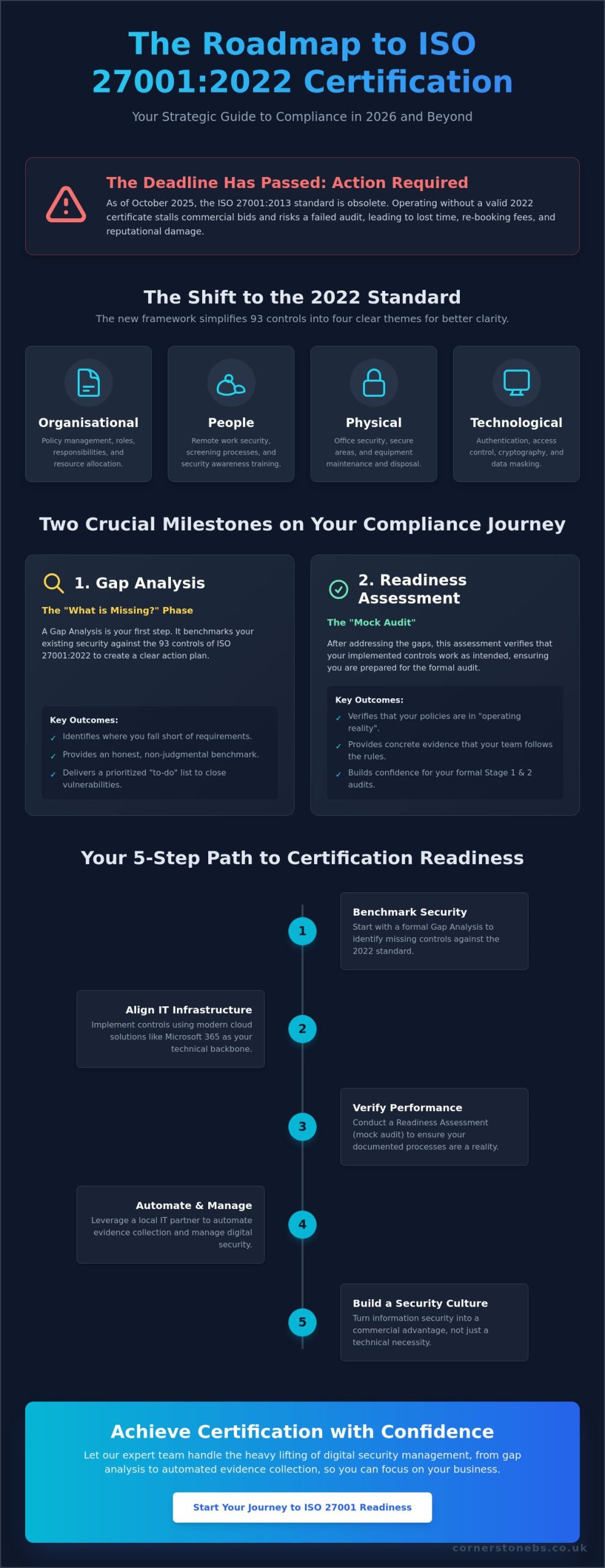
With the October 2025 transition deadline now behind us, any UK business still relying on the old 2013 standard is officially operating without a valid certificate. It’s a high-stakes reality that can stall commercial bids and leave your digital infrastructure vulnerable to modern threats. Achieving true ISO 27001 certification readiness in 2026 requires more than just a checkbox exercise. It demands a proactive shift toward the 2022 standard updates and the latest UK Data (Use and Access) Act requirements that came into force this February.
As a team recognized for our commitment to regional business excellence, we know it’s a challenge to document every process while keeping your daily operations running smoothly. It’s natural to feel some audit anxiety when you’re balancing growth with complex security controls. This guide is here to replace that uncertainty with a clear, strategic roadmap. You’ll discover how to benchmark your current security, close compliance gaps, and build a robust defense that protects your reputation. We’ve simplified the technical hurdles so you can achieve your goals with total confidence, treating your information security as the vital foundation of your business stability.
Key Takeaways
Distinguish between identifying missing controls and verifying their performance through a formal readiness assessment before your audit begins.
See how modern cloud solutions and Microsoft 365 configurations serve as the technical backbone for your compliance framework.
Follow our five-step checklist to achieve ISO 27001 certification readiness while maintaining focus on your core business goals.
Leverage the expertise of a local IT partner to automate evidence collection and handle the heavy lifting of digital security management.
Build a culture where information security is a commercial advantage rather than just a technical necessity.
At its core, ISO 27001 certification readiness is the specific point where your Information Security Management System (ISMS) is fully documented, properly implemented, and supported by concrete evidence. It serves as the vital “pre-flight check” before you invite an external auditor for your formal Stage 1 and Stage 2 assessments. For businesses across the UK, achieving this state means you’ve moved past the planning phase and into a cycle of continuous improvement. This level of preparation is a significant commercial asset. It signals to your stakeholders and supply chain partners that you treat their data with the highest level of care. As your local expert, we believe this readiness creates the emotional security every business owner needs to grow with confidence.
The Shift to ISO/IEC 27001:2022
The recent shift to the ISO/IEC 27001:2022 standard changed the landscape for everyone. Since the transition deadline passed in October 2025, the old 2013 framework is no longer valid for new certifications. The 2022 update simplified the process by grouping 93 controls into four clear themes:
Organisational controls like policy management and resource allocation.
People controls such as remote working security and screening.
Physical controls covering office security and equipment maintenance.
Technological controls including authentication and data masking.
This structure makes it easier for business owners to understand where their responsibilities lie. Many firms fall into the trap of “false confidence,” assuming their old security habits will pass the new test. In reality, the 2022 standard requires a more integrated approach to modern digital risks and updated regulations like the Data (Use and Access) Act 2025. Modern readiness ensures your controls reflect the actual threats your business faces today.
Why Readiness Matters More Than Effort
Auditors are looking for “operating reality.” They want to see that your policies aren’t just sitting in a digital drawer. They’ll look for evidence that your team actually follows the rules you’ve set. If your documentation says you perform weekly backups, but you only have evidence for three out of the last four weeks, you’ll likely face a non-conformity. The cost of a failed audit goes far beyond the initial fee. You have to consider the time lost, potential re-booking charges, and the damage to your commercial reputation if a major contract is pending.
By focusing on ISO 27001 certification readiness, you turn your cyber security services into a permanent shield for your business. It ensures that when the auditor arrives, you can demonstrate your compliance with total ease. We view this as a foundational element of your stability, giving you the freedom to focus on your daily operations while we help manage the technical weight of compliance.
Readiness Assessment vs. Gap Analysis: Key Differences
Don’t mistake a gap analysis for a readiness assessment. While they share some DNA, they serve entirely different purposes on your journey toward compliance. We view these as distinct milestones in a bespoke technology roadmap, each designed to build your confidence and protect your investment. You can’t have a successful readiness assessment without first completing a thorough gap analysis; one identifies the work required, while the other verifies that the work actually functions as intended.
The Gap Analysis: Identifying the Holes
Think of the gap analysis as the “what is missing” phase. During this stage, we benchmark your existing security controls against the 93 controls defined in the official ISO 27001 standard. This isn’t about passing or failing; it’s about honest benchmarking. We look at your current digital infrastructure and identify where you fall short of the 2022 requirements.
The primary outcome of this phase is a prioritised “to-do” list for your IT team or managed partner. By using a formal risk assessment, we help you determine which gaps pose the greatest threat to your business continuity. This ensures you aren’t wasting resources on minor issues while major vulnerabilities remain open. If you’re feeling unsure about where to start, our local expert team is always available for an informal conversation to help you map out these initial steps.
The Readiness Assessment: The Mock Audit
Once you’ve implemented the necessary controls and policies, you move to the ISO 27001 certification readiness assessment. This is the “is it working” phase. We treat this as a full dress rehearsal conducted by an impartial expert who mimics the behaviour of a formal UKAS auditor. The focus shifts from “do you have a policy?” to “can you prove it’s working?”
During this mock audit, the expert will scrutinise your evidence, including:
System logs and automated monitoring reports.
Meeting minutes that show leadership engagement with security.
Staff interviews to ensure your team understands their security responsibilities.
Documented evidence of recent risk treatments.
This phase concludes with an Executive Briefing. This report gives you the green light to proceed or highlights specific areas that need one final polish. It’s the ultimate safety net that ensures you don’t pull the trigger on a formal audit until you’re absolutely certain of a positive outcome. This structured approach minimises disruption to your daily operations and keeps your certification journey on a steady, predictable path.
Aligning Your IT Infrastructure with 2026 Standards
Your digital foundation determines how smoothly you’ll reach the finish line. In 2026, a secure infrastructure isn’t just about speed; it’s about granular control and visibility. For most UK businesses, this starts with securing cloud solutions like Azure and AWS. These platforms offer incredible flexibility, yet they require expert configuration to ensure that data residency and access permissions align with your Information Security Management System (ISMS). When your infrastructure is built correctly, it acts as a silent partner in your ISO 27001 certification readiness journey.
A successful Microsoft 365 migration for business UK provides the perfect opportunity to bake security into your daily workflows. By moving away from legacy on-premise servers, you gain access to enterprise-grade tools that simplify the path to compliance. However, your chosen it company solutions must be designed to support these goals. If your technology stack is clunky or poorly integrated, your team will find workarounds that create security gaps and lead to audit failure. We’ve seen how a well-structured network provides the emotional security needed to scale without fear.
Securing the Microsoft 365 Ecosystem
Modern auditors love automation. Tools like Microsoft Intune and Purview allow you to automate the collection of evidence, proving that your devices are encrypted and your data is classified correctly. In a hybrid work environment, identity is the new perimeter. Protecting this perimeter requires Multi-Factor Authentication (MFA) and strict conditional access policies. Microsoft 365 Business Premium directly addresses at least five Annex A controls by managing access rights, securing authentication, protecting endpoint devices, automating information deletion, and restricting privileged access.
Network Infrastructure & Physical Security
The 5-Step ISO 27001 Readiness Checklist
Achieving ISO 27001 certification readiness doesn’t have to be an overwhelming ordeal. We’ve streamlined the process into five actionable steps that protect your time and your investment. By following this roadmap, you ensure that every part of your Information Security Management System (ISMS) is robust, compliant, and ready for the spotlight of a formal audit.
Step 1: Define the Scope. Be precise about what you’re certifying. You don’t always need to include every department; focus on the areas that handle sensitive data or critical business processes.
Step 2: Leadership & ISMS Policy. Auditors look for the “tone from the top.” Your senior management must demonstrate a clear commitment to security through documented policies and resource allocation.
Step 3: Risk Assessment & Treatment. Identify the threats to your information and decide how to handle them. You must document why you chose to accept, transfer, or mitigate specific risks.
Step 4: The Statement of Applicability (SoA). This is your auditor’s map. It lists which controls apply to your business and, crucially, which ones don’t.
Step 5: Internal Audit & Management Review. This is your final check. You must conduct an internal audit to verify that your controls are working and present the findings to your leadership team.
If you’re worried about the technical burden of these steps, our locally based team can help you navigate the complexities with multi-award-winning expertise.
Mastering the Statement of Applicability (SoA)
The SoA is the most critical document you’ll present to a Stage 1 auditor. It lists which of the 93 Annex A controls from the 2022 standard are relevant to your operations. You cannot simply exclude controls because they seem difficult; every exclusion requires a valid, documented reason that the auditor will scrutinise. A well-crafted SoA proves you understand your unique risk landscape and have intentionally chosen the right safeguards to protect your business stability.
Preparing Your People for the Audit
Information security is as much about people as it is about technology. Staff awareness is a major component of ISO 27001 certification readiness. During a formal audit, the assessor may interview your team to see if they understand your security policies. We recommend regular training sessions and mock social engineering tests, such as simulated phishing emails, to keep security top of mind. You must document this training and any subsequent competency checks. This evidence shows the auditor that security is woven into your company culture, providing the emotional security your clients expect from a professional partner.
How Managed IT Support Accelerates Your Path to Certification
Achieving ISO 27001 certification readiness is often viewed as a daunting technical mountain to climb. However, partnering with a multi-award-winning managed IT provider shifts that weight off your shoulders. We don’t just give you a list of things to do; we implement the technical controls, configure the secure environments, and manage the ongoing monitoring that auditors demand. This proactive approach ensures your security controls are always active and functional, rather than just existing as words in a policy document. We treat your security as a foundational element of your business stability.
In the current 2026 threat landscape, staying ahead of sophisticated cyberattacks is a full-time commitment. Our team understands the specific nuances of the UK’s latest regulations, including the Data (Use and Access) Act 2025. We provide the technical evidence your auditor needs, from automated log reports to proof of encryption across all endpoints. This collaboration turns a complex certification process into a structured, manageable journey. We act as your long-term partner, ensuring your security foundation is strong enough to support your most ambitious growth plans while protecting your commercial reputation.
From Project to ‘Business as Usual’
Many businesses treat certification as a one-off project, but it’s actually a three-year cycle. After your initial success, you’ll face annual surveillance audits to prove you’re still meeting the standard. Managed IT support turns compliance into a standard operating procedure rather than a yearly scramble. Through regular technical audits and rigorous patch management, we ensure your systems remain secure every single day. This consistency removes the audit panic that often strikes when a surveillance date approaches. We keep the evidence trail warm so your ISO 27001 certification readiness is a permanent state, not a temporary achievement.
The Cornerstone Approach to Security
We pride ourselves on being more than just a service provider. Our approach blends professional authority with an approachable, regional warmth that makes complex technology feel manageable for any business owner. We design bespoke solutions that fit your specific needs, providing the emotional security that comes from knowing your digital assets are protected by experts. As a locally based team, we’re deeply invested in the success of our community’s businesses and the stability of their infrastructure.
Your path to a more secure, reputable, and commercially competitive business starts with a simple step. We invite you to have an informal conversation with our friendly team of experts. Let’s discuss your certification goals and see how we can build a resilient future together. Whether you’re just starting your gap analysis or looking to polish your final readiness assessment, we’re here to help you move forward with total confidence.
Securing Your Commercial Future with Confidence
Transitioning to the 2022 standard is more than a regulatory hurdle; it’s a strategic opportunity to build a more resilient, trustworthy organisation. We’ve explored how a robust Statement of Applicability and a well-configured Microsoft 365 environment provide the concrete evidence auditors demand. By shifting from a “project” mindset to a “business as usual” approach, you ensure your ISO 27001 certification readiness remains a constant state of excellence. This proactive stance protects your commercial edge and builds lasting trust with your stakeholders.
As a multi-award-winning IT services provider and certified partner for Microsoft, IBM, and Cisco, we provide the technical depth and national UK coverage needed to secure your infrastructure. We believe in a partner-led approach that prioritises your emotional security and business stability. You don’t have to navigate these complex global standards alone. Our team is here to simplify the technical mechanisms so you can focus on what you do best.
We look forward to helping you turn compliance into a powerful engine for your long-term growth and success.
Frequently Asked Questions
How long does it take to achieve ISO 27001 certification readiness?
Most UK small and medium enterprises take between 6 and 12 months to reach full ISO 27001 certification readiness. The exact timeline depends on your current security maturity and the resources you can dedicate to the project. If you already have robust digital infrastructure in place, you might find the process moves much faster. We always recommend a steady pace to ensure your team truly adopts the new security culture.
Is ISO 27001 a legal requirement for UK businesses in 2026?
ISO 27001 isn’t a universal legal mandate, but it’s increasingly a commercial necessity for UK businesses. While the law doesn’t force you to certify, many public sector contracts and large corporate supply chains now require it. It also serves as powerful evidence that you’re meeting the “appropriate technical and organisational measures” required by the Data (Use and Access) Act 2025 and UK GDPR.
What is the difference between ISO 27001 and Cyber Essentials Plus?
Cyber Essentials Plus is a technical snapshot focused on five specific security areas, while ISO 27001 is a holistic management system. Think of Cyber Essentials as a vital baseline and ISO 27001 as the complete architecture for your business stability. The 2022 version of ISO 27001 manages 93 controls across people, physical, and digital domains, offering a much broader shield for your reputation.
How much does an ISO 27001 readiness assessment cost?
The cost of a readiness assessment depends on the size of your organisation and the complexity of your data processes. Larger firms with multiple sites or complex cloud environments will require more time for a thorough review. While audit day rates for UKAS accredited auditors have risen recently due to a shortage of qualified professionals, investing in a readiness assessment prevents the much higher costs of a failed formal audit.
Can a small business with under 10 employees get ISO 27001 certified?
Absolutely, businesses with fewer than 10 employees can and do achieve certification. The standard is designed to be scalable, meaning you only implement controls that are relevant to your specific risks. Small teams often reach ISO 27001 certification readiness faster than larger corporations because their communication lines are shorter and their internal structures are less complex.
What happens if we fail our ISO 27001 Stage 1 audit?
Failing a Stage 1 audit simply means you have some homework to do before the final assessment. Your auditor will provide a report detailing any non-conformities or areas where your documentation is thin. You’ll need to address these issues before you can proceed to Stage 2. It’s best to view this as a helpful safety net that prevents a more costly failure during the final certification stage.
Do we need to buy expensive software to manage our ISO 27001 compliance?
You don’t need to purchase dedicated compliance software to meet the standard. While automated platforms can be helpful, many successful businesses manage their compliance using their existing Microsoft 365 ecosystem. The key to ISO 27001 certification readiness is the quality of your processes and the evidence you produce, not the price tag of the software you use to track them.
How often do we need to renew our ISO 27001 certification?
Your ISO 27001 certificate follows a three-year cycle. Once you’re certified, you’ll undergo annual surveillance audits in years one and two to ensure your systems are still performing well. At the end of the third year, you’ll need a full recertification audit to maintain your status. This cycle ensures that your security remains a proactive, foundational element of your business rather than a one-off project.
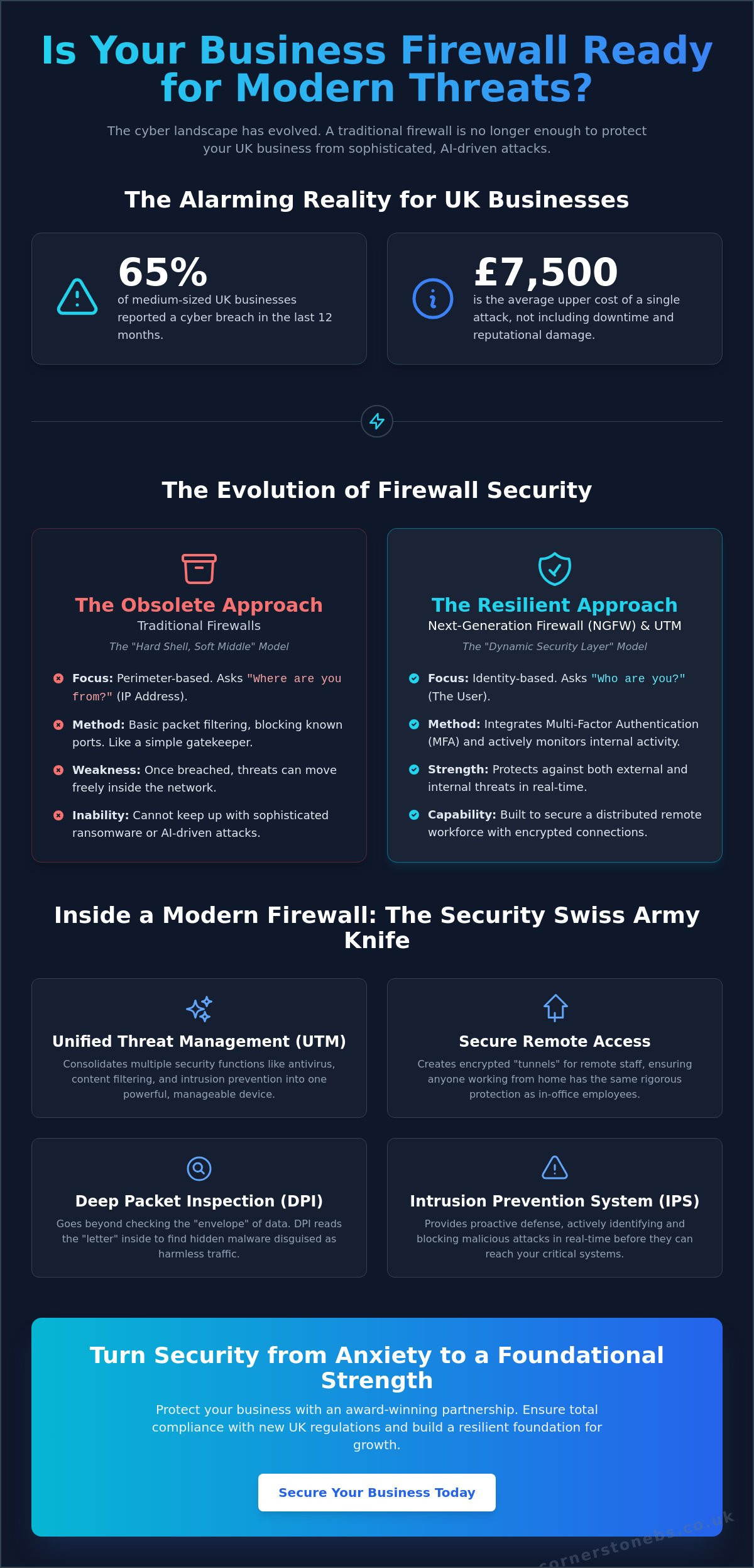
Did you know that 65% of medium-sized UK businesses reported a cyber breach in the last 12 months? With the average cost of an attack now hitting up to £7,500, the stakes for your digital infrastructure have never been higher. It’s a stressful reality for many local business owners who are trying to balance securing a remote workforce with the rising threat of sophisticated ransomware. You likely feel the pressure of keeping your data safe while lacking the internal expertise to monitor your network around the clock.
We understand that finding the right business firewall solutions UK organisations can trust is about more than just hardware; it’s about protecting your livelihood. This guide shows you how to select and manage a firewall that ensures zero downtime and full compliance with the 2026 Cyber Security and Resilience Bill. We’ll explore how AI-driven threat prevention and expert management can turn your security from a source of anxiety into a foundational strength for your business growth.
Key Takeaways
Learn why the old-school “hard shell” approach is obsolete and how a dynamic security layer protects you from 2026’s sophisticated ransomware.
Discover how Next-Generation Firewalls and UTM tools act as a “security Swiss Army knife” to keep your remote teams safe and productive.
Compare the true costs of unmanaged security against professional business firewall solutions UK experts provide to eliminate hidden downtime risks.
Identify whether physical hardware or cloud-native architecture is the right fit for your specific business infrastructure and growth plans.
Find out how a proactive, award-winning partnership ensures total compliance with new UK regulations while simplifying your digital security.
Why Traditional Business Firewall Solutions are No Longer Enough in 2026
The digital landscape for UK businesses has shifted dramatically over the last few years. If you are still relying on a basic router or a legacy system, your network is likely more exposed than you think. In the past, understanding what is a firewall meant thinking of it as a simple gatekeeper that blocked specific ports. Today, that is no longer enough. Modern business firewall solutions UK organisations depend on are dynamic security layers. They don’t just sit there; they actively inspect every packet of data for hidden threats in real-time.
We used to talk about the “hard shell, soft middle” approach to security. This involved building a strong perimeter while leaving the internal network relatively open. That model is now obsolete. Once a threat bypasses a traditional perimeter, it can move laterally through your systems with ease. In 2026, AI-driven threats can probe your network for weaknesses thousands of times per second. Standard business routers simply cannot keep up with this level of automated aggression. You need a system built for proactive resilience, creating a stable foundation that allows your business to grow without the constant fear of a breach.
The Shift from Perimeter to Identity-Based Security
Old-school firewalls focused on where a connection came from by looking at IP addresses. However, IP addresses are easily spoofed and change constantly in a mobile world. Modern systems have moved toward verifying the user. This means your firewall now asks “Who are you?” rather than “Where are you?”. By integrating multi-factor authentication (MFA) directly at the network edge, we ensure that only authorised personnel can touch your data. Identity-Based Security is the new standard for UK SMEs, providing a much higher level of precision than traditional methods.
Supporting a National Remote Workforce Securely
Understanding Next-Generation Firewall (NGFW) and UTM Capabilities
Choosing between different business firewall solutions UK providers can feel overwhelming. However, understanding the difference between a standard firewall and a Next-Generation Firewall (NGFW) is vital. Traditional firewalls act like a simple bouncer checking IDs at the door. NGFWs are more like an undercover security team. They don’t just check who is coming in; they monitor what people are doing once they are inside. This active monitoring is crucial when you consider that 43% of UK businesses reported a breach in the last 12 months.
For many local firms, Unified Threat Management (UTM) is the “security Swiss Army knife” they need. It bundles multiple security features like antivirus, content filtering, and intrusion prevention into one manageable device. This consolidation is perfect for businesses that want robust protection without the complexity of managing several different systems. Our team often recommends these integrated business firewall solutions UK SMEs can rely on for simplicity and strength.
Deep Packet Inspection and Intrusion Prevention
Standard packet filtering only looks at the “envelope” of a data packet. Deep Packet Inspection (DPI) actually opens the envelope to read the letter inside. This is how modern firewalls find hidden malware disguised as harmless traffic. An Intrusion Prevention System (IPS) takes this further by actively blocking attacks before they reach your servers. According to the latest cyber security statistics, phishing and malware remain top threats. We believe these tools provide more than just technical safety; they offer the emotional security you need to focus on your business goals while your digital borders are defended.
Application Awareness and Content Filtering
Your firewall should be smart enough to know the difference between a productive session and a risky download. Application awareness allows you to set granular rules. You might allow LinkedIn for your marketing team but block high-bandwidth streaming sites that slow down the office network. Content filtering goes a step further by preventing employees from accidentally visiting malicious websites. This proactive approach keeps your team focused and your bandwidth clear for essential tasks. If you’re curious about how these features could fit your workflow, our cyber security experts are always happy to have a conversation.
Managed vs. Self-Managed Firewalls: Evaluating the Real Cost of Security
Many UK business owners ask why their internal IT team can’t just handle the firewall. It’s a fair question. Your internal staff are brilliant at supporting your workflows and keeping your team productive. However, managing the business firewall solutions UK companies need in 2026 is a specialized, full-time commitment. It isn’t just about plugging in a high-tech box. It’s about constant vigilance and the ability to react to threats the moment they appear. Asking an internal team to handle this on top of their daily tasks often leads to burnout or, worse, overlooked vulnerabilities.
The hidden costs of unmanaged security are often far higher than a monthly service fee. When a system is left to its own devices, “configuration drift” sets in. This happens when small, undocumented changes are made to the network over time. Without professional audits, these tiny gaps eventually become wide-open doors for attackers. If a breach occurs, the average cost to a UK business can reach up to £7,500 in immediate recovery fees. We believe in a partnership model. We don’t just sell you hardware; we become a proactive extension of your team to ensure your network remains a stable foundation for growth.
The Burden of 24/7 Monitoring and Patching
A firewall is only as good as its last update. New exploits emerge every single day, and your defense must evolve just as fast. If your team only monitors the system during standard office hours, you are leaving your data exposed for the majority of the week. Cybercriminals don’t work 9-to-5, so your security shouldn’t either. Professional management ensures that critical patches are applied the moment they are released. This proactive approach eliminates the window of opportunity that attackers rely on. It’s about providing the emotional security that comes from knowing your business is defended while you sleep.
Compliance and Reporting Requirements
Staying on the right side of UK regulations is a significant part of modern network management. Our cyber security services help you navigate the complexities of GDPR and the upcoming requirements of the Cyber Security and Resilience Bill. For businesses in critical sectors, these aren’t just suggestions; they are legal mandates that require proof of active defense. Managed reports provide the third-party validation your stakeholders, insurers, and clients expect. We provide the clarity and documentation needed to prove your business is resilient, turning a complex technical necessity into a clear competitive advantage.
Selecting the Right Firewall Architecture for Your Business Model
Every UK business is unique. A small accounting firm in the Cotswolds has vastly different requirements than a large manufacturing plant in the Midlands. Selecting the right architecture for your business firewall solutions UK strategy depends entirely on where your data lives and how your team accesses it. We pride ourselves on being a long-term partner that looks at your whole business, not just a single piece of hardware. By working with global leaders like Cisco and IBM, we ensure our clients have access to world-class technology that fits their specific local needs.
The choice between physical hardware and cloud-native solutions isn’t just a technical one; it’s a decision about how your business will scale. For some, a physical appliance provides the raw power needed for high-speed local tasks. For others, the flexibility of the cloud offers the agility required to support a growing, mobile workforce. We help you navigate these choices with the clarity of an expert who wants to simplify the complex.
Hardware Firewalls for On-Premise Infrastructure
Physical appliances remain the gold standard for offices with high local data usage. If your team regularly handles large files or relies on on-site servers, a hardware firewall provides the dedicated processing power you need. We always recommend implementing “High Availability” (HA) pairs. This setup involves two identical firewalls working in tandem. If one unit fails, the other takes over instantly, preventing a single point of failure. This level of redundancy is a foundational element of our IT infrastructure support, ensuring your business stays online no matter what.
Virtual and Cloud-Native Firewall Solutions
As more organisations migrate to a cloud environment, traditional hardware isn’t always the most efficient path. Virtual firewalls offer incredible scalability, allowing you to increase security capacity the moment your business grows. For multi-site organisations, Firewall as a Service (FWaaS) is an excellent choice. It allows you to manage security policies from a central point, ensuring total parity between your physical office and your cloud applications. This ensures that a staff member in London has the exact same level of protection as someone in your head office.
Choosing the right path for your network security is a big step toward long-term stability. If you are ready to find the perfect fit for your organisation, contact our local team of experts for a friendly conversation about your requirements.
Strengthening Your Business Resilience with Cornerstone Business Solutions’ Managed Security
As a multi-award-winning IT provider, Cornerstone Business Solutions believes that network security is an ongoing journey. We don’t just sell you a box and walk away. Instead, we provide the managed business firewall solutions UK firms need to build lasting stability. Our goal is to simplify the complex technical jargon that often surrounds digital safety. We want you to focus on running your company with total peace of mind. By acting as a dedicated long-term partner, our team ensures your network is always a step ahead of evolving threats while maintaining the regional warmth you expect from a local expert.
Security should never be a barrier to your productivity. It should be the invisible engine that keeps your business moving forward. Cornerstone Business Solutions takes a collaborative approach to every project. We work closely with you to understand your specific challenges. Whether you’re dealing with the complexity of remote teams or the pressure of new UK regulations, we provide clear, benefit-driven results. This isn’t just about technical necessity. It’s about providing the emotional security that comes from knowing your livelihood is protected by a team that genuinely cares about your success.
Proactive Monitoring and Award-Winning Support
Our proactive system monitoring identifies and neutralises threats before they ever impact your daily operations. This constant vigilance is backed by our award-winning support team. You get unlimited helpdesk access for any security queries, no matter how small or specific they might be. Supporting a diverse national clientele has given Cornerstone Business Solutions the insight to handle almost any challenge with confidence. We catch the small issues before they become big problems. This ensures your team stays online and your data stays private. It’s the difference between reacting to a disaster and preventing one entirely.
Integration with Microsoft 365 and Cloud Ecosystems
A modern security posture requires a joined-up strategy across your entire digital footprint. Our firewall solutions perfectly complement a Microsoft 365 migration, creating a unified defense for your data and communications. We bridge the gap between daily IT maintenance and high-level cyber security. This ensures there are no weak links in your chain as you move more services to the cloud. This holistic approach provides the solid foundation for growth that every ambitious UK business deserves.
We’d love to help you secure your future. If you’re ready to move beyond transactional IT and find a partner who values your business as much as you do, let’s talk. Cornerstone Business Solutions invites you to an informal conversation with our local team to explore how we can strengthen your resilience together.
Securing Your Digital Future in 2026 and Beyond
The shift from passive filters to dynamic security is no longer optional for organisations. As we have explored, the landscape of 2026 demands a move away from the “hard shell” perimeters of the past toward identity-based, managed resilience. Selecting the right business firewall solutions UK providers offer is about more than just checking a box on a compliance list. It’s about ensuring your business has the stability to scale without the constant threat of disruption or configuration drift.
Cornerstone Business Solutions brings together the power of global partnerships with Microsoft, IBM, and Cisco to deliver world-class protection with an approachable, local face. We provide the 24/7 proactive system monitoring and award-winning support needed to keep your network secure while you focus on your core goals. If you’re ready to move from a reactive posture to a foundation of strength, our team is ready to support you. We invite you to book a proactive security conversation with our award-winning team. Let’s ensure your digital infrastructure remains a stable, secure asset for your long-term success.
Frequently Asked Questions
What is the difference between a home router firewall and a business firewall?
Business firewalls provide advanced security layers like deep packet inspection and intrusion prevention that standard home routers lack. While a home device simply blocks or allows traffic based on basic rules, business firewall solutions UK firms use today can identify specific applications and block hidden malware. This keeps your professional network stable and your sensitive client data protected from sophisticated attacks.
Do I still need a firewall if all my business data is in the cloud?
How much does a managed firewall solution cost for a UK SME?
The cost of a managed firewall depends on your business size, the number of users, and the specific security features you require. While pricing varies across the industry, we focus on providing a solution that balances robust protection with a clear return on investment. We always suggest a quick chat with our local team to get an accurate estimate tailored to your unique infrastructure.
Can a firewall protect my employees when they are working from home?
Firewalls protect remote employees by creating secure, encrypted tunnels between their home devices and your office network. This ensures that even if they are using a personal Wi-Fi connection, their data traffic is inspected and secured by your central security policies. It’s a foundational step in maintaining a consistent security posture across a national workforce.
What is Next-Generation Firewall (NGFW) and why is it recommended?
A Next-Generation Firewall (NGFW) is a more advanced version of traditional security that includes features like integrated intrusion prevention and application awareness. It doesn’t just look at where data is coming from; it looks at what the data is actually doing. We recommend it because it provides the granular control needed to stop modern, automated cyber threats in real-time.
How often does a business firewall need to be updated or patched?
Your firewall should receive threat intelligence updates in real-time to defend against the latest exploits. Critical security patches and firmware updates should be applied as soon as they are released by the manufacturer. Our managed service handles this automatically, so you don’t have to worry about your defenses falling behind the latest hacker techniques.
Does a firewall help with GDPR compliance for my UK business?
A firewall is a critical component of GDPR compliance because it helps satisfy the “security by design” requirement. By preventing unauthorised access to personal data and providing detailed logs of network activity, you can prove to regulators that you’ve taken proactive steps to protect privacy. It turns a complex legal obligation into a manageable part of your IT strategy.
What happens if our firewall hardware fails suddenly?
If your hardware fails and you have a High Availability (HA) pair, a second unit takes over instantly to prevent any downtime. In a managed environment, our team receives an immediate alert and begins the replacement process before you even notice a problem. This proactive approach ensures your business stays online and your emotional security remains intact.
Did you know that 69% of large UK businesses experienced a cyber attack in the last year? It is a sobering figure that confirms what many local business owners already feel; the digital landscape is moving faster than most internal IT setups can handle. You have worked hard to build your brand, and the fear of a data breach causing lasting reputational damage is a heavy burden to carry, especially when technical jargon makes security feel like a closed book. We understand that you want to protect your legacy without getting lost in complex code.
We believe security should be a source of confidence rather than confusion. That is why professional vulnerability assessment services UK are essential for identifying hidden gaps before hackers can exploit them. By choosing a proactive approach, you can transform that nagging worry into a concrete strategy for growth. This guide provides a clear roadmap to fortify your business against evolving threats. We will show you how to ensure compliance with the 2026 Cyber Security and Resilience Bill while gaining the peace of mind your stakeholders deserve.
Key Takeaways
Learn how professional vulnerability assessment services UK identify hidden gaps in your network and applications before they can be exploited.
Understand the vital distinction between automated scanning and manual penetration testing to ensure you’re investing in the right level of defense.
Discover how to turn complex scan data into a clear roadmap for security improvements by prioritizing risks that actually impact your business continuity.
Explore why moving to a managed approach for your cyber security provides the 24/7 peace of mind that a one-off audit simply cannot match.
Understanding Vulnerability Assessment Services in the Modern UK Landscape
A vulnerability assessment is a systematic, proactive evaluation of your digital infrastructure designed to find known security weaknesses before they cause trouble. In 2026, simply reacting to problems as they happen is no longer a viable strategy for any UK business. The shift from reactive firefighting to proactive management is about more than just technology; it is about business continuity. Professional vulnerability assessment services UK provide the clarity you need to move forward with confidence. By combining high-speed automated scanning with the nuanced insight of expert human analysis, we ensure that your foundational systems remain robust and reliable.
There is a deep sense of relief that comes from knowing your systems aren’t just “working”, but are actively defended by experts who care about your local reputation. It isn’t just about code. It’s about the people who rely on your services every day. According to the UK Government Cyber Security Breaches Survey 2025/2026, approximately 43% of UK businesses reported a breach in the last year. For medium and large firms, that number jumps to over 65%. These aren’t just statistics; they represent real businesses facing real disruptions. A managed approach turns these risks into manageable tasks.
The Core Purpose: Identifying Before Exploitation
Think of an assessment as a comprehensive check of every digital door and window in your organisation. These services find the “open doors” in your network that cybercriminals are actively searching for. The window of opportunity for a hacker is the precise time between a developer announcing a security flaw and your IT team successfully applying the fix. Without full visibility across your cloud and on-premise assets, you’re essentially flying blind. Regular scans close those windows, turning potential disasters into minor, scheduled updates. This visibility is the first step toward true resilience.
Compliance and Regulatory Requirements in the UK
Staying on the right side of the law is a top priority for any local business owner. In 2026, regulatory pressures have intensified with the introduction of the Cyber Security and Resilience Bill. Regular assessments help you meet the rigorous standards of modern business. It isn’t just about avoiding fines; it’s about proving your commitment to data safety to your customers and partners.
Cyber Essentials: A foundational requirement that is often a prerequisite for government contracts.
ISO 27001:2022: Maintaining this certification requires regular, documented evidence of security testing.
GDPR: Protecting personal data starts with knowing where your infrastructure is weakest.
Insurance Eligibility: Many cyber insurance providers now require proof of regular vulnerability assessment services UK before they will offer or renew a policy.
By satisfying these stakeholder demands for due diligence, you protect your eligibility for insurance and maintain the trust that keeps your business growing.
The Critical Scope: What a Comprehensive Assessment Should Cover
A thorough evaluation goes far beyond a simple checklist. It requires a deep dive into every corner of your digital estate to ensure no stone is left unturned. High-quality vulnerability assessment services UK examine your entire network infrastructure. We look for tiny misconfigurations in routers, firewalls, and switches that could lead to a major breach. We also scrutinise application security. The software your team relies on every day often contains hidden flaws that, if left unaddressed, provide an easy path for attackers. Cloud environments like Azure and Microsoft 365 require specific attention too. Misconfigured permissions or disabled security features can leave your data exposed to the world without you even realising it.
You can’t just guard the front gate and ignore the backyard. While external scans check your public-facing assets, internal scans are equally vital. They simulate what happens if an attacker gains a foothold inside your network. This “inside-out” perspective is a core recommendation from the National Cyber Security Centre (NCSC). It helps us ensure that your internal defenses are strong enough to stop a local incident from becoming a national headline. Every laptop and mobile device connected to your network must be a brick in your wall, not a hole in it. If you want to see how your current setup measures up, our experts are ready to help you strengthen your Cyber Security posture with a local, personal touch.
Network and Wireless Infrastructure Audits
Rogue devices and unauthorised access points are more common than you might think. A single unmanaged switch or an old router can create a massive blind spot. Our audits focus on identifying these outliers and testing the strength of your internal segmentation. By preventing lateral movement, we ensure that a single compromised endpoint doesn’t lead to a total system failure. We also check for outdated firmware in your hardware. This is a frequently ignored vulnerability that hackers love to exploit because many businesses forget that physical kit needs updates just as much as software does.
Securing the Remote Workforce
Remote work has changed the security perimeter forever. Your office is now wherever your employees happen to be sitting. This means assessing VPNs and remote desktop protocols for potential leaks is a non-negotiable part of modern security. Implementing a Microsoft 365 migration for business UK is a fantastic way to set a secure foundation, but constant vigilance is required to keep those cloud environments safe. We ensure your mobile devices and laptops are not just tools for productivity, but hardened endpoints that resist intrusion. This proactive approach keeps your team connected and your data locked down tight.
Vulnerability Assessment vs. Penetration Testing: Which Does Your Business Need?
Choosing between a vulnerability assessment and a penetration test often feels like a technical riddle. It doesn’t have to be. To keep your business safe, you need to understand that these two tools serve very different purposes. A vulnerability assessment is a wide-reaching, automated scan. It answers the question: “What is wrong?” It looks at your entire digital footprint to find known weaknesses. On the other hand, a penetration test is a manual, targeted “ethical hack”. It answers the question: “How would a breach actually happen?” While a scan identifies the holes, a pen test tries to jump through them.
Timing is everything in security. We recommend that vulnerability assessment services UK are conducted on a monthly or quarterly basis. This ensures you catch new flaws as they emerge in the ever-changing digital landscape. Penetration tests are much more intensive and are typically an annual event, or something you trigger after a major system change. By aligning the frequency of these tests with your actual risk, you ensure your security scales alongside your business growth without unnecessary complexity.
Breadth vs. Depth: A Strategic Choice
Think of an assessment as a wide-angle lens. It provides continuous monitoring across a large number of assets, giving you a bird’s-eye view of your security posture. This breadth is essential for day-to-day safety. Deep-dive validation is where pen testing shines, specifically for high-value systems like payment gateways or sensitive client databases. Both of these elements feed directly into a robust cyber security services strategy that leaves no room for guesswork or blind spots.
Cost-Effectiveness for UK SMEs
For many local firms, budget and return on investment are primary concerns. Automated assessments offer the best ROI for routine security hygiene because they cover so much ground quickly and efficiently. You don’t want to “over-test” and waste resources on manual exercises that aren’t necessary for your current risk level. Experts agree that ongoing vulnerability assessments are the most reliable way to maintain a sound security posture without breaking the bank. Automated tools significantly reduce the overhead of manual security audits, allowing your team to focus on growth while we handle the technical heavy lifting.
From Scanning to Strategy: Turning Data into Business Continuity
Data without direction is just noise. One of the biggest mistakes we see is “report fatigue”. A 200-page automated scan might look impressive on a desk, but it is practically useless without expert interpretation. Professional vulnerability assessment services UK don’t just hand you a list of problems; they provide a clear, prioritized path to a more secure future. We use the Common Vulnerability Scoring System (CVSS) to rank threats. This allows you to focus your resources on “Critical” and “High” risks first, ensuring your business continuity is never left to chance.
Effective security requires a partnership between scanning and ongoing IT maintenance. Once a flaw is discovered, it must be patched. This is where the real work begins. If you are looking for a team to handle both the discovery and the cure, our Cyber Security experts are ready to secure your infrastructure today.
Interpreting the Findings for Stakeholders
Your board of directors doesn’t need to know the technical specifics of a CVE code. They need to understand how a specific vulnerability impacts the bottom line. We translate complex technical data into concise business risk summaries. Every audit we produce includes a punchy executive summary designed for decision-makers. This clarity empowers you to present security progress to investors with total confidence. It turns a technical necessity into a clear demonstration of professional due diligence.
Building a Remediation Roadmap
Fixing everything at once is impossible. You need a realistic timeline for patching and system upgrades. This is where managed IT services Teesside and across the UK provide immense value. These services automate the “fix” phase, ensuring that discovered flaws are closed quickly without disrupting your daily operations. Once the remediation is complete, a follow-up scan is essential. This verifies that the fix actually worked and that no new issues were introduced during the update. It is a continuous cycle of improvement that keeps your business stable and resilient.
Why a Managed Approach to Cyber Security is the Logical Next Step
A point-in-time scan provides a helpful snapshot, but digital threats don’t take breaks. Moving away from occasional checks toward a 24/7 proactive posture is the logical next step for any organisation that values its stability. When you work with a team that understands your business history and local infrastructure, security becomes a continuous conversation rather than a stressful chore. Our approach ensures that vulnerability assessment services UK are woven into the very fabric of your daily operations. We don’t just look for holes; we build a foundation that prevents them from forming in the first place.
The “Cornerstone” philosophy is built on a simple promise. We combine professional authority with a supportive, collaborative tone that makes complex tech feel manageable. We aren’t just a faceless service provider. We are your dedicated long-term partner. This means our it company solutions integrate security into every hardware and software choice you make. Whether you are upgrading your network or rolling out new cloud tools, security is the starting point, not an afterthought. This integration creates a seamless shield that protects your revenue and your reputation simultaneously.
The Value of Bespoke Technology Solutions
Generic security bundles often miss the mark because they ignore the nuances of your specific industry. Specialist sectors have unique risks that a “one size fits all” approach simply cannot address. No two UK businesses have identical security needs, and your defense strategy should reflect that reality. We customize scan frequencies and depths to match your specific risk profile. This ensures you aren’t paying for tools you don’t need, while remaining fully protected where it matters most. It is about precision and efficiency, ensuring your budget works as hard as you do.
Your Partner in Long-Term Resilience
Proactive system monitoring is the ultimate insurance policy for your digital estate. It prevents downtime before it impacts your revenue or upsets your loyal customers. There is a profound sense of emotional security in knowing that expert help is always just a phone call away. We provide the reassurance of unlimited helpdesk access for any security concerns your team might face. You aren’t alone in this journey. We are here to simplify the complex and keep your business moving forward with confidence. Ready to start? We invite our experts for a conversation about your security to see how we can support your long-term growth and resilience.
Step into 2026 with Total Digital Confidence
The digital landscape in 2026 moves fast, but your security strategy can move faster. You now understand that professional vulnerability assessment services UK are the foundation of a resilient business. It isn’t just about ticking a compliance box; it’s about protecting the brand you’ve worked so hard to build. By prioritizing “High” and “Critical” threats and moving toward a managed security posture, you ensure that your operations remain stable even as cyber threats evolve. You don’t have to face these technical challenges alone.
We invite you to work with a multi-award-winning IT provider that acts as a true extension of your team. As strategic partners with Microsoft, IBM, and Cisco, we combine national UK coverage with the approachable, regional warmth you expect from a local expert. Our proactive, partner-led approach means we’re always looking ahead to keep your infrastructure secure and your stakeholders at ease. Book a Security Conversation with Our Award-Winning UK Team today. Let’s build a secure, thriving future for your business together.
Frequently Asked Questions
How often should my UK business perform a vulnerability assessment?
You should aim for monthly or quarterly assessments to stay ahead of emerging threats. Regular testing ensures that new software updates or network changes haven’t introduced fresh weaknesses into your environment. Some industries with high data sensitivity may even require continuous scanning to maintain a robust security posture throughout the year.
Will a vulnerability scan slow down my network or affect employee productivity?
No, modern scans are designed to be lightweight and typically run in the background without affecting your daily operations. We often schedule these assessments during off-peak hours or configure them to use minimal bandwidth. This proactive approach ensures your team can keep working efficiently while we verify the strength of your digital infrastructure.
What is the average cost of vulnerability assessment services in the UK?
The investment for vulnerability assessment services UK varies based on the size of your network and the complexity of your digital assets. Factors such as the number of IP addresses, cloud environments, and the depth of analysis required will influence the final scope. We recommend a brief conversation to determine a plan that fits your specific business needs and budget.
Can a vulnerability assessment guarantee my business won’t be hacked?
No assessment can provide a 100% guarantee, but it significantly reduces your risk by closing the gaps attackers actively seek. It is an essential part of a layered defense strategy. By identifying and fixing known flaws, you make your business a much harder target and ensure your systems are as resilient as possible.
Do I need a vulnerability assessment if I already have an antivirus and firewall?
Yes, because firewalls and antivirus tools are reactive defenses, while assessments are proactive. Antivirus software stops known malware, but it won’t find a misconfigured cloud server or an unpatched piece of software. Assessments find the structural holes that your existing tools are simply not designed to see.
What is the difference between an internal and external vulnerability scan?
An external scan checks your public-facing assets like websites and email servers, while an internal scan looks at your network from the inside. External scans find “open doors” that anyone on the internet could potentially exploit. Internal scans simulate what happens if an attacker gets past your perimeter, ensuring they cannot move easily through your systems.
How long does a typical vulnerability assessment take to complete?
A standard scan can take anywhere from a few hours to a couple of days, depending on the scale of your infrastructure. Once the automated portion is finished, our experts spend time interpreting the data to create your prioritized roadmap. You’ll receive a clear, actionable report shortly after the technical phase of the assessment concludes.
Are vulnerability assessments a legal requirement for UK companies?
While not every business has a direct legal mandate, vulnerability assessment services UK are often necessary to comply with GDPR and the 2026 Cyber Security and Resilience Bill. Many industry standards and cyber insurance policies also require regular testing as proof of due diligence. Staying proactive helps you avoid the legal and financial fallout of a preventable data breach.
Did you know that over 612,000 UK businesses faced a cyber breach in the last year alone? With 5.19 million cybercrimes recorded against British firms recently, the old belief that small companies are “too small to target” is officially dead. You’re likely feeling the squeeze from cyber insurance providers demanding security information and event management (SIEM) for SMEs, all while your team struggles to make sense of a never-ending stream of security alerts. It’s a heavy burden when you’re trying to focus on growth rather than just surviving the next attack.
We know that advanced monitoring often feels like an expensive, enterprise-only luxury. This 2026 guide changes that narrative. We’ll show you how modern, cloud-native solutions provide a “digital flight recorder” for your business without the “big tech” price tag. You’ll get a clear roadmap to meet the June 19, 2026, data protection deadlines and build a resilient defense that fits your budget. We’re here to help you turn complex technical data into genuine peace of mind for your local business.
Key Takeaways
Learn why SIEM acts as your business’s “digital flight recorder,” providing the essential visibility required for cyber insurance and rapid recovery.
Discover how modern security information and event management (SIEM) for SMEs filters through network noise to highlight real threats before they impact your operations.
Understand the differences between EDR and SIEM to build a comprehensive defense that leaves no room for sophisticated attackers to hide.
Follow our five-step roadmap to audit your data sources and meet the 2026 UK data protection compliance deadlines with total confidence.
Explore how a managed partnership provides the proactive monitoring your business needs to stay secure without the overhead of a full-time internal team.
Understanding SIEM: The Digital Flight Recorder for Your Business
Think of your business network like a busy regional airport. You have security guards at the gates and cameras in the lobby, but what happens if something goes wrong mid-flight? You need the black box. This is exactly what What is Security Information and Event Management (SIEM) does for your digital world. It’s a central brain that collects and analyses security data from every corner of your network, from your office server to a remote worker’s laptop.
The “flight recorder” analogy isn’t just for show. In 2026, cyber insurance providers increasingly demand a clear record of network events before they’ll even consider a payout. If a breach occurs, you can’t afford to spend weeks guessing what happened. SIEM gives you the forensic evidence needed for a fast recovery. It bridges the gap between simply detecting a problem and stopping a total disaster.
Standard antivirus and firewalls are no longer enough on their own. Modern threats are quiet. They don’t always trigger a traditional alarm. Instead, they mimic normal user behaviour to slip past your perimeter. By the time a basic firewall notices something is wrong, it’s often too late. You need a system that connects the dots across your entire infrastructure to spot these subtle patterns early.
The Evolution of SIEM for the Modern SME
SIEM used to be a luxury reserved for massive banks with seven-figure budgets. That’s changed. The rise of cloud-native platforms has removed the high entry costs and complex hardware requirements of the past. Today, security information and event management (SIEM) for SMEs uses AI-driven intelligence to automate the heavy lifting. This shift allows smaller firms to move away from reactive “clean-up” jobs. Instead, you can focus on proactive threat hunting, finding vulnerabilities before a hacker does.
Why UK SMEs are Now the Primary Targets
Hackers often target UK small businesses as a “back door” into larger supply chains. They know that attacking a smaller partner is often easier than hitting a multinational corporation directly. Beyond the risk of downtime, there’s also the weight of regulation. With the Data (Use and Access) Act 2025 now in effect, UK organisations face a critical June 19, 2026, deadline to have formal internal processes for handling data protection. SIEM provides the automated logging and reporting required to stay compliant with GDPR and Cyber Essentials Plus without drowning in paperwork. In 2026, security information and event management (SIEM) for SMEs is the essential foundation of business continuity and digital trust.
How SIEM Works: Turning Noise into Actionable Intelligence
Every digital action leaves a trail. From the moment your first employee logs in over breakfast to the last automated backup running at midnight, your network is constantly generating data. On their own, these logs are just background noise. Security information and event management (SIEM) for SMEs acts as a filter, gathering every scrap of information from your laptops, servers, and cloud apps into one central location. This process, known as data aggregation, ensures nothing slips through the cracks.
Once gathered, the system performs “normalization.” This simply means it translates different technical logs into a single, readable language. A security event from your firewall looks very different from a login event on a tablet. By standardising this data, the SIEM can compare them side by side. This follows official guidelines on SIEM systems which highlight that unified visibility is the only way to catch sophisticated intruders. It turns a mountain of confusing code into a clear, chronological story of your network’s health.
The real power lies in correlation. A single failed login isn’t a threat; it’s usually just a forgotten password. However, if that same user account then attempts to access a sensitive database from an unusual IP address, the SIEM connects those dots instantly. It flags the “quiet” events that traditional antivirus would ignore. This leads to smart alerting, which is the ultimate cure for the notification fatigue many business owners face. You only get a call when there’s a genuine reason to act.
The Role of AI and Machine Learning in 2026
In 2026, AI has transformed how we manage security. Modern systems use behavioural analytics to learn what “normal” looks like for your specific team. If an employee who typically works 9-5 from their usual location suddenly starts downloading large files from a server in a different country at 2 AM, the system notices the deviation immediately. AI helps eliminate false positives, meaning your security resources aren’t wasted chasing shadows. Some advanced setups even allow for automated response, where the system can isolate a compromised device the second a threat is confirmed.
Integrating SIEM with Your Existing UK Infrastructure
Most British businesses now operate in a hybrid world. Your security needs to cover the office, the home, and the cloud simultaneously. We frequently assist businesses across the UK with their Microsoft 365 migration for business UK, and it’s vital that your SIEM integrates directly with these environments. This ensures that your remote workers stay just as protected as those sitting in your main office. If you’re concerned about how your current setup handles these hidden risks, it might be time to chat with a security expert who understands the diverse operational landscape facing businesses today.
SIEM vs. The Alternatives: Choosing the Right Level of Protection
Choosing the right level of protection often feels like a balancing act between security and budget. Many business owners ask if they can just stick with Endpoint Detection and Response (EDR). While EDR is excellent for protecting individual devices like laptops or servers, it doesn’t see the whole picture. You need security information and event management (SIEM) for SMEs to connect those isolated dots. Without SIEM, an attacker could move from your email to your cloud storage without ever being detected by your antivirus. It’s the difference between having a lock on every door and having a central security hub that monitors the entire building.
The shift toward managed detection models is accelerating across the UK. Our cyber security services now focus heavily on this integrated approach because threats have become too complex for single-point tools. A DIY SIEM might look cheaper on paper, but the hidden costs often bite. You have to account for significant data storage fees, software licensing, and most importantly, the time of a skilled analyst. In the UK, the current skills shortage means hiring an in-house security expert is both difficult and expensive for a growing company.
The Myth of the “Set and Forget” Security Tool
Installing a SIEM and walking away is a recipe for disaster. Without a human analyst to interpret the data, you’re essentially building a very expensive log pile. Real threats require real-time eyes to distinguish between a harmless technical glitch and a sophisticated breach. Most UK businesses don’t have the internal resources to monitor alerts at 3 AM on a Sunday. This is why many are looking toward cybersecurity solutions for SMEs that offer enterprise-grade monitoring at a price that makes sense for a regional firm. It’s about having a proactive partner who watches your back while you sleep.
Cost-Benefit Analysis for SME Leaders
The Cyber Security Breaches Survey 2025/2026 found that 43% of UK businesses experienced a breach last year. That’s approximately 612,000 firms facing potential disruption. When you compare the cost of a managed SIEM subscription to the average financial impact of a breach, the decision becomes much clearer. Beyond just stopping attacks, there’s a significant insurance incentive. Many providers now offer lower cyber insurance premiums for firms that can prove they have active, logged monitoring in place. Ultimately, SIEM is an investment in business stability, not just an IT expense.
Building Your SIEM Strategy: A 5-Step Roadmap for UK Businesses
Implementing a robust security strategy doesn’t have to be an overwhelming technical hurdle. For many UK business owners, the challenge lies in knowing where to start without wasting budget on unnecessary features. A successful rollout of security information and event management (SIEM) for SMEs follows a logical path that prioritises your most valuable assets while ensuring you stay on the right side of the law. Here is your chronological roadmap for 2026.
Step 1: Audit your data sources. Identify exactly what needs to be watched. This includes your servers, cloud applications, and every endpoint used by your team.
Step 2: Define your compliance goals. Whether you’re aiming for Cyber Essentials Plus or need to meet the June 19, 2026, deadline for the Data (Use and Access) Act 2025, your SIEM must be configured to generate the right reports.
Step 3: Choose your deployment model. Decide between a cloud-native setup, an on-premise installation, or a fully managed service. Most SMEs find the managed model offers the best balance of cost and expertise.
Step 4: Establish an Incident Response Plan. Currently, only 25% of UK businesses have a formal plan for when things go wrong. Your SIEM provides the data, but you need a pre-defined process to act on it.
Step 5: Continuous Tuning. Your business will grow, and your security must grow with it. Regular reviews ensure your system isn’t flagging harmless activities as threats.
Prioritising Your Critical Assets
Not all data is created equal. Your strategy should focus heavily on protecting customer records, financial systems, and intellectual property. We often see firms trying to monitor everything at once, which leads to high costs and confusion. Our team providing managed IT services Teesside helps local leaders identify these high-risk gaps first. By mapping your SIEM strategy to your specific business risks, you ensure that your strongest defences are wrapped around your most vital information.
Selecting a SIEM Vendor That Scales
When evaluating vendors, look beyond the technical specs. For UK firms, data residency is a major factor; you need to know your security logs are stored in compliance with local regulations. Predictable pricing is equally important. Many “big tech” solutions have hidden costs based on data volume that can spiral out of control. Ensure your chosen tool integrates seamlessly with the cloud solutions you already use, such as Microsoft 365 or AWS. If you’re unsure which platform fits your 2026 growth plans, contact our expert team for a friendly chat about your options.
Future-Proofing Your Business with Managed SIEM
At Cornerstone Business Solutions, we don’t just sell you a license and wish you luck. We provide the “Expert Eyes” that your network deserves. As a multi-award-winning team, we take pride in our regional roots and our ability to simplify complex cyber security concepts for busy business owners. We act as an extension of your own team, watching your systems so you can focus on growth. This collaborative approach turns a technical necessity into a foundational element of your business stability.
The Cornerstone Approach to Managed Security
We believe in proactive monitoring that stops threats before they become headlines. Our approach is built on constant vigilance that identifies anomalies in real-time. We don’t believe in one-size-fits-all packages. Instead, we provide bespoke technology solutions tailored to your industry’s specific risks. You get direct access to a local team that understands the UK business landscape and speaks your language, not just “tech-speak.” It’s about building a relationship based on trust and reliability.
Next Steps: Securing Your 2026 Growth
If you’re ready to move beyond basic protection and want to explore how a managed partnership can safeguard your business, we’re here to help. We’d love to invite you for a no-obligation conversation about your security roadmap. Let’s talk about how we can work together to keep your business resilient and ready for whatever 2026 brings. Reach out to our approachable team of experts today to get started.
Take Control of Your Digital Future Today
The 2026 threat landscape doesn’t give small businesses a pass. As we’ve discussed, having a “digital flight recorder” is now a necessity for both cyber insurance and regulatory compliance. You’ve seen how security information and event management (SIEM) for SMEs turns overwhelming network noise into clear, actionable intelligence that stops disasters before they start. By following a clear roadmap and choosing a managed model, you can secure enterprise-grade protection without the massive overhead of a dedicated internal team.
We’re proud to be a multi-award-winning IT provider and strategic partners with industry leaders like Microsoft, IBM, and Cisco. Our proactive, expert team provides national UK coverage, ensuring your business stays resilient no matter where your team is based. It’s time to move beyond basic IT support and embrace a partnership that prioritises your emotional and financial security. Secure your business with a Managed SIEM solution from Cornerstone and let’s start a conversation about your roadmap. You’ve built a great business; we’re here to help you protect it.
Frequently Asked Questions
Does an SME really need a SIEM if we have a firewall?
Yes, because a firewall only guards the perimeter, while a SIEM monitors what happens inside your network. Firewalls are excellent at blocking known threats at the door, but they can’t see lateral movement if an attacker slips through using stolen credentials. Think of a firewall as a sturdy front door lock and a SIEM as a motion-sensor alarm system that covers every room in the house.
How much does a SIEM solution typically cost for a small business?
The cost depends on several factors, including the volume of data logs being processed and the number of devices you need to monitor. While enterprise tools were once very expensive, modern cloud-based options offer flexible monthly subscriptions that scale with your business. We suggest a security audit to determine your specific requirements, as this ensures you only pay for the protection your organisation actually needs.
Will a SIEM slow down our office network or internet speed?
No, modern SIEM solutions are designed to have a negligible impact on your network performance. These systems typically collect metadata or small log files rather than monitoring every piece of raw data traffic, which keeps bandwidth usage very low. Since the heavy data processing happens in the cloud, your local servers and office internet speeds remain fast and responsive for your team.
What is the difference between SIEM and a Managed SOC?
SIEM is the software tool that collects and analyses data, while a Managed SOC is the team of experts who monitor that tool. Think of the software as a high-tech CCTV system and the SOC as the professional guards watching the monitors. security information and event management (SIEM) for SMEs is most effective when paired with expert human oversight to catch subtle threats.
Can SIEM help us comply with UK GDPR requirements?
Yes, SIEM provides the automated logging and reporting necessary to prove compliance with UK GDPR and the Data (Use and Access) Act 2025. It helps your business identify data breaches quickly, which is vital for meeting the 72-hour reporting window required by the ICO. Having a clear, searchable record of network events ensures you can answer regulatory queries with total confidence.
How long does it take to implement a SIEM for a mid-sized company?
A typical implementation usually takes between a few weeks and a couple of months, depending on the complexity of your current infrastructure. The process involves connecting your various data sources, such as Microsoft 365 and local servers, to the central hub. After the initial technical setup, there is a short “tuning” period where the system learns your normal business patterns to reduce false alarms.
Do we need to hire a security expert to run the SIEM software?
No, you don’t need an internal hire if you opt for a managed partnership. Managing security information and event management (SIEM) for SMEs requires specific technical expertise that can be difficult and expensive to source in the current UK job market. A managed provider gives you instant access to a team of analysts who watch your network around the clock, saving you the cost of recruitment.
Is SIEM required for Cyber Essentials Plus certification?
While SIEM isn’t a strict requirement for the basic Cyber Essentials, it’s a powerful tool for meeting the monitoring and logging standards of Cyber Essentials Plus. It provides the documented evidence that your security controls are working in real-time. Many UK businesses find that having a SIEM in place makes the entire certification process much smoother and provides a higher level of long-term resilience.
What if the biggest hurdle to winning your next major contract isn’t your competition, but a security patch you missed just 13 days ago? It’s a stressful reality for many firms. With the introduction of the “Danzell” framework on April 27, 2026, meeting the Cyber Essentials Plus requirements has become more demanding than ever. We know the fear of failing a technical audit and losing your investment is real, especially with strict new rules regarding MFA for cloud services and specific patching windows.
You want a secure business that protects your local reputation, not just a certificate to hang on the wall. We agree that navigating these technical hurdles should feel like a proactive partnership, not a confusing headache. This guide provides a clear roadmap to passing your audit the first time by mastering the latest standards for Microsoft 365 and cloud security. You’ll learn exactly how to handle the 14-day patching rule and build a resilient infrastructure that supports your growth throughout 2026.
Key Takeaways
Understand the vital shift from simple self-assessment to the rigorous, audited technical verification that defines the Plus standard.
Master the five core technical controls and the latest 2026 Cyber Essentials Plus requirements to ensure your business passes the audit first time.
Identify common pitfalls like the “unsupported software” rule to prevent wasted investment and strengthen your overall security posture.
Learn how to use your certification to unlock high-value government contracts and potentially reduce your annual cyber insurance premiums.
Gain a clear roadmap for conducting a gap analysis to ensure your network infrastructure is ready for both internal and external scans.
What Are the Cyber Essentials Plus Requirements in 2026?
The 2026 security landscape has shifted significantly. For many UK businesses, the Cyber Essentials Plus requirements represent the gold standard of verified digital safety. While the basic certification is a vital first step, the Plus version is an audited, technical verification of your infrastructure. It moves beyond simple declarations and requires you to prove that your security controls actually work. In 2025 alone, 13,707 organizations achieved this higher standard, showing a clear trend toward verified resilience. Cyber Essentials Plus is the UK’s primary technical standard for verified business cyber hygiene.
Achieving this status isn’t just about security; it’s about business continuity and trust. Many government departments and large-scale supply chains now mandate this certification as a prerequisite for bidding. If you’re looking to grow, you’ll likely find that partners want to see this badge of honor. Timing is everything here. You must complete your technical audit within 90 days of achieving your basic certification. If you miss this three-month window, you’ll need to start the process from scratch, which can be a costly and time-consuming setback for any busy team.
The Core Difference: Verification vs. Declaration
The Cyber Essentials scheme offers two levels of protection. The standard level is a self-assessment where you declare your compliance. However, the Plus level introduces an independent assessor from an IASME certification body. They don’t just take your word for it. They probe your network, check your devices, and verify that your technical controls are robust. This independent validation carries much more weight with insurers and stakeholders. It transforms a “tick-box” exercise into a badge of genuine reliability that protects your local reputation and your bottom line.
Why 2026 is a Turning Point for Compliance
The 2026 update, specifically the “Danzell” framework launched on April 27, 2026, introduces more rigorous rules. There’s a much sharper focus on cloud security and Bring Your Own Device (BYOD) policies. As businesses rely more on remote work and mobile platforms, the audit standards have evolved to match these risks. Meeting these Cyber Essentials Plus requirements also provides a fantastic foundation for more complex standards. If your long-term goal includes achieving ISO 27001, the technical controls you implement now will put you miles ahead in that journey. It’s about building a strong, stable foundation for everything your business does next.
The Five Technical Controls: A 2026 Deep Dive
Meeting the Cyber Essentials Plus requirements involves mastering five core technical pillars. These aren’t just suggestions. They are the baseline for a secure, resilient infrastructure. Since the April 2026 update, the official delivery partner IASME has placed even greater emphasis on how these controls apply to cloud environments and remote workers. Your business must demonstrate that these protections are active and effective across your entire estate.
First, your firewalls must protect every boundary. In a ‘de-perimeterised’ workplace where staff work from home, this means securing your cloud gateways and local devices alike. Next comes secure configuration. We see many businesses fail because they leave ‘out-of-the-box’ settings active. You must disable unnecessary services and change all default passwords to prevent easy exploits. These simple steps build a foundation of reliability that keeps your operations running smoothly.
User access control is equally vital. You should follow the Principle of Least Privilege (PoLP). This means giving staff only the access they need for their specific role. For malware protection, a simple antivirus isn’t enough in 2026. You need to use sandboxing or trusted application execution to stop modern threats before they take hold. Finally, security update management ensures your software stays current. If a critical vulnerability is found, you have a strict window to fix it.
Mastering Access Control and MFA
Multi-Factor Authentication (MFA) is now mandatory for all cloud services and administrative accounts. If a service offers MFA, you must enable it. Failure to do so results in an automatic audit failure. Managing these privileges shouldn’t hinder your daily productivity. We recommend a clear process for prompt account deactivation when staff leave. This prevents ‘zombie’ accounts from becoming a backdoor into your sensitive data, ensuring your business stability remains intact.
The 14-Day Patching Challenge
The NCSC requirement to patch ‘high’ or ‘critical’ vulnerabilities within 14 days is often the hardest hurdle for SMEs. Manually checking every device for updates is a recipe for exhaustion. Practical strategies involve using automated tools to push updates across your hybrid work environment. Cornerstone Business Solutions automates this process for our partners, ensuring you’re always compliant without lifting a finger. If you’re feeling overwhelmed by these technical demands, looking into our Managed IT Support can provide the professional authority you need to secure your growth.
Navigating the Cyber Essentials Plus Technical Audit
The technical audit is the moment your hard work meets independent verification. It isn’t an interrogation; it’s a collaborative process to ensure your defenses are as strong as you believe. While the NCSC Cyber Essentials Overview provides the high-level framework, the audit day itself focuses on the practical application of your security controls. Our team sees this as a vital health check that provides the emotional security you need to focus on growing your business.
Meeting the Cyber Essentials Plus requirements means passing both internal and external vulnerability scans. The internal scan probes your network for known weaknesses and unpatched software, ensuring that the 14-day patching rule we discussed earlier is strictly followed. Meanwhile, the external scan looks at your public-facing infrastructure through the eyes of a hacker. It identifies open ports or misconfigured services that could provide an easy entry point for a cyber attack. These scans provide a clear, data-driven picture of your current resilience.
Beyond the automated scans, the auditor will perform workstation testing. They check individual devices to ensure malware protection is active and browser security settings are correctly configured. They’ll also verify your Multi-Factor Authentication (MFA) setup. Expect the auditor to witness MFA in action, either physically or via a remote session, to prove that your cloud services and admin accounts are truly protected. This hands-on verification is what gives the Plus certification its significant weight with partners and insurers.
What Happens on Audit Day?
The assessor starts with a walkthrough of your infrastructure. They’ll run their scanning tools and perform manual checks on a sample of your devices. A common ‘gotcha’ is the forgotten legacy server or an old printer that hasn’t been updated in years. If the scan finds issues, don’t panic. You’ll receive a ‘Technical Audit Report’ that outlines exactly what needs fixing. We help our clients interpret these findings, turning technical jargon into a simple checklist for success.
The Remote Working Audit
In 2026, many audits happen remotely. Auditors test devices used by home-workers via secure connections or VPNs. It’s important to remember that while the worker’s device remains in scope, their home router typically doesn’t. You must ensure that every laptop or tablet accessing organizational data meets the same Cyber Essentials Plus requirements as those in the office. This consistency ensures your business stability, no matter where your team chooses to work.
Preparing Your Infrastructure for Certification Success
Preparing for a technical audit shouldn’t feel like a shot in the dark. We always recommend a thorough pre-audit gap analysis to identify weak points before you pay for the official assessment. This proactive approach saves you from the frustration of a failed audit and the cost of re-testing. It’s about ensuring your Cyber Essentials Plus requirements are met in a controlled environment. We’ve seen that businesses who take the time to probe their own defenses first have a much higher success rate on their first attempt.
Your software estate is often where the biggest risks hide. The ‘unsupported software’ rule is the number one cause of audit failure in the UK. Any software no longer receiving security updates from the vendor must be removed or isolated to pass. We help our local partners audit their applications to ensure every tool is current and safe. This isn’t just about compliance; it’s about removing the easy targets that hackers love to exploit. Standardising your device builds also creates a predictable, secure environment. It ensures that every laptop, whether in the office or used by a remote worker, follows the same security settings.
While these are technical hurdles, don’t forget your team. Compliance is a technical challenge, but people are often the primary target for cyber criminals. Educating your staff on why these controls matter helps them become a strong first line of defense. When your team understands the importance of MFA and prompt patching, your business stability becomes a shared responsibility rather than a technical burden.
Tackling Legacy Systems and Technical Debt
Old hardware or software that cannot be patched creates significant technical debt. You have two choices: replace the equipment or segregate it entirely from the main network. We often conduct a cost-benefit analysis for our clients to decide if an upgrade or implementing ‘compensating controls’ is the most efficient path. Replacing aging IT Hardware often provides a better long-term ROI than trying to protect a system that’s reached its end-of-life.
Leveraging Microsoft 365 for Compliance
Microsoft 365 is a powerful ally for modern compliance. Tools like Microsoft Intune allow for automated device configuration and provide the detailed patch reporting that auditors love to see. A well-planned Microsoft 365 migration simplifies the path to Cyber Essentials Plus by centralising your security management. By configuring Entra ID correctly, you meet strict access control rules while keeping your team productive. If you’re ready to secure your infrastructure, contact our local team for a friendly conversation about your audit readiness.
The ROI of Cyber Essentials Plus: Beyond the Badge
Beyond winning new business, there’s a significant financial impact on your existing overheads. Cyber insurance providers have become much stricter; they now demand technical proof of security before offering coverage or renewing policies. Passing the Plus audit can lead to lower premiums and, perhaps more importantly, significantly reduces the risk of a claim being denied due to poor security hygiene. It’s about protecting your cash flow and your hard-earned reputation at the same time. A dedicated Cyber Security Services partnership ensures these standards stay high all year round, not just during your audit window.
From Transactional Compliance to Proactive Security
We see too many firms treat certification as a stressful, one-off event. True resilience happens when you move away from transactional compliance and embrace a proactive strategy. This is why we integrate the Cyber Essentials Plus requirements into a wider Managed IT Support framework. This approach guards your business 365 days a year, providing the emotional security that comes from knowing your technical controls are independently validated. At Cornerstone Business Solutions, we act as your ‘virtual CISO’. We manage the technical heavy lifting and maintain your standards so you can stay focused on your team and your clients.
Next Steps: Starting Your Journey
Success starts with early preparation. We recommend beginning your journey at least 3-6 months before your renewal date or desired certification window. This lead time allows you to address any legacy hardware issues or software gaps we identified in previous sections without disrupting your daily operations. Choosing an IASME-accredited partner for your readiness journey is vital for a smooth, first-time pass. We pride ourselves on being a local team that speaks your language, making complex security feel simple and achievable. If you’re ready to secure your infrastructure for 2026, contact the Cornerstone team for a collaborative conversation about your cyber security.
Securing Your Competitive Edge for 2026
As a multi-award-winning IT provider and proud Microsoft, IBM, and Cisco Partner, we’re here to simplify this journey for you. Our specialist Cyber Security Audit Team understands the regional challenges you face. We’re ready to help you build a resilient, future-proof infrastructure that supports your growth. Don’t let technical debt or missed patches hold your ambitions back. We pride ourselves on being a dedicated partner that turns complex compliance into a clear competitive advantage.
What is the difference between Cyber Essentials and Cyber Essentials Plus?
Cyber Essentials is a self-verified declaration where you state that your business meets the required security standards. In contrast, Cyber Essentials Plus involves a hands-on technical audit by an independent assessor who verifies those claims. While the basic level relies on your own assessment, the Plus level requires you to prove your defenses work through rigorous vulnerability scans and workstation testing.
How much does Cyber Essentials Plus certification cost in 2026?
As of June 2026, industry-standard assessment fees are based on the size of your organization. Micro organizations with up to 9 employees typically pay between £1499 and £1650 plus VAT. Small businesses range from £1999 to £2250, while medium-sized firms usually see costs between £2499 and £3250. Large enterprises with over 250 employees can expect fees starting from £2999 plus VAT.
Can I pass Cyber Essentials Plus if my staff work from home?
You can certainly pass the audit with a remote or hybrid workforce, provided their devices are managed correctly. Any laptop, tablet, or mobile phone used to access organizational data must meet the same Cyber Essentials Plus requirements as office-based equipment. While the home-worker’s router is generally out of scope, the device itself must be secured with active firewalls and managed updates to ensure your infrastructure remains resilient.
What happens if my business fails the technical audit?
If your business fails the technical audit, you’ll receive a detailed report outlining the specific areas that didn’t meet the standard. You typically have a short window to fix these issues before a re-test is required. We always recommend performing a pre-audit gap analysis to identify these weak points early, which helps you avoid the stress and extra cost of a failed assessment on the day.
Is Multi-Factor Authentication (MFA) mandatory for Cyber Essentials Plus?
Yes, Multi-Factor Authentication is now mandatory for all cloud services and administrative accounts. Under the Danzell framework introduced on April 27, 2026, failing to enable MFA where it’s available results in an automatic fail. This applies even if the cloud service provider charges an extra fee for MFA, making it a critical component of your modern security posture and business stability.
Do I need to patch my software within 14 days to pass?
You must apply all high-risk and critical security updates within 14 days of their release to pass the assessment. This strict timeline applies to operating systems, applications, and firmware across your entire estate. Missing this window for just one device is now an automatic fail, which is why we help our partners use automated tools to ensure their software is always current and safe.
How long does the Cyber Essentials Plus certificate last?
A Cyber Essentials Plus certificate is valid for 12 months from the date it’s issued. To maintain your certified status and continue bidding for sensitive contracts, you must undergo a fresh technical audit every year. This annual cycle ensures your security controls keep pace with the evolving threat landscape, providing consistent peace of mind for you and your supply chain partners.
Is Cyber Essentials Plus a legal requirement for UK businesses?
Cyber Essentials Plus isn’t a universal legal requirement, but it’s often a mandatory contractual one. If you want to bid for central government contracts or work with the Ministry of Defence, certification is usually a prerequisite. Many cyber insurance providers and large-scale enterprises also require it as a baseline of trust before they will agree to provide coverage or sign a partnership agreement.
Sixty percent of small businesses that experience a major data loss event close their doors within just six months. It is a sobering reality, especially when you consider that the average cost of a data breach in the United States has climbed to $10.22 million in 2026. You have likely felt the mounting pressure of keeping up with strict regulations like California’s SB 446 while searching for professional business data recovery services that truly understand the cost of operational downtime. It is natural to feel protective of the assets you have worked so hard to build within our community.
Key Takeaways
Distinguish between physical hardware failures and logical data corruption to select the most effective path for business data recovery services.
Learn how expert restoration of RAID arrays and SQL databases prevents long-term operational downtime for your core infrastructure.
Understand the “One Shot” rule and why professional diagnostics are essential to avoid the permanent loss often caused by DIY recovery attempts.
Discover how to transition from reactive fixes to a proactive disaster recovery model that safeguards your business assets before a crisis hits.
Implement the 3-2-1-1 backup gold standard to ensure your organization remains resilient and compliant in an evolving digital landscape.
Professional business data recovery services represent much more than just “fixing a broken drive.” At its core, What is Data Recovery involves the sophisticated process of salvaging inaccessible, lost, or corrupted information from business-grade storage systems. While a consumer might focus on saving personal photos, your organization needs to restore entire SQL databases, virtualized environments, and encrypted archives to maintain operational continuity. We see this as a foundational element of your business stability, not just a technical fix.
We categorize these efforts into two distinct areas. Physical recovery deals with mechanical failure; imagine a server damaged by a localized flood or a RAID array with multiple failed spindles. This work often requires a specialized “Clean Room” environment. These labs are designed to keep the air completely free of dust particles that could ruin sensitive drive platters during an open-drive procedure. Logical recovery, however, tackles corrupted files, accidental deletions, or data held hostage by ransomware. In 2026, business data recovery services must be agile enough to handle both scenarios across complex hybrid-cloud setups.
The scale of business recovery is what sets it apart. You aren’t just dealing with higher volumes of data; you are dealing with layers of encryption and strict compliance requirements. A local expert understands that your data isn’t just a collection of bits. It is your reputation, your intellectual property, and your legal responsibility.
The Evolution of Data Loss: More Than Just Hardware Failure
Data loss isn’t always a dramatic hardware crash. Simple human error remains a leading cause of downtime. Whether it’s an accidental “delete all” command or an improperly configured cloud sync, the results are equally devastating. We are also seeing a rise in “stealth ransomware” that sits dormant in your backups for months before activating. This makes “clean recovery” a vital part of your strategy, as it ensures you aren’t just restoring the same malware that caused the initial crisis. Logical corruption within complex virtualized environments is another growing hurdle that requires expert intervention to untangle.
Why Professional Services Are Non-Negotiable for UK Firms
Compliance is a major driver for professional intervention. With the 2026 updates to data protection laws, the financial penalties for losing client data are staggering. You need a partner who maintains a strict chain of custody. This is essential for legal and forensic evidence if a breach occurs. Trying a “DIY” fix on a failing drive usually results in permanent data destruction. You often get just one chance to get it right. We take that responsibility seriously, acting as your dedicated partner to ensure your data remains secure and your business stays compliant.
Critical Recovery Scenarios: RAID, Servers, and Cloud Infrastructure
Modern business storage is a complex web of interconnected systems. While these setups provide incredible speed and efficiency, they also create unique challenges when things go wrong. Professional business data recovery services must look beyond simple file retrieval to understand the architectural nuances of your NAS, SAN, and server environments. We know that for a local business, every hour your SQL database or Exchange server is offline is an hour of lost opportunity. Our goal is to bridge that gap with expert precision and local reliability.
RAID and Enterprise Storage Challenges
Many business owners believe that RAID is a substitute for a backup. It isn’t. RAID provides uptime, not data protection. If a multi-disk failure occurs in a RAID 5 or RAID 6 configuration, the “rebuild” process itself can often stress the remaining healthy drives to the point of total collapse. We specialize in reconstructing data from these striped and parity-based configurations, even when proprietary file systems are involved. Recovering an enterprise array requires a deep understanding of block-level data distribution. A solid disaster recovery strategy serves as your first line of defense, but when hardware fails, specialized reconstruction is the only way forward.
Server recovery extends to virtualized environments like VMware and Hyper-V. When a host cluster becomes corrupted, it doesn’t just affect one machine; it can bring down your entire digital workplace. We treat these virtual machine (VM) recoveries with the highest priority, untangling the corruption within the hypervisor to restore your proprietary business applications and data layers.
Recovering the Modern Hybrid Workspace
The SERP gap in most recovery discussions is the “cloud safety” myth. Just because your data lives in Microsoft 365, SharePoint, or Azure doesn’t mean it’s immune to loss. Accidental deletions, sync errors, and “SaaS Data Sprawl” can leave critical information scattered and inaccessible. We help you retrieve data from these cloud environments and remote worker devices, ensuring your mobile endpoints are back in the loop quickly.
Recovering data is only half the battle. In 2026, we must ensure that the restored information isn’t hiding dormant malware. Integrating robust cyber security services into the recovery process ensures that your “clean” data is actually safe to use. This proactive approach protects your infrastructure from immediate re-infection. If you’re concerned about the resilience of your current setup, we’d love to chat about our cloud solutions and how they can simplify your path to recovery.
The Business Case for Professional Recovery vs. DIY Attempts
The “Downtime Clock” starts the moment a system fails. For most organizations, the true cost of an outage isn’t just the IT bill. It’s the cumulative loss of productivity, missed deadlines, and the erosion of client trust. While it might be tempting to reach for a “free” tool found online, professional business data recovery services offer a level of certainty that software alone cannot match. We view data recovery as a critical component of your broader business stability. We want to ensure your operations return to normal with minimal friction.
Understanding the official disaster recovery plan definition highlights that true resilience is about more than just backups. It is about a structured, expert response. One of the most vital concepts we share with our partners is the “One Shot” rule. The first attempt at recovering data from a compromised device is statistically your most likely path to success. Every subsequent attempt, especially those made by untrained hands, significantly decreases the chances of a full restoration. A human engineer brings a level of diagnostic nuance that automated tools simply lack.
The Hidden Risks of DIY Recovery Software
Using automated software on a failing hard drive is often like trying to run a marathon on a broken leg. If the drive has a mechanical issue, such as a motor failure or a head crash, running software forces the device to spin at high speeds. This can cause the read heads to scrape across the data platters. This often turns your valuable information into literal dust. Unlike the generic advice found on public forums, we can identify these mechanical warnings before a single bit is read. This protects your hardware from permanent, irreversible damage.
Confidentiality and Compliance in the Recovery Process
Your intellectual property is the lifeblood of your company. When you partner with a local expert, you ensure that your sensitive data never leaves the UK. We use strict security protocols, including background-checked staff and robust Non-Disclosure Agreements (NDAs), to give you total peace of mind. Every recovered file is returned on an encrypted drive. This maintains a secure chain of custody from start to finish. This level of care is essential for meeting modern regulatory standards and protecting your professional reputation. We don’t just recover files; we protect your business’s future.
The Professional Data Recovery Process: What to Expect
When you reach out for business data recovery services, the first step is always a transparent conversation. We need to understand your specific timeline. Whether it’s a single database or an entire server cluster, we establish the criticality of the lost data to ensure our engineering resources are focused where they matter most for your continuity. This initial consultation isn’t just about technical specs; it’s about understanding how the loss impacts your team and your clients. We want to provide a clear path forward that eases the immediate stress of the situation.
Once we have your media in our lab, we move into the diagnostic phase. Our engineers identify the root cause of the failure, distinguishing between physical hardware damage and logical corruption. We then provide you with a comprehensive quote and a detailed file list. You’ll see exactly what is recoverable before you commit to the full service. During the actual recovery phase, we use specialized hardware to clone your device bit-by-bit. This allows us to extract data from a stable copy, protecting your original hardware from any further wear or risk. Finally, we verify the integrity of every file to ensure your data is ready for immediate use.
Diagnostic and Assessment: The Critical First 24 Hours
Our engineers use specialized “Read-Only” tools during the testing phase. These tools prevent the operating system from writing any new metadata to your drive, which is vital for preserving the current state of your files. You will receive a “File Tree” report that acts as a digital inventory of your recoverable assets. This transparency is a cornerstone of our service. Most professional partners operate on a “No Data, No Fee” structure, meaning you only pay for the successful retrieval of the information you actually need. It’s a proactive way to build trust during a difficult time.
Secure Delivery and Post-Recovery Support
We offer multiple options for the secure return of your data, including encrypted physical media or a direct, secure cloud transfer. We don’t just hand you a drive and consider the job done. Our team can work alongside your internal IT staff to assist with the re-integration of recovered databases or email archives into your existing network infrastructure. A certified Clean Room is a specialized laboratory environment that utilizes high-efficiency particulate air filtration to eliminate microscopic dust that would otherwise destroy exposed drive platters during physical repair. If you are dealing with a sudden outage, invite us to a conversation so we can start your diagnostic today.
Beyond Recovery: Building a Resilient Disaster Recovery Strategy
While expert business data recovery services act as a vital safety net, our ultimate goal is to build a system where you never have to experience the panic of data loss. We want to help you move away from a reactive “emergency fix” mindset. Instead, we focus on a proactive model that prioritizes total business continuity. We don’t just want to be the team you call after a crash; we want to be the partners who ensure your operations stay steady, no matter what happens in the digital landscape.
The 3-2-1 backup rule is still the gold standard for protection, but in 2026, we have taken it a step further. You should keep three copies of your data on two different media types, with at least one copy stored off-site and immutable. This air-gapped copy is your last line of defense against modern ransomware. For organizations that can’t afford even a few minutes of downtime, Disaster Recovery as a Service (DRaaS) provides a path to near-zero Recovery Time Objectives (RTO). It’s essentially a “standby” version of your digital environment, ready to activate the moment your primary systems falter.
Regular “fire drills” are the only way to know your plan actually works. We don’t just set up your backups and hope for the best. We test them. We simulate failures to verify that your data can be restored quickly and accurately. This ensures that when a real crisis hits, your team knows exactly what to do, and your systems respond with the reliability you expect.
The Role of Cloud Solutions in Business Continuity
Modern cloud solutions provide the foundation for this off-site safety. By utilizing tools like Microsoft Azure Site Recovery, we can provide instant failover for your most critical servers. If your physical hardware fails, your business simply keeps running in the cloud. We also find that a well-planned Microsoft 365 migration is a key step in decentralizing your data. It moves your essential files into a secure, redundant environment that your team can access from anywhere, safely.
Partnering for Long-Term Peace of Mind
Choosing an IT partner is about more than just technical specs. As a multi-award-winning team, we’re proud of our regional roots and our commitment to the success of our local business community. When you invest in business data recovery services, you’re really buying the emotional security that comes from knowing your assets are protected. We customize every recovery plan to fit your specific risk profile, ensuring you have the right level of protection without unnecessary complexity.
Our managed IT services are designed to provide the foundational stability your company needs to grow. We’d like to invite you to an informal, no-obligation conversation about your current backup resilience. Let’s make sure your business is ready for whatever 2026 brings.
Secure Your Future with Proactive Data Resilience
Your business data is more than just files on a drive; it’s the foundation of your hard-earned reputation and operational stability. We’ve explored how the 2026 regulatory landscape and sophisticated cyber threats make professional intervention essential. Whether you’re managing complex RAID arrays or navigating cloud-based SaaS sprawl, the right strategy ensures you aren’t just recovering data, but restoring confidence. Professional business data recovery services provide the technical precision needed to bypass the “One Shot” risk of DIY attempts while keeping your intellectual property securely within the UK.
As a multi-award-winning UK IT provider, we combine regional warmth with global expertise. Our deep partnerships with Microsoft, IBM, and Cisco allow us to build high-security environments that exceed standard GDPR requirements. We’re here to be your long-term partner, not just a one-time fix. It’s time to move from reactive worry to proactive peace of mind. Book a Disaster Recovery Audit with our Award-Winning Team today. Let’s work together to ensure your business remains resilient, secure, and ready for whatever comes next.
Frequently Asked Questions
How much do business data recovery services cost?
Pricing for business data recovery services depends on the complexity of your storage architecture and the specific nature of the failure. A logical file corruption on a single SSD requires a different engineering approach than a multi-disk RAID array with mechanical damage. We provide a transparent, fixed quote after the diagnostic phase so you know exactly what the investment will be before we begin the work.
Is data recovery 100% guaranteed for every business?
No professional provider can offer a 100% guarantee because physical damage can sometimes be irreversible. If a hard drive’s magnetic platters are physically scraped or “scored,” the data may be lost forever. However, our team uses specialized laboratory tools to maximize the chances of a successful retrieval. We operate with a proactive mindset to ensure we exhaust every technical possibility to get your files back.
How long does the business data recovery process typically take?
The timeline varies based on the volume of data and the severity of the hardware failure. A standard logical recovery might be completed in a few business days, while complex server reconstructions requiring donor parts can take longer. We establish a clear timeline during your initial consultation to help you manage operational downtime. We always balance speed with the precision needed for a clean result.
Can you recover data from a server that has been encrypted by ransomware?
Recovery from ransomware is often possible depending on the encryption strain and the state of your system’s shadow copies. Our experts analyze the infection to determine if a “clean recovery” can be performed without paying a ransom. We integrate this process with our cyber security protocols to ensure that once your data is restored, your entire network infrastructure remains protected from re-infection.
What is the difference between data backup and disaster recovery?
Data backup is the act of copying your files, while disaster recovery is the comprehensive plan and infrastructure used to restore your entire business operation. Think of backup as the spare tyre in your boot and disaster recovery as the expert roadside team that gets you back on the motorway. A robust strategy defines your Recovery Time Objective (RTO) to minimize the costs of prolonged operational downtime.
Will our business data remain confidential during the recovery process?
Confidentiality is a foundational element of our partnership. we use strict security protocols, including background-checked engineers and Non-Disclosure Agreements, to protect your intellectual property. Your sensitive data remains within the UK throughout the entire process. We return your recovered information on encrypted media to maintain a secure chain of custody and ensure you remain fully compliant with all data protection regulations.
What should I do immediately after discovering business data loss?
You should immediately power down the affected device and disconnect it from your network. Continued use of a failing drive or an infected server can cause permanent data destruction or allow malware to spread to other systems. Avoid the temptation to use “free” software tools, as these often overwrite the very files you need to save. Contact a local expert to begin a safe diagnostic process immediately.
What if the specific law your current provider keeps quoting doesn’t actually exist in the way they’ve described? It sounds counterintuitive, but many UK business owners are currently overspending on maintenance because they lack a clear answer to the question: is pat testing a legal requirement? You’ve likely dealt with conflicting advice for years, leaving you caught between the fear of non-compliance fines and the frustration of hidden service costs. We know you want to protect your team and your bottom line without getting bogged down in technical jargon.
At Cornerstone Business Solutions, our award-winning team believes in providing the clarity you need to run a safe, successful operation. We have supported local North East firms with proactive compliance since 2008, ensuring they meet the essential standards of the Electricity at Work Regulations 1989. This guide delivers the definitive truth about your legal responsibilities in 2026, offering a straightforward framework for testing frequency that guarantees genuine peace of mind. You will discover exactly how to keep your workplace compliant while avoiding the unnecessary expenses of over-testing.
Key Takeaways
Understand why asking is pat testing a legal requirement reveals a common industry myth and learn how the Electricity at Work Regulations 1989 actually define your safety duties.
Move beyond the “once-a-year” tick-box exercise by adopting a smarter, risk-based approach to equipment maintenance tailored to your specific workplace environment.
Discover what truly defines a “competent person” for electrical testing, ensuring your team has the right mix of knowledge and equipment to keep your business compliant.
Learn how our award-winning, North East-based team integrates electrical safety into a proactive managed IT strategy to provide your business with genuine peace of mind.
Identify the critical link between robust electrical maintenance and long-term hardware reliability to protect your infrastructure and ensure seamless business continuity.
Understanding PAT Testing: The Legal Requirement vs. Industry Standards
Portable Appliance Testing (PAT) involves the routine examination of electrical equipment to ensure it remains safe for staff and visitors to use. A question we frequently encounter from our North East partners is: is pat testing a legal requirement? Technically, the term “PAT testing” does not appear anywhere in UK legislation. You won’t find a specific law that dictates exactly how many times a year you must test a kettle or a printer. However, the legal duty to maintain equipment in a safe condition is absolute.
The Electricity at Work Regulations 1989 mandates that all electrical systems shall be maintained so as to prevent danger. This means that while the specific method of PAT testing isn’t forced upon you by name, the outcome of having safe equipment is a strict legal obligation. Understanding PAT Testing helps you realise that safety is about more than just a sticker on a plug. It’s about a robust, proactive approach to workplace safety. Our award-winning team always recommends a mix of user checks, formal visual inspections, and manual testing to meet these standards.
Visual inspections identify approximately 90% of electrical defects. You can often spot a frayed cable or a cracked casing with the naked eye. Manual testing goes a step further by using specialised equipment to check earth continuity and insulation resistance. This dual approach ensures your business remains compliant and your team stays protected.
What Qualifies as a Portable Appliance?
The Consequences of Neglecting Electrical Safety
Ignoring electrical safety is a gamble that rarely pays off. Faulty appliances are a leading cause of workplace fires, accounting for a significant portion of accidental blazes in UK commercial properties. If a fire breaks out and you lack records showing you’ve maintained your equipment, your insurance company may refuse your claim. This leaves your business liable for all damages. Furthermore, if an employee is injured by an unsafe appliance, you face the risk of HSE prosecution. When you consider the question, is pat testing a legal requirement, think of it as a foundational element of your business peace of mind. Keeping your equipment tested prevents these disasters and secures your professional reputation.
The Legislation Behind Electrical Safety: Electricity at Work Regulations 1989
Understanding whether is pat testing a legal requirement starts with the Electricity at Work Regulations 1989. This legislation is the primary framework for electrical safety in UK workplaces. Specifically, Regulation 4(2) requires that all electrical equipment is maintained in a safe condition to prevent danger. It doesn’t give you a choice on whether to maintain your kit; it makes it a mandatory part of running a business.
Duty Holders and Their Legal Responsibilities
The law identifies a “Duty Holder” who carries the weight of these responsibilities. Usually, this is the employer or the business owner. In the North East, we’ve seen a rise in shared office spaces and flexible working hubs. If you’re based in one of these, don’t assume the landlord is responsible for your specific devices. You’re liable for every plug your team uses. Claiming “I didn’t know” provides zero protection in a legal dispute. It’s your job to ensure every piece of tech is fit for purpose.
Maintenance vs. Testing: What Does the Law Demand?
A common misconception is that the law explicitly lists PAT testing as a mandatory ritual. It doesn’t. The law demands safe outcomes, not specific methods. However, testing has become the industry standard because it’s the most robust way to prove compliance. While the law is silent on the method, it is vocal on the outcome: total equipment safety.
Visual inspections catch about 90% of faults, but the remaining 10% are internal and invisible. Our award-winning team at Cornerstone Business Solutions often finds that a proactive partnership is the best way to manage these hidden risks. We help you move beyond simple “box-ticking” to create a genuinely safe environment for your staff. By documenting every test, you build a robust shield against potential litigation and ensure your business continuity remains uninterrupted.
Determining Frequency: How Often Should You Organise PAT Testing?
One of the most common myths we encounter at Cornerstone Business Solutions is that every appliance requires an annual inspection. This “one size fits all” approach often leads to unnecessary costs for North East businesses. While you may still be asking is pat testing a legal requirement, the reality is that the law focuses on safety outcomes rather than rigid calendar dates. You should adopt a proactive, risk-based approach to maintenance that reflects how your equipment is actually used.
The HSE guidance on maintaining portable electrical equipment clarifies that the frequency of testing should depend on the type of equipment and the environment it operates in. A laptop charger in a quiet office doesn’t face the same wear and tear as a heavy-duty industrial vacuum on a factory floor. Our award-winning team recommends reviewing your risk assessments annually to ensure your testing schedule remains robust and cost-effective.
User checks are your first line of defence between formal inspections. We encourage staff to perform quick visual scans for frayed cables, cracked plugs, or burn marks before plugging in a device. These simple habits create a culture of safety that provides genuine peace of mind for business owners.
High-Risk vs. Low-Risk Environments
Recording Results and Managing Your Asset Register
Maintaining a detailed PAT testing log is a vital part of your safety strategy. While the physical green “passed” stickers are a familiar sight, they aren’t actually a legal requirement. They are, however, an incredibly useful visual tool for your staff to see at a glance that a device is safe to use. For larger firms in the North East, digital asset tracking has become the standard for 2026. Transitioning to a digital register allows you to automate reminders and provides an instant audit trail for insurance providers or health and safety inspectors. This level of organisation transforms a technical necessity into a seamless part of your business continuity plan. If you’re unsure where your equipment falls on the risk scale, let’s have a chat about creating a tailored schedule for your site.
Identifying a ‘Competent Person’: Who Can Legally Carry Out PAT Tests?
Many business owners across the North East believe only a fully qualified electrician can verify their electrical equipment. This is a common misconception. While understanding whether is pat testing a legal requirement is vital for your compliance strategy, the law doesn’t demand a specific professional title. Instead, the Electricity at Work Regulations 1989 require that the person performing the task is “competent.”
Training and Equipment Requirements
Effective testing requires more than just a pass or fail sticker. A competent person should ideally hold a recognised qualification, such as the City & Guilds 2377-77. This training covers the theory behind earth leakage and insulation resistance. It’s not just about the machine, though. Industry data shows that 90% of electrical defects are discovered during a formal visual inspection. A trained eye knows how to spot a counterfeit plug or a frayed internal wire that a digital tester might miss. We ensure every check includes a rigorous physical assessment of the casing, cable, and fuse.
Calibrated Meters: Instruments must be calibrated annually to ensure accuracy.
Environment Awareness: Understanding that a drill on a construction site needs more frequent checks than a monitor in a Teesside office.
The Value of Professional Certification
Choosing an award-winning partner for your testing provides peace of mind that goes beyond a simple checklist. Professional certification delivers a robust audit trail that satisfies HSE inspectors and insurance brokers. This is particularly important for your IT infrastructure. Modern servers and PCs are delicate. An untrained person might use a high-voltage test that could permanently damage a £3,000 server. Our team understands the nuances of technology, ensuring your hardware is protected while remaining compliant.
Proactive Compliance: Building a Safer Business with Cornerstone
By weaving electrical safety into a wider managed IT services strategy, you eliminate the hidden costs of equipment failure. A single short-circuit can destroy a high-spec server or corrupt vital client databases. We treat your hardware with the same regional pride and attention to detail that has defined our North East roots for years. It’s about a long-term partnership, not just a one-off transaction. This proactive care ensures business continuity and provides the peace of mind you need to focus on growth.
Integrating Safety with Your IT Infrastructure
Hardware reliability is the silent engine behind successful cloud solutions. If your local access point or terminal fails due to a frayed power cable, your cloud access vanishes instantly. We ensure that your journey toward zero trust security begins with physical hardware integrity. You can’t trust a network if you can’t trust the plug powering the switch. Understanding that is pat testing a legal requirement is only the first step; the second is realising that proactive maintenance reduces unplanned downtime by up to 35%. We keep your team productive and your hardware healthy through consistent, expert oversight.
Next Steps for Your Business
Secure Your Business Safety for 2026 and Beyond
While the specific phrase ‘PAT testing’ doesn’t appear in the text of the Electricity at Work Regulations 1989, the duty to maintain safe electrical systems is absolute. Understanding whether is pat testing a legal requirement comes down to your commitment to the Health and Safety at Work etc Act 1974. Failure to comply can lead to fines exceeding £20,000 or even criminal prosecution. By partnering with a multi-award-winning IT service provider like Cornerstone, you gain more than just technical support. We’re proud Microsoft, IBM, and Cisco Partners who focus on your total peace of mind. Our team takes a proactive approach to your infrastructure, ensuring your North East business stays robust and compliant. Just as electrical safety forms the foundation of your physical infrastructure, implementing comprehensive NIS2 compliance measures ensures your digital infrastructure meets the latest security standards for 2026.
Is it a legal requirement to have a PAT test every year?
It’s not a strict legal requirement to test your equipment every 12 months. UK law, specifically the Electricity at Work Regulations 1989, requires you to maintain electrical systems in a safe condition. Most North East businesses adopt an annual schedule for high-risk items like power tools, while office printers might only need testing every 48 months based on HSE INDG236 guidance. We help you build a tailored schedule that fits your specific risks.
Do I need to PAT test brand new electrical equipment?
You don’t need to PAT test brand new equipment straight out of the box. Most manufacturers provide a 12-month warranty that covers initial safety. However, our award-winning team recommends a quick visual check for any transit damage before use. Once the item is over a year old, it should join your regular maintenance rotation to ensure ongoing compliance and safety for your staff.
Can I be fined for not having PAT testing records?
You can face significant fines or prosecution under the Health and Safety at Work Act 1974 if faulty equipment causes an accident. While there’s no specific “no-record fine,” the Health and Safety Executive issued over £35 million in total fines during the 2022/23 period for safety breaches. Keeping digital records proves you’ve taken proactive steps to protect your staff and business. It’s about securing your peace of mind.
Who is responsible for PAT testing in a rented office space?
Responsibility usually falls on the employer for any equipment they bring into the building. Under the Regulatory Reform (Fire Safety) Order 2005, the “Responsible Person” must ensure electrical safety within their workspace. If your landlord provides a kettle or fridge in a shared kitchen, they’re responsible for those specific items. We always suggest checking your lease agreement to clarify these boundaries with your property provider; if you’re looking to upgrade your premises, you can check out Horns Construction for high-quality renovation services.
Does PAT testing apply to employees working from home?
Yes, the same safety regulations apply to any equipment you provide for home use. Whether it’s a laptop or a second monitor, you’re responsible for its safety under the Provision and Use of Work Equipment Regulations 1998. Many local firms now include home-worker equipment in their annual safety audits to ensure total protection for their remote teams. It’s a vital part of being a modern, caring employer.
What happens if an appliance fails its PAT test?
You must immediately remove any failed appliance from service to prevent accidents. Label the item clearly with a “Failed” sticker and unplug it so nobody uses it by mistake. Our proactive engineers can often perform minor repairs, like replacing a 13-amp fuse or a damaged plug, on the spot. This keeps your business moving without the unnecessary cost of buying brand new kit for your office.
Is a PAT test required for 110v equipment on building sites?
Yes, 110v equipment requires much more frequent testing due to the harsh environment of a construction site. HSE guidance suggests a formal inspection and test every 3 months for heavy-duty tools. While 110v systems are safer than standard 230v supplies, the high risk of cable damage means regular checks are a vital part of your site safety strategy. We provide robust testing for these demanding environments.
Do I need to test laptop chargers and mobile phone plugs?
You should include laptop chargers and mobile phone plugs in your testing schedule. These items are frequently handled and moved, which increases the risk of internal wire damage or overheating. Ensuring these smaller items are safe is a core part of confirming is pat testing a legal requirement for your specific workplace. We treat these as “IT Equipment” and check them thoroughly to prevent potential fire risks. Modern businesses must also consider how these devices connect to their broader IT infrastructure, particularly when implementing comprehensive NIS2 compliance frameworks that protect both physical and digital assets. Just as physical security vulnerabilities can expose your business to risk, so too can digital threats — as demonstrated by the Marks and Spencer data breach, which serves as a stark reminder that even well-established organisations must remain vigilant against evolving ransomware and cyber threats in 2026.