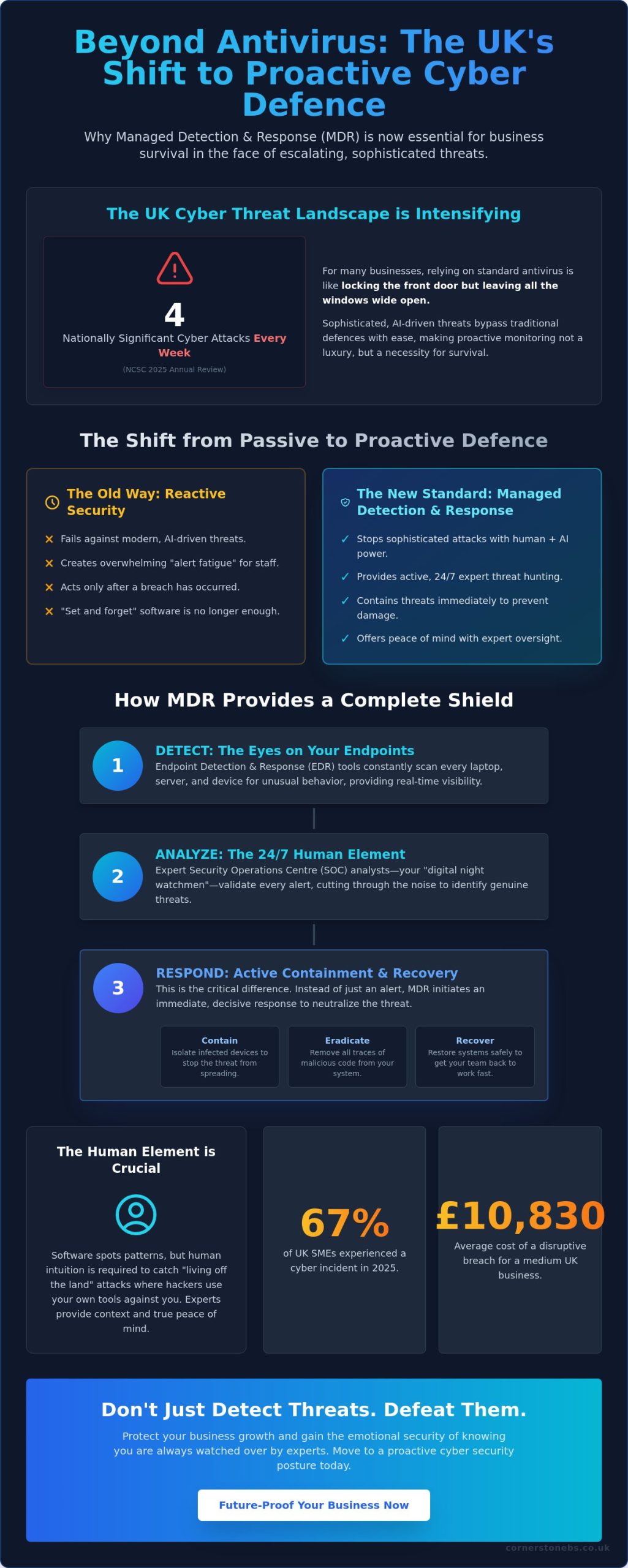
Did you know the National Cyber Security Centre confirmed in its 2025 Annual Review that the UK now faces four nationally significant cyber attacks every week? For many local business leaders, this startling reality makes standard antivirus feel like a locked front door with the windows left wide open. It’s exactly why more organizations are shifting their focus toward managed detection and response (MDR) services UK to bridge the gap between simple detection and actual survival.
We understand the pressure you’re under. You’re likely tired of the overwhelming volume of security alerts and the constant fear that a ransomware attack might go undetected until it’s too late. You want to know your data is safe without needing to build a massive in-house team from scratch. This guide will show you how to achieve 24/7 peace of mind through proactive monitoring and expert-led response. We’ll break down the 2026 regulatory environment, including the new Cyber Security and Resilience Bill and the latest Cyber Essentials updates, so you can focus on running your business while we keep the threats at bay.
Key Takeaways
Move beyond static defenses by pairing advanced technology with human oversight to stop sophisticated, AI-driven threats before they take hold.
See how managed detection and response (MDR) services UK provide active containment and recovery rather than just sending overwhelming security alerts.
Identify the critical benchmarks for choosing a UK security partner, including the necessity of local expertise and vendor-agnostic support.
Learn why behavioral analysis is the new gold standard for spotting breaches that traditional signature-based security often misses.
Discover how a proactive security partnership protects your growth and provides the emotional security of knowing your business is always watched.
Why Managed Detection and Response (MDR) is Essential for UK Businesses in 2026
In 2026, the digital perimeter of your business isn’t a static wall; it’s a moving target. Cyber criminals now use automated social engineering and AI-driven ransomware to find gaps in your security in seconds. This is why Managed detection and response (MDR) has become the baseline for modern protection. It isn’t just a piece of software you install and ignore. Instead, it’s a sophisticated blend of high-speed technology and 24/7 human expertise. For local firms, choosing managed detection and response (MDR) services UK means moving past simple alerts and toward active, real-time protection that actually stops an intruder in their tracks.
We know that the upcoming Cyber Security and Resilience Bill is weighing on the minds of many directors. You aren’t just worried about losing data; you’re worried about the legal fallout and the hit to your hard-earned reputation. Noticing a threat is no longer enough to stay compliant or safe. If your system flags a breach at 2 AM on a Sunday, but no one is there to kill the process, the damage is already done. True MDR bridges that gap by providing a response that is immediate and decisive.
The Shift from Passive to Proactive Defence
Traditional “set and forget” security models failed many in 2025. Statistics show that 67% of UK SMEs experienced a cyber incident that year, proving that basic firewalls are no longer a total solution. We focus heavily on Mean Time to Detect (MTTD). In the UK SME sector, reducing the time an intruder spends in your network is vital for survival. Active threat hunting is now a standard requirement for business continuity. It involves searching your network for signs of a “silent” intruder before they ever trigger a standard alarm. This proactive stance ensures that your Managed IT Support isn’t just fixing what’s broken, but actively preventing the break from happening.
The Human Element: Why Software Alone is Not Enough
Software creates noise. Your staff are likely already buried under a mountain of digital notifications. This “alert fatigue” is dangerous because it leads to critical warnings being ignored or buried. Our Security Operations Centre (SOC) analysts act as your digital night watchmen, providing the backbone for effective managed detection and response (MDR) services UK. They validate every alert so you don’t have to. While AI is great at spotting patterns, human intuition is required to catch “living off the land” attacks. These are breaches where hackers use your own legitimate admin tools against you. No algorithm can match the gut feeling of an expert who knows when a routine task looks suspicious. It’s about providing the emotional security that comes from knowing a real person is watching over your business.
The Core Components: How MDR Services Protect Your Digital Infrastructure
MDR isn’t just a dashboard; it’s a comprehensive shield for your digital assets. Think of Endpoint Detection and Response (EDR) as the “eyes” of the system. These tools constantly scan every laptop, server, and mobile device for unusual behavior. This real-time data feeds into a broader strategy where 24/7 monitoring acts as a digital night watchman. According to the UK Government Cyber Security Breaches Survey, the average cost of a disruptive breach for medium UK businesses reached £10,830 in 2024. That’s a financial and operational hit no leader wants to face.
The “Response” in managed detection and response (MDR) services UK is where the real value lies for a busy professional. It isn’t just about sounding an alarm. It’s about active containment, where we isolate infected devices to stop a threat from spreading. Then comes eradication, removing the malicious code entirely, followed by recovery to get your team back to work. This seamless flow is especially vital when protecting cloud solutions like Microsoft 365, where a single compromised account could expose your entire organization in minutes.
24/7/365 Security Operations Centre (SOC)
Cybercriminals don’t clock off at 5 PM on a Friday. Your security shouldn’t either. A SOC is a dedicated hub of security professionals who monitor your systems around the clock. Their primary job is triage. They expertly separate the “noise” of harmless system updates from genuine, malicious attacks. This ensures that when we reach out to you, it’s because there’s a real issue that needs attention, not a false alarm. It’s about providing the clarity you need to make informed decisions without the technical jargon.
Advanced Threat Hunting and Intelligence
We use global threat intelligence to protect our local partners. By analyzing data from attacks happening across the world, we can spot “indicators of compromise” before they even trigger a standard alert. This proactive hunting creates a solid foundation for growth. It ensures your operations remain stable while you focus on scaling your business. If you’re concerned about your current vulnerabilities, exploring our Cyber Security options is a great place to start a conversation about your long-term stability.
MDR vs. Traditional Security: Why Standard Antivirus is No Longer Enough
“We have a firewall and antivirus, so we’re fine.” It’s a phrase we hear often from busy business owners. While these tools were once enough, the 2026 threat landscape has moved on. A firewall is like a sturdy fence around your property. It’s great for keeping out casual intruders, but it won’t stop a professional who knows how to climb over or walk through with a stolen key. This is where managed detection and response (MDR) services UK provide the active oversight that basic software simply can’t match.
Traditional antivirus relies on signature-based detection. It’s essentially looking for a “mugshot” of a known virus. If the threat is new or has changed its appearance, the antivirus won’t recognize it. As Gartner defines MDR, the service focuses on detecting and responding to threats that have already bypassed these initial defenses. We use behavioral analysis to watch what a program *does* rather than what it looks like. If an application suddenly starts encrypting files or communicating with an unknown server in the middle of the night, we stop it immediately.
Another critical factor is the “Detection Gap.” This is the time a hacker spends inside your system before being noticed. Without proactive monitoring, an intruder can spend weeks quietly stealing data or preparing a ransomware attack. MDR shrinks this gap to minutes. By the time a traditional system might have flagged an error, an MDR team has already contained the threat and started the remediation process.
Antivirus vs. EDR vs. MDR
It’s helpful to clear up the jargon. Antivirus is a tool, and EDR (Endpoint Detection and Response) is the data that tool generates. However, data is useless if no one is looking at it. MDR is the service that provides the “brain” to act on the information EDR collects. Antivirus stops known threats, while MDR finds the unknown ones hiding in the shadows. It’s the difference between having a smoke alarm and having a fire crew already on-site when the first spark flies.
The Real Cost of a Cyber Breach in 2026
The financial impact of a breach goes far beyond a single ransom payment. You have to consider the fines from regulatory bodies, the total loss of productivity while systems are down, and the long-term reputational damage. In fact, many UK insurance providers now mandate MDR-level security before they’ll even consider offering cyber coverage. It’s no longer a luxury; it’s a requirement for staying insured and operational. For more on building a resilient business, take a look at our guide on cyber security services. Investing in prevention is always more cost-effective than paying for a cure that might come too late.
Evaluating MDR Providers: A Framework for UK Business Leaders
Selecting a partner for managed detection and response (MDR) services UK is a significant step toward securing your business’s future. It’s a choice that moves you from a transactional relationship to a long-term partnership. You need a team that doesn’t just sit behind a screen in a different time zone. Instead, look for UK-based support that understands the specific regulatory and economic pressures your organization faces. A local presence ensures that communication is clear and that your partner is truly invested in your regional success.
One of the first things to clarify is whether a provider is vendor-agnostic or vendor-specific. Vendor-specific providers often require you to use their preferred software stack. This can lead to hidden costs if you’re forced to replace systems that already work for you. Vendor-agnostic partners are more flexible. They integrate with your existing setup, providing oversight without demanding a total infrastructure overhaul. You should also ensure they offer full incident response. Some providers only “detect” and notify you of a breach, leaving the hard work of fixing it to your busy staff. A true partner contains the threat and handles the eradication themselves.
Key Questions to Ask Your Potential Partner
Don’t be afraid to dig into the details during your evaluation. Start with these three critical questions to separate the experts from the pretenders:
“What is your guaranteed response time for a critical incident?”
“How do you handle false positives to avoid disrupting my staff’s daily work?”
“Can you demonstrate clear compliance with NIS2 or Cyber Essentials Plus requirements?”
Understanding Service Level Agreements (SLAs)
Not all SLAs are created equal. You must distinguish between “notification SLAs” and “remediation SLAs.” A notification SLA only guarantees that they will tell you about an attack within a certain timeframe. A remediation SLA is far more valuable; it outlines how quickly they will actually start stopping the threat. Transparency is the bedrock of this relationship. You should expect regular security posture reporting and executive briefings that translate technical data into business logic. This collaborative approach ensures you always know exactly how your investment is protecting your growth. If you’re ready to strengthen your defenses with a team that speaks your language, reach out to us to discuss our Cyber Security solutions.
Future-Proofing Your Business with Cornerstone Business Solutions’ Managed Cyber Security
At Cornerstone Business Solutions, we don’t believe in one-size-fits-all security. As a multi-award-winning provider, we’ve built our reputation on understanding the unique pulse of UK SMEs. We know that for you, managed detection and response (MDR) services UK isn’t just about code; it’s about protecting the livelihood of your team and the trust of your clients. By integrating our advanced security measures directly into your Managed IT Support, we create a unified defense that works silently in the background. This ensures your business continuity is never a matter of luck.
We focus on the emotional security of business owners just as much as the technical data. You deserve to sleep soundly knowing that a dedicated, local partner is watching over your systems. We move away from transactional relationships. Instead, we act as a long-term ally that grows alongside you. Our proactive stance means we’re constantly looking for ways to strengthen your posture before a threat even appears on the horizon. It’s about providing a foundation of stability that allows you to focus on your next big move.
A Seamless Extension of Your Team
Our approach is simple: we find the problems so you don’t have to. Cornerstone Business Solutions acts as a seamless extension of your existing staff, removing the burden of security management from your shoulders. To do this, we leverage powerful partnerships with global leaders like Microsoft, IBM, and Cisco. We take this high-level technology and make it simple, reliable, and relevant to your specific needs. You don’t need to understand the complex mechanics behind every alert because our experts are already handling it. We translate the technical jargon into clear, benefit-driven insights that help you lead with confidence.
Your Next Steps to Total Security
Getting started shouldn’t feel like a mountain to climb. Our onboarding process is designed to be efficient and transparent. It begins with a comprehensive audit of your current digital infrastructure to identify any immediate gaps. From there, we move into implementation, tailored to your specific operational flow. Once the systems are live, our 24/7 watch begins. It’s vital to remember that security is a journey, not a destination. As threats evolve, our strategies adapt to keep you ahead of the curve. We invite you to a low-pressure, informal chat about your current security roadmap and how we can help you secure your future. Book a conversation with our security experts today and let’s start building a more resilient business together.
Secure Your Business Growth with Expert Oversight
The 2026 threat landscape demands more than just a locked door; it requires a watchful eye that never blinks. We’ve explored how moving from passive tools to active threat hunting dramatically reduces the time an intruder can spend in your network. By choosing managed detection and response (MDR) services UK, you ensure that your organization isn’t just noticing problems, but actively stopping them in real-time. This level of professional protection provides the emotional security you need to lead your business with confidence while staying compliant with the latest UK regulations.
As a multi-award-winning IT provider, we combine our regional roots with global technical strength through partnerships with leaders like Microsoft, IBM, and Cisco. Our 24/7/365 proactive monitoring ensures your digital infrastructure remains a foundation for growth rather than a source of stress. We’re here to be your long-term partner in resilience, simplifying complex security into reliable results. Let’s have an informal conversation about securing your business and building a roadmap that keeps you safe. We’re ready to help you protect what you’ve worked so hard to build.
Frequently Asked Questions
What is the difference between MDR and an MSSP?
An MSSP typically manages your security infrastructure, such as firewalls, and sends alerts when something looks wrong. MDR goes a step further by focusing on active threat hunting and immediate response. While an MSSP tells you there’s a problem, an MDR service takes the lead in fixing it. This proactive approach ensures that threats are neutralized before they can cause lasting damage to your operations.
Does my small business really need MDR services?
Small businesses are often targeted by automated attacks because they frequently lack the dedicated security teams found in larger corporations. Implementing managed detection and response (MDR) services UK provides you with enterprise-level protection without the massive overhead. It’s a strategic move that ensures your growth isn’t derailed by a single, undetected breach. We help you level the playing field against sophisticated cyber criminals.
How does MDR help with UK GDPR and NIS2 compliance?
MDR provides the continuous monitoring and rapid incident response required to meet “state of the art” security standards under UK GDPR. For organizations navigating the new NIS2 requirements or the UK’s Cyber Security and Resilience Bill, MDR offers the documented evidence of security controls you need. It demonstrates that you’re taking proactive steps to protect sensitive data and maintain essential services.
What happens if the MDR service detects a ransomware attack at 3 AM?
The system automatically isolates the affected device the moment a threat is detected to prevent ransomware from spreading through your network. Our analysts then step in to validate the alert and begin the eradication process immediately. You won’t wake up to a locked network and a ransom demand. Instead, you’ll receive a report explaining how the threat was neutralized while you slept.
Can MDR replace my existing internal IT team?
MDR doesn’t replace your internal IT staff; it empowers them to focus on what they do best. Most internal teams are busy with daily operations and strategic projects rather than 24/7 security monitoring. We handle the specialized threat hunting and the constant stream of alerts. This partnership allows your team to focus on the core activities that drive your business success.
How long does it take to implement an MDR service?
Most businesses can be fully protected within a few weeks. The process starts with a thorough audit of your digital infrastructure and the deployment of lightweight sensors across your network. Once we establish an initial baseline of your normal operations, our 24/7 monitoring begins. We work closely with you to ensure the rollout is smooth and doesn’t disrupt your daily business activities.
What is the typical cost structure for MDR services in the UK?
The cost structure for managed detection and response (MDR) services UK is typically based on a predictable monthly subscription. This is usually calculated per endpoint or per user, making it a manageable operational expense rather than a large capital investment. This model allows you to scale your security protection up or down as your business needs change over time.
Will MDR slow down my employees’ computers or network?
Modern MDR agents are designed to be extremely lightweight and have a negligible impact on system performance. They operate quietly in the background, using minimal memory and processing power. Your employees can continue their work without noticing any slowdowns in their computer speed or network connectivity. We prioritize both your security and your team’s productivity.
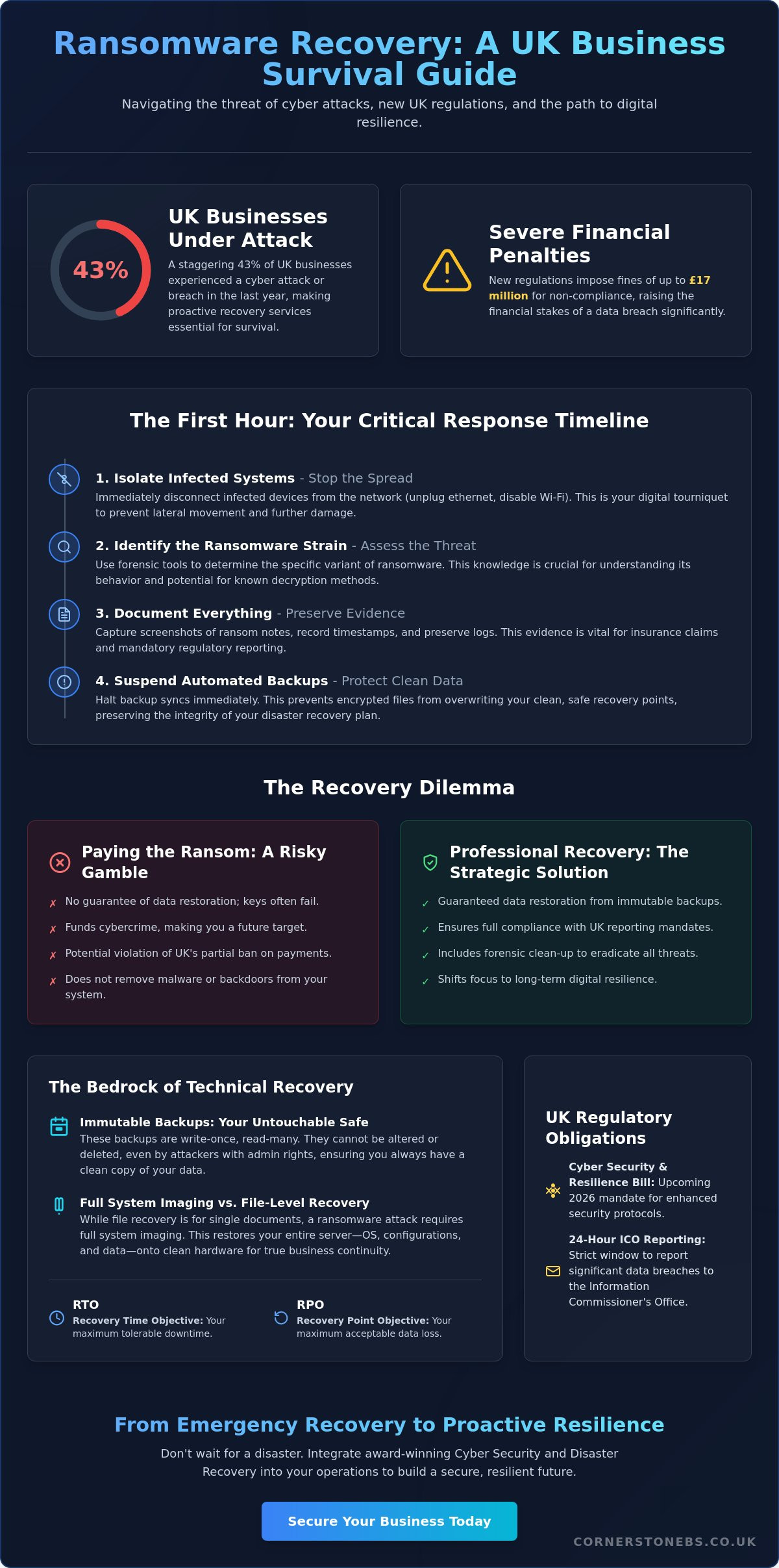
Did you know that 43% of UK businesses experienced a cyber attack in the last year, with many now facing potential fines of up to £17 million under new regulations? You likely feel the pressure of the upcoming Cyber Security and Resilience Bill, especially with its mandatory 24-hour incident reporting requirements. Securing the right ransomware recovery services UK business leaders need is no longer a luxury; it’s the foundation of your operational survival. We understand that the fear of total data loss and crippling downtime keeps many local business owners awake at night.
We agree that the stakes have never been higher, particularly as the UK government moves toward a partial ban on ransomware payments. This guide provides a comprehensive roadmap to help you navigate the recovery process, restore your systems, and ensure long-term digital resilience. You’ll learn how to handle the new reporting mandates, minimize your downtime through robust disaster recovery, and maintain full compliance with evolving UK data laws. We’ve designed this guide to turn technical complexity into a clear path forward for your business stability and peace of mind.
Key Takeaways
Stop the spread immediately by isolating infected systems and using forensic tools to identify the specific ransomware strain within the first hour.
Ensure guaranteed data restoration by leveraging immutable backups and full system imaging instead of relying on unstable decryption keys from criminals.
Navigate complex 2026 regulations with professional ransomware recovery services UK to meet strict ICO reporting windows and protect your reputation.
Shift from emergency recovery to proactive digital strength by integrating award-winning Cyber Security and Disaster Recovery into your daily operations.
Immediate Steps: What to Do in the First Hour of a Ransomware Attack
The first hour of a ransomware attack is often the most stressful period a business owner will ever face. You might see strange file extensions appearing in your folders or a glaring ransom note on your desktop. Stay calm. Your first job is to stop the bleeding. You must isolate infected machines immediately to prevent the malware from moving laterally through your network infrastructure. If you don’t act fast, a single infected device can compromise your entire server array. This is where the right ransomware recovery services UK expertise becomes the difference between a minor hiccup and a total shutdown.
Identifying the specific strain is the next priority. Using professional forensic tools helps determine if there’s a known remedy for the What is Ransomware? variant you’re facing. Our local team focuses on documenting every screen, message, and timestamp. This evidence is essential for your insurance claim and your 24-hour reporting mandate under the 2026 Cyber Security and Resilience Bill. You should avoid the temptation to speak with attackers directly. They’re professional manipulators, and direct contact often leads to higher ransom demands or further security risks. We’re here to help you manage these initial steps with the clarity of a long-term partner.
The Critical Containment Phase
Containment acts as the digital tourniquet for business survival, stopping the spread before it claims your entire network. You need to physically disconnect ethernet cables and disable Wi-Fi protocols on all suspected devices. It’s also vital to suspend your automated backup syncs immediately. If your system keeps syncing during an active attack, you risk overwriting your clean archives with encrypted data. Halting these processes preserves the integrity of your Disaster Recovery points and keeps your clean data safe from corruption.
Initial Assessment and Triage
Once the spread is contained, we assess the scope of the breach. We differentiate between files that are simply locked and data that has been exfiltrated to external servers. Our experts look across your UK-based servers and Microsoft 365 cloud environments to map the infection accurately. We then help you prioritise your restoration queue. By focusing on critical business functions first, we ensure your most important operations are back online while we continue the deeper cleaning process. This structured approach helps you maintain business continuity even under extreme pressure.
Technical Recovery Mechanisms: Restoring Business Continuity
Restoring your business operations involves much more than just clicking ‘undo’ on a hacker’s encryption. While many focus solely on data, true continuity requires a structured approach to rebuilding your entire digital environment. Leading ransomware recovery services UK providers rely on immutable backups as the first line of defence. These backups are specifically designed to be unchangeable; once written, they cannot be modified or deleted, even by someone with stolen administrative credentials. This ensures you always have a clean, untouchable copy of your history to fall back on.
We distinguish between simple file-level recovery and full system imaging. File-level recovery works for accidental deletions, but after a total ransomware sweep, you need system imaging. This process restores your entire server environment, including the operating system and configurations, onto clean hardware. By utilising cloud-based Disaster Recovery, we can often spin up these images in a virtual environment, allowing your team to work while we sanitise your physical on-site servers. This dual-track approach slashes the time you spend in operational limbo.
Understanding RTO and RPO in 2026
Success in recovery is measured by two vital metrics: RTO and RPO. Think of the Recovery Time Objective (RTO) as the ‘clock of downtime.’ It’s the maximum amount of time your business can survive without its systems before the damage becomes irreversible. Recovery Point Objective (RPO) is your ‘threshold of data loss,’ representing how much work you’re willing to lose between your last backup and the attack. We work as your long-term partner to align these metrics with your specific commercial needs, ensuring your protection matches your pace of growth.
The Forensic Clean-Up Process
You can’t simply restore data into an environment that might still be compromised. We follow UK government guidance on mitigating ransomware by thoroughly sanitising every server and workstation. This involves identifying ‘sleeper’ malware that may have been lurking in your backup sets for weeks before the final payload was delivered. By extracting data into sandboxed environments, we verify its integrity before it ever touches your live network. This rigorous verification process ensures that when you reconnect to the UK internet backbone, you do so with total confidence in your system’s purity.
Professional Recovery Services vs. Paying the Ransom
When you’re staring at a frozen screen and a multi-million pound demand, the pressure to pay can feel overwhelming. You want your business back, and the hackers promise a quick fix. However, paying a ransom is a high-stakes gamble that rarely delivers the clean break you’re hoping for. Statistics from early 2026 show that only 17% of UK organisations chose to pay the ransom, a sharp decline from previous years. This shift isn’t just about ethics; it’s about the cold reality that partnering with ransomware recovery services UK experts is a more reliable investment in your business’s future. Paying doesn’t just fund criminal enterprises; it marks your company as a “proven payer,” often leading to repeat attacks within months.
The technical reality is that decryption keys provided by attackers are notoriously unstable. They’re often poorly coded and can corrupt your files during the decryption process. Research from 2025 indicates that only about 60% of organisations that pay a ransom successfully recover all their data. You might spend $1.5 million (the median UK ransom payment in 2025) and still end up with a shattered database. Beyond the data loss, you face the risk of “double extortion,” where criminals take your money but still leak your sensitive information or demand a second payment to stop a public data dump. Investing in professional restoration through your Managed IT Support partner ensures your systems are rebuilt on a clean, secure foundation rather than a patched-up crime scene.
The Myth of the “Honest Hacker”
Don’t fall for the idea that hackers have a reputation to uphold. They aren’t service providers; they’re criminals. Even if they give you a key, they often leave “sleeper” malware behind. These backdoors allow them to bypass your Cyber Security and strike again once you’ve resumed operations. Professional recovery focuses on a “clean start” by wiping infected environments and restoring from immutable backups. This method ensures that no hidden threats remain to jeopardise your long-term stability.
Legal Risks for UK Businesses
The legal landscape in the UK has become significantly more complex. You must consider the UK government financial sanctions guidance before even discussing a payment. Paying a ransom to a sanctioned entity can lead to severe legal penalties, regardless of your intentions. Additionally, many UK insurance providers now exclude ransomware payments from their coverage. Working with a certified recovery partner is often a prerequisite for a successful insurance claim, as it proves you’ve taken reasonable steps to mitigate the damage through legitimate channels.
UK Regulatory Obligations and Data Breach Compliance
Recovering your data is only half the battle. In the UK, the legal aftermath of a ransomware attack can be just as daunting as the technical breach itself. You’re likely aware of the UK GDPR requirements, but the 2026 regulatory landscape has added new layers of urgency. Under the Cyber Security and Resilience Bill, many organisations now face a mandatory 24-hour incident reporting window. This sits alongside the existing 72-hour ICO notification requirement for personal data breaches. If you miss these deadlines, or if you can’t prove you took “reasonable care” to protect your infrastructure, the financial penalties can be staggering.
Engaging professional ransomware recovery services UK experts ensures you aren’t just restoring files; you’re building a robust legal defence. We help you document every step of the incident, from the initial discovery to the final system sanitisation. This detailed paper trail is vital when you communicate the breach to clients, stakeholders, and your employees. Transparency is your best tool for preserving trust. We ensure your response aligns with the latest National Cyber Security Centre (NCSC) standards, providing the structured approach that regulators expect from a responsible business.
Navigating the ICO Reporting Process
Reporting a breach shouldn’t be a guessing game. The ICO notification form requires specific details about the nature of the breach, the categories of data involved, and your mitigation steps. We guide you through this process, ensuring your technical recovery documentation supports your claim of proactive management. By being clear and transparent in your UK-wide communication, you manage the narrative and reduce the risk of long-term reputational fallout. This structured approach helps satisfy the authorities while protecting your brand’s integrity.
Compliance as a Recovery Milestone
A successful recovery is the perfect time to harden your defences for the long term. Many of our clients use this transition to achieve Cyber Security Services certification, turning a vulnerability into a verified strength. We’ll help you update your internal data processing registers and ensure you’re aligned with standards like NIS2 or DORA if your sector requires it. This isn’t just about ticking boxes; it’s about building a resilient future where your business is better protected than ever before. If you’re concerned about your current compliance posture, reach out for a chat with our local experts to see how we can strengthen your digital foundations.
Building a Ransomware-Resilient Future with Cornerstone
Surviving a cyber attack is a major milestone, but the ultimate goal is ensuring it never happens again. We believe that the most effective ransomware recovery services UK businesses rely on should lead directly into a proactive security posture. Our multi-award-winning support isn’t just about reacting to alarms; it’s about building a digital fortress around your daily operations. We help you transition from the stress of emergency recovery to the stability of managed IT. By implementing a Zero Trust architecture across your network, we ensure that every user and device is verified. This strategy significantly reduces the risk of lateral movement, keeping your core assets safe even if a single endpoint is compromised.
We’re proud to act as your long-term technology partner rather than just a fix-it shop. Our team is deeply connected to our regional roots, and we take a genuine interest in the success of your business. We don’t just provide technical fixes. We offer the emotional security that comes from knowing your systems are managed by experts who care. This collaborative approach turns your IT infrastructure into a foundational element of your business growth, rather than a constant source of worry.
Proactive Monitoring and Threat Hunting
We leverage elite global partnerships with industry leaders like Cisco and Microsoft to bring world-class protection to your local network. Our UK-based helpdesk monitors your systems around the clock, identifying anomalies and hunting for “sleeper” threats before they have a chance to encrypt your files. For many local leaders, this journey toward total resilience starts with Managed IT Services Teesside to establish a rock-solid foundation. We act as your dedicated security eyes and ears, allowing you to focus on your commercial goals with total confidence.
Tailored Disaster Recovery Planning
True resilience requires moving beyond basic backups into a sophisticated Cloud Solutions environment. We customise your recovery protocols to match your specific RTO and RPO requirements. We don’t just hope the plan works; we run regular “fire drill” testing to prove it. These simulations ensure that your team knows exactly what to do and that your data can be restored within minutes. We’d love to invite you to a no-pressure conversation about your current risk level. Let’s have a friendly chat about how we can strengthen your digital foundations for the years ahead.
Secure Your Digital Legacy and Business Continuity
Navigating a ransomware attack is one of the toughest challenges any business leader will face. We’ve explored how immediate containment, technical restoration through immutable backups, and strict adherence to UK regulatory reporting can turn a potential disaster into a managed recovery. By choosing professional restoration over the risks of paying a ransom, you protect your business from double extortion and ensure your systems are rebuilt on a clean, secure foundation. Securing the right ransomware recovery services UK experts provide is the most effective way to meet the 2026 reporting mandates while preserving your professional reputation.
As a multi-award-winning IT provider and strategic partner with Microsoft, IBM, and Cisco, we’re here to be your long-term technology partner. Our UK-based proactive support team focuses on building a resilient future for your organisation, moving you from emergency response to a Zero Trust environment. Don’t wait for a crisis to test your defences. We invite you to talk to our award-winning UK experts about your recovery plan and discover how we can strengthen your digital foundations together. Your business stability is our priority, and we’re ready to help you thrive with confidence.
Frequently Asked Questions
Is it illegal for a UK business to pay a ransomware demand?
Paying a ransom isn’t universally illegal, but it’s a high-risk legal minefield that the UK government strongly discourages. If you unknowingly pay a group that is on the UK’s financial sanctions list, your business could face criminal prosecution. Under the 2026 Cyber Security and Resilience Bill, organisations must also report any intention to pay a ransom to the authorities before the transaction occurs. We focus on restoration through secure backups to keep your business on the right side of the law.
How long does professional ransomware recovery typically take?
Recovery timelines depend on the volume of data and the complexity of your network, but 59% of UK businesses achieved a full recovery within one week in 2025. While simple file restoration might happen quickly, a full forensic sanitisation of your servers ensures that no “sleeper” malware remains. Our local team prioritises your most critical business functions so you can resume operations while the deeper cleaning of your infrastructure continues in the background.
Will my cyber insurance cover the cost of recovery services?
Most cyber insurance policies cover the professional fees for ransomware recovery services UK providers offer to rebuild your systems. However, a growing number of UK insurers now specifically exclude the cost of the ransom payment itself. You should review your policy to confirm it covers digital forensics, data restoration, and the temporary hardware needed to maintain business continuity during the rebuild. Working with a recognised partner often makes the claims process much smoother.
Can ransomware infect my cloud backups like Microsoft 365 or Azure?
Yes, ransomware can compromise cloud environments if your automated sync processes remain active during an attack. If your local files are encrypted, the cloud service may simply sync those “changes,” overwriting your clean versions with encrypted ones. We prevent this by using immutable cloud backups and Disaster Recovery solutions that are isolated from your live sync environment. This ensures you always have a version of your data that the malware cannot touch.
What is the difference between data recovery and ransomware recovery?
Data recovery is the technical act of retrieving lost or deleted files, while ransomware recovery is a comprehensive strategic restoration of your entire business environment. Ransomware recovery involves forensic analysis to find the entry point, sanitising the network to remove backdoors, and verifying the integrity of every system. It’s a structured move toward long-term resilience rather than just a simple file restore. We treat it as a business continuity project to ensure your digital foundations are stronger than before.
Do I need to report a ransomware attack to the police or the ICO?
You must report any breach involving personal data to the ICO within 72 hours under the UK GDPR. For many sectors, the 2026 regulations have shortened this to a 24-hour mandatory reporting window for the initial incident. You should also report the attack to Action Fraud, which is the UK’s national reporting centre for cybercrime. These reports are essential for your legal compliance and can be vital when making a claim on your cyber insurance policy.
How can I tell if my backups are safe from a current infection?
Your backups are only truly safe if they are immutable or physically air-gapped from your primary network. We use forensic scanning tools to check your backup sets for “sleeper” malware that might have been planted weeks before the attack. If your backups were connected to the network during the infection without specific write-protection, there’s a risk they could be compromised. Regular “fire drill” testing is the most reliable way to verify your recovery points.
What are the first three things I should do if I see a ransom note?
First, isolate the infected devices by disconnecting ethernet cables and disabling Wi-Fi to stop the spread. Second, take photos of the ransom note and any on-screen messages to provide evidence for the police and your insurance provider. Third, contact your Managed IT Support partner immediately to begin the professional containment phase. These steps act as a digital tourniquet, protecting your remaining network infrastructure from lateral movement while you prepare for a secure restoration.
If a retail giant like M&S can be compromised, your business’s digital front door might be more vulnerable than you think. The marks and spencer data breach serves as a stark reminder that even household names face evolving ransomware threats in 2026. You probably feel that the weight of GDPR compliance and the fear of a public leak are enough to keep any North East business owner awake at night. We understand that anxiety. It’s not just about a technical glitch; it’s about avoiding potential £17.5 million fines and protecting the hard-earned trust you’ve built with your local customers.
We agree that protecting your reputation is just as vital as securing your servers. Our award-winning team is here to ensure you have the tools to stay resilient. This guide explains the full impact of the M&S incident and shows you exactly how to shield your own operations from similar ransomware threats. We’ll break down the mechanics of the breach, provide a clear response plan for your business, and share proactive IT security tips to give you total peace of mind.
Key Takeaways
Uncover the critical details of the marks and spencer data breach to understand how modern ransomware-as-a-service models exploit even the largest UK retailers.
Learn the essential steps to isolate active infections and contain damage, protecting your customers’ sensitive data and your brand’s reputation.
Discover why immutable backups are a non-negotiable component of a modern recovery strategy for maintaining total business continuity.
Gain peace of mind by exploring how our award-winning North East team delivers the bespoke, proactive security your business deserves.
What Happened in the Marks and Spencer Data Breach?
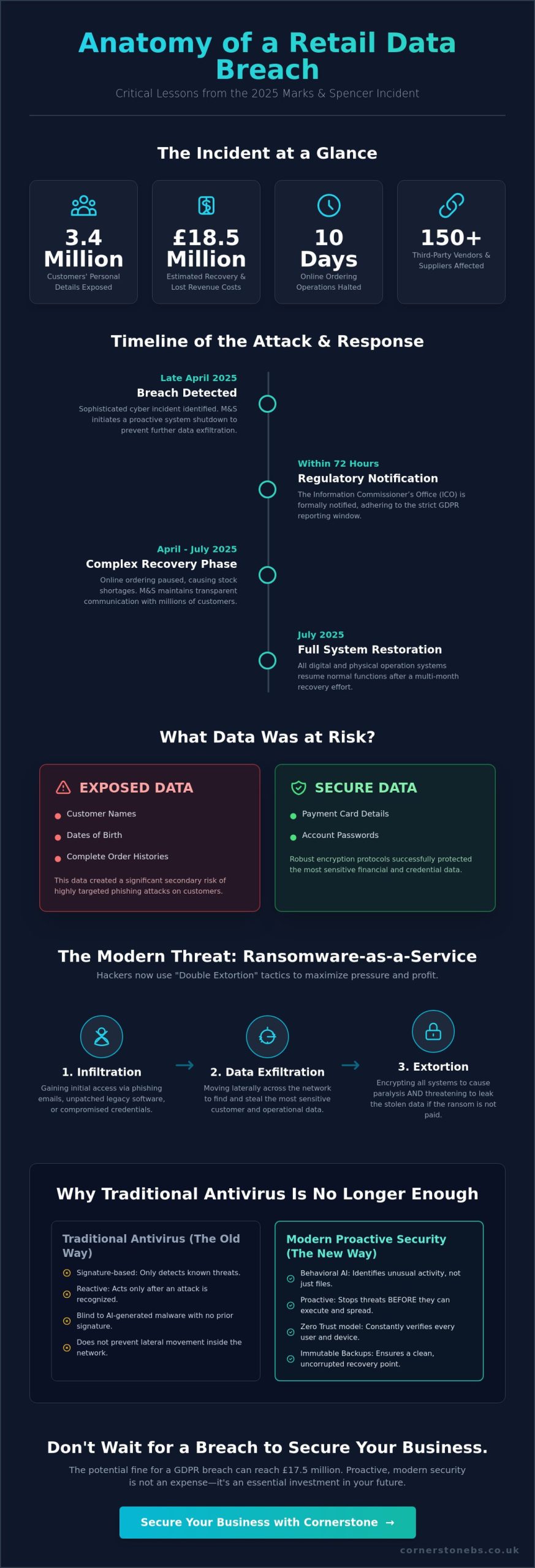
In April 2025, a sophisticated cyber incident targeted one of the UK’s most iconic retailers, causing widespread disruption across its digital and physical operations. This marks and spencer data breach forced the company to take immediate, drastic action to protect its infrastructure. To understand the gravity of this event, it is helpful to first define what is a data breach? and how it impacts a business of this scale. The incident resulted in the exposure of personal details for approximately 3.4 million customers, specifically targeting names, dates of birth, and order histories. While this caused significant concern, the retailer’s robust encryption protocols ensured that payment card details and account passwords remained secure and uncompromised.
The scale of the disruption was felt immediately by shoppers across the country. M&S made the proactive decision to pause online ordering for a period of 10 days to contain the threat. This led to noticeable stock shortages in physical stores, including those throughout the North East, as automated replenishment systems were taken offline. It was a stark reminder that digital security is the foundation of modern retail reliability.
The Timeline of the Incident
The breach was first detected in the final week of April 2025. Within hours, the retailer initiated a proactive system shutdown to prevent further data exfiltration. Our award-winning team at Cornerstone knows that speed is everything in these scenarios. However, the recovery phase was complex, and it took until July 2025 for all systems to resume normal operations. During this time, M&S followed a transparent communication strategy, notifying the Information Commissioner’s Office (ICO) within the 72-hour regulatory window and keeping millions of customers informed through direct, clear updates.
The Immediate Impact on Customers and Suppliers
The marks and spencer data breach echoed through the entire supply chain, affecting over 150 third-party vendors who relied on the retailer’s logistics platform. The financial toll was substantial, with estimated recovery and lost revenue costs reaching £18.5 million. For customers, the primary risk shifted to secondary fraud. M&S provided tailored guidance, urging users to be wary of phishing emails that might use their leaked order history to appear legitimate. They recommended heightened vigilance and immediate reporting of any suspicious activity to maintain peace of mind.
The Anatomy of a Retail Ransomware Attack
Modern cybercrime isn’t just a lone hacker in a basement; it’s a professionalized industry. Most high-street attacks now utilize the Ransomware-as-a-Service (RaaS) model. This allows entry-level criminals to lease powerful encryption tools from expert syndicates in exchange for a cut of the profit. Large retailers like M&S are high-value targets for these syndicates because they manage vast amounts of customer data and rely on constant uptime. A single hour of downtime for a major retailer can cost thousands in lost revenue and logistics delays.
In 2026, hackers have moved beyond simple encryption. They now use “double extortion” tactics. They steal sensitive customer information before locking the systems. If the business refuses to pay the ransom, the criminals threaten to leak the stolen data online. This approach makes a potential marks and spencer data breach a multi-layered disaster involving both operational paralysis and massive regulatory fines. Common entry points remain surprisingly simple, ranging from sophisticated phishing emails to unpatched legacy software that hasn’t been updated in months.
How Ransomware Penetrates Business Networks
The first 24 hours of a cyber attack are the most critical. Once a hacker gains initial access, they don’t usually strike immediately. Instead, they perform lateral movement. This involves jumping from a single compromised device to the main server to find the most sensitive data. Implementing Zero Trust security is the most effective way to stop this. It ensures that every user and device is constantly verified, preventing hackers from moving freely through your systems. If you suspect an intrusion, following an official data breach response guide can help your team contain the threat before it spreads to your entire infrastructure.
Why Traditional Antivirus is No Longer Enough
Old-school antivirus software relies on signature-based detection. It only catches threats it has seen before. By 2026, hackers are using AI to create unique malware for every attack, meaning it has no “signature” to track. You need behavioral AI monitoring that identifies unusual activity, such as a user account suddenly accessing thousands of files at 2 AM. A “set and forget” IT strategy is a recipe for disaster in the current climate.
Vulnerabilities often stem from simple human error or outdated patches. This is why 24/7 proactive monitoring by an award-winning IT provider is essential for modern business continuity. We focus on stopping threats before they reach your front door, giving you the peace of mind to run your business without fear. If you’re unsure if your current systems could withstand a marks and spencer data breach style event, we’d love to have a friendly chat about your security posture.
Critical Lessons from the M&S Cyber Incident
The marks and spencer data breach serves as a vital case study for UK business owners. M&S earned praise for their transparency, yet the incident exposed how even retail giants can stumble. Their proactive notification helped maintain customer trust, but the initial vulnerability reminds us that no one is immune. Our award-winning team at Cornerstone Business Solutions works with North East businesses to turn these lessons into action. We don’t just fix PCs; we build resilient systems. The breach highlights that your security is only as strong as your weakest supplier.
You need an immutable backup strategy to ensure your data stays safe from encryption. This is a non-negotiable part of NIS2 compliance, especially when managing complex supply chains in 2026. Most breaches start with a single human error. Staff training isn’t just a box-ticking exercise; it’s your first line of defence. Expert advice on preventing ransomware attacks shows that technical fixes must be paired with a culture of security. Under 2026 regulations, you’re responsible for your entire digital chain. We help you vet partners and secure your perimeter so you aren’t left vulnerable.
Communication as a Defence Mechanism
Speed is your best friend when things go wrong. You must report serious breaches to the Information Commissioner’s Office (ICO) within 72 hours. Promptly telling your customers protects your reputation and can lower potential fines. It’s a delicate balance. You should share enough to be helpful without giving hackers a roadmap of your ongoing investigation. Transparent communication shows you’re in control, which is essential for long-term brand loyalty in the North East market.
The Cost of Inaction vs. Proactive IT Support
Emergency recovery costs can easily spiral into thousands of pounds per day. Compare that to a fixed monthly fee for award-winning managed IT support, and the choice becomes clear. Proactive maintenance stops problems before they start. Business Continuity is a proactive strategy that ensures your SME can keep operating during and after a technical crisis. This approach gives you the peace of mind to focus on growth. Investing in a partnership with a local expert ensures your systems are robust, tailored, and ready for any challenge 2026 brings. High-quality support isn’t an overhead; it’s an investment in your company’s survival.
Proactive monitoring: Detects threats before they breach the perimeter.
Immutable backups: Ensures data cannot be deleted or changed by attackers.
Staff empowerment: Reduces the risk of successful phishing attempts by 70%.
How to Respond to a Data Breach: A Step-by-Step Guide
When a security incident occurs, your first 60 minutes determine the next six months of your business’s health. Taking a structured, calm approach is the only way to protect your reputation and your bottom line. Whether you are dealing with a localized issue or studying the fallout of a major marks and spencer data breach, the response framework remains the same. You must act with speed, but you must also act with precision.
Immediate Containment Strategies
Isolate and contain the infection as your first priority. Stop the spread by disconnecting affected hardware from the network. Don’t simply pull the power cables. Keeping devices powered on while disconnected from the internet helps preserve volatile forensic evidence that our award-winning team uses to trace the attacker’s path. This evidence is vital for understanding how the breach happened.
Law enforcement advice from the National Cyber Security Centre (NCSC) is clear: never pay the ransom. Paying doesn’t guarantee your data’s return and often marks your business as an easy target for future hits. Instead, engage with a specialist IT partner for emergency professional services. We provide the technical muscle needed to secure your perimeter and begin the recovery process without rewarding criminal activity.
Managing Stakeholder Communications
Transparency builds trust. You have a legal obligation under UK GDPR to notify the Information Commissioner’s Office (ICO) within 72 hours if personal data is at risk. Failing to meet this window can lead to significant fines. Draft a clear, honest statement for your customers and employees. Avoid technical jargon and focus on what they need to do to stay safe, such as changing passwords or monitoring bank statements.
Set up a dedicated support line or FAQ page to handle inquiries.
Be specific about what data was accessed, such as names or contact details.
Explain the proactive steps you’re taking to prevent a recurrence.
Ensuring your IT company solutions include disaster recovery planning is essential for long-term peace of mind. We help North East businesses build these frameworks before a crisis hits. Once the immediate threat is gone, restore your systems from secure, offline backups. A post-incident review is the final step. We’ll help you update your security protocols and close the gaps that allowed the breach to occur, ensuring your business is more resilient than ever.
The fallout from a high-profile incident like the marks and spencer data breach shows that no organisation is immune to sophisticated cyber threats. For UK firms, the stakes have never been higher. Cornerstone Business Solutions delivers bespoke technology designed to protect your assets and your reputation. We don’t just fix computers; we act as your dedicated long-term partner. Based in the North East, our team brings a mix of regional warmth and professional authority to every project. We help you move toward a Zero Trust architecture. This security model ensures that every user and device is verified, effectively eliminating the “single point of failure” that hackers love to exploit. We conduct proactive cybersecurity audits to find gaps before criminals do, ensuring your infrastructure is resilient against 2026 threat levels.
Award-Winning Managed IT Support
Our award-winning managed IT support gives you unlimited helpdesk access and proactive system monitoring. You won’t wait in a long queue when things go wrong. We partner with global leaders like Microsoft and Cisco to provide enterprise-grade security for local businesses. This means you get the same robust protection as a multinational corporation, delivered by a team that understands the local market. We build trust through transparency and reliability. Our “can-do” attitude ensures that your business stays operational 24/7. Benefits of our support include:
Proactive Monitoring: We identify and resolve issues before they cause downtime.
Global Partnerships: Access to the latest security protocols from Microsoft and Cisco.
Regional Expertise: A North East team that values community and personal service.
Scalable Solutions: Technology that grows alongside your business goals.
Building a Robust Defence-in-Depth
True security requires multiple layers. We integrate Microsoft 365 security features with rigorous hardware maintenance to create a defence-in-depth strategy. This includes regular digital checks and physical safety assessments. For instance, you should verify if PAT testing is a legal requirement for your specific equipment to ensure workplace safety and compliance. Our audits cover everything from cloud permissions to the physical state of your servers. We want to ensure your business remains resilient against the next marks and spencer data breach or similar industry-wide threat. By combining software intelligence with physical hardware reliability, we provide total peace of mind for business owners.
Don’t leave your security to chance. Chat with our expert team today to secure your business infrastructure and build a foundation for growth.
Secure Your Business Legacy Against Modern Cyber Threats
The marks and spencer data breach highlights why retail security requires a proactive rather than reactive stance. We’ve seen that a well-documented response strategy and robust infrastructure are the only ways to mitigate the impact of sophisticated ransomware. IBM’s 2023 Cost of a Data Breach Report confirms that UK organisations now face average breach costs of £3.4 million, a figure that demands serious boardroom attention. Protecting your reputation means staying one step ahead of the evolving tactics used by global cyber-criminal groups.
Cornerstone Business Solutions brings professional authority and North East warmth to your security strategy. As a multi-award-winning IT provider, we’ve built strong partnerships with Microsoft, IBM, and Cisco to ensure your systems remain impenetrable. We offer national UK coverage with a dedicated, personal approach that treats your business like our own. It’s about more than just software; it’s about providing the peace of mind you need to focus on growth. Let’s work together to build a resilient digital foundation for 2026 and beyond.
We’re ready to help you turn these insights into a powerful defence for your company’s future.
Frequently Asked Questions
Was my credit card stolen in the Marks and Spencer data breach?
You should check your official M&S account communications and bank statements for any unauthorised activity immediately. While M&S typically uses encrypted payment processors, hackers often target personal data to attempt identity fraud. If your financial details were compromised in the 2025 incident, the company would’ve notified you directly by 15 May 2025. We recommend monitoring your credit score via a provider like Experian to catch any suspicious applications for credit in your name.
Do I need to change my M&S password after the 2025 cyber attack?
Yes, you must update your password immediately to secure your account against the marks and spencer data breach. We recommend creating a unique password of at least 14 characters that you haven’t used on any other platforms. Our award-winning security team suggests enabling Multi-Factor Authentication (MFA) right away. This proactive step provides essential peace of mind by ensuring that a stolen password alone isn’t enough for a criminal to access your data.
How can I tell if an email from M&S is a phishing scam?
Check the sender’s email address carefully to ensure it ends exactly in marksandspencer.com. Scammers often use slightly altered domains or urgent, threatening language to trick you into clicking malicious links. According to the 2024 Cyber Security Breaches Survey, 84 percent of UK businesses experienced phishing attempts. If you’re unsure, don’t click any links. Instead, log in to your account through the official website or give our local North East team a chat for advice.
What are the legal requirements for a UK business after a data breach?
UK businesses must notify the Information Commissioner’s Office (ICO) within 72 hours of becoming aware of a personal data breach. This is a strict requirement under the UK GDPR and the Data Protection Act 2018 if the breach poses a risk to individuals. Companies must also inform the affected customers without undue delay. Failure to comply can result in significant fines of up to £17.5 million or 4 percent of total annual global turnover.
How much does it cost to recover from a ransomware attack?
The average cost of a cyber breach for a UK medium or large business reached £10,830 in 2024, according to government data. This figure only covers the immediate response and doesn’t account for long-term lost revenue or reputational damage. For smaller firms, the financial impact often forces a total halt in operations. Our tailored recovery strategies focus on getting your systems back online quickly to minimise these rising costs and protect your bottom line.
What is the best way to prevent a data breach in a small business?
Achieving Cyber Essentials certification is the most effective way to block 99 percent of common cyber attacks. This government-backed scheme ensures you have robust firewalls, secure configurations, and up-to-date software. As a dedicated North East partner, we simplify this technical process for you. We focus on proactive maintenance and employee training, turning your staff into a human firewall. This approach creates a foundation of security that supports your long-term business growth and stability.
Does GDPR apply to the Marks and Spencer data breach?
Yes, the UK GDPR applies to the marks and spencer data breach because the company processes the personal data of UK residents. These regulations require M&S to implement technical and organisational measures to protect consumer information. If the ICO finds that the company failed to meet these standards, they have the authority to issue enforcement notices or financial penalties. This legal framework ensures that your right to data privacy is protected by law across the United Kingdom.
How long does it take for a company to recover from a cyber incident?
It takes an average of 277 days for an organisation to identify and fully contain a data breach, according to industry reports from 2023. The initial technical recovery might happen within days, but the forensic investigation and data restoration often take months. Our award-winning managed services aim to slash this timeline through seamless backup solutions and rapid response protocols. We focus on business continuity so you can return to normal operations without the usual lengthy delays.