Did you know that the ICO now has the power to issue fines of up to £17.5 million for simple communication breaches? With the Data (Use and Access) Act 2025 now in full effect, staying ahead of the law requires more than just basic firewalls. It’s easy to feel overwhelmed by these shifting rules, especially when you’re trying to find a reliable it compliance checklist for uk businesses that actually makes sense for your daily operations. You need a strategy that protects your reputation and your bottom line without slowing down your team.
We understand that you want peace of mind, not a legal textbook. Our award-winning team has developed a guide that replaces uncertainty with absolute confidence. This framework simplifies complex technical requirements into clear, actionable steps that benefit your business. We break down the latest “Danzell” Cyber Essentials updates, explain the new 30-day data subject complaint window, and show you how proactive managed IT support acts as a continuous compliance engine. Let’s move past the jargon and ensure your business is resilient, legal, and ready for growth.
Key Takeaways
Learn why being “secure” isn’t the same as being “compliant” and how to avoid the ICO’s increased £17.5 million fining powers.
Get up to speed with the Data (Use and Access) Act 2025, including the strict new 30-day timeline for handling data subject complaints.
Follow our it compliance checklist for uk businesses to perform essential operational audits on user permissions and hardware lifecycles.
See how the latest Cyber Essentials “Danzell” update mandates Multi-Factor Authentication for all cloud users, not just admins.
Shift from a “set and forget” mindset to a proactive model that uses managed IT services to maintain continuous operational resilience.
Understanding IT Compliance in the 2026 UK Landscape
We’ve moved beyond the original 2018 General Data Protection Regulation (GDPR) baseline. Since February 5, 2026, the Data (Use and Access) Act 2025 has introduced stricter requirements for data subject complaints and incident reporting. This shift means your it compliance checklist for uk businesses needs to account for these updated mandates. For directors, this is about more than just avoiding legal trouble. It’s about emotional security. Knowing your systems are robust and compliant allows you to focus on growth without the constant fear of a regulatory audit hanging over your head.
The Consequences of Non-Compliance
The Data Protection Pillar: GDPR and the 2025 Data Act
The Data (Use and Access) Act 2025 (DUAA) officially became the primary influence on UK data protection on February 5, 2026. It’s not a total rewrite of the rules you already know. Instead, it amends the UK GDPR and the Data Protection Act 2018 to better suit our modern economy. For any business owner, this means your it compliance checklist for uk businesses must account for these specific refinements. The Act aims to reduce “red tape” for low-risk data usage while strengthening the protections around sensitive personal information. One of the biggest shifts involves how you justify data collection. You need to re-audit your “Lawful Basis for Processing” to ensure your reasons for holding data still align with the streamlined definitions provided by the new Act.
Handling Subject Access Requests (SARs) and data complaints has also become more structured. As of June 19, 2026, you’re legally required to acknowledge any data subject complaint within 30 days. You then have to provide a full response without undue delay. This isn’t just about avoiding fines; it’s about showing your customers that you value their privacy. We always recommend following the official ICO guidance on UK GDPR to stay on the right side of these evolving expectations. Clear communication builds the foundation of a long-term partnership with your clients.
The 72-Hour Breach Reporting Rule
Speed is your best friend when a security incident occurs. Under the current 2026 guidelines, you must report any breach that risks the rights and freedoms of individuals to the ICO within 72 hours. This window is incredibly tight if you’re relying on manual checks. We use automated monitoring to detect anomalies instantly, giving you the best chance to meet this deadline. A proactive response plan ensures your team knows exactly who to call and what to do the moment a red flag appears. If you’re worried about your current detection speed, our Cyber Security audits can identify gaps before they turn into reportable incidents.
Data Governance and Documentation
Cyber Essentials is no longer just a “nice to have” recommendation. It’s the bedrock of any it compliance checklist for uk businesses. Since the Danzell update took effect in April 2026, the requirements have sharpened significantly to meet modern threats. We view this certification as a quality signature. It proves to your partners and customers that you take their digital safety seriously. While the standard version involves a verified self-assessment, we often recommend Cyber Essentials Plus for businesses handling sensitive data. This higher tier includes a hands-on technical audit, providing the absolute certainty that your defences are as strong as you claim.
Even if your business is strictly UK-based, you’re likely part of a broader supply chain affected by international shifts. Regulations like NIS2 and the Digital Operational Resilience Act (DORA) are rippling through the UK market in 2026. These mandates require larger firms to prove their suppliers are secure. Meeting the Cyber Essentials scheme standards ensures you don’t get locked out of lucrative contracts due to compliance gaps. It positions your company as a reliable, long-term partner in a competitive landscape.
Technical Controls for Compliance
Modern compliance demands concrete technical evidence rather than vague promises. Multi-Factor Authentication (MFA) is now a mandatory check under the Danzell update for all cloud services. It’s not enough to enable it for administrators; every single user must have it active to pass an audit. We also focus on robust encryption for data both at rest and in transit. This prevents unauthorized access even if data is intercepted. Patch management is another critical area with zero room for error. You must apply all high-risk and critical security updates within 14 days of release. Failing to do so results in an automatic assessment failure, leaving your business both vulnerable and non-compliant.
Zero Trust Architecture in 2026
The Step-by-Step IT Compliance Checklist for 2026
Phase 1: Discovery and Documentation
Once you have a clear map, you must harden your defences. Enforce Multi-Factor Authentication (MFA) across all cloud subscriptions, including Microsoft 365 and Azure environments, to meet the mandatory Danzell update requirements. Standardise device encryption for all business mobiles and laptops to protect data in transit. This phase also involves an operational audit of user access levels. We advocate for “Least Privilege” policies, ensuring staff only have access to the data they need for their specific roles. To maintain this standard without manual effort, consider setting up automated patch management via Managed IT Support. This ensures critical security updates are applied within the required 14-day window.
Phase 3: Training and Culture
Technology alone isn’t enough; your people are your first line of defence. Deliver quarterly cyber security awareness training to help staff recognise evolving threats like AI-driven phishing. We recommend simulating phishing attacks to test your organisational resilience in a safe environment. The goal is to create a transparent culture where reporting a mistake is encouraged over hiding a breach. Finally, ensure your disaster recovery plan is more than just a document. Test your backup restoration at least annually to guarantee you can recover quickly from any incident. If you want to ensure your infrastructure meets every requirement, request a comprehensive IT audit from our expert team today.
Maintaining Compliance with Managed IT Services
Compliance isn’t a destination; it’s a constant state of readiness. The dangerous myth of “set and forget” compliance often leads to the very breaches and ICO fines we’ve discussed. In a 2026 regulatory environment, your digital infrastructure changes every day. New patches are released, user permissions shift, and data flows evolve. To stay legal and secure, you need a system that breathes with your business. Proactive monitoring identifies non-compliance markers before they escalate into a reportable incident. This approach transforms your it compliance checklist for uk businesses from a static document into a living, breathing shield for your organization.
At Cornerstone Business Solutions, we act as your long-term compliance partner. We don’t just fix things when they break; we ensure they’re built to meet the highest standards from the ground up. We leverage our multi-award-winning expertise to simplify complex technical audits, giving you the clarity you need to make informed decisions. By positioning managed IT support as your “continuous compliance engine,” we provide the emotional security that comes from knowing your systems are always under expert watch.
The Benefits of a Managed Compliance Approach
Taking a managed approach to your regulatory obligations offers several strategic advantages that benefit your bottom line. You gain predictable monthly costs, which is a far better alternative to the high price of emergency compliance fixes after a failed audit. You also get direct access to our team of Microsoft and Cisco certified engineers who understand the nuances of the 2025 Data Act. Our service includes:
Expert Guidance: Real-time advice on how new technologies impact your legal standing.
Regular Reporting: Clear, jargon-free documentation for your board of directors or stakeholders.
Automated Safeguards: Systems that enforce MFA and encryption standards without manual intervention.
Next Steps: Your Compliance Audit
Navigating the 2026 regulatory environment doesn’t have to be a source of constant anxiety for your leadership team. We’ve shown that staying ahead of the Data (Use and Access) Act 2025 and the latest “Danzell” Cyber Essentials updates is about building a culture of resilience. By following a structured it compliance checklist for uk businesses, you protect your professional reputation and your bottom line. It’s about moving away from a reactive mindset and embracing a proactive partnership that supports your long-term growth and stability. Compliance is the foundation that allows you to innovate with absolute confidence.
As a multi-award-winning IT provider and certified Microsoft and Cisco partner, we’re trusted by businesses and educational institutions nationwide to simplify these complex technical hurdles. We understand the pressure of meeting 30-day complaint windows and 72-hour breach reporting rules. Our team is here to provide the clarity and emotional security you need to focus on your core goals. Book your 2026 IT Compliance Audit with our award-winning team today. Let’s start a conversation about securing your digital future and ensuring your systems are as robust as your ambitions. You’ve built a great business; let’s work together to keep it protected and compliant.
Frequently Asked Questions
Is GDPR still relevant in the UK in 2026?
Yes, UK GDPR remains the foundational law for data protection, though it was amended by the Data (Use and Access) Act 2025. It still dictates how you collect, store, and process personal information. While the 2025 Act streamlined some administrative tasks, the core principles of transparency and security remain. You must continue to document your processing activities to stay on the right side of the ICO’s current enforcement policies.
What is the Data (Use and Access) Act 2025 and how does it affect my business?
The Data (Use and Access) Act 2025 is the latest evolution of UK data law, coming into full force on February 5, 2026. It introduces a formal process for data subject complaints and requires an acknowledgment within 30 days. It also clarifies the lawful basis for processing for common business tasks. This act aims to reduce red tape while maintaining high standards, making it a key part of any it compliance checklist for uk businesses.
Does my small business really need Cyber Essentials certification?
Yes, Cyber Essentials is a critical baseline for any organization, as the NCSC estimates it can block 80% of common cyberattacks. In 2026, many government and private sector contracts require this certification as a mandatory condition. The “Danzell” update now requires Multi-Factor Authentication for all cloud users. Beyond securing your systems, it acts as a quality signature that builds trust with your clients and professional partners.
How often should we conduct an IT compliance audit?
You should conduct a comprehensive IT compliance audit at least once a year, or whenever you make significant changes to your infrastructure. Regulatory environments move fast, and a set and forget approach is dangerous. Regular audits identify gaps in hardware lifecycles or software patches before they become liabilities. For businesses in high-risk sectors like finance or law, quarterly reviews are often the gold standard for maintaining continuous operational resilience.
Can Managed IT services help with legal compliance?
Managed IT services act as a continuous compliance engine by providing proactive monitoring and automated security updates. We handle the technical heavy lifting, such as enforcing encryption and managing patch cycles within the required 14-day window. This ensures your it compliance checklist for uk businesses is always up to date. By partnering with experts, you gain the emotional security of knowing your legal obligations are met without distracting from your core business goals.
What are the penalties for a data breach in the UK in 2026?
The ICO has enhanced powers in 2026, with maximum fines reaching £17.5 million or 4% of global turnover. These penalties now apply to breaches of the Privacy and Electronic Communications Regulations (PECR) as well as GDPR. Beyond the financial cost, you face permanent reputational damage and potential service shutdowns. Regulators are now moving from policy reviews to verifying evidence, so having a proactive response plan is essential to minimize these risks.
Is Microsoft 365 automatically compliant with UK laws?
No, Microsoft 365 provides the tools for compliance, but the responsibility for correct configuration lies with your business. You must actively enable features like Multi-Factor Authentication and data loss prevention policies to meet UK standards. Simply purchasing a subscription doesn’t satisfy the Data (Use and Access) Act 2025. We work as certified partners to harden your Microsoft 365 environment, ensuring your cloud setup is both secure and legally robust.
What should be included in an IT disaster recovery plan for compliance?
A compliant disaster recovery plan must include a clear restoration timeline, a communication strategy for stakeholders, and a full hardware inventory. You are legally required to test your backup restoration at least annually to prove your business can recover from an incident. The plan should detail how you’ll meet the 72-hour breach reporting window. Having these documented processes ensures continuity and provides the evidence regulators look for during a formal audit.
Could your business survive a £17.5 million fine? With the ICO now empowered to levy penalties of that scale or 4% of your global turnover, it’s no wonder many local leaders feel overwhelmed. We know the pressure you’re under. Between the updated Data Protection Act requirements that kicked in this June and the constant hum of cyber threats, managing it compliance requirements uk can feel like chasing a moving target. You want to protect your hard-earned reputation, but the technical jargon often gets in the way.
We’re here to simplify the complex and help you breathe easier. This guide offers a clear, proactive roadmap for 2026 to ensure your systems are resilient and your data stays locked down. We’ll compare key standards like Cyber Essentials and ISO 27001, explain the latest MFA mandates, and provide a practical checklist for your next audit. By the end, you’ll have the clarity needed to turn compliance from a box-ticking exercise into a strategic edge that helps you win bigger contracts and grow with confidence.
Key Takeaways
Master the 2026 updates to the Data Protection Act to avoid high ICO fines and ensure your data handling remains transparent and secure.
Navigate it compliance requirements uk with confidence by selecting the right security framework to protect your supply chain and win more contracts.
Identify how new regulations like NIS2 and DORA impact your specific sector and what you must do to stay ahead of upcoming implementation deadlines.
Use our practical roadmap to audit your infrastructure and map data flows, giving you total visibility over where your business information lives.
Shift from reactive fixes to proactive resilience by leveraging Managed IT Support to maintain continuous compliance and operational stability.
The Foundation of UK IT Compliance: GDPR and the Data Protection Act
In 2026, staying ahead of it compliance requirements uk isn’t just about avoiding a legal headache. It’s a strategic move that builds deep trust with your clients and local partners. We define IT compliance today as the proactive management of your digital infrastructure to meet strict legal standards while ensuring business continuity. It’s the bedrock of a resilient organization. When your systems are compliant, they’re inherently more secure, efficient, and ready for growth.
The core of this framework remains the synergy between the UK GDPR and the Data Protection Act 2018. While the GDPR provides the broad strokes for data privacy, the Act tailors these rules for the UK. A critical update arrived on June 19, 2026, which granted data subjects a specific right to complain directly to a controller. You must now acknowledge these complaints within 30 days. This shift underscores why accountability is the most vital principle for company directors. You don’t just need to be compliant; you must be able to prove it at a moment’s notice.
The Seven Core Principles of Data Protection
Success starts with mastering the seven core principles. You must process data with lawfulness, fairness, and transparency. This means being open with people about how you use their information. Purpose limitation ensures you only collect data for specified, legitimate reasons. We often see businesses falling into the trap of storage limitation; keeping data “just in case” is now a major compliance risk. Finally, integrity and confidentiality demand robust technical security to prevent unauthorized access or accidental loss.
Individual Rights and Subject Access Requests (SARs)
Your IT systems must be built to respect individual rights, such as the right to erasure and the right to be informed. Handling a Subject Access Request (SAR) shouldn’t be a manual scramble. Modern infrastructure allows you to locate, verify, and export personal data quickly. This efficiency is essential for data portability, allowing your customers to move their information between services. If your systems are cluttered or disorganized, meeting the 30-day response deadline becomes nearly impossible.
Essential Security Frameworks: Cyber Essentials vs. ISO 27001
Choosing the right framework is a pivotal decision for your 2026 business strategy. Baseline security has evolved from a “nice to have” into a non-negotiable entry requirement for most UK supply chains. If you’re looking to scale, you’ll find that meeting it compliance requirements uk often starts with proving your technical mettle. Cyber Essentials is the minimum entry point for UK government contracts. This government-backed scheme provides a solid foundation, while ISO 27001 offers an internationally recognized Information Security Management System (ISMS) for those managing more complex risks.
The Cyber Essentials scheme focuses on five key technical areas that stop the majority of common cyber attacks. It’s practical, effective, and tailored for businesses of all sizes. Since April 27, 2026, the scheme has also mandated that multi-factor authentication (MFA) must be enabled on every cloud service that supports it. This proactive step significantly reduces the risk of unauthorized access. We see this as a foundational element of your digital stability.
The Five Technical Controls of Cyber Essentials
Firewalls: These act as your digital perimeter, screening incoming traffic to block known threats before they reach your network.
Secure Configuration: We ensure you strip away unnecessary software and change default passwords that hackers often exploit.
User Access Control: You should follow the principle of least privilege; staff only get access to the data they need for their specific roles.
Malware Protection: This involves keeping active, updated defenses across all your devices to catch viruses and ransomware.
Patch Management: Closing software vulnerabilities quickly is essential. Most breaches happen because a known “hole” wasn’t plugged in time.
Moving Toward ISO 27001 Certification
For larger organizations or those handling sensitive intellectual property, ISO 27001 is the natural progression. It moves beyond just technical “fixes” to create a complete culture of security. It’s about how you manage people, processes, and technology together. This standard requires a rigorous risk assessment methodology. You identify your specific business threats and build a custom plan to mitigate them. It’s a living document that thrives on continuous improvement, ensuring your security evolves as quickly as the threats do. Exploring our cyber security services is a great way to start your journey toward this global standard. We’ll help you bridge the gap between where you are now and where you need to be for maximum resilience.
Navigating Sector-Specific Regulations: NIS2, DORA, and NHS DSPT
If you operate in critical sectors like energy, finance, or healthcare, the goalposts have moved. While general laws set the bar, sector-specific it compliance requirements uk are becoming significantly more stringent in 2026. The UK’s new Cyber Security and Resilience Bill, which aligns closely with the EU’s NIS2 directive, is expected to receive Royal Assent this year. This isn’t just another layer of red tape. It’s a vital response to the increasing complexity of our digital supply chains. We believe that understanding these nuances now will give your business a massive competitive advantage when bidding for high-value contracts.
Critical Infrastructure and the NIS2 Directive
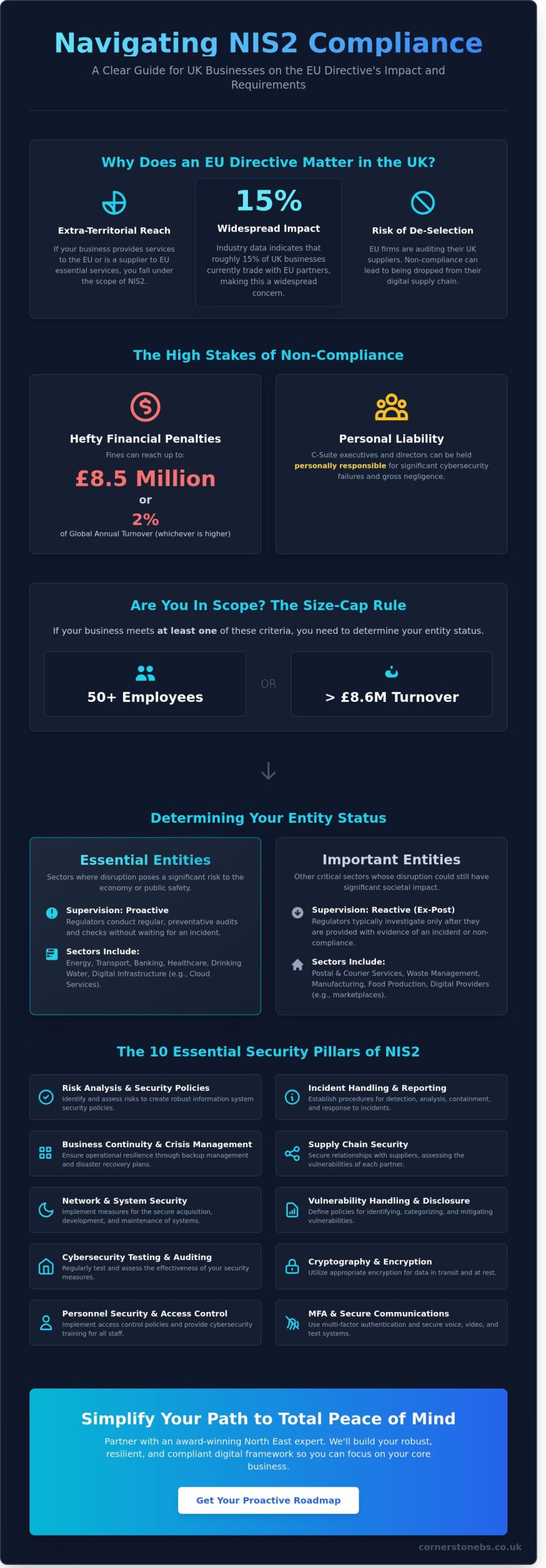
NIS2 distinguishes between ‘Essential’ and ‘Important’ entities. If you provide services in transport, water, or digital infrastructure, you likely fall into the ‘Essential’ category, facing the strictest oversight. A major shift in 2026 is the focus on supply chain security. You’re now responsible for the security posture of your third-party vendors. The UK Government’s Cyber Essentials Scheme is a fantastic starting point to ensure your own vendors meet a baseline standard. Perhaps most importantly, management bodies now face personal liability for non-compliance, making cybersecurity a top-tier boardroom priority.
Compliance for Financial and Health Services
For our partners in the financial sector, the Digital Operational Resilience Act (DORA) is now in full swing. Even if you’re UK-based, DORA applies if you have EU operations or provide ICT services to EU financial entities. DORA requires firms to map their entire ICT asset landscape for compliance. This mapping ensures you know exactly where your vulnerabilities lie before a crisis hits. You’ll also need to demonstrate resilience through regular stress testing and rigorous audits of your third-party ICT providers. It’s about moving from “if we get hacked” to “how we continue to operate during a disruption”.
Healthcare suppliers face their own unique hurdles. The deadline for meeting the requirements of the NHS Data Security and Protection Toolkit (DSPT) version 8 is June 30, 2026. If you handle NHS patient data, this annual self-assessment is mandatory. It ensures you’re following the latest 10 data security standards. We’ve seen a growing focus on AI governance in this year’s toolkit, requiring clear documentation on how machine learning systems handle sensitive information. Staying on top of these it compliance requirements uk ensures you remain a trusted partner in the national health ecosystem. We’re here to help you navigate these audits with ease, providing the technical evidence you need to prove your systems are rock-solid.
A Practical Roadmap to Achieving and Maintaining Compliance
Step 1: The Internal Audit and Gap Analysis
Your journey starts with a deep dive into what you already have. Legacy hardware that no longer receives security updates is a silent killer of compliance. If a device can’t be patched, it’s a wide-open door for attackers. We also recommend a thorough review of your cloud licensing and user permissions. Within Microsoft 365, it’s easy for permissions to drift over time. You must ensure that only the right people have access to sensitive data. Don’t forget the physical side; your servers and network switches need to be in secure, restricted areas to prevent unauthorized physical access.
Step 2: Technical Implementation and Disaster Recovery
Once you’ve identified the gaps, it’s time to harden your defenses. Modern cloud solutions offer built-in compliance advantages, such as automated encryption and real-time threat detection. However, technology alone isn’t enough. You need a robust disaster recovery plan that defines your Recovery Time Objective (RTO) and Recovery Point Objective (RPO). This tells you exactly how much data you can afford to lose and how quickly you need to be back online. Regular penetration testing and vulnerability scanning are also essential. These tests find the “holes” in your armor before a criminal does.
The human element is often the weakest link in any security chain. Your team needs regular training on how to spot phishing attempts and follow acceptable use policies. When your staff understands the “why” behind the rules, they become your most effective firewall. Finally, establish a regular review cycle. Regulations change, and your business evolves. A quarterly check ensures you’re always one step ahead of new it compliance requirements uk. If you’re ready to secure your future, let’s have a conversation about a comprehensive compliance audit for your business today.
The Role of Managed IT Support in Continuous Compliance
Achieving compliance is one thing; keeping it is another. In 2026, it compliance requirements uk change too fast for a set-and-forget approach. You need 24/7 monitoring to ensure your security posture doesn’t slip when you aren’t looking. We see compliance as a byproduct of high-quality Managed IT Support. By partnering with a multi-award-winning provider, you gain a dedicated long-term partner who treats your business stability as their own. Proactive maintenance is the best defense against the data breaches that lead to the heavy penalties and reputation damage we discussed earlier.
Transitioning from a reactive “break-fix” model to a strategic foundation is essential for any growing organization. Instead of waiting for a system to fail or a vulnerability to be exploited, we monitor your infrastructure in real-time. This proactive stance identifies risks before they escalate into legal liabilities. It’s about building a future-proof environment that supports your growth while keeping you on the right side of the law. When your IT is managed properly, compliance feels like a natural part of your daily operations rather than a looming deadline.
Proactive Monitoring vs. Reactive Compliance
Real-time alerts allow us to identify compliance drift immediately. If a critical security patch is missed or a user attempts to bypass security controls, we know about it instantly. Automated patching ensures your defenses are always current without disrupting your workday. We ensure our it company solutions are built on world-class partnerships with leaders like Microsoft, IBM, and Cisco. This gives you access to the same robust technology used by global enterprises, tailored specifically for your local business needs and regional identity.
Choosing a Partner for the Long Term
When selecting a partner, look at their own commitment to excellence. A provider should hold the same high standards they recommend to you. A dedicated helpdesk is also vital for rapid incident response. If a breach occurs, you have a very tight window to report it to the ICO; having an expert team ready to act provides essential emotional and financial security. Our managed IT services provide the clear, detailed documentation you need for external audits. This evidence proves you’ve taken every reasonable step to protect your data, making the audit process smooth and stress-free. We’re proud to be a local team that remains deeply connected to our roots while delivering sophisticated support. We invite you to a conversation about securing your business for 2026 and beyond.
Building a Compliant Foundation for Your Business Future
The 2026 landscape for it compliance requirements uk is undeniably complex, but it doesn’t have to be a source of anxiety. By mastering the core principles of the Data Protection Act and adopting frameworks like Cyber Essentials, you transform a technical necessity into a strategic asset. You aren’t just ticking boxes; you’re building a resilient, trustworthy brand that partners and clients can rely on for the long term. We’ve seen how proactive maintenance and real-time monitoring prevent the breaches that lead to devastating fines.
As a multi-award-winning managed IT support provider and trusted partner to Microsoft, IBM, and Cisco, we specialize in simplifying these technical hurdles. We’re proud to be a local team that brings world-class security to our regional community. Our proactive 24/7 system monitoring ensures your infrastructure stays rock-solid while you focus on growth. Ready to eliminate the guesswork? We invite you to Book a Comprehensive IT Compliance Audit with our Award-Winning Team and gain total peace of mind. Let’s work together to make your business secure, compliant, and ready for whatever 2026 brings.
Frequently Asked Questions
What are the main IT compliance regulations for UK small businesses?
The primary it compliance requirements uk focus on the UK GDPR and the Data Protection Act 2018. These laws govern how you collect, store, and protect personal information. As of June 19, 2026, you’re legally required to acknowledge any data subject complaints within 30 days. Failing to meet these standards puts your business at risk of significant fines and reputational damage in our local community.
Is Cyber Essentials a legal requirement for all UK companies?
Cyber Essentials isn’t a legal requirement for every business, but it’s mandatory for anyone bidding on central government contracts. It acts as a baseline security standard that protects you against the majority of common cyber threats. Since April 27, 2026, the scheme requires multi-factor authentication on all cloud services. We recommend it as a foundational step for any organization wanting to prove their commitment to data security.
How often should a business conduct an IT compliance audit?
You should conduct a comprehensive audit at least once a year. However, significant infrastructure changes or new regulations like the 2026 Cyber Security and Resilience Bill might require more frequent checks. For those in the healthcare sector, the NHS DSPT requires a fresh submission by June 30 every year. Regular audits ensure your defenses stay ahead of evolving threats and prevent compliance drift before it becomes a problem.
What happens if my business fails a GDPR audit by the ICO?
The ICO can issue enforcement notices, stop you from processing data, or levy heavy financial penalties. Fines can reach up to £17.5 million or 4% of your global turnover. With the average GDPR fine sitting at approximately €2.4 million, the financial impact is often devastating for small firms. We focus on proactive monitoring to ensure you never face these high-stakes enforcement actions in the first place.
Can managed IT support help with sector-specific compliance like NIS2?
Yes, a managed partner is essential for navigating complex regulations like NIS2. These rules now place a massive emphasis on supply chain security and personal liability for management bodies. We help you map your entire ICT asset landscape and implement the technical controls required by law. This partnership moves compliance from a stressful manual task to a seamless, automated part of your business strategy.
Is Microsoft 365 inherently compliant with UK data protection laws?
Microsoft 365 is built with compliance in mind, but it isn’t compliant out of the box. You’re responsible for configuring the privacy settings, access controls, and retention policies correctly. We specialize in optimizing these cloud environments to ensure they meet it compliance requirements uk. Without professional setup, you might accidentally leave data exposed or fail to meet the strict storage limitation principles of the GDPR.
What is the difference between IT security and IT compliance?
IT security refers to the technical measures you use to protect your data, like firewalls and encryption. IT compliance is the process of proving those measures meet specific legal or industry standards. Think of security as the lock on your door and compliance as the certificate proving that lock meets your insurance company’s requirements. You need both to ensure your business remains resilient and legally protected.
How much does it cost to achieve IT compliance in the UK?
The cost depends on your organization’s size, the complexity of your network, and the specific certifications you need. Standard certification fees for schemes like Cyber Essentials are tiered based on employee headcount, while ISO 27001 requires a larger investment in audits and auditor day rates. We view these costs as an investment in your business’s stability and competitive edge rather than just another operational expense.
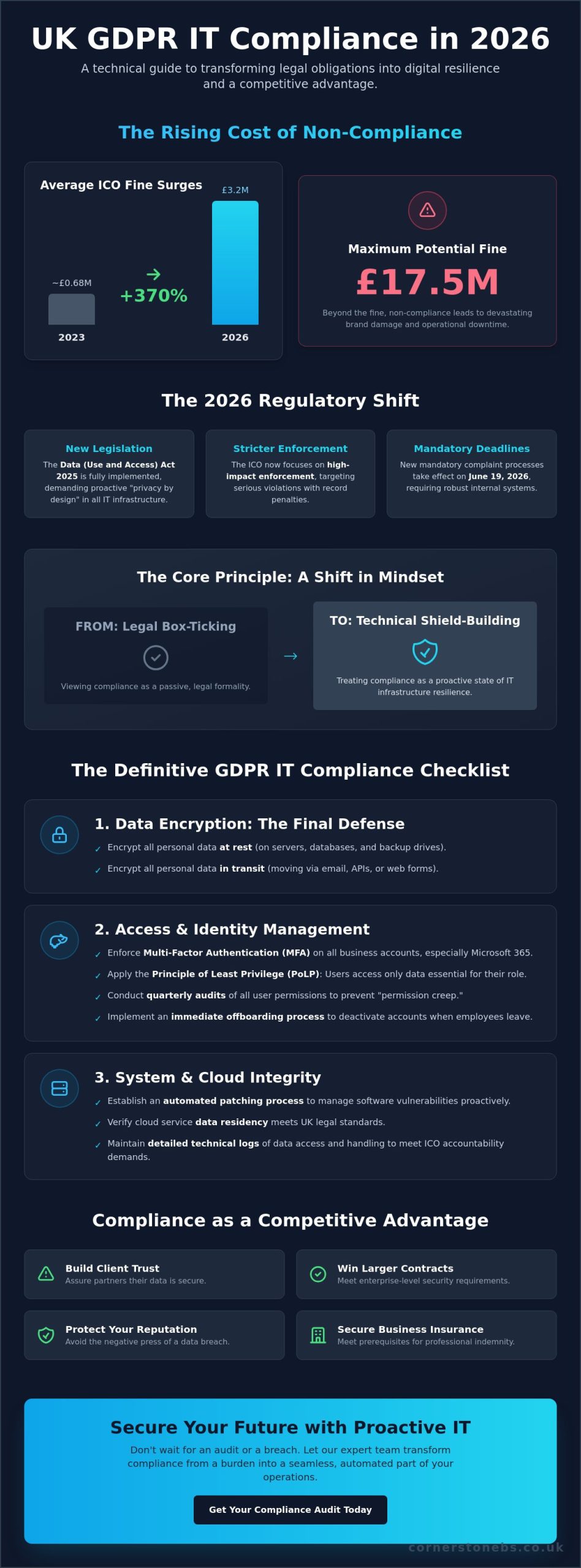
Did you know the average ICO fine has surged to nearly £3.2 million in 2026? That is a staggering 370% increase since 2023, proving that maintaining a GDPR IT compliance checklist for UK businesses is no longer just a legal formality; it’s a fundamental pillar of your digital resilience. As a local team that prides itself on keeping our regional partners secure, we know how daunting these shifting regulations and high-stakes penalties can feel.
It’s perfectly natural to feel overwhelmed by the technical jargon of the Data (Use and Access) Act 2025 or to worry about the complexities of cloud data residency. You want to focus on serving your customers, not on the fear of a £17.5 million penalty. This guide moves past the legalese to provide a clear, technical to-do list for your modern infrastructure. We’ll walk you through the essential system updates, from automated decision-making safeguards to the mandatory complaint processes taking effect on June 19, 2026. You’ll gain a robust framework for business continuity and the peace of mind that comes from being truly prepared for the year ahead.
Key Takeaways
Move beyond legal theory by treating compliance as a proactive technical state of IT infrastructure resilience.
Build a secure foundation using essential technical controls, specifically focusing on advanced encryption for data at rest and in transit.
Use our GDPR IT compliance checklist for UK businesses to audit your hardware and software assets and locate every piece of personal data.
Navigate cloud complexities with confidence by verifying your data residency meets the specific requirements of the latest UK legal standards.
Ensure long-term stability by positioning managed IT support as a proactive monitoring strategy rather than just a technical necessity.
Think of UK GDPR IT compliance as the digital fortress that surrounds your business operations. It isn’t just about having a privacy policy tucked away in a filing cabinet; it’s the technical implementation of every data protection principle within your actual network. While the Data Protection Act 2018 provides the legal foundation, IT compliance is the mechanism that enforces those laws through encryption, access controls, and secure backups. In 2026, the gap between “saying” you are compliant and “being” compliant has never been wider.
Why Compliance is a Competitive Advantage
The Role of the ICO in 2026
The ICO’s current focus is on high-impact enforcement, targeting the most serious violations with record-breaking penalties. The accountability principle now demands that you maintain detailed technical logs to prove exactly how data is accessed and handled. If you can’t show the logs, the ICO assumes the protection wasn’t there. Beyond the £17.5 million maximum fine, the real cost of non-compliance lies in the devastating blow to your brand and the operational downtime that follows a breach. We want to help you avoid that stress by making compliance a seamless, proactive part of your daily operations.
Technical Controls: The Foundation of Digital Privacy
While legal policies provide the rules, technical controls are the actual locks on your digital doors. In 2026, the ICO expects more than just a signed document; they want to see robust, active defenses. Any effective GDPR IT compliance checklist for UK businesses must start with the hardware and software settings that protect your data from the inside out. We help our local partners move beyond theory by implementing the specific technical measures that keep sensitive information out of the wrong hands.
Encryption acts as your final line of defense. You must ensure that all personal data is encrypted both at rest, such as on your servers and backup drives, and in transit, when it’s moving through email or web forms. This ensures that even if a data packet is intercepted, it remains completely unreadable. Coupling this with Multi-Factor Authentication (MFA) across every business account creates a formidable barrier. MFA is no longer an optional extra. It’s a fundamental requirement for securing your Microsoft 365 environment and preventing unauthorized access from stolen credentials.
Hackers look for the easiest path. Often, that’s through unpatched software. A proactive approach to vulnerability management means your systems aren’t left open to known exploits. Regular, automated patching keeps your infrastructure resilient and stable. If managing these technical layers feels like a full-time job, our team provides the expert Cyber Security support you need to stay ahead of emerging threats without losing focus on your daily operations.
Access Control and Identity Management
We recommend the Principle of Least Privilege (PoLP) for every business network. This means users only have access to the specific data required for their job role, and nothing more. For those using Microsoft 365 or local servers, you should audit user permissions quarterly to prevent “permission creep.” When an employee leaves your organization, their accounts must be deactivated immediately. Leaving a dormant account active is a massive security hole that the ICO’s Guide to the GDPR specifically warns against.
Endpoint Security and Device Management
Hybrid work has made endpoint security a top priority. Laptops and mobile devices are easily lost or stolen, making them high-risk targets. You should use Mobile Device Management (MDM) to maintain control over these assets, allowing for remote data wiping if a device disappears. To meet strict compliance standards, you must implement full-disk encryption on all portable hardware to ensure data remains protected even if the physical device is compromised. These small technical steps provide immense emotional and financial security for your business.
Cloud Infrastructure and Data Residency Requirements
Storing your data in the cloud isn’t just about convenience; it’s about geography. Data residency refers to the physical location where your information sits. For UK businesses, ensuring your cloud provider uses UK-based data centers is a vital part of any modern GDPR IT compliance checklist for UK businesses. Platforms like Microsoft Azure and Microsoft 365 allow you to select specific UK data regions. This keeps your client information within our borders, which simplifies your legal obligations and provides a clear audit trail for the ICO. You should also remember that using any SaaS provider makes them a “data processor.” This requires a solid third-party agreement to ensure they meet the same high standards for security and privacy that you do.
Managing these cloud environments requires a proactive approach to ensure data doesn’t drift into unapproved regions. We help our local partners configure their cloud settings to prioritize regional storage, providing the peace of mind that comes from knowing exactly where your data lives. This technical oversight is a foundational element of business stability. It ensures you aren’t caught out by shifting international data transfer rules that can change without much notice.
Microsoft 365 Compliance Features
Microsoft 365 is more than just a set of productivity tools. It includes powerful security features like Microsoft Purview and Data Loss Prevention (DLP) settings. These tools allow you to set up auto-labeling, which automatically detects and protects sensitive business data like financial records or personal IDs. If you’re planning a move to a more secure environment, our Microsoft 365 Migration for Business UK guide offers a complete strategy for a secure transition. These built-in features help you stay organized and demonstrate your commitment to data protection.
Backup and Disaster Recovery as a GDPR Requirement
GDPR isn’t just about privacy; it’s about availability. If your systems go down and you can’t access personal data when a customer requests it, you’re technically in breach. A simple backup is a great start, but a compliant disaster recovery plan ensures your business can actually keep running during a crisis. We align our Cloud Solutions for UK Businesses with the NCSC’s 10 Steps to Cyber Security to ensure your infrastructure is resilient. This level of technical support provides the emotional and financial security you need to focus on growth. It transforms a technical necessity into a long-term partnership for success.
The Definitive GDPR IT Compliance Checklist for UK Businesses
While we’ve discussed the theory and cloud residency, compliance ultimately comes down to the specific settings on your devices and servers. To help you build a resilient foundation, we’ve compiled this GDPR IT compliance checklist for UK businesses. It moves beyond paperwork to focus on the technical enforcement required to satisfy the ICO in 2026. Start by auditing every piece of hardware and software in your building. You must identify exactly where personal data resides, whether it’s on a local desktop, a legacy server, or a staff member’s mobile phone.
Your next step is implementing end-to-end encryption for all email communications and file sharing. This ensures that sensitive information remains secure from the moment it leaves your network until it reaches the intended recipient. Combine this with a strict password policy and universal MFA deployment across every single business application. Finally, don’t wait for a crisis to test your defenses. Schedule regular Cyber Security audits and penetration testing to find the cracks before a hacker does. Proactive testing isn’t just a technical necessity; it’s a foundational element of your business stability.
Data Mapping and Asset Discovery
You can’t protect what you can’t see. “Shadow IT” often creeps into organisations when staff use unauthorized personal apps or hardware for work tasks. To combat this, create a technical data flow diagram for your IT network that maps every point where personal data enters, moves through, and leaves your systems. Robust IT inventory management is the only way to ensure your GDPR IT compliance checklist for UK businesses covers 100% of your digital footprint. It gives you the clarity of an expert and the confidence of a leader.
The 72-Hour Breach Notification Rule
The law requires you to report most data breaches within 72 hours, but you can’t report what you haven’t detected. This requires real-time technical monitoring to catch unauthorized access as it happens. Under technical guidelines, a reportable breach is defined as any security incident that leads to the accidental or unlawful destruction, loss, alteration, or unauthorized disclosure of personal data. If you aren’t sure if your current systems can spot these triggers, our Cyber Security Services provide the proactive monitoring you need for true peace of mind. We invite you to have a conversation with our local team to see how we can strengthen your defenses today at cornerstonebs.co.uk.
Securing Your Future: Proactive Managed IT as a Compliance Strategy
Completing a GDPR IT compliance checklist for UK businesses is a fantastic milestone, but true data protection is never a “one and done” task. Compliance is a living state of your infrastructure. To maintain the high standards required by the ICO in 2026, your systems need constant, proactive oversight. Managed IT Support bridges the gap between having a plan and actually living it. It provides the continuous monitoring necessary to detect unauthorized access attempts or system vulnerabilities the moment they appear, rather than weeks after a breach has occurred.
Think of an outsourced partner as providing “compliance-as-a-service.” At Cornerstone Business Solutions, we deliver bespoke technology solutions that go beyond generic software fixes. We understand that every organisation has a unique digital footprint. Our multi-award-winning expertise allows us to navigate complex technical audits with the clarity of a long-term partner. We don’t just sell you a license; we build a resilient framework that supports your business continuity and provides the emotional security you need to lead with confidence.
From Reactive Repairs to Proactive Compliance
The old “break-fix” model of IT support is now a major compliance risk. If you only call for help when something stops working, you’ve likely already left a window open for a data breach. GDPR demands “availability” and “integrity,” which are impossible to guarantee with reactive repairs. Moving to a fixed-term contract ensures your system health and security patches are always current. While we are proud of our roots and provide industry-leading Managed IT Services in Teesside, our technical reach and compliance expertise support businesses on a national scale. This proactive approach keeps your network stable and your data locked down tight.
Your Next Steps for 2026
The most effective way to start your journey toward total resilience is with a professional security audit. We’ll help you identify the specific gaps in your current setup and refine your GDPR IT compliance checklist for UK businesses to match your actual operational needs. Our award-winning support team is ready to simplify the technical hurdles of the Data (Use and Access) Act 2025, turning complex regulations into a clear path forward. We invite you to a conversation about your digital future. It’s time to move away from the fear of fines and toward the peace of mind that comes from expert protection. Book a consultation with our compliance experts today and let’s build something secure together.
Build a Resilient Future Through Technical Excellence
The transition toward strict technical enforcement in 2026 proves that data protection is no longer just a legal task. It’s a fundamental part of your business’s digital health. By moving from reactive repairs to a proactive GDPR IT compliance checklist for UK businesses, you ensure your infrastructure remains stable, secure, and ready for growth. You’ve learned that robust encryption, regional data residency, and universal MFA are the pillars of modern privacy by design.
We believe that every local business deserves the peace of mind that comes from expert protection. As a multi-award-winning IT services provider and strategic partner with industry leaders like Microsoft, IBM, and Cisco, we offer the 24/7 proactive monitoring required to stay ahead of evolving threats. We don’t just fix problems; we prevent them from happening in the first place. This collaborative approach turns a regulatory necessity into a powerful engine for client trust and operational stability.
Your journey toward total resilience starts with a single conversation. Start your journey to total technical compliance with a Cornerstone IT audit. Let’s work together to secure your data and protect your reputation for the long term. You’ve got this, and we are right here to support you every step of the way.
Frequently Asked Questions
Is UK GDPR compliance different from EU GDPR in 2026?
Yes, the Data (Use and Access) Act 2025 has created a distinct UK framework that diverges from the EU version. While the core principles of privacy remain, the UK has relaxed rules on automated decision-making and introduced “recognised legitimate interests” to simplify processing for specific cases like crime prevention. It is vital to ensure your systems reflect these specific UK legislative updates rather than relying on generic EU guidance.
Does a small business with fewer than 10 employees need a GDPR IT checklist?
Absolutely, because data protection laws apply to every organisation regardless of its size. A GDPR IT compliance checklist for UK businesses ensures that even the smallest team protects sensitive client data from rising cyber threats. Smaller businesses are often targeted because they lack robust defenses, so having a clear technical plan provides essential security and prevents devastating financial penalties.
What are the technical requirements for “Privacy by Design”?
Privacy by Design requires you to integrate data protection into your system architecture from the moment of purchase or development. This includes implementing pseudonymisation, setting automatic data deletion periods, and ensuring that default settings are always the most private options available. It moves privacy from a manual task to an automated technical standard within your network infrastructure.
Can I store UK customer data on US-based cloud servers?
You can store data in the US, provided you use appropriate safeguards like the UK-US Data Bridge or specific standard contractual clauses. However, the most reliable way to ensure compliance is to select a UK-based data region within your cloud platform. This keeps your information within our borders and simplifies your residency requirements under current UK law.
How often should we conduct a technical GDPR audit?
We recommend a full technical audit at least once a year or whenever you implement significant changes to your IT infrastructure. Regular quarterly reviews of user permissions and software patches are also essential. This proactive rhythm ensures your GDPR IT compliance checklist for UK businesses stays relevant as new cyber threats emerge throughout the year.
Is Multi-Factor Authentication (MFA) a legal requirement under GDPR?
While the law doesn’t name “MFA” specifically, it mandates that you use “appropriate technical measures” to protect personal data. In 2026, the ICO considers MFA a basic industry standard for any business network. Failing to implement it can be viewed as negligence, making it much harder to defend your actions if a breach occurs via stolen credentials.
What happens if our business suffers a data breach but we followed the checklist?
Following a technical checklist demonstrates that you took “reasonable and proportionate” steps to protect your data. While you must still report a reportable breach to the ICO within 72 hours, having a documented audit trail of your technical controls significantly reduces the likelihood of heavy fines. It proves you acted as a responsible and proactive data controller.
How does Managed IT Support help with GDPR accountability?
Managed IT Support provides the technical logging and continuous monitoring required to prove your compliance to regulators. By outsourcing to a local expert, you gain a detailed audit trail of every security patch, backup, and access request. This satisfies the accountability principle by providing concrete evidence that your systems are actively managed and secured 24/7.
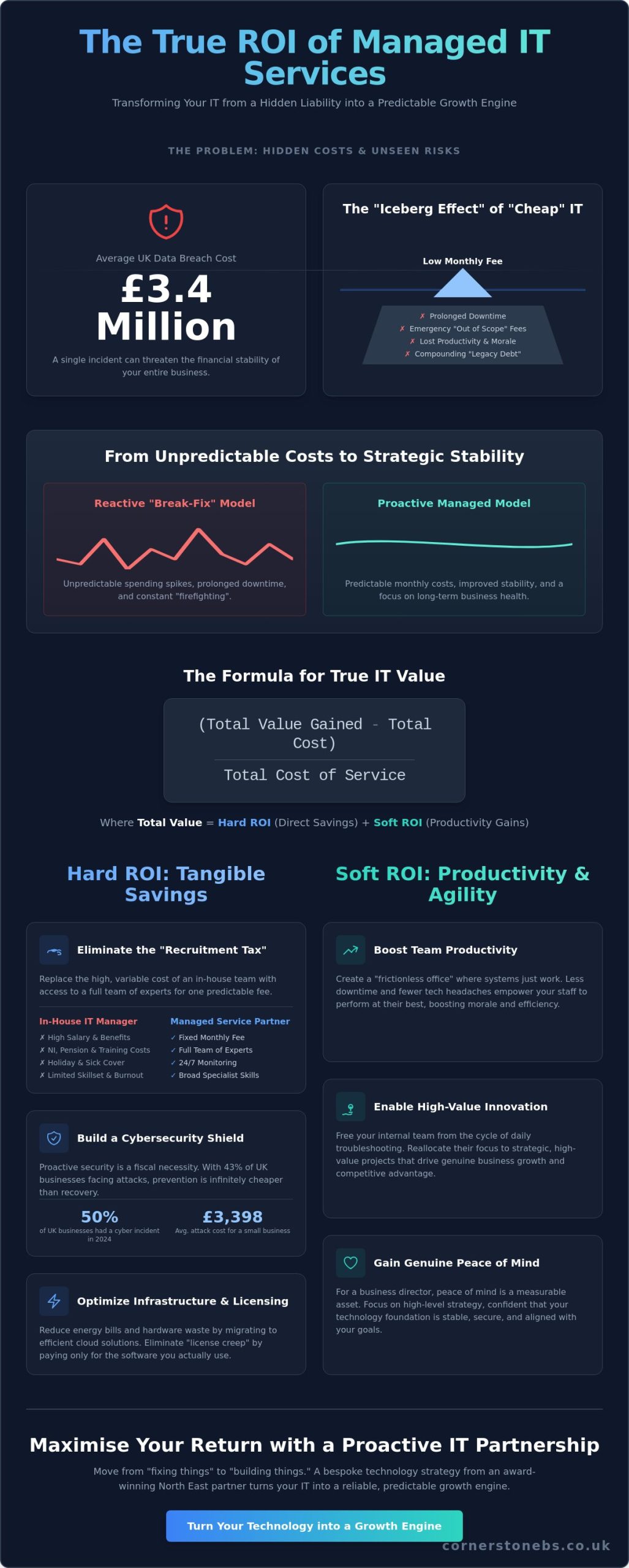
Did you know the average cost of a data breach in the UK has reached a staggering £3.4 million? For many business owners, calculating the ROI of managed IT services feels like a guessing game while facing rising recruitment costs and unpredictable repair bills. You likely see IT as a necessary expense rather than a tool for growth. We agree that technology should never be a “black hole” for your budget or a source of constant financial stress.
As an award-winning partner with deep North East roots, we’re here to help you move from “fixing things” to “building things.” This guide provides the exact financial and strategic framework you need to measure the true return on your IT partnership. You’ll learn how to account for the new Data (Use and Access) Act 2025 requirements and use a clear formula to prove that proactive support reduces your total cost of ownership. We’ll show you how to turn your technology into a predictable growth engine that offers genuine peace of mind. Let’s dive into the numbers and see what your business is really capable of.
Key Takeaways
Master a comprehensive framework for calculating the ROI of managed IT services that accounts for direct savings, productivity gains, and long-term risk reduction.
Learn how to eliminate the “recruitment tax” and reallocate your internal team’s focus from daily troubleshooting to high-value business innovation.
Uncover the true cost of “legacy debt” and see how migrating to proactive cloud solutions reduces hardware waste while boosting your team’s daily efficiency.
Protect your bottom line by understanding the financial impact of 2026 UK compliance requirements and the vital role of proactive security in preventing data breaches.
Discover how a bespoke technology strategy turns your IT infrastructure into a reliable growth engine that provides genuine peace of mind for your business.
Beyond the Monthly Invoice: A Framework for Calculating IT ROI
Most business owners look at their monthly IT bill and see a line item that takes money away from the bottom line. At Cornerstone, we see things differently. We believe that technology is an engine for growth, not a drain on resources. Moving away from the old “Break-Fix” model is the first step toward financial clarity. In a reactive model, you only pay when something breaks, which creates unpredictable spikes in spending and leaves you vulnerable to “legacy debt.” By contrast, a proactive managed model focuses on stability and long-term health. Before diving into the numbers, it helps to understand the basics of What are Managed IT Services? and how they differ from traditional, transactional support. We use the concept of Total Cost of Ownership (TCO) to help our partners see the full picture of their technology spend. Ultimately, IT ROI is the measurable impact of technical stability on business profitability.
The Basic ROI Formula for Managed Services
When calculating the ROI of managed IT services, you need a formula that captures more than just surface-level costs. The standard calculation we use is: (Total Value Gained – Total Cost of Service) / Total Cost of Service. Total value isn’t just about the money you didn’t spend on a new server. It’s the sum of direct savings, risk reduction, and productivity gains. We distinguish between “Hard ROI” and “Soft ROI” to give you a complete picture. Hard ROI includes tangible cash in hand, such as reduced energy bills from cloud migration or lower recruitment costs. Soft ROI measures the “frictionless office” where employee morale and speed increase because systems just work. Don’t fall into the trap of looking at a 12-month snapshot. A 3-year strategic view is much more accurate. It accounts for the avoided costs of major hardware failures and the steady compounding of increased staff efficiency.
Why ‘Cheap’ IT Often Yields the Lowest ROI
A low-cost provider might look attractive on a spreadsheet, but these contracts often suffer from the “Iceberg Effect.” The low monthly fee is just the tip. Beneath the surface, you’ll often find hidden emergency fees, “out of scope” charges, and the massive cost of prolonged downtime. Our award-winning support is designed to prevent this “revolving door” of technical debt. When you choose a partner based solely on the lowest price, you often end up paying three times more in lost productivity and emergency repairs. For a North East business director, peace of mind is a measurable asset. It allows you to focus on high-level strategy rather than worrying if your systems will hold up during a busy Tuesday. High ROI comes from a robust, tailored partnership that eliminates surprises and keeps your team moving forward.
The Hard Numbers: Direct Cost Savings and Risk Mitigation
Numbers don’t lie. When you begin calculating the ROI of managed IT services, the first place to look is your balance sheet. Most companies are leaking cash through what we call the “Recruitment Tax.” In the UK, the cost of hiring a single IT Manager isn’t just the salary. Once you add National Insurance, pensions, ongoing training, and holiday cover, the figure often spirals. Compare that to a fixed monthly fee for an entire award-winning team of experts. You get 24/7 monitoring and a deep bench of specialist skills without the heavy payroll burden.
Financial institutions like Fidelity offer standard frameworks for how to calculate Return on Investment, but IT requires a more nuanced approach that includes “avoided costs.” We often find “license creep” in Microsoft 365 environments where businesses pay for features they never use. Proactive licensing governance can trim this waste immediately. Then there is the financial shield of cybersecurity. With the average UK data breach cost hitting £3.4 million, and 43% of UK businesses facing attacks in the past year, managed security isn’t just a technical choice. It’s a fiscal necessity.
Infrastructure optimization also plays a massive role in your hard savings. When you are calculating the ROI of managed IT services, you must account for the 50% of UK businesses that experienced a cyber incident in 2024. By moving away from power-hungry on-site servers to tailored cloud solutions, you reduce energy costs and hardware waste. A small UK business faces an average attack cost of £3,398. Preventing just one of these incidents pays for months of support. These are not just theoretical gains. They are direct reductions in your total cost of ownership.
Staffing and Operational Overhead Savings
Hiring one person gives you one set of eyes. Partnering with us gives you a proactive team that never takes a sick day. You eliminate the overhead of internal HR management and gain access to robust network infrastructure experts instantly. This shift allows you to maintain 24/7 monitoring without the 24/7 internal payroll expense. It’s a smarter way to scale your North East business without the growing pains of a bloated department.
Quantifying the Cost of System Downtime
Downtime is the ultimate ROI killer. To find your “Cost Per Hour,” simply divide your annual revenue by your total working hours. If your systems go dark, that’s the money vanishing every sixty minutes. Beyond the immediate loss, downtime erodes client trust and risks long-term contracts. Our approach to managed IT services Teesside reduces mean-time-to-recovery (MTTR) by identifying bottlenecks before they cause a crash. If you’re ready to stop the leaks, it might be time for a quick chat about your IT budget.
The ‘Soft’ ROI: Boosting Productivity and Business Agility
Strategic reallocation is another massive win for your bottom line. If you have an internal IT person, their time is too valuable to spend on “fixing printers” or resetting passwords. By partnering with a proactive team, you free up your internal experts to focus on high-level innovation. They can finally work on projects that actually grow the business, such as data analysis or process automation. This shift transforms your IT department from a cost centre into a genuine growth engine. It’s about moving from a state of constant firefighting to a state of strategic movement.
Reclaiming Employee Productivity Hours
Reclaiming just ten minutes of technical frustration per day for every employee creates a massive return. This efficiency is driven by high-speed cloud solutions that allow for seamless remote and hybrid work. When your team has unlimited helpdesk access, problems are resolved in minutes rather than hours. This rapid resolution keeps your projects on track and keeps your team focused on their actual jobs. It’s a simple way to boost your output without increasing your headcount.
Agility and Competitive Advantage
Being “first-to-market” is often the difference between winning and losing a contract. Our tailored it company solutions allow SMEs to punch well above their weight by deploying enterprise-grade tech rapidly. When calculating the ROI of managed IT services, consider the value of proactive technology roadmapping. Instead of reactive patching, you get a clear plan for the future. This foresight ensures your business stays ahead of the curve and ready for whatever 2026 throws your way.
Calculating the Cost of Inaction: Legacy Debt and Cybersecurity Risks
Choosing to do nothing is still a financial decision, and in 2026, it is often the most expensive one you can make. Many business owners fall into the trap of the “if it isn’t broken, don’t fix it” mindset. However, the “Legacy Tax” on aging hardware is a silent profit killer. Research shows that maintaining on-site servers older than five years can cost three times more than migrating to a secure cloud environment. These costs hide in spiked energy bills, constant emergency repairs, and the slow drain of system lag. When calculating the ROI of managed IT services, you must weigh the price of a proactive partnership against the snowballing cost of technical neglect.
Cyber insurance has also become a major financial hurdle for North East firms. In the current landscape, insurers demand proof of robust, active monitoring before they even offer a quote. Without professional management, your premiums can skyrocket, or worse, you could be denied coverage entirely. A managed security approach keeps these costs predictable and manageable. Beyond the premiums, there is the “Brand Damage” variable. A public-facing technical failure or data leak causes unrecoverable damage to your reputation. While you can eventually fix a server, you cannot easily buy back the trust of a client who feels their data was handled carelessly.
The Financial Burden of Technical Debt
Technical debt is the cumulative cost of “quick fixes” and outdated patches that pile up over time. Every time you delay an upgrade, you add to this invisible debt. Our award-winning cyber security services act as an audit-ready foundation that clears this debt. We help you move from unpredictable capital expenditure (CAPEX) to a steady, predictable operational expenditure (OPEX) model. This shift allows you to budget with confidence while knowing your systems are always current and secure.
Regulatory and Legal Safeguards
The UK’s regulatory landscape has tightened significantly with the implementation of the Data (Use and Access) Act 2025. Compliance is no longer optional; it is a core business requirement. Professional data governance helps you avoid the heavy fines associated with non-compliance. When calculating the ROI of managed IT services, the value of an “avoided fine” can often justify the entire annual cost of the service. Proactive maintenance ensures genuine peace of mind for company directors, knowing that their legal obligations are met without constant manual oversight. If you are worried about your current compliance status, it’s time to book a strategic IT audit with our local team.
Maximising Your Return: The Cornerstone Approach to Managed IT
At Cornerstone, we believe that technology should work for you, not the other way around. True value isn’t found in a basic helpdesk contract; it’s found in a strategic partnership. We favor a “Partner, Not Provider” philosophy that aligns your IT strategy directly with your 2026 business goals. When calculating the ROI of managed IT services, you need to see how every technical decision supports your growth. We avoid the ROI-killing “one size fits all” approach that many national providers use. Instead, we offer bespoke technology solutions tailored to the specific needs of your North East business. This ensures you only pay for the infrastructure and support that actually adds value to your operations.
Our award-winning proactive monitoring acts as a financial safeguard for your organization. By catching potential system failures before they impact your bottom line, we eliminate the expensive “firefighting” cycles common in reactive IT models. You’ll see this impact clearly through our transparent reporting. We don’t hide behind technical jargon. During every quarterly review, we demonstrate measurable ROI by showing you exactly how your systems are performing and where we’ve prevented costly downtime. It’s about providing the clarity you need to make informed financial decisions for your company’s future.
The Value of Award-Winning Expertise
Choosing a partner with a multi-award-winning status translates to significantly lower risk for your organization. Our accolades aren’t just for show; they are a recurring signature of the quality and reliability we bring to every client. We leverage global partnerships with industry leaders like Microsoft, IBM, and Cisco to bring enterprise-grade tech to local SMEs. You get direct access to senior experts who understand the unique challenges of the UK business environment. This high-level expertise ensures your network infrastructure is robust, secure, and ready to scale. It’s a level of support that provides genuine peace of mind for directors who want to focus on their core business.
Your ROI Roadmap: Getting Started
Every successful partnership starts with a clear understanding of the present. We begin with a comprehensive IT audit to baseline your current “true cost” of technology. This audit uncovers hidden inefficiencies, security gaps, and wasted licensing fees that might be draining your budget. From there, we build a tailored roadmap that prioritises high-ROI technical upgrades. We focus on the “quick wins” first, such as optimising your Microsoft 365 environment or securing your remote access. This strategic approach ensures your IT spend is always an investment, never just an expense. If you’re ready to see what your technology can really do, we’d love to have a “chat” about your specific systems and growth plans. Let’s work together to turn your IT into a powerful engine for success.
Take Control of Your Technology Budget Today
Transforming your IT from a cost centre into a growth engine starts with a clear shift in perspective. You now understand how proactive support eliminates hidden “Recruitment Taxes” and protects your business from the £3.4 million average cost of a UK data breach. Mastering the process of calculating the ROI of managed IT services ensures that every pound spent on your infrastructure contributes directly to your long-term stability and success.
As a multi-award-winning provider with deep North East roots, we combine our local commitment with global strategic partnerships with Microsoft, IBM, and Cisco. Our proactive 24/7 monitoring and unlimited helpdesk support are designed to provide total peace of mind. We don’t just fix problems; we build the robust systems your business deserves. If you’re ready to see the real-world impact of a dedicated technical partnership, we’re here to help.
What is the average ROI for managed IT services in the UK?
Most UK businesses see a reduction in overall IT costs of 25% to 45% when moving from a reactive “break-fix” model to proactive support. Calculating the ROI of managed IT services involves looking at both these direct savings and the value of avoided risks. While every business is different, the return usually justifies the investment through increased uptime and improved staff efficiency.
How long does it take to see a positive ROI after switching to managed IT?
You will likely notice “soft” ROI, such as improved employee morale and faster system speeds, within the first month. The “hard” financial return typically becomes clear on your balance sheet within 12 to 18 months. This timeframe allows you to move past initial onboarding and start seeing the compounding benefits of reduced emergency repair bills and optimized cloud licensing.
Is managed IT support cheaper than hiring an internal IT person?
Managed IT is almost always more cost-effective for small and medium-sized enterprises. A full award-winning support team costs significantly less than a single senior IT manager’s salary when you factor in National Insurance, pensions, and ongoing training. You also gain a deep bench of specialist skills that one person simply cannot provide alone.
Can managed IT services help reduce our cyber insurance premiums?
Yes, a robust security posture is now a primary requirement for competitive insurance rates in the UK. Insurers demand proof of active monitoring, multi-factor authentication, and verified disaster recovery plans. Our proactive approach helps you meet these strict criteria, which can lead to lower premiums and easier policy renewals for your organization.
How do I calculate the cost of downtime for my specific business?
Start by dividing your annual turnover by your total annual working hours to find your hourly revenue. Add the hourly wage of every employee who cannot work during an outage. This total represents your baseline cost per hour of downtime. It doesn’t even include the long-term damage to your brand reputation or potential regulatory fines.
What are the hidden costs I should look for in an IT support contract?
Watch out for setup fees, travel expenses for on-site visits, and surcharges for “out of hours” assistance. Some contracts also exclude certain types of project work or hardware procurement. We believe in transparent partnership, which is why we provide clear reporting so you always know exactly what is included in your fixed monthly fee.
Does a Microsoft 365 migration offer a measurable ROI?
A migration offers a high return by eliminating the high energy and maintenance costs of on-site servers. Calculating the ROI of managed IT services for Microsoft 365 also includes the productivity gains from seamless remote collaboration. You’ll also save money through proactive licensing governance, ensuring you never pay for features your team doesn’t actually use.
How does proactive maintenance actually save money compared to fixing things when they break?
Proactive maintenance identifies and resolves technical bottlenecks before they cause a total system crash. Fixing things only when they break results in expensive emergency call-out fees and the massive cost of idle staff. Preventing a single major data breach or a day of total downtime often pays for an entire year of managed support.
What if the most expensive part of your IT contract isn’t the monthly fee, but the silence you hear when a critical system fails? We’ve seen too many local businesses struggle with sluggish response times and “out of scope” invoices that make budgeting impossible. You likely feel the weight of rising cyber threats and want a partner who offers clear security guidance rather than just jargon. Finding the right fit starts with the specific questions to ask a potential IT support company to ensure they can handle the complexities of 2026.
We promise to provide a comprehensive vetting framework that identifies a proactive, secure, and strategic partner for your business. Whether it’s managing new regulations like the Texas Responsible AI Governance Act or shifting from old-school SLAs to modern Experience-Level Agreements, you need an award-winning team that stays ahead of the curve. This guide previews 21 essential questions designed to help you secure predictable costs and total peace of mind. Let’s find an IT partnership that supports your growth and keeps your North East business thriving.
Key Takeaways
Learn how to move beyond reactive “break-fix” support by choosing a partner that aligns with your specific industry growth goals.
Master the essential questions to ask a potential IT support company to uncover hidden costs in hardware, licensing, or site visits.
Ensure your business stays resilient and compliant with 2026 regulations by vetting a provider’s internal security standards and expertise.
Discover the difference between simple response times and actual resolution times to keep your team productive.
Identify the red flags in IT contracts and what an award-winning, seamless onboarding process should look like for your business.
The Vetting Process: Why Asking the Right IT Questions Matters in 2026
The days of calling a technician only when a server goes dark are long gone. In 2026, business moves too fast for reactive “break-fix” models that only address problems after they’ve caused damage. You need a proactive approach that stops issues before they interrupt your morning coffee. This shift defines why your vetting process is so critical. When you prepare your list of questions to ask a potential IT support company, you aren’t just looking for a repairman. You’re searching for a long-term technology partner who understands your specific North East business goals and regional challenges.
Choosing the wrong provider based solely on a low monthly invoice often leads to hidden costs that dwarf the initial savings. A single afternoon of downtime can cost thousands in lost productivity and missed opportunities. We believe IT should be a predictable investment, not a source of constant financial surprises. By asking the right questions now, you ensure your technology acts as a sturdy foundation rather than a fragile ceiling. It’s about finding a team that values your uptime as much as you do.
Moving Beyond the Helpdesk
Technical expertise has become a baseline requirement. Most providers can reset a password or set up a laptop without much trouble. What differentiates an award-winning managed service provider is their ability to align technology with your commercial strategy. They should speak your language, not just code. This partnership-first mindset means they care about your bottom line and your future scalability. A strategic IT partner acts as a powerful catalyst for your business growth.
The Consequences of Getting It Wrong
A poor fit doesn’t just mean slow internet or a grumpy helpdesk. It exposes your business to severe risks that can take years to recover from. Consider these common pitfalls of a weak partnership:
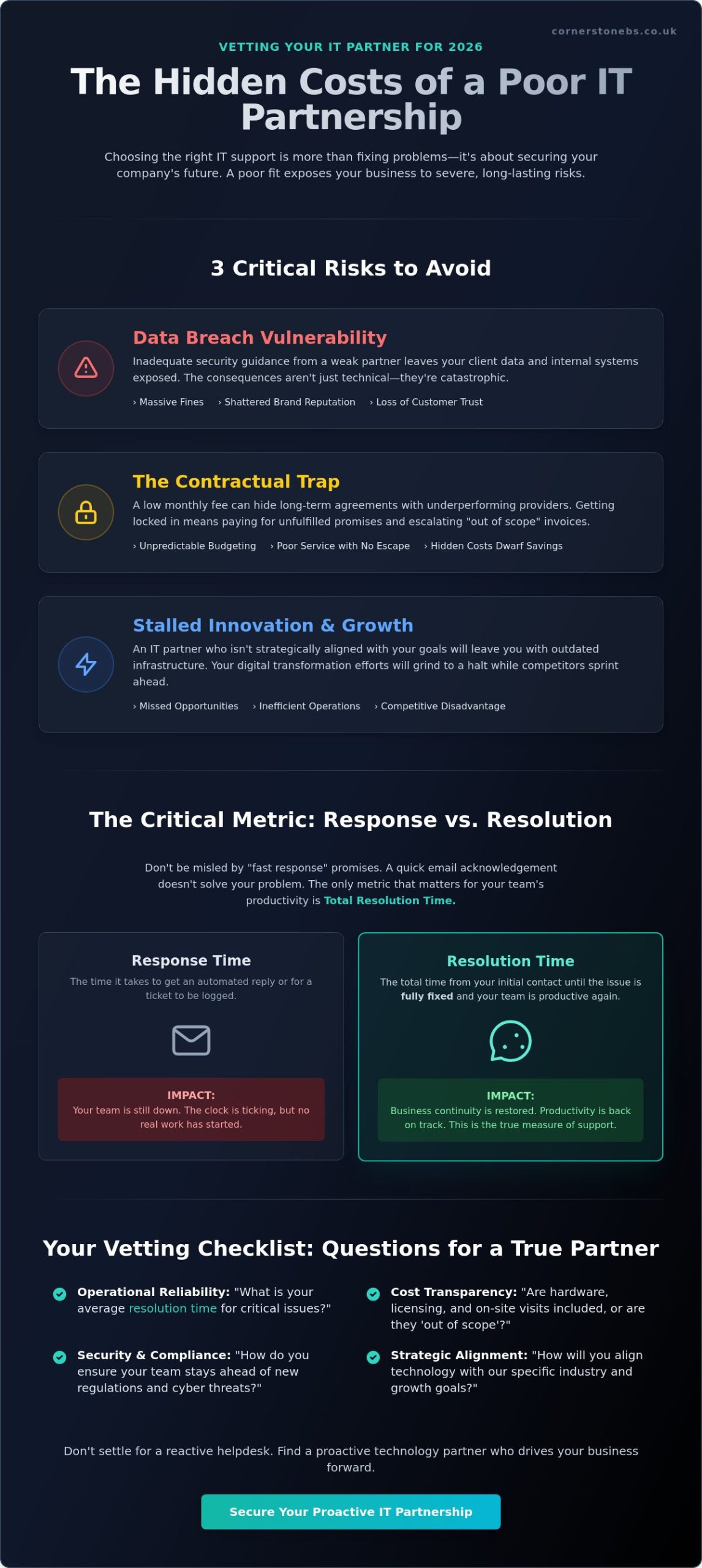
Data Breach Vulnerability: Inadequate security guidance leaves your client data exposed, leading to massive fines and a shattered brand reputation.
Contractual Trap: Many businesses find themselves locked into long-term agreements with underperforming providers who don’t deliver on their promises.
Stalled Innovation: If your IT infrastructure is outdated, your digital transformation efforts will grind to a halt while competitors sprint ahead.
Essential Operational Questions: Testing Reliability and Response Times
When your systems go down, every minute feels like an hour. You need more than just a friendly voice on the other end of the line; you need results. As you gather questions to ask a potential IT support company, focus on the mechanics of their daily operations. It’s easy to promise fast support, but delivering it consistently requires a robust infrastructure and a dedicated team. We’ve found that the best partnerships are built on transparency and clear expectations from day one.
The first hurdle is distinguishing between response and resolution. A provider might promise a “15-minute response,” but if that’s just an automated email saying your ticket was received, it doesn’t help your team get back to work. Ask specifically: “What is your average resolution time for critical issues?” This helps you evaluate your ideal technology partner based on tangible outcomes rather than marketing slogans. You should also verify how they handle emergencies outside of the standard 9-to-5. If your server fails on a Sunday night, will someone be working on it before your staff arrives Monday morning?
Understanding Service Level Agreements (SLAs)
Don’t let the technical jargon in an SLA overwhelm you. Look past the “guaranteed” 99.9% uptime figures and find out what happens when things actually break. Does “response” mean a ticket was logged, or that a qualified engineer has started working on the fix? A proactive partner will link these metrics directly to your business continuity and peace of mind. This clarity ensures you aren’t left guessing while your productivity stalls. We believe an SLA should be a promise of performance, not just a legal shield for the provider.
Account Management and Communication
Reliability isn’t just about fixing broken PCs; it’s about strategic guidance. Ask if you’ll have a dedicated account manager who understands your business history or if you’ll be treated as just another number in a general helpdesk queue. We believe in the power of regular strategic reviews, often called vCIO services, to ensure your technology evolves with your goals. For example, our approach to managed IT services Teesside demonstrates how deep regional expertise creates a more tailored experience for local firms. If you’re tired of explaining your setup to a different person every time you call, it’s time for a more personal touch. You can always chat with our award-winning team to see how a dedicated partnership feels.
Finally, always ask for recent case studies or references from your specific sector. A provider who excels in retail might not understand the compliance nuances of a law firm or the high-speed demands of a manufacturing plant. Seeing how they’ve solved problems for businesses like yours is the ultimate proof of their reliability. This level of sector-specific insight is what separates a generic service from a tailored, award-winning solution.
Proactive Strategy and Security: Vetting for Resilience and Compliance
Disaster recovery is another area where generic answers won’t cut it. Ask for specific Recovery Time Objectives (RTO) and Recovery Point Objectives (RPO). If your system fails, how quickly are you back online and how much data might you lose? We believe in setting these targets clearly so you have total peace of mind. Additionally, find out how they use AI and automation. In 2026, global spending on AI infrastructure has surged. Your provider should be using these tools to detect threats faster and automate routine tasks to boost your team’s efficiency.
The Cyber Security Baseline
Security isn’t an optional add-on; it’s the bedrock of every service we provide. Every provider you interview should be a vocal advocate for robust cyber security services. They should move you toward a Zero Trust architecture where every access request is verified, not just assumed safe. Check their backup protocols too. We recommend off-site storage and frequent testing to ensure your data is actually recoverable when you need it most. It’s about building layers of protection that keep your North East business safe from evolving threats.
Future-Proofing and Scalability
Your business won’t stay the same size forever, and your IT shouldn’t either. Ask how they manage cloud solutions to help you scale without massive hardware costs. A partner with strong ties to global leaders like Microsoft and Cisco can offer better insights into emerging tech. Most importantly, ask about their 3-5 year roadmap for your technology. A proactive partner doesn’t just react to today’s problems. They prepare you for tomorrow’s opportunities, ensuring your infrastructure is always one step ahead of your growth plans.
The Onboarding and Contract Framework: Spotting Red Flags Early
The honeymoon period of a new partnership often ends the moment the contract is signed. To avoid a messy breakup later, you need total clarity on the transition process before you commit. When reviewing questions to ask a potential IT support company, pay close attention to how they handle the first 90 days. A professional onboarding isn’t just a quick software install; it’s a deep dive into your network infrastructure to document every device, user, and security gap. If a provider can’t give you a clear, written timeline for this phase, they likely don’t have a repeatable process for success.
Cost transparency is where many local businesses get caught out. We’ve seen providers lure clients in with low monthly fees, only to hit them with unexpected invoices for site visits or “emergency” hardware setups. A good answer to your cost questions should be all-encompassing. It should cover everything from Microsoft 365 licensing to how they handle the transition from your current provider. You want a partner who takes full responsibility for the handover, ensuring no data is lost and no downtime occurs during the switch. This proactive approach is what provides true peace of mind.
Contract Transparency and Costs
Avoid the trap of “per-incident” billing. This model creates a conflict of interest where your provider makes more money when your systems fail. Instead, look for fixed-fee managed services that align your goals with theirs. You should also explore it company solutions that offer hardware leasing. This keeps your technology fresh without huge upfront capital outlays. An award-winning partner will also audit your Microsoft 365 environment regularly to ensure you aren’t paying for licenses your team no longer uses.
Red Flags to Watch For
Keep a sharp eye out for “The Ghost.” This is the provider who is incredibly attentive during the sales process but disappears the moment you need support. If they lack clear documentation or use proprietary hardware locks to keep you from leaving, walk away immediately. Another warning sign is a vague SLA that doesn’t define what “emergency” support actually looks like. If they seem under-staffed for a business of your size, your tickets will inevitably sit in a queue while your team stays idle. We believe in being an open book from the start. If you want a partner who values honesty and regional expertise, book a discovery call with Cornerstone today.
Finally, always ask about notice periods and exit fees. A confident provider doesn’t need to “trap” you with predatory exit clauses or data migration fees. They should earn your business every month through high-quality service and robust security. If the contract feels one-sided, it probably is. Your IT support should be a foundational element of your business growth, not a legal anchor that holds you back.
Finding Your Long-Term Technology Partner with Cornerstone
Choosing the right partner is about more than just a list of questions to ask a potential IT support company; it’s about finding a team that truly cares about your success. At Cornerstone Business Solutions, we don’t just fix computers. We build robust, award-winning bespoke technology foundations that empower North East businesses to thrive. Our proactive approach means we’re monitoring your systems every second of the day. We identify and resolve potential issues before they ever reach your desk, giving you the peace of mind to focus on your core operations.
Our elite partnerships with global leaders like Microsoft, Cisco, and IBM give our clients a distinct competitive edge. You gain direct access to enterprise-grade expertise and cutting-edge tools, all delivered with our signature regional warmth. We combine this professional authority with a genuine “can-do” attitude that simplifies the most complex technical challenges. Whether you need seamless cloud migrations or a more reliable network infrastructure, our team acts as a dedicated extension of your own staff.
Bespoke Solutions for Every Sector
We understand that a manufacturing plant in Teesside has different needs than a professional services firm in Newcastle. That’s why we tailor our IT maintenance and mobile communications specifically for UK SMEs. We’re committed to exceptional customer service and clear, jargon-free communication that keeps everyone on the same page. Cornerstone Business Solutions is a multi-award-winning provider known for simplifying complex technology into reliable business results. We take pride in our North East roots and the long-term partnerships we’ve built across the region.
Next Steps: Start a Conversation
Ready to move beyond a generic helpdesk? The next step is booking a strategic IT audit with our expert team. During your first consultation, we’ll perform a deep dive into your current setup to identify security gaps and efficiency bottlenecks. We won’t just hand you a sales pitch; we’ll provide a roadmap for how technology can support your specific goals over the next three years. It’s an opportunity to see how our proactive strategy can transform your daily operations.
If you’re tired of slow response times and want to secure your company’s future, we’re here to help. We’d love to hear about your business goals and show you how a true technology partnership feels. Invite our team for a chat today and let’s get your IT working exactly the way it should.
Secure Your Business Future with the Right Partnership
As a multi-award-winning IT services provider with deep North East roots, we’re ready to help you turn these insights into action. Our elite partnerships with industry leaders like Microsoft, IBM, and Cisco allow us to deliver enterprise-grade solutions tailored for local SMEs. We offer unlimited helpdesk access and a “can-do” attitude that simplifies your digital transformation. It’s time to gain total peace of mind and focus on what you do best. Book a free strategic IT consultation with our award-winning team today. Let’s start a conversation that moves your business forward.
Frequently Asked Questions
How much should business IT support cost in the UK?
Managed IT services typically range between £75 and £250 per user per month depending on your specific security and compliance requirements. Basic support plans usually sit at the lower end of that scale; however, comprehensive packages that include advanced cyber security and disaster recovery often reach £200 or more. For small businesses, the average monthly investment generally falls between £95 and £230 per user. We always suggest a fixed-fee model to ensure your costs remain predictable and transparent.
Is it better to have an in-house IT person or an outsourced company?
Outsourcing to a managed service provider offers a broader range of expertise and 24/7 coverage that a single in-house hire simply cannot match. While an internal staff member knows your office culture, an outsourced team provides a deep bench of specialists in cloud solutions and network infrastructure. You benefit from the collective knowledge of an award-winning team for a fraction of the cost of a senior engineer’s salary. This approach provides better scalability as your North East business grows.
What is a typical response time for a managed IT service provider?
A reputable provider should acknowledge critical issues within 15 to 60 minutes to minimize business disruption. You should distinguish between a simple ticket acknowledgement and actual resolution time. High-performing partners aim to resolve most remote issues within four hours; this keeps your team productive and your systems stable. We focus on these resolution outcomes to provide true peace of mind for our partners.
Can I switch IT providers if I am currently in a contract?
You can switch providers, but you’ll need to review your current agreement for notice periods and potential exit fees. Most professional contracts require a 30 to 90-day notice period to facilitate a seamless handover of credentials and system documentation. We frequently manage this transition for new clients by coordinating directly with their outgoing provider. This ensures there are no security gaps or service drops during the migration process.
What certifications should a reputable IT support company have?
Look for providers holding Cyber Essentials Plus and ISO 27001 certifications to verify their commitment to robust data security. These credentials prove the company follows strict government and industry standards for protecting client information. It’s also essential to check for elite partnerships with global brands like Microsoft and Cisco. These relationships demonstrate high-level technical competence and ensure your provider has direct access to the latest technology roadmaps.
How does an IT company handle data security for remote workers?
We secure remote teams by implementing Zero Trust architecture and mandatory multi-factor authentication (MFA) for all applications. This ensures every access request is verified regardless of the user’s location. Proactive monitoring tools allow us to manage security patches on remote laptops and secure company data on business mobiles. We provide the same level of robust protection for a home office as we do for your main headquarters.
What happens to my data if I leave my IT support provider?
Your data always belongs to you, and a professional provider should facilitate a clean, documented export of all files and configurations. You must ensure there are no proprietary hardware locks that would prevent a new partner from managing your systems. One of the most vital questions to ask a potential IT support company is how they handle the offboarding process and credential handovers. A confident partner will never use your data as a “hostage” to prevent you from leaving.
Do IT support companies provide hardware as well as software support?
Yes, a full-service provider manages both your software environment and your physical network infrastructure. This includes everything from Microsoft 365 management to the maintenance of servers, firewalls, and business VoIP hardware. By handling both aspects, we act as a single point of contact for all your technology needs. This unified approach simplifies troubleshooting and ensures your entire system works together seamlessly.
Could a piece of EU legislation actually be the most important security upgrade your North East business makes in 2026? You likely feel that nis2 compliance is just another complex hurdle to clear, especially when you’re already busy managing local UK operations. It’s completely normal to feel frustrated by technical jargon or the threat of non-compliance penalties that can reach upwards of £8.4 million for essential service providers under Article 34 of the directive.
We’ve designed this guide to replace that confusion with a clear, proactive roadmap. As an award-winning IT partner, we want to simplify these requirements so you can focus on your core business while we ensure your digital supply chain is robust and resilient. We’ll walk you through a definitive “yes or no” scope check, a prioritised list of security improvements, and a plan to achieve total peace of mind. Let’s take the stress out of your digital protection together.
Key Takeaways
Understand why the NIS2 Directive applies to UK businesses trading with the EU and how it impacts your digital supply chain.
Discover how to categorise your organisation as “Essential” or “Important” based on the new size-cap rules and specific industry sectors.
Learn the 10 essential security pillars required for nis2 compliance to build a robust and resilient cyber security framework.
Gain actionable insights on implementing a risk management strategy that fosters a proactive, “security-first” culture from the boardroom down.
See why partnering with an award-winning North East expert can simplify complex technical requirements and deliver total peace of mind.
Understanding NIS2 Compliance for UK Organisations
The NIS2 Directive, which came into force in January 2023, serves as the successor to the original 2016 NIS regulations. It represents a significant step forward in Cyber-security regulation, designed to harmonise and strengthen resilience across the European Union. At Cornerstone Business Solutions, our award-winning team specialises in interpreting these complex frameworks for local firms. We believe that nis2 compliance is more than just a box-ticking exercise; it’s a commitment to robust business continuity.
Why Does an EU Directive Matter in the UK?
You might wonder why an EU law impacts a business based in Teesside or Tyneside. The answer lies in the principle of extra-territoriality. If your organisation provides services into the EU or operates as a critical supplier for European essential services, you fall directly under its scope. Industry data indicates that roughly 15% of UK businesses currently trade with EU partners, making this a widespread concern. If you can’t demonstrate nis2 compliance, you risk being “de-selected” during the procurement process. European firms are increasingly auditing their British suppliers to ensure their own compliance isn’t compromised by a weak link in the chain.
The Consequences of Non-Compliance
The financial stakes are high for those who ignore these updates. Non-compliant organisations face fines of up to £8.5 million or 2% of their total global annual turnover, whichever is higher. It’s a heavy price for any business to pay. Perhaps more importantly, the directive introduces personal liability for management bodies. This means C-suite executives and directors can be held personally responsible for cybersecurity failures. We focus on providing the “peace of mind” that comes from knowing your leadership is protected. Beyond the threat of fines, the loss of reputation following a breach can be devastating, as demonstrated by the Marks and Spencer data breach which showed how even household names face severe reputational and financial consequences from ransomware attacks. We act as your long-term partner to ensure your business remains both secure and reputable in a competitive market.
Determining Your Entity Status: Are You Essential or Important?
Identifying your organisation’s classification is the foundation of a solid nis2 compliance strategy. The directive doesn’t apply to everyone, but its reach is far wider than previous regulations. It primarily targets medium and large enterprises. If your business employs more than 50 people or has an annual turnover exceeding £8.6 million, you must determine which of the two categories you fall into. This ensures our local North East supply chains remain robust against evolving threats.
The distinction between “Essential” and “Important” depends on the criticality of your sector. While the 2024 UK Cyber Security and Resilience Bill will refine these definitions for the British market, they closely mirror the 18 sectors identified by the EU. Regardless of your label, the underlying security requirements are equally stringent. You’ll need to implement proactive measures to protect your operations and your clients’ data. If you’re feeling overwhelmed by the technical jargon, our award-winning team is always ready for a friendly chat to simplify your path to protection.
Essential Entities: High-Stakes Sectors
Proactive Supervision: Regulators don’t wait for a breach. They’ll conduct regular audits to ensure you’re meeting standards.
Strict Reporting: You’re under a microscope regarding incident reporting timelines, with 24-hour early warnings often required.
High Scrutiny: Expect frequent, detailed checks on your risk management frameworks and supply chain security.
Important Entities: The Broader Net
The “Important” category captures seven other critical sectors that are vital but slightly less sensitive than those in the Essential group. This includes food production and distribution, postal services, waste management, and chemical manufacturing. Digital providers, such as online marketplaces and search engines, also fall under this banner. It’s a broad net designed to catch the wider supply chain that keeps the UK running.
The main difference lies in the supervision model. Important entities are subject to reactive supervision. This means authorities typically only step in if they receive evidence of non-compliance or after a security incident has occurred. Don’t let this lighter oversight fool you. The actual security obligations and nis2 compliance standards are identical to those for Essential entities. You must still implement robust encryption, multi-factor authentication, and incident response plans. Failing to do so can result in the same heavy fines, which can reach up to £6 million or 1.4% of global turnover for Important entities.
The 10 Pillars of NIS2 Compliance: Your Practical Checklist
Article 21 of the directive outlines ten specific security measures that form the bedrock of your nis2 compliance journey. These aren’t just bureaucratic hurdles. They represent a foundational cyber security strategy designed to keep your operations running smoothly. The UK government is currently aligning our national standards with these principles through the Cyber Security and Resilience Bill, making these steps essential for any forward-thinking North East business.
Your security measures must be proportionate. This means the complexity of your defence should match your firm’s size and the specific risks you face. A local manufacturer won’t need the same setup as a global financial hub, but both must prove they’ve taken appropriate action. Documenting every step is vital. If an audit occurs in 2026, your records will provide the peace of mind that you’ve met your legal obligations.
Risk Management and Information System Security
Effective security starts with knowing your weaknesses. You need established protocols for regular vulnerability scanning and comprehensive risk assessments. These shouldn’t be annual events; they’re ongoing processes. You’ll also need clear policies on cryptography and encryption to protect sensitive data at rest and in transit. Many award-winning firms are now moving toward a Zero Trust Security framework. This approach ensures that every access request is fully authenticated and authorised, regardless of where it originates.
Supply Chain Security and Incident Handling
You’re only as strong as your weakest link. You must assess the security levels of your third-party suppliers to ensure they don’t become a back door into your network. Alongside this, you need a robust plan for when things go wrong. This includes clear procedures for detecting and reporting threats. The nis2 compliance framework is strict about timelines. You’ll have just 24 hours to provide an “early warning” of a significant incident and a full 72 hours to submit a formal notification to the authorities.
Business Continuity and Cyber Hygiene
Resilience is about how quickly you can bounce back. Secure your communications with multi-factor authentication (MFA) and encrypted voice or video channels. Your backup management and disaster recovery planning must be tested regularly to ensure they actually work when needed. Don’t forget the human element. Basic cyber hygiene training for all staff members reduces the risk of successful phishing attacks. We’ve seen that 82% of breaches involve a human element, so educating your team is one of the most proactive steps you can take. It’s about building a culture of security that supports your long-term growth.
Implementing a Robust Cyber Risk Management Strategy
Moving from a static checklist to active implementation marks the start of your real journey toward nis2 compliance. You can’t treat this as a simple IT project. It requires a structured plan that reshapes how your business handles data and risk. A “security-first” culture must start in the boardroom; it’s no longer just a task for the server room. When leadership prioritises cyber hygiene, the rest of the organisation follows suit. This shift ensures that every employee understands their role in protecting the company’s digital assets.
Relying on a one-off audit is a dangerous mistake. NIS2 requires continuous monitoring and proactive threat detection. Cyber threats don’t wait for your annual review. Our award-winning Managed IT Services deliver the constant oversight needed to identify and neutralise risks in real-time. We act as your dedicated partner, ensuring your systems remain resilient against the latest vulnerabilities. This proactive approach provides the peace of mind you need to focus on your core business goals.
The Role of Board Accountability
Directors and senior leaders now face unprecedented pressure. Under NIS2, management can be held personally liable for cybersecurity failures within their organisation. This isn’t just about corporate fines; it’s about individual accountability. You must implement mandatory cybersecurity training for all senior management to bridge the knowledge gap. Boards are now legally required to approve risk management measures and oversee their implementation directly. It’s about taking ownership of your digital safety at the highest level.
Gap Analysis: Finding Your Weak Points
Your first step is a thorough internal audit against the 10 pillars of NIS2. You need to identify where your current defences fall short. Start by prioritising “low-hanging fruit” like Multi-Factor Authentication (MFA) and rigorous patch management. UK government figures from 2024 show that 50% of all businesses experienced some form of cyber breach in the last 12 months. Using external experts provides an unbiased view of your infrastructure. We help you see the blind spots that internal teams might miss, ensuring your nis2 compliance strategy is watertight and robust.
Partnering for Peace of Mind: Managed IT and NIS2 Compliance
Achieving nis2 compliance isn’t a one-off task. It’s a fundamental change in how your business operates and protects its digital assets. For most UK SMEs, the technical and administrative burden of these new regulations is simply too heavy to carry alone. Managing risk across complex supply chains while maintaining constant system availability requires resources that internal IT teams often lack. The complexity of the 2024 directive, which sees full enforcement by 2026, means that guesswork is no longer an option.
We are Cornerstone Business Solutions. As an award-winning technology partner based in the North East, we specialise in turning these regulatory hurdles into competitive advantages. Our team doesn’t just fix problems; we build resilient systems that protect your reputation and your bottom line. We bring professional authority and regional warmth to every project, ensuring you feel supported at every turn. We believe that technology should empower your growth, not hinder it with red tape.
How Cornerstone Simplifies Compliance
We take the guesswork out of security. Our managed security updates and patch management programmes ensure that vulnerabilities are closed before attackers can exploit them. We implement Cloud Solutions with built-in compliance features, allowing your team to work flexibly without compromising data integrity. This proactive approach reduces the risk of costly downtime and ensures your infrastructure meets the high standards required by modern legislation.
NIS2 requires strict incident reporting, often within 24 hours of a significant threat detection. Our proactive monitoring runs 24/7, identifying anomalies and mitigating risks in real-time. This level of oversight ensures you meet legal deadlines and keep your operations running smoothly. We provide the robust framework you need to demonstrate “appropriate and proportionate” security measures to regulators. You get the benefit of an enterprise-level security operations centre without the overheads of building one yourself.
Your Next Steps to a Secure Future
Securing your business shouldn’t feel like a battle. We start by booking a comprehensive cyber security audit with our expert team to identify exactly where your gaps are. From there, we develop a tailored roadmap that aligns with your specific business goals. This ensures every penny spent on IT delivers maximum value and directly contributes to your nis2 compliance status.
You deserve the peace of mind that comes from knowing your business is safe. Let’s have a chat about your current status and how we can help you achieve robust security without the stress. We’re here to be your long-term partner, providing the “can-do” attitude that North East businesses are famous for. Achieving compliance is a journey, and we’re ready to walk it with you.
Secure Your Competitive Edge for 2026 and Beyond
The 2026 regulatory shift represents a significant change for UK organisations. Acting now ensures you aren’t caught in a last-minute rush to meet strict security standards. Identifying your entity status and addressing the 10 pillars of nis2 compliance today creates a resilient foundation for your business growth. It’s about protecting your supply chain and maintaining the trust of your clients in an increasingly volatile digital landscape.
Cornerstone Business Solutions has spent over 15 years acting as a trusted partner for UK firms. Our multi-award-winning team works alongside global leaders like Microsoft, IBM, and Cisco to deliver world-class security with a friendly, regional touch. We’ll help you navigate these complex requirements with clear, proactive strategies that simplify your technology. Let’s work together to protect your reputation and provide the genuine peace of mind you deserve. You’ve built a great business; we’re here to help you keep it safe.
Yes, NIS2 applies to UK businesses if they provide essential or important services within the EU or form part of an EU-based supply chain. Even though the UK has left the EU, your organisation must comply if you operate in sectors like energy, transport, or digital infrastructure and have a physical presence or customers in the Eurozone. Our award-winning team helps local firms navigate these cross-border rules to ensure your operations remain seamless and secure.
What is the deadline for NIS2 compliance in 2026?
The primary enforcement window for most UK supply chain partners intensifies in 2026, following the initial EU transposition deadline of 17 October 2024. While the core legislation is already active, many regional businesses are using 2026 as the critical milestone for completing full infrastructure audits. Starting your nis2 compliance journey now prevents a last-minute rush. We recommend a proactive approach to keep your North East business ahead of these evolving regulatory requirements.
What are the fines for failing to meet NIS2 requirements?
Fines for non-compliance are substantial, reaching up to £8.5 million or 2% of total global annual turnover for essential entities. For important entities, the ceiling is approximately £6 million or 1.4% of global turnover. These penalties demonstrate why robust cybersecurity is a foundation for business peace of mind. We implement tailored solutions that protect your bottom line from these heavy financial risks while building a more resilient digital environment.
What is the difference between an “Essential” and “Important” entity?
The main difference lies in the specific sector and the size of your organisation. Essential entities include large organisations in high-criticality sectors like energy, transport, and health with over 250 employees. Important entities typically cover medium-sized businesses in sectors such as postal services, waste management, and food production. Our experts help you identify your specific category to ensure your security measures are perfectly sized for your unique business needs.
How does NIS2 differ from the original NIS directive?
NIS2 significantly expands the scope of the original 2018 directive by including more sectors and introducing much stricter enforcement rules. It places personal liability on senior management for security failures and mandates more rigorous risk management across the entire supply chain. This update ensures that nis2 compliance covers a broader range of modern digital threats. We provide the expert analysis needed to transition your legacy systems to these tougher, modern standards.
Can my Managed IT provider help with NIS2 reporting?
Yes, your managed IT provider plays a vital role in meeting your reporting obligations through constant, proactive network monitoring. Our award-winning support team tracks threats in real-time, providing the precise data needed for the 24-hour early warning and 72-hour incident reports. We act as your long-term partner, handling the technical heavy lifting so you can focus on growing your North East business with total confidence and clarity.
Is Cyber Essentials enough to meet NIS2 standards?
Cyber Essentials is a brilliant starting point, but it doesn’t cover the full scope of NIS2 requirements on its own. While Cyber Essentials focuses on basic technical controls, NIS2 demands comprehensive risk management, supply chain security, and specific incident reporting timelines. Think of Cyber Essentials as the foundation and NIS2 as the complete, robust structure. We’ll help you build upon your existing certifications to reach full, award-winning compliance levels.
What are the incident reporting timelines under NIS2?
You must submit an initial “early warning” to relevant authorities within 24 hours of becoming aware of a significant incident. This is followed by a formal incident notification within 72 hours and a detailed final report within one month of the event. These tight deadlines require a highly organised response plan. Our local team ensures your systems are set up to detect and flag issues immediately, keeping your business on the right side of the law.