The right hardware choice is only half the job. A reliable rollout starts before an order is placed. Enterprise hardware sourcing can become complicated when requirements are unclear, several suppliers are involved, or security and support are considered too late. The practical question for IT teams is how to source suitable equipment and prepare it for dependable use.
Specifications and purchase costs matter, but equipment also needs to fit existing systems, user needs, security controls and plans for growth. Buying more capacity than the workload requires can waste budget. Choosing equipment that falls short can create disruption and repeat work.
This guide explains how to turn business needs into clear specifications, compare sourcing approaches and coordinate procurement with deployment. It covers lifecycle considerations, including security, support and refresh planning. Cornerstone Business Solutions provides business IT hardware, professional deployment projects and managed IT support, bringing equipment decisions into the wider technology environment.
Key Takeaways
Define the business need before selecting equipment, so the specification reflects actual workloads and avoids unnecessary features.
Use a bill of materials to record required equipment and specifications, then validate the plan before deployment.
Compare purchasing approaches by ownership, coordination, validation, deployment and ongoing support.
Include compatibility, security, support, deployment readiness and asset records in your enterprise hardware sourcing checklist.
Plan hardware deployment alongside managed IT support and network infrastructure so equipment fits the wider technology environment.
Why enterprise hardware sourcing affects more than the purchase order
A hardware order can look complete on paper and still leave users waiting. A device may not work with existing systems, security settings may be inconsistent, or installation may depend on preparation that nobody has planned. Enterprise hardware sourcing is therefore more than selecting equipment and placing an order. It means specifying, acquiring and preparing business technology so it is fit for the intended work.
Requirements-led hardware sourcing matches equipment to business needs and prepares it for dependable deployment, helping maintain operational continuity. This wider view connects purchasing decisions to how people work, how systems interact and how the organisation plans to grow. The Enterprise Architecture perspective is useful: technology choices should support organisational objectives, not sit apart from them.
Which business needs should hardware sourcing support?
Translate business priorities into requirements before comparing specific models. A growing team may need equipment that can be added consistently. A planned replacement may need to avoid interrupting access to essential systems. A change in operations may call for infrastructure that fits the wider technology environment. Record these needs first, including any dependencies on existing applications, connections or equipment.
Separate essentials from preferences. Compatibility, required capacity, security controls and support needs are essential when they determine whether equipment can be used safely and reliably. Optional features or preferred finishes can be weighed after those conditions are clear. This distinction helps prevent both under-specification and purchasing equipment that exceeds the real requirement.
Where can a one-off purchasing approach fall short?
Buying each item as an isolated transaction can create a patchwork of equipment. Different models may need different setup steps, accessories or maintenance routines. Records can also become harder to manage when orders, configurations and ownership details are spread across separate requests. That can add coordination work for the IT team and create an inconsistent experience for users.
Timing matters, too. If compatibility is checked only after delivery, teams may find that a device does not connect as expected or that deployment depends on configuration work nobody planned. If security and support are considered late, access controls, settings and responsibility for ongoing maintenance may be unclear. These gaps can delay productive use or make day-to-day management more difficult.
A controlled approach treats the purchase as one stage in a wider process. Before ordering, define the user and workload, check how the equipment fits the existing environment, and identify what must happen before it reaches staff. Then plan how it will be recorded and supported after deployment. This turns procurement from a series of disconnected decisions into a practical foundation for reliable operations.
How enterprise hardware sourcing works from requirements to deployment
A dependable process moves through distinct stages. Procurement clarifies what needs to be acquired and how it will be coordinated. Technical validation confirms that the equipment matches the specification and suits the intended environment. Rollout planning prepares it for people to use. Connecting these stages helps teams find gaps before they become deployment delays.
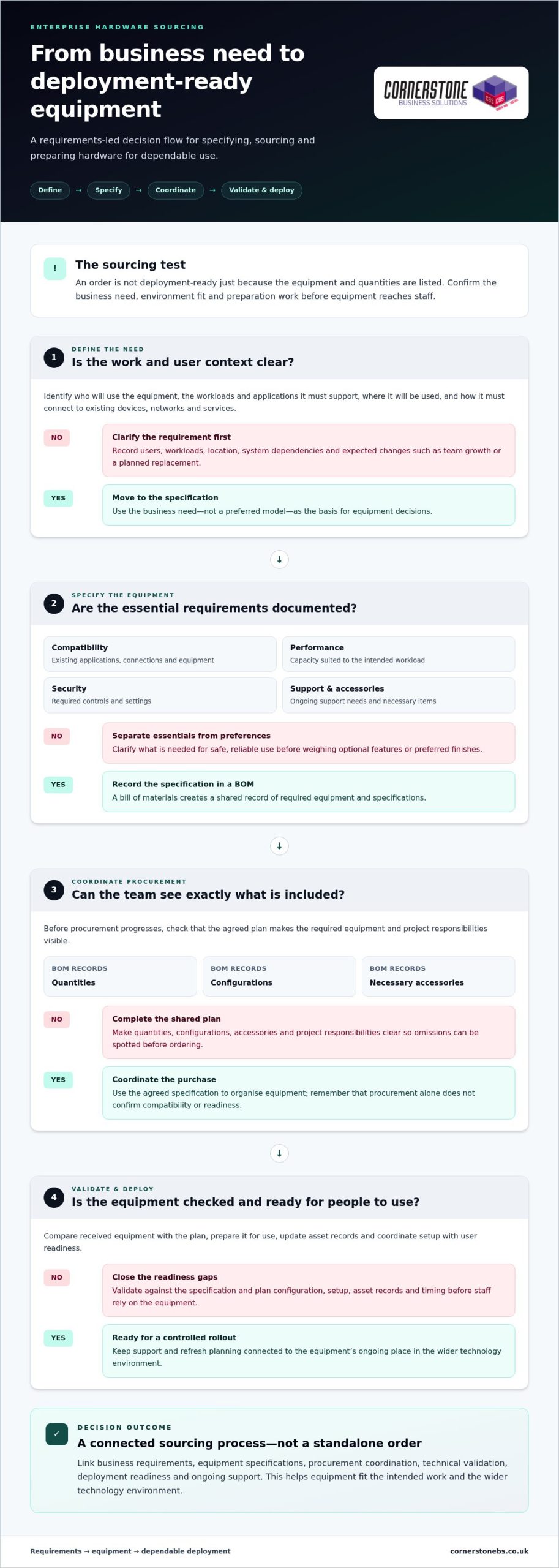
Define the need. Record who will use the equipment, what work it must support, which systems it needs to connect with and what business changes are planned.
Specify the equipment. Translate those needs into requirements for compatibility, performance, security, support and necessary accessories.
Coordinate procurement. Use the agreed specification to organise the required equipment and keep quantities, configurations and project responsibilities visible.
Validate and deploy. Check received equipment against the plan, prepare it for use, update asset records and coordinate setup with user readiness.
The exact workflow depends on project scope and business requirements, but these stages distinguish ordering from the technical and operational work that follows. Procurement can confirm that the requested equipment and quantities are accounted for. It does not, by itself, establish that equipment is compatible, configured appropriately or ready for staff.
Turn business requirements into a usable hardware specification
Capture the number and types of users, their workloads, existing systems and expected changes, such as team growth or a planned replacement. Document what the equipment must support, including compatibility, performance, security controls and ongoing support needs. A bill of materials (BOM) turns this information into a shared record of required equipment and specifications. Include quantities, configurations and necessary accessories so the team can track what is included and spot omissions before procurement progresses.
Coordinate validation, delivery and deployment
Before rollout, compare received equipment with the specification and check its condition, configuration and required accessories. Resolve discrepancies before devices are issued. Also confirm that delivery timing fits the setup plan, asset records can be updated and users are ready for changes to their usual equipment or access.
Validate hardware before deployment so incompatibilities and configuration gaps are addressed before they interrupt users. Match the checks to the project: a device refresh and a network infrastructure change have different setup and readiness needs. Assign clear responsibilities for procurement, technical validation and rollout, so each task has an owner and the team can see what remains before equipment enters service.
Where hardware choices need to fit deployment and ongoing IT support, Cornerstone’s business IT solutions bring those considerations into the wider technology picture.
Compare enterprise hardware sourcing options against your requirements
The right procurement route depends on your team’s capacity, the equipment involved and the coordination the project needs. Direct purchasing can suit a clearly defined requirement and an experienced internal IT team. Reseller-led procurement can bring product selection and purchasing together, while coordinated project delivery connects procurement with technical preparation and rollout. No approach suits every organisation.
Compare what each route covers, not just who places the order. Make responsibilities for validation, deployment and support clear, especially when equipment comes from more than one source.
Consideration
Direct purchasing
Reseller-led procurement
Coordinated project delivery
Ownership
Your organisation manages the purchase and its requirements.
The reseller handles the order for the equipment it supplies.
Responsibilities are aligned across procurement and project delivery.
Coordination
Your team coordinates vendors and orders.
Coordination may centre on the reseller’s order.
Equipment and project tasks are considered together.
Validation
Your team arranges technical checks.
Product checks depend on the agreed scope.
Validation can be planned alongside deployment.
Deployment
Your team plans setup and rollout.
Deployment may be separate from procurement.
Rollout planning is considered as part of the project.
Ongoing support
Your organisation arranges support separately.
Support depends on the arrangements in place.
Support needs can be considered alongside the wider technology environment.
When might direct or coordinated procurement fit better?
Direct purchasing can work well when internal staff have the technical knowledge and time to manage requirements, orders and checks. A technology partner can help when a project involves several equipment categories, dependencies or deployment tasks that need coordination. Some organisations use a mix: internal purchasing for routine replacements and coordinated delivery for more complex changes. Choose based on internal capacity and the work involved.
One supplier relationship can make coordination more straightforward when the equipment and responsibilities align. Multiple vendors may be appropriate when different requirements call for different sources, but your team will need a clear view of order status, compatibility and who handles each issue. Make ownership explicit in either case.
How should new and refurbished hardware be assessed?
Neither new nor refurbished equipment is automatically the better choice. Assess condition, compatibility with existing systems, security requirements, support arrangements and how long the equipment needs to meet the organisation’s needs. Refurbished equipment may suit some use cases; new equipment may be preferable when specific lifecycle or support expectations apply.
Purchase status alone does not establish whether hardware is fit for business use. Evaluate each option against the same requirements, including configuration, maintenance responsibilities and replacement plans. The decision should reflect the equipment’s operational importance and the organisation’s tolerance for disruption. That keeps the choice grounded in business needs rather than a simple new-versus-refurbished assumption.
Use this enterprise hardware sourcing checklist to reduce risk
A practical checklist helps teams catch gaps before equipment is approved, configured or put into service. Use it to review technical, security and operational questions together. The checks depend on the equipment and its role, but every item should have a clear answer or an owner responsible for resolving it.
Compatibility: Confirm that equipment will work with the organisation’s platforms, network infrastructure, applications and user workflows. Identify dependencies such as connections, accessories or configuration requirements.
Security: Define the required security configuration before deployment. Consider how devices will be protected, what access users need and how access will be managed when roles change.
Support: Record who is responsible for setup, maintenance and support, and understand the relevant support arrangements for the equipment.
Deployment readiness: Check that configuration, delivery timing, installation tasks and user preparation are accounted for before rollout.
Asset records: Plan how the organisation will record equipment, assigned users, locations and relevant support details.
Lifecycle: Consider how long the equipment is expected to meet business needs, what might prompt replacement and how it will be securely retired or responsibly handled at end of use.
Check compatibility, security and support before commitment
Compare the proposed specification with the systems and workflows the equipment must support. A device may meet a general performance requirement yet still be unsuitable if it cannot connect to a required platform or fit the organisation’s security approach. Flag uncertainties for technical validation before final approval, rather than leaving them to be resolved during rollout.
Security should shape configuration and access decisions from the outset. Define who needs access, what level of access is appropriate and which protective settings must be applied before equipment reaches a user. Align these decisions with the organisation’s wider cyber security approach. For a broader view, explore the business cyber security guide.
Plan asset records and lifecycle responsibilities
Useful asset records help teams understand what equipment is in use, where it is and who is responsible for it. Capture ownership, assigned user or team, location and relevant support information, then decide who will keep those details current. Assign responsibility for setup, maintenance, replacement planning and secure retirement as well. Clear ownership makes it easier to manage equipment throughout its working life.
Replacement planning should not rely on age alone. Consider whether equipment continues to meet user, compatibility, security and support needs, and plan changes to maintain access to essential systems. At retirement, account for secure handling of equipment and any data it may hold. The business IT solutions guide offers wider context for connecting hardware decisions with the organisation’s technology plans.
Use this checklist as part of a joined-up enterprise hardware sourcing process, not as a form to complete once and forget. Cornerstone’s business IT hardware and support services bring deployment and ongoing support into the wider discussion.
How Cornerstone connects enterprise hardware sourcing with IT support
Hardware decisions work best when they account for what happens after equipment arrives. Cornerstone Business Solutions provides business IT hardware and network infrastructure, alongside professional hardware deployment projects and managed IT support. This connects equipment decisions with the systems people rely on and the support that helps keep them working.
For enterprise hardware sourcing, the wider context matters. New equipment may need to fit existing systems, network infrastructure, security requirements and user workflows. A deployment plan can account for those dependencies, while ongoing IT support keeps day-to-day technology needs in view beyond the initial rollout. Cornerstone’s technology partnerships with Microsoft, IBM and Cisco inform its wider technology relationships without tying a project to a particular product or configuration.
Connect hardware decisions with the wider IT environment
Start with the intended business outcome, then consider how the equipment will fit the organisation’s current technology and priorities. A hardware project might replace devices, extend network infrastructure or prepare equipment for a change in how a team works. The right approach depends on the requirements, but the aim is to make the equipment useful in its real operating environment.
Discuss deployment planning and continuing support alongside the equipment itself. Decisions about configuration, access and setup affect how hardware is maintained and supported after it reaches users. Bringing these considerations together helps teams plan for reliable use, not simply installation. A broader managed IT approach can also keep ongoing support needs connected to the technology environment.
Set clear next steps for a hardware project
A short project brief gives everyone a practical starting point. Note who will use the equipment, the work it needs to support, relevant systems or network constraints, security considerations and the outcome the organisation wants. Include planned business changes that could affect the requirements. This context helps shape a solution around the project rather than treating every equipment request as an isolated purchase.
Cornerstone tailors technology solutions to the organisation and project, bringing business IT hardware, network infrastructure, deployment and managed support into the wider discussion. The details will vary with the scope of the work, but a clear view of needs and priorities helps guide sound decisions. You can explore Cornerstone’s business IT solutions and see how hardware fits alongside wider technology requirements.
Make your next hardware project a confident step forward
Your next technology decision can do more than meet an immediate need. Treat enterprise hardware sourcing as an opportunity to support how your organisation works, prepare for future plans and build confidence in the systems people rely on. Begin with a clear brief: capture the outcome you want, the constraints you need to work within and the people who will depend on the equipment.
Cornerstone brings business IT hardware, network infrastructure, deployment projects and managed support into the wider conversation. As a multi-award-winning IT services provider, the team works with organisations to shape technology solutions around their requirements. The aim is to connect equipment choices with real operational needs.
Is enterprise hardware sourcing only for large enterprises?
No. Organisations of different sizes can benefit when equipment needs to fit users, systems and operational plans. A smaller business might be replacing a handful of devices, while a larger organisation may be coordinating equipment across teams or sites. The right level of planning depends on project complexity, internal IT capacity and the importance of maintaining services during the change.
Can enterprise hardware sourcing help reduce supply disruption?
A structured approach can improve preparedness, but it cannot guarantee equipment availability or prevent market disruption. Identify items that are critical to operations, note dependencies that could affect alternatives, and plan replacements before equipment becomes difficult to support. Any substitute should still meet the organisation’s compatibility, security and support needs. This gives the team options to assess if its original choice becomes unavailable.
Should a business consider refurbished enterprise hardware?
Yes, if it meets the organisation’s requirements and risk tolerance. Assess condition, compatibility with existing systems, security suitability, expected useful life and support arrangements. Equipment used for a non-critical task may have different lifecycle requirements from hardware supporting an essential business function. Compare refurbished and new options against the same criteria, rather than assuming purchase status alone determines suitability.
What information should we prepare before starting a hardware sourcing project?
Prepare a short brief covering who will use the equipment, the work it must support, current systems and planned business changes. Include essential performance, compatibility, security and support requirements, plus constraints such as rollout timing or infrastructure dependencies. State the outcome the project should achieve, too. This context helps the team compare suitable options while keeping the specification open until technical needs have been assessed.
How often should a business review its hardware requirements?
There is no single review interval that suits every organisation. Revisit requirements when equipment approaches replacement, business operations change, security needs evolve or users encounter limitations with existing systems. Regularly reviewing asset and support records can help identify upcoming decisions before they become urgent. Coordinate any refresh with technical checks and deployment capacity, so planned changes do not create avoidable disruption to everyday work.
Can hardware sourcing include network infrastructure as well as end-user devices?
Yes. A hardware project can cover network infrastructure as well as laptops, workstations and other user equipment. For example, a device refresh may depend on existing connectivity or network capacity. Record those relationships in the project brief and consider how equipment, configuration and security requirements work together. This helps the team assess the environment as a connected system rather than treating each purchase as unrelated.
What is the difference between hardware sourcing and hardware deployment?
Hardware sourcing defines requirements and coordinates the acquisition of suitable equipment. Deployment prepares and introduces it into the working environment. They are separate stages, but decisions in one affect the other. A device may meet the purchasing specification yet still need configuration, access setup or user preparation before it is ready for work. Include those needs in the project plan early rather than leaving them until equipment arrives.
Did you know that DRAM contract prices surged by over 90% in the first quarter of 2026 alone? For many UK businesses, this volatility means that a quote received on Monday might be obsolete by Friday. You’ve likely felt the sting of hardware arriving late, with the wrong specifications, or requiring hours of internal staff time just to get a single PC onto the network. It’s a stressful experience that pulls your team away from their real work. As a multi-award-winning national provider, we know that hardware isn’t just a purchase; it’s the foundation for your growth.
We agree that your IT team shouldn’t spend their days unboxing monitors or chasing multiple warranty support lines. This 2026 guide promises to show you how a strategic IT hardware procurement service secures the best technology at a competitive price while stripping away the hidden costs of device management. We’ll preview the benefits of zero-touch deployment, explain how our partnerships with Microsoft, IBM, and Cisco drive better pricing, and outline a clear hardware refresh strategy to keep your business stable for the next three to five years.
Key Takeaways
Shift from transactional “box buying” to a strategic lifecycle approach to shield your business from 2026’s market volatility and supply chain delays.
Discover how a professional IT hardware procurement service implements zero-touch deployment, ensuring your staff receives pre-configured devices without draining internal resources.
Identify the hidden financial risks of consumer-grade hardware and why a small upfront saving can result in thousands of pounds in lost productivity.
Master the Total Cost of Ownership (TCO) calculation to look beyond the initial price tag and secure a better long-term return on your technology investment.
Learn how leveraging award-winning partnerships with global leaders like Microsoft, IBM, and Cisco provides the supply chain security and expert advice your growth depends on.
At its core, What is an IT Hardware Procurement Service? It’s much more than simply placing an order on a website. It’s a strategic, end-to-end process designed to identify, source, and deploy technology assets that actually support your business goals. In the fast-moving market of 2026, this service has evolved. It’s no longer about “buying boxes” and hoping they arrive on time. It’s about managing a complete technology lifecycle that protects your budget from extreme volatility.
The current market demands a proactive approach. With DRAM contract prices spiking by up to 95% in the first quarter of 2026, businesses without a dedicated procurement partner often find themselves overpaying for sub-par gear. We provide the transparency and vendor neutrality needed to navigate these supply chain shifts. We focus on what your business needs to grow, ensuring you aren’t locked into proprietary systems that don’t serve your long-term interests.
The Difference Between Buying and Procuring
Why Businesses are Moving to Managed Procurement
Many UK businesses are moving away from self-managed purchasing to reduce the heavy burden on internal staff. Your IT team’s time is valuable. They shouldn’t spend hours unboxing, tagging, and configuring new PCs. By leveraging the buying power of an award-winning national provider, you gain direct access to global supply chains through our partnerships with Cisco, IBM, and Microsoft.
We ensure every device is work-ready the moment it reaches your staff. This proactive model turns a traditionally stressful experience into a seamless transition. You get better pricing, guaranteed compatibility, and the emotional security of knowing your hardware is a foundation for growth, not a source of downtime. It’s about building a partnership that values your time as much as your technology.
The 5 Stages of a Strategic IT Procurement Lifecycle
Effective technology management isn’t a one-off event. It’s a continuous cycle that ensures your team always has the tools they need to succeed. While many treat buying a laptop like a quick trip to the high street, a professional IT hardware procurement service views every device through its entire lifespan. This lifecycle approach prevents technical debt and ensures your infrastructure remains a foundation for growth rather than a source of frustration.
Stage 1: Strategic Consultation
We start by listening. Jumping straight into a catalogue often leads to “over-speccing” expensive machines that your team won’t fully use, or “under-speccing” gear that slows down within months. Our initial audit prevents wasted capital expenditure by identifying exactly what your environment requires. We ensure your new hardware aligns perfectly with your cloud solutions strategy. This alignment ensures that every pound spent contributes to a faster, more secure network.
Once we understand your goals, we move to sourcing and negotiation. We use our award-winning partnerships with global leaders like Cisco, IBM, and Microsoft to secure enterprise-grade gear that isn’t always available to the general public. This stage protects you from the price volatility seen in 2026 by leveraging our national buying power to secure the best possible terms.
Stage 3: Professional Configuration
The fourth stage focuses on logistics and deployment. We provide national UK delivery and on-site setup to ensure your new systems are integrated correctly from day one. If you’re looking for a partner who takes the stress out of this process, our team is ready to help you streamline your IT infrastructure with a proactive approach.
Stage 5: Secure Disposal and Refresh
The lifecycle doesn’t end when a device gets old. In 2026, meeting UK GDPR requirements for data destruction is a non-negotiable priority. We manage the secure disposal of old hard drives and ensure full WEEE compliance for sustainable recycling. By planning your next refresh cycle three to five years in advance, we help you avoid “emergency buying” when equipment inevitably fails. This proactive strategy keeps your budget stable and your technology modern, providing the emotional security that comes with a reliable IT hardware procurement service.
Business-Grade vs. Consumer Hardware: The Real Cost of “Cheap” Options
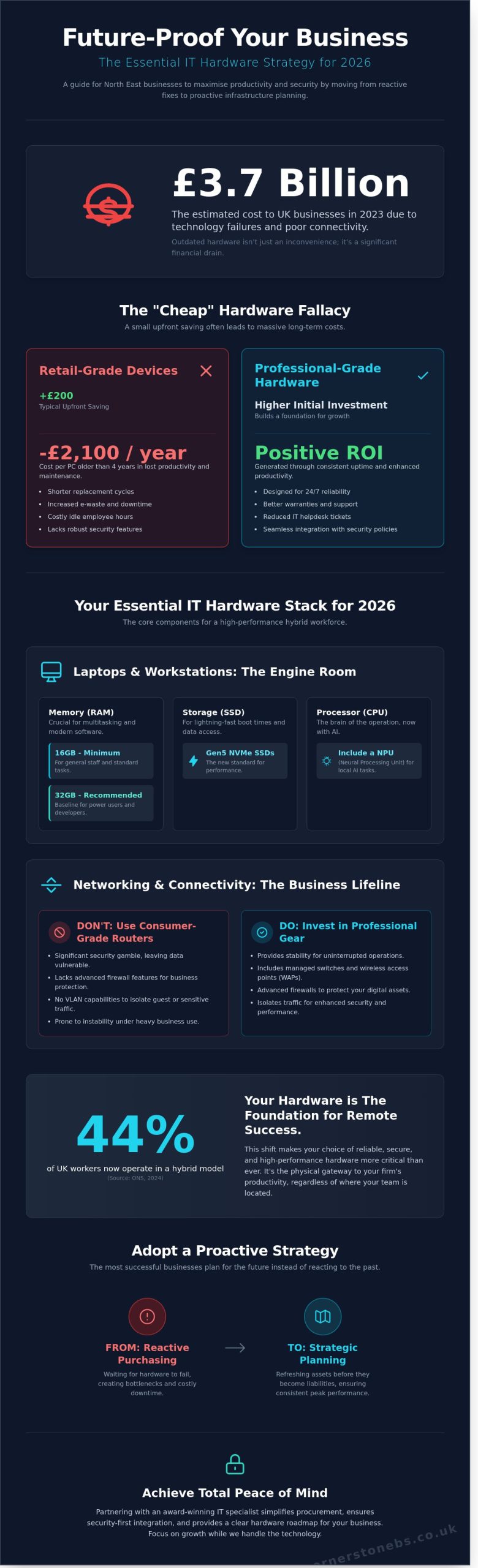
It’s tempting to browse high-street retailers for the latest laptop deals. The prices look attractive, and the designs are sleek. However, for a growing UK business, these consumer-grade devices are often a false economy. They aren’t built for the rigours of a professional environment. When a device fails, the initial £500 you saved on the purchase price can quickly spiral into a £5,000 loss in productivity. This happens through downtime, frustrated staff, and the urgent need for a replacement.
The difference starts with build quality. While consumer laptops often use plastic chassis that flex and crack, business-grade machines feature magnesium alloy frames designed for durability. Warranty support is where the gap widens further. Consumer gear usually relies on “Return to Base” warranties, which can leave a staff member without a computer for two weeks. A strategic IT hardware procurement service ensures you receive “Next Business Day On-Site” support. This keeps your team working and your projects on track.
Internal Components and Longevity
Business-grade CPUs and SSDs are engineered for constant, 8-hour daily use. They handle the heat and stress of professional workloads far better than their domestic counterparts. This reliability is a cornerstone of our cyber security services, as business hardware often includes hardware-level encryption and security features that consumer models lack. Even your office connectivity benefits from this distinction. Enterprise-grade WiFi access points provide stable, multi-user connections that domestic routers simply can’t match, ensuring your video calls stay crisp and your data transfers stay fast.
Standardisation and Support
Choosing a professional IT hardware procurement service allows you to standardise your fleet. When every staff member uses a similar build, your IT helpdesk can troubleshoot issues much faster. You don’t have to worry about a dozen different driver versions or incompatible docking stations. Standardisation also simplifies your long-term planning. Business-grade hardware models remain “available” for much longer than consumer versions. This makes it easy to source matching spares or add new units that fit perfectly into your existing setup. It’s a proactive way to build a stable, scalable infrastructure that respects your time and your budget.
Maximising ROI: Total Cost of Ownership (TCO) in IT Procurement
Energy-efficient hardware isn’t just about your company’s sustainability goals; it’s a direct win for your bottom line. Choosing gear with lower power consumption reduces operational overheads over a three to five-year cycle. This is why leasing and Device as a Service (DaaS) models have become so popular this year. They allow you to keep your infrastructure modern and efficient without the massive upfront capital hit that can stifle a growing business. We help you find the balance between performance and power consumption to keep your costs predictable.
Vendor Neutrality and Impartial Advice
Brand bias is a real risk when you work with providers who only push one manufacturer. We believe in vendor neutrality. By leveraging our multi-award-winning partnerships with Cisco, IBM, and Microsoft, we find the hardware that actually fits your workflow. Our goal is to ensure your new equipment is fully compatible with your existing it company solutions, preventing expensive integration headaches later. We’re here to act as your partner, not just a supplier, ensuring every piece of gear serves your specific business needs.
Financing Your IT Infrastructure
Choosing between CAPEX and OPEX is a significant decision for any UK business owner. While buying outright (CAPEX) might suit some, hardware leasing (OPEX) offers superior cash flow management. It keeps your capital free for other growth initiatives while keeping your tech stack fresh. Additionally, tax-efficient procurement strategies can significantly lower the effective cost of your hardware by utilising available capital allowances to offset your investment. This approach turns a major expense into a manageable, strategic asset.
Streamline Your Infrastructure with Cornerstone’s Procurement Solutions
Choosing an IT hardware procurement service shouldn’t feel like a cold transaction. It’s a partnership that defines how your business operates every day. At Cornerstone, we provide multi-award-winning national support that treats you as a valued partner, not just another ticket number. We bridge the gap between high-level technology and the people who use it. By securing direct access to global supply chains through our partnerships with Cisco, IBM, and Microsoft, we ensure your business remains resilient even during the market volatility of 2026.
We manage the entire journey for you. Our team handles everything from the initial strategic audit to the final, secure disposal of your legacy assets. What truly sets us apart is how we integrate procurement with our proactive managed IT support. We don’t just deliver a box and walk away. We monitor the health of your systems, track warranties, and ensure every device remains a high-performing asset. This end-to-end approach provides total peace of mind, allowing you to focus on your core business goals while we manage the technical foundation.
The Cornerstone Advantage
We combine regional warmth with a national reach. This gives you the personal touch of a local team backed by the massive buying power of a UK leader. We understand that technology can be a source of stress, so we prioritise your “emotional security” by building systems that simply work. This commitment to continuity extends beyond hardware. For example, our Microsoft 365 migration services ensure your software environment is just as robust and modern as the physical devices we source for you.
Ready to Upgrade Your Business Technology?
Now is the perfect time to audit your aging hardware fleet. Don’t wait for a critical failure to force your hand. Emergency buying is expensive and often leads to compromised choices. Our process for getting a bespoke procurement quote is simple, transparent, and designed to respect your time. We invite you to a “no-jargon” conversation about your technology goals. We’ll listen to your challenges, explain the best options in plain English, and show you how a strategic approach to hardware can drive your success through 2026 and beyond. Let’s build a reliable foundation for your growth together.
Secure Your Business Foundation for 2026 and Beyond
Navigating the complexities of the 2026 hardware market doesn’t have to be a stressful experience. By shifting from reactive buying to a strategic lifecycle approach, you protect your budget and your team’s productivity. We’ve explored how business-grade technology and a focus on the total cost of ownership turn IT from a liability into a growth engine. It’s about building a technical foundation that supports your long-term goals without the hidden costs of downtime.
A professional IT hardware procurement service provides the supply chain security and technical expertise needed to stay ahead. As a multi-award-winning IT provider with national UK deployment capability, we’re proud to be strategic partners with Microsoft, Cisco, and IBM. We handle the configuration, deployment, and secure disposal so you can focus on leading your company with confidence. We treat your infrastructure with the same care we give our own, ensuring every device is a reliable tool for success.
It’s time to stop worrying about lead times and compatibility issues. We’re here to help you build a stable, scalable infrastructure that respects your budget and your time. Book a Free IT Cost Review with our Award-Winning Team and let’s start a conversation about your future.
Frequently Asked Questions
What is included in an IT hardware procurement service?
An IT hardware procurement service provides a complete end-to-end management cycle for your technology assets. It includes an initial strategic audit to understand your needs, sourcing through global partners like Cisco and IBM, and professional configuration before delivery. We also handle the logistics of national deployment and secure disposal. This proactive approach ensures your hardware is a foundation for growth rather than a source of administrative stress for your internal team.
Why shouldn’t I just buy business laptops from a retail website?
Retail websites often sell consumer-grade devices that lack the durability and security features required for a professional environment. Business-grade hardware features magnesium alloy chassis and enterprise-level encryption that retail models miss. Most importantly, retail warranties are usually “return to base”, leaving staff without tools for weeks. We provide business-grade equipment with “Next Business Day On-Site” support, ensuring your productivity never takes a hit due to a simple hardware failure.
How does a procurement service handle hardware warranties?
We act as your single point of contact for all hardware warranties, eliminating the need for you to chase multiple manufacturers. Our team tracks every device’s coverage and manages the repair or replacement process on your behalf. By leveraging our enterprise-level partnerships, we secure high-priority support like on-site repairs. This provides you with emotional security, knowing that any hardware issue will be resolved quickly by experts who understand your business continuity needs.
Can you help with hardware for remote and hybrid teams?
Yes, we specialise in supporting remote and hybrid teams across the UK through our zero-touch deployment model. As part of our IT hardware procurement service, we pre-configure every device with Microsoft 365, secure VPNs, and antivirus software before shipping it directly to your employee’s home. This ensures every staff member is “work-ready” the moment they unbox their laptop. It removes the logistical burden from your office manager and ensures security.
What is the typical lead time for business hardware in 2026?
Lead times in 2026 are heavily influenced by the global demand for AI-related components, causing volatility in the supply of memory chips and networking gear. While standard laptops are often available within days, specialised Cisco networking equipment can have longer lead times depending on current manufacturing capacity. We provide proactive monitoring of these supply chains to give you accurate estimates. This helps you plan refreshes early and avoid the risks of last-minute emergency buying.
Do you provide setup and installation as part of the service?
Setup and installation are foundational parts of our service, ensuring your gear is ready for immediate use. We don’t just deliver boxes; we provide fully imaged devices pre-loaded with your specific business applications and security protocols. Our team can also provide on-site installation for complex network infrastructure. This end-to-end management saves your internal staff hours of unboxing and configuration time, allowing them to focus on high-value projects instead of basic technical setup.
How do you ensure my old hardware is disposed of securely?
We follow a strict process for secure disposal that meets all current UK GDPR and WEEE environmental standards. Every old hard drive undergoes certified data destruction to ensure your sensitive business information is unrecoverable. We then manage the sustainable recycling of the physical components. This proactive approach protects your company from the legal and reputational risks associated with data breaches, providing a clean, documented end to the hardware lifecycle for your peace of mind.
Is it better to lease or buy IT hardware for my business?
The choice depends on your financial strategy, but many businesses in 2026 prefer leasing to manage cash flow effectively. Leasing moves your hardware spend from a large upfront capital expense (CAPEX) to a predictable monthly operational cost (OPEX). This makes it easier to stay on a 3 to 5 year refresh cycle, ensuring your team always has modern, efficient tools. We provide impartial advice to help you choose the most tax-efficient model for your goals.
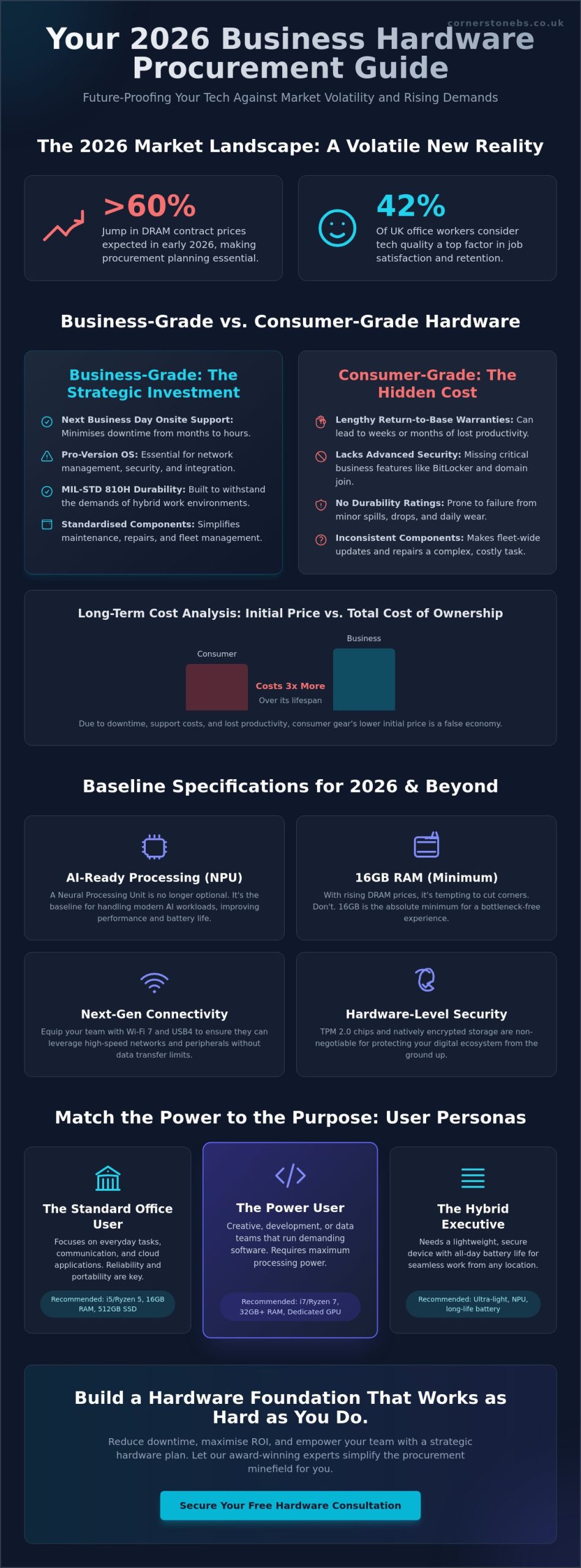
What if your next IT upgrade costs 20% more than your last one, yet fails to handle the AI tools your team needs by next Christmas? With DRAM contract prices jumping by over 60% in early 2026, securing a robust business hardware supply is no longer just about buying boxes; it’s about protecting the entry points to your entire digital ecosystem. You’ve likely felt the frustration of lead times stretching into months or discovered that your new laptops don’t play nice with your existing cloud software. It’s a headache that drains your budget and slows down your team’s momentum.
Our award-winning team knows that technology should provide peace of mind, not a pile of invoices. This guide helps you master your procurement strategy so you can choose, secure, and manage high-performance gear that actually lasts. We’ll show you how to reduce downtime and improve ROI despite the current market volatility. From meeting the new NIST CSF 2.0 standards to hitting the UK’s 532,882-tonne WEEE collection target, we’ve got the expert insights you need to keep your business moving forward. Let’s have a chat about how to build a hardware foundation that works as hard as you do.
Key Takeaways
Learn why treating hardware procurement as a strategic partnership directly improves employee productivity and long-term retention across your team.
Discover how to tailor your business hardware supply using specific user personas and the latest Neural Processing Units (NPUs) to future-proof your tech.
Secure your digital ecosystem from the ground up with essential hardware-level defences like TPM 2.0 chips and encrypted storage.
Maximise your ROI by moving to a proactive refresh cycle and standardising your fleet for easier maintenance and significantly less downtime.
See how an award-winning local partner provides the peace of mind you need by simplifying the complex procurement minefield.
The Strategic Role of Business Hardware Supply in 2026
Successful procurement in 2026 isn’t a race to the bottom on price. It’s a calculated investment in your company’s future. When you view business hardware supply as a strategic partnership rather than a simple transaction, you gain a competitive edge that keeps your operations stable. Modern e-procurement strategies now focus on long-term value, ensuring your team has the tools to excel without fighting their equipment every morning. Our award-winning team at Cornerstone Business Solutions knows that the right gear doesn’t just sit on a desk; it powers your growth.
Business-Grade vs. Consumer-Grade: The Real Difference
Next Business Day onsite support: Minimises downtime by getting a technician to your door immediately.
Pro-version operating systems: Essential for network management, advanced security, and seamless integration.
Standardised internal parts: Simplifies maintenance and ensures your entire fleet remains consistent.
The Cost of “Making Do” with Outdated Gear
Old gear creates a massive “Downtime Tax” that many owners overlook. Legacy laptops struggle to run modern cloud solutions, leading to synchronisation errors and security vulnerabilities. When your hardware can’t keep up with your software, your productivity plateaus. In 2026, the average lifespan of a business laptop is exactly 36 to 48 months before performance degradation begins to outweigh the cost of replacement. We help you plan these cycles proactively so you’re never left scrambling when a critical machine fails.
Choosing the Right Specifications: A 2026 Buyer’s Guide
Memory and storage have also hit a new tipping point. With 2026 DRAM contract prices rising by over 55% in the first quarter, it’s tempting to cut corners. Don’t. In 2026, 16GB of RAM is the absolute minimum for a productive office environment. Anything less will cause bottlenecks as modern browsers and background security tools fight for resources. We recommend pairing this with Wi-Fi 7 and USB4 connectivity to ensure your team can take full advantage of the high-speed networks we install across the North East. If you’re unsure which path fits your growth plans, our award-winning experts are always ready to chat about your hardware needs.
Laptops and Desktops: Matching Power to Purpose
Servers and Infrastructure: The Backbone of Your Business
While many firms move toward cloud solutions, on-premise hardware still plays a vital role for businesses needing local data control or high-speed internal access. We always recommend redundancy features like dual power supplies and RAID configurations to prevent a single component failure from stopping your operations. For growing SMEs, hyper-converged infrastructure offers a streamlined way to combine compute, storage, and networking into one easy-to-manage system that scales as you do.
Infrastructure and Security: Why Your Supply Chain Matters
Grey market hardware might save a few pounds upfront, but it carries a massive risk of pre-installed malware or unverified components. This is why your hardware partner must be an integrated part of your cyber security services strategy. We only source from trusted global leaders to guarantee that features like TPM 2.0 chips and hardware-encrypted storage are present and active. These tools provide the peace of mind that your data remains safe, even if a device is physically lost or stolen. Our award-winning team doesn’t just deliver a box; we deliver a secure foundation for your business to thrive.
Securing the Remote Entry Point
Network Hardware: Beyond the Basic Router
Procurement and Lifecycle Management: Maximising ROI
Total Cost of Ownership (TCO) vs. Purchase Price
The sticker price is only the beginning. You have to factor in the time spent on deployment, software licensing, and ongoing technical support. Our award-winning it company solutions reduce the TCO by handling the heavy lifting of imaging and setup before the gear even reaches your office. We also leverage manufacturer-direct warranties. These protect your investment by ensuring that if a part fails, it’s replaced with genuine components at no extra cost to you. It’s about securing long-term value, not just a short-term bargain.
Hardware as a Service (HaaS): A Modern Alternative
Many local businesses are shifting away from large upfront costs. Hardware as a Service (HaaS) moves your tech spend from a capital expenditure (CapEx) to an operational one (OpEx). This keeps your cash flow healthy and predictable. This model provides an “evergreen” fleet where devices are automatically refreshed every three years. It integrates perfectly with our managed IT services, giving you a single monthly fee for both your gear and your support. If you want to stop worrying about obsolescence, it’s time to optimise your hardware lifecycle with a partner you can trust.
Partnering with Cornerstone for Award-Winning Hardware Solutions
More Than Just a Supplier: A Technology Partner
We believe your physical gear must work in harmony with your software ecosystem. We align your hardware choices with your Microsoft 365 migration and long-term cloud goals to prevent compatibility issues. Our proactive monitoring systems often alert us to a failing hard drive or a battery issue before you even notice a flicker. This gives you the peace of mind that your foundation is stable, secure, and tailored to your specific needs. We’re here to ensure your technology supports your growth, not hinders it.
Get Started with a Hardware Audit
Secure Your Competitive Edge for 2026
As a multi-award-winning IT provider and official partner with Microsoft, IBM, and Cisco, we’re here to simplify this complexity for you. Our managed plans include proactive 24/7 system monitoring to catch hardware failures before they disrupt your day. Don’t let outdated gear or long lead times hold your North East business back. Book a free technology consultation with our award-winning team today. We’re ready to help you build a robust, high-performance future that works as hard as you do.
Common Questions About Business Hardware Procurement
What are the essential hardware components for a small business in 2026?
Is it better to lease or buy business IT hardware?
Choosing between leasing and buying depends entirely on your cash flow strategy. Leasing through Hardware as a Service (HaaS) turns technology costs into predictable monthly OpEx payments, which keeps your capital free for other investments. Buying gives you full asset ownership but requires significant upfront capital. Most North East businesses we partner with prefer the “evergreen” nature of leasing to ensure their fleet is automatically refreshed every three years.
How often should a business refresh its laptop and desktop fleet?
What is the difference between consumer and enterprise-grade hardware?
Can a business hardware supplier help with software licensing as well?
What should I do with old business hardware when it reaches end-of-life?
You must use professional recycling and certified data destruction services to meet the UK’s 2026 WEEE collection target of 532,882 tonnes. Simply throwing old gear away risks a major data breach and environmental fines. Our award-winning team manages the entire disposal process, providing you with certificates of destruction for total peace of mind and regulatory compliance.
How do I ensure my new hardware is compatible with my existing cloud systems?
We ensure compatibility by conducting a full technology audit before suggesting any new business hardware supply. This process verifies that your processors and memory can handle the specific processing demands of your cloud software. It prevents performance bottlenecks and ensures your team can access their files and applications without frustrating lag or synchronisation errors.
What are the current lead times for enterprise-grade servers and networking gear?
Current lead times for enterprise-grade servers and networking gear typically range from 3 to 6 months. High demand for AI-specific components and memory has created a structural shift in the global market. We recommend planning your procurement at least two quarters in advance to avoid being caught out by these industry-wide delays.
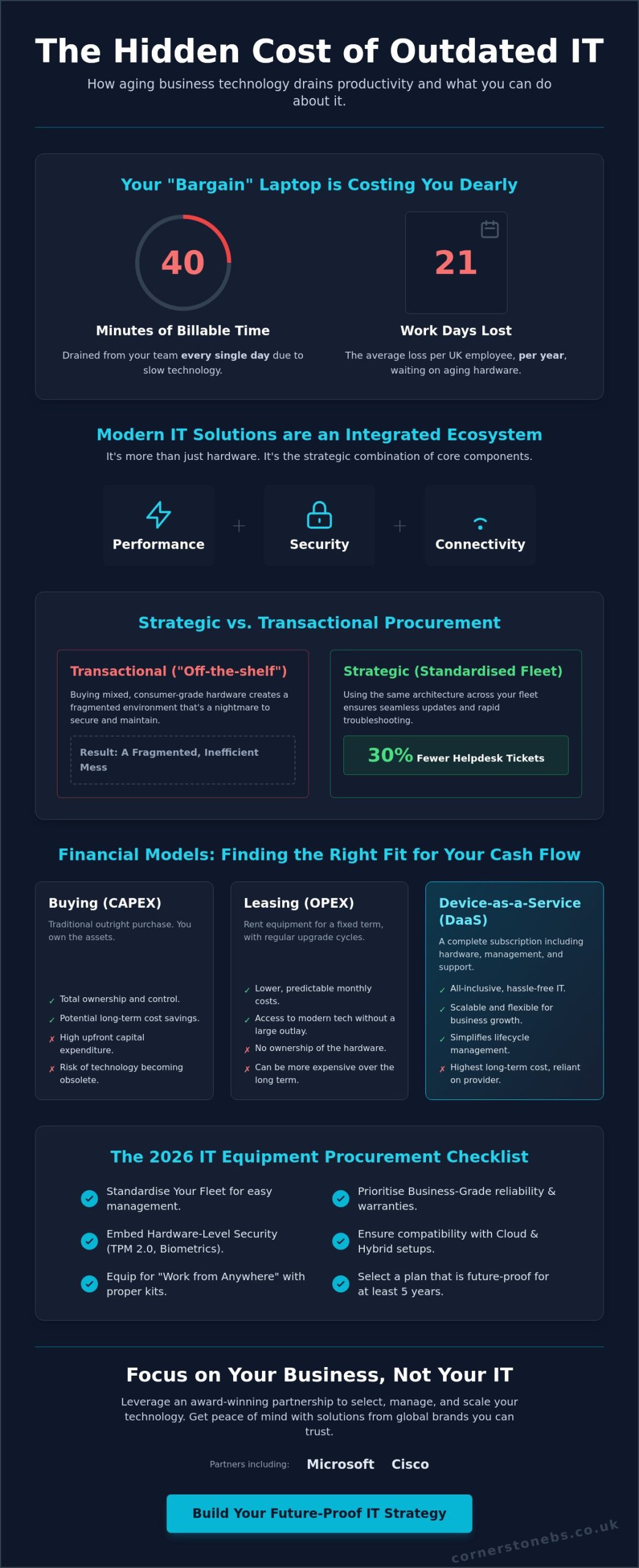
That “bargain” laptop in your office is likely draining 40 minutes of billable time from your team every single day. According to 2024 industry research, UK employees lose nearly 21 days of work per year simply waiting for aging technology to catch up. Finding the right it equipment solutions shouldn’t be a gamble between high upfront costs and technical confusion. It’s a frustrating reality for many North East business owners who want to grow but feel held back by frequent downtime and security worries.
You deserve a setup that just works. We’ve written this guide to help you select, manage, and scale your technology to drive productivity while eliminating the hidden costs of legacy systems. As an award-winning partner, we’re here to simplify the complex stuff so you can focus on your business. You’ll learn how to navigate the 2026 procurement landscape, decide whether leasing or buying fits your cash flow, and build a secure hardware fleet that stays reliable for the long haul.
Key Takeaways
Modern it equipment solutions are more than just hardware; they are integrated ecosystems that combine connectivity, security, and performance.
Identify the essential hardware categories every UK business needs to evaluate to remain competitive and secure through 2026.
Compare the financial benefits of buying, leasing, and Device-as-a-Service to find the best fit for your company cash flow.
Follow our 2026 procurement checklist to ensure your new hardware remains reliable and future-proof for at least five years.
Discover how an award-winning partnership provides peace of mind by leveraging global technology brands like Microsoft and Cisco.
What are IT Equipment Solutions in a Modern Business Context?
In the past, buying a computer was a simple transaction. You walked into a shop, picked a box, and plugged it in. Today, it equipment solutions represent a far more sophisticated ecosystem. It involves the integrated hardware, firmware, and initial configuration required to keep your business operational and secure. When we talk about What is IT Infrastructure?, we’re describing the foundation that allows your team to communicate, collaborate, and compete in a digital-first economy. It’s the engine room of your daily operations.
Modern solutions must look beyond the physical device. A laptop is just a piece of plastic and silicon until it’s layered with robust connectivity and proactive security measures. We see many businesses make the mistake of choosing consumer-grade hardware to save pennies. However, business-grade equipment offers enhanced reliability, longer warranties, and remote management features that consumer models lack. This hardware is a vital part of the wider managed IT services ecosystem, ensuring that every device on your network is a known, secure quantity.
The Shift from Transactional to Strategic Procurement
Buying “off-the-shelf” often creates a fragmented environment that’s a nightmare to maintain. Strategic procurement focuses on standardisation. When your entire fleet uses the same architecture, updates are seamless and troubleshooting takes minutes rather than hours. This approach is essential for supporting a hybrid workforce. In 2024, companies using standardised hardware reported 30% fewer helpdesk tickets compared to those with mixed-fleet policies. It’s about creating a stable platform for growth, not just filling desks with monitors.
Core Components of a Business Hardware Stack
A reliable hardware stack is built on three pillars:
End-user devices: High-performance laptops and tablets tailored to specific roles, from heavy-duty processing for designers to lightweight portability for sales teams.
Infrastructure: The “heavy lifting” gear including servers, storage units, and networking equipment like routers and firewalls that keep data flowing safely.
Peripherals and Comms: Modern VoIP handsets, noise-cancelling headsets, and professional conference room technology that make remote collaboration feel natural.
Key Categories of IT Hardware for UK Businesses
Selecting the right hardware isn’t just about processing speed; it’s about building a fortress around your data. By 2026, the equipment you choose must feature hardware-level protections like TPM 2.0 and biometric authentication as standard. We ensure that cyber security services are baked into every device we supply, closing the gap that software alone cannot fill. This proactive approach aligns with the UK Government’s Technology Playbook, which advocates for security-by-design to protect national business interests.
Your server strategy acts as the heart of your it equipment solutions. While many North East firms are transitioning to virtualised environments to slash energy costs and physical footprint, others still rely on physical on-site servers for high-demand local tasks. Whether your infrastructure is on-premise or hybrid, it requires a rock-solid link to your cloud solutions. Without robust networking gear, your team will struggle with latency, regardless of how fast your internet connection claims to be.
End-User Computing (EUC)
Network & Security Infrastructure
Business-grade firewalls are non-negotiable. They do more than block basic threats; they inspect encrypted traffic and manage secure VPN tunnels for your remote staff. We always recommend managed switches over unmanaged ones because they allow us to prioritise voice traffic for your VoIP phones, preventing dropped calls during busy periods. As we move through 2026, upgrading to Wi-Fi 7 Wireless Access Points (WAPs) will become essential to handle the increased density of connected devices in modern offices.
Building a reliable fleet doesn’t have to be overwhelming. If you’re unsure which category to prioritise for your next refresh, our award-winning team is ready to audit your current hardware and provide a clear roadmap for your it equipment solutions.
Financial Models: Buying vs. Leasing vs. Device-as-a-Service (DaaS)
Choosing how to fund your it equipment solutions is a commercial decision that carries as much weight as the technical specifications themselves. It’s about more than just a price tag; it is about balancing immediate cash flow against long term agility. In the current economic climate, UK businesses generally follow three distinct paths to refresh their hardware fleet. Each model has a different impact on your balance sheet and your daily operations. We help you cut through the financial jargon to find the route that provides the most peace of mind for your specific situation.
When weighing up these options, many directors look at the “Total Cost of Ownership” (TCO). This calculation includes the initial purchase, the cost of maintenance, power consumption, and the eventual secure disposal of the data. Industry data from 2024 suggests that unmanaged hardware can cost up to 3 times its original purchase price in hidden maintenance over its lifespan. To make an informed choice, we recommend reviewing the UK government technology procurement standards, which offer a framework for value-driven purchasing.
Traditional Capital Expenditure (Capex)
Buying hardware outright remains a popular choice for businesses with healthy cash reserves. You own the asset from day one. There are no monthly interest charges or ongoing contract obligations. Since the Autumn Statement 2023, the UK’s “Full Expensing” policy allows companies to claim significant tax relief on qualifying IT investments. This is often best for firms with internal IT teams who can handle the maintenance and disposal themselves. However, the downside is the large upfront drain on your capital and the risk of being stuck with “legacy” kit that loses value quickly.
Operational Expenditure (Opex) and DaaS
Many North East SMEs now prefer the flexibility of Opex models. Device-as-a-Service (DaaS) is the modern evolution of the traditional lease. It integrates high-performance hardware with our award-winning it company solutions into one predictable monthly payment. This model allows you to scale up or down as your headcount changes. You get the latest technology without the heavy upfront cost. While you don’t own the asset, you benefit from included support and a guaranteed refresh cycle every three or four years. This keeps your team productive on the latest, most secure devices.
The tax implications of Capex versus Opex can be complex. While we provide the expert technical guidance, we always advise a quick chat with your accountant to see which model best suits your current tax strategy. Our goal is to ensure your it equipment solutions act as a catalyst for growth, not a burden on your bank account.
The 2026 IT Equipment Procurement Checklist
Procurement shouldn’t feel like a guessing game. A strategic approach ensures your it equipment solutions remain viable for the next 3 to 5 years, preventing the “performance cliff” that often hits unmanaged hardware. This checklist moves beyond basic price comparisons to focus on the long term resilience of your fleet. By 2026, every device you purchase must meet strict hardware security standards, including TPM 2.0 and biometric support, to defend against increasingly sophisticated local threats. We also recommend prioritising Energy Star 8.0 ratings to reduce your carbon footprint and lower office energy bills.
Your hardware choices impact your team’s ability to stay productive. If a device fails, the cost isn’t just the replacement part; it’s the hours of lost work. Our award-winning team helps North East businesses build a procurement roadmap that balances cutting-edge performance with environmental responsibility. This includes clear e-waste disposal policies that comply with UK regulations, ensuring your old tech is recycled securely and ethically.
Step 1: Audit Your Current Environment
Before buying anything, you must understand what you already have. Identify aging assets that cause frequent downtime or struggle with modern software. This is particularly important if you are planning a Microsoft 365 migration for business UK, as older hardware may lack the processing power to handle cloud-integrated features efficiently. We suggest defining user personas, such as “Power Users” for your creative team and “Remote Workers” for your sales staff. This allows you to tailor specifications to actual needs rather than overspending on a one-size-fits-all model.
Step 2: Define Minimum Specifications
In 2026, 16GB of RAM is the absolute minimum for business productivity. Anything less will lead to system lag when running multiple browser tabs and communication tools simultaneously. Your it equipment solutions should also standardise on NVMe SSDs, which provide boot times up to 5 times faster than older SATA drives. Don’t overlook physical security features like integrated privacy screens for laptops used in public spaces and hardware-level encryption that protects data even if a device is stolen. These small details provide the peace of mind your business needs to operate anywhere.
A well-planned refresh cycle keeps your business ahead of the curve. To get started with a professional assessment of your current fleet, you can book a hardware audit with our expert team today.
How Cornerstone Delivers Award-Winning IT Equipment Solutions
Cornerstone Business Solutions is more than a service provider; we are your award-winning technology partner. We’ve built a reputation for delivering robust it equipment solutions that empower businesses from our North East headquarters to satellite offices across the UK. We don’t believe in simple “box-shifting” or transactional sales. Instead, we manage the entire hardware lifecycle, ensuring every device remains a high-performing asset rather than a technical burden. This proactive stance is why we’ve secured multiple industry accolades, including being named a multi-award-winning IT partner for our commitment to excellence and regional growth.
Our status as a trusted expert is reinforced by our close ties with global technology leaders. We maintain strategic partnerships with brands like Microsoft, Cisco, and IBM. These alliances ensure our clients receive vetted, industry-leading hardware that integrates perfectly with modern software environments. It is about providing you with the same level of enterprise-grade technology used by global corporations, but with the approachable, regional warmth of a local team that truly cares about your success. We speak your language, simplifying the technical details to provide true peace of mind.
Bespoke Technology Planning
We don’t offer generic, one-size-fits-all hardware bundles. Every hardware stack we design is tailored to meet your specific business objectives for 2026 and beyond. Whether you need to overhaul your network infrastructure or equip a hybrid workforce with secure mobile devices, we bring a “can-do” attitude to even the most complex technical challenges. By providing a single point of contact for all your procurement and support needs, we eliminate the frustration of managing multiple vendors. We simplify your technology stack so you can focus entirely on scaling your business.
Seamless Implementation and Ongoing Support
A hardware rollout shouldn’t cause a single minute of unnecessary downtime. We handle the logistical heavy lifting through a process that includes full pre-configuration in our specialized labs before any equipment arrives at your office. Our expert engineers manage the on-site setup, ensuring everything is “plug-and-play” for your staff from day one. Once your new fleet is live, our proactive monitoring systems provide constant oversight, identifying and resolving performance dips before they impact your productivity. This dedication to reliability is a foundational element of our service.
If you’re ready to stop worrying about aging hardware and start focusing on your future, we’d love to help. We invite you to have a friendly chat about your technology roadmap and discover how the right it equipment solutions can drive your business forward.
Build a Foundation for Success in 2026
Strategic technology procurement is the difference between a team that struggles with downtime and one that thrives. By moving away from reactive purchases, you secure a fleet that is reliable, scalable, and protected against modern threats. We’ve shown how the right financial model and a rigorous 2026 checklist can transform your it equipment solutions into a powerful driver of productivity rather than a hidden cost center. Your hardware should be a silent partner in your growth, not a hurdle to overcome.
At Cornerstone, we pride ourselves on being a multi-award-winning partner with national reach and a proactive “can-do” attitude. Our strategic partnerships with Microsoft, IBM, and Cisco allow us to deliver world-class hardware backed by the approachable, regional warmth of our North East roots. We don’t just supply devices; we provide the peace of mind that comes from knowing your infrastructure is in expert hands. Book a chat with our award-winning team to discuss your IT equipment solutions today. Let’s build a technology roadmap that keeps your business moving forward.
Frequently Asked Questions
How often should a business replace its IT equipment?
Most UK businesses should replace laptops every 3 years and core networking gear every 5 years. Following this cycle prevents the steep drop in reliability that usually occurs after the 36-month mark. 2024 industry studies suggest that employees lose an average of 40 minutes per day when working on hardware that is over 4 years old, making early replacement a smart financial move.
Is it better to buy or lease IT hardware in 2026?
Choosing the right it equipment solutions depends on your specific tax strategy and cash flow. Leasing provides predictable monthly costs and easier scaling for growing teams without a large upfront drain on capital. Buying outright allows you to take advantage of the UK’s 2023 Full Expensing policy for immediate tax relief. Our award-winning team helps you weigh these options to find the best fit for your balance sheet.
What is the difference between consumer and business-grade laptops?
Business-grade laptops are built with more durable materials and include advanced security features like TPM 2.0 chips. Unlike consumer models, they are designed for 8-hour daily use and offer better thermal management to prevent slowing down under load. They also include professional versions of operating systems, which are essential for connecting to your company network safely and managing updates centrally across your entire fleet.
Can I use my existing hardware when migrating to the cloud?
You can often use existing hardware for cloud migration if it supports modern browser standards and secure connection protocols. However, older machines may lack the processing power to handle the latest cloud-integrated features efficiently. In these cases, we often repurpose older kit as “thin clients” to access virtual desktops. This extends the life of your it equipment solutions while maintaining high performance for your staff.
What should I do with old IT equipment when upgrading?
Old hardware must be disposed of via WEEE-compliant recycling services that provide a certificate of data destruction. It is a legal requirement in the UK to ensure all sensitive information is wiped before the physical components are recycled. We handle this entire process for our partners, ensuring 100% of your data is securely erased before the old kit leaves your premises for ethical recycling.
Does business IT hardware come with a better warranty than consumer gear?
Yes, business-grade hardware almost always includes a 3-year Next Business Day (NBD) on-site warranty as standard. This is a significant upgrade from the 1-year return-to-base warranties found on consumer gear. If a device fails, an engineer arrives at your office the following day to fix it. This minimizes downtime and provides the peace of mind that a local expert is always ready to help.
What are the minimum specs I should look for in a business laptop today?
The current benchmark for a reliable business laptop is 16GB of RAM and an NVMe SSD with at least 256GB of storage. You should also ensure the processor is an Intel i5 or AMD Ryzen 5 from the latest two generations. These specs prevent the performance bottlenecks that frequently slow down multitasking and video conferencing in a modern North East office environment.
How can I secure my hardware for remote employees?
Securing remote devices requires a combination of hardware-level encryption and Mobile Device Management (MDM). We implement BitLocker encryption on all endpoints to protect your data if a laptop is lost or stolen. Adding a robust VPN and multi-factor authentication ensures your team can work from anywhere without exposing your network to 2026’s emerging cyber threats. This proactive approach keeps your remote workforce secure and productive.
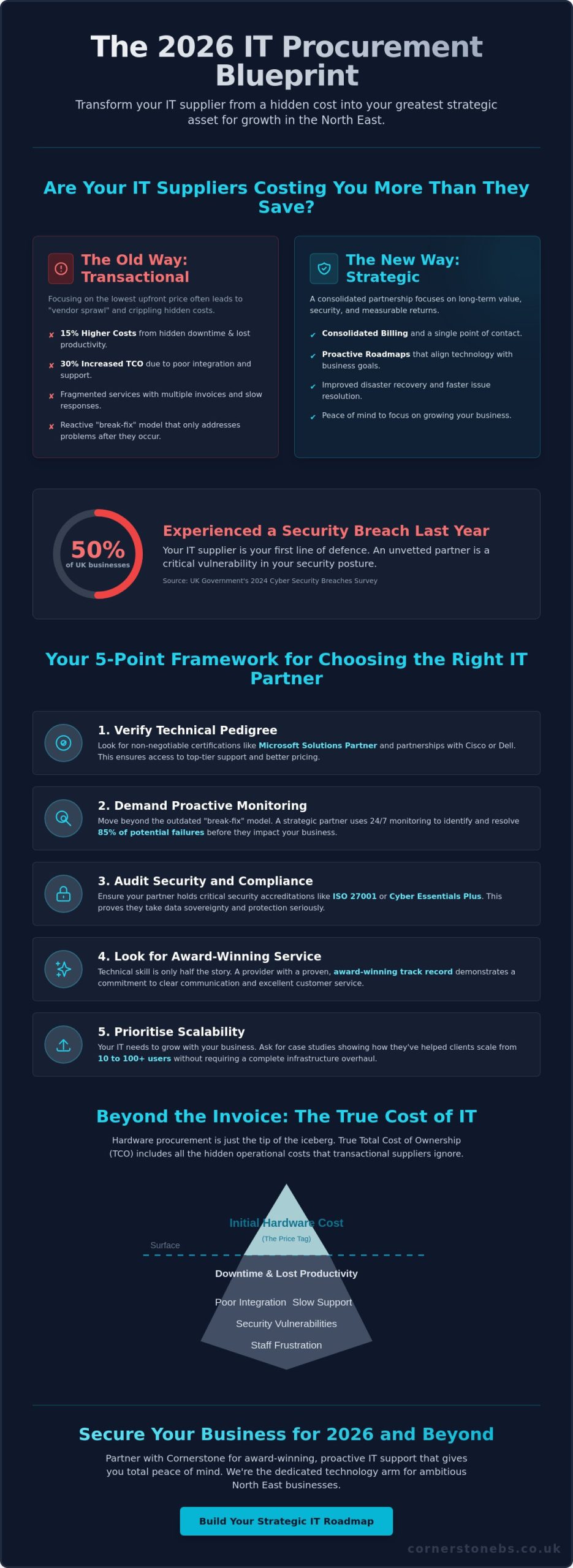
What if the it suppliers you hired to save you money are actually costing you 15% more in hidden downtime and lost productivity? You likely feel the frustration of chasing slow vendors or juggling five different invoices for services that don’t even talk to each other. Managing your technology shouldn’t feel like a second job. You want your systems to work so you can focus on growing your business here in the North East.
This guide will show you how to transform your procurement from a series of hardware transactions into a strategic partnership. We’ll teach you how to demand more than just a quick fix, focusing instead on consolidated billing and proactive roadmaps. According to the UK Government’s 2024 Cyber Security Breaches Survey, 50% of businesses experienced a breach last year; we’ll show you how to bake security into your supply chain. We are diving into the exact steps to secure award-winning support and the peace of mind your business deserves for 2026.
Key Takeaways
Learn why shifting from transactional resellers to strategic partners is essential for avoiding hidden costs and securing long-term growth.
Discover our 5-point decision framework for evaluating it suppliers based on technical certifications and proactive service level agreements.
Understand the Total Cost of Ownership (TCO) and why hardware procurement is only a small fraction of your technology investment.
Access a definitive 2026 procurement checklist to ensure your business benefits from integrated Microsoft MFA and reliable UK-based support.
Find out how partnering with an award-winning local expert provides the tailored technology and peace of mind your business deserves.
Understanding the IT Supplier Landscape in 2026
The UK technology market has transformed. By 2026, 84% of businesses rely on AI-driven workflows and hybrid cloud environments to stay competitive. Selecting it suppliers is no longer just a procurement task. It’s a strategic decision that dictates your business’s agility. At Cornerstone, we’ve seen that the most successful North East firms treat technology as a foundation, not an after-thought.
Many organisations still fall into the trap of the “lowest price” hardware model. They buy a device and hope for the best. This transactional approach often results in a 30% increase in long-term operational costs due to poor integration and unexpected downtime. A strategic partner looks beyond the initial invoice. They focus on how that hardware supports your growth over the next three years, ensuring every pound spent delivers a measurable return.
Manufacturers vs. Resellers vs. Managed Service Providers
Manufacturers like Dell or HP are ideal for massive, high-volume orders where you have an internal team to handle every bit of setup. Resellers work well for one-off hardware needs without any need for ongoing advice. However, for most UK SMEs, our award-winning managed service provider (MSP) model is the gold standard. We don’t just deliver a box; we provide a dedicated technology arm for your business. This proactive approach ensures your systems are robust and your team stays productive without the headache of managing the kit themselves.
The Shift Towards Consolidated Technology Solutions
Managing five different it suppliers for mobile, cloud, and hardware creates “vendor sprawl.” This fragmentation slows down your response times and complicates your billing. By the start of 2026, 68% of high-growth UK firms moved toward a single point of contact to eliminate these silos. A consolidated approach simplifies your supplier evaluation process and significantly improves disaster recovery times. When a crisis hits, you don’t want to be caught in a loop of different vendors blaming each other. You want one local expert who takes ownership and resolves the issue fast.
Our North East based team understands that technology should provide total peace of mind. We’ve evolved into solution integrators, blending the latest AI tools with human expertise to keep your business moving. It’s about a long-term partnership that simplifies the complex. We’re here to make sure your IT works as hard as you do, giving you the freedom to focus on what you do best. Let’s have a chat about how a consolidated strategy can protect your bottom line.
Evaluating IT Suppliers: A 5-Point Decision Framework
Selecting the right it suppliers is no longer just a procurement task; it’s a foundational business decision that dictates your agility for the next five years. By 2026, the gap between basic support and strategic partnership will widen significantly. You need a framework that filters out the noise and focuses on long-term stability. This five-point plan ensures your technology remains an asset rather than a bottleneck.
Step 1: Verify Technical Pedigree. Check for active Microsoft Solutions Partner status and high-level certifications from Cisco or IBM. These aren’t just logos; they represent a direct line to manufacturer support and early access to security patches.
Step 2: Demand Proactive Monitoring. The outdated break-fix model costs UK businesses thousands in lost productivity. Shift to a 24/7 proactive model where 85% of potential system failures are identified and resolved before they impact your staff.
Step 3: Audit Security and Compliance. Ensure your partner holds ISO 27001 or Cyber Essentials Plus. According to 2024 government data, 32% of UK businesses identified a cyber attack in the last year; your supplier must be your first line of defence.
Step 4: Look for Award-Winning Service. Technical skill is half the battle. A provider with a proven, award-winning track record in customer service will communicate clearly and respect your time.
Step 5: Prioritise Scalability. Your IT should expand as fast as your ambitions. A supplier must demonstrate how they’ve helped clients scale from 10 to 100 users without a total infrastructure rebuild.
Certifications and Industry Partnerships
Microsoft Solutions Partner status is a non-negotiable for UK businesses in 2026. It guarantees that the engineers managing your cloud environment are trained to the highest current standards. Tier 1 hardware partnerships are equally vital, often providing 15% better lead times and more competitive pricing on essential kit. Always verify credentials; checking for Cyber Essentials Plus or ISO 27001 ensures your it suppliers take data sovereignty as seriously as you do. These standards provide the peace of mind that your business remains compliant with evolving UK data laws.
SLA Transparency and Proactive Support
Modern business doesn’t sleep, so your support shouldn’t either. Moving beyond the “break-fix” mentality to a 24/7 proactive monitoring model means your systems are being optimised while you sleep. We recommend choosing a partner that offers unlimited helpdesk access. This creates predictable monthly budgeting and encourages your staff to report small issues before they become major disasters. A bespoke SLA is a tailored commitment to business uptime, ensuring that the most critical parts of your operation receive the fastest response times. If you want to see how a more reliable partnership feels, you can have a chat with our North East team about your specific goals.
Hardware Procurement vs. Managed IT Services
Buying a laptop is a simple transaction. Managing that laptop for four years is a strategic operation. Research from Gartner shows the initial purchase price of hardware accounts for only 20% of its total cost of ownership (TCO). The other 80% is swallowed by maintenance, support, and security updates. High-performing it suppliers look beyond the box. They focus on the entire lifecycle of your tech, from initial configuration to secure, eco-friendly recycling. At Cornerstone, our award-winning team ensures your hardware rollout is integrated with a Microsoft 365 migration for business UK right from the start. This means your team can log in and work immediately, without waiting for software updates or cloud syncing. Managed services provide a level of peace of mind that transactional retailers simply cannot match.
The Hidden Costs of Unmanaged Hardware
Security risks start the moment a device leaves the factory. “Out of the box” devices lack the custom imaging and hardened security profiles needed to protect UK businesses in 2026. Without a managed replacement plan, hardware failure leads to massive productivity losses. Industry data suggests unplanned downtime costs businesses an average of £4,000 per minute. We prevent this by keeping standby hardware ready for your team. Efficient Microsoft license management is another key factor. It prevents the common 30% overspend on unused software seats. We audit your usage monthly to ensure you only pay for what your staff actually use.
Bespoke Technology Roadmaps
Our approach is built on long-term strategy rather than quick sales. We create bespoke technology roadmaps that plan your hardware refresh cycles five years in advance. This allows you to align IT spend with your projected revenue growth, avoiding sudden, large capital outlays. We believe in conversation-led planning. You won’t be stuck in an automated ticket queue. You’ll have a direct line to our North East based experts who understand your specific goals. Reliable it suppliers act as your internal IT department, providing the stability you need to focus on running your business. We take pride in being a partner that looks ahead, ensuring your technology never becomes a bottleneck for your success. For businesses planning a move to the cloud, our Microsoft 365 migration for business UK strategy guide outlines exactly how to transition seamlessly while keeping your team productive from day one.
The 2026 IT Procurement Checklist for UK Businesses
Selecting the right partners requires a move beyond comparing price lists. In 2026, your technology stack must be a seamless extension of your operations. When vetting potential it suppliers, use this checklist to ensure they provide the robust foundation your business deserves.
Security Standards: Check for integrated Microsoft MFA as a non-negotiable setup requirement. Microsoft data shows that MFA blocks 99.9% of automated cyberattacks, making it your first line of defense.
Local Support: Verify a UK-based helpdesk. Our award-winning team knows that having on-site support availability in the North East provides peace of mind that a remote-only provider can’t match.
Resilience: Ensure cloud backup and disaster recovery are included in every hardware quote. Don’t treat data protection as an optional add-on; it’s a core necessity for business continuity.
Compliance: Confirm the supplier meets NIS2 requirements and UK GDPR standards. Since the NIS2 implementation deadline passed in October 2024, regulatory scrutiny on supply chains has intensified, making compliance a major business risk.
Security-First Procurement
Modern procurement means hardware arrives “secure by design.” Your supplier should configure devices before they reach your office, ensuring every laptop and tablet is encrypted and updated. Ask how they manage Endpoint Detection and Response (EDR). A proactive partner monitors these systems 24/7 to stop threats before they escalate. We recommend auditing a supplier’s internal security protocols. They should protect your data with the same intensity they protect their own.
Communication and Connectivity
A fragmented comms stack wastes time and money. Look for Microsoft Teams integration that bridges the gap between your office phones and digital workspaces. Evaluating it suppliers based on their ability to bundle business mobile and hosted VoIP into a single package is a smart move for 2026. Consolidating these services into a single monthly fee simplifies your accounts and ensures your technology works in harmony. It’s about creating a unified experience for your team and your customers.
Cornerstone: Your Award-Winning Strategic IT Partner
Choosing between different it suppliers often feels like a box-ticking exercise. At Cornerstone Business Solutions, we’ve spent years proving that it should be much more. We deliver bespoke technology solutions for a national client base, ensuring that every piece of hardware and software aligns with specific commercial goals. Our multi-award-winning team doesn’t just fix computers; we build the digital foundations that allow businesses to scale without friction. Since our inception in 2008, we’ve focused on a single mission: providing the technical edge our clients need to lead their industries.
Our approach centers on proactive maintenance. We don’t wait for your server to fail or your network to lag. Our engineers monitor systems 24/7, identifying potential vulnerabilities before they impact your bottom line. This commitment to exceptional customer service has earned us a reputation for reliability that goes far beyond the standard service level agreement. If you’re unsure if your current provider is keeping pace with the demands of 2026, booking a technology audit is the first step toward clarity. We’ll evaluate your current setup and show you exactly where improvements can be made.
Why a “Partnership” Beats a “Transaction”
Most it suppliers focus on the sale, but we focus on the relationship. Our “can-do” attitude means we’re always looking for ways to say “yes” to your growth plans. We take a genuine interest in your success because we know that when your business thrives, our partnership grows stronger. We pride ourselves on simplifying the complex. You won’t hear us hiding behind dense technical jargon; instead, we provide clear, expert advice that empowers business owners to make informed decisions. We provide the stability you need to focus on your core operations.
Expert Clarity: We translate complex cloud and security concepts into actionable business strategies that make sense for your budget.
Infrastructure for Growth: We design robust systems that handle increased workloads seamlessly as your company expands.
Regional Warmth, National Reach: We combine our proud North East roots with the technical capacity to support clients across the UK with equal efficiency.
Ready for a Better IT Experience?
It’s time to move past the frustration of reactive support and aging systems. Our comprehensive service range covers everything from seamless cloud migrations to iron-clad cyber security protocols. We’ve refined our processes over nearly two decades to ensure that your transition to a better IT experience is smooth and stress-free. Let’s have a chat about your future. Our expert team is ready to listen to your specific challenges and design a roadmap that works for you. You deserve an IT partner that is as invested in your business as you are.
Take the first step toward a more reliable, secure, and efficient business environment today. Our team is standing by to help you transform your technology from a cost center into a competitive advantage.
Navigating the shift toward 2026 requires more than just a vendor list; it demands a strategic alignment that turns technology into a growth engine. By applying our 5-point decision framework, you’ll move beyond transactional hardware purchases and into a model of sustained efficiency. The right it suppliers don’t just sell you boxes. They integrate themselves into your business fabric to ensure your infrastructure is robust and ready for the next decade of innovation.
At Cornerstone, we’ve built our reputation as a multi-award-winning IT service provider by focusing on your peace of mind. Our strategic partnerships with industry giants like Microsoft, IBM, and Cisco mean you get world-class solutions delivered with local North East care. You’ll benefit from proactive 24/7 monitoring and unlimited helpdesk support that keeps your team productive every hour of the day. We’re here to simplify the complex and help your business thrive.
What is the difference between an IT reseller and an IT supplier?
An IT reseller focuses on selling specific hardware or software products, while a comprehensive supplier provides end-to-end managed services and strategic support. As award-winning it suppliers, we move beyond simple transactions to act as your long-term technology partner. Resellers typically handle one-off sales; we focus on your business continuity and growth through tailored infrastructure solutions.
How do I know if my current IT supplier is providing value for money?
You’re getting true value when your system downtime remains below 1% and your technology actively improves staff productivity. Review your monthly reports to ensure your provider meets 99.9% uptime targets as specified in your Service Level Agreement. If you’re paying for reactive fixes instead of proactive maintenance that prevents issues, your current setup is likely costing you more in lost hours.
Should I use different IT suppliers for hardware, software, and support?
Consolidating your requirements with a single partner reduces administrative complexity and stops different vendors from blaming each other when problems occur. A unified approach ensures your hardware and software integrate seamlessly for maximum efficiency. Industry data indicates that businesses managing 3 or more separate vendors spend 20% more time on procurement tasks than those using a single strategic partner.
What certifications should I look for in a UK IT supplier?
Prioritise providers with ISO 27001 for information security and ISO 9001 for quality management systems. These certifications prove the company follows strict international standards for protecting your data. We also recommend choosing a Microsoft Solutions Partner, which requires the team to maintain 100% compliance with the latest technical exams and performance benchmarks set by Microsoft.
Can an IT supplier help with cyber security compliance like Cyber Essentials?
Yes, a proactive partner will manage the 5 technical controls required to achieve your Cyber Essentials certification. This government-backed scheme reduces your risk of a successful cyber attack by 80% when implemented correctly. We help you secure firewalls, manage user access, and ensure all critical security patches are applied within 14 days of their release to keep you protected.
How often should my IT supplier review my technology roadmap?
You should review your technology roadmap every 3 months during a formal Quarterly Business Review. This rhythm ensures your IT strategy stays aligned with your 2026 business goals and budget. Regular catch-ups allow you to plan hardware refreshes and adopt new software tools before your equipment becomes obsolete or your competitors gain a technical advantage.
Is it better to have a national or local IT supplier?
A local North East based supplier provides faster on-site response times and a genuine understanding of our regional economy. While national firms offer scale, they often lack the personal touch and accountability of a local partner. Being able to have a face-to-face chat about your business goals provides a level of peace of mind that a distant call centre simply cannot match.
What are the red flags to look for when choosing a new IT vendor?
Avoid it suppliers who demand long-term contracts without offering clear performance guarantees or transparent exit clauses. A 2023 industry survey found that 45% of UK businesses cited poor communication as their primary reason for switching providers. If a vendor uses overly complex jargon or fails to offer 24/7 proactive monitoring, they aren’t focused on your long-term success.
Did you know that technology failures and poor connectivity cost UK businesses an estimated £3.7 billion in 2023? It’s a staggering figure that proves how quickly outdated it hardware can turn from a vital tool into a significant drain on your bottom line. We understand that balancing the high upfront costs of new kit with the need for peak performance is a constant challenge for North East business owners.
You likely recognise the frustration of equipment that struggles to keep pace with modern cloud software or the worry that a sudden failure could halt your operations. As an award-winning team, we’re here to simplify these complexities and provide total peace of mind. This guide provides a clear path to selecting, managing, and scaling your infrastructure to ensure maximum productivity and long-term security. We’ll explore the essential equipment for 2026, a proven framework for evaluating ROI, and a proactive strategy to keep your business future-proof.
Key Takeaways
Understand why your physical infrastructure is the essential foundation for a successful cloud strategy and robust cyber security.
Identify the core it hardware stack required to keep your hybrid or remote workforce operating at peak efficiency in 2026.
Recognise the critical “tipping point” where upgrading your assets delivers a better ROI than continuing with costly maintenance.
Implement a security-first procurement process to ensure every new device integrates seamlessly into your business defence.
Discover how an award-winning strategic partnership simplifies procurement and brings long-term peace of mind to your North East business.
Navigating the IT Hardware Landscape for UK Businesses
IT hardware is no longer just a collection of physical devices sitting on a desk. In the lead-up to 2026, it represents the foundational engine that powers your entire digital ecosystem. Whether you are operating from Middlesbrough or managing a remote team across the North East, your it hardware choices dictate how effectively your cloud software performs and how resilient your cybersecurity defences remain. A fast cloud platform is useless if the local workstation lacks the processing power to run it. We view hardware as the physical gateway to your firm’s productivity.
The shift from reactive purchasing to proactive infrastructure planning is the defining trend for 2026. Many UK firms still wait for a laptop to fail before replacing it, but this approach creates hidden bottlenecks. Modern business success requires a strategy where Essential IT Hardware Components like NVMe storage, high-speed RAM, and encrypted chipsets are refreshed before they become liabilities. Our award-winning support starts by ensuring your team uses professional-grade tools that don’t quit when things get busy.
Why “Cheap” Hardware Costs More in the Long Run
Opting for retail-grade laptops might save £200 upfront, but the long-term data tells a different story. According to industry research, PCs older than four years can cost UK businesses upwards of £2,100 per year in lost productivity and maintenance fees. Consumer devices lack the robust build quality of enterprise machines, leading to shorter replacement cycles and increased e-waste. When a “cheap” device fails, the cost of an employee sitting idle for four hours often exceeds the initial savings. Professional hardware includes better warranties and specialised components designed for 24/7 reliability, ensuring your investment pays for itself through consistent uptime.
Hardware as the Anchor of Business Peace of Mind
Essential IT Hardware Components for the Modern Workplace
Building a robust hardware stack isn’t just about buying the latest gadgets. It’s about creating a foundation for long-term growth. For a North East business to thrive in 2026, the core stack must include high-performance workstations, secure networking gear, and resilient mobile devices. According to 2024 data from the Office for National Statistics, 44% of UK workers now operate in a hybrid model. This shift makes your choice of it hardware more critical than ever. High-performance workstations serve as the engine room for these teams, ensuring staff have the processing power to stay productive regardless of their physical location.
Laptops and Workstations: Finding the Sweet Spot
Networking and Connectivity: The Business Lifeline
Your network is the silent partner in your success. Using a consumer-grade router in a business environment is a significant security gamble that leaves your data vulnerable. These devices lack the advanced firewall features and VLAN capabilities needed to isolate guest traffic or protect sensitive financial information. Professional-grade managed switches and wireless access points provide the stability your team needs to function without interruption.
Reliable networking hardware is also essential for handling the heavy bandwidth requirements of modern cloud solutions. If your infrastructure can’t handle high-speed data transfers, your investment in cloud software won’t deliver the expected ROI. We focus on balancing portability with power, helping you select mobile devices that weigh under 1.5kg but still pack enough punch to handle complex data analysis. This proactive approach gives you total peace of mind. If you’re concerned your current setup is slowing you down, we’d love to have a friendly chat about your infrastructure.
RAM: 16GB minimum; 32GB for multitasking.
Storage: NVMe Gen5 SSDs for maximum throughput.
AI Ready: CPUs with integrated NPUs for local processing.
Connectivity: WiFi 7 compatible access points for future-proofing.
Evaluating Hardware Lifecycles and the ROI of Upgrading
Smart IT management isn’t just about buying the latest kit. It’s about knowing when to let go. Most business laptops serve their purpose for 3 to 4 years before performance begins to dip. Servers and networking gear usually offer more longevity, often reaching the 5 to 7-year mark. We see a clear “tipping point” when annual maintenance costs hit 50% of a new unit’s price. At this stage, your aging it hardware stops being an asset and starts being a drain on your bottom line. Many North East businesses are also discovering that running a virtual server environment can dramatically reduce physical hardware costs while improving resilience and scalability.
Standardising your equipment across the organisation brings massive financial benefits. It simplifies your support desk’s job and ensures every member of your team has the same user experience. You’ll reduce downtime and make training much faster. Prioritise your upgrades based on business impact. If a specific workstation handles your core accounts, it needs modern reliability more than a communal printing station does. This strategic approach ensures your budget goes where it matters most.
Repair vs. Replace: Making the Strategic Choice
Deciding when repairing laptop hardware makes sense requires a cold look at the numbers. A screen repair on a high-spec device that’s only 18 months old is a wise investment. However, you must avoid “zombie hardware.” These are older machines that still run but can’t support the latest security patches or TPM 2.0 requirements. They create massive holes in your perimeter. Our award-winning team uses proactive maintenance plans to extend equipment life, but we’ll always be honest about when it’s time to retire a device for your peace of mind.
Sustainable Hardware Management and E-waste
Responsible disposal is a legal necessity for UK firms. You must ensure data destruction is certified and follows WEEE regulations to protect your business from heavy fines. A structured replacement cycle improves your sustainability credentials and keeps your office green. Modern it hardware is significantly more energy-efficient than older models. Upgrading can reduce your operational energy costs by as much as 30% per workstation. This blend of environmental care and cost-saving is exactly how we help North East businesses grow. If you’re unsure where your kit stands, let’s have a chat about a hardware audit.
A Strategic IT Hardware Procurement Checklist
Procuring new it hardware shouldn’t be a reactive scramble. For North East businesses, a standardised approach ensures every laptop, server, and switch works in harmony. When you mix and match brands without a plan, you create a support nightmare that drains your internal resources. Consistency is the secret to lower overheads. Our award-winning team recommends a rigorous checklist to ensure your investment delivers for the next five years.
Standardised Specifications: Stick to a core set of configurations to simplify deployments and reduce helpdesk tickets by up to 25%.
Onsite Warranty Terms: Avoid “return to base” delays. Only accept next-business-day onsite support for critical business assets.
Service Integration: Confirm every device integrates with your managed IT services for proactive monitoring and patching.
Security at the Silicon Level
Security starts before you even install your first application. By 2026, software-only protection won’t be enough to stop sophisticated threats. You need hardware built with a “zero trust” mindset. Look for devices featuring TPM 2.0 chips as a minimum requirement for secure boot processes. Modern processors now include dedicated threat detection engines that spot ransomware patterns before they reach the operating system. Regular firmware updates are your second line of defence. They patch vulnerabilities at the physical layer, keeping your Teesside business safe from low-level attacks that traditional antivirus software might miss. We help you select hardware that makes security a physical reality, not just a software setting.
Future-Proofing for Cloud and AI Integration
The tech you buy today must handle the workloads of 2028. AI-ready hardware is no longer a luxury for UK firms; it’s a baseline requirement for staying competitive. Ensure your new machines feature dedicated Neural Processing Units (NPUs) to handle Microsoft 365 Copilot and Azure AI tasks locally. This reduces latency and keeps your data processing efficient. Scalability is equally vital. Choose hardware that allows for easy RAM or storage upgrades as your team grows. Our award-winning team often sees businesses forced into expensive upgrades because they chose rigid, non-expandable systems. Don’t let your it hardware become a bottleneck for your cloud ambitions. We’ll ensure your kit is ready for the future of the digital workplace.
Why Partnering with a Specialist Simplifies Hardware Management
Buying it hardware shouldn’t feel like a series of disconnected transactions. Many firms fall into the trap of reactive purchasing, only replacing a laptop or server when it finally gives up the ghost. This “firefighting” approach creates a fragmented environment where devices don’t talk to each other and maintenance costs spiral. Moving towards a strategic hardware partnership allows you to view your technology as a single, cohesive engine that drives your business forward. Exploring comprehensive it company solutions is the most effective way to move beyond reactive break-fix cycles and build a truly proactive technology strategy.
At Cornerstone Business Solutions, we’ve spent years refining a one-stop-shop approach. We handle everything from the initial procurement and setup to ongoing support and eventual decommissioning. As an award-winning provider with deep North East roots, we’ve built global partnerships with industry leaders like Dell, HP, and Microsoft. This gives your firm access to enterprise-grade technology and pricing that’s usually reserved for much larger corporations. We bring that global clout directly to your local office, ensuring your strategy is proactive rather than a desperate response to a breakdown.
Strategic Alignment: We match your hardware lifecycle to your three-year or five-year business plan.
Cost Efficiency: Consolidating your procurement reduces shipping costs and simplifies your accounting.
Expert Guidance: You benefit from a team that lives and breathes technology, so you don’t have to.
Seamless Implementation and Configuration
New kit is only an asset if it works from the moment it’s unboxed. Professional imaging and configuration are critical for immediate productivity. We ensure every device is pre-loaded with your specific software and security protocols before it reaches your desk. This removes the burden from your internal staff during large-scale rollouts. A 2024 study found that UK employees lose an average of 21 minutes per day to slow or poorly configured technology. Our setup process eliminates this lag, ensuring your team stays focused on their actual jobs.
Ongoing Maintenance and Peace of Mind
Proactive monitoring is the foundation of business continuity. We use advanced tools to identify potential it hardware failures before they cause a second of downtime. If a drive shows signs of wear or a fan starts to fail, we’re already on the case. You get a dedicated team for rapid troubleshooting and the reassurance that help is always just a phone call away. It’s about providing total peace of mind. Let us handle the complex technical details while you focus on growing your business. If you’re ready to simplify your setup, let’s have a chat about how we can support your firm.
Future-Proof Your Business Infrastructure
Your it hardware strategy dictates how effectively your team performs in an increasingly digital landscape. By 2026, the gap between businesses using legacy systems and those investing in modern, high-performance components will only widen. Focusing on hardware lifecycles and strategic procurement ensures your technology remains a tool for growth rather than a bottleneck. It’s about securing the best ROI while maintaining the seamless connectivity your staff expect. Modernising your setup reduces downtime and boosts employee morale across the board.
We’re ready to help you build a robust foundation for your future success.
Frequently Asked Questions
What is the most essential IT hardware for a small business in 2026?
The most essential it hardware for your small business includes AI-ready laptops equipped with Neural Processing Units (NPUs) and Wi-Fi 7 enabled networking gear. These devices handle the increased processing demands of 2026 software while ensuring your team stays connected at speeds up to 46 Gbps. Our award-winning team recommends investing in hardware that supports biometric security as standard to protect your local North East enterprise from evolving threats.
How often should a UK business replace its laptop fleet?
You should aim to replace your business laptops every three to four years to maintain peak efficiency. Performance typically degrades by 22% after the third year of heavy use, which directly impacts your staff productivity. Refreshing your fleet on this cycle ensures your team benefits from the latest battery technology and security patches. It’s a proactive way to avoid the sudden costs associated with hardware failure.
Is it better to lease or buy business IT hardware?
Leasing is often the superior choice for UK firms wanting to preserve cash flow and access the latest technology. Under current HMRC Full Expensing rules, companies can claim 100% capital allowance on qualifying plant and machinery investments in the first year. Leasing provides a predictable monthly cost and simplifies your upgrades. We often find a partnership approach to leasing helps local businesses scale without the burden of large upfront costs.
How does hardware impact our overall cyber security posture?
Your hardware serves as the foundation of your security because modern threats often target vulnerabilities below the operating system. Secure it hardware features like TPM 2.0 chips and hardware-level encryption prevent unauthorised access even if a device is stolen. Statistics show that 80% of successful data breaches involve older hardware that lacks these modern silicon-level protections. Upgrading your physical kit is a vital step in building a robust defence.
What is Hardware as a Service (HaaS) and is it right for us?
Hardware as a Service is a subscription model where you pay a fixed monthly fee for all your equipment, maintenance, and support. It’s an excellent fit for North East businesses that want to eliminate the headache of technical obsolescence and unexpected repair bills. This model turns your IT spend into a manageable operating expense. You’ll always have the latest kit, backed by our proactive support, giving you total peace of mind.
Can I use consumer-grade hardware for my business to save money?
You shouldn’t use consumer-grade kit because it lacks the durability and professional support required for a commercial environment. Business-grade machines are built to run for 40 hours or more per week and typically include three-year on-site warranties. In contrast, consumer laptops often come with basic one-year “return to base” cover. Choosing professional hardware reduces your downtime and provides a much better return on investment over the life of the device.
What should I do with old business hardware that is no longer needed?
You must dispose of old kit through a provider that complies with the UK WEEE Regulations 2013 and offers certified data destruction. Simply deleting files isn’t enough to protect your business data from recovery. We recommend a process that includes physical shredding or industrial-grade wiping of hard drives. This ensures your business stays GDPR compliant while preventing environmental harm from electronic waste in our local community.
How do I know if my current hardware is compatible with Windows 11 or newer?
Your hardware must have a TPM 2.0 chip and a compatible processor, which generally includes Intel 8th Gen or AMD Ryzen 2000 series and newer. Microsoft will end support for Windows 10 on 14 October 2025, making this check critical for your business continuity. You can use the PC Health Check app to verify your current fleet, or follow our step-by-step Windows 11 upgrade guide for businesses to ensure you’re ready for the transition. If you’re unsure, let’s have a chat about auditing your systems to ensure you’re ready for the transition.