
What if the biggest threat to your North East business in 2026 isn’t a competitor, but the operating system your team uses every single day? You likely know that Windows 10 reached its official end of life on 14 October 2025, yet many organisations still feel the pressure of that transition. It’s natural to worry about legacy software breaking or the potential for costly downtime during a windows 11 upgrade. We understand that your priority is keeping your team productive and your data secure without unnecessary headaches.
As an award-winning IT partner, we believe technology should empower your growth rather than create hurdles. We’ve designed this comprehensive guide to give you total peace of mind during your migration. You’ll learn how to navigate hardware requirements and secure your infrastructure without the risk of system failures. We’ll walk you through a proven, step-by-step process to modernise your workplace while keeping your daily operations completely undisrupted.
Key Takeaways
- Understand why the 2026 Windows 10 end-of-life makes a windows 11 upgrade a critical security necessity rather than just a cosmetic update.
- Navigate the non-negotiable TPM 2.0 hardware requirements and learn why this “chip-to-cloud” security is vital for protecting your business data.
- Discover a secure step-by-step migration roadmap, from essential system backups to auditing your line-of-business software for total compatibility.
- Evaluate the ROI of repairing existing hardware versus replacing it, ensuring you make the most cost-effective decision for your firm’s budget.
- Learn how an award-winning proactive approach can provide the peace of mind needed to transition your entire team without the risk of downtime.
Why Upgrading to Windows 11 is Critical for Business in 2026
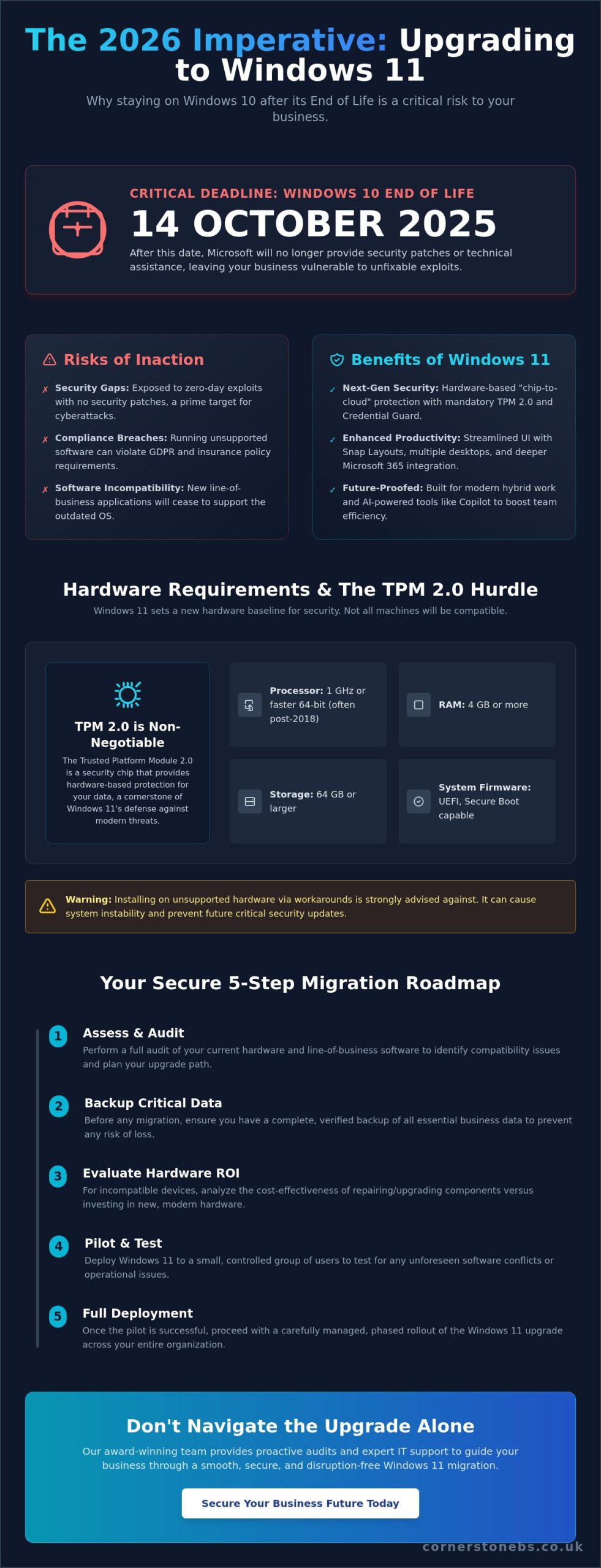
By 2026, the grace period for legacy systems has officially ended. Microsoft retired Windows 10 on 14 October 2025, meaning any business still running the older OS is now operating without a safety net. This windows 11 upgrade isn’t a cosmetic choice or a simple UI refresh. It’s a fundamental security mandate for any UK firm that values its data. Operating on an unsupported system in 2026 leaves your entire network open to zero-day exploits that will never receive a patch. We’ve seen how quickly vulnerabilities are exploited once official support vanishes. This Windows 11 overview details the foundational hardware shifts that make this new level of protection possible.
Staying on legacy systems doesn’t just invite hackers; it kills your compliance status. For businesses handling sensitive client information, running end-of-life software often breaches insurance requirements and industry regulations like GDPR. Our award-winning team at Cornerstone knows that proactive migration is the only way to maintain peace of mind. We don’t just look at the software; we look at how modern it company solutions integrate with your OS to drive performance. A seamless transition ensures your team stays protected while benefiting from a system built for the 2026 threat landscape.
The Security Advantage: Beyond the Interface
Windows 11 shifts the security baseline by mandating TPM 2.0 hardware. This creates a hardware-based root of trust that’s much harder for malware to bypass than software-only solutions. UK firms benefit from enhanced phishing protection and Credential Guard, which isolate secrets so only privileged system software can access them. These features are vital for preventing the credential theft that leads to most modern data breaches.
End of Life definition: In the context of OS support, End of Life marks the point where a developer stops providing security patches and technical assistance, creating significant business risk through unfixable system vulnerabilities.
Productivity Gains in a Hybrid World
Efficiency is the engine of any North East business. Windows 11 introduces snap layouts and multiple desktops that allow your staff to tailor their workspace for specific tasks. This reduces the cognitive load of switching between apps. Integration with Microsoft 365 is now deeper and more intuitive, ensuring your cloud tools and local files work in total harmony.
In 2026, AI is no longer a futuristic concept but a daily tool. Copilot is baked directly into the Windows 11 ecosystem to help your team automate routine admin and find information faster. This windows 11 upgrade gives your staff the tools they need to stay competitive in a fast-moving market. We’re here to help you make the switch smoothly, acting as your long-term partner rather than just a one-off service provider. Let’s have a chat about how we can secure your business future today.
Understanding Hardware Requirements and the TPM 2.0 Hurdle
Upgrading your business fleet isn’t just about clicking a button anymore. Microsoft set a higher bar for the windows 11 upgrade to ensure your data stays safe. Every machine in your office needs a compatible 64-bit processor, at least 4GB of RAM, and 64GB of storage. You can find the full list of minimum hardware requirements on the official Microsoft documentation site. While these specs seem modest, the processor compatibility list is strict, often excluding CPUs released before 2018.
The real sticking point for many North East firms is the TPM 2.0 requirement. This Trusted Platform Module is a dedicated chip on the motherboard that handles cryptographic keys. It provides “chip-to-cloud” security, protecting user identities and sensitive data at the hardware level. Since 2025, cyber threats have become more sophisticated; this hardware-based security is now a non-negotiable layer of protection for your business continuity.
Don’t guess which machines are ready for the transition. Use the PC Health Check app to scan your devices individually. If you’re managing a larger fleet across multiple sites, our award-winning team can perform a proactive audit to map out your migration path. We’ve seen some users attempt workarounds to install Windows 11 on unsupported hardware. We strongly advise against this. These “hacks” often result in system instability and, more importantly, may prevent your systems from receiving critical security updates. For a professional environment, the risk to your data isn’t worth the temporary cost saving.
The Role of UEFI and Secure Boot
Legacy BIOS served the industry well for decades, but it lacks the security features needed for 2026’s threat environment. Windows 11 requires Unified Extensible Firmware Interface (UEFI) and Secure Boot. This technology ensures your PCs only boot using software trusted by the manufacturer. It effectively blocks rootkits and boot-level malware from hijacking your system before the antivirus even loads. Check our ultimate business IT hardware guide for a deeper look at the specs that drive performance.
Virtualisation and Modern Infrastructure
Windows 11 relies heavily on hardware virtualisation to isolate sensitive OS functions from potential attacks. This is a game-changer for remote teams who need to access company resources securely from various locations. If you’re running older hardware, you might find that enabling these features impacts system speed. For those managing older on-site hardware, it’s helpful to understand what is a virtual server and how modern infrastructure supports your OS migration. If you’re worried about your hardware’s lifespan, chat with our local experts to find a tailored solution.
Step-by-Step: How to Perform a Secure Windows 11 Upgrade
Upgrading your fleet isn’t just about clicking a button; it’s about protecting your business continuity. At Cornerstone, our award-winning team follows a strict protocol to ensure your windows 11 upgrade is seamless and secure. We focus on getting it right the first time so your staff stay productive.
Step 1: Secure your data. Never start a migration without a full system backup. We recommend an off-site, encrypted copy of all critical files. If the power fails or a hardware glitch occurs during installation, you need a way to roll back instantly without losing a single invoice or client record.
Step 2: Audit your software stack. Check that your line-of-business applications are fully compatible. While 99.7% of Windows 10 apps work on the new OS according to Microsoft, that 0.3% could include your bespoke CRM or legacy accounting software. Verify this with your vendors before you commit.
Step 3: Choose your deployment route. Small offices might use the Installation Assistant for a single machine. Larger North East firms usually require ISO files or managed deployment tools to handle multiple machines simultaneously. This ensures every device receives the same configuration and security baseline.
Step 4: Time the execution. Run your upgrades during off-peak hours. A typical windows 11 upgrade can take between 30 minutes and two hours depending on the hardware. Schedule this for an evening or weekend to avoid stopping your team mid-task and losing billable hours.
Step 5: Conduct a post-migration audit. Once the desktop appears, the job isn’t done. Verify that drivers for specialist hardware are active, security settings like BitLocker are engaged, and user access permissions remain intact. This final check provides the peace of mind that your “new” machines are just as secure as the old ones.
Pre-Migration Checklist for UK SMEs
Success lies in the details. Before you start, verify these three critical factors to avoid common pitfalls:
- Bandwidth check: Each download is roughly 4GB or more. If you’re upgrading ten PCs on a standard 30Mbps connection, your office internet will crawl. Plan for staggered downloads or use a local distribution point.
- Administrator rights: You’ll need full local admin permissions to change the OS. Ensure your IT lead or partner has these credentials ready before starting the process.
- Peripheral compatibility: Don’t assume your five-year-old plotter or label printer will just work. Check the manufacturer’s website for Windows 11 drivers today.
Managed vs. Manual Deployment
Manual upgrades are risky for any North East business with more than 5 devices. Handling each machine individually leads to “version drift,” where different PCs run different updates. This makes troubleshooting a nightmare for your support team and leaves gaps in your cybersecurity.
Our proactive approach uses Remote Monitoring and Management (RMM) tools. This technology lets us push the update to your entire fleet at once from our local base. It ensures every laptop in your company is on the same version, providing a uniform security posture across the whole organization. We view this as a partnership, ensuring your technology supports your growth rather than slowing it down.
The ROI Dilemma: Repairing Hardware vs. Replacing for Windows 11
Deciding whether to patch up your current fleet or invest in new kit is the biggest hurdle for a successful windows 11 upgrade. By 2026, many North East businesses will face the “TPM 2.0 wall.” This security requirement is non-negotiable. If your processors date back to before 2018, Microsoft simply won’t let you install the OS. You’re looking at a hard ceiling where “making do” isn’t just frustrating; it’s a security risk. Our award-winning team often sees firms trying to squeeze life out of 2019-era machines, only to find the cost of downtime far exceeds the price of a new device.
The hidden costs of aging hardware are silent profit killers. Battery degradation alone can drop mobile productivity by 30% for field-based staff. Relying on legacy hardware creates a productivity tax that costs UK businesses approximately £2,700 per employee every year in wasted wait times. We recommend a phased hardware refresh to spread these costs. By replacing 25% of your oldest machines every quarter, you balance your cash flow while ensuring your migration stays on track for the October 2025 Windows 10 end-of-life deadline.
When to Repair Existing Laptops
Repairing is a smart move if your device is under 3 years old and already houses a compatible CPU. A simple RAM boost to 16GB or a fresh NVMe SSD can make a 2023 model feel brand new for a fraction of the cost of a replacement. This approach also supports your ESG goals. Extending hardware life reduces e-waste, which is a growing priority for businesses across the UK. Read our guide on repairing vs replacing laptop hardware for a full ROI breakdown.
The Case for a Clean Start with New Hardware
New hardware delivers immediate peace of mind through manufacturer warranties. This drastically reduces helpdesk tickets, as our local support team spends less time fixing hardware failures and more time on proactive strategy. Modern 2026-spec laptops are also roughly 40% more energy-efficient than 2020 models. This lowers your office energy bills and supports a more mobile workforce. A seamless transition to new devices ensures your team stays happy and focused on growth.
Navigating Your Business Transition with Cornerstone’s Expert Support
A successful windows 11 upgrade shouldn’t keep you awake at night. At Cornerstone Business Solutions, we provide a peace of mind approach that turns a complex technical shift into a smooth business improvement. Our North East team takes full ownership of the process, acting as your dedicated long term partner rather than a one-off contractor. We understand that every hour of downtime costs your business money, so we focus on proactive stability.
Our award-winning proactive monitoring tools are central to this strategy. We don’t wait for things to break; we identify hardware and software compatibility issues before they reach your end users. By 2026, legacy systems will face increased security risks, making this foresight vital. We build bespoke technology solutions that align your new OS environment with your specific industry requirements, whether you’re in manufacturing, finance, or retail. This tailored fit ensures your team has the exact tools they need from day one.
Seamless Migration with Zero Downtime
We eliminate the risk of operational paralysis through our night-shift deployment strategy. Our engineers perform your windows 11 upgrade while your office is empty, ensuring your team arrives to fully functional workstations. We back this with a total data integrity guarantee. Every file, email, and database remains secure and accessible throughout the transition. To bridge the gap between the old and new, we provide hands-on user training. We help your staff master the new interface quickly, turning potential frustration into immediate productivity gains.
- Night-Shift Deployment: Upgrades completed outside of your core business hours.
- Data Integrity: Tiered backup protocols to prevent any loss of company information.
- Interface Training: Guided sessions to familiarise staff with the new Windows 11 layout.
Ready for a Modern Business Environment?
The 14th of October 2025 marks the end of support for Windows 10, making 2026 the critical year to finalise your digital transformation. Staying on unsupported software leaves your business vulnerable to cyber threats that cost UK SMEs an average of £4,200 per attack. Cornerstone simplifies this transition by managing your licensing, hardware procurement, and comprehensive cyber security audits. We ensure your infrastructure is robust enough to handle modern demands. We’d love to help you plan your next steps. Let’s have a chat about your specific migration roadmap and how we can support your growth.
Our Migration Support Includes:
- Full hardware compatibility audits across your entire fleet.
- Procurement of Windows 11 ready devices at competitive UK rates.
- Strategic licensing reviews to reduce unnecessary software spend.
- Post-migration support from our local, award-winning service desk.
Secure Your Business Success Beyond 2025
The October 14, 2025, end-of-life date for Windows 10 isn’t just a technical milestone; it’s a firm deadline for your business continuity. Navigating a windows 11 upgrade requires a proactive approach to hardware audits and TPM 2.0 requirements to avoid sudden capital expenditure or security vulnerabilities. By planning your migration now, you turn a potential IT headache into a competitive advantage through faster performance and robust, modern features.
At Cornerstone, we’re more than just a multi-award-winning IT services provider. As a Microsoft Gold Partner with deep North East roots, we act as your long-term partner to simplify complex transitions. Our team provides proactive 24/7 system monitoring, ensuring your move to new infrastructure is seamless and secure. We’ll help you decide whether to repair or replace, keeping your budget on track while delivering total peace of mind. Let’s have a chat and get your migration moving today.
Book a free IT migration consultation with our award-winning team
Frequently Asked Questions
Is the Windows 11 upgrade still free for businesses in 2026?
Yes, your Windows 11 upgrade remains free for eligible business devices already running a genuine version of Windows 10. Microsoft hasn’t set an official expiry date for this transition yet. You’ll simply need to ensure your hardware meets the minimum specifications. Our award-winning team suggests checking your fleet early to avoid the rush. It’s a straightforward way to keep your North East business secure without extra licensing costs.
What happens if I continue to use Windows 10 after the 2026 deadline?
You’ll stop receiving free security patches and technical support because Microsoft ended standard support on 14 October 2025. Running unsupported software exposes your business to 3x higher cyberattack risks according to industry data. You can pay for Extended Security Updates (ESU), which start at approximately £50 per device for the first year. However, this is a temporary fix. Upgrading ensures your systems stay robust and compliant.
Can I downgrade back to Windows 10 if my business apps don’t work?
You have a 10-day window to roll back to Windows 10 while keeping your files and data. This built-in recovery feature allows you to test critical software without risk. If you miss this 10-day period, a clean installation is required to go back. We recommend testing your bespoke business apps on a single machine first. Our proactive approach ensures your peace of mind before a full rollout across your office.
How long does the Windows 11 installation actually take for a standard office PC?
A standard installation typically takes between 30 and 60 minutes on a modern office PC with an SSD. This timing excludes the initial download, which depends on your local North East internet speeds. You can continue working while the update downloads in the background. We schedule these updates out of hours for our partners to ensure zero downtime. It’s an efficient way to modernise your workspace without disruption.
Do I need to buy new Microsoft 365 licenses when I upgrade to Windows 11?
No, your existing Microsoft 365 subscriptions carry over seamlessly to your new operating system. Windows 11 is designed to integrate with your current Business Standard or Premium plans without any price hikes. You’ll gain better performance in apps like Teams and Outlook. We help local firms manage these licenses to ensure you’re getting the best value. Your digital tools will feel faster and more reliable after the switch.
Will Windows 11 slow down my older business laptops?
Your laptops won’t slow down if they meet the 8th Gen Intel or AMD Ryzen 2000 processor requirements. Windows 11 actually manages memory 20% more efficiently than its predecessor. This means your apps wake from sleep faster and respond more quickly. If your hardware is older than 2018, it might struggle or fail the compatibility check. We’ll provide a tailored audit of your current kit to ensure everything stays fast.
What is the ‘Installation Assistant’ and is it safe for business use?
The Installation Assistant is an official Microsoft tool designed for manual upgrades on individual PCs. It’s safe for small businesses, but we don’t recommend it for larger fleets. Manually updating 20 or 30 machines is time-consuming and prone to human error. For a more robust solution, use managed deployment tools. Our award-winning experts prefer a centralised approach to keep your North East operations running smoothly and securely.
How do I check if my PC has a TPM 2.0 chip enabled?
Press the Windows Key + R, type “tpm.msc”, and hit enter to see your status. You’ll see “Specification Version: 2.0” if your device is ready for the windows 11 upgrade. If it says “Compatible TPM cannot be found,” it might just be disabled in your BIOS settings. Most business-grade PCs built after 2018 include this chip as standard. We can help you verify this across your entire network for total confidence.
Tags: business IT, IT Security, OS Migration, TPM 2.0, Windows 10 End of Life, Windows 11, Windows 11 Upgrade