Did you know that 65% of medium-sized UK businesses reported a cyber breach in the last year? It’s a sobering figure that highlights why a professional business cyber security audit is no longer just a “nice to have” for your peace of mind. With the Cyber Security and Resilience Bill 2026 now in full effect, the pressure to prove your security measures to insurers and regulators has never been higher. We understand that staring down complex compliance jargon and the fear of a devastating data leak can feel overwhelming for any local business owner.
You probably already know that your digital assets are the lifeblood of your company, yet finding the time to check every lock and bolt on your virtual doors is difficult. We’re here to simplify that process. This guide explains how a professional audit identifies hidden vulnerabilities and provides a clear, strategic roadmap to protect your reputation. You’ll discover the specific steps to achieve compliance with UK regulations, understand the realistic costs for SMEs, and learn how to turn security gaps into a rock-solid foundation for growth.
Key Takeaways
Understand why the 2026 landscape requires moving beyond basic antivirus to a full digital health check that supports long-term business continuity.
Learn how to identify gaps in your “digital front door” and secure your internal network against threats that bypass initial defences.
Discover why a professional business cyber security audit provides the independent validation needed to satisfy UK insurers and maintain client trust.
Get a step-by-step preparation plan, including how to identify your “Crown Jewels”: the critical data your business cannot survive without.
Master the “Traffic Light” system to prioritise security risks and turn your audit report into a living roadmap for stability and growth.
Why Every UK Business Needs a Cyber Security Audit in 2026
Think of a business cyber security audit as a comprehensive health check for your company’s digital nervous system. It isn’t just a quick scan of your antivirus software. It’s a deep, professional review of your entire infrastructure, your staff’s habits, and your data handling processes. In 2026, the digital world moves faster than ever. Basic security measures that worked two years ago are now easily bypassed by modern threats. If you aren’t looking for the cracks in your floorboards, someone else certainly will.
The introduction of the Cyber Security and Resilience Bill 2026 has shifted the goalposts for every UK business owner. You’re now operating in an environment where mandatory incident reporting is the norm and regulatory scrutiny is at an all-time high. Beyond legalities, a professional audit is your ticket to the big table. Most high-value contracts and professional insurers now require proof of a robust security posture before they’ll even consider a partnership. We see this as an opportunity to move from a defensive crouch to a position of strength.
Moving Beyond Compliance to Business Resilience
Ticking a box for GDPR or Cyber Essentials is a great start, but it isn’t the same as being truly resilient. Compliance tells you what you must do; an audit tells you what you can do to thrive. When your clients know their data is handled by a multi-award-winning level of care, their trust in your brand grows. This reliability becomes a foundational element of your business growth. A secure infrastructure doesn’t just stop attacks. It provides the stable platform you need to scale without the constant fear of a catastrophic setback.
The Cost of Inaction vs. The Value of Prevention
According to the GOV.UK Cyber Security Breaches Survey 2025/2026, 43% of UK businesses experienced a breach or attack in the last 12 months. For those who haven’t prepared, the fallout often includes expensive emergency IT spend and significant downtime. We believe that proactive audits are far more cost-effective than reactive firefighting. By identifying vulnerabilities early, you avoid the hidden costs of lost productivity and damaged reputations. More importantly, it gives you the emotional security of knowing your business is protected by experts who treat your systems with the same care as their own. It’s about protecting your livelihood and the community you serve.
The Core Components of a Comprehensive Security Assessment
A thorough business cyber security audit covers every angle of your operation. It isn’t just a technical checklist; it’s a holistic review. We start at your “digital front door” with external perimeter testing. This identifies gaps in your firewalls or web servers that an attacker might exploit from the outside. But we don’t stop there. Internal network analysis examines what happens if a threat actually gets inside your system. We look at how easily a virus or intruder could move through your folders and databases once they’ve bypassed your initial defences.
Technical Vulnerability Scanning and Penetration Testing
Automated tools are excellent for catching “low-hanging fruit” like outdated software or weak credentials. However, they lack the intuition of a human expert. Our cyber security services combine these automated scans with manual penetration testing. This means we think like a hacker to find the complex vulnerabilities that software alone misses. It’s about proactive system monitoring that keeps you one step ahead of 2026’s evolving threats. If you’re unsure where your biggest risks lie, it might be time for a friendly chat with our local security experts.
User Access and Identity Management
Internal vs. Professional Audits: Choosing the Right Depth
Choosing between a DIY approach and a professional business cyber security audit often comes down to the level of risk you’re willing to accept. Many growing firms start with basic “DIY” security checklists found online. While these are better than nothing, they rarely go deep enough to satisfy modern requirements. A checklist might tell you to change your passwords, but it won’t tell you if your encrypted backups are actually recoverable after a ransomware attack. Relying solely on internal checks often creates a false sense of security.
There is also the “Conflict of Interest” problem to consider. It’s difficult for an internal IT team to audit their own work with total objectivity. They might overlook a configuration error they made six months ago because they’ve grown accustomed to the system’s quirks. Professional auditors bring a fresh, independent perspective. This third-party validation is now a strict requirement for many UK insurers in 2026. Without an external certificate or report, you might find your premiums skyrocketing or your coverage denied entirely when you need it most.
When to Opt for a Bespoke Security Audit
If your business handles sensitive client data in the legal, financial, or educational sectors, a standard off-the-shelf package isn’t enough. You need a bespoke assessment that accounts for your specific regulatory landscape. We often see businesses outgrow their initial security setups as they scale. This is where managed IT services become invaluable. By integrating ongoing security into your daily operations, you ensure that your infrastructure remains resilient between formal audit periods. It’s about building a long-term partnership rather than just ticking a box once a year.
The ROI of Professional Expertise
The true value of a professional audit lies in identifying “logic flaws” that automated tools simply miss. A scanner might see a secure server, but an expert auditor will notice if the process for granting access to that server is fundamentally broken. You don’t just get a list of problems; you receive a prioritised Action Plan. We use our award-winning expertise to simplify these complex technical findings into clear, jargon-free steps. This allows you to focus your budget on the most critical gaps first. It turns a technical necessity into a strategic roadmap for your business stability and emotional peace of mind.
How to Prepare Your Infrastructure for a Security Audit
Preparation shouldn’t be a source of stress. It’s simply about giving the auditing team the clearest possible map of your digital territory. Start by collating your existing IT policies and network diagrams. If these documents are currently missing or outdated, don’t worry. A business cyber security audit often provides the perfect opportunity to build these essential records from scratch. Next, identify your “Crown Jewels”. This refers to the specific data your business simply cannot survive without, such as your client database, financial records, or proprietary designs. Knowing exactly what matters most allows us to prioritise your defences where they are needed most.
You should also notify your key stakeholders well in advance. Ensure your IT lead or office manager is available to answer questions during the process to avoid delays. Finally, perform a quick physical audit of your premises. Make sure all hardware, from your main server racks to those forgotten laptops tucked away in a cupboard, is accounted for and physically accessible to the auditor. This transparency ensures nothing is missed during the assessment.
Documentation and Access Requirements
Modern UK businesses rely heavily on the web to stay competitive. Create a comprehensive list of every cloud service and third-party software provider your team uses daily. In 2026, cloud solutions require a specific security focus. Since your data often lives outside your physical office, we must verify that these providers meet your resilience standards. We’ll need administrative access to these platforms to check your permission settings and encryption levels. Having these logins ready ensures the process moves quickly, which respects both your time and your budget.
Setting Clear Objectives for the Audit
Every organisation has different priorities. What does success look like for you? Perhaps you’re facing pressure from insurers to prove your security, or maybe you’re aiming for a high-value contract that requires Cyber Essentials Plus. Communicate these goals and your biggest security fears to your auditor upfront. We always foster a “no-blame” culture. The goal isn’t to point fingers at past mistakes or technical oversights. We’re here as your dedicated long-term partner to identify gaps and build a stronger, more secure future for your company. If you’re ready to protect your reputation and assets, talk to our local security experts about your next steps.
Turning Audit Results into a Proactive Security Strategy
Receiving your final report is just the beginning of your journey toward true resilience. We use a clear “Traffic Light” system to help you make sense of the findings without the headache of technical jargon. Critical (Red) risks require immediate action to prevent an imminent breach. High and Medium (Amber) risks are significant but allow for planned remediation over the coming weeks. This prioritised approach ensures you don’t feel overwhelmed by a long list of tasks. Instead, you get a clear, manageable path forward that respects your time and your budget.
Think of your business cyber security audit report as a living document for your business strategy. It shouldn’t sit in a drawer gathering dust. It’s a powerful tool you can use to justify IT budget requests or necessary infrastructure upgrades to your stakeholders. When you have hard data showing exactly where your vulnerabilities lie, it’s much easier to secure the investment needed for modern hardware. It moves the conversation from “we might need this” to “we definitely need this to stay safe.” We believe that a secure business is a stable business, and this report is your blueprint for that stability.
Building a Roadmap for Remediation
We always recommend starting with “Quick Wins” to lower your risk profile immediately. These are often high-impact changes, such as enforcing stricter password policies or closing unused network ports, that don’t require a massive financial investment. These findings should feed directly into your broader it company solutions plan. To maintain a high security posture, we suggest establishing a cycle of “micro-audits” throughout the year. These smaller, regular checks ensure that new devices or staff members don’t accidentally introduce fresh gaps into your system between major assessments.
Partnering for Long-Term Resilience
Managing post-audit upgrades is much easier with a dedicated IT partner by your side. We don’t just hand over a report and walk away; we act as an extension of your own team. We’re here to help you implement the changes and provide the reassuring, proactive support you need to thrive. If a threat does emerge in the future, you’ll have the confidence that your systems are robust and your local experts are ready to act. We pride ourselves on being more than a service provider. We’re a part of your business continuity. We invite you to have a friendly conversation with our team to see how we can transform your audit data into a rock-solid foundation for growth.
Securing Your Digital Future with Confidence
A business cyber security audit is far more than a technical hurdle; it’s a strategic investment in your company’s longevity. By moving beyond basic compliance and identifying your most critical digital assets, you create a rock-solid foundation for growth. You’ve seen how professional validation satisfies insurers and how a clear roadmap turns overwhelming risks into manageable tasks. It’s about replacing the fear of the unknown with the peace of mind that comes from expert preparation. We believe every local business deserves to operate without the constant shadow of a digital threat.
As a multi-award-winning IT provider trusted by businesses across the UK, we’re proud to be strategic partners with Microsoft and Cisco. We don’t just find gaps; we build long-term partnerships that keep your systems resilient and your reputation intact. Our team is ready to help you navigate the complexities of 2026 with clarity and regional warmth. We invite you to book a conversation with our security experts today. Let’s work together to ensure your business remains secure, stable, and ready for whatever comes next.
Frequently Asked Questions
How long does a business cyber security audit typically take?
A standard business cyber security audit typically takes between one and two weeks to complete. This timeframe includes the initial information gathering, technical testing, and the final report delivery. For larger organisations with complex cloud infrastructure, it might take slightly longer. We work efficiently to ensure you receive your strategic roadmap quickly. This allows you to address any gaps without unnecessary delays to your daily operations or your team’s schedule.
Will an audit cause downtime for my staff or customers?
A professional audit is designed to be non-disruptive, so your staff and customers shouldn’t experience any downtime. We perform technical scans and network analysis in the background while your team continues their work. If we need to test specific systems that carry a minor risk of interruption, we’ll always schedule these at a time that suits your business. Our goal is to enhance your security without hindering your current productivity or reputation.
What is the difference between a vulnerability scan and a full security audit?
A vulnerability scan is an automated tool that looks for known technical weaknesses, whereas a full business cyber security audit is a comprehensive human-led review. The audit includes manual penetration testing, policy reviews, and an assessment of your staff’s security awareness. While scans are useful for regular checks, only a full audit provides the deep strategic insight needed to protect your assets. It identifies the complex logic flaws that automated software often misses.
Do small businesses really need a professional security audit?
Small businesses are often primary targets because they frequently have weaker defences than larger corporations. According to the GOV.UK Cyber Security Breaches Survey 2025/2026, 42% of micro businesses and 46% of small businesses identified a breach in the last year. A professional assessment ensures you aren’t an easy target for attackers. It provides the same level of protection used by global brands, scaled perfectly to fit your specific needs and budget.
How often should my business undergo a cyber security assessment?
Can a security audit help reduce my business insurance premiums?
Yes, many UK insurers now offer lower premiums to businesses that can demonstrate a proactive approach to security. By providing an independent audit report, you prove to your insurer that you’ve identified and mitigated your biggest risks. This third-party validation makes your business a much lower risk to cover. In some cases, having a recent professional audit is a mandatory requirement just to secure a policy or renew your existing cover.
What happens if the audit finds critical vulnerabilities in our system?
If we find critical vulnerabilities, we’ll alert you immediately through our “Traffic Light” prioritisation system. These “Red” risks become the top priority in your remediation roadmap. We don’t just point out the problems; we provide the expert support needed to fix them quickly. Identifying a gap during an audit is a positive outcome. It allows us to close the door before a real attacker finds and exploits the same weakness.
Is a cyber security audit a legal requirement for UK businesses?
While not every UK company is legally mandated to have an audit, the Cyber Security and Resilience Bill 2026 makes them a necessity for many sectors. This includes Managed Service Providers and entities handling critical data. Even if you aren’t legally required to have one, the UK GDPR still mandates that you implement appropriate technical measures to protect personal data. A documented audit is the best way to prove you’ve met these obligations.
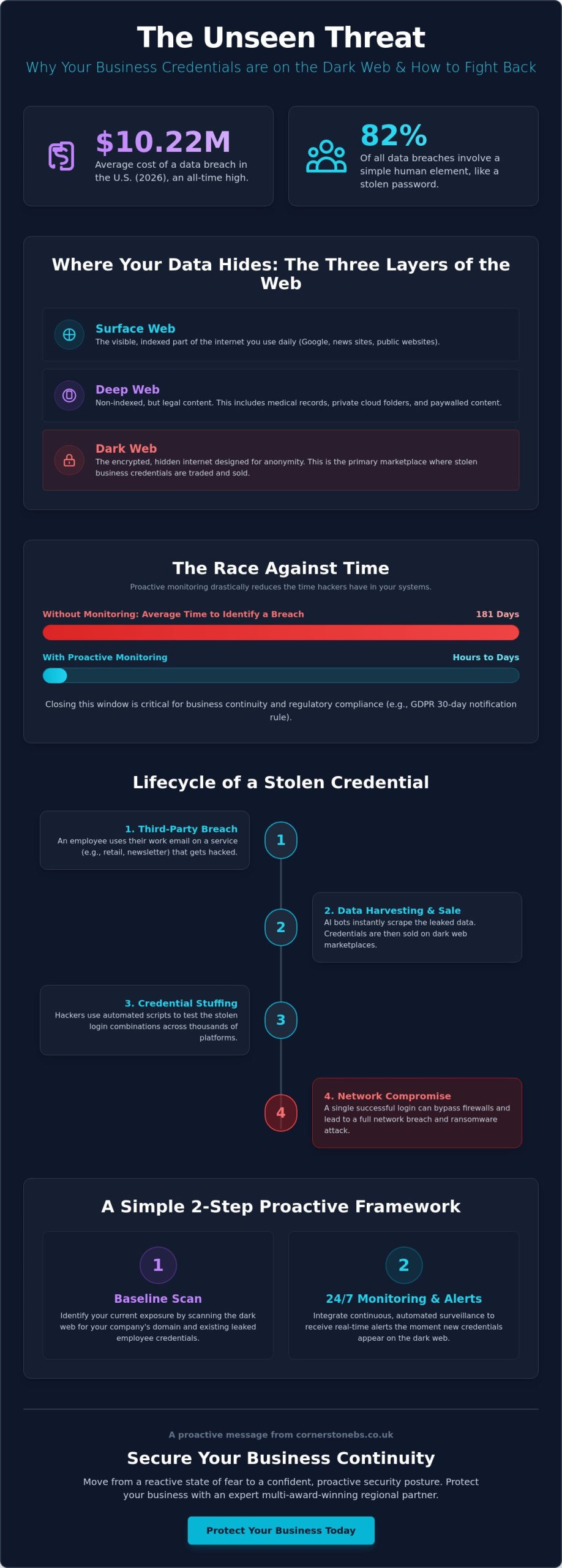
Did you know the average cost of a data breach in the U.S. has reached an all-time high of $10.22 million in 2026? It is a staggering figure that weighs on every business owner, especially when you realize that 82% of these breaches still involve a simple human element. We understand the anxiety that comes with managing a team’s password hygiene while trying to decipher complex technical jargon. You want to focus on growing your company, not worrying about what might be lurking in the hidden corners of the internet.
That is why proactive dark web monitoring for business credentials is your most vital line of defense. Think of it as a dedicated early warning system that spots your stolen data before a crisis begins. In this guide, we’ll explore how to move from a reactive state of fear to a confident, proactive security posture. You’ll discover exactly how clear alerts protect your business continuity and provide the peace of mind you deserve from a local partner who’s dedicated to your long-term success.
Key Takeaways
Understand why proactive dark web monitoring for business credentials is your most effective early warning system against modern cyber threats.
Learn how monitoring helps identify “Shadow IT” risks where employees use work emails for personal accounts, leaving your infrastructure vulnerable.
Discover why real-time alerts outperform periodic audits by closing the window of opportunity for hackers to use leaked data.
Follow a clear, two-step framework to establish a baseline scan and integrate 24/7 monitoring into your existing security operations.
Explore how partnering with a multi-award-winning regional expert ensures your business continuity is protected by a team that understands your local needs.
What is Dark Web Monitoring for Business Credentials?
Think of dark web monitoring for business credentials as a digital smoke detector for your company’s identity. It is a proactive security service that identifies stolen login information before it can be used to bypass your defenses. This isn’t a one-off scan that you perform once a year and forget about. In 2026, security is a living process. It requires 24/7 automated surveillance to catch leaks the moment they happen. We focus specifically on business credentials because your professional emails, passwords, and sensitive employee data are the keys to your commercial kingdom.
The landscape has shifted dramatically this year. AI-driven credential harvesting has made manual checks and basic password policies obsolete. Criminals now use sophisticated bots to scrape data from breaches instantly. This means your information could be for sale within minutes of a leak. Without automated monitoring, you are essentially flying blind in a storm. Our goal is to provide the clarity you need to stay ahead of these automated threats and maintain your business continuity.
The Three Layers of the Web: Where Your Data Hides
Understanding where your data lives is the first step toward securing it. Most people only interact with a small fraction of the internet, but your business footprint is much larger than you might realize. To get a better grasp of the environment, it is useful to look at what the dark web is in the context of the entire digital landscape.
Surface Web: These are the indexed sites we use daily, like Google, Bing, and public company websites.
Deep Web: This consists of non-indexed but perfectly legal data. It includes your paywalled content, internal medical records, and private cloud folders.
Dark Web: This is the encrypted, hidden portion of the internet. It is specifically designed for anonymity and is the primary marketplace where stolen business credentials are traded and sold.
Why Credentials are the “Gold Standard” for Cybercriminals
You might wonder why a simple password is so valuable. For a cybercriminal, a single stolen password can lead to a full network compromise, allowing them to bypass firewalls and encryption. This has created a booming market for “Initial Access Brokers.” These are specialists who do the hard work of finding a way into your business network and then sell that access to other hackers who carry out ransomware attacks. They don’t need to be technical geniuses; they just need one legitimate login.
Credential stuffing is a primary 2026 threat where attackers use automated scripts to test stolen username and password combinations across thousands of different platforms at once. It only takes one match to put your entire business infrastructure at risk. By monitoring the dark web, we find those matches before the hackers do, giving you the chance to reset passwords and secure your accounts before an intrusion begins.
How Credential Monitoring Protects Your Business Infrastructure
Proactive protection isn’t just about building higher walls. It’s about knowing when someone has already stolen the keys. Effective dark web monitoring for business credentials acts as a sophisticated early warning system. It catches data leaks in the gap between when a breach occurs and when a criminal actually attempts to log into your network. By closing this window, you prevent the theft from turning into a full-scale intrusion.
This approach significantly reduces your Mean Time to Identify (MTTI). According to 2025 research from DeepStrike and Swif, the average time to identify a breach is 181 days. That is nearly half a year for a hacker to roam your systems undetected. Monitoring cuts this time down to hours or days. This speed is vital for regulatory compliance. Under regulations like GDPR or the 2026 California SB 446, companies must notify affected individuals within 30 days of discovery. Proactive alerts ensure you aren’t the last to know about your own data exposure.
We often find that “Shadow IT” is a major culprit in business leaks. Employees frequently use their work email addresses to sign up for personal services, such as retail sites or industry newsletters. When those third-party sites suffer a breach, your business domain ends up on a dark web marketplace. Monitoring helps us identify these risky habits, allowing you to strengthen your cyber security posture through better employee education and policy enforcement.
The Lifecycle of a Stolen Business Credential
Step 1: The Third-Party Breach. A service your employee uses is compromised, leaking their email and password.
Step 2: The Dark Web Dump. The data is bundled with millions of other records and sold on underground forums.
Step 3: Automated Verification. AI bots or “checkers” test the credentials against business portals to see if they still work.
Beyond Passwords: What Else is Being Monitored?
A comprehensive strategy looks at more than just login pairs. We monitor for leaked corporate IP addresses and domain names that could be used to target your network. We also watch for employee Personally Identifiable Information (PII) that criminals use to craft convincing social engineering attacks. In 2026, we are seeing a rise in leaked API keys and cloud infrastructure configurations. These technical assets provide a direct path into your digital infrastructure, making their protection a foundational element of your business stability and emotional security.
Real-Time Alerts vs. Periodic Audits: Choosing Your Strategy
Choosing how to watch over your data is as important as the act of watching itself. Many business owners rely on periodic audits, thinking a thorough check every few months is enough. We see these audits as “snapshots” in time. They capture a single moment of your security status, but they leave dangerous windows of vulnerability wide open. If a breach happens the day after your audit, you could be exposed for months without knowing it. In 2026, the speed of cyberattacks means that dark web monitoring for business credentials must be a continuous stream, not a collection of still photos.
Real-time monitoring allows for immediate action. When a leak is detected, you don’t wait for a quarterly report to find out. You get an alert instantly, allowing you to reset passwords and secure accounts before a criminal can even try to log in. This proactive approach moves you away from the anxiety of the unknown. It replaces technical jargon with clear, actionable intelligence. Instead of handed a raw data dump of thousands of leaked emails, you receive a specific notification about which account is at risk and exactly what steps to take next.
The Risks of the “Snapshot” Approach
A scan performed today offers zero protection against a breach that occurs tomorrow. Modern hackers are efficient; credentials found on the dark web are often tested and used within hours of appearing. Relying on outdated data creates a false sense of security that can be more dangerous than having no monitoring at all. It leaves your business continuity at risk while you assume everything is fine. As a local partner, we’ve seen how this gap can devastate small and medium-sized enterprises that don’t have the luxury of a 24/7 internal security team.
Comparing Monitoring Methods for SMEs
For most businesses, the choice comes down to self-service tools versus managed monitoring. Self-service tools are often cheaper, but they require your team to have the expertise to filter through the noise. You are left to decide which alerts are real threats and which are just background noise. Managed monitoring includes expert analysis. Our team filters the data for you, ensuring you only hear about what actually matters. This reduces the “alert fatigue” that often overwhelms busy professionals and ensures your security posture remains strong without draining your internal resources.
Feature
Manual Scans
Automated Tools
Managed Security
Frequency
Periodic/Occasional
Continuous
Continuous
Analysis Level
None (Raw Data)
High (Automated Noise)
Expert (Actionable)
Response Speed
Very Slow
Medium
Very High
Resource Needs
High Internal Effort
Moderate Internal Effort
Low Internal Effort
Implementing a Robust Credential Security Framework
Knowing that your data is exposed is only half the battle. The real value lies in what you do next. Building a resilient defense requires a structured framework that turns raw alerts into defensive actions. We recommend a five-step approach to ensure your dark web monitoring for business credentials actually stops attackers in their tracks. It starts with a baseline scan. This initial audit identifies which of your business domains already have exposed data, giving you a clear starting point for remediation.
Once you understand your current exposure, you must move to 24/7 monitoring. This shouldn’t exist in a vacuum. Integrating these alerts with your Security Information and Event Management (SIEM) or Security Operations Centre (SOC) ensures that a credential leak triggers an immediate response from your technical team. You also need a predefined incident response plan. When a credential is found, your team should have a checklist ready: immediately lock the account, force a password reset, and audit recent login logs for any suspicious activity. Finally, never underestimate the human element. Educating your employees on the dangers of password reuse is essential for long-term stability.
The Critical Role of Multi-Factor Authentication (MFA)
Monitoring combined with MFA is the “Gold Standard” for security in 2026. Even if a cybercriminal manages to buy a valid password on a dark web marketplace, MFA acts as a final, unyielding barrier. We focus heavily on implementing robust MFA strategies as a primary defense for UK businesses. The industry is currently moving toward “phishing-resistant” MFA methods, such as biometrics or physical security keys, which are much harder for attackers to bypass than traditional SMS codes. This layer of protection provides the emotional security you need to run your business without constant fear.
Integrating Monitoring with Microsoft 365
Your security tools should talk to each other. By integrating dark web alerts with your Microsoft 365 environment, you can trigger automated conditional access policies. For example, if a user’s credentials appear in a leak, the system can automatically require an extra layer of verification or block access from unfamiliar locations until the threat is resolved. This creates a unified identity management system that secures the modern workplace. Protecting these environments is a core part of our secure cloud solutions, ensuring your infrastructure scales without opening new doors to criminals.
Building this framework doesn’t have to be overwhelming. We are here to help you simplify these complex steps into a clear, manageable strategy. If you’re ready to move beyond basic scans, we invite you to chat with our local experts about strengthening your business defenses today.
Securing Your Future with Cornerstone’s Cyber Security Services
Cornerstone Business Solutions isn’t just another IT company. We are a multi-award-winning partner for businesses across the UK, deeply rooted in our community. We believe that technology should be a foundation for growth, not a source of stress. Our team combines professional authority with the approachable warmth of a local expert. We don’t hide behind complex technical terms. Instead, we speak with clarity so you can make informed decisions for your company’s future.
Integrating dark web monitoring for business credentials into our managed IT services is a key part of our security strategy. Most providers simply send you an automated report when a breach is found. Cornerstone Business Solutions takes a different path. We don’t just alert you; we fix the problem. Our engineers work behind the scenes to secure compromised accounts, update policies, and ensure your infrastructure remains stable. This proactive stance is backed by our strong partnerships with global industry leaders like Microsoft, IBM, and Cisco. These relationships give us access to world-class tools and intelligence, which we use to protect your regional business.
Proactive Protection, Not Just Reactive Alerts
Our commitment is to your business continuity. We know that a data breach is more than just a technical failure. It is an emotional burden for business owners. Our multi-award-winning status reflects our dedication to excellence and our ability to provide high-level security that feels personal. As a national provider with a dedicated helpdesk, Cornerstone Business Solutions offers the scale of a large organization with the responsiveness of a local team. You aren’t just a ticket number to us; you are a partner in the success of our region. We manage the technical details so you can enjoy the emotional security of knowing your data is safe.
Taking the Next Step Toward Resilience
Ready to strengthen your defenses? We invite you to a “no-jargon” conversation about your current security posture. Getting started is simple. We can conduct a comprehensive audit to identify your existing vulnerabilities and build a custom plan to address them. You deserve to feel confident that your business is protected by experts who truly care. Cornerstone Business Solutions focuses on building long-term relationships, not just transactional support. Protect your credentials with Cornerstone Business Solutions’ Cyber Security Services today and let us handle the complexities of the digital world while you focus on what you do best.
Take Control of Your Digital Security Today
Protecting your business in 2026 requires more than just reactive fixes. It demands a strategy where you identify threats before they reach your front door. By implementing dark web monitoring for business credentials, you’ve taken the first step toward a proactive security posture that preserves your business continuity. You now understand how real-time alerts outperform periodic audits and why integrating MFA is non-negotiable for modern infrastructure.
Ready to see where you stand? We’d love to invite you to a conversation about your needs. Secure your business with a professional Cyber Security Audit and gain the confidence that your digital identity is in expert hands. Let Cornerstone Business Solutions work together with you to protect your future.
Frequently Asked Questions
Is dark web monitoring worth it for small businesses?
Yes, it is an essential investment for companies of all sizes. Statistics show that 60% of small businesses close their doors within six months of a major cyberattack. Monitoring provides a cost-effective way to stop breaches before they escalate into financial disasters. It gives smaller teams the same level of protection as large enterprises without needing a massive internal security department.
How do I know if my business credentials are on the dark web?
You cannot see this information through standard search engines like Google. Specialized dark web monitoring for business credentials is required to scan encrypted marketplaces and forums where stolen data is traded. We use these tools to identify if your company’s email addresses or passwords have been leaked, allowing us to secure your accounts before they are exploited by criminals.
What should I do if my password is found on the dark web?
Change the password immediately across all platforms where it was used. You should also enable Multi-Factor Authentication (MFA) to add an extra layer of defense. Our team recommends auditing your recent login logs to ensure no unauthorized access has already occurred. Acting quickly is the best way to turn a potential crisis into a simple security update.
Can dark web monitoring prevent a ransomware attack?
It acts as a vital preventative measure. Most ransomware attacks begin with a stolen login sold by “Initial Access Brokers” on the dark web. By identifying and resetting these credentials early, you close the door on hackers before they can deploy malicious software. It is a proactive step that protects your business continuity and saves you from devastating downtime.
How often should a business scan the dark web for leaks?
A continuous, 24/7 approach is far superior to occasional scans. A one-off scan only tells you what happened in the past; it doesn’t protect you from a leak that happens tomorrow. Automated monitoring ensures you receive an alert the moment your data appears on a hidden forum. This constant vigilance is the only way to keep up with the speed of modern cybercriminals.
Does dark web monitoring cover personal email accounts used for work?
Our monitoring focuses on any credentials tied to your official business domains. However, if employees use their work emails for personal accounts, those leaks will still trigger an alert. This helps identify “Shadow IT” risks where personal habits might compromise your professional infrastructure. Educating your team about keeping work and personal accounts separate is a foundational part of our collaborative approach.
What is the difference between a data breach and a credential leak?
A data breach is the actual event where a system is compromised by an attacker. A credential leak is the specific result where usernames and passwords are exposed and traded online. While a breach might involve many types of data, a credential leak is particularly dangerous because it provides a direct, legitimate-looking path for hackers to enter your network undetected.
Is dark web monitoring a legal requirement in the UK?
There is no specific law that names “dark web monitoring,” but regulations like GDPR and NIS2 require you to take proactive steps to secure personal data. If a breach occurs and you haven’t taken reasonable measures to protect your infrastructure, you could face significant fines. Using these tools demonstrates a commitment to security that helps meet your legal and ethical obligations to your clients.
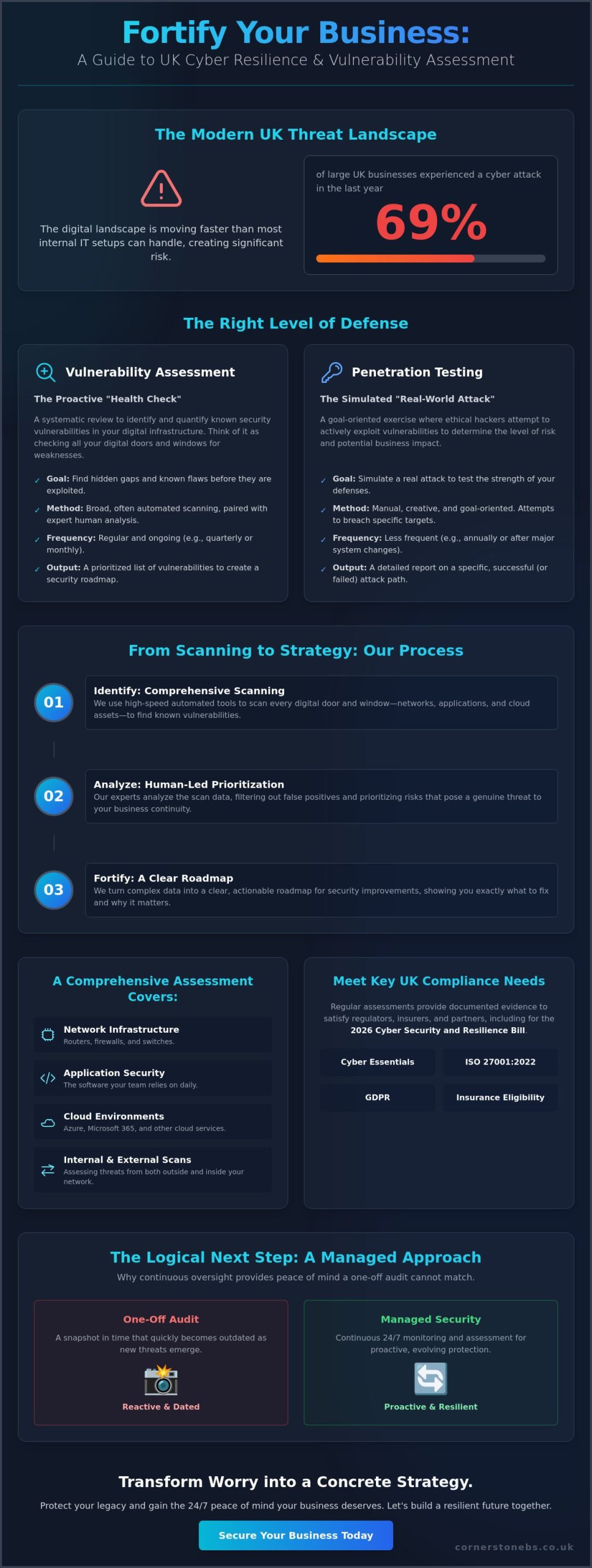
Did you know that 69% of large UK businesses experienced a cyber attack in the last year? It is a sobering figure that confirms what many local business owners already feel; the digital landscape is moving faster than most internal IT setups can handle. You have worked hard to build your brand, and the fear of a data breach causing lasting reputational damage is a heavy burden to carry, especially when technical jargon makes security feel like a closed book. We understand that you want to protect your legacy without getting lost in complex code.
We believe security should be a source of confidence rather than confusion. That is why professional vulnerability assessment services UK are essential for identifying hidden gaps before hackers can exploit them. By choosing a proactive approach, you can transform that nagging worry into a concrete strategy for growth. This guide provides a clear roadmap to fortify your business against evolving threats. We will show you how to ensure compliance with the 2026 Cyber Security and Resilience Bill while gaining the peace of mind your stakeholders deserve.
Key Takeaways
Learn how professional vulnerability assessment services UK identify hidden gaps in your network and applications before they can be exploited.
Understand the vital distinction between automated scanning and manual penetration testing to ensure you’re investing in the right level of defense.
Discover how to turn complex scan data into a clear roadmap for security improvements by prioritizing risks that actually impact your business continuity.
Explore why moving to a managed approach for your cyber security provides the 24/7 peace of mind that a one-off audit simply cannot match.
Understanding Vulnerability Assessment Services in the Modern UK Landscape
A vulnerability assessment is a systematic, proactive evaluation of your digital infrastructure designed to find known security weaknesses before they cause trouble. In 2026, simply reacting to problems as they happen is no longer a viable strategy for any UK business. The shift from reactive firefighting to proactive management is about more than just technology; it is about business continuity. Professional vulnerability assessment services UK provide the clarity you need to move forward with confidence. By combining high-speed automated scanning with the nuanced insight of expert human analysis, we ensure that your foundational systems remain robust and reliable.
There is a deep sense of relief that comes from knowing your systems aren’t just “working”, but are actively defended by experts who care about your local reputation. It isn’t just about code. It’s about the people who rely on your services every day. According to the UK Government Cyber Security Breaches Survey 2025/2026, approximately 43% of UK businesses reported a breach in the last year. For medium and large firms, that number jumps to over 65%. These aren’t just statistics; they represent real businesses facing real disruptions. A managed approach turns these risks into manageable tasks.
The Core Purpose: Identifying Before Exploitation
Think of an assessment as a comprehensive check of every digital door and window in your organisation. These services find the “open doors” in your network that cybercriminals are actively searching for. The window of opportunity for a hacker is the precise time between a developer announcing a security flaw and your IT team successfully applying the fix. Without full visibility across your cloud and on-premise assets, you’re essentially flying blind. Regular scans close those windows, turning potential disasters into minor, scheduled updates. This visibility is the first step toward true resilience.
Compliance and Regulatory Requirements in the UK
Staying on the right side of the law is a top priority for any local business owner. In 2026, regulatory pressures have intensified with the introduction of the Cyber Security and Resilience Bill. Regular assessments help you meet the rigorous standards of modern business. It isn’t just about avoiding fines; it’s about proving your commitment to data safety to your customers and partners.
Cyber Essentials: A foundational requirement that is often a prerequisite for government contracts.
ISO 27001:2022: Maintaining this certification requires regular, documented evidence of security testing.
GDPR: Protecting personal data starts with knowing where your infrastructure is weakest.
Insurance Eligibility: Many cyber insurance providers now require proof of regular vulnerability assessment services UK before they will offer or renew a policy.
By satisfying these stakeholder demands for due diligence, you protect your eligibility for insurance and maintain the trust that keeps your business growing.
The Critical Scope: What a Comprehensive Assessment Should Cover
A thorough evaluation goes far beyond a simple checklist. It requires a deep dive into every corner of your digital estate to ensure no stone is left unturned. High-quality vulnerability assessment services UK examine your entire network infrastructure. We look for tiny misconfigurations in routers, firewalls, and switches that could lead to a major breach. We also scrutinise application security. The software your team relies on every day often contains hidden flaws that, if left unaddressed, provide an easy path for attackers. Cloud environments like Azure and Microsoft 365 require specific attention too. Misconfigured permissions or disabled security features can leave your data exposed to the world without you even realising it.
You can’t just guard the front gate and ignore the backyard. While external scans check your public-facing assets, internal scans are equally vital. They simulate what happens if an attacker gains a foothold inside your network. This “inside-out” perspective is a core recommendation from the National Cyber Security Centre (NCSC). It helps us ensure that your internal defenses are strong enough to stop a local incident from becoming a national headline. Every laptop and mobile device connected to your network must be a brick in your wall, not a hole in it. If you want to see how your current setup measures up, our experts are ready to help you strengthen your Cyber Security posture with a local, personal touch.
Network and Wireless Infrastructure Audits
Rogue devices and unauthorised access points are more common than you might think. A single unmanaged switch or an old router can create a massive blind spot. Our audits focus on identifying these outliers and testing the strength of your internal segmentation. By preventing lateral movement, we ensure that a single compromised endpoint doesn’t lead to a total system failure. We also check for outdated firmware in your hardware. This is a frequently ignored vulnerability that hackers love to exploit because many businesses forget that physical kit needs updates just as much as software does.
Securing the Remote Workforce
Remote work has changed the security perimeter forever. Your office is now wherever your employees happen to be sitting. This means assessing VPNs and remote desktop protocols for potential leaks is a non-negotiable part of modern security. Implementing a Microsoft 365 migration for business UK is a fantastic way to set a secure foundation, but constant vigilance is required to keep those cloud environments safe. We ensure your mobile devices and laptops are not just tools for productivity, but hardened endpoints that resist intrusion. This proactive approach keeps your team connected and your data locked down tight.
Vulnerability Assessment vs. Penetration Testing: Which Does Your Business Need?
Choosing between a vulnerability assessment and a penetration test often feels like a technical riddle. It doesn’t have to be. To keep your business safe, you need to understand that these two tools serve very different purposes. A vulnerability assessment is a wide-reaching, automated scan. It answers the question: “What is wrong?” It looks at your entire digital footprint to find known weaknesses. On the other hand, a penetration test is a manual, targeted “ethical hack”. It answers the question: “How would a breach actually happen?” While a scan identifies the holes, a pen test tries to jump through them.
Timing is everything in security. We recommend that vulnerability assessment services UK are conducted on a monthly or quarterly basis. This ensures you catch new flaws as they emerge in the ever-changing digital landscape. Penetration tests are much more intensive and are typically an annual event, or something you trigger after a major system change. By aligning the frequency of these tests with your actual risk, you ensure your security scales alongside your business growth without unnecessary complexity.
Breadth vs. Depth: A Strategic Choice
Think of an assessment as a wide-angle lens. It provides continuous monitoring across a large number of assets, giving you a bird’s-eye view of your security posture. This breadth is essential for day-to-day safety. Deep-dive validation is where pen testing shines, specifically for high-value systems like payment gateways or sensitive client databases. Both of these elements feed directly into a robust cyber security services strategy that leaves no room for guesswork or blind spots.
Cost-Effectiveness for UK SMEs
For many local firms, budget and return on investment are primary concerns. Automated assessments offer the best ROI for routine security hygiene because they cover so much ground quickly and efficiently. You don’t want to “over-test” and waste resources on manual exercises that aren’t necessary for your current risk level. Experts agree that ongoing vulnerability assessments are the most reliable way to maintain a sound security posture without breaking the bank. Automated tools significantly reduce the overhead of manual security audits, allowing your team to focus on growth while we handle the technical heavy lifting.
From Scanning to Strategy: Turning Data into Business Continuity
Data without direction is just noise. One of the biggest mistakes we see is “report fatigue”. A 200-page automated scan might look impressive on a desk, but it is practically useless without expert interpretation. Professional vulnerability assessment services UK don’t just hand you a list of problems; they provide a clear, prioritized path to a more secure future. We use the Common Vulnerability Scoring System (CVSS) to rank threats. This allows you to focus your resources on “Critical” and “High” risks first, ensuring your business continuity is never left to chance.
Effective security requires a partnership between scanning and ongoing IT maintenance. Once a flaw is discovered, it must be patched. This is where the real work begins. If you are looking for a team to handle both the discovery and the cure, our Cyber Security experts are ready to secure your infrastructure today.
Interpreting the Findings for Stakeholders
Your board of directors doesn’t need to know the technical specifics of a CVE code. They need to understand how a specific vulnerability impacts the bottom line. We translate complex technical data into concise business risk summaries. Every audit we produce includes a punchy executive summary designed for decision-makers. This clarity empowers you to present security progress to investors with total confidence. It turns a technical necessity into a clear demonstration of professional due diligence.
Building a Remediation Roadmap
Fixing everything at once is impossible. You need a realistic timeline for patching and system upgrades. This is where managed IT services Teesside and across the UK provide immense value. These services automate the “fix” phase, ensuring that discovered flaws are closed quickly without disrupting your daily operations. Once the remediation is complete, a follow-up scan is essential. This verifies that the fix actually worked and that no new issues were introduced during the update. It is a continuous cycle of improvement that keeps your business stable and resilient.
Why a Managed Approach to Cyber Security is the Logical Next Step
A point-in-time scan provides a helpful snapshot, but digital threats don’t take breaks. Moving away from occasional checks toward a 24/7 proactive posture is the logical next step for any organisation that values its stability. When you work with a team that understands your business history and local infrastructure, security becomes a continuous conversation rather than a stressful chore. Our approach ensures that vulnerability assessment services UK are woven into the very fabric of your daily operations. We don’t just look for holes; we build a foundation that prevents them from forming in the first place.
The “Cornerstone” philosophy is built on a simple promise. We combine professional authority with a supportive, collaborative tone that makes complex tech feel manageable. We aren’t just a faceless service provider. We are your dedicated long-term partner. This means our it company solutions integrate security into every hardware and software choice you make. Whether you are upgrading your network or rolling out new cloud tools, security is the starting point, not an afterthought. This integration creates a seamless shield that protects your revenue and your reputation simultaneously.
The Value of Bespoke Technology Solutions
Generic security bundles often miss the mark because they ignore the nuances of your specific industry. Specialist sectors have unique risks that a “one size fits all” approach simply cannot address. No two UK businesses have identical security needs, and your defense strategy should reflect that reality. We customize scan frequencies and depths to match your specific risk profile. This ensures you aren’t paying for tools you don’t need, while remaining fully protected where it matters most. It is about precision and efficiency, ensuring your budget works as hard as you do.
Your Partner in Long-Term Resilience
Proactive system monitoring is the ultimate insurance policy for your digital estate. It prevents downtime before it impacts your revenue or upsets your loyal customers. There is a profound sense of emotional security in knowing that expert help is always just a phone call away. We provide the reassurance of unlimited helpdesk access for any security concerns your team might face. You aren’t alone in this journey. We are here to simplify the complex and keep your business moving forward with confidence. Ready to start? We invite our experts for a conversation about your security to see how we can support your long-term growth and resilience.
Step into 2026 with Total Digital Confidence
The digital landscape in 2026 moves fast, but your security strategy can move faster. You now understand that professional vulnerability assessment services UK are the foundation of a resilient business. It isn’t just about ticking a compliance box; it’s about protecting the brand you’ve worked so hard to build. By prioritizing “High” and “Critical” threats and moving toward a managed security posture, you ensure that your operations remain stable even as cyber threats evolve. You don’t have to face these technical challenges alone.
We invite you to work with a multi-award-winning IT provider that acts as a true extension of your team. As strategic partners with Microsoft, IBM, and Cisco, we combine national UK coverage with the approachable, regional warmth you expect from a local expert. Our proactive, partner-led approach means we’re always looking ahead to keep your infrastructure secure and your stakeholders at ease. Book a Security Conversation with Our Award-Winning UK Team today. Let’s build a secure, thriving future for your business together.
Frequently Asked Questions
How often should my UK business perform a vulnerability assessment?
You should aim for monthly or quarterly assessments to stay ahead of emerging threats. Regular testing ensures that new software updates or network changes haven’t introduced fresh weaknesses into your environment. Some industries with high data sensitivity may even require continuous scanning to maintain a robust security posture throughout the year.
Will a vulnerability scan slow down my network or affect employee productivity?
No, modern scans are designed to be lightweight and typically run in the background without affecting your daily operations. We often schedule these assessments during off-peak hours or configure them to use minimal bandwidth. This proactive approach ensures your team can keep working efficiently while we verify the strength of your digital infrastructure.
What is the average cost of vulnerability assessment services in the UK?
The investment for vulnerability assessment services UK varies based on the size of your network and the complexity of your digital assets. Factors such as the number of IP addresses, cloud environments, and the depth of analysis required will influence the final scope. We recommend a brief conversation to determine a plan that fits your specific business needs and budget.
Can a vulnerability assessment guarantee my business won’t be hacked?
No assessment can provide a 100% guarantee, but it significantly reduces your risk by closing the gaps attackers actively seek. It is an essential part of a layered defense strategy. By identifying and fixing known flaws, you make your business a much harder target and ensure your systems are as resilient as possible.
Do I need a vulnerability assessment if I already have an antivirus and firewall?
Yes, because firewalls and antivirus tools are reactive defenses, while assessments are proactive. Antivirus software stops known malware, but it won’t find a misconfigured cloud server or an unpatched piece of software. Assessments find the structural holes that your existing tools are simply not designed to see.
What is the difference between an internal and external vulnerability scan?
An external scan checks your public-facing assets like websites and email servers, while an internal scan looks at your network from the inside. External scans find “open doors” that anyone on the internet could potentially exploit. Internal scans simulate what happens if an attacker gets past your perimeter, ensuring they cannot move easily through your systems.
How long does a typical vulnerability assessment take to complete?
A standard scan can take anywhere from a few hours to a couple of days, depending on the scale of your infrastructure. Once the automated portion is finished, our experts spend time interpreting the data to create your prioritized roadmap. You’ll receive a clear, actionable report shortly after the technical phase of the assessment concludes.
Are vulnerability assessments a legal requirement for UK companies?
While not every business has a direct legal mandate, vulnerability assessment services UK are often necessary to comply with GDPR and the 2026 Cyber Security and Resilience Bill. Many industry standards and cyber insurance policies also require regular testing as proof of due diligence. Staying proactive helps you avoid the legal and financial fallout of a preventable data breach.
Could a piece of EU legislation actually be the most important security upgrade your North East business makes in 2026? You likely feel that nis2 compliance is just another complex hurdle to clear, especially when you’re already busy managing local UK operations. It’s completely normal to feel frustrated by technical jargon or the threat of non-compliance penalties that can reach upwards of £8.4 million for essential service providers under Article 34 of the directive.
We’ve designed this guide to replace that confusion with a clear, proactive roadmap. As an award-winning IT partner, we want to simplify these requirements so you can focus on your core business while we ensure your digital supply chain is robust and resilient. We’ll walk you through a definitive “yes or no” scope check, a prioritised list of security improvements, and a plan to achieve total peace of mind. Let’s take the stress out of your digital protection together.
Key Takeaways
Understand why the NIS2 Directive applies to UK businesses trading with the EU and how it impacts your digital supply chain.
Discover how to categorise your organisation as “Essential” or “Important” based on the new size-cap rules and specific industry sectors.
Learn the 10 essential security pillars required for nis2 compliance to build a robust and resilient cyber security framework.
Gain actionable insights on implementing a risk management strategy that fosters a proactive, “security-first” culture from the boardroom down.
See why partnering with an award-winning North East expert can simplify complex technical requirements and deliver total peace of mind.
Understanding NIS2 Compliance for UK Organisations
The NIS2 Directive, which came into force in January 2023, serves as the successor to the original 2016 NIS regulations. It represents a significant step forward in Cyber-security regulation, designed to harmonise and strengthen resilience across the European Union. At Cornerstone Business Solutions, our award-winning team specialises in interpreting these complex frameworks for local firms. We believe that nis2 compliance is more than just a box-ticking exercise; it’s a commitment to robust business continuity.
Why Does an EU Directive Matter in the UK?
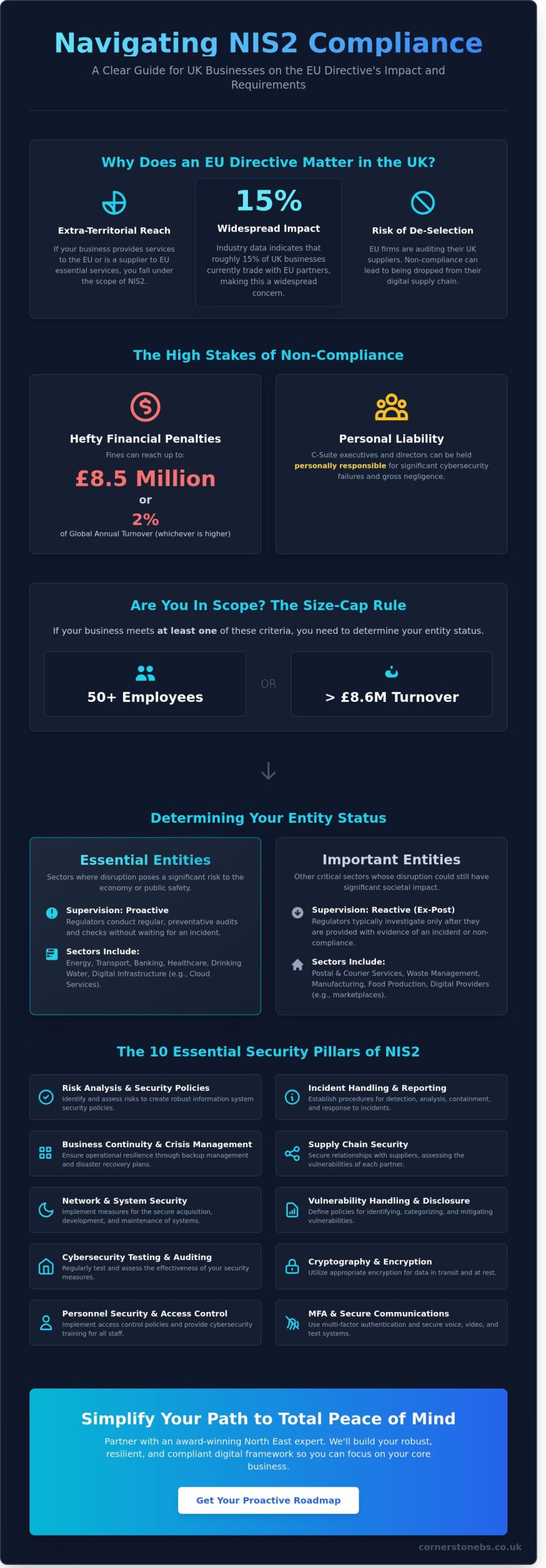
You might wonder why an EU law impacts a business based in Teesside or Tyneside. The answer lies in the principle of extra-territoriality. If your organisation provides services into the EU or operates as a critical supplier for European essential services, you fall directly under its scope. Industry data indicates that roughly 15% of UK businesses currently trade with EU partners, making this a widespread concern. If you can’t demonstrate nis2 compliance, you risk being “de-selected” during the procurement process. European firms are increasingly auditing their British suppliers to ensure their own compliance isn’t compromised by a weak link in the chain.
The Consequences of Non-Compliance
The financial stakes are high for those who ignore these updates. Non-compliant organisations face fines of up to £8.5 million or 2% of their total global annual turnover, whichever is higher. It’s a heavy price for any business to pay. Perhaps more importantly, the directive introduces personal liability for management bodies. This means C-suite executives and directors can be held personally responsible for cybersecurity failures. We focus on providing the “peace of mind” that comes from knowing your leadership is protected. Beyond the threat of fines, the loss of reputation following a breach can be devastating, as demonstrated by the Marks and Spencer data breach which showed how even household names face severe reputational and financial consequences from ransomware attacks. We act as your long-term partner to ensure your business remains both secure and reputable in a competitive market.
Determining Your Entity Status: Are You Essential or Important?
Identifying your organisation’s classification is the foundation of a solid nis2 compliance strategy. The directive doesn’t apply to everyone, but its reach is far wider than previous regulations. It primarily targets medium and large enterprises. If your business employs more than 50 people or has an annual turnover exceeding £8.6 million, you must determine which of the two categories you fall into. This ensures our local North East supply chains remain robust against evolving threats.
The distinction between “Essential” and “Important” depends on the criticality of your sector. While the 2024 UK Cyber Security and Resilience Bill will refine these definitions for the British market, they closely mirror the 18 sectors identified by the EU. Regardless of your label, the underlying security requirements are equally stringent. You’ll need to implement proactive measures to protect your operations and your clients’ data. If you’re feeling overwhelmed by the technical jargon, our award-winning team is always ready for a friendly chat to simplify your path to protection.
Essential Entities: High-Stakes Sectors
Proactive Supervision: Regulators don’t wait for a breach. They’ll conduct regular audits to ensure you’re meeting standards.
Strict Reporting: You’re under a microscope regarding incident reporting timelines, with 24-hour early warnings often required.
High Scrutiny: Expect frequent, detailed checks on your risk management frameworks and supply chain security.
Important Entities: The Broader Net
The “Important” category captures seven other critical sectors that are vital but slightly less sensitive than those in the Essential group. This includes food production and distribution, postal services, waste management, and chemical manufacturing. Digital providers, such as online marketplaces and search engines, also fall under this banner. It’s a broad net designed to catch the wider supply chain that keeps the UK running.
The main difference lies in the supervision model. Important entities are subject to reactive supervision. This means authorities typically only step in if they receive evidence of non-compliance or after a security incident has occurred. Don’t let this lighter oversight fool you. The actual security obligations and nis2 compliance standards are identical to those for Essential entities. You must still implement robust encryption, multi-factor authentication, and incident response plans. Failing to do so can result in the same heavy fines, which can reach up to £6 million or 1.4% of global turnover for Important entities.
The 10 Pillars of NIS2 Compliance: Your Practical Checklist
Article 21 of the directive outlines ten specific security measures that form the bedrock of your nis2 compliance journey. These aren’t just bureaucratic hurdles. They represent a foundational cyber security strategy designed to keep your operations running smoothly. The UK government is currently aligning our national standards with these principles through the Cyber Security and Resilience Bill, making these steps essential for any forward-thinking North East business.
Your security measures must be proportionate. This means the complexity of your defence should match your firm’s size and the specific risks you face. A local manufacturer won’t need the same setup as a global financial hub, but both must prove they’ve taken appropriate action. Documenting every step is vital. If an audit occurs in 2026, your records will provide the peace of mind that you’ve met your legal obligations.
Risk Management and Information System Security
Effective security starts with knowing your weaknesses. You need established protocols for regular vulnerability scanning and comprehensive risk assessments. These shouldn’t be annual events; they’re ongoing processes. You’ll also need clear policies on cryptography and encryption to protect sensitive data at rest and in transit. Many award-winning firms are now moving toward a Zero Trust Security framework. This approach ensures that every access request is fully authenticated and authorised, regardless of where it originates.
Supply Chain Security and Incident Handling
You’re only as strong as your weakest link. You must assess the security levels of your third-party suppliers to ensure they don’t become a back door into your network. Alongside this, you need a robust plan for when things go wrong. This includes clear procedures for detecting and reporting threats. The nis2 compliance framework is strict about timelines. You’ll have just 24 hours to provide an “early warning” of a significant incident and a full 72 hours to submit a formal notification to the authorities.
Business Continuity and Cyber Hygiene
Resilience is about how quickly you can bounce back. Secure your communications with multi-factor authentication (MFA) and encrypted voice or video channels. Your backup management and disaster recovery planning must be tested regularly to ensure they actually work when needed. Don’t forget the human element. Basic cyber hygiene training for all staff members reduces the risk of successful phishing attacks. We’ve seen that 82% of breaches involve a human element, so educating your team is one of the most proactive steps you can take. It’s about building a culture of security that supports your long-term growth.
Implementing a Robust Cyber Risk Management Strategy
Moving from a static checklist to active implementation marks the start of your real journey toward nis2 compliance. You can’t treat this as a simple IT project. It requires a structured plan that reshapes how your business handles data and risk. A “security-first” culture must start in the boardroom; it’s no longer just a task for the server room. When leadership prioritises cyber hygiene, the rest of the organisation follows suit. This shift ensures that every employee understands their role in protecting the company’s digital assets.
Relying on a one-off audit is a dangerous mistake. NIS2 requires continuous monitoring and proactive threat detection. Cyber threats don’t wait for your annual review. Our award-winning Managed IT Services deliver the constant oversight needed to identify and neutralise risks in real-time. We act as your dedicated partner, ensuring your systems remain resilient against the latest vulnerabilities. This proactive approach provides the peace of mind you need to focus on your core business goals.
The Role of Board Accountability
Directors and senior leaders now face unprecedented pressure. Under NIS2, management can be held personally liable for cybersecurity failures within their organisation. This isn’t just about corporate fines; it’s about individual accountability. You must implement mandatory cybersecurity training for all senior management to bridge the knowledge gap. Boards are now legally required to approve risk management measures and oversee their implementation directly. It’s about taking ownership of your digital safety at the highest level.
Gap Analysis: Finding Your Weak Points
Your first step is a thorough internal audit against the 10 pillars of NIS2. You need to identify where your current defences fall short. Start by prioritising “low-hanging fruit” like Multi-Factor Authentication (MFA) and rigorous patch management. UK government figures from 2024 show that 50% of all businesses experienced some form of cyber breach in the last 12 months. Using external experts provides an unbiased view of your infrastructure. We help you see the blind spots that internal teams might miss, ensuring your nis2 compliance strategy is watertight and robust.
Partnering for Peace of Mind: Managed IT and NIS2 Compliance
Achieving nis2 compliance isn’t a one-off task. It’s a fundamental change in how your business operates and protects its digital assets. For most UK SMEs, the technical and administrative burden of these new regulations is simply too heavy to carry alone. Managing risk across complex supply chains while maintaining constant system availability requires resources that internal IT teams often lack. The complexity of the 2024 directive, which sees full enforcement by 2026, means that guesswork is no longer an option.
We are Cornerstone Business Solutions. As an award-winning technology partner based in the North East, we specialise in turning these regulatory hurdles into competitive advantages. Our team doesn’t just fix problems; we build resilient systems that protect your reputation and your bottom line. We bring professional authority and regional warmth to every project, ensuring you feel supported at every turn. We believe that technology should empower your growth, not hinder it with red tape.
How Cornerstone Simplifies Compliance
We take the guesswork out of security. Our managed security updates and patch management programmes ensure that vulnerabilities are closed before attackers can exploit them. We implement Cloud Solutions with built-in compliance features, allowing your team to work flexibly without compromising data integrity. This proactive approach reduces the risk of costly downtime and ensures your infrastructure meets the high standards required by modern legislation.
NIS2 requires strict incident reporting, often within 24 hours of a significant threat detection. Our proactive monitoring runs 24/7, identifying anomalies and mitigating risks in real-time. This level of oversight ensures you meet legal deadlines and keep your operations running smoothly. We provide the robust framework you need to demonstrate “appropriate and proportionate” security measures to regulators. You get the benefit of an enterprise-level security operations centre without the overheads of building one yourself.
Your Next Steps to a Secure Future
Securing your business shouldn’t feel like a battle. We start by booking a comprehensive cyber security audit with our expert team to identify exactly where your gaps are. From there, we develop a tailored roadmap that aligns with your specific business goals. This ensures every penny spent on IT delivers maximum value and directly contributes to your nis2 compliance status.
You deserve the peace of mind that comes from knowing your business is safe. Let’s have a chat about your current status and how we can help you achieve robust security without the stress. We’re here to be your long-term partner, providing the “can-do” attitude that North East businesses are famous for. Achieving compliance is a journey, and we’re ready to walk it with you.
Secure Your Competitive Edge for 2026 and Beyond
The 2026 regulatory shift represents a significant change for UK organisations. Acting now ensures you aren’t caught in a last-minute rush to meet strict security standards. Identifying your entity status and addressing the 10 pillars of nis2 compliance today creates a resilient foundation for your business growth. It’s about protecting your supply chain and maintaining the trust of your clients in an increasingly volatile digital landscape.
Cornerstone Business Solutions has spent over 15 years acting as a trusted partner for UK firms. Our multi-award-winning team works alongside global leaders like Microsoft, IBM, and Cisco to deliver world-class security with a friendly, regional touch. We’ll help you navigate these complex requirements with clear, proactive strategies that simplify your technology. Let’s work together to protect your reputation and provide the genuine peace of mind you deserve. You’ve built a great business; we’re here to help you keep it safe.
Yes, NIS2 applies to UK businesses if they provide essential or important services within the EU or form part of an EU-based supply chain. Even though the UK has left the EU, your organisation must comply if you operate in sectors like energy, transport, or digital infrastructure and have a physical presence or customers in the Eurozone. Our award-winning team helps local firms navigate these cross-border rules to ensure your operations remain seamless and secure.
What is the deadline for NIS2 compliance in 2026?
The primary enforcement window for most UK supply chain partners intensifies in 2026, following the initial EU transposition deadline of 17 October 2024. While the core legislation is already active, many regional businesses are using 2026 as the critical milestone for completing full infrastructure audits. Starting your nis2 compliance journey now prevents a last-minute rush. We recommend a proactive approach to keep your North East business ahead of these evolving regulatory requirements.
What are the fines for failing to meet NIS2 requirements?
Fines for non-compliance are substantial, reaching up to £8.5 million or 2% of total global annual turnover for essential entities. For important entities, the ceiling is approximately £6 million or 1.4% of global turnover. These penalties demonstrate why robust cybersecurity is a foundation for business peace of mind. We implement tailored solutions that protect your bottom line from these heavy financial risks while building a more resilient digital environment.
What is the difference between an “Essential” and “Important” entity?
The main difference lies in the specific sector and the size of your organisation. Essential entities include large organisations in high-criticality sectors like energy, transport, and health with over 250 employees. Important entities typically cover medium-sized businesses in sectors such as postal services, waste management, and food production. Our experts help you identify your specific category to ensure your security measures are perfectly sized for your unique business needs.
How does NIS2 differ from the original NIS directive?
NIS2 significantly expands the scope of the original 2018 directive by including more sectors and introducing much stricter enforcement rules. It places personal liability on senior management for security failures and mandates more rigorous risk management across the entire supply chain. This update ensures that nis2 compliance covers a broader range of modern digital threats. We provide the expert analysis needed to transition your legacy systems to these tougher, modern standards.
Can my Managed IT provider help with NIS2 reporting?
Yes, your managed IT provider plays a vital role in meeting your reporting obligations through constant, proactive network monitoring. Our award-winning support team tracks threats in real-time, providing the precise data needed for the 24-hour early warning and 72-hour incident reports. We act as your long-term partner, handling the technical heavy lifting so you can focus on growing your North East business with total confidence and clarity.
Is Cyber Essentials enough to meet NIS2 standards?
Cyber Essentials is a brilliant starting point, but it doesn’t cover the full scope of NIS2 requirements on its own. While Cyber Essentials focuses on basic technical controls, NIS2 demands comprehensive risk management, supply chain security, and specific incident reporting timelines. Think of Cyber Essentials as the foundation and NIS2 as the complete, robust structure. We’ll help you build upon your existing certifications to reach full, award-winning compliance levels.
What are the incident reporting timelines under NIS2?
You must submit an initial “early warning” to relevant authorities within 24 hours of becoming aware of a significant incident. This is followed by a formal incident notification within 72 hours and a detailed final report within one month of the event. These tight deadlines require a highly organised response plan. Our local team ensures your systems are set up to detect and flag issues immediately, keeping your business on the right side of the law.